CHAPTER 5 :
METAPHYSICS
Metaphysics:The Origin of the Word
 The word metaphysics is made up of the two separate words,“meta” and “physics”.
 Meta means ‘after’, ‘above’ or ‘beyond’.
 Physics refers to the material world.
 So ‘metaphysics’ implies a study of the physical world in a way that ‘transcends’ or ‘goes
beyond’ it. This transcendence can be understood in two ways.
 The first is ‘philosophical’, the second ‘religious’ or ‘metaphysical’.
Metaphysics: 2 Meanings
First Meaning: A study of things in its most
abstract form, or a study of the general
features of the world. Sometimes also
defined as a study of the nature of reality
insofar as these general features captures
the nature of that reality. Here the word
‘meta’ implies a study of the world at a
‘second order’ level, where one reflects on
the abstract characteristics of the natural
world.
Second Meaning: A study of the world
beyond the observable physical world, and
a world not accessible through our
ordinary five senses. Here it is assumed
that reality is not only limited to what
exists in the known observable world, but
can include real entities that are not
perceived by our senses.
Aristotle’s Concept of Metaphysics
 Metaphysics is the study of "being qua being", or the study of attributes that belong to things
merely insofar as they exist, e.g. existence, unity, sameness and difference, wholes and parts.
 Here it also refers to a study of existence in its most general or abstract form, i.e. what are the
general features of things that exist?
A SOFA
The
Fundamental
Questions of
Metaphysics
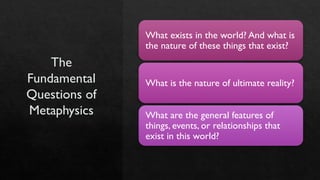
What exists in the world? And what is
the nature of these things that exist?
What is the nature of ultimate reality?
What are the general features of
things, events, or relationships that
exist in this world?
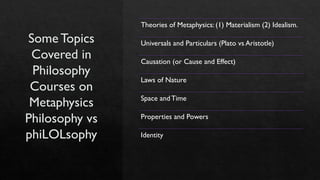
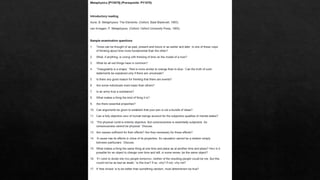
Some Topics
Covered in
Philosophy
Courses on
Metaphysics
Philosophy vs
phiLOLsophy
Theories of Metaphysics: (1) Materialism (2) Idealism.
Universals and Particulars (Plato vs Aristotle)
Causation (or Cause and Effect)
Laws of Nature
Space andTime
Properties and Powers
Identity
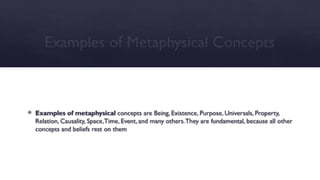
Examples of Metaphysical Concepts
 Examples of metaphysical concepts are Being, Existence, Purpose, Universals, Property,
Relation, Causality, Space,Time, Event, and many others.They are fundamental, because all other
concepts and beliefs rest on them
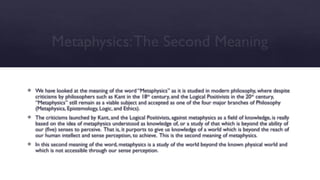
Metaphysics:The Second Meaning
 We have looked at the meaning of the word “Metaphysics” as it is studied in modern philosophy, where despite
criticisms by philosophers such as Kant in the 18th
century, and the Logical Positivists in the 20th
century,
“Metaphysics” still remain as a viable subject and accepted as one of the four major branches of Philosophy
(Metaphysics, Epistemology, Logic, and Ethics).
 The criticisms launched by Kant, and the Logical Positivists, against metaphysics as a field of knowledge, is really
based on the idea of metaphysics understood as knowledge of, or a study of that which is beyond the ability of
our (five) senses to perceive. That is, it purports to give us knowledge of a world which is beyond the reach of
our human intellect and sense perception, to achieve. This is the second meaning of metaphysics.
 In this second meaning of the word, metaphysics is a study of the world beyond the known physical world and
which is not accessible through our sense perception.
Religious
Ideas and the
Second
Meaning of
Metaphysics
 This second meaning of the term ‘metaphysics’, i.e. that which refers
to a world beyond the reach of the ordinary senses, lends itself to
religious ideas, which also refer to such a world or reality.
 It is through this second meaning of the word ‘metaphysics’ that we
are entitled to talk about concepts drawn from the various
religions. This is because religions often refer to an unseen world
consisting of entities such as spirits, souls, angels, jinn etc, or even
God for that matter, that we cannot perceive through our senses.
 Thus whereas courses on ‘Metaphysics’ in the Philosophy syllabus of
most western universities would not include religious ideas or
theology as part of its curriculum, in this course we feel that it is
appropriate to do so, because this second meaning allows for it, and
also because of the influence of religion in Malaysian society.
Furthermore, it is this second meaning which the lay public, or most
Malaysians for that matter associate with, when they come across
the word ‘metaphysics’.
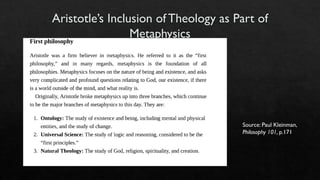
Aristotle’s Inclusion ofTheology as Part of
Metaphysics
Source: Paul Kleinman,
Philosophy 101, p.171
Aristotle’s
Philosophy and
the Justification
of Metaphysics
as s Study of
That Which is
Beyond the
Physical
 As we can see from the above slide, although modern
western philosophy has excluded this second meaning
from philosophical texts on metaphysics, it was not
excluded by Aristotle in his original conception of
metaphysics.
 So this serves as another reason or justification for us
to include this second meaning of the word
‘metaphysics’, which refers to religious ideas on the
nature of reality, in this course.
Concepts and
Reality
 When philosophers abstract and conceptualise the natural world, what then
becomes the status of those concepts or conceptualisation?
 Here, there are basically two positions, namely the realist and the nominalist
position.
 In order to understand this better, let us look at the controversy between Aristotle
and Plato on the status of Universals.
 An example of a Universal is the idea or concept of ‘Beauty’. In this world we find
beautiful things or beautiful people, and thus the idea of beauty is associated with
some individual concrete thing.
 However, Plato took a realist position with regards to Universals, and regard
‘Beauty’ for example as a reality in itself, while Aristotle took a nominalist position.
 For Plato, there exist a ‘World of Forms’ not accessible through our senses, which
contain these ‘Universals’ conceived as essential realities. Thus there exists a ‘Form
of Beauty’ as a reality in itself, over and above the individual things that instantiate
the ‘form of beauty’ in this world.
 On the contrary, Aristotle rejects the existence of such a Platonic world of forms,
and instead took a nominalist position with regard to universals, i.e. their reality lies
in the concrete cases found in this world, and that the word which signify a
universal such as ‘Beauty’, does not refer to a separate reality existing in itself.
Two Main Metaphysical Theories: Materialism and
Idealism
 There are two main theories in metaphysics, regarding the ultimate nature of reality.These two
theories are: (1) Materialism, (2) Idealism.
 (Idealism) Cultural Condition drive economic changes VS (Materialism) Economic condition
drive culture changes
Materialism
 Materialism is a set of related theories which hold that all entities and processes are composed of
- or are reducible to - matter, material forces or physical processes.
 All events and facts are explainable, actually or in principle, in terms of body, material objects or
dynamic material changes or movements.
 In general, the metaphysical theory of materialism entails the denial of the reality of
spiritual beings, consciousness and mental or psychic states or processes, as ontologically
distinct from, or independent of, material changes or processes.
 Since it denies the existence of spiritual beings or forces, materialism typically is allied with
atheism or agnosticism.The forms of materialism extend from the ancient Greek atomistic
materialism through eighteenth- and nineteenth-century scientifically based theories, to recent
sophisticated defences of various types of materialism.
Idealism
 Idealism is now usually understood in philosophy as the view that mind is the most basic reality and that the physical world
exists only as an appearance to or expression of mind, or as somehow mental in its inner essence.
 However, a philosophy which makes the physical world dependent upon mind is usually also called idealist even if it postulates
some further hidden, more basic reality behind the mental and physical scenes (for example, Kant things-in-themselves).
 There is also a certain tendency to restrict the term to systems for which what is basic is mind of a somewhat lofty
nature, so that are the ultimate shapers of reality.
 (An older and broader use counts as idealist any view for which the physical world is somehow unreal compared with some
more ultimate, not necessarily mental, reality conceived as the source of value, for example Platonic forms.)
 The founding fathers of idealism in Western thought are Berkeley (theistic idealism), Kant (transcendental idealism) and Hegel
(absolute idealism).
 Because of its acceptance of the primacy of the mind or consciousness over that of the material, Idealism can be regarded as
compatible with religious metaphysics or views of reality, where the reality of an unseen spiritual world is accepted.
The Mind-
Body Problem
as an
Illustration of
Materialist vs
IdealistViews
of Reality
 What is the mind-body problem?
 The mind-body problem in philosophy refers to the problem of how to
explain the relationship between the mind and the body given that one is
material in nature (the body), while the other (mind) is not.
 If we were to say that there is a causal interaction between the two, then
how can we explain or make sense of this, since our science can only explain
the causal interaction between material things, i.e. the causal chain does not
include something non-material.
 For the materialist, they say that the body is fundamental, and that the mind
can be explained in terms of the workings of the brain.They deny the reality
of mental states as something that can exist independently of the brain.
 Cartesian Idealism however, claimed that since we can conceive of our own
consciousness independently of the body, therefore our mind or
consciousness has a reality of its own, and cannot be reduced to the body.
 Religious view on the soul also share something in common with Descartes
in this respect, since they believe that the soul can exist independently of the
body.
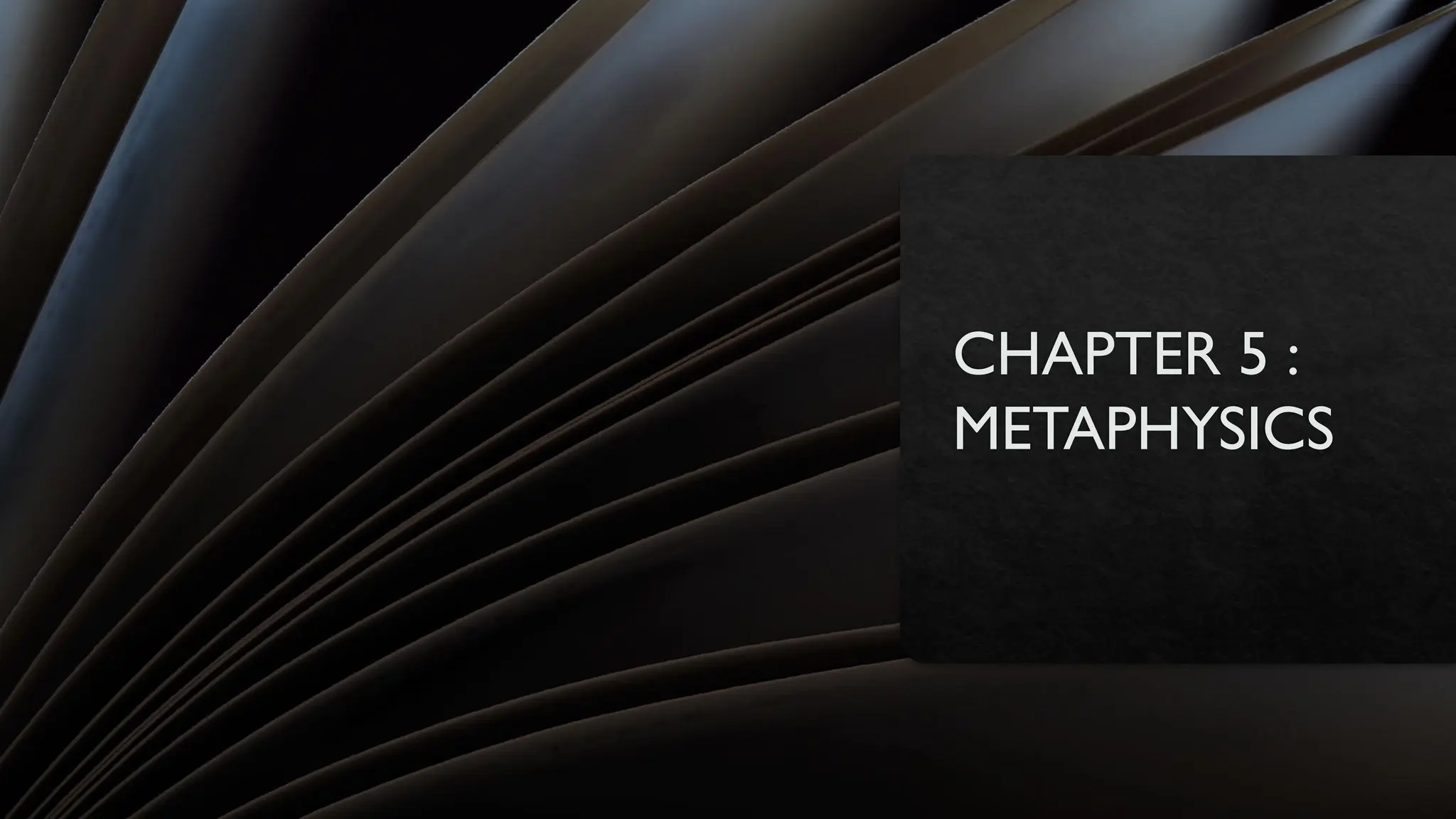
Types of Belief
Theism- The belief in the existence of supreme being or deties
- Monotheism- The doctrine or belief that there is only ONE god
-Polytheism- The belief in or woship of more than one God
Agnosticism- The view that existence of GOD, the divine, or the supernatural is not known or
knowable with any certainty.
Panthesism-a doctrine which identifies God with the universe, or regards the universe as a
manifestation of God
Panentheism- the belief or doctrine that god is greater than the universe
Deism- Belief in the existence of a supreme being/god but reject the supernatural revelation.
Etheism- Dont have / belief in god

Chap 5 - MetaphySDSDADSsics D3 edited.pptx

  • 1.
  • 2.
    Metaphysics:The Origin ofthe Word  The word metaphysics is made up of the two separate words,“meta” and “physics”.  Meta means ‘after’, ‘above’ or ‘beyond’.  Physics refers to the material world.  So ‘metaphysics’ implies a study of the physical world in a way that ‘transcends’ or ‘goes beyond’ it. This transcendence can be understood in two ways.  The first is ‘philosophical’, the second ‘religious’ or ‘metaphysical’.
  • 3.
    Metaphysics: 2 Meanings FirstMeaning: A study of things in its most abstract form, or a study of the general features of the world. Sometimes also defined as a study of the nature of reality insofar as these general features captures the nature of that reality. Here the word ‘meta’ implies a study of the world at a ‘second order’ level, where one reflects on the abstract characteristics of the natural world. Second Meaning: A study of the world beyond the observable physical world, and a world not accessible through our ordinary five senses. Here it is assumed that reality is not only limited to what exists in the known observable world, but can include real entities that are not perceived by our senses.
  • 4.
    Aristotle’s Concept ofMetaphysics  Metaphysics is the study of "being qua being", or the study of attributes that belong to things merely insofar as they exist, e.g. existence, unity, sameness and difference, wholes and parts.  Here it also refers to a study of existence in its most general or abstract form, i.e. what are the general features of things that exist?
  • 5.
  • 6.
    The Fundamental Questions of Metaphysics What existsin the world? And what is the nature of these things that exist? What is the nature of ultimate reality? What are the general features of things, events, or relationships that exist in this world?
  • 7.
    Some Topics Covered in Philosophy Courseson Metaphysics Philosophy vs phiLOLsophy Theories of Metaphysics: (1) Materialism (2) Idealism. Universals and Particulars (Plato vs Aristotle) Causation (or Cause and Effect) Laws of Nature Space andTime Properties and Powers Identity
  • 8.
    Examples of MetaphysicalConcepts  Examples of metaphysical concepts are Being, Existence, Purpose, Universals, Property, Relation, Causality, Space,Time, Event, and many others.They are fundamental, because all other concepts and beliefs rest on them
  • 10.
    Metaphysics:The Second Meaning We have looked at the meaning of the word “Metaphysics” as it is studied in modern philosophy, where despite criticisms by philosophers such as Kant in the 18th century, and the Logical Positivists in the 20th century, “Metaphysics” still remain as a viable subject and accepted as one of the four major branches of Philosophy (Metaphysics, Epistemology, Logic, and Ethics).  The criticisms launched by Kant, and the Logical Positivists, against metaphysics as a field of knowledge, is really based on the idea of metaphysics understood as knowledge of, or a study of that which is beyond the ability of our (five) senses to perceive. That is, it purports to give us knowledge of a world which is beyond the reach of our human intellect and sense perception, to achieve. This is the second meaning of metaphysics.  In this second meaning of the word, metaphysics is a study of the world beyond the known physical world and which is not accessible through our sense perception.
  • 11.
    Religious Ideas and the Second Meaningof Metaphysics  This second meaning of the term ‘metaphysics’, i.e. that which refers to a world beyond the reach of the ordinary senses, lends itself to religious ideas, which also refer to such a world or reality.  It is through this second meaning of the word ‘metaphysics’ that we are entitled to talk about concepts drawn from the various religions. This is because religions often refer to an unseen world consisting of entities such as spirits, souls, angels, jinn etc, or even God for that matter, that we cannot perceive through our senses.  Thus whereas courses on ‘Metaphysics’ in the Philosophy syllabus of most western universities would not include religious ideas or theology as part of its curriculum, in this course we feel that it is appropriate to do so, because this second meaning allows for it, and also because of the influence of religion in Malaysian society. Furthermore, it is this second meaning which the lay public, or most Malaysians for that matter associate with, when they come across the word ‘metaphysics’.
  • 12.
    Aristotle’s Inclusion ofTheologyas Part of Metaphysics Source: Paul Kleinman, Philosophy 101, p.171
  • 13.
    Aristotle’s Philosophy and the Justification ofMetaphysics as s Study of That Which is Beyond the Physical  As we can see from the above slide, although modern western philosophy has excluded this second meaning from philosophical texts on metaphysics, it was not excluded by Aristotle in his original conception of metaphysics.  So this serves as another reason or justification for us to include this second meaning of the word ‘metaphysics’, which refers to religious ideas on the nature of reality, in this course.
  • 14.
    Concepts and Reality  Whenphilosophers abstract and conceptualise the natural world, what then becomes the status of those concepts or conceptualisation?  Here, there are basically two positions, namely the realist and the nominalist position.  In order to understand this better, let us look at the controversy between Aristotle and Plato on the status of Universals.  An example of a Universal is the idea or concept of ‘Beauty’. In this world we find beautiful things or beautiful people, and thus the idea of beauty is associated with some individual concrete thing.  However, Plato took a realist position with regards to Universals, and regard ‘Beauty’ for example as a reality in itself, while Aristotle took a nominalist position.  For Plato, there exist a ‘World of Forms’ not accessible through our senses, which contain these ‘Universals’ conceived as essential realities. Thus there exists a ‘Form of Beauty’ as a reality in itself, over and above the individual things that instantiate the ‘form of beauty’ in this world.  On the contrary, Aristotle rejects the existence of such a Platonic world of forms, and instead took a nominalist position with regard to universals, i.e. their reality lies in the concrete cases found in this world, and that the word which signify a universal such as ‘Beauty’, does not refer to a separate reality existing in itself.
  • 15.
    Two Main MetaphysicalTheories: Materialism and Idealism  There are two main theories in metaphysics, regarding the ultimate nature of reality.These two theories are: (1) Materialism, (2) Idealism.  (Idealism) Cultural Condition drive economic changes VS (Materialism) Economic condition drive culture changes
  • 16.
    Materialism  Materialism isa set of related theories which hold that all entities and processes are composed of - or are reducible to - matter, material forces or physical processes.  All events and facts are explainable, actually or in principle, in terms of body, material objects or dynamic material changes or movements.  In general, the metaphysical theory of materialism entails the denial of the reality of spiritual beings, consciousness and mental or psychic states or processes, as ontologically distinct from, or independent of, material changes or processes.  Since it denies the existence of spiritual beings or forces, materialism typically is allied with atheism or agnosticism.The forms of materialism extend from the ancient Greek atomistic materialism through eighteenth- and nineteenth-century scientifically based theories, to recent sophisticated defences of various types of materialism.
  • 17.
    Idealism  Idealism isnow usually understood in philosophy as the view that mind is the most basic reality and that the physical world exists only as an appearance to or expression of mind, or as somehow mental in its inner essence.  However, a philosophy which makes the physical world dependent upon mind is usually also called idealist even if it postulates some further hidden, more basic reality behind the mental and physical scenes (for example, Kant things-in-themselves).  There is also a certain tendency to restrict the term to systems for which what is basic is mind of a somewhat lofty nature, so that are the ultimate shapers of reality.  (An older and broader use counts as idealist any view for which the physical world is somehow unreal compared with some more ultimate, not necessarily mental, reality conceived as the source of value, for example Platonic forms.)  The founding fathers of idealism in Western thought are Berkeley (theistic idealism), Kant (transcendental idealism) and Hegel (absolute idealism).  Because of its acceptance of the primacy of the mind or consciousness over that of the material, Idealism can be regarded as compatible with religious metaphysics or views of reality, where the reality of an unseen spiritual world is accepted.
  • 18.
    The Mind- Body Problem asan Illustration of Materialist vs IdealistViews of Reality  What is the mind-body problem?  The mind-body problem in philosophy refers to the problem of how to explain the relationship between the mind and the body given that one is material in nature (the body), while the other (mind) is not.  If we were to say that there is a causal interaction between the two, then how can we explain or make sense of this, since our science can only explain the causal interaction between material things, i.e. the causal chain does not include something non-material.  For the materialist, they say that the body is fundamental, and that the mind can be explained in terms of the workings of the brain.They deny the reality of mental states as something that can exist independently of the brain.  Cartesian Idealism however, claimed that since we can conceive of our own consciousness independently of the body, therefore our mind or consciousness has a reality of its own, and cannot be reduced to the body.  Religious view on the soul also share something in common with Descartes in this respect, since they believe that the soul can exist independently of the body.
  • 19.
    Types of Belief Theism-The belief in the existence of supreme being or deties - Monotheism- The doctrine or belief that there is only ONE god -Polytheism- The belief in or woship of more than one God Agnosticism- The view that existence of GOD, the divine, or the supernatural is not known or knowable with any certainty. Panthesism-a doctrine which identifies God with the universe, or regards the universe as a manifestation of God Panentheism- the belief or doctrine that god is greater than the universe Deism- Belief in the existence of a supreme being/god but reject the supernatural revelation. Etheism- Dont have / belief in god