Chapter 5
Project Cash Flow Management
The Concept of Cash Flow
 Definition:
Cash flow is the movement of funds in and
out of a business or a project, while cash
flow management focuses on the timing of
the movements of funds or cash flows.
 Why cash flow management is so important
to project managers?
 because poor cash flows of a project may cause
a project to be behind schedule, increase its
costs of completion and miss financial goals.
2
The Concept of Cash Flow
 Cash flow management is equally
important to both sponsors and
contractors.
 The sponsor must:
be aware of the progress of the
project, its growing costs and cash flow
requirements
plan to have access to funds to pay
the bills of the contractors.
3
 The contractor must have:
a prediction of costs and cash flow
requirements and a planed source of
financing.
systems in place that correctly gather
costs as they are incurred and generate
billing at the appropriate time.
a control system that ensures payment
is received within an acceptable
timeframe.
4
The Concept of Cash Flow
CASH FLOW AND THE WORTH OF
PROJECTS
 The term cash flow may refer to inflow or
outflows. What does net cash flow
represent?
 When a project is acquired for commercial
purpose, its financial viability has to be
checked: its estimated income must
exceed costs.
 For a longer-term project, the timing of
future cash flows, among others, can
have a bearing on its worth ( today)- Time
Value of Money.
5
 The concept of Time Value of Money states
that money received today is worth more than
money received any time in the future, for two
reasons:
1.The required or desired rate of
return (in consideration of the loss of
opportunity to invest elsewhere) and
the risk taken
2. The decline in purchasing power
due to inflation.
6
The Time Value and the Worth of a Project
 There are a variety of methods to
evaluate the financial viability of a
project.
 There are two kinds of methods:
1. Discounted Cash Flow Methods: methods that
take into account the time value of money. (e.g.
Net Present Value (NPV), Profitability Index (PI)
and Internal Rate of Return (IRR) methods)
2. Non-discounted Cash Flow Methods: methods
that don’t consider time value of money. (e.g.
Payback and Accounting Rate of Return
methods). 7
The Time Value and the Worth of a Project
Calculating the Discounting Factor
 Discount Rate, K= k + r
 Discount factor (PVIF)= 1 / (1 + k + r)t
or 1/(1+K)t , where
k = the expected inflation rate
r = the required or desired rate of return
t = time period
PVIF= present value interest factor for 1 dollar
 Note that the longer the time it takes to
receive or pay a cash flow the less the
value of the cash flow today (Present
Value).
8
Appraising the Financial Viability of Projects
1. The Net Present Value (NPV)
 It is a discounted cash flow
method.
 NPV = Present value of cash inflow
less PV of Cash Out flows.
 The decision rule: If NPV is greater than
zero, accept the project; if NPV is less than
zero (negative), reject the project.
 What do you mean by NPV = 0?
9
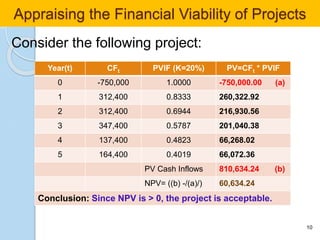
Consider the following project:
10
Year(t) CFt PVIF (K=20%) PV=CFt * PVIF
0 -750,000 1.0000 -750,000.00 (a)
1 312,400 0.8333 260,322.92
2 312,400 0.6944 216,930.56
3 347,400 0.5787 201,040.38
4 137,400 0.4823 66,268.02
5 164,400 0.4019 66,072.36
PV Cash Inflows 810,634.24 (b)
NPV= ((b) -/(a)/) 60,634.24
Conclusion: Since NPV is > 0, the project is acceptable.
Appraising the Financial Viability of Projects
2. Internal Rate of Return (IRR)
 It is a discounted cash flow technique.
 It is the discount rate which equates the sum of
the PVs of the project’s expected cash inflows to
the sum of the PVs of the project’s costs
(outflows).
 In other words, IRR is the discount rate that
equates NPV to zero.
11
Appraising the Financial Viability of Projects
Decision Rule:
Accept a project only when its IRR is
greater than the required rate of return of
the project (or the cost of capital or
hurdle rate).
12
Appraising the Financial Viability of Projects
 IRR: Steps
 1. Try different rates of returns to
calculate the PV of the cash inflows.
 2. Subtract the PV of cash outflows
from the PV of the inflows.
 3. The rate at which the value from
step 2 is close to zero is the IRR.
13
Appraising the Financial Viability of
Projects
 For the previous example, these
steps lead us to the IRR value of
24.11%.
 Since IRR, 24.11% is greater than the
cost of capital, K, 20%, then the
project is acceptable.
14
Appraising the Financial Viability of Projects
3. Profitability Index (PI)
 It is one of the DCF techniques, it is also
called the benefit/cost ratio.
 The PI method computes the ratio
between the sum of present values of
cash inflows and initial investment.
 Decision rule: Accept a project only if it
has a profitability index of greater than
1.0.
15
Appraising the Financial Viability of Projects
PI= PV of Cash Inflows
Initial Investment
For our project,
PI = 810,634.24
750,000.00
PI= 1.08
Conclusion: Since the PI is greater than
1, the project is acceptable. How do you
further interpret it?
16
Appraising the Financial Viability of Projects
4. Payback Period: is the expected
number of years required to recover
the original investment.
 Generally, the less the calculated payback
period of a project the better, among others.
 Decision Rule: Accept a project only if the
calculated payback period of the project is
less than the maximum acceptable payback
period set by management.
17
Appraising the Financial Viability of Projects
PBP= 2 + (750,000-624,800)
347,400
= 2 + 125,200 = 2.36 years.
347,400
Conclusion: If the maximum
acceptable payback period is
approximately 3 years, the project is
acceptable. What if it is 2?
18
Appraising the Financial Viability of Projects
 Thought Payback method has a
number of limitations compared to
NPV, IRR and PI, it is most often used
as a supplement to NPV, IRR or PI.
 What are some of the limitations of
payback period as a project
evaluation criterion?
 What do you know Accounting Rate
of Return (ARR)?
19
Appraising the Financial Viability of Projects
What is ARR?
 Accounting Rate of Return (ARR) is the average
net income an asset is expected to generate
divided by its average capital cost, expressed as
an annual percentage.
 The formula for ARR is:
 ARR = average annual profit / average
investment
 where,
 Average investment = (book value at year 1+ book
value at end of useful life) / 2
 Average annual profit = total profit over investment
period/number of years
20
 If the ARR is equal to 5%, this means that
the project is expected to earn five cents for
every dollar invested per year.
 In terms of decision making, if the ARR is
equal to or greater than the required rate
of return, the project is acceptable because
the company will earn at least the required
rate of return.
 If the ARR is less than the required rate
of return, the project should be rejected.
 Therefore, the higher the ARR, the more
profitable the investment. 21
Payment Arrangements
 An important consideration in cash flow
management of projects is the payment
arrangement adopted.
 Payment arrangements adopted in a
project affect the cash flows of both the
contractor and the sponsor.
22
 Cost-reimbursable Arrangements
 A cost-reimbursable arrangement is
often the simplest form of contract, a
typical arrangement when the project
work is ill defined at the outset.
Also called the ‘‘cost-plus-fee’’ or ‘‘cost-
plus’’ contract.
23
Payment Arrangements
 Contractors are normally allowed to bill
(often on a monthly basis) for costs
incurred to complete a work plus an
allowance for profit.
 Sponsors, in this respect, may take
different measures to ensure the quantity
and quality of work done before making
payments:
 making an independent audit,
 conducting a physical inspection of the work done
and 24
Payment Arrangements
 Payment Plans
 are a useful way of regulating cash-flow
exposure (or) for the contractor and that of the
sponsor.
 are developed out of payment arrangements
adopted.
Payment plans help:
 assess the amount of cash flow expected to
be received by the contractor or paid by the
sponsor.
 ensure only work planned and completed is
paid. 25
Payment Arrangements
 A fixed-price contract (arrangement)
requires defining a series of easily
identifiable points of achievement or
milestones (marks or measurements of
the progress of the project).
 Payments plan is compiled based on
when milestones are going to be
reached/ attained.
26
Payment Arrangements
 Claims and Variations
 Though sponsors usually attempt to limit
payments to the agreed amount, it is usually a
source of contention with contractors.
 They are the two ways to recover the cost of
work done or to be done but not included in the
contract:
(1) Claims: A claim is generally a fair demand
for compensation for additional costs properly
incurred on a project- necessary but not in the
agreed-up on work plan.
27
Payment Arrangements
(2) Variations:
Unlike claims, variations cover work
that will take place in the future.
Variations may arise due to a change in
sponsor’s demand, contractors make
suggestions or acceptance of changed
circumstances around the project.
28
Payment Arrangements
Contract Price Adjustments
 Contract price adjustments are made for
various reasons and they affect cash flows of
both contractors and sponsors.
 The type of price adjustments include:
1. Contract price adjustments due to
inflation
2. Price adjustments due to schedule
variations: being ahead or behind
schedule.
3. Price adjustments due to performance.
variations—related to project functionality
4. Price adjustments due to cost 29
Retentions
 Retention is an amount of money
withheld by the sponsor (or customer)
until final settlement is made with the
contractor.
 Usually, retentions are used to:
 ensure defects are rectified.
 correct pricing and invoicing errors/
discrepancies.
 Dose not often exceed 10% and kept no
longer than three months after project
completion. 30
End of Chapter 5
Thanks.
31

Chapter 5 Project Cash Flows Management.ppt

  • 1.
    Chapter 5 Project CashFlow Management
  • 2.
    The Concept ofCash Flow  Definition: Cash flow is the movement of funds in and out of a business or a project, while cash flow management focuses on the timing of the movements of funds or cash flows.  Why cash flow management is so important to project managers?  because poor cash flows of a project may cause a project to be behind schedule, increase its costs of completion and miss financial goals. 2
  • 3.
    The Concept ofCash Flow  Cash flow management is equally important to both sponsors and contractors.  The sponsor must: be aware of the progress of the project, its growing costs and cash flow requirements plan to have access to funds to pay the bills of the contractors. 3
  • 4.
     The contractormust have: a prediction of costs and cash flow requirements and a planed source of financing. systems in place that correctly gather costs as they are incurred and generate billing at the appropriate time. a control system that ensures payment is received within an acceptable timeframe. 4 The Concept of Cash Flow
  • 5.
    CASH FLOW ANDTHE WORTH OF PROJECTS  The term cash flow may refer to inflow or outflows. What does net cash flow represent?  When a project is acquired for commercial purpose, its financial viability has to be checked: its estimated income must exceed costs.  For a longer-term project, the timing of future cash flows, among others, can have a bearing on its worth ( today)- Time Value of Money. 5
  • 6.
     The conceptof Time Value of Money states that money received today is worth more than money received any time in the future, for two reasons: 1.The required or desired rate of return (in consideration of the loss of opportunity to invest elsewhere) and the risk taken 2. The decline in purchasing power due to inflation. 6 The Time Value and the Worth of a Project
  • 7.
     There area variety of methods to evaluate the financial viability of a project.  There are two kinds of methods: 1. Discounted Cash Flow Methods: methods that take into account the time value of money. (e.g. Net Present Value (NPV), Profitability Index (PI) and Internal Rate of Return (IRR) methods) 2. Non-discounted Cash Flow Methods: methods that don’t consider time value of money. (e.g. Payback and Accounting Rate of Return methods). 7 The Time Value and the Worth of a Project
  • 8.
    Calculating the DiscountingFactor  Discount Rate, K= k + r  Discount factor (PVIF)= 1 / (1 + k + r)t or 1/(1+K)t , where k = the expected inflation rate r = the required or desired rate of return t = time period PVIF= present value interest factor for 1 dollar  Note that the longer the time it takes to receive or pay a cash flow the less the value of the cash flow today (Present Value). 8
  • 9.
    Appraising the FinancialViability of Projects 1. The Net Present Value (NPV)  It is a discounted cash flow method.  NPV = Present value of cash inflow less PV of Cash Out flows.  The decision rule: If NPV is greater than zero, accept the project; if NPV is less than zero (negative), reject the project.  What do you mean by NPV = 0? 9
  • 10.
    Consider the followingproject: 10 Year(t) CFt PVIF (K=20%) PV=CFt * PVIF 0 -750,000 1.0000 -750,000.00 (a) 1 312,400 0.8333 260,322.92 2 312,400 0.6944 216,930.56 3 347,400 0.5787 201,040.38 4 137,400 0.4823 66,268.02 5 164,400 0.4019 66,072.36 PV Cash Inflows 810,634.24 (b) NPV= ((b) -/(a)/) 60,634.24 Conclusion: Since NPV is > 0, the project is acceptable. Appraising the Financial Viability of Projects
  • 11.
    2. Internal Rateof Return (IRR)  It is a discounted cash flow technique.  It is the discount rate which equates the sum of the PVs of the project’s expected cash inflows to the sum of the PVs of the project’s costs (outflows).  In other words, IRR is the discount rate that equates NPV to zero. 11 Appraising the Financial Viability of Projects
  • 12.
    Decision Rule: Accept aproject only when its IRR is greater than the required rate of return of the project (or the cost of capital or hurdle rate). 12 Appraising the Financial Viability of Projects
  • 13.
     IRR: Steps 1. Try different rates of returns to calculate the PV of the cash inflows.  2. Subtract the PV of cash outflows from the PV of the inflows.  3. The rate at which the value from step 2 is close to zero is the IRR. 13 Appraising the Financial Viability of Projects
  • 14.
     For theprevious example, these steps lead us to the IRR value of 24.11%.  Since IRR, 24.11% is greater than the cost of capital, K, 20%, then the project is acceptable. 14 Appraising the Financial Viability of Projects
  • 15.
    3. Profitability Index(PI)  It is one of the DCF techniques, it is also called the benefit/cost ratio.  The PI method computes the ratio between the sum of present values of cash inflows and initial investment.  Decision rule: Accept a project only if it has a profitability index of greater than 1.0. 15 Appraising the Financial Viability of Projects
  • 16.
    PI= PV ofCash Inflows Initial Investment For our project, PI = 810,634.24 750,000.00 PI= 1.08 Conclusion: Since the PI is greater than 1, the project is acceptable. How do you further interpret it? 16 Appraising the Financial Viability of Projects
  • 17.
    4. Payback Period:is the expected number of years required to recover the original investment.  Generally, the less the calculated payback period of a project the better, among others.  Decision Rule: Accept a project only if the calculated payback period of the project is less than the maximum acceptable payback period set by management. 17 Appraising the Financial Viability of Projects
  • 18.
    PBP= 2 +(750,000-624,800) 347,400 = 2 + 125,200 = 2.36 years. 347,400 Conclusion: If the maximum acceptable payback period is approximately 3 years, the project is acceptable. What if it is 2? 18 Appraising the Financial Viability of Projects
  • 19.
     Thought Paybackmethod has a number of limitations compared to NPV, IRR and PI, it is most often used as a supplement to NPV, IRR or PI.  What are some of the limitations of payback period as a project evaluation criterion?  What do you know Accounting Rate of Return (ARR)? 19 Appraising the Financial Viability of Projects
  • 20.
    What is ARR? Accounting Rate of Return (ARR) is the average net income an asset is expected to generate divided by its average capital cost, expressed as an annual percentage.  The formula for ARR is:  ARR = average annual profit / average investment  where,  Average investment = (book value at year 1+ book value at end of useful life) / 2  Average annual profit = total profit over investment period/number of years 20
  • 21.
     If theARR is equal to 5%, this means that the project is expected to earn five cents for every dollar invested per year.  In terms of decision making, if the ARR is equal to or greater than the required rate of return, the project is acceptable because the company will earn at least the required rate of return.  If the ARR is less than the required rate of return, the project should be rejected.  Therefore, the higher the ARR, the more profitable the investment. 21
  • 22.
    Payment Arrangements  Animportant consideration in cash flow management of projects is the payment arrangement adopted.  Payment arrangements adopted in a project affect the cash flows of both the contractor and the sponsor. 22
  • 23.
     Cost-reimbursable Arrangements A cost-reimbursable arrangement is often the simplest form of contract, a typical arrangement when the project work is ill defined at the outset. Also called the ‘‘cost-plus-fee’’ or ‘‘cost- plus’’ contract. 23 Payment Arrangements
  • 24.
     Contractors arenormally allowed to bill (often on a monthly basis) for costs incurred to complete a work plus an allowance for profit.  Sponsors, in this respect, may take different measures to ensure the quantity and quality of work done before making payments:  making an independent audit,  conducting a physical inspection of the work done and 24 Payment Arrangements
  • 25.
     Payment Plans are a useful way of regulating cash-flow exposure (or) for the contractor and that of the sponsor.  are developed out of payment arrangements adopted. Payment plans help:  assess the amount of cash flow expected to be received by the contractor or paid by the sponsor.  ensure only work planned and completed is paid. 25 Payment Arrangements
  • 26.
     A fixed-pricecontract (arrangement) requires defining a series of easily identifiable points of achievement or milestones (marks or measurements of the progress of the project).  Payments plan is compiled based on when milestones are going to be reached/ attained. 26 Payment Arrangements
  • 27.
     Claims andVariations  Though sponsors usually attempt to limit payments to the agreed amount, it is usually a source of contention with contractors.  They are the two ways to recover the cost of work done or to be done but not included in the contract: (1) Claims: A claim is generally a fair demand for compensation for additional costs properly incurred on a project- necessary but not in the agreed-up on work plan. 27 Payment Arrangements
  • 28.
    (2) Variations: Unlike claims,variations cover work that will take place in the future. Variations may arise due to a change in sponsor’s demand, contractors make suggestions or acceptance of changed circumstances around the project. 28 Payment Arrangements
  • 29.
    Contract Price Adjustments Contract price adjustments are made for various reasons and they affect cash flows of both contractors and sponsors.  The type of price adjustments include: 1. Contract price adjustments due to inflation 2. Price adjustments due to schedule variations: being ahead or behind schedule. 3. Price adjustments due to performance. variations—related to project functionality 4. Price adjustments due to cost 29
  • 30.
    Retentions  Retention isan amount of money withheld by the sponsor (or customer) until final settlement is made with the contractor.  Usually, retentions are used to:  ensure defects are rectified.  correct pricing and invoicing errors/ discrepancies.  Dose not often exceed 10% and kept no longer than three months after project completion. 30
  • 31.
    End of Chapter5 Thanks. 31