CHAPTER 4:
ANALYTICS & TALENT MANAGEMENT
KMS2154 HRD ANALYTICS
shelmi@unimas.my
+6082584511 / +60198471184
Instructor: Helmi
Sumilan
LEARNING OUTCOMES
By the end of this lecture, you will be
able to:
1. Define talent & talent management,
2. Explain the importance of HR
analytics to talent management, and
3. Discuss the implication of HR
analytics to talent management.
WHAT IS TALENT?
Talent is the sum of :
 A person’s abilities
 His or her intrinsic gifts
 Skills, knowledge experience
 Intelligence
 Judgment, attitude, character , drive
 His or her ability to learn and grow
TALENT MANAGEMENT
The ability, competency and power of employees within an organization
The concept is not restricted to recruiting but also to exploration,
development, transition according to the culture of the organization.
It is a continuous process that involves sourcing, hiring, developing, retaining and
promoting them while meeting the organization’s requirements simultaneously.
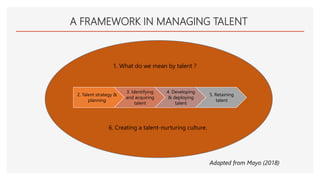
A FRAMEWORK IN MANAGING TALENT
2. Talent strategy &
planning
3. Identifying
and acquiring
talent
4. Developing
& deploying
talent
5. Retaining
talent
1. What do we mean by talent ?
6. Creating a talent-nurturing culture.
Adapted from Mayo (2018)
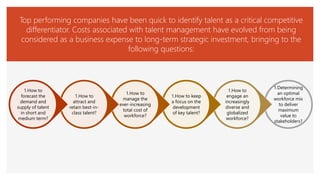
Top performing companies have been quick to identify talent as a critical competitive
differentiator. Costs associated with talent management have evolved from being
considered as a business expense to long-term strategic investment, bringing to the
following questions:
1.Determining
an optimal
workforce mix
to deliver
maximum
value to
stakeholders?
1.How to
engage an
increasingly
diverse and
globalized
workforce?
1.How to keep
a focus on the
development
of key talent?
1.How to
manage the
ever-increasing
total cost of
workforce?
1.How to
attract and
retain best-in-
class talent?
1.How to
forecast the
demand and
supply of talent
in short and
medium term?
HR Analytics & Talent Management
Hiring the right talent,
nurturing & retaining
them have always been
among the top
challenges faced by HR
teams across
organizations.
The task of hiring a
candidate had a major
hunch factor involved
rather than facts.
On the other hand a lot
of HR activities of
nurturing and retaining
talents too, are not
attributed to data driven
facts.
However, things are
changing fast as
organizations now
leverage data to facilitate
their HR activities.
A starting point for HR analytics for talent management:
Talent Strategy &
Planning
• the per cent of posts without
a designated immediate
successor;
• the per cent of posts with no
successor either now or long
term;
• the per cent of posts on the
plan becoming vacant and
being filled from the plan; and
• the marginal costs associated
with having to fill senior
positions externally rather
than internally.
Identifying &
Acquiring Talent
• the quality and quantity of
graduate recruits;
• the “employment brand”
• the per cent of senior
vacancies filled internally;
• the per cent of external
candidates accepting the
offer; and
• the quality of employee value
proposition in the market (a
ranking perhaps).
Developing &
Deploying Talent
• the per cent who have been
moved to a new position in
the last year;
• the per cent that are on
development secondments;
• the per cent with experience
in more than one function
and/or geography;
• the per cent who have had a
business school development
experience; and
• the per cent that are beyond
their “earliest date for a
move”.
Retaining
Talent
• the per cent of people in
talent pools lost to the
organization over a defined
period;
• the per cent of such people
giving “lack of career
opportunity” as their reason
for leaving;
• the per cent of such people
giving “discomfort with the
culture” as their reason for
leaving; and
• the average engagement level
of people in our different
talent pools
The Importance of HR Analytics to
Talent Management
HR analytics can be used to
help manage talent.
From predicting future top
performers to grooming
successors for key positions
and identifying internal
threats before they strike,
today’s HR analytics are
powerful tools for employers.
This concept provides greater
visibility into employee data
which can then help
enterprise leaders to develop
and improve recruiting
methods, make better-
informed hiring decisions,
and retain the top talent
within a company.
With huge amounts of data
being generated by the
various applications used by
organizations, HR analytics
tools can provide critical
insights into different aspects
of the organization’s human
resources.
These insights can be
leveraged to make better-
informed decisions.
HR Analytics & Talent Management
1
•Workforce analytics give
organizations a great
alternative to applicant
tracking systems because they
have more comprehensive and
relevant data, keywords,
algorithms, etc.
•In this way, the results will be
much more relevant and up-
to-date as well.
•While performing background
checks, for example, workforce
analytics algorithms are
designed to use external data,
like social media activities, to
get a more detailed profile of
the candidate, which can
reduce recruitment/hiring
time.
2
•HR analytics can also provide
insight into which sources or
channels have a higher ROI
(Return on Investment).
•As a result, organizations can
target their recruitment
strategies on those specific
sources and channels where
the returns are highest.
•They can be used to find out
any risks in employee
retention, the best candidate
for a job role, compliance risks
and a whole lot more.
3
•One of the major factors that
cause employees to leave or
stay in a company is
compensation.
•Workforce analytics can be
leveraged in this aspect to
determine fair compensation
on the basis of data and
information collected from
various relevant external
sources, years of service,
performance, etc.
4
•Succession planning is another
area where workforce analytics
can be used – organizations
can use details about
employee capabilities and
career paths to identify and
prepare potential successors.
5
•Lastly, when organizations
look for candidates before the
interviewing process, the
candidate’s public record and
social media usage data are
usually reviewed beforehand.
•Pre-hire analysis, however, is a
relatively new kind of
workforce analytics. It can be
used to find and predict the
undesirable behavior of the
candidates’ behavior pattern
during the hiring process.
•This ensures that time and/or
resources are not wasted on
potential candidates that
aren’t fit for the role.
IMPLICATION OF HR ANALYTICS TO TALENT MANAGEMENT
HR analytics will make the
HR function more strategic.
•The goal of people analytics is to
see how business outcomes can
be improved by changing people
management practices.
•People analytics is therefore
inherently strategic and data-
driven and will, therefore, impact
how we attract, hire, evaluate,
promote & fire people.
Analytics requires a data-
driven mindset for HR
professionals.
•Access to data & analytics
changes the role of the HR
business partner.
•Traditionally, the business partner
followed the manager’s input.
This could involve very
operational activities
The data going into the
systems will become more
important.
•HR data is notorious for its data
quality. The data going into the
systems become increasingly
important as it is now used for
analysis and forms the basis of
informed decision making and
action.
•This requires system
administrators to design better
systems with a lower risk of errors
and makes the administrative
roles in the HR department more
important.
HR analytics will impact
the tools we use.
•Analytics enables the optimization
of talent management. Every step
in the employee journey can be
analyzed and optimized.
•This involves measuring how we
attract, manage, and promote
talent. This will change how we
deploy our HR tools as they will
have to aggregate data from each
step in the talent management
model.
People analytics changes
HR by busting long-held
beliefs.
•For example, a fast-food company
was actively hiring people that
had quit the company earlier.
They were hiring them because
they thought these people would
require a shorter onboarding time
and would stay longer because
they already knew the work.
However, after some analysis, the
people analytics team discovered
that the reason for termination
was not checked and that people
who were fired for fraudulent
behavior were hired again.
•By sharing these insights, the
recruitment team was able to
make better hiring decisions.
Do you have any
questions?
This Photo by Unknown Author is licensed under CC BY-SA-NC
Chapter 4-analytics-talent-management

Chapter 4-analytics-talent-management

  • 1.
    CHAPTER 4: ANALYTICS &TALENT MANAGEMENT KMS2154 HRD ANALYTICS shelmi@unimas.my +6082584511 / +60198471184 Instructor: Helmi Sumilan
  • 2.
    LEARNING OUTCOMES By theend of this lecture, you will be able to: 1. Define talent & talent management, 2. Explain the importance of HR analytics to talent management, and 3. Discuss the implication of HR analytics to talent management.
  • 3.
    WHAT IS TALENT? Talentis the sum of :  A person’s abilities  His or her intrinsic gifts  Skills, knowledge experience  Intelligence  Judgment, attitude, character , drive  His or her ability to learn and grow
  • 4.
    TALENT MANAGEMENT The ability,competency and power of employees within an organization The concept is not restricted to recruiting but also to exploration, development, transition according to the culture of the organization. It is a continuous process that involves sourcing, hiring, developing, retaining and promoting them while meeting the organization’s requirements simultaneously.
  • 7.
    A FRAMEWORK INMANAGING TALENT 2. Talent strategy & planning 3. Identifying and acquiring talent 4. Developing & deploying talent 5. Retaining talent 1. What do we mean by talent ? 6. Creating a talent-nurturing culture. Adapted from Mayo (2018)
  • 8.
    Top performing companieshave been quick to identify talent as a critical competitive differentiator. Costs associated with talent management have evolved from being considered as a business expense to long-term strategic investment, bringing to the following questions: 1.Determining an optimal workforce mix to deliver maximum value to stakeholders? 1.How to engage an increasingly diverse and globalized workforce? 1.How to keep a focus on the development of key talent? 1.How to manage the ever-increasing total cost of workforce? 1.How to attract and retain best-in- class talent? 1.How to forecast the demand and supply of talent in short and medium term?
  • 9.
    HR Analytics &Talent Management Hiring the right talent, nurturing & retaining them have always been among the top challenges faced by HR teams across organizations. The task of hiring a candidate had a major hunch factor involved rather than facts. On the other hand a lot of HR activities of nurturing and retaining talents too, are not attributed to data driven facts. However, things are changing fast as organizations now leverage data to facilitate their HR activities.
  • 10.
    A starting pointfor HR analytics for talent management: Talent Strategy & Planning • the per cent of posts without a designated immediate successor; • the per cent of posts with no successor either now or long term; • the per cent of posts on the plan becoming vacant and being filled from the plan; and • the marginal costs associated with having to fill senior positions externally rather than internally. Identifying & Acquiring Talent • the quality and quantity of graduate recruits; • the “employment brand” • the per cent of senior vacancies filled internally; • the per cent of external candidates accepting the offer; and • the quality of employee value proposition in the market (a ranking perhaps). Developing & Deploying Talent • the per cent who have been moved to a new position in the last year; • the per cent that are on development secondments; • the per cent with experience in more than one function and/or geography; • the per cent who have had a business school development experience; and • the per cent that are beyond their “earliest date for a move”. Retaining Talent • the per cent of people in talent pools lost to the organization over a defined period; • the per cent of such people giving “lack of career opportunity” as their reason for leaving; • the per cent of such people giving “discomfort with the culture” as their reason for leaving; and • the average engagement level of people in our different talent pools
  • 11.
    The Importance ofHR Analytics to Talent Management HR analytics can be used to help manage talent. From predicting future top performers to grooming successors for key positions and identifying internal threats before they strike, today’s HR analytics are powerful tools for employers. This concept provides greater visibility into employee data which can then help enterprise leaders to develop and improve recruiting methods, make better- informed hiring decisions, and retain the top talent within a company. With huge amounts of data being generated by the various applications used by organizations, HR analytics tools can provide critical insights into different aspects of the organization’s human resources. These insights can be leveraged to make better- informed decisions.
  • 12.
    HR Analytics &Talent Management 1 •Workforce analytics give organizations a great alternative to applicant tracking systems because they have more comprehensive and relevant data, keywords, algorithms, etc. •In this way, the results will be much more relevant and up- to-date as well. •While performing background checks, for example, workforce analytics algorithms are designed to use external data, like social media activities, to get a more detailed profile of the candidate, which can reduce recruitment/hiring time. 2 •HR analytics can also provide insight into which sources or channels have a higher ROI (Return on Investment). •As a result, organizations can target their recruitment strategies on those specific sources and channels where the returns are highest. •They can be used to find out any risks in employee retention, the best candidate for a job role, compliance risks and a whole lot more. 3 •One of the major factors that cause employees to leave or stay in a company is compensation. •Workforce analytics can be leveraged in this aspect to determine fair compensation on the basis of data and information collected from various relevant external sources, years of service, performance, etc. 4 •Succession planning is another area where workforce analytics can be used – organizations can use details about employee capabilities and career paths to identify and prepare potential successors. 5 •Lastly, when organizations look for candidates before the interviewing process, the candidate’s public record and social media usage data are usually reviewed beforehand. •Pre-hire analysis, however, is a relatively new kind of workforce analytics. It can be used to find and predict the undesirable behavior of the candidates’ behavior pattern during the hiring process. •This ensures that time and/or resources are not wasted on potential candidates that aren’t fit for the role.
  • 13.
    IMPLICATION OF HRANALYTICS TO TALENT MANAGEMENT HR analytics will make the HR function more strategic. •The goal of people analytics is to see how business outcomes can be improved by changing people management practices. •People analytics is therefore inherently strategic and data- driven and will, therefore, impact how we attract, hire, evaluate, promote & fire people. Analytics requires a data- driven mindset for HR professionals. •Access to data & analytics changes the role of the HR business partner. •Traditionally, the business partner followed the manager’s input. This could involve very operational activities The data going into the systems will become more important. •HR data is notorious for its data quality. The data going into the systems become increasingly important as it is now used for analysis and forms the basis of informed decision making and action. •This requires system administrators to design better systems with a lower risk of errors and makes the administrative roles in the HR department more important. HR analytics will impact the tools we use. •Analytics enables the optimization of talent management. Every step in the employee journey can be analyzed and optimized. •This involves measuring how we attract, manage, and promote talent. This will change how we deploy our HR tools as they will have to aggregate data from each step in the talent management model. People analytics changes HR by busting long-held beliefs. •For example, a fast-food company was actively hiring people that had quit the company earlier. They were hiring them because they thought these people would require a shorter onboarding time and would stay longer because they already knew the work. However, after some analysis, the people analytics team discovered that the reason for termination was not checked and that people who were fired for fraudulent behavior were hired again. •By sharing these insights, the recruitment team was able to make better hiring decisions.
  • 14.
    Do you haveany questions? This Photo by Unknown Author is licensed under CC BY-SA-NC