Chapter 4:  Supply
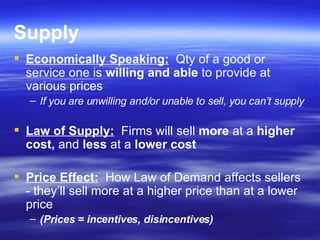
Supply Economically Speaking:   Qty of a good or service one is  willing and able  to provide at various prices If you are unwilling and/or unable to sell, you can’t supply Law of Supply:   Firms will sell  more  at a  higher cost,  and  less  at a  lower cost Price Effect:   How Law of Demand affects sellers - they’ll sell more at a higher price than at a lower price (Prices = incentives, disincentives)
How to Graph Supply: Market Supply:   All possible P,Q combinations! Aggregate Supply :  Total of all goods,services of all firms Supply (S) Quantity (Q) Price (P)
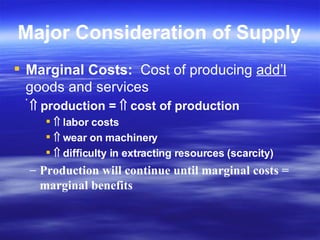
Major Consideration of Supply Marginal Costs:  Cost of producing  add’l  goods and services    production =    cost of production     labor costs    wear on machinery    difficulty in extracting resources (scarcity) Production will continue until marginal costs = marginal benefits
Price Elasticity of Supply Elastic (Luxury item):   Price changes greatly affect the # of products supplied    # of items to sell when price   Inelastic (Necessity): Price changes have  little  or  no  effect on # of products supplied Gas is inelastic, since a price   means producers can make    $ w/ same sales (my gas tank didn’t get any smaller) :(
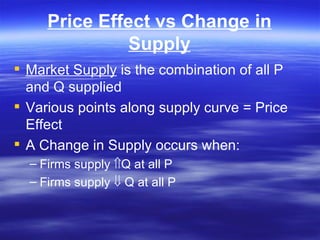
Price Effect vs Change in Supply Market Supply  is the combination of all P and Q supplied Various points along supply curve = Price Effect A Change in Supply occurs when: Firms supply   Q at all P Firms supply    Q at all P
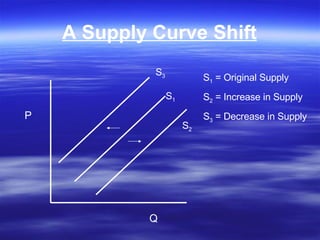
A Supply Curve Shift S 1  = Original Supply S 2  = Increase in Supply S 3  = Decrease in Supply P Q S 1 S 2 S 3
What Causes A Supply Shift? Change in Marginal Cost Change in the # of Sellers Change in Expectations
Shifting Supply Curves 1)  When Marginal cost  in supply if # of producers      supply price of cheese       supply now and    in future

Chapter 4 Supply

  • 1.
  • 2.
    Supply Economically Speaking: Qty of a good or service one is willing and able to provide at various prices If you are unwilling and/or unable to sell, you can’t supply Law of Supply: Firms will sell more at a higher cost, and less at a lower cost Price Effect: How Law of Demand affects sellers - they’ll sell more at a higher price than at a lower price (Prices = incentives, disincentives)
  • 3.
    How to GraphSupply: Market Supply: All possible P,Q combinations! Aggregate Supply : Total of all goods,services of all firms Supply (S) Quantity (Q) Price (P)
  • 4.
    Major Consideration ofSupply Marginal Costs: Cost of producing add’l goods and services  production =  cost of production  labor costs  wear on machinery  difficulty in extracting resources (scarcity) Production will continue until marginal costs = marginal benefits
  • 5.
    Price Elasticity ofSupply Elastic (Luxury item): Price changes greatly affect the # of products supplied  # of items to sell when price  Inelastic (Necessity): Price changes have little or no effect on # of products supplied Gas is inelastic, since a price  means producers can make  $ w/ same sales (my gas tank didn’t get any smaller) :(
  • 6.
    Price Effect vsChange in Supply Market Supply is the combination of all P and Q supplied Various points along supply curve = Price Effect A Change in Supply occurs when: Firms supply  Q at all P Firms supply  Q at all P
  • 7.
    A Supply CurveShift S 1 = Original Supply S 2 = Increase in Supply S 3 = Decrease in Supply P Q S 1 S 2 S 3
  • 8.
    What Causes ASupply Shift? Change in Marginal Cost Change in the # of Sellers Change in Expectations
  • 9.
    Shifting Supply Curves1) When Marginal cost  in supply if # of producers  supply price of cheese  supply now and in future