PREPARED BY :-
KARTIK ZALA
Assi. Proff.,
Civil Engg. Department,
VICT.
CONTENTS
 Wind
Waves
Tides
Currents
Wind is horizontal movement of air due to differences in
air pressure which are caused by differential heating and cooling.
In short wind means air in motion.
 Wind Characteristics:-
 Direction of wind usually specified by compass.
 Frequency of wind is the percentage of the time in a year it
will blow from a particular direction.
 Intensity gives the velocity of the wind.
Speed of wind is expressed in “knots” and wind strength
is measured in kmph.
(1 knot = 1.852 km/hr)
Waves are periodic undulations of the sea surface. Water
waves are generated by transfer of energy from air moving over
the water.
Causes of Sea Waves:-
Wind,
Revolution of the earth,
Gravitational force of the moon and sun,
Earthquake,
Land slide and seashore,
Types of Sea Waves:-
Deep sea waves
Shallow sea waves
Oscillatory waves (unbroken waves, travelling in deep water)
Translatory waves
Capillary waves
Surfs (low height and long waves produced by wind)
Surges (produced by cyclone)
Tsunami (produced by eruption of volcano or earthquake)
DEEP SEA WAVE OSCILLATORY WAVES
CAPILLARY WAVES
 Wave Velocity:-
Where, L = Length
T = Wave Period
 Fetch:-
Straight line stretch of open water available for wave growth
without the interruption of land is called fetch.
Where, H = Wave Height (m)
F = Fetch (km)
 Wave Length:-
Where, L = Length of wave (m) =
T = Wave Period (sec)
 Wave Breaking:-
Waves break when the forward velocity of the crest particles
exceeds the velocity of the wave propagation itself in deep
water.
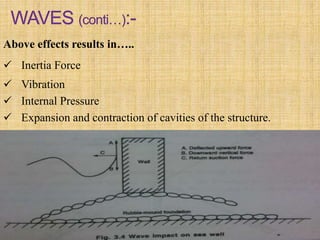
Ocean waves on breaking against marine structure give rise
to….
 Compression due to direct horizontal force,
 Shearing action at the projection on the face of the wall,
 Suction effect due to return water,
 Sea bed & Foundation disturbance due to downward force.
Above effects results in…..
 Inertia Force
 Vibration
 Internal Pressure
 Expansion and contraction of cavities of the structure.
 Wave Reflection:-
Non breaking waves are acting on a vertical wall (break
water), do not loose their energy by the impact but are
reflected.
Due to continuous interaction of the incidents and reflected
waves, a wave of higher height (2 to 3 times) is formed which
is called Standing Waves (Clapotis).
 Methods To Minimize Wave Reflection Inside The
Harbour:-
 Break water must in such a way that the reflected waves are not
diverted towards piers or any other structure.
 The interior slopes of breakwater can be designed for the wave
to break, which spend the wave energy.
 Special spending beaches can be planned at points of maximum
waves take place.
Due to gravitational force of sun and moon there is rise
and fall in ocean waters called TIDES. The rise in water level
is called high tide and fall in water level is called low tides.
In Mediterranean sea, height is 0.5 to 1.0 m.
In the Gulf of fundy, height is 15 to 20m.
Connected to Atlantic Ocean,
Completely enclosed by land.
It is on the Atlantic Coast.
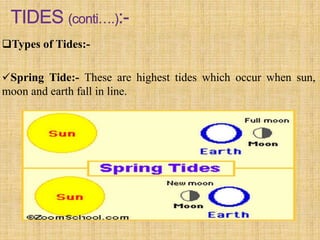
Types of Tides:-
Spring Tide:- These are highest tides which occur when sun,
moon and earth fall in line.
Types of Tides:-
Neap Tide:- These are lowest tides which occur when the lines
connecting the earth with the sun and the moon form right angle.
Types of Tides:-
Semi-diurnal Tide:- These are the tides which occurs twice each
lunar day.
Lunar Day means time taken by moon to make a complete
revolution around the earth.
Diurnal Tide:- These are high tides occur only one time a day.
E.g. at Florida.
Types of Tides:-
Mixed Tide:- If one of the two daily high tides does not reach the
height of the previous tide, it is called a mixed tide. E.g. U. S. A,
California.
Tidal Bore:- These are high crested waves caused by the rush of
flood tide up a river. Regular occurrence in bay of fundy.
Uses of Tides:-
Tides can be used for harnessing the power.
Tides are used for entry and exit of ships in the harbour.
Fisherman takes an advantage of tides.
Ports remain clean due to tides.
High tide water can be used for harvesting salt.
Horizontal movement of water is called current.
Causes of Currents:-
Tides,
Wind blowing over ocean,
Difference in temperature,
Turbidity of water,
Wave breaking at an angle of a beach.
Effects of Currents:-
Scouring and erosion,
Deposition(silting),
Increase in corrosion rate,
Delay in construction operations,
Significant forces on marine structure,
Loads on moored vessels.
It is desirable that to a large extent Harbours are free from
erosion and silting.
Types of Currents:-
Primary Current
Turbidity Current
Tidal and Wind drift Current
Wind stress Current
Littoral Current
CHAPTER - 3. NATURAL PHENOMENA.pptx

CHAPTER - 3. NATURAL PHENOMENA.pptx

  • 1.
    PREPARED BY :- KARTIKZALA Assi. Proff., Civil Engg. Department, VICT.
  • 2.
  • 3.
    Wind is horizontalmovement of air due to differences in air pressure which are caused by differential heating and cooling. In short wind means air in motion.  Wind Characteristics:-  Direction of wind usually specified by compass.  Frequency of wind is the percentage of the time in a year it will blow from a particular direction.  Intensity gives the velocity of the wind. Speed of wind is expressed in “knots” and wind strength is measured in kmph. (1 knot = 1.852 km/hr)
  • 4.
    Waves are periodicundulations of the sea surface. Water waves are generated by transfer of energy from air moving over the water. Causes of Sea Waves:- Wind, Revolution of the earth, Gravitational force of the moon and sun, Earthquake, Land slide and seashore,
  • 5.
    Types of SeaWaves:- Deep sea waves Shallow sea waves Oscillatory waves (unbroken waves, travelling in deep water) Translatory waves Capillary waves Surfs (low height and long waves produced by wind) Surges (produced by cyclone) Tsunami (produced by eruption of volcano or earthquake)
  • 6.
    DEEP SEA WAVEOSCILLATORY WAVES CAPILLARY WAVES
  • 7.
     Wave Velocity:- Where,L = Length T = Wave Period  Fetch:- Straight line stretch of open water available for wave growth without the interruption of land is called fetch. Where, H = Wave Height (m) F = Fetch (km)
  • 8.
     Wave Length:- Where,L = Length of wave (m) = T = Wave Period (sec)
  • 9.
     Wave Breaking:- Wavesbreak when the forward velocity of the crest particles exceeds the velocity of the wave propagation itself in deep water. Ocean waves on breaking against marine structure give rise to….  Compression due to direct horizontal force,  Shearing action at the projection on the face of the wall,  Suction effect due to return water,  Sea bed & Foundation disturbance due to downward force.
  • 10.
    Above effects resultsin…..  Inertia Force  Vibration  Internal Pressure  Expansion and contraction of cavities of the structure.
  • 11.
     Wave Reflection:- Nonbreaking waves are acting on a vertical wall (break water), do not loose their energy by the impact but are reflected. Due to continuous interaction of the incidents and reflected waves, a wave of higher height (2 to 3 times) is formed which is called Standing Waves (Clapotis).
  • 12.
     Methods ToMinimize Wave Reflection Inside The Harbour:-  Break water must in such a way that the reflected waves are not diverted towards piers or any other structure.  The interior slopes of breakwater can be designed for the wave to break, which spend the wave energy.  Special spending beaches can be planned at points of maximum waves take place.
  • 13.
    Due to gravitationalforce of sun and moon there is rise and fall in ocean waters called TIDES. The rise in water level is called high tide and fall in water level is called low tides. In Mediterranean sea, height is 0.5 to 1.0 m. In the Gulf of fundy, height is 15 to 20m. Connected to Atlantic Ocean, Completely enclosed by land. It is on the Atlantic Coast.
  • 14.
    Types of Tides:- SpringTide:- These are highest tides which occur when sun, moon and earth fall in line.
  • 15.
    Types of Tides:- NeapTide:- These are lowest tides which occur when the lines connecting the earth with the sun and the moon form right angle.
  • 16.
    Types of Tides:- Semi-diurnalTide:- These are the tides which occurs twice each lunar day. Lunar Day means time taken by moon to make a complete revolution around the earth. Diurnal Tide:- These are high tides occur only one time a day. E.g. at Florida.
  • 17.
    Types of Tides:- MixedTide:- If one of the two daily high tides does not reach the height of the previous tide, it is called a mixed tide. E.g. U. S. A, California. Tidal Bore:- These are high crested waves caused by the rush of flood tide up a river. Regular occurrence in bay of fundy.
  • 18.
    Uses of Tides:- Tidescan be used for harnessing the power. Tides are used for entry and exit of ships in the harbour. Fisherman takes an advantage of tides. Ports remain clean due to tides. High tide water can be used for harvesting salt.
  • 19.
    Horizontal movement ofwater is called current. Causes of Currents:- Tides, Wind blowing over ocean, Difference in temperature, Turbidity of water, Wave breaking at an angle of a beach.
  • 20.
    Effects of Currents:- Scouringand erosion, Deposition(silting), Increase in corrosion rate, Delay in construction operations, Significant forces on marine structure, Loads on moored vessels. It is desirable that to a large extent Harbours are free from erosion and silting.
  • 21.
    Types of Currents:- PrimaryCurrent Turbidity Current Tidal and Wind drift Current Wind stress Current Littoral Current