Chapter 2
LIBRARY RESEARCH AND
LITERATURE REVIEWS
CHAPTER OVERVIEW
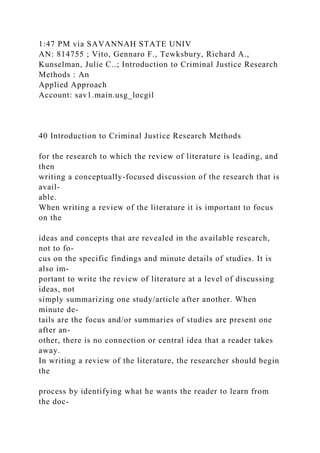
In this chapter you will learn about the purpose, process, and
uses ofresearch that focus on identifying what information is
already known
about a particular topic or question. One of the important things
to re-
member about criminal justice research is that all research is
about
adding to the existing body of knowledge that exists about a
particular
topic or question. Research is not necessarily about just creating
new in-
formation or knowledge, but instead is about expanding what is
already
known and adding to a cumulative body of knowledge. This
means that
researchers rely on what previous studies have shown to guide
their
own studies, including identifying potentially valuable lines in
inquiry,
knowing what variables should and should not be included in a
study,
and knowing what types of data collection and analysis methods
are
more and less likely to be productive. Research studies that are
done
today do not replace the knowledge that was learned by studies
done
in the past; instead, today’s studies add to our knowledge base
and help
to understand things in more detail, from different perspectives
or they
simply make our confidence in knowledge stronger (because
more
studies have found similar results).
This means that as the first step in any research endeavor a re-
searcher needs to identify the existing knowledge about his or
her top-
ic. So, step one in any research project is to identify, find, and
review
previously completed studies on the topic and specific question
that is
of interest presently. The information from previous studies can
be
27
Co
py
ri
gh
t
@
20
14
.
Ch
ar
le
s
C
Th
om
as
.
Al
l
ri
gh
ts
r
es
er
ve
d.
M
ay
n
ot
b
e
re
pr
od
uc
ed
i
n
an
y
fo
rm
w
it
ho
ut
p
er
mi
ss
io
n
fr
om
t
he
p
ub
li
sh
er
,
ex
ce
pt
f
ai
r
us
es
p
er
mi
tt
ed
u
nd
er
U
.S
.
or
a
pp
li
ca
bl
e
co
py
ri
gh
t
la
w.
EBSCO : eBook Collection (EBSCOhost) - printed on 9/19/2018
1:47 PM via SAVANNAH STATE UNIV
AN: 814755 ; Vito, Gennaro F., Tewksbury, Richard A.,
Kunselman, Julie C..; Introduction to Criminal Justice Research
Methods : An
Applied Approach
Account: sav1.main.usg_locgil
28 Introduction to Criminal Justice Research Methods
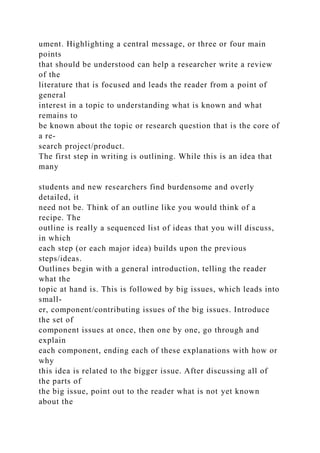
found in several ways, and from a variety of sources. When
researchers
talk about doing background research — or “reviewing the
literature” —
they are talking about the basic processes of what is also called
library
research. Working in libraries and with library resources are
experi-
ences and skills that most people first have in elementary
school. These
same skills are used, although in some refined and more focused
ways,
by researchers throughout their careers to start all of their
research pro-
jects.
WHAT IS LIBRARY RESEARCH?
Library research is the process of searching for, finding, and
review-
ing existing information so as to help in planning and
conducting a cur-
rent research project. The goals of doing library research are to
identi-
fy what is already known about a particular topic or research
question,
and to provide researchers with guidance about what remains
un-
known, what approaches and methods of data collection have
(or have
not) previously been shown to be effective and efficient, what
informa-
tion (or, variables) are important to include in a study and what
prob-
lems researchers should be aware of as they embark on their
own re-
search process.
Doing library research on the topic or question that a researcher
is
interested in provides background information that guides the
re-
searcher in setting up her own study. By knowing what is
already
known, how previous researchers have defined their variables,
from
whom data on questions has previously been collected, and what
processes have and have not worked well, a researcher can
avoid mak-
ing the mistakes that others have made and she can design and
conduct
a study that will add to the knowledge base about her topic of
interest.
DOING LIBRARY RESEARCH
The actual practice of doing library research involves searching
for
information in a variety of places, knowing where to look for
informa-
tion and being able to narrow the focus of information that is
collected,
read, and used for guidance. The first thing that researchers
doing back-
Co
py
ri
gh
t
@
20
14
.
Ch
ar
le
s
C
Th
om
as
.
Al
l
ri
gh
ts
r
es
er
ve
d.
M
ay
n
ot
b
e
re
pr
od
uc
ed
i
n
an
y
fo
rm
w
it
ho
ut
p
er
mi
ss
io
n
fr
om
t
he
p
ub
li
sh
er
,
ex
ce
pt
f
ai
r
us
es
p
er
mi
tt
ed
u
nd
er
U
.S
.
or
a
pp
li
ca
bl
e
co
py
ri
gh
t
la
w.
EBSCO : eBook Collection (EBSCOhost) - printed on 9/19/2018
1:47 PM via SAVANNAH STATE UNIV
AN: 814755 ; Vito, Gennaro F., Tewksbury, Richard A.,
Kunselman, Julie C..; Introduction to Criminal Justice Research
Methods : An
Applied Approach
Account: sav1.main.usg_locgil
Library Research and Literature Reviews 29
ground research on a topic need to know is where to look for
informa-
tion on previous research.
Sources of Research Literature
There are a number of types of resources that can provide re-
searchers with information to guide their work and to get a
thorough
working understanding of what is already known about a topic
or re-
search question. Each of the types of sources, however, tends to
provide
a different type of information, and varying degrees of depth
and de-
tail. As with just about anything, there are both advantages and
disad-
vantages for each type of source. Therefore, it is important for a
re-
searcher to use multiple types of sources in order to obtain a
complete
understanding of the existing state of knowledge about a topic.
Here we
will discuss seven types of research literature that can and
should be in-
cluded in any review of the research literature on a particular
topic.
The first type of source of information is books. Books can be
useful
resources, especially when looking for theoretical
understandings of an
issue and in-depth, comprehensive discussions of a topic. Books
can
also provide discussions (usually very detailed) about large
scale re-
search projects. When a researcher says that she uses books in
her re-
view of the literature, she means that she has found and
reviewed/read
what is also referred to as “research monographs.” These types
of
books are discussions devoted to the comprehensive
presentation of
one study, not a discussion of the broad range of information
about a
topic.
When talking about using books, we are not talking about the
type
of books with which most students are most familiar —
textbooks. Yes,
it can be very tempting to find a course textbook about a topic
and rely
on what is in it for your understanding about what is known
about a
particular topic. The textbooks that students use in classes (such
as this
one you are reading right now) are obviously useful and
efficient ways
to learn many pieces of information about a topic. However,
textbooks
are not considered true scholarly sources for several reasons.
First, the
information presented in textbooks tends to be broad, and not
deep.
This means that while a lot of information may be included,
there is
also not much detail about the way this information was
discovered and
is presented. Therefore, it is difficult for a researcher to assess
the qual-
ity of the research process that is behind the discovery of the
informa-
Co
py
ri
gh
t
@
20
14
.
Ch
ar
le
s
C
Th
om
as
.
Al
l
ri
gh
ts
r
es
er
ve
d.
M
ay
n
ot
b
e
re
pr
od
uc
ed
i
n
an
y
fo
rm
w
it
ho
ut
p
er
mi
ss
io
n
fr
om
t
he
p
ub
li
sh
er
,
ex
ce
pt
f
ai
r
us
es
p
er
mi
tt
ed
u
nd
er
U
.S
.
or
a
pp
li
ca
bl
e
co
py
ri
gh
t
la
w.
EBSCO : eBook Collection (EBSCOhost) - printed on 9/19/2018
1:47 PM via SAVANNAH STATE UNIV
AN: 814755 ; Vito, Gennaro F., Tewksbury, Richard A.,
Kunselman, Julie C..; Introduction to Criminal Justice Research
Methods : An
Applied Approach
Account: sav1.main.usg_locgil
30 Introduction to Criminal Justice Research Methods
tion included in a textbook. (Or, said differently, knowing
whether or
not the research that produced a particular fact/finding was high
qual-
ity research is very difficult without more information than is
typically
reported in a textbook.) A second problem with using textbooks
as a
source of information is that the information presented in a
textbook is
both selective and filtered and based on the interpretations of
the text-
book author(s); it is not the actual work of the researchers who
did the
studies being discussed. This leaves the information open to
possible
errors, omissions, and misinterpretations. And, by design,
textbooks do
not include all of the research knowledge about a topic, but
instead in-
cludes only selected information (that which the textbook
author
thought most important, or most interesting, or most important
to in-
clude for whatever reason). With all of this being said, it is
important to
realize that textbooks can be useful, however, as a place to
identify ma-
jor studies that researchers can then obtain and read and review
for
themselves. But, beyond using a textbook simply as a way to
identify a
handful of “classic” or major studies from which to start your
searching,
textbooks are not good sources.
The second and most common source of information that most
crim-
inal justice researchers use when reviewing what is already
known
about a topic or question is the scholarly journal article.
Articles that
are published in scholarly journals are (almost always) reports
of indi-
vidual research projects. Each journal article will typically be
focused
on a very specific research question, and the findings of the
individual
study on that research question. For most criminal justice
researchers,
and most social scientists generally, the primary way that
research re-
sults are reported is through articles in scholarly journals.
A scholarly journal article will include several important
sections.
First, there is an introduction and a review of the existing
research lit-
erature that pertains to the question being studied in the project.
This
in itself can be very useful to researchers, as this makes
available a sum-
mary and review of what was known at a given point in time
(e.g., the
time when the article was written and published) about the topic
in
question. In many ways, this can be like finding a version of
exactly
what you are trying to compose, but which was done and
summarizes
a topic or question at one previous point in time. Following the
review
of literature is the detailed discussion of the research methods
that were
used to study the question. This is a very important part of the
journal
article, as this is where the reader gets the information that
allows him
Co
py
ri
gh
t
@
20
14
.
Ch
ar
le
s
C
Th
om
as
.
Al
l
ri
gh
ts
r
es
er
ve
d.
M
ay
n
ot
b
e
re
pr
od
uc
ed
i
n
an
y
fo
rm
w
it
ho
ut
p
er
mi
ss
io
n
fr
om
t
he
p
ub
li
sh
er
,
ex
ce
pt
f
ai
r
us
es
p
er
mi
tt
ed
u
nd
er
U
.S
.
or
a
pp
li
ca
bl
e
co
py
ri
gh
t
la
w.
EBSCO : eBook Collection (EBSCOhost) - printed on 9/19/2018
1:47 PM via SAVANNAH STATE UNIV
AN: 814755 ; Vito, Gennaro F., Tewksbury, Richard A.,
Kunselman, Julie C..; Introduction to Criminal Justice Research
Methods : An
Applied Approach
Account: sav1.main.usg_locgil
Library Research and Literature Reviews 31
to assess whether the research was done in a high quality way,
and is
likely to produce valid, reliable, and generalizable
results/findings. Af-
ter the detailed discussion of the research methods, the article
will in-
clude the presentation of the findings or results of the project.
And, fi-
nally, the conclusion (or “discussion”) section of the article will
explain
the relevance of the results and inform the reader about how
these re-
sults fit into the bigger picture of knowledge about the topic.
Another critically important thing to understand about research
that
is reported in scholarly journal articles is that the articles that
are pub-
lished in these outlets have all undergone a rigorous process of
quality
assurance. Most so than any other of our variety of sources of
informa-
tion, scholarly journal articles have the most arduous review
prior to
being published and made public. The peer review process in
schol-
arly publishing is when a researcher submits her finished
research re-
port (a “manuscript”) to a journal for the editor to consider it
for publi-
cation. When an editor receives a manuscript, she then solicits a
panel
(using anywhere between three and five) of other scholars who
are ex-
perts in the topic of the manuscript to conduct a peer review of
the
study/manuscript. Typically this is done in what is referred to
as a dou-
ble-blind manner, where the reviewing scholars do not know the
iden-
tity of the manuscript author and the author does not know who
is con-
ducting the peer review. It is the job of this panel of scholars to
care-
fully review the research being reported, looking for problems
in how
the research was conducted, how the results/findings are
reported, and
how the theoretical explanation/argument of the results are
presented.
This process is designed to ensure that only high quality
research,
which is valid, reliable, and explained in theoretically and
practically
sound ways, ends up being published. The peer review process
is the
way that scientists work to ensure that only high quality
(“accurate”) re-
search is publicized and widely available.
Scholarly journal articles are not only important sources of
knowl-
edge, but they are also usually very specific in what they
address. As a
study of a particular, specific research question, the information
that is
reported in a journal article may either be dead-on for assisting
a cur-
rent researcher understand what is known about his topic, or it
can be
frustrating that the study is sort of related to what he is
interested in, but
based on a different population, or from a too-different-to-be-
relevant
location, or uses variables defined in different ways and
therefore only
somewhat informative. But, this is also beneficial, as this
suggests that
Co
py
ri
gh
t
@
20
14
.
Ch
ar
le
s
C
Th
om
as
.
Al
l
ri
gh
ts
r
es
er
ve
d.
M
ay
n
ot
b
e
re
pr
od
uc
ed
i
n
an
y
fo
rm
w
it
ho
ut
p
er
mi
ss
io
n
fr
om
t
he
p
ub
li
sh
er
,
ex
ce
pt
f
ai
r
us
es
p
er
mi
tt
ed
u
nd
er
U
.S
.
or
a
pp
li
ca
bl
e
co
py
ri
gh
t
la
w.
EBSCO : eBook Collection (EBSCOhost) - printed on 9/19/2018
1:47 PM via SAVANNAH STATE UNIV
AN: 814755 ; Vito, Gennaro F., Tewksbury, Richard A.,
Kunselman, Julie C..; Introduction to Criminal Justice Research
Methods : An
Applied Approach
Account: sav1.main.usg_locgil
32 Introduction to Criminal Justice Research Methods
your own research idea/question is a good one, and has not yet
been
answered. One of the worst feelings as a researcher can come
when you
have an idea for a research project and in the course of
reviewing the
existing literature, you discover that someone else has recently
done
your project. Your question is answered already. In such a
situation it is
usually a good idea to find a way to slightly alter your question,
or mod-
ify your population of interest, or how what specific
information you
can and will use to address your topic/question of interest.
A third source of information, but one that can be a bit more
diffi-
cult to access than books or scholarly journal articles, is
research re-
ports from criminal justice agencies. Many agencies, especially
larger
ones, will do their own research on a topic, question, problem,
or pol-
icy issue that is relevant to their operations. Typically this
research is
used for internal agency decision-making and guidance for
operations
of the organization, and hence is not usually written up as a
journal ar-
ticle or book. Especially when a researcher is interested in a
question
about operations or policies of criminal justice agencies, the
existing re-
search from agencies can be a great resource. This type of
resource is
most easily identified and accessed by reviewing the websites of
indi-
vidual agencies and organizations. Or, there are also some
online com-
pilations of these types of research studies, sometimes referred
to as the
“gray literature” which can be searched in an effort to identify
relevant
studies.
A fourth source of information, but one that generally is thought
to
be of more limited value, is the reporting of information in
trade pub-
lications (newsletters, magazines, etc. written for persons in
particular
professions). These publications will report on research results
(some-
times including preliminary findings) that pertain to particular
ques-
tions and topics germane to that profession. One of the
advantages of
these sources of information is that it tends to be in simple
language
and to focus on findings and how they can be used for practical
pur-
poses. However, reports of research in trade publications also
tend to
lack the details about what the research process included and
specifics
of the results.
However, if a researcher was interested in studying the
effectiveness
of various methods of recruitment for police departments, she
might
find it useful to skim through past issues of Police Chief
magazine or
newsletters from the International Association of Chiefs of
Police to see
if there are any stories about whether or not particular
recruitment
Co
py
ri
gh
t
@
20
14
.
Ch
ar
le
s
C
Th
om
as
.
Al
l
ri
gh
ts
r
es
er
ve
d.
M
ay
n
ot
b
e
re
pr
od
uc
ed
i
n
an
y
fo
rm
w
it
ho
ut
p
er
mi
ss
io
n
fr
om
t
he
p
ub
li
sh
er
,
ex
ce
pt
f
ai
r
us
es
p
er
mi
tt
ed
u
nd
er
U
.S
.
or
a
pp
li
ca
bl
e
co
py
ri
gh
t
la
w.
EBSCO : eBook Collection (EBSCOhost) - printed on 9/19/2018
1:47 PM via SAVANNAH STATE UNIV
AN: 814755 ; Vito, Gennaro F., Tewksbury, Richard A.,
Kunselman, Julie C..; Introduction to Criminal Justice Research
Methods : An
Applied Approach
Account: sav1.main.usg_locgil
Library Research and Literature Reviews 33
methods are more or less effective. If she does find relevant
stories, she
should use this information as a starting point for trying to then
locate
more detailed information about the studies being reported.
Hence, she
could check the specific agency’s website or contact either the
article
author or agency where the reported project was done to ask for
more
information. Trade publications can be useful starting points to
locate
information, but very rarely are the actual articles in them
sufficiently
detailed to be useful as sources themselves. Additionally, trade
publi-
cations are not subject to the peer-review process that journal
articles
undergo. Therefore, the information reported in trade
publication arti-
cles may need to be viewed with a degree of skepticism.
The fifth type of source of information that can inform a
researcher’s
review of the literature are papers presented by researchers at
academ-
ic and professional conferences. The papers presented at
conferences
have (in almost all instances) not yet been published in any
outlet, and
are usually the most recent research findings that exist. Often
the pa-
pers presented at conferences are works in progress, preliminary
find-
ings, or projects that the researcher has completed but is still
working
on to identify the full range of implications and conclusions.
A sixth source of information to search and include in a review
of the
literature on a particular topic is student research in the form of
doc-
toral dissertations and master’s theses. In most social science
disci-
plines, and at most universities, dissertations and theses are
required to
be original research. Often these sources (especially theses) do
not get
rewritten and published in any form, meaning that the only
place this
work can be found is in the dissertation or thesis. The research
report-
ed in dissertations and theses is reported in painstaking detail,
and typ-
ically includes a very thorough review of the literature. So, in
disserta-
tions and theses, the research itself is of value, as is the
included review
of the literature.
A seventh and final source of information that some researchers
find
useful to use is book reviews in their process of identifying and
review-
ing existing research. Book reviews are most useful for
providing the re-
searcher with information about whether or not a research
monograph
is truly on point for her interests. Reviews provide a brief
summary of
the book’s content, and reviews provide at least one other
scholar’s
evaluation of the quality of the research (or theoretical
discussion) re-
ported in the book.
Co
py
ri
gh
t
@
20
14
.
Ch
ar
le
s
C
Th
om
as
.
Al
l
ri
gh
ts
r
es
er
ve
d.
M
ay
n
ot
b
e
re
pr
od
uc
ed
i
n
an
y
fo
rm
w
it
ho
ut
p
er
mi
ss
io
n
fr
om
t
he
p
ub
li
sh
er
,
ex
ce
pt
f
ai
r
us
es
p
er
mi
tt
ed
u
nd
er
U
.S
.
or
a
pp
li
ca
bl
e
co
py
ri
gh
t
la
w.
EBSCO : eBook Collection (EBSCOhost) - printed on 9/19/2018
1:47 PM via SAVANNAH STATE UNIV
AN: 814755 ; Vito, Gennaro F., Tewksbury, Richard A.,
Kunselman, Julie C..; Introduction to Criminal Justice Research
Methods : An
Applied Approach
Account: sav1.main.usg_locgil
34 Introduction to Criminal Justice Research Methods
What is important to keep in mind about the range of types of
sources of information is that it is essential to search for
information in
a variety of types of places, and the types of sources are likely
to pro-
vide different types of information. Some of these sources of
informa-
tion can be fairly easy to identify and access; others can be
more chal-
lenging. The next section discusses ways to find the information
you
need to develop a well-rounded and thorough understanding of a
par-
ticular topic or question, and where you should look for
information.
How to Find Previous Research
The ways that researchers can and do find previous research
will
vary based on what types of sources are being sought (or, said
differ-
ently, each approach to searching for previous research is likely
to yield
different types of sources of information). As early as
elementary
school, most of us were taught how to find basic information in
the li-
brary. While the tools used for that information have changed
signifi-
cantly over the years (does anyone remember the card
catalogue?), the
strategies and approaches for searching remain basically the
same. The
places that we look for identifying what is available are the
same today
as they were 10, 20, even perhaps 50 years ago, but the form
that those
sources take have changed.
Today the vast majority of library research is conducted
electronical-
ly. However, as recently as the mid-1990s many (if not most)
re-
searchers were still working with actual paper and books to
locate in-
formation. The move to electronic versions of the basic search
tools has
made the process of library research much quicker, more
efficient, and
likely to yield larger bodies of information than was the norm
previ-
ously. Suffice it to say that the two oldest authors of this book
remem-
ber well being students and having to actually walk to the
library (or,
in some cases multiple libraries on campus), sit in front of a
long line of
thick books that listed the newly published research by key
words,
thumb through book after book after book of listings of
abstracts, write
down the citation for the articles and reports that seemed
important,
and then walk through the library collecting the bound copies of
jour-
nals which then had to be taken to a photocopy machine so
coins could
be deposited and copies could be made of the various pieces.
Today’s
students probably find the description of this process to be
quaint, and
completely foreign. Today a researcher can sit at a computer,
anywhere
Co
py
ri
gh
t
@
20
14
.
Ch
ar
le
s
C
Th
om
as
.
Al
l
ri
gh
ts
r
es
er
ve
d.
M
ay
n
ot
b
e
re
pr
od
uc
ed
i
n
an
y
fo
rm
w
it
ho
ut
p
er
mi
ss
io
n
fr
om
t
he
p
ub
li
sh
er
,
ex
ce
pt
f
ai
r
us
es
p
er
mi
tt
ed
u
nd
er
U
.S
.
or
a
pp
li
ca
bl
e
co
py
ri
gh
t
la
w.
EBSCO : eBook Collection (EBSCOhost) - printed on 9/19/2018
1:47 PM via SAVANNAH STATE UNIV
AN: 814755 ; Vito, Gennaro F., Tewksbury, Richard A.,
Kunselman, Julie C..; Introduction to Criminal Justice Research
Methods : An
Applied Approach
Account: sav1.main.usg_locgil
Library Research and Literature Reviews 35
in the world, at any time of day or night, and quickly search for,
find,
and print copies of stacks of articles. And, all of this is done for
no cost.
So, what are the tools that can be used to find and access
background
research? The first important tool to be familiar with is the
electronic
version of abstract databases. These are collections of brief
sum-
maries of the goals, methods, and findings of published (and in
some
databases, agency reports and conference presentations)
research re-
ports that can be searched using key words, by author and
depending
on the specific database, sometimes other variables as well. The
brief
summaries are what are known as the article’s/report’s abstract.
These
databases are usually discipline specific, or include sources
from sever-
al closely related disciplines. Criminal justice researchers
usually start
their search for background information in Criminal Justice
Abstracts,
and often also look in databases focused on sociology,
psychology, po-
litical science, and law.
There are some unique abstract databases with which criminal
justice
researchers also should be familiar. One of these is the abstract
data-
base maintained by the National Criminal Justice Reference
Service
(NCJRS). This is a division of U.S. Department of Justice.
Included in
this web-based database are published research reports and a
signifi-
cant portion of agency-produced research reports and some
trade pub-
lications.
Another productive, but more simplistic version of this
approach is
for a researcher to carefully review the reference list in any and
all ar-
ticles, books, reports, etc. that they do identify for their
background re-
search. Simply reading through the reference lists of the first
few pieces
of literature you find can direct you to many more relevant
pieces in a
very short period of time. The thing to remember here, however,
is that
if the first few articles, reports, etc. that you encounter are not
very re-
cent, reviewing the reference lists of these pieces will not
provide you
with more recent pieces; after all, only things available at the
time the
piece whose reference list you are reading were available have a
chance
of being included in that reference list.
Another important place to look for information, especially
statistics
about the operations of criminal justice agencies are the
websites of
both government research agencies and criminal justice
agencies. At
the federal level, the Bureau of Justice Statistics is a wealth of
informa-
tion about criminal justice organizations’ operations, staffing,
cases han-
dled, and many other issues. The Federal Bureau of
Investigation main-
Co
py
ri
gh
t
@
20
14
.
Ch
ar
le
s
C
Th
om
as
.
Al
l
ri
gh
ts
r
es
er
ve
d.
M
ay
n
ot
b
e
re
pr
od
uc
ed
i
n
an
y
fo
rm
w
it
ho
ut
p
er
mi
ss
io
n
fr
om
t
he
p
ub
li
sh
er
,
ex
ce
pt
f
ai
r
us
es
p
er
mi
tt
ed
u
nd
er
U
.S
.
or
a
pp
li
ca
bl
e
co
py
ri
gh
t
la
w.
EBSCO : eBook Collection (EBSCOhost) - printed on 9/19/2018
1:47 PM via SAVANNAH STATE UNIV
AN: 814755 ; Vito, Gennaro F., Tewksbury, Richard A.,
Kunselman, Julie C..; Introduction to Criminal Justice Research
Methods : An
Applied Approach
Account: sav1.main.usg_locgil
36 Introduction to Criminal Justice Research Methods
tains the Uniform Crime Reports which is the major source of
infor-
mation about crimes reported to law enforcement agencies. The
Na-
tional Crime Victimization Survey is the major source of
information
about the number of crimes (and characteristics of victims,
perpetra-
tors, and incidents) reported by victims, but not necessarily to
law en-
forcement. The federal Office for Victims of Crime also
provides a
range of statistical information about crime victims and
criminal events.
Other types of government agencies also can be rich sources of
in-
formation. As discussed earlier, actual criminal justice agencies
(espe-
cially larger ones) will often have a research unit or department
that
does and posts research reports. Other types of government
agencies
also maintain collections and databases of research reports. For
re-
searchers interested in corrections, the National Institute of
Corrections
maintains a database with summaries (and many full text
documents)
of published and unpublished research and many reports of
research
and programs produced by corrections agencies.
It is also worthwhile to check the websites of professional
organiza-
tions in topical and practice areas in which one is interested in
con-
ducting research. For instance, both the International
Association of
Chiefs of Police and the American Probation and Parole
Association
have entire sections of their websites devoted to research they
have
done themselves and that they have identified from others.
Many oth-
er criminal justice professional organizations also maintain
collections
of both internally and externally produced research pertaining
to their
professional membership and audience.
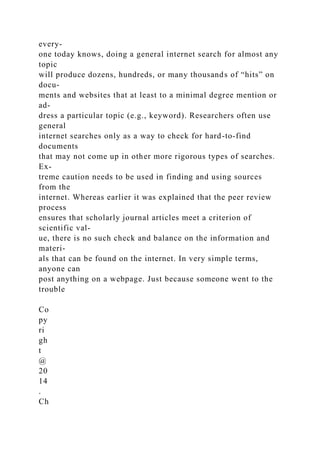
Finally, and perhaps most familiar for many students, there is
the
general internet search via a commercial search engine. As most
every-
one today knows, doing a general internet search for almost any
topic
will produce dozens, hundreds, or many thousands of “hits” on
docu-
ments and websites that at least to a minimal degree mention or
ad-
dress a particular topic (e.g., keyword). Researchers often use
general
internet searches only as a way to check for hard-to-find
documents
that may not come up in other more rigorous types of searches.
Ex-
treme caution needs to be used in finding and using sources
from the
internet. Whereas earlier it was explained that the peer review
process
ensures that scholarly journal articles meet a criterion of
scientific val-
ue, there is no such check and balance on the information and
materi-
als that can be found on the internet. In very simple terms,
anyone can
post anything on a webpage. Just because someone went to the
trouble
Co
py
ri
gh
t
@
20
14
.
Ch
ar
le
s
C
Th
om
as
.
Al
l
ri
gh
ts
r
es
er
ve
d.
M
ay
n
ot
b
e
re
pr
od
uc
ed
i
n
an
y
fo
rm
w
it
ho
ut
p
er
mi
ss
io
n
fr
om
t
he
p
ub
li
sh
er
,
ex
ce
pt
f
ai
r
us
es
p
er
mi
tt
ed
u
nd
er
U
.S
.
or
a
pp
li
ca
bl
e
co
py
ri
gh
t
la
w.
EBSCO : eBook Collection (EBSCOhost) - printed on 9/19/2018
1:47 PM via SAVANNAH STATE UNIV
AN: 814755 ; Vito, Gennaro F., Tewksbury, Richard A.,
Kunselman, Julie C..; Introduction to Criminal Justice Research
Methods : An
Applied Approach
Account: sav1.main.usg_locgil
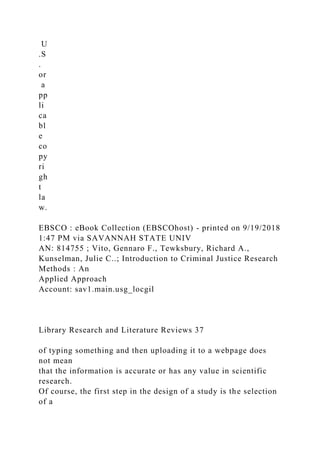
Library Research and Literature Reviews 37
of typing something and then uploading it to a webpage does
not mean
that the information is accurate or has any value in scientific
research.
Of course, the first step in the design of a study is the selection
of a
topic.
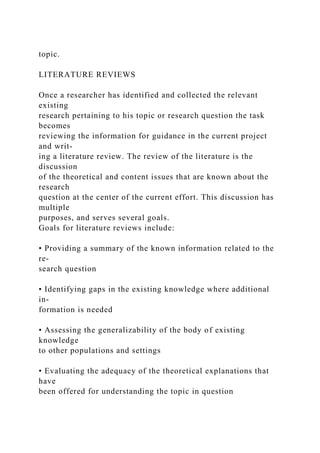
LITERATURE REVIEWS
Once a researcher has identified and collected the relevant
existing
research pertaining to his topic or research question the task
becomes
reviewing the information for guidance in the current project
and writ-
ing a literature review. The review of the literature is the
discussion
of the theoretical and content issues that are known about the
research
question at the center of the current effort. This discussion has
multiple
purposes, and serves several goals.
Goals for literature reviews include:
• Providing a summary of the known information related to the
re-
search question
• Identifying gaps in the existing knowledge where additional
in-
formation is needed
• Assessing the generalizability of the body of existing
knowledge
to other populations and settings
• Evaluating the adequacy of the theoretical explanations that
have
been offered for understanding the topic in question
• Identifying methodological approaches that do and do work ef-
fectively and efficiently when studying the topic of interest
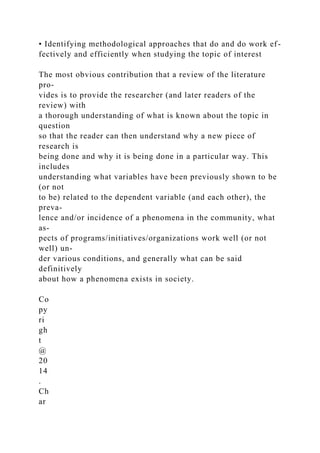
The most obvious contribution that a review of the literature
pro-
vides is to provide the researcher (and later readers of the
review) with
a thorough understanding of what is known about the topic in
question
so that the reader can then understand why a new piece of
research is
being done and why it is being done in a particular way. This
includes
understanding what variables have been previously shown to be
(or not
to be) related to the dependent variable (and each other), the
preva-
lence and/or incidence of a phenomena in the community, what
as-
pects of programs/initiatives/organizations work well (or not
well) un-
der various conditions, and generally what can be said
definitively
about how a phenomena exists in society.
Co
py
ri
gh
t
@
20
14
.
Ch
ar
le
s
C
Th
om
as
.
Al
l
ri
gh
ts
r
es
er
ve
d.
M
ay
n
ot
b
e
re
pr
od
uc
ed
i
n
an
y
fo
rm
w
it
ho
ut
p
er
mi
ss
io
n
fr
om
t
he
p
ub
li
sh
er
,
ex
ce
pt
f
ai
r
us
es
p
er
mi
tt
ed
u
nd
er
U
.S
.
or
a
pp
li
ca
bl
e
co
py
ri
gh
t
la
w.
EBSCO : eBook Collection (EBSCOhost) - printed on 9/19/2018
1:47 PM via SAVANNAH STATE UNIV
AN: 814755 ; Vito, Gennaro F., Tewksbury, Richard A.,
Kunselman, Julie C..; Introduction to Criminal Justice Research
Methods : An
Applied Approach
Account: sav1.main.usg_locgil
38 Introduction to Criminal Justice Research Methods
The summary of what is known is directly related to the second
goal
for literature reviews, pointing out what is not known. When a
re-
searcher can identify these gaps in the existing literature, this
means
that the knowledge base about a topic lacks some piece(s) of
informa-
tion that therefore limits our ability to have a complete
understanding
of the topic being studied. These are topics and questions that
then
should or need to be the focus of additional research. This is
important
to know. Knowing what is unknown may be even more
informative
than knowing what is known. This is also a way to justify the
impor-
tance for your own research. For example, if you can show that
there is
existing knowledge about a how a particular crime occurs, who
tends
to commit it, why they tend to commit it, but no information
about
when such crimes tend to occur, you can easily argue that a
study about
the “when” issue is needed.
A literature review will often serve the purpose of assessing the
pre-
viously completed research regarding the persons and places
from
which data was collected, and hence to which the findings of a
study
can be generalized. By considering from whom and where data
for
studies whose findings are available come, it is possible to
identify gaps
in knowledge about to which the findings can be applied more
broad-
ly. Consider, for example, a researcher interested in whether
deaf indi-
viduals can effectively work as law enforcement officers. If,
after re-
viewing the literature, she can identify studies about persons
with dis-
abilities serving in law enforcement and the types of jobs for
which deaf
persons do and do not effectively work, a researcher realizes all
of the
research available has been done in cities with a population of
one mil-
lion or more, there is a clear gap in generalizability of these
findings.
This would suggest that additional research should be done in
smaller
cities, suburban areas, and rural communities. If the body of
research
that has been identified presents strong arguments that deaf
individuals
make very good police officers in major cities, can we trust that
this
would hold true in rural west Texas, central Montana, or the
Ap-
palachian regions of Kentucky and Tennessee? Based on the
research
available, we would not be able to say whether the existing
literature
could or should be generalized to these types of settings.
Therefore, a
review of the literature should point out this limitation of the
existing
research.
As explained in Chapter One, criminal justice research is guided
by
theory. As the foundation of understanding and explaining the
criminal
Co
py
ri
gh
t
@
20
14
.
Ch
ar
le
s
C
Th
om
as
.
Al
l
ri
gh
ts
r
es
er
ve
d.
M
ay
n
ot
b
e
re
pr
od
uc
ed
i
n
an
y
fo
rm
w
it
ho
ut
p
er
mi
ss
io
n
fr
om
t
he
p
ub
li
sh
er
,
ex
ce
pt
f
ai
r
us
es
p
er
mi
tt
ed
u
nd
er
U
.S
.
or
a
pp
li
ca
bl
e
co
py
ri
gh
t
la
w.
EBSCO : eBook Collection (EBSCOhost) - printed on 9/19/2018
1:47 PM via SAVANNAH STATE UNIV
AN: 814755 ; Vito, Gennaro F., Tewksbury, Richard A.,
Kunselman, Julie C..; Introduction to Criminal Justice Research
Methods : An
Applied Approach
Account: sav1.main.usg_locgil
Library Research and Literature Reviews 39
justice system, the actions of those who work in, are served by,
and are
processed by the criminal justice system, theory is critical to
explaining
the relevance of research findings. One common goal of a
review of the
literature is an examination of if and how well the findings of
previous
research projects are explained by (or fit with) theoretical
propositions
and perspectives. This approach involves assessing whether the
find-
ings reported in previous research studies fit with what a
particular the-
ory says are the necessary/important types of variables and
relation-
ships. If the findings of previous research do show that the way
a theo-
ry suggests something operates is in fact the way that things
seem to be
occurring, then the review of the literature would be supportive
of such
a theory. If the opposite is shown, then we may conclude that a
partic-
ular theory does not appear to be a good explanation for a
particular
phenomenon.
Finally, reviews of literature regarding a particular topic or
question
should look at what types of data collection and analysis
processes have
been used in previous research, and where researchers have
reported
difficulties and problems. Additionally, this approach to a
review of the
literature will look at how key concepts and variables are
defined and
operationalized (or, how measurements of variable X are made),
to see
if when researchers use different definitions they end up with
different
results.
Regardless of the purposes that a review of the literature fulfill,
the
ultimate goal of the final written document that is the literature
review
is to lead a reader from a starting point of “oh, this might be an
inter-
esting topic” to the point of understanding why a researcher
does the
study he does, and how it will contribute to a developing body
of
knowledge about the particular topic. This means that a review
of the
literature needs to develop ideas and move a reader along a path
of
greater understanding. How this movement and development of
un-
derstanding is constructed is the focus of the final section of
this chap-
ter.
Writing the Literature Review
The process of actually writing a review of the literature
includes
reading and taking notes on all of the relevant pieces of
research that
are identified, organizing the information into conceptual
groups, out-
lining a logical progression of ideas from general to showing
the need
Co
py
ri
gh
t
@
20
14
.
Ch
ar
le
s
C
Th
om
as
.
Al
l
ri
gh
ts
r
es
er
ve
d.
M
ay
n
ot
b
e
re
pr
od
uc
ed
i
n
an
y
fo
rm
w
it
ho
ut
p
er
mi
ss
io
n
fr
om
t
he
p
ub
li
sh
er
,
ex
ce
pt
f
ai
r
us
es
p
er
mi
tt
ed
u
nd
er
U
.S
.
or
a
pp
li
ca
bl
e
co
py
ri
gh
t
la
w.
EBSCO : eBook Collection (EBSCOhost) - printed on 9/19/2018
1:47 PM via SAVANNAH STATE UNIV
AN: 814755 ; Vito, Gennaro F., Tewksbury, Richard A.,
Kunselman, Julie C..; Introduction to Criminal Justice Research
Methods : An
Applied Approach
Account: sav1.main.usg_locgil
40 Introduction to Criminal Justice Research Methods
for the research to which the review of literature is leading, and
then
writing a conceptually-focused discussion of the research that is
avail-
able.
When writing a review of the literature it is important to focus
on the
ideas and concepts that are revealed in the available research,
not to fo-
cus on the specific findings and minute details of studies. It is
also im-
portant to write the review of literature at a level of discussing
ideas, not
simply summarizing one study/article after another. When
minute de-
tails are the focus and/or summaries of studies are present one
after an-
other, there is no connection or central idea that a reader takes
away.
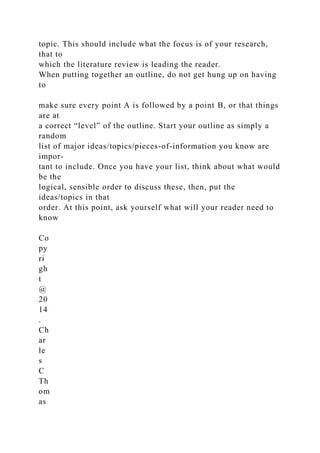
In writing a review of the literature, the researcher should begin
the
process by identifying what he wants the reader to learn from
the doc-
ument. Highlighting a central message, or three or four main
points
that should be understood can help a researcher write a review
of the
literature that is focused and leads the reader from a point of
general
interest in a topic to understanding what is known and what
remains to
be known about the topic or research question that is the core of
a re-
search project/product.
The first step in writing is outlining. While this is an idea that
many
students and new researchers find burdensome and overly
detailed, it
need not be. Think of an outline like you would think of a
recipe. The
outline is really a sequenced list of ideas that you will discuss,
in which
each step (or each major idea) builds upon the previous
steps/ideas.
Outlines begin with a general introduction, telling the reader
what the
topic at hand is. This is followed by big issues, which leads into
small-
er, component/contributing issues of the big issues. Introduce
the set of
component issues at once, then one by one, go through and
explain
each component, ending each of these explanations with how or
why
this idea is related to the bigger issue. After discussing all of
the parts of
the big issue, point out to the reader what is not yet known
about the
topic. This should include what the focus is of your research,
that to
which the literature review is leading the reader.
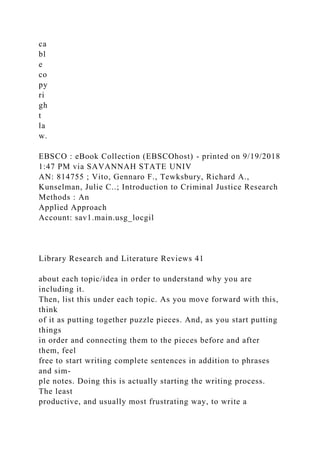
When putting together an outline, do not get hung up on having
to
make sure every point A is followed by a point B, or that things
are at
a correct “level” of the outline. Start your outline as simply a
random
list of major ideas/topics/pieces-of-information you know are
impor-
tant to include. Once you have your list, think about what would
be the
logical, sensible order to discuss these, then, put the
ideas/topics in that
order. At this point, ask yourself what will your reader need to
know
Co
py
ri
gh
t
@
20
14
.
Ch
ar
le
s
C
Th
om
as
.
Al
l
ri
gh
ts
r
es
er
ve
d.
M
ay
n
ot
b
e
re
pr
od
uc
ed
i
n
an
y
fo
rm
w
it
ho
ut
p
er
mi
ss
io
n
fr
om
t
he
p
ub
li
sh
er
,
ex
ce
pt
f
ai
r
us
es
p
er
mi
tt
ed
u
nd
er
U
.S
.
or
a
pp
li
ca
bl
e
co
py
ri
gh
t
la
w.
EBSCO : eBook Collection (EBSCOhost) - printed on 9/19/2018
1:47 PM via SAVANNAH STATE UNIV
AN: 814755 ; Vito, Gennaro F., Tewksbury, Richard A.,
Kunselman, Julie C..; Introduction to Criminal Justice Research
Methods : An
Applied Approach
Account: sav1.main.usg_locgil
Library Research and Literature Reviews 41
about each topic/idea in order to understand why you are
including it.
Then, list this under each topic. As you move forward with this,
think
of it as putting together puzzle pieces. And, as you start putting
things
in order and connecting them to the pieces before and after
them, feel
free to start writing complete sentences in addition to phrases
and sim-
ple notes. Doing this is actually starting the writing process.
The least
productive, and usually most frustrating way, to write a
literature re-
view is to simply start with a blank screen and start writing
complete
sentences and figuring out what to write as you go. Put the
pieces of in-
formation next to the other pieces of information to which they
are re-
lated, and when you feel like it, write a sentence here and there,
and al-
low yourself to do a little bit on the connection between ideas A
and B,
then jump down to adding a point after idea F, and connecting it
with
a couple of sentences to idea G.
What you are doing in this approach to writing is filling in an
outline,
piece by piece, just like you would fill in a jigsaw puzzle. Think
of how
you put together a puzzle. Most people start with the outer
edges (the
outline), then look for pieces to connect to that outer edge.
Occasion-
ally you will run across a couple of pieces that fit together and
go some-
where in the middle, so you connect those pieces, and set them
aside.
It would be frustrating and very unproductive to put together
the top
line of pieces of the puzzle then look for only pieces to make up
the sec-
ond line of pieces, then the third, and so on. Take the same
approach
with your writing as you would with a jigsaw puzzle. Pick up a
piece of
information and ask yourself where it might fit, then connect it
there.
As with the puzzle, you will whittle down the pieces that still
need a
place to go, and rather quickly have the entire picture in place.
CONCLUSION
Background research, including identifying previous research
on a
topic of interest to a current researcher and reviews of that
literature,
provides important contributions to the design, conduct, and
reporting
of any research project. There are a variety of places that
research is re-
ported, and all of which may provide insights and contributions
to a re-
searcher planning a research project. The purpose of finding,
reading,
and reviewing research about a topic that has been previously
done is
to allow a researcher to thoroughly understand the knowledge
based
Co
py
ri
gh
t
@
20
14
.
Ch
ar
le
s
C
Th
om
as
.
Al
l
ri
gh
ts
r
es
er
ve
d.
M
ay
n
ot
b
e
re
pr
od
uc
ed
i
n
an
y
fo
rm
w
it
ho
ut
p
er
mi
ss
io
n
fr
om
t
he
p
ub
li
sh
er
,
ex
ce
pt
f
ai
r
us
es
p
er
mi
tt
ed
u
nd
er
U
.S
.
or
a
pp
li
ca
bl
e
co
py
ri
gh
t
la
w.
EBSCO : eBook Collection (EBSCOhost) - printed on 9/19/2018
1:47 PM via SAVANNAH STATE UNIV
AN: 814755 ; Vito, Gennaro F., Tewksbury, Richard A.,
Kunselman, Julie C..; Introduction to Criminal Justice Research
Methods : An
Applied Approach
Account: sav1.main.usg_locgil
42 Introduction to Criminal Justice Research Methods
about a topic, and to plan a research project while taking
advantage of
the lessons learned in previous research.
Library research, and literature reviews that are written with the
in-
formation gathered via library research, both inform the design
of a re-
search project and functions to show consumers of a research
product
that there is a need for the information and findings of a
research pro-
ject. Without reviews of the literature there would be no easy
way to
know what is known about a topic and if, how and where any
particu-
lar research project and its findings contribute to the body of
knowl-
edge about a topic.
KEY TERMS
Library research
Scholarly journal article
Peer review process
Research reports
Trade publications
Abstract databases
Abstract
Literature review
REVIEW QUESTIONS
1. What is the purpose of the literature review?
2. Why are journal articles a valuable source of information?
3. Why are research reports from agencies relevant to the
research
process?
4. How can a writer efficiently write a review of what is known
about
a topic?
Co
py
ri
gh
t
@
20
14
.
Ch
ar
le
s
C
Th
om
as
.
Al
l
ri
gh
ts
r
es
er
ve
d.
M
ay
n
ot
b
e
re
pr
od
uc
ed
i
n
an
y
fo
rm
w
it
ho
ut
p
er
mi
ss
io
n
fr
om
t
he
p
ub
li
sh
er
,
ex
ce
pt
f
ai
r
us
es
p
er
mi
tt
ed
u
nd
er
U
.S
.
or
a
pp
li
ca
bl
e
co
py
ri
gh
t
la
w.
EBSCO : eBook Collection (EBSCOhost) - printed on 9/19/2018
1:47 PM via SAVANNAH STATE UNIV
AN: 814755 ; Vito, Gennaro F., Tewksbury, Richard A.,
Kunselman, Julie C..; Introduction to Criminal Justice Research
Methods : An
Applied Approach
Account: sav1.main.usg_locgil
Chapter 3
ETHICAL ISSUES IN
CRIMINAL JUSTICE RESEARCH
CHAPTER OVERVIEW
Ethics refers to the study of moral principles between what is
rightand what is wrong or standards of good conduct. All
research rais-
es certain ethical issues and concerns and criminal justice
research
lends itself to ethical considerations before, during, and after a
research
project. The central conflict posed by the research process is
how to
balance moral values and principles with the need for scientific
knowl-
edge and “methodological rigor.”1 This means as one engages
in re-
search he/she must achieve and uphold moral standards of
behavior
and action, avoid research strategies that may endanger these
values,
and balance conflicting values that confront researchers.2
When a researcher is confronted with such a conflict or moral
dilem-
ma, the application of an ethical framework provides a
guideline for de-
cision-making. Consider, for example, a researcher’s need to
evaluate
whether there could be harm to research participants and if so,
whether
or not the suggested harm outweighs the potential benefits of
the pro-
posed study. One’s knowledge of ethics and one’s application of
an eth-
ical framework guide such decisions (preresearch), in addition
to one’s
behavior while engaged in the field and in analysis
(postresearch). This
process parallels the value of ethics and the value of applying
an ethi-
cal framework in our decision-making as criminal justice
professionals.
The federal and international laws in place today which
establish
guidelines for conducting ethical research did not always exist.
The
classical study of obedience by Stanley Milgrim3 is one
example of a
43
Co
py
ri
gh
t
@
20
14
.
Ch
ar
le
s
C
Th
om
as
.
Al
l
ri
gh
ts
r
es
er
ve
d.
M
ay
n
ot
b
e
re
pr
od
uc
ed
i
n
an
y
fo
rm
w
it
ho
ut
p
er
mi
ss
io
n
fr
om
t
he
p
ub
li
sh
er
,
ex
ce
pt
f
ai
r
us
es
p
er
mi
tt
ed
u
nd
er
U
.S
.
or
a
pp
li
ca
bl
e
co
py
ri
gh
t
la
w.
EBSCO : eBook Collection (EBSCOhost) - printed on 9/19/2018
1:47 PM via SAVANNAH STATE UNIV
AN: 814755 ; Vito, Gennaro F., Tewksbury, Richard A.,
Kunselman, Julie C..; Introduction to Criminal Justice Research
Methods : An
Applied Approach
Account: sav1.main.usg_locgil

Chapter 2LIBRARY RESEARCH ANDLITERATURE REVIEWSCHAPT.docx

  • 1.
    Chapter 2 LIBRARY RESEARCHAND LITERATURE REVIEWS CHAPTER OVERVIEW In this chapter you will learn about the purpose, process, and uses ofresearch that focus on identifying what information is already known about a particular topic or question. One of the important things to re- member about criminal justice research is that all research is about adding to the existing body of knowledge that exists about a particular topic or question. Research is not necessarily about just creating new in- formation or knowledge, but instead is about expanding what is already known and adding to a cumulative body of knowledge. This means that researchers rely on what previous studies have shown to guide their own studies, including identifying potentially valuable lines in inquiry, knowing what variables should and should not be included in a study, and knowing what types of data collection and analysis methods are more and less likely to be productive. Research studies that are done
  • 2.
    today do notreplace the knowledge that was learned by studies done in the past; instead, today’s studies add to our knowledge base and help to understand things in more detail, from different perspectives or they simply make our confidence in knowledge stronger (because more studies have found similar results). This means that as the first step in any research endeavor a re- searcher needs to identify the existing knowledge about his or her top- ic. So, step one in any research project is to identify, find, and review previously completed studies on the topic and specific question that is of interest presently. The information from previous studies can be 27 Co py ri gh t @ 20 14 . Ch ar le s C
  • 3.
  • 4.
  • 5.
    a pp li ca bl e co py ri gh t la w. EBSCO : eBookCollection (EBSCOhost) - printed on 9/19/2018 1:47 PM via SAVANNAH STATE UNIV AN: 814755 ; Vito, Gennaro F., Tewksbury, Richard A., Kunselman, Julie C..; Introduction to Criminal Justice Research Methods : An Applied Approach Account: sav1.main.usg_locgil 28 Introduction to Criminal Justice Research Methods found in several ways, and from a variety of sources. When researchers talk about doing background research — or “reviewing the literature” — they are talking about the basic processes of what is also called library research. Working in libraries and with library resources are experi- ences and skills that most people first have in elementary school. These
  • 6.
    same skills areused, although in some refined and more focused ways, by researchers throughout their careers to start all of their research pro- jects. WHAT IS LIBRARY RESEARCH? Library research is the process of searching for, finding, and review- ing existing information so as to help in planning and conducting a cur- rent research project. The goals of doing library research are to identi- fy what is already known about a particular topic or research question, and to provide researchers with guidance about what remains un- known, what approaches and methods of data collection have (or have not) previously been shown to be effective and efficient, what informa- tion (or, variables) are important to include in a study and what prob- lems researchers should be aware of as they embark on their own re- search process. Doing library research on the topic or question that a researcher is interested in provides background information that guides the re- searcher in setting up her own study. By knowing what is already known, how previous researchers have defined their variables, from
  • 7.
    whom data onquestions has previously been collected, and what processes have and have not worked well, a researcher can avoid mak- ing the mistakes that others have made and she can design and conduct a study that will add to the knowledge base about her topic of interest. DOING LIBRARY RESEARCH The actual practice of doing library research involves searching for information in a variety of places, knowing where to look for informa- tion and being able to narrow the focus of information that is collected, read, and used for guidance. The first thing that researchers doing back- Co py ri gh t @ 20 14 . Ch ar le s C Th om as
  • 8.
  • 9.
  • 10.
    ca bl e co py ri gh t la w. EBSCO : eBookCollection (EBSCOhost) - printed on 9/19/2018 1:47 PM via SAVANNAH STATE UNIV AN: 814755 ; Vito, Gennaro F., Tewksbury, Richard A., Kunselman, Julie C..; Introduction to Criminal Justice Research Methods : An Applied Approach Account: sav1.main.usg_locgil Library Research and Literature Reviews 29 ground research on a topic need to know is where to look for informa- tion on previous research. Sources of Research Literature There are a number of types of resources that can provide re- searchers with information to guide their work and to get a thorough working understanding of what is already known about a topic or re- search question. Each of the types of sources, however, tends to provide
  • 11.
    a different typeof information, and varying degrees of depth and de- tail. As with just about anything, there are both advantages and disad- vantages for each type of source. Therefore, it is important for a re- searcher to use multiple types of sources in order to obtain a complete understanding of the existing state of knowledge about a topic. Here we will discuss seven types of research literature that can and should be in- cluded in any review of the research literature on a particular topic. The first type of source of information is books. Books can be useful resources, especially when looking for theoretical understandings of an issue and in-depth, comprehensive discussions of a topic. Books can also provide discussions (usually very detailed) about large scale re- search projects. When a researcher says that she uses books in her re- view of the literature, she means that she has found and reviewed/read what is also referred to as “research monographs.” These types of books are discussions devoted to the comprehensive presentation of one study, not a discussion of the broad range of information about a topic. When talking about using books, we are not talking about the type
  • 12.
    of books withwhich most students are most familiar — textbooks. Yes, it can be very tempting to find a course textbook about a topic and rely on what is in it for your understanding about what is known about a particular topic. The textbooks that students use in classes (such as this one you are reading right now) are obviously useful and efficient ways to learn many pieces of information about a topic. However, textbooks are not considered true scholarly sources for several reasons. First, the information presented in textbooks tends to be broad, and not deep. This means that while a lot of information may be included, there is also not much detail about the way this information was discovered and is presented. Therefore, it is difficult for a researcher to assess the qual- ity of the research process that is behind the discovery of the informa- Co py ri gh t @ 20 14 . Ch
  • 13.
  • 14.
  • 15.
    U .S . or a pp li ca bl e co py ri gh t la w. EBSCO : eBookCollection (EBSCOhost) - printed on 9/19/2018 1:47 PM via SAVANNAH STATE UNIV AN: 814755 ; Vito, Gennaro F., Tewksbury, Richard A., Kunselman, Julie C..; Introduction to Criminal Justice Research Methods : An Applied Approach Account: sav1.main.usg_locgil 30 Introduction to Criminal Justice Research Methods tion included in a textbook. (Or, said differently, knowing whether or not the research that produced a particular fact/finding was high qual- ity research is very difficult without more information than is typically
  • 16.
    reported in atextbook.) A second problem with using textbooks as a source of information is that the information presented in a textbook is both selective and filtered and based on the interpretations of the text- book author(s); it is not the actual work of the researchers who did the studies being discussed. This leaves the information open to possible errors, omissions, and misinterpretations. And, by design, textbooks do not include all of the research knowledge about a topic, but instead in- cludes only selected information (that which the textbook author thought most important, or most interesting, or most important to in- clude for whatever reason). With all of this being said, it is important to realize that textbooks can be useful, however, as a place to identify ma- jor studies that researchers can then obtain and read and review for themselves. But, beyond using a textbook simply as a way to identify a handful of “classic” or major studies from which to start your searching, textbooks are not good sources. The second and most common source of information that most crim- inal justice researchers use when reviewing what is already known about a topic or question is the scholarly journal article. Articles that
  • 17.
    are published inscholarly journals are (almost always) reports of indi- vidual research projects. Each journal article will typically be focused on a very specific research question, and the findings of the individual study on that research question. For most criminal justice researchers, and most social scientists generally, the primary way that research re- sults are reported is through articles in scholarly journals. A scholarly journal article will include several important sections. First, there is an introduction and a review of the existing research lit- erature that pertains to the question being studied in the project. This in itself can be very useful to researchers, as this makes available a sum- mary and review of what was known at a given point in time (e.g., the time when the article was written and published) about the topic in question. In many ways, this can be like finding a version of exactly what you are trying to compose, but which was done and summarizes a topic or question at one previous point in time. Following the review of literature is the detailed discussion of the research methods that were used to study the question. This is a very important part of the journal article, as this is where the reader gets the information that allows him
  • 18.
  • 19.
  • 20.
    r us es p er mi tt ed u nd er U .S . or a pp li ca bl e co py ri gh t la w. EBSCO : eBookCollection (EBSCOhost) - printed on 9/19/2018 1:47 PM via SAVANNAH STATE UNIV AN: 814755 ; Vito, Gennaro F., Tewksbury, Richard A., Kunselman, Julie C..; Introduction to Criminal Justice Research Methods : An Applied Approach Account: sav1.main.usg_locgil
  • 21.
    Library Research andLiterature Reviews 31 to assess whether the research was done in a high quality way, and is likely to produce valid, reliable, and generalizable results/findings. Af- ter the detailed discussion of the research methods, the article will in- clude the presentation of the findings or results of the project. And, fi- nally, the conclusion (or “discussion”) section of the article will explain the relevance of the results and inform the reader about how these re- sults fit into the bigger picture of knowledge about the topic. Another critically important thing to understand about research that is reported in scholarly journal articles is that the articles that are pub- lished in these outlets have all undergone a rigorous process of quality assurance. Most so than any other of our variety of sources of informa- tion, scholarly journal articles have the most arduous review prior to being published and made public. The peer review process in schol- arly publishing is when a researcher submits her finished research re- port (a “manuscript”) to a journal for the editor to consider it for publi- cation. When an editor receives a manuscript, she then solicits a
  • 22.
    panel (using anywhere betweenthree and five) of other scholars who are ex- perts in the topic of the manuscript to conduct a peer review of the study/manuscript. Typically this is done in what is referred to as a dou- ble-blind manner, where the reviewing scholars do not know the iden- tity of the manuscript author and the author does not know who is con- ducting the peer review. It is the job of this panel of scholars to care- fully review the research being reported, looking for problems in how the research was conducted, how the results/findings are reported, and how the theoretical explanation/argument of the results are presented. This process is designed to ensure that only high quality research, which is valid, reliable, and explained in theoretically and practically sound ways, ends up being published. The peer review process is the way that scientists work to ensure that only high quality (“accurate”) re- search is publicized and widely available. Scholarly journal articles are not only important sources of knowl- edge, but they are also usually very specific in what they address. As a study of a particular, specific research question, the information that is reported in a journal article may either be dead-on for assisting
  • 23.
    a cur- rent researcherunderstand what is known about his topic, or it can be frustrating that the study is sort of related to what he is interested in, but based on a different population, or from a too-different-to-be- relevant location, or uses variables defined in different ways and therefore only somewhat informative. But, this is also beneficial, as this suggests that Co py ri gh t @ 20 14 . Ch ar le s C Th om as . Al l ri gh ts
  • 24.
  • 25.
  • 26.
    t la w. EBSCO : eBookCollection (EBSCOhost) - printed on 9/19/2018 1:47 PM via SAVANNAH STATE UNIV AN: 814755 ; Vito, Gennaro F., Tewksbury, Richard A., Kunselman, Julie C..; Introduction to Criminal Justice Research Methods : An Applied Approach Account: sav1.main.usg_locgil 32 Introduction to Criminal Justice Research Methods your own research idea/question is a good one, and has not yet been answered. One of the worst feelings as a researcher can come when you have an idea for a research project and in the course of reviewing the existing literature, you discover that someone else has recently done your project. Your question is answered already. In such a situation it is usually a good idea to find a way to slightly alter your question, or mod- ify your population of interest, or how what specific information you can and will use to address your topic/question of interest. A third source of information, but one that can be a bit more diffi- cult to access than books or scholarly journal articles, is research re-
  • 27.
    ports from criminaljustice agencies. Many agencies, especially larger ones, will do their own research on a topic, question, problem, or pol- icy issue that is relevant to their operations. Typically this research is used for internal agency decision-making and guidance for operations of the organization, and hence is not usually written up as a journal ar- ticle or book. Especially when a researcher is interested in a question about operations or policies of criminal justice agencies, the existing re- search from agencies can be a great resource. This type of resource is most easily identified and accessed by reviewing the websites of indi- vidual agencies and organizations. Or, there are also some online com- pilations of these types of research studies, sometimes referred to as the “gray literature” which can be searched in an effort to identify relevant studies. A fourth source of information, but one that generally is thought to be of more limited value, is the reporting of information in trade pub- lications (newsletters, magazines, etc. written for persons in particular professions). These publications will report on research results (some- times including preliminary findings) that pertain to particular ques-
  • 28.
    tions and topicsgermane to that profession. One of the advantages of these sources of information is that it tends to be in simple language and to focus on findings and how they can be used for practical pur- poses. However, reports of research in trade publications also tend to lack the details about what the research process included and specifics of the results. However, if a researcher was interested in studying the effectiveness of various methods of recruitment for police departments, she might find it useful to skim through past issues of Police Chief magazine or newsletters from the International Association of Chiefs of Police to see if there are any stories about whether or not particular recruitment Co py ri gh t @ 20 14 . Ch ar le s
  • 29.
  • 30.
  • 31.
    or a pp li ca bl e co py ri gh t la w. EBSCO : eBookCollection (EBSCOhost) - printed on 9/19/2018 1:47 PM via SAVANNAH STATE UNIV AN: 814755 ; Vito, Gennaro F., Tewksbury, Richard A., Kunselman, Julie C..; Introduction to Criminal Justice Research Methods : An Applied Approach Account: sav1.main.usg_locgil Library Research and Literature Reviews 33 methods are more or less effective. If she does find relevant stories, she should use this information as a starting point for trying to then locate more detailed information about the studies being reported. Hence, she could check the specific agency’s website or contact either the article author or agency where the reported project was done to ask for
  • 32.
    more information. Trade publicationscan be useful starting points to locate information, but very rarely are the actual articles in them sufficiently detailed to be useful as sources themselves. Additionally, trade publi- cations are not subject to the peer-review process that journal articles undergo. Therefore, the information reported in trade publication arti- cles may need to be viewed with a degree of skepticism. The fifth type of source of information that can inform a researcher’s review of the literature are papers presented by researchers at academ- ic and professional conferences. The papers presented at conferences have (in almost all instances) not yet been published in any outlet, and are usually the most recent research findings that exist. Often the pa- pers presented at conferences are works in progress, preliminary find- ings, or projects that the researcher has completed but is still working on to identify the full range of implications and conclusions. A sixth source of information to search and include in a review of the literature on a particular topic is student research in the form of doc- toral dissertations and master’s theses. In most social science disci- plines, and at most universities, dissertations and theses are
  • 33.
    required to be originalresearch. Often these sources (especially theses) do not get rewritten and published in any form, meaning that the only place this work can be found is in the dissertation or thesis. The research report- ed in dissertations and theses is reported in painstaking detail, and typ- ically includes a very thorough review of the literature. So, in disserta- tions and theses, the research itself is of value, as is the included review of the literature. A seventh and final source of information that some researchers find useful to use is book reviews in their process of identifying and review- ing existing research. Book reviews are most useful for providing the re- searcher with information about whether or not a research monograph is truly on point for her interests. Reviews provide a brief summary of the book’s content, and reviews provide at least one other scholar’s evaluation of the quality of the research (or theoretical discussion) re- ported in the book. Co py ri gh t
  • 34.
  • 35.
  • 36.
    tt ed u nd er U .S . or a pp li ca bl e co py ri gh t la w. EBSCO : eBookCollection (EBSCOhost) - printed on 9/19/2018 1:47 PM via SAVANNAH STATE UNIV AN: 814755 ; Vito, Gennaro F., Tewksbury, Richard A., Kunselman, Julie C..; Introduction to Criminal Justice Research Methods : An Applied Approach Account: sav1.main.usg_locgil 34 Introduction to Criminal Justice Research Methods What is important to keep in mind about the range of types of
  • 37.
    sources of informationis that it is essential to search for information in a variety of types of places, and the types of sources are likely to pro- vide different types of information. Some of these sources of informa- tion can be fairly easy to identify and access; others can be more chal- lenging. The next section discusses ways to find the information you need to develop a well-rounded and thorough understanding of a par- ticular topic or question, and where you should look for information. How to Find Previous Research The ways that researchers can and do find previous research will vary based on what types of sources are being sought (or, said differ- ently, each approach to searching for previous research is likely to yield different types of sources of information). As early as elementary school, most of us were taught how to find basic information in the li- brary. While the tools used for that information have changed signifi- cantly over the years (does anyone remember the card catalogue?), the strategies and approaches for searching remain basically the same. The places that we look for identifying what is available are the same today as they were 10, 20, even perhaps 50 years ago, but the form
  • 38.
    that those sources takehave changed. Today the vast majority of library research is conducted electronical- ly. However, as recently as the mid-1990s many (if not most) re- searchers were still working with actual paper and books to locate in- formation. The move to electronic versions of the basic search tools has made the process of library research much quicker, more efficient, and likely to yield larger bodies of information than was the norm previ- ously. Suffice it to say that the two oldest authors of this book remem- ber well being students and having to actually walk to the library (or, in some cases multiple libraries on campus), sit in front of a long line of thick books that listed the newly published research by key words, thumb through book after book after book of listings of abstracts, write down the citation for the articles and reports that seemed important, and then walk through the library collecting the bound copies of jour- nals which then had to be taken to a photocopy machine so coins could be deposited and copies could be made of the various pieces. Today’s students probably find the description of this process to be quaint, and completely foreign. Today a researcher can sit at a computer,
  • 39.
  • 40.
  • 41.
    ai r us es p er mi tt ed u nd er U .S . or a pp li ca bl e co py ri gh t la w. EBSCO : eBookCollection (EBSCOhost) - printed on 9/19/2018 1:47 PM via SAVANNAH STATE UNIV AN: 814755 ; Vito, Gennaro F., Tewksbury, Richard A., Kunselman, Julie C..; Introduction to Criminal Justice Research Methods : An Applied Approach
  • 42.
    Account: sav1.main.usg_locgil Library Researchand Literature Reviews 35 in the world, at any time of day or night, and quickly search for, find, and print copies of stacks of articles. And, all of this is done for no cost. So, what are the tools that can be used to find and access background research? The first important tool to be familiar with is the electronic version of abstract databases. These are collections of brief sum- maries of the goals, methods, and findings of published (and in some databases, agency reports and conference presentations) research re- ports that can be searched using key words, by author and depending on the specific database, sometimes other variables as well. The brief summaries are what are known as the article’s/report’s abstract. These databases are usually discipline specific, or include sources from sever- al closely related disciplines. Criminal justice researchers usually start their search for background information in Criminal Justice Abstracts, and often also look in databases focused on sociology, psychology, po- litical science, and law.
  • 43.
    There are someunique abstract databases with which criminal justice researchers also should be familiar. One of these is the abstract data- base maintained by the National Criminal Justice Reference Service (NCJRS). This is a division of U.S. Department of Justice. Included in this web-based database are published research reports and a signifi- cant portion of agency-produced research reports and some trade pub- lications. Another productive, but more simplistic version of this approach is for a researcher to carefully review the reference list in any and all ar- ticles, books, reports, etc. that they do identify for their background re- search. Simply reading through the reference lists of the first few pieces of literature you find can direct you to many more relevant pieces in a very short period of time. The thing to remember here, however, is that if the first few articles, reports, etc. that you encounter are not very re- cent, reviewing the reference lists of these pieces will not provide you with more recent pieces; after all, only things available at the time the piece whose reference list you are reading were available have a chance of being included in that reference list.
  • 44.
    Another important placeto look for information, especially statistics about the operations of criminal justice agencies are the websites of both government research agencies and criminal justice agencies. At the federal level, the Bureau of Justice Statistics is a wealth of informa- tion about criminal justice organizations’ operations, staffing, cases han- dled, and many other issues. The Federal Bureau of Investigation main- Co py ri gh t @ 20 14 . Ch ar le s C Th om as . Al l ri
  • 45.
  • 46.
  • 47.
    ri gh t la w. EBSCO : eBookCollection (EBSCOhost) - printed on 9/19/2018 1:47 PM via SAVANNAH STATE UNIV AN: 814755 ; Vito, Gennaro F., Tewksbury, Richard A., Kunselman, Julie C..; Introduction to Criminal Justice Research Methods : An Applied Approach Account: sav1.main.usg_locgil 36 Introduction to Criminal Justice Research Methods tains the Uniform Crime Reports which is the major source of infor- mation about crimes reported to law enforcement agencies. The Na- tional Crime Victimization Survey is the major source of information about the number of crimes (and characteristics of victims, perpetra- tors, and incidents) reported by victims, but not necessarily to law en- forcement. The federal Office for Victims of Crime also provides a range of statistical information about crime victims and criminal events. Other types of government agencies also can be rich sources of in- formation. As discussed earlier, actual criminal justice agencies
  • 48.
    (espe- cially larger ones)will often have a research unit or department that does and posts research reports. Other types of government agencies also maintain collections and databases of research reports. For re- searchers interested in corrections, the National Institute of Corrections maintains a database with summaries (and many full text documents) of published and unpublished research and many reports of research and programs produced by corrections agencies. It is also worthwhile to check the websites of professional organiza- tions in topical and practice areas in which one is interested in con- ducting research. For instance, both the International Association of Chiefs of Police and the American Probation and Parole Association have entire sections of their websites devoted to research they have done themselves and that they have identified from others. Many oth- er criminal justice professional organizations also maintain collections of both internally and externally produced research pertaining to their professional membership and audience. Finally, and perhaps most familiar for many students, there is the general internet search via a commercial search engine. As most
  • 49.
    every- one today knows,doing a general internet search for almost any topic will produce dozens, hundreds, or many thousands of “hits” on docu- ments and websites that at least to a minimal degree mention or ad- dress a particular topic (e.g., keyword). Researchers often use general internet searches only as a way to check for hard-to-find documents that may not come up in other more rigorous types of searches. Ex- treme caution needs to be used in finding and using sources from the internet. Whereas earlier it was explained that the peer review process ensures that scholarly journal articles meet a criterion of scientific val- ue, there is no such check and balance on the information and materi- als that can be found on the internet. In very simple terms, anyone can post anything on a webpage. Just because someone went to the trouble Co py ri gh t @ 20 14 . Ch
  • 50.
  • 51.
  • 52.
    U .S . or a pp li ca bl e co py ri gh t la w. EBSCO : eBookCollection (EBSCOhost) - printed on 9/19/2018 1:47 PM via SAVANNAH STATE UNIV AN: 814755 ; Vito, Gennaro F., Tewksbury, Richard A., Kunselman, Julie C..; Introduction to Criminal Justice Research Methods : An Applied Approach Account: sav1.main.usg_locgil Library Research and Literature Reviews 37 of typing something and then uploading it to a webpage does not mean that the information is accurate or has any value in scientific research. Of course, the first step in the design of a study is the selection of a
  • 53.
    topic. LITERATURE REVIEWS Once aresearcher has identified and collected the relevant existing research pertaining to his topic or research question the task becomes reviewing the information for guidance in the current project and writ- ing a literature review. The review of the literature is the discussion of the theoretical and content issues that are known about the research question at the center of the current effort. This discussion has multiple purposes, and serves several goals. Goals for literature reviews include: • Providing a summary of the known information related to the re- search question • Identifying gaps in the existing knowledge where additional in- formation is needed • Assessing the generalizability of the body of existing knowledge to other populations and settings • Evaluating the adequacy of the theoretical explanations that have been offered for understanding the topic in question
  • 54.
    • Identifying methodologicalapproaches that do and do work ef- fectively and efficiently when studying the topic of interest The most obvious contribution that a review of the literature pro- vides is to provide the researcher (and later readers of the review) with a thorough understanding of what is known about the topic in question so that the reader can then understand why a new piece of research is being done and why it is being done in a particular way. This includes understanding what variables have been previously shown to be (or not to be) related to the dependent variable (and each other), the preva- lence and/or incidence of a phenomena in the community, what as- pects of programs/initiatives/organizations work well (or not well) un- der various conditions, and generally what can be said definitively about how a phenomena exists in society. Co py ri gh t @ 20 14 . Ch ar
  • 55.
  • 56.
  • 57.
    .S . or a pp li ca bl e co py ri gh t la w. EBSCO : eBookCollection (EBSCOhost) - printed on 9/19/2018 1:47 PM via SAVANNAH STATE UNIV AN: 814755 ; Vito, Gennaro F., Tewksbury, Richard A., Kunselman, Julie C..; Introduction to Criminal Justice Research Methods : An Applied Approach Account: sav1.main.usg_locgil 38 Introduction to Criminal Justice Research Methods The summary of what is known is directly related to the second goal for literature reviews, pointing out what is not known. When a re- searcher can identify these gaps in the existing literature, this means that the knowledge base about a topic lacks some piece(s) of
  • 58.
    informa- tion that thereforelimits our ability to have a complete understanding of the topic being studied. These are topics and questions that then should or need to be the focus of additional research. This is important to know. Knowing what is unknown may be even more informative than knowing what is known. This is also a way to justify the impor- tance for your own research. For example, if you can show that there is existing knowledge about a how a particular crime occurs, who tends to commit it, why they tend to commit it, but no information about when such crimes tend to occur, you can easily argue that a study about the “when” issue is needed. A literature review will often serve the purpose of assessing the pre- viously completed research regarding the persons and places from which data was collected, and hence to which the findings of a study can be generalized. By considering from whom and where data for studies whose findings are available come, it is possible to identify gaps in knowledge about to which the findings can be applied more broad- ly. Consider, for example, a researcher interested in whether deaf indi- viduals can effectively work as law enforcement officers. If,
  • 59.
    after re- viewing theliterature, she can identify studies about persons with dis- abilities serving in law enforcement and the types of jobs for which deaf persons do and do not effectively work, a researcher realizes all of the research available has been done in cities with a population of one mil- lion or more, there is a clear gap in generalizability of these findings. This would suggest that additional research should be done in smaller cities, suburban areas, and rural communities. If the body of research that has been identified presents strong arguments that deaf individuals make very good police officers in major cities, can we trust that this would hold true in rural west Texas, central Montana, or the Ap- palachian regions of Kentucky and Tennessee? Based on the research available, we would not be able to say whether the existing literature could or should be generalized to these types of settings. Therefore, a review of the literature should point out this limitation of the existing research. As explained in Chapter One, criminal justice research is guided by theory. As the foundation of understanding and explaining the criminal
  • 60.
  • 61.
  • 62.
    us es p er mi tt ed u nd er U .S . or a pp li ca bl e co py ri gh t la w. EBSCO : eBookCollection (EBSCOhost) - printed on 9/19/2018 1:47 PM via SAVANNAH STATE UNIV AN: 814755 ; Vito, Gennaro F., Tewksbury, Richard A., Kunselman, Julie C..; Introduction to Criminal Justice Research Methods : An Applied Approach Account: sav1.main.usg_locgil
  • 63.
    Library Research andLiterature Reviews 39 justice system, the actions of those who work in, are served by, and are processed by the criminal justice system, theory is critical to explaining the relevance of research findings. One common goal of a review of the literature is an examination of if and how well the findings of previous research projects are explained by (or fit with) theoretical propositions and perspectives. This approach involves assessing whether the find- ings reported in previous research studies fit with what a particular the- ory says are the necessary/important types of variables and relation- ships. If the findings of previous research do show that the way a theo- ry suggests something operates is in fact the way that things seem to be occurring, then the review of the literature would be supportive of such a theory. If the opposite is shown, then we may conclude that a partic- ular theory does not appear to be a good explanation for a particular phenomenon. Finally, reviews of literature regarding a particular topic or question should look at what types of data collection and analysis processes have
  • 64.
    been used inprevious research, and where researchers have reported difficulties and problems. Additionally, this approach to a review of the literature will look at how key concepts and variables are defined and operationalized (or, how measurements of variable X are made), to see if when researchers use different definitions they end up with different results. Regardless of the purposes that a review of the literature fulfill, the ultimate goal of the final written document that is the literature review is to lead a reader from a starting point of “oh, this might be an inter- esting topic” to the point of understanding why a researcher does the study he does, and how it will contribute to a developing body of knowledge about the particular topic. This means that a review of the literature needs to develop ideas and move a reader along a path of greater understanding. How this movement and development of un- derstanding is constructed is the focus of the final section of this chap- ter. Writing the Literature Review The process of actually writing a review of the literature includes
  • 65.
    reading and takingnotes on all of the relevant pieces of research that are identified, organizing the information into conceptual groups, out- lining a logical progression of ideas from general to showing the need Co py ri gh t @ 20 14 . Ch ar le s C Th om as . Al l ri gh ts r es er ve d.
  • 66.
  • 67.
  • 68.
    1:47 PM viaSAVANNAH STATE UNIV AN: 814755 ; Vito, Gennaro F., Tewksbury, Richard A., Kunselman, Julie C..; Introduction to Criminal Justice Research Methods : An Applied Approach Account: sav1.main.usg_locgil 40 Introduction to Criminal Justice Research Methods for the research to which the review of literature is leading, and then writing a conceptually-focused discussion of the research that is avail- able. When writing a review of the literature it is important to focus on the ideas and concepts that are revealed in the available research, not to fo- cus on the specific findings and minute details of studies. It is also im- portant to write the review of literature at a level of discussing ideas, not simply summarizing one study/article after another. When minute de- tails are the focus and/or summaries of studies are present one after an- other, there is no connection or central idea that a reader takes away. In writing a review of the literature, the researcher should begin the process by identifying what he wants the reader to learn from the doc-
  • 69.
    ument. Highlighting acentral message, or three or four main points that should be understood can help a researcher write a review of the literature that is focused and leads the reader from a point of general interest in a topic to understanding what is known and what remains to be known about the topic or research question that is the core of a re- search project/product. The first step in writing is outlining. While this is an idea that many students and new researchers find burdensome and overly detailed, it need not be. Think of an outline like you would think of a recipe. The outline is really a sequenced list of ideas that you will discuss, in which each step (or each major idea) builds upon the previous steps/ideas. Outlines begin with a general introduction, telling the reader what the topic at hand is. This is followed by big issues, which leads into small- er, component/contributing issues of the big issues. Introduce the set of component issues at once, then one by one, go through and explain each component, ending each of these explanations with how or why this idea is related to the bigger issue. After discussing all of the parts of the big issue, point out to the reader what is not yet known about the
  • 70.
    topic. This shouldinclude what the focus is of your research, that to which the literature review is leading the reader. When putting together an outline, do not get hung up on having to make sure every point A is followed by a point B, or that things are at a correct “level” of the outline. Start your outline as simply a random list of major ideas/topics/pieces-of-information you know are impor- tant to include. Once you have your list, think about what would be the logical, sensible order to discuss these, then, put the ideas/topics in that order. At this point, ask yourself what will your reader need to know Co py ri gh t @ 20 14 . Ch ar le s C Th om as
  • 71.
  • 72.
  • 73.
    ca bl e co py ri gh t la w. EBSCO : eBookCollection (EBSCOhost) - printed on 9/19/2018 1:47 PM via SAVANNAH STATE UNIV AN: 814755 ; Vito, Gennaro F., Tewksbury, Richard A., Kunselman, Julie C..; Introduction to Criminal Justice Research Methods : An Applied Approach Account: sav1.main.usg_locgil Library Research and Literature Reviews 41 about each topic/idea in order to understand why you are including it. Then, list this under each topic. As you move forward with this, think of it as putting together puzzle pieces. And, as you start putting things in order and connecting them to the pieces before and after them, feel free to start writing complete sentences in addition to phrases and sim- ple notes. Doing this is actually starting the writing process. The least productive, and usually most frustrating way, to write a
  • 74.
    literature re- view isto simply start with a blank screen and start writing complete sentences and figuring out what to write as you go. Put the pieces of in- formation next to the other pieces of information to which they are re- lated, and when you feel like it, write a sentence here and there, and al- low yourself to do a little bit on the connection between ideas A and B, then jump down to adding a point after idea F, and connecting it with a couple of sentences to idea G. What you are doing in this approach to writing is filling in an outline, piece by piece, just like you would fill in a jigsaw puzzle. Think of how you put together a puzzle. Most people start with the outer edges (the outline), then look for pieces to connect to that outer edge. Occasion- ally you will run across a couple of pieces that fit together and go some- where in the middle, so you connect those pieces, and set them aside. It would be frustrating and very unproductive to put together the top line of pieces of the puzzle then look for only pieces to make up the sec- ond line of pieces, then the third, and so on. Take the same approach with your writing as you would with a jigsaw puzzle. Pick up a piece of information and ask yourself where it might fit, then connect it
  • 75.
    there. As with thepuzzle, you will whittle down the pieces that still need a place to go, and rather quickly have the entire picture in place. CONCLUSION Background research, including identifying previous research on a topic of interest to a current researcher and reviews of that literature, provides important contributions to the design, conduct, and reporting of any research project. There are a variety of places that research is re- ported, and all of which may provide insights and contributions to a re- searcher planning a research project. The purpose of finding, reading, and reviewing research about a topic that has been previously done is to allow a researcher to thoroughly understand the knowledge based Co py ri gh t @ 20 14 . Ch ar le
  • 76.
  • 77.
  • 78.
    . or a pp li ca bl e co py ri gh t la w. EBSCO : eBookCollection (EBSCOhost) - printed on 9/19/2018 1:47 PM via SAVANNAH STATE UNIV AN: 814755 ; Vito, Gennaro F., Tewksbury, Richard A., Kunselman, Julie C..; Introduction to Criminal Justice Research Methods : An Applied Approach Account: sav1.main.usg_locgil 42 Introduction to Criminal Justice Research Methods about a topic, and to plan a research project while taking advantage of the lessons learned in previous research. Library research, and literature reviews that are written with the in- formation gathered via library research, both inform the design of a re-
  • 79.
    search project andfunctions to show consumers of a research product that there is a need for the information and findings of a research pro- ject. Without reviews of the literature there would be no easy way to know what is known about a topic and if, how and where any particu- lar research project and its findings contribute to the body of knowl- edge about a topic. KEY TERMS Library research Scholarly journal article Peer review process Research reports Trade publications Abstract databases Abstract Literature review REVIEW QUESTIONS 1. What is the purpose of the literature review? 2. Why are journal articles a valuable source of information? 3. Why are research reports from agencies relevant to the research process? 4. How can a writer efficiently write a review of what is known about a topic? Co
  • 80.
  • 81.
  • 82.
    es p er mi tt ed u nd er U .S . or a pp li ca bl e co py ri gh t la w. EBSCO : eBookCollection (EBSCOhost) - printed on 9/19/2018 1:47 PM via SAVANNAH STATE UNIV AN: 814755 ; Vito, Gennaro F., Tewksbury, Richard A., Kunselman, Julie C..; Introduction to Criminal Justice Research Methods : An Applied Approach Account: sav1.main.usg_locgil
  • 83.
    Chapter 3 ETHICAL ISSUESIN CRIMINAL JUSTICE RESEARCH CHAPTER OVERVIEW Ethics refers to the study of moral principles between what is rightand what is wrong or standards of good conduct. All research rais- es certain ethical issues and concerns and criminal justice research lends itself to ethical considerations before, during, and after a research project. The central conflict posed by the research process is how to balance moral values and principles with the need for scientific knowl- edge and “methodological rigor.”1 This means as one engages in re- search he/she must achieve and uphold moral standards of behavior and action, avoid research strategies that may endanger these values, and balance conflicting values that confront researchers.2 When a researcher is confronted with such a conflict or moral dilem- ma, the application of an ethical framework provides a guideline for de- cision-making. Consider, for example, a researcher’s need to evaluate whether there could be harm to research participants and if so, whether or not the suggested harm outweighs the potential benefits of
  • 84.
    the pro- posed study.One’s knowledge of ethics and one’s application of an eth- ical framework guide such decisions (preresearch), in addition to one’s behavior while engaged in the field and in analysis (postresearch). This process parallels the value of ethics and the value of applying an ethi- cal framework in our decision-making as criminal justice professionals. The federal and international laws in place today which establish guidelines for conducting ethical research did not always exist. The classical study of obedience by Stanley Milgrim3 is one example of a 43 Co py ri gh t @ 20 14 . Ch ar le s C Th
  • 85.
  • 86.
  • 87.
    pp li ca bl e co py ri gh t la w. EBSCO : eBookCollection (EBSCOhost) - printed on 9/19/2018 1:47 PM via SAVANNAH STATE UNIV AN: 814755 ; Vito, Gennaro F., Tewksbury, Richard A., Kunselman, Julie C..; Introduction to Criminal Justice Research Methods : An Applied Approach Account: sav1.main.usg_locgil