Native American Cultures

       Chapter 2.2
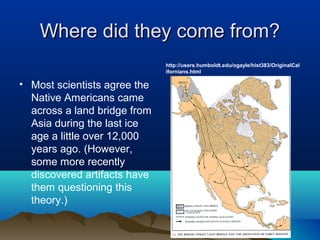
Where did they come from?
                              http://users.humboldt.edu/ogayle/hist383/OriginalCal
                              ifornians.html

• Most scientists agree the
  Native Americans came
  across a land bridge from
  Asia during the last ice
  age a little over 12,000
  years ago. (However,
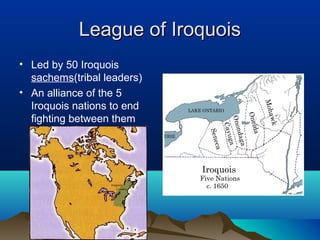
  some more recently
  discovered artifacts have
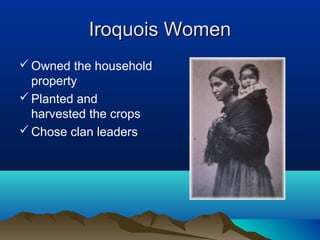
  them questioning this
  theory.)
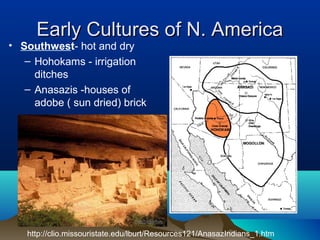
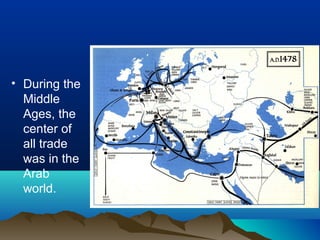
Early Cultures of N. America
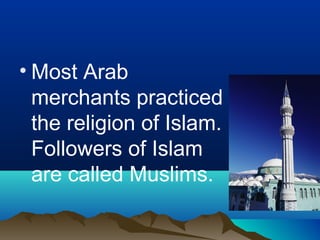
• Southwest- hot and dry
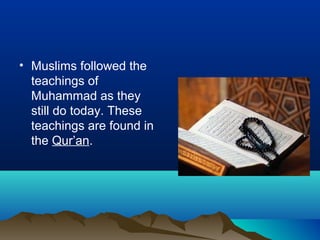
   – Hohokams - irrigation
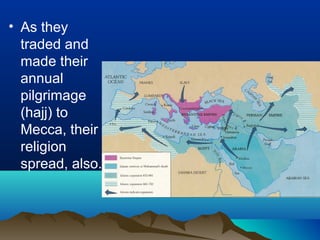
     ditches
   – Anasazis -houses of
     adobe ( sun dried) brick


   http://clio.missouristate.edu/lburt/Resources121/AnasazIndians_1.htm
Culture Areas
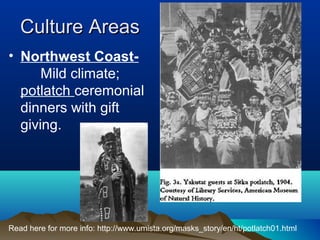
• Northwest Coast-
      Mild climate;
  potlatch ceremonial
  dinners with gift
  giving.


Read here for more info: http://www.umista.org/masks_story/en/ht/potlatch01.html
Culture Areas
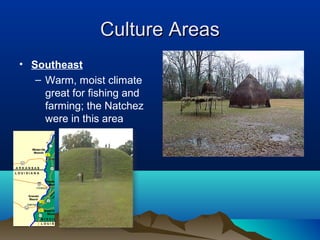
• Southeast
   – Warm, moist climate
     great for fishing and
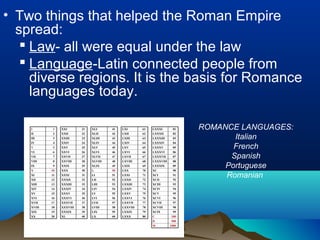
     farming; the Natchez
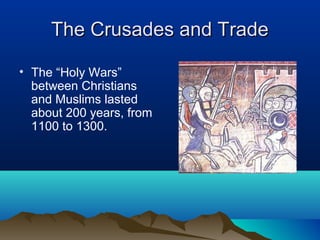
     were in this area
Culture Areas
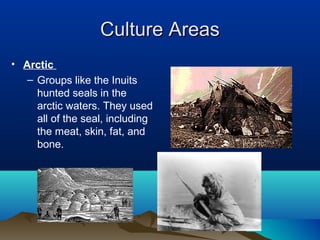
• Arctic
   – Groups like the Inuits
     hunted seals in the
     arctic waters. They used
     all of the seal, including
     the meat, skin, fat, and
     bone.
Culture Areas
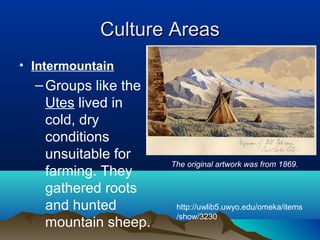
• Intermountain
  – Groups like the
    Utes lived in
    cold, dry
    conditions
    unsuitable for
                      The original artwork was from 1869.
    farming. They
    gathered roots
    and hunted         http://uwlib5.uwyo.edu/omeka/items
                       /show/3230
    mountain sheep.
Culture Areas
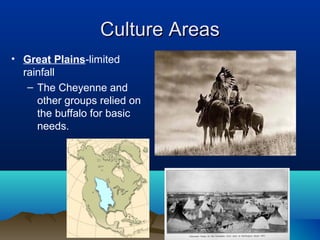
• Great Plains-limited
  rainfall
   – The Cheyenne and
     other groups relied on
     the buffalo for basic
     needs.
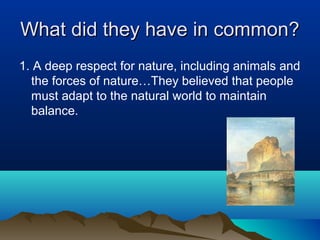
What did they have in common?
1. A deep respect for nature, including animals and
  the forces of nature…They believed that people
  must adapt to the natural world to maintain
  balance.
What did they have in common?
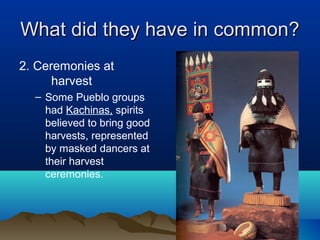
2. Ceremonies at
      harvest
  – Some Pueblo groups
    had Kachinas, spirits
    believed to bring good
    harvests, represented
    by masked dancers at
    their harvest
    ceremonies.
League of the Iroquois allied
     Eastern Woodland groups
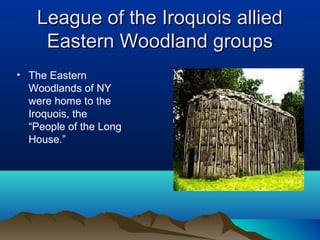
• The Eastern
  Woodlands of NY
  were home to the
  Iroquois, the
  “People of the Long
  House.”
League of Iroquois
• Led by 50 Iroquois
  sachems(tribal leaders)
• An alliance of the 5
  Iroquois nations to end
  fighting between them
Iroquois Women
 Owned the household
  property
 Planted and
  harvested the crops
 Chose clan leaders
Trade Networks of Africa
       and Asia
      Chapter 2.3
• During the
  Middle
  Ages, the
  center of
  all trade
  was in the
  Arab
  world.
• Most Arab
  merchants practiced
  the religion of Islam.
  Followers of Islam
  are called Muslims.
• Muslims followed the
  teachings of
  Muhammad as they
  still do today. These
  teachings are found in
  the Qur’an.
• As they
  traded and
  made their
  annual
  pilgrimage
  (hajj) to
  Mecca, their
  religion
  spread, also.
• As Muslims traded with
  others in Africa, the Middle
  East, Europe, and Asia,
  they began the 1 global
                     st

  age.
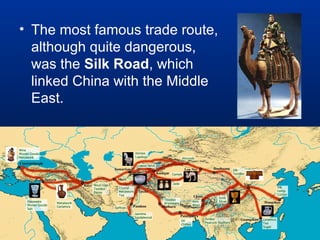
• The most famous trade route,
  although quite dangerous,
  was the Silk Road, which
  linked China with the Middle
  East.
• Initially, the Chinese were
  reluctant to trade with
  outsiders. It was an isolated
  empire.
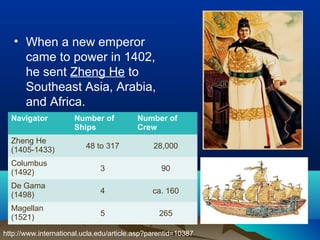
• When a new emperor
     came to power in 1402,
     he sent Zheng He to
     Southeast Asia, Arabia,
     and Africa.
  Navigator           Number of           Number of
                      Ships               Crew
  Zheng He
  (1405-1433)             48 to 317            28,000

  Columbus
  (1492)                      3                  90

  De Gama
  (1498)                      4                ca. 160

  Magellan
  (1521)                      5                  265

http://www.international.ucla.edu/article.asp?parentid=10387
• Later emperors reverted to
  the closed door idea.
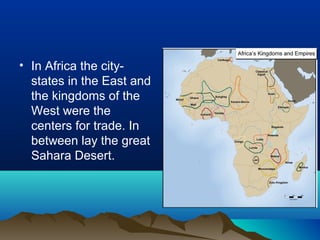
• In Africa the city-
  states in the East and
  the kingdoms of the
  West were the
  centers for trade. In
  between lay the great
  Sahara Desert.
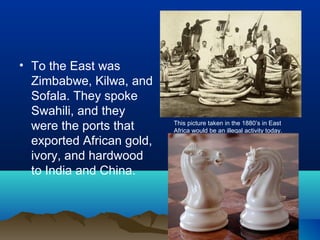
• To the East was
  Zimbabwe, Kilwa, and
  Sofala. They spoke
  Swahili, and they
  were the ports that      This picture taken in the 1880’s in East
                           Africa would be an illegal activity today.
  exported African gold,
  ivory, and hardwood
  to India and China.
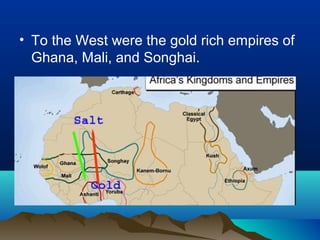
• To the West were the gold rich empires of
  Ghana, Mali, and Songhai.
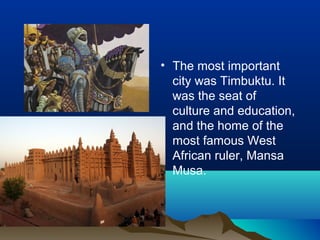
• The most important
  city was Timbuktu. It
  was the seat of
  culture and education,
  and the home of the
  most famous West
  African ruler, Mansa
  Musa.
Tradition and Change in
         Europe
      Chapter 2.4
Jews and Christians
• Both believed in one
  God, who determined
  their laws and moral
  behaviors.
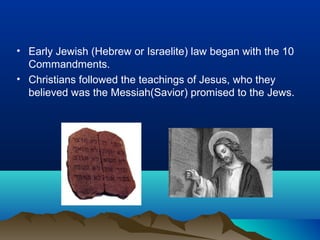
• Early Jewish (Hebrew or Israelite) law began with the 10
  Commandments.
• Christians followed the teachings of Jesus, who they
  believed was the Messiah(Savior) promised to the Jews.
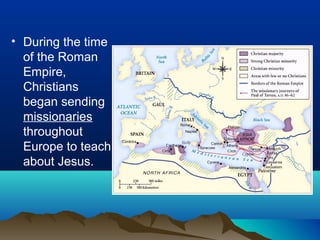
• During the time
  of the Roman
  Empire,
  Christians
  began sending
  missionaries
  throughout
  Europe to teach
  about Jesus.
Greeks and Romans
• Greeks had practiced direct democracy, with
  ordinary citizens voting.
• Romans began as republic, with citizens
  choosing representatives to govern them.
• Two things that helped the Roman Empire
  spread:
    Law- all were equal under the law
    Language-Latin connected people from
     diverse regions. It is the basis for Romance
     languages today.

                               ROMANCE LANGUAGES:
                                      Italian
                                      French
                                     Spanish
                                    Portuguese
                                    Romanian
The Crusades and Trade

• The “Holy Wars”
  between Christians
  and Muslims lasted
  about 200 years, from
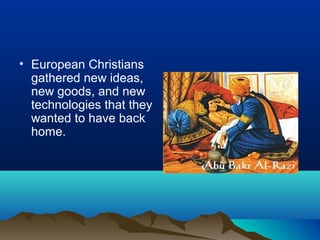
  1100 to 1300.
• European Christians
  gathered new ideas,
  new goods, and new
  technologies that they
  wanted to have back
  home.
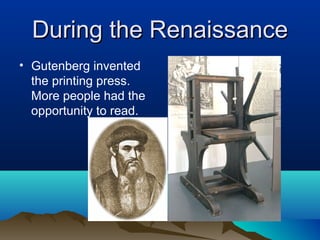
During the Renaissance
• Gutenberg invented
  the printing press.
  More people had the
  opportunity to read.
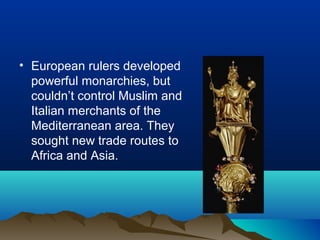
• European rulers developed
  powerful monarchies, but
  couldn’t control Muslim and
  Italian merchants of the
  Mediterranean area. They
  sought new trade routes to
  Africa and Asia.
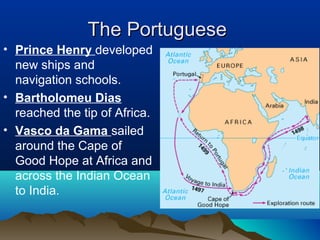
The Portuguese
• Prince Henry developed
  new ships and
  navigation schools.
• Bartholomeu Dias
  reached the tip of Africa.
• Vasco da Gama sailed
  around the Cape of
  Good Hope at Africa and
  across the Indian Ocean
  to India.
Chapter 2.2 2.4

Chapter 2.2 2.4

  • 1.
  • 2.
    Where did theycome from? http://users.humboldt.edu/ogayle/hist383/OriginalCal ifornians.html • Most scientists agree the Native Americans came across a land bridge from Asia during the last ice age a little over 12,000 years ago. (However, some more recently discovered artifacts have them questioning this theory.)
  • 3.
    Early Cultures ofN. America • Southwest- hot and dry – Hohokams - irrigation ditches – Anasazis -houses of adobe ( sun dried) brick http://clio.missouristate.edu/lburt/Resources121/AnasazIndians_1.htm
  • 4.
    Culture Areas • NorthwestCoast- Mild climate; potlatch ceremonial dinners with gift giving. Read here for more info: http://www.umista.org/masks_story/en/ht/potlatch01.html
  • 5.
    Culture Areas • Southeast – Warm, moist climate great for fishing and farming; the Natchez were in this area
  • 6.
    Culture Areas • Arctic – Groups like the Inuits hunted seals in the arctic waters. They used all of the seal, including the meat, skin, fat, and bone.
  • 7.
    Culture Areas • Intermountain – Groups like the Utes lived in cold, dry conditions unsuitable for The original artwork was from 1869. farming. They gathered roots and hunted http://uwlib5.uwyo.edu/omeka/items /show/3230 mountain sheep.
  • 8.
    Culture Areas • GreatPlains-limited rainfall – The Cheyenne and other groups relied on the buffalo for basic needs.
  • 9.
    What did theyhave in common? 1. A deep respect for nature, including animals and the forces of nature…They believed that people must adapt to the natural world to maintain balance.
  • 10.
    What did theyhave in common? 2. Ceremonies at harvest – Some Pueblo groups had Kachinas, spirits believed to bring good harvests, represented by masked dancers at their harvest ceremonies.
  • 11.
    League of theIroquois allied Eastern Woodland groups • The Eastern Woodlands of NY were home to the Iroquois, the “People of the Long House.”
  • 12.
    League of Iroquois •Led by 50 Iroquois sachems(tribal leaders) • An alliance of the 5 Iroquois nations to end fighting between them
  • 13.
    Iroquois Women  Ownedthe household property  Planted and harvested the crops  Chose clan leaders
  • 14.
    Trade Networks ofAfrica and Asia Chapter 2.3
  • 15.
    • During the Middle Ages, the center of all trade was in the Arab world.
  • 16.
    • Most Arab merchants practiced the religion of Islam. Followers of Islam are called Muslims.
  • 17.
    • Muslims followedthe teachings of Muhammad as they still do today. These teachings are found in the Qur’an.
  • 18.
    • As they traded and made their annual pilgrimage (hajj) to Mecca, their religion spread, also.
  • 19.
    • As Muslimstraded with others in Africa, the Middle East, Europe, and Asia, they began the 1 global st age.
  • 20.
    • The mostfamous trade route, although quite dangerous, was the Silk Road, which linked China with the Middle East.
  • 21.
    • Initially, theChinese were reluctant to trade with outsiders. It was an isolated empire.
  • 22.
    • When anew emperor came to power in 1402, he sent Zheng He to Southeast Asia, Arabia, and Africa. Navigator Number of Number of Ships Crew Zheng He (1405-1433) 48 to 317 28,000 Columbus (1492) 3 90 De Gama (1498) 4 ca. 160 Magellan (1521) 5 265 http://www.international.ucla.edu/article.asp?parentid=10387
  • 23.
    • Later emperorsreverted to the closed door idea.
  • 24.
    • In Africathe city- states in the East and the kingdoms of the West were the centers for trade. In between lay the great Sahara Desert.
  • 25.
    • To theEast was Zimbabwe, Kilwa, and Sofala. They spoke Swahili, and they were the ports that This picture taken in the 1880’s in East Africa would be an illegal activity today. exported African gold, ivory, and hardwood to India and China.
  • 26.
    • To theWest were the gold rich empires of Ghana, Mali, and Songhai.
  • 27.
    • The mostimportant city was Timbuktu. It was the seat of culture and education, and the home of the most famous West African ruler, Mansa Musa.
  • 28.
    Tradition and Changein Europe Chapter 2.4
  • 29.
    Jews and Christians •Both believed in one God, who determined their laws and moral behaviors.
  • 30.
    • Early Jewish(Hebrew or Israelite) law began with the 10 Commandments. • Christians followed the teachings of Jesus, who they believed was the Messiah(Savior) promised to the Jews.
  • 31.
    • During thetime of the Roman Empire, Christians began sending missionaries throughout Europe to teach about Jesus.
  • 32.
    Greeks and Romans •Greeks had practiced direct democracy, with ordinary citizens voting. • Romans began as republic, with citizens choosing representatives to govern them.
  • 33.
    • Two thingsthat helped the Roman Empire spread:  Law- all were equal under the law  Language-Latin connected people from diverse regions. It is the basis for Romance languages today. ROMANCE LANGUAGES: Italian French Spanish Portuguese Romanian
  • 34.
    The Crusades andTrade • The “Holy Wars” between Christians and Muslims lasted about 200 years, from 1100 to 1300.
  • 35.
    • European Christians gathered new ideas, new goods, and new technologies that they wanted to have back home.
  • 36.
    During the Renaissance •Gutenberg invented the printing press. More people had the opportunity to read.
  • 37.
    • European rulersdeveloped powerful monarchies, but couldn’t control Muslim and Italian merchants of the Mediterranean area. They sought new trade routes to Africa and Asia.
  • 38.
    The Portuguese • PrinceHenry developed new ships and navigation schools. • Bartholomeu Dias reached the tip of Africa. • Vasco da Gama sailed around the Cape of Good Hope at Africa and across the Indian Ocean to India.