BY THEISA
Procedural Programming can be defined as a programming
model which is derived from structured programming, based
upon the concept of calling procedure.
Procedures, also known as routines, subroutines or functions,
simply consist of a series of computational steps to be carried
out.
During a program’s execution, any given procedure might be
called at any point, including by other procedures or itself.
Languages used in Procedural Programming:
FORTRAN, ALGOL, COBOL
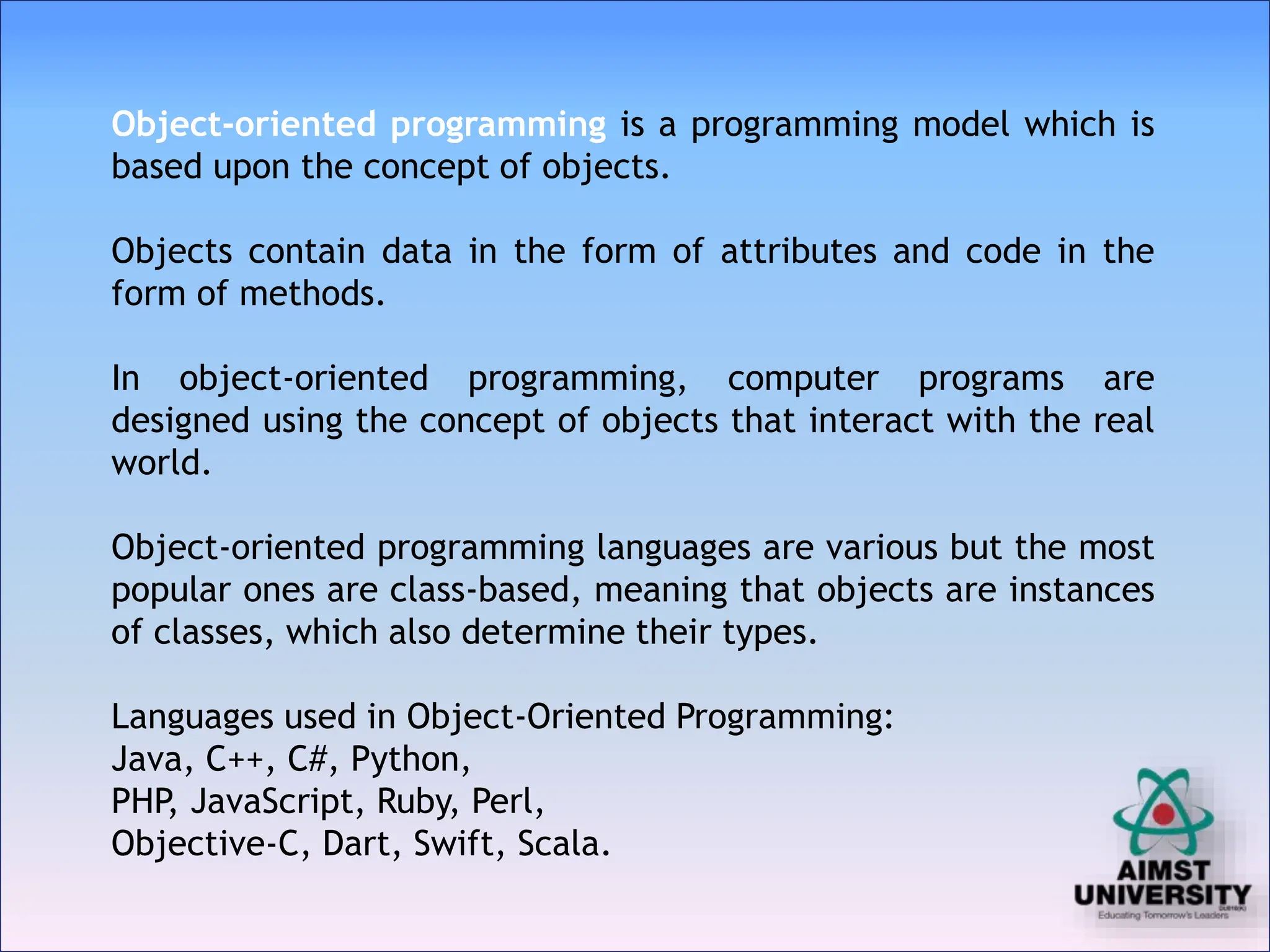
Object-oriented programming is a programming model which is
based upon the concept of objects.
Objects contain data in the form of attributes and code in the
form of methods.
In object-oriented programming, computer programs are
designed using the concept of objects that interact with the real
world.
Object-oriented programming languages are various but the most
popular ones are class-based, meaning that objects are instances
of classes, which also determine their types.
Languages used in Object-Oriented Programming:
Java, C++, C#, Python,
PHP
, JavaScript, Ruby, Perl,
Objective-C, Dart, Swift, Scala.
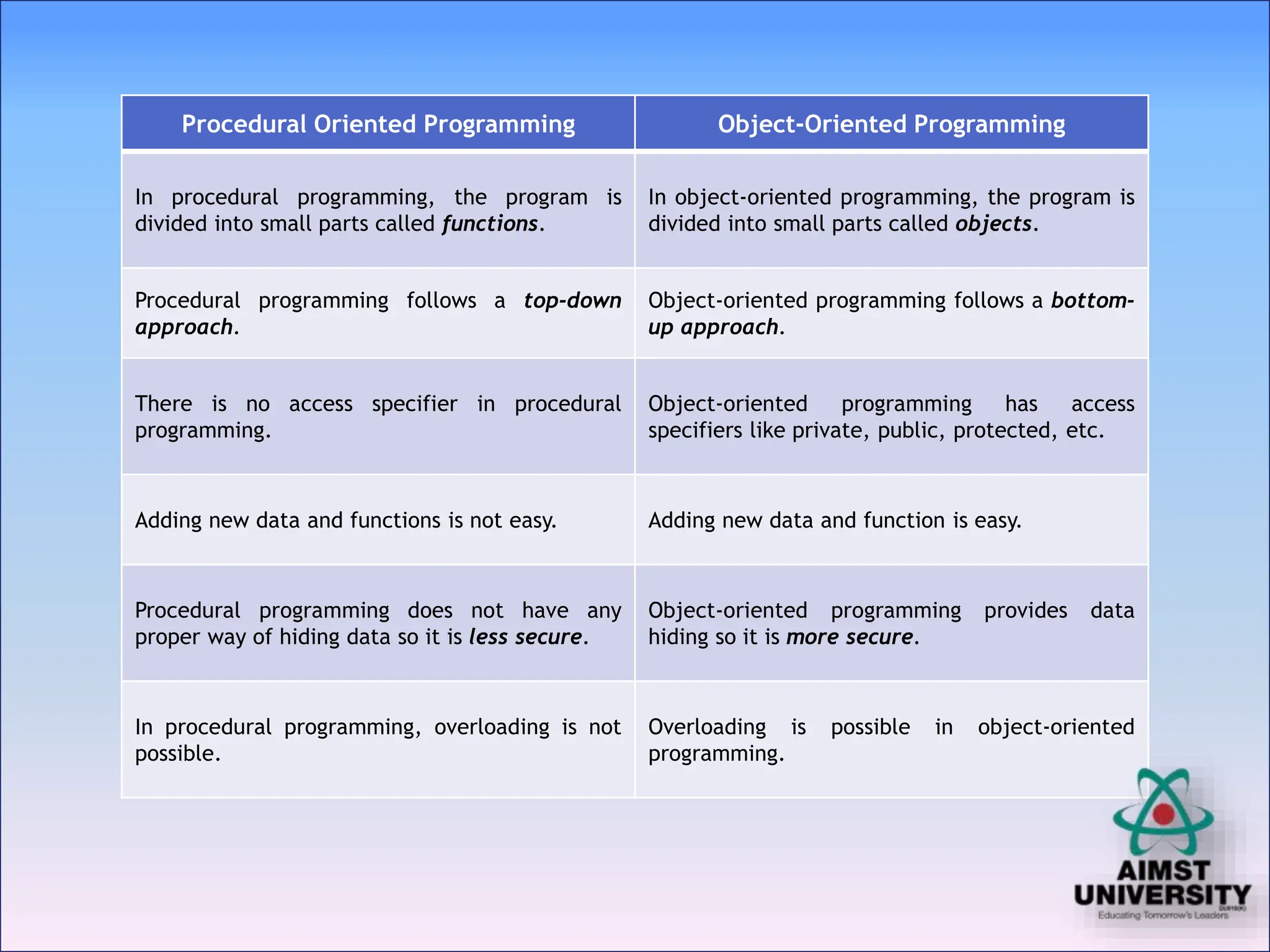
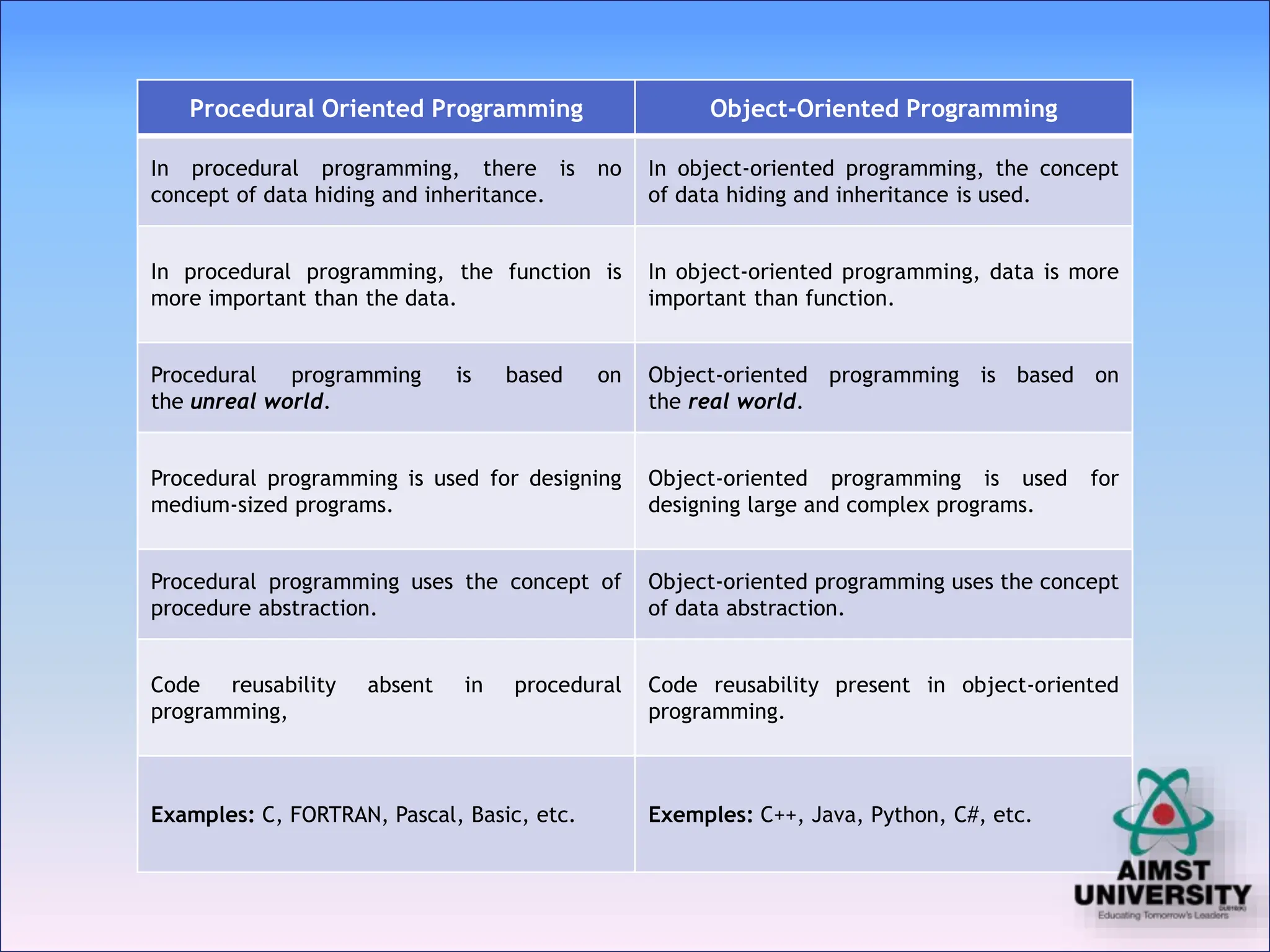
Procedural Oriented Programming Object-Oriented Programming
In procedural programming, the program is
divided into small parts called functions.
In object-oriented programming, the program is
divided into small parts called objects.
Procedural programming follows a top-down
approach.
Object-oriented programming follows a bottom-
up approach.
There is no access specifier in procedural
programming.
Object-oriented programming has access
specifiers like private, public, protected, etc.
Adding new data and functions is not easy. Adding new data and function is easy.
Procedural programming does not have any
proper way of hiding data so it is less secure.
Object-oriented programming provides data
hiding so it is more secure.
In procedural programming, overloading is not
possible.
Overloading is possible in object-oriented
programming.
Procedural Oriented Programming Object-Oriented Programming
In procedural programming, there is no
concept of data hiding and inheritance.
In object-oriented programming, the concept
of data hiding and inheritance is used.
In procedural programming, the function is
more important than the data.
In object-oriented programming, data is more
important than function.
Procedural programming is based on
the unreal world.
Object-oriented programming is based on
the real world.
Procedural programming is used for designing
medium-sized programs.
Object-oriented programming is used for
designing large and complex programs.
Procedural programming uses the concept of
procedure abstraction.
Object-oriented programming uses the concept
of data abstraction.
Code reusability absent in procedural
programming,
Code reusability present in object-oriented
programming.
Examples: C, FORTRAN, Pascal, Basic, etc. Exemples: C++, Java, Python, C#, etc.
1 #1 JAVA
Advantages - Simple,
secure, an official
Android language,
robust, platform-
independent.
Disadvantages - Slow,
requires a lot of memory,
poor GUI.
2 #2N PYTHON
Advantages - Ideal for
data science, artificial
intelligence, and machine
learning, flexible, plenty
of libraries, huge
community, user-friendly.
Disadvantages - Relatively
slow, high memory
consumption.
3 #3 C++
Advantages - Portable, multi-
paradigm, good memory
management, high
performance, large
community of support,
scalable.
Disadvantages - No garbage
collection, less safe than
some other object-oriented
counterparts, complex, less
flexible.
4 #4 C#
Advantages - Type-safe,
memory access capabilities,
part of the C family of
programming languages,
simple, flexible, inbuilt
garbage collection, more
secure than some other C
languages, cross-platform.
Disadvantages - Generally
limited to the Windows
sphere, relies on .NET, no
independent compiler, limited
performance.
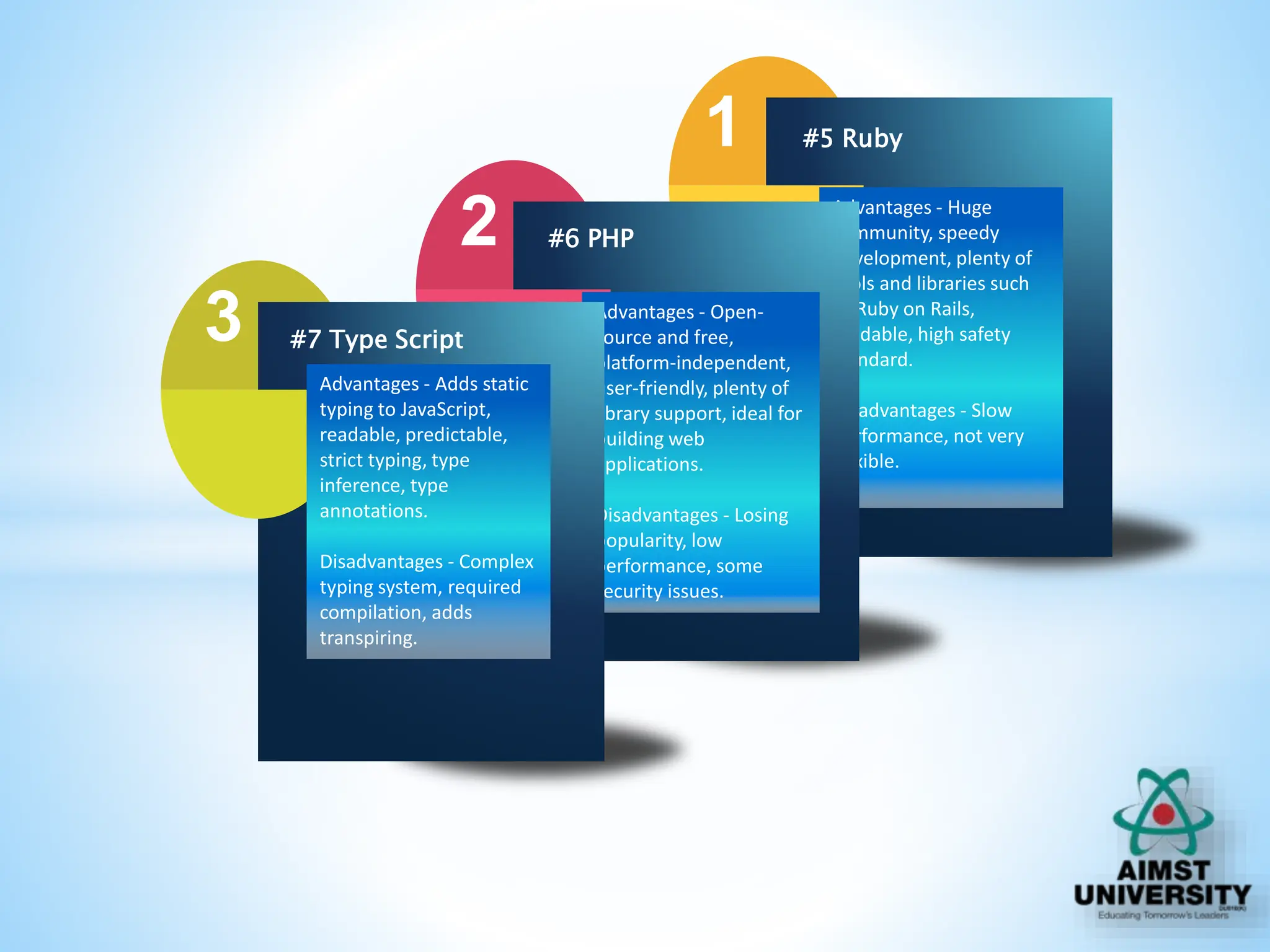
1 #5 Ruby
Advantages - Huge
community, speedy
development, plenty of
tools and libraries such
as Ruby on Rails,
readable, high safety
standard.
Disadvantages - Slow
performance, not very
flexible.
2 #6 PHP
Advantages - Open-
source and free,
platform-independent,
user-friendly, plenty of
library support, ideal for
building web
applications.
Disadvantages - Losing
popularity, low
performance, some
security issues.
3 #7 Type Script
Advantages - Adds static
typing to JavaScript,
readable, predictable,
strict typing, type
inference, type
annotations.
Disadvantages - Complex
typing system, required
compilation, adds
transpiring.
CHAPTER 2 object oriented programming.pptx

CHAPTER 2 object oriented programming.pptx

  • 1.
  • 2.
    Procedural Programming canbe defined as a programming model which is derived from structured programming, based upon the concept of calling procedure. Procedures, also known as routines, subroutines or functions, simply consist of a series of computational steps to be carried out. During a program’s execution, any given procedure might be called at any point, including by other procedures or itself. Languages used in Procedural Programming: FORTRAN, ALGOL, COBOL
  • 3.
    Object-oriented programming isa programming model which is based upon the concept of objects. Objects contain data in the form of attributes and code in the form of methods. In object-oriented programming, computer programs are designed using the concept of objects that interact with the real world. Object-oriented programming languages are various but the most popular ones are class-based, meaning that objects are instances of classes, which also determine their types. Languages used in Object-Oriented Programming: Java, C++, C#, Python, PHP , JavaScript, Ruby, Perl, Objective-C, Dart, Swift, Scala.
  • 4.
    Procedural Oriented ProgrammingObject-Oriented Programming In procedural programming, the program is divided into small parts called functions. In object-oriented programming, the program is divided into small parts called objects. Procedural programming follows a top-down approach. Object-oriented programming follows a bottom- up approach. There is no access specifier in procedural programming. Object-oriented programming has access specifiers like private, public, protected, etc. Adding new data and functions is not easy. Adding new data and function is easy. Procedural programming does not have any proper way of hiding data so it is less secure. Object-oriented programming provides data hiding so it is more secure. In procedural programming, overloading is not possible. Overloading is possible in object-oriented programming.
  • 5.
    Procedural Oriented ProgrammingObject-Oriented Programming In procedural programming, there is no concept of data hiding and inheritance. In object-oriented programming, the concept of data hiding and inheritance is used. In procedural programming, the function is more important than the data. In object-oriented programming, data is more important than function. Procedural programming is based on the unreal world. Object-oriented programming is based on the real world. Procedural programming is used for designing medium-sized programs. Object-oriented programming is used for designing large and complex programs. Procedural programming uses the concept of procedure abstraction. Object-oriented programming uses the concept of data abstraction. Code reusability absent in procedural programming, Code reusability present in object-oriented programming. Examples: C, FORTRAN, Pascal, Basic, etc. Exemples: C++, Java, Python, C#, etc.
  • 6.
    1 #1 JAVA Advantages- Simple, secure, an official Android language, robust, platform- independent. Disadvantages - Slow, requires a lot of memory, poor GUI. 2 #2N PYTHON Advantages - Ideal for data science, artificial intelligence, and machine learning, flexible, plenty of libraries, huge community, user-friendly. Disadvantages - Relatively slow, high memory consumption. 3 #3 C++ Advantages - Portable, multi- paradigm, good memory management, high performance, large community of support, scalable. Disadvantages - No garbage collection, less safe than some other object-oriented counterparts, complex, less flexible. 4 #4 C# Advantages - Type-safe, memory access capabilities, part of the C family of programming languages, simple, flexible, inbuilt garbage collection, more secure than some other C languages, cross-platform. Disadvantages - Generally limited to the Windows sphere, relies on .NET, no independent compiler, limited performance.
  • 7.
    1 #5 Ruby Advantages- Huge community, speedy development, plenty of tools and libraries such as Ruby on Rails, readable, high safety standard. Disadvantages - Slow performance, not very flexible. 2 #6 PHP Advantages - Open- source and free, platform-independent, user-friendly, plenty of library support, ideal for building web applications. Disadvantages - Losing popularity, low performance, some security issues. 3 #7 Type Script Advantages - Adds static typing to JavaScript, readable, predictable, strict typing, type inference, type annotations. Disadvantages - Complex typing system, required compilation, adds transpiring.