Introduction to Health Insurance Chapter 2
Announcements Library class time meetings Name tags (first name) Open Lab (Tuesdays & Thursdays) Rm. 118 Midterm is an exam! (50 pts) Project (interview 4 people) due same day as midterm exam (October 28)
Defining Health Insurance Health insurance Contract between a policyholder and a third-party payer  or government program to reimburse the policyholder  for all or a portion of the cost of medically necessary  treatment or preventive care provided by health care  Professionals Medical care Identification of disease and treatment of those who are  sick, injured, or concerned about their health Health care Medical care + preventive service
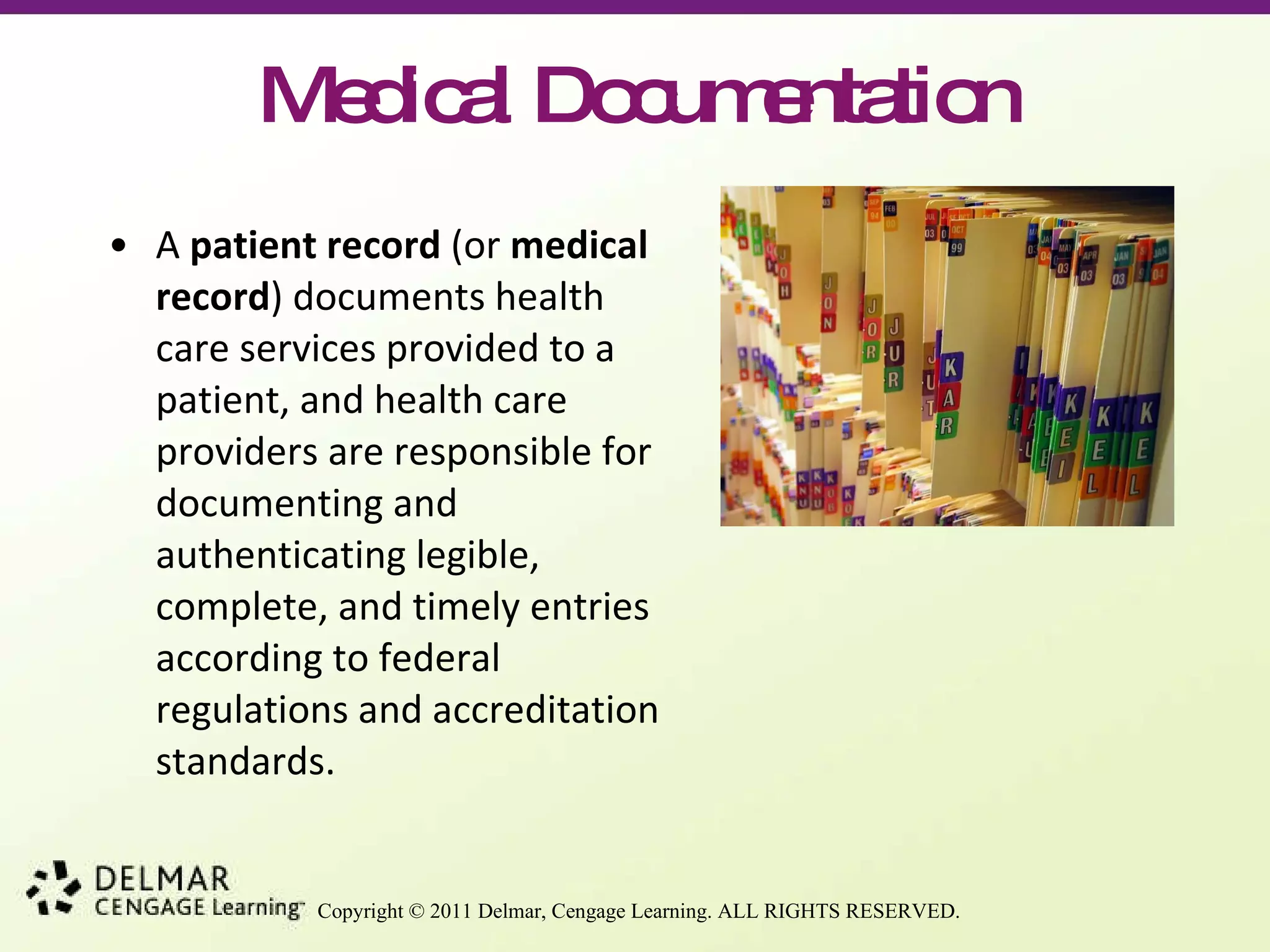
Medical Documentation A  patient record  (or  medical record ) documents health care services provided to a patient, and health care providers are responsible for documenting and authenticating legible, complete, and timely entries according to federal regulations and accreditation standards.
Medical Documentation “ If it wasn’t documented, it wasn’t done.”
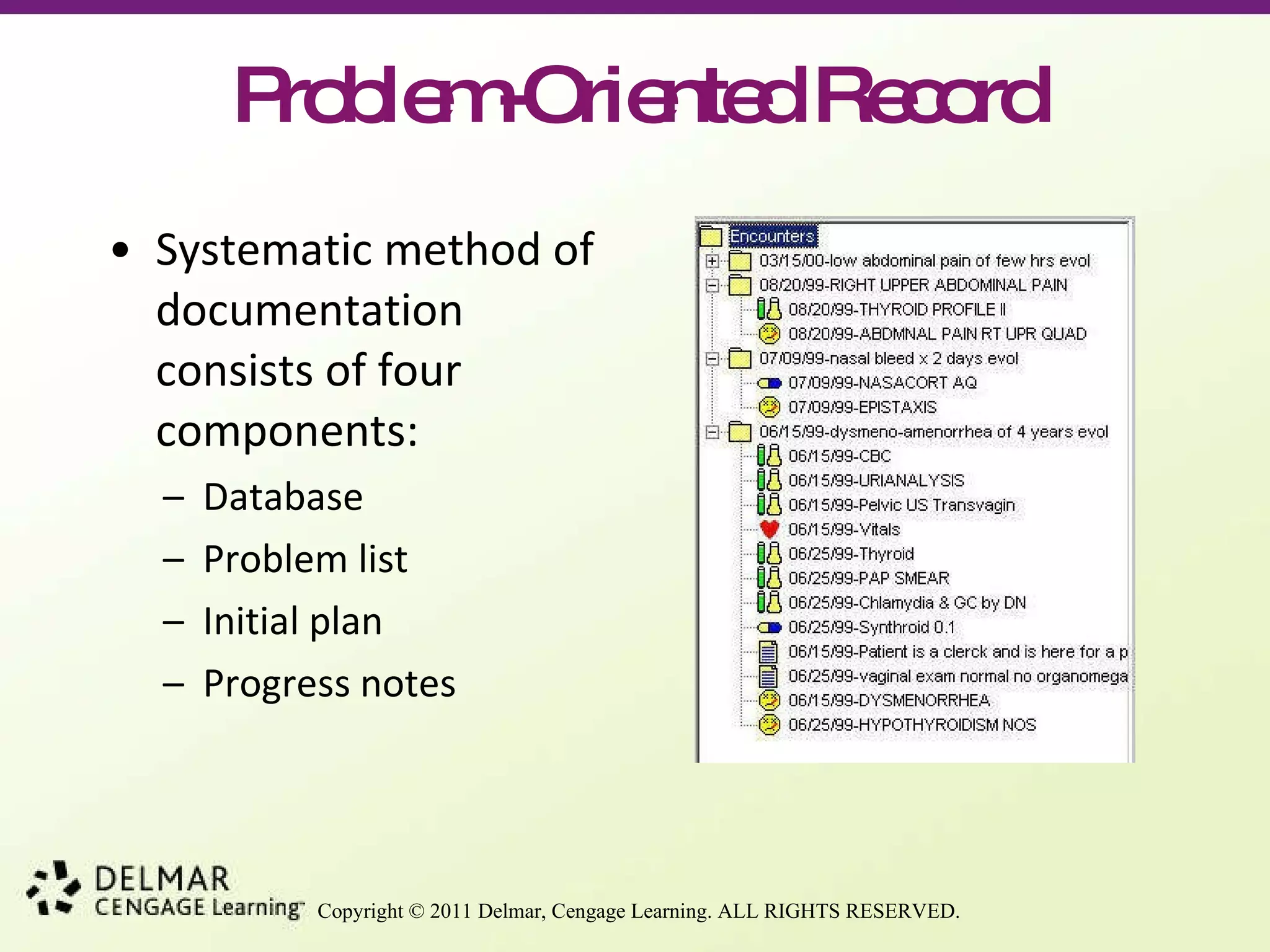
Problem-Oriented Record Systematic method of documentation consists of four components: Database Problem list Initial plan Progress notes
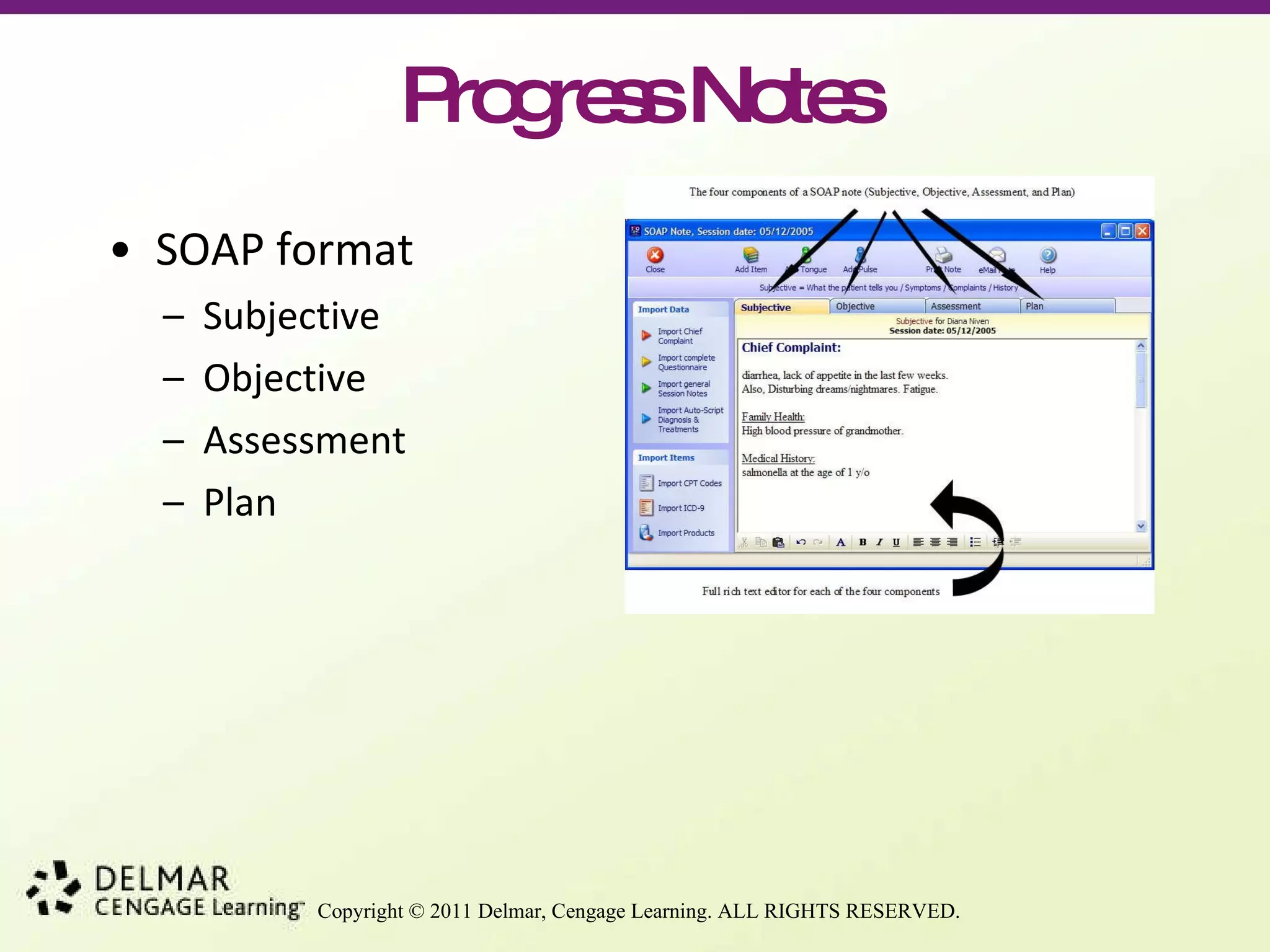
Progress Notes SOAP format Subjective Objective Assessment Plan
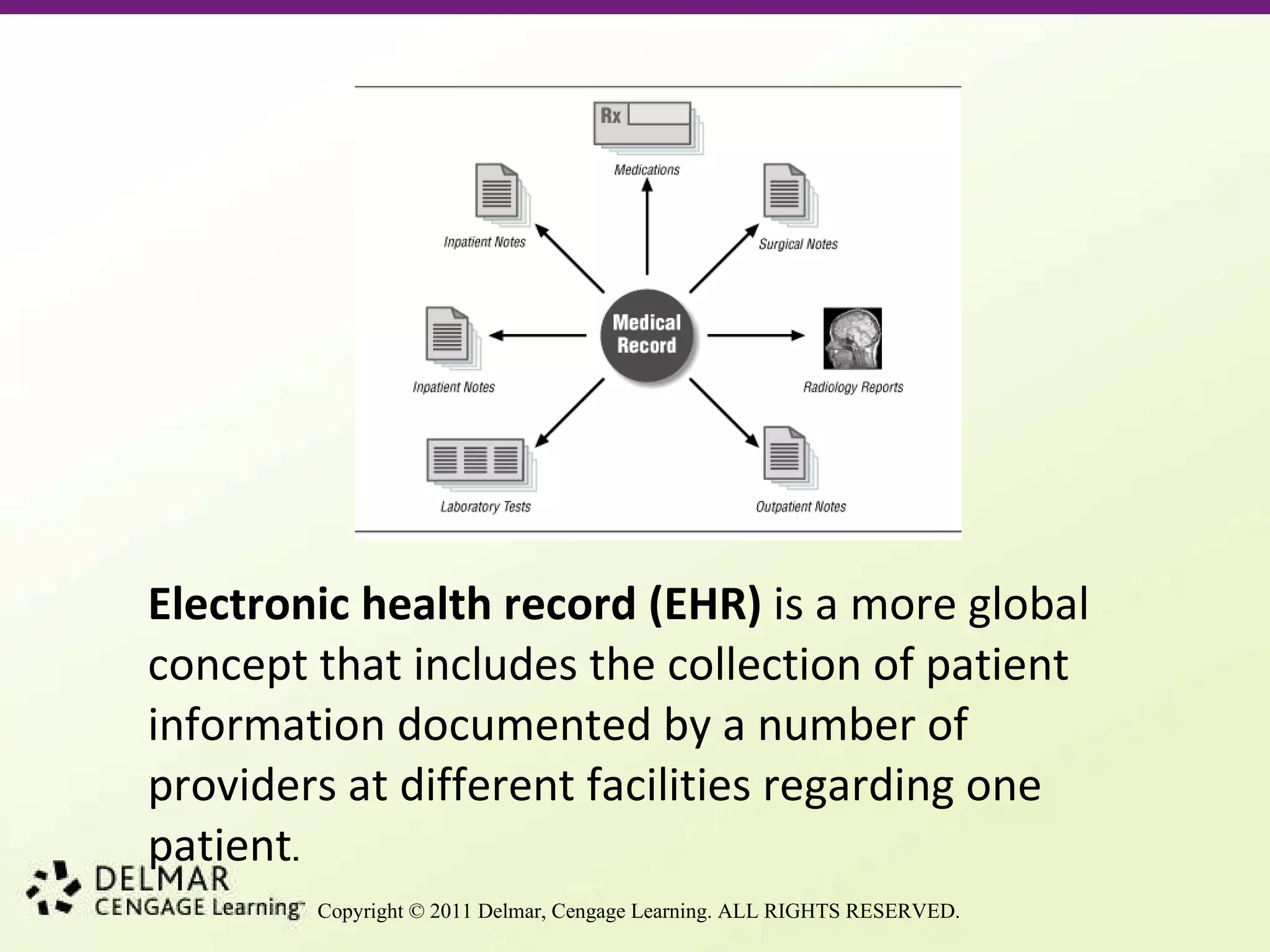
Electronic health record (EHR)  is a more global concept that includes the collection of patient information documented by a number of providers at different facilities regarding one patient .
Managed Health Care Chapter 3
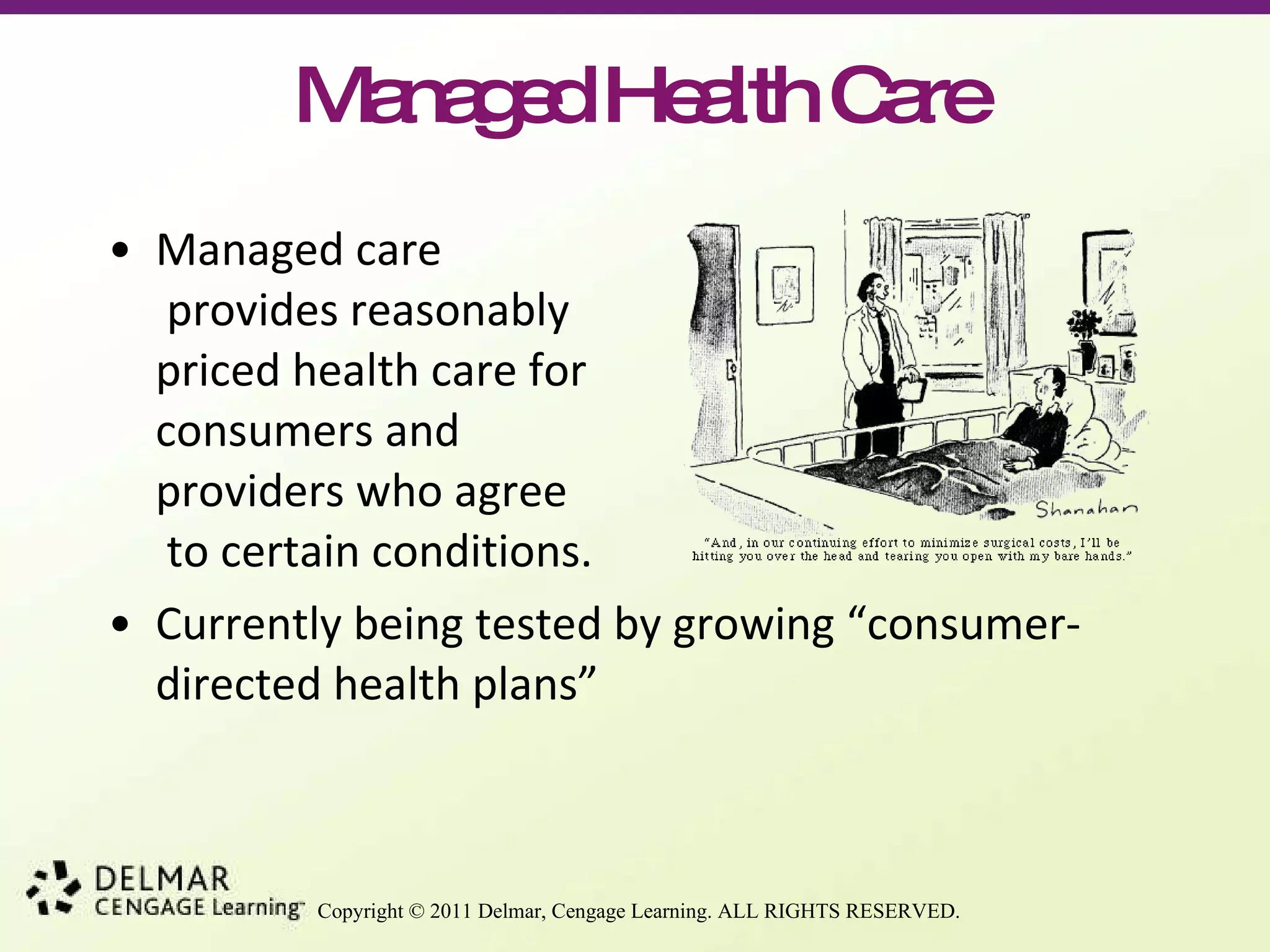
Managed Health Care Managed care  provides reasonably  priced health care for  consumers and  providers who agree  to certain conditions.  Currently being tested by growing “consumer-directed health plans”
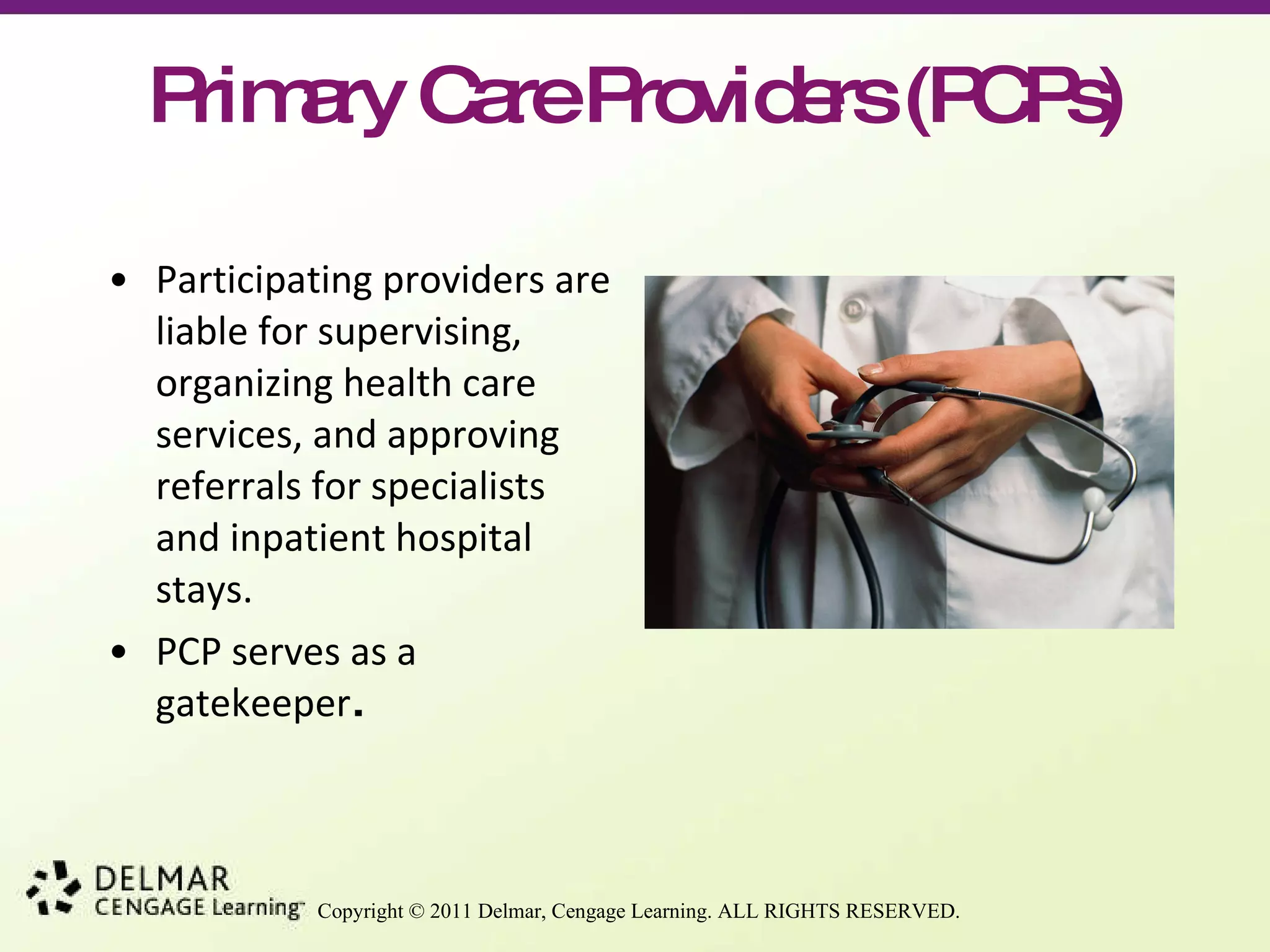
Primary Care Providers (PCPs) Participating providers are liable for supervising, organizing health care services, and approving referrals for specialists and inpatient hospital stays. PCP serves as a gatekeeper .
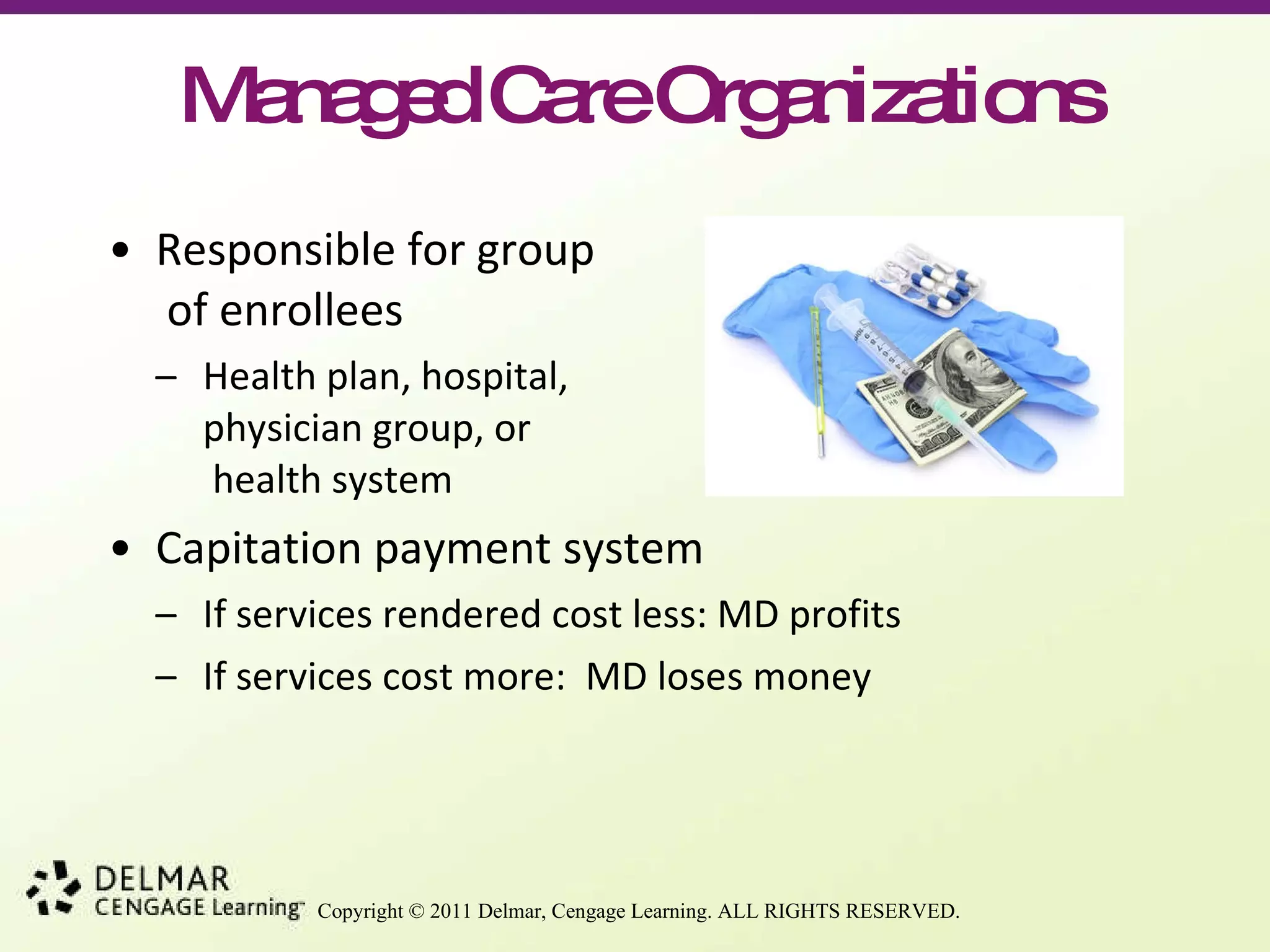
Managed Care Organizations Responsible for group  of enrollees Health plan, hospital, physician group, or  health system Capitation payment system If services rendered cost less: MD profits If services cost more:  MD loses money
Quality Assurance Activities that assess the quality of care in a health care setting  Types Government oversight Patient satisfaction surveys Data from grievance procedures Reviews by independent organizations NCQA and The Joint Commission
Utilization Management (Utilization Review) System of controlling health care costs and quality of care by evaluating care provided Preadmission certification Review of necessary medical outpatient treatment Preauthorization Prior approval for reimbursements
Managed Care Models EPO – Exclusive Provider Organization IDS – Integrated Delivery System HMO – Health Maintenance Organization POS – Point of Service PPO – Preferred Provider Organization TOP – Triple Option Plan
Managed Care Group Project Divide into 6 groups. Select a group  reporter. Each group will report on one managed model group. Name 3 things that make this type of group different from the others. Present to the class a short explanation  using your own words.
Consumer-Directed Health Plans Provide individuals with an incentive to control the costs of health benefits and health care Full coverage for in-network preventive care Freedom to spend up to a designated amount Members assume responsibility for higher cost sharing after designated amount is expended
Accreditation Voluntary process that a health care facility or organization (e.g., hospital or managed care plan) undergoes to demonstrate that it has met standards beyond those required by law NCQA
Impact of Managed Care on Physician Office Separate bookkeeping systems Tracking system for preauthorizations Preauthorizations/precertifications Referrals Special administrative procedures Copayments

Chapter 2 & 3

  • 1.
    Introduction to HealthInsurance Chapter 2
  • 2.
    Announcements Library classtime meetings Name tags (first name) Open Lab (Tuesdays & Thursdays) Rm. 118 Midterm is an exam! (50 pts) Project (interview 4 people) due same day as midterm exam (October 28)
  • 3.
    Defining Health InsuranceHealth insurance Contract between a policyholder and a third-party payer or government program to reimburse the policyholder for all or a portion of the cost of medically necessary treatment or preventive care provided by health care Professionals Medical care Identification of disease and treatment of those who are sick, injured, or concerned about their health Health care Medical care + preventive service
  • 4.
    Medical Documentation A patient record (or medical record ) documents health care services provided to a patient, and health care providers are responsible for documenting and authenticating legible, complete, and timely entries according to federal regulations and accreditation standards.
  • 5.
    Medical Documentation “If it wasn’t documented, it wasn’t done.”
  • 6.
    Problem-Oriented Record Systematicmethod of documentation consists of four components: Database Problem list Initial plan Progress notes
  • 7.
    Progress Notes SOAPformat Subjective Objective Assessment Plan
  • 8.
    Electronic health record(EHR) is a more global concept that includes the collection of patient information documented by a number of providers at different facilities regarding one patient .
  • 9.
  • 10.
    Managed Health CareManaged care provides reasonably priced health care for consumers and providers who agree to certain conditions. Currently being tested by growing “consumer-directed health plans”
  • 11.
    Primary Care Providers(PCPs) Participating providers are liable for supervising, organizing health care services, and approving referrals for specialists and inpatient hospital stays. PCP serves as a gatekeeper .
  • 12.
    Managed Care OrganizationsResponsible for group of enrollees Health plan, hospital, physician group, or health system Capitation payment system If services rendered cost less: MD profits If services cost more: MD loses money
  • 13.
    Quality Assurance Activitiesthat assess the quality of care in a health care setting Types Government oversight Patient satisfaction surveys Data from grievance procedures Reviews by independent organizations NCQA and The Joint Commission
  • 14.
    Utilization Management (UtilizationReview) System of controlling health care costs and quality of care by evaluating care provided Preadmission certification Review of necessary medical outpatient treatment Preauthorization Prior approval for reimbursements
  • 15.
    Managed Care ModelsEPO – Exclusive Provider Organization IDS – Integrated Delivery System HMO – Health Maintenance Organization POS – Point of Service PPO – Preferred Provider Organization TOP – Triple Option Plan
  • 16.
    Managed Care GroupProject Divide into 6 groups. Select a group reporter. Each group will report on one managed model group. Name 3 things that make this type of group different from the others. Present to the class a short explanation using your own words.
  • 17.
    Consumer-Directed Health PlansProvide individuals with an incentive to control the costs of health benefits and health care Full coverage for in-network preventive care Freedom to spend up to a designated amount Members assume responsibility for higher cost sharing after designated amount is expended
  • 18.
    Accreditation Voluntary processthat a health care facility or organization (e.g., hospital or managed care plan) undergoes to demonstrate that it has met standards beyond those required by law NCQA
  • 19.
    Impact of ManagedCare on Physician Office Separate bookkeeping systems Tracking system for preauthorizations Preauthorizations/precertifications Referrals Special administrative procedures Copayments

Editor's Notes

  • #4 In 2008, The CDC states that 43.6 million people under age 65 are uninsured, or 17 % population Of those, children under 18, 8.9% uninsured; adults 18-64, 20% (taken from National Health Interview Survey, 2007)
  • #5 Records include Patient demographic data Documentation to support diagnoses and justify treatment provided Results of treatment provided Continuity of care involves documenting patient care services so that others who treat the patient have a source of information to assist with additional care and treatment Documentation includes dictated and transcribed, typed or handwritten, and computer-generated notes and reports recorded in the patient’s records by a health care professional. Must be dated and authenticated (with a legible signature or electronic authentication) Documentation in the patient record serves as the basis for coding. The patient’s diagnosis must also justify diagnostic and/or therapeutic procedures or services provided Medical necessity Proper and needed for the diagnosis or treatment of a medical condition Provided for the diagnosis, direct care, and treatment of a medical condition Consistent with standards of good medical practice in the local area Not mainly for the convenience of the physician or health care facility
  • #6 If a provider performs a service but does not document it, the patient (or third-party payer) can refuse to pay for that service, resulting in loss in revenue for the provider.
  • #7 Problem-Oriented Database Chief complaint Present conditions and diagnoses Social data Past, personal, medical, and social history Review of systems Physical examination Baseline laboratory data
  • #9 Provides access to complete and accurate patient health problems, status, and treatment data Allows access to evidence-based decision support tools (e.g., drug interaction alerts) that assist providers with decision-making Automates and streamlines a provider’s workflow, ensuring that all clinical information is communicated Prevents delays in health care response that result in gaps in care (e.g., automated prescription renewal notices) Supports the collection of data for uses other than clinical care (e.g., billing, outcome reporting, public health disease surveillance/reporting, and quality management) More narrow focus because it is the patient record created for a single medical practice using a computer, keyboard, mouse, optical pen device, voice recognition system, scanner, and/or touch screen Includes a patient’s medication lists, problem lists, clinical notes, and other documentation Allows providers to prescribe medications and order and view results of ancillary tests (e.g., laboratory, radiology) Alerts the provider about drug interactions, abnormal ancillary testing results, and when ancillary tests are needed Total Practice Management Software Used to generate the EMR, automating the following medical practice functions: Registering patients Scheduling appointments Generating insurance claims and patient statements Processing payments from patient and third-party payers Producing administrative and clinical reports
  • #11 Managed Care Developed Affordable health care 2. Comprehensive health care 3. Prepaid health care
  • #14 QISMC Ensures accountability of plans through objective, measurable standards HEDIS Performance measures used to evaluate managed care plans (report cards)
  • #15 Concurrent review Review of necessary medical inpatient treatment Discharge planning Arrangement of appropriate health care services for patient prior to discharge URO – Used by some managed care plans for establishing a utilization management program TPA – Third-Party Administrator provides health benefits claims administration and other outsourced services for self-insured companies
  • #16 EPO – Exclusive Provider Organization Most restrictive of the models Member must receive all care within the network Care outside network results in full cost paid by member IDS – Integrated Delivery System organization of affiliated providers’ sites (e.g., hospitals, ambulatory surgical centers, or physician groups) that offer joint health care services to subscribers Models: PHO, MSO, GPWW, IPO, medical foundation HMO – Health Maintenance Organization provides comprehensive health care services to voluntarily enrolled members on a prepaid basis Preventive care services, health risk assessments Members must have PCP Copayments POS – Point of Service Freedom to use managed care panel or self-refer In-network services incur standard out-of-pocket costs (copayment) Out-of-network services require payment of deductible and/or coinsurance PPO – Preferred Provider Organization Network of physicians and hospitals joined together in contract with insurance companies, employers, or other organizations to provide health care to members at a discounted rate Use of non-PPO providers results in higher out-of-pocket costs Premiums, deductibles, copayments higher than HMO TOP – Triple Option Plan Choice of HMO, PPO, and traditional health insurance plan Cafeteria plan
  • #18 Three tiers Tax exempt account used to pay for health care expenses – provides more flexibility Out-of-pocket payments after tax exempt amount reached and before deductible (gap in coverage) High-deductible insurance policy – reimburses allowable health care expenses after deductible met Types Customized subcapitation Flexible spending account Health savings account; health savings security account Health care reimbursement account Health reimbursement account VEBA
  • #20 Patient interviews for preauthorizations and explaining out-of-network requirements if self-referring Additional paperwork for specialists Some MCOs employ case managers to follow-up with patients. Attachment of preauthorization documentation to some claims