BMCG 4213
Vibration Monitoring of Rotating
Machines
Lesson 1
Review
Dr Roszaidi Ramlan
Introducing Vibration
• To be come an expert in the field of vibration,
a person needs to have a thorough
understanding on:
qHow to make a measurement
qWhat you are measuring
qWhat the signals look like
qHow to interpret final data graphically
• Familiarization on waveform and spectrum
Review
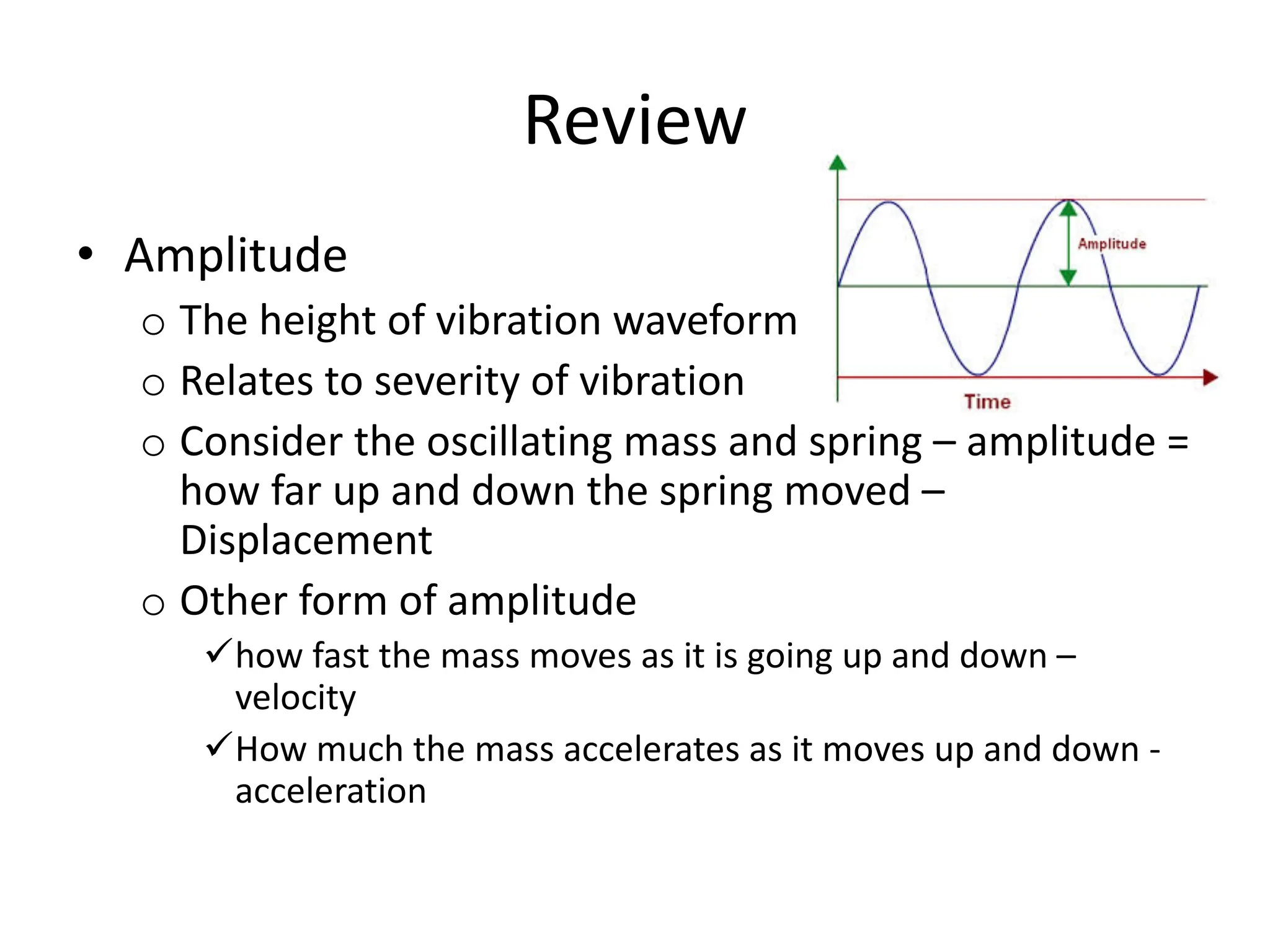
• Amplitude
o The height of vibration waveform
o Relates to severity of vibration
o Consider the oscillating mass and spring – amplitude =
how far up and down the spring moved –
Displacement
o Other form of amplitude
ühow fast the mass moves as it is going up and down –
velocity
üHow much the mass accelerates as it moves up and down -
acceleration
Review
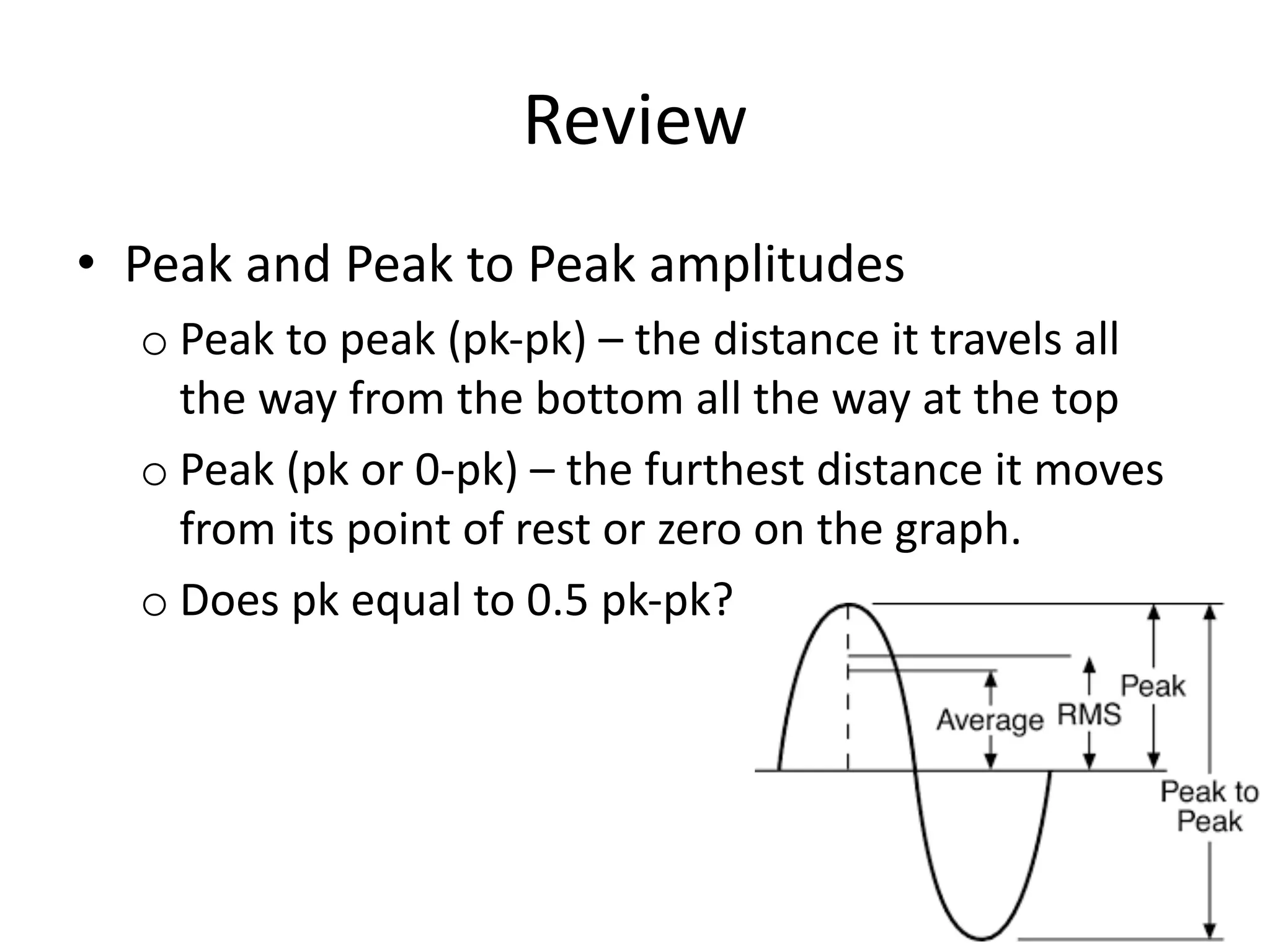
• Peak and Peak to Peak amplitudes
o Peak to peak (pk-pk) – the distance it travels all
the way from the bottom all the way at the top
o Peak (pk or 0-pk) – the furthest distance it moves
from its point of rest or zero on the graph.
o Does pk equal to 0.5 pk-pk?
Review
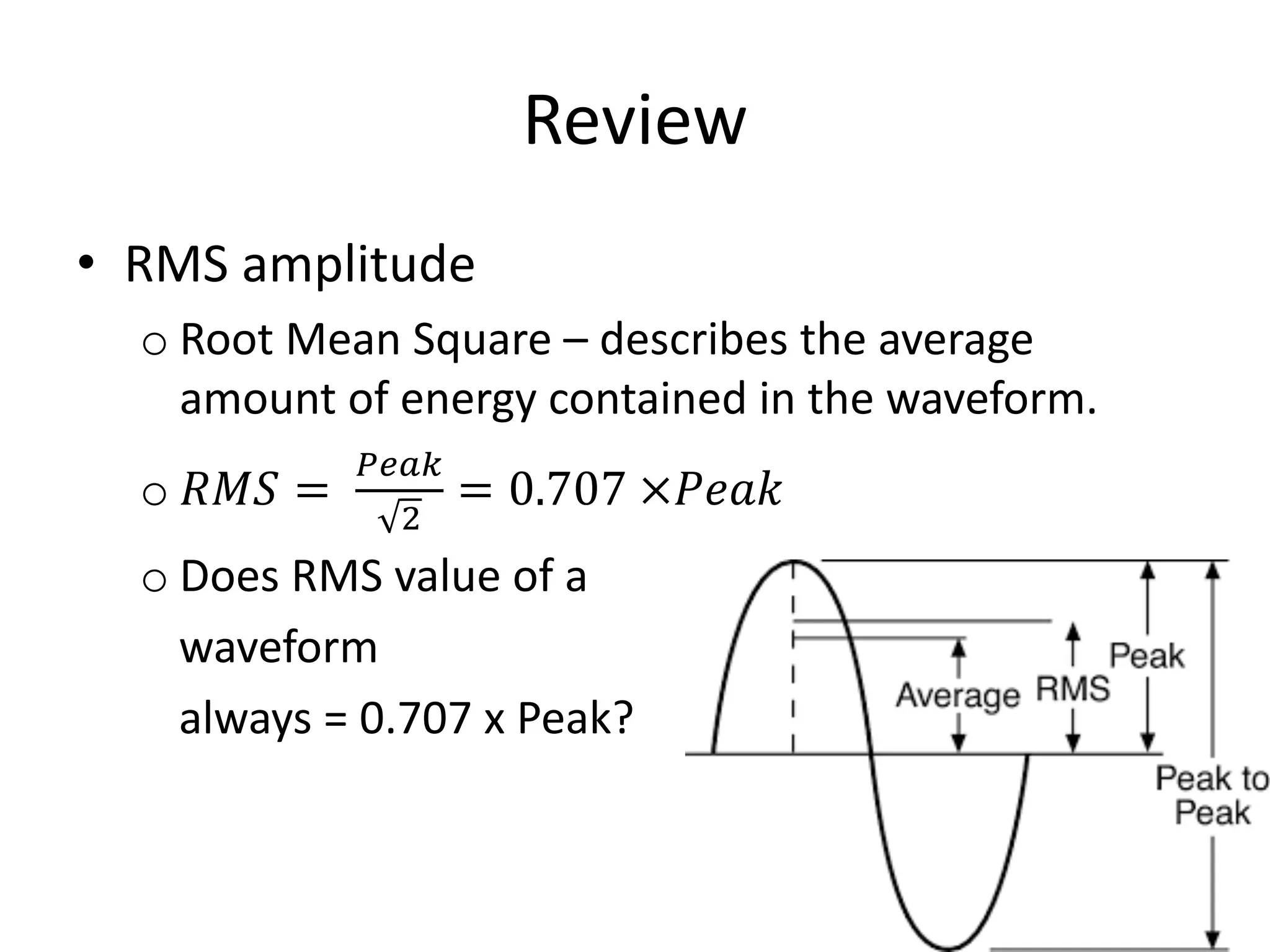
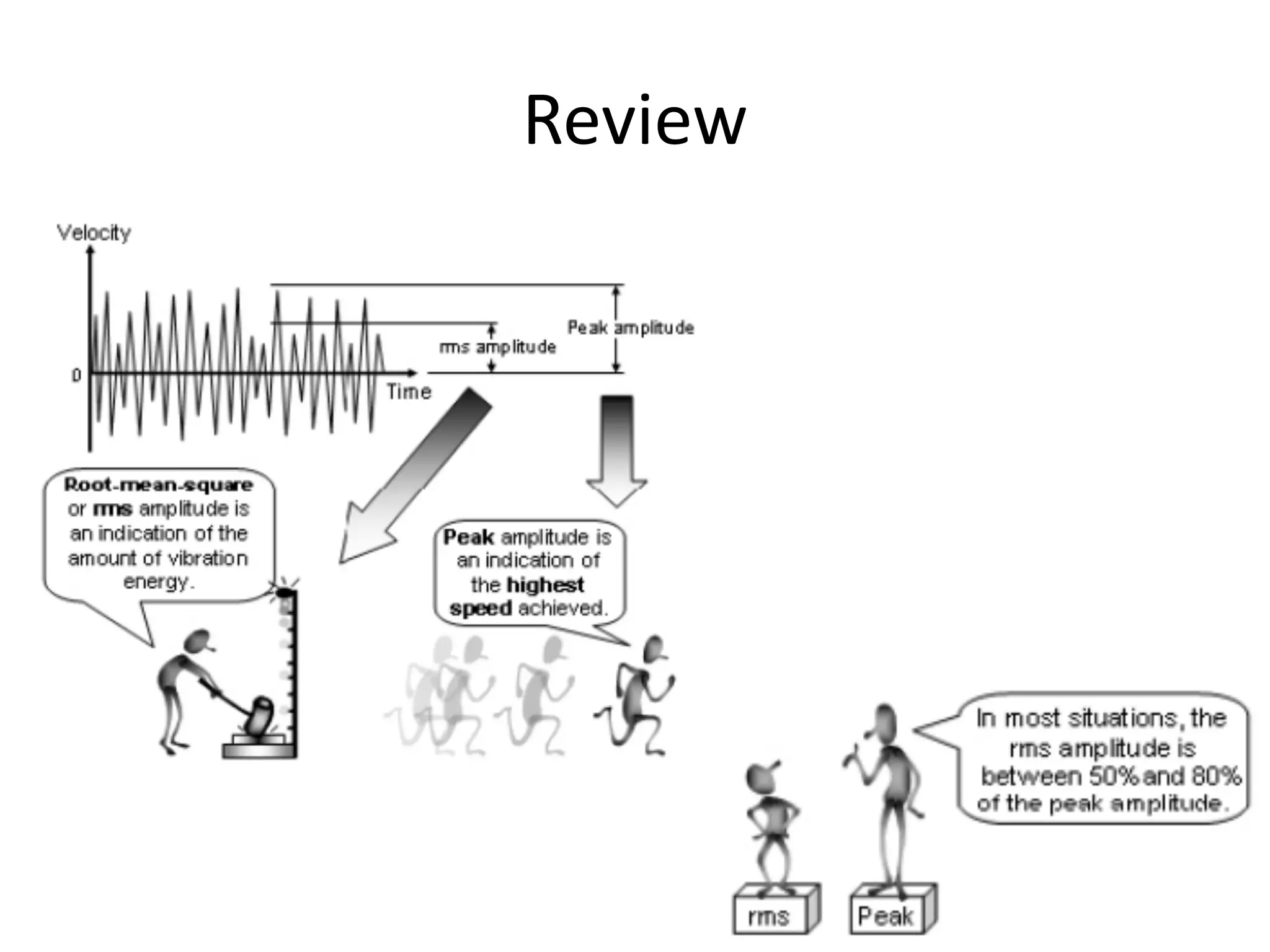
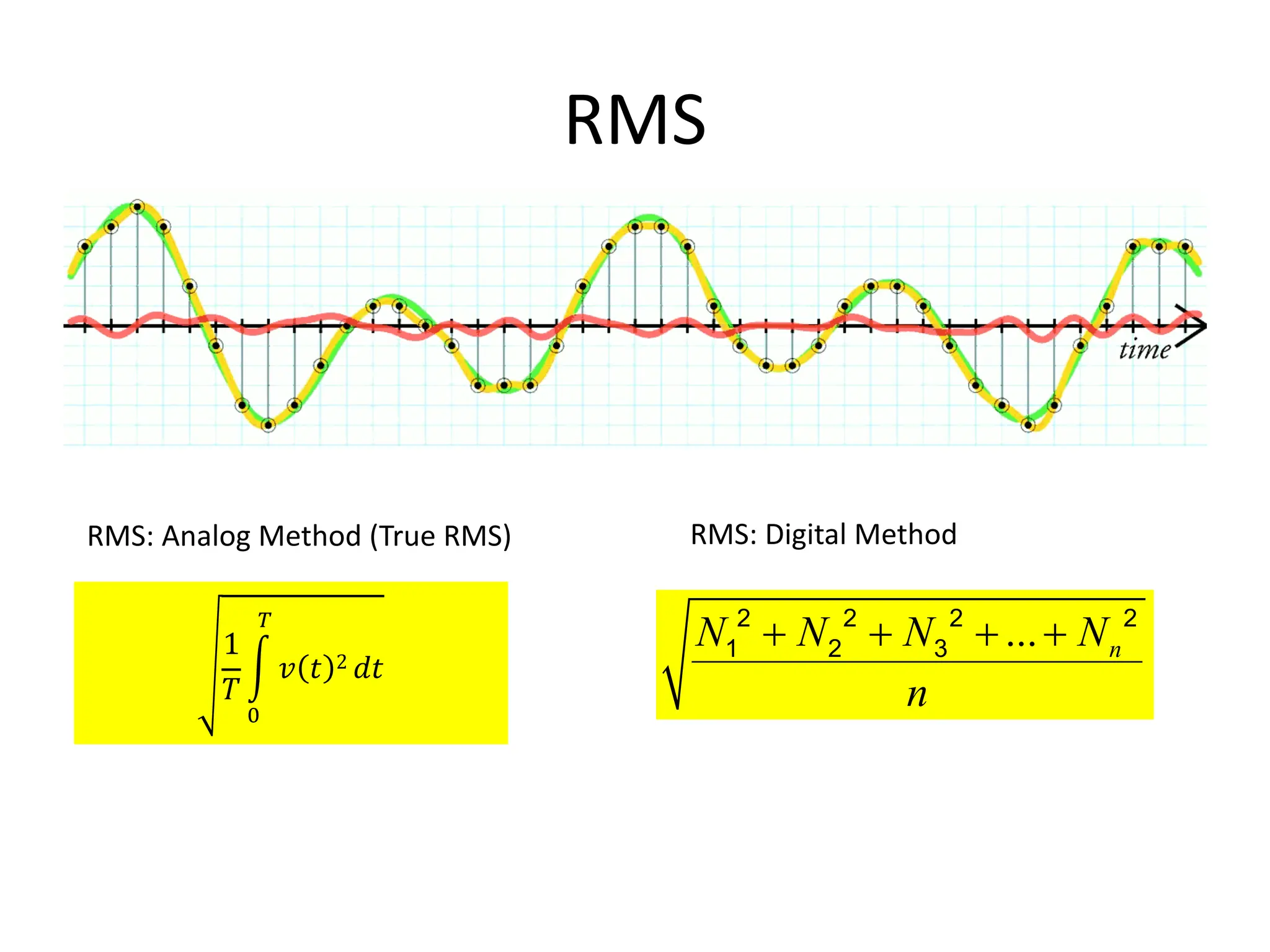
• RMS amplitude
o Root Mean Square – describes the average
amount of energy contained in the waveform.
o 𝑅𝑀𝑆 =
&'()
*
= 0.707 ×𝑃𝑒𝑎𝑘
o Does RMS value of a
waveform
always = 0.707 x Peak?
Review
Review
• Frequency
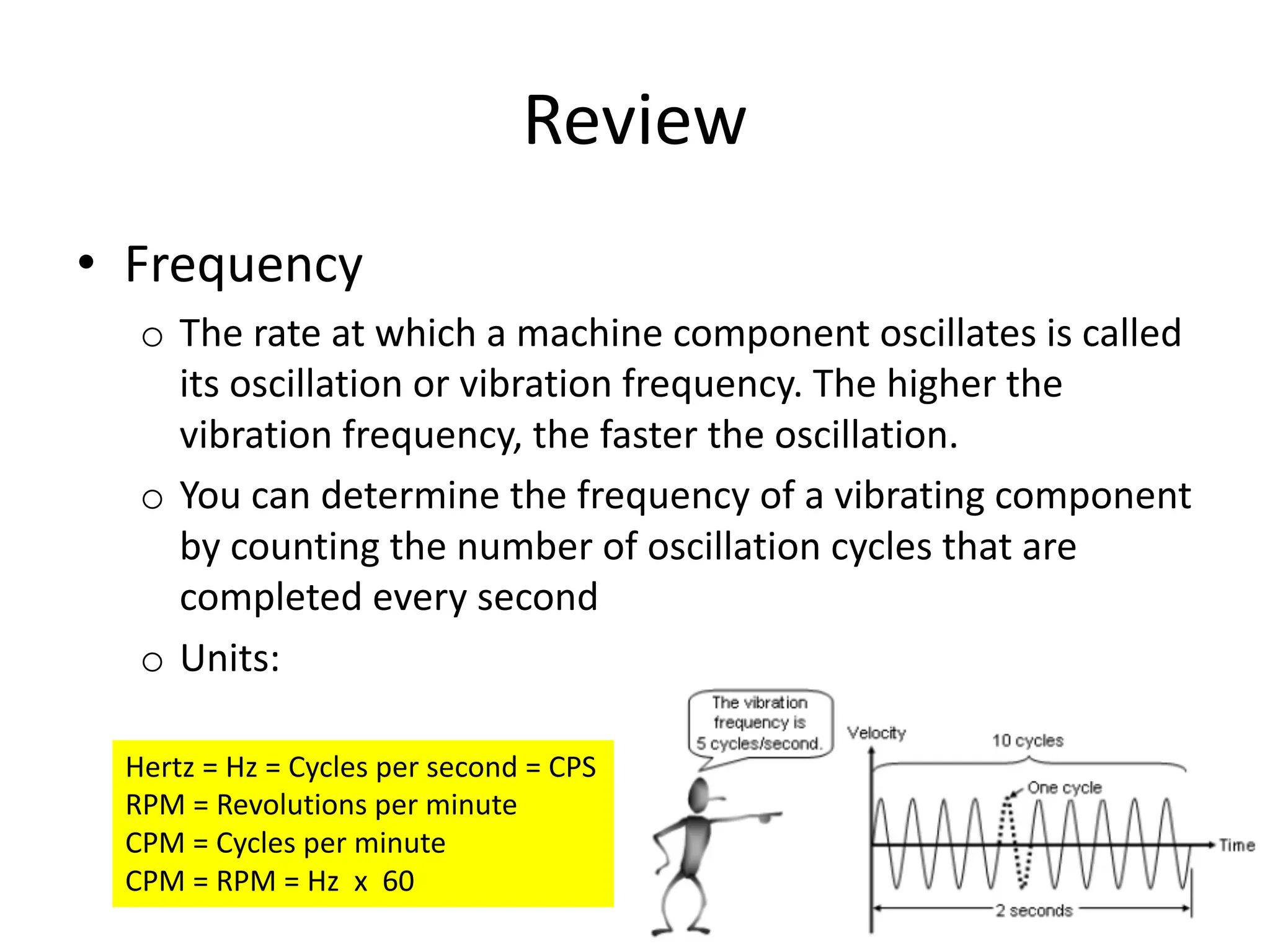
o The rate at which a machine component oscillates is called
its oscillation or vibration frequency. The higher the
vibration frequency, the faster the oscillation.
o You can determine the frequency of a vibrating component
by counting the number of oscillation cycles that are
completed every second
o Units:
Hertz = Hz = Cycles per second = CPS
RPM = Revolutions per minute
CPM = Cycles per minute
CPM = RPM = Hz x 60
Review
• Frequency
o CPM vs RPM
• CPM is the more general term and can be used to
describe things that are not “rotating”
• Example – heart beat – my heart beats at 100 beats per
minute = my heart rate is 100 CPM
• It would not sound right to say my heart rate is 100
RPM.
Review
• Displacement
o The movement of an object in terms of distance.
In rotating machinery, proximity probes measure
the distance between the sensor and the shaft.
o Typical units are: Metric (micron pk-pk), Imperial
(mils pk-pk)
o 1 micron = 0.04 mils, thus 1 mil = ? Micron
Review
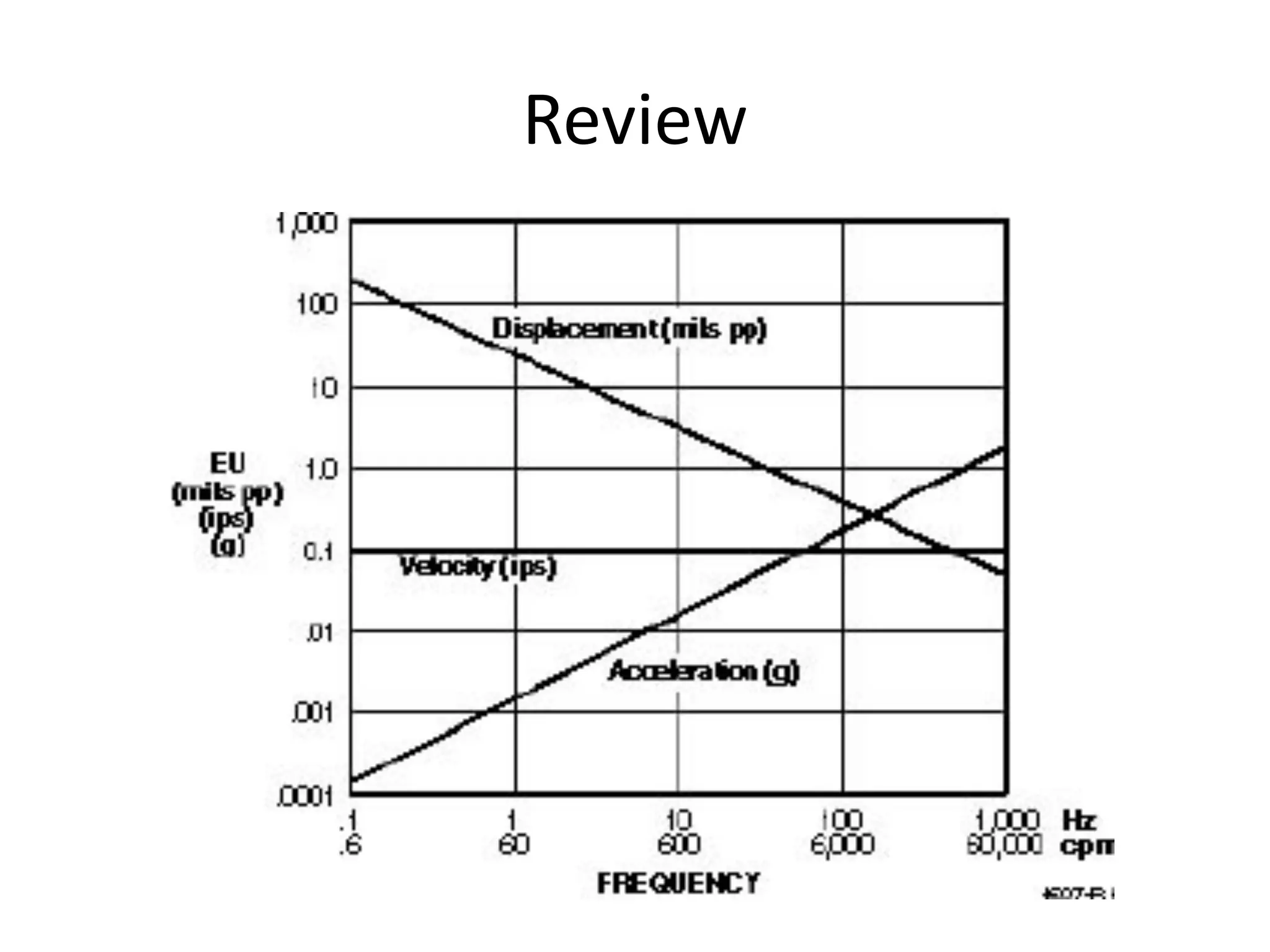
• Important characteristics of displacement
o High at low frequencies
o Low at high frequencies
o Unit of choice typically involving low speed
machines (below 600 RPM)
o Measured using proximity probes
o Proportional to stress
Review
• Velocity
o Rate of change of displacement
o Typical units are: Metric (mm/sec RMS), Imperial
in/sec pk (or IPS pk)
o 1 mm = 0.04 inch, 1 inch = ? mm
o Good measure of vibration across most machine
speeds and frequencies between 2 – 2000 Hz (120 –
120000 CPM)
o Proportional to fatigue
o Leads displacement by 90 degrees
Review
• Acceleration
o Rate of change of velocity
o Popular and preferred measurement of vibration due to
greater dynamic range of most data collector.
o Typical units: Metric ( g’s, mm/sec2 rms, m/s2 rms),
Imperial (g’s rms, in/s2 , AdB
o Sensitive at high frequencies
o Typically used at high speed machines greater than 10000
rpm.
o Also used on high frequency analysis such as bearing and
gearbox analysis.
o Proportional to the force within a machine.
o Lead velocity by 90 degrees
Review
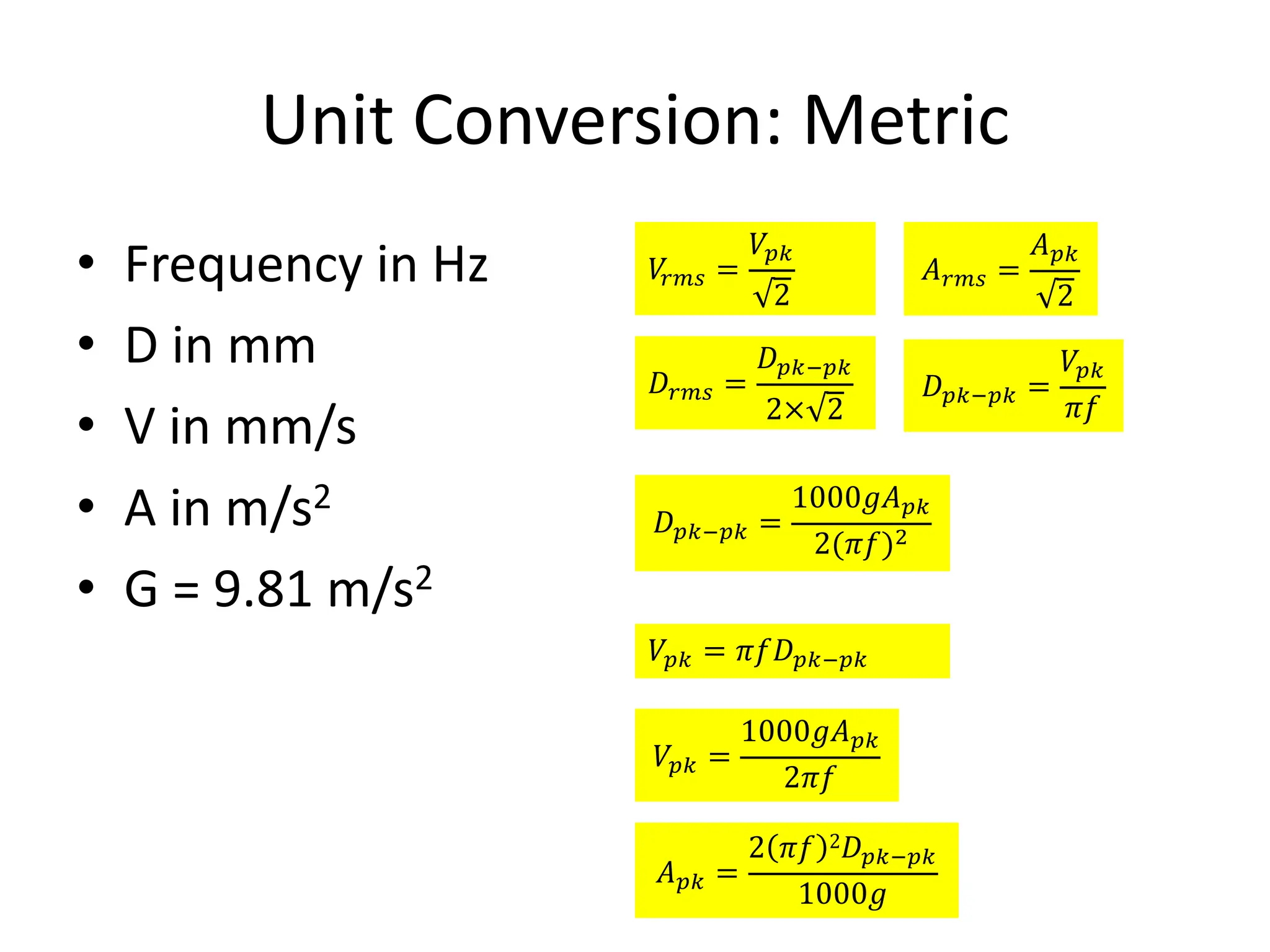
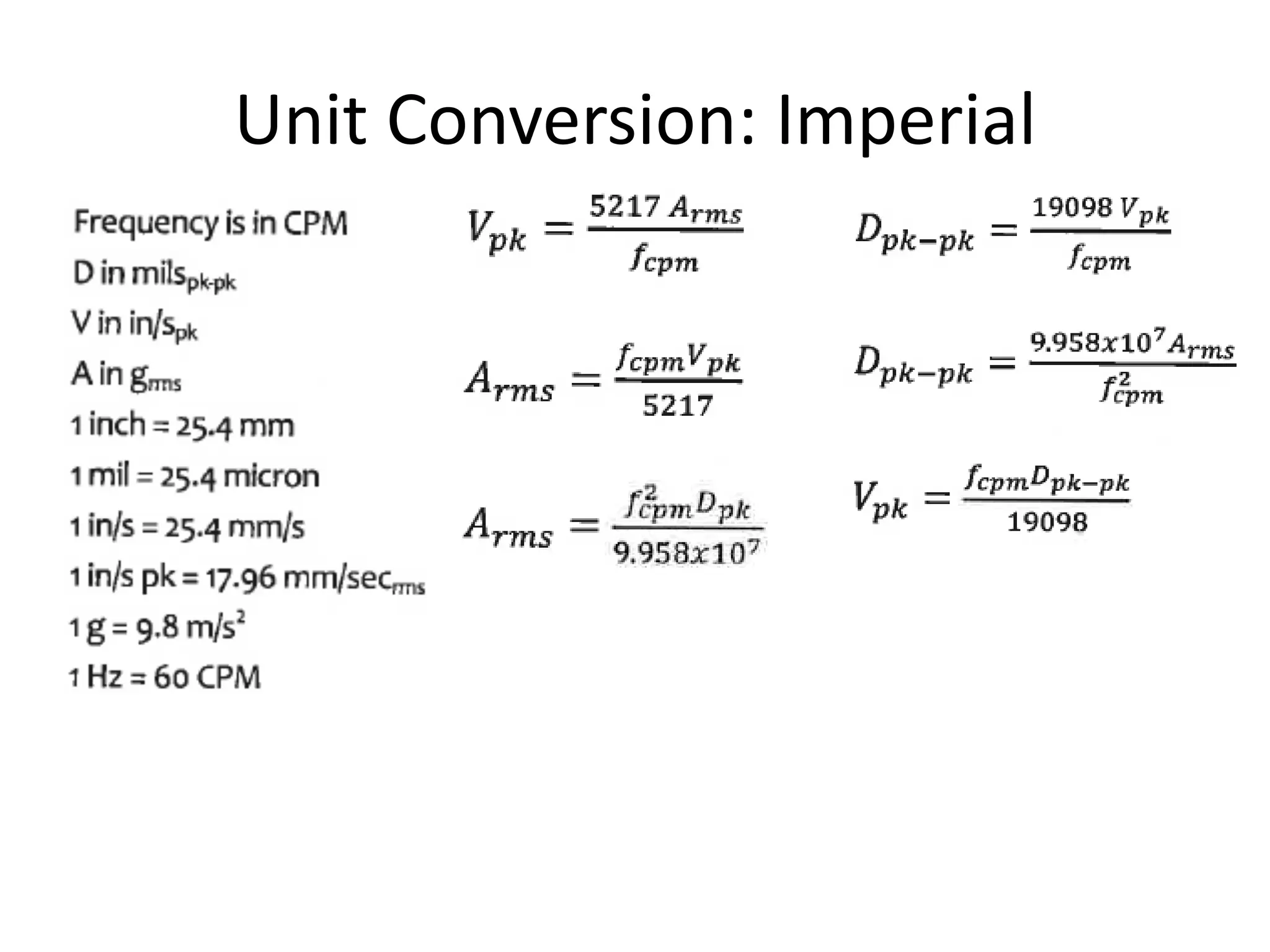
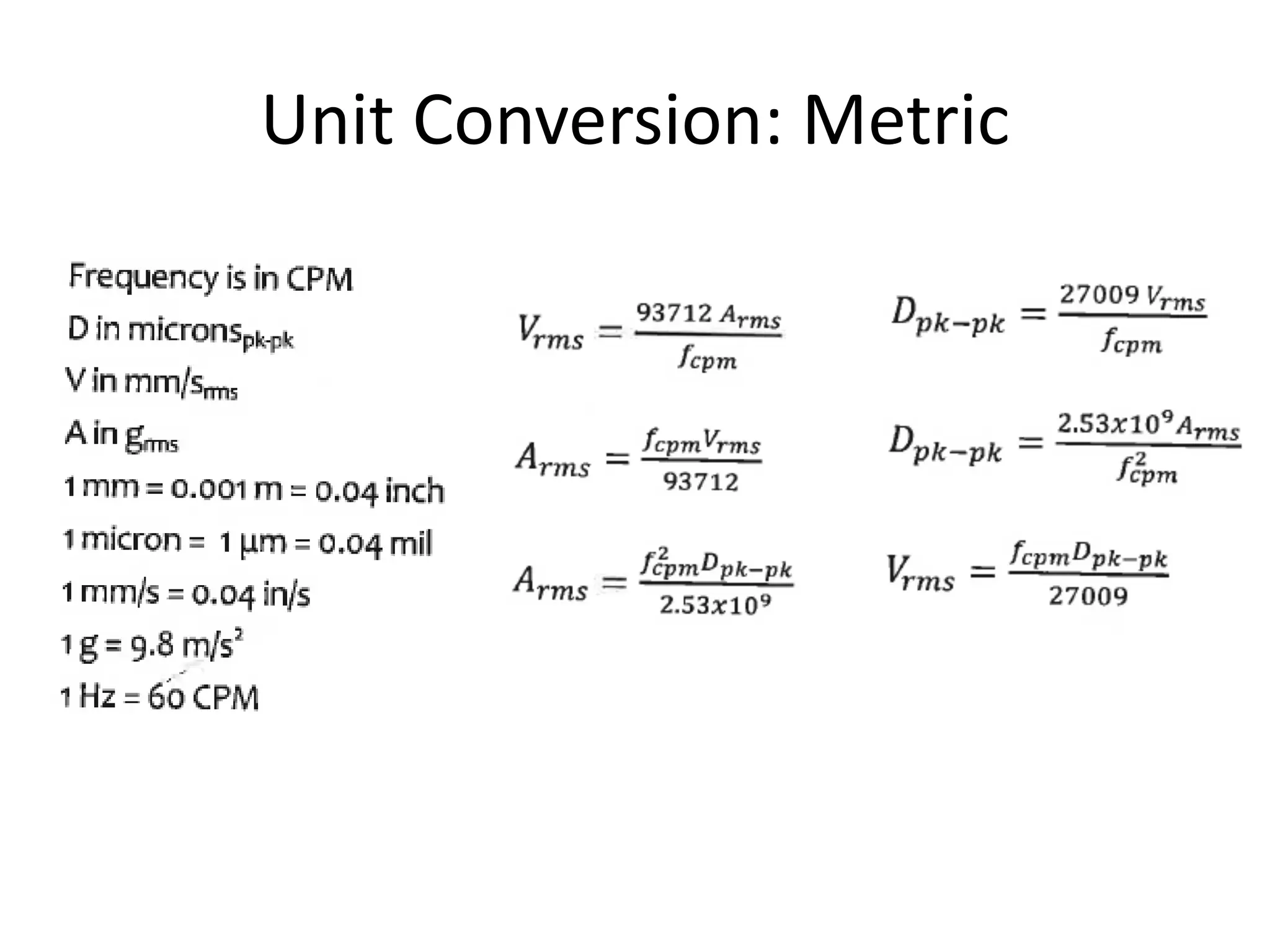
Unit Conversion: Metric
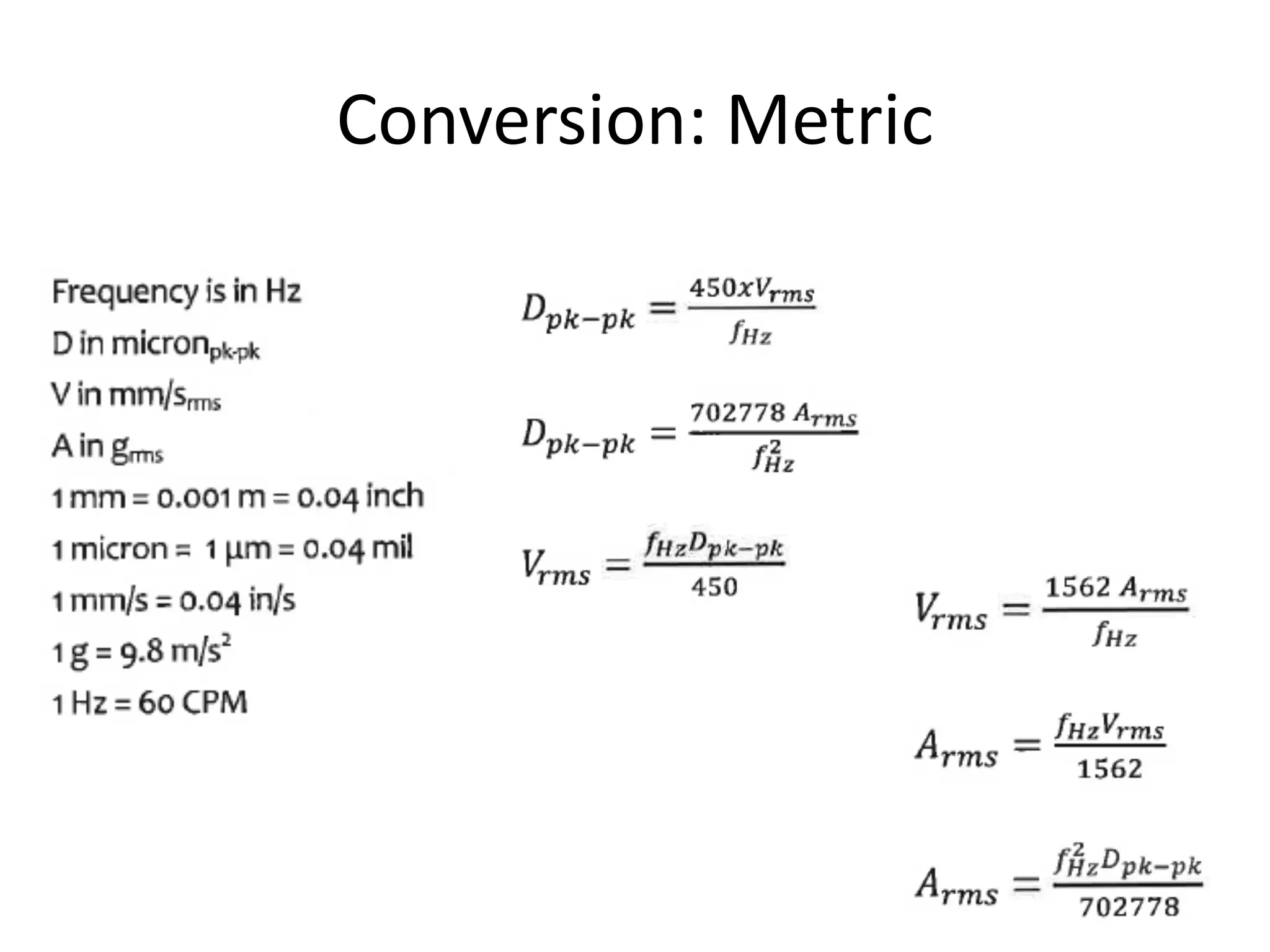
• Frequency in Hz
• D in mm
• V in mm/s
• A in m/s2
• G = 9.81 m/s2
𝑉
567 =
𝑉8)
2
𝐴567 =
𝐴8)
2
𝐷567 =
𝐷8)<8)
2× 2
𝐷8)<8) =
𝑉8)
𝜋𝑓
𝐷8)<8) =
1000𝑔𝐴8)
2(𝜋𝑓)*
𝑉8) = 𝜋𝑓𝐷8)<8)
𝑉8) =
1000𝑔𝐴8)
2𝜋𝑓
𝐴8) =
2 𝜋𝑓 2𝐷8)<8)
1000𝑔
Unit Conversion: Imperial
Unit Conversion: Metric
Conversion: Metric
RMS
RMS: Analog Method (True RMS)
1
𝑇
D 𝑣 𝑡 2
G
H
𝑑𝑡
RMS: Digital Method
... n
N N N N
n
2 2 2 2
1 2 3
+ + + +
RMS
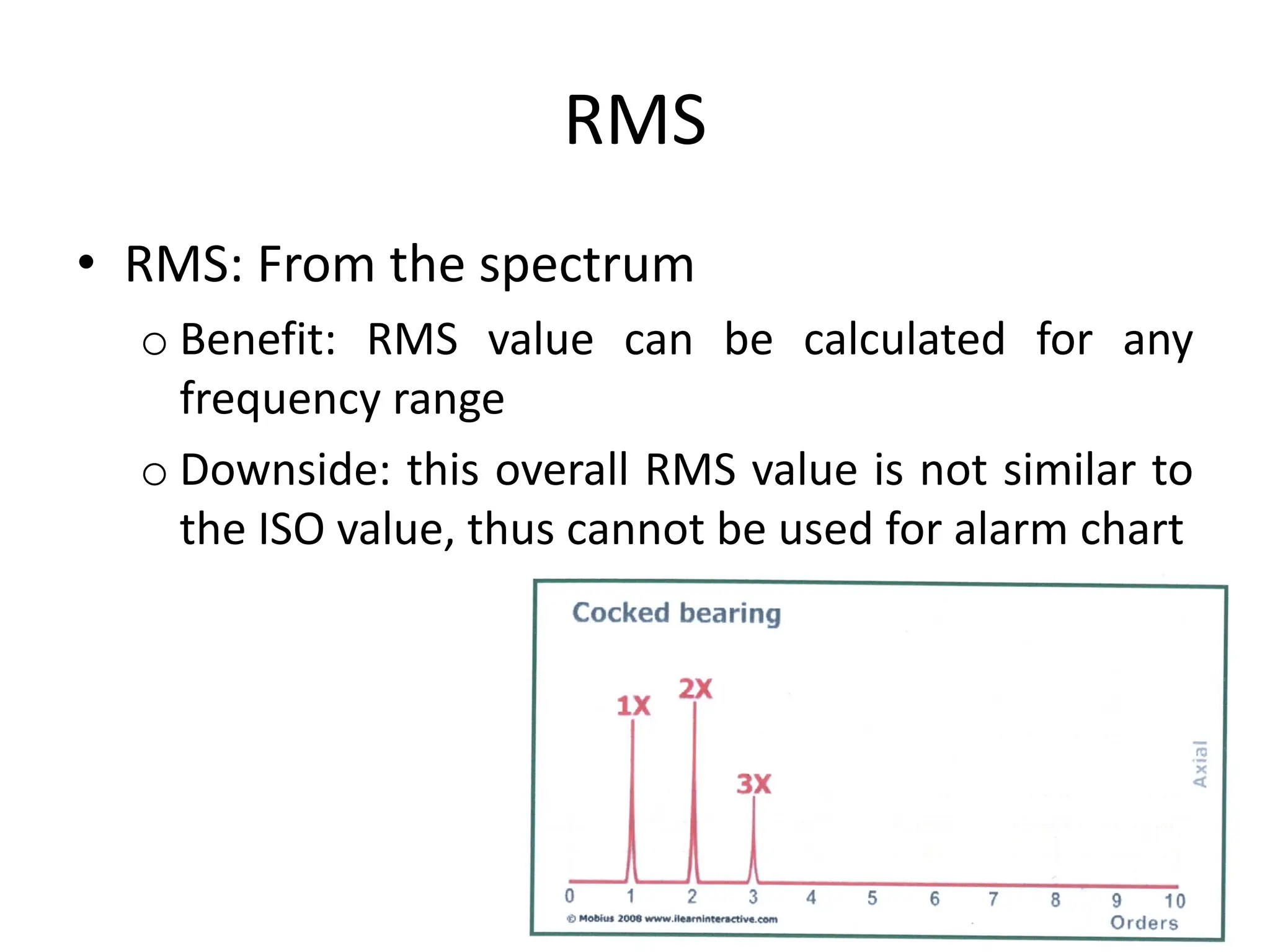
• RMS: From the spectrum
o Benefit: RMS value can be calculated for any
frequency range
o Downside: this overall RMS value is not similar to
the ISO value, thus cannot be used for alarm chart
Review
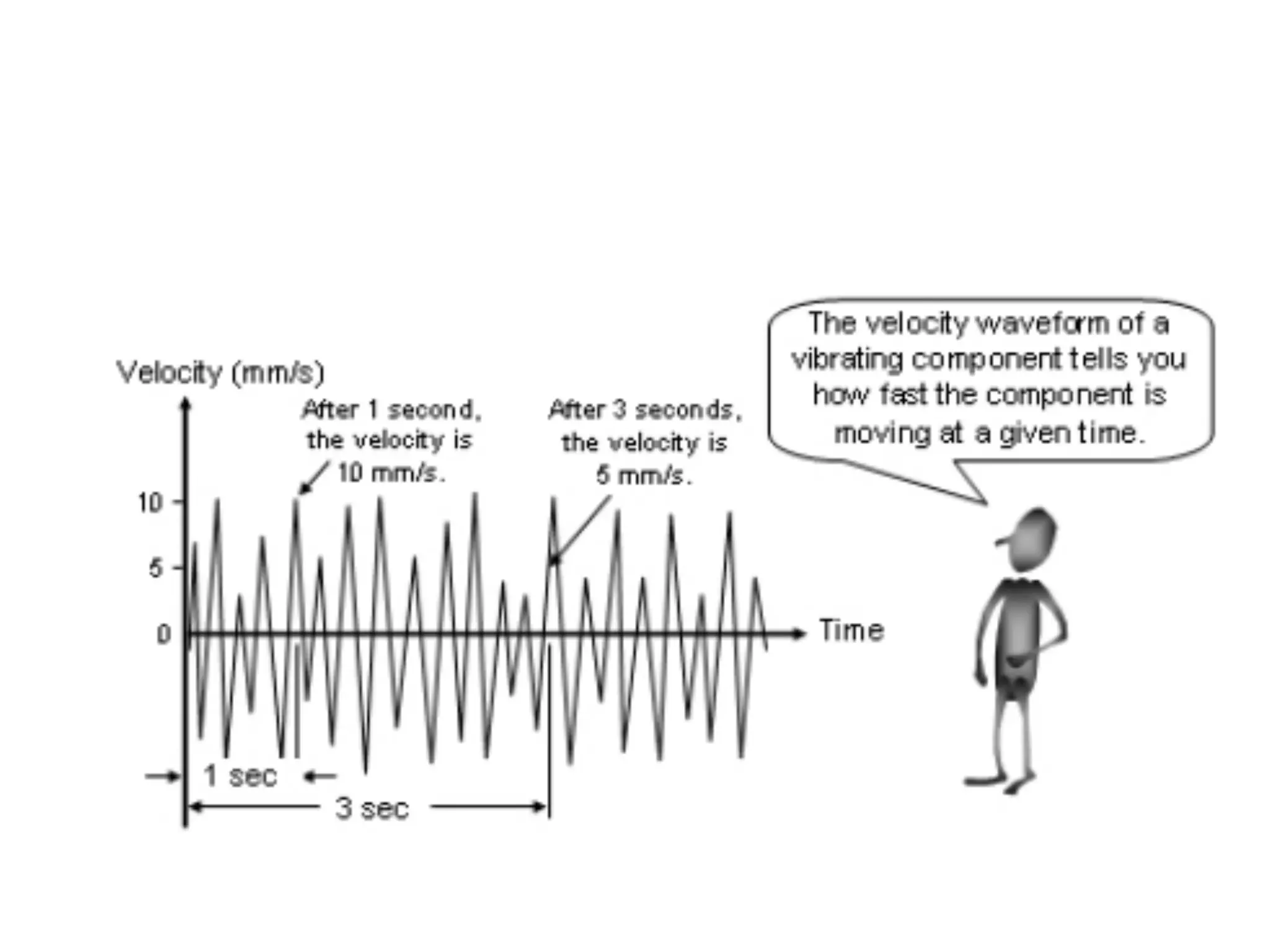
• Waveform
o A waveform is a graphical representation of how the
vibration level changes with time
o The amount of information a waveform contains depends
on the duration and resolution of the waveform.
o The duration of a waveform is the total time period over
which information may be obtained from the waveform. In
most cases, a few seconds are sufficient.
o The resolution of a waveform is a measure of the level of
detail in the waveform and is determined by the number
of data points or samples characterizing the shape of the
waveform. The more samples there are, the more detailed
the waveform is.
Review
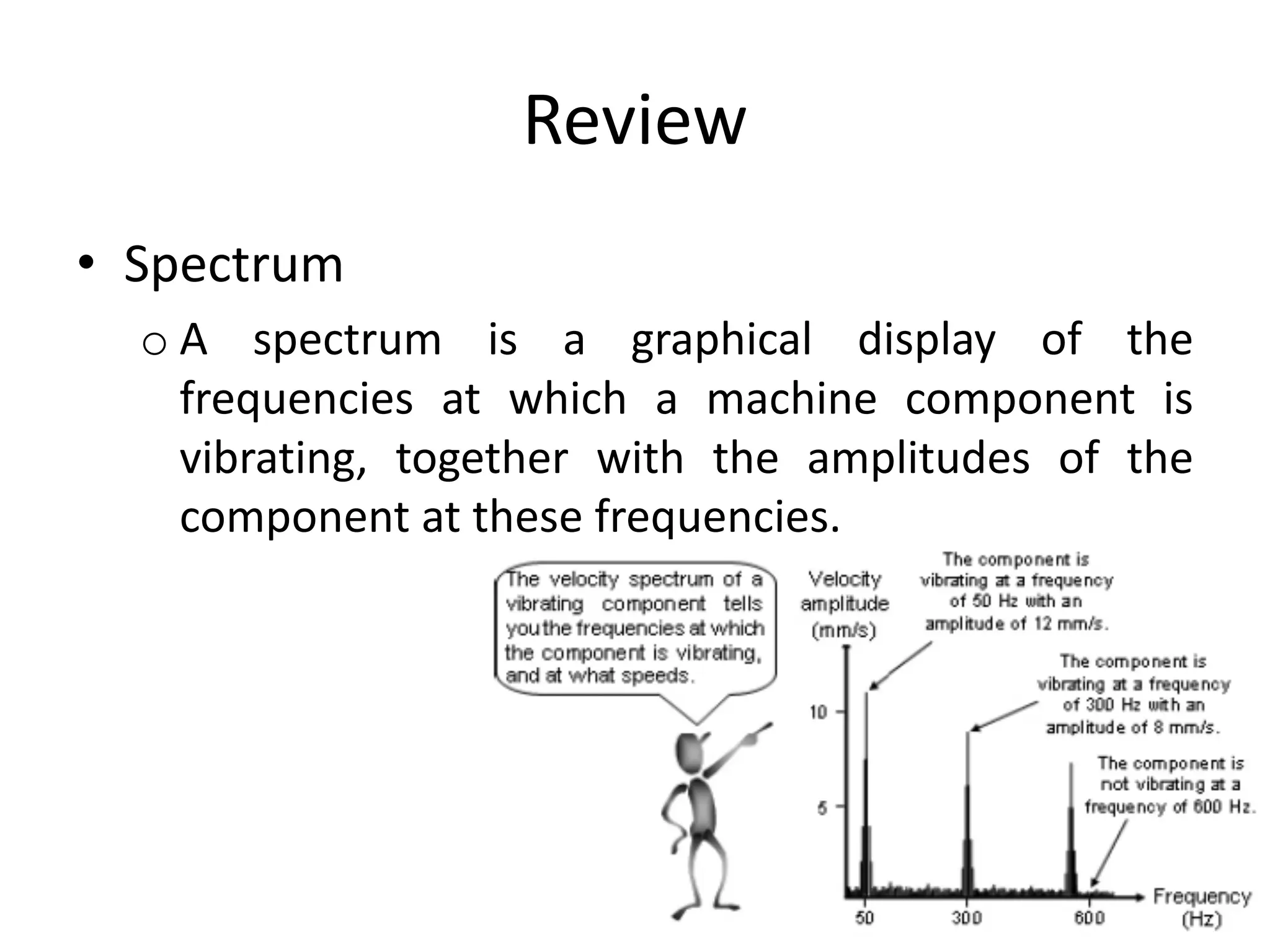
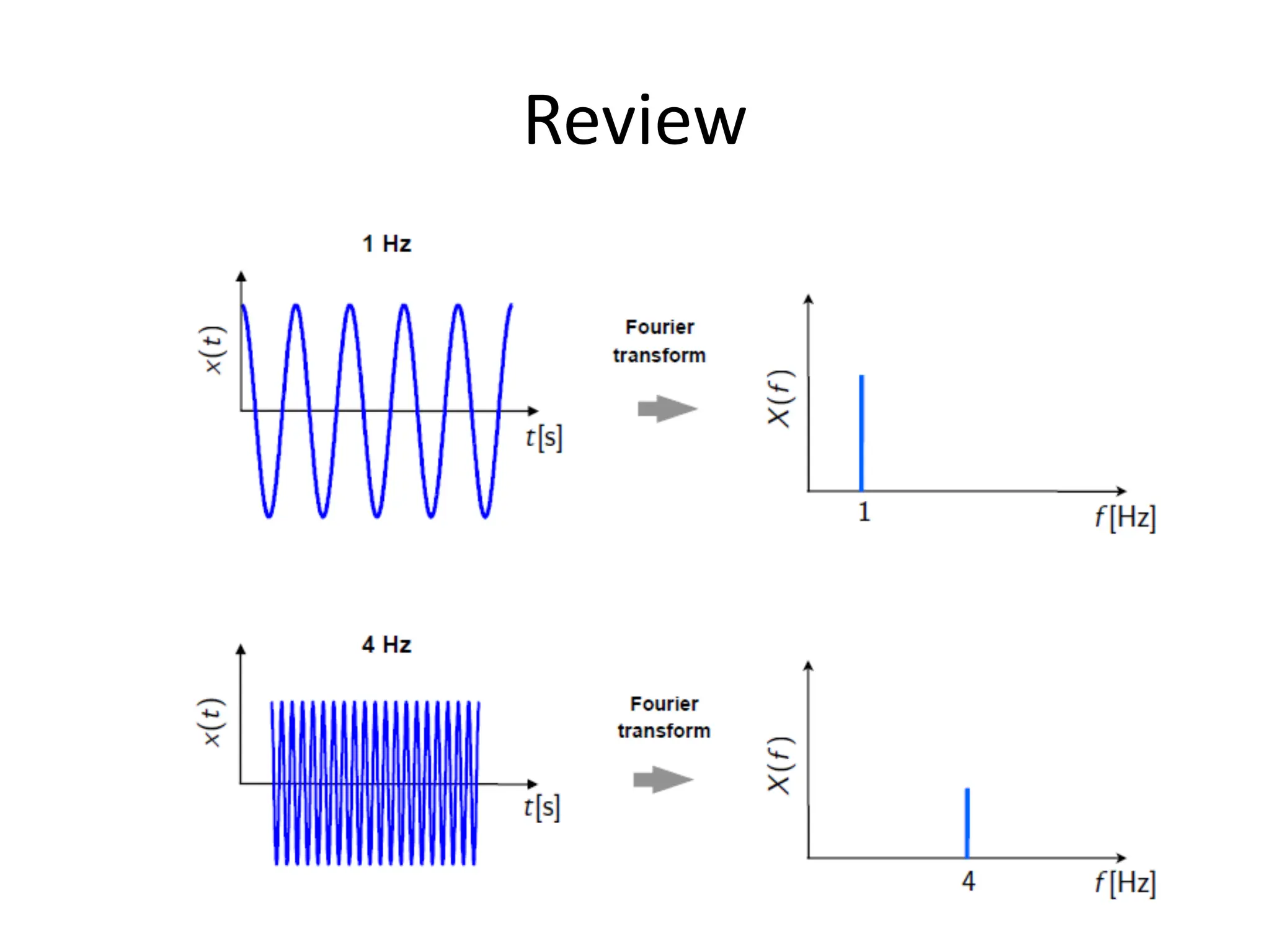
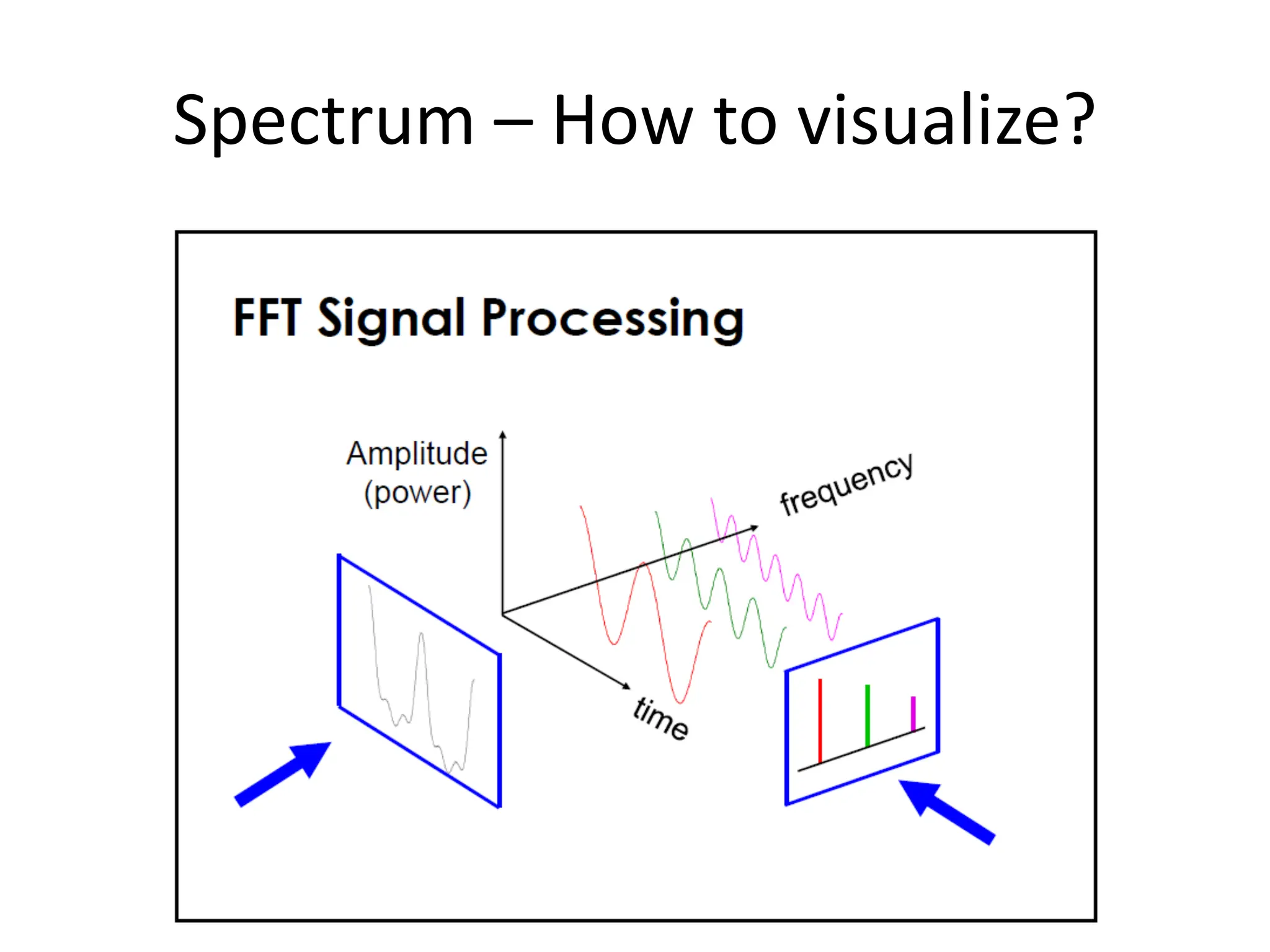
• Spectrum
o A spectrum is a graphical display of the
frequencies at which a machine component is
vibrating, together with the amplitudes of the
component at these frequencies.
Review
• Spectrum
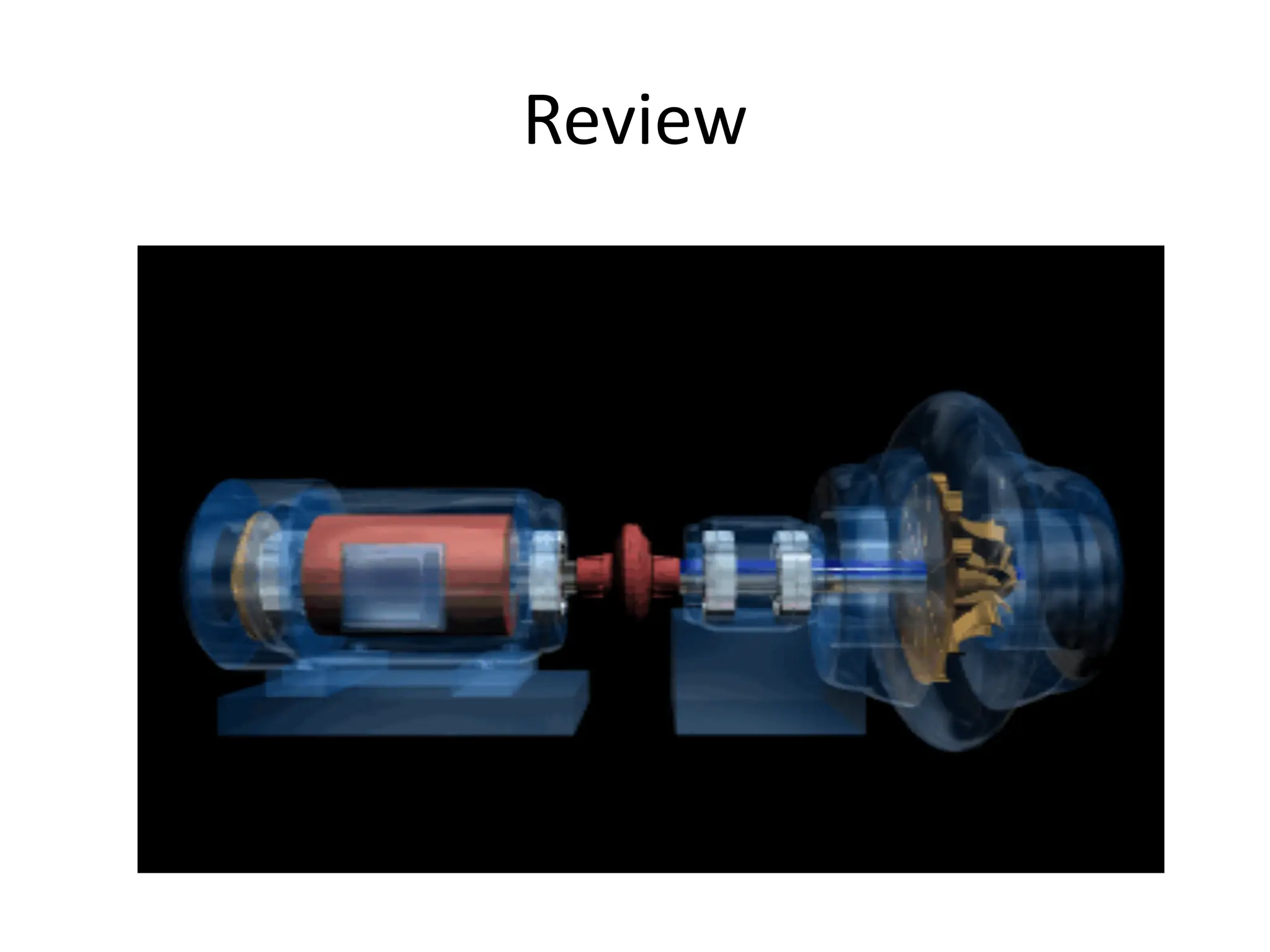
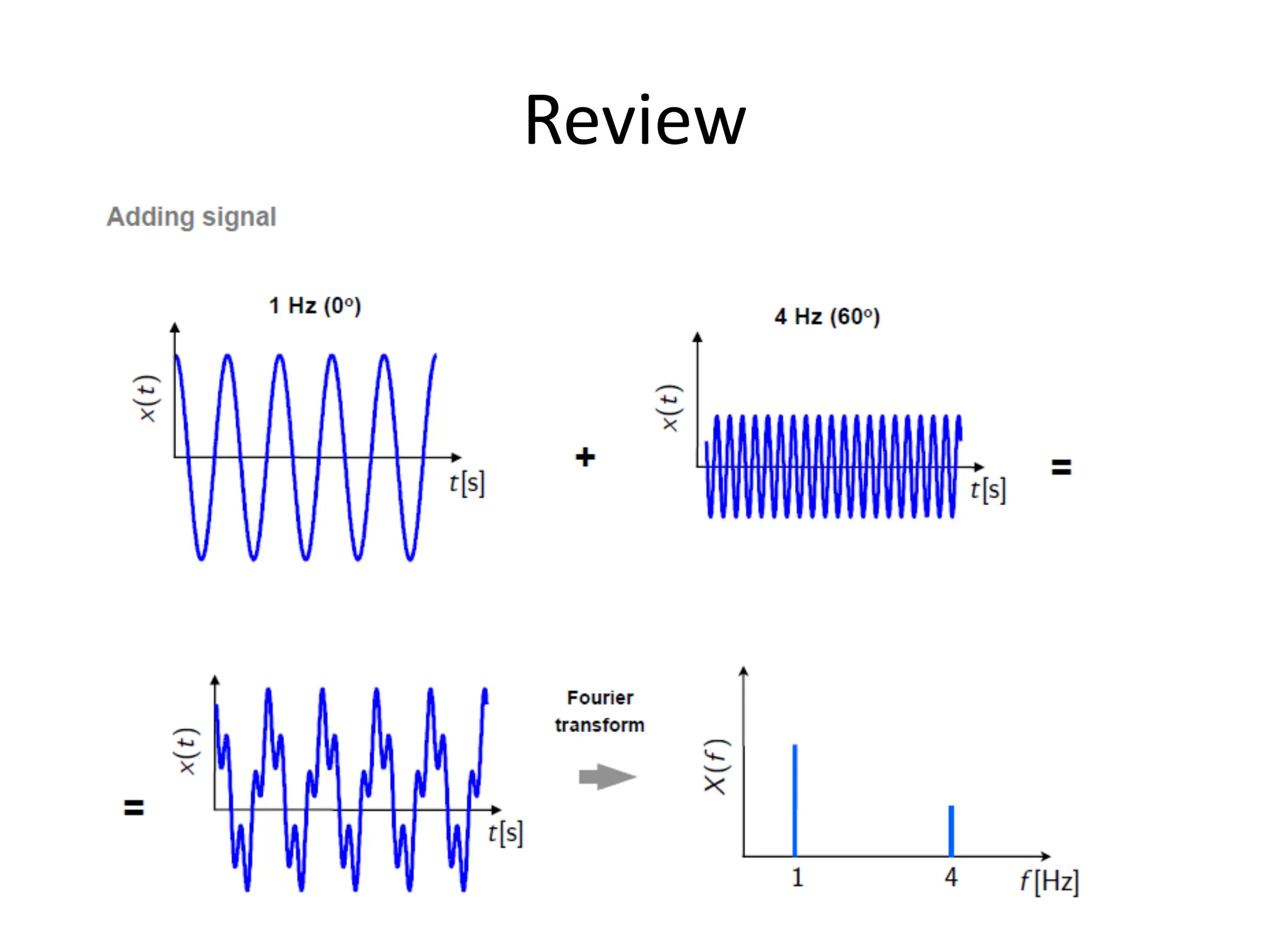
o But how can a single machine component be
simultaneously vibrating at more than one
frequency?
o machine vibration, as opposed to the simple
oscillatory motion of a pendulum, does not
usually consist of just one simple vibratory
motion.
o Usually, it consists of many vibratory motions
taking place simultaneously.
Review
Review
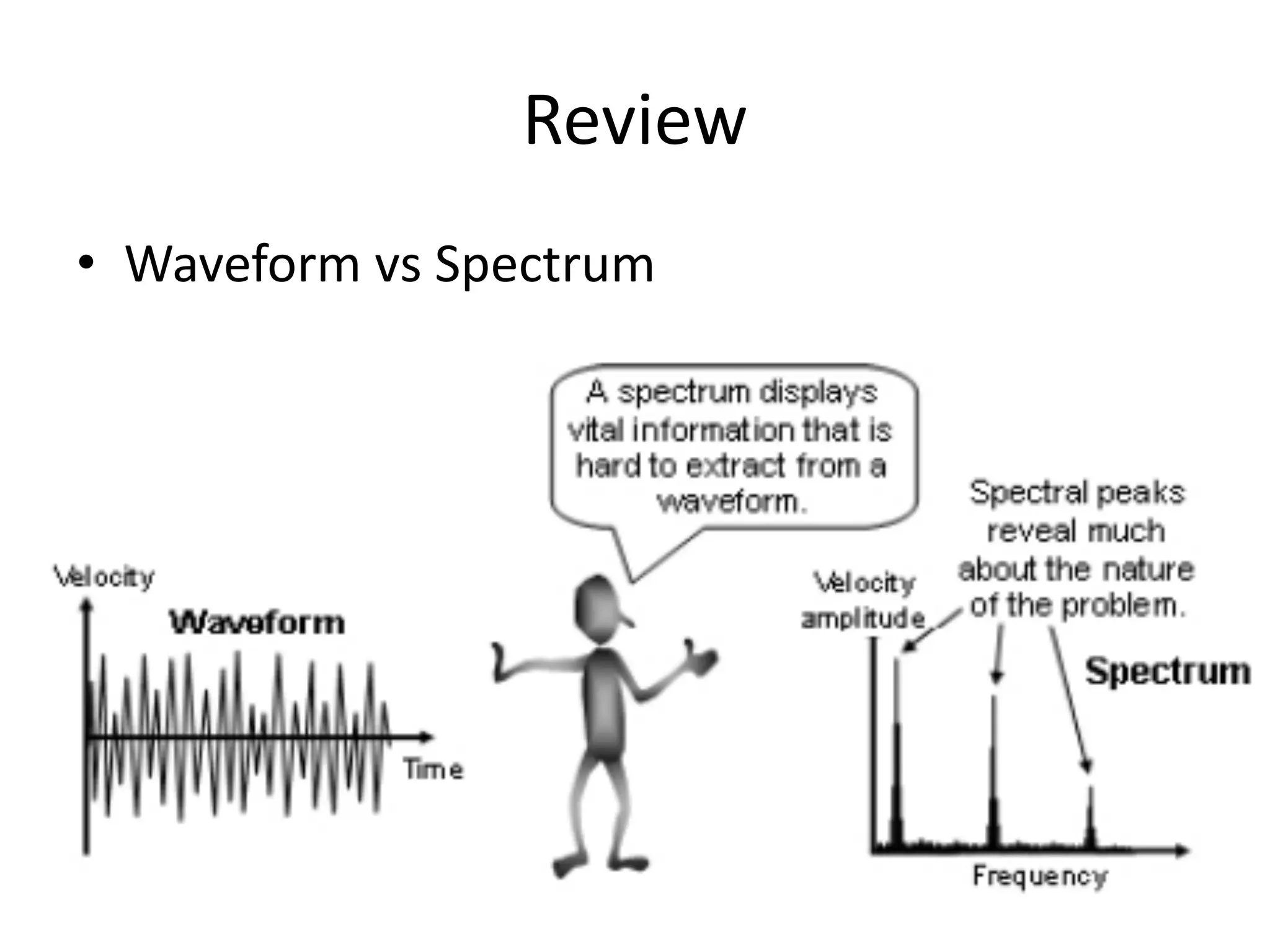
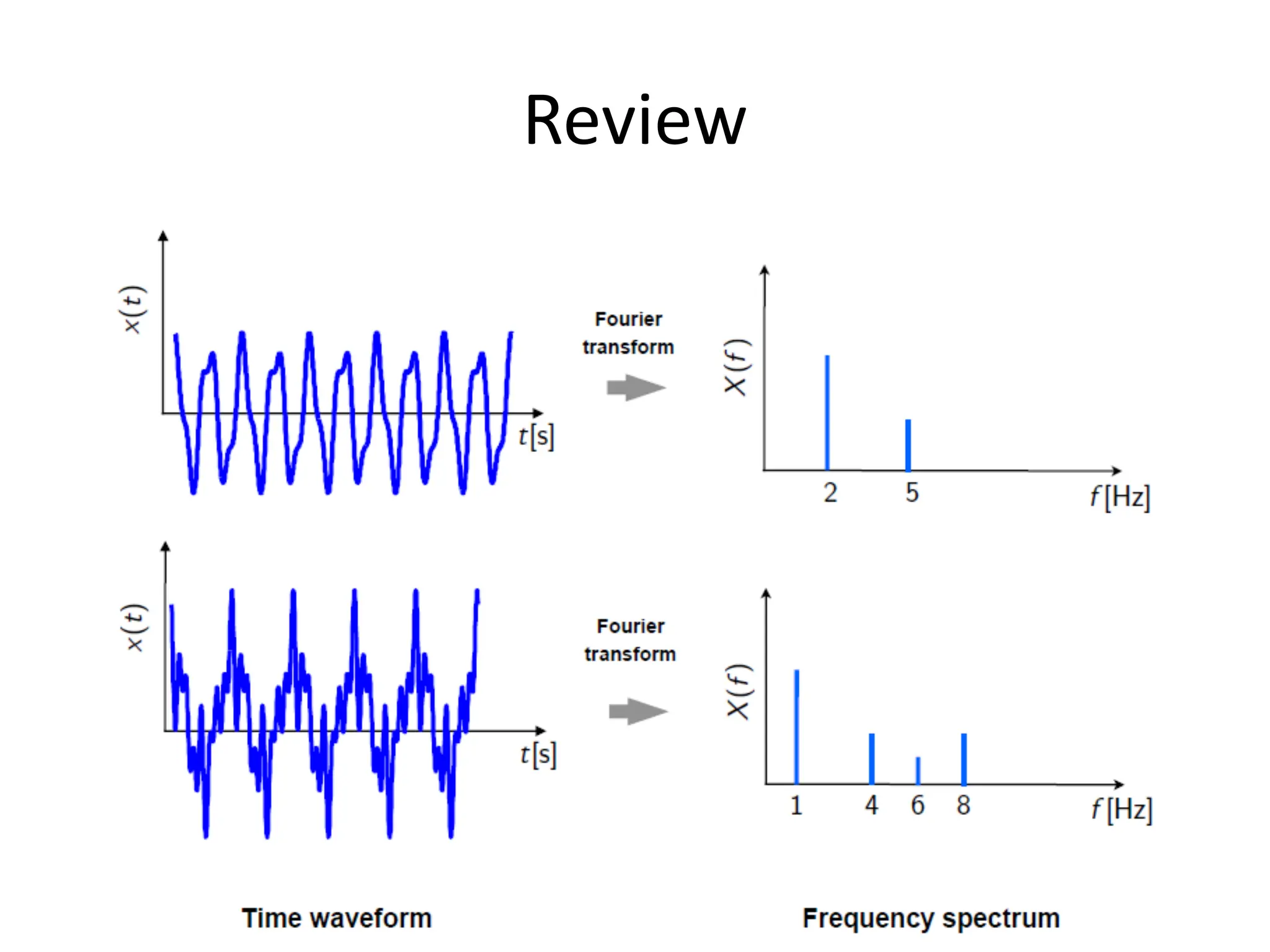
• Waveform vs Spectrum
o spectrum shows the frequencies at which vibration
occurs, it is a very useful analytical tool. By studying
the individual frequencies at which a machine
component vibrates, as well as the amplitudes
corresponding to those frequencies, we can infer a
great deal about the cause of the vibration and the
condition of the machine.
o a waveform does not clearly display the individual
frequencies at which vibration occurs. A waveform
instead displays only the overall effect. It is thus not as
easy to diagnose machine problems using waveforms.
Review
• Waveform vs Spectrum
Review
Review
Review
Review
Spectrum – How to visualize?
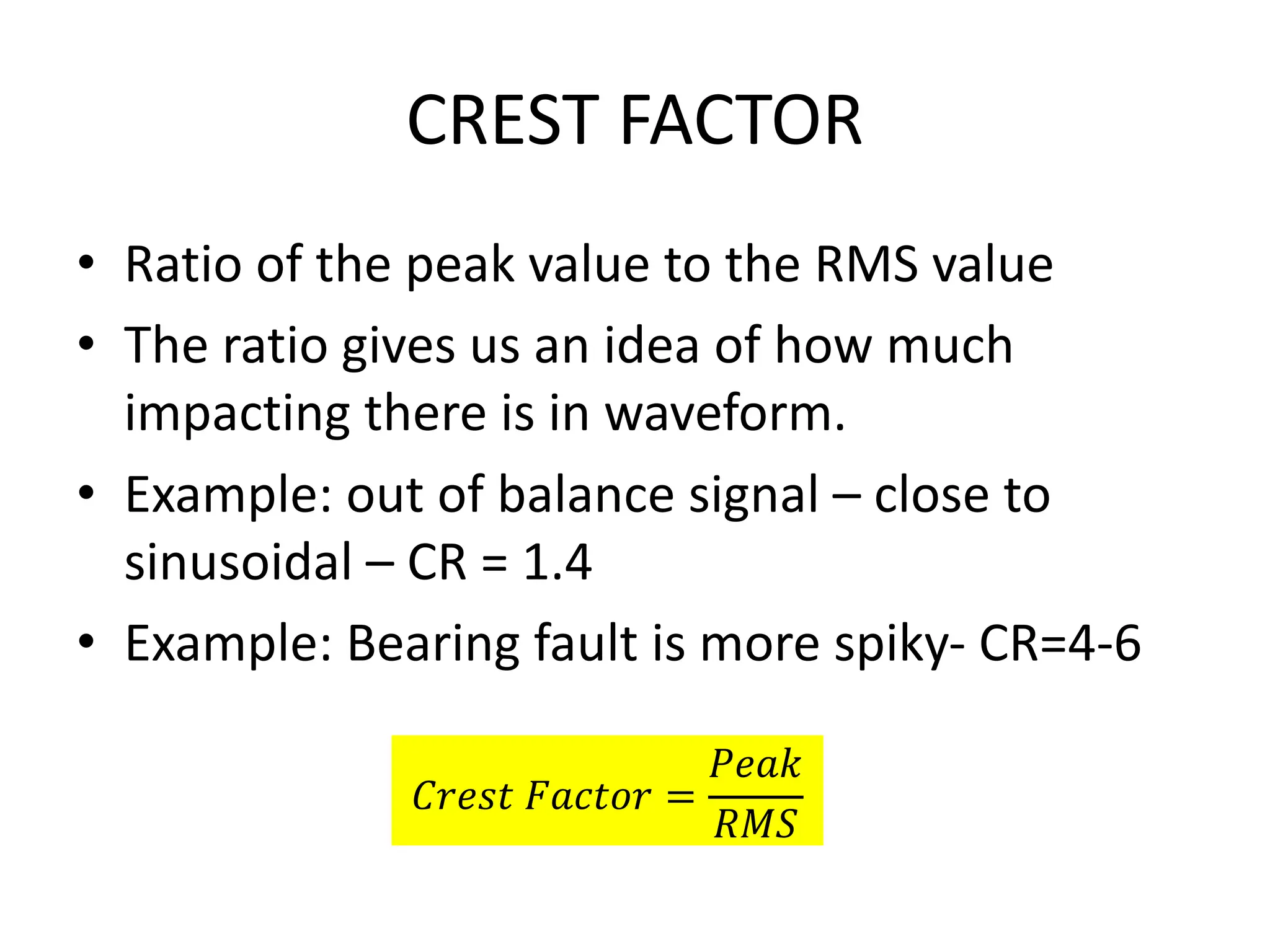
CREST FACTOR
• Ratio of the peak value to the RMS value
• The ratio gives us an idea of how much
impacting there is in waveform.
• Example: out of balance signal – close to
sinusoidal – CR = 1.4
• Example: Bearing fault is more spiky- CR=4-6
𝐶𝑟𝑒𝑠𝑡 𝐹𝑎𝑐𝑡𝑜𝑟 =
𝑃𝑒𝑎𝑘
𝑅𝑀𝑆
Forcing Frequencies
o Different components in a machine produce force
at particular frequencies.
o Forcing frequencies allow us to relate specific
peaks in the spectrum to particular machine
components (fan blades, shaft, gear teeth) and
also to particular mechanical faults (bearing wear,
misalignment, unbalance)
o May also be referred as “fault frequencies” or
“defect frequencies”.
Forcing Frequencies
o Common forcing frequencies are
calculated by multiplying the
number of components times
the shaft rate.
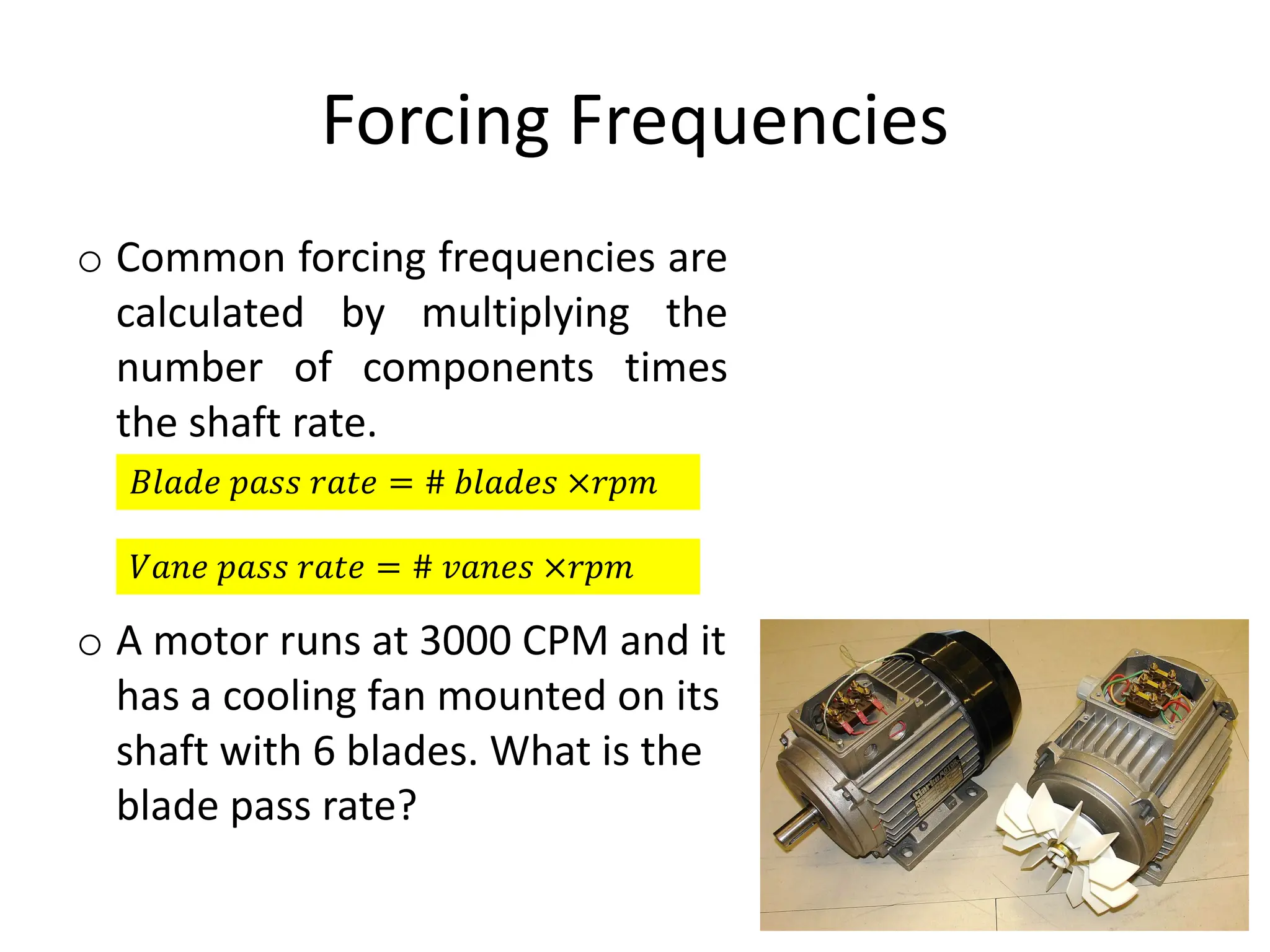
o A motor runs at 3000 CPM and it
has a cooling fan mounted on its
shaft with 6 blades. What is the
blade pass rate?
𝐵𝑙𝑎𝑑𝑒 𝑝𝑎𝑠𝑠 𝑟𝑎𝑡𝑒 = # 𝑏𝑙𝑎𝑑𝑒𝑠 ×𝑟𝑝𝑚
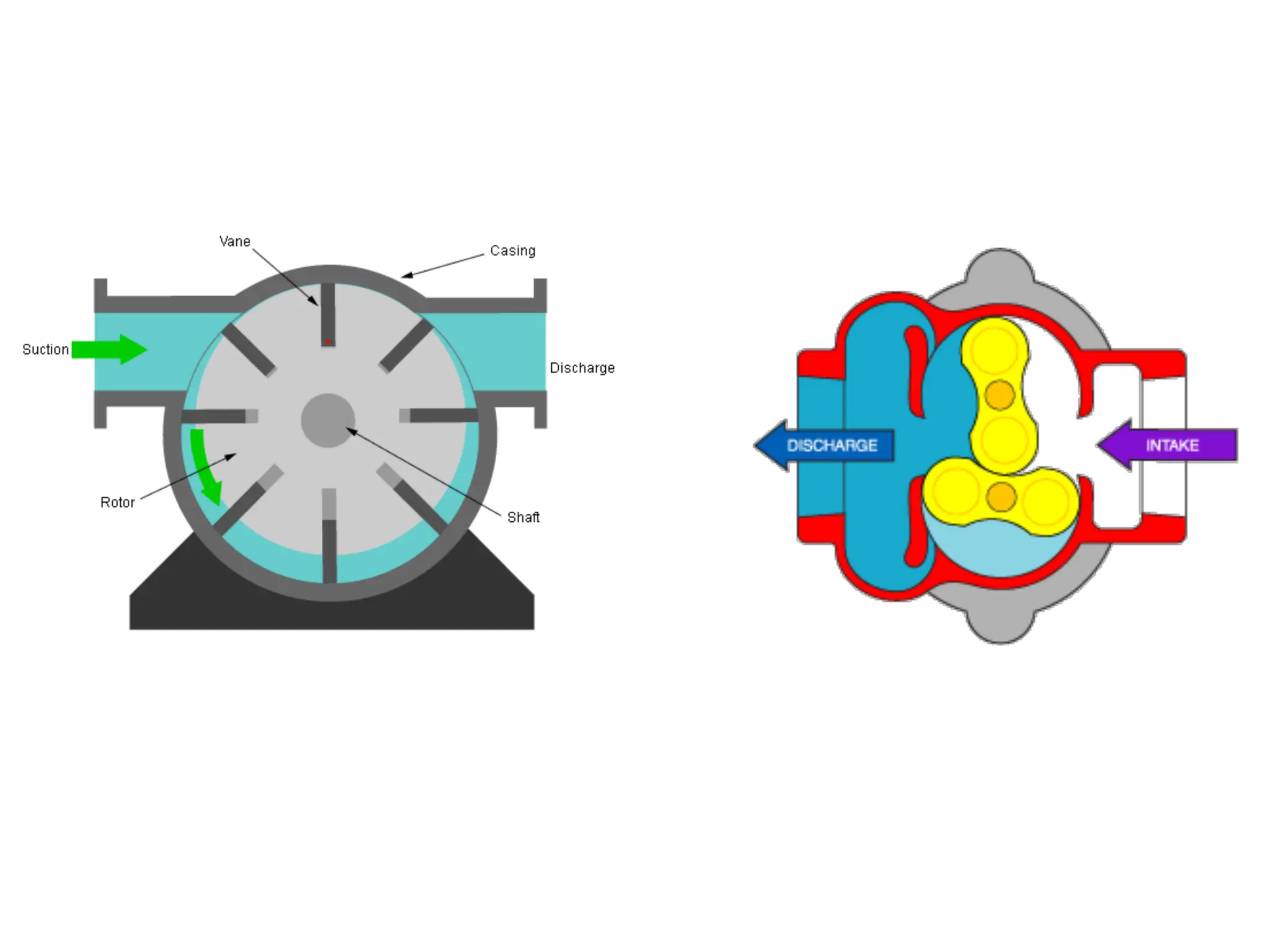
𝑉𝑎𝑛𝑒 𝑝𝑎𝑠𝑠 𝑟𝑎𝑡𝑒 = # 𝑣𝑎𝑛𝑒𝑠 ×𝑟𝑝𝑚
Forcing Frequencies
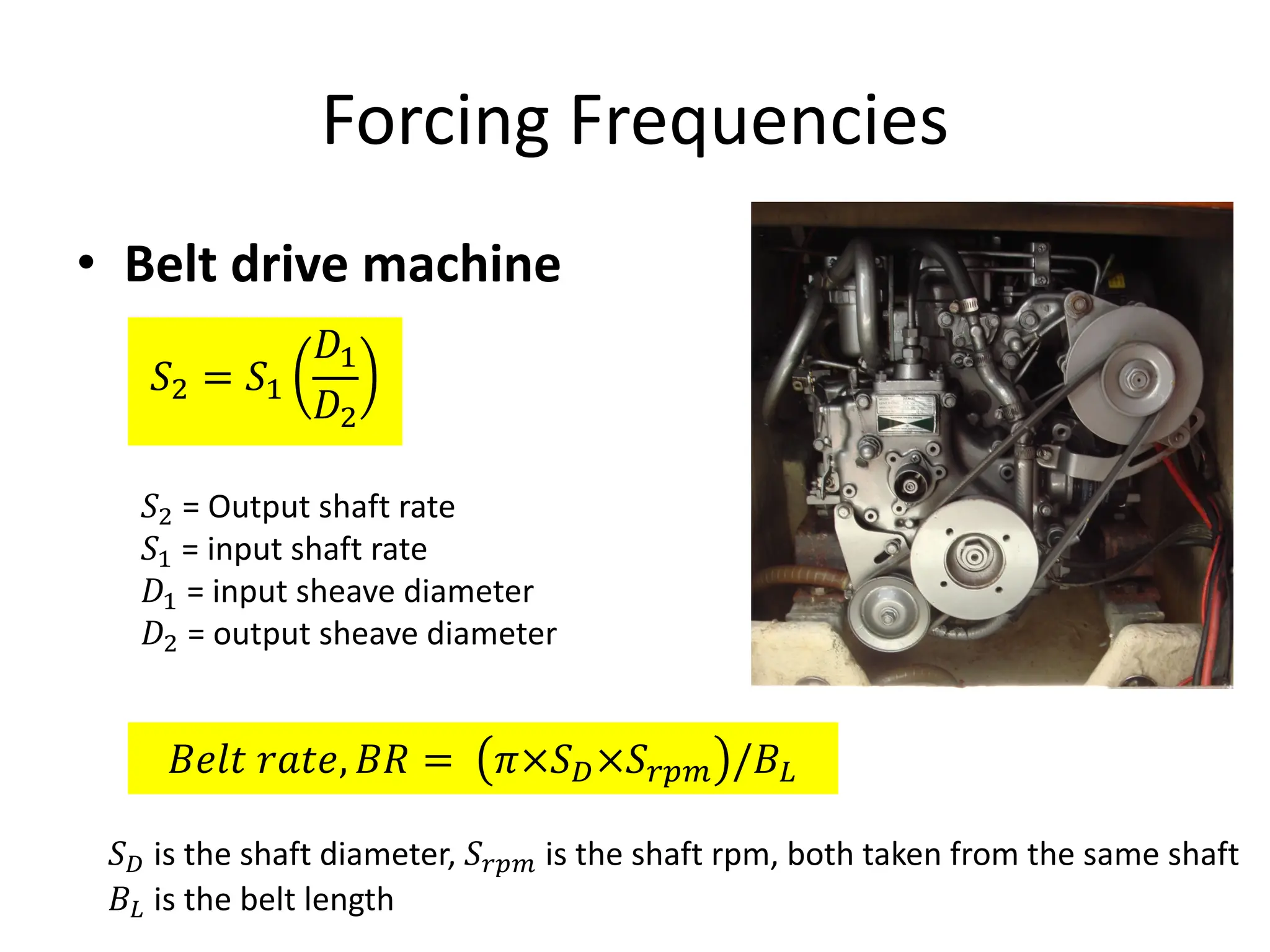
• Belt drive machine
𝑆* = 𝑆W
𝐷W
𝐷*
𝑆* = Output shaft rate
𝑆W = input shaft rate
𝐷W = input sheave diameter
𝐷* = output sheave diameter
𝐵𝑒𝑙𝑡 𝑟𝑎𝑡𝑒, 𝐵𝑅 = 𝜋×𝑆Y×𝑆586 /𝐵[
𝑆Y is the shaft diameter, 𝑆586 is the shaft rpm, both taken from the same shaft
𝐵[ is the belt length
Forcing frequencies
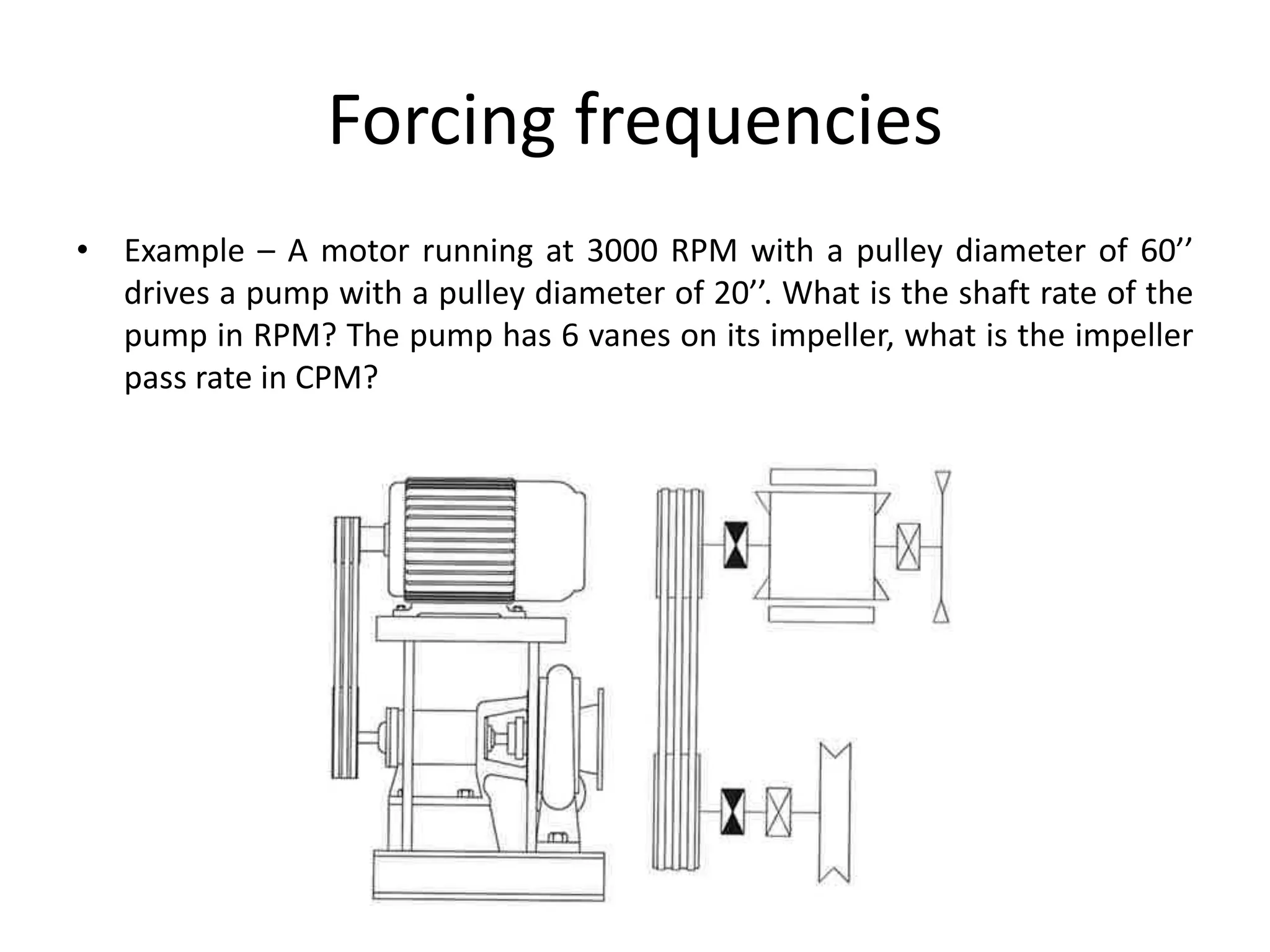
• Example – A motor running at 3000 RPM with a pulley diameter of 60’’
drives a pump with a pulley diameter of 20’’. What is the shaft rate of the
pump in RPM? The pump has 6 vanes on its impeller, what is the impeller
pass rate in CPM?
Forcing Frequencies
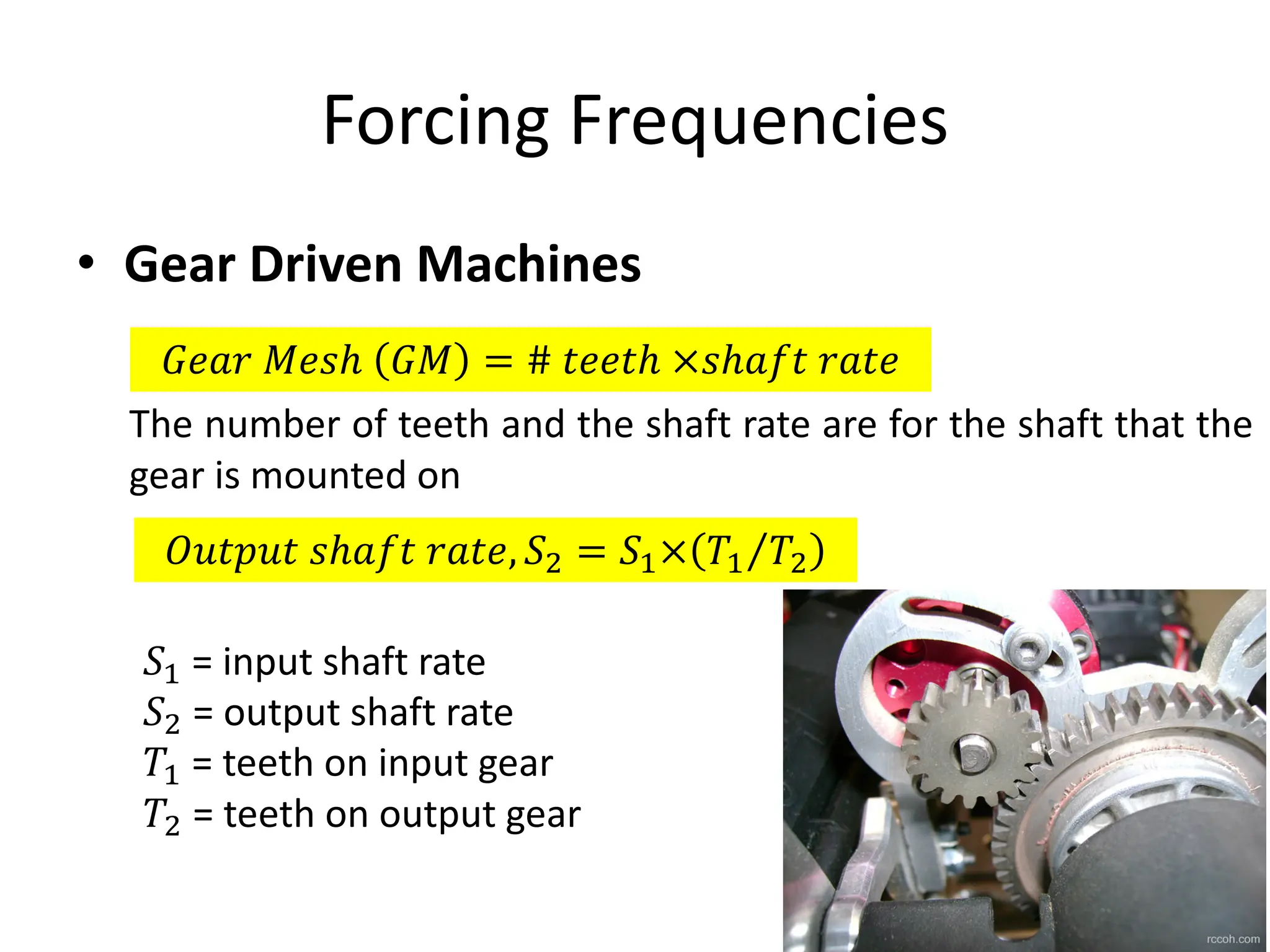
• Gear Driven Machines
𝐺𝑒𝑎𝑟 𝑀𝑒𝑠ℎ 𝐺𝑀 = # 𝑡𝑒𝑒𝑡ℎ ×𝑠ℎ𝑎𝑓𝑡 𝑟𝑎𝑡𝑒
The number of teeth and the shaft rate are for the shaft that the
gear is mounted on
𝑂𝑢𝑡𝑝𝑢𝑡 𝑠ℎ𝑎𝑓𝑡 𝑟𝑎𝑡𝑒, 𝑆* = 𝑆W× 𝑇W 𝑇*
⁄
𝑆W = input shaft rate
𝑆* = output shaft rate
𝑇W = teeth on input gear
𝑇* = teeth on output gear
Forcing Frequencies
A motor is running at 20 Hz drives a pump via a
gearbox with 90 teeth on the input shaft and 30
on the output shaft. What is the pump shaft rate
in Hz?
Forcing Frequency
Practice session
Forcing frequencies - practice
1. If the following compressor ran at 1785 CPM.
And there are 8 vanes on the impeller,
calculate the compressor vane pass rate in
CPM, Hz and orders:
2. What would happen if the compressor speed
changed to 1773 RPM when tested next
time, which of these calculations would not
change?
Forcing frequencies - practice
• If the following fan had 12 blades, and the
motor RPM was 1800, calculate the fan blade
pass forcing frequency in orders, Hz and CPM.
• If there were 8 vanes on the following
compressor, and the compressor vane rate
was 28560 CPM, calculate the RPM of the
compressor.
Vibration Monitoring of Rotating Equipment

  • 1.
    BMCG 4213 Vibration Monitoringof Rotating Machines Lesson 1 Review Dr Roszaidi Ramlan
  • 2.
    Introducing Vibration • Tobe come an expert in the field of vibration, a person needs to have a thorough understanding on: qHow to make a measurement qWhat you are measuring qWhat the signals look like qHow to interpret final data graphically • Familiarization on waveform and spectrum
  • 3.
    Review • Amplitude o Theheight of vibration waveform o Relates to severity of vibration o Consider the oscillating mass and spring – amplitude = how far up and down the spring moved – Displacement o Other form of amplitude ühow fast the mass moves as it is going up and down – velocity üHow much the mass accelerates as it moves up and down - acceleration
  • 4.
    Review • Peak andPeak to Peak amplitudes o Peak to peak (pk-pk) – the distance it travels all the way from the bottom all the way at the top o Peak (pk or 0-pk) – the furthest distance it moves from its point of rest or zero on the graph. o Does pk equal to 0.5 pk-pk?
  • 5.
    Review • RMS amplitude oRoot Mean Square – describes the average amount of energy contained in the waveform. o 𝑅𝑀𝑆 = &'() * = 0.707 ×𝑃𝑒𝑎𝑘 o Does RMS value of a waveform always = 0.707 x Peak?
  • 6.
  • 7.
    Review • Frequency o Therate at which a machine component oscillates is called its oscillation or vibration frequency. The higher the vibration frequency, the faster the oscillation. o You can determine the frequency of a vibrating component by counting the number of oscillation cycles that are completed every second o Units: Hertz = Hz = Cycles per second = CPS RPM = Revolutions per minute CPM = Cycles per minute CPM = RPM = Hz x 60
  • 8.
    Review • Frequency o CPMvs RPM • CPM is the more general term and can be used to describe things that are not “rotating” • Example – heart beat – my heart beats at 100 beats per minute = my heart rate is 100 CPM • It would not sound right to say my heart rate is 100 RPM.
  • 9.
    Review • Displacement o Themovement of an object in terms of distance. In rotating machinery, proximity probes measure the distance between the sensor and the shaft. o Typical units are: Metric (micron pk-pk), Imperial (mils pk-pk) o 1 micron = 0.04 mils, thus 1 mil = ? Micron
  • 10.
    Review • Important characteristicsof displacement o High at low frequencies o Low at high frequencies o Unit of choice typically involving low speed machines (below 600 RPM) o Measured using proximity probes o Proportional to stress
  • 11.
    Review • Velocity o Rateof change of displacement o Typical units are: Metric (mm/sec RMS), Imperial in/sec pk (or IPS pk) o 1 mm = 0.04 inch, 1 inch = ? mm o Good measure of vibration across most machine speeds and frequencies between 2 – 2000 Hz (120 – 120000 CPM) o Proportional to fatigue o Leads displacement by 90 degrees
  • 12.
    Review • Acceleration o Rateof change of velocity o Popular and preferred measurement of vibration due to greater dynamic range of most data collector. o Typical units: Metric ( g’s, mm/sec2 rms, m/s2 rms), Imperial (g’s rms, in/s2 , AdB o Sensitive at high frequencies o Typically used at high speed machines greater than 10000 rpm. o Also used on high frequency analysis such as bearing and gearbox analysis. o Proportional to the force within a machine. o Lead velocity by 90 degrees
  • 13.
  • 14.
    Unit Conversion: Metric •Frequency in Hz • D in mm • V in mm/s • A in m/s2 • G = 9.81 m/s2 𝑉 567 = 𝑉8) 2 𝐴567 = 𝐴8) 2 𝐷567 = 𝐷8)<8) 2× 2 𝐷8)<8) = 𝑉8) 𝜋𝑓 𝐷8)<8) = 1000𝑔𝐴8) 2(𝜋𝑓)* 𝑉8) = 𝜋𝑓𝐷8)<8) 𝑉8) = 1000𝑔𝐴8) 2𝜋𝑓 𝐴8) = 2 𝜋𝑓 2𝐷8)<8) 1000𝑔
  • 15.
  • 16.
  • 17.
  • 18.
    RMS RMS: Analog Method(True RMS) 1 𝑇 D 𝑣 𝑡 2 G H 𝑑𝑡 RMS: Digital Method ... n N N N N n 2 2 2 2 1 2 3 + + + +
  • 19.
    RMS • RMS: Fromthe spectrum o Benefit: RMS value can be calculated for any frequency range o Downside: this overall RMS value is not similar to the ISO value, thus cannot be used for alarm chart
  • 20.
    Review • Waveform o Awaveform is a graphical representation of how the vibration level changes with time o The amount of information a waveform contains depends on the duration and resolution of the waveform. o The duration of a waveform is the total time period over which information may be obtained from the waveform. In most cases, a few seconds are sufficient. o The resolution of a waveform is a measure of the level of detail in the waveform and is determined by the number of data points or samples characterizing the shape of the waveform. The more samples there are, the more detailed the waveform is.
  • 22.
    Review • Spectrum o Aspectrum is a graphical display of the frequencies at which a machine component is vibrating, together with the amplitudes of the component at these frequencies.
  • 23.
    Review • Spectrum o Buthow can a single machine component be simultaneously vibrating at more than one frequency? o machine vibration, as opposed to the simple oscillatory motion of a pendulum, does not usually consist of just one simple vibratory motion. o Usually, it consists of many vibratory motions taking place simultaneously.
  • 24.
  • 25.
    Review • Waveform vsSpectrum o spectrum shows the frequencies at which vibration occurs, it is a very useful analytical tool. By studying the individual frequencies at which a machine component vibrates, as well as the amplitudes corresponding to those frequencies, we can infer a great deal about the cause of the vibration and the condition of the machine. o a waveform does not clearly display the individual frequencies at which vibration occurs. A waveform instead displays only the overall effect. It is thus not as easy to diagnose machine problems using waveforms.
  • 26.
  • 27.
  • 28.
  • 29.
  • 30.
  • 31.
    Spectrum – Howto visualize?
  • 32.
    CREST FACTOR • Ratioof the peak value to the RMS value • The ratio gives us an idea of how much impacting there is in waveform. • Example: out of balance signal – close to sinusoidal – CR = 1.4 • Example: Bearing fault is more spiky- CR=4-6 𝐶𝑟𝑒𝑠𝑡 𝐹𝑎𝑐𝑡𝑜𝑟 = 𝑃𝑒𝑎𝑘 𝑅𝑀𝑆
  • 33.
    Forcing Frequencies o Differentcomponents in a machine produce force at particular frequencies. o Forcing frequencies allow us to relate specific peaks in the spectrum to particular machine components (fan blades, shaft, gear teeth) and also to particular mechanical faults (bearing wear, misalignment, unbalance) o May also be referred as “fault frequencies” or “defect frequencies”.
  • 34.
    Forcing Frequencies o Commonforcing frequencies are calculated by multiplying the number of components times the shaft rate. o A motor runs at 3000 CPM and it has a cooling fan mounted on its shaft with 6 blades. What is the blade pass rate? 𝐵𝑙𝑎𝑑𝑒 𝑝𝑎𝑠𝑠 𝑟𝑎𝑡𝑒 = # 𝑏𝑙𝑎𝑑𝑒𝑠 ×𝑟𝑝𝑚 𝑉𝑎𝑛𝑒 𝑝𝑎𝑠𝑠 𝑟𝑎𝑡𝑒 = # 𝑣𝑎𝑛𝑒𝑠 ×𝑟𝑝𝑚
  • 36.
    Forcing Frequencies • Beltdrive machine 𝑆* = 𝑆W 𝐷W 𝐷* 𝑆* = Output shaft rate 𝑆W = input shaft rate 𝐷W = input sheave diameter 𝐷* = output sheave diameter 𝐵𝑒𝑙𝑡 𝑟𝑎𝑡𝑒, 𝐵𝑅 = 𝜋×𝑆Y×𝑆586 /𝐵[ 𝑆Y is the shaft diameter, 𝑆586 is the shaft rpm, both taken from the same shaft 𝐵[ is the belt length
  • 37.
    Forcing frequencies • Example– A motor running at 3000 RPM with a pulley diameter of 60’’ drives a pump with a pulley diameter of 20’’. What is the shaft rate of the pump in RPM? The pump has 6 vanes on its impeller, what is the impeller pass rate in CPM?
  • 38.
    Forcing Frequencies • GearDriven Machines 𝐺𝑒𝑎𝑟 𝑀𝑒𝑠ℎ 𝐺𝑀 = # 𝑡𝑒𝑒𝑡ℎ ×𝑠ℎ𝑎𝑓𝑡 𝑟𝑎𝑡𝑒 The number of teeth and the shaft rate are for the shaft that the gear is mounted on 𝑂𝑢𝑡𝑝𝑢𝑡 𝑠ℎ𝑎𝑓𝑡 𝑟𝑎𝑡𝑒, 𝑆* = 𝑆W× 𝑇W 𝑇* ⁄ 𝑆W = input shaft rate 𝑆* = output shaft rate 𝑇W = teeth on input gear 𝑇* = teeth on output gear
  • 39.
    Forcing Frequencies A motoris running at 20 Hz drives a pump via a gearbox with 90 teeth on the input shaft and 30 on the output shaft. What is the pump shaft rate in Hz?
  • 40.
  • 41.
    Forcing frequencies -practice 1. If the following compressor ran at 1785 CPM. And there are 8 vanes on the impeller, calculate the compressor vane pass rate in CPM, Hz and orders: 2. What would happen if the compressor speed changed to 1773 RPM when tested next time, which of these calculations would not change?
  • 42.
    Forcing frequencies -practice • If the following fan had 12 blades, and the motor RPM was 1800, calculate the fan blade pass forcing frequency in orders, Hz and CPM. • If there were 8 vanes on the following compressor, and the compressor vane rate was 28560 CPM, calculate the RPM of the compressor.