15-3
What is aPartnership?
An association of two or
more persons who
are co-owners of a
business, and
share profits and losses
in an agreed-upon
manner. ABC
Company
A B
4.
15-4
What is a“Person”?
An individual
A corporation
Another partnership
Z Corp
T&D
Partnership
5.
15-5
Partnerships: Pros &Cons
Advantages
Ease of formation
Lack of formality
Single taxation (see following slide)
Disadvantages
Unlimited liability (for general partnerships)
Difficulty in disposing of partnership interests
Mutual agency
6.
15-6
Partnership Form ofOrganization: Income Tax
Reporting
Single Taxation of Partnership
Earnings
Partnerships only report their
earnings—they are not taxed at the
business entity level (as are
corporations).
Partnerships file IRS Form 1065,
which shows the allocation of profits
among partners.
Partners report their share of profits
on their individual IRS Form 1040
return.
AB
Partnership
A B
Uncle Sam
7.
15-7
Regulation
Each stateregulates the partnerships
that are formed in it.
Most states begin with a model act and
then modifies it to fit that state’s
business culture and history.
Most have now adopted the Uniform
Partnership Act of 1997 (UPA 1997) as
their model act.
8.
15-8
Regulation: The UniformPartnership Act (UPA)
The UPA 1997 covers:
Relations of partners to one another.
Relations of partners to persons dealing
with the partnership.
Dissolution and winding up of the
partnership.
9.
15-9
The Partnership Agreement
What is a partnership agreement?
A written expression of what the
partners have agreed to.
Examples of areas addressed:
Manner of sharing profits.
Limitations on withdrawals.
Rights of partners.
Settling with withdrawing partners.
Expulsion of partners.
Conflicts of interest.
10.
15-10
Practice Quiz Question#1
Which of the following is not one of
the advantages of general
partnerships?
a. Ease of formation
b. Unlimited liability
c. Lack of formality
d. Single taxation
11.
15-11
Practice Quiz Question#1 Solution
Which of the following is not one of
the advantages of general
partnerships?
a. Ease of formation
b. Unlimited liability
c. Lack of formality
d. Single taxation
15-13
Types of Partnerships
General Partnerships
All partners have unlimited liability.
Creditors can go after the personal assets of
any or all of the partners.
14.
15-14
Types of Partnerships
Limited Partnerships
Limited partners have limited liability to
partnership creditors if the partnership is unable
to pay its debts.
Limited partners’ risk is limited to their invested
capital.
Thus, personal assets are not at risk.
At least one of the partners must be a general
partner.
15.
15-15
Types of Partnerships
Limited Liability Partnerships (LLPs)
A partner’s personal assets are at risk only for
his or her own negligence and wrongdoing,
the negligence and wrongdoing of those under his or
her control, but
not debts.
Since 1993, many accounting firms have changed
from general partnerships to LLPs.
16.
15-16
Types of Partnerships
Limited Liability Limited Partnerships
(LLLPs)
Like a limited partnership, must have at least one
general partner.
General partners manage the partnership.
Big difference relates to the liability of general
partners:
No personal liability for partnership obligations (like a
limited partner)
Not liable for wrongdoing of other partners—just
personal decisions and decisions of those supervised
17.
15-17
Practice Quiz Question#2
Which of the following statements is true?
a. The partners in a general partnership
have limited liability.
b. At least two of the partners in a limited
partnership must be general partners.
c. Partners in an LLP are not responsible
for their own actions.
d. Limited liability limited partnerships
must have at least one general partner.
18.
15-18
Practice Quiz Question#2 Solution
Which of the following statements is true?
a. The partners in a general partnership
have limited liability.
b. At least two of the partners in a limited
partnership must be general partners.
c. Partners in an LLP are not responsible
for their own actions.
d. Limited liability limited partnerships
must have at least one general partner.
15-20
Partners’ Accounts
Eachpartner can have
a capital account.
a drawing account (a contra capital
account—closed out at year-end).
a loan account (loans usually earn
interest—a partnership expense).
Partnerships do NOT use a
retained earnings account. DR CR
21.
15-21
Recording Capital Contributions
Keep it FAIR!
Current Fair Market
Values should be used to
record
noncash assets contributed
to a partnership.
liabilities assumed by a
partnership. ABC
Partnership
22.
15-22
$150,000 + $175,000= $325,000
Partnership Formation Example
Brian and Spencer wish to form the B&S partnership.
Brian contributes land with a book value of $65,000
and a current value of $150,000 and a building with a
book value of $142,000 and a current value of
$175,000. Spencer will contribute cash.
If the partners plan to share profits and losses equally
after the formation of the partnership and assuming
they have agreed to equal capital contributions, how
much cash will Spencer have to contribute to form the
partnership?
23.
15-23
Comprehensive Partnership CreationProblem
The partnerships of Brad & Mike (B&M) and Austin
and Justin (A&J) began business on 1/1/X1; each
partnership owns one retail appliance store. The two
partnerships agree to combine as of 7/1/X8 to form a
new partnership, BAM-J Discount Stores.
REQUIRED
Given the information on the next two slides,
1. Prepare the journal entries to record the initial capital
contribution after considering the effect of this information.
Use separate entries for each of the combining partnerships.
2. Prepare a schedule computing the cash contributed or
withdrawn by each partner to bring the initial capital balances
into the profit and loss sharing ratio.
24.
15-24
Comprehensive Partnership CreationProblem
1. Profit and loss ratios. The profit and loss sharing ratios for the former partnerships were
40% to Brad and 60% to Mike, and 30% to Austin and 70% to Justin. The profit and loss
sharing ratio for the new partnership is Brad, 20%; Mike, 30%; Austin, 15%; and Justin, 35%.
2. Capital investments. The opening capital investments for the new partnership are to be in
the same ratio as the profit and loss sharing ratios for the new partnership. If necessary,
certain partners may have to contribute additional cash, and others may have to withdraw
cash to bring the capital investments into the proper ratio.
3. Accounts receivable. The partners agreed to set the new partnership’s allowance for bad
debts at 3% of the accounts receivable contributed by B&M and 12% of the accounts
receivable contributed by A&J.
4. Inventory. The new partnership’s opening inventory is to be valued by the FIFO method.
B&M used the FIFO method to value inventory (which approximates its current value), and
A&J used the LIFO method. The LIFO inventory represents 85% of its FIFO value.
5. Property and equipment. The partners agree that the building’s current value is
approximately 70% of the building’s historical cost, as recorded on each partnership’s books.
6. Unpaid liability. After each partnership’s books were closed on 6/30/X8, an unrecorded
merchandise purchase of $1,500 by A&J was discovered. The merchandise had been sold by
6/30/X8.
7. The 6/30/X8 post-closing trial balances of the partnerships follow.
25.
15-25
Comprehensive Partnership CreationProblem
Account
Brad & Mike Trial
Balance – June 30, 20X8
Austin & Justin Trial
Balance – June 30, 20X8
Cash 25,000 22,000
Accounts Receivable 100,000 150,000
Allowance for doubtful accounts 2,000 6,000
Inventory 175,000 119,000
Building & Equipment 105,000 160,000
Accumulated Depreciation 24,000 61,000
Accounts Payable 40,000 60,000
Notes Payable 100,000 120,000
Brad, Capital 95,000
Mike, Capital 144,000
Austin, Capital 65,000
Justin, Capital 139,000
Totals 405,000 405,000 451,000 451,000
1. Prepare the journal entries to record the initial capital contribution after considering the
effect of this information. Use separate entries for each of the combining partnerships.
2. Prepare a schedule computing the cash contributed or withdrawn by each partner to
bring the initial capital balances into the profit and los sharing ratio.
26.
15-26
Comprehensive Problem Solution
PART1
Summary of changes to carrying values:
Brad & Mike Austin & Justin
Increase allowance for bad debt $(1,000) $(12,000)
Increase inventory 21,000)
Increase buildings and equipment (7,500) 13,000)
Increase accounts payable (1,500)
Net increase $(8,500) $20,500)
Brad (40%) $(3,400) Austin (30%) $6,150
Mike (60%) (5,100) Justin (70%) 14,350
$(8,500) $20,500
Allocate to:
27.
15-27
Cash 25,000
Accounts Receivable100,000
Allowance for doubtful accounts 3,000
Inventory 75,000
Building & Equipment 73,500
Accounts Payable 40,000
Notes Payable 100,000
Brad, Capital 91,600
Mike, Capital 138,900
Comprehensive Problem Solution
Brad & Mike Journal Entry:
28.
15-28
Comprehensive Problem Solution
Austin& Justin Journal Entry:
Cash 22,000
Accounts Receivable 150,000
Allowance for doubtful accounts 18,000
Inventory 140,000
Building & Equipment 112,000
Accounts Payable 61,500
Notes Payable 120,000
Austin, Capital 71,150
Justin, Capital 153,350
29.
15-29
Comprehensive Problem Solution
PART2
Brad Mike Austin Justin Total
Profit sharing percentage 20% 30% 15% 35%
Capital balances 91,600 138,900 71,150 153,350 455,000
Capital balances required
using profit and loss
sharing percentages
91,000 136,500 68,250 159,250
Capital contribution or
(withdrawal)
(600) (2,400) (2,900) 5,900
15-31
Accounting for Operationsof a Partnership
Partners’ accounts
Capital accounts
Used to record the initial investment of a partner, any
subsequent capital contributions, profit or loss
distributions, and any withdrawals of capital by the
partner
Deficiencies are usually eliminated by additional
capital contributions
Capital
Investment
Contributions
% Profit
% Loss
Drawings
32.
15-32
Accounting for Operationsof a Partnership
Partners’ accounts
Drawing accounts
Used to record periodic withdrawals and is then
closed to the partner’s capital account at the end of
the period
Noncash drawings are valued at their market values
at the date of the withdrawal
Loan accounts
A loan from a partner is shown as a payable on the
partnership’s books
Unless all partners agree otherwise, the partnership
is obligated to pay interest on the loan
33.
15-33
Practice Quiz Question#3
Which of the following would result in
a reduction to a partner’s capital
account?
a. The initial investment.
b. The allocation of a profit.
c. Additional capital contributions.
d. A withdrawal.
e. A loan to a partner.
34.
15-34
Practice Quiz Question#3 Solution
Which of the following would result in
a reduction to a partner’s capital
account?
a. The initial investment.
b. The allocation of a profit.
c. Additional capital contributions.
d. A withdrawal.
e. A loan to a partner.
15-36
Profit & LossSummary 162,000
Capital, Brian 81,000
Capital, Spencer 81,000
Income Allocation Example
Assume that in its first year of operation, B&S
partnership earns $162,000 of income.
What journal entry would B&S make to allocate
the profits between the two partners?
37.
15-37
Sharing Profits andLosses
Partners can share profits and losses in
any way they choose.
Possible ways include
ratios
salary allowances and ratios
imputed interest on capital, salary
allowances, and ratios
capital balances only
performance methods
38.
15-38
REQUIRED
1. Prepare aschedule showing how the profit would be divided,
assuming the partnership profit or loss is:
a. $ 102,000
b. $ 57,000
c. $(34,000)
2. What journal entry should be made to allocate the profit or loss
for each of the three cases listed above?
Group Exercise 1: Allocating Profit and Loss,
No Restrictions
The partnership of Alex and James has the following provisions:
• Alex and James receive salary allowances of $37,000 and $18,000,
respectively.
• Interest is imputed at 10% on the average capital investment.
• Any remaining profit or loss is shared between Alex and James in
a 3:2 ratio, respectively.
• Average Capital investments: Alex, $ 50,000; James, 130,000
39.
15-39
ALLOCATED TO
Alex JamesTotal
Total Profit 102,000)
Salary
Interest on Capital
Residual Profit
Allocate Profit
Group Exercise 1: Solution for part a
37,000 18,000 (55,000)
5,000 13,000 (18,000)
29,000
17,400 11,600 (29,000)
59,400 42,600 0
Income Summary 102,000
Capital, Alex 59,400
Capital, James 42,600
40.
15-40
REQUIRED
1. Prepare aschedule showing how the profit would be divided,
assuming the partnership profit or loss is:
a. $ 102,000
b. $ 57,000
c. $(34,000)
2. What journal entry should be made to allocate the profit or loss
for each of the three cases listed above?
Group Exercise 1: Allocating Profit and Loss,
No Restrictions
The partnership of Alex and James has the following provisions:
• Alex and James receive salary allowances of $37,000 and $18,000,
respectively.
• Interest is imputed at 10% on the average capital investment.
• Any remaining profit or loss is shared between Alex and James in
a 3:2 ratio, respectively.
• Average Capital investments: Alex, $ 50,000; James, 130,000
41.
15-41
Income Summary 57,000
Capital,Alex 32,400
Capital, James 24,600
ALLOCATED TO
Alex James Total
Total Profit 57,000)
Salary 37,000) 18,000) (55,000)
Interest on Capital 5,000) 13,000) (18,000)
Residual Profit (16,000)
Allocate Profit (9,600) (6,400) 16,000)
32,400) 24,600) 0)
Group Exercise 1: Solution for part b
42.
15-42
REQUIRED
1. Prepare aschedule showing how the profit would be divided,
assuming the partnership profit or loss is:
a. $ 102,000
b. $ 57,000
c. $(34,000)
2. What journal entry should be made to allocate the profit or loss
for each of the three cases listed above?
Group Exercise 1: Allocating Profit and Loss,
No Restrictions
The partnership of Alex and James has the following provisions:
• Alex and James receive salary allowances of $37,000 and $18,000,
respectively.
• Interest is imputed at 10% on the average capital investment.
• Any remaining profit or loss is shared between Alex and James in
a 3:2 ratio, respectively.
• Average Capital investments: Alex, $ 50,000; James, 130,000
43.
15-43
Capital, Alex 22,200
Capital,James 11,800
Income Summary 34,000
ALLOCATED TO
Alex James Total
Total Profit (34,000)
Salary 37,000) 18,000) (55,000)
Interest on Capital 5,000) 13,000) (18,000)
Residual Profit (107,000)
Allocate Profit (64,200) (42,800) 107,000)
(22,200) (11,800) 0)
Group Exercise 1: Solution for part c
44.
15-44
Methods to ShareProfits and Losses: “To the
Extent Possible” Limitations
When a “limit” provision exists:
The next lower level method of sharing can be
reached if and only if there is still unallocated
profit remaining after dealing with the current
level.
45.
15-45
Group Exercise 2:Allocating Profit and Loss—
“Limit”
Assume the same information provided in Group Exercise 1,
except that the partnership agreement stipulates the following
order of priority:
1. Salary allowances (only to the extent available)
2. Imputed interest on average capital investments (only to
the extent available).
3. Any remaining profit in a 3:2 ratio. (No mention is made
regarding losses.)
REQUIRED:
The requirements are the same as for Group Exercise 1 (i.e.,
calculate the allocations and prepare journal entries).
a. $ 102,000
b. $ 57,000
c. $ (34,000)
46.
15-46
Income Summary 102,000
Capital,Alex 59,400
Capital, James 42,600
ALLOCATED TO
Alex James Total
Total Profit 102,000)
Salary 37,000) 18,000) (55,000)
Interest on Capital 5,000) 13,000) (18,000)
Residual Profit 29,000)
Allocate Profit 17,400) 11,600) (29,000)
59,400) 42,600) 0)
Group Exercise 2: Solution for part a
47.
15-47
Group Exercise 2:Allocating Profit and Loss—
“Limit”
Assume the same information provided in Group Exercise 1,
except that the partnership agreement stipulates the following
order of priority:
1. Salary allowances (only to the extent available)
2. Imputed interest on average capital investments (only to
the extent available).
3. Any remaining profit in a 3:2 ratio. (No mention is made
regarding losses.)
REQUIRED:
The requirements are the same as for Group Exercise 1 (i.e.,
calculate the allocations and prepare journal entries).
a. $ 102,000
b. $ 57,000
c. $ (34,000)
48.
15-48
Income Summary 57,000
Capital,Alex 37,556
Capital, James 19,444
ALLOCATED TO
Alex James Total
Total Profit 57,000)
Salary 37,000) 18,000) (55,000)
2,000)
Interest on Capital * 556) 1,444) (2,000)
Residual Profit 0)
Allocate Profit 0) 0) 0)
37,556) 19,444) 0)
Group Exercise 2: Solution for part b
* $2,000 x (5,000 ÷ $18,000) = 556
$2,000 x ($13,000 ÷ $18,000) = 1,444
49.
15-49
Group Exercise 2:Solution for part c
In this case, the partnership agreement is
vague. An argument can be made for allocating
the loss equally pursuant the UPA 1997 because
the partnership agreement is silent with respect
to losses.
Alternatively, we could presume that losses were
intended to be shared in the residual profit-
sharing ratio.
In these cases, the accountant should seek
clarification from each partner.
50.
15-50
Practice Quiz Question#4
Matt and Chad created a partnership (M&C)
on 12/31/X8 (sharing profits 50/50). Matt
contributed equipment from his sole
proprietorship having a carrying value of
$4,000 and a fair value of $8,000. In 20X9,
M&C had profits of $96,000 and borrowed
$20,000 from a bank. In 2009, Matt withdrew
$35,000 cash. Matt’s Y/E capital balance is
a. $11,000.
b. $17,000.
c. $21,000.
d. $56,000.
51.
15-51
Practice Quiz Question#4 Solution
Matt and Chad created a partnership (M&C)
on 12/31/X8 (sharing profits 50/50). Matt
contributed equipment from his sole
proprietorship having a carrying value of
$4,000 and a fair value of $8,000. In 20X9,
M&C had profits of $96,000 and borrowed
$20,000 from a bank. In 2009, Matt withdrew
$35,000 cash. Matt’s Y/E capital balance is
a. $11,000.
b. $17,000.
c. $21,000 ($8,000 + $96,000/2 - $35,000)
d. $56,000.
15-53
Partner’s Admission: Purchaseof An Existing
Interest
The purchase of an interest from
one or more of a partnership’s
existing partners is a:
personal transaction between the
incoming partner and the selling
partner(s).
The only entry required on the
partnership’s books is to transfer
an amount:
from the selling partner’s Capital
account.
to the new partner’s Capital account.
C
Interest $
AB
Partnership
A B
54.
15-54
Partner’s Admission: Addinga New Partner
Key Objective
Achieve equity among the partners
AB
Partnership
A B
+
C
Assets
= ABC
Partnership
A B C
55.
15-55
How to AchieveEquity?
Example
AB
Partnership
A B
+
C
Assets
= ABC
Partnership
A B C
How much would C have to contribute?
What factors would you have to consider?
Cash $100,000 Capital, A $100,000
Land 100,000 Capital, B 100,000
Total Assets $200,000 Total Equity $200,000
56.
15-56
How to AchieveEquity?
Example
Q: What if the land has a current value of $200,000?
Assume C contributes $150,000 (FMV of value
owned by A and B) for a 1/3 interest in assets,
profits, and losses.
Q: What if the land is sold the next day for $200,000?
Cash $100,000 Capital, A $100,000
Land 100,000 Capital, B 100,000
Total Assets $200,000 Total Equity $200,000
57.
15-57
Minimizing Inequities
TheThree Methods
The revaluing of assets / goodwill method
The bonus method
The special profit-and-loss sharing
provision method
Some methods can still result in
inequities if events do not materialize as
assumed.
≠
58.
15-58
Minimizing Inequities
TheThree Methods
The revaluing of assets / goodwill method
The bonus method
The special profit-and-loss sharing
provision method
Some methods can still result in
inequities if events do not materialize as
assumed.
≠
59.
15-59
(1) Revaluing ofAssets Method
Q: What if the land has a current value of $200,000?
A: Simply “revalue” the land before admitting C!
Q: How do you record C’s contribution?
Q: What if the land is sold two years later for $230,000?
A: Each gets $10,000 of gain.
Cash $100,000 Capital, A $150,000
Land 200,000 Capital, B 150,000
Total Assets $300,000 Total Equity $300,000
Land 100,000
Capital, A 50,000
Capital, B 50,000
Cash 150,000
Capital, C 150,000
60.
15-60
Q: Given thatthe land has a current value of $200,000?
(2) Bonus Method
The partners agree to share equally in all future gains or
losses on the disposal of the land. However, C’s capital
account is decreased up front by the amount of the first
$100,000 of gain that he/she will receive ($33,333). This
decrease is added to A’s and B’s capital accounts up front.
Cash 150,000
Capital, A 16,667
Capital, B 16,667
Capital, C 116,667
Q: What if the land is sold two years later for $230,000?
A: Each gets $43,333 of gain.
61.
15-61
(3) Special Profitand Loss Sharing Provision
Q: Given that the land has a current value of $200,000?
Q: What if the land is sold two years later for $230,000?
A: A and B share equally in the first $100,000 of gain and all
partners share equally in the additional $30,000 of gain.
A and B each get $60,000 and C gets $10,000 of the gain.
Cash 150,000
Capital, C 150,000
Specify in the new partnership agreement that the land’s
current value is $200,000 and that partners A and B share
equally (or in some other specified manner) in the first
$100,000 of gain when the land is disposed of.
62.
15-62
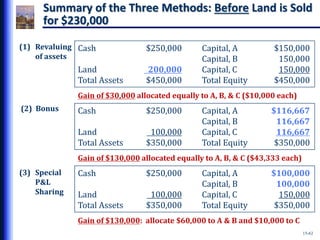
Cash $250,000 Capital,A $150,000
Capital, B 150,000
Land 200,000 Capital, C 150,000
Total Assets $450,000 Total Equity $450,000
Cash $250,000 Capital, A $100,000
Capital, B 100,000
Land 100,000 Capital, C 150,000
Total Assets $350,000 Total Equity $350,000
Cash $250,000 Capital, A $116,667
Capital, B 116,667
Land 100,000 Capital, C 116,667
Total Assets $350,000 Total Equity $350,000
(1) Revaluing
of assets
(3) Special
P&L
Sharing
(2) Bonus
Gain of $30,000 allocated equally to A, B, & C ($10,000 each)
Gain of $130,000: allocate $60,000 to A & B and $10,000 to C
Gain of $130,000 allocated equally to A, B, & C ($43,333 each)
Summary of the Three Methods: Before Land is Sold
for $230,000
63.
15-63
Cash $480,000 Capital,A $160,000
Capital, B 160,000
Capital, C 160,000
Total Assets $480,000 Total Equity $480,000
Cash $480,000 Capital, A $160,000
Capital, B 160,000
Capital, C 160,000
Total Assets $480,000 Total Equity $480,000
Cash $480,000 Capital, A $160,000
Capital, B 160,000
Capital, C 160,000
Total Assets $480,000 Total Equity $480,000
(1) Revaluing
of assets
(3) Special
P&L
Sharing
(2) Bonus
We get the same result under each method!
Summary of the Three Methods: After Land is Sold
for $230,000
64.
15-64
Minimizing Inequities
Onlythe special profit-and loss sharing
provision method will prevent an
inequity to one or more of the partners in
the event that
the agreed-upon values of the assets are
erroneous.
the agreed-upon value of goodwill does not
materialize.
≠
65.
15-65
Key Differences BetweenRevaluation /
Goodwill and Bonus Methods
Revaluation/Goodwill Method
Revalue the balance sheet by
recording goodwill or revaluing
existing assets.
Thus, we now have a bigger “pie”
to divide up among the partners.
Land 100,000
Capital, A 50,000
Capital, B 50,000
Excess Value
Book Value
of Net Assets
66.
15-66
Key Differences BetweenRevaluation /
Goodwill and Bonus Methods
Revaluation/Goodwill Method
Revalue the balance sheet by
recording goodwill or revaluing
existing assets.
Thus, we now have a bigger “pie”
to divide up among the partners.
The new partner’s capital account
will be equal to his/her ownership
percentage of the “Big Pie.”
Cash 150,000
Capital, C 150,000
Land = $100,000
Small Pie =
200,000 +
150,000 =
350,000
x 1/3 =
$150,000
67.
15-67
Key Differences BetweenRevaluation /
Goodwill and Bonus Methods
Bonus Method
Do not revalue the balance sheet.
Only leaves the book value of net
assets on the balance sheet.
Book Value
of Net Assets
68.
15-68
Key Differences BetweenRevaluation /
Goodwill and Bonus Methods
Bonus Method
Do not revalue the balance sheet.
Only leaves the book value of net
assets on the balance sheet.
The new partner’s capital account
will be equal to his/her ownership
percentage of the “Small Pie.”
Small Pie =
200,000 +
150,000 =
350,000
x 1/3 =
$116,667
Cash 150,000
Capital, A 16,667
Capital, B 16,667
Capital, C 116,667
69.
15-69
The Revaluing ofAssets / Goodwill Method
Advantages
Credit to incoming partner always at least
equal to cash contribution
Can be important “psychologically”
Disadvantages
Departs from GAAP
Complicates income tax preparation
70.
15-70
The Bonus Method
Major Advantages
Does not result in a departure from GAAP
Minimizes bookkeeping and tax return effort
Major Disadvantages
A portion of one or more partner’s capital balance
is transferred to one or more other partners.
The hope is that the transferred amount will later be
recouped via future profits.
Incoming partner’s capital account may be less
than his/her cash contribution!
71.
15-71
Determining the Valueof Goodwill
Steps to follow:
1. Estimate the implied value of the partnership based on
the new partner’s contribution.
New capital contribution ÷ new partner ownership %
2. Estimate the implied value of the partnership based on
the old partners’ total equity.
Total old partner capital balance ÷ total old ownership %
3. Calculate the amount of existing net assets.
The sum of old partner capital and new partner contributed
capital.
4. Calculate implied goodwill
Implied value (greater of 1 or 2) – existing net assets (3)
5. Determine whether the new or old partners possess
goodwill.
The smaller of 1 or 2
The one who paid less for their relative share.
72.
15-72
Practice Quiz Question#5a
Betsy contributes $54,000 cash for a 25% interest
in the new net assets of the partnership (that has
existing equity of $180,000). The old partners
capital accounts are not to decrease (i.e., use the
Revaluation / Goodwill method). Betsy’s capital
account is credited:
a. $ 9,000
b. $54,000
c. $58,500
d. $60,000
e. $76,500
73.
15-73
Solution, Summary
1. Newimplied value: $ 54,000 ÷ 25% = $216,000
2. Old implied value: $180,000 ÷ 75% = $240,000
3. BV of net assets: $180,000 + $54,000 = $234,000
4. Implied Goodwill = $240,000 $234,000 = $ 6,000
5. Goodwill belongs to new partner (because
$216,000 is less than $240,000). [Implies that
she paid less for her relative share of the business.]
Since we’re revaluing, use the BIG pie:
x 25% = $60,000
GW = 6,000
234,000
The BIG PIE (BV of NA + Goodwill)
The SMALL PIE (BV Only)
74.
15-74
Practice Quiz Question#5a Solution
Betsy contributes $54,000 cash for a 25% interest
in the new net assets of the partnership (that has
existing equity of $180,000). The old partners
capital accounts are not to decrease (i.e., use the
Revaluation / Goodwill method). Betsy’s capital
account is credited:
a. $ 9,000
b. $54,000
c. $58,500
d. $60,000 ($240,000 x 25%)
e. $76,500
Betsy’s share of the “big pie.”
Cash 54,000
Goodwill 6,000
Capital, Betsy 60,000
75.
15-75
Practice Quiz Question#5b
Betsy contributes $54,000 cash for a 25%
interest in the new net assets of the partnership
(that has existing equity of $180,000). Use the
Bonus Method. Betsy’s capital account is
credited
a. $ 9,000.
b. $54,000.
c. $58,500.
d. $60,000.
e. $76,500.
76.
15-76
Solution, Summary
1. Newimplied value: $ 54,000 ÷ 25% = $216,000
2. Old implied value: $180,000 ÷ 75% = $240,000
3. BV of net assets: $180,000 + $54,000 = $234,000
4. Implied Goodwill = $240,000 $234,000 = $ 6,000
5. Goodwill belongs to new partner (because
$216,000 is less than $240,000). [Implies that
she paid less for her relative share of the business.]
The BIG PIE (BV of NA + Goodwill)
The SMALL PIE (BV Only)
Small Pie
= 180,000
+ 54,000
= 234,000 x 25% = $58,500
Since we’re not
revaluing, use the
Small pie:
77.
15-77
Practice Quiz Question#5b Solution
Betsy contributes $54,000 cash for a 25%
interest in the new net assets of the partnership
(that has existing equity of $180,000). Use the
Bonus Method. Betsy’s capital account is
credited:
a. $ 9,000.
b. $54,000.
c. $58,500.
d. $60,000.
e. $76,500.
Betsy’s share of the “Small Pie.”
Cash 54,000
Capital, Old Part. 4,500
Capital, Betsy 58,500
78.
15-78
Group Exercise: GoodwillMethod
Scott and Stephanie are partners with capital balances
of $100,000 and $65,000, and they share profits and
losses in the ratio of 3:2, respectively. Zoe invests
$60,000 cash for a 25% interest in the capital and
profits of the new partnership. The partners agree that
the implied partnership goodwill is to be recorded
simultaneously with the admission of Zoe.
REQUIRED
1. Calculate the firm’s total implied goodwill.
2. Prepare the entry or entries to record the
admission of Zoe.
79.
15-79
Solution, Summary
1. Newimplied value: $ 60,000 ÷ 25% = $240,000
2. Old implied value: $165,000 ÷ 75% = $220,000
3. BV of net assets: $165,000 + $60,000 = $225,000
4. Implied Goodwill = $240,000 $225,000 = $ 15,000
5. Goodwill belongs to old partners (because
$220,000 is less than $240,000). [Implies that
they “gave” less for their relative share of the business.]
The BIG PIE (BV of NA + Goodwill)
The SMALL PIE (BV Only)
80.
15-80
Note that thisis 25% of the
“Big Pie” because we revalue
the balance sheet!
Group Exercise: Goodwill Method Solution
Entry to record Goodwill
Entry to record Zoe’s cash contribution
Goodwill 15,000
Capital, Scott 9,000
Capital, Stephanie 6,000
Cash 60,000
Capital, Zoe 60,000
x 25% = $60,000
GW = 15,000
165,000 +
60,000 =
225,000
81.
15-81
Group Exercise: BonusMethod
Jim and June are partners who share profits and losses
in the ratio of 2:1, respectively. On 12/31/X8 their
capital accounts are as follows:
Jim $ 40,000
June 30,000
Total $ 70,000
On that date, they agreed to admit Mel as a partner
with a 30% interest in the capital and profits and
losses for an investment of $15,000. The new
partnership will begin with total capital of $85,000.
REQUIRED
Prepare the entry or entries to record the
admission of Mel.
82.
15-82
Solution, Summary
1. Newimplied value: $ 15,000 ÷ 30% = $ 50,000
2. Old implied value: $ 70,000 ÷ 70% = $100,000
3. BV of net assets: $ 70,000 + $15,000 = $ 85,000
4. Implied Goodwill = $100,000 $85,000 = $ 15,000
5. Goodwill belongs to new partner (because
$50,000 is less than $100,000). [Implies that
he “gave” less for his relative share of the business.]
The BIG PIE (BV of NA + Goodwill)
The SMALL PIE (BV Only)
Note that we use the small pie here with bonus method.
83.
15-83
Note that thisis 30% of the
“Small Pie” because we don’t
revalue the balance sheet!
Group Exercise: Goodwill Method Solution
Entry to record admission of Mel
Cash 15,000
Capital, Jim 7,000
Capital, June 3,500
Capital, Mel 25,500
x 30% = $25,500
Small Pie =
70,000 +
15,000 =
85,000
Note: The bonus to the new partner is shared between the
old partners in their old profit and loss sharing ratio
of 2:1.
84.
15-84
Comprehensive Group Problem
Jennand Amanda are in partnership—they share profits and losses in
the ratio of 7:1, respectively, and they have capital balances of
$30,000 each. The partnership’s land has a fair value of $30,000 in
excess of book value. Tommy is admitted into the partnership for a
cash contribution of $25,000. The new profit and loss sharing
formula is Jenn, 70%, Amanda, 10%, and Tommy, 20%. The value of
the partnership’s existing goodwill is agreed to be $10,000.
REQUIRED
1. Prepare the required entries, assuming the land is to be revalued and the
goodwill is to be recorded on the partnership’s books.
2. Prepare the required entries, assuming that the bonus method is to be
used with respect to the undervalued existing assets and the goodwill.
Note that this goodwill number is given because it is a bit harder to
calculate when there is also unrecorded appreciation in existing
assets. However, the next slide shows the calculation.
85.
15-85
Solution, Summary
1. Newimplied value: $ 25,000 ÷ 20% = $125,000
2. Old implied value: $ 60,000 ÷ 80% = $ 75,000
3. BV of net assets: $ 60,000 + $25,000 = $ 85,000
4. Total Excess Value = $125,000 $85,000 = $ 40,000
Goodwill = Total Excess Value – Excess Land Value
Goodwill = $40,000 - $30,000 = $10,000
5. Goodwill belongs to the old partners (because
$75,000 is less than $125,000). [Implies that they
“gave” less for their relative share of the business.]
The BIG PIE (BV of NA + Goodwill)
The SMALL PIE (BV Only)
GW = 10,000
60,000 +
25,000 =
85,000
Land = 30,000
86.
15-86
Note that this
is20% of the
“Big Pie.”
Comprehensive Group Problem Solution
PART 1 (Revaluation / Goodwill Method):
To revalue existing assets to their current values.
To record goodwill.
To record cash contribution by Tommy.
Land 30,000
Capital, Jenn 26,250
Capital, Amanda 3,750
Goodwill 10,000
Capital, Jenn 8,750
Capital, Amanda 1,250
Cash 25,000
Capital, Tommy 25,000
x 20% = $25,000
GW = 10,000
60,000 +
25,000 =
85,000
Land = 30,000
87.
15-87
Comprehensive Group ProblemSolution
PART 2 (Bonus Method):
If the partnership were sold one day after Tommy was admitted and the
selling price was $40,000 more than the book value of the net assets, Tommy
would share in the $40,000 gain to the extent of $8,000 (20% × $40,000), the
amount of his capital contribution that is given as a bonus to Jenn and
Amanda.
Cash 25,000
Capital, Jenn 7,000
Capital, Amanda 1,000
Capital, Tommy 17,000
Note that this is 20% of the
“Small Pie” without revaluing
the land ($60,000 + $25,000).
x 20% = $17,000
Small Pie =
60,000 +
25,000 =
85,000 Note: The bonus to be given the old partners is Tommy’s
profit and loss sharing percentage of 20%
multiplied by the sum of the undervalued existing
assets ($30,000) and the goodwill ($10,000).
88.
15-88
Legal Aspects: Joininga Partnership
A major risk of joining an existing
partnership is the general practice of
requiring the new partner to become
jointly responsible for
all pre-existing partnership liabilities.
all pre-existing contingent liabilities.
89.
15-89
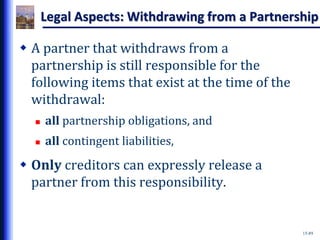
Legal Aspects: Withdrawingfrom a Partnership
A partner that withdraws from a
partnership is still responsible for the
following items that exist at the time of the
withdrawal:
all partnership obligations, and
all contingent liabilities,
Only creditors can expressly release a
partner from this responsibility.
90.
15-90
Legal Aspects: Withdrawingfrom a Partnership
Disassociation
A broad term that refers to when a partner is no
longer associated with a partnership.
Dissolution
A narrow term that refers to when a
(1) partnership is dissolved, and
(2) its affairs must be wound up.
Thus, the partnership’s existence is terminated.
91.
15-91
Practice Quiz Question#6
Upon withdrawal from a partnership, Cliff
received $14,000 cash in excess of his capital
balance. Cliff’s share of profits and losses was
20%. Partnership land was undervalued by
$50,000. The total partnership goodwill is
a. $ 4,000.
b. $20,000.
c. $24,000
d. $70,000.
92.
15-92
Solution
Excess value ofland $50,000
x 20%
Cliff’s share $10,000
Total excess payment $14,000
Share of land excess 10,000
Cliff’s share of goodwill $ 4,000
20%
Total Goodwill $20,000
93.
15-93
Practice Quiz Question#6 Solution
Upon withdrawal from a partnership, Cliff
received $14,000 cash in excess of his capital
balance. Cliff’s share of profits and losses was
20%. Partnership land was undervalued by
$50,000. The total partnership goodwill is
a. $ 4,000.
b. $20,000. (5 x [$14,000 - {20% x $50,000}])
c. $24,000
d. $70,000.
94.
15-94
Group Exercise: Retirement
The6/30/X8 balance sheet of the partnership of Sandy, Rees, and
Raymond as follows. The partners share profits and losses in the ratio
of 2:2:6, respectively.
Assets at cost $145,000
Liabilities 26,000
Capital, Sandy 20,000
Capital, Rees 37,000
Capital, Raymond 62,000
Sandy retires from the partnership. By mutual agreement, the assets
are to be adjusted to their fair value of $150,000 at 6/30/X8. Rees
and Raymond agree that the partnership will pay Sandy $45,000 cash
for her partnership interest. No goodwill is to be recorded.
REQUIRED
1. Prepare the entry to record the revaluation of assets to fair value.
2. Prepare the entry to record Sandy’s retirement.
3. What is the implicit total goodwill for the partnership?
95.
15-95
Group Exercise Solution
PART1
Assets 5,000
Capital, Sandy 1,000
Capital, Rees 1,000
Capital, Raymond 3,000
PART 2
Capital, Sandy 21,000
Capital, Rees 6,000
Capital, Raymond 18,000
Cash 45,000
PART 3
To revalue assets to their current value.
To record the withdrawal of Sandy.
Sandy received a bonus of $24,000, which was equal to her share of the
goodwill. Because Sandy’s profit and loss sharing ratio was 20%, the total
goodwill must have been $120,000 ($24,000 ÷ 20%).




![15-73
Solution, Summary
1. New implied value: $ 54,000 ÷ 25% = $216,000
2. Old implied value: $180,000 ÷ 75% = $240,000
3. BV of net assets: $180,000 + $54,000 = $234,000
4. Implied Goodwill = $240,000 $234,000 = $ 6,000
5. Goodwill belongs to new partner (because
$216,000 is less than $240,000). [Implies that
she paid less for her relative share of the business.]
Since we’re revaluing, use the BIG pie:
x 25% = $60,000
GW = 6,000
234,000
The BIG PIE (BV of NA + Goodwill)
The SMALL PIE (BV Only)](https://image.slidesharecdn.com/chapter15akl-230901024827-42585ab4/85/chapter-15-akl-pptx-73-320.jpg)


![15-76
Solution, Summary
1. New implied value: $ 54,000 ÷ 25% = $216,000
2. Old implied value: $180,000 ÷ 75% = $240,000
3. BV of net assets: $180,000 + $54,000 = $234,000
4. Implied Goodwill = $240,000 $234,000 = $ 6,000
5. Goodwill belongs to new partner (because
$216,000 is less than $240,000). [Implies that
she paid less for her relative share of the business.]
The BIG PIE (BV of NA + Goodwill)
The SMALL PIE (BV Only)
Small Pie
= 180,000
+ 54,000
= 234,000 x 25% = $58,500
Since we’re not
revaluing, use the
Small pie:](https://image.slidesharecdn.com/chapter15akl-230901024827-42585ab4/85/chapter-15-akl-pptx-76-320.jpg)


![15-79
Solution, Summary
1. New implied value: $ 60,000 ÷ 25% = $240,000
2. Old implied value: $165,000 ÷ 75% = $220,000
3. BV of net assets: $165,000 + $60,000 = $225,000
4. Implied Goodwill = $240,000 $225,000 = $ 15,000
5. Goodwill belongs to old partners (because
$220,000 is less than $240,000). [Implies that
they “gave” less for their relative share of the business.]
The BIG PIE (BV of NA + Goodwill)
The SMALL PIE (BV Only)](https://image.slidesharecdn.com/chapter15akl-230901024827-42585ab4/85/chapter-15-akl-pptx-79-320.jpg)


![15-82
Solution, Summary
1. New implied value: $ 15,000 ÷ 30% = $ 50,000
2. Old implied value: $ 70,000 ÷ 70% = $100,000
3. BV of net assets: $ 70,000 + $15,000 = $ 85,000
4. Implied Goodwill = $100,000 $85,000 = $ 15,000
5. Goodwill belongs to new partner (because
$50,000 is less than $100,000). [Implies that
he “gave” less for his relative share of the business.]
The BIG PIE (BV of NA + Goodwill)
The SMALL PIE (BV Only)
Note that we use the small pie here with bonus method.](https://image.slidesharecdn.com/chapter15akl-230901024827-42585ab4/85/chapter-15-akl-pptx-82-320.jpg)


![15-85
Solution, Summary
1. New implied value: $ 25,000 ÷ 20% = $125,000
2. Old implied value: $ 60,000 ÷ 80% = $ 75,000
3. BV of net assets: $ 60,000 + $25,000 = $ 85,000
4. Total Excess Value = $125,000 $85,000 = $ 40,000
Goodwill = Total Excess Value – Excess Land Value
Goodwill = $40,000 - $30,000 = $10,000
5. Goodwill belongs to the old partners (because
$75,000 is less than $125,000). [Implies that they
“gave” less for their relative share of the business.]
The BIG PIE (BV of NA + Goodwill)
The SMALL PIE (BV Only)
GW = 10,000
60,000 +
25,000 =
85,000
Land = 30,000](https://image.slidesharecdn.com/chapter15akl-230901024827-42585ab4/85/chapter-15-akl-pptx-85-320.jpg)




![15-93
Practice Quiz Question #6 Solution
Upon withdrawal from a partnership, Cliff
received $14,000 cash in excess of his capital
balance. Cliff’s share of profits and losses was
20%. Partnership land was undervalued by
$50,000. The total partnership goodwill is
a. $ 4,000.
b. $20,000. (5 x [$14,000 - {20% x $50,000}])
c. $24,000
d. $70,000.](https://image.slidesharecdn.com/chapter15akl-230901024827-42585ab4/85/chapter-15-akl-pptx-93-320.jpg)


