Copyright 2016 Wadsworth Cengage Learning.
All Rights Reserved.
Chapter 14
Print—Early Knowledge and
Emerging Interest
Chapter Highlights
A. Preschoolers and Print
B. Starting from a Different Place
C. Research on Writing Development
D. A Child’s Progress in Printing
E. Invented Spelling
F. Instructional Goals
G. Physical Coordination and Cognitive Development
H. Drawing Experience
I. Exposure to Print—Books
J. Print Awareness and Skill Development Programs
K. Environmental Materials and Aids
Copyright 2016 Wadsworth Cengage Learning.
All Rights Reserved.
Chapter Highlights (cont.)
L. Alphabets and Print Activities
M. Family Information Concerning Print
Observable Stages in Preschool Writing
Age 3
* aimless scribbling
* horizontal marks
* systematic up and down strokes
Age 3 ½ - 4
* horizontal and vertical strokes
* discrete symbol units
* barely recognizable letters
Copyright 2016 Wadsworth Cengage Learning.
All Rights Reserved.
Chapter Highlights (cont.)
Age 4 – 4 ½
* separate symbols
* a wave-like motion imitating writing
* some closed forms
* occasional alphabet letters
Age 4 ½ - 5
* some correctly formed letters
* may print name
* letter units askew
* may invent groups of letters
Age 5
* Correct spelling of name and a few other words
Copyright 2016 Wadsworth Cengage Learning.
All Rights Reserved.
Chapter Highlights (cont.)
Age 5 (cont.)
* reversals and poor letter formations
* better alignment of letters
Copyright 2016 Wadsworth Cengage Learning.
All Rights Reserved.
Copyright 2016 Wadsworth Cengage Learning.
All Rights Reserved.
Objectives
 Understand small muscle development
 Understand sequence of skills for written
language
 Understand settings that promote
development of print
 Plan print-awareness activities
Copyright 2016 Wadsworth Cengage Learning.
All Rights Reserved.
Important Understandings
 Early experiences with print form foundation
for literacy
Print is different from other visual symbols.
Print symbolizes language.
Print can be produced by anyone.
Print holds information.
Copyright 2016 Wadsworth Cengage Learning.
All Rights Reserved.
Reading Skills Gained
from Read-Aloud Process (1 of 2)
 Where reading starts on the page
 Proceeds from left to right
 Return to left margin at the end of a line
 Pages sequenced beginning with page 1
Copyright 2016 Wadsworth Cengage Learning.
All Rights Reserved.
Reading Skills Gained
from Read-Aloud Process (2 of 2)
 Difference between letter, word, and
sentence
 Spaces between words
 Special marks (punctuation) have meaning
 Upper- and lowercase letters
Copyright 2016 Wadsworth Cengage Learning.
All Rights Reserved.
Remember: It’s All Connected
 Reading
 Writing
 Listening
 Speaking
 Viewing
Copyright 2016 Wadsworth Cengage Learning.
All Rights Reserved.
Definitions to Understand
 Phonological awareness
• focus on the sounds of speech as distinct
from its meaning
 Phonemic awareness
• ability to hear and manipulate larger units of
sound, such as onsets, rimes, and syllables
Copyright 2016 Wadsworth Cengage Learning.
All Rights Reserved.
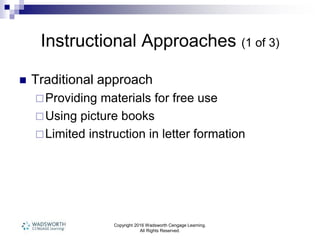
Instructional Approaches (1 of 3)
 Traditional approach
Providing materials for free use
Using picture books
Limited instruction in letter formation
Copyright 2016 Wadsworth Cengage Learning.
All Rights Reserved.
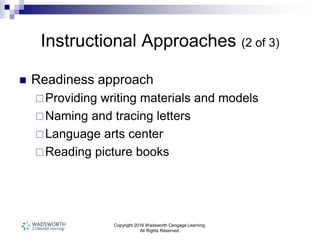
Instructional Approaches (2 of 3)
 Readiness approach
Providing writing materials and models
Naming and tracing letters
Language arts center
Reading picture books
Copyright 2016 Wadsworth Cengage Learning.
All Rights Reserved.
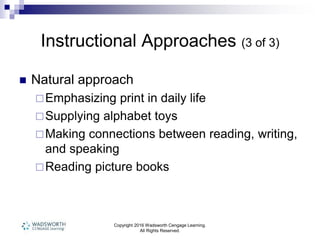
Instructional Approaches (3 of 3)
 Natural approach
Emphasizing print in daily life
Supplying alphabet toys
Making connections between reading, writing,
and speaking
Reading picture books
Copyright 2016 Wadsworth Cengage Learning.
All Rights Reserved.
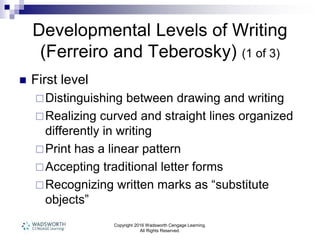
Developmental Levels of Writing
(Ferreiro and Teberosky) (1 of 3)
 First level
Distinguishing between drawing and writing
Realizing curved and straight lines organized
differently in writing
Print has a linear pattern
Accepting traditional letter forms
Recognizing written marks as “substitute
objects”
Copyright 2016 Wadsworth Cengage Learning.
All Rights Reserved.
Developmental Levels of Writing
(Ferreiro and Teberosky) (2 of 3)
 Second level
Look for differences in strings of print
Does not yet understand sound/symbol
relationship
Copyright 2016 Wadsworth Cengage Learning.
All Rights Reserved.
Developmental Levels of Writing
(Ferreiro and Teberosky) (3 of 3)
 Third level
Awareness of letter string that forms name
Printing letter forms as words heard
Looking for similar letters to write similar
sounds
Beginning to understand that letters represent
sounds
Copyright 2016 Wadsworth Cengage Learning.
All Rights Reserved.
Sequence in Written
Language (1 of 2)
 Forms print-like scribbles
 Scribbles become linear
 Begins formation of closed shapes and
purposeful line
 Letter-like forms created
 Makes recognizable alphabet letters
Copyright 2016 Wadsworth Cengage Learning.
All Rights Reserved.
Sequence in Written
Language (2 of 2)
 Forms alphabet groupings with spaces
 Begins invented spellings
 Spells words correctly with appropriate
spaces
Copyright 2016 Wadsworth Cengage Learning.
All Rights Reserved.
Stages of Invented Spelling
 Spelling awareness
 Primitive spelling
 Pre-phonetic spelling
 Phonetic spelling
 Correct spelling
Copyright 2016 Wadsworth Cengage Learning.
All Rights Reserved.
What About ABCs?
 Make it developmentally appropriate.
 Keep it based in meaning.
 Make letters relevant to the child’s world.
 Use environmental print.
 Provide a variety of materials.
 Provide a print-rich environment.
Copyright 2016 Wadsworth Cengage Learning.
All Rights Reserved.
Prerequisite Skills for Handwriting
 Small-muscle coordination
 Eye-hand coordination
 Ability to hold writing tools
 Ability to form basic strokes
 Letter perception
 Desire to write and communicate
 Understanding of left-to-right
Copyright 2016 Wadsworth Cengage Learning.
All Rights Reserved.
Play and Writing
 Provide print materials for play settings.
 Print props help children to view themselves
as readers and writers.
 Children mimic literacy behaviors of adults.
Copyright 2016 Wadsworth Cengage Learning.
All Rights Reserved.
Communicating with Parents
 Note telling about child’s interest in print
 Encouraging printing attempts at home
 Explain that early printing attempts often
include letters that are backwards or upside
down (this is normal)

Chapter 14 Print - Early Knowledge and Emerging Interest

  • 1.
    Copyright 2016 WadsworthCengage Learning. All Rights Reserved. Chapter 14 Print—Early Knowledge and Emerging Interest
  • 2.
    Chapter Highlights A. Preschoolersand Print B. Starting from a Different Place C. Research on Writing Development D. A Child’s Progress in Printing E. Invented Spelling F. Instructional Goals G. Physical Coordination and Cognitive Development H. Drawing Experience I. Exposure to Print—Books J. Print Awareness and Skill Development Programs K. Environmental Materials and Aids Copyright 2016 Wadsworth Cengage Learning. All Rights Reserved.
  • 3.
    Chapter Highlights (cont.) L.Alphabets and Print Activities M. Family Information Concerning Print Observable Stages in Preschool Writing Age 3 * aimless scribbling * horizontal marks * systematic up and down strokes Age 3 ½ - 4 * horizontal and vertical strokes * discrete symbol units * barely recognizable letters Copyright 2016 Wadsworth Cengage Learning. All Rights Reserved.
  • 4.
    Chapter Highlights (cont.) Age4 – 4 ½ * separate symbols * a wave-like motion imitating writing * some closed forms * occasional alphabet letters Age 4 ½ - 5 * some correctly formed letters * may print name * letter units askew * may invent groups of letters Age 5 * Correct spelling of name and a few other words Copyright 2016 Wadsworth Cengage Learning. All Rights Reserved.
  • 5.
    Chapter Highlights (cont.) Age5 (cont.) * reversals and poor letter formations * better alignment of letters Copyright 2016 Wadsworth Cengage Learning. All Rights Reserved.
  • 6.
    Copyright 2016 WadsworthCengage Learning. All Rights Reserved. Objectives  Understand small muscle development  Understand sequence of skills for written language  Understand settings that promote development of print  Plan print-awareness activities
  • 7.
    Copyright 2016 WadsworthCengage Learning. All Rights Reserved. Important Understandings  Early experiences with print form foundation for literacy Print is different from other visual symbols. Print symbolizes language. Print can be produced by anyone. Print holds information.
  • 8.
    Copyright 2016 WadsworthCengage Learning. All Rights Reserved. Reading Skills Gained from Read-Aloud Process (1 of 2)  Where reading starts on the page  Proceeds from left to right  Return to left margin at the end of a line  Pages sequenced beginning with page 1
  • 9.
    Copyright 2016 WadsworthCengage Learning. All Rights Reserved. Reading Skills Gained from Read-Aloud Process (2 of 2)  Difference between letter, word, and sentence  Spaces between words  Special marks (punctuation) have meaning  Upper- and lowercase letters
  • 10.
    Copyright 2016 WadsworthCengage Learning. All Rights Reserved. Remember: It’s All Connected  Reading  Writing  Listening  Speaking  Viewing
  • 11.
    Copyright 2016 WadsworthCengage Learning. All Rights Reserved. Definitions to Understand  Phonological awareness • focus on the sounds of speech as distinct from its meaning  Phonemic awareness • ability to hear and manipulate larger units of sound, such as onsets, rimes, and syllables
  • 12.
    Copyright 2016 WadsworthCengage Learning. All Rights Reserved. Instructional Approaches (1 of 3)  Traditional approach Providing materials for free use Using picture books Limited instruction in letter formation
  • 13.
    Copyright 2016 WadsworthCengage Learning. All Rights Reserved. Instructional Approaches (2 of 3)  Readiness approach Providing writing materials and models Naming and tracing letters Language arts center Reading picture books
  • 14.
    Copyright 2016 WadsworthCengage Learning. All Rights Reserved. Instructional Approaches (3 of 3)  Natural approach Emphasizing print in daily life Supplying alphabet toys Making connections between reading, writing, and speaking Reading picture books
  • 15.
    Copyright 2016 WadsworthCengage Learning. All Rights Reserved. Developmental Levels of Writing (Ferreiro and Teberosky) (1 of 3)  First level Distinguishing between drawing and writing Realizing curved and straight lines organized differently in writing Print has a linear pattern Accepting traditional letter forms Recognizing written marks as “substitute objects”
  • 16.
    Copyright 2016 WadsworthCengage Learning. All Rights Reserved. Developmental Levels of Writing (Ferreiro and Teberosky) (2 of 3)  Second level Look for differences in strings of print Does not yet understand sound/symbol relationship
  • 17.
    Copyright 2016 WadsworthCengage Learning. All Rights Reserved. Developmental Levels of Writing (Ferreiro and Teberosky) (3 of 3)  Third level Awareness of letter string that forms name Printing letter forms as words heard Looking for similar letters to write similar sounds Beginning to understand that letters represent sounds
  • 18.
    Copyright 2016 WadsworthCengage Learning. All Rights Reserved. Sequence in Written Language (1 of 2)  Forms print-like scribbles  Scribbles become linear  Begins formation of closed shapes and purposeful line  Letter-like forms created  Makes recognizable alphabet letters
  • 19.
    Copyright 2016 WadsworthCengage Learning. All Rights Reserved. Sequence in Written Language (2 of 2)  Forms alphabet groupings with spaces  Begins invented spellings  Spells words correctly with appropriate spaces
  • 20.
    Copyright 2016 WadsworthCengage Learning. All Rights Reserved. Stages of Invented Spelling  Spelling awareness  Primitive spelling  Pre-phonetic spelling  Phonetic spelling  Correct spelling
  • 21.
    Copyright 2016 WadsworthCengage Learning. All Rights Reserved. What About ABCs?  Make it developmentally appropriate.  Keep it based in meaning.  Make letters relevant to the child’s world.  Use environmental print.  Provide a variety of materials.  Provide a print-rich environment.
  • 22.
    Copyright 2016 WadsworthCengage Learning. All Rights Reserved. Prerequisite Skills for Handwriting  Small-muscle coordination  Eye-hand coordination  Ability to hold writing tools  Ability to form basic strokes  Letter perception  Desire to write and communicate  Understanding of left-to-right
  • 23.
    Copyright 2016 WadsworthCengage Learning. All Rights Reserved. Play and Writing  Provide print materials for play settings.  Print props help children to view themselves as readers and writers.  Children mimic literacy behaviors of adults.
  • 24.
    Copyright 2016 WadsworthCengage Learning. All Rights Reserved. Communicating with Parents  Note telling about child’s interest in print  Encouraging printing attempts at home  Explain that early printing attempts often include letters that are backwards or upside down (this is normal)