Civil Litigation:
  Process and Procedures

              Chapter Thirteen
Interrogatories and Requests for Production
Interrogatories and
         Requests for Production
              The two most frequently used
               discovery devices
              Written requests for information
              Addressed only to parties, not
               witnesses
              The basis for other investigation,
               additional discovery requests

Civil Litigation: Process and Procedures       © 2009 Pearson Education, Upper Saddle River, NJ 07458.
                                                                                  All Rights Reserved.
Goldman/Hughes                             2
Interrogatories
   A formal request for answers to written questions
   Answers are made under oath, signed by the
    client/party
          Subject to perjury laws
          Can be used for impeachment at trial
   Protected information generates an objection, rather
    than an answer
          Usually privilege or work product
          Attorney must sign (ratify) an objection


Civil Litigation: Process and Procedures       © 2009 Pearson Education, Upper Saddle River, NJ 07458.
                                                                                  All Rights Reserved.
Goldman/Hughes                             3
Requests for Production
   Federal Rule 34 – Production of Documents and
    Things and Entry Upon Land for Inspection and
    Other Purposes
   Moveable items and documents must be furnished
    upon receiving the discovery request
   Non-moveable items (e.g., real property, large
    equipment) can be inspected on-site (entry)
   Requests for protected material should generate
    an objection


Civil Litigation: Process and Procedures       © 2009 Pearson Education, Upper Saddle River, NJ 07458.
                                                                                  All Rights Reserved.
Goldman/Hughes                             4
Request for
Production – Non-Parties
   Although the discovery tool is not
    available, non-parties may be asked to
    produce documents or permit inspection
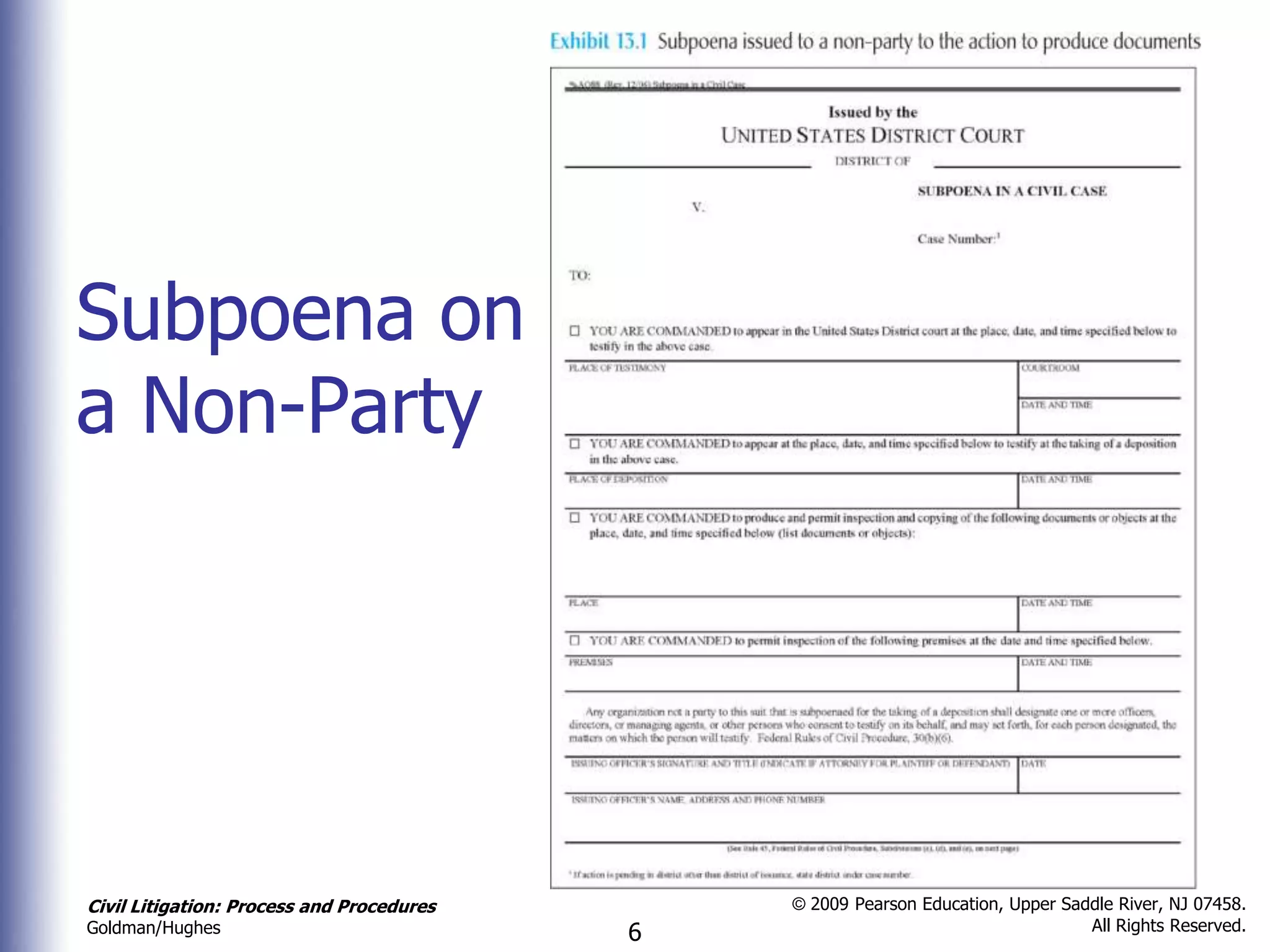
   The request comes in the form of a
    subpoena duces tecum
   This may also command an appearance at
    a hearing, deposition or trial


Civil Litigation: Process and Procedures       © 2009 Pearson Education, Upper Saddle River, NJ 07458.
                                                                                  All Rights Reserved.
Goldman/Hughes                             5
Subpoena on
a Non-Party


Civil Litigation: Process and Procedures       © 2009 Pearson Education, Upper Saddle River, NJ 07458.
                                                                                  All Rights Reserved.
Goldman/Hughes                             6
Discovery Document Format
   Similar to pleadings
          Caption
          Identification of the document
          Introductory paragraph
          Party serving it
          Action required of the recipient
          List of definitions
          Body
          Attorney’s signature
          Certification of service
          Verification of the party (answer)


Civil Litigation: Process and Procedures        © 2009 Pearson Education, Upper Saddle River, NJ 07458.
                                                                                   All Rights Reserved.
Goldman/Hughes                             7
Body of the Document
   In interrogatories, written questions
   In requests for productions
          List of documents
          List of physical objects
          Proposed arrangements for inspection, right
           of entry


Civil Litigation: Process and Procedures       © 2009 Pearson Education, Upper Saddle River, NJ 07458.
                                                                                  All Rights Reserved.
Goldman/Hughes                             8
Time-Frame
     Some preliminary information is required “up-
      front”
     A meet-and-confer will set out the timeline
     The faster the discovery is completed, the
      greater the time available for settlement prior
      to trial
     Deadlines may be extended
            In initial discovery plan
            By stipulation between the attorneys
            By order of the court, with good cause
Civil Litigation: Process and Procedures       © 2009 Pearson Education, Upper Saddle River, NJ 07458.
                                                                                  All Rights Reserved.
Goldman/Hughes                             9
Drafting Interrogatories
   Largest source of objections during discovery
   Court may limit the number of objections
   Used to obtain information controlled by the
    other party
   In addition to 25 initial questions, there will be
    initial disclosures under federal rules which will
    eliminate some areas of inquiry


Civil Litigation: Process and Procedures        © 2009 Pearson Education, Upper Saddle River, NJ 07458.
                                                                                   All Rights Reserved.
Goldman/Hughes                             10
Drafting
   Based on an analysis of the claims, proof
    needed, and possible defenses
   May be modeled on forms for simple
    cases (form books, form files)
   In complex cases, may be designed to
    lead to additional avenues of investigation


Civil Litigation: Process and Procedures        © 2009 Pearson Education, Upper Saddle River, NJ 07458.
                                                                                   All Rights Reserved.
Goldman/Hughes                             11
Claims, Defenses, Issues
   Review the complaint, any motions
   Review or research the elements needed
    to prove the claims
   Review the defenses outlined in the
    answer
   Review the preliminary material provided
    under Fed. Rule 26


Civil Litigation: Process and Procedures        © 2009 Pearson Education, Upper Saddle River, NJ 07458.
                                                                                   All Rights Reserved.
Goldman/Hughes                             12
Proof
     What will need to be produced to prove the
      client’s claim or defense?
            Identity of witnesses
            Documentary evidence
            Physical evidence
            Inspection or testing required for expert
             analysis
     As a matter of strategy, some questions will
      be reserved for depositions (more
      spontaneous responses)

Civil Litigation: Process and Procedures        © 2009 Pearson Education, Upper Saddle River, NJ 07458.
                                                                                   All Rights Reserved.
Goldman/Hughes                             13
Preparing Interrogatories
   Writing
          Review pleadings and prepare a list of claims &
           defenses
          Review or research the necessary elements
          Review initial disclosures made under Rule 26(a)
          Identify areas with a lack of supporting information
   Service
          Set of interrogatories should be sent to opposing
           counsel(s), if that party is represented


Civil Litigation: Process and Procedures        © 2009 Pearson Education, Upper Saddle River, NJ 07458.
                                                                                   All Rights Reserved.
Goldman/Hughes                             14
Reminders
   Never directly contact a party who is
    represented by counsel
   Be sure to calendar (docket or tickle) the
    expected due date for answers
   If responding to interrogatories, be sure to
    calendar the necessary reminders as well as the
    due date
   If the due date passes without response, a
    motion to compel may need to be prepared

Civil Litigation: Process and Procedures        © 2009 Pearson Education, Upper Saddle River, NJ 07458.
                                                                                   All Rights Reserved.
Goldman/Hughes                             15
Responding to Interrogatories
   Make 2 working copies
   Review with attorney to identify any objections
   Send a copy to the client & schedule a meeting
   Review all case information
   Meet with the client, draft responses
   Review draft responses with attorney, amend as
    necessary
   Meet with client for verification of final answers
   Be sure response is received before due date


Civil Litigation: Process and Procedures        © 2009 Pearson Education, Upper Saddle River, NJ 07458.
                                                                                   All Rights Reserved.
Goldman/Hughes                             16
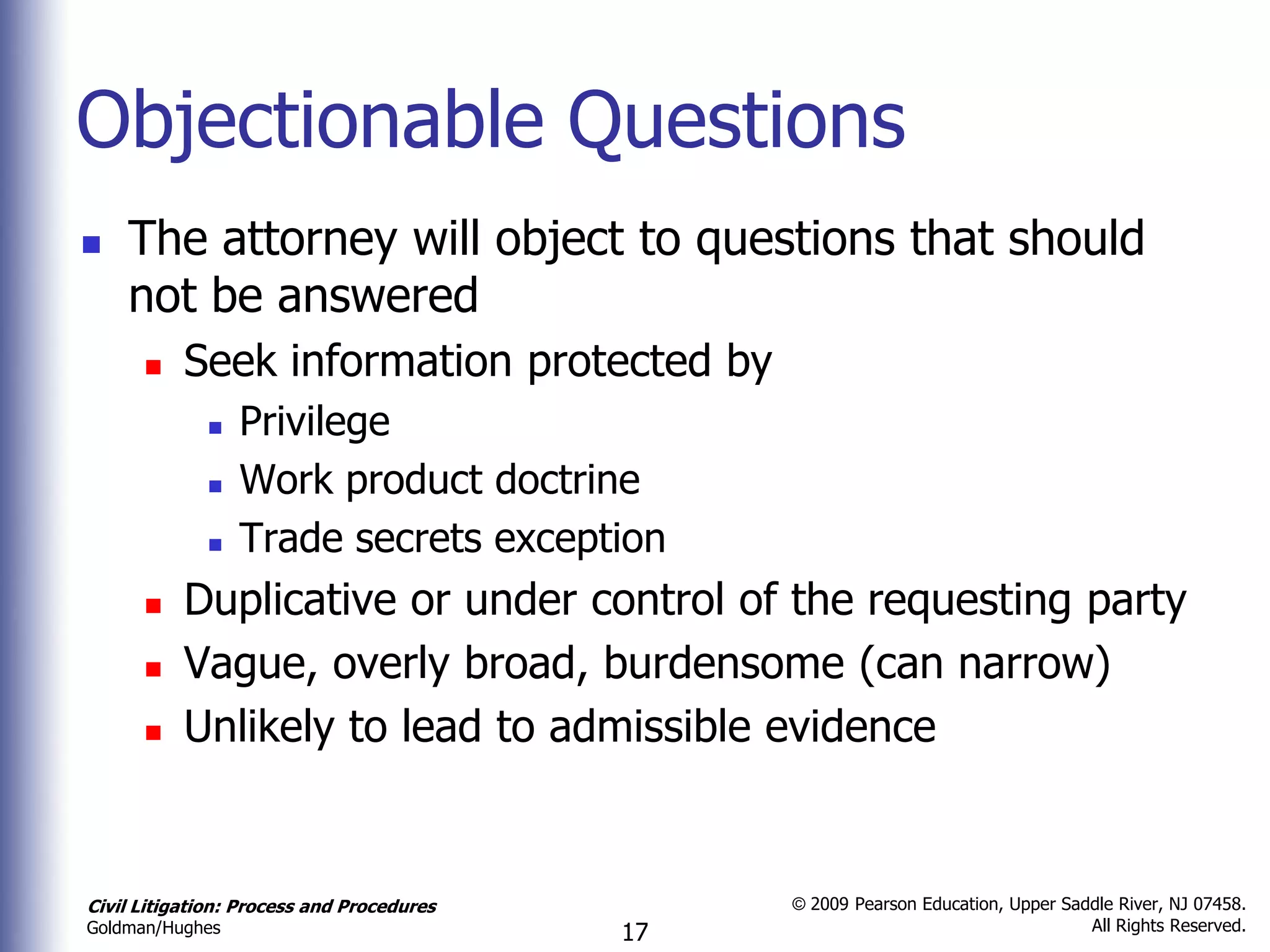
Objectionable Questions
   The attorney will object to questions that should
    not be answered
          Seek information protected by
                Privilege
                Work product doctrine
                Trade secrets exception
          Duplicative or under control of the requesting party
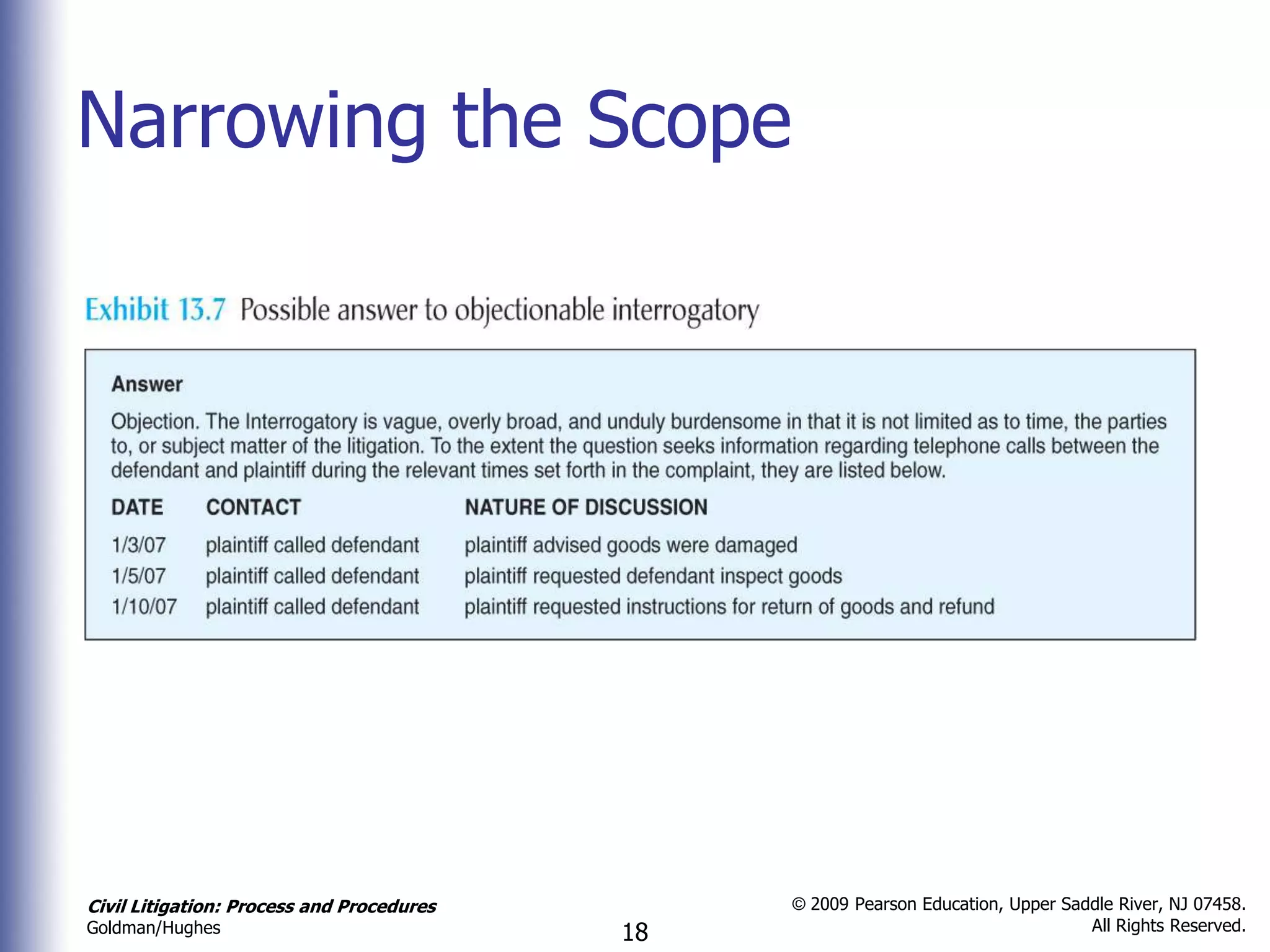
          Vague, overly broad, burdensome (can narrow)
          Unlikely to lead to admissible evidence


Civil Litigation: Process and Procedures        © 2009 Pearson Education, Upper Saddle River, NJ 07458.
                                                                                   All Rights Reserved.
Goldman/Hughes                             17
Narrowing the Scope


Civil Litigation: Process and Procedures        © 2009 Pearson Education, Upper Saddle River, NJ 07458.
                                                                                   All Rights Reserved.
Goldman/Hughes                             18
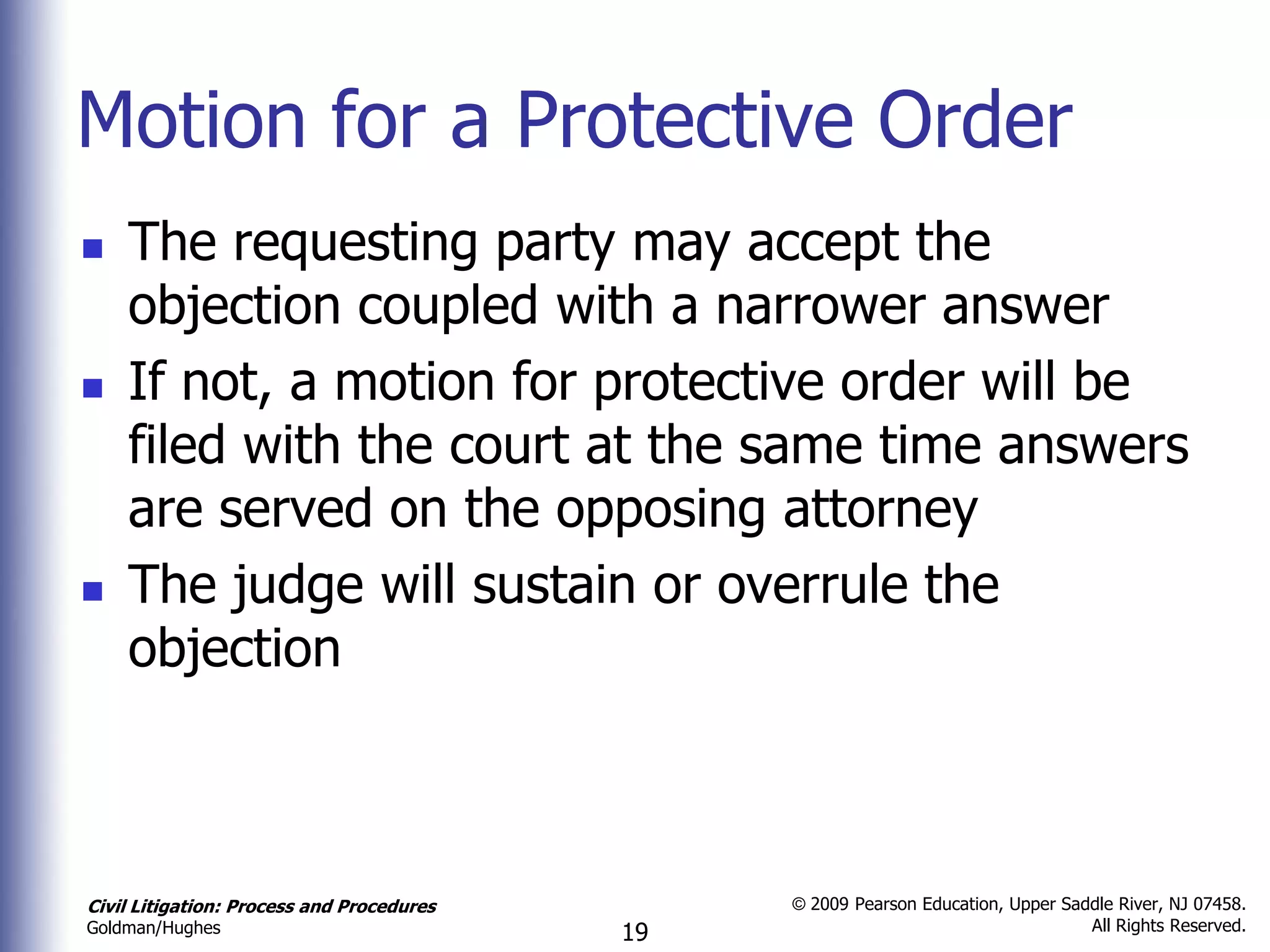
Motion for a Protective Order
   The requesting party may accept the
    objection coupled with a narrower answer
   If not, a motion for protective order will be
    filed with the court at the same time answers
    are served on the opposing attorney
   The judge will sustain or overrule the
    objection


Civil Litigation: Process and Procedures        © 2009 Pearson Education, Upper Saddle River, NJ 07458.
                                                                                   All Rights Reserved.
Goldman/Hughes                             19
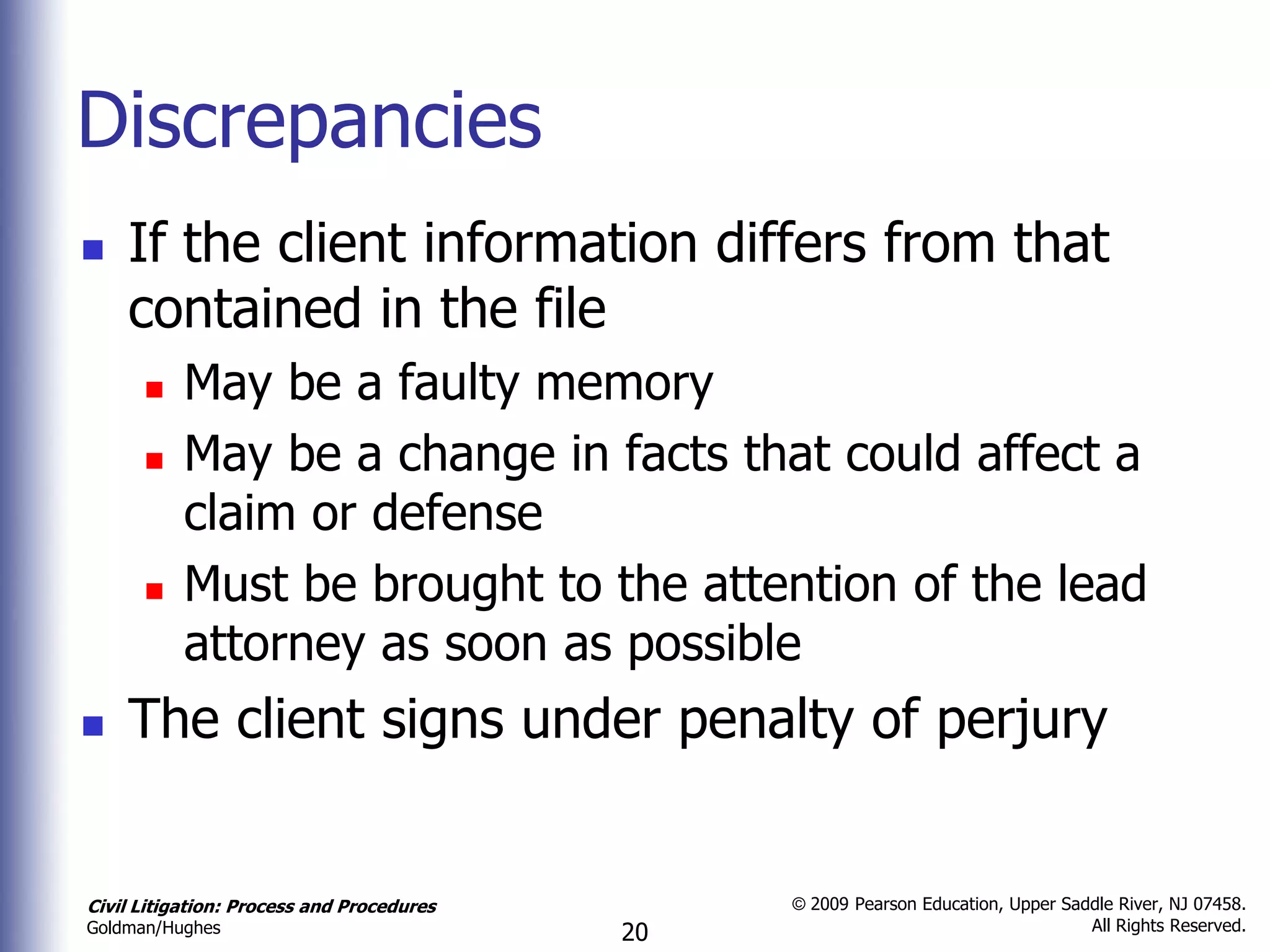
Discrepancies
   If the client information differs from that
    contained in the file
          May be a faulty memory
          May be a change in facts that could affect a
           claim or defense
          Must be brought to the attention of the lead
           attorney as soon as possible
   The client signs under penalty of perjury


Civil Litigation: Process and Procedures        © 2009 Pearson Education, Upper Saddle River, NJ 07458.
                                                                                   All Rights Reserved.
Goldman/Hughes                             20
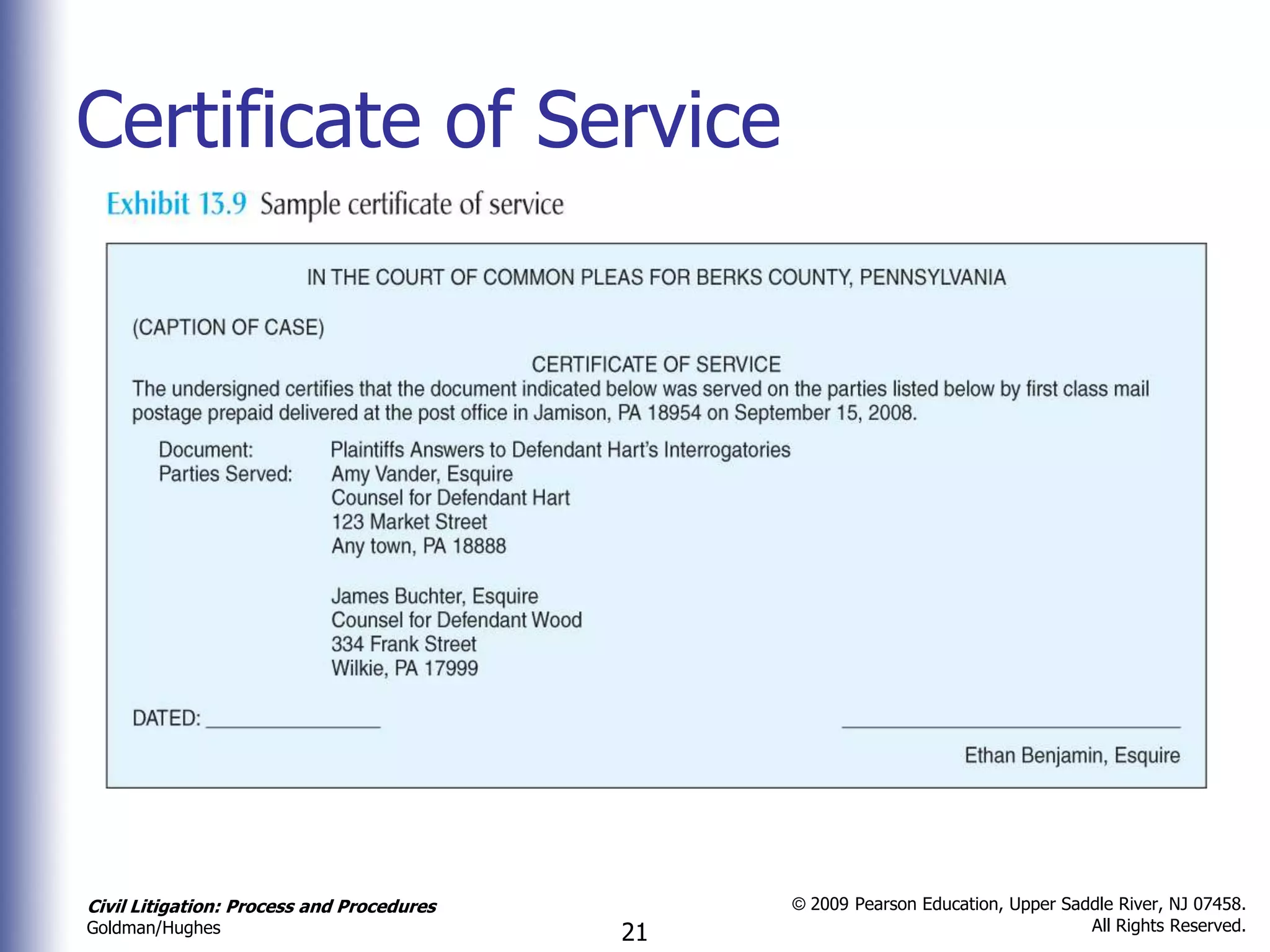
Certificate of Service


Civil Litigation: Process and Procedures        © 2009 Pearson Education, Upper Saddle River, NJ 07458.
                                                                                   All Rights Reserved.
Goldman/Hughes                             21
Reviewing Answers
   Check to see that all have been addressed
          Answered fully
          Objected to
   If a motion for a protective order has been
    filed, calendar (tickle) it with adequate
    reminders for preparation
   Analyze answers to discover any follow-up
    required by requests for production or
    deposition

Civil Litigation: Process and Procedures        © 2009 Pearson Education, Upper Saddle River, NJ 07458.
                                                                                   All Rights Reserved.
Goldman/Hughes                             22
Preparing a
Request for Documents
   Integrate information from interrogatories
    into case file, and re-analyze the claims,
    elements & defenses
   Request any documents revealed in the
    previous discovery requests (remembering
    that the order of discovery is a strategy
    issue)


Civil Litigation: Process and Procedures        © 2009 Pearson Education, Upper Saddle River, NJ 07458.
                                                                                   All Rights Reserved.
Goldman/Hughes                             23
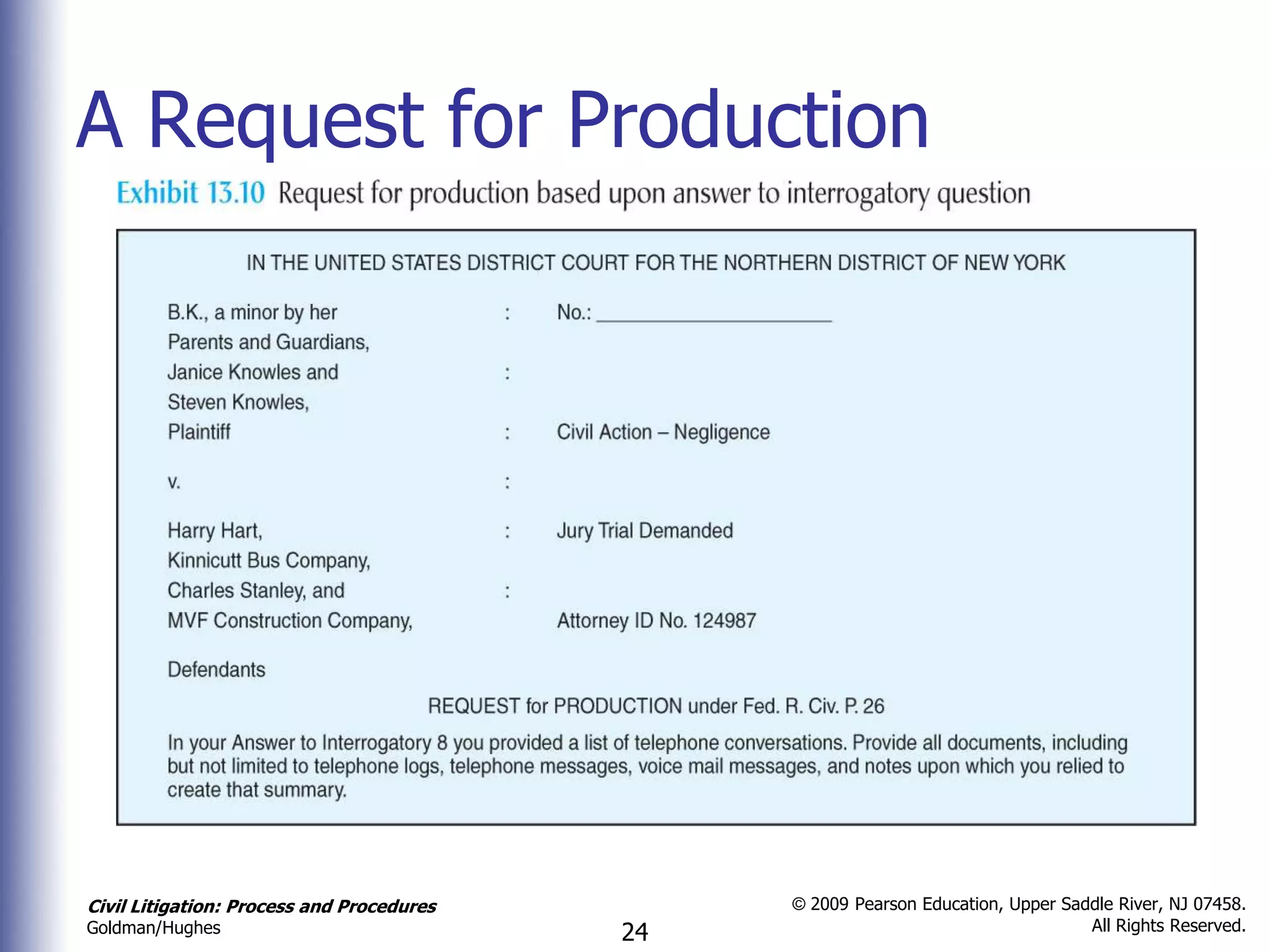
A Request for Production


Civil Litigation: Process and Procedures        © 2009 Pearson Education, Upper Saddle River, NJ 07458.
                                                                                   All Rights Reserved.
Goldman/Hughes                             24
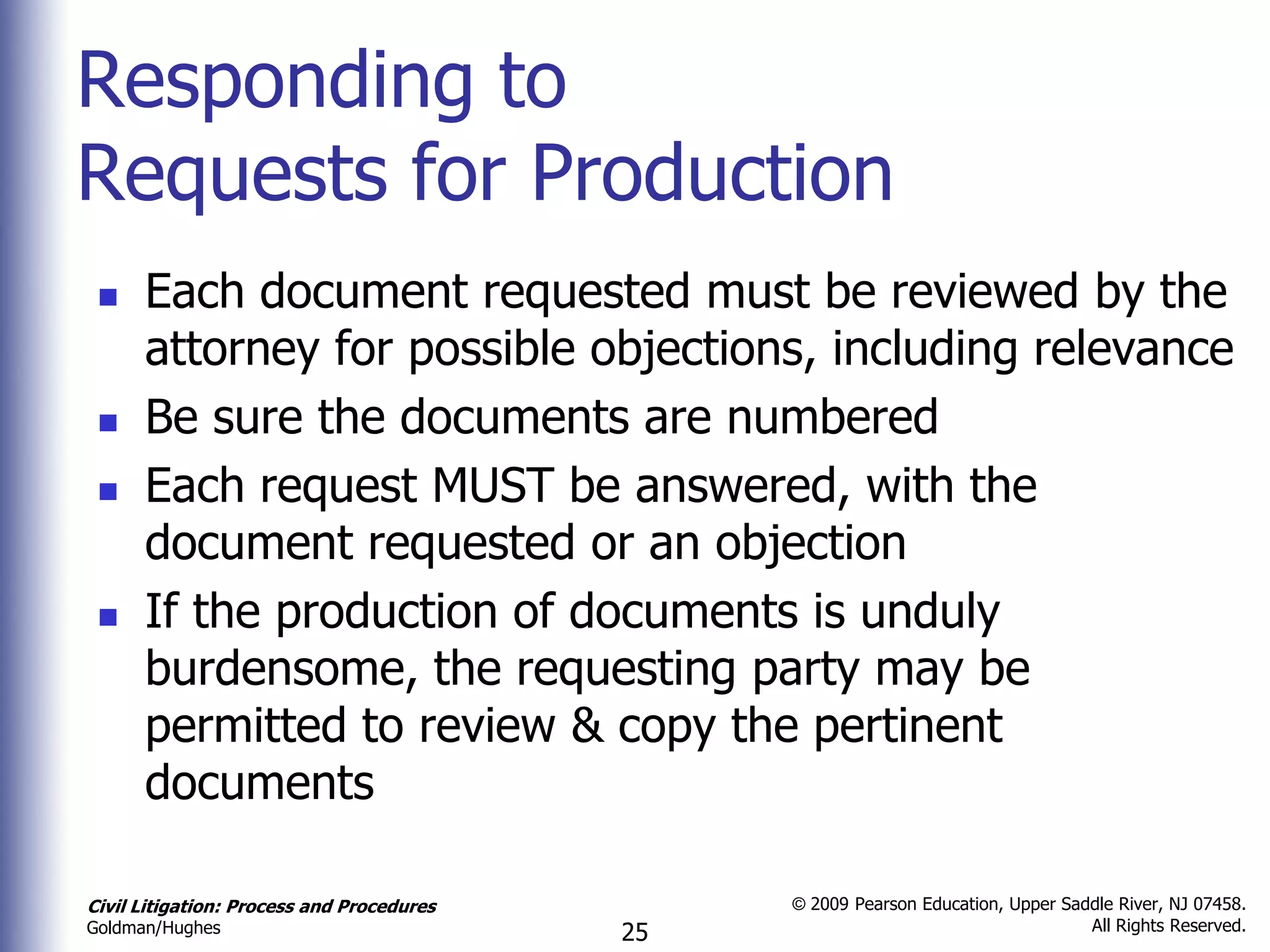
Responding to
Requests for Production
     Each document requested must be reviewed by the
      attorney for possible objections, including relevance
     Be sure the documents are numbered
     Each request MUST be answered, with the
      document requested or an objection
     If the production of documents is unduly
      burdensome, the requesting party may be
      permitted to review & copy the pertinent
      documents

Civil Litigation: Process and Procedures        © 2009 Pearson Education, Upper Saddle River, NJ 07458.
                                                                                   All Rights Reserved.
Goldman/Hughes                             25
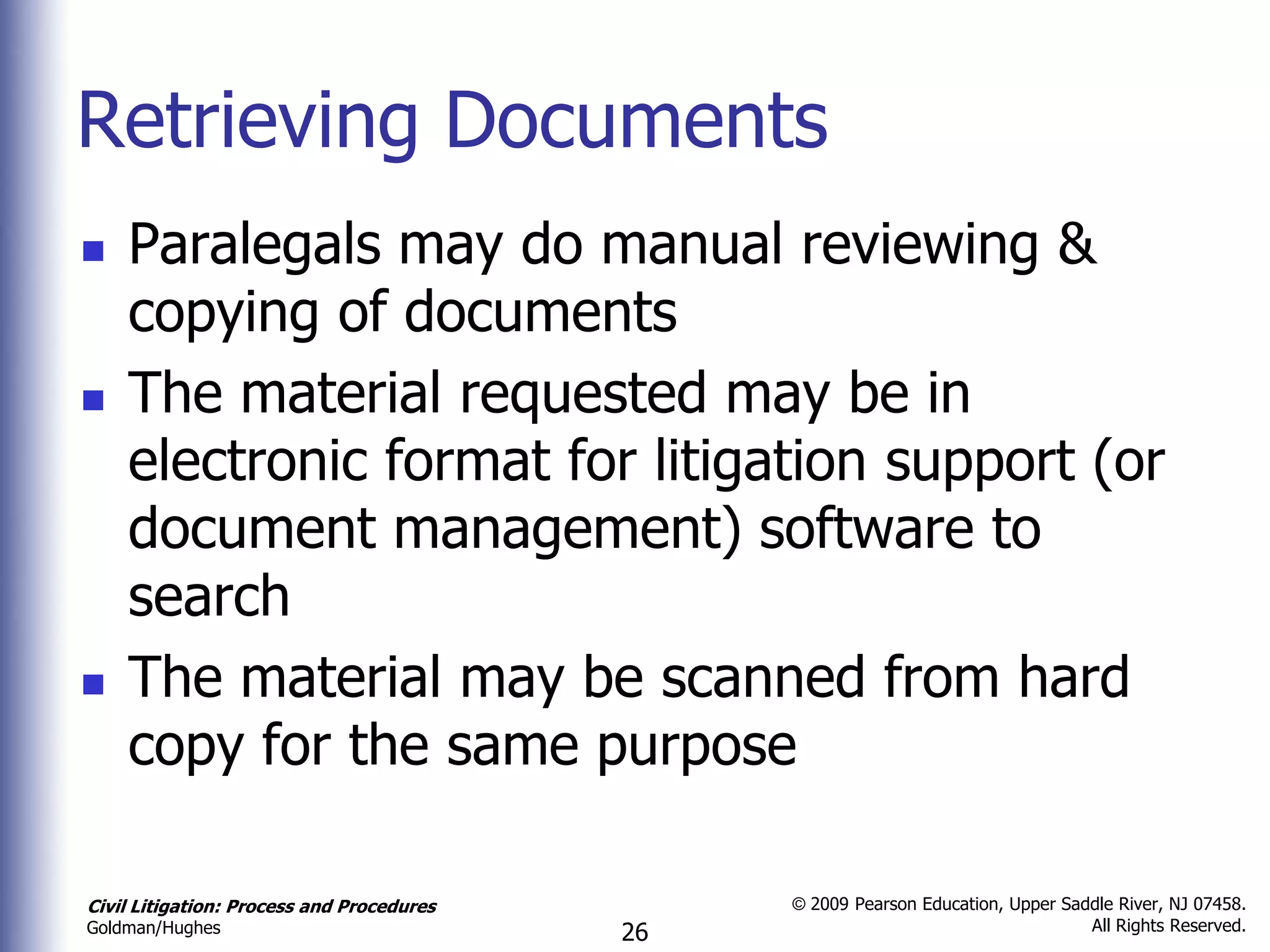
Retrieving Documents
   Paralegals may do manual reviewing &
    copying of documents
   The material requested may be in
    electronic format for litigation support (or
    document management) software to
    search
   The material may be scanned from hard
    copy for the same purpose

Civil Litigation: Process and Procedures        © 2009 Pearson Education, Upper Saddle River, NJ 07458.
                                                                                   All Rights Reserved.
Goldman/Hughes                             26
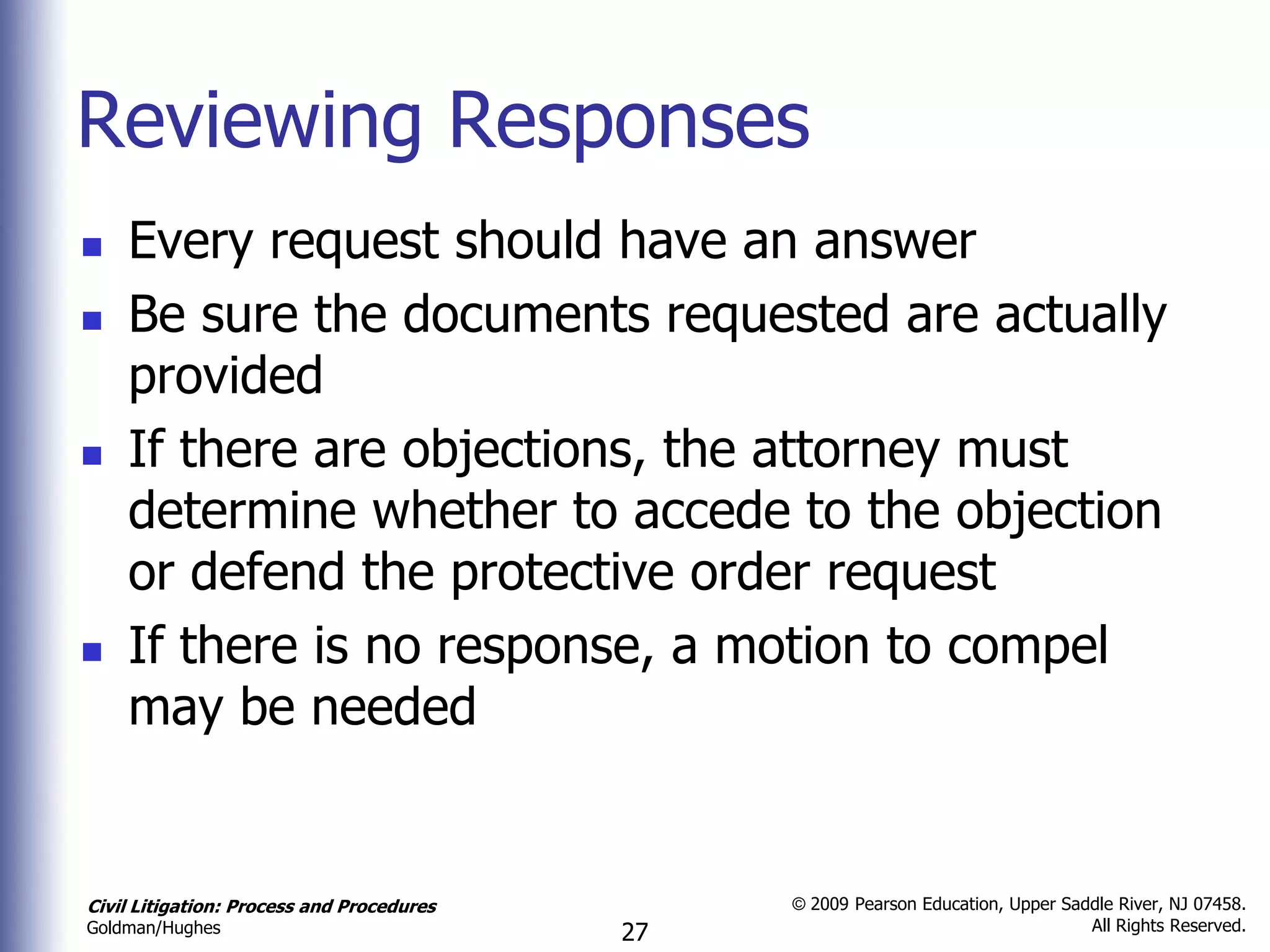
Reviewing Responses
   Every request should have an answer
   Be sure the documents requested are actually
    provided
   If there are objections, the attorney must
    determine whether to accede to the objection
    or defend the protective order request
   If there is no response, a motion to compel
    may be needed


Civil Litigation: Process and Procedures        © 2009 Pearson Education, Upper Saddle River, NJ 07458.
                                                                                   All Rights Reserved.
Goldman/Hughes                             27
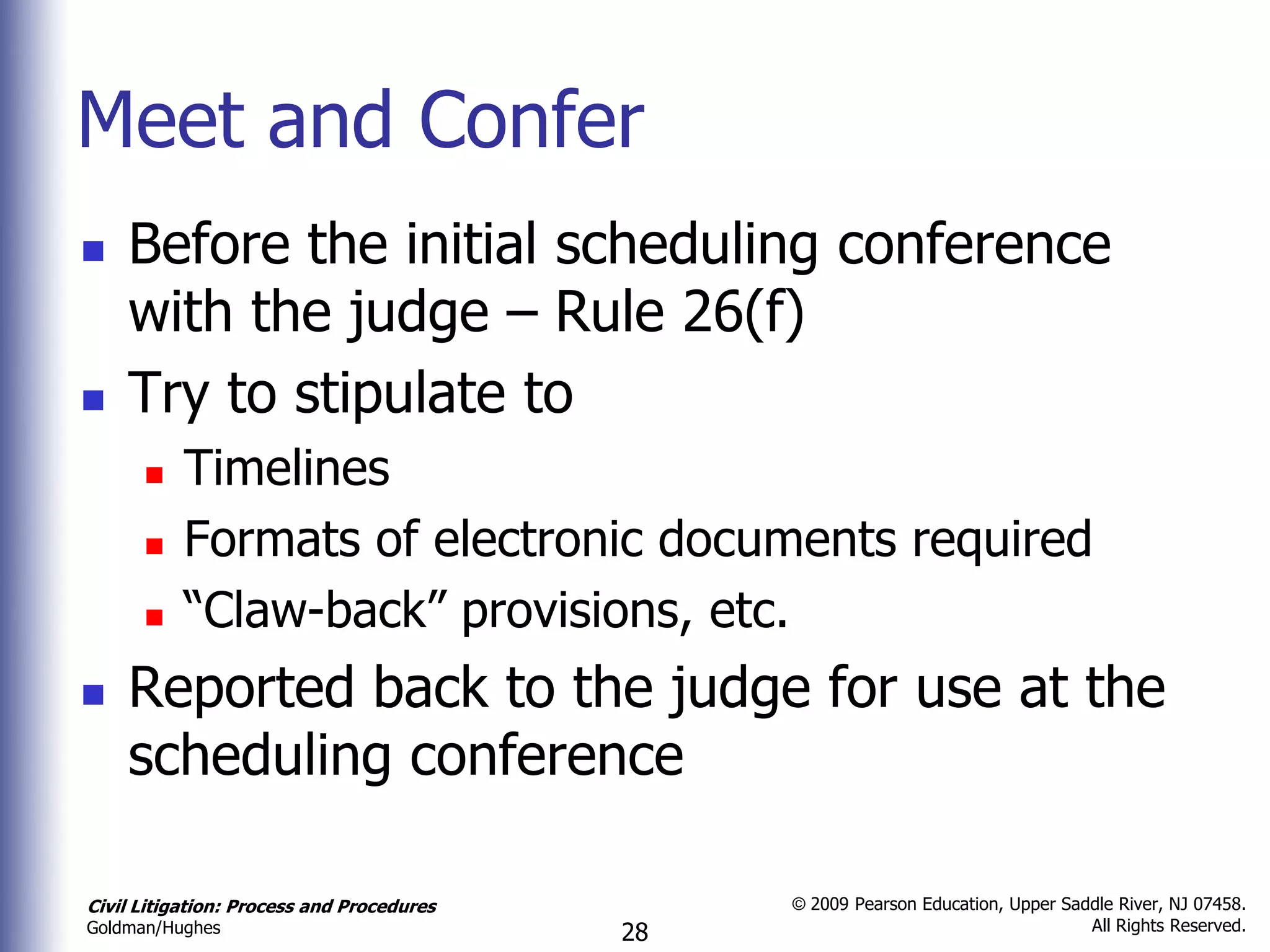
Meet and Confer
   Before the initial scheduling conference
    with the judge – Rule 26(f)
   Try to stipulate to
          Timelines
          Formats of electronic documents required
          “Claw-back” provisions, etc.
   Reported back to the judge for use at the
    scheduling conference

Civil Litigation: Process and Procedures        © 2009 Pearson Education, Upper Saddle River, NJ 07458.
                                                                                   All Rights Reserved.
Goldman/Hughes                             28
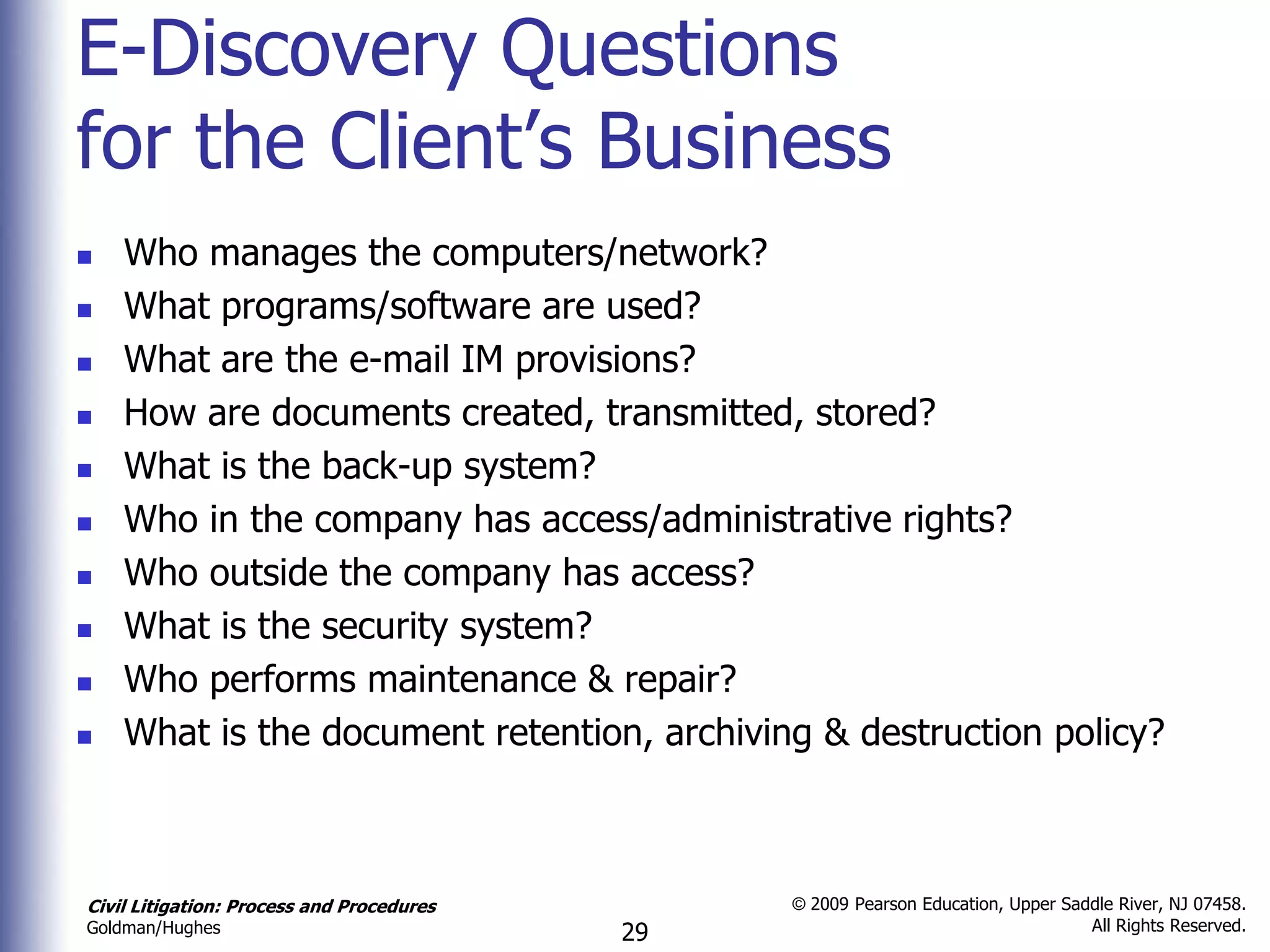
E-Discovery Questions
for the Client’s Business
   Who manages the computers/network?
   What programs/software are used?
   What are the e-mail IM provisions?
   How are documents created, transmitted, stored?
   What is the back-up system?
   Who in the company has access/administrative rights?
   Who outside the company has access?
   What is the security system?
   Who performs maintenance & repair?
   What is the document retention, archiving & destruction policy?


Civil Litigation: Process and Procedures        © 2009 Pearson Education, Upper Saddle River, NJ 07458.
                                                                                   All Rights Reserved.
Goldman/Hughes                             29
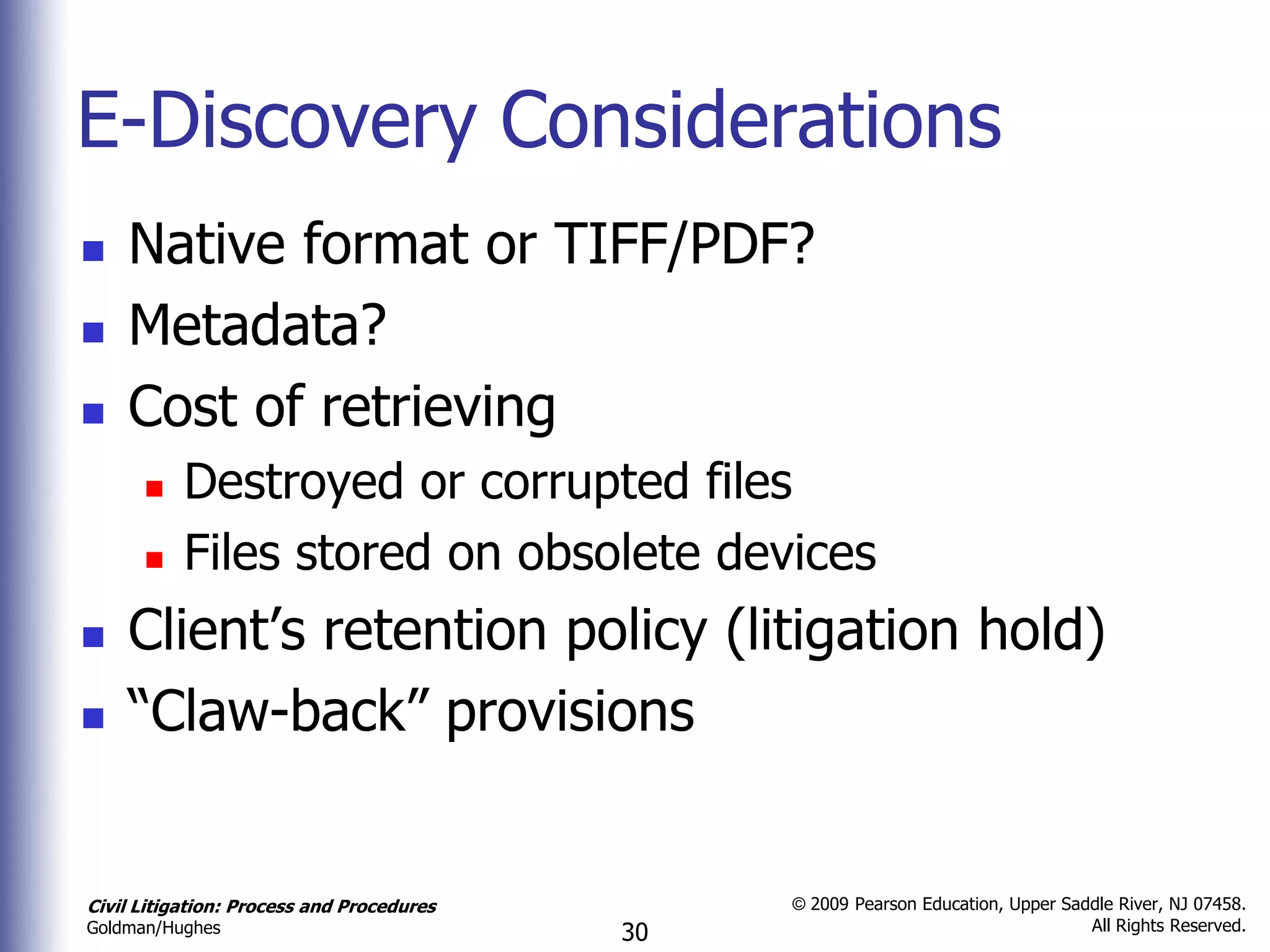
E-Discovery Considerations
   Native format or TIFF/PDF?
   Metadata?
   Cost of retrieving
          Destroyed or corrupted files
          Files stored on obsolete devices
   Client’s retention policy (litigation hold)
   “Claw-back” provisions


Civil Litigation: Process and Procedures        © 2009 Pearson Education, Upper Saddle River, NJ 07458.
                                                                                   All Rights Reserved.
Goldman/Hughes                             30

Chapter 13 thirteen interrogatories and requests for production

  • 1.
    Civil Litigation: Process and Procedures Chapter Thirteen Interrogatories and Requests for Production
  • 2.
    Interrogatories and Requests for Production  The two most frequently used discovery devices  Written requests for information  Addressed only to parties, not witnesses  The basis for other investigation, additional discovery requests Civil Litigation: Process and Procedures © 2009 Pearson Education, Upper Saddle River, NJ 07458. All Rights Reserved. Goldman/Hughes 2
  • 3.
    Interrogatories  A formal request for answers to written questions  Answers are made under oath, signed by the client/party  Subject to perjury laws  Can be used for impeachment at trial  Protected information generates an objection, rather than an answer  Usually privilege or work product  Attorney must sign (ratify) an objection Civil Litigation: Process and Procedures © 2009 Pearson Education, Upper Saddle River, NJ 07458. All Rights Reserved. Goldman/Hughes 3
  • 4.
    Requests for Production  Federal Rule 34 – Production of Documents and Things and Entry Upon Land for Inspection and Other Purposes  Moveable items and documents must be furnished upon receiving the discovery request  Non-moveable items (e.g., real property, large equipment) can be inspected on-site (entry)  Requests for protected material should generate an objection Civil Litigation: Process and Procedures © 2009 Pearson Education, Upper Saddle River, NJ 07458. All Rights Reserved. Goldman/Hughes 4
  • 5.
    Request for Production –Non-Parties  Although the discovery tool is not available, non-parties may be asked to produce documents or permit inspection  The request comes in the form of a subpoena duces tecum  This may also command an appearance at a hearing, deposition or trial Civil Litigation: Process and Procedures © 2009 Pearson Education, Upper Saddle River, NJ 07458. All Rights Reserved. Goldman/Hughes 5
  • 6.
    Subpoena on a Non-Party CivilLitigation: Process and Procedures © 2009 Pearson Education, Upper Saddle River, NJ 07458. All Rights Reserved. Goldman/Hughes 6
  • 7.
    Discovery Document Format  Similar to pleadings  Caption  Identification of the document  Introductory paragraph  Party serving it  Action required of the recipient  List of definitions  Body  Attorney’s signature  Certification of service  Verification of the party (answer) Civil Litigation: Process and Procedures © 2009 Pearson Education, Upper Saddle River, NJ 07458. All Rights Reserved. Goldman/Hughes 7
  • 8.
    Body of theDocument  In interrogatories, written questions  In requests for productions  List of documents  List of physical objects  Proposed arrangements for inspection, right of entry Civil Litigation: Process and Procedures © 2009 Pearson Education, Upper Saddle River, NJ 07458. All Rights Reserved. Goldman/Hughes 8
  • 9.
    Time-Frame  Some preliminary information is required “up- front”  A meet-and-confer will set out the timeline  The faster the discovery is completed, the greater the time available for settlement prior to trial  Deadlines may be extended  In initial discovery plan  By stipulation between the attorneys  By order of the court, with good cause Civil Litigation: Process and Procedures © 2009 Pearson Education, Upper Saddle River, NJ 07458. All Rights Reserved. Goldman/Hughes 9
  • 10.
    Drafting Interrogatories  Largest source of objections during discovery  Court may limit the number of objections  Used to obtain information controlled by the other party  In addition to 25 initial questions, there will be initial disclosures under federal rules which will eliminate some areas of inquiry Civil Litigation: Process and Procedures © 2009 Pearson Education, Upper Saddle River, NJ 07458. All Rights Reserved. Goldman/Hughes 10
  • 11.
    Drafting  Based on an analysis of the claims, proof needed, and possible defenses  May be modeled on forms for simple cases (form books, form files)  In complex cases, may be designed to lead to additional avenues of investigation Civil Litigation: Process and Procedures © 2009 Pearson Education, Upper Saddle River, NJ 07458. All Rights Reserved. Goldman/Hughes 11
  • 12.
    Claims, Defenses, Issues  Review the complaint, any motions  Review or research the elements needed to prove the claims  Review the defenses outlined in the answer  Review the preliminary material provided under Fed. Rule 26 Civil Litigation: Process and Procedures © 2009 Pearson Education, Upper Saddle River, NJ 07458. All Rights Reserved. Goldman/Hughes 12
  • 13.
    Proof  What will need to be produced to prove the client’s claim or defense?  Identity of witnesses  Documentary evidence  Physical evidence  Inspection or testing required for expert analysis  As a matter of strategy, some questions will be reserved for depositions (more spontaneous responses) Civil Litigation: Process and Procedures © 2009 Pearson Education, Upper Saddle River, NJ 07458. All Rights Reserved. Goldman/Hughes 13
  • 14.
    Preparing Interrogatories  Writing  Review pleadings and prepare a list of claims & defenses  Review or research the necessary elements  Review initial disclosures made under Rule 26(a)  Identify areas with a lack of supporting information  Service  Set of interrogatories should be sent to opposing counsel(s), if that party is represented Civil Litigation: Process and Procedures © 2009 Pearson Education, Upper Saddle River, NJ 07458. All Rights Reserved. Goldman/Hughes 14
  • 15.
    Reminders  Never directly contact a party who is represented by counsel  Be sure to calendar (docket or tickle) the expected due date for answers  If responding to interrogatories, be sure to calendar the necessary reminders as well as the due date  If the due date passes without response, a motion to compel may need to be prepared Civil Litigation: Process and Procedures © 2009 Pearson Education, Upper Saddle River, NJ 07458. All Rights Reserved. Goldman/Hughes 15
  • 16.
    Responding to Interrogatories  Make 2 working copies  Review with attorney to identify any objections  Send a copy to the client & schedule a meeting  Review all case information  Meet with the client, draft responses  Review draft responses with attorney, amend as necessary  Meet with client for verification of final answers  Be sure response is received before due date Civil Litigation: Process and Procedures © 2009 Pearson Education, Upper Saddle River, NJ 07458. All Rights Reserved. Goldman/Hughes 16
  • 17.
    Objectionable Questions  The attorney will object to questions that should not be answered  Seek information protected by  Privilege  Work product doctrine  Trade secrets exception  Duplicative or under control of the requesting party  Vague, overly broad, burdensome (can narrow)  Unlikely to lead to admissible evidence Civil Litigation: Process and Procedures © 2009 Pearson Education, Upper Saddle River, NJ 07458. All Rights Reserved. Goldman/Hughes 17
  • 18.
    Narrowing the Scope CivilLitigation: Process and Procedures © 2009 Pearson Education, Upper Saddle River, NJ 07458. All Rights Reserved. Goldman/Hughes 18
  • 19.
    Motion for aProtective Order  The requesting party may accept the objection coupled with a narrower answer  If not, a motion for protective order will be filed with the court at the same time answers are served on the opposing attorney  The judge will sustain or overrule the objection Civil Litigation: Process and Procedures © 2009 Pearson Education, Upper Saddle River, NJ 07458. All Rights Reserved. Goldman/Hughes 19
  • 20.
    Discrepancies  If the client information differs from that contained in the file  May be a faulty memory  May be a change in facts that could affect a claim or defense  Must be brought to the attention of the lead attorney as soon as possible  The client signs under penalty of perjury Civil Litigation: Process and Procedures © 2009 Pearson Education, Upper Saddle River, NJ 07458. All Rights Reserved. Goldman/Hughes 20
  • 21.
    Certificate of Service CivilLitigation: Process and Procedures © 2009 Pearson Education, Upper Saddle River, NJ 07458. All Rights Reserved. Goldman/Hughes 21
  • 22.
    Reviewing Answers  Check to see that all have been addressed  Answered fully  Objected to  If a motion for a protective order has been filed, calendar (tickle) it with adequate reminders for preparation  Analyze answers to discover any follow-up required by requests for production or deposition Civil Litigation: Process and Procedures © 2009 Pearson Education, Upper Saddle River, NJ 07458. All Rights Reserved. Goldman/Hughes 22
  • 23.
    Preparing a Request forDocuments  Integrate information from interrogatories into case file, and re-analyze the claims, elements & defenses  Request any documents revealed in the previous discovery requests (remembering that the order of discovery is a strategy issue) Civil Litigation: Process and Procedures © 2009 Pearson Education, Upper Saddle River, NJ 07458. All Rights Reserved. Goldman/Hughes 23
  • 24.
    A Request forProduction Civil Litigation: Process and Procedures © 2009 Pearson Education, Upper Saddle River, NJ 07458. All Rights Reserved. Goldman/Hughes 24
  • 25.
    Responding to Requests forProduction  Each document requested must be reviewed by the attorney for possible objections, including relevance  Be sure the documents are numbered  Each request MUST be answered, with the document requested or an objection  If the production of documents is unduly burdensome, the requesting party may be permitted to review & copy the pertinent documents Civil Litigation: Process and Procedures © 2009 Pearson Education, Upper Saddle River, NJ 07458. All Rights Reserved. Goldman/Hughes 25
  • 26.
    Retrieving Documents  Paralegals may do manual reviewing & copying of documents  The material requested may be in electronic format for litigation support (or document management) software to search  The material may be scanned from hard copy for the same purpose Civil Litigation: Process and Procedures © 2009 Pearson Education, Upper Saddle River, NJ 07458. All Rights Reserved. Goldman/Hughes 26
  • 27.
    Reviewing Responses  Every request should have an answer  Be sure the documents requested are actually provided  If there are objections, the attorney must determine whether to accede to the objection or defend the protective order request  If there is no response, a motion to compel may be needed Civil Litigation: Process and Procedures © 2009 Pearson Education, Upper Saddle River, NJ 07458. All Rights Reserved. Goldman/Hughes 27
  • 28.
    Meet and Confer  Before the initial scheduling conference with the judge – Rule 26(f)  Try to stipulate to  Timelines  Formats of electronic documents required  “Claw-back” provisions, etc.  Reported back to the judge for use at the scheduling conference Civil Litigation: Process and Procedures © 2009 Pearson Education, Upper Saddle River, NJ 07458. All Rights Reserved. Goldman/Hughes 28
  • 29.
    E-Discovery Questions for theClient’s Business  Who manages the computers/network?  What programs/software are used?  What are the e-mail IM provisions?  How are documents created, transmitted, stored?  What is the back-up system?  Who in the company has access/administrative rights?  Who outside the company has access?  What is the security system?  Who performs maintenance & repair?  What is the document retention, archiving & destruction policy? Civil Litigation: Process and Procedures © 2009 Pearson Education, Upper Saddle River, NJ 07458. All Rights Reserved. Goldman/Hughes 29
  • 30.
    E-Discovery Considerations  Native format or TIFF/PDF?  Metadata?  Cost of retrieving  Destroyed or corrupted files  Files stored on obsolete devices  Client’s retention policy (litigation hold)  “Claw-back” provisions Civil Litigation: Process and Procedures © 2009 Pearson Education, Upper Saddle River, NJ 07458. All Rights Reserved. Goldman/Hughes 30