Chapter 12
The Nervous System
Review of -phasia, -plegia, aphasia, and
paraplegia
Suffixes


-phasia


Speech




Example: dysphasia/aphasia

-plegia


Paralysis


Examples: paraplegia, quadriplegia, monoplegia,
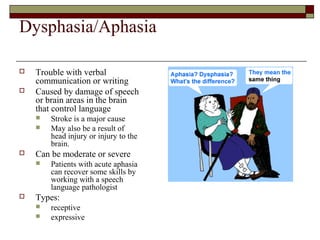
Dysphasia/Aphasia



Trouble with verbal
communication or writing
Caused by damage of speech
or brain areas in the brain
that control language





Can be moderate or severe




Stroke is a major cause
May also be a result of
head injury or injury to the
brain.
Patients with acute aphasia
can recover some skills by
working with a speech
language pathologist

Types:



receptive
expressive
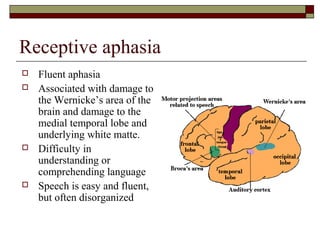
Receptive aphasia







Fluent aphasia
Associated with damage to
the Wernicke’s area of the
brain and damage to the
medial temporal lobe and
underlying white matte.
Difficulty in
understanding or
comprehending language
Speech is easy and fluent,
but often disorganized
Expressive aphasia







Also called non-fluent aphasia
Caused by damage to the anterior regions of the
brain, Broca’s area usually due to stroke.
Trouble putting words together for meaning and
articulating thoughts verbally, although usually
understanding is intact
Individuals with expressive aphasia often use made
up words or neologisms to convey meaning.


Example: “short” instead of “stroke”
Paraplegia
Paraplegia





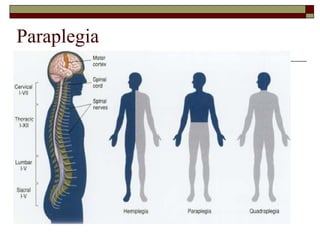
Complete or partial paralysis of the lower half of the body
Lower part of the body loses sensation or movement
Have full movement and use of arm and hands
Result of damage to the nervous system (usually due to accident) is the
most frequent cause of paraplegia





Broken neck/back
Spinal cord injury
Stroke
Congenital






Spinal bifida

Tumor
Infection
Spinal cord disorder


Syrinx
Paraplegia


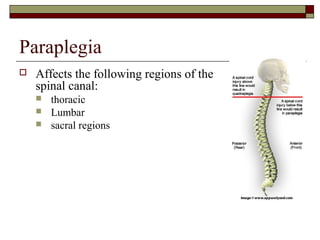
Affects the following regions of the
spinal canal:




thoracic
Lumbar
sacral regions
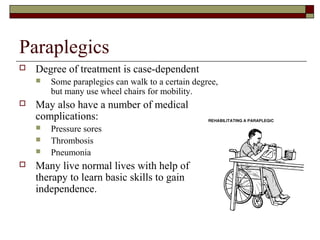
Paraplegics


Degree of treatment is case-dependent




May also have a number of medical
complications:






Some paraplegics can walk to a certain degree,
but many use wheel chairs for mobility.

Pressure sores
Thrombosis
Pneumonia

Many live normal lives with help of
therapy to learn basic skills to gain
independence.
Bibliography












American Speech-Language-Hearing Association. “Aphasia.”
http://www.asha.org/public/speech/disorders/aphasia.html. 12 November 2013
Expressive dysphasia. http://www.nle.nottingham.ac.uk/websites/stroke/contents/expdysphasia.html. 11
Novmber 2013
Fregman, B and Frucht S. “Chapter 8. Digestive System.” Medical Terminology: A Living Language (5 th
edition). 2005.
Human Diseases and Conditions. “Paralysis.” http://www.humanillnesses.com/original/PanPre/Paralysis.html. 13 November 2013.
Innovative Health Technologies. “Aphasia Help.”
http://www.aphasiahelp.org/information/aphasia/11_aphasiadysphasia/. 12 November 2013
Kean. “The brain.” UC Irvine. http://wwwrohan.sdsu.edu/~gawron/intro/course_core/lectures/aphasia_cases_slides.html. 11 November 2013.
Medical Exhibits, Demonstrative Aids, Illustrations, and Models. “Paraplegic Condition.”
http://www.medicalexhibits.com/medical_exhibits.php?exhibit=06907_09W&query=paraplegic
%20condition%20paralysis%20T10%20T11%20lower%20extremities. 13 November 2013.
National Institute of Health. “Genetics Home Reference.” http://ghr.nlm.nih.gov/glossary=paraplegia 12
November 2013.
Primary Surgery: Volume 2. The Spine. “Mobilizing and rehabilitating the paraplegic.”
http://www.primary-surgery.org/ps/vol2/html/sect0244.html.
Spinal Cord Injury Support. “Types of Paralysis - Quadriplegia (Tetraplegia) and Paraplegia.”
http://www.apparelyzed.com/paralysis.html. 13 November 2013

Chapter 12: The Nervous System

  • 1.
    Chapter 12 The NervousSystem Review of -phasia, -plegia, aphasia, and paraplegia
  • 2.
  • 3.
    Dysphasia/Aphasia   Trouble with verbal communicationor writing Caused by damage of speech or brain areas in the brain that control language    Can be moderate or severe   Stroke is a major cause May also be a result of head injury or injury to the brain. Patients with acute aphasia can recover some skills by working with a speech language pathologist Types:   receptive expressive
  • 4.
    Receptive aphasia     Fluent aphasia Associatedwith damage to the Wernicke’s area of the brain and damage to the medial temporal lobe and underlying white matte. Difficulty in understanding or comprehending language Speech is easy and fluent, but often disorganized
  • 5.
    Expressive aphasia     Also callednon-fluent aphasia Caused by damage to the anterior regions of the brain, Broca’s area usually due to stroke. Trouble putting words together for meaning and articulating thoughts verbally, although usually understanding is intact Individuals with expressive aphasia often use made up words or neologisms to convey meaning.  Example: “short” instead of “stroke”
  • 6.
  • 7.
    Paraplegia     Complete or partialparalysis of the lower half of the body Lower part of the body loses sensation or movement Have full movement and use of arm and hands Result of damage to the nervous system (usually due to accident) is the most frequent cause of paraplegia     Broken neck/back Spinal cord injury Stroke Congenital     Spinal bifida Tumor Infection Spinal cord disorder  Syrinx
  • 8.
    Paraplegia  Affects the followingregions of the spinal canal:    thoracic Lumbar sacral regions
  • 9.
    Paraplegics  Degree of treatmentis case-dependent   May also have a number of medical complications:     Some paraplegics can walk to a certain degree, but many use wheel chairs for mobility. Pressure sores Thrombosis Pneumonia Many live normal lives with help of therapy to learn basic skills to gain independence.
  • 10.
    Bibliography           American Speech-Language-Hearing Association.“Aphasia.” http://www.asha.org/public/speech/disorders/aphasia.html. 12 November 2013 Expressive dysphasia. http://www.nle.nottingham.ac.uk/websites/stroke/contents/expdysphasia.html. 11 Novmber 2013 Fregman, B and Frucht S. “Chapter 8. Digestive System.” Medical Terminology: A Living Language (5 th edition). 2005. Human Diseases and Conditions. “Paralysis.” http://www.humanillnesses.com/original/PanPre/Paralysis.html. 13 November 2013. Innovative Health Technologies. “Aphasia Help.” http://www.aphasiahelp.org/information/aphasia/11_aphasiadysphasia/. 12 November 2013 Kean. “The brain.” UC Irvine. http://wwwrohan.sdsu.edu/~gawron/intro/course_core/lectures/aphasia_cases_slides.html. 11 November 2013. Medical Exhibits, Demonstrative Aids, Illustrations, and Models. “Paraplegic Condition.” http://www.medicalexhibits.com/medical_exhibits.php?exhibit=06907_09W&query=paraplegic %20condition%20paralysis%20T10%20T11%20lower%20extremities. 13 November 2013. National Institute of Health. “Genetics Home Reference.” http://ghr.nlm.nih.gov/glossary=paraplegia 12 November 2013. Primary Surgery: Volume 2. The Spine. “Mobilizing and rehabilitating the paraplegic.” http://www.primary-surgery.org/ps/vol2/html/sect0244.html. Spinal Cord Injury Support. “Types of Paralysis - Quadriplegia (Tetraplegia) and Paraplegia.” http://www.apparelyzed.com/paralysis.html. 13 November 2013