Chapter 1. Why Performance
Test?
The Application Performance Testing
Faster than a speeding bullet…
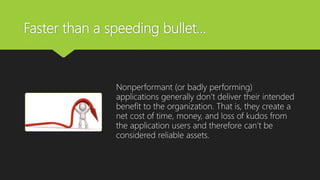
Nonperformant (or badly performing)
applications generally don’t deliver their intended
benefit to the organization. That is, they create a
net cost of time, money, and loss of kudos from
the application users and therefore can’t be
considered reliable assets.
Faster than a speeding
bullet…
If an application is not delivering benefits,
its continued existence is definitely on
shaky ground.
What is
Performance?
The End-User Perspective
With a performant application, users are never
greeted with a blank screen during login and
can achieve what they set out to accomplish
without letting their attention wander. Casual
visitors browsing a web site can find what they
are looking for and purchase it without
experiencing too much frustration.
Performance
Measurement
Availability
Response Time
Throughput
Utilization
Performance Standars
Greater than 15 seconds
Greater than 4 seconds
2 to 4 seconds
Less than 2 seconds
Subsecond response time
Deci-second response time
The Internet
Effect
Customer interface
applications are also the
most vulnerable to sudden
spikes in demand, as more
than a few high-profile retail
companies have discovered
at peak shopping times of
the year.
Bad
Performance:
Why It’s So
Common
Bad Performance: Why It’s
So Common
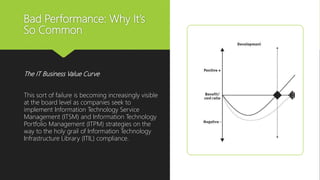
The IT Business Value Curve
This sort of failure is becoming increasingly visible
at the board level as companies seek to
implement Information Technology Service
Management (ITSM) and Information Technology
Portfolio Management (ITPM) strategies on the
way to the holy grail of Information Technology
Infrastructure Library (ITIL) compliance.
Bad Performance:
Why It’s So
Common
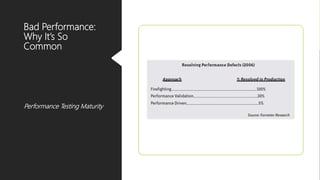
Performance Testing Maturity
Bad Performance: Why It’s So Common
Lack of Performance Considerations in Application Design
Most applications are built from software components that can be tested individually and may
perform well in isolation, but it is equally important to consider the application as a whole. These
components must interact in an efficient manner in order to achieve good performance.
Bad Performance:
Why It’s So Common
Performance Testing is Left to the Last Minute
One typical result is a delay in the application
rollout while the problems are resolved. An
application that is deployed with significant
performance issues will require costly, time
consuming remedial work after deployment.
Even worse, the application might have to be
withdrawn from circulation entirely as it’s
battered into shape.
Bad Performance: Why
It’s So Common
How Many Users Are There
 How many end users will actually use the application?
 How many of these users will use it concurrently?
 How will the end users connect to the application?
 How many additional end users will require access to the
application over time?
 What will the final application landscape look like in terms of the
number and location of
 the servers?
 What effect will the application have on network capacity?
Bad Performance: Why
It’s So Common
Underestimating Your Popularity
When something’s shiny and new, people generally find
it interesting and so they turn up in droves.
Bad Performance:
Why It’s So Common
Performance Testing is Still an Informal
Discipline
Searching for performance testing on the
Internet is more likely to yield information
about sports cars or even washing machines.
Bad Performance:
Why It’s So Common
Not Using Automated Testing Tools
This has become a considerably weaker
excuse for not doing any performance
testing, since the vast majority of applications
are now web-enabled to some degree. Web
technology is generally well supported by the
current crop of automated test solutions.
Bad Performance: Why
It’s So Common
Application Technology Impact
Certain technologies that are commonly used
in creating applications didn’t work well with
the first and even second generation of
automated test tools. This has become a
considerably weaker excuse for not doing any
performance testing, since the vast majority of
applications are now web-enabled to some
degree.
Summary
Testing for performance is not given the
consideration that its importance deserves
as part of the application’s entire life cycle.

Chapter 1. Why Performance Test

  • 1.
    Chapter 1. WhyPerformance Test? The Application Performance Testing
  • 2.
    Faster than aspeeding bullet… Nonperformant (or badly performing) applications generally don’t deliver their intended benefit to the organization. That is, they create a net cost of time, money, and loss of kudos from the application users and therefore can’t be considered reliable assets.
  • 3.
    Faster than aspeeding bullet… If an application is not delivering benefits, its continued existence is definitely on shaky ground.
  • 4.
    What is Performance? The End-UserPerspective With a performant application, users are never greeted with a blank screen during login and can achieve what they set out to accomplish without letting their attention wander. Casual visitors browsing a web site can find what they are looking for and purchase it without experiencing too much frustration.
  • 5.
  • 6.
    Performance Standars Greater than15 seconds Greater than 4 seconds 2 to 4 seconds Less than 2 seconds Subsecond response time Deci-second response time
  • 7.
    The Internet Effect Customer interface applicationsare also the most vulnerable to sudden spikes in demand, as more than a few high-profile retail companies have discovered at peak shopping times of the year.
  • 8.
  • 9.
    Bad Performance: WhyIt’s So Common The IT Business Value Curve This sort of failure is becoming increasingly visible at the board level as companies seek to implement Information Technology Service Management (ITSM) and Information Technology Portfolio Management (ITPM) strategies on the way to the holy grail of Information Technology Infrastructure Library (ITIL) compliance.
  • 10.
    Bad Performance: Why It’sSo Common Performance Testing Maturity
  • 11.
    Bad Performance: WhyIt’s So Common Lack of Performance Considerations in Application Design Most applications are built from software components that can be tested individually and may perform well in isolation, but it is equally important to consider the application as a whole. These components must interact in an efficient manner in order to achieve good performance.
  • 12.
    Bad Performance: Why It’sSo Common Performance Testing is Left to the Last Minute One typical result is a delay in the application rollout while the problems are resolved. An application that is deployed with significant performance issues will require costly, time consuming remedial work after deployment. Even worse, the application might have to be withdrawn from circulation entirely as it’s battered into shape.
  • 13.
    Bad Performance: Why It’sSo Common How Many Users Are There  How many end users will actually use the application?  How many of these users will use it concurrently?  How will the end users connect to the application?  How many additional end users will require access to the application over time?  What will the final application landscape look like in terms of the number and location of  the servers?  What effect will the application have on network capacity?
  • 14.
    Bad Performance: Why It’sSo Common Underestimating Your Popularity When something’s shiny and new, people generally find it interesting and so they turn up in droves.
  • 15.
    Bad Performance: Why It’sSo Common Performance Testing is Still an Informal Discipline Searching for performance testing on the Internet is more likely to yield information about sports cars or even washing machines.
  • 16.
    Bad Performance: Why It’sSo Common Not Using Automated Testing Tools This has become a considerably weaker excuse for not doing any performance testing, since the vast majority of applications are now web-enabled to some degree. Web technology is generally well supported by the current crop of automated test solutions.
  • 17.
    Bad Performance: Why It’sSo Common Application Technology Impact Certain technologies that are commonly used in creating applications didn’t work well with the first and even second generation of automated test tools. This has become a considerably weaker excuse for not doing any performance testing, since the vast majority of applications are now web-enabled to some degree.
  • 18.
    Summary Testing for performanceis not given the consideration that its importance deserves as part of the application’s entire life cycle.