Programming Language Theory 2014, kkman@sangji.ac.kr 1
Chapter 1 ::
Introduction
Origin : Michael L. Scott
School of Computer & Information Engineering,
Sangji University
Kwangman Ko
(kkman@sangji.ac.kr)
Programming Language Theory 2014, kkman@sangji.ac.kr 2
Reading 1, P40.
Reading 2, P40
Programming Language Theory 2014, kkman@sangji.ac.kr 3
1. Introduction, P41
Why are there so many programming languages?
– evolution - we've learned better ways of doing things over time
– socio-economic factors: proprietary interests, commercial advantage
– orientation toward special purposes
– orientation toward special hardware
– diverse ideas about what is pleasant to use
Programming Language Theory 2014, kkman@sangji.ac.kr 4
Introduction
What makes a language successful? , PP42-43.
– easy to learn(BASIC, Pascal, LOGO, Scheme)
– easy to express things, easy use once fluent, "powerful”
• C, Common Lisp, APL, Algol-68, Perl, …
– easy to implement (BASIC, Forth)
– possible to compile to very good (fast/small) code (Fortran)
– backing of a powerful sponsor (COBOL, PL/1, Ada, Visual Basic)
– wide dissemination at minimal cost (Pascal, Turing, Java)
Programming Language Theory 2014, kkman@sangji.ac.kr 5
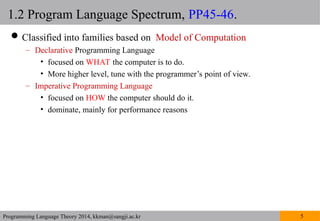
1.2 Program Language Spectrum, PP45-46.
Classified into families based on Model of Computation
– Declarative Programming Language
• focused on WHAT the computer is to do.
• More higher level, tune with the programmer’s point of view.
– Imperative Programming Language
• focused on HOW the computer should do it.
• dominate, mainly for performance reasons
Programming Language Theory 2014, kkman@sangji.ac.kr 6
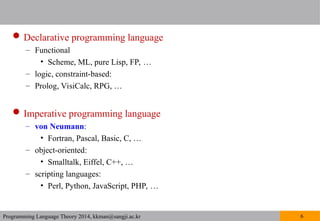
Declarative programming language
– Functional
• Scheme, ML, pure Lisp, FP, …
– logic, constraint-based:
– Prolog, VisiCalc, RPG, …
Imperative programming language
– von Neumann:
• Fortran, Pascal, Basic, C, …
– object-oriented:
• Smalltalk, Eiffel, C++, …
– scripting languages:
• Perl, Python, JavaScript, PHP, …
Programming Language Theory 2014, kkman@sangji.ac.kr 7
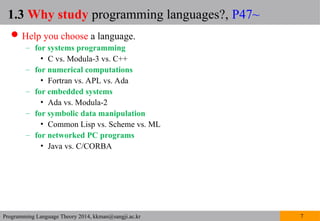
1.3 Why study programming languages?, P47~
Help you choose a language.
– for systems programming
• C vs. Modula-3 vs. C++
– for numerical computations
• Fortran vs. APL vs. Ada
– for embedded systems
• Ada vs. Modula-2
– for symbolic data manipulation
• Common Lisp vs. Scheme vs. ML
– for networked PC programs
• Java vs. C/CORBA
Programming Language Theory 2014, kkman@sangji.ac.kr 8
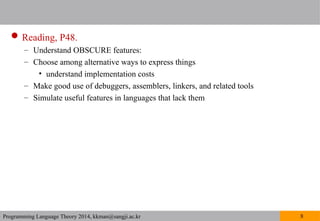
Reading, P48.
– Understand OBSCURE features:
– Choose among alternative ways to express things
• understand implementation costs
– Make good use of debuggers, assemblers, linkers, and related tools
– Simulate useful features in languages that lack them
Programming Language Theory 2014, kkman@sangji.ac.kr 9
1.4 Compilation vs. Interpretation
Compilation vs. Interpretation
– not opposites
– not a clear-cut distinction
Source Program Compiler
Input Data
Outputs
Target Program
Source Program
Interpreter
Input Data
Outputs
Programming Language Theory 2014, kkman@sangji.ac.kr 10
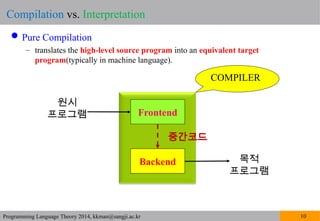
Compilation vs. Interpretation
Pure Compilation
– translates the high-level source program into an equivalent target
program(typically in machine language).
원시
프로그램
목적
프로그램
Frontend
Backend
중간코드
COMPILER
Programming Language Theory 2014, kkman@sangji.ac.kr 11
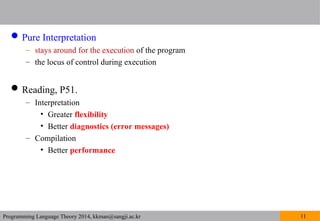
Pure Interpretation
– stays around for the execution of the program
– the locus of control during execution
Reading, P51.
– Interpretation
• Greater flexibility
• Better diagnostics (error messages)
– Compilation
• Better performance
Programming Language Theory 2014, kkman@sangji.ac.kr 12
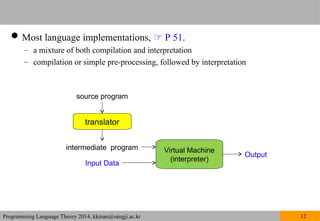
Most language implementations, ☞ P 51.
– a mixture of both compilation and interpretation
– compilation or simple pre-processing, followed by interpretation
source program
translator
intermediate program Virtual Machine
(interpreter)
Input Data
Output
Programming Language Theory 2014, kkman@sangji.ac.kr 13
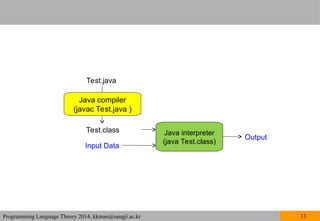
source program
translator
intermediate program Virtual Machine
(interpreter)
Input Data
Output
Test.java
Java compiler
(javac Test.java )
Test.class Java interpreter
(java Test.class)
Programming Language Theory 2014, kkman@sangji.ac.kr 14
Preprocessor
– Removes comments and white space
– Groups characters into tokens (keywords, identifiers, numbers, symbols)
– Expands abbreviations in the style of a macro assembler
– Identifies higher-level syntactic structures (loops, subroutines)
Programming Language Theory 2014, kkman@sangji.ac.kr 15
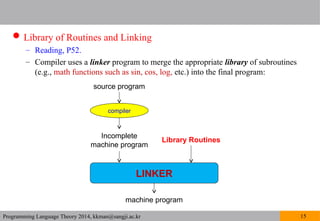
Library of Routines and Linking
– Reading, P52.
– Compiler uses a linker program to merge the appropriate library of subroutines
(e.g., math functions such as sin, cos, log, etc.) into the final program:
source program
compiler
Incomplete
machine program
LINKER
Library Routines
machine program
Programming Language Theory 2014, kkman@sangji.ac.kr 16
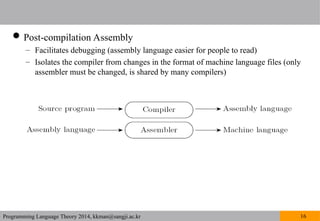
Post-compilation Assembly
– Facilitates debugging (assembly language easier for people to read)
– Isolates the compiler from changes in the format of machine language files (only
assembler must be changed, is shared by many compilers)
Programming Language Theory 2014, kkman@sangji.ac.kr 17
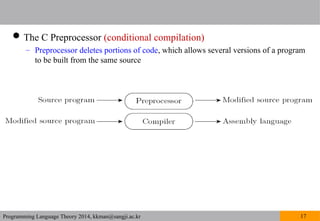
The C Preprocessor (conditional compilation)
– Preprocessor deletes portions of code, which allows several versions of a program
to be built from the same source
Programming Language Theory 2014, kkman@sangji.ac.kr 18
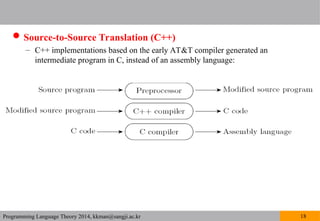
Source-to-Source Translation (C++)
– C++ implementations based on the early AT&T compiler generated an
intermediate program in C, instead of an assembly language:
Programming Language Theory 2014, kkman@sangji.ac.kr 19
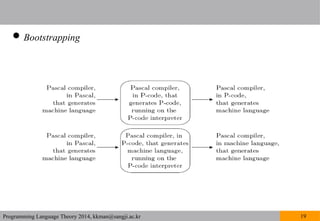
Bootstrapping
Programming Language Theory 2014, kkman@sangji.ac.kr 20
Dynamic and Just-in-Time(JIT) Compilation
– Reading, P56.
– In some cases a programming system may deliberately delay compilation until the
last possible moment.
– The Java language definition defines a machine-independent intermediate form
known as byte code. Byte code is the standard format for distribution of Java
programs.
– The main C# compiler produces .NET Common Intermediate Language (CIL),
which is then translated into machine code immediately prior to execution.
Programming Language Theory 2014, kkman@sangji.ac.kr 21
Compilation vs. Interpretation
Tools
Programming Language Theory 2014, kkman@sangji.ac.kr 22
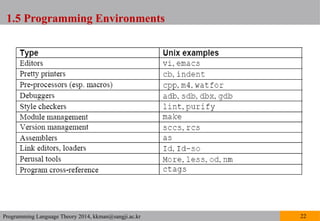
1.5 Programming Environments
Programming Language Theory 2014, kkman@sangji.ac.kr 23
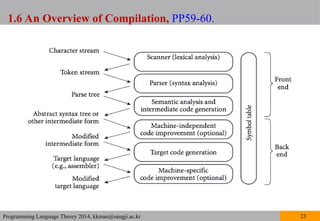
1.6 An Overview of Compilation, PP59-60.

Chapter 1 Theory of Programming Languages

  • 1.
    Programming Language Theory2014, kkman@sangji.ac.kr 1 Chapter 1 :: Introduction Origin : Michael L. Scott School of Computer & Information Engineering, Sangji University Kwangman Ko (kkman@sangji.ac.kr)
  • 2.
    Programming Language Theory2014, kkman@sangji.ac.kr 2 Reading 1, P40. Reading 2, P40
  • 3.
    Programming Language Theory2014, kkman@sangji.ac.kr 3 1. Introduction, P41 Why are there so many programming languages? – evolution - we've learned better ways of doing things over time – socio-economic factors: proprietary interests, commercial advantage – orientation toward special purposes – orientation toward special hardware – diverse ideas about what is pleasant to use
  • 4.
    Programming Language Theory2014, kkman@sangji.ac.kr 4 Introduction What makes a language successful? , PP42-43. – easy to learn(BASIC, Pascal, LOGO, Scheme) – easy to express things, easy use once fluent, "powerful” • C, Common Lisp, APL, Algol-68, Perl, … – easy to implement (BASIC, Forth) – possible to compile to very good (fast/small) code (Fortran) – backing of a powerful sponsor (COBOL, PL/1, Ada, Visual Basic) – wide dissemination at minimal cost (Pascal, Turing, Java)
  • 5.
    Programming Language Theory2014, kkman@sangji.ac.kr 5 1.2 Program Language Spectrum, PP45-46. Classified into families based on Model of Computation – Declarative Programming Language • focused on WHAT the computer is to do. • More higher level, tune with the programmer’s point of view. – Imperative Programming Language • focused on HOW the computer should do it. • dominate, mainly for performance reasons
  • 6.
    Programming Language Theory2014, kkman@sangji.ac.kr 6 Declarative programming language – Functional • Scheme, ML, pure Lisp, FP, … – logic, constraint-based: – Prolog, VisiCalc, RPG, … Imperative programming language – von Neumann: • Fortran, Pascal, Basic, C, … – object-oriented: • Smalltalk, Eiffel, C++, … – scripting languages: • Perl, Python, JavaScript, PHP, …
  • 7.
    Programming Language Theory2014, kkman@sangji.ac.kr 7 1.3 Why study programming languages?, P47~ Help you choose a language. – for systems programming • C vs. Modula-3 vs. C++ – for numerical computations • Fortran vs. APL vs. Ada – for embedded systems • Ada vs. Modula-2 – for symbolic data manipulation • Common Lisp vs. Scheme vs. ML – for networked PC programs • Java vs. C/CORBA
  • 8.
    Programming Language Theory2014, kkman@sangji.ac.kr 8 Reading, P48. – Understand OBSCURE features: – Choose among alternative ways to express things • understand implementation costs – Make good use of debuggers, assemblers, linkers, and related tools – Simulate useful features in languages that lack them
  • 9.
    Programming Language Theory2014, kkman@sangji.ac.kr 9 1.4 Compilation vs. Interpretation Compilation vs. Interpretation – not opposites – not a clear-cut distinction Source Program Compiler Input Data Outputs Target Program Source Program Interpreter Input Data Outputs
  • 10.
    Programming Language Theory2014, kkman@sangji.ac.kr 10 Compilation vs. Interpretation Pure Compilation – translates the high-level source program into an equivalent target program(typically in machine language). 원시 프로그램 목적 프로그램 Frontend Backend 중간코드 COMPILER
  • 11.
    Programming Language Theory2014, kkman@sangji.ac.kr 11 Pure Interpretation – stays around for the execution of the program – the locus of control during execution Reading, P51. – Interpretation • Greater flexibility • Better diagnostics (error messages) – Compilation • Better performance
  • 12.
    Programming Language Theory2014, kkman@sangji.ac.kr 12 Most language implementations, ☞ P 51. – a mixture of both compilation and interpretation – compilation or simple pre-processing, followed by interpretation source program translator intermediate program Virtual Machine (interpreter) Input Data Output
  • 13.
    Programming Language Theory2014, kkman@sangji.ac.kr 13 source program translator intermediate program Virtual Machine (interpreter) Input Data Output Test.java Java compiler (javac Test.java ) Test.class Java interpreter (java Test.class)
  • 14.
    Programming Language Theory2014, kkman@sangji.ac.kr 14 Preprocessor – Removes comments and white space – Groups characters into tokens (keywords, identifiers, numbers, symbols) – Expands abbreviations in the style of a macro assembler – Identifies higher-level syntactic structures (loops, subroutines)
  • 15.
    Programming Language Theory2014, kkman@sangji.ac.kr 15 Library of Routines and Linking – Reading, P52. – Compiler uses a linker program to merge the appropriate library of subroutines (e.g., math functions such as sin, cos, log, etc.) into the final program: source program compiler Incomplete machine program LINKER Library Routines machine program
  • 16.
    Programming Language Theory2014, kkman@sangji.ac.kr 16 Post-compilation Assembly – Facilitates debugging (assembly language easier for people to read) – Isolates the compiler from changes in the format of machine language files (only assembler must be changed, is shared by many compilers)
  • 17.
    Programming Language Theory2014, kkman@sangji.ac.kr 17 The C Preprocessor (conditional compilation) – Preprocessor deletes portions of code, which allows several versions of a program to be built from the same source
  • 18.
    Programming Language Theory2014, kkman@sangji.ac.kr 18 Source-to-Source Translation (C++) – C++ implementations based on the early AT&T compiler generated an intermediate program in C, instead of an assembly language:
  • 19.
    Programming Language Theory2014, kkman@sangji.ac.kr 19 Bootstrapping
  • 20.
    Programming Language Theory2014, kkman@sangji.ac.kr 20 Dynamic and Just-in-Time(JIT) Compilation – Reading, P56. – In some cases a programming system may deliberately delay compilation until the last possible moment. – The Java language definition defines a machine-independent intermediate form known as byte code. Byte code is the standard format for distribution of Java programs. – The main C# compiler produces .NET Common Intermediate Language (CIL), which is then translated into machine code immediately prior to execution.
  • 21.
    Programming Language Theory2014, kkman@sangji.ac.kr 21 Compilation vs. Interpretation Tools
  • 22.
    Programming Language Theory2014, kkman@sangji.ac.kr 22 1.5 Programming Environments
  • 23.
    Programming Language Theory2014, kkman@sangji.ac.kr 23 1.6 An Overview of Compilation, PP59-60.