CS 152: Programming Language
Paradigms
February 5 Class Meeting
Department of Computer Science
San Jose State University
Spring 2014
Instructor: Ron Mak
www.cs.sjsu.edu/~mak
SJSU Dept. of Computer Science
Spring 2014: February 5
CS 152: Programming Language Paradigms
© R. Mak
2
Language Syntax
 Example: Syntax of the Java if statement:
 This syntax rule is written in English.
 Later, we’ll use a more precise notation called
Backus Naur Form (BNF).
_
An if statement consists of the reserved word if
followed by a left parenthesis followed by an
expression followed by a right parenthesis
followed by a statement. Optionally, this is
followed by the else part which consists of the
reserved word else followed by a statement.
SJSU Dept. of Computer Science
Spring 2014: February 5
CS 152: Programming Language Paradigms
© R. Mak
3
Language Semantics
 Semantics: The meaning of a language’s statements.
 What is the effect of executing the statement at run time?
 It can be difficult to provide a comprehensive description
of meaning in all contexts.
 Example: Semantics of the Java if statement:
First evaluate the expression following the
reserved word if. If the expression’s value is true,
then execute the statement following the expression,
otherwise skip over the statement. If there is an
else part, execute the statement following the
reserved word else if the expression’s value is false,
otherwise skip over that statement.
SJSU Dept. of Computer Science
Spring 2014: February 5
CS 152: Programming Language Paradigms
© R. Mak
4
Syntax and Semantics
 How are a language’s syntax and semantics used?
 A well-specified syntax allows programs in the language
to be automatically read and translated.
 Well-understood semantics allows the program to be
translated into a equivalent program.
 Equivalent programs have similar runtime behaviors.
_
SJSU Dept. of Computer Science
Spring 2014: February 5
CS 152: Programming Language Paradigms
© R. Mak
5
Programming Language Translation
 There are two major types of language translators:
 compiler
 interpreter
 Source program: The program to be translated,
written in a high-level programming language.
 Example: A Java program.
_
SJSU Dept. of Computer Science
Spring 2014: February 5
CS 152: Programming Language Paradigms
© R. Mak
6
Programming Language Translation
 Both types of language translators will read
a source program and ...
 Check the program for syntax errors.
 Convert the program into
 Intermediate code, such as tree structures (parse trees)
 Symbol tables that contain information about
the program’s named elements, such as its variables.
 An interpreter can then use the intermediate code and
the symbol tables to execute the program.
_
SJSU Dept. of Computer Science
Spring 2014: February 5
CS 152: Programming Language Paradigms
© R. Mak
7
Compilers
 A compiler takes the intermediate code and the symbol
tables and generates a lower-level form of the program.
 This lower-level form is closer to machine language.
 Example: An equivalent assembly language program.
 Target language: The language that a compiler
translates a source language into.
 Example: Assembly language
 Other tools, such as an assembler, translates the compiler’s
target language into machine language code.
_
SJSU Dept. of Computer Science
Spring 2014: February 5
CS 152: Programming Language Paradigms
© R. Mak
8
Compilers
 Object code: The machine language code
generated by an assembler.
 The object code can then linked with other object code
and then loaded into memory for execution.
_
SJSU Dept. of Computer Science
Spring 2014: February 5
CS 152: Programming Language Paradigms
© R. Mak
9
Compiler
Interpreter
Compiler and Interpreter
Compilers and Interpreters
Front-end
translator
Intermediate
code
Symbol
tables
Assembly
code
Assembler
Machine
code
Execution
Code
generator
Executor
Source
program
Execution Program executes under the
control of the interpreter.
Program executes
on its own.
SJSU Dept. of Computer Science
Spring 2014: February 5
CS 152: Programming Language Paradigms
© R. Mak
10
Compilers and Interpreters
 A compiler generates object code,
but an interpreter does not.
 Executing the source program from object code can be
several orders of magnitude faster than executing the program
by interpreting the intermediate code and the symbol table.
 But an interpreter requires less effort to get a source program
to execute = faster turnaround time.
 An interpreter maintains control
of the source program’s execution.
 Interpreters often come with interactive source-level debuggers
that allow you to refer to source program elements, such as
variable names.
 AKA symbolic debugger
_
SJSU Dept. of Computer Science
Spring 2014: February 5
CS 152: Programming Language Paradigms
© R. Mak
11
Compilers and Interpreters
 Therefore ...
 Interpreters are useful during program development.
 Compilers are useful to run released programs
in a production environment.
_
SJSU Dept. of Computer Science
Spring 2014: February 5
CS 152: Programming Language Paradigms
© R. Mak
12
The Future of Programming Languages
 In the 1960s, computer scientists wanted a single
universal programming language to meet all needs.
 In the late 1970s and early 1980s, they wanted
specification languages that would allow users
to define the needs and then generate the application.
 Tell the system what you want it to do.
 The system figures out how to do it.
 This is what logic programming languages attempt to do
 Programming has not become obsolete.
 New languages arise to support new technologies.
 Example: Web programming.
SJSU Dept. of Computer Science
Spring 2014: February 5
CS 152: Programming Language Paradigms
© R. Mak
13
Popularity of Programming Languages
SJSU Dept. of Computer Science
Spring 2014: February 5
CS 152: Programming Language Paradigms
© R. Mak
14
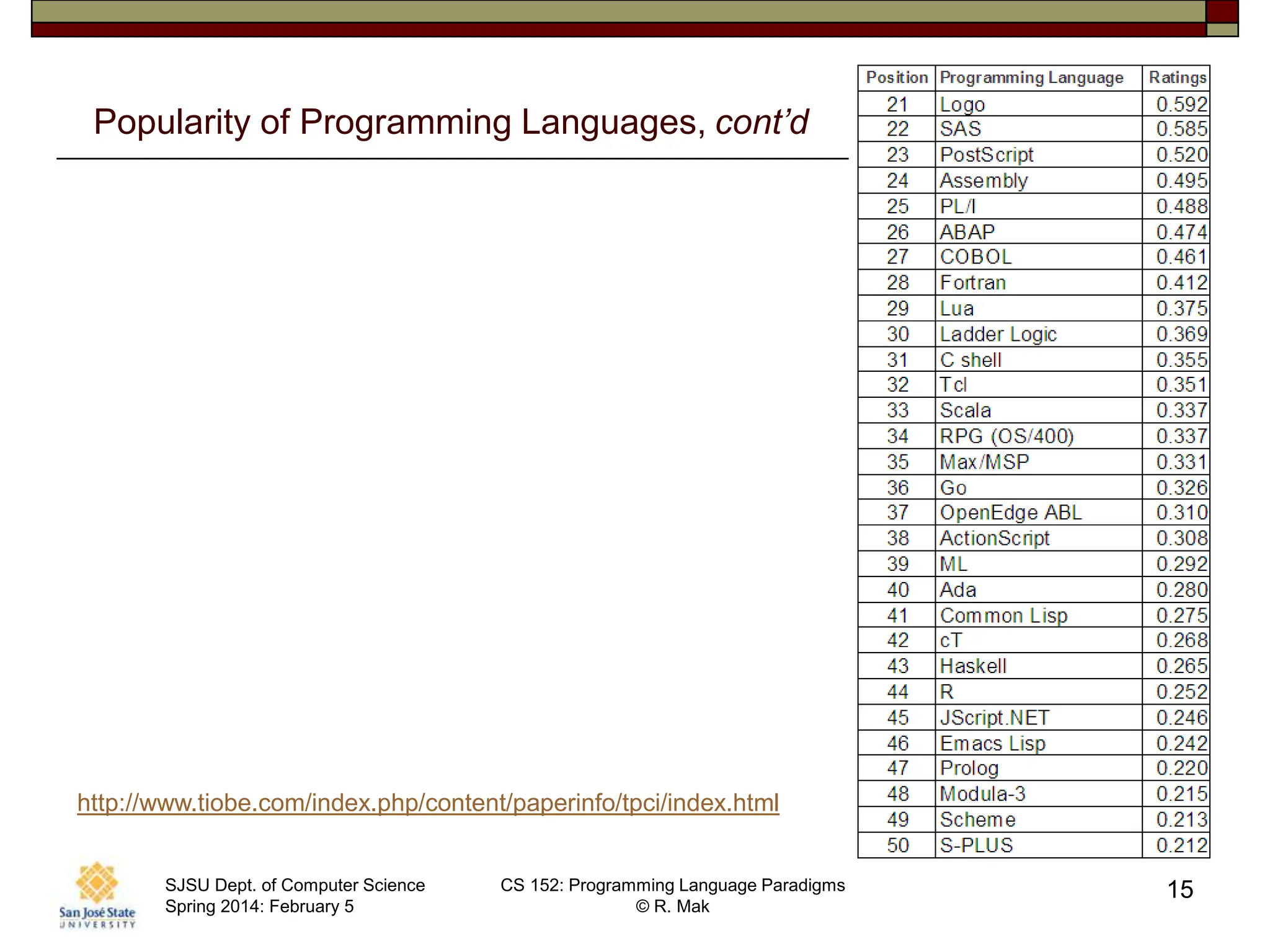
Popularity of Programming Languages, cont’d
SJSU Dept. of Computer Science
Spring 2014: February 5
CS 152: Programming Language Paradigms
© R. Mak
15
Popularity of Programming Languages, cont’d
http://www.tiobe.com/index.php/content/paperinfo/tpci/index.html
SJSU Dept. of Computer Science
Spring 2014: February 5
CS 152: Programming Language Paradigms
© R. Mak
16
Good Programming Language Design
 What is good programming language design?
 What criteria should be used to judge a language?
 How should success or failure of a language be defined?
 A language design is successful if it satisfies
any or all of these criteria:
 It achieves the goals of its designers.
 Therefore, it must have a clear goal.
 It attains widespread use in an application area.
 It serves as a model for other languages that are successful.
_
SJSU Dept. of Computer Science
Spring 2014: February 5
CS 152: Programming Language Paradigms
© R. Mak
17
Good Programming Language Design, cont’d
 When designing a new language,
choose a clear overall goal.
 Keep the goal in mind throughout the design process.
 This is especially important for
special purpose languages
 Build the abstractions for the target application area
into the language design.
 Example: SQL for relational databases
_
SJSU Dept. of Computer Science
Spring 2014: February 5
CS 152: Programming Language Paradigms
© R. Mak
18
Historical Overview
 In the early days, machines were extremely slow
and memory was scarce.
 Program speed and memory usage were prime concerns.
 Efficiency of execution was a primary design criterion.
 Early FORTRAN code mapped closely to machine code,
minimizing the amount of translation required by the compiler
 Writability of a language enables a programmer
to use it to express computation clearly, correctly,
concisely, and quickly.
 Writability of FORTRAN was less important then efficiency.
 Readability was even less of a concern.
SJSU Dept. of Computer Science
Spring 2014: February 5
CS 152: Programming Language Paradigms
© R. Mak
19
Historical Overview, cont’d
 Algol 60 was designed to express algorithms
in a logically clear and concise way.
 The language imposed structure on its programs.
 block structure
 structured control statements
 structured array type
 It also incorporated recursion.
 COBOL attempted to improve readability of programs
by trying to make them look like ordinary English.
 However, this made them long and verbose.
_
SJSU Dept. of Computer Science
Spring 2014: February 5
CS 152: Programming Language Paradigms
© R. Mak
20
Historical Overview, cont’d
 In the 1970s and early 1980s, the emphasis was on
simplicity and abstraction, along with reliability.
 Mathematical definitions for language constructs.
 Mechanisms to allow a translator to partially
prove the correctness of a program before translation.
 This led to strong data typing.
 Examples: Pascal, Modula 2, C, Ada
 In the 1980s and 1990s, the emphasis was on
logical or mathematical precision.
 This led to a renewed interest in functional languages.
 Examples: Lisp, Scheme, ML, Haskell
_
SJSU Dept. of Computer Science
Spring 2014: February 5
CS 152: Programming Language Paradigms
© R. Mak
21
Historical Overview, cont’d
 The most influential design criteria of the last 25 years ...
 The object-oriented approach to abstraction.
 The use of libraries and other object-oriented techniques
increased the reusability of existing code.
 In addition to the early goals of efficiency,
nearly every design decision still considers
 readability
 abstraction
 complexity control
_
SJSU Dept. of Computer Science
Spring 2014: February 5
CS 152: Programming Language Paradigms
© R. Mak
22
Target Code Efficiency
 Strong data typing
 Enforced at compile time.
 No need at run time to check data types
before executing operations.
 Example: FORTRAN IV
 All data declarations and subroutine calls
had to be known at compile time.
 Memory space is allocated once
at the beginning of program execution.
_
SJSU Dept. of Computer Science
Spring 2014: February 5
CS 152: Programming Language Paradigms
© R. Mak
23
Programmer Efficiency
 Program reliability is an programmer efficiency issue.
 Unreliable programs require programmer time
to diagnose and correct.
 Programmer efficiency is also impacted by
the ease with which errors can be found and corrected.
 Since roughly 90% of time is spent on debugging and
maintaining programs, maintainability may be the most
important index of programming language efficiency.
_
SJSU Dept. of Computer Science
Spring 2014: February 5
CS 152: Programming Language Paradigms
© R. Mak
24
Regularity
 Regularity refers to how well
the features of a language are integrated.
 Greater regularity implies:
 Fewer restrictions on the use of particular constructs.
 Fewer strange interactions between constructs.
 Fewer surprises in general in the way the language features
behave.
 Languages that satisfy the criterion of regularity are
said to adhere to the Principle of Least Astonishment.
_
SJSU Dept. of Computer Science
Spring 2014: February 5
CS 152: Programming Language Paradigms
© R. Mak
25
Regularity, cont’d
 Regularity involves three concepts:
 Generality
 Orthogonal design
 Uniformity
 Otherwise classify a feature or construct as irregular.
_
SJSU Dept. of Computer Science
Spring 2014: February 5
CS 152: Programming Language Paradigms
© R. Mak
26
Regularity, cont’d
 Generality
 Avoid special cases in the availability or use of constructs.
 Combine closely related constructs
into a single more general one.
 Orthogonal design
 Combine constructs in any meaningful way.
 No unexpected restrictions or behaviors.
 Uniformity
 Similar things look similar and have similar meanings.
 Different things look different.
_
SJSU Dept. of Computer Science
Spring 2014: February 5
CS 152: Programming Language Paradigms
© R. Mak
27
Generality
 Avoid special cases wherever possible.
 Example: Pascal procedures and functions
 You can nest procedures and functions.
 You can pass procedures and functions as parameters
to other procedures and functions.
 However, you cannot assign procedures and functions
to variables or store them in data structures.
 Example: Pascal constants
 You cannot compute a constant value with an expression.
 Example: C operators
 You cannot use == to compare two structures.
SJSU Dept. of Computer Science
Spring 2014: February 5
CS 152: Programming Language Paradigms
© R. Mak
28
Orthogonality
 Constructs do not behave differently
in different contexts.
 Nonorthogonal: context-dependent restrictions.
 Lack of generality: restrictions regardless of context.
 Example: Function return types
 Pascal: Only scalar and pointer types.
 C and C++: All data types except array types.
 Ada and Python: All data types.
_
SJSU Dept. of Computer Science
Spring 2014: February 5
CS 152: Programming Language Paradigms
© R. Mak
29
Orthogonality, cont’d
 Example: Variable declarations
 C: Declare local variables only at a block beginning.
 C++ and Java: Declare local variables anywhere in a block
prior to their use.
 Example: Java primitive and reference types
 Primitive types use value semantics.
 Copy values during assignments.
 Reference (object) types use reference semantics.
 An assignment creates two references to the same object.
 Algol 68: Orthogonality was a major design goal.
 Best example of a language where you can
combine constructs in all meaningful ways.
SJSU Dept. of Computer Science
Spring 2014: February 5
CS 152: Programming Language Paradigms
© R. Mak
30
Uniformity
 The appearance and behavior of language constructs
are consistent.
 Example: C++ semicolon
 Required after a class definition.
 Forbidden after a function definition.
 Example: Pascal function return
 Return a function value by assigning the value
to the function name.
 Easily confused with a standard assignment statement.
 Other languages use a return statement.
_

Programming Language Paradigms February.ppt

  • 1.
    CS 152: ProgrammingLanguage Paradigms February 5 Class Meeting Department of Computer Science San Jose State University Spring 2014 Instructor: Ron Mak www.cs.sjsu.edu/~mak
  • 2.
    SJSU Dept. ofComputer Science Spring 2014: February 5 CS 152: Programming Language Paradigms © R. Mak 2 Language Syntax  Example: Syntax of the Java if statement:  This syntax rule is written in English.  Later, we’ll use a more precise notation called Backus Naur Form (BNF). _ An if statement consists of the reserved word if followed by a left parenthesis followed by an expression followed by a right parenthesis followed by a statement. Optionally, this is followed by the else part which consists of the reserved word else followed by a statement.
  • 3.
    SJSU Dept. ofComputer Science Spring 2014: February 5 CS 152: Programming Language Paradigms © R. Mak 3 Language Semantics  Semantics: The meaning of a language’s statements.  What is the effect of executing the statement at run time?  It can be difficult to provide a comprehensive description of meaning in all contexts.  Example: Semantics of the Java if statement: First evaluate the expression following the reserved word if. If the expression’s value is true, then execute the statement following the expression, otherwise skip over the statement. If there is an else part, execute the statement following the reserved word else if the expression’s value is false, otherwise skip over that statement.
  • 4.
    SJSU Dept. ofComputer Science Spring 2014: February 5 CS 152: Programming Language Paradigms © R. Mak 4 Syntax and Semantics  How are a language’s syntax and semantics used?  A well-specified syntax allows programs in the language to be automatically read and translated.  Well-understood semantics allows the program to be translated into a equivalent program.  Equivalent programs have similar runtime behaviors. _
  • 5.
    SJSU Dept. ofComputer Science Spring 2014: February 5 CS 152: Programming Language Paradigms © R. Mak 5 Programming Language Translation  There are two major types of language translators:  compiler  interpreter  Source program: The program to be translated, written in a high-level programming language.  Example: A Java program. _
  • 6.
    SJSU Dept. ofComputer Science Spring 2014: February 5 CS 152: Programming Language Paradigms © R. Mak 6 Programming Language Translation  Both types of language translators will read a source program and ...  Check the program for syntax errors.  Convert the program into  Intermediate code, such as tree structures (parse trees)  Symbol tables that contain information about the program’s named elements, such as its variables.  An interpreter can then use the intermediate code and the symbol tables to execute the program. _
  • 7.
    SJSU Dept. ofComputer Science Spring 2014: February 5 CS 152: Programming Language Paradigms © R. Mak 7 Compilers  A compiler takes the intermediate code and the symbol tables and generates a lower-level form of the program.  This lower-level form is closer to machine language.  Example: An equivalent assembly language program.  Target language: The language that a compiler translates a source language into.  Example: Assembly language  Other tools, such as an assembler, translates the compiler’s target language into machine language code. _
  • 8.
    SJSU Dept. ofComputer Science Spring 2014: February 5 CS 152: Programming Language Paradigms © R. Mak 8 Compilers  Object code: The machine language code generated by an assembler.  The object code can then linked with other object code and then loaded into memory for execution. _
  • 9.
    SJSU Dept. ofComputer Science Spring 2014: February 5 CS 152: Programming Language Paradigms © R. Mak 9 Compiler Interpreter Compiler and Interpreter Compilers and Interpreters Front-end translator Intermediate code Symbol tables Assembly code Assembler Machine code Execution Code generator Executor Source program Execution Program executes under the control of the interpreter. Program executes on its own.
  • 10.
    SJSU Dept. ofComputer Science Spring 2014: February 5 CS 152: Programming Language Paradigms © R. Mak 10 Compilers and Interpreters  A compiler generates object code, but an interpreter does not.  Executing the source program from object code can be several orders of magnitude faster than executing the program by interpreting the intermediate code and the symbol table.  But an interpreter requires less effort to get a source program to execute = faster turnaround time.  An interpreter maintains control of the source program’s execution.  Interpreters often come with interactive source-level debuggers that allow you to refer to source program elements, such as variable names.  AKA symbolic debugger _
  • 11.
    SJSU Dept. ofComputer Science Spring 2014: February 5 CS 152: Programming Language Paradigms © R. Mak 11 Compilers and Interpreters  Therefore ...  Interpreters are useful during program development.  Compilers are useful to run released programs in a production environment. _
  • 12.
    SJSU Dept. ofComputer Science Spring 2014: February 5 CS 152: Programming Language Paradigms © R. Mak 12 The Future of Programming Languages  In the 1960s, computer scientists wanted a single universal programming language to meet all needs.  In the late 1970s and early 1980s, they wanted specification languages that would allow users to define the needs and then generate the application.  Tell the system what you want it to do.  The system figures out how to do it.  This is what logic programming languages attempt to do  Programming has not become obsolete.  New languages arise to support new technologies.  Example: Web programming.
  • 13.
    SJSU Dept. ofComputer Science Spring 2014: February 5 CS 152: Programming Language Paradigms © R. Mak 13 Popularity of Programming Languages
  • 14.
    SJSU Dept. ofComputer Science Spring 2014: February 5 CS 152: Programming Language Paradigms © R. Mak 14 Popularity of Programming Languages, cont’d
  • 15.
    SJSU Dept. ofComputer Science Spring 2014: February 5 CS 152: Programming Language Paradigms © R. Mak 15 Popularity of Programming Languages, cont’d http://www.tiobe.com/index.php/content/paperinfo/tpci/index.html
  • 16.
    SJSU Dept. ofComputer Science Spring 2014: February 5 CS 152: Programming Language Paradigms © R. Mak 16 Good Programming Language Design  What is good programming language design?  What criteria should be used to judge a language?  How should success or failure of a language be defined?  A language design is successful if it satisfies any or all of these criteria:  It achieves the goals of its designers.  Therefore, it must have a clear goal.  It attains widespread use in an application area.  It serves as a model for other languages that are successful. _
  • 17.
    SJSU Dept. ofComputer Science Spring 2014: February 5 CS 152: Programming Language Paradigms © R. Mak 17 Good Programming Language Design, cont’d  When designing a new language, choose a clear overall goal.  Keep the goal in mind throughout the design process.  This is especially important for special purpose languages  Build the abstractions for the target application area into the language design.  Example: SQL for relational databases _
  • 18.
    SJSU Dept. ofComputer Science Spring 2014: February 5 CS 152: Programming Language Paradigms © R. Mak 18 Historical Overview  In the early days, machines were extremely slow and memory was scarce.  Program speed and memory usage were prime concerns.  Efficiency of execution was a primary design criterion.  Early FORTRAN code mapped closely to machine code, minimizing the amount of translation required by the compiler  Writability of a language enables a programmer to use it to express computation clearly, correctly, concisely, and quickly.  Writability of FORTRAN was less important then efficiency.  Readability was even less of a concern.
  • 19.
    SJSU Dept. ofComputer Science Spring 2014: February 5 CS 152: Programming Language Paradigms © R. Mak 19 Historical Overview, cont’d  Algol 60 was designed to express algorithms in a logically clear and concise way.  The language imposed structure on its programs.  block structure  structured control statements  structured array type  It also incorporated recursion.  COBOL attempted to improve readability of programs by trying to make them look like ordinary English.  However, this made them long and verbose. _
  • 20.
    SJSU Dept. ofComputer Science Spring 2014: February 5 CS 152: Programming Language Paradigms © R. Mak 20 Historical Overview, cont’d  In the 1970s and early 1980s, the emphasis was on simplicity and abstraction, along with reliability.  Mathematical definitions for language constructs.  Mechanisms to allow a translator to partially prove the correctness of a program before translation.  This led to strong data typing.  Examples: Pascal, Modula 2, C, Ada  In the 1980s and 1990s, the emphasis was on logical or mathematical precision.  This led to a renewed interest in functional languages.  Examples: Lisp, Scheme, ML, Haskell _
  • 21.
    SJSU Dept. ofComputer Science Spring 2014: February 5 CS 152: Programming Language Paradigms © R. Mak 21 Historical Overview, cont’d  The most influential design criteria of the last 25 years ...  The object-oriented approach to abstraction.  The use of libraries and other object-oriented techniques increased the reusability of existing code.  In addition to the early goals of efficiency, nearly every design decision still considers  readability  abstraction  complexity control _
  • 22.
    SJSU Dept. ofComputer Science Spring 2014: February 5 CS 152: Programming Language Paradigms © R. Mak 22 Target Code Efficiency  Strong data typing  Enforced at compile time.  No need at run time to check data types before executing operations.  Example: FORTRAN IV  All data declarations and subroutine calls had to be known at compile time.  Memory space is allocated once at the beginning of program execution. _
  • 23.
    SJSU Dept. ofComputer Science Spring 2014: February 5 CS 152: Programming Language Paradigms © R. Mak 23 Programmer Efficiency  Program reliability is an programmer efficiency issue.  Unreliable programs require programmer time to diagnose and correct.  Programmer efficiency is also impacted by the ease with which errors can be found and corrected.  Since roughly 90% of time is spent on debugging and maintaining programs, maintainability may be the most important index of programming language efficiency. _
  • 24.
    SJSU Dept. ofComputer Science Spring 2014: February 5 CS 152: Programming Language Paradigms © R. Mak 24 Regularity  Regularity refers to how well the features of a language are integrated.  Greater regularity implies:  Fewer restrictions on the use of particular constructs.  Fewer strange interactions between constructs.  Fewer surprises in general in the way the language features behave.  Languages that satisfy the criterion of regularity are said to adhere to the Principle of Least Astonishment. _
  • 25.
    SJSU Dept. ofComputer Science Spring 2014: February 5 CS 152: Programming Language Paradigms © R. Mak 25 Regularity, cont’d  Regularity involves three concepts:  Generality  Orthogonal design  Uniformity  Otherwise classify a feature or construct as irregular. _
  • 26.
    SJSU Dept. ofComputer Science Spring 2014: February 5 CS 152: Programming Language Paradigms © R. Mak 26 Regularity, cont’d  Generality  Avoid special cases in the availability or use of constructs.  Combine closely related constructs into a single more general one.  Orthogonal design  Combine constructs in any meaningful way.  No unexpected restrictions or behaviors.  Uniformity  Similar things look similar and have similar meanings.  Different things look different. _
  • 27.
    SJSU Dept. ofComputer Science Spring 2014: February 5 CS 152: Programming Language Paradigms © R. Mak 27 Generality  Avoid special cases wherever possible.  Example: Pascal procedures and functions  You can nest procedures and functions.  You can pass procedures and functions as parameters to other procedures and functions.  However, you cannot assign procedures and functions to variables or store them in data structures.  Example: Pascal constants  You cannot compute a constant value with an expression.  Example: C operators  You cannot use == to compare two structures.
  • 28.
    SJSU Dept. ofComputer Science Spring 2014: February 5 CS 152: Programming Language Paradigms © R. Mak 28 Orthogonality  Constructs do not behave differently in different contexts.  Nonorthogonal: context-dependent restrictions.  Lack of generality: restrictions regardless of context.  Example: Function return types  Pascal: Only scalar and pointer types.  C and C++: All data types except array types.  Ada and Python: All data types. _
  • 29.
    SJSU Dept. ofComputer Science Spring 2014: February 5 CS 152: Programming Language Paradigms © R. Mak 29 Orthogonality, cont’d  Example: Variable declarations  C: Declare local variables only at a block beginning.  C++ and Java: Declare local variables anywhere in a block prior to their use.  Example: Java primitive and reference types  Primitive types use value semantics.  Copy values during assignments.  Reference (object) types use reference semantics.  An assignment creates two references to the same object.  Algol 68: Orthogonality was a major design goal.  Best example of a language where you can combine constructs in all meaningful ways.
  • 30.
    SJSU Dept. ofComputer Science Spring 2014: February 5 CS 152: Programming Language Paradigms © R. Mak 30 Uniformity  The appearance and behavior of language constructs are consistent.  Example: C++ semicolon  Required after a class definition.  Forbidden after a function definition.  Example: Pascal function return  Return a function value by assigning the value to the function name.  Easily confused with a standard assignment statement.  Other languages use a return statement. _