THE INDUSTRY OF
HOSPITALITY SERVICE
QUALITY SERVICE MANAGEMENT
CHAPTER 1
Defining the hospitality
 The hospitality field, by definition, is a service
industry. Its task is to create shareholder wealth
by servicing and satisfying guests. Industry
segments include, among others: hotels,
restaurants, private clubs, managed food service,
event planning, tourism related businesses, and
travel providers. More often than not, the product
purchased is either intangible or the perceived
quality of the product purchased is impacted by
the service method in which it was received.
Defining the hospitality
 Langhorn (2004) noted that in hospitality, the
service provider is “part of the product itself”. For
guests to be satisfied, they not only must believe
that they have received a valuable service for
their money, but also feel valued and respected
by the workers providing the service.
Defining the hospitality
Hospitality is:
- the act of kindness in welcoming and looking
after the basic needs of guests or strangers, mainly
in relation to food, drink and accommodation;
- refers to the relationship process between a guest
and a host;
- the reception and entertainment of guests,
visitors, or strangers with liberality and goodwill
(Oxford English Dictionary);
- derived from the Latin word hospitare meaning
to “receive as a guest”
The hospitality industry
 The Hospitality Industry include the
companies or organizations which provide food
and/or drink and/or accommodation to people
who are away from home.
The hospitality industry
The hospitality and tourism industry (H&T
industry) meets the needs of people with
kindness and goodwill while they are away from
their homes.
The H&T industry has four service sectors: food
and beverage, lodging, recreation, and travel and
tourism.
The hospitality industry
 The H&T industry is about service. The
industry provides service to people when they are
away from their home,and sometimes even when
they are home. For example, home delivery of
food would be part of the hospitality industry as
would a masseuse that does home visits or a cook
that does at-home cooking lessons or catering.
The hospitality industry
 The H&T industry is about diversity. There
are small, large, privately owned, and publicly
owned businesses. There are people of every
socioeconomic class, cultural background, race,
age, and religion involved with H&T, both in
providing and receiving the services. The H&T
industry reaches every corner of the globe, while
providing jobs, entertainment, food,
transportation, and a place sleep.
The hospitality industry
 The H&T industry is about entrepreneurs.
The H&T industry is full of businesses that serve
people and are owned by a single person or
family. This means not only are there many H&T
jobs working for someone else, there is a lot of
H&T opportunity to work for yourself.
Worldwide examples of entrepreneurs creating
small businesses that became big business are:
McDonalds, Marriott hotels,Holiday Inn hotels,
Albertsons food stores, and Southwest Airlines.
The hospitality industry
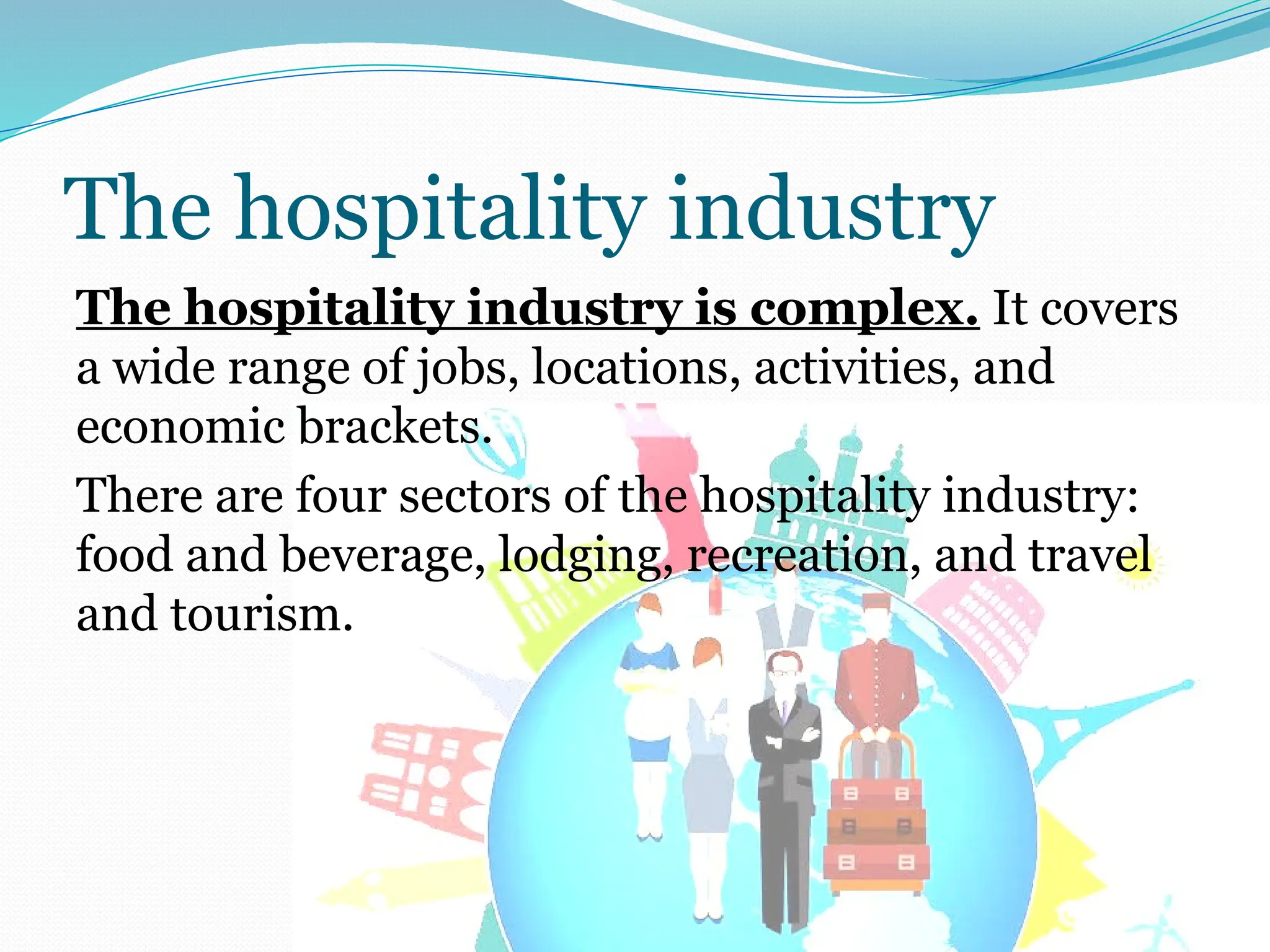
The hospitality industry is complex. It covers
a wide range of jobs, locations, activities, and
economic brackets.
There are four sectors of the hospitality industry:
food and beverage, lodging, recreation, and travel
and tourism.
The hospitality industry
The food and beverage industry, also known as
the foodservice industry, consists of businesses
that prepare food for customers.
- Lodging, also known as accommodation, is a
place to sleep for one or more nights. A business in
the lodging industry provides a place for people to
sleep overnight. It can be one of many sleeping
places such as a fancy hotel, a hostel, or highway
side motel.
The hospitality industry
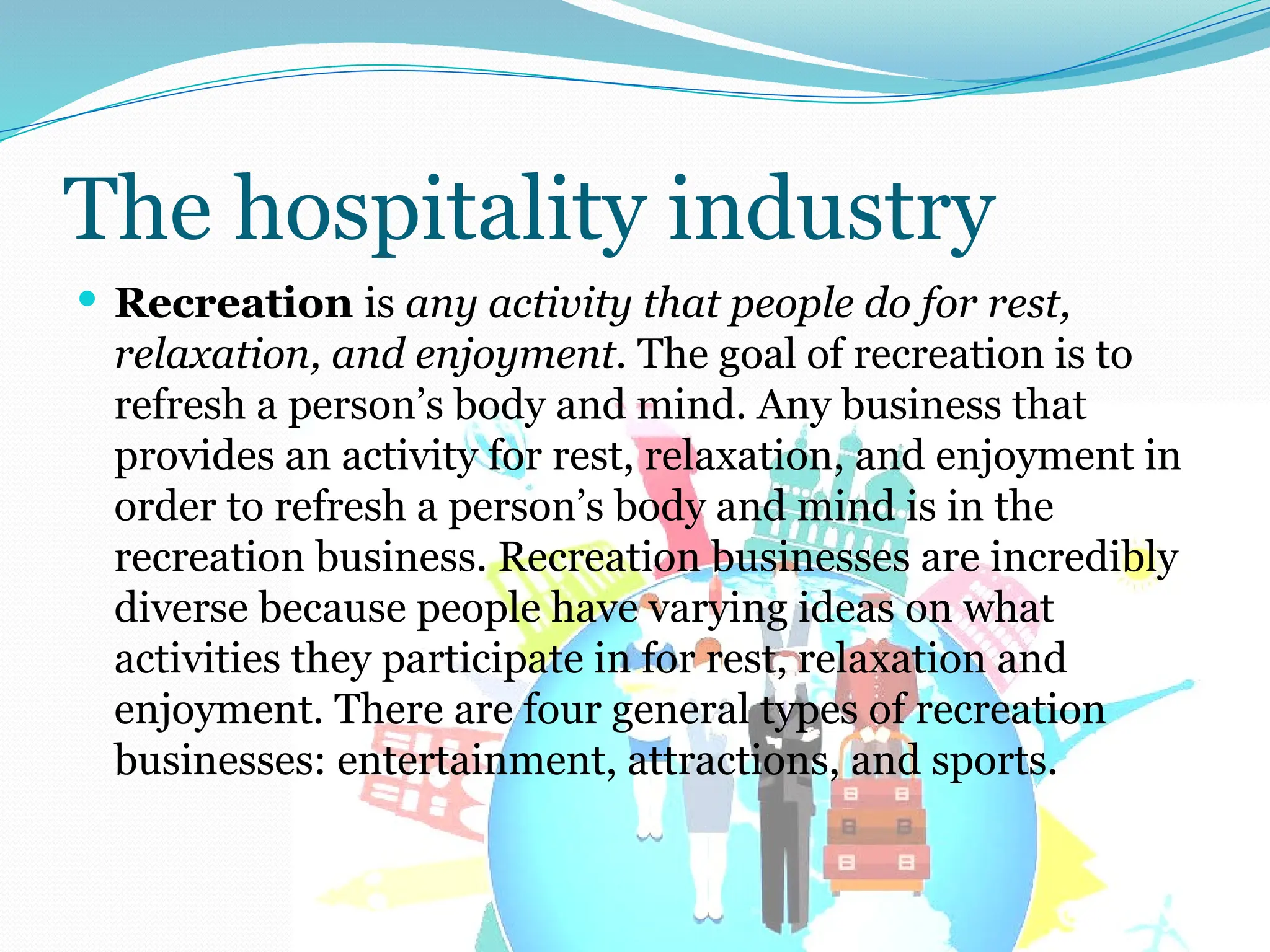
 Recreation is any activity that people do for rest,
relaxation, and enjoyment. The goal of recreation is to
refresh a person’s body and mind. Any business that
provides an activity for rest, relaxation, and enjoyment in
order to refresh a person’s body and mind is in the
recreation business. Recreation businesses are incredibly
diverse because people have varying ideas on what
activities they participate in for rest, relaxation and
enjoyment. There are four general types of recreation
businesses: entertainment, attractions, and sports.
The hospitality industry
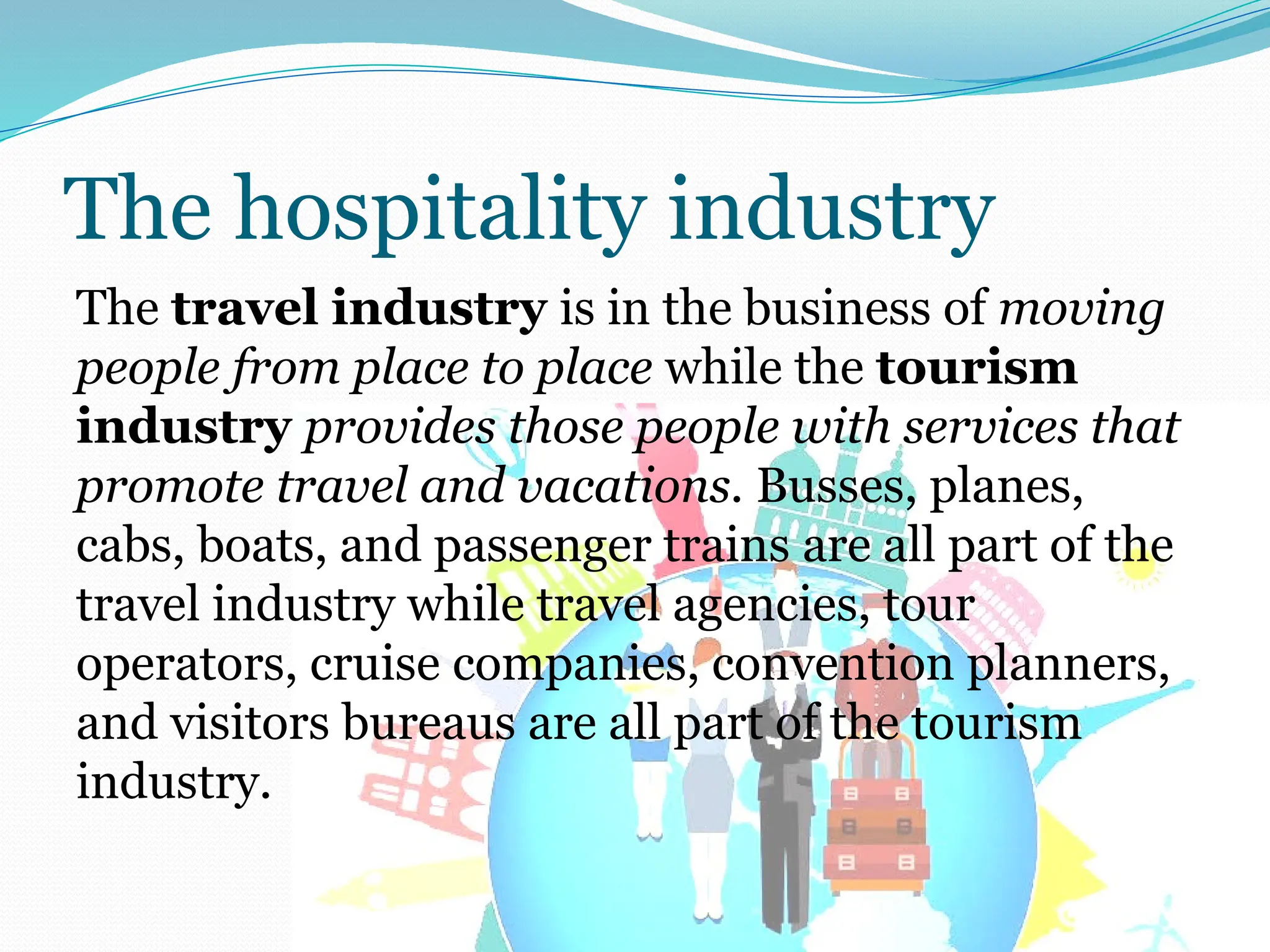
The travel industry is in the business of moving
people from place to place while the tourism
industry provides those people with services that
promote travel and vacations. Busses, planes,
cabs, boats, and passenger trains are all part of the
travel industry while travel agencies, tour
operators, cruise companies, convention planners,
and visitors bureaus are all part of the tourism
industry.
Questions:
1. What does the term hospitality mean to you?
Give a definition for hospitality.
2. What sections of the hospitality industry have
you visited or used?
3. How does hospitality impact on our lives?
Activity:
The hospitality business and you
Answer with a Yes, No or Sometimes
1. Can I talk to strangers?
2. Am I pleasant and courteous even when under
stress?
3. Am I at ease when using the telephone?
4. Do I generally look clean and neat?
5. Can I follow orders?
The hospitality business and you
6. Do I accept criticism gracefully?
7. Do I like staying busy?
8. Do I do detailed work well?
9. Do I enjoy working with other people?
10.Do I enjoy helping people?
Characteristics of The Hospitality
Industry
- Shift work;
- The physical products of hospitality, e.g. food and
drink in a restaurant or the actual hotel room, are
products that are sold at a price to the guests or
customers (e.g. the price a guest paid for renting a
hotel room, or the price a customer paid for buying
a meal in a restaurant). These are often regarded as
the tangible aspects of hospitality.;
Characteristics of The Hospitality
Industry
- The qualities of staff and the way they deliver the
service are often more important than the tangible
products in making a hospitality experience
satisfactory or unsatisfactory or these are the
intangible aspects of hospitality.;
- Inseparability of Production and Consumption;
- Highly perishable product;
- No such thing as business hours;
-Hospitality operations run on a 24 hour basis all
year round;
The objectives of hospitality
industry
1. Making the guests feel welcome personally
This requires both a friendly manner on your part
toward the guest and an atmosphere of “liberality
and good will” among the people who work with
you in serving the guest. That often translates to
an organization in which workers get along well
with one another.
The objectives of hospitality
industry
2. Making things work for the guests
Everything needs to be clean and in working order
before the guests step foot on the establishment. A
hospitality system requires a lot of work and the
manager must see that it is done properly and
maintained at all times.
The objectives of hospitality
industry
3. Making sure that the operation will continue to
provide service and meet its budget
As a manager, the key to achieving this objective
lies in achieving a controlled profitable operation.
A good term to describe this management concern
is “conformance to budget.”
Trends influencing the hospitality
industry
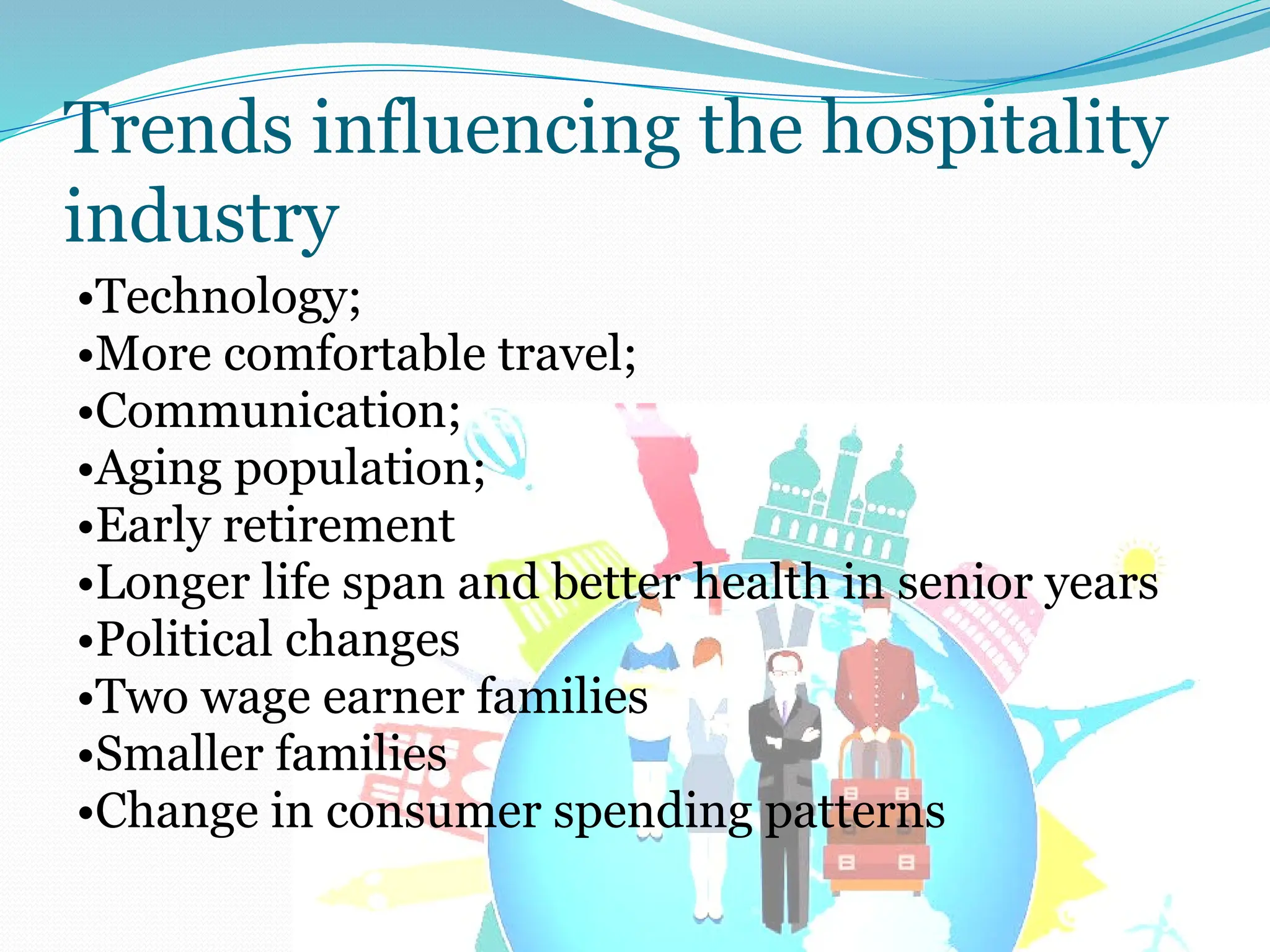
•Technology;
•More comfortable travel;
•Communication;
•Aging population;
•Early retirement
•Longer life span and better health in senior years
•Political changes
•Two wage earner families
•Smaller families
•Change in consumer spending patterns
Trends influencing the hospitality
industry
•Social impact
•Shorter work week
–Not so in US
–Europeans get more holidays
–Professions work more
•Downsizing causes more work
•More leisure time
•Short, last minute trips
•Seasonality not a factor
•Greater disposable income
Trends influencing the hospitality
industry
Demand for leisure travel services will
continue to outpace than for business
travel
– there are now significantly more leisure
travelers filling airline seats, checking into hotel
rooms, and consuming other travel services than
business travelers, and this gap will grow
Trends influencing the hospitality
industry
More leisure travelers will select cruises and
timeshares as alternatives to vacations that
include conventional lodging
– the popularity of cruising will continue to
grow, driven principally by the construction and
arrival of magnificent, new floating "resorts" (and
remarkably attractive pricing), while timeshares will be
in big demand as more savvy travelers discover both
the value and flexibility of "owning" vacation time that
reflects their lifestyles and travel habits
Trends influencing the hospitality
industry
Activities that promote stress reduction will
gain in popularity
– growing interest in "adventure" travel
notwithstanding, the pursuit of stress reduction will
remain the number one motivator for the one-half of
all active leisure travelers who now feel they "don’t
have enough vacation time." This is likely to translate
into growing patronage of both amenity and
destination spas (by both women and men), as well as
the growth of amenity spas in urban hotels that cater
to business travelers and meeting attendees
Trends influencing the hospitality
industry
Meetings and conventions will drive the
recovery of demand for business travel
services
– individual business travelers will continue
to seek ways to do business without traveling,
while demand for travel services from meeting and
convention attendees will continue to grow
Trends influencing the hospitality
industry
Expect to be "fired" if you’re not wired
– hotels, resorts, conference centers, even
airline terminals that don't provide high-speed
Internet access will rapidly discover the error of
their ways as more travelers, both business and
leisure, demand such access (and for free!) in an
increasingly wired world. And they’ll probably
head elsewhere if they don't get it.
Trends influencing the hospitality
industry
Air travel will remain remarkably
affordable
– hard to believe given the unpredictable
nature of the cost of jet fuel and the fact that half of
all domestic airline seats are now operated by
bankrupt carriers, yet unprecedented competition
brought about by transparent pricing for
"undifferentiated" brands will insure fares remain
low relative to the escalating cost of other travel
services
Trends influencing the hospitality
industry
Lodging rates will rise
– hotel room rates will continue to escalate
as operators manipulate yield to capitalize on
growing demand. "Upscale" and "Luxury"
operators are likely to be the biggest beneficiaries
of this trend as consumers who traded up in the
go-go '90s begin to indulge once again
Trends influencing the hospitality
industry
Travel agents will continue to morph into
sellers of "complex" and "high risk" travel
products and services
– contrary to popular (and unenlightened)
opinion, travel agents will actually consolidate and
strengthen their position as purveyors of
"complex" and "high risk" travel products
including cruises, all-inclusive vacations, multi-
stop tours and group tours
Trends influencing the hospitality
industry
Consumers' utilization of the Internet will
continue to reinvent the distribution and
sale of travel services
– although the actual percentage of business
and leisure travelers who use the Internet to plan
some aspect of travel is expected to remain flat if
not decline, the percentage who go online to make
reservations will continue to grow
Trends influencing the hospitality
industry
Transparent pricing will underscore the
urgent need for brand clarity
– techno-savvy consumers can now compare
prices for airline seats, hotel rooms, car rentals,
cruises, even complete vacations with just a couple of
clicks, so the question arises: who will get the sale? The
answer will be determined by the "value" ascribed to
the proposed transaction which, in turn, will depend
on the "clarity" of the brands under consideration.
Those that stand for something relevant to the
consumer will ascend to the top of the list. Those that
do not will become vulnerable.
Trends Affecting the Future of the
Hospitality Industry
- Increasing competition;
- Emphasis on service;
- Customers’ growing value consciousness;
- Changes in marketing and management made
possible by technology;
Trends Affecting the Future of the
Hospitality Industry
- Increased responsibility for employees and
managers through employment;
- Greater diversity of the workforce;
- Customers’ concerns with security
- Consumers’ and governments’ concern with
sanitation
- Globalization
Industry Relationships
Travel Agents - responsible for recommending
destinations and making bookings for travel and
accommodation
Tourist Information Centers - the hospitality
industry relies on staff in information centers to
correctly advise customers on the services it offers,
such as accommodation and food & beverage
services
Retail Outlets - helps attract tourists
The success of the service
- Focus on the guest
- Understand the role of the guest-contact
employee
- Weave a service culture into education and
training systems
- Thrive on change
Disney Service Model
Smile
Make Eye contact
Respect and welcome all guests
Value the magic
Initiate guest contact
Creative service solutions
End with a “thank you”
“Seven Deadly Sins of Service”
- Apathy (absence of passion)
- Brush-off (To ignore or behave coldly toward);
- Coldness
- Condescension (lack of respect)
- Robotics
- Rule book
- Runaround (form of evasive excuses )
The activities of the hospitality
industry
Main business sectors in the hospitality
industry:
- Accommodation – To provide accommodation
(and usually food and drink) to people who for
whatever reason are away from home
-Food and beverage – To provide food and
beverage to local, commuting, transient customers
and tourists
The accommodation
The Functions and Departments of a
Hotel
The day-to-day operations of a hotel are the key
factors determining the success or failure of its
service. It is necessary to understand the structure
of hotels in order to get an overview of how the
organisation fits together. Regardless of the size of
a hotel, the organisational structure will be
basically the same. It is usually divided into several
distinct departments, each responsible for a
particular area of work. The larger the hotel is and
the more facilities it offered, the more specialised
the departments become.
The Functions and Departments of a
Hotel
Functions of major hotel departments
Engineering
The engineering department is responsible for
maintaining the physical plant of the hotel such as
electricity, plumbing, air conditioning, heating and
elevator systems; and for overseeing all mechanical
and technical conditions of the hotel.
Functions of major hotel departments
Security
Security is an important concern in every hotel.
The security department is responsible for
implementing procedures which aim at protecting
the safety and security of hotel guests, visitors,
hotel employees and the hotel itself. Examples
include monitoring surveillance equipments,
patrolling the hotel premises and maintaining
security alarm systems.
Functions of major hotel departments
Human Resources
The human resources (personnel and training)
department is responsible for hiring, orientation,
training, wages and benefit administration, labour
relations, employee relations, and staff development.
Food and Beverage
The food and beverage (F&B) department provides
food and beverage services to the hotel guests and
visitors through a variety of outlets and
facilities/services. Examples include lounge, bar,
coffee shop, restaurants, banquet service, room service
(also called in-room dining) and cake shop.
Functions of major hotel departments
Sales and Marketing
The main functions of the sales and marketing
department involve generating new businesses for
the hotel, coordinating advertising, as well as sales
promotions and public relations activities aiming
at enhancing the hotel’s image.
Functions of major hotel departments
Accounts
The accounts department is headed by the financial
controller who, as a key member of the management
team, can guide the hotel to an increasing profitability
through better control and asset management. In
addition, this department is responsible for
monitoring all of the financial activities of a hotel.
Examples include overseeing accounts receivable,
accounts payable, payroll, and cost control systems of
the hotel; keeping records of assets, liabilities and
financial transaction of the hotel; preparing the
monthly profit-and-loss statement, coordinating with
purchasing department and information technology
department, and handling guests’ inquiries about
billing.
Functions of major hotel departments
 Rooms division
Functions of major hotel departments
The three main functions of the front office are as
follows:
1. Selling rooms
2. Maintaining balanced guest accounts
3. Providing services and information to guests
The front office department is headed by the front
office manager (FOM) whose main duty is to
enhance guest services by constantly developing
services to meet guests’ needs.
Functions of major hotel departments
The FOM performs the following duties:
- Monitoring reservation status
- Looking over market mix and preparing occupancy
forecasts
- Determining rate structures and supervising
implementation of rate policies
- Reviewing previous night’s occupancy and average room
rate
- Reviewing arrivals and departures for the day and the
next day
- Making staffing adjustments needed for arrivals and
departures
- Reviewing the VIP list, checking VIP rooms, meeting VIPs
and entertaining them
The Front Office Department
The Housekeeping Department
The housekeeping department requires the following
information from the front desk:
- Check-in, occupied and check-out rooms in order to
organise room cleaning
- Special requests from guests, such as baby cot or
extra blanket, etc., so that extra amenities and services
can be provided to guests
In return, the housekeeping department will provide
the actual room status to the front desk for comparison
with the computer record which ensures that the front
desk has the correct room status. Any discrepancy
found will be double checked by the Assistant
Manager.
The Housekeeping Department
The housekeeping department of a large-sized
hotel comprises of the following sections:
- Laundry department
- Uniform and linen room
- Housekeeping office
- Guest floors
- Public areas
- Health club
- Floral and plant arrangement
The Housekeeping Department
The housekeeping department is responsible for
cleaning and maintaining the guestrooms,public
areas, office spaces and back of the house areas in
the hotel so that the property is as fresh and
attractive as its first day of business. Although the
roles that housekeeping performs vary from one
hotel to another, the tasks performed by the
housekeeping department are critical to the
smooth daily operations of any hotel.
Food and Beverage
FOOD & BEVERAGE is a term the hospitality
industry uses to refer to all food and beverage
needs for an event, dining experience or general
catering. The food and beverage department within
a hotel consists of many areas and personnel that
cater to internal or external guests.
Food and Beverage
Divisions
- Kitchens
- Restaurants
- Catering, internal and external
- Banqueting, internal and external
- Room service (In-room dining)
- Minibars
- Lounge bars
- Stewarding
Conclusion
A business approach toward hospitality industry:
- be able to communicate with customers in the
hospitality environment;
- develop positive image and organisational
reputation;
- contribute to good customer service;
- avoid misunderstandings and complaints;
- follow organisational standards for personal
presentation, etc.
END
BE READY FOR YOUR QUIZ ON THIS
CHAPTER.

CHAPTER-1-THE-HOSPITALITY-INDUSTRY-3.pptx

  • 1.
    THE INDUSTRY OF HOSPITALITYSERVICE QUALITY SERVICE MANAGEMENT CHAPTER 1
  • 2.
    Defining the hospitality The hospitality field, by definition, is a service industry. Its task is to create shareholder wealth by servicing and satisfying guests. Industry segments include, among others: hotels, restaurants, private clubs, managed food service, event planning, tourism related businesses, and travel providers. More often than not, the product purchased is either intangible or the perceived quality of the product purchased is impacted by the service method in which it was received.
  • 3.
    Defining the hospitality Langhorn (2004) noted that in hospitality, the service provider is “part of the product itself”. For guests to be satisfied, they not only must believe that they have received a valuable service for their money, but also feel valued and respected by the workers providing the service.
  • 4.
    Defining the hospitality Hospitalityis: - the act of kindness in welcoming and looking after the basic needs of guests or strangers, mainly in relation to food, drink and accommodation; - refers to the relationship process between a guest and a host; - the reception and entertainment of guests, visitors, or strangers with liberality and goodwill (Oxford English Dictionary); - derived from the Latin word hospitare meaning to “receive as a guest”
  • 5.
    The hospitality industry The Hospitality Industry include the companies or organizations which provide food and/or drink and/or accommodation to people who are away from home.
  • 6.
    The hospitality industry Thehospitality and tourism industry (H&T industry) meets the needs of people with kindness and goodwill while they are away from their homes. The H&T industry has four service sectors: food and beverage, lodging, recreation, and travel and tourism.
  • 7.
    The hospitality industry The H&T industry is about service. The industry provides service to people when they are away from their home,and sometimes even when they are home. For example, home delivery of food would be part of the hospitality industry as would a masseuse that does home visits or a cook that does at-home cooking lessons or catering.
  • 8.
    The hospitality industry The H&T industry is about diversity. There are small, large, privately owned, and publicly owned businesses. There are people of every socioeconomic class, cultural background, race, age, and religion involved with H&T, both in providing and receiving the services. The H&T industry reaches every corner of the globe, while providing jobs, entertainment, food, transportation, and a place sleep.
  • 9.
    The hospitality industry The H&T industry is about entrepreneurs. The H&T industry is full of businesses that serve people and are owned by a single person or family. This means not only are there many H&T jobs working for someone else, there is a lot of H&T opportunity to work for yourself. Worldwide examples of entrepreneurs creating small businesses that became big business are: McDonalds, Marriott hotels,Holiday Inn hotels, Albertsons food stores, and Southwest Airlines.
  • 10.
    The hospitality industry Thehospitality industry is complex. It covers a wide range of jobs, locations, activities, and economic brackets. There are four sectors of the hospitality industry: food and beverage, lodging, recreation, and travel and tourism.
  • 11.
    The hospitality industry Thefood and beverage industry, also known as the foodservice industry, consists of businesses that prepare food for customers. - Lodging, also known as accommodation, is a place to sleep for one or more nights. A business in the lodging industry provides a place for people to sleep overnight. It can be one of many sleeping places such as a fancy hotel, a hostel, or highway side motel.
  • 12.
    The hospitality industry Recreation is any activity that people do for rest, relaxation, and enjoyment. The goal of recreation is to refresh a person’s body and mind. Any business that provides an activity for rest, relaxation, and enjoyment in order to refresh a person’s body and mind is in the recreation business. Recreation businesses are incredibly diverse because people have varying ideas on what activities they participate in for rest, relaxation and enjoyment. There are four general types of recreation businesses: entertainment, attractions, and sports.
  • 13.
    The hospitality industry Thetravel industry is in the business of moving people from place to place while the tourism industry provides those people with services that promote travel and vacations. Busses, planes, cabs, boats, and passenger trains are all part of the travel industry while travel agencies, tour operators, cruise companies, convention planners, and visitors bureaus are all part of the tourism industry.
  • 14.
    Questions: 1. What doesthe term hospitality mean to you? Give a definition for hospitality. 2. What sections of the hospitality industry have you visited or used? 3. How does hospitality impact on our lives?
  • 15.
  • 16.
    The hospitality businessand you Answer with a Yes, No or Sometimes 1. Can I talk to strangers? 2. Am I pleasant and courteous even when under stress? 3. Am I at ease when using the telephone? 4. Do I generally look clean and neat? 5. Can I follow orders?
  • 17.
    The hospitality businessand you 6. Do I accept criticism gracefully? 7. Do I like staying busy? 8. Do I do detailed work well? 9. Do I enjoy working with other people? 10.Do I enjoy helping people?
  • 18.
    Characteristics of TheHospitality Industry - Shift work; - The physical products of hospitality, e.g. food and drink in a restaurant or the actual hotel room, are products that are sold at a price to the guests or customers (e.g. the price a guest paid for renting a hotel room, or the price a customer paid for buying a meal in a restaurant). These are often regarded as the tangible aspects of hospitality.;
  • 19.
    Characteristics of TheHospitality Industry - The qualities of staff and the way they deliver the service are often more important than the tangible products in making a hospitality experience satisfactory or unsatisfactory or these are the intangible aspects of hospitality.; - Inseparability of Production and Consumption; - Highly perishable product; - No such thing as business hours; -Hospitality operations run on a 24 hour basis all year round;
  • 20.
    The objectives ofhospitality industry 1. Making the guests feel welcome personally This requires both a friendly manner on your part toward the guest and an atmosphere of “liberality and good will” among the people who work with you in serving the guest. That often translates to an organization in which workers get along well with one another.
  • 21.
    The objectives ofhospitality industry 2. Making things work for the guests Everything needs to be clean and in working order before the guests step foot on the establishment. A hospitality system requires a lot of work and the manager must see that it is done properly and maintained at all times.
  • 22.
    The objectives ofhospitality industry 3. Making sure that the operation will continue to provide service and meet its budget As a manager, the key to achieving this objective lies in achieving a controlled profitable operation. A good term to describe this management concern is “conformance to budget.”
  • 23.
    Trends influencing thehospitality industry •Technology; •More comfortable travel; •Communication; •Aging population; •Early retirement •Longer life span and better health in senior years •Political changes •Two wage earner families •Smaller families •Change in consumer spending patterns
  • 24.
    Trends influencing thehospitality industry •Social impact •Shorter work week –Not so in US –Europeans get more holidays –Professions work more •Downsizing causes more work •More leisure time •Short, last minute trips •Seasonality not a factor •Greater disposable income
  • 25.
    Trends influencing thehospitality industry Demand for leisure travel services will continue to outpace than for business travel – there are now significantly more leisure travelers filling airline seats, checking into hotel rooms, and consuming other travel services than business travelers, and this gap will grow
  • 26.
    Trends influencing thehospitality industry More leisure travelers will select cruises and timeshares as alternatives to vacations that include conventional lodging – the popularity of cruising will continue to grow, driven principally by the construction and arrival of magnificent, new floating "resorts" (and remarkably attractive pricing), while timeshares will be in big demand as more savvy travelers discover both the value and flexibility of "owning" vacation time that reflects their lifestyles and travel habits
  • 27.
    Trends influencing thehospitality industry Activities that promote stress reduction will gain in popularity – growing interest in "adventure" travel notwithstanding, the pursuit of stress reduction will remain the number one motivator for the one-half of all active leisure travelers who now feel they "don’t have enough vacation time." This is likely to translate into growing patronage of both amenity and destination spas (by both women and men), as well as the growth of amenity spas in urban hotels that cater to business travelers and meeting attendees
  • 28.
    Trends influencing thehospitality industry Meetings and conventions will drive the recovery of demand for business travel services – individual business travelers will continue to seek ways to do business without traveling, while demand for travel services from meeting and convention attendees will continue to grow
  • 29.
    Trends influencing thehospitality industry Expect to be "fired" if you’re not wired – hotels, resorts, conference centers, even airline terminals that don't provide high-speed Internet access will rapidly discover the error of their ways as more travelers, both business and leisure, demand such access (and for free!) in an increasingly wired world. And they’ll probably head elsewhere if they don't get it.
  • 30.
    Trends influencing thehospitality industry Air travel will remain remarkably affordable – hard to believe given the unpredictable nature of the cost of jet fuel and the fact that half of all domestic airline seats are now operated by bankrupt carriers, yet unprecedented competition brought about by transparent pricing for "undifferentiated" brands will insure fares remain low relative to the escalating cost of other travel services
  • 31.
    Trends influencing thehospitality industry Lodging rates will rise – hotel room rates will continue to escalate as operators manipulate yield to capitalize on growing demand. "Upscale" and "Luxury" operators are likely to be the biggest beneficiaries of this trend as consumers who traded up in the go-go '90s begin to indulge once again
  • 32.
    Trends influencing thehospitality industry Travel agents will continue to morph into sellers of "complex" and "high risk" travel products and services – contrary to popular (and unenlightened) opinion, travel agents will actually consolidate and strengthen their position as purveyors of "complex" and "high risk" travel products including cruises, all-inclusive vacations, multi- stop tours and group tours
  • 33.
    Trends influencing thehospitality industry Consumers' utilization of the Internet will continue to reinvent the distribution and sale of travel services – although the actual percentage of business and leisure travelers who use the Internet to plan some aspect of travel is expected to remain flat if not decline, the percentage who go online to make reservations will continue to grow
  • 34.
    Trends influencing thehospitality industry Transparent pricing will underscore the urgent need for brand clarity – techno-savvy consumers can now compare prices for airline seats, hotel rooms, car rentals, cruises, even complete vacations with just a couple of clicks, so the question arises: who will get the sale? The answer will be determined by the "value" ascribed to the proposed transaction which, in turn, will depend on the "clarity" of the brands under consideration. Those that stand for something relevant to the consumer will ascend to the top of the list. Those that do not will become vulnerable.
  • 35.
    Trends Affecting theFuture of the Hospitality Industry - Increasing competition; - Emphasis on service; - Customers’ growing value consciousness; - Changes in marketing and management made possible by technology;
  • 36.
    Trends Affecting theFuture of the Hospitality Industry - Increased responsibility for employees and managers through employment; - Greater diversity of the workforce; - Customers’ concerns with security - Consumers’ and governments’ concern with sanitation - Globalization
  • 37.
    Industry Relationships Travel Agents- responsible for recommending destinations and making bookings for travel and accommodation Tourist Information Centers - the hospitality industry relies on staff in information centers to correctly advise customers on the services it offers, such as accommodation and food & beverage services Retail Outlets - helps attract tourists
  • 38.
    The success ofthe service - Focus on the guest - Understand the role of the guest-contact employee - Weave a service culture into education and training systems - Thrive on change
  • 39.
    Disney Service Model Smile MakeEye contact Respect and welcome all guests Value the magic Initiate guest contact Creative service solutions End with a “thank you”
  • 40.
    “Seven Deadly Sinsof Service” - Apathy (absence of passion) - Brush-off (To ignore or behave coldly toward); - Coldness - Condescension (lack of respect) - Robotics - Rule book - Runaround (form of evasive excuses )
  • 41.
    The activities ofthe hospitality industry Main business sectors in the hospitality industry: - Accommodation – To provide accommodation (and usually food and drink) to people who for whatever reason are away from home -Food and beverage – To provide food and beverage to local, commuting, transient customers and tourists
  • 42.
  • 43.
    The Functions andDepartments of a Hotel The day-to-day operations of a hotel are the key factors determining the success or failure of its service. It is necessary to understand the structure of hotels in order to get an overview of how the organisation fits together. Regardless of the size of a hotel, the organisational structure will be basically the same. It is usually divided into several distinct departments, each responsible for a particular area of work. The larger the hotel is and the more facilities it offered, the more specialised the departments become.
  • 44.
    The Functions andDepartments of a Hotel
  • 45.
    Functions of majorhotel departments Engineering The engineering department is responsible for maintaining the physical plant of the hotel such as electricity, plumbing, air conditioning, heating and elevator systems; and for overseeing all mechanical and technical conditions of the hotel.
  • 46.
    Functions of majorhotel departments Security Security is an important concern in every hotel. The security department is responsible for implementing procedures which aim at protecting the safety and security of hotel guests, visitors, hotel employees and the hotel itself. Examples include monitoring surveillance equipments, patrolling the hotel premises and maintaining security alarm systems.
  • 47.
    Functions of majorhotel departments Human Resources The human resources (personnel and training) department is responsible for hiring, orientation, training, wages and benefit administration, labour relations, employee relations, and staff development. Food and Beverage The food and beverage (F&B) department provides food and beverage services to the hotel guests and visitors through a variety of outlets and facilities/services. Examples include lounge, bar, coffee shop, restaurants, banquet service, room service (also called in-room dining) and cake shop.
  • 48.
    Functions of majorhotel departments Sales and Marketing The main functions of the sales and marketing department involve generating new businesses for the hotel, coordinating advertising, as well as sales promotions and public relations activities aiming at enhancing the hotel’s image.
  • 49.
    Functions of majorhotel departments Accounts The accounts department is headed by the financial controller who, as a key member of the management team, can guide the hotel to an increasing profitability through better control and asset management. In addition, this department is responsible for monitoring all of the financial activities of a hotel. Examples include overseeing accounts receivable, accounts payable, payroll, and cost control systems of the hotel; keeping records of assets, liabilities and financial transaction of the hotel; preparing the monthly profit-and-loss statement, coordinating with purchasing department and information technology department, and handling guests’ inquiries about billing.
  • 50.
    Functions of majorhotel departments  Rooms division
  • 51.
    Functions of majorhotel departments The three main functions of the front office are as follows: 1. Selling rooms 2. Maintaining balanced guest accounts 3. Providing services and information to guests The front office department is headed by the front office manager (FOM) whose main duty is to enhance guest services by constantly developing services to meet guests’ needs.
  • 52.
    Functions of majorhotel departments The FOM performs the following duties: - Monitoring reservation status - Looking over market mix and preparing occupancy forecasts - Determining rate structures and supervising implementation of rate policies - Reviewing previous night’s occupancy and average room rate - Reviewing arrivals and departures for the day and the next day - Making staffing adjustments needed for arrivals and departures - Reviewing the VIP list, checking VIP rooms, meeting VIPs and entertaining them
  • 53.
    The Front OfficeDepartment
  • 54.
    The Housekeeping Department Thehousekeeping department requires the following information from the front desk: - Check-in, occupied and check-out rooms in order to organise room cleaning - Special requests from guests, such as baby cot or extra blanket, etc., so that extra amenities and services can be provided to guests In return, the housekeeping department will provide the actual room status to the front desk for comparison with the computer record which ensures that the front desk has the correct room status. Any discrepancy found will be double checked by the Assistant Manager.
  • 55.
    The Housekeeping Department Thehousekeeping department of a large-sized hotel comprises of the following sections: - Laundry department - Uniform and linen room - Housekeeping office - Guest floors - Public areas - Health club - Floral and plant arrangement
  • 56.
    The Housekeeping Department Thehousekeeping department is responsible for cleaning and maintaining the guestrooms,public areas, office spaces and back of the house areas in the hotel so that the property is as fresh and attractive as its first day of business. Although the roles that housekeeping performs vary from one hotel to another, the tasks performed by the housekeeping department are critical to the smooth daily operations of any hotel.
  • 57.
    Food and Beverage FOOD& BEVERAGE is a term the hospitality industry uses to refer to all food and beverage needs for an event, dining experience or general catering. The food and beverage department within a hotel consists of many areas and personnel that cater to internal or external guests.
  • 58.
    Food and Beverage Divisions -Kitchens - Restaurants - Catering, internal and external - Banqueting, internal and external - Room service (In-room dining) - Minibars - Lounge bars - Stewarding
  • 59.
    Conclusion A business approachtoward hospitality industry: - be able to communicate with customers in the hospitality environment; - develop positive image and organisational reputation; - contribute to good customer service; - avoid misunderstandings and complaints; - follow organisational standards for personal presentation, etc.
  • 60.
    END BE READY FORYOUR QUIZ ON THIS CHAPTER.