STRATEGIC PRICING
Coordinating the Drivers of Profitability
TOPIC OUTLINE
• Cost-plus Pricing
• Customer-Driven Pricing
• Share-Driven Pricing
• What’s Strategic Pricing?
• Value Creation
• Price Structure
• Price and Value Communication
• Pricing Policy
• Price Level
• Implementing the Pricing Strategy
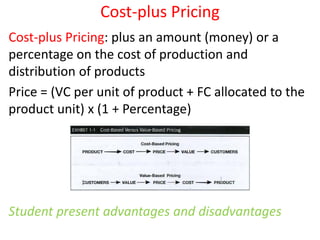
Cost-plus Pricing
Cost-plus Pricing: plus an amount (money) or a
percentage on the cost of production and
distribution of products
Price = (VC per unit of product + FC allocated to the
product unit) x (1 + Percentage)
Student present advantages and disadvantages
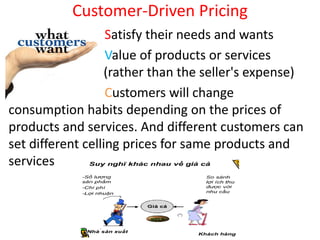
Customer-Driven Pricing
Satisfy their needs and wants
Value of products or services
ra (rather than the seller's expense)
Customers will change
consumption habits depending on the prices of
products and services. And different customers can
set different celling prices for same products and
services
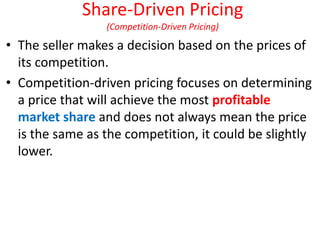
Share-Driven Pricing
(Competition-Driven Pricing)
• The seller makes a decision based on the prices of
its competition.
• Competition-driven pricing focuses on determining
a price that will achieve the most profitable
market share and does not always mean the price
is the same as the competition, it could be slightly
lower.
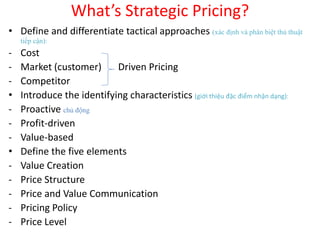
What’s Strategic Pricing?
• Define and differentiate tactical approaches (xác định và phân biệt thủ thuật
tiếp cận):
- Cost
- Market (customer) Driven Pricing
- Competitor
• Introduce the identifying characteristics (giới thiệu đặc điểm nhận dạng):
- Proactive chủ động
- Profit-driven
- Value-based
• Define the five elements
- Value Creation
- Price Structure
- Price and Value Communication
- Pricing Policy
- Price Level
The Strategic Pricing Pyramid
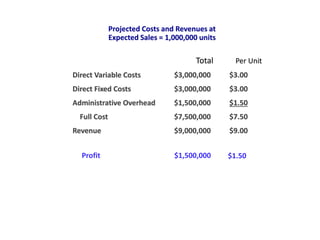
Total Per Unit
Direct Variable Costs $3,000,000 $3.00
Direct Fixed Costs $3,000,000 $3.00
Administrative Overhead $1,500,000 $1.50
Full Cost $7,500,000 $7.50
Revenue $9,000,000 $9.00
Projected Costs and Revenues at
Expected Sales = 1,000,000 units
Profit $1,500,000 $1.50
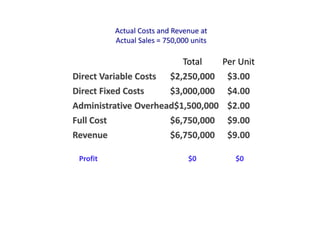
Actual Costs and Revenue at
Actual Sales = 750,000 units
Total Per Unit
Direct Variable Costs $2,250,000 $3.00
Direct Fixed Costs $3,000,000 $4.00
Administrative Overhead$1,500,000 $2.00
Full Cost $6,750,000 $9.00
Revenue $6,750,000 $9.00
Profit $0 $0

Chapter 1 STRATEGIC PRICING.pdf

  • 1.
    STRATEGIC PRICING Coordinating theDrivers of Profitability
  • 2.
    TOPIC OUTLINE • Cost-plusPricing • Customer-Driven Pricing • Share-Driven Pricing • What’s Strategic Pricing? • Value Creation • Price Structure • Price and Value Communication • Pricing Policy • Price Level • Implementing the Pricing Strategy
  • 3.
    Cost-plus Pricing Cost-plus Pricing:plus an amount (money) or a percentage on the cost of production and distribution of products Price = (VC per unit of product + FC allocated to the product unit) x (1 + Percentage) Student present advantages and disadvantages
  • 4.
    Customer-Driven Pricing Satisfy theirneeds and wants Value of products or services ra (rather than the seller's expense) Customers will change consumption habits depending on the prices of products and services. And different customers can set different celling prices for same products and services
  • 5.
    Share-Driven Pricing (Competition-Driven Pricing) •The seller makes a decision based on the prices of its competition. • Competition-driven pricing focuses on determining a price that will achieve the most profitable market share and does not always mean the price is the same as the competition, it could be slightly lower.
  • 6.
    What’s Strategic Pricing? •Define and differentiate tactical approaches (xác định và phân biệt thủ thuật tiếp cận): - Cost - Market (customer) Driven Pricing - Competitor • Introduce the identifying characteristics (giới thiệu đặc điểm nhận dạng): - Proactive chủ động - Profit-driven - Value-based • Define the five elements - Value Creation - Price Structure - Price and Value Communication - Pricing Policy - Price Level
  • 7.
  • 9.
    Total Per Unit DirectVariable Costs $3,000,000 $3.00 Direct Fixed Costs $3,000,000 $3.00 Administrative Overhead $1,500,000 $1.50 Full Cost $7,500,000 $7.50 Revenue $9,000,000 $9.00 Projected Costs and Revenues at Expected Sales = 1,000,000 units Profit $1,500,000 $1.50
  • 10.
    Actual Costs andRevenue at Actual Sales = 750,000 units Total Per Unit Direct Variable Costs $2,250,000 $3.00 Direct Fixed Costs $3,000,000 $4.00 Administrative Overhead$1,500,000 $2.00 Full Cost $6,750,000 $9.00 Revenue $6,750,000 $9.00 Profit $0 $0