DJP50063
PACKAGING LINE
OPERATION
PREPARED BY : GIHA BINTI TARDAN
MECHANICAL ENGINEERING DEPARTMENT
POLITEKNIK SULTAN SALAHUDDIN ABDUL AZIZ
SHAH
CHAPTER
I
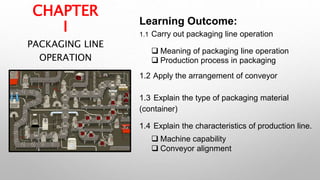
PACKAGING LINE
OPERATION
Learning Outcome:
1.1 Carry out packaging line operation
 Meaning of packaging line operation
 Production process in packaging
1.2 Apply the arrangement of conveyor
1.3 Explain the type of packaging material
(container)
1.4 Explain the characteristics of production line.
 Machine capability
 Conveyor alignment
THE MEANING
OF
PACKAGING
OPERATION
AND
PACKAGING
LINE.
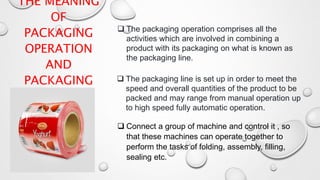
 Connect a group of machine and control it , so
that these machines can operate together to
perform the tasks of folding, assembly, filling,
sealing etc.
 The packaging operation comprises all the
activities which are involved in combining a
product with its packaging on what is known as
the packaging line.
 The packaging line is set up in order to meet the
speed and overall quantities of the product to be
packed and may range from manual operation up
to high speed fully automatic operation.
 Place the containers onto a conveyor belt which will move them
through the packaging line in the correct orientation
 Fill the product into the containers
 Close the containers
 If required at this stage, check product has been filled accurately
and safely
 Apply any additional packaging (e.g. a carton with a leaflet)
 Accept and assemble (as necessary) packaging components.
 Place a product into packages for: Protection, Identification,
Decoration, Distribution, Etc.
 Deliver complete packages ready for storage/shipping.
 Bring the packaging components from the packaging warehouse
 Apply suitable identification such as a label.
A typical sequence of activities in a packaging
line:
Example:
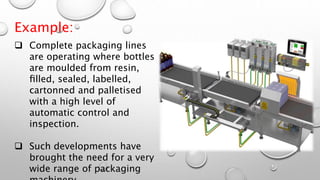
 Complete packaging lines
are operating where bottles
are moulded from resin,
filled, sealed, labelled,
cartonned and palletised
with a high level of
automatic control and
inspection.
 Such developments have
brought the need for a very
wide range of packaging
Packaging lines
; Can be …
• Semi-automatic, work done by combination
of
hand and machine.
• Fully automatic, work done entirely by
machine.
Automated packaging lines may be:
Multiple machines, working as one large
machine.
A single machine, such as a Form-Fill-
 The packaging line efficiency is dependent on the
machine, or method in the case of a manually operated
line, the product, the operators, and the quality of the
packaging material.
 The two most important tasks to fulfil on the packaging
line are to minimise the number of damaged packages
and to maximise the output.
The Packaging
lines ;
TYPES OF LAYOUT FOR PACKAGING LINES
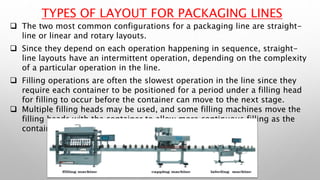
 The two most common configurations for a packaging line are straight-
line or linear and rotary layouts.
 Since they depend on each operation happening in sequence, straight-
line layouts have an intermittent operation, depending on the complexity
of a particular operation in the line.
 Filling operations are often the slowest operation in the line since they
require each container to be positioned for a period under a filling head
for filling to occur before the container can move to the next stage.
 Multiple filling heads may be used, and some filling machines move the
filling heads with the container to allow more continuous filling as the
containers move along the packaging line.
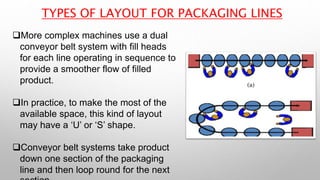
More complex machines use a dual
conveyor belt system with fill heads
for each line operating in sequence to
provide a smoother flow of filled
product.
In practice, to make the most of the
available space, this kind of layout
may have a ‘U’ or ‘S’ shape.
Conveyor belt systems take product
down one section of the packaging
line and then loop round for the next
TYPES OF LAYOUT FOR PACKAGING LINES
One way of minimising delays in straight-line
packaging lines is to use a rotary layout.
In these systems product is fed out of the main
packaging line into a rotating circle (called a turret)
where a more complex operation such as filling can
take place before the product is fed back into the
main packaging line.
The advantage of this configuration is that the turret
can process more units at a slower speed than the
main packaging line, for example by incorporating a
large number of filling heads, thus allowing a more
rapid, continuous flow of product onto the next
stage.
TYPES OF LAYOUT FOR PACKAGING LINES
MAIN CHARACTERISTICS OF
PRODUCTION LINE
i. Machine
Capability
ii. Conveyor
Alignment
 It is the measure of the actual quality
of a machine with respect to its
specifications (abbreviation: cm: c
stands for capability and m for
machine).
 In order to achieve high characteristic
capability values, it is necessary to
invest in safe and controlled
production processes instead of test
processes. For this reason, the
general idea can be described as
follows: ‘It is better to prevent errors
than correcting them.’
 A conveyor system is a common piece of
mechanical handling equipment that moves
materials from one location to another.
 Conveyors are especially useful in
applications involving the transport of heavy
or bulky materials.
 Conveyor systems allow quick and efficient
transport for a wide variety of materials,
which make them very popular in
the material handling and packaging .
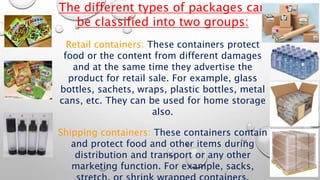
The different types of packages can
be classified into two groups:
Retail containers: These containers protect
food or the content from different damages
and at the same time they advertise the
product for retail sale. For example, glass
bottles, sachets, wraps, plastic bottles, metal
cans, etc. They can be used for home storage
also.
Shipping containers: These containers contain
and protect food and other items during
distribution and transport or any other
marketing function. For example, sacks,
PACKAGING MATERIAL CONTAINER
PLASTIC
PAPER
METAL
GLASS
BY : Giha Binti Tardan
TODAY’S TASK.
• FIND EXAMPLES OF ANY PRODUCTION LINE.
• MUST; AT LEAST 4 PROCESS INVOLVED IN THAT
LINE OPERATION.
• DISCUSS THE ITEM CHOSEN, AND THE OPERATION
INVOLVED IN THE LINE.
• IN A GROUP DURING THE CLASS.
xample : PARATHA BREAD PRODUCTION LINE
MIXING
KNEADING DOUGH
FERMENTING
FORMING
BAKING
PACKAGING

Chapter 1 Introduction Packaging Line.pptx

  • 1.
    DJP50063 PACKAGING LINE OPERATION PREPARED BY: GIHA BINTI TARDAN MECHANICAL ENGINEERING DEPARTMENT POLITEKNIK SULTAN SALAHUDDIN ABDUL AZIZ SHAH
  • 2.
    CHAPTER I PACKAGING LINE OPERATION Learning Outcome: 1.1Carry out packaging line operation  Meaning of packaging line operation  Production process in packaging 1.2 Apply the arrangement of conveyor 1.3 Explain the type of packaging material (container) 1.4 Explain the characteristics of production line.  Machine capability  Conveyor alignment
  • 3.
    THE MEANING OF PACKAGING OPERATION AND PACKAGING LINE.  Connecta group of machine and control it , so that these machines can operate together to perform the tasks of folding, assembly, filling, sealing etc.  The packaging operation comprises all the activities which are involved in combining a product with its packaging on what is known as the packaging line.  The packaging line is set up in order to meet the speed and overall quantities of the product to be packed and may range from manual operation up to high speed fully automatic operation.
  • 4.
     Place thecontainers onto a conveyor belt which will move them through the packaging line in the correct orientation  Fill the product into the containers  Close the containers  If required at this stage, check product has been filled accurately and safely  Apply any additional packaging (e.g. a carton with a leaflet)  Accept and assemble (as necessary) packaging components.  Place a product into packages for: Protection, Identification, Decoration, Distribution, Etc.  Deliver complete packages ready for storage/shipping.  Bring the packaging components from the packaging warehouse  Apply suitable identification such as a label. A typical sequence of activities in a packaging line:
  • 5.
    Example:  Complete packaginglines are operating where bottles are moulded from resin, filled, sealed, labelled, cartonned and palletised with a high level of automatic control and inspection.  Such developments have brought the need for a very wide range of packaging
  • 6.
    Packaging lines ; Canbe … • Semi-automatic, work done by combination of hand and machine. • Fully automatic, work done entirely by machine. Automated packaging lines may be: Multiple machines, working as one large machine. A single machine, such as a Form-Fill-
  • 7.
     The packagingline efficiency is dependent on the machine, or method in the case of a manually operated line, the product, the operators, and the quality of the packaging material.  The two most important tasks to fulfil on the packaging line are to minimise the number of damaged packages and to maximise the output. The Packaging lines ;
  • 9.
    TYPES OF LAYOUTFOR PACKAGING LINES  The two most common configurations for a packaging line are straight- line or linear and rotary layouts.  Since they depend on each operation happening in sequence, straight- line layouts have an intermittent operation, depending on the complexity of a particular operation in the line.  Filling operations are often the slowest operation in the line since they require each container to be positioned for a period under a filling head for filling to occur before the container can move to the next stage.  Multiple filling heads may be used, and some filling machines move the filling heads with the container to allow more continuous filling as the containers move along the packaging line.
  • 10.
    More complex machinesuse a dual conveyor belt system with fill heads for each line operating in sequence to provide a smoother flow of filled product. In practice, to make the most of the available space, this kind of layout may have a ‘U’ or ‘S’ shape. Conveyor belt systems take product down one section of the packaging line and then loop round for the next TYPES OF LAYOUT FOR PACKAGING LINES
  • 11.
    One way ofminimising delays in straight-line packaging lines is to use a rotary layout. In these systems product is fed out of the main packaging line into a rotating circle (called a turret) where a more complex operation such as filling can take place before the product is fed back into the main packaging line. The advantage of this configuration is that the turret can process more units at a slower speed than the main packaging line, for example by incorporating a large number of filling heads, thus allowing a more rapid, continuous flow of product onto the next stage. TYPES OF LAYOUT FOR PACKAGING LINES
  • 12.
    MAIN CHARACTERISTICS OF PRODUCTIONLINE i. Machine Capability ii. Conveyor Alignment  It is the measure of the actual quality of a machine with respect to its specifications (abbreviation: cm: c stands for capability and m for machine).  In order to achieve high characteristic capability values, it is necessary to invest in safe and controlled production processes instead of test processes. For this reason, the general idea can be described as follows: ‘It is better to prevent errors than correcting them.’  A conveyor system is a common piece of mechanical handling equipment that moves materials from one location to another.  Conveyors are especially useful in applications involving the transport of heavy or bulky materials.  Conveyor systems allow quick and efficient transport for a wide variety of materials, which make them very popular in the material handling and packaging .
  • 13.
    The different typesof packages can be classified into two groups: Retail containers: These containers protect food or the content from different damages and at the same time they advertise the product for retail sale. For example, glass bottles, sachets, wraps, plastic bottles, metal cans, etc. They can be used for home storage also. Shipping containers: These containers contain and protect food and other items during distribution and transport or any other marketing function. For example, sacks,
  • 14.
  • 18.
    BY : GihaBinti Tardan
  • 19.
    TODAY’S TASK. • FINDEXAMPLES OF ANY PRODUCTION LINE. • MUST; AT LEAST 4 PROCESS INVOLVED IN THAT LINE OPERATION. • DISCUSS THE ITEM CHOSEN, AND THE OPERATION INVOLVED IN THE LINE. • IN A GROUP DURING THE CLASS.
  • 20.
    xample : PARATHABREAD PRODUCTION LINE MIXING KNEADING DOUGH FERMENTING FORMING BAKING PACKAGING