Introduction
Course: Introduction to Computing
1 Computer Fundamentals by Pradeep K. Sinha, Priti Sinha
Computer
 The word computer comes from the word compute
which means to calculate
 Thereby, computer is an electronic device that can
perform arithmetic operations at high speed
 A computer is also called data processor because it
can store, process and retrieve data whenever
desired
2 Computer Fundamentals by Pradeep K. Sinha, Priti Sinha
Data Processing
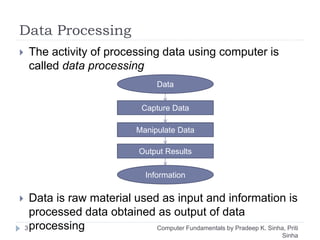
 The activity of processing data using computer is
called data processing
 Data is raw material used as input and information is
processed data obtained as output of data
processing
Data
Capture Data
Manipulate Data
Output Results
Information
3 Computer Fundamentals by Pradeep K. Sinha, Priti
Sinha
Characteristic of Computer
 Automatic
 Given a job, computer can work on it automatically
without human intervention
 Speed
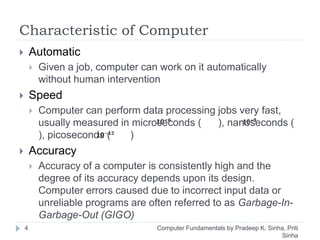
 Computer can perform data processing jobs very fast,
usually measured in microseconds ( ), nanoseconds (
), picoseconds ( )
 Accuracy
 Accuracy of a computer is consistently high and the
degree of its accuracy depends upon its design.
Computer errors caused due to incorrect input data or
unreliable programs are often referred to as Garbage-In-
Garbage-Out (GIGO)
4 Computer Fundamentals by Pradeep K. Sinha, Priti
Sinha
Characteristic of Computer
 Diligence
 Computer is free from monotony, tiredness and lack of
concentration. It can continuously work for hours without
creating any error.
 Versatility
 Computer is capable of performing almost any task, if a
task can be reduced to a finite series of logic steps
 Power of Remembering
 Computer can store and recall any amount of information
because of its secondary storage capability. It forgets or
looses certain information only when it is asked to do so.
5 Computer Fundamentals by Pradeep K. Sinha, Priti
Sinha
Characteristic of Computer
 No I.Q.
 A computer does only what it is programmed to do. It
cannot take its own decision in this regard.
 No Feelings
 Computers are devoid of emotions. Their judgement is
based on the instructions given to them in the form of
programs that are written by us (human beings)
6 Computer Fundamentals by Pradeep K. Sinha, Priti Sinha
Evolution of Computers
 Blaise Pascal invented the first mechanical adding
machine in 1642
 Baron Gottfried Wilhlem von Leibniz invented the
first calculator for multiplication in 1671
 Keyboard machines originated in United States
around 1880
 Around 1880 Herman Hollerith came up with concept
of punch cards that were extensively used as input
media until late 1970s
7 Computer Fundamentals by Pradeep K. Sinha, Priti Sinha
Evolution of Computers
 Charles Babbage is considered to be the father of
modern digital computers
 He designed Difference Engine in 1822
 He designed fully automatic analytical engine in 1842 for
performing basic arithmetic functions
 His efforts established a number of principles that are
fundamental to the design of any digital computer
8 Computer Fundamentals by Pradeep K. Sinha, Priti Sinha
Some Well Known Early Computers
 The Mark I Computer (1937- 44)
 The Atanasoff Berry Computer(1939- 42)
 The ANIAC (1943- 46)
 The EDVAC (1946- 52)
 The EDSAC (1947- 49)
 The UNIVAC I (1951)
9 Computer Fundamentals by Pradeep K. Sinha, Priti
Sinha
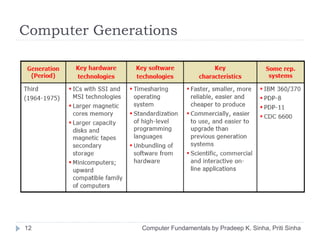
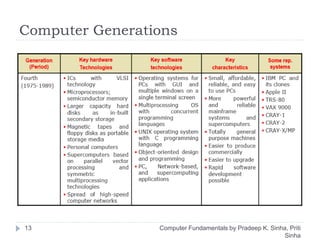
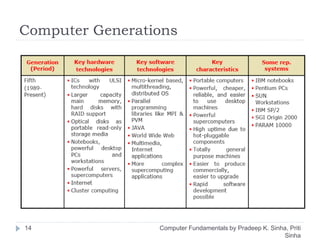
Computer Generations
 “Generation” in computer talk is a step in technology.
It provides a framework for the growth of computer
industry.
 Originally, it was used to distinguish between varying
hardware technologies but now it has been extended
to include both hardware and software
 Till today, there are five computer generations
10 Computer Fundamentals by Pradeep K. Sinha, Priti
Sinha
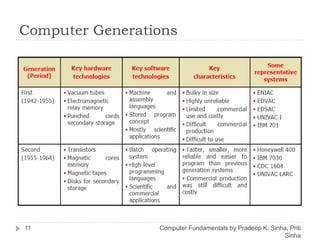
Computer Generations
11 Computer Fundamentals by Pradeep K. Sinha, Priti
Sinha
Computer Generations
12 Computer Fundamentals by Pradeep K. Sinha, Priti Sinha
Computer Generations
13 Computer Fundamentals by Pradeep K. Sinha, Priti
Sinha
Computer Generations
14 Computer Fundamentals by Pradeep K. Sinha, Priti
Sinha
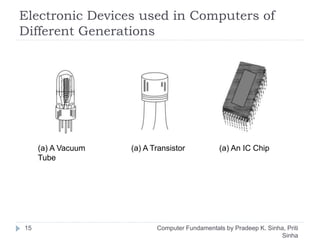
Electronic Devices used in Computers of
Different Generations
(a) A Vacuum
Tube
(a) A Transistor (a) An IC Chip
15 Computer Fundamentals by Pradeep K. Sinha, Priti
Sinha

Chapter 1 introduction

  • 1.
    Introduction Course: Introduction toComputing 1 Computer Fundamentals by Pradeep K. Sinha, Priti Sinha
  • 2.
    Computer  The wordcomputer comes from the word compute which means to calculate  Thereby, computer is an electronic device that can perform arithmetic operations at high speed  A computer is also called data processor because it can store, process and retrieve data whenever desired 2 Computer Fundamentals by Pradeep K. Sinha, Priti Sinha
  • 3.
    Data Processing  Theactivity of processing data using computer is called data processing  Data is raw material used as input and information is processed data obtained as output of data processing Data Capture Data Manipulate Data Output Results Information 3 Computer Fundamentals by Pradeep K. Sinha, Priti Sinha
  • 4.
    Characteristic of Computer Automatic  Given a job, computer can work on it automatically without human intervention  Speed  Computer can perform data processing jobs very fast, usually measured in microseconds ( ), nanoseconds ( ), picoseconds ( )  Accuracy  Accuracy of a computer is consistently high and the degree of its accuracy depends upon its design. Computer errors caused due to incorrect input data or unreliable programs are often referred to as Garbage-In- Garbage-Out (GIGO) 4 Computer Fundamentals by Pradeep K. Sinha, Priti Sinha
  • 5.
    Characteristic of Computer Diligence  Computer is free from monotony, tiredness and lack of concentration. It can continuously work for hours without creating any error.  Versatility  Computer is capable of performing almost any task, if a task can be reduced to a finite series of logic steps  Power of Remembering  Computer can store and recall any amount of information because of its secondary storage capability. It forgets or looses certain information only when it is asked to do so. 5 Computer Fundamentals by Pradeep K. Sinha, Priti Sinha
  • 6.
    Characteristic of Computer No I.Q.  A computer does only what it is programmed to do. It cannot take its own decision in this regard.  No Feelings  Computers are devoid of emotions. Their judgement is based on the instructions given to them in the form of programs that are written by us (human beings) 6 Computer Fundamentals by Pradeep K. Sinha, Priti Sinha
  • 7.
    Evolution of Computers Blaise Pascal invented the first mechanical adding machine in 1642  Baron Gottfried Wilhlem von Leibniz invented the first calculator for multiplication in 1671  Keyboard machines originated in United States around 1880  Around 1880 Herman Hollerith came up with concept of punch cards that were extensively used as input media until late 1970s 7 Computer Fundamentals by Pradeep K. Sinha, Priti Sinha
  • 8.
    Evolution of Computers Charles Babbage is considered to be the father of modern digital computers  He designed Difference Engine in 1822  He designed fully automatic analytical engine in 1842 for performing basic arithmetic functions  His efforts established a number of principles that are fundamental to the design of any digital computer 8 Computer Fundamentals by Pradeep K. Sinha, Priti Sinha
  • 9.
    Some Well KnownEarly Computers  The Mark I Computer (1937- 44)  The Atanasoff Berry Computer(1939- 42)  The ANIAC (1943- 46)  The EDVAC (1946- 52)  The EDSAC (1947- 49)  The UNIVAC I (1951) 9 Computer Fundamentals by Pradeep K. Sinha, Priti Sinha
  • 10.
    Computer Generations  “Generation”in computer talk is a step in technology. It provides a framework for the growth of computer industry.  Originally, it was used to distinguish between varying hardware technologies but now it has been extended to include both hardware and software  Till today, there are five computer generations 10 Computer Fundamentals by Pradeep K. Sinha, Priti Sinha
  • 11.
    Computer Generations 11 ComputerFundamentals by Pradeep K. Sinha, Priti Sinha
  • 12.
    Computer Generations 12 ComputerFundamentals by Pradeep K. Sinha, Priti Sinha
  • 13.
    Computer Generations 13 ComputerFundamentals by Pradeep K. Sinha, Priti Sinha
  • 14.
    Computer Generations 14 ComputerFundamentals by Pradeep K. Sinha, Priti Sinha
  • 15.
    Electronic Devices usedin Computers of Different Generations (a) A Vacuum Tube (a) A Transistor (a) An IC Chip 15 Computer Fundamentals by Pradeep K. Sinha, Priti Sinha