Computer Fundamentals: Pradeep K. Sinha & Priti Sinha
Slide 1/17
Chapter 1: Introduction to Computers
Ref Page
Computer Fundamentals: Pradeep K. Sinha & Priti Sinha
Slide 2/17
Chapter 1: Introduction to Computers
Ref Page
Learning Objectives
Learning Objectives
In this chapter you will learn about:
§ Computer
§ Data processing
§ Characteristic features of computers
§ Computers’ evolution to their present form
§ Computer generations
§ Characteristic features of each computer generation
01
Computer Fundamentals: Pradeep K. Sinha & Priti Sinha
Slide 3/17
Chapter 1: Introduction to Computers
Ref Page
§ The word computer comes from the word “compute”,
which means, “to calculate”
§ Thereby, a computer is an electronic device that can
perform arithmetic operations at high speed
§ A computer is also called a data processor because it can
store, process, and retrieve data whenever desired
Computer
Computer
01
Computer Fundamentals: Pradeep K. Sinha & Priti Sinha
Slide 4/17
Chapter 1: Introduction to Computers
Ref Page
Data Processing
Data Processing
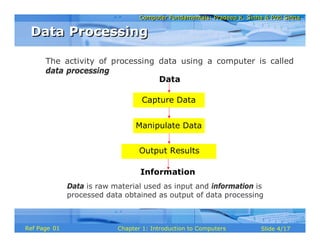
The activity of processing data using a computer is called
data processing
Data
Capture Data
Manipulate Data
Output Results
Information
Data is raw material used as input and information is
processed data obtained as output of data processing
01
Computer Fundamentals: Pradeep K. Sinha & Priti Sinha
Slide 5/17
Chapter 1: Introduction to Computers
Ref Page
1) Automatic: Given a job, computer can work on it
automatically without human interventions
2) Speed: Computer can perform data processing jobs
very fast, usually measured in microseconds (10-6),
nanoseconds (10-9), and picoseconds (10-12)
3) Accuracy: Accuracy of a computer is consistently high
and the degree of its accuracy depends upon its design.
Computer errors caused due to incorrect input data or
unreliable programs are often referred to as Garbage-
In-Garbage-Out (GIGO)
(Continued on next slide)
Characteristics of Computers
02
Computer Fundamentals: Pradeep K. Sinha & Priti Sinha
Slide 6/17
Chapter 1: Introduction to Computers
Ref Page
4) Diligence: Computer is free from monotony, tiredness,
and lack of concentration. It can continuously work for
hours without creating any error and without grumbling
5) Versatility: Computer is capable of performing almost
any task, if the task can be reduced to a finite series of
logical steps
6) Power of Remembering: Computer can store and
recall any amount of information because of its
secondary storage capability. It forgets or looses certain
information only when it is asked to do so
(Continued from previous slide..)
Characteristics of Computers
(Continued on next slide)
02
Computer Fundamentals: Pradeep K. Sinha & Priti Sinha
Slide 7/17
Chapter 1: Introduction to Computers
Ref Page
7) No I.Q.: A computer does only what it is programmed
to do. It cannot take its own decision in this regard
8) No Feelings: Computers are devoid of emotions. Their
judgement is based on the instructions given to them in
the form of programs that are written by us (human
beings)
(Continued from previous slide..)
(Continued on next slide)
Characteristics of Computers
03
Computer Fundamentals: Pradeep K. Sinha & Priti Sinha
Slide 8/17
Chapter 1: Introduction to Computers
Ref Page
Evolution of Computers
§ Blaise Pascal invented the first mechanical adding
machine in 1642
§ Baron Gottfried Wilhelm von Leibniz invented the first
calculator for multiplication in 1671
§ Keyboard machines originated in the United States
around 1880
§ Around 1880, Herman Hollerith came up with the concept
of punched cards that were extensively used as input
media until late 1970s
03
Computer Fundamentals: Pradeep K. Sinha & Priti Sinha
Slide 9/17
Chapter 1: Introduction to Computers
Ref Page
§ Charles Babbage is considered to be the father of
modern digital computers
§ He designed “Difference Engine” in 1822
§ He designed a fully automatic analytical engine in
1842 for performing basic arithmetic functions
§ His efforts established a number of principles that
are fundamental to the design of any digital
computer
(Continued from previous slide..)
(Continued on next slide)
Evolution of Computers
03
Computer Fundamentals: Pradeep K. Sinha & Priti Sinha
Slide 10/17
Chapter 1: Introduction to Computers
Ref Page
Some Well Known Early Computers
§ The Mark I Computer (1937-44)
§ The Atanasoff-Berry Computer (1939-42)
§ The ENIAC (1943-46)
§ The EDVAC (1946-52)
§ The EDSAC (1947-49)
§ Manchester Mark I (1948)
§ The UNIVAC I (1951)
03
Computer Fundamentals: Pradeep K. Sinha & Priti Sinha
Slide 11/17
Chapter 1: Introduction to Computers
Ref Page
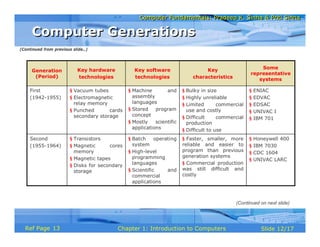
§ “Generation” in computer talk is a step in technology. It
provides a framework for the growth of computer industry
§ Originally it was used to distinguish between various
hardware technologies, but now it has been extended to
include both hardware and software
§ Till today, there are five computer generations
Computer Generations
(Continued on next slide)
05
Computer Fundamentals: Pradeep K. Sinha & Priti Sinha
Slide 12/17
Chapter 1: Introduction to Computers
Ref Page
§ Honeywell 400
§ IBM 7030
§ CDC 1604
§ UNIVAC LARC
§ Faster, smaller, more
reliable and easier to
program than previous
generation systems
§ Commercial production
was still difficult and
costly
§ Batch operating
system
§ High-level
programming
languages
§ Scientific and
commercial
applications
§ Transistors
§ Magnetic cores
memory
§ Magnetic tapes
§ Disks for secondary
storage
Second
(1955-1964)
§ ENIAC
§ EDVAC
§ EDSAC
§ UNIVAC I
§ IBM 701
§ Bulky in size
§ Highly unreliable
§ Limited commercial
use and costly
§ Difficult commercial
production
§ Difficult to use
§ Machine and
assembly
languages
§ Stored program
concept
§ Mostly scientific
applications
§ Vacuum tubes
§ Electromagnetic
relay memory
§ Punched cards
secondary storage
First
(1942-1955)
Some
representative
systems
Key
characteristics
Key software
technologies
Key hardware
technologies
Generation
(Period)
(Continued from previous slide..)
(Continued on next slide)
Computer Generations
13
Computer Fundamentals: Pradeep K. Sinha & Priti Sinha
Slide 13/17
Chapter 1: Introduction to Computers
Ref Page
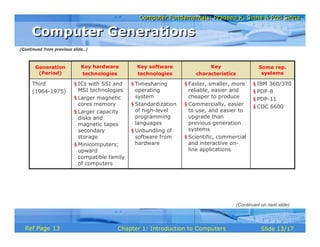
§ IBM 360/370
§ PDP-8
§ PDP-11
§ CDC 6600
§ Faster, smaller, more
reliable, easier and
cheaper to produce
§ Commercially, easier
to use, and easier to
upgrade than
previous generation
systems
§ Scientific, commercial
and interactive on-
line applications
§ Timesharing
operating
system
§ Standardization
of high-level
programming
languages
§ Unbundling of
software from
hardware
§ ICs with SSI and
MSI technologies
§ Larger magnetic
cores memory
§ Larger capacity
disks and
magnetic tapes
secondary
storage
§ Minicomputers;
upward
compatible family
of computers
Third
(1964-1975)
Some rep.
systems
Key
characteristics
Key software
technologies
Key hardware
technologies
Generation
(Period)
(Continued from previous slide..)
(Continued on next slide)
Computer Generations
13
Computer Fundamentals: Pradeep K. Sinha & Priti Sinha
Slide 14/17
Chapter 1: Introduction to Computers
Ref Page
§ IBM PC and
its clones
§ Apple II
§ TRS-80
§ VAX 9000
§ CRAY-1
§ CRAY-2
§ CRAY-X/MP
§ Small, affordable,
reliable, and easy
to use PCs
§ More powerful
and reliable
mainframe
systems and
supercomputers
§ Totally general
purpose machines
§ Easier to produce
commercially
§ Easier to upgrade
§ Rapid software
development
possible
§ Operating systems for
PCs with GUI and
multiple windows on a
single terminal screen
§ Multiprocessing OS
with concurrent
programming
languages
§ UNIX operating system
with C programming
language
§ Object-oriented design
and programming
§ PC, Network-based,
and supercomputing
applications
§ ICs with VLSI
technology
§ Microprocessors;
semiconductor memory
§ Larger capacity hard
disks as in-built
secondary storage
§ Magnetic tapes and
floppy disks as portable
storage media
§ Personal computers
§ Supercomputers based
on parallel vector
processing and
symmetric
multiprocessing
technologies
§ Spread of high-speed
computer networks
Fourth
(1975-1989)
Some rep.
systems
Key
characteristics
Key software
technologies
Key hardware
Technologies
Generation
(Period)
(Continued from previous slide..)
(Continued on next slide)
Computer Generations
13
Computer Fundamentals: Pradeep K. Sinha & Priti Sinha
Slide 15/17
Chapter 1: Introduction to Computers
Ref Page
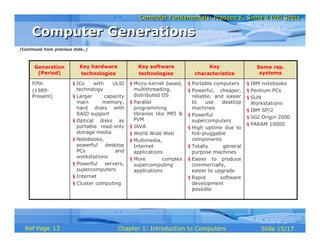
§ IBM notebooks
§ Pentium PCs
§ SUN
Workstations
§ IBM SP/2
§ SGI Origin 2000
§ PARAM 10000
§ Portable computers
§ Powerful, cheaper,
reliable, and easier
to use desktop
machines
§ Powerful
supercomputers
§ High uptime due to
hot-pluggable
components
§ Totally general
purpose machines
§ Easier to produce
commercially,
easier to upgrade
§ Rapid software
development
possible
§ Micro-kernel based,
multithreading,
distributed OS
§ Parallel
programming
libraries like MPI &
PVM
§ JAVA
§ World Wide Web
§ Multimedia,
Internet
applications
§ More complex
supercomputing
applications
§ ICs with ULSI
technology
§ Larger capacity
main memory,
hard disks with
RAID support
§ Optical disks as
portable read-only
storage media
§ Notebooks,
powerful desktop
PCs and
workstations
§ Powerful servers,
supercomputers
§ Internet
§ Cluster computing
Fifth
(1989-
Present)
Some rep.
systems
Key
characteristics
Key software
technologies
Key hardware
technologies
Generation
(Period)
(Continued from previous slide..)
Computer Generations
13
Computer Fundamentals: Pradeep K. Sinha & Priti Sinha
Slide 16/17
Chapter 1: Introduction to Computers
Ref Page
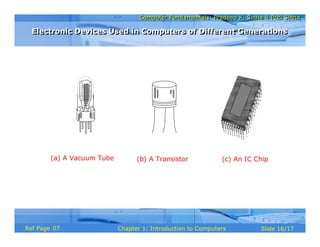
(c) An IC Chip
(b) A Transistor
(a) A Vacuum Tube
Electronic Devices Used in Computers of Different Generations
07
Computer Fundamentals: Pradeep K. Sinha & Priti Sinha
Slide 17/17
Chapter 1: Introduction to Computers
Ref Page
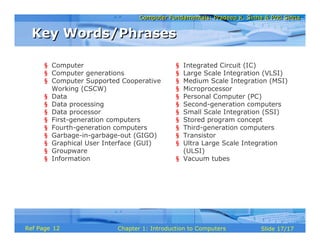
Key Words/Phrases
Key Words/Phrases
§ Computer
§ Computer generations
§ Computer Supported Cooperative
Working (CSCW)
§ Data
§ Data processing
§ Data processor
§ First-generation computers
§ Fourth-generation computers
§ Garbage-in-garbage-out (GIGO)
§ Graphical User Interface (GUI)
§ Groupware
§ Information
§ Integrated Circuit (IC)
§ Large Scale Integration (VLSI)
§ Medium Scale Integration (MSI)
§ Microprocessor
§ Personal Computer (PC)
§ Second-generation computers
§ Small Scale Integration (SSI)
§ Stored program concept
§ Third-generation computers
§ Transistor
§ Ultra Large Scale Integration
(ULSI)
§ Vacuum tubes
12

Computer Basics

  • 1.
    Computer Fundamentals: PradeepK. Sinha & Priti Sinha Computer Fundamentals: Pradeep K. Sinha & Priti Sinha Slide 1/17 Chapter 1: Introduction to Computers Ref Page
  • 2.
    Computer Fundamentals: PradeepK. Sinha & Priti Sinha Computer Fundamentals: Pradeep K. Sinha & Priti Sinha Slide 2/17 Chapter 1: Introduction to Computers Ref Page Learning Objectives Learning Objectives In this chapter you will learn about: § Computer § Data processing § Characteristic features of computers § Computers’ evolution to their present form § Computer generations § Characteristic features of each computer generation 01
  • 3.
    Computer Fundamentals: PradeepK. Sinha & Priti Sinha Computer Fundamentals: Pradeep K. Sinha & Priti Sinha Slide 3/17 Chapter 1: Introduction to Computers Ref Page § The word computer comes from the word “compute”, which means, “to calculate” § Thereby, a computer is an electronic device that can perform arithmetic operations at high speed § A computer is also called a data processor because it can store, process, and retrieve data whenever desired Computer Computer 01
  • 4.
    Computer Fundamentals: PradeepK. Sinha & Priti Sinha Computer Fundamentals: Pradeep K. Sinha & Priti Sinha Slide 4/17 Chapter 1: Introduction to Computers Ref Page Data Processing Data Processing The activity of processing data using a computer is called data processing Data Capture Data Manipulate Data Output Results Information Data is raw material used as input and information is processed data obtained as output of data processing 01
  • 5.
    Computer Fundamentals: PradeepK. Sinha & Priti Sinha Computer Fundamentals: Pradeep K. Sinha & Priti Sinha Slide 5/17 Chapter 1: Introduction to Computers Ref Page 1) Automatic: Given a job, computer can work on it automatically without human interventions 2) Speed: Computer can perform data processing jobs very fast, usually measured in microseconds (10-6), nanoseconds (10-9), and picoseconds (10-12) 3) Accuracy: Accuracy of a computer is consistently high and the degree of its accuracy depends upon its design. Computer errors caused due to incorrect input data or unreliable programs are often referred to as Garbage- In-Garbage-Out (GIGO) (Continued on next slide) Characteristics of Computers Characteristics of Computers 02
  • 6.
    Computer Fundamentals: PradeepK. Sinha & Priti Sinha Computer Fundamentals: Pradeep K. Sinha & Priti Sinha Slide 6/17 Chapter 1: Introduction to Computers Ref Page 4) Diligence: Computer is free from monotony, tiredness, and lack of concentration. It can continuously work for hours without creating any error and without grumbling 5) Versatility: Computer is capable of performing almost any task, if the task can be reduced to a finite series of logical steps 6) Power of Remembering: Computer can store and recall any amount of information because of its secondary storage capability. It forgets or looses certain information only when it is asked to do so (Continued from previous slide..) Characteristics of Computers Characteristics of Computers (Continued on next slide) 02
  • 7.
    Computer Fundamentals: PradeepK. Sinha & Priti Sinha Computer Fundamentals: Pradeep K. Sinha & Priti Sinha Slide 7/17 Chapter 1: Introduction to Computers Ref Page 7) No I.Q.: A computer does only what it is programmed to do. It cannot take its own decision in this regard 8) No Feelings: Computers are devoid of emotions. Their judgement is based on the instructions given to them in the form of programs that are written by us (human beings) (Continued from previous slide..) (Continued on next slide) Characteristics of Computers Characteristics of Computers 03
  • 8.
    Computer Fundamentals: PradeepK. Sinha & Priti Sinha Computer Fundamentals: Pradeep K. Sinha & Priti Sinha Slide 8/17 Chapter 1: Introduction to Computers Ref Page Evolution of Computers Evolution of Computers § Blaise Pascal invented the first mechanical adding machine in 1642 § Baron Gottfried Wilhelm von Leibniz invented the first calculator for multiplication in 1671 § Keyboard machines originated in the United States around 1880 § Around 1880, Herman Hollerith came up with the concept of punched cards that were extensively used as input media until late 1970s 03
  • 9.
    Computer Fundamentals: PradeepK. Sinha & Priti Sinha Computer Fundamentals: Pradeep K. Sinha & Priti Sinha Slide 9/17 Chapter 1: Introduction to Computers Ref Page § Charles Babbage is considered to be the father of modern digital computers § He designed “Difference Engine” in 1822 § He designed a fully automatic analytical engine in 1842 for performing basic arithmetic functions § His efforts established a number of principles that are fundamental to the design of any digital computer (Continued from previous slide..) (Continued on next slide) Evolution of Computers Evolution of Computers 03
  • 10.
    Computer Fundamentals: PradeepK. Sinha & Priti Sinha Computer Fundamentals: Pradeep K. Sinha & Priti Sinha Slide 10/17 Chapter 1: Introduction to Computers Ref Page Some Well Known Early Computers Some Well Known Early Computers § The Mark I Computer (1937-44) § The Atanasoff-Berry Computer (1939-42) § The ENIAC (1943-46) § The EDVAC (1946-52) § The EDSAC (1947-49) § Manchester Mark I (1948) § The UNIVAC I (1951) 03
  • 11.
    Computer Fundamentals: PradeepK. Sinha & Priti Sinha Computer Fundamentals: Pradeep K. Sinha & Priti Sinha Slide 11/17 Chapter 1: Introduction to Computers Ref Page § “Generation” in computer talk is a step in technology. It provides a framework for the growth of computer industry § Originally it was used to distinguish between various hardware technologies, but now it has been extended to include both hardware and software § Till today, there are five computer generations Computer Generations Computer Generations (Continued on next slide) 05
  • 12.
    Computer Fundamentals: PradeepK. Sinha & Priti Sinha Computer Fundamentals: Pradeep K. Sinha & Priti Sinha Slide 12/17 Chapter 1: Introduction to Computers Ref Page § Honeywell 400 § IBM 7030 § CDC 1604 § UNIVAC LARC § Faster, smaller, more reliable and easier to program than previous generation systems § Commercial production was still difficult and costly § Batch operating system § High-level programming languages § Scientific and commercial applications § Transistors § Magnetic cores memory § Magnetic tapes § Disks for secondary storage Second (1955-1964) § ENIAC § EDVAC § EDSAC § UNIVAC I § IBM 701 § Bulky in size § Highly unreliable § Limited commercial use and costly § Difficult commercial production § Difficult to use § Machine and assembly languages § Stored program concept § Mostly scientific applications § Vacuum tubes § Electromagnetic relay memory § Punched cards secondary storage First (1942-1955) Some representative systems Key characteristics Key software technologies Key hardware technologies Generation (Period) (Continued from previous slide..) (Continued on next slide) Computer Generations Computer Generations 13
  • 13.
    Computer Fundamentals: PradeepK. Sinha & Priti Sinha Computer Fundamentals: Pradeep K. Sinha & Priti Sinha Slide 13/17 Chapter 1: Introduction to Computers Ref Page § IBM 360/370 § PDP-8 § PDP-11 § CDC 6600 § Faster, smaller, more reliable, easier and cheaper to produce § Commercially, easier to use, and easier to upgrade than previous generation systems § Scientific, commercial and interactive on- line applications § Timesharing operating system § Standardization of high-level programming languages § Unbundling of software from hardware § ICs with SSI and MSI technologies § Larger magnetic cores memory § Larger capacity disks and magnetic tapes secondary storage § Minicomputers; upward compatible family of computers Third (1964-1975) Some rep. systems Key characteristics Key software technologies Key hardware technologies Generation (Period) (Continued from previous slide..) (Continued on next slide) Computer Generations Computer Generations 13
  • 14.
    Computer Fundamentals: PradeepK. Sinha & Priti Sinha Computer Fundamentals: Pradeep K. Sinha & Priti Sinha Slide 14/17 Chapter 1: Introduction to Computers Ref Page § IBM PC and its clones § Apple II § TRS-80 § VAX 9000 § CRAY-1 § CRAY-2 § CRAY-X/MP § Small, affordable, reliable, and easy to use PCs § More powerful and reliable mainframe systems and supercomputers § Totally general purpose machines § Easier to produce commercially § Easier to upgrade § Rapid software development possible § Operating systems for PCs with GUI and multiple windows on a single terminal screen § Multiprocessing OS with concurrent programming languages § UNIX operating system with C programming language § Object-oriented design and programming § PC, Network-based, and supercomputing applications § ICs with VLSI technology § Microprocessors; semiconductor memory § Larger capacity hard disks as in-built secondary storage § Magnetic tapes and floppy disks as portable storage media § Personal computers § Supercomputers based on parallel vector processing and symmetric multiprocessing technologies § Spread of high-speed computer networks Fourth (1975-1989) Some rep. systems Key characteristics Key software technologies Key hardware Technologies Generation (Period) (Continued from previous slide..) (Continued on next slide) Computer Generations Computer Generations 13
  • 15.
    Computer Fundamentals: PradeepK. Sinha & Priti Sinha Computer Fundamentals: Pradeep K. Sinha & Priti Sinha Slide 15/17 Chapter 1: Introduction to Computers Ref Page § IBM notebooks § Pentium PCs § SUN Workstations § IBM SP/2 § SGI Origin 2000 § PARAM 10000 § Portable computers § Powerful, cheaper, reliable, and easier to use desktop machines § Powerful supercomputers § High uptime due to hot-pluggable components § Totally general purpose machines § Easier to produce commercially, easier to upgrade § Rapid software development possible § Micro-kernel based, multithreading, distributed OS § Parallel programming libraries like MPI & PVM § JAVA § World Wide Web § Multimedia, Internet applications § More complex supercomputing applications § ICs with ULSI technology § Larger capacity main memory, hard disks with RAID support § Optical disks as portable read-only storage media § Notebooks, powerful desktop PCs and workstations § Powerful servers, supercomputers § Internet § Cluster computing Fifth (1989- Present) Some rep. systems Key characteristics Key software technologies Key hardware technologies Generation (Period) (Continued from previous slide..) Computer Generations Computer Generations 13
  • 16.
    Computer Fundamentals: PradeepK. Sinha & Priti Sinha Computer Fundamentals: Pradeep K. Sinha & Priti Sinha Slide 16/17 Chapter 1: Introduction to Computers Ref Page (c) An IC Chip (b) A Transistor (a) A Vacuum Tube Electronic Devices Used in Computers of Different Generations Electronic Devices Used in Computers of Different Generations 07
  • 17.
    Computer Fundamentals: PradeepK. Sinha & Priti Sinha Computer Fundamentals: Pradeep K. Sinha & Priti Sinha Slide 17/17 Chapter 1: Introduction to Computers Ref Page Key Words/Phrases Key Words/Phrases § Computer § Computer generations § Computer Supported Cooperative Working (CSCW) § Data § Data processing § Data processor § First-generation computers § Fourth-generation computers § Garbage-in-garbage-out (GIGO) § Graphical User Interface (GUI) § Groupware § Information § Integrated Circuit (IC) § Large Scale Integration (VLSI) § Medium Scale Integration (MSI) § Microprocessor § Personal Computer (PC) § Second-generation computers § Small Scale Integration (SSI) § Stored program concept § Third-generation computers § Transistor § Ultra Large Scale Integration (ULSI) § Vacuum tubes 12