Overview of Network Components
1
By Chhay Buntha
Chapter 1
Data Communications
The word data refers to information presented in whatever form is
agreed upon by the parties creating and using the data. Data
communications are the exchange of data between two devices via
some form of transmission medium such as a wire cable or wireless.
What is Data Communications?
Chapter1
2
By Chhay Buntha
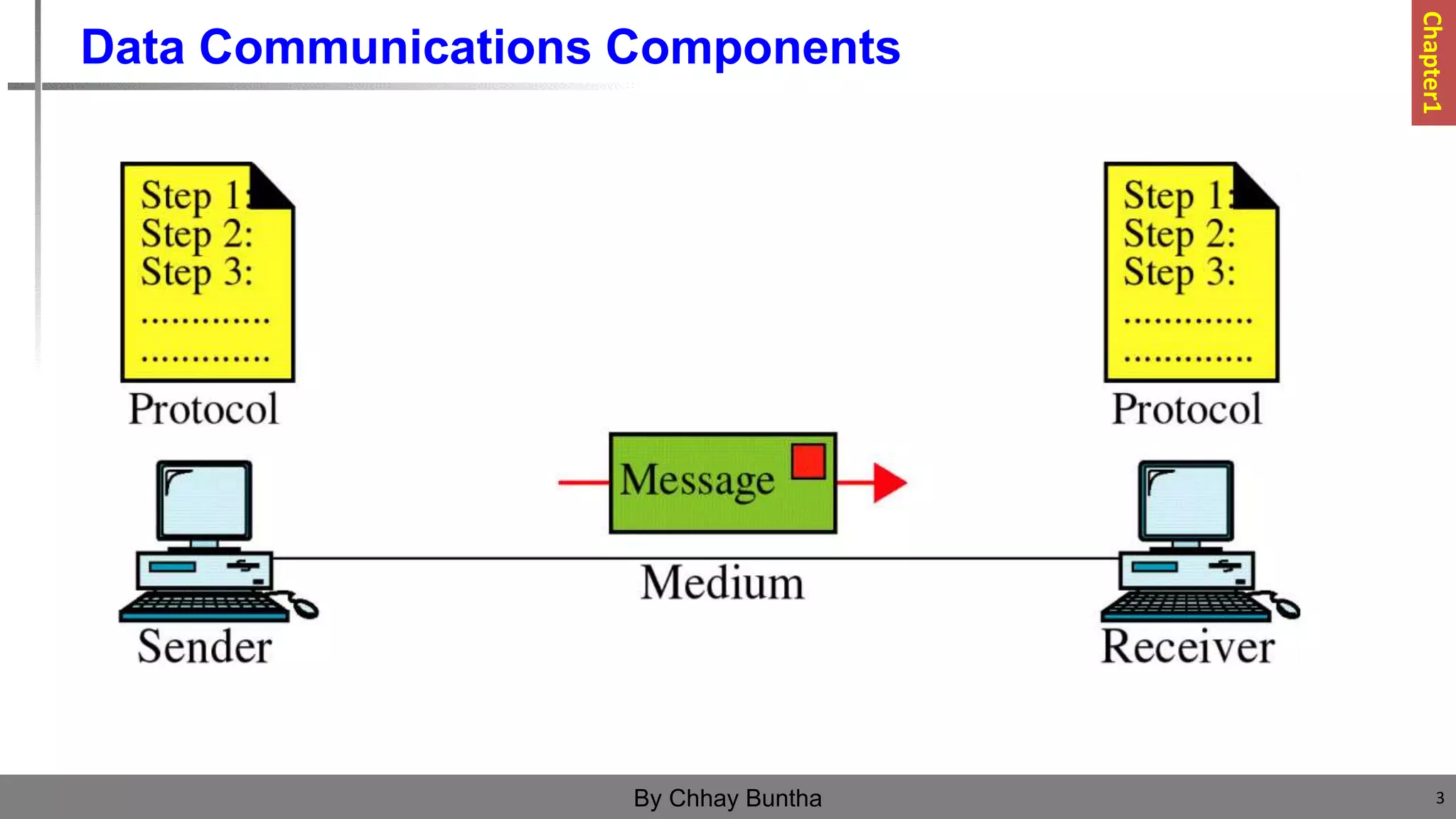
Data Communications Components
3
By Chhay Buntha
Chapter1
Data Communications Components
1- Message or Data
The Message is the information (data) to be communicated.
It can consist of text, number, pictures, sound or video or any combination of
these.
2- Sender
The sender is the device that sends the data message. It can be a computer,
workstation, telephone handset, video camera. And so on.
4
By Chhay Buntha
Chapter1
Data Communications Components
3- Medium
The transmission medium is the physical path by which a message travels
from sender to receiver.
It can be twisted pair wire, coaxial cable, fiber optic or radio wave.
4- Receiver
The received is the device that receives the message.
It can be a computer, workstation, telephone handset, television, and so on
5- Protocol
A protocol is a set of rules that govern data communication. It represents an
agreement between the communicating devices. Without a protocol, two
devices may be connected but not communicating
5
By Chhay Buntha
Chapter1
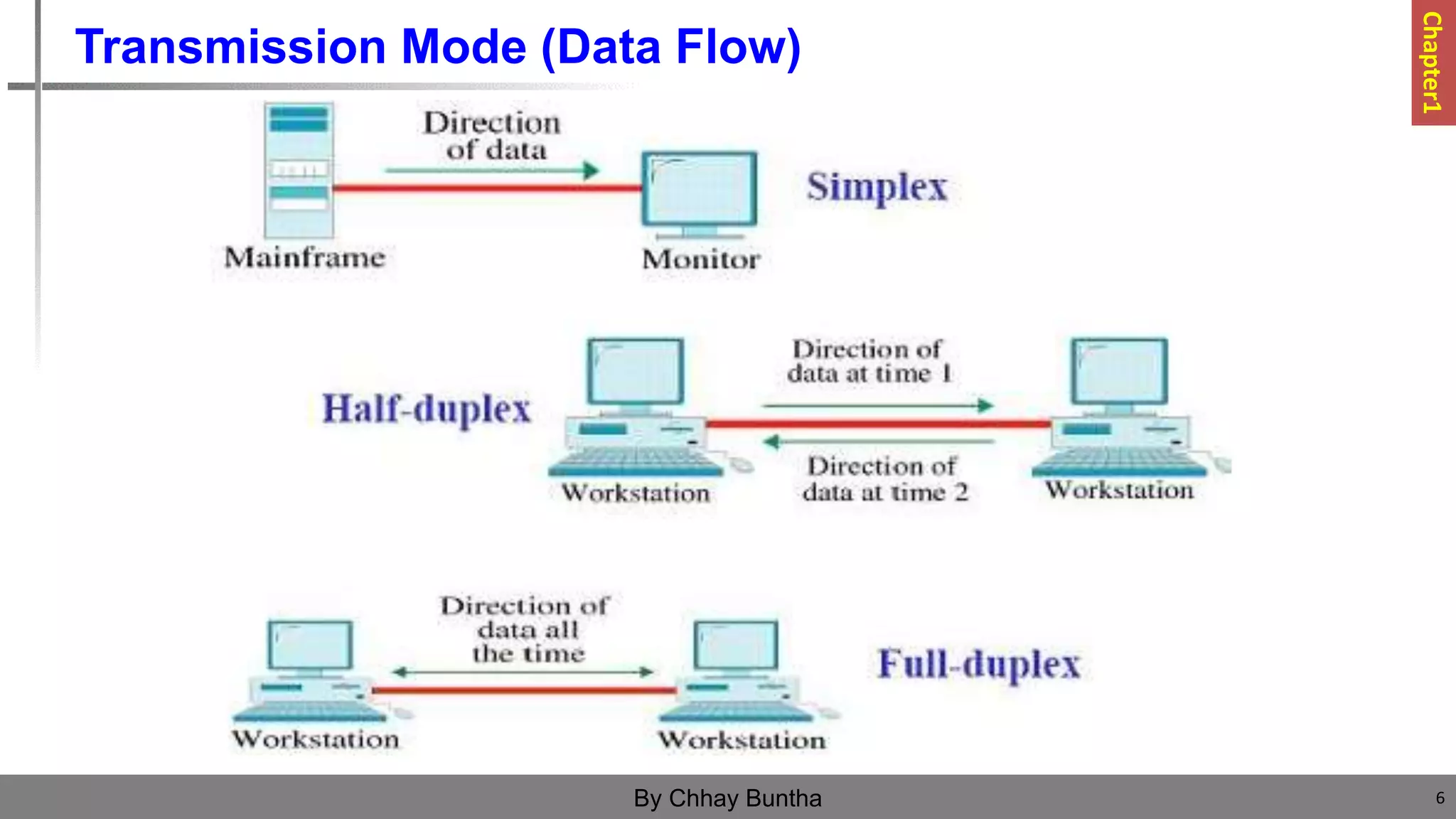
Transmission Mode (Data Flow)
6
By Chhay Buntha
Chapter1
Simplex
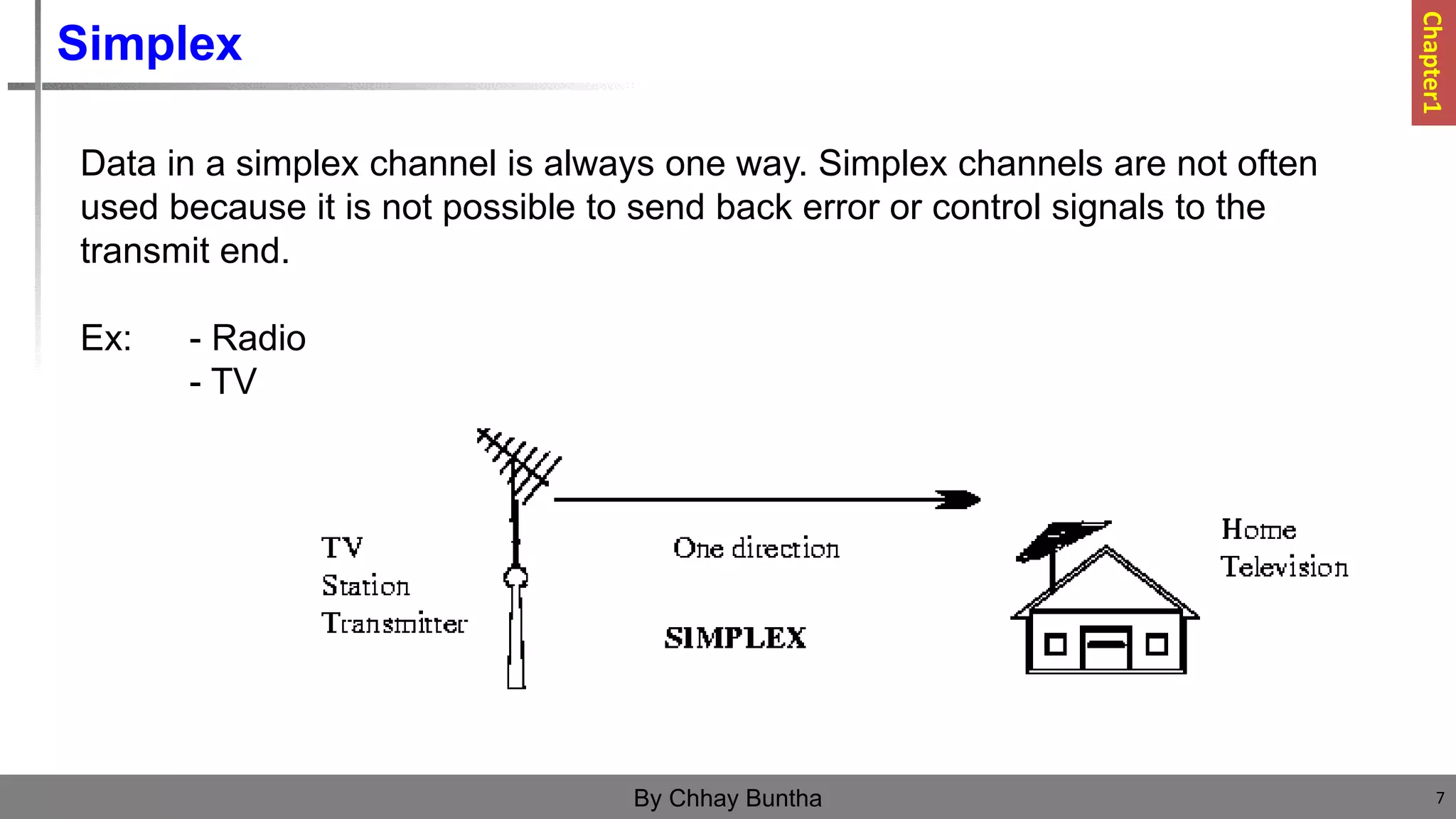
Data in a simplex channel is always one way. Simplex channels are not often
used because it is not possible to send back error or control signals to the
transmit end.
Ex: - Radio
- TV
7
By Chhay Buntha
Chapter1
Half-Duplex
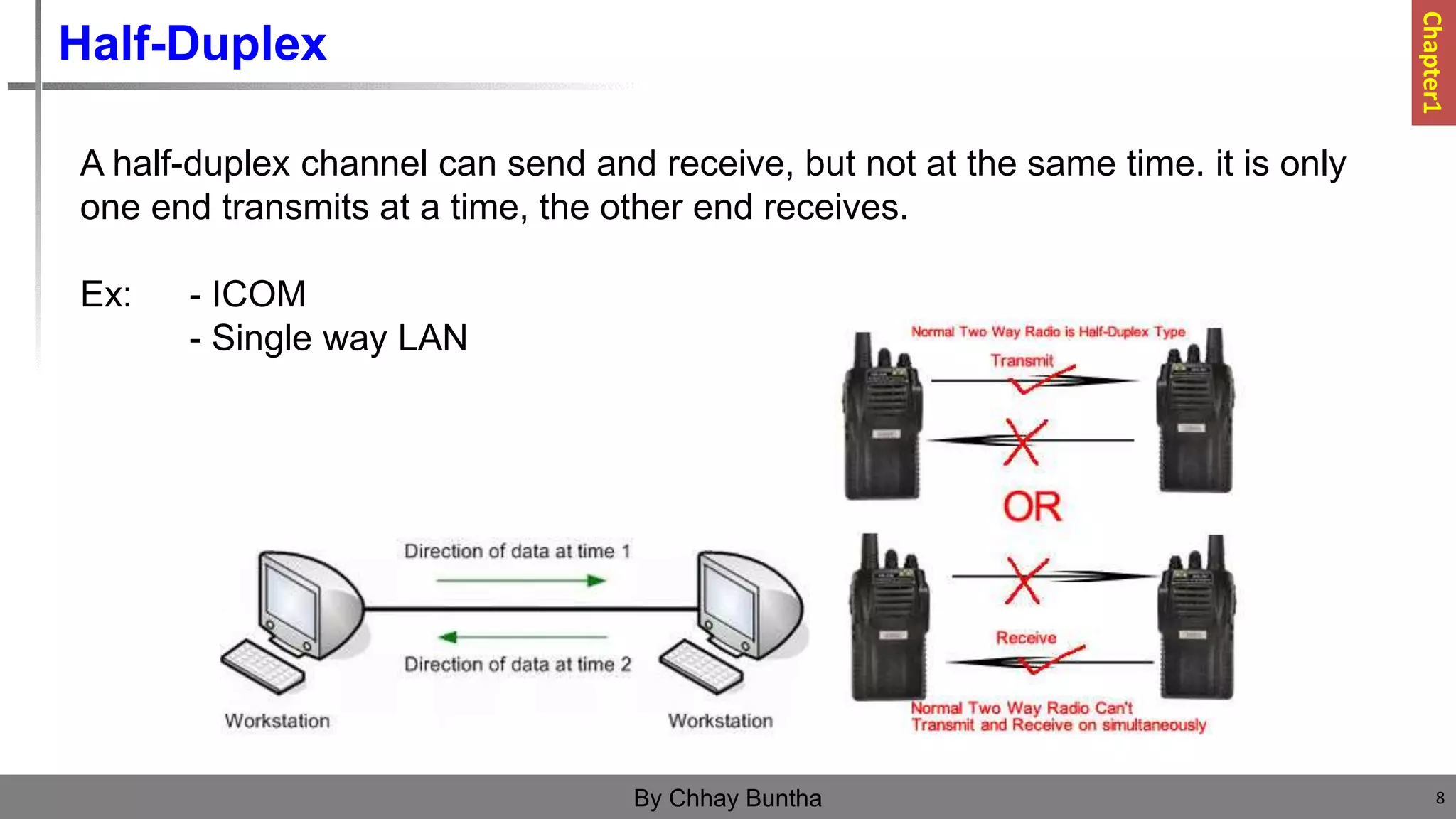
A half-duplex channel can send and receive, but not at the same time. it is only
one end transmits at a time, the other end receives.
Ex: - ICOM
- Single way LAN
8
By Chhay Buntha
Chapter1
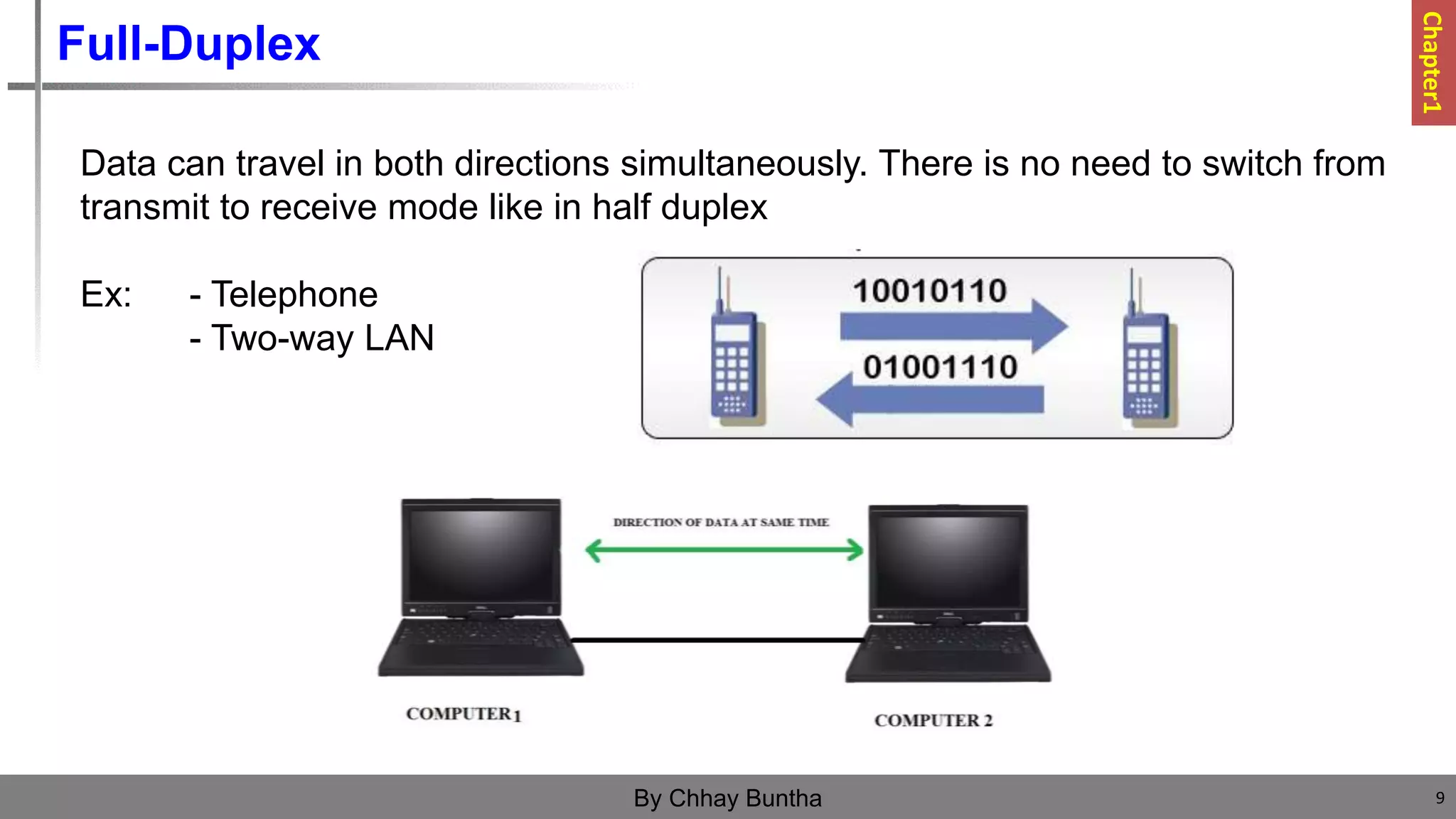
Full-Duplex
Data can travel in both directions simultaneously. There is no need to switch from
transmit to receive mode like in half duplex
Ex: - Telephone
- Two-way LAN
9
By Chhay Buntha
Chapter1
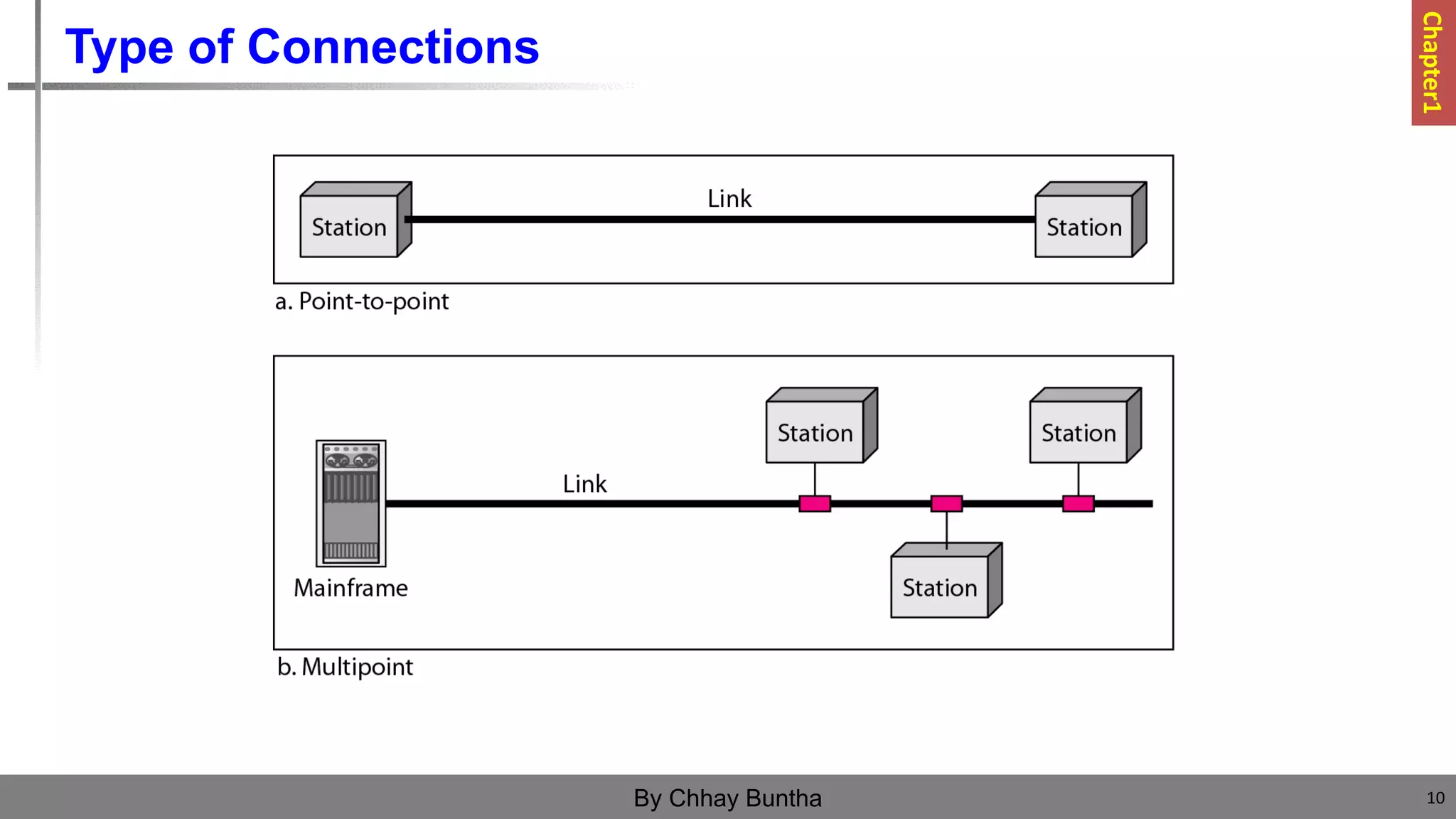
Type of Connections
10
By Chhay Buntha
Chapter1
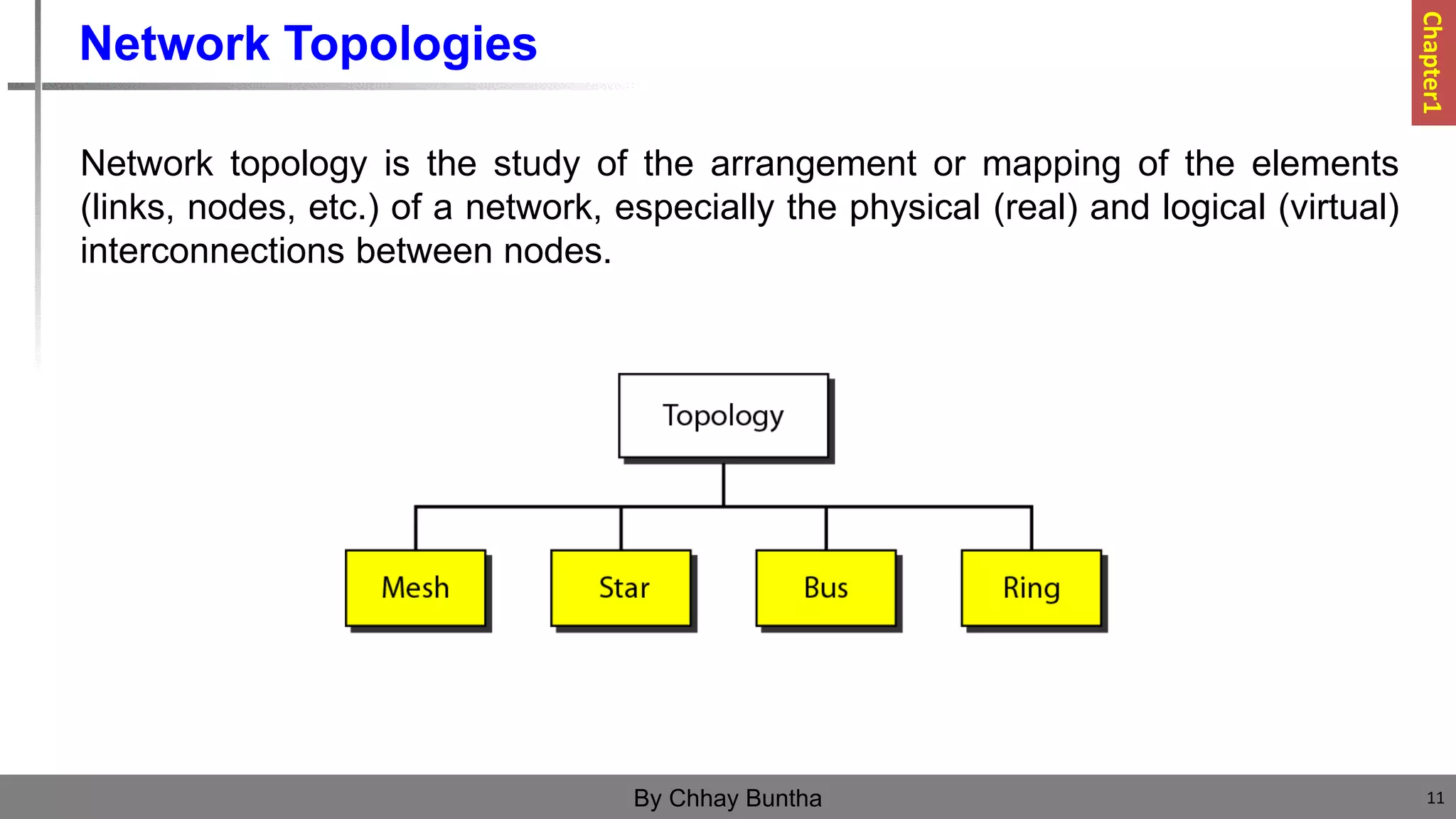
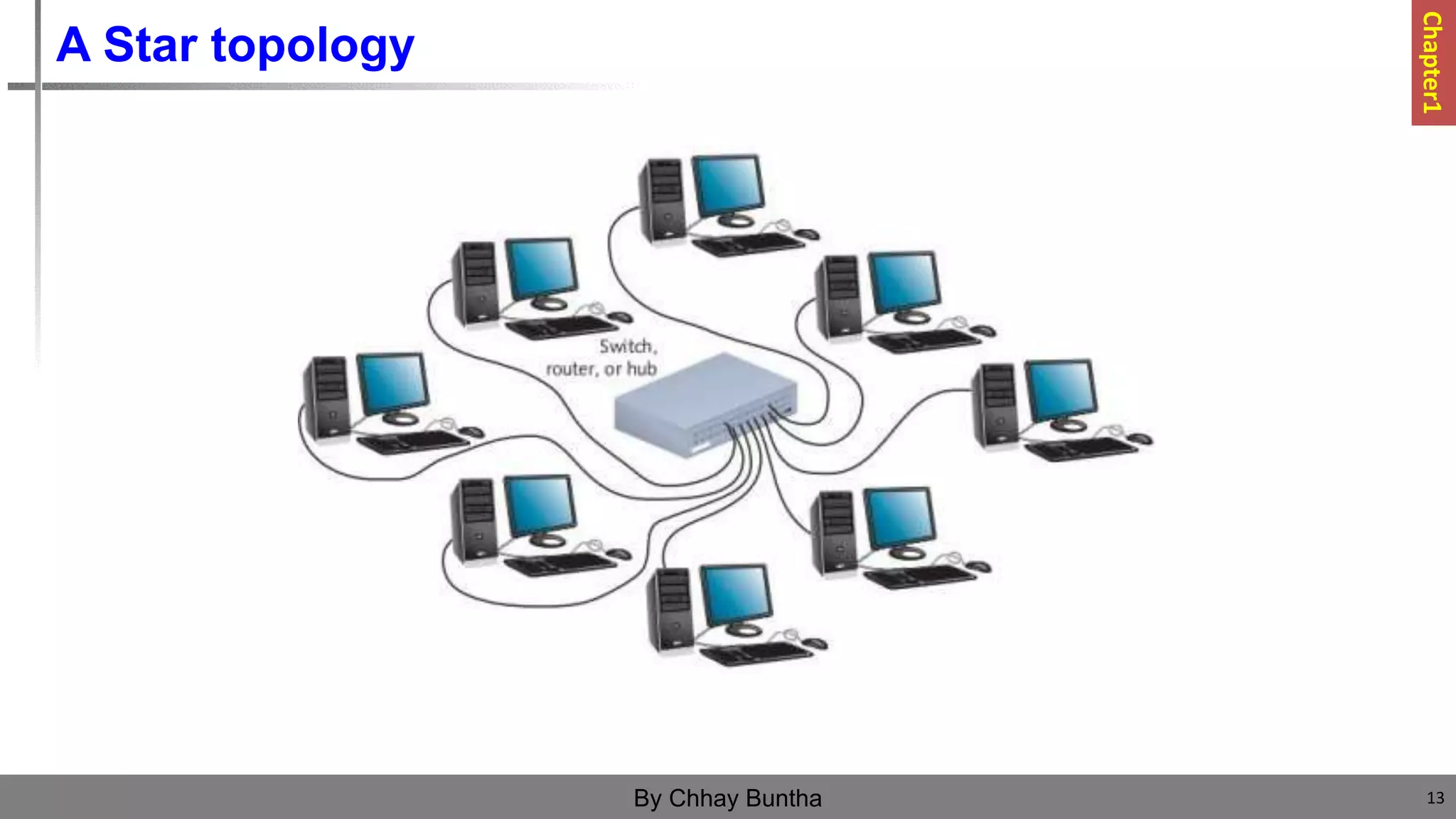
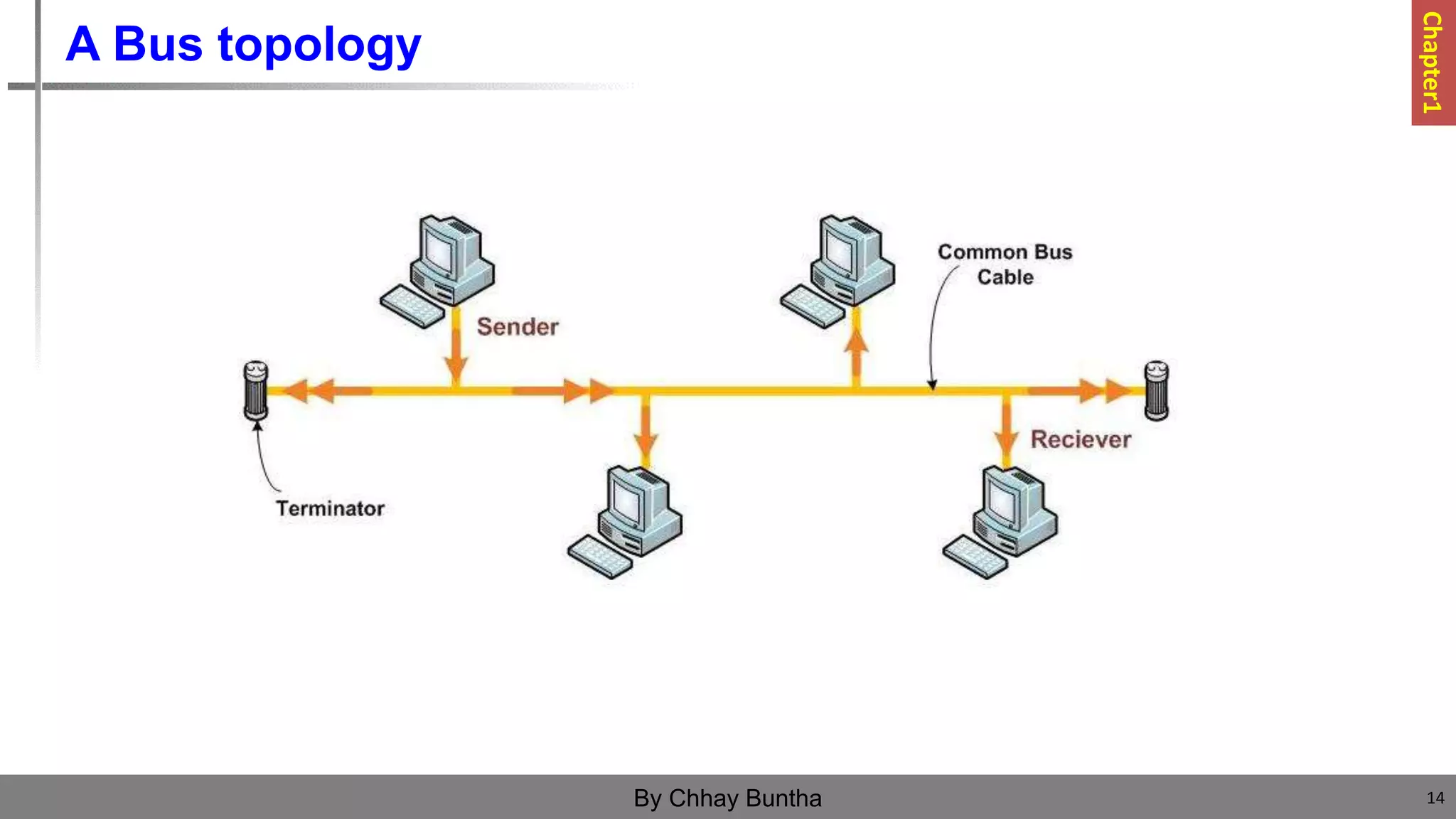
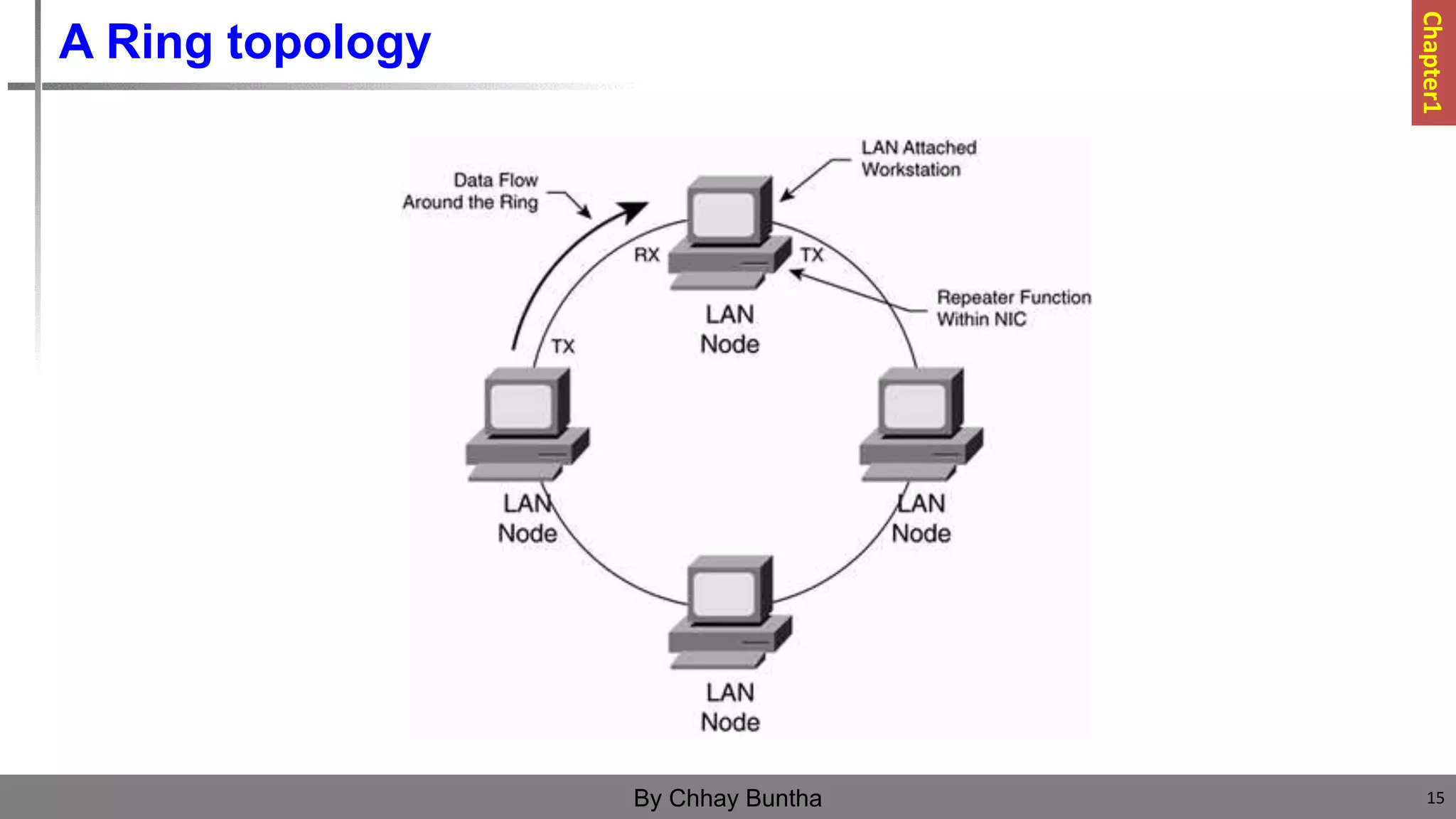
Network Topologies
Network topology is the study of the arrangement or mapping of the elements
(links, nodes, etc.) of a network, especially the physical (real) and logical (virtual)
interconnections between nodes.
11
By Chhay Buntha
Chapter1
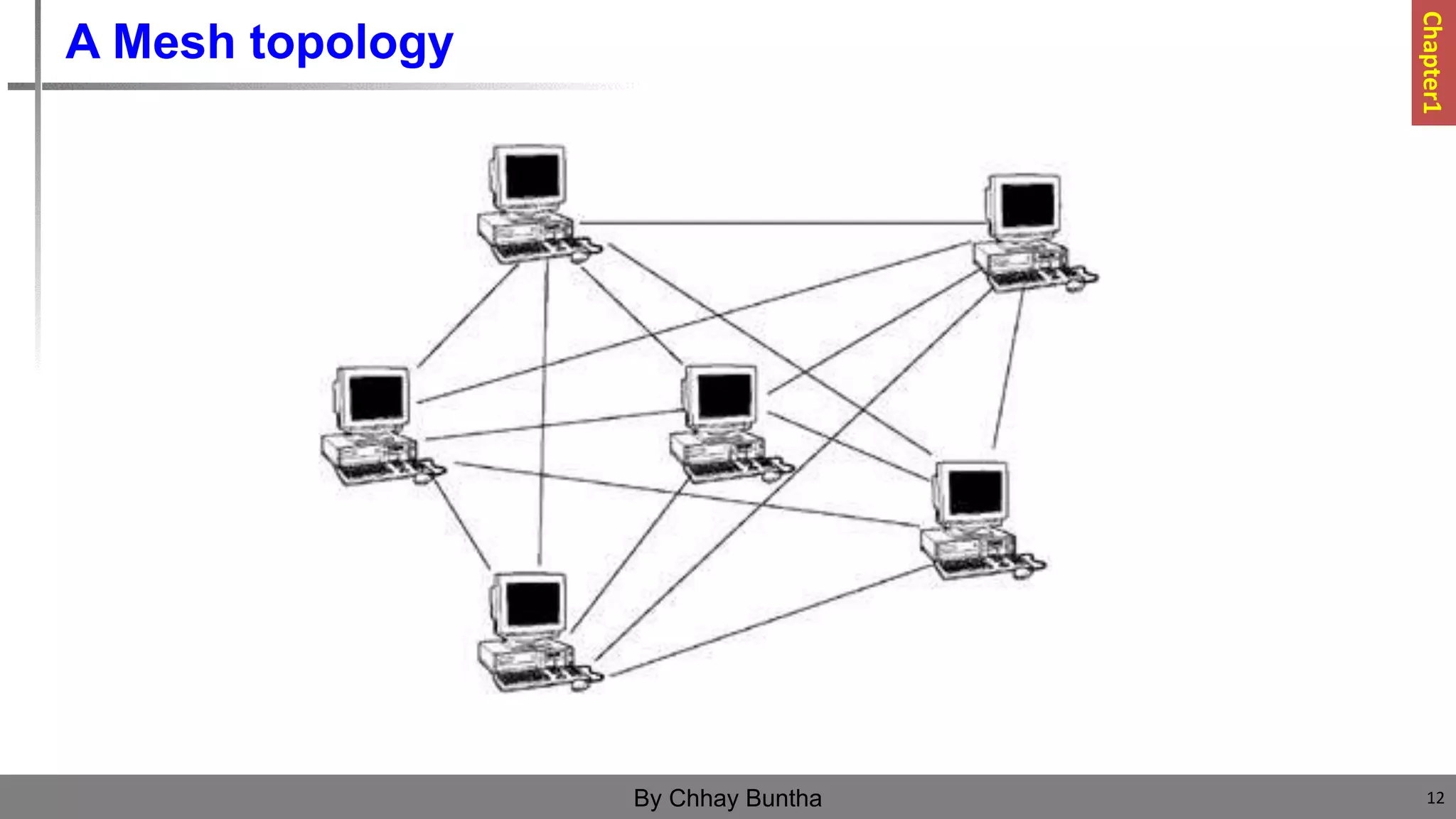
A Mesh topology
12
By Chhay Buntha
Chapter1
A Star topology
13
By Chhay Buntha
Chapter1
A Bus topology
14
By Chhay Buntha
Chapter1
A Ring topology
15
By Chhay Buntha
Chapter1
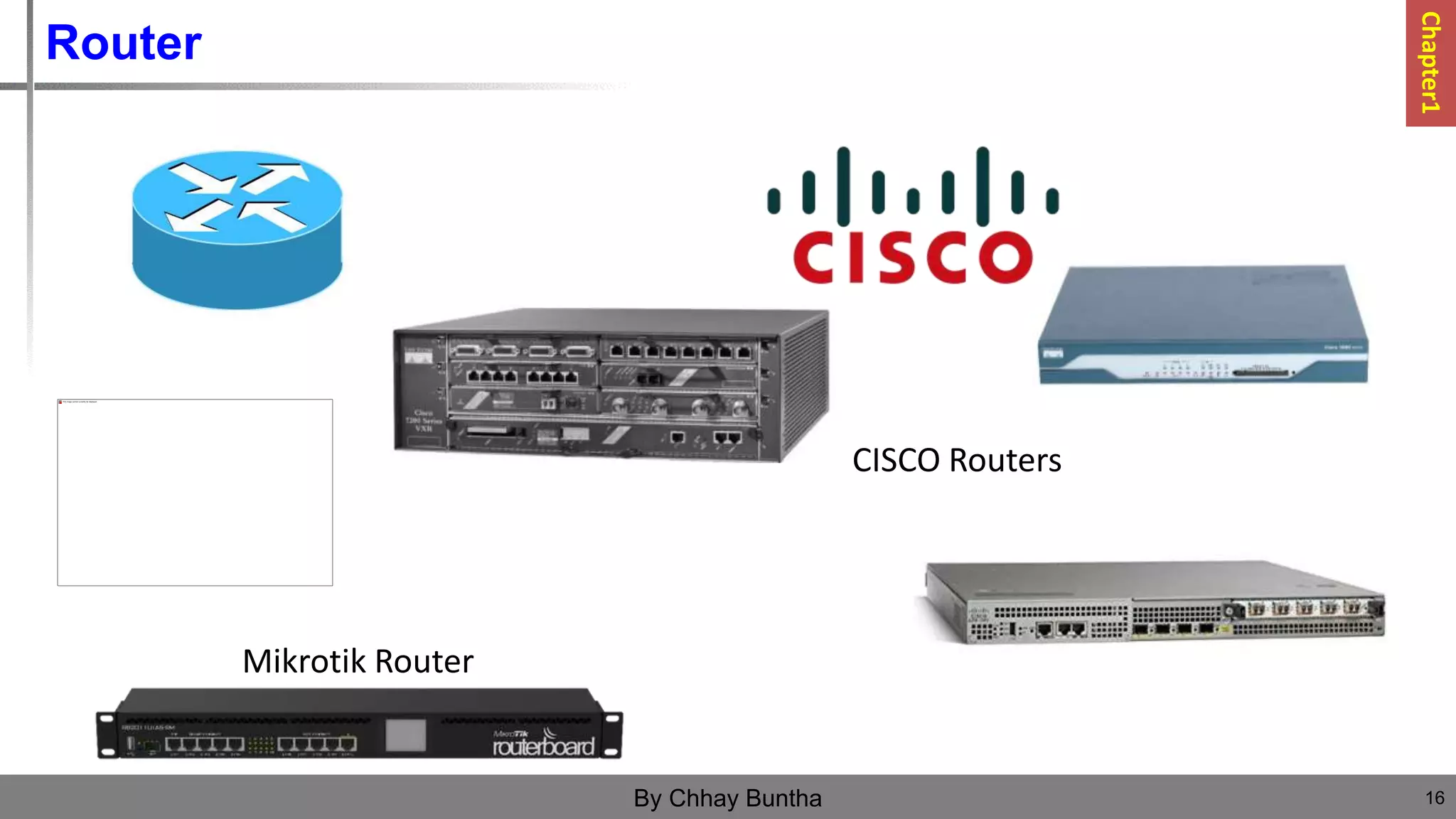
Router
16
By Chhay Buntha
Chapter1
CISCO Routers
Mikrotik Router
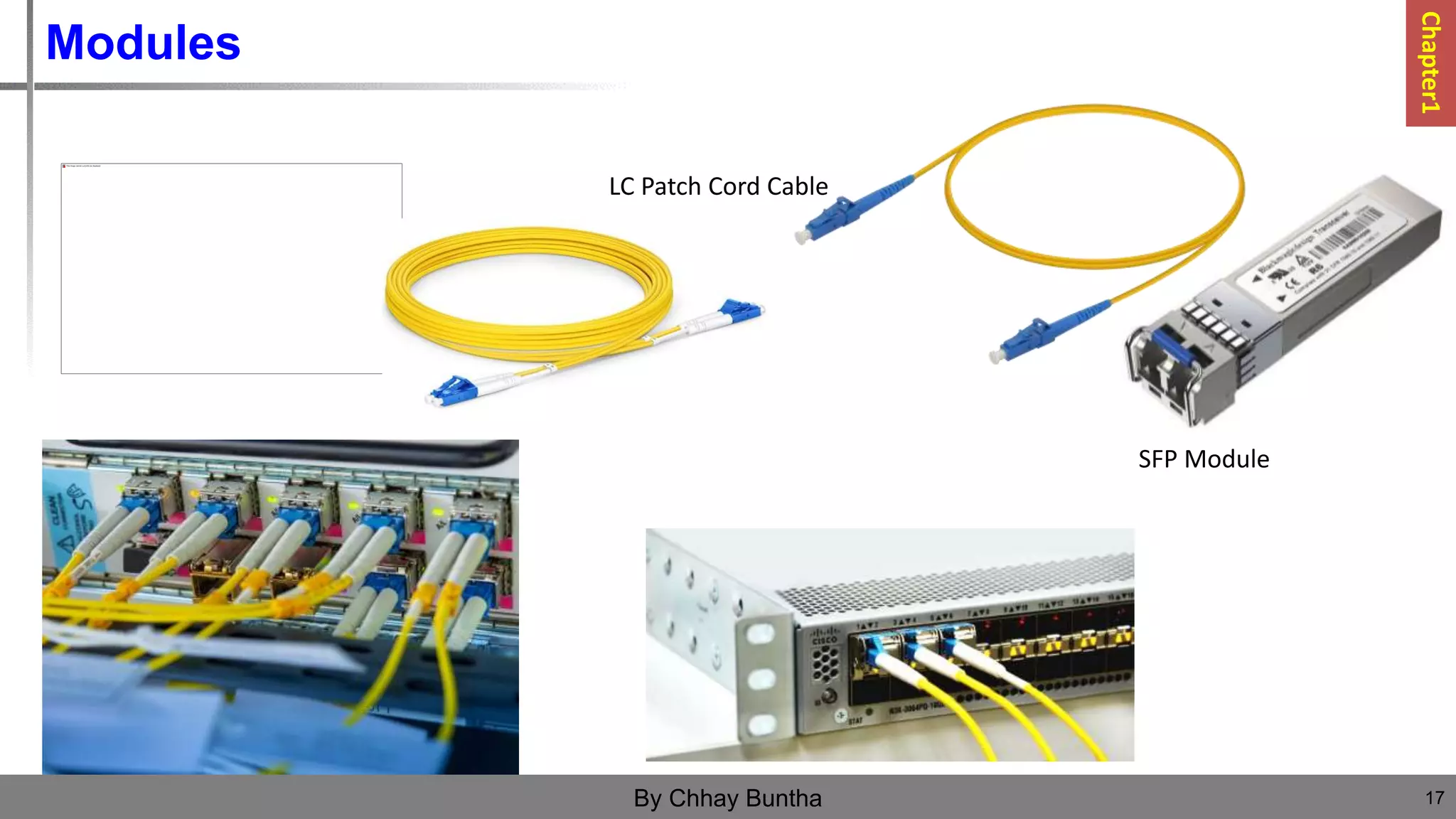
Modules
17
By Chhay Buntha
Chapter1
LC Patch Cord Cable
SFP Module
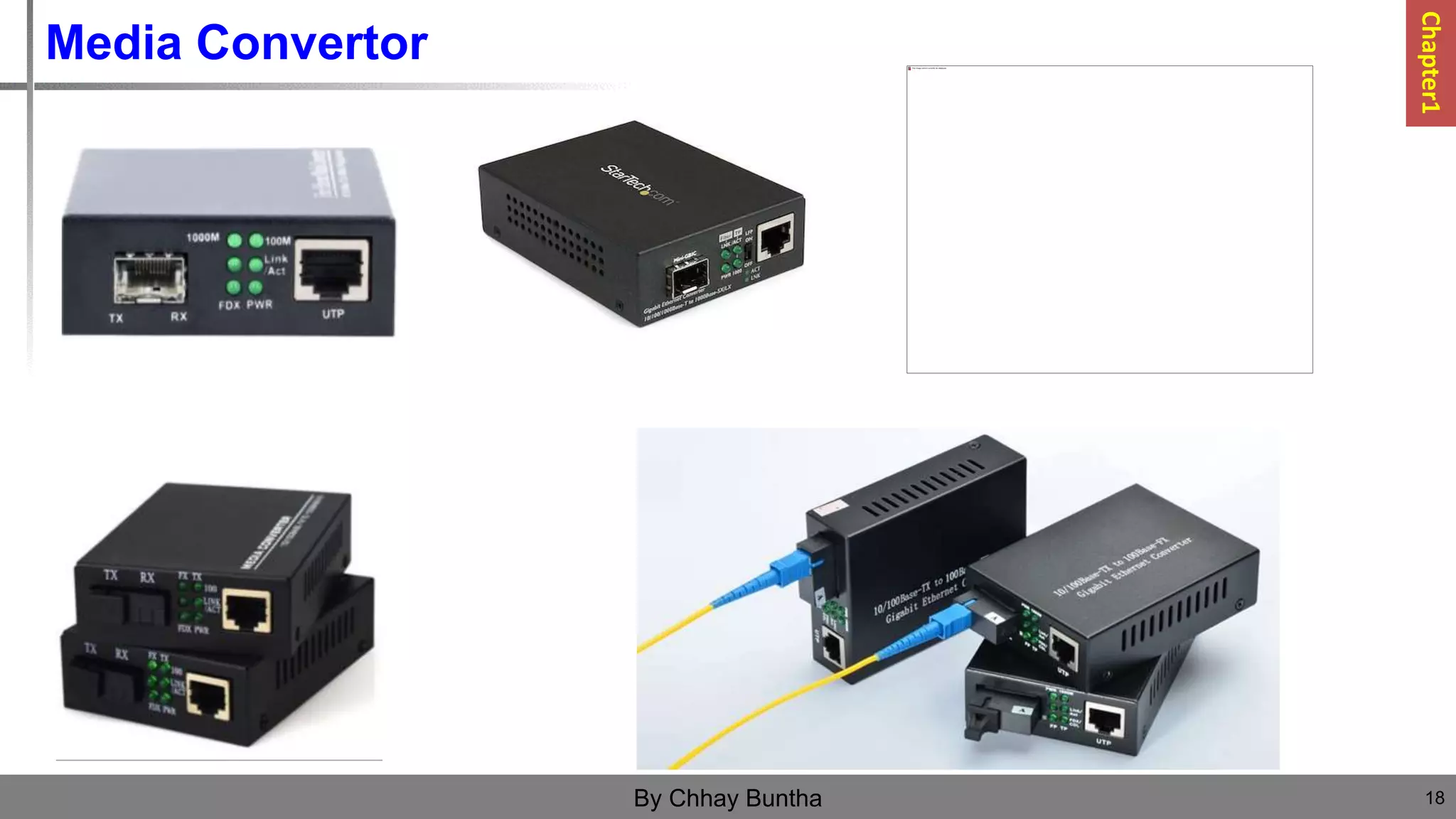
Media Convertor
18
By Chhay Buntha
Chapter1
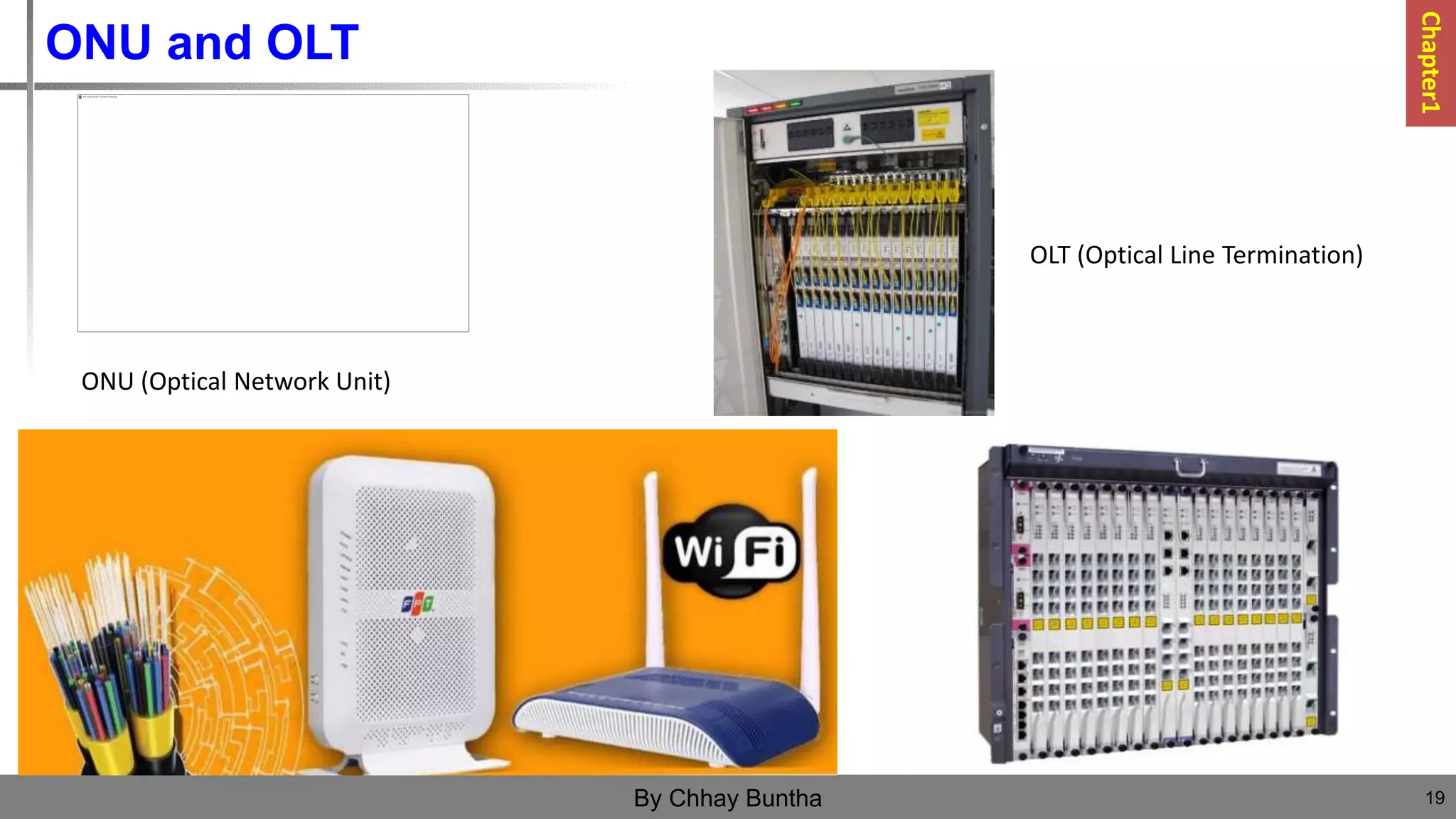
ONU and OLT
19
By Chhay Buntha
Chapter1
ONU (Optical Network Unit)
OLT (Optical Line Termination)
Networking Protocols
20
By Chhay Buntha
Chapter1
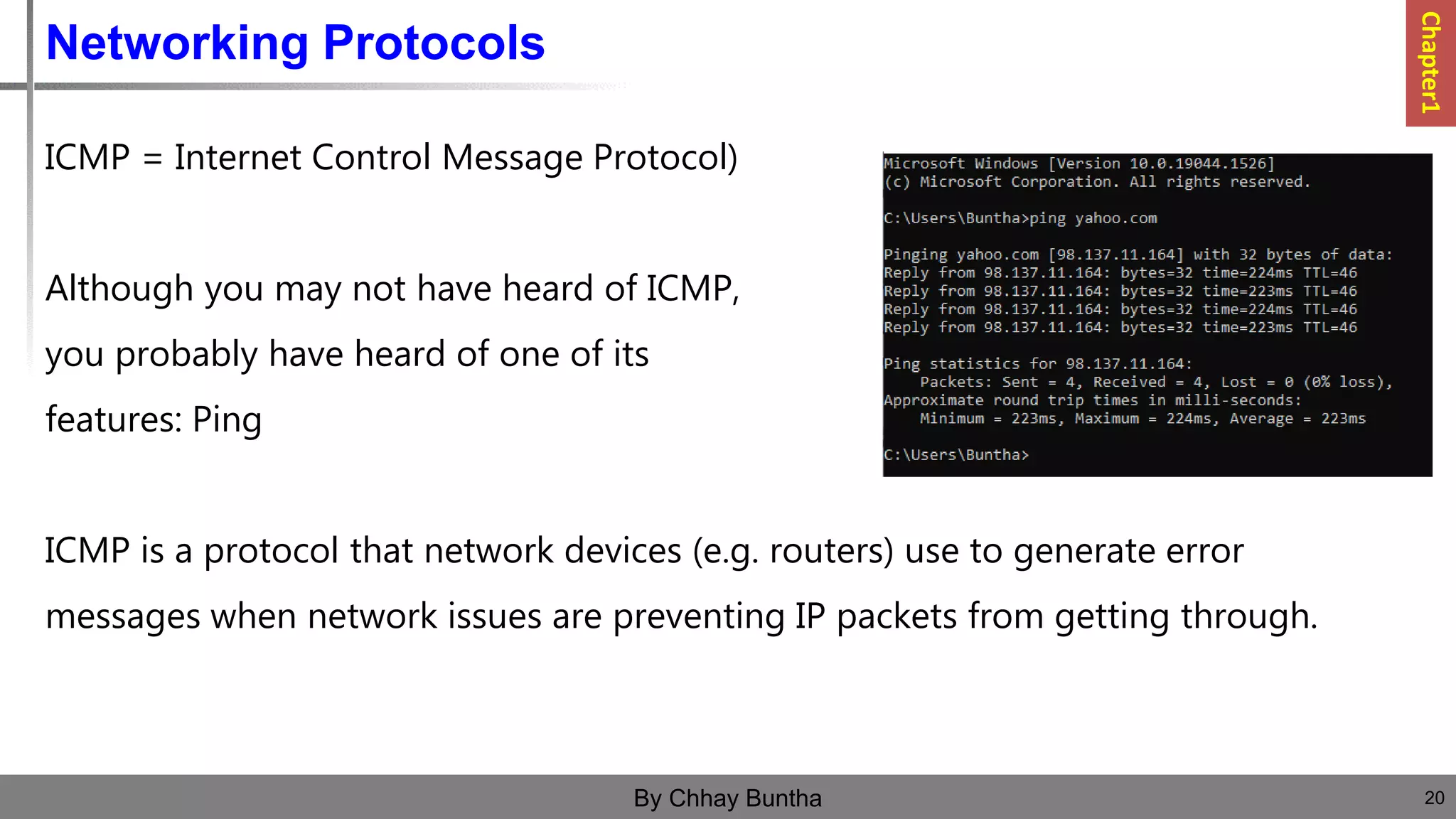
ICMP = Internet Control Message Protocol)
Although you may not have heard of ICMP,
you probably have heard of one of its
features: Ping
ICMP is a protocol that network devices (e.g. routers) use to generate error
messages when network issues are preventing IP packets from getting through.
Networking Protocols
21
By Chhay Buntha
Chapter1
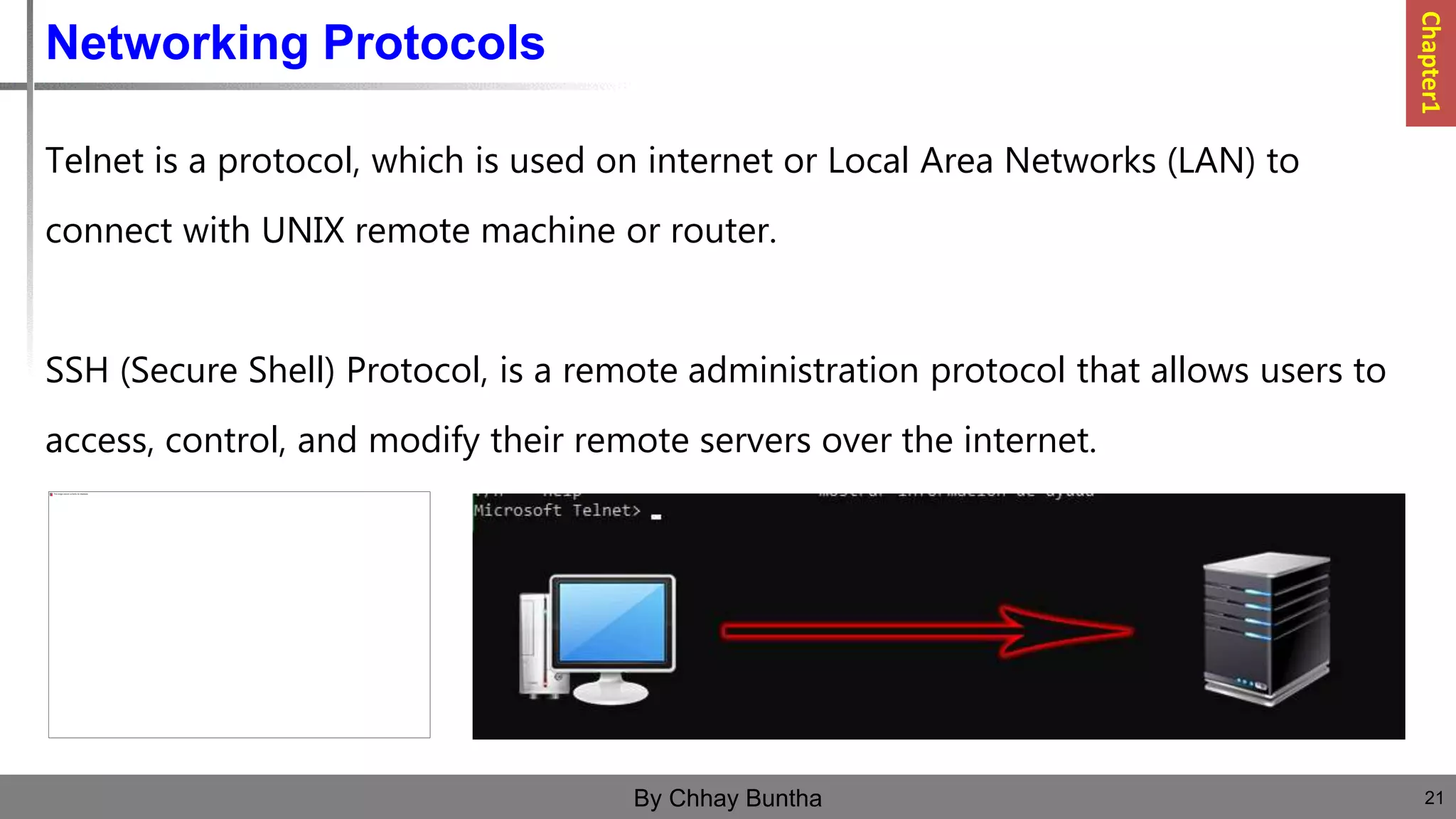
Telnet is a protocol, which is used on internet or Local Area Networks (LAN) to
connect with UNIX remote machine or router.
SSH (Secure Shell) Protocol, is a remote administration protocol that allows users to
access, control, and modify their remote servers over the internet.
End Devices
22
By Chhay Buntha
Chapter1
End Devices, refer to computer, wireless router, wireless access point, server, smart
devices
The Network
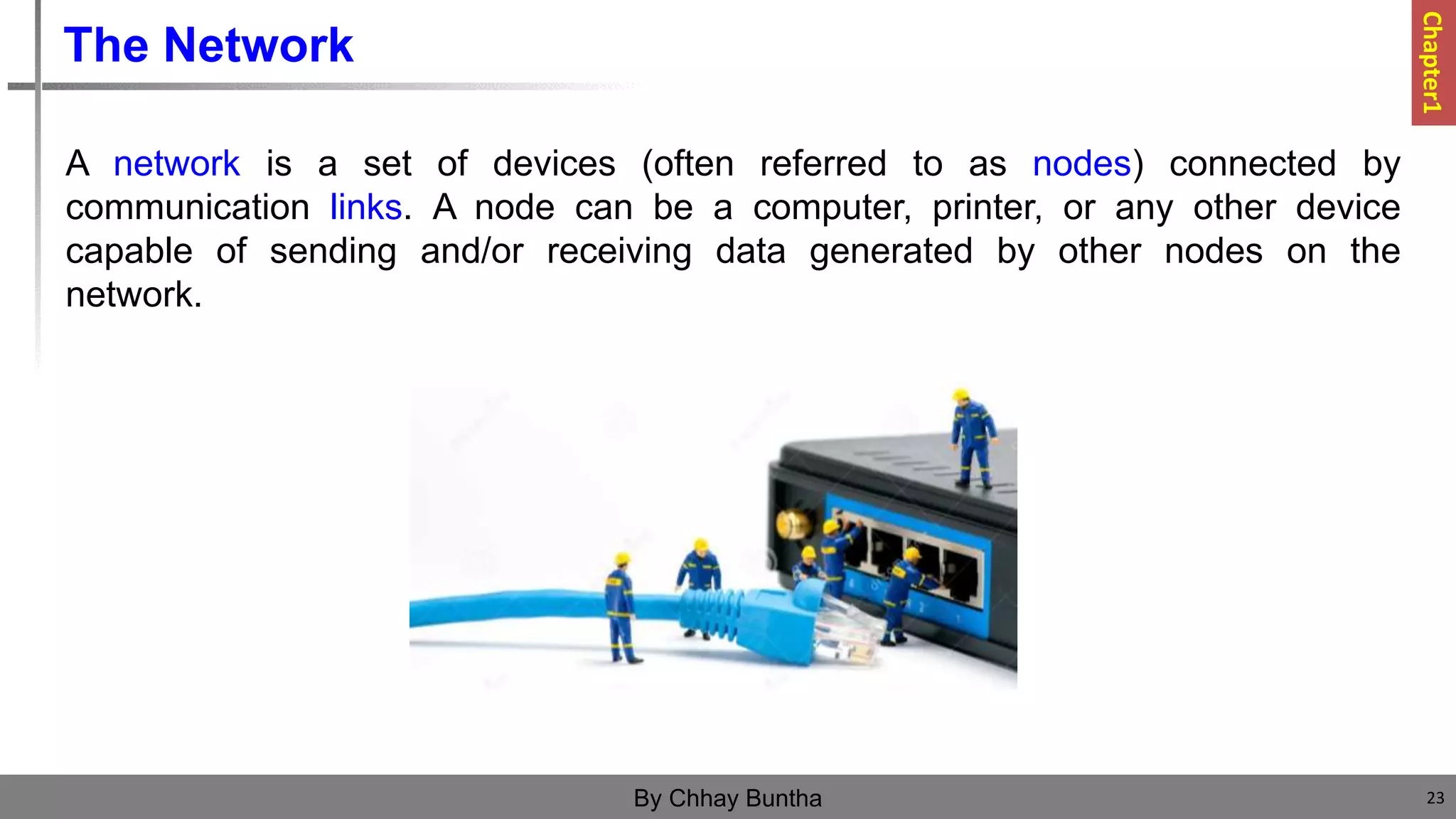
A network is a set of devices (often referred to as nodes) connected by
communication links. A node can be a computer, printer, or any other device
capable of sending and/or receiving data generated by other nodes on the
network.
23
By Chhay Buntha
Chapter1
The Internet
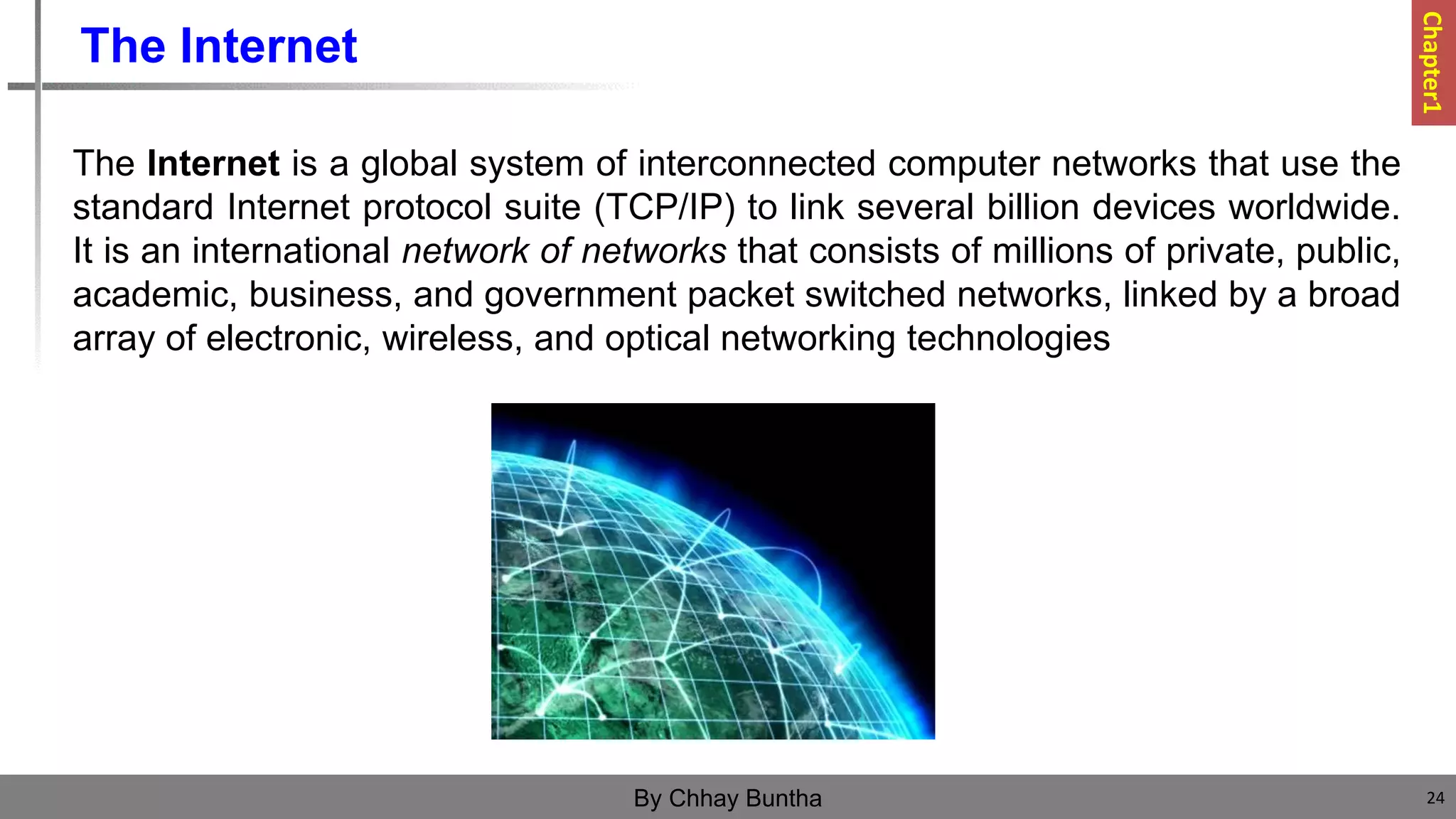
The Internet is a global system of interconnected computer networks that use the
standard Internet protocol suite (TCP/IP) to link several billion devices worldwide.
It is an international network of networks that consists of millions of private, public,
academic, business, and government packet switched networks, linked by a broad
array of electronic, wireless, and optical networking technologies
24
By Chhay Buntha
Chapter1
Chapter 01 Introduction to Network Components.pptx

Chapter 01 Introduction to Network Components.pptx

  • 1.
    Overview of NetworkComponents 1 By Chhay Buntha Chapter 1 Data Communications
  • 2.
    The word datarefers to information presented in whatever form is agreed upon by the parties creating and using the data. Data communications are the exchange of data between two devices via some form of transmission medium such as a wire cable or wireless. What is Data Communications? Chapter1 2 By Chhay Buntha
  • 3.
  • 4.
    Data Communications Components 1-Message or Data The Message is the information (data) to be communicated. It can consist of text, number, pictures, sound or video or any combination of these. 2- Sender The sender is the device that sends the data message. It can be a computer, workstation, telephone handset, video camera. And so on. 4 By Chhay Buntha Chapter1
  • 5.
    Data Communications Components 3-Medium The transmission medium is the physical path by which a message travels from sender to receiver. It can be twisted pair wire, coaxial cable, fiber optic or radio wave. 4- Receiver The received is the device that receives the message. It can be a computer, workstation, telephone handset, television, and so on 5- Protocol A protocol is a set of rules that govern data communication. It represents an agreement between the communicating devices. Without a protocol, two devices may be connected but not communicating 5 By Chhay Buntha Chapter1
  • 6.
    Transmission Mode (DataFlow) 6 By Chhay Buntha Chapter1
  • 7.
    Simplex Data in asimplex channel is always one way. Simplex channels are not often used because it is not possible to send back error or control signals to the transmit end. Ex: - Radio - TV 7 By Chhay Buntha Chapter1
  • 8.
    Half-Duplex A half-duplex channelcan send and receive, but not at the same time. it is only one end transmits at a time, the other end receives. Ex: - ICOM - Single way LAN 8 By Chhay Buntha Chapter1
  • 9.
    Full-Duplex Data can travelin both directions simultaneously. There is no need to switch from transmit to receive mode like in half duplex Ex: - Telephone - Two-way LAN 9 By Chhay Buntha Chapter1
  • 10.
    Type of Connections 10 ByChhay Buntha Chapter1
  • 11.
    Network Topologies Network topologyis the study of the arrangement or mapping of the elements (links, nodes, etc.) of a network, especially the physical (real) and logical (virtual) interconnections between nodes. 11 By Chhay Buntha Chapter1
  • 12.
    A Mesh topology 12 ByChhay Buntha Chapter1
  • 13.
    A Star topology 13 ByChhay Buntha Chapter1
  • 14.
    A Bus topology 14 ByChhay Buntha Chapter1
  • 15.
    A Ring topology 15 ByChhay Buntha Chapter1
  • 16.
  • 17.
    Modules 17 By Chhay Buntha Chapter1 LCPatch Cord Cable SFP Module
  • 18.
  • 19.
    ONU and OLT 19 ByChhay Buntha Chapter1 ONU (Optical Network Unit) OLT (Optical Line Termination)
  • 20.
    Networking Protocols 20 By ChhayBuntha Chapter1 ICMP = Internet Control Message Protocol) Although you may not have heard of ICMP, you probably have heard of one of its features: Ping ICMP is a protocol that network devices (e.g. routers) use to generate error messages when network issues are preventing IP packets from getting through.
  • 21.
    Networking Protocols 21 By ChhayBuntha Chapter1 Telnet is a protocol, which is used on internet or Local Area Networks (LAN) to connect with UNIX remote machine or router. SSH (Secure Shell) Protocol, is a remote administration protocol that allows users to access, control, and modify their remote servers over the internet.
  • 22.
    End Devices 22 By ChhayBuntha Chapter1 End Devices, refer to computer, wireless router, wireless access point, server, smart devices
  • 23.
    The Network A networkis a set of devices (often referred to as nodes) connected by communication links. A node can be a computer, printer, or any other device capable of sending and/or receiving data generated by other nodes on the network. 23 By Chhay Buntha Chapter1
  • 24.
    The Internet The Internetis a global system of interconnected computer networks that use the standard Internet protocol suite (TCP/IP) to link several billion devices worldwide. It is an international network of networks that consists of millions of private, public, academic, business, and government packet switched networks, linked by a broad array of electronic, wireless, and optical networking technologies 24 By Chhay Buntha Chapter1