Assembly Language for x86 Processors
7th Edition
7th Edition
Chapter 3: Assembly Language
Fundamentals
Kip Irvine
Irvine, Kip R. Assembly Language for x86 Processors 7/e, 2015.
2
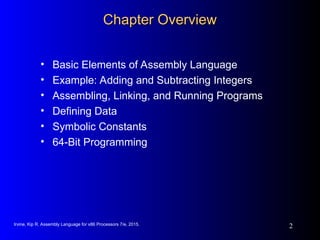
Chapter Overview
Chapter Overview
• Basic Elements of Assembly Language
• Example: Adding and Subtracting Integers
• Assembling, Linking, and Running Programs
• Defining Data
• Symbolic Constants
• 64-Bit Programming
Irvine, Kip R. Assembly Language for x86 Processors 7/e, 2015.
3
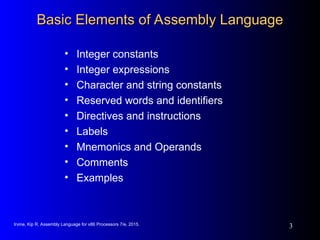
Basic Elements of Assembly Language
• Integer constants
• Integer expressions
• Character and string constants
• Reserved words and identifiers
• Directives and instructions
• Labels
• Mnemonics and Operands
• Comments
• Examples
Irvine, Kip R. Assembly Language for x86 Processors 7/e, 2015.
4
Integer Constants
Integer Constants
• Optional leading + or – sign
• binary, decimal, hexadecimal, or octal digits
• Common radix characters:
• h – hexadecimal
• d – decimal
• b – binary
• r – encoded real
Examples: 30d, 6Ah, 42, 1101b
Hexadecimal beginning with letter: 0A5h
Irvine, Kip R. Assembly Language for x86 Processors 7/e, 2015.
5
Integer Expressions
Integer Expressions
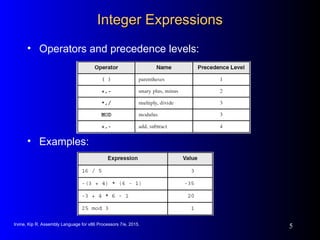
• Operators and precedence levels:
• Examples:
Irvine, Kip R. Assembly Language for x86 Processors 7/e, 2015.
6
Character and String Constants
• Enclose character in single or double quotes
• 'A', "x"
• ASCII character = 1 byte
• Enclose strings in single or double quotes
• "ABC"
• 'xyz'
• Each character occupies a single byte
• Embedded quotes:
• 'Say "Goodnight," Gracie'
Irvine, Kip R. Assembly Language for x86 Processors 7/e, 2015.
7
Reserved Words and Identifiers
• Reserved words cannot be used as identifiers
• Instruction mnemonics, directives, type attributes,
operators, predefined symbols
• See MASM reference in Appendix A
• Microsoft Macro Assembler Reference
• Identifiers
• 1-247 characters, including digits
• not case sensitive
• first character must be a letter, _, @, ?, or $
Irvine, Kip R. Assembly Language for x86 Processors 7/e, 2015.
8
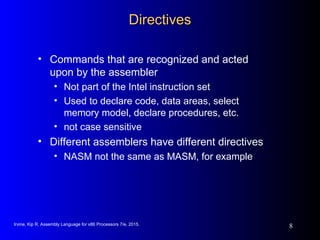
Directives
Directives
• Commands that are recognized and acted
upon by the assembler
• Not part of the Intel instruction set
• Used to declare code, data areas, select
memory model, declare procedures, etc.
• not case sensitive
• Different assemblers have different directives
• NASM not the same as MASM, for example
Irvine, Kip R. Assembly Language for x86 Processors 6/e, 2010.
9
Instructions
Instructions
• Assembled into machine code by assembler
• Executed at runtime by the CPU
• We use the Intel IA-32 instruction set
• An instruction contains:
• Label (optional)
• Mnemonic (required)
• Operand (depends on the instruction)
• Comment (optional)
[Label:] Mnemonic Operand(s) [; Comment]
Irvine, Kip R. Assembly Language for x86 Processors 7/e, 2015.
10
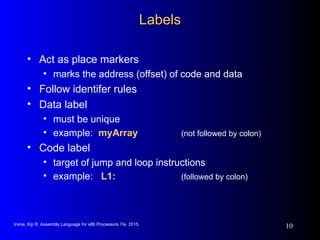
Labels
Labels
• Act as place markers
• marks the address (offset) of code and data
• Follow identifer rules
• Data label
• must be unique
• example: myArray (not followed by colon)
• Code label
• target of jump and loop instructions
• example: L1: (followed by colon)

chap3intro.ppt(assembly language fundamentals)

  • 1.
    Assembly Language forx86 Processors Assembly Language for x86 Processors 7th Edition 7th Edition Chapter 3: Assembly Language Fundamentals Kip Irvine
  • 2.
    Irvine, Kip R.Assembly Language for x86 Processors 7/e, 2015. 2 Chapter Overview Chapter Overview • Basic Elements of Assembly Language • Example: Adding and Subtracting Integers • Assembling, Linking, and Running Programs • Defining Data • Symbolic Constants • 64-Bit Programming
  • 3.
    Irvine, Kip R.Assembly Language for x86 Processors 7/e, 2015. 3 Basic Elements of Assembly Language Basic Elements of Assembly Language • Integer constants • Integer expressions • Character and string constants • Reserved words and identifiers • Directives and instructions • Labels • Mnemonics and Operands • Comments • Examples
  • 4.
    Irvine, Kip R.Assembly Language for x86 Processors 7/e, 2015. 4 Integer Constants Integer Constants • Optional leading + or – sign • binary, decimal, hexadecimal, or octal digits • Common radix characters: • h – hexadecimal • d – decimal • b – binary • r – encoded real Examples: 30d, 6Ah, 42, 1101b Hexadecimal beginning with letter: 0A5h
  • 5.
    Irvine, Kip R.Assembly Language for x86 Processors 7/e, 2015. 5 Integer Expressions Integer Expressions • Operators and precedence levels: • Examples:
  • 6.
    Irvine, Kip R.Assembly Language for x86 Processors 7/e, 2015. 6 Character and String Constants Character and String Constants • Enclose character in single or double quotes • 'A', "x" • ASCII character = 1 byte • Enclose strings in single or double quotes • "ABC" • 'xyz' • Each character occupies a single byte • Embedded quotes: • 'Say "Goodnight," Gracie'
  • 7.
    Irvine, Kip R.Assembly Language for x86 Processors 7/e, 2015. 7 Reserved Words and Identifiers Reserved Words and Identifiers • Reserved words cannot be used as identifiers • Instruction mnemonics, directives, type attributes, operators, predefined symbols • See MASM reference in Appendix A • Microsoft Macro Assembler Reference • Identifiers • 1-247 characters, including digits • not case sensitive • first character must be a letter, _, @, ?, or $
  • 8.
    Irvine, Kip R.Assembly Language for x86 Processors 7/e, 2015. 8 Directives Directives • Commands that are recognized and acted upon by the assembler • Not part of the Intel instruction set • Used to declare code, data areas, select memory model, declare procedures, etc. • not case sensitive • Different assemblers have different directives • NASM not the same as MASM, for example
  • 9.
    Irvine, Kip R.Assembly Language for x86 Processors 6/e, 2010. 9 Instructions Instructions • Assembled into machine code by assembler • Executed at runtime by the CPU • We use the Intel IA-32 instruction set • An instruction contains: • Label (optional) • Mnemonic (required) • Operand (depends on the instruction) • Comment (optional) [Label:] Mnemonic Operand(s) [; Comment]
  • 10.
    Irvine, Kip R.Assembly Language for x86 Processors 7/e, 2015. 10 Labels Labels • Act as place markers • marks the address (offset) of code and data • Follow identifer rules • Data label • must be unique • example: myArray (not followed by colon) • Code label • target of jump and loop instructions • example: L1: (followed by colon)