Engineering Internet QoS
QoS Fundamentals
Engineering Internet QoS
QoS Framework
Static Functions
o Traffic and QoS specifications (traffic types/parameters)
o QoS negotiation and signalling
o Admission control
o Resource reservation
Dynamic Functions
o Traffic shaping and policing
o Queuing and scheduling (later)
o Congestion control (later)
Engineering Internet QoS
Traffic Source Types
CBR (Constant Bit Rate) : transmits traffic at a
fixed rate, such as 64 Kbps voice
VBR (Variable Bit Rate) : traffic rate is not fixed;
sometimes high, sometimes low, such as MPEG
coded video
Engineering Internet QoS
Traffic Parameters
Different flows have different traffic patterns
A given traffic pattern can be described using
several traffic parameters
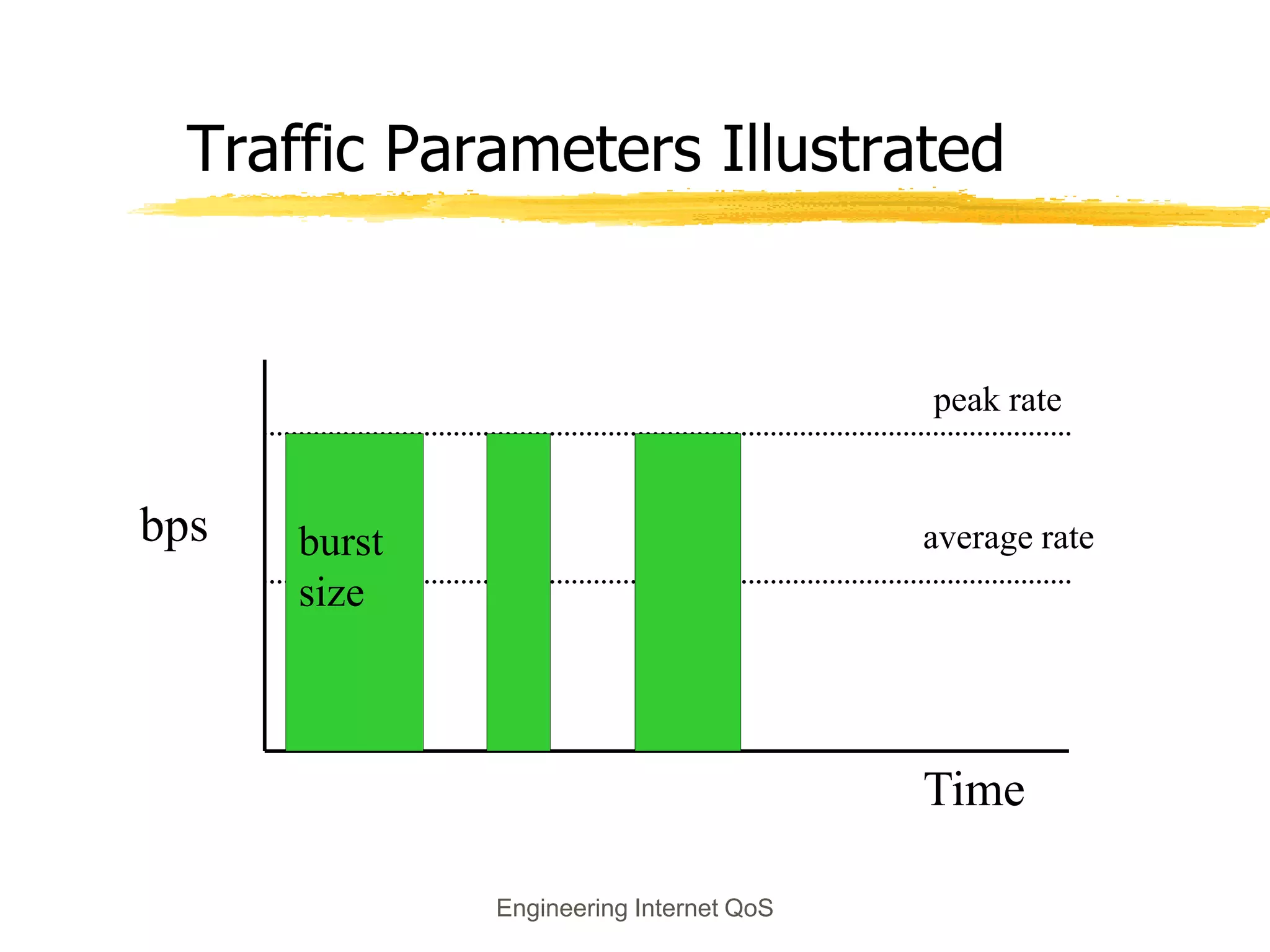
Peak rate : maximum rate in any time interval CBR traffic
can be completely described using the peak rate of the
traffic.
Average rate : long term average mean of the traffic
rate for a VBR source.
Burst size : refers to the number of packets that can be
delivered in the peak rate.
Engineering Internet QoS
Traffic Parameters Illustrated
peak rate
average rate
burst
size
Time
bps
Engineering Internet QoS
Traffic Patterns
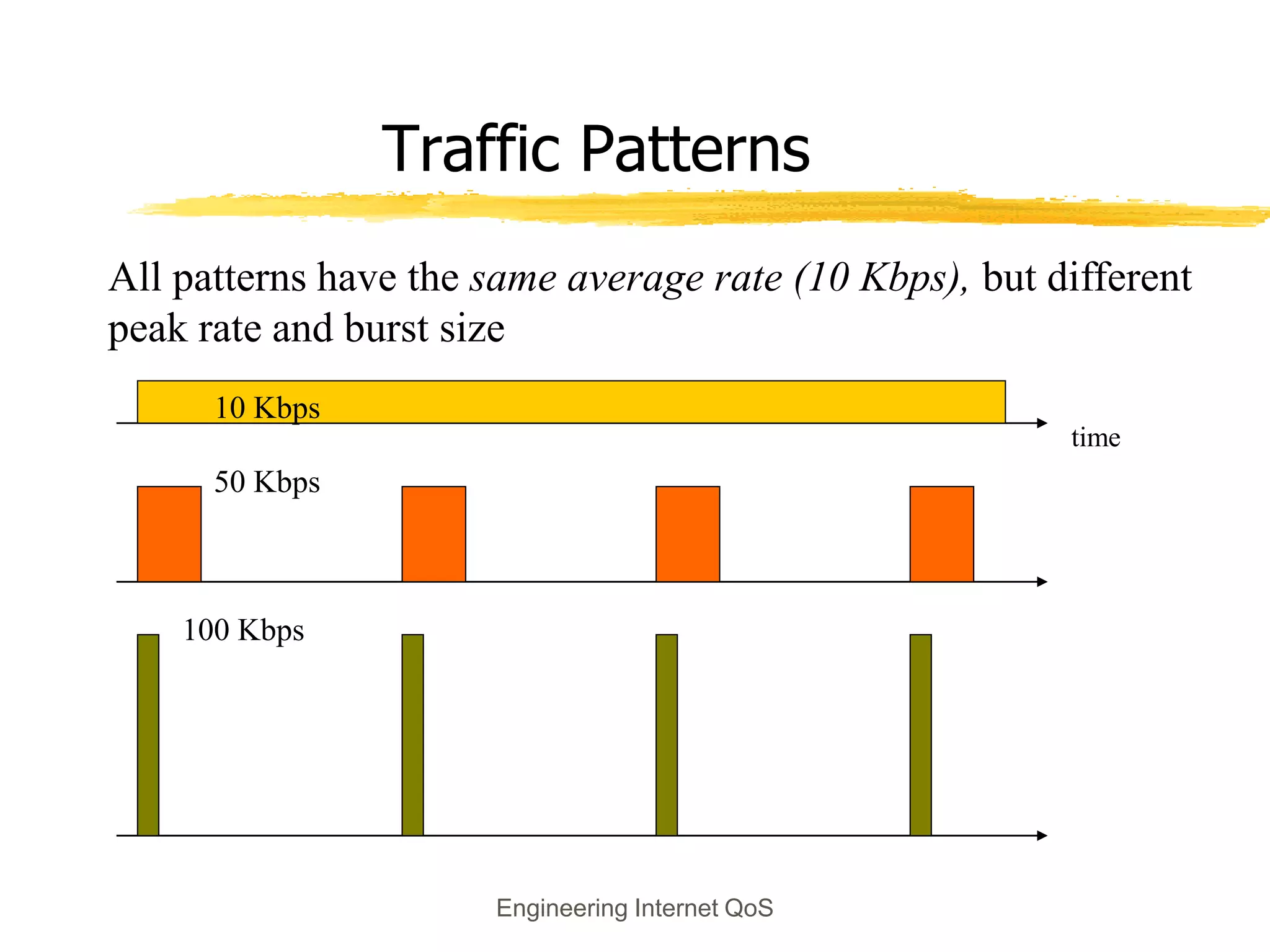
All patterns have the same average rate (10 Kbps), but different
peak rate and burst size
time
100 Kbps
50 Kbps
10 Kbps
Engineering Internet QoS
QoS Parameters
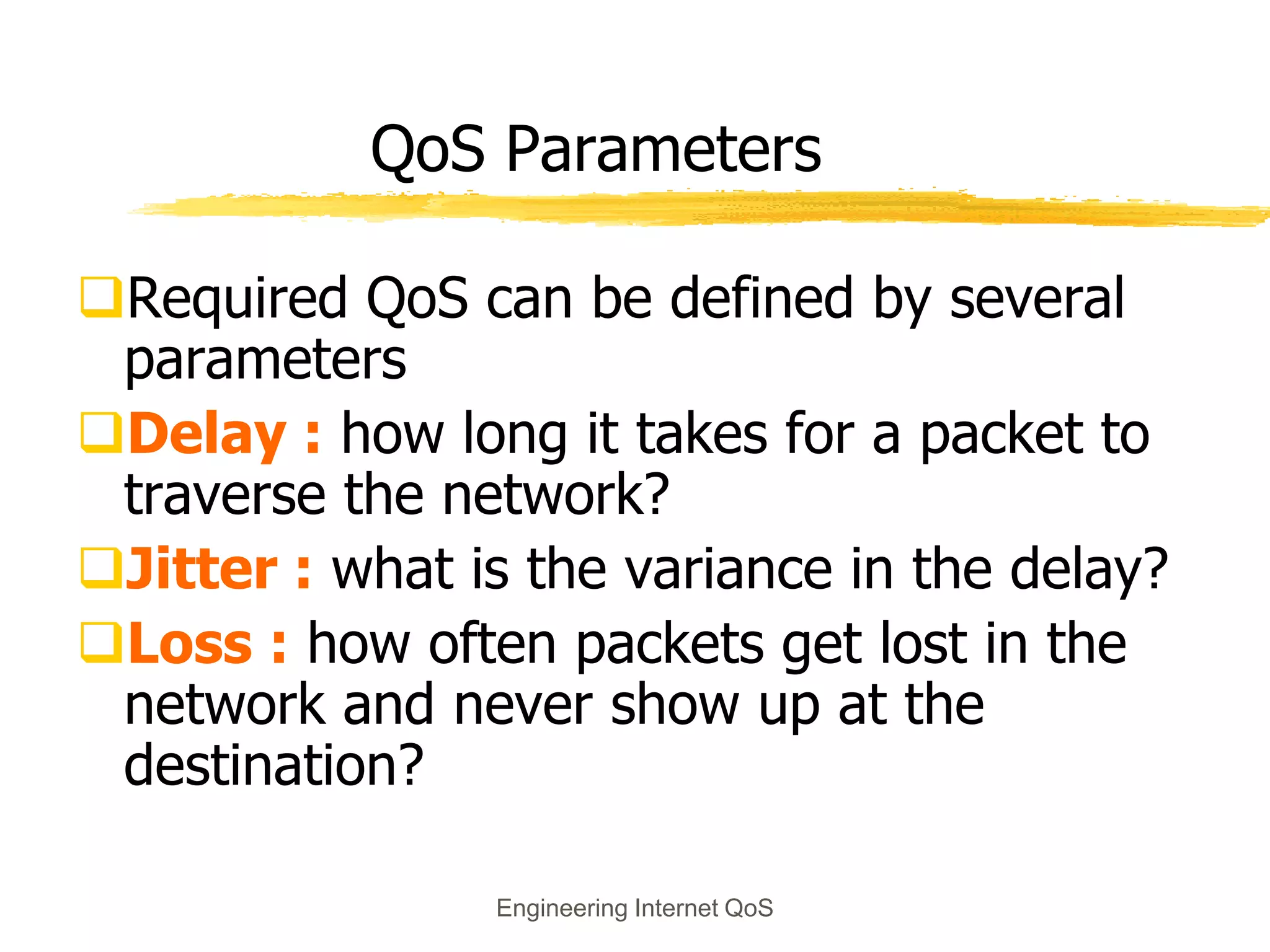
Required QoS can be defined by several
parameters
Delay : how long it takes for a packet to
traverse the network?
Jitter : what is the variance in the delay?
Loss : how often packets get lost in the
network and never show up at the
destination?
Engineering Internet QoS
 QoS guarantee. The user will precisely know what
QoS guarantee it is going to get from the network
Quality monitoring. The user and the network can
monitor the quality of a call against the set of QoS
parameters.
Charging. For example, a contract with a delay limit of
10 ms could be charged higher than the one with a
delay limit of 100 ms.
Engineering Internet QoS
A well-specified QoS contract yields the following benefits:
Engineering Internet QoS
Signalling
 Signalling is a mechanism used by the users to
communicate QoS related information to the network
 Static Configuration. Relevant table entries are created
manually
 Dynamic Negotiation. QoS configurations are
accomplished automatically using
 software.
 Using signalling
o User conveys its traffic parameters and QoS
requirements to the network
o Network conveys any QoS guarantees to the user
Engineering Internet QoS
Resource Reservation
To guarantee any QoS, network resources
must be reserved in advance
Types of network resources
o link Bandwidth
o Buffer space
Reservation could be dynamic, using
signalling, or static (manual)
Engineering Internet QoS
Admission Control
 First line of defence against attacks on QoS
 Network should not commit any guarantee if available
resources are not enough to maintain requested QoS
 Admission control functions must examine both traffic
and QoS parameters carefully before accepting or
rejecting a new request for QoS
 Implementation
o Dynamic : using signalling protocol/software
o Static : manual process (no signalling required)
Engineering Internet QoS
How Much to Reserve?
Easy for Constant bit rate sources
o Reserve at the peak rate
Difficult for VBR sources
o Peak rate reservation wastes bandwidth (no
statistical gain)
o Average rate reservation may cause excessive
packet delays
Engineering Internet QoS
Traffic Policing
Users violating the traffic contract can
jeopardise the QoS of other connections
The network must protect well behaving users
against such traffic violations
All entering traffic is therefore subject to
policing
Policing functions are deployed at the edge
(entry) of the network
Engineering Internet QoS
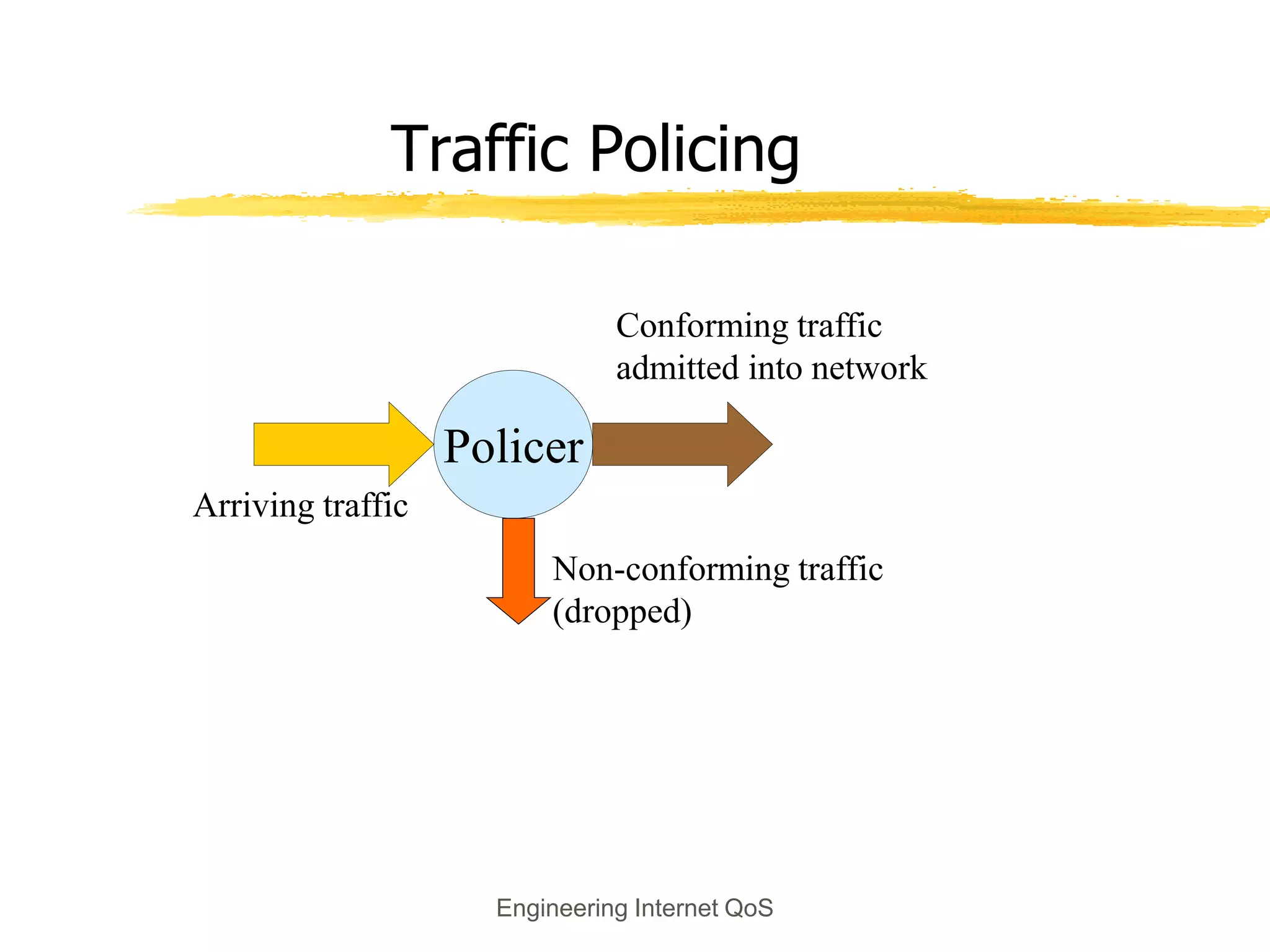
Traffic Policing
Policer
Arriving traffic
Conforming traffic
admitted into network
Non-conforming traffic
(dropped)
Engineering Internet QoS
Requirements for Policing Mechanisms
1. It must operate in real-time and should not cause
any additional delay for the admitted packets
2. It must not discard or decrease the priority of
packets that do not violate the negotiated contract
3. negotiated contract Easy and simple (not complex)
to implement
4. It must detect every packet that violates the
contract and take appropriate actions (drop or
decrease the priority).
Engineering Internet QoS
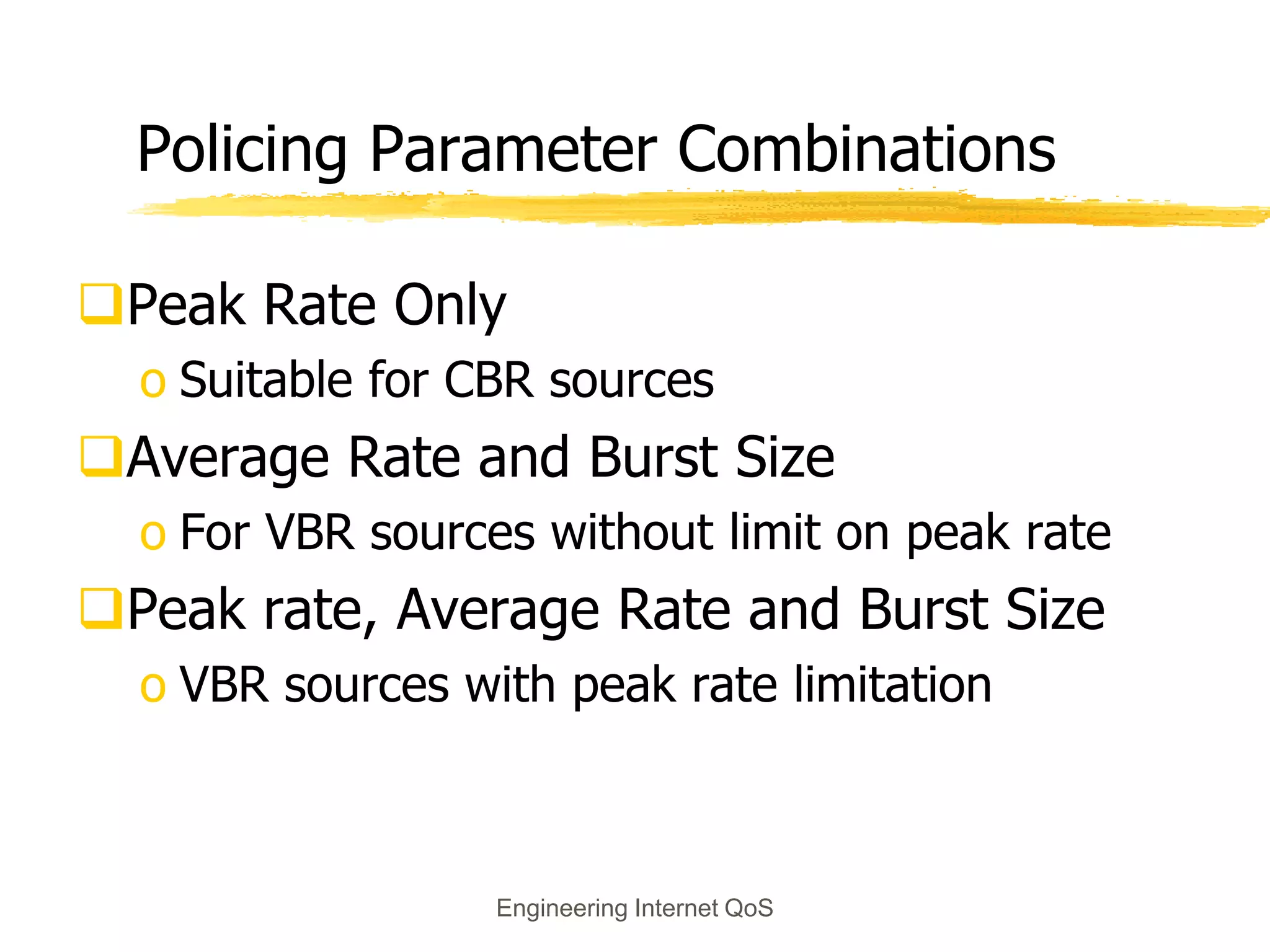
Policing Parameter Combinations
Peak Rate Only
o Suitable for CBR sources
Average Rate and Burst Size
o For VBR sources without limit on peak rate
Peak rate, Average Rate and Burst Size
o VBR sources with peak rate limitation
Engineering Internet QoS
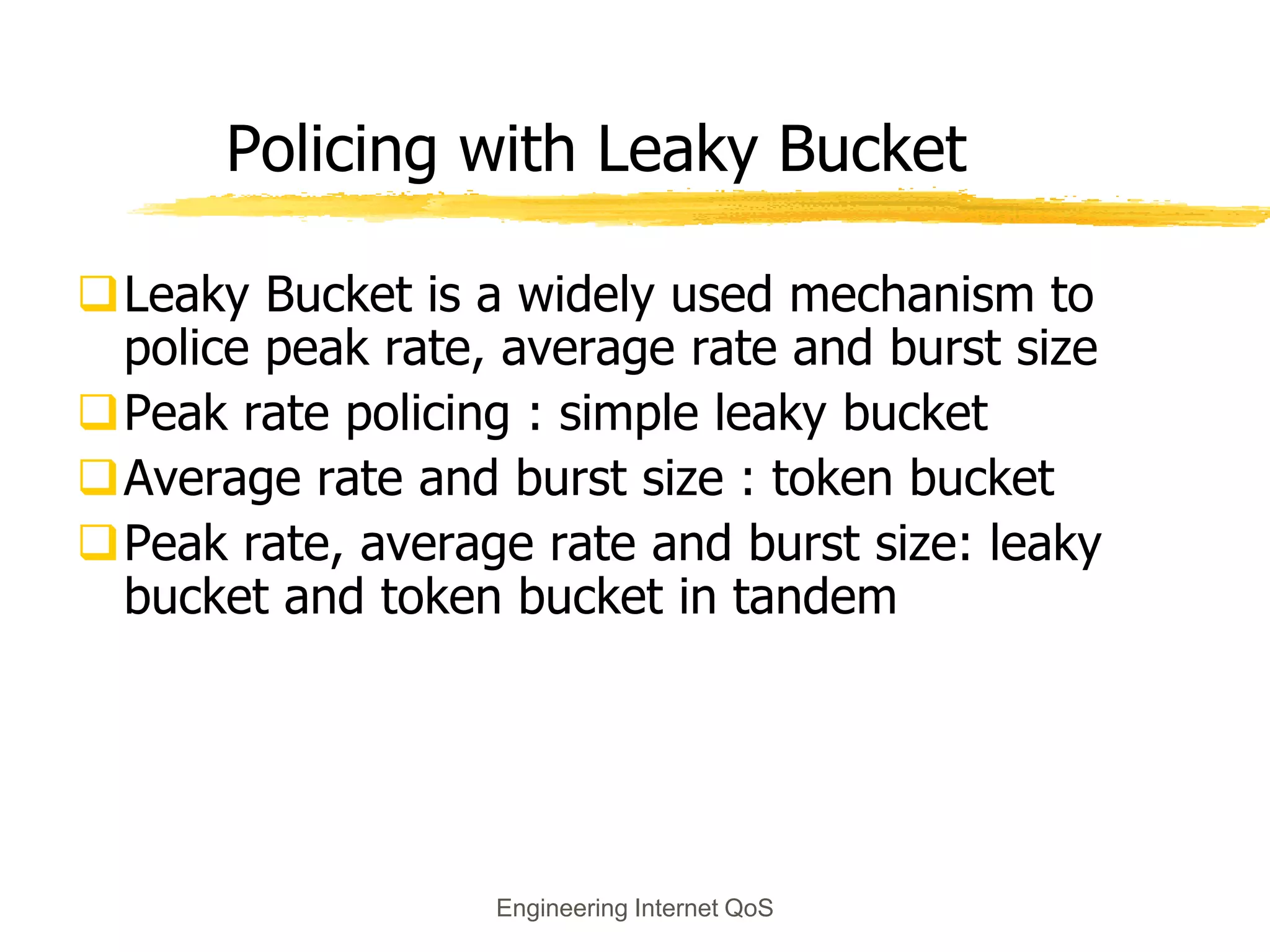
Policing with Leaky Bucket
Leaky Bucket is a widely used mechanism to
police peak rate, average rate and burst size
Peak rate policing : simple leaky bucket
Average rate and burst size : token bucket
Peak rate, average rate and burst size: leaky
bucket and token bucket in tandem
Engineering Internet QoS
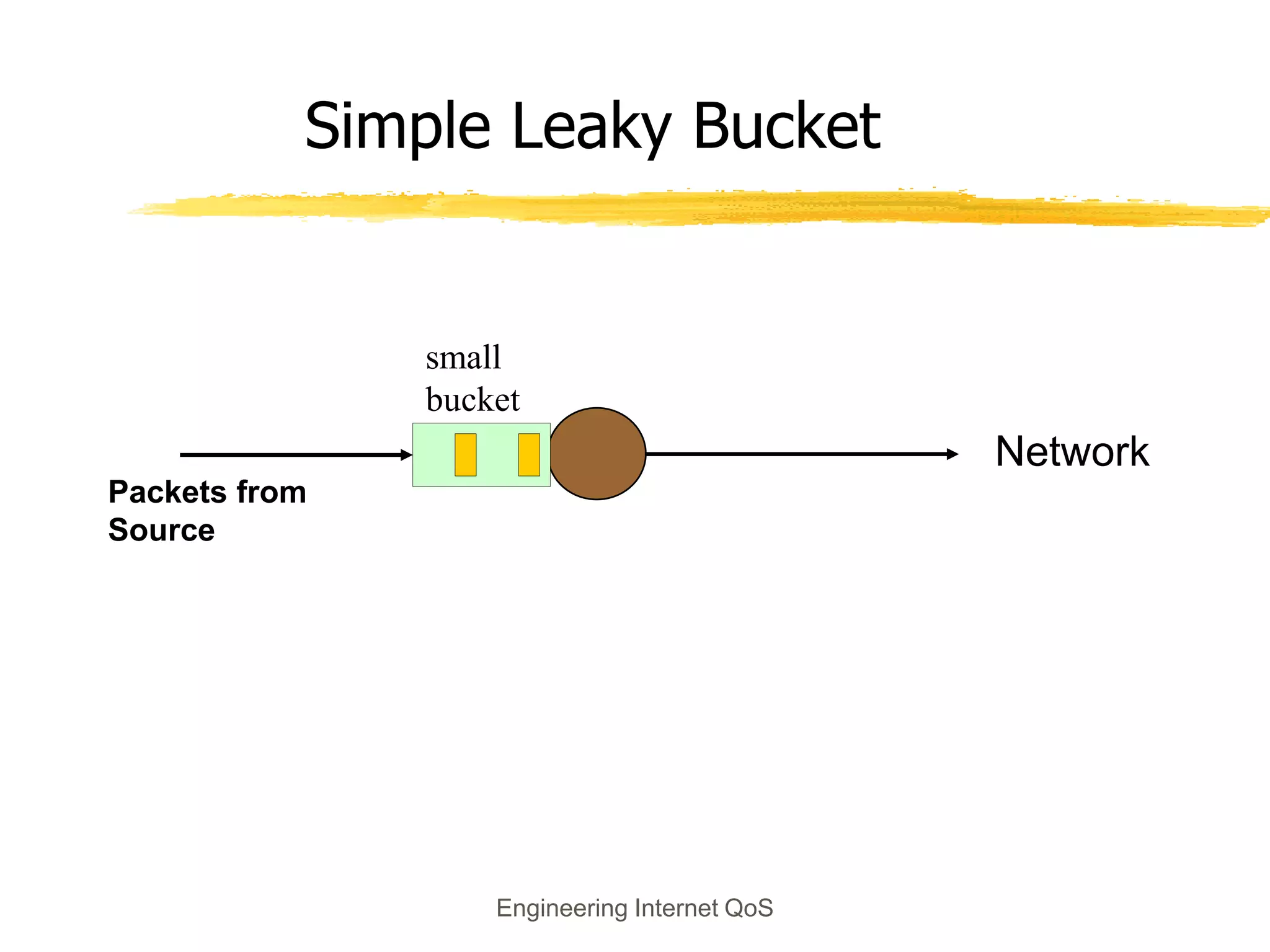
Simple Leaky Bucket
Packets from
Source
Network
small
bucket
Engineering Internet QoS
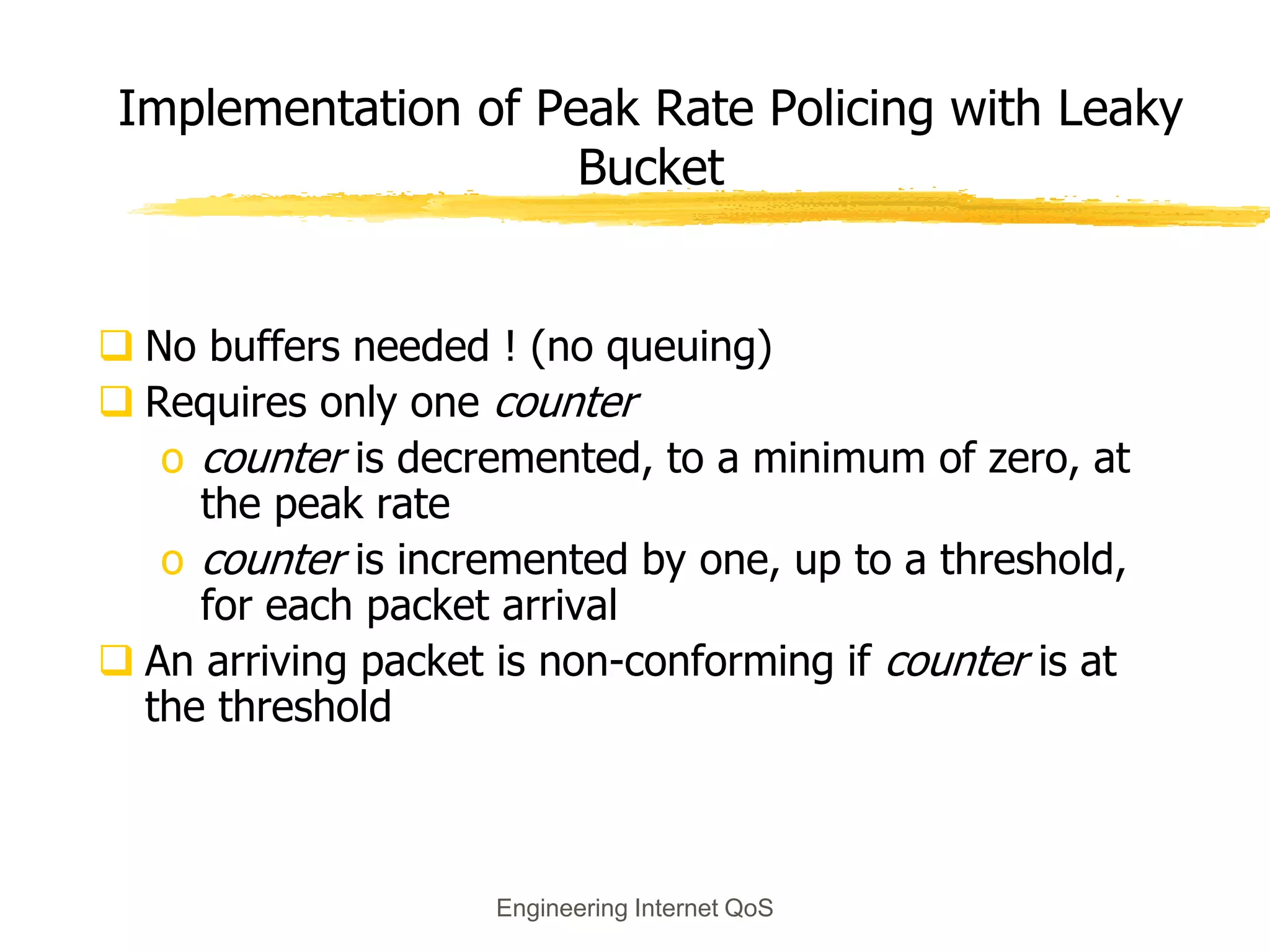
Implementation of Peak Rate Policing with Leaky
Bucket
 No buffers needed ! (no queuing)
 Requires only one counter
o counter is decremented, to a minimum of zero, at
the peak rate
o counter is incremented by one, up to a threshold,
for each packet arrival
 An arriving packet is non-conforming if counter is at
the threshold
Engineering Internet QoS
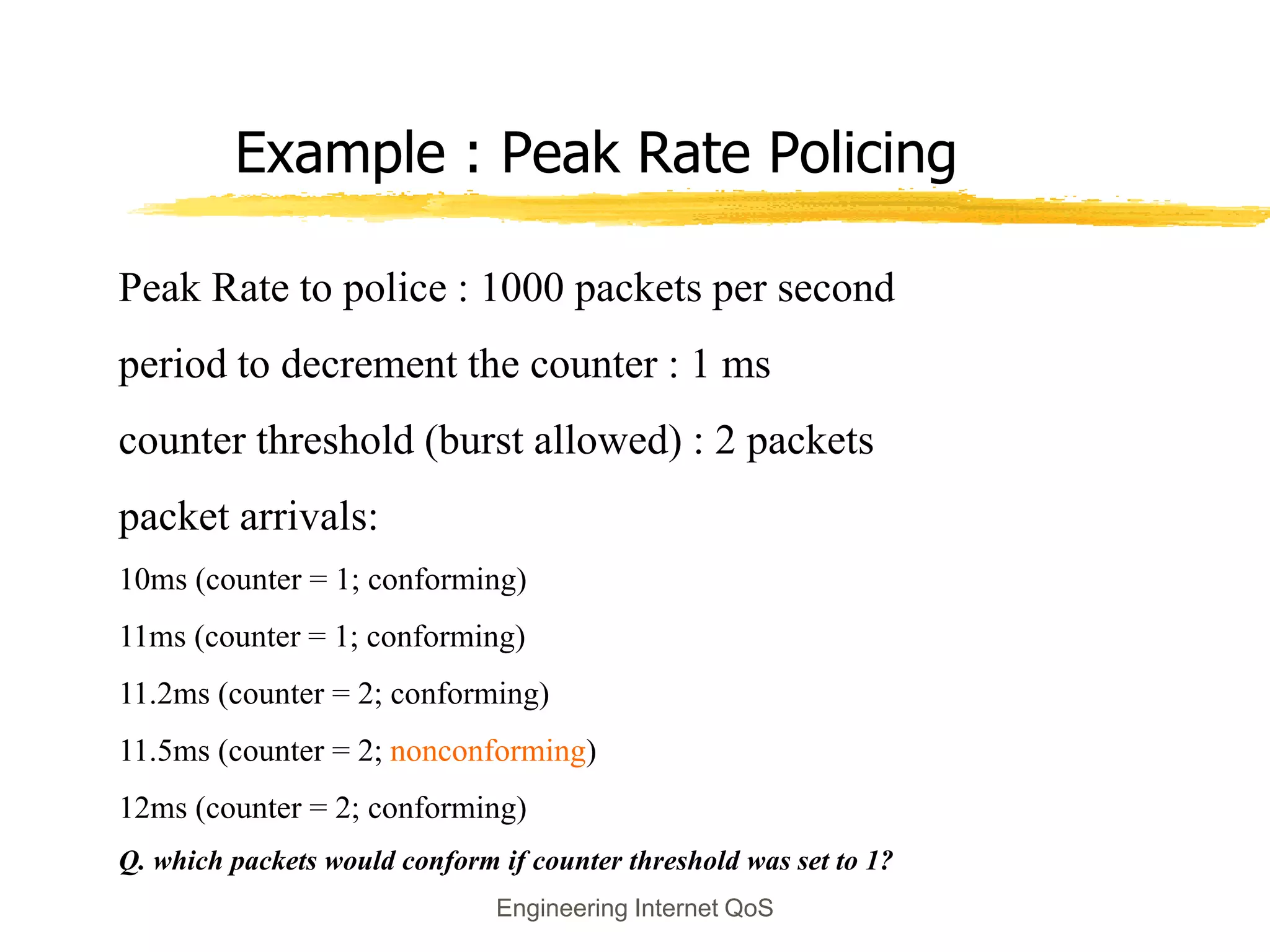
Example : Peak Rate Policing
Peak Rate to police : 1000 packets per second
period to decrement the counter : 1 ms
counter threshold (burst allowed) : 2 packets
packet arrivals:
10ms (counter = 1; conforming)
11ms (counter = 1; conforming)
11.2ms (counter = 2; conforming)
11.5ms (counter = 2; nonconforming)
12ms (counter = 2; conforming)
Q. which packets would conform if counter threshold was set to 1?
Engineering Internet QoS
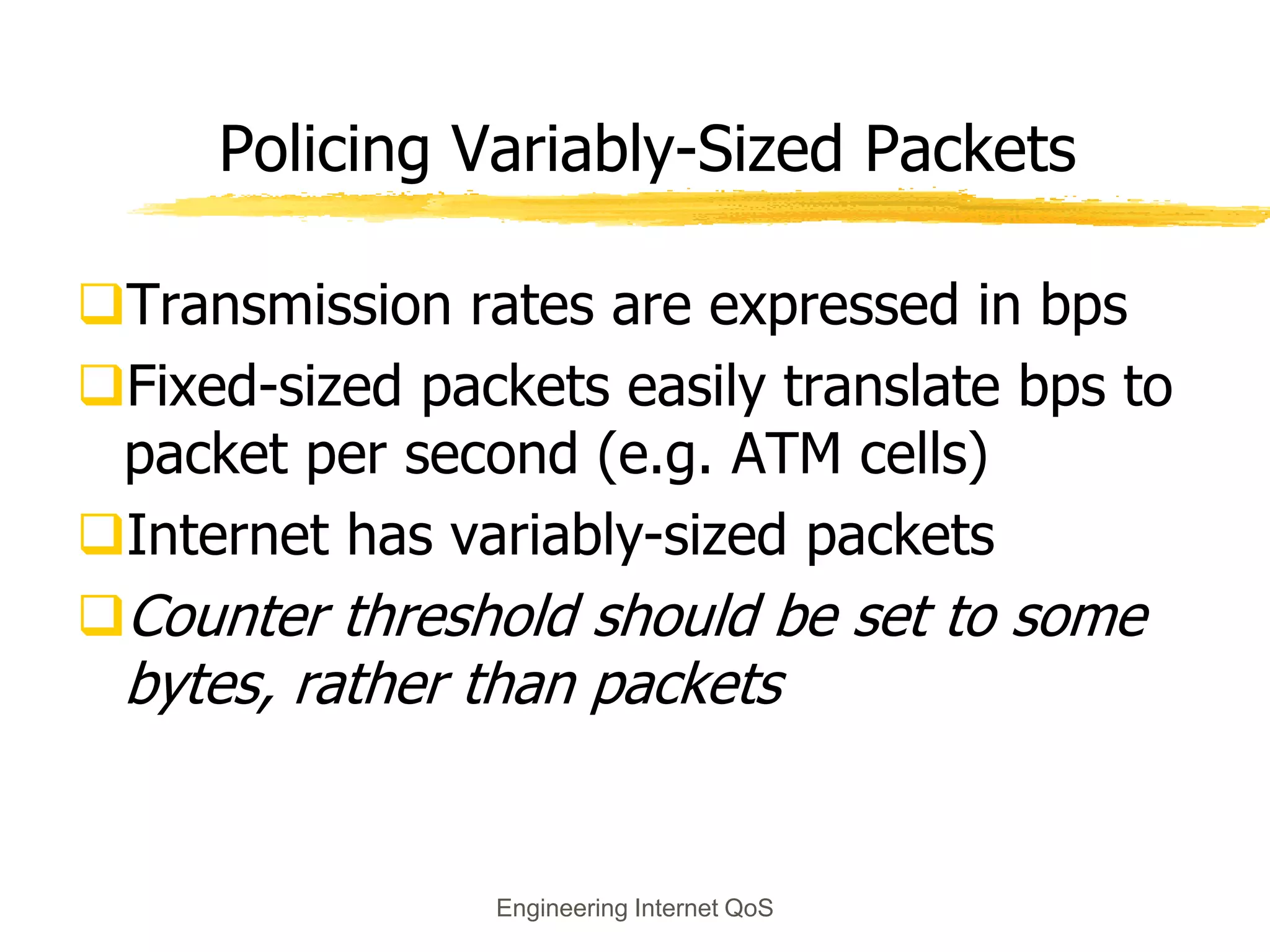
Policing Variably-Sized Packets
Transmission rates are expressed in bps
Fixed-sized packets easily translate bps to
packet per second (e.g. ATM cells)
Internet has variably-sized packets
Counter threshold should be set to some
bytes, rather than packets
Engineering Internet QoS
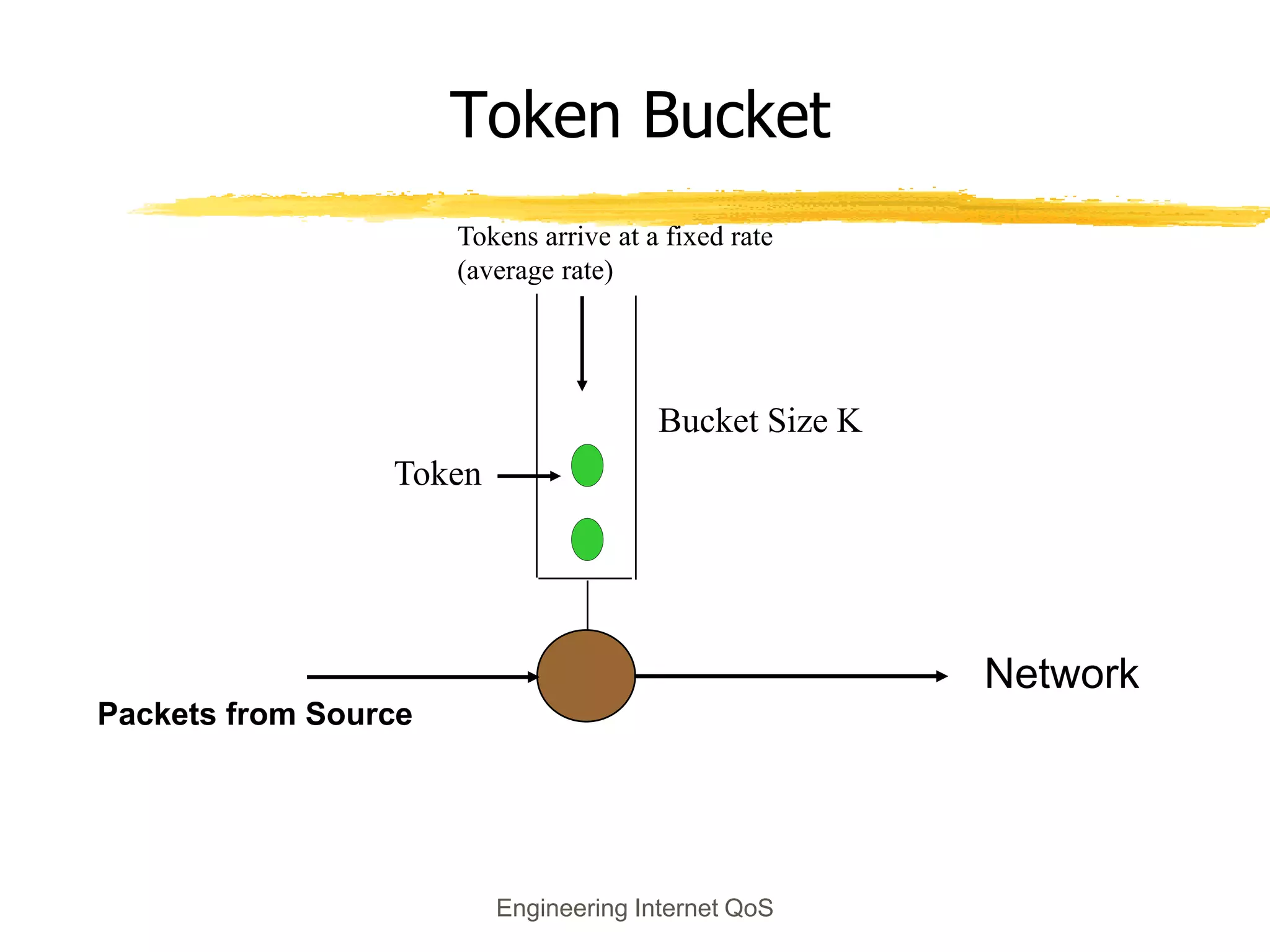
Token Bucket
Packets from Source
Network
Token
Bucket Size K
Tokens arrive at a fixed rate
(average rate)
Engineering Internet QoS
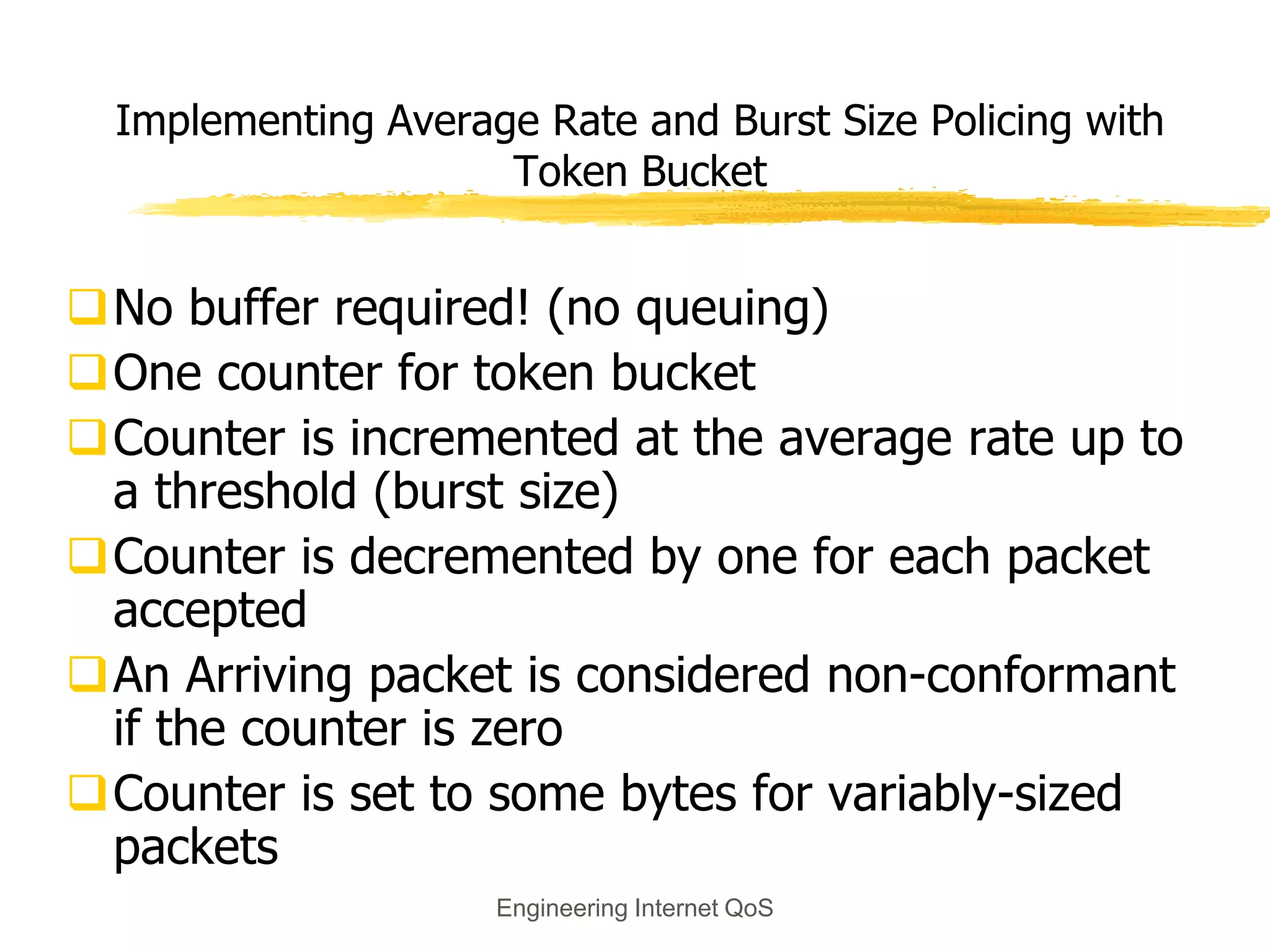
Implementing Average Rate and Burst Size Policing with
Token Bucket
No buffer required! (no queuing)
One counter for token bucket
Counter is incremented at the average rate up to
a threshold (burst size)
Counter is decremented by one for each packet
accepted
An Arriving packet is considered non-conformant
if the counter is zero
Counter is set to some bytes for variably-sized
packets
Engineering Internet QoS
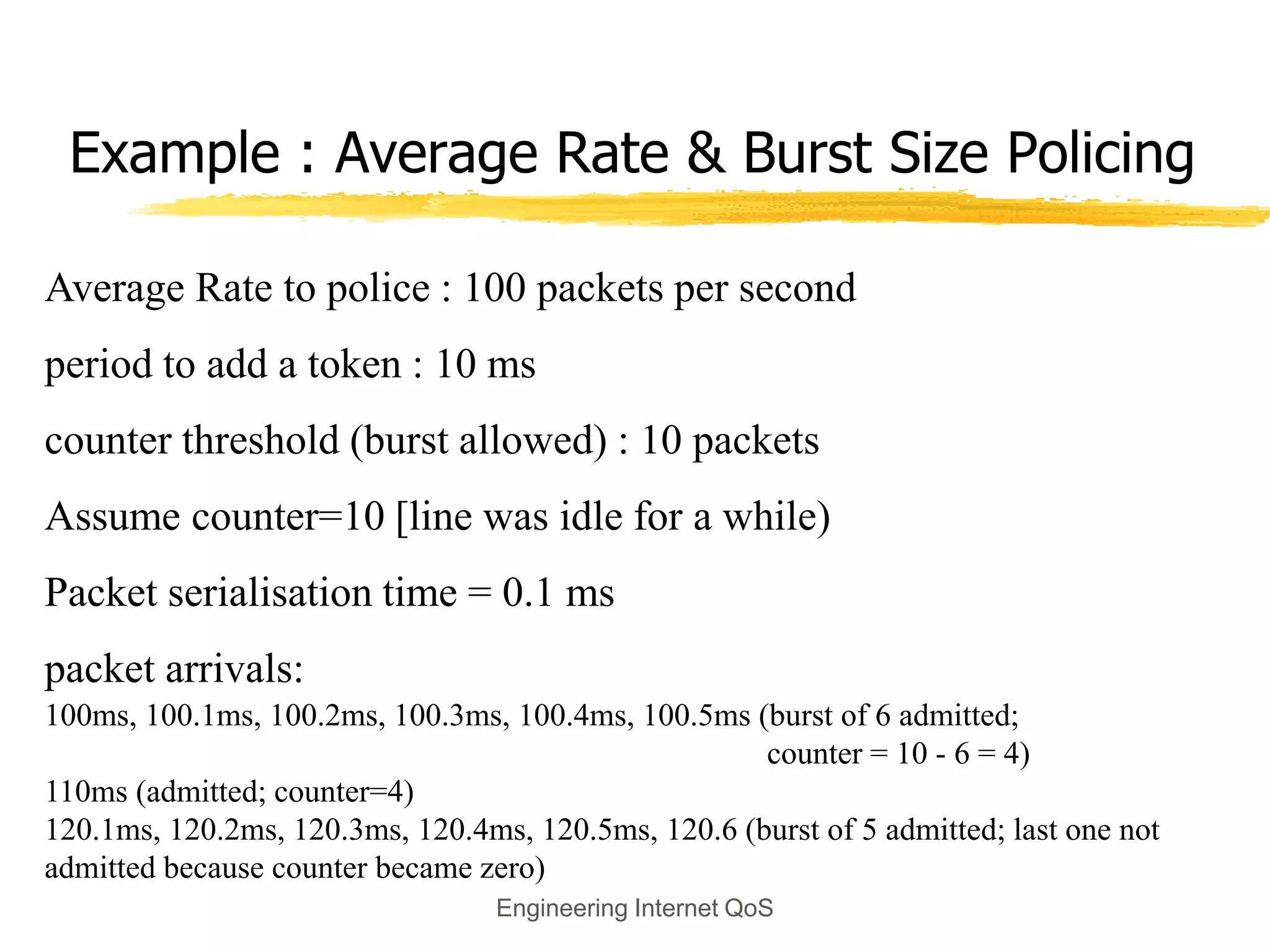
Example : Average Rate & Burst Size Policing
Average Rate to police : 100 packets per second
period to add a token : 10 ms
counter threshold (burst allowed) : 10 packets
Assume counter=10 [line was idle for a while)
Packet serialisation time = 0.1 ms
packet arrivals:
100ms, 100.1ms, 100.2ms, 100.3ms, 100.4ms, 100.5ms (burst of 6 admitted;
counter = 10 - 6 = 4)
110ms (admitted; counter=4)
120.1ms, 120.2ms, 120.3ms, 120.4ms, 120.5ms, 120.6 (burst of 5 admitted; last one not
admitted because counter became zero)
Engineering Internet QoS
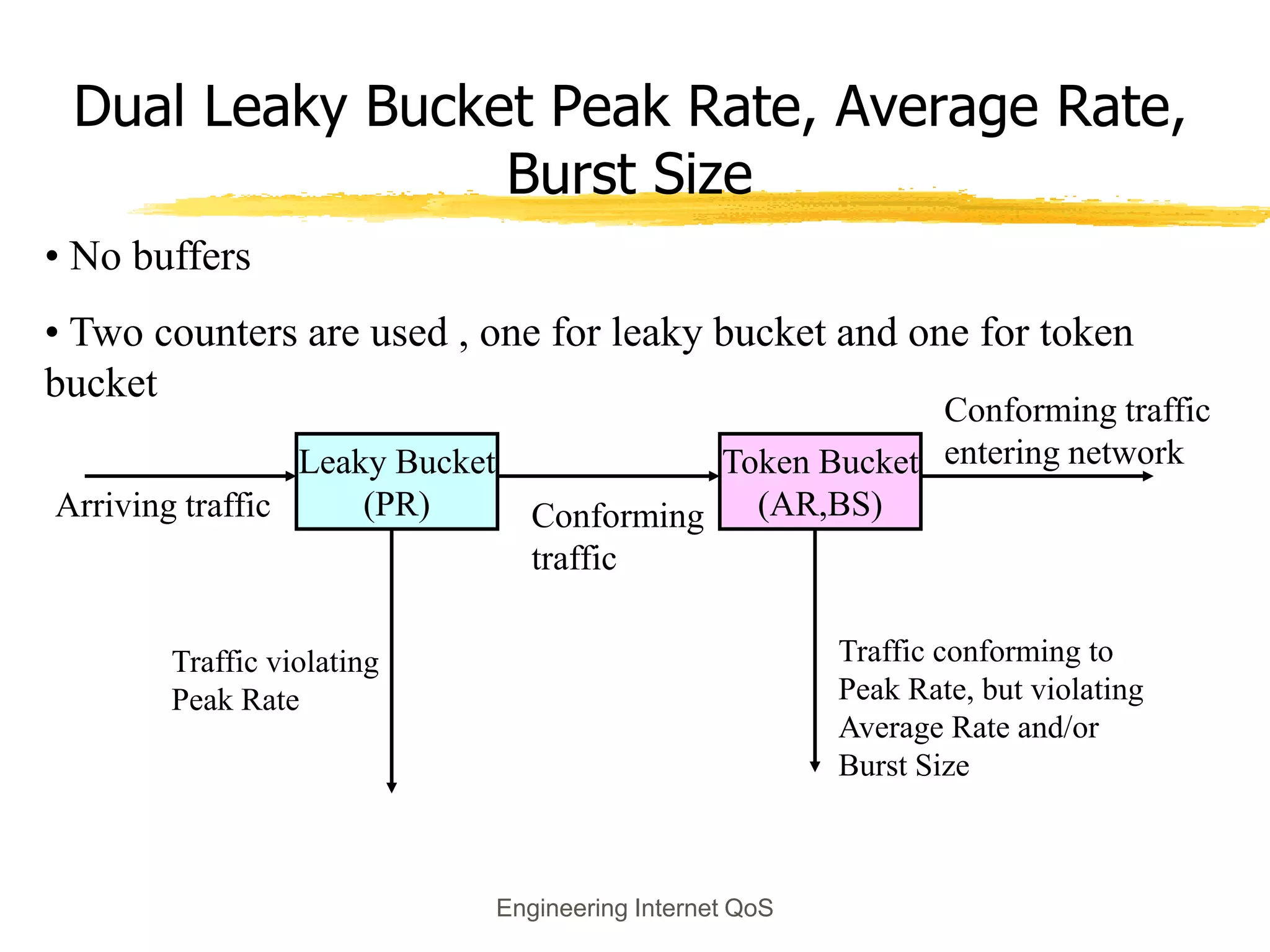
Dual Leaky Bucket Peak Rate, Average Rate,
Burst Size
Leaky Bucket
(PR)
Token Bucket
(AR,BS)
Arriving traffic Conforming
traffic
Conforming traffic
entering network
• No buffers
• Two counters are used , one for leaky bucket and one for token
bucket
Traffic violating
Peak Rate
Traffic conforming to
Peak Rate, but violating
Average Rate and/or
Burst Size
Engineering Internet QoS
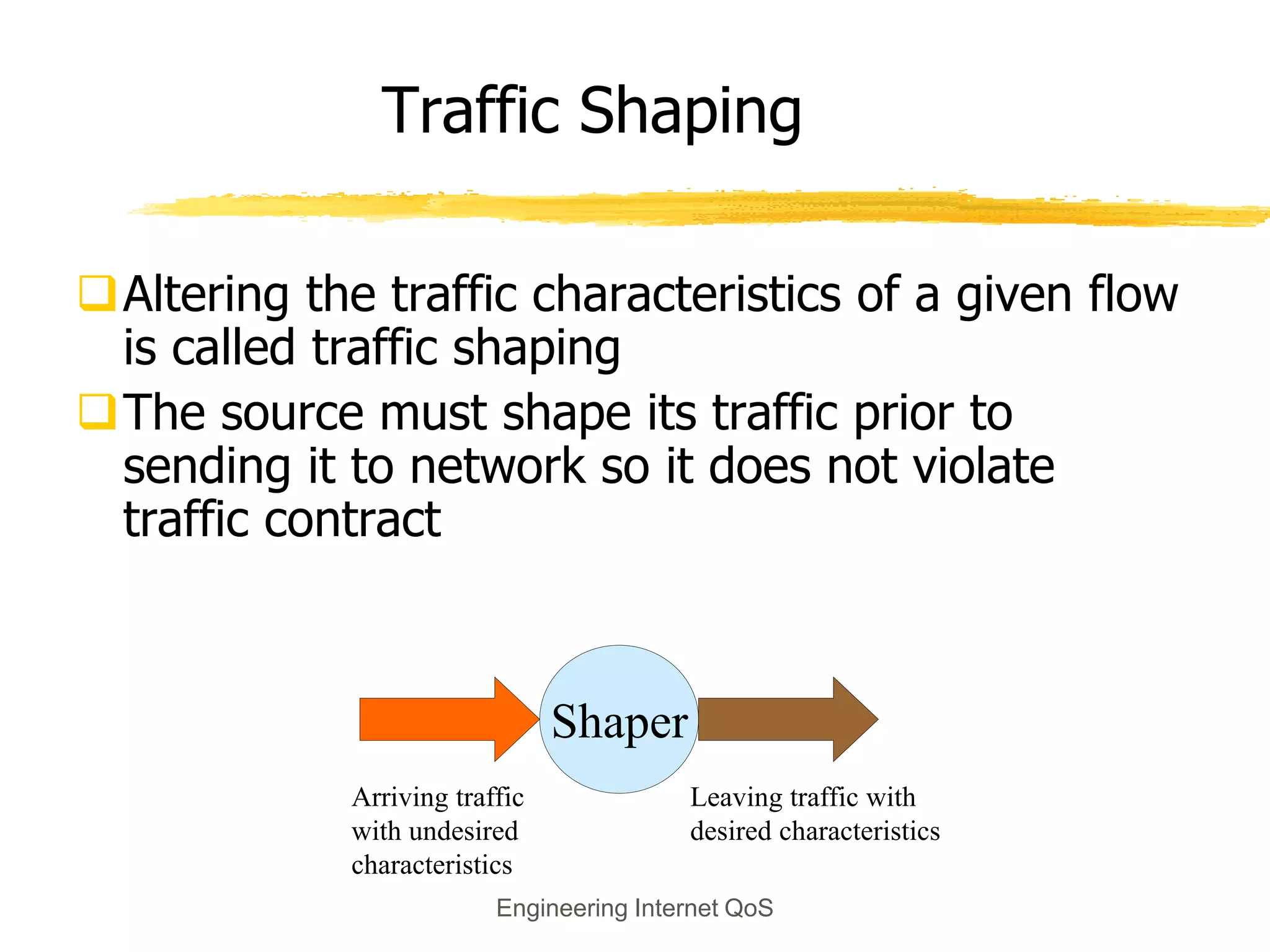
Traffic Shaping
Altering the traffic characteristics of a given flow
is called traffic shaping
The source must shape its traffic prior to
sending it to network so it does not violate
traffic contract
Shaper
Arriving traffic
with undesired
characteristics
Leaving traffic with
desired characteristics
Engineering Internet QoS
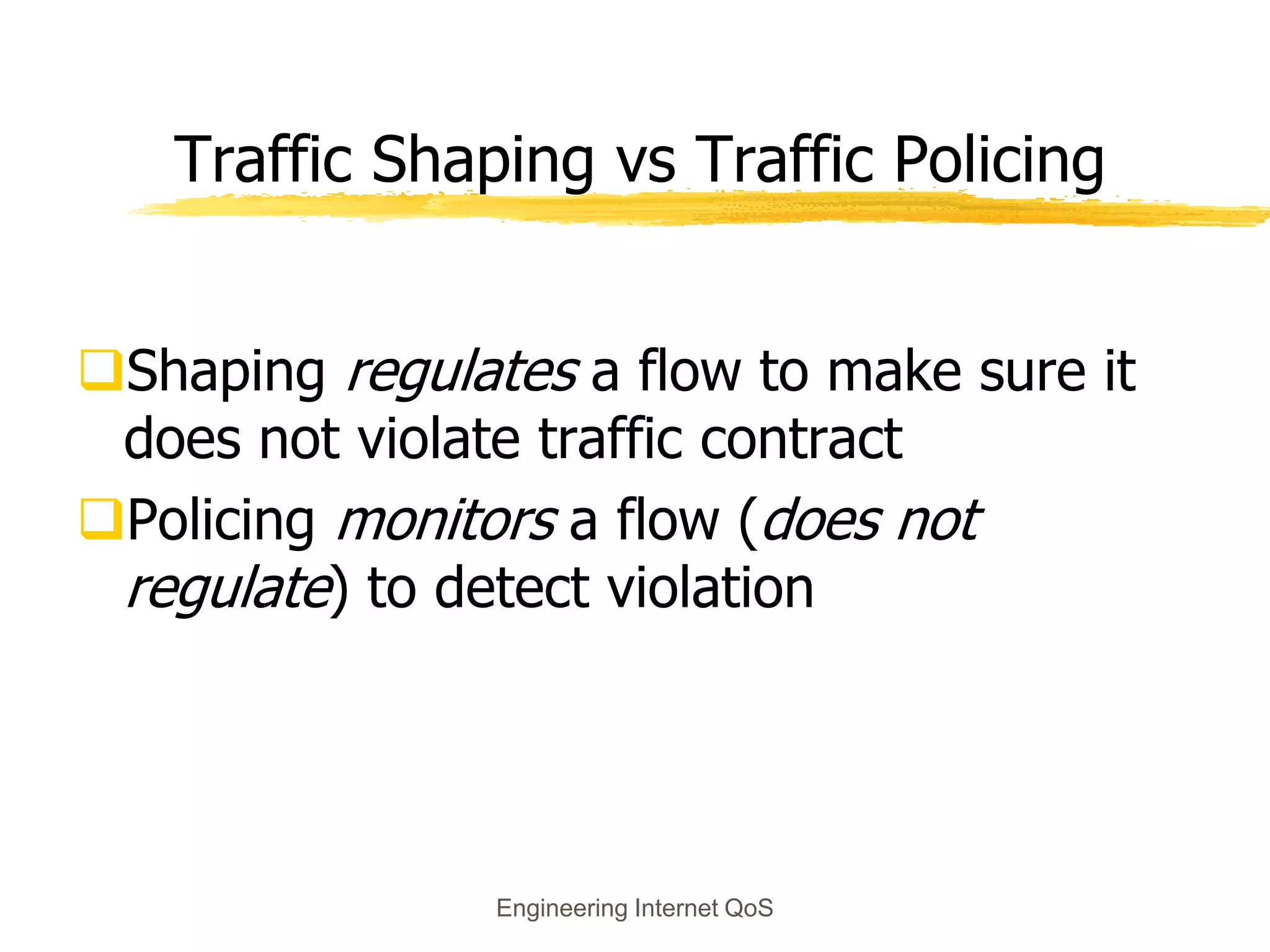
Traffic Shaping vs Traffic Policing
Shaping regulates a flow to make sure it
does not violate traffic contract
Policing monitors a flow (does not
regulate) to detect violation
Engineering Internet QoS
Shaping Mechanisms
Similar to policing mechanisms except it
buffers traffic to smooth it out (policing
does not buffer traffic as it is not
interested in smoothing it)
Token Bucket : peak rate, average rate
and burst size shaping
Engineering Internet QoS
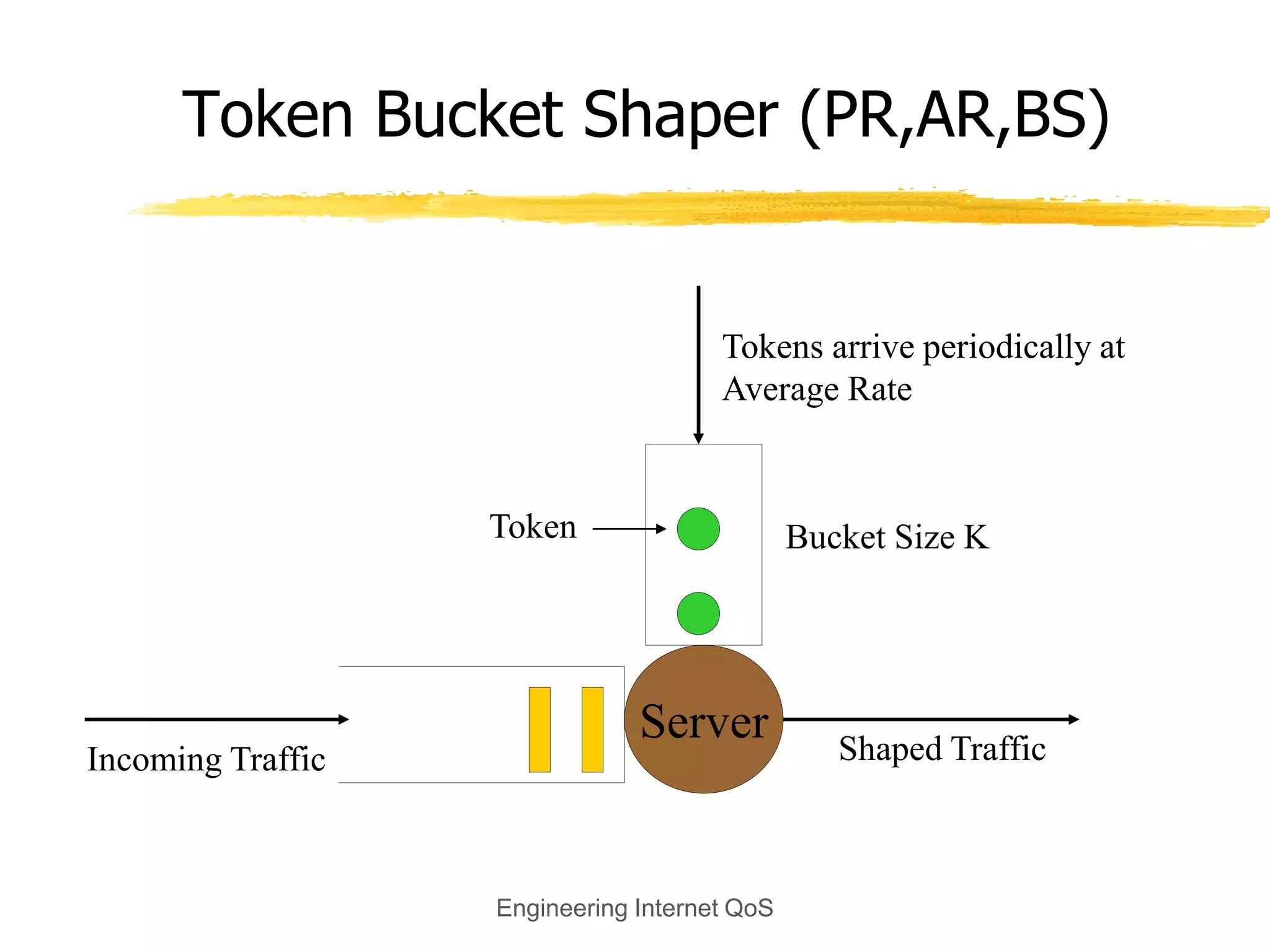
Token Bucket Shaper (PR,AR,BS)
Server Shaped Traffic
Bucket Size K
Tokens arrive periodically at
Average Rate
Incoming Traffic
Token
Engineering Internet QoS
Queuing and Scheduling
 Two basic mechanisms allow that link BW is shared by
multiple traffic sources
 Significantly affect the packet loss rate, delay, QoS
parameters
 Queuing: process of buffering incoming packets
 Scheduling: transmission schedule of the packets over
the serial link
 Label switching is more suitable for guaranteeing QoS for
a given flow of packets
Engineering Internet QoS
Congestion Control and Buffer
Managment
 Congestion: a major cause of packet loss in wired
networks
 Network can take proactive or reactive measures to
control congestion: the best effort network – mostly
reactive (ex: TCP)
 Buffer management: a proactive techniques
o Monitor queue length -> once exceeds a certain threshold ->
dropping packets
Engineering Internet QoS
Label Switching vs Datagram Switching
 Label switching refers to switching based on fixed size,
short labels as in virtual circuit switching, such as X.25,
ATM
 Label switching establishes a path at the beginning of a
communication; all packets of a flow take the same path
 Datagram switching uses destination address in the
packet header to find a path for each packet
 Label switching is more suitable for guaranteeing QoS for
a given flow of packets

chap2.ppt

  • 1.
  • 2.
    Engineering Internet QoS QoSFramework Static Functions o Traffic and QoS specifications (traffic types/parameters) o QoS negotiation and signalling o Admission control o Resource reservation Dynamic Functions o Traffic shaping and policing o Queuing and scheduling (later) o Congestion control (later)
  • 3.
    Engineering Internet QoS TrafficSource Types CBR (Constant Bit Rate) : transmits traffic at a fixed rate, such as 64 Kbps voice VBR (Variable Bit Rate) : traffic rate is not fixed; sometimes high, sometimes low, such as MPEG coded video
  • 4.
    Engineering Internet QoS TrafficParameters Different flows have different traffic patterns A given traffic pattern can be described using several traffic parameters Peak rate : maximum rate in any time interval CBR traffic can be completely described using the peak rate of the traffic. Average rate : long term average mean of the traffic rate for a VBR source. Burst size : refers to the number of packets that can be delivered in the peak rate.
  • 5.
    Engineering Internet QoS TrafficParameters Illustrated peak rate average rate burst size Time bps
  • 6.
    Engineering Internet QoS TrafficPatterns All patterns have the same average rate (10 Kbps), but different peak rate and burst size time 100 Kbps 50 Kbps 10 Kbps
  • 7.
    Engineering Internet QoS QoSParameters Required QoS can be defined by several parameters Delay : how long it takes for a packet to traverse the network? Jitter : what is the variance in the delay? Loss : how often packets get lost in the network and never show up at the destination?
  • 8.
  • 9.
     QoS guarantee.The user will precisely know what QoS guarantee it is going to get from the network Quality monitoring. The user and the network can monitor the quality of a call against the set of QoS parameters. Charging. For example, a contract with a delay limit of 10 ms could be charged higher than the one with a delay limit of 100 ms. Engineering Internet QoS A well-specified QoS contract yields the following benefits:
  • 10.
    Engineering Internet QoS Signalling Signalling is a mechanism used by the users to communicate QoS related information to the network  Static Configuration. Relevant table entries are created manually  Dynamic Negotiation. QoS configurations are accomplished automatically using  software.  Using signalling o User conveys its traffic parameters and QoS requirements to the network o Network conveys any QoS guarantees to the user
  • 11.
    Engineering Internet QoS EngineeringInternet QoS Resource Reservation To guarantee any QoS, network resources must be reserved in advance Types of network resources o link Bandwidth o Buffer space Reservation could be dynamic, using signalling, or static (manual)
  • 12.
    Engineering Internet QoS AdmissionControl  First line of defence against attacks on QoS  Network should not commit any guarantee if available resources are not enough to maintain requested QoS  Admission control functions must examine both traffic and QoS parameters carefully before accepting or rejecting a new request for QoS  Implementation o Dynamic : using signalling protocol/software o Static : manual process (no signalling required)
  • 13.
    Engineering Internet QoS HowMuch to Reserve? Easy for Constant bit rate sources o Reserve at the peak rate Difficult for VBR sources o Peak rate reservation wastes bandwidth (no statistical gain) o Average rate reservation may cause excessive packet delays
  • 14.
    Engineering Internet QoS TrafficPolicing Users violating the traffic contract can jeopardise the QoS of other connections The network must protect well behaving users against such traffic violations All entering traffic is therefore subject to policing Policing functions are deployed at the edge (entry) of the network
  • 15.
    Engineering Internet QoS TrafficPolicing Policer Arriving traffic Conforming traffic admitted into network Non-conforming traffic (dropped)
  • 16.
    Engineering Internet QoS Requirementsfor Policing Mechanisms 1. It must operate in real-time and should not cause any additional delay for the admitted packets 2. It must not discard or decrease the priority of packets that do not violate the negotiated contract 3. negotiated contract Easy and simple (not complex) to implement 4. It must detect every packet that violates the contract and take appropriate actions (drop or decrease the priority).
  • 17.
    Engineering Internet QoS PolicingParameter Combinations Peak Rate Only o Suitable for CBR sources Average Rate and Burst Size o For VBR sources without limit on peak rate Peak rate, Average Rate and Burst Size o VBR sources with peak rate limitation
  • 18.
    Engineering Internet QoS Policingwith Leaky Bucket Leaky Bucket is a widely used mechanism to police peak rate, average rate and burst size Peak rate policing : simple leaky bucket Average rate and burst size : token bucket Peak rate, average rate and burst size: leaky bucket and token bucket in tandem
  • 19.
    Engineering Internet QoS SimpleLeaky Bucket Packets from Source Network small bucket
  • 20.
    Engineering Internet QoS Implementationof Peak Rate Policing with Leaky Bucket  No buffers needed ! (no queuing)  Requires only one counter o counter is decremented, to a minimum of zero, at the peak rate o counter is incremented by one, up to a threshold, for each packet arrival  An arriving packet is non-conforming if counter is at the threshold
  • 21.
    Engineering Internet QoS Example: Peak Rate Policing Peak Rate to police : 1000 packets per second period to decrement the counter : 1 ms counter threshold (burst allowed) : 2 packets packet arrivals: 10ms (counter = 1; conforming) 11ms (counter = 1; conforming) 11.2ms (counter = 2; conforming) 11.5ms (counter = 2; nonconforming) 12ms (counter = 2; conforming) Q. which packets would conform if counter threshold was set to 1?
  • 22.
    Engineering Internet QoS PolicingVariably-Sized Packets Transmission rates are expressed in bps Fixed-sized packets easily translate bps to packet per second (e.g. ATM cells) Internet has variably-sized packets Counter threshold should be set to some bytes, rather than packets
  • 23.
    Engineering Internet QoS TokenBucket Packets from Source Network Token Bucket Size K Tokens arrive at a fixed rate (average rate)
  • 24.
    Engineering Internet QoS ImplementingAverage Rate and Burst Size Policing with Token Bucket No buffer required! (no queuing) One counter for token bucket Counter is incremented at the average rate up to a threshold (burst size) Counter is decremented by one for each packet accepted An Arriving packet is considered non-conformant if the counter is zero Counter is set to some bytes for variably-sized packets
  • 25.
    Engineering Internet QoS Example: Average Rate & Burst Size Policing Average Rate to police : 100 packets per second period to add a token : 10 ms counter threshold (burst allowed) : 10 packets Assume counter=10 [line was idle for a while) Packet serialisation time = 0.1 ms packet arrivals: 100ms, 100.1ms, 100.2ms, 100.3ms, 100.4ms, 100.5ms (burst of 6 admitted; counter = 10 - 6 = 4) 110ms (admitted; counter=4) 120.1ms, 120.2ms, 120.3ms, 120.4ms, 120.5ms, 120.6 (burst of 5 admitted; last one not admitted because counter became zero)
  • 26.
    Engineering Internet QoS DualLeaky Bucket Peak Rate, Average Rate, Burst Size Leaky Bucket (PR) Token Bucket (AR,BS) Arriving traffic Conforming traffic Conforming traffic entering network • No buffers • Two counters are used , one for leaky bucket and one for token bucket Traffic violating Peak Rate Traffic conforming to Peak Rate, but violating Average Rate and/or Burst Size
  • 27.
    Engineering Internet QoS TrafficShaping Altering the traffic characteristics of a given flow is called traffic shaping The source must shape its traffic prior to sending it to network so it does not violate traffic contract Shaper Arriving traffic with undesired characteristics Leaving traffic with desired characteristics
  • 28.
    Engineering Internet QoS TrafficShaping vs Traffic Policing Shaping regulates a flow to make sure it does not violate traffic contract Policing monitors a flow (does not regulate) to detect violation
  • 29.
    Engineering Internet QoS ShapingMechanisms Similar to policing mechanisms except it buffers traffic to smooth it out (policing does not buffer traffic as it is not interested in smoothing it) Token Bucket : peak rate, average rate and burst size shaping
  • 30.
    Engineering Internet QoS TokenBucket Shaper (PR,AR,BS) Server Shaped Traffic Bucket Size K Tokens arrive periodically at Average Rate Incoming Traffic Token
  • 31.
    Engineering Internet QoS Queuingand Scheduling  Two basic mechanisms allow that link BW is shared by multiple traffic sources  Significantly affect the packet loss rate, delay, QoS parameters  Queuing: process of buffering incoming packets  Scheduling: transmission schedule of the packets over the serial link  Label switching is more suitable for guaranteeing QoS for a given flow of packets
  • 32.
    Engineering Internet QoS CongestionControl and Buffer Managment  Congestion: a major cause of packet loss in wired networks  Network can take proactive or reactive measures to control congestion: the best effort network – mostly reactive (ex: TCP)  Buffer management: a proactive techniques o Monitor queue length -> once exceeds a certain threshold -> dropping packets
  • 33.
    Engineering Internet QoS LabelSwitching vs Datagram Switching  Label switching refers to switching based on fixed size, short labels as in virtual circuit switching, such as X.25, ATM  Label switching establishes a path at the beginning of a communication; all packets of a flow take the same path  Datagram switching uses destination address in the packet header to find a path for each packet  Label switching is more suitable for guaranteeing QoS for a given flow of packets