Chapter 1: Chemistry
and the Atomic/Molecular
View of Matter
Chemistry: The Molecular Nature
of Matter, 6E
Brady/Jespersen/Hyslop
Brady/Jespersen/Hyslop Chemistry: The Molecular Nature of Matter, 6E
1.2- Scientific Method
 Approach to gathering information &
formulating explanations.
 Scientists perform experiments in laboratories
under controlled conditions
1. Make observations/collect data
2. Law or Scientific Law
3. Hypothesis
4. Theory
2
Brady/Jespersen/Hyslop Chemistry: The Molecular Nature of Matter, 6E
Atomic Theory
 Most significant theoretical model of nature
Atoms
 Tiny submicroscopic particles
 Make up all chemical substances
 Make up everything in Macroscopic world
 Smallest particle that has all properties of given
element
 Composed of:
 Electrons
 Neutrons
 Protons
3
Brady/Jespersen/Hyslop Chemistry: The Molecular Nature of Matter, 6E
1.3- Matter & Its Classifications
Matter
 Anything that has mass & occupies space
Mass
 How much matter given object has
Weight
 Force with which object is attracted by gravity
Ex. Mass vs. Weight
Astronaut on moon & on earth
 Weight on moon = 1/6 weight on earth
 Same mass regardless of location
4
Brady/Jespersen/Hyslop Chemistry: The Molecular Nature of Matter, 6E
Matter
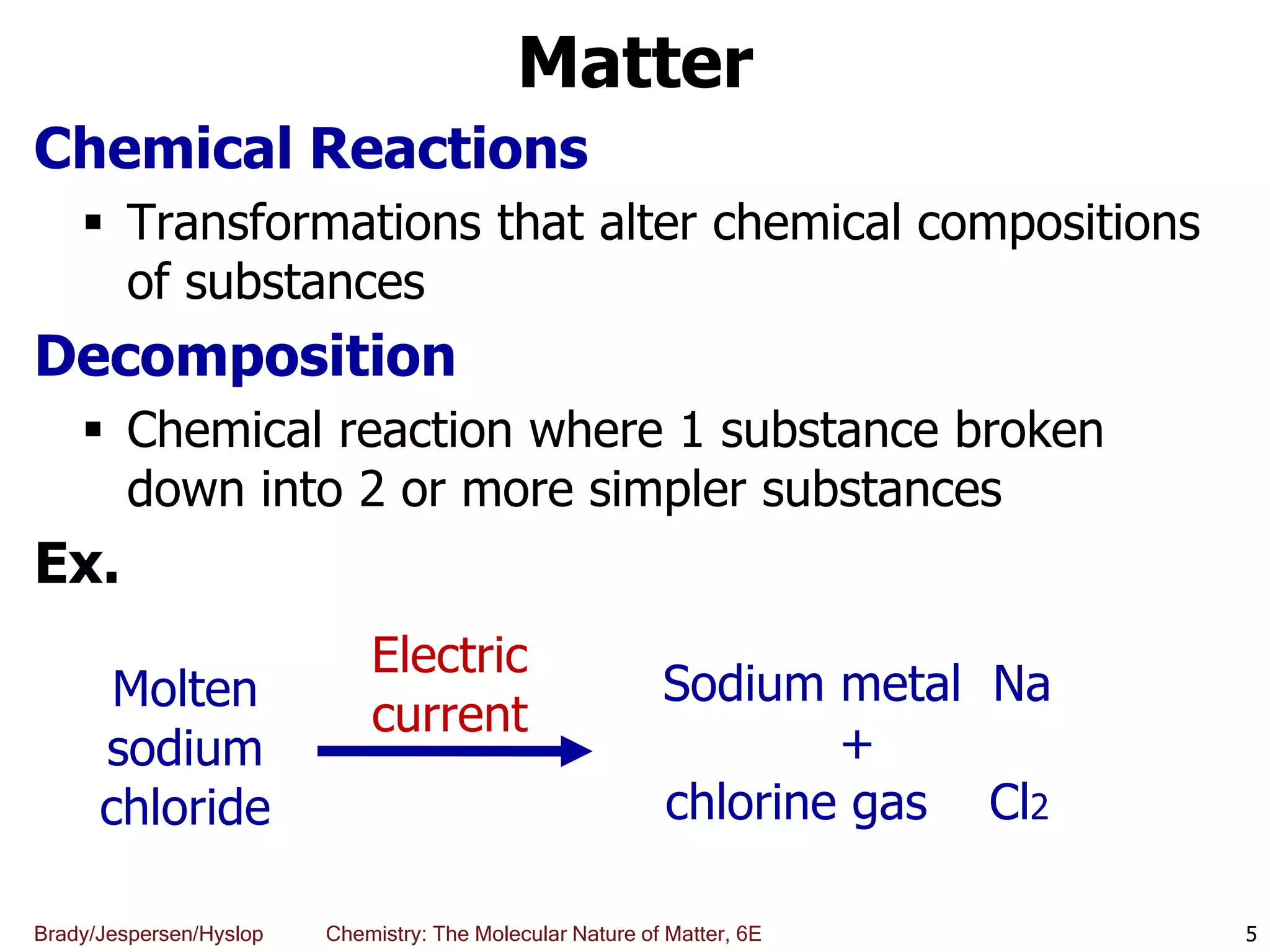
Chemical Reactions
 Transformations that alter chemical compositions
of substances
Decomposition
 Chemical reaction where 1 substance broken
down into 2 or more simpler substances
Ex.
5
Molten
sodium
chloride
Sodium metal Na
+
chlorine gas Cl2
Electric
current
Brady/Jespersen/Hyslop Chemistry: The Molecular Nature of Matter, 6E
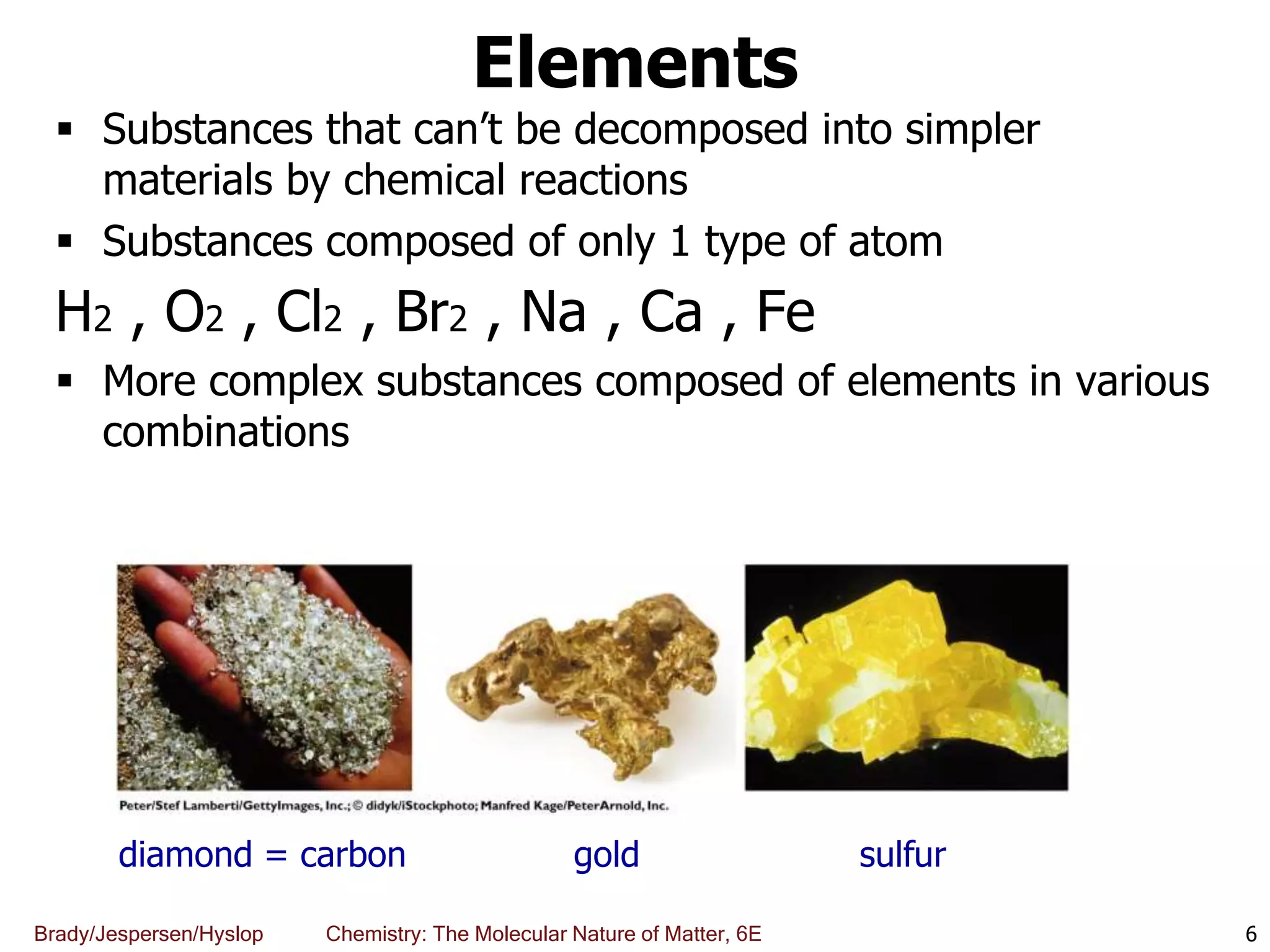
Elements
 Substances that can’t be decomposed into simpler
materials by chemical reactions
 Substances composed of only 1 type of atom
H2 , O2 , Cl2 , Br2 , Na , Ca , Fe
 More complex substances composed of elements in various
combinations
6
diamond = carbon gold sulfur
Brady/Jespersen/Hyslop Chemistry: The Molecular Nature of Matter, 6E
Chemical Symbols for Elements
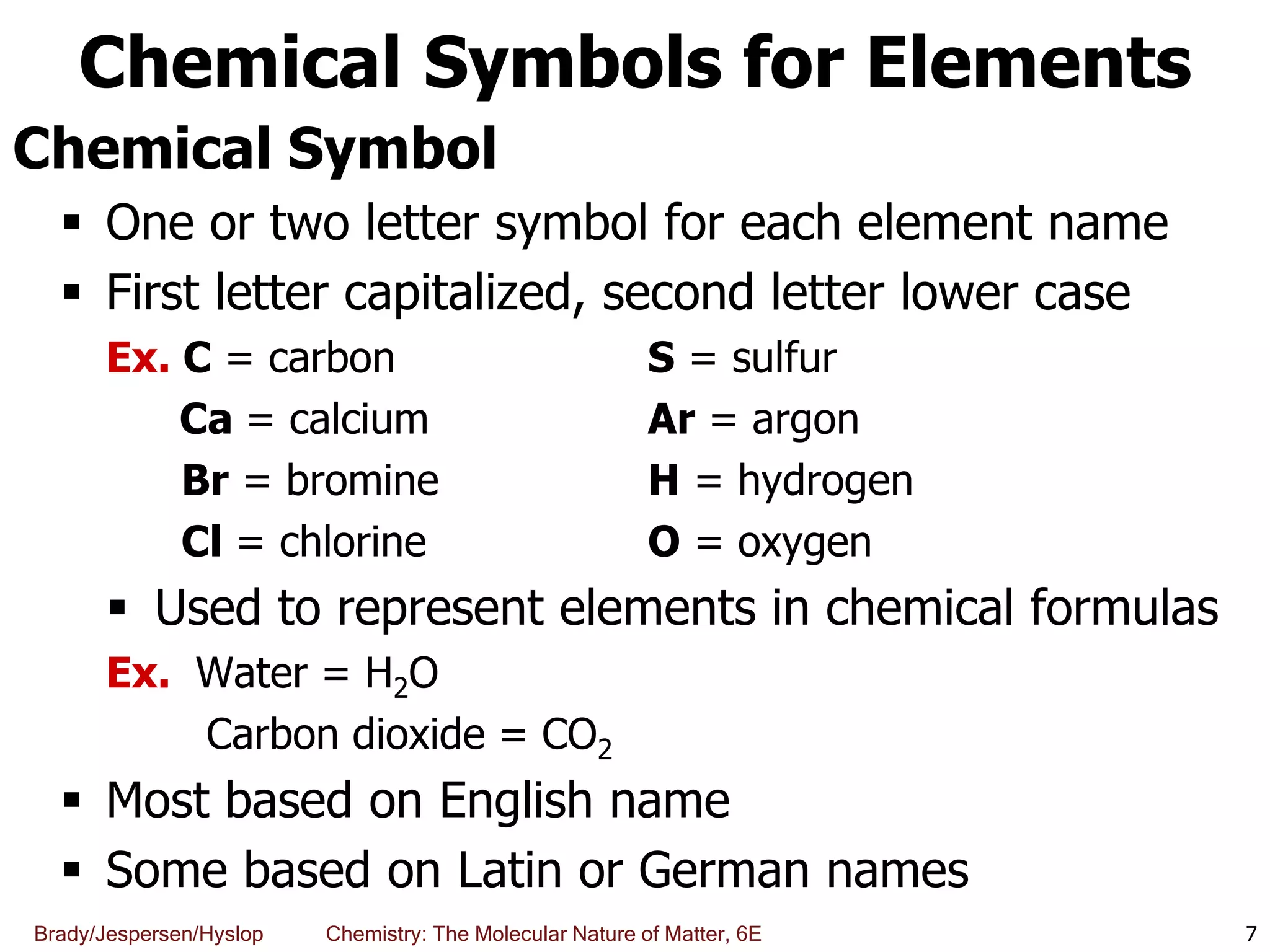
Chemical Symbol
 One or two letter symbol for each element name
 First letter capitalized, second letter lower case
Ex. C = carbon S = sulfur
Ca = calcium Ar = argon
Br = bromine H = hydrogen
Cl = chlorine O = oxygen
 Used to represent elements in chemical formulas
Ex. Water = H2O
Carbon dioxide = CO2
 Most based on English name
 Some based on Latin or German names
7
Brady/Jespersen/Hyslop Chemistry: The Molecular Nature of Matter, 6E
Chemical Symbols
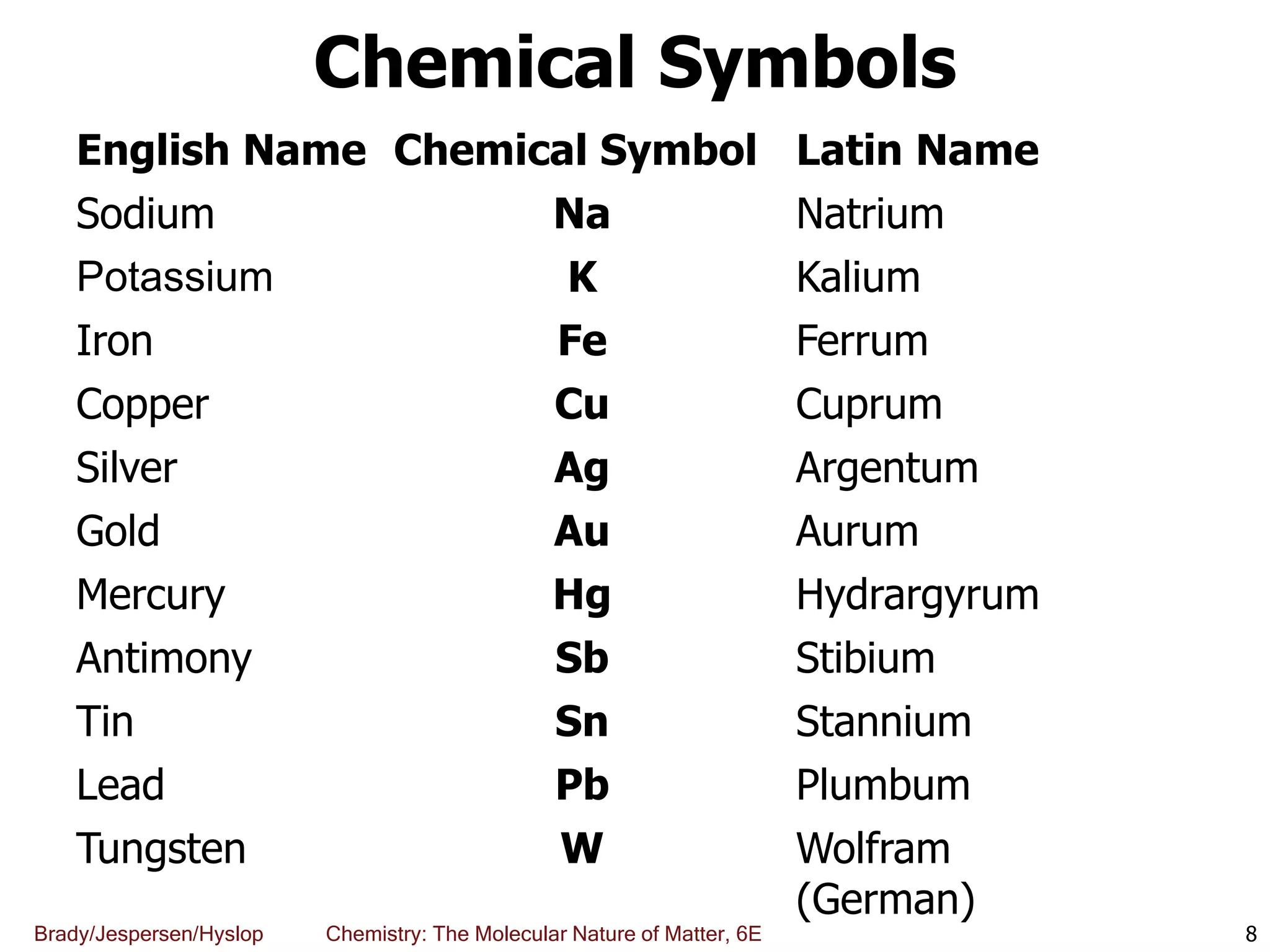
English Name Chemical Symbol Latin Name
Sodium Na Natrium
Potassium K Kalium
Iron Fe Ferrum
Copper Cu Cuprum
Silver Ag Argentum
Gold Au Aurum
Mercury Hg Hydrargyrum
Antimony Sb Stibium
Tin Sn Stannium
Lead Pb Plumbum
Tungsten W Wolfram
(German)
8
Brady/Jespersen/Hyslop Chemistry: The Molecular Nature of Matter, 6E
Compound
 Formed from 2 or more atoms of different
elements
 Always combined in same fixed ratios by
mass
 Can be broken down into elements by some
chemical changes
Ex. Water decomposed to elemental hydrogen
& oxygen
Mass of oxygen =
8 × mass of hydrogen
9
Brady/Jespersen/Hyslop Chemistry: The Molecular Nature of Matter, 6E
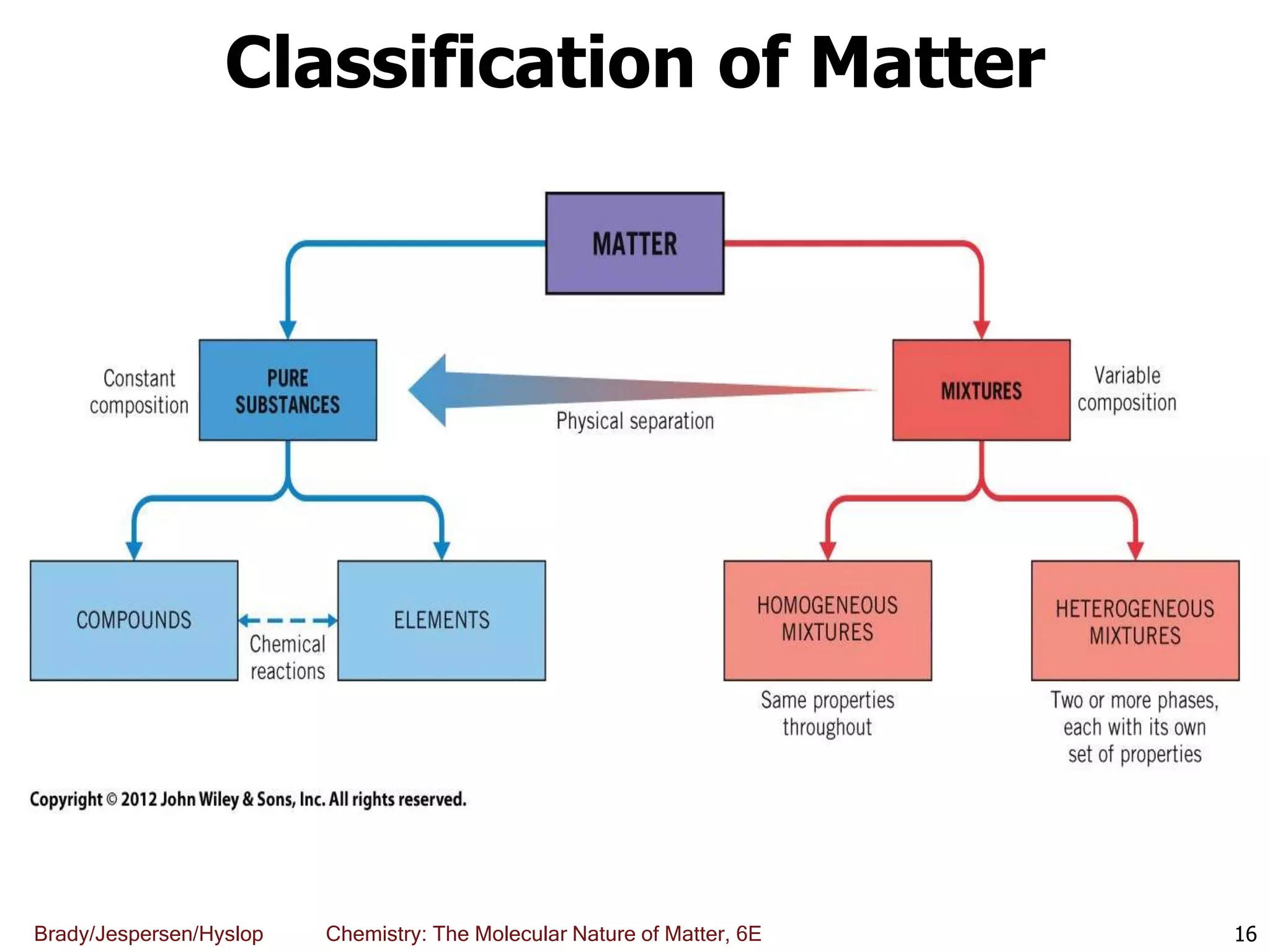
Pure Substance vs. Mixture
Pure substances
 Elements and compounds / H2O, Na, N2, …
 Composition always same regardless of source
Mixture
 Can have variable compositions
 Made up of two or more substances
Ex. CO2 in water—varying amounts of “fizz” in soda
 2 broad categories of mixtures:
 Heterogeneous Mixtures
 Homogeneous Mixtures
10
Brady/Jespersen/Hyslop Chemistry: The Molecular Nature of Matter, 6E
Homogeneous Mixtures
 Same properties throughout sample
 Solution
 Thoroughly stirred homogeneous mixture
Ex.
 Liquid solution
 Sugar in water
 Salt in water
 Gas solution
 Air
 Contains nitrogen, oxygen, carbon
dioxide & other gases
 Solid solution
 US 5¢ coin – Metal Alloy
 Contains copper & nickel metals
11
Other examples
- Flour
- Milk powder
- Potable water
- Gasoline
Brady/Jespersen/Hyslop Chemistry: The Molecular Nature of Matter, 6E
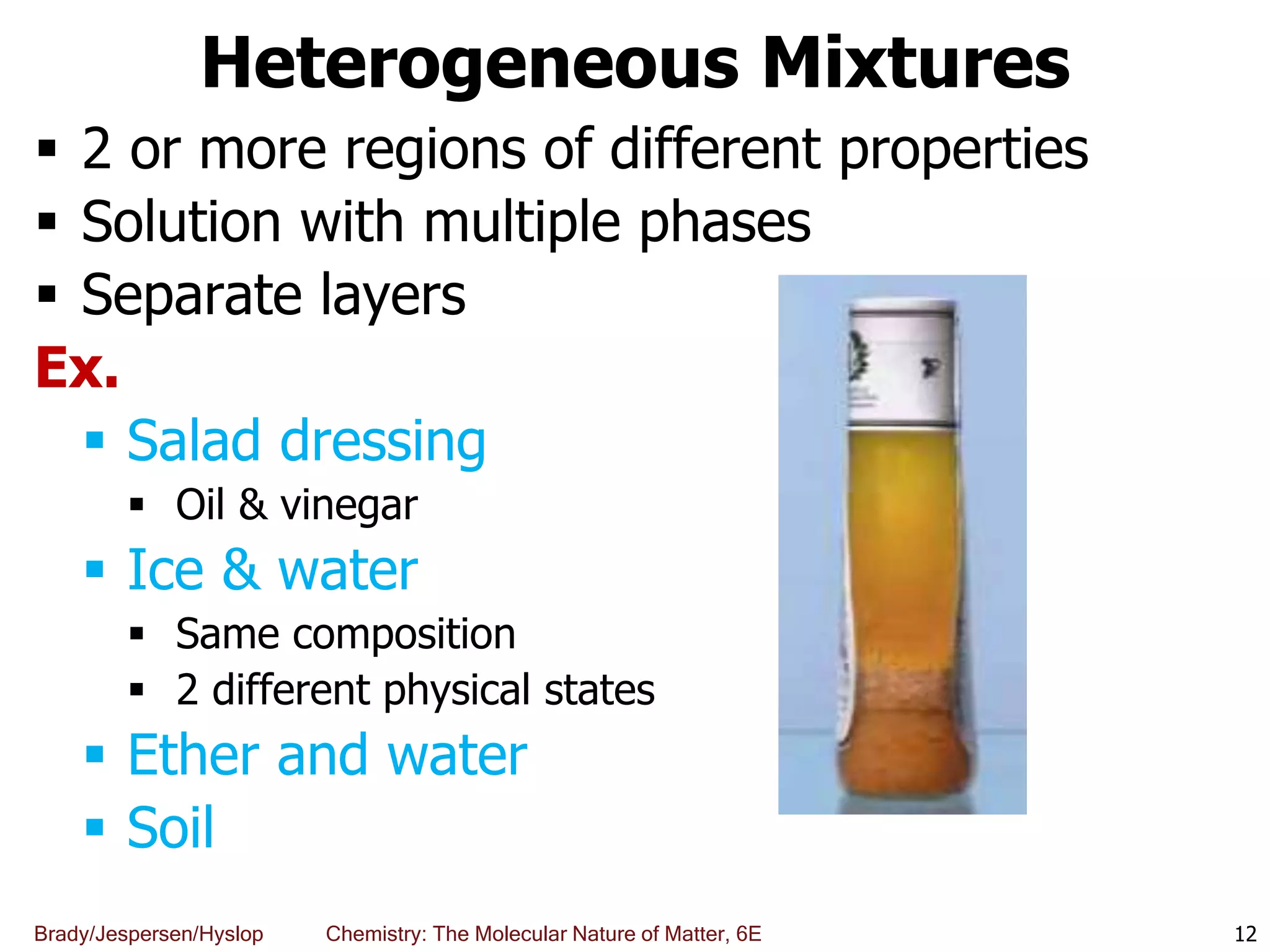
Heterogeneous Mixtures
 2 or more regions of different properties
 Solution with multiple phases
 Separate layers
Ex.
 Salad dressing
 Oil & vinegar
 Ice & water
 Same composition
 2 different physical states
 Ether and water
 Soil
12
Brady/Jespersen/Hyslop Chemistry: The Molecular Nature of Matter, 6E
Physical Change
 No new substances formed
 Substance may change state or the proportions
Ex. Ice melting or water freezing
 Sugar or salt dissolving
 Melting of metals
 Condensation of vapor or evaporation of water
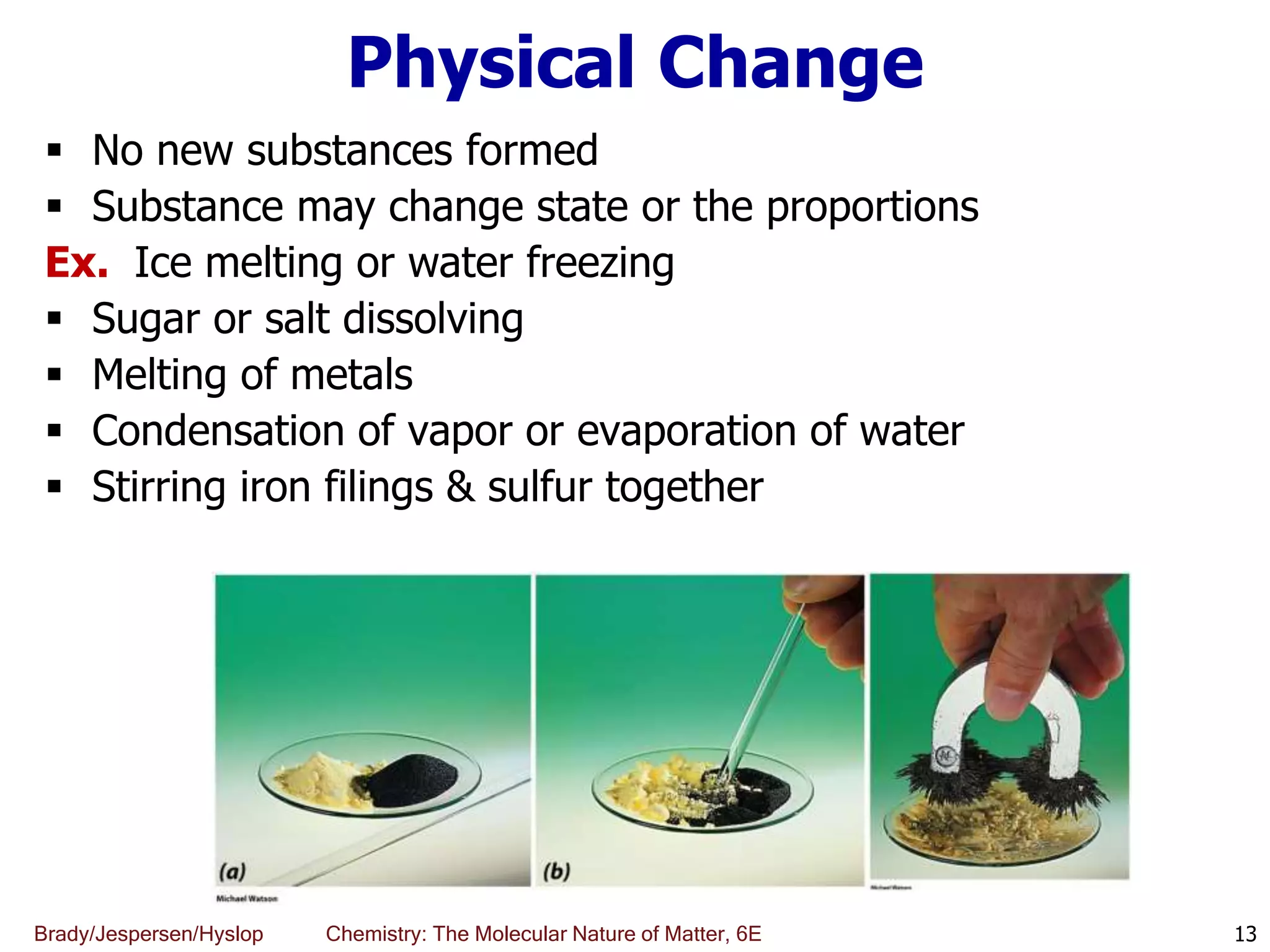
 Stirring iron filings & sulfur together
13
Brady/Jespersen/Hyslop Chemistry: The Molecular Nature of Matter, 6E
Chemical Change
or Chemical Reaction
 Formation of new substance or compound
 Involves changing chemical makeup of substances
 New substance has different physical properties
 Can’t be separated by physical means
Ex.
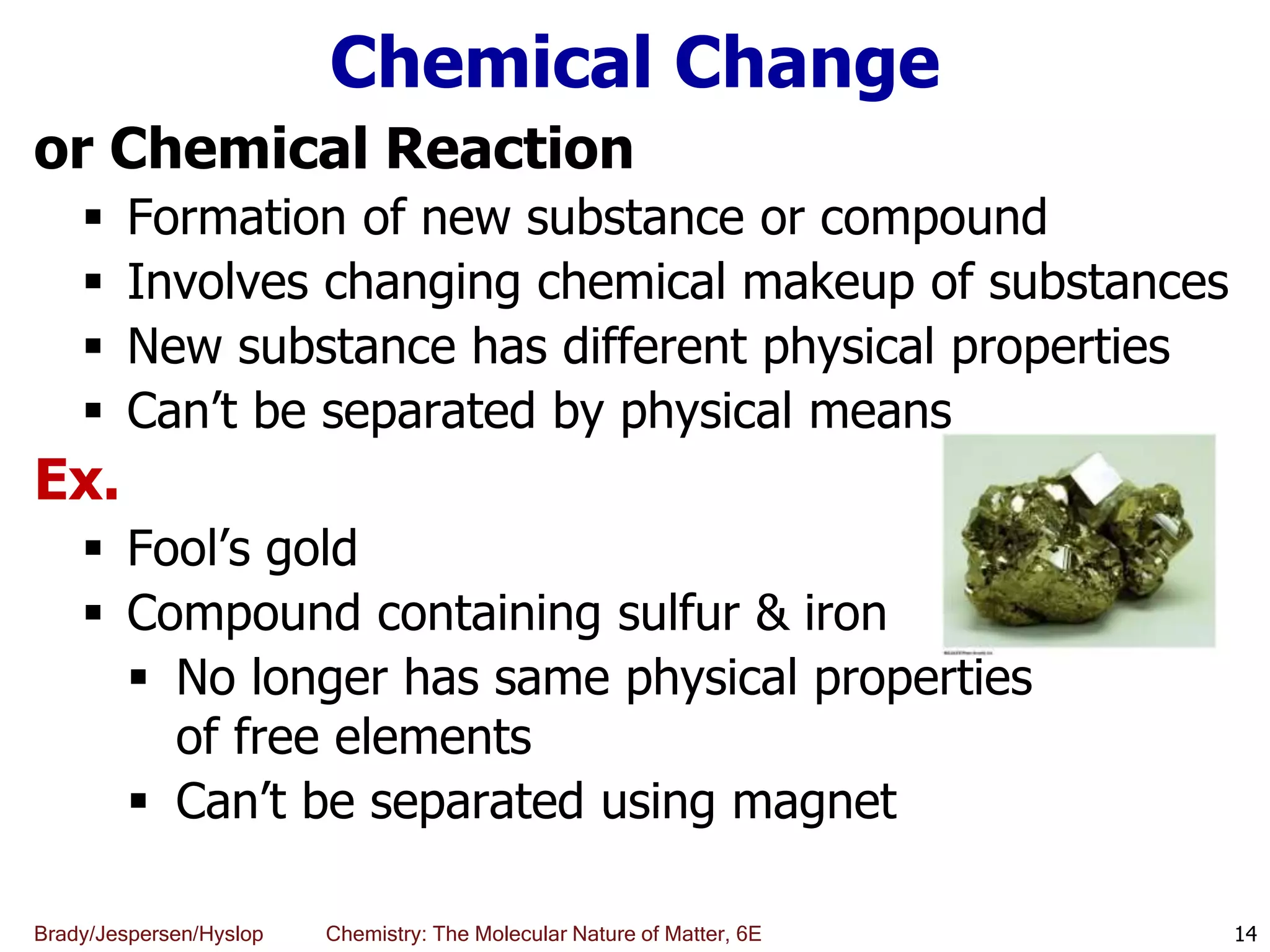
 Fool’s gold
 Compound containing sulfur & iron
 No longer has same physical properties
of free elements
 Can’t be separated using magnet
14
Brady/Jespersen/Hyslop Chemistry: The Molecular Nature of Matter, 6E
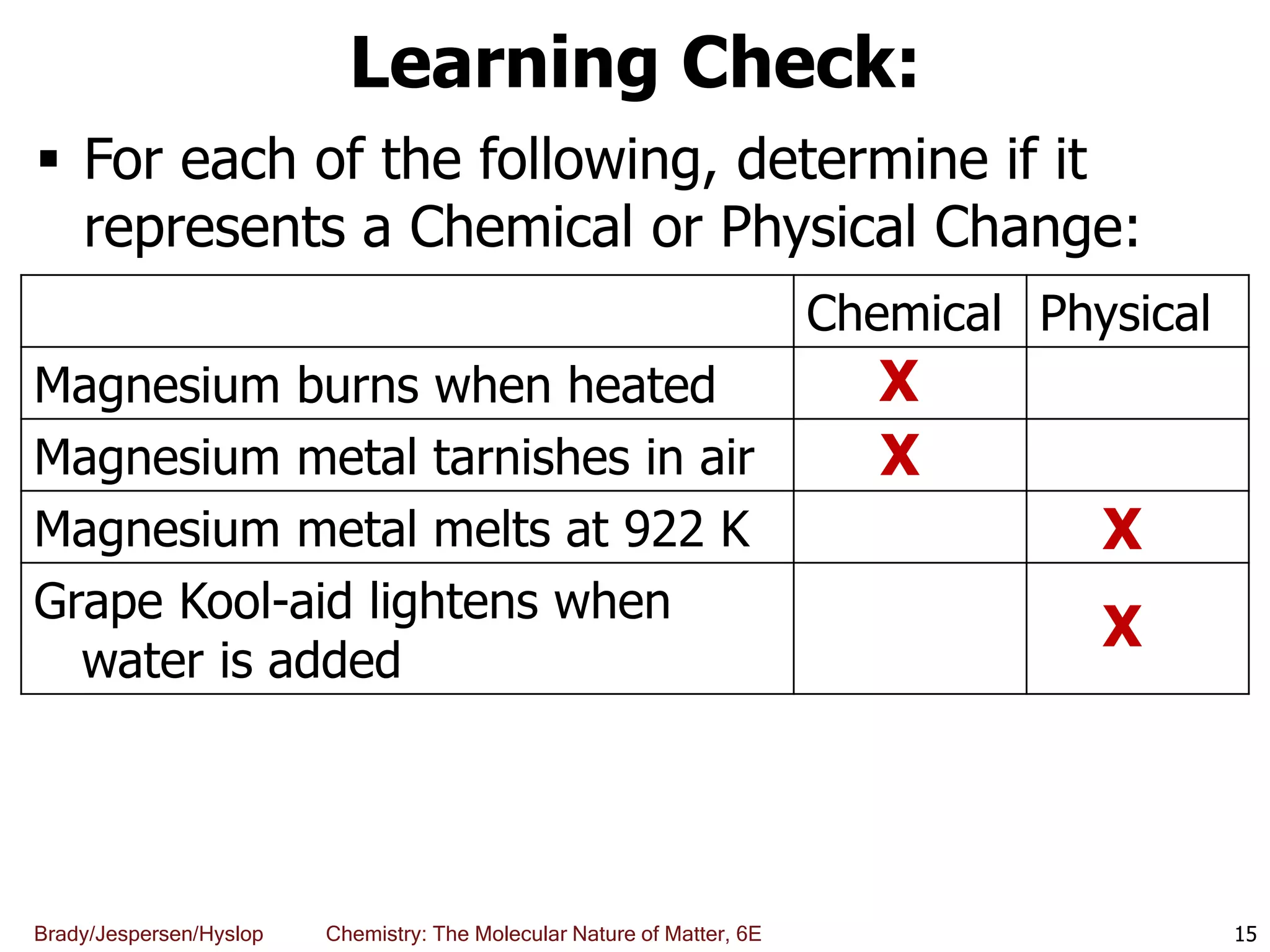
Learning Check:
Chemical Physical
Magnesium burns when heated
Magnesium metal tarnishes in air
Magnesium metal melts at 922 K
Grape Kool-aid lightens when
water is added
15
 For each of the following, determine if it
represents a Chemical or Physical Change:
X
X
X
X
Brady/Jespersen/Hyslop Chemistry: The Molecular Nature of Matter, 6E
Classification of Matter
16
Brady/Jespersen/Hyslop Chemistry: The Molecular Nature of Matter, 6E
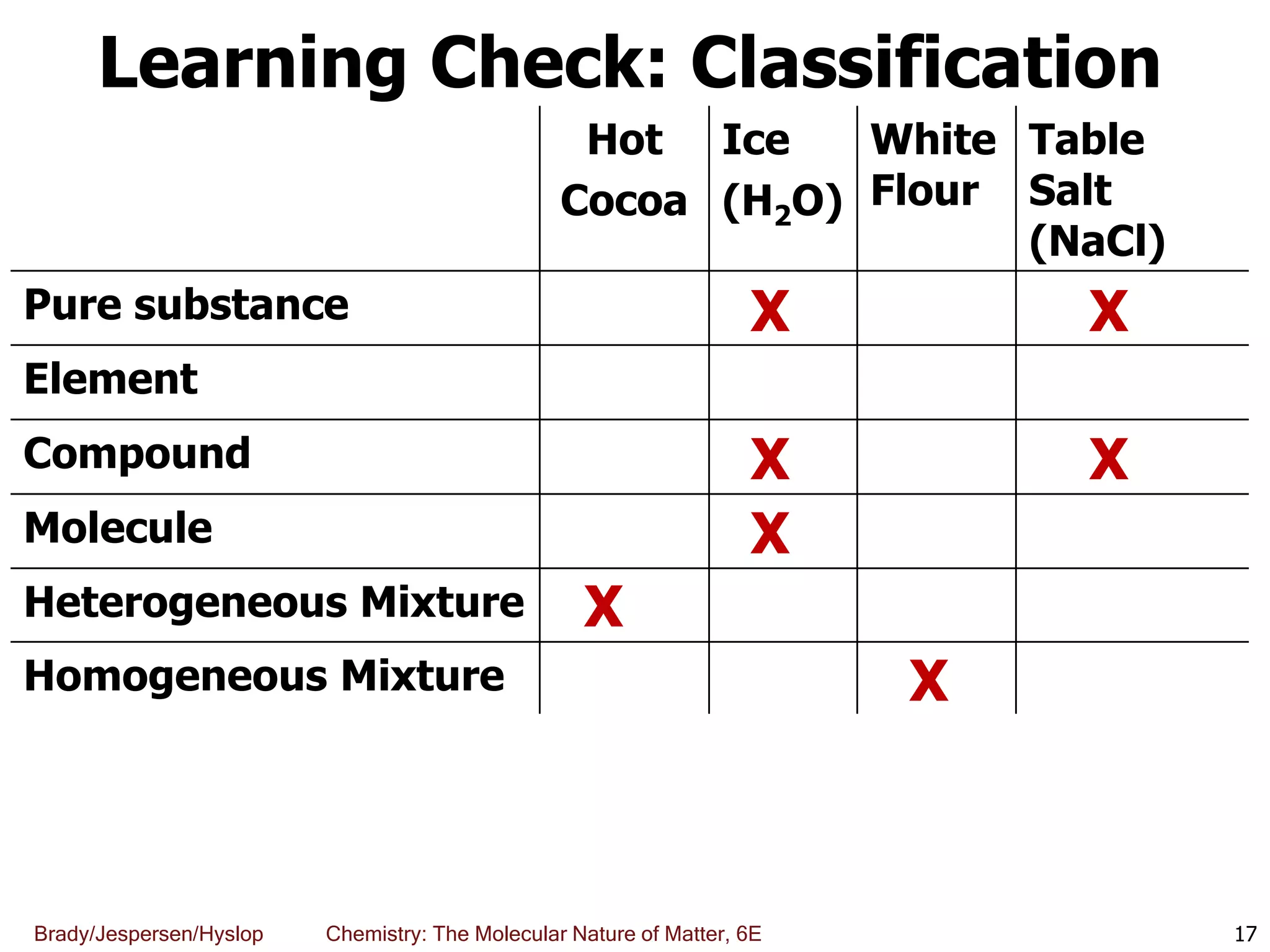
Learning Check: Classification
Hot
Cocoa
Ice
(H2O)
White
Flour
Table
Salt
(NaCl)
Pure substance
Element
Compound
Molecule
Heterogeneous Mixture
Homogeneous Mixture
17
X
X
X
X X
X
X
Brady/Jespersen/Hyslop Chemistry: The Molecular Nature of Matter, 6E
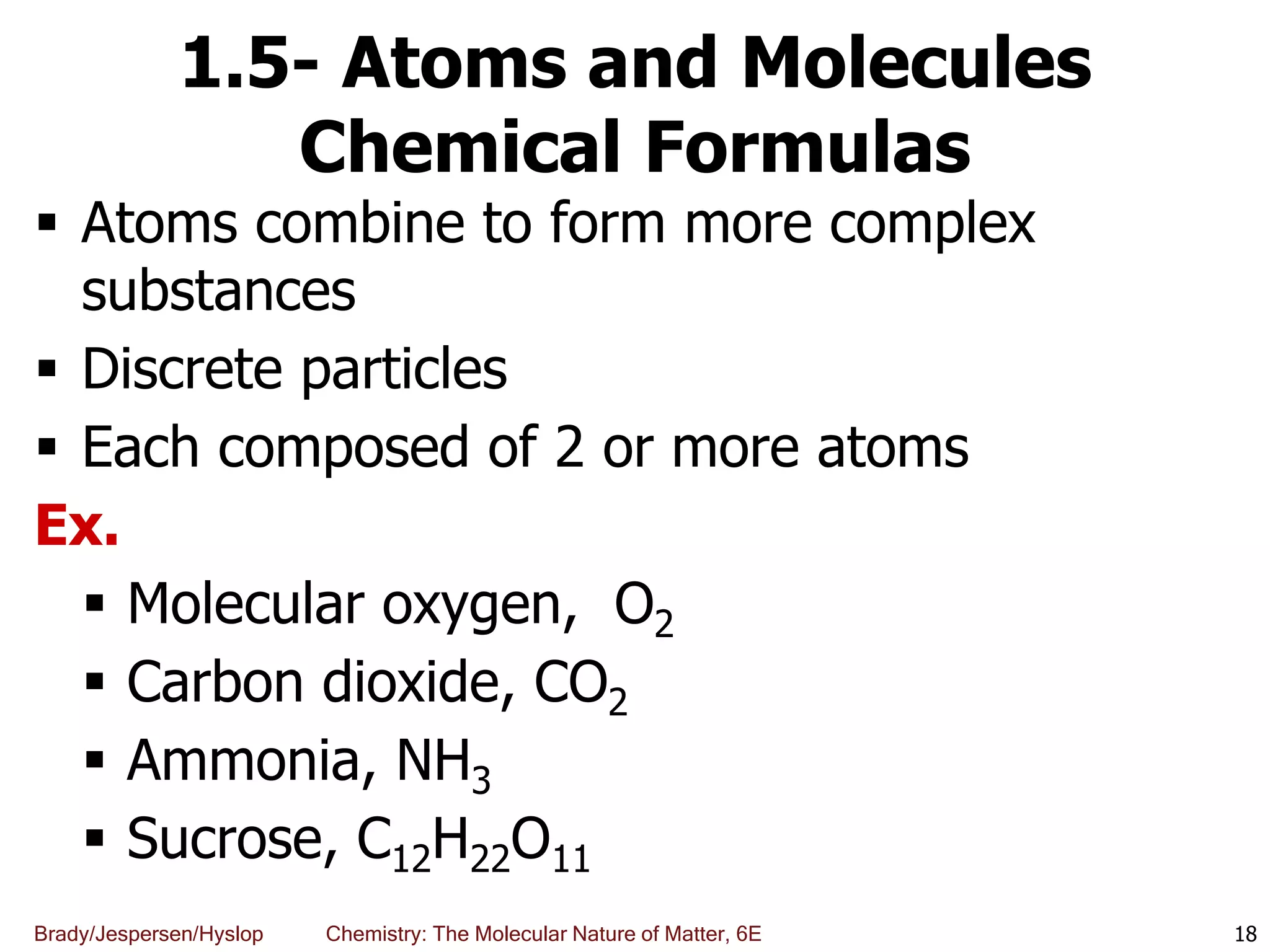
1.5- Atoms and Molecules
Chemical Formulas
 Atoms combine to form more complex
substances
 Discrete particles
 Each composed of 2 or more atoms
Ex.
 Molecular oxygen, O2
 Carbon dioxide, CO2
 Ammonia, NH3
 Sucrose, C12H22O11
18
Brady/Jespersen/Hyslop Chemistry: The Molecular Nature of Matter, 6E
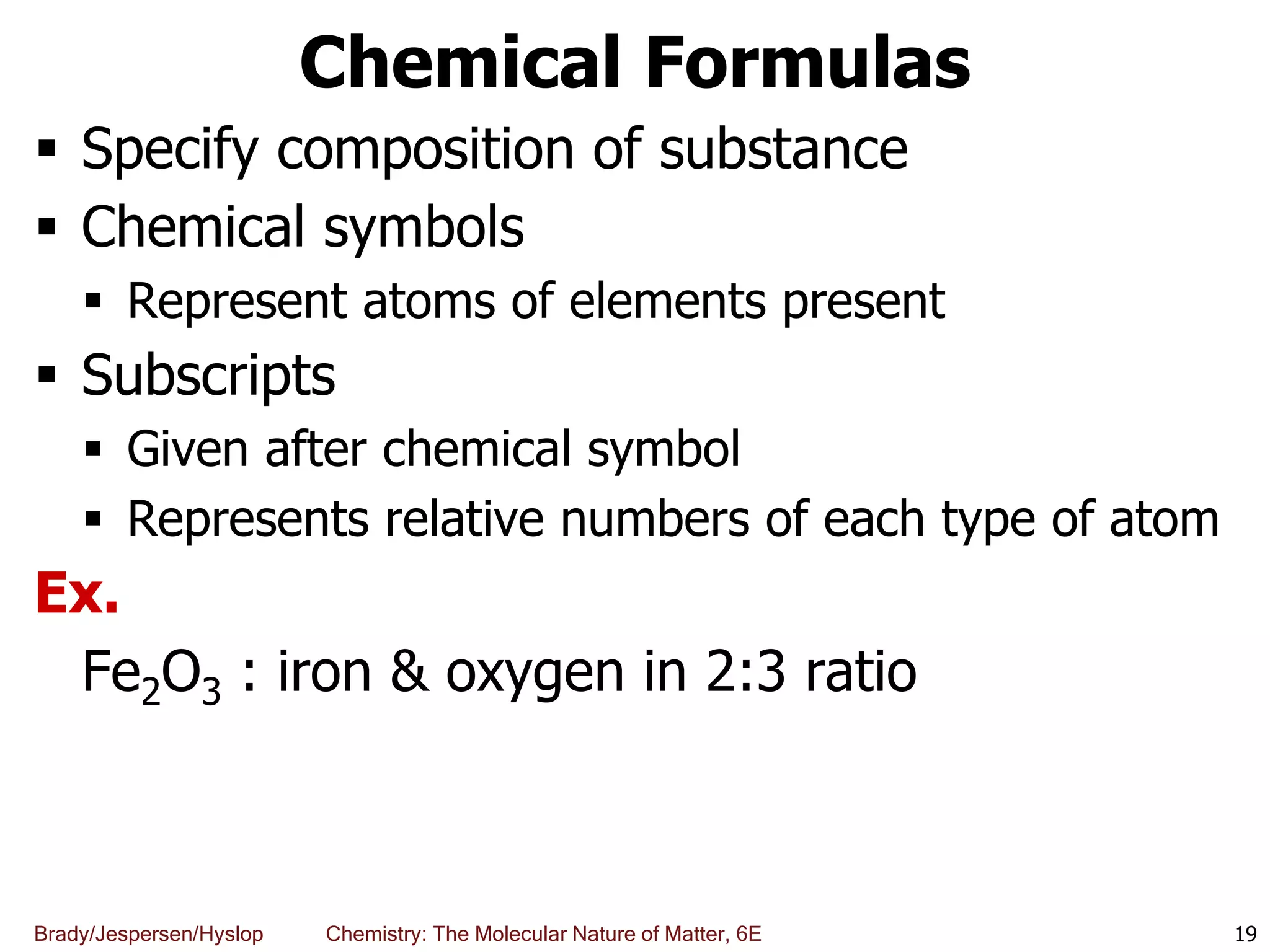
Chemical Formulas
 Specify composition of substance
 Chemical symbols
 Represent atoms of elements present
 Subscripts
 Given after chemical symbol
 Represents relative numbers of each type of atom
Ex.
Fe2O3 : iron & oxygen in 2:3 ratio
19
Brady/Jespersen/Hyslop Chemistry: The Molecular Nature of Matter, 6E
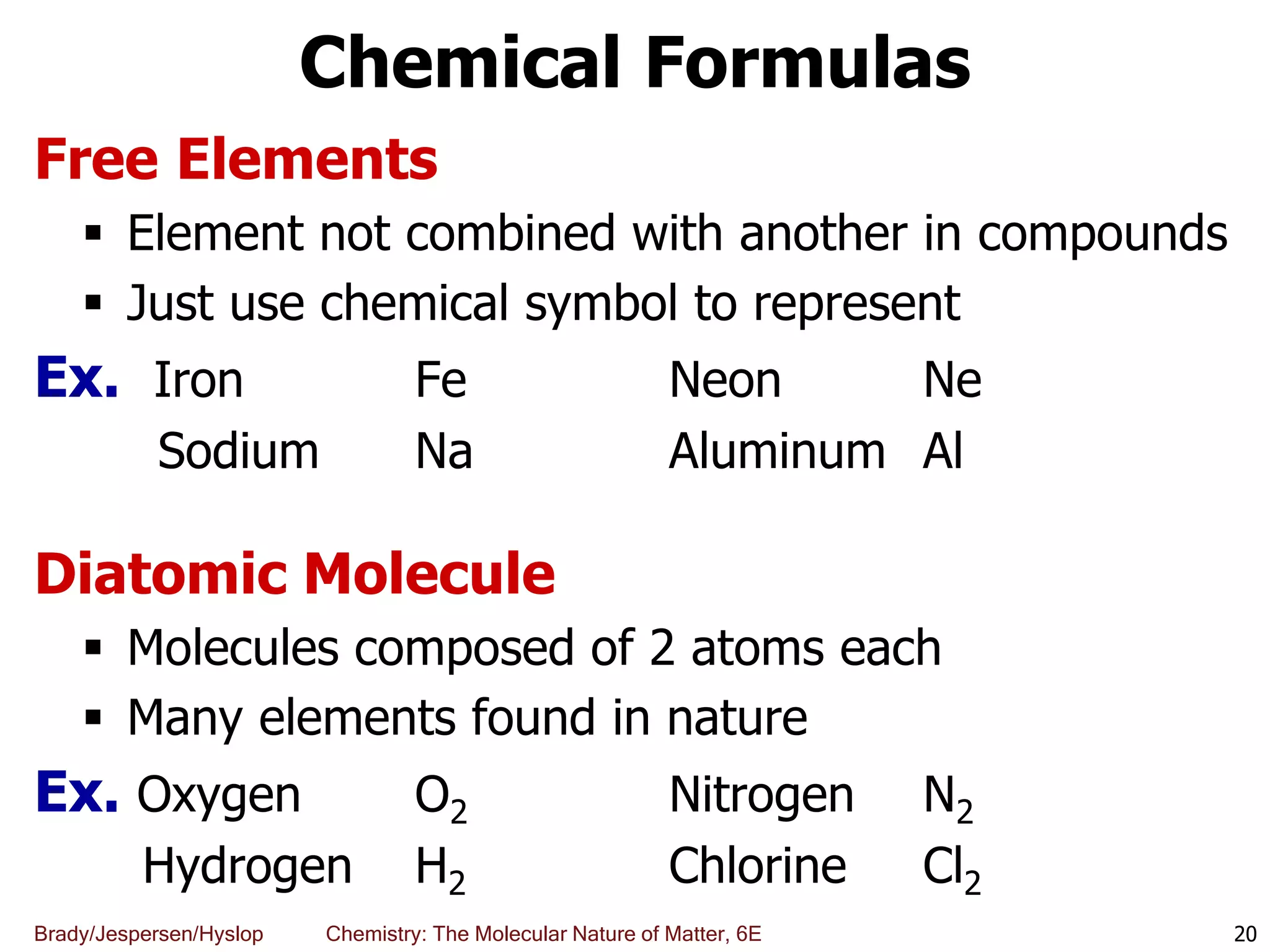
Chemical Formulas
Free Elements
 Element not combined with another in compounds
 Just use chemical symbol to represent
Ex. Iron Fe Neon Ne
Sodium Na Aluminum Al
Diatomic Molecule
 Molecules composed of 2 atoms each
 Many elements found in nature
Ex. Oxygen O2 Nitrogen N2
Hydrogen H2 Chlorine Cl2
20
Brady/Jespersen/Hyslop Chemistry: The Molecular Nature of Matter, 6E
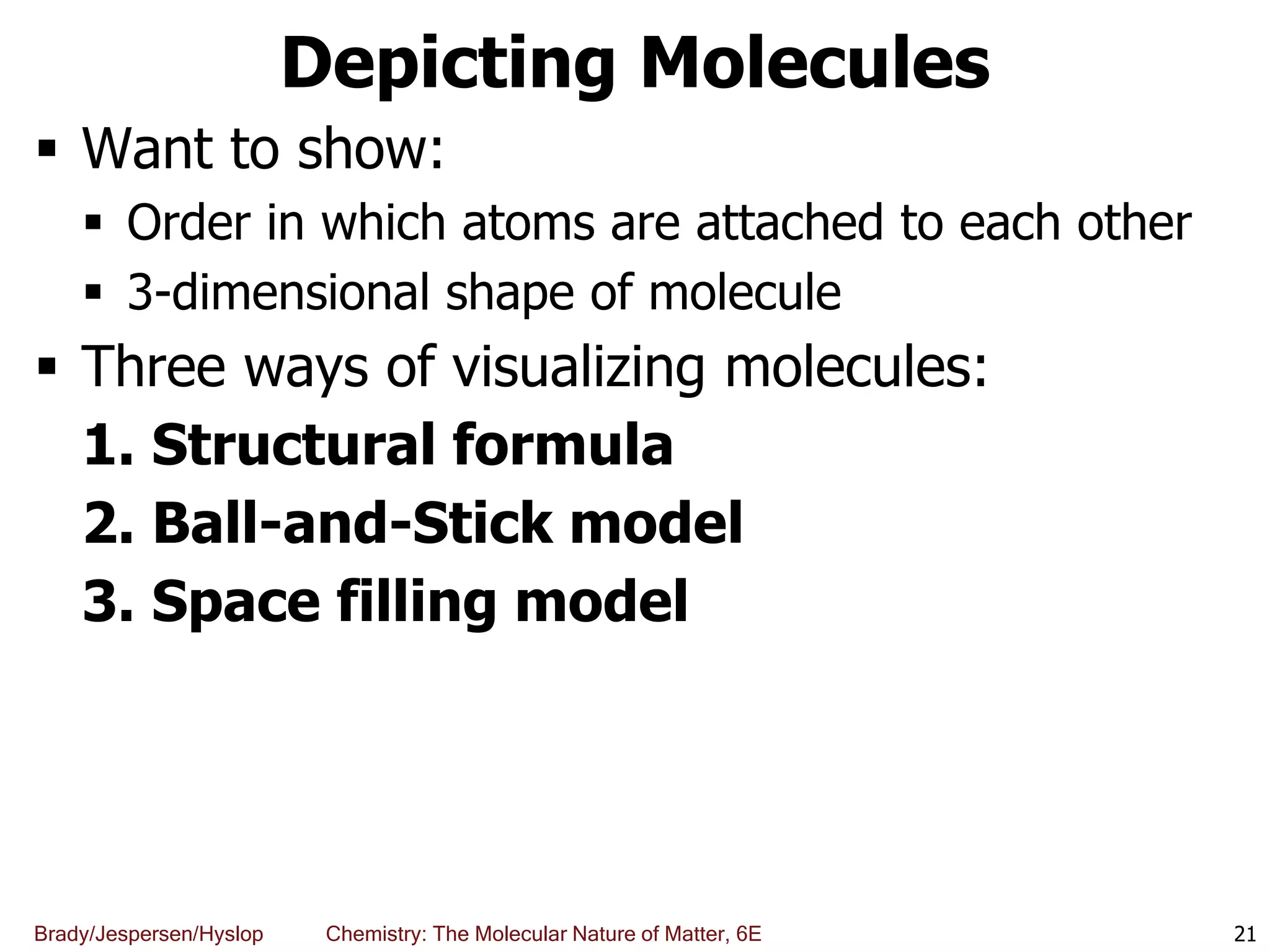
Depicting Molecules
 Want to show:
 Order in which atoms are attached to each other
 3-dimensional shape of molecule
 Three ways of visualizing molecules:
1. Structural formula
2. Ball-and-Stick model
3. Space filling model
21
Brady/Jespersen/Hyslop Chemistry: The Molecular Nature of Matter, 6E
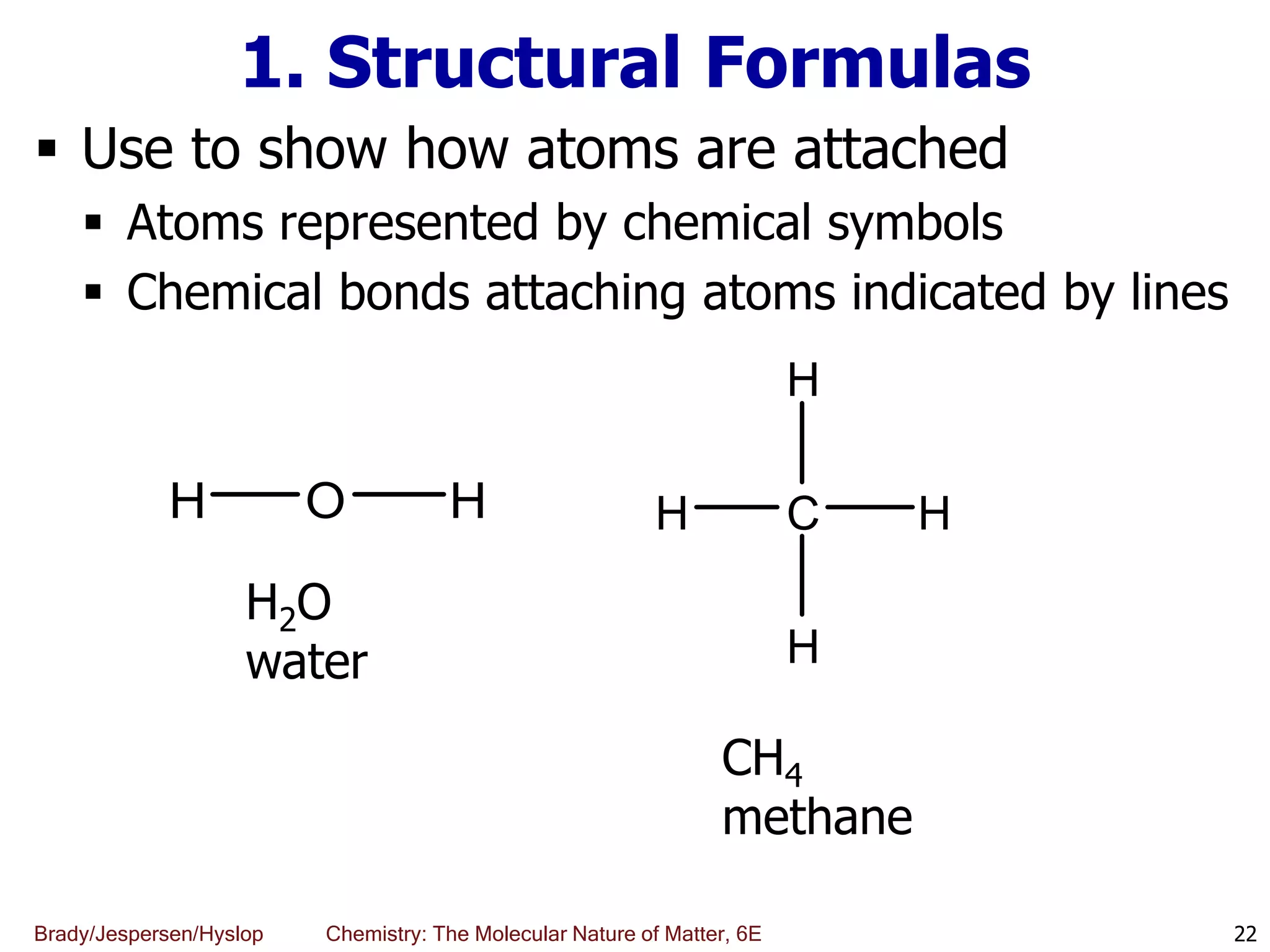
1. Structural Formulas
 Use to show how atoms are attached
 Atoms represented by chemical symbols
 Chemical bonds attaching atoms indicated by lines
22
H O H H C H
H
H
H2O
water
CH4
methane
Brady/Jespersen/Hyslop Chemistry: The Molecular Nature of Matter, 6E
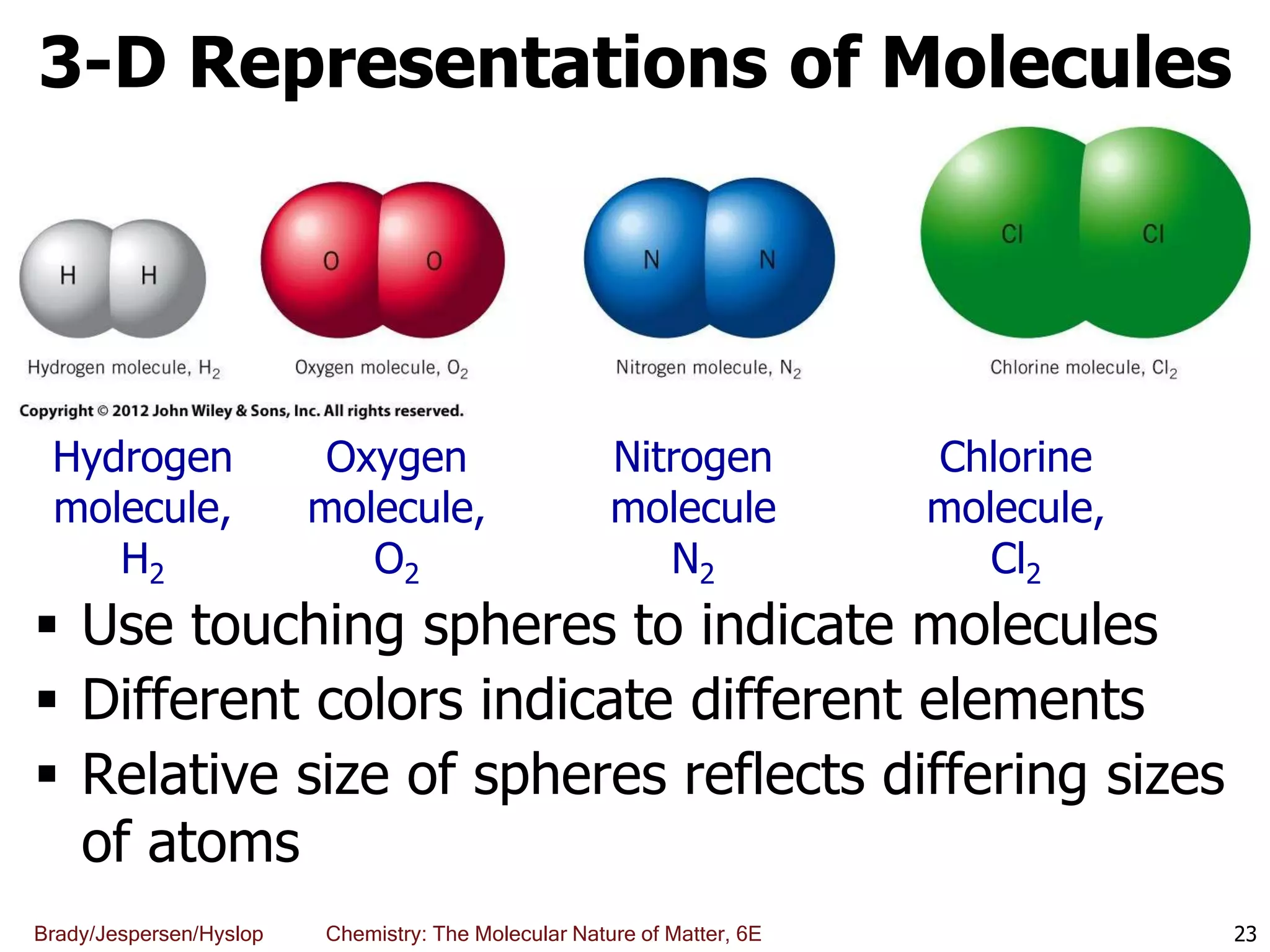
3-D Representations of Molecules
 Use touching spheres to indicate molecules
 Different colors indicate different elements
 Relative size of spheres reflects differing sizes
of atoms
23
Hydrogen
molecule,
H2
Oxygen
molecule,
O2
Nitrogen
molecule
N2
Chlorine
molecule,
Cl2
Brady/Jespersen/Hyslop Chemistry: The Molecular Nature of Matter, 6E
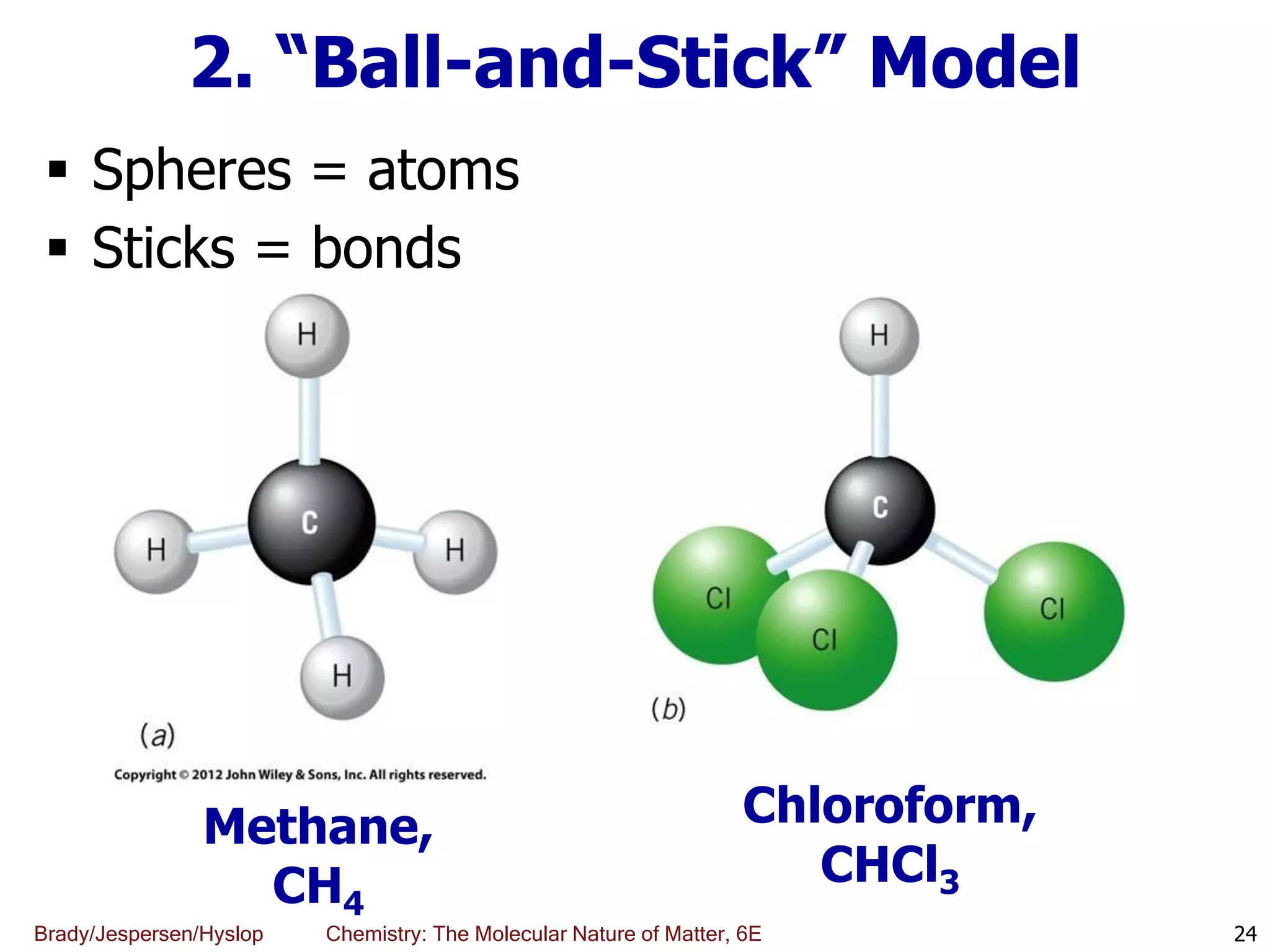
2. “Ball-and-Stick” Model
 Spheres = atoms
 Sticks = bonds
24
Chloroform,
CHCl3
Methane,
CH4
Brady/Jespersen/Hyslop Chemistry: The Molecular Nature of Matter, 6E
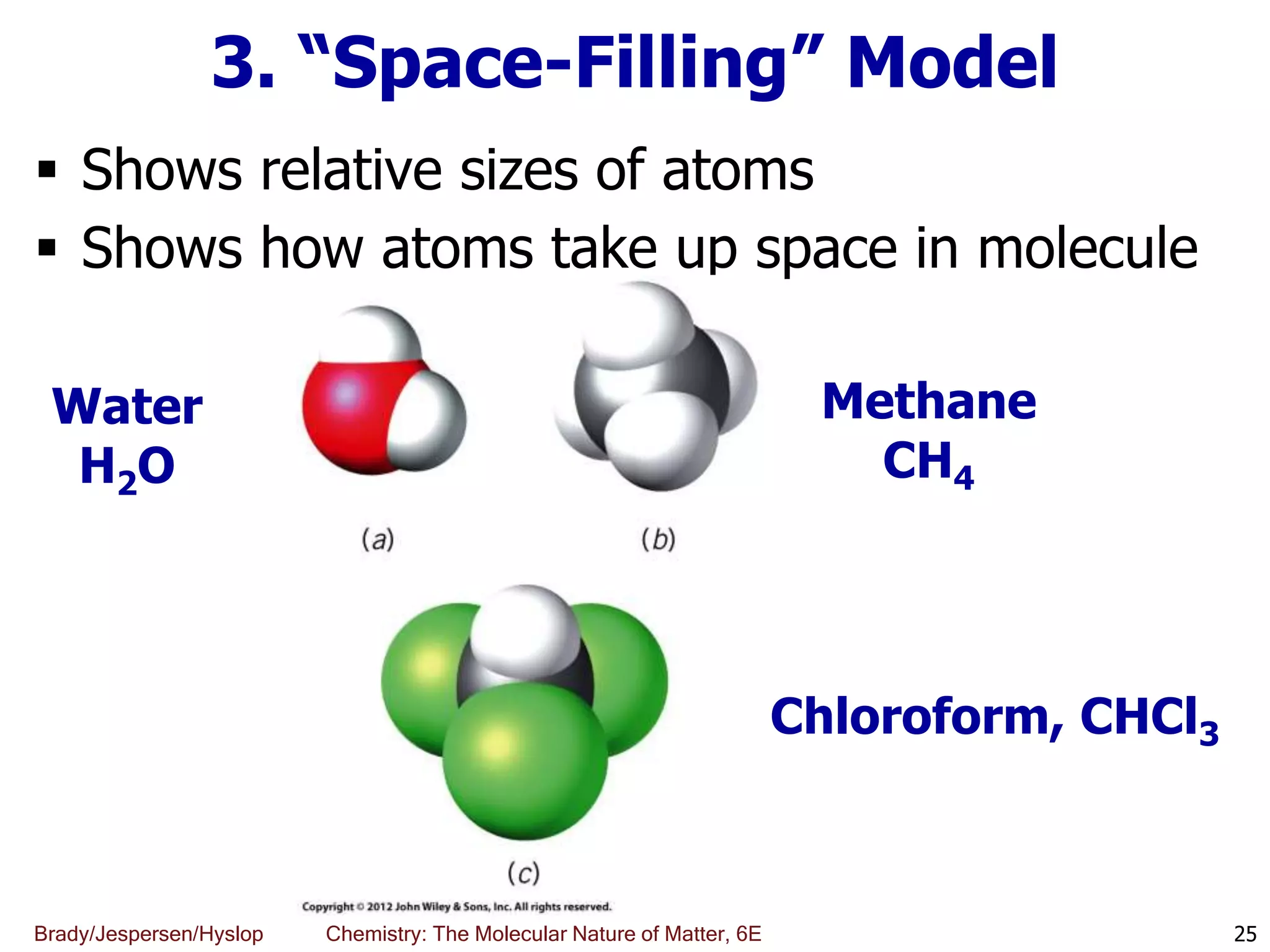
3. “Space-Filling” Model
 Shows relative sizes of atoms
 Shows how atoms take up space in molecule
25
Chloroform, CHCl3
Methane
CH4
Water
H2O
Brady/Jespersen/Hyslop Chemistry: The Molecular Nature of Matter, 6E
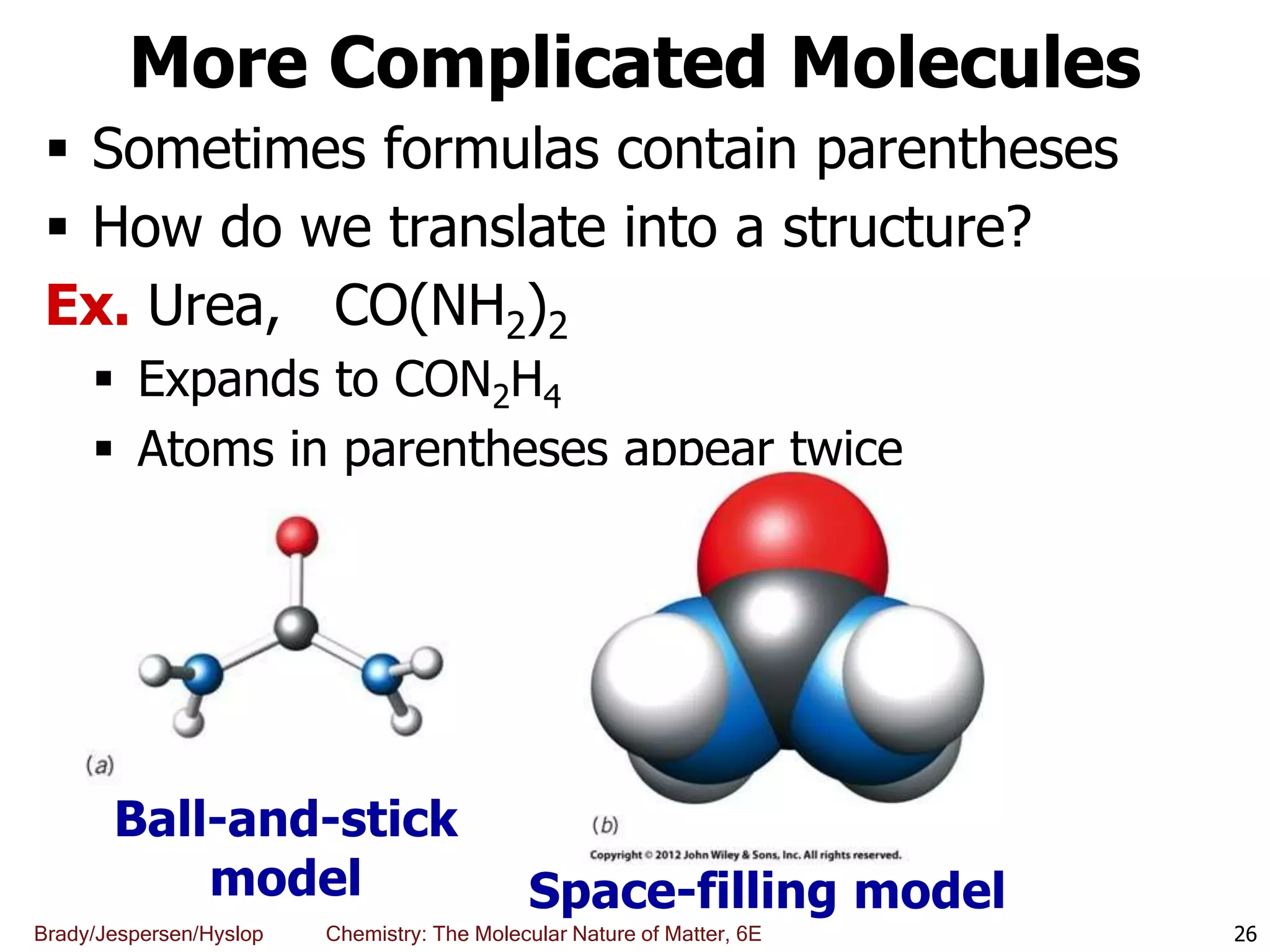
More Complicated Molecules
 Sometimes formulas contain parentheses
 How do we translate into a structure?
Ex. Urea, CO(NH2)2
 Expands to CON2H4
 Atoms in parentheses appear twice
26
Ball-and-stick
model Space-filling model
Brady/Jespersen/Hyslop Chemistry: The Molecular Nature of Matter, 6E
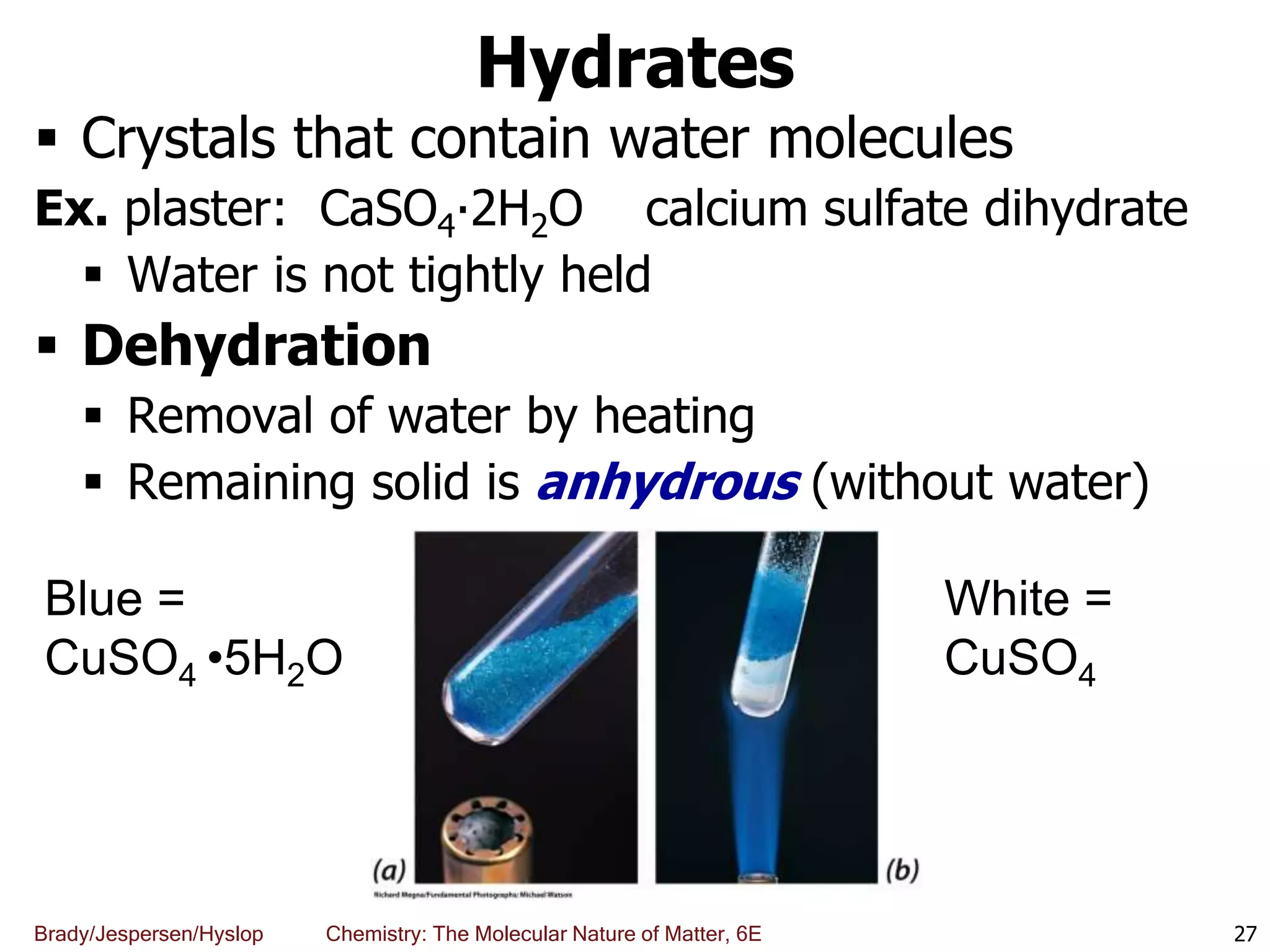
Hydrates
 Crystals that contain water molecules
Ex. plaster: CaSO4∙2H2O calcium sulfate dihydrate
 Water is not tightly held
 Dehydration
 Removal of water by heating
 Remaining solid is anhydrous (without water)
27
Blue =
CuSO4 •5H2O
White =
CuSO4
Brady/Jespersen/Hyslop Chemistry: The Molecular Nature of Matter, 6E
Counting Atoms
1. Subscript following chemical symbol
indicates how many of that element are part
of the formula
 No subscript implies a subscript of 1.
2. Quantity in parentheses is repeated a
number of times equal to the subscript that
follows.
3. Raised dot in formula indicates that the
substance is a hydrate
 Number preceding H2O specifies how
many water molecules are present.
28
Brady/Jespersen/Hyslop Chemistry: The Molecular Nature of Matter, 6E
Counting Atoms
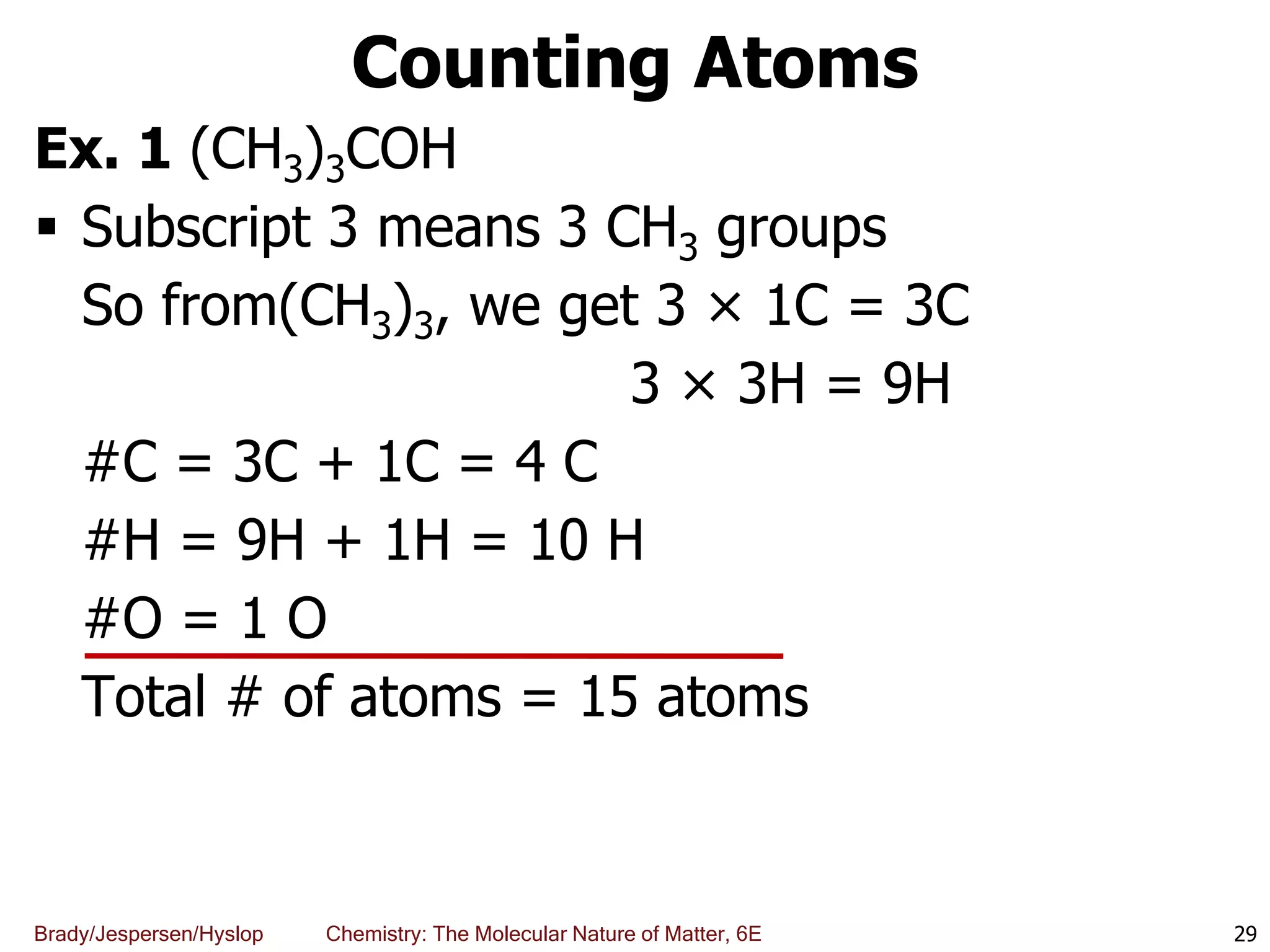
Ex. 1 (CH3)3COH
 Subscript 3 means 3 CH3 groups
So from(CH3)3, we get 3 × 1C = 3C
3 × 3H = 9H
#C = 3C + 1C = 4 C
#H = 9H + 1H = 10 H
#O = 1 O
Total # of atoms = 15 atoms
29
Brady/Jespersen/Hyslop Chemistry: The Molecular Nature of Matter, 6E
Counting Atoms
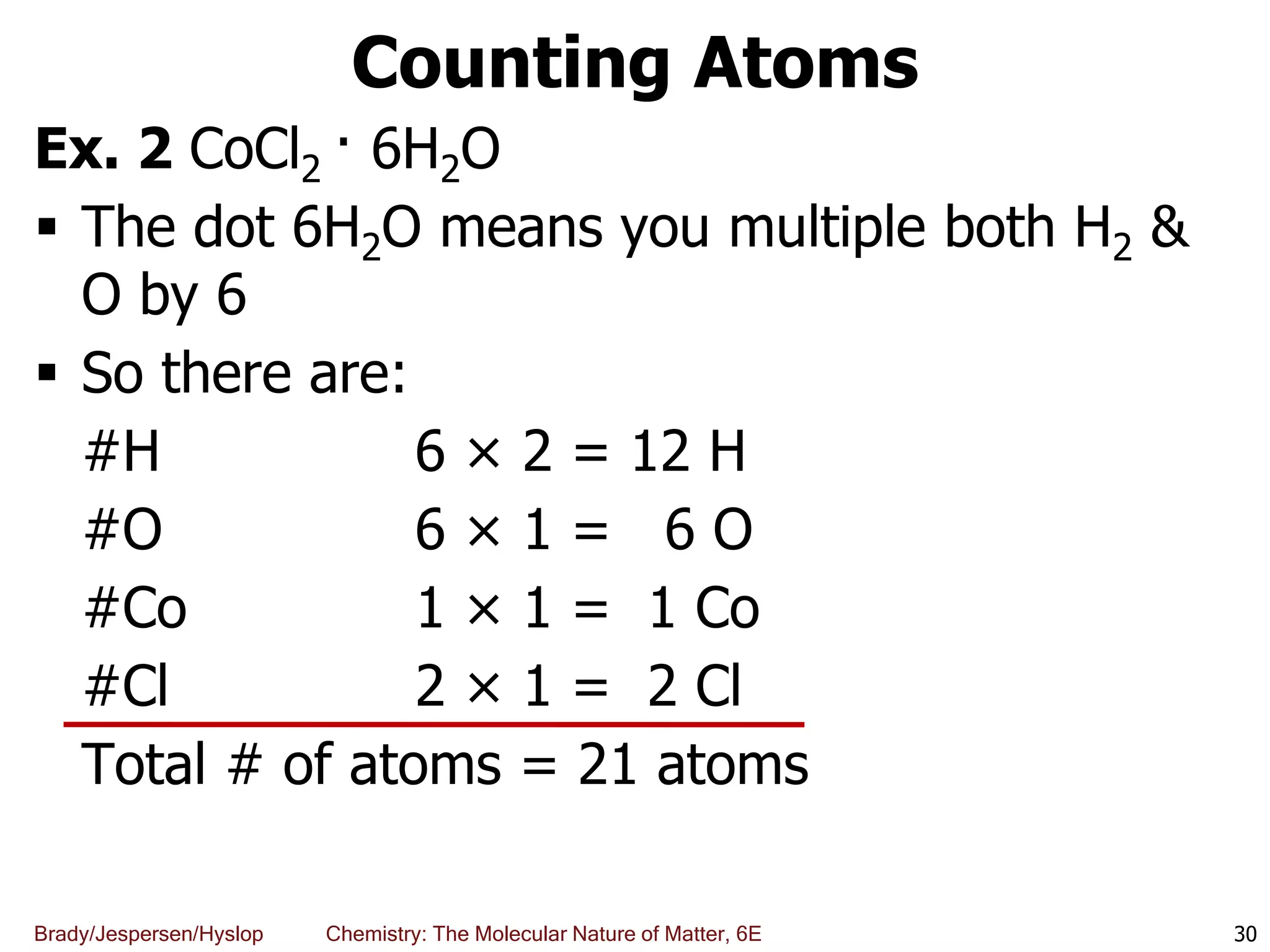
Ex. 2 CoCl2 · 6H2O
 The dot 6H2O means you multiple both H2 &
O by 6
 So there are:
#H 6 × 2 = 12 H
#O 6 × 1 = 6 O
#Co 1 × 1 = 1 Co
#Cl 2 × 1 = 2 Cl
Total # of atoms = 21 atoms
30
Brady/Jespersen/Hyslop Chemistry: The Molecular Nature of Matter, 6E
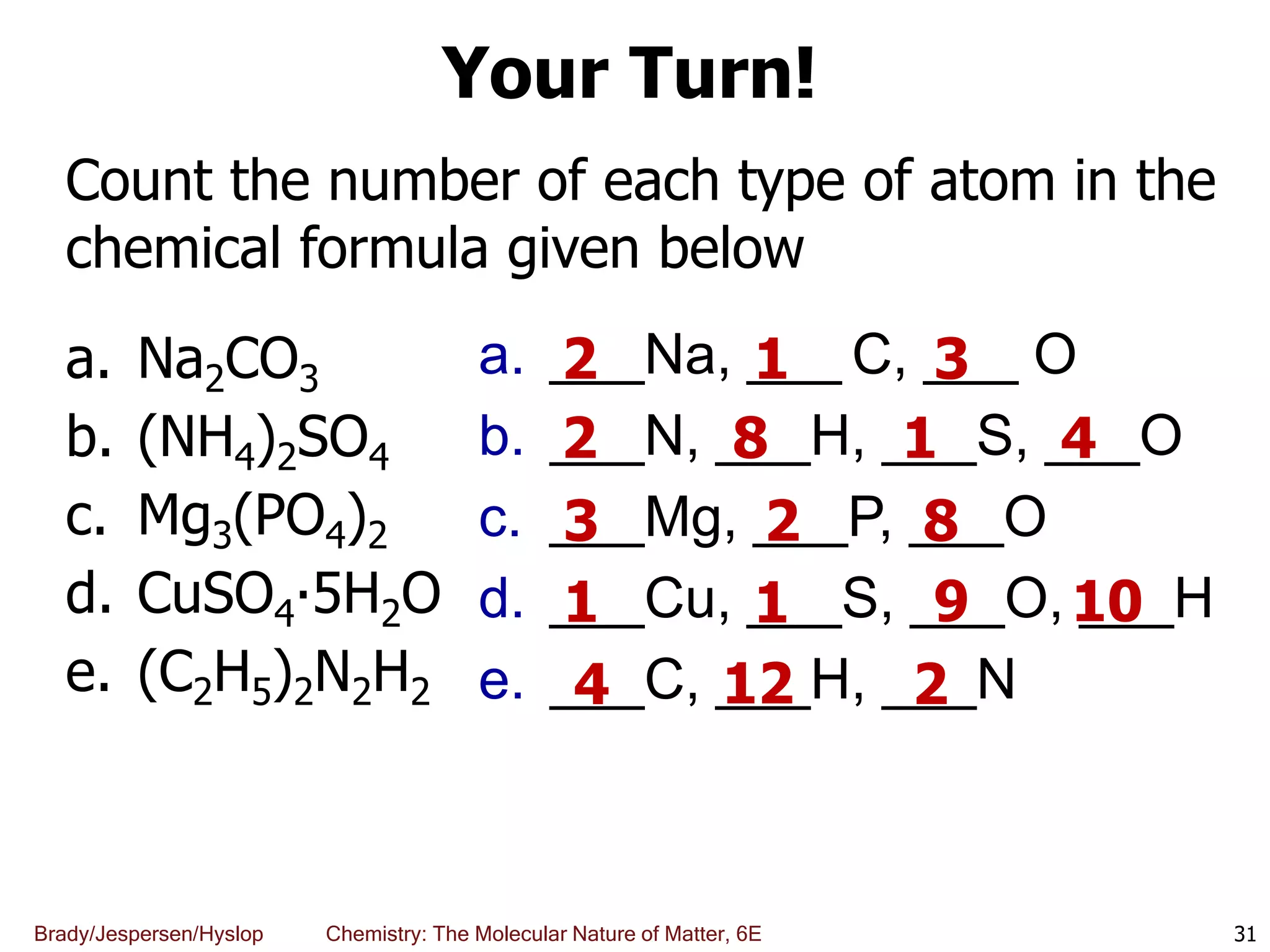
Your Turn!
a. Na2CO3
b. (NH4)2SO4
c. Mg3(PO4)2
d. CuSO4∙5H2O
e. (C2H5)2N2H2
31
a. ___Na, ___ C, ___ O
b. ___N, ___H, ___S, ___O
c. ___Mg, ___P, ___O
d. ___Cu, ___S, ___O, ___H
e. ___C, ___H, ___N
3
2 1
2 8 1 4
3 2 8
1 1 9 10
Count the number of each type of atom in the
chemical formula given below
4 12 2
Brady/Jespersen/Hyslop Chemistry: The Molecular Nature of Matter, 6E
1.6- Chemical Reactions
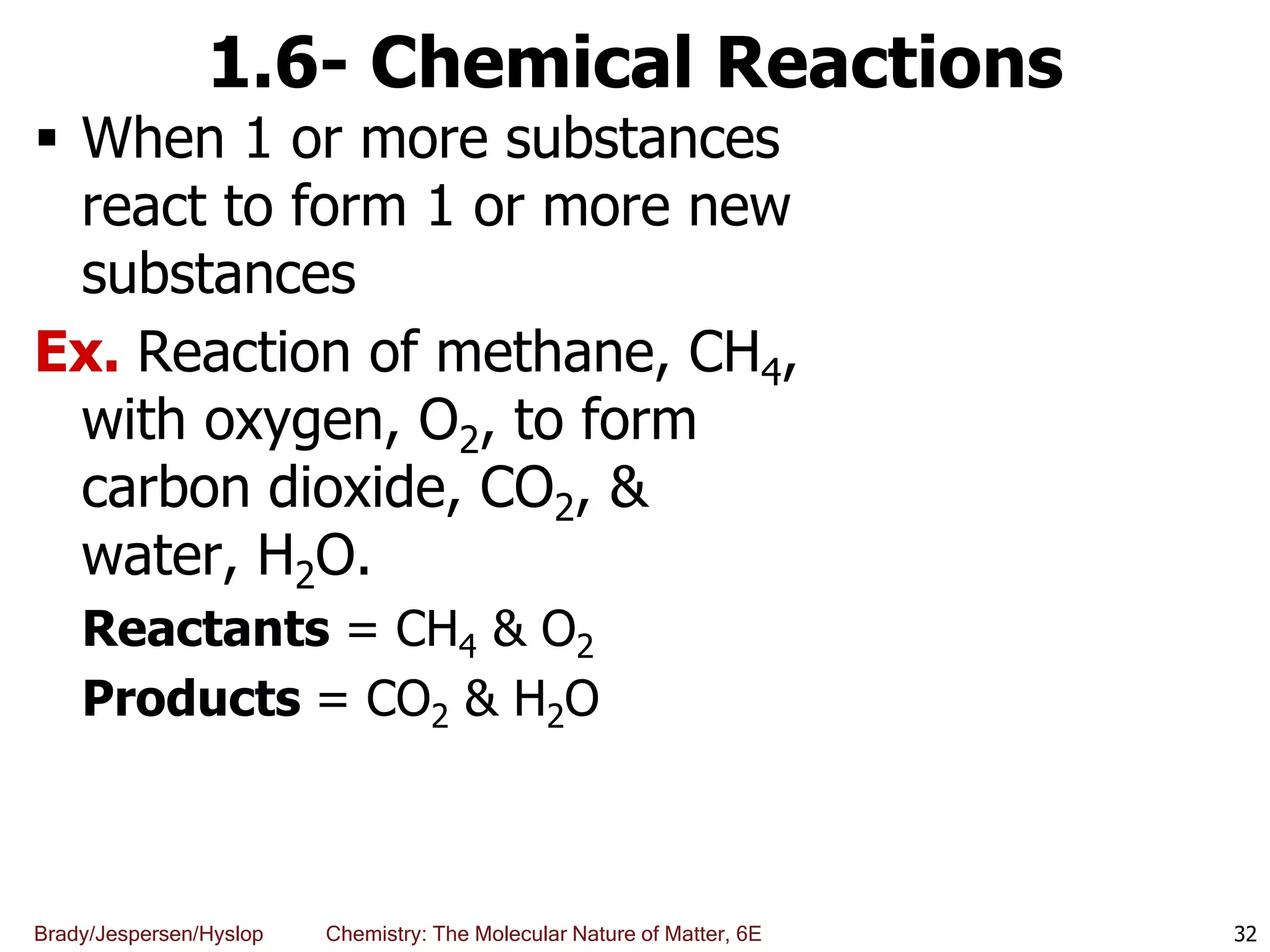
 When 1 or more substances
react to form 1 or more new
substances
Ex. Reaction of methane, CH4,
with oxygen, O2, to form
carbon dioxide, CO2, &
water, H2O.
Reactants = CH4 & O2
Products = CO2 & H2O
32
Brady/Jespersen/Hyslop Chemistry: The Molecular Nature of Matter, 6E
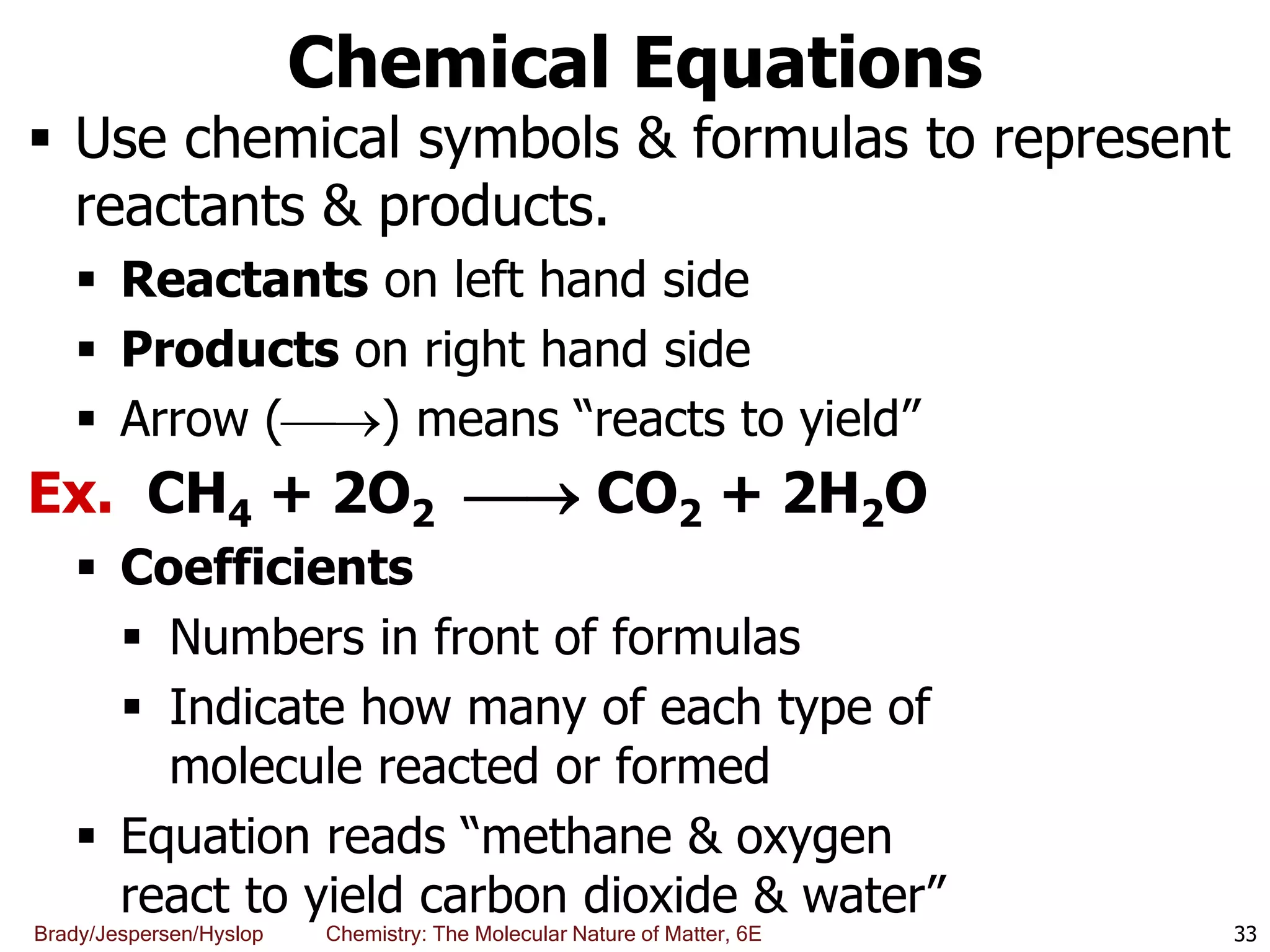
Chemical Equations
 Use chemical symbols & formulas to represent
reactants & products.
 Reactants on left hand side
 Products on right hand side
 Arrow () means “reacts to yield”
Ex. CH4 + 2O2  CO2 + 2H2O
 Coefficients
 Numbers in front of formulas
 Indicate how many of each type of
molecule reacted or formed
 Equation reads “methane & oxygen
react to yield carbon dioxide & water”
33
Brady/Jespersen/Hyslop Chemistry: The Molecular Nature of Matter, 6E
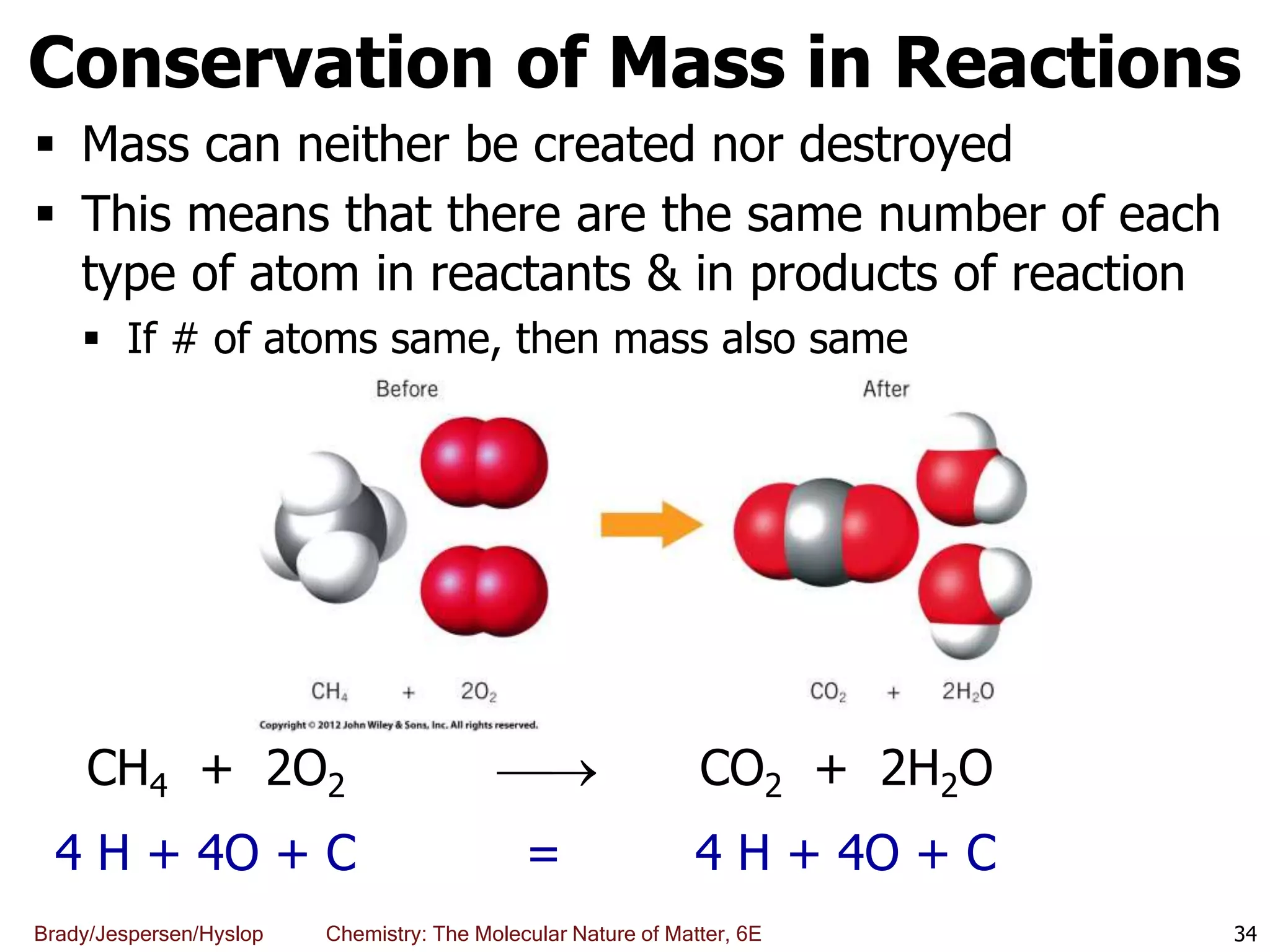
Conservation of Mass in Reactions
 Mass can neither be created nor destroyed
 This means that there are the same number of each
type of atom in reactants & in products of reaction
 If # of atoms same, then mass also same
34
CH4 + 2O2  CO2 + 2H2O
4 H + 4O + C = 4 H + 4O + C
Brady/Jespersen/Hyslop Chemistry: The Molecular Nature of Matter, 6E
Balanced Chemical Equation
Ex. 2C4H10 + 13O2  8CO2 + 10H2O
35
4 C & 10 H
per
molecule
2 O per
molecule
2 H & 1 O
per
molecule
1 C & 2 O
per
molecule
Brady/Jespersen/Hyslop Chemistry: The Molecular Nature of Matter, 6E
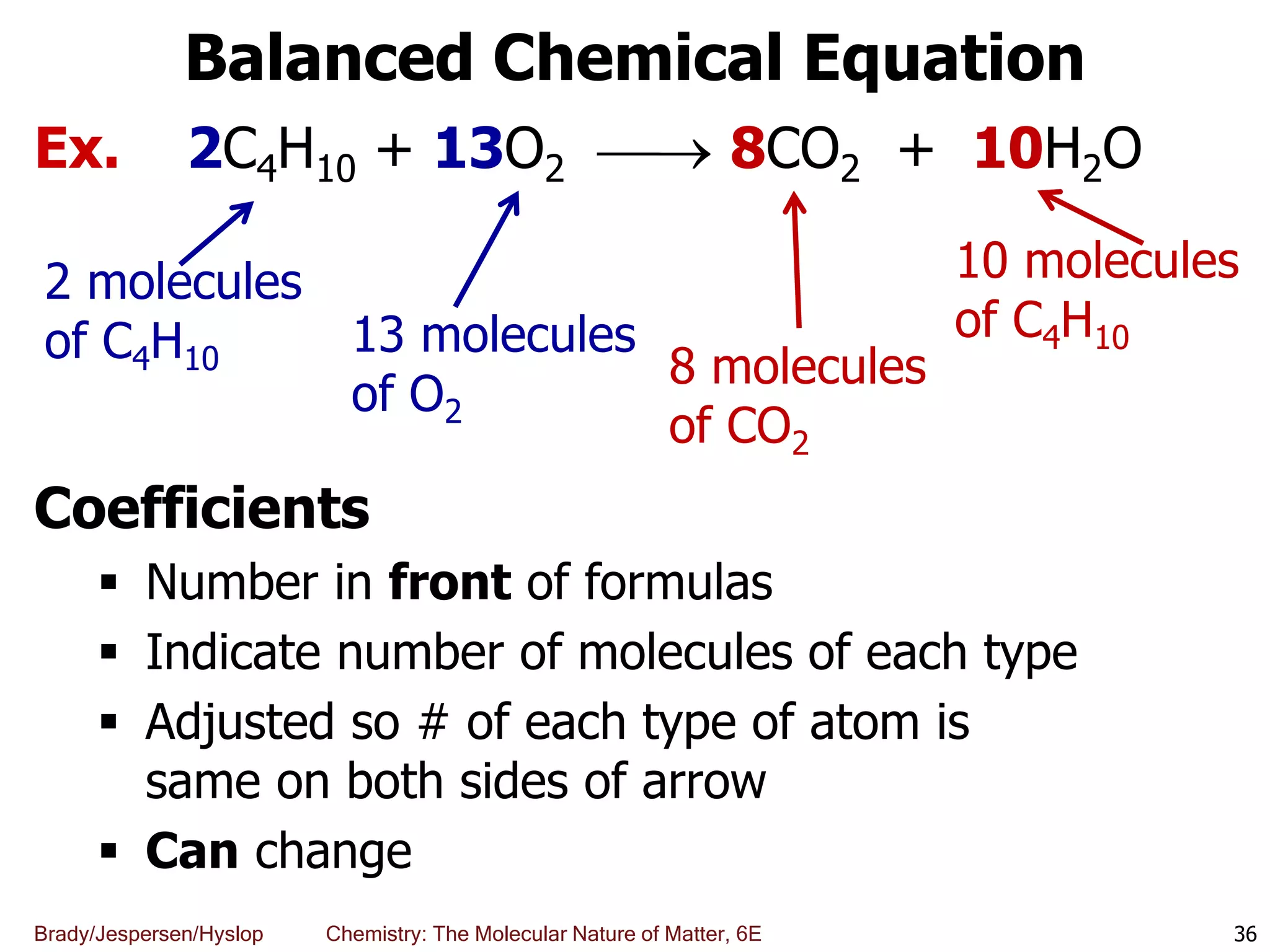
Balanced Chemical Equation
Ex. 2C4H10 + 13O2  8CO2 + 10H2O
36
2 molecules
of C4H10
13 molecules
of O2
10 molecules
of C4H10
8 molecules
of CO2
Coefficients
 Number in front of formulas
 Indicate number of molecules of each type
 Adjusted so # of each type of atom is
same on both sides of arrow
 Can change
Brady/Jespersen/Hyslop Chemistry: The Molecular Nature of Matter, 6E
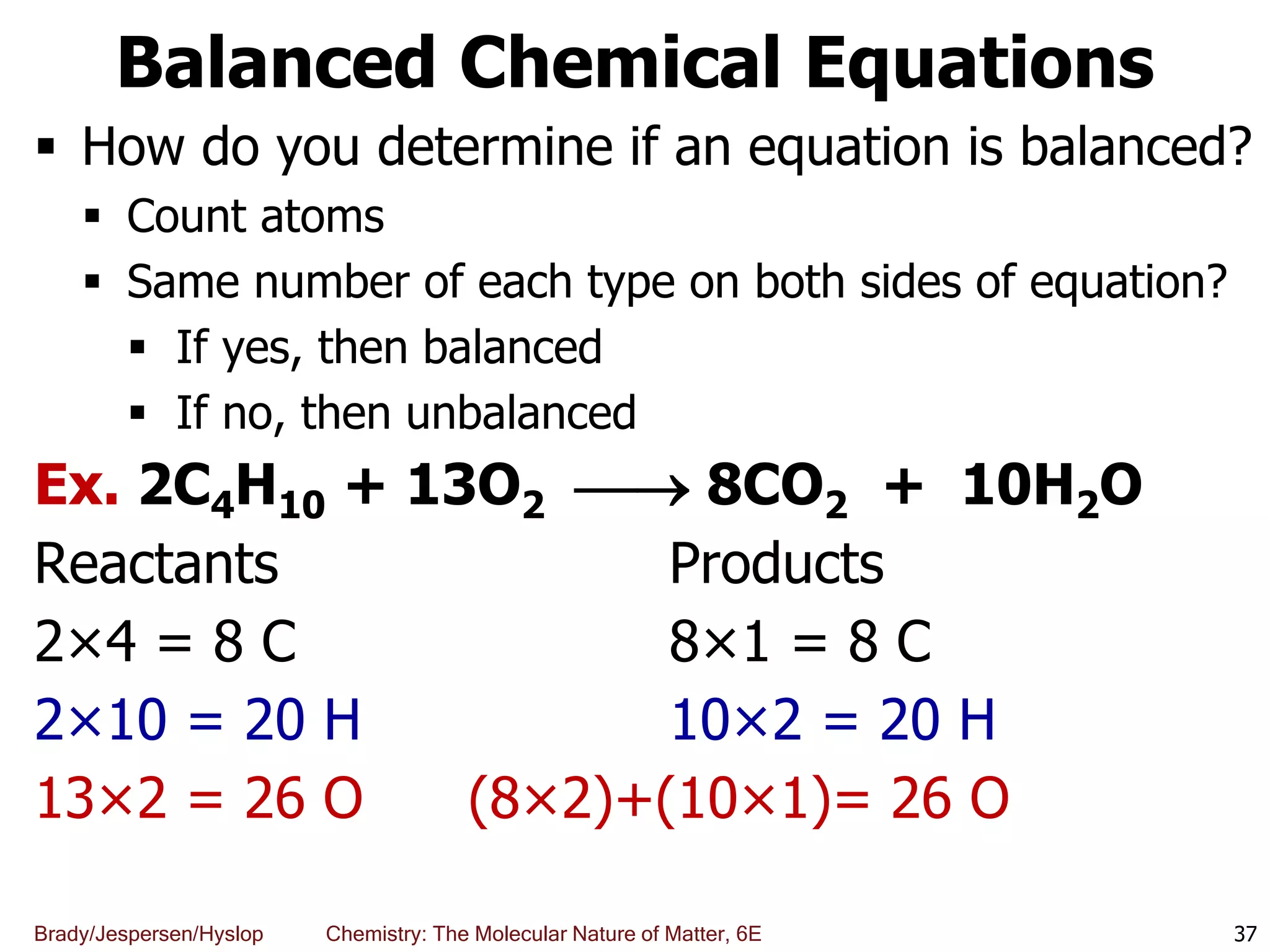
Balanced Chemical Equations
 How do you determine if an equation is balanced?
 Count atoms
 Same number of each type on both sides of equation?
 If yes, then balanced
 If no, then unbalanced
Ex. 2C4H10 + 13O2  8CO2 + 10H2O
Reactants Products
2×4 = 8 C 8×1 = 8 C
2×10 = 20 H 10×2 = 20 H
13×2 = 26 O (8×2)+(10×1)= 26 O
37
Brady/Jespersen/Hyslop Chemistry: The Molecular Nature of Matter, 6E
Learning Check
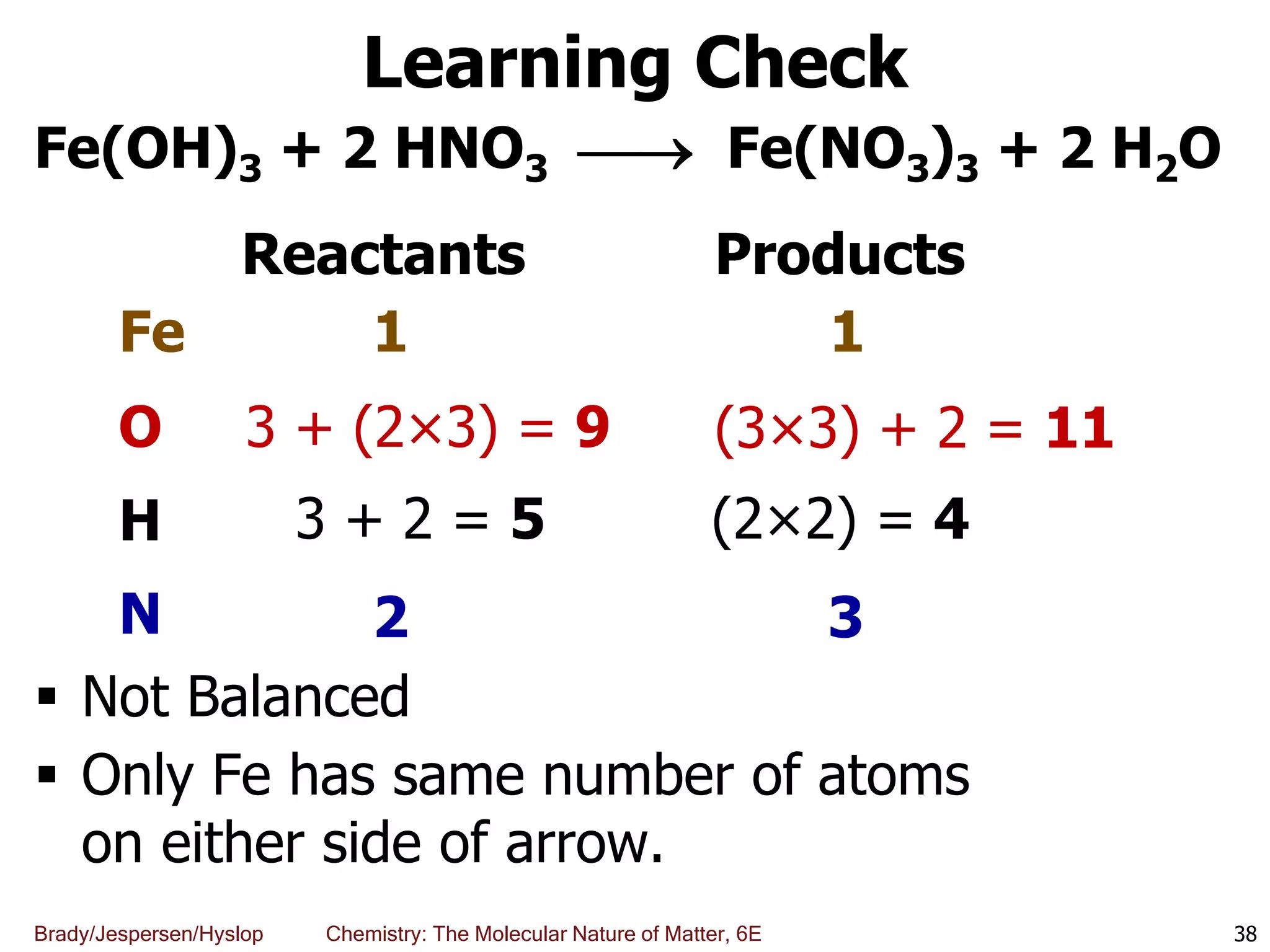
Fe(OH)3 + 2 HNO3  Fe(NO3)3 + 2 H2O
 Not Balanced
 Only Fe has same number of atoms
on either side of arrow.
38
Reactants Products
Fe 1 1
3 + (2×3) = 9 (3×3) + 2 = 11
O
3 + 2 = 5 (2×2) = 4
H
2 3
N
Brady/Jespersen/Hyslop Chemistry: The Molecular Nature of Matter, 6E
Your Turn!
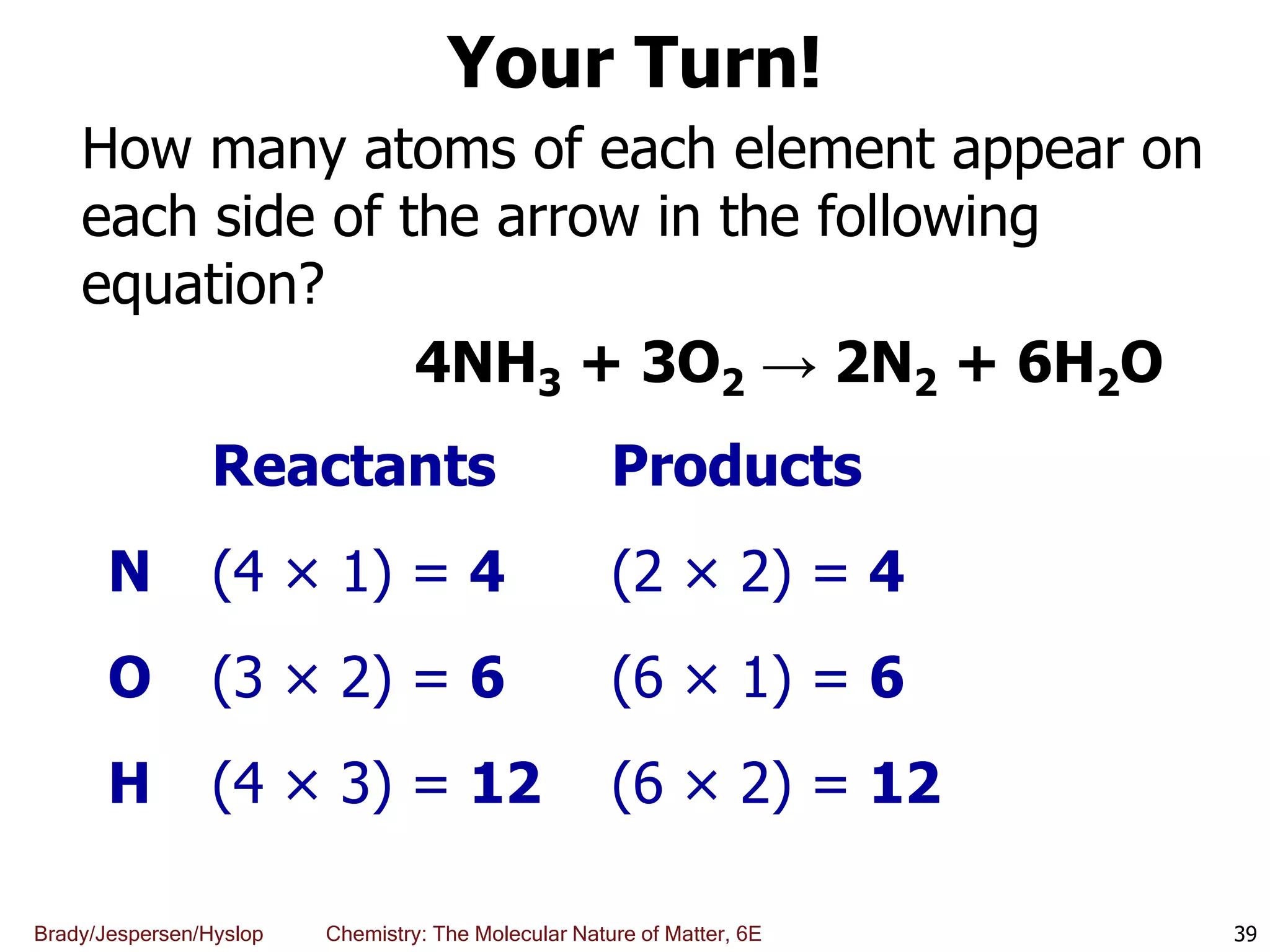
How many atoms of each element appear on
each side of the arrow in the following
equation?
4NH3 + 3O2 → 2N2 + 6H2O
39
Reactants Products
N (4 × 1) = 4 (2 × 2) = 4
O (3 × 2) = 6 (6 × 1) = 6
H (4 × 3) = 12 (6 × 2) = 12
Brady/Jespersen/Hyslop Chemistry: The Molecular Nature of Matter, 6E 40
* All Review Questions are required
Focus On the following
1.5
1.11
1.12
1.14
1.29
1.32
1.33
1.41
1.48
1.53

Chap(1).ppt

  • 1.
    Chapter 1: Chemistry andthe Atomic/Molecular View of Matter Chemistry: The Molecular Nature of Matter, 6E Brady/Jespersen/Hyslop
  • 2.
    Brady/Jespersen/Hyslop Chemistry: TheMolecular Nature of Matter, 6E 1.2- Scientific Method  Approach to gathering information & formulating explanations.  Scientists perform experiments in laboratories under controlled conditions 1. Make observations/collect data 2. Law or Scientific Law 3. Hypothesis 4. Theory 2
  • 3.
    Brady/Jespersen/Hyslop Chemistry: TheMolecular Nature of Matter, 6E Atomic Theory  Most significant theoretical model of nature Atoms  Tiny submicroscopic particles  Make up all chemical substances  Make up everything in Macroscopic world  Smallest particle that has all properties of given element  Composed of:  Electrons  Neutrons  Protons 3
  • 4.
    Brady/Jespersen/Hyslop Chemistry: TheMolecular Nature of Matter, 6E 1.3- Matter & Its Classifications Matter  Anything that has mass & occupies space Mass  How much matter given object has Weight  Force with which object is attracted by gravity Ex. Mass vs. Weight Astronaut on moon & on earth  Weight on moon = 1/6 weight on earth  Same mass regardless of location 4
  • 5.
    Brady/Jespersen/Hyslop Chemistry: TheMolecular Nature of Matter, 6E Matter Chemical Reactions  Transformations that alter chemical compositions of substances Decomposition  Chemical reaction where 1 substance broken down into 2 or more simpler substances Ex. 5 Molten sodium chloride Sodium metal Na + chlorine gas Cl2 Electric current
  • 6.
    Brady/Jespersen/Hyslop Chemistry: TheMolecular Nature of Matter, 6E Elements  Substances that can’t be decomposed into simpler materials by chemical reactions  Substances composed of only 1 type of atom H2 , O2 , Cl2 , Br2 , Na , Ca , Fe  More complex substances composed of elements in various combinations 6 diamond = carbon gold sulfur
  • 7.
    Brady/Jespersen/Hyslop Chemistry: TheMolecular Nature of Matter, 6E Chemical Symbols for Elements Chemical Symbol  One or two letter symbol for each element name  First letter capitalized, second letter lower case Ex. C = carbon S = sulfur Ca = calcium Ar = argon Br = bromine H = hydrogen Cl = chlorine O = oxygen  Used to represent elements in chemical formulas Ex. Water = H2O Carbon dioxide = CO2  Most based on English name  Some based on Latin or German names 7
  • 8.
    Brady/Jespersen/Hyslop Chemistry: TheMolecular Nature of Matter, 6E Chemical Symbols English Name Chemical Symbol Latin Name Sodium Na Natrium Potassium K Kalium Iron Fe Ferrum Copper Cu Cuprum Silver Ag Argentum Gold Au Aurum Mercury Hg Hydrargyrum Antimony Sb Stibium Tin Sn Stannium Lead Pb Plumbum Tungsten W Wolfram (German) 8
  • 9.
    Brady/Jespersen/Hyslop Chemistry: TheMolecular Nature of Matter, 6E Compound  Formed from 2 or more atoms of different elements  Always combined in same fixed ratios by mass  Can be broken down into elements by some chemical changes Ex. Water decomposed to elemental hydrogen & oxygen Mass of oxygen = 8 × mass of hydrogen 9
  • 10.
    Brady/Jespersen/Hyslop Chemistry: TheMolecular Nature of Matter, 6E Pure Substance vs. Mixture Pure substances  Elements and compounds / H2O, Na, N2, …  Composition always same regardless of source Mixture  Can have variable compositions  Made up of two or more substances Ex. CO2 in water—varying amounts of “fizz” in soda  2 broad categories of mixtures:  Heterogeneous Mixtures  Homogeneous Mixtures 10
  • 11.
    Brady/Jespersen/Hyslop Chemistry: TheMolecular Nature of Matter, 6E Homogeneous Mixtures  Same properties throughout sample  Solution  Thoroughly stirred homogeneous mixture Ex.  Liquid solution  Sugar in water  Salt in water  Gas solution  Air  Contains nitrogen, oxygen, carbon dioxide & other gases  Solid solution  US 5¢ coin – Metal Alloy  Contains copper & nickel metals 11 Other examples - Flour - Milk powder - Potable water - Gasoline
  • 12.
    Brady/Jespersen/Hyslop Chemistry: TheMolecular Nature of Matter, 6E Heterogeneous Mixtures  2 or more regions of different properties  Solution with multiple phases  Separate layers Ex.  Salad dressing  Oil & vinegar  Ice & water  Same composition  2 different physical states  Ether and water  Soil 12
  • 13.
    Brady/Jespersen/Hyslop Chemistry: TheMolecular Nature of Matter, 6E Physical Change  No new substances formed  Substance may change state or the proportions Ex. Ice melting or water freezing  Sugar or salt dissolving  Melting of metals  Condensation of vapor or evaporation of water  Stirring iron filings & sulfur together 13
  • 14.
    Brady/Jespersen/Hyslop Chemistry: TheMolecular Nature of Matter, 6E Chemical Change or Chemical Reaction  Formation of new substance or compound  Involves changing chemical makeup of substances  New substance has different physical properties  Can’t be separated by physical means Ex.  Fool’s gold  Compound containing sulfur & iron  No longer has same physical properties of free elements  Can’t be separated using magnet 14
  • 15.
    Brady/Jespersen/Hyslop Chemistry: TheMolecular Nature of Matter, 6E Learning Check: Chemical Physical Magnesium burns when heated Magnesium metal tarnishes in air Magnesium metal melts at 922 K Grape Kool-aid lightens when water is added 15  For each of the following, determine if it represents a Chemical or Physical Change: X X X X
  • 16.
    Brady/Jespersen/Hyslop Chemistry: TheMolecular Nature of Matter, 6E Classification of Matter 16
  • 17.
    Brady/Jespersen/Hyslop Chemistry: TheMolecular Nature of Matter, 6E Learning Check: Classification Hot Cocoa Ice (H2O) White Flour Table Salt (NaCl) Pure substance Element Compound Molecule Heterogeneous Mixture Homogeneous Mixture 17 X X X X X X X
  • 18.
    Brady/Jespersen/Hyslop Chemistry: TheMolecular Nature of Matter, 6E 1.5- Atoms and Molecules Chemical Formulas  Atoms combine to form more complex substances  Discrete particles  Each composed of 2 or more atoms Ex.  Molecular oxygen, O2  Carbon dioxide, CO2  Ammonia, NH3  Sucrose, C12H22O11 18
  • 19.
    Brady/Jespersen/Hyslop Chemistry: TheMolecular Nature of Matter, 6E Chemical Formulas  Specify composition of substance  Chemical symbols  Represent atoms of elements present  Subscripts  Given after chemical symbol  Represents relative numbers of each type of atom Ex. Fe2O3 : iron & oxygen in 2:3 ratio 19
  • 20.
    Brady/Jespersen/Hyslop Chemistry: TheMolecular Nature of Matter, 6E Chemical Formulas Free Elements  Element not combined with another in compounds  Just use chemical symbol to represent Ex. Iron Fe Neon Ne Sodium Na Aluminum Al Diatomic Molecule  Molecules composed of 2 atoms each  Many elements found in nature Ex. Oxygen O2 Nitrogen N2 Hydrogen H2 Chlorine Cl2 20
  • 21.
    Brady/Jespersen/Hyslop Chemistry: TheMolecular Nature of Matter, 6E Depicting Molecules  Want to show:  Order in which atoms are attached to each other  3-dimensional shape of molecule  Three ways of visualizing molecules: 1. Structural formula 2. Ball-and-Stick model 3. Space filling model 21
  • 22.
    Brady/Jespersen/Hyslop Chemistry: TheMolecular Nature of Matter, 6E 1. Structural Formulas  Use to show how atoms are attached  Atoms represented by chemical symbols  Chemical bonds attaching atoms indicated by lines 22 H O H H C H H H H2O water CH4 methane
  • 23.
    Brady/Jespersen/Hyslop Chemistry: TheMolecular Nature of Matter, 6E 3-D Representations of Molecules  Use touching spheres to indicate molecules  Different colors indicate different elements  Relative size of spheres reflects differing sizes of atoms 23 Hydrogen molecule, H2 Oxygen molecule, O2 Nitrogen molecule N2 Chlorine molecule, Cl2
  • 24.
    Brady/Jespersen/Hyslop Chemistry: TheMolecular Nature of Matter, 6E 2. “Ball-and-Stick” Model  Spheres = atoms  Sticks = bonds 24 Chloroform, CHCl3 Methane, CH4
  • 25.
    Brady/Jespersen/Hyslop Chemistry: TheMolecular Nature of Matter, 6E 3. “Space-Filling” Model  Shows relative sizes of atoms  Shows how atoms take up space in molecule 25 Chloroform, CHCl3 Methane CH4 Water H2O
  • 26.
    Brady/Jespersen/Hyslop Chemistry: TheMolecular Nature of Matter, 6E More Complicated Molecules  Sometimes formulas contain parentheses  How do we translate into a structure? Ex. Urea, CO(NH2)2  Expands to CON2H4  Atoms in parentheses appear twice 26 Ball-and-stick model Space-filling model
  • 27.
    Brady/Jespersen/Hyslop Chemistry: TheMolecular Nature of Matter, 6E Hydrates  Crystals that contain water molecules Ex. plaster: CaSO4∙2H2O calcium sulfate dihydrate  Water is not tightly held  Dehydration  Removal of water by heating  Remaining solid is anhydrous (without water) 27 Blue = CuSO4 •5H2O White = CuSO4
  • 28.
    Brady/Jespersen/Hyslop Chemistry: TheMolecular Nature of Matter, 6E Counting Atoms 1. Subscript following chemical symbol indicates how many of that element are part of the formula  No subscript implies a subscript of 1. 2. Quantity in parentheses is repeated a number of times equal to the subscript that follows. 3. Raised dot in formula indicates that the substance is a hydrate  Number preceding H2O specifies how many water molecules are present. 28
  • 29.
    Brady/Jespersen/Hyslop Chemistry: TheMolecular Nature of Matter, 6E Counting Atoms Ex. 1 (CH3)3COH  Subscript 3 means 3 CH3 groups So from(CH3)3, we get 3 × 1C = 3C 3 × 3H = 9H #C = 3C + 1C = 4 C #H = 9H + 1H = 10 H #O = 1 O Total # of atoms = 15 atoms 29
  • 30.
    Brady/Jespersen/Hyslop Chemistry: TheMolecular Nature of Matter, 6E Counting Atoms Ex. 2 CoCl2 · 6H2O  The dot 6H2O means you multiple both H2 & O by 6  So there are: #H 6 × 2 = 12 H #O 6 × 1 = 6 O #Co 1 × 1 = 1 Co #Cl 2 × 1 = 2 Cl Total # of atoms = 21 atoms 30
  • 31.
    Brady/Jespersen/Hyslop Chemistry: TheMolecular Nature of Matter, 6E Your Turn! a. Na2CO3 b. (NH4)2SO4 c. Mg3(PO4)2 d. CuSO4∙5H2O e. (C2H5)2N2H2 31 a. ___Na, ___ C, ___ O b. ___N, ___H, ___S, ___O c. ___Mg, ___P, ___O d. ___Cu, ___S, ___O, ___H e. ___C, ___H, ___N 3 2 1 2 8 1 4 3 2 8 1 1 9 10 Count the number of each type of atom in the chemical formula given below 4 12 2
  • 32.
    Brady/Jespersen/Hyslop Chemistry: TheMolecular Nature of Matter, 6E 1.6- Chemical Reactions  When 1 or more substances react to form 1 or more new substances Ex. Reaction of methane, CH4, with oxygen, O2, to form carbon dioxide, CO2, & water, H2O. Reactants = CH4 & O2 Products = CO2 & H2O 32
  • 33.
    Brady/Jespersen/Hyslop Chemistry: TheMolecular Nature of Matter, 6E Chemical Equations  Use chemical symbols & formulas to represent reactants & products.  Reactants on left hand side  Products on right hand side  Arrow () means “reacts to yield” Ex. CH4 + 2O2  CO2 + 2H2O  Coefficients  Numbers in front of formulas  Indicate how many of each type of molecule reacted or formed  Equation reads “methane & oxygen react to yield carbon dioxide & water” 33
  • 34.
    Brady/Jespersen/Hyslop Chemistry: TheMolecular Nature of Matter, 6E Conservation of Mass in Reactions  Mass can neither be created nor destroyed  This means that there are the same number of each type of atom in reactants & in products of reaction  If # of atoms same, then mass also same 34 CH4 + 2O2  CO2 + 2H2O 4 H + 4O + C = 4 H + 4O + C
  • 35.
    Brady/Jespersen/Hyslop Chemistry: TheMolecular Nature of Matter, 6E Balanced Chemical Equation Ex. 2C4H10 + 13O2  8CO2 + 10H2O 35 4 C & 10 H per molecule 2 O per molecule 2 H & 1 O per molecule 1 C & 2 O per molecule
  • 36.
    Brady/Jespersen/Hyslop Chemistry: TheMolecular Nature of Matter, 6E Balanced Chemical Equation Ex. 2C4H10 + 13O2  8CO2 + 10H2O 36 2 molecules of C4H10 13 molecules of O2 10 molecules of C4H10 8 molecules of CO2 Coefficients  Number in front of formulas  Indicate number of molecules of each type  Adjusted so # of each type of atom is same on both sides of arrow  Can change
  • 37.
    Brady/Jespersen/Hyslop Chemistry: TheMolecular Nature of Matter, 6E Balanced Chemical Equations  How do you determine if an equation is balanced?  Count atoms  Same number of each type on both sides of equation?  If yes, then balanced  If no, then unbalanced Ex. 2C4H10 + 13O2  8CO2 + 10H2O Reactants Products 2×4 = 8 C 8×1 = 8 C 2×10 = 20 H 10×2 = 20 H 13×2 = 26 O (8×2)+(10×1)= 26 O 37
  • 38.
    Brady/Jespersen/Hyslop Chemistry: TheMolecular Nature of Matter, 6E Learning Check Fe(OH)3 + 2 HNO3  Fe(NO3)3 + 2 H2O  Not Balanced  Only Fe has same number of atoms on either side of arrow. 38 Reactants Products Fe 1 1 3 + (2×3) = 9 (3×3) + 2 = 11 O 3 + 2 = 5 (2×2) = 4 H 2 3 N
  • 39.
    Brady/Jespersen/Hyslop Chemistry: TheMolecular Nature of Matter, 6E Your Turn! How many atoms of each element appear on each side of the arrow in the following equation? 4NH3 + 3O2 → 2N2 + 6H2O 39 Reactants Products N (4 × 1) = 4 (2 × 2) = 4 O (3 × 2) = 6 (6 × 1) = 6 H (4 × 3) = 12 (6 × 2) = 12
  • 40.
    Brady/Jespersen/Hyslop Chemistry: TheMolecular Nature of Matter, 6E 40 * All Review Questions are required Focus On the following 1.5 1.11 1.12 1.14 1.29 1.32 1.33 1.41 1.48 1.53