CHAPTER IV  SPECIAL TARIFF PREFERENCE PROGRAMS Generalized System of Preferences (GSP) Caribbean Basin Initiative (CBI)  Andean Trade Preference Act (ATPA)  Freely Associated States (FAS)  African Growth & Opportunity Act (AGOA) U.S.-Caribbean Basin Trade Partnership Act (CBTPA) Maquiladora
Generalized System of Preferences (GSP) Grants duty-free entry to specified products from designated developing countries  Trade Act of 1974: 1/1/76 to 7/4/93 & To 9/30/94, 7/31/95, 5/31/97,6/30/98, 6/30/99, 9/30/01  12/31/2006 per the Trade Act of 2002 & extended again to 12/31/2008 Approximately 4,400 items eligible from more than 140 countries in 1994
Generalized System of Preferences (GSP) Eligibility Requirements:   A beneficiary developing country designated by the President  A or A* or A+ in "Special subcolumn of Column 1 of HTSUS Directly imported into the USA  Produced in a beneficiary country  Wholly (100%) the growth, product or manufacture of a beneficiary country  Substantially transformed into a new and different product
Generalized System of Preferences (GSP) Produced in a beneficiary country (continued) The sum of the cost or value of the materials and direct cost of processing operations in the beneficiary country, not less than 35% of the appraised value at the time of entry into the U.S.  General and Administrative (G&A) expenses and profit not considered as direct cost of process operations.  A Certificate of Origin Form A of the UNCTAD
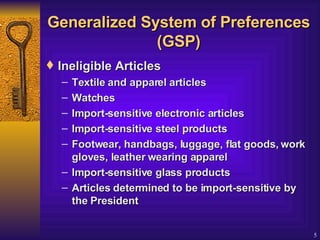
Generalized System of Preferences (GSP) Ineligible Articles   Textile and apparel articles  Watches  Import-sensitive electronic articles  Import-sensitive steel products  Footwear, handbags, luggage, flat goods, work gloves, leather wearing apparel  Import-sensitive glass products  Articles determined to be import-sensitive by the President
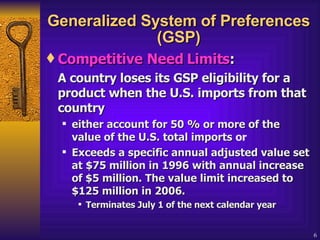
Generalized System of Preferences (GSP) Competitive Need Limits :   A country loses its GSP eligibility for a product when the U.S. imports from that country  either account for 50 % or more of the value of the U.S. total imports  or Exceeds a specific annual adjusted value set at $75 million in 1996 with annual increase of $5 million. The value limit increased to $125 million in 2006. Terminates July 1 of the next calendar year
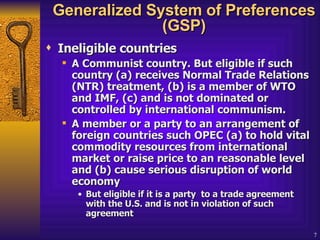
Generalized System of Preferences (GSP) Ineligible countries   A Communist country. But eligible if such country (a) receives Normal Trade Relations (NTR) treatment, (b) is a member of WTO and IMF, (c) and is not dominated or controlled by international communism.  A member or a party to an arrangement of foreign countries such OPEC (a) to hold vital commodity resources from international market or raise price to an reasonable level and (b) cause serious disruption of world economy  But eligible if it is a party  to a trade agreement with the U.S. and is not in violation of such agreement
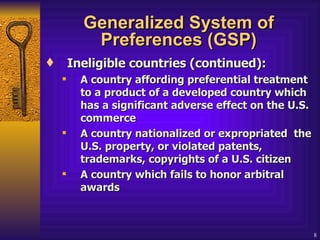
Generalized System of Preferences (GSP) Ineligible countries (continued): A country affording preferential treatment to a product of a developed country which has a significant adverse effect on the U.S. commerce   A country nationalized or expropriated  the U.S. property, or violated patents, trademarks, copyrights of a U.S. citizen  A country which fails to honor arbitral awards
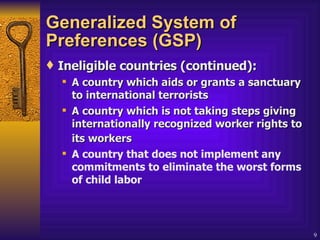
Generalized System of Preferences (GSP) Ineligible countries (continued): A country which aids or grants a sanctuary to international terrorists  A country which is not taking steps giving internationally recognized worker rights to its workers   A country that does not implement any commitments to eliminate the worst forms of child labor
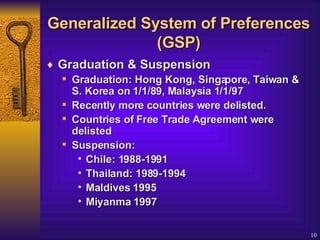
Generalized System of Preferences (GSP) Graduation & Suspension   Graduation: Hong Kong, Singapore, Taiwan & S. Korea on 1/1/89, Malaysia 1/1/97  Recently more countries were delisted. Countries of Free Trade Agreement were delisted Suspension:  Chile: 1988-1991  Thailand: 1989-1994  Maldives 1995  Miyanma 1997
 
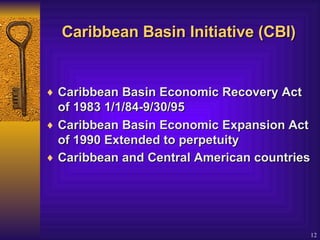
Caribbean Basin Initiative (CBI) Caribbean Basin Economic Recovery Act of 1983 1/1/84-9/30/95  Caribbean Basin Economic Expansion Act of 1990 Extended to perpetuity  Caribbean and Central American countries
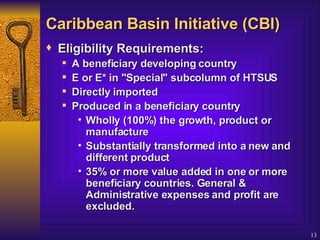
Caribbean Basin Initiative (CBI) Eligibility Requirements:   A beneficiary developing country  E or E* in "Special" subcolumn of HTSUS  Directly imported  Produced in a beneficiary country  Wholly (100%) the growth, product or manufacture  Substantially transformed into a new and different product  35% or more value added in one or more beneficiary countries. General & Administrative expenses and profit are excluded.
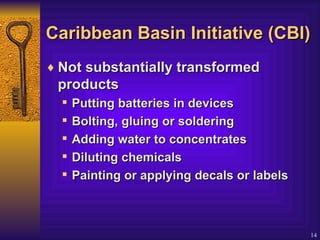
Caribbean Basin Initiative (CBI) Not substantially transformed products   Putting batteries in devices  Bolting, gluing or soldering  Adding water to concentrates  Diluting chemicals  Painting or applying decals or labels
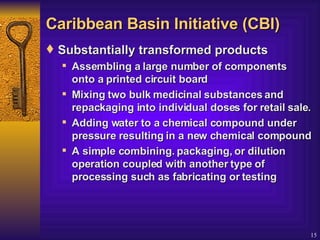
Caribbean Basin Initiative (CBI) Substantially transformed products   Assembling a large number of components  onto a printed circuit board  Mixing two bulk medicinal substances and repackaging into individual doses for retail sale.  Adding water to a chemical compound under pressure resulting in a new chemical compound  A simple combining. packaging, or dilution operation coupled with another type of processing such as fabricating or testing
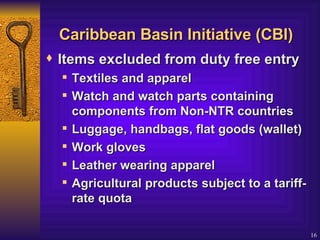
Caribbean Basin Initiative (CBI) Items excluded from duty free entry  Textiles and apparel  Watch and watch parts containing components from Non-NTR countries Luggage, handbags, flat goods (wallet) Work gloves Leather wearing apparel  Agricultural products subject to a tariff-rate quota
Caribbean Basin Initiative (CBI) Products of 100% U.S. components: Duty-free entry except water, textile & apparel, petroleum and petroleum products
Caribbean Basin Initiative (CBI) Special Access Program (SAP) for CBI Textile   Since the textile quota ended as of January 1, 2005` this grogram does not have any effect anymore.
Andean Trade Preference Act (ATPA) 12/4/1991-12/4/2001, 12/31/2006: Trade Act of 2002. Extended to 12/31/2008 Bolivia, Colombia, Ecuador, Peru  "J "or "J*" in the "Special" subcolumn of Column 1  Min. 35% Regional Value Content (RVC)
Andean Trade Preference Act (ATPA) Articles Excluded from Duty-free Entry Textiles & Apparel articles Footwear Tuna in airtight containers Petroleum and its products Watches and its parts Handbags, luggage, flat goods, work gloves, leather apparel
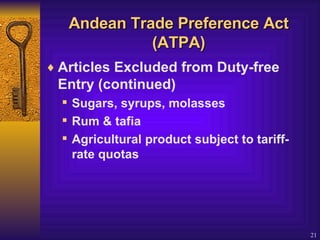
Andean Trade Preference Act (ATPA) Articles Excluded from Duty-free Entry (continued) Sugars, syrups, molasses Rum & tafia Agricultural product subject to tariff-rate quotas
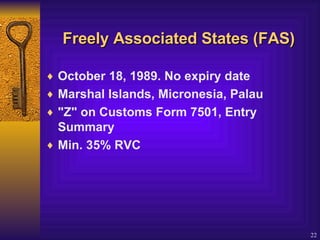
Freely  Associated States (FAS) October 18, 1989. No expiry date  Marshal Islands, Micronesia, Palau  "Z" on Customs Form 7501, Entry Summary  Min. 35% RVC
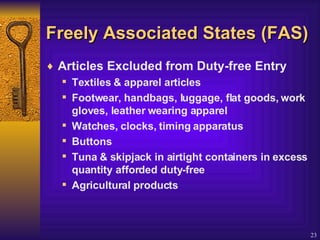
Freely  Associated States (FAS) Articles Excluded from Duty-free Entry Textiles & apparel articles Footwear, handbags, luggage, flat goods, work gloves, leather wearing apparel Watches, clocks, timing apparatus Buttons Tuna & skipjack in airtight containers in excess quantity afforded duty-free Agricultural products
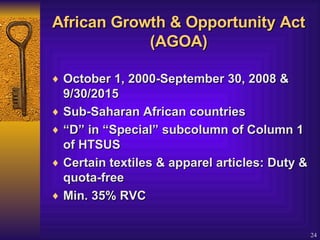
African Growth & Opportunity Act (AGOA) October 1, 2000-September 30, 2008 & 9/30/2015 Sub-Saharan African countries  “ D” in “Special” subcolumn of Column 1 of HTSUS  Certain textiles & apparel articles: Duty & quota-free  Min. 35% RVC
U.S.-Caribbean Trade Partnership Act (CBTPA) October 1, 2000-September 30, 2008 or FTA entry date, whichever comes first Caribbean and Central American countries (fewer countries than CBI)  “ R” in “Special” subcolumn of Column 1 of HTSUS  More trade benefits than the initial CBI  Certain textile & apparel articles: Duty & quota-free  50% RVC under net cost. 60% under transaction value
Maquiladora Program Launched as Border Industrialization Program  by the Mexican government in 1966 after the end of 23-year Bracero Program in1965 Mexican Corporation operating under In-Bond Program of Mexico Mexican production facilities processing or assembling components into finished products for exportation Partly or entirely owned by non-Mexicans
Maquiladoras & the U.S. Tariff No. 9802.00.80 of Chapter 98 of Harmonized Tariff Schedule of the U.S. (HTSUS): Articles Exported and Returned, Advanced or Improved Abroad Permits only assembly operation abroad
Maquiladoras & the U.S. (1) Procedures of Maquiladora Operation   U.S. parts, components, equipment and machinery are imported into Mexico duty-free  Parts and components assembled into the products  Pays U.S. import duty only on the value added in Mexico, when finished products are imported into the U.S.
Maquiladoras & the U.S. (2) Requirements by HTSUS  Components ready for assembly without further fabrication  Have not lost physical identity  Have not advanced in value except assembly process (3) Items Excluded:  Raw materials such as Chemicals, Food ingredients, Gases, Liquid &  Powder
Maquiladoras & the U.S. (4) Documents for Finished Goods  Importer must file with the U.S. Customs & Border Protection Commercial Invoice  Declaration by the Assembler  Endorsement by the Importer
Maquiladoras & the U.S. Benefits to Mexico   Provides Mexico with employments  Higher wages than domestic Mexican factories Provides Mexico with foreign exchange   More than tourism 2 nd  foreign exchange provider after oil
Maquiladoras & the U.S. Benefits to U.S. Businesses   Mexico's large, low-cost, highly trained work force: 8 to 13% of the U.S. wage Relaxed environmental and worker-safety standards  Quick access to the U.S. consumer market  Lower inventory requirements, lower transportation costs and lower insurance costs than Asian factories
Maquiladoras & the U.S. Entry Options  for Maquiladora Subcontracting  With a maquiladora to manufacture products on a per-piece cost basis. Can quickly find out cost savings and production quality Shelter Program   U. S. firm manages assembling activities Contracts out administrative tasks to a Mexican firm at a pre-determined rate per hour Ownership  100% owned by a U.S. person
Maquiladoras & the U.S. Most Promising Products  In 2000, 4,000 plants employing 1,300,000 workers More of U.S. factories for time-sensitive products in Asia are expected to move to Mexico  Besides U.S. and Canadian firms, Asian companies started production operation in maquiladora for U.S. market
Maquiladoras & the U.S. Most Promising Products Highly labor-intensive products Electronics, Apparel, Auto parts, Furniture, Toys, Sporting Goods Time-sensitive products Fashionable goods: Apparel, Toys Bulky products Transportation containers for domestic and international transportation
Maquiladoras & the U.S. Labor Management & Environment  Labor turnover up to 25%: the biggest headache To reduce high labor turnover Locate in the interior far from the border Train supervisors Introduce good work ethics Provide incentive programs to prevent absenteeism
Maquiladoras & the U.S. Environmental Problems (Air, Water, & Hazardous waste)  Factories toxic materials including solvents, heavy metals and dangerous chemicals  Lack of sewage and water treatment plants  More relaxed Mexican environmental laws  Lack of enforcement by Mexican government   Mexico must improve environment to shed the image of a polluter's haven

Chap04

  • 1.
    CHAPTER IV SPECIAL TARIFF PREFERENCE PROGRAMS Generalized System of Preferences (GSP) Caribbean Basin Initiative (CBI) Andean Trade Preference Act (ATPA) Freely Associated States (FAS) African Growth & Opportunity Act (AGOA) U.S.-Caribbean Basin Trade Partnership Act (CBTPA) Maquiladora
  • 2.
    Generalized System ofPreferences (GSP) Grants duty-free entry to specified products from designated developing countries Trade Act of 1974: 1/1/76 to 7/4/93 & To 9/30/94, 7/31/95, 5/31/97,6/30/98, 6/30/99, 9/30/01 12/31/2006 per the Trade Act of 2002 & extended again to 12/31/2008 Approximately 4,400 items eligible from more than 140 countries in 1994
  • 3.
    Generalized System ofPreferences (GSP) Eligibility Requirements: A beneficiary developing country designated by the President A or A* or A+ in "Special subcolumn of Column 1 of HTSUS Directly imported into the USA Produced in a beneficiary country Wholly (100%) the growth, product or manufacture of a beneficiary country Substantially transformed into a new and different product
  • 4.
    Generalized System ofPreferences (GSP) Produced in a beneficiary country (continued) The sum of the cost or value of the materials and direct cost of processing operations in the beneficiary country, not less than 35% of the appraised value at the time of entry into the U.S. General and Administrative (G&A) expenses and profit not considered as direct cost of process operations. A Certificate of Origin Form A of the UNCTAD
  • 5.
    Generalized System ofPreferences (GSP) Ineligible Articles Textile and apparel articles Watches Import-sensitive electronic articles Import-sensitive steel products Footwear, handbags, luggage, flat goods, work gloves, leather wearing apparel Import-sensitive glass products Articles determined to be import-sensitive by the President
  • 6.
    Generalized System ofPreferences (GSP) Competitive Need Limits : A country loses its GSP eligibility for a product when the U.S. imports from that country either account for 50 % or more of the value of the U.S. total imports or Exceeds a specific annual adjusted value set at $75 million in 1996 with annual increase of $5 million. The value limit increased to $125 million in 2006. Terminates July 1 of the next calendar year
  • 7.
    Generalized System ofPreferences (GSP) Ineligible countries A Communist country. But eligible if such country (a) receives Normal Trade Relations (NTR) treatment, (b) is a member of WTO and IMF, (c) and is not dominated or controlled by international communism. A member or a party to an arrangement of foreign countries such OPEC (a) to hold vital commodity resources from international market or raise price to an reasonable level and (b) cause serious disruption of world economy But eligible if it is a party to a trade agreement with the U.S. and is not in violation of such agreement
  • 8.
    Generalized System ofPreferences (GSP) Ineligible countries (continued): A country affording preferential treatment to a product of a developed country which has a significant adverse effect on the U.S. commerce A country nationalized or expropriated the U.S. property, or violated patents, trademarks, copyrights of a U.S. citizen A country which fails to honor arbitral awards
  • 9.
    Generalized System ofPreferences (GSP) Ineligible countries (continued): A country which aids or grants a sanctuary to international terrorists A country which is not taking steps giving internationally recognized worker rights to its workers A country that does not implement any commitments to eliminate the worst forms of child labor
  • 10.
    Generalized System ofPreferences (GSP) Graduation & Suspension Graduation: Hong Kong, Singapore, Taiwan & S. Korea on 1/1/89, Malaysia 1/1/97 Recently more countries were delisted. Countries of Free Trade Agreement were delisted Suspension: Chile: 1988-1991 Thailand: 1989-1994 Maldives 1995 Miyanma 1997
  • 11.
  • 12.
    Caribbean Basin Initiative(CBI) Caribbean Basin Economic Recovery Act of 1983 1/1/84-9/30/95 Caribbean Basin Economic Expansion Act of 1990 Extended to perpetuity Caribbean and Central American countries
  • 13.
    Caribbean Basin Initiative(CBI) Eligibility Requirements: A beneficiary developing country E or E* in "Special" subcolumn of HTSUS Directly imported Produced in a beneficiary country Wholly (100%) the growth, product or manufacture Substantially transformed into a new and different product 35% or more value added in one or more beneficiary countries. General & Administrative expenses and profit are excluded.
  • 14.
    Caribbean Basin Initiative(CBI) Not substantially transformed products Putting batteries in devices Bolting, gluing or soldering Adding water to concentrates Diluting chemicals Painting or applying decals or labels
  • 15.
    Caribbean Basin Initiative(CBI) Substantially transformed products Assembling a large number of components onto a printed circuit board Mixing two bulk medicinal substances and repackaging into individual doses for retail sale. Adding water to a chemical compound under pressure resulting in a new chemical compound A simple combining. packaging, or dilution operation coupled with another type of processing such as fabricating or testing
  • 16.
    Caribbean Basin Initiative(CBI) Items excluded from duty free entry Textiles and apparel Watch and watch parts containing components from Non-NTR countries Luggage, handbags, flat goods (wallet) Work gloves Leather wearing apparel Agricultural products subject to a tariff-rate quota
  • 17.
    Caribbean Basin Initiative(CBI) Products of 100% U.S. components: Duty-free entry except water, textile & apparel, petroleum and petroleum products
  • 18.
    Caribbean Basin Initiative(CBI) Special Access Program (SAP) for CBI Textile Since the textile quota ended as of January 1, 2005` this grogram does not have any effect anymore.
  • 19.
    Andean Trade PreferenceAct (ATPA) 12/4/1991-12/4/2001, 12/31/2006: Trade Act of 2002. Extended to 12/31/2008 Bolivia, Colombia, Ecuador, Peru "J "or "J*" in the "Special" subcolumn of Column 1 Min. 35% Regional Value Content (RVC)
  • 20.
    Andean Trade PreferenceAct (ATPA) Articles Excluded from Duty-free Entry Textiles & Apparel articles Footwear Tuna in airtight containers Petroleum and its products Watches and its parts Handbags, luggage, flat goods, work gloves, leather apparel
  • 21.
    Andean Trade PreferenceAct (ATPA) Articles Excluded from Duty-free Entry (continued) Sugars, syrups, molasses Rum & tafia Agricultural product subject to tariff-rate quotas
  • 22.
    Freely AssociatedStates (FAS) October 18, 1989. No expiry date Marshal Islands, Micronesia, Palau "Z" on Customs Form 7501, Entry Summary Min. 35% RVC
  • 23.
    Freely AssociatedStates (FAS) Articles Excluded from Duty-free Entry Textiles & apparel articles Footwear, handbags, luggage, flat goods, work gloves, leather wearing apparel Watches, clocks, timing apparatus Buttons Tuna & skipjack in airtight containers in excess quantity afforded duty-free Agricultural products
  • 24.
    African Growth &Opportunity Act (AGOA) October 1, 2000-September 30, 2008 & 9/30/2015 Sub-Saharan African countries “ D” in “Special” subcolumn of Column 1 of HTSUS Certain textiles & apparel articles: Duty & quota-free Min. 35% RVC
  • 25.
    U.S.-Caribbean Trade PartnershipAct (CBTPA) October 1, 2000-September 30, 2008 or FTA entry date, whichever comes first Caribbean and Central American countries (fewer countries than CBI) “ R” in “Special” subcolumn of Column 1 of HTSUS More trade benefits than the initial CBI Certain textile & apparel articles: Duty & quota-free 50% RVC under net cost. 60% under transaction value
  • 26.
    Maquiladora Program Launchedas Border Industrialization Program by the Mexican government in 1966 after the end of 23-year Bracero Program in1965 Mexican Corporation operating under In-Bond Program of Mexico Mexican production facilities processing or assembling components into finished products for exportation Partly or entirely owned by non-Mexicans
  • 27.
    Maquiladoras & theU.S. Tariff No. 9802.00.80 of Chapter 98 of Harmonized Tariff Schedule of the U.S. (HTSUS): Articles Exported and Returned, Advanced or Improved Abroad Permits only assembly operation abroad
  • 28.
    Maquiladoras & theU.S. (1) Procedures of Maquiladora Operation U.S. parts, components, equipment and machinery are imported into Mexico duty-free Parts and components assembled into the products Pays U.S. import duty only on the value added in Mexico, when finished products are imported into the U.S.
  • 29.
    Maquiladoras & theU.S. (2) Requirements by HTSUS Components ready for assembly without further fabrication Have not lost physical identity Have not advanced in value except assembly process (3) Items Excluded: Raw materials such as Chemicals, Food ingredients, Gases, Liquid & Powder
  • 30.
    Maquiladoras & theU.S. (4) Documents for Finished Goods Importer must file with the U.S. Customs & Border Protection Commercial Invoice Declaration by the Assembler Endorsement by the Importer
  • 31.
    Maquiladoras & theU.S. Benefits to Mexico Provides Mexico with employments Higher wages than domestic Mexican factories Provides Mexico with foreign exchange More than tourism 2 nd foreign exchange provider after oil
  • 32.
    Maquiladoras & theU.S. Benefits to U.S. Businesses Mexico's large, low-cost, highly trained work force: 8 to 13% of the U.S. wage Relaxed environmental and worker-safety standards Quick access to the U.S. consumer market Lower inventory requirements, lower transportation costs and lower insurance costs than Asian factories
  • 33.
    Maquiladoras & theU.S. Entry Options for Maquiladora Subcontracting With a maquiladora to manufacture products on a per-piece cost basis. Can quickly find out cost savings and production quality Shelter Program U. S. firm manages assembling activities Contracts out administrative tasks to a Mexican firm at a pre-determined rate per hour Ownership 100% owned by a U.S. person
  • 34.
    Maquiladoras & theU.S. Most Promising Products In 2000, 4,000 plants employing 1,300,000 workers More of U.S. factories for time-sensitive products in Asia are expected to move to Mexico Besides U.S. and Canadian firms, Asian companies started production operation in maquiladora for U.S. market
  • 35.
    Maquiladoras & theU.S. Most Promising Products Highly labor-intensive products Electronics, Apparel, Auto parts, Furniture, Toys, Sporting Goods Time-sensitive products Fashionable goods: Apparel, Toys Bulky products Transportation containers for domestic and international transportation
  • 36.
    Maquiladoras & theU.S. Labor Management & Environment Labor turnover up to 25%: the biggest headache To reduce high labor turnover Locate in the interior far from the border Train supervisors Introduce good work ethics Provide incentive programs to prevent absenteeism
  • 37.
    Maquiladoras & theU.S. Environmental Problems (Air, Water, & Hazardous waste) Factories toxic materials including solvents, heavy metals and dangerous chemicals Lack of sewage and water treatment plants More relaxed Mexican environmental laws Lack of enforcement by Mexican government Mexico must improve environment to shed the image of a polluter's haven