GSP AND
GSTP
By shameem ET
Generalized System of Preferences
Generalized System of Preferences (GSP) is a preferential tariff
system extended by developed countries (also known as
preference giving countries or donor countries) to developing
countries (also known as preference receiving countries or
beneficiary countries). It involves reduced MFNTariffs or duty-free
entry of eligible products exported by beneficiary countries to the
markets of donor countries. It involves reduced MFNTariffs or
duty-free entry of eligible products exported by beneficiary
countries to the markets of donor countries.
The idea of tariff preferences for developing countries was the subject of
considerable discussion within theThe United Nations Conference onTrade
and Development (UNCTAD) in the 1960s.
• In 1971, the GATT enacted two waivers to the MFN that permitted tariff
preferences to be granted to developing country goods. Both these waivers
were limited in time to ten years.
• In 1979, as part of theTokyo Round, the GATT established a permanent
exemption to the MFN obligation by way of the enabling clause.
GSP is presently extended by 29 developed countries
Australia , Republic of Bulgaria, Canada Republic of Hungary, Austria,
Italy ,Czech Republic, Republic of Poland ,Belgium, Luxembourg ,
European Union Russian Federation ,Denmark ,Netherlands, Japan
,Slovakia ,Finland ,Portugal New Zealand, Switzerland ,France ,Spain
,Norway ,Republic of Belarus ,United States of America ,Germany
,Sweden , Greece, United Kingdom
In addition, it is understood that Kazakhstan, Kyrgyzstan, Lithuania and
Ukraine may also be allowing preferential tariff treatment to select
Indian goods.
ELIGIBILE PRODUCTS
Only such products of a beneficiary country (like India) that fulfill
the requirements of the rules of origin laid down by the
importing country, are considered eligible for preferential tariff
treatment on import into the markets of donor countries .
For example, in the case of 15 member states of European
Union, an Indian product is considered eligible only if it fulfils
the requirements of Rules of Origin laid down in the Community
legislation.
Objectives of Generalized System of
Preferences
The main objectives of granting trade preferences to developing countries are
to:
Enhance their export earnings;
Promote industrialization, and
Encourage the diversification of their economies
Standard of living
Most of the GSP product coverage includes agricultural and industrial exports
with a few but often notable exceptions.The exceptions established by the
United States GSP include textiles and apparel, certain footwear, certain
leather products ( handbags, luggage), certain watches and watch parts,
and petroleum and petroleum products.
Global System ofTrade Preferences
The Agreement on Global System ofTrade Preferences among
developing countries (GSTP) was negotiated in the year 1988
by 48 developing countries that were member of Group of 77.
The declared objectives of the GSTP are:
• To promote and sustain mutual trade, and
• To develop economic cooperation among developing
countries (members of Group of 77)
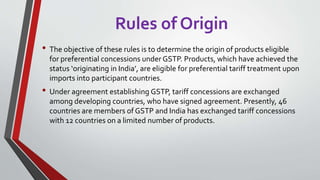
Rules of Origin
• The objective of these rules is to determine the origin of products eligible
for preferential concessions under GSTP. Products, which have achieved the
status ‘originating in India’, are eligible for preferential tariff treatment upon
imports into participant countries.
• Under agreement establishing GSTP, tariff concessions are exchanged
among developing countries, who have signed agreement. Presently, 46
countries are members of GSTP and India has exchanged tariff concessions
with 12 countries on a limited number of products.
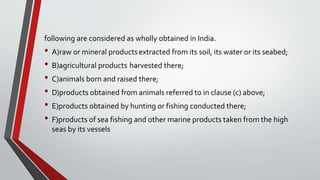
following are considered as wholly obtained in India.
• A)raw or mineral productsextracted from its soil, its water or its seabed;
• B)agricultural products harvested there;
• C)animals born and raised there;
• D)products obtained from animals referred to in clause (c) above;
• E)products obtained by hunting or fishing conducted there;
• F)products of sea fishing and other marine products taken from the high
seas by its vessels
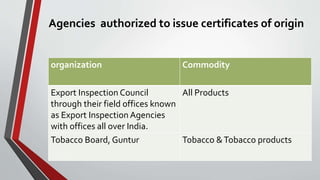
Agencies authorized to issue certificates of origin
organization Commodity
Export Inspection Council
through their field offices known
as Export Inspection Agencies
with offices all over India.
All Products
Tobacco Board, Guntur Tobacco &Tobacco products
Thank you

gsp and gstp

  • 1.
  • 2.
    Generalized System ofPreferences Generalized System of Preferences (GSP) is a preferential tariff system extended by developed countries (also known as preference giving countries or donor countries) to developing countries (also known as preference receiving countries or beneficiary countries). It involves reduced MFNTariffs or duty-free entry of eligible products exported by beneficiary countries to the markets of donor countries. It involves reduced MFNTariffs or duty-free entry of eligible products exported by beneficiary countries to the markets of donor countries.
  • 3.
    The idea oftariff preferences for developing countries was the subject of considerable discussion within theThe United Nations Conference onTrade and Development (UNCTAD) in the 1960s. • In 1971, the GATT enacted two waivers to the MFN that permitted tariff preferences to be granted to developing country goods. Both these waivers were limited in time to ten years. • In 1979, as part of theTokyo Round, the GATT established a permanent exemption to the MFN obligation by way of the enabling clause.
  • 4.
    GSP is presentlyextended by 29 developed countries Australia , Republic of Bulgaria, Canada Republic of Hungary, Austria, Italy ,Czech Republic, Republic of Poland ,Belgium, Luxembourg , European Union Russian Federation ,Denmark ,Netherlands, Japan ,Slovakia ,Finland ,Portugal New Zealand, Switzerland ,France ,Spain ,Norway ,Republic of Belarus ,United States of America ,Germany ,Sweden , Greece, United Kingdom In addition, it is understood that Kazakhstan, Kyrgyzstan, Lithuania and Ukraine may also be allowing preferential tariff treatment to select Indian goods.
  • 5.
    ELIGIBILE PRODUCTS Only suchproducts of a beneficiary country (like India) that fulfill the requirements of the rules of origin laid down by the importing country, are considered eligible for preferential tariff treatment on import into the markets of donor countries . For example, in the case of 15 member states of European Union, an Indian product is considered eligible only if it fulfils the requirements of Rules of Origin laid down in the Community legislation.
  • 6.
    Objectives of GeneralizedSystem of Preferences The main objectives of granting trade preferences to developing countries are to: Enhance their export earnings; Promote industrialization, and Encourage the diversification of their economies Standard of living
  • 7.
    Most of theGSP product coverage includes agricultural and industrial exports with a few but often notable exceptions.The exceptions established by the United States GSP include textiles and apparel, certain footwear, certain leather products ( handbags, luggage), certain watches and watch parts, and petroleum and petroleum products.
  • 8.
  • 9.
    The Agreement onGlobal System ofTrade Preferences among developing countries (GSTP) was negotiated in the year 1988 by 48 developing countries that were member of Group of 77. The declared objectives of the GSTP are: • To promote and sustain mutual trade, and • To develop economic cooperation among developing countries (members of Group of 77)
  • 10.
    Rules of Origin •The objective of these rules is to determine the origin of products eligible for preferential concessions under GSTP. Products, which have achieved the status ‘originating in India’, are eligible for preferential tariff treatment upon imports into participant countries. • Under agreement establishing GSTP, tariff concessions are exchanged among developing countries, who have signed agreement. Presently, 46 countries are members of GSTP and India has exchanged tariff concessions with 12 countries on a limited number of products.
  • 11.
    following are consideredas wholly obtained in India. • A)raw or mineral productsextracted from its soil, its water or its seabed; • B)agricultural products harvested there; • C)animals born and raised there; • D)products obtained from animals referred to in clause (c) above; • E)products obtained by hunting or fishing conducted there; • F)products of sea fishing and other marine products taken from the high seas by its vessels
  • 12.
    Agencies authorized toissue certificates of origin organization Commodity Export Inspection Council through their field offices known as Export Inspection Agencies with offices all over India. All Products Tobacco Board, Guntur Tobacco &Tobacco products
  • 13.