8-1
Chapter Eight
Planning for
New Products
McGraw-Hill/Irwin © 2006 The McGraw-Hill Companies, Inc., All Rights Reserved.
8-2
Planning for New
Products
The Innovation
Mandate
8-3
PLANNING FOR
NEW PRODUCTS
 Importance of New Products
 Customer Driven Process
 Steps in New Product Planning
– Idea Generation
– Screening/Evaluating/and Business
Analysis
– Product and Process Development
– Marketing Strategy and Market
Testing
– Commercialization
 Variation in the Generic Planning
Process
8-4
Importance of
New Products
 Innovation at top of potential
value drivers (Ernst & Young)
Innovation initiatives extend
beyond new goods and services
to include ideas, processes, and
business practices
 Organizations must build a
culture of innovation
8-5
New Product
Planning as a
Customer Driven
Process New product
classifications:
1. Newness to market
2. Newness to company
 New product types:
– Transformational
innovations
– New product category
– Product line extensions
– Incremental improvements
8-6
High
Low
New product
lines
20%
Improvements/
revisions to
existing
products
26%
Additions
to existing
product lines
26%
Repositionings
7%
Cost
reduction
s
11%
New-to-world
products
10%
High
Newness to market
Newnesstocompany
Size of circle denotes number of introductions relative to total.
Source: New Product Management for the 1980s, Booz Allen & Hamilton Inc. 1982.
8-7
Customer value analysis
Objective is to identify
needs for:
1. New products
2. Improvements to existing
products
3. Improvements in
production processes
4. Improvements in
supporting services
Finding Customer
Value
Opportunities
8-8
Matching Capabilities to
Customer Value Opportunities
– Fit between capabilities and
product offering
Transformational Innovations
– “new-to-the-world” ideas
– Customers not always the
best guides
8-9
Customer
Expectations
Customer
Satisfaction
Gap
Actual
Product
Performance
OPPORTUNITIES
(1) New Products
(2) Improvements
(3) New and Improved
Processes
8-10
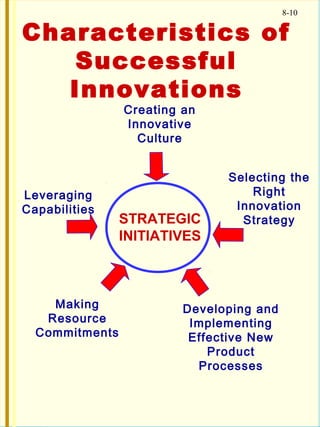
Characteristics of
Successful
Innovations
STRATEGIC
INITIATIVES
Creating an
Innovative
Culture
Leveraging
Capabilities
Selecting the
Right
Innovation
Strategy
Developing and
Implementing
Effective New
Product
Processes
Making
Resource
Commitments
8-11
Developing an
Innovation Culture
 Innovation Workshop for
top executives to develop
an innovation plan.
 Innovation Statement
highlighting objectives and
senior management’s role
and responsibilities.
 Training programs for
employees and managers.
 Communicate the priority of
innovation.
 Speakers to expose
employees to innovation
authorities.
Source: Thomas D. Kuczmarski et al., “The Breakthrough Mindset,” Marketing Management, March/April
2003, 43.
8-12
The Innovation
Strategy Spells Out
Management’s
Priorities for New
Product Opportunities1. Set specific New Product
Objectives.
2. Communicate the role of New
Products throughout the
organization.
3. Define the areas of strategic
focus:
Product Scope
Markets
Technologies
4. Include longer term
discontinuous projects in the
portfolio along with
incremental projects.
Source: Robert Cooper, “Benchmarking New Product Performance,” European Management Journal, Feb. 1998, 1-7.
8-13
Customer
Needs
Analysis
Customer
Needs
Analysis
Business
Analysis
Business
Analysis
Screening
and
Evaluation
Screening
and
Evaluation
Idea
Generation
Idea
Generation
Marketing
Strategy
Development
Marketing
Strategy
Development
Product
Development
Product
Development
TestingTesting
CommercializationCommercialization
NEW PRODUCT
PLANNING PROCESS
8-14
Achieving Cross-
Functional Interaction
and Coordination
R & D
Operation
s
Marketing
Finance
8-15
 Coordination of new product
activities by a high-level general
manager
 Inter-functional coordination by a
team of new product planning
representatives
 Creation of a project task force
responsible for new product
planning
 Designation of a new products
manager to coordinate planning
between departments
 Formation of matrix structure for
integration new product planning
with business functions
 Creation of a permanent design
center
Responsibility for New
Product Planning
8-16
 Idea search: targeted or open-
ended?
 How extensive and
aggressive?
 What specific sources are
best for generating a regular
flow of new product ideas?
 How can new ideas be
obtained from customers?
 Where will responsibility for
the new product ideas search
be placed?
 What are potential threats
from alternative (or disruptive)
technologies?
IDEA GENERATION
8-17
BENETTON’S
STRATEGY TO REVIVE
APPAREL IDEA
GENERATION“We didn’t take advantage of the [industry’s] quick
transformation,” says Silvana Cassano, the ex-Fiat
manager who assumed the post of chief executive of
Benetton Group on May 5.
The transformation saw the best retailers turn
into cutting-edge users of digital technology.
Benetton’s competitors-notably Spain’s Zara and
Sweden’s H&M Hennes & Mauritz-have raised the bar
for the entire industry. These retailers can beam new
styles from the catwalk to the shop floor in less than a
month-and at bargain prices. Both deploy
sophisticated technology to track which items are
selling and which aren’t, so winners can be speedily
restocked and slow movers yanked down from the
racks. They’ve got the look down, too-cool and minimal
for the working women who love Zara, and over-the-
top trendy for H&M’s teen fans. And Benetton’s look?
Blan. “The Benetton brand is out of fashion,” says
Sagra Maceira de Rosen, retail analyst at J.P. Morgan
Chase & Co. in London.
8-18
Cassano is out to change that. The message
he delivered in his first encounter with shareholders
was short and powerful: Benetton is going to refocus
on the apparel business, which encompasses the
Sisley and Benetton brands.
It’s no secret that Benetton’s core casual wear
business has suffered neglect. In 1994, founder
Luciano Benetton launched an ill-fated diversification
into sports equipment, snapping up trophy brands such
as Prince (tennis rackets), Rollerblade (in-line skates),
and Killer Loop (snowboards). But the strategy
foundered and last year, Benetton sold the entire
equipment division, booking $190 million in write-offs.
The company posted its first annual loss-$10.5 million,
on revenues of $2.3 million.
Benetton’s Strategy
(continued)
Source: “Has Benetton Stopped Unraveling?” Business Week, June 30, 2003, 76.
8-19
METHODS
OF
GENERATING
IDEAS
Direct
Search
Linking
Marketing
and Technology
Facilitating
Lead User
Analysis
Creative
Methods
National
Policy
Exploratory
Customer
Studies
Alliances/
Acquisition/
Licensing
Technological
Innovation
8-20
IDEA GENERATION
SCREENING
(fit/feasibility)
CONCEPT EVALUATION
BUSINESS ANALYSIS
SCREENING,
EVALUATING, AND
BUSINESS ANALYSIS
8-21
Business
Analysis
 Revenue Forecasts
 Preliminary Marketing
Plan
 Cost Estimation
 Profit Projections
 Other Considerations
8-22
NEW
PRODUCT
CONCEPT
PRODUCT
DEVELOPMENT
AND USE
TESTING
MARKETING
STRATEGY
DEVELOPMENT
MARKET
TESTING
LAUNCH
PRODUCT AND
PROCESS
DEVELOPMENT
8-23
 Development of the new product
includes:
– Product design
– Packaging design
– Decisions to make or purchase
product components
 Product Development Process:
– Product Specifications
– Industrial Design
– Prototype
– Use Tests
– Process Development
 Collaborative Development
Product and
Process
Development
8-24
PURPOSE
OF
USE TESTS
Does it have the
required attributes?
Verify
claims
Ideas for
improvements
Identify use
situations
8-25
MARKETING
STRATEGY AND
MARKET TESTING
 Marketing Strategy Decisions
– Market Targeting
– Positioning Strategy
 Market Testing Options
– Simulated Test Marketing
– Scanner – Based Test Marketing
– Conventional Test Marketing
– Testing Industrial Products
– Selecting Test Sites
– Length of the Test
– External Influences
8-26
Less artificial than simulated
testing
Costs less than full-scale market
test
Test is controlled by using IRI’s
2300 panel members in each test
city
Cable TV enables use of controlled
ad testing
Tests take about 12 months
Costs are $250,000+
Scanner-based Test
Marketing
8-27
COMMERCIALIZATI
ON
The Marketing Plan
– Complete marketing strategy
– Responsibilities for execution
– Cross – functional approach
Monitoring and Control
– Real – time tracking
– Role of the Internet
– Include product performance
metrics with performance
targets
8-28
Market
Target(s)
Marketing
Program(s)Objectives
Marketing Strategy
8-29
 Technology Push
Processes
 Platform Products
 Process – Intensive
Products
 Customized
Products
VARIATIONS IN THE
GENERIC NEW
PRODUCT PLANNING

Chap008