1

Chapter
   6

     Enterprise e-Business Systems


McGraw-Hill/Irwin   Copyright © 2004, The McGraw-Hill Companies, Inc. All rights reserved.
2


                    Learning Objectives
Identify  and give examples to illustrate the
  following aspects of customer relationship
  management, enterprise resource
  management, and supply chain management
  systems:
   Business processes supported

   Customer and business value provided

   Potential challenges and trends


McGraw-Hill/Irwin         Copyright © 2004, The McGraw-Hill Companies, Inc. All rights reserved.
3


                     Section I


         Customer Relationship Management:
                  The Business Focus


McGraw-Hill/Irwin     Copyright © 2004, The McGraw-Hill Companies, Inc. All rights reserved.
4


        Customer Relationship Management
Provides   customer-facing employees with a
  single, complete view of every customer at
  every touch point and across all channels

Provides   the customer with a single, complete
  view of the company and its extended channels


McGraw-Hill/Irwin   Copyright © 2004, The McGraw-Hill Companies, Inc. All rights reserved.
5


                    Customer Relationship Management (continued)


CRM..

   Integrates  and automates many of the
      customer serving processes

   Creates   an IT framework of Web-enabled
      software & databases that integrates these
      processes with the rest of the company’s
      business operations

McGraw-Hill/Irwin                 Copyright © 2004, The McGraw-Hill Companies, Inc. All rights reserved.
6


                    Customer Relationship Management (continued)


   Includes   software modules that provide tools
      that enable a business & its employees to
      provide fast, convenient, dependable,
      consistent service.


McGraw-Hill/Irwin                 Copyright © 2004, The McGraw-Hill Companies, Inc. All rights reserved.
7


                    Customer Relationship Management (continued)


Major         Application Components

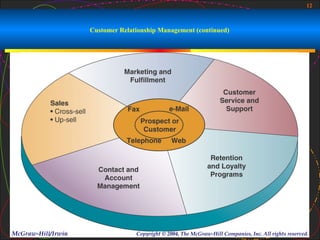
   Contact   & Account Management
       Helps capture and track relevant data

        about past and planned contacts with
        prospects & customers.


McGraw-Hill/Irwin                 Copyright © 2004, The McGraw-Hill Companies, Inc. All rights reserved.
8


                     Customer Relationship Management (continued)


   Sales

       Provides sales reps with software tools &
         company data needed to support &
         manage their sales activities.

       Helps       optimize cross-selling & up-selling


McGraw-Hill/Irwin                  Copyright © 2004, The McGraw-Hill Companies, Inc. All rights reserved.
9


                    Customer Relationship Management (continued)


   Marketing     & Fulfillment
       Helps accomplish direct marketing

        campaigns by automating tasks
       Helps capture & manage prospect &

        customer response data
       Helps in fulfillment by quickly scheduling

        sales contacts & providing appropriate
        information on products & services to
        them
McGraw-Hill/Irwin                 Copyright © 2004, The McGraw-Hill Companies, Inc. All rights reserved.
10


                    Customer Relationship Management (continued)


   Customer     Service and Support
       Provides software tools & real-time access

        to the common customer database
       Helps create, assign, & manage requests

        for service from customers
         Call center software

         Help desk software


McGraw-Hill/Irwin                 Copyright © 2004, The McGraw-Hill Companies, Inc. All rights reserved.
11


                    Customer Relationship Management (continued)


Retention          and Loyalty Programs

   Helps   the company identify, reward, and
      market to their most loyal and profitable
      customers


McGraw-Hill/Irwin                 Copyright © 2004, The McGraw-Hill Companies, Inc. All rights reserved.
12


                    Customer Relationship Management (continued)


McGraw-Hill/Irwin                 Copyright © 2004, The McGraw-Hill Companies, Inc. All rights reserved.
13


                    Customer Relationship Management (continued)


Three         Phases of CRM

   Acquire    (new customers)
       By doing a superior job of contact

        management, sales prospecting, selling,
        direct marketing, & fulfillment.


McGraw-Hill/Irwin                 Copyright © 2004, The McGraw-Hill Companies, Inc. All rights reserved.
14


                    Customer Relationship Management (continued)


   Enhance     (customer satisfaction)
       By supporting superior service from a

        responsive networked team of sales and
        service specialists.


McGraw-Hill/Irwin                 Copyright © 2004, The McGraw-Hill Companies, Inc. All rights reserved.
15


                    Customer Relationship Management (continued)


   Retain    (your customers)
       Help identify and reward your most loyal,

        profitable customers.


McGraw-Hill/Irwin                 Copyright © 2004, The McGraw-Hill Companies, Inc. All rights reserved.
16


                    Customer Relationship Management (continued)


Benefits   and Challenges
   Allows a business to identify its best

    customers
   Makes possible real-time customization &

    personalization of products & services based
    on customer wants, needs, buying habits, &
    life cycles


McGraw-Hill/Irwin                 Copyright © 2004, The McGraw-Hill Companies, Inc. All rights reserved.
17


                    Customer Relationship Management (continued)


Benefits and Challenges (continued)
   Enables a company to provide a consistent

    customer service experience

Failures

   Dueto lack of understanding & preparation.
   CRM is not a silver bullet


McGraw-Hill/Irwin                 Copyright © 2004, The McGraw-Hill Companies, Inc. All rights reserved.
18


                    Customer Relationship Management (continued)


Trends

   Operational CRM
   Analytical CRM

   Collaborative CRM

   Portal-based CRM


McGraw-Hill/Irwin                 Copyright © 2004, The McGraw-Hill Companies, Inc. All rights reserved.
19


                         Section II


               Enterprise Resource Planning:
                   The Business Backbone


McGraw-Hill/Irwin         Copyright © 2004, The McGraw-Hill Companies, Inc. All rights reserved.
20


               Enterprise Resource Planning
Serves as a cross-functional enterprise
 backbone that integrates & automates many
 internal business processes and information
 systems
Helps companies gain the efficiency, agility, &

 responsiveness needed to succeed today


McGraw-Hill/Irwin        Copyright © 2004, The McGraw-Hill Companies, Inc. All rights reserved.
21


                    Enterprise Resource Planning (continued)


Gives   a company an integrated real-time view
 of its core business processes
ERP software suites typically consist of

 integrated modules of…
  Manufacturing

  Distribution

  Sales

  Accounting

  Human Resource Management
McGraw-Hill/Irwin               Copyright © 2004, The McGraw-Hill Companies, Inc. All rights reserved.
22


                    Enterprise Resource Planning (continued)


Benefits and Challenges
   Quality and efficiency

    Helps improve the quality and efficiency

     of customer service, production, &
     distribution by creating a framework for
     integrating and improving internal
     business processes


McGraw-Hill/Irwin               Copyright © 2004, The McGraw-Hill Companies, Inc. All rights reserved.
23


                    Enterprise Resource Planning (continued)


   Decreased   Costs
       Reductions in transaction processing costs

        and hardware, software, and IT support
        staff


McGraw-Hill/Irwin               Copyright © 2004, The McGraw-Hill Companies, Inc. All rights reserved.
24


                    Enterprise Resource Planning (continued)


Decision  support
   Provides cross-functional information on

    business performance to assist managers in
    making better decisions


McGraw-Hill/Irwin               Copyright © 2004, The McGraw-Hill Companies, Inc. All rights reserved.
25


                    Enterprise Resource Planning (continued)


Enterprise   agility
   Results in more flexible organizational

    structures, managerial responsibilities, and
    work roles


McGraw-Hill/Irwin               Copyright © 2004, The McGraw-Hill Companies, Inc. All rights reserved.
26


                    Enterprise Resource Planning (continued)


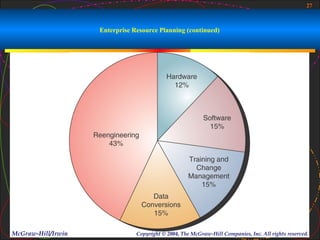
Costs  of ERP
   The costs and risks of failure in

    implementing a new ERP system are
    substantial.


McGraw-Hill/Irwin               Copyright © 2004, The McGraw-Hill Companies, Inc. All rights reserved.
27


                    Enterprise Resource Planning (continued)


McGraw-Hill/Irwin               Copyright © 2004, The McGraw-Hill Companies, Inc. All rights reserved.
28


                    Enterprise Resource Planning (continued)


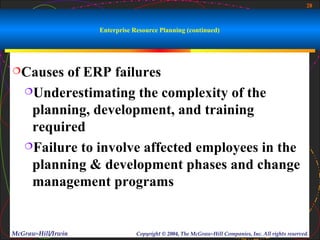
Causes  of ERP failures
   Underestimating the complexity of the

    planning, development, and training
    required
   Failure to involve affected employees in the

    planning & development phases and change
    management programs


McGraw-Hill/Irwin               Copyright © 2004, The McGraw-Hill Companies, Inc. All rights reserved.
29


                       Enterprise Resource Planning (continued)


   Trying          to do too much, too fast

   Insufficient         training

   Believing  everything the software vendors
      and/or consultants say


McGraw-Hill/Irwin                  Copyright © 2004, The McGraw-Hill Companies, Inc. All rights reserved.
30


                    Enterprise Resource Planning (continued)


Trends

   FlexibleERP
   Web-enabled ERP

   Interenterprise ERP

   E-Business Suites


McGraw-Hill/Irwin               Copyright © 2004, The McGraw-Hill Companies, Inc. All rights reserved.
31


                           Section III


                    Supply Chain Management:
                       The Business Network


McGraw-Hill/Irwin            Copyright © 2004, The McGraw-Hill Companies, Inc. All rights reserved.
32


                    Supply Chain Management
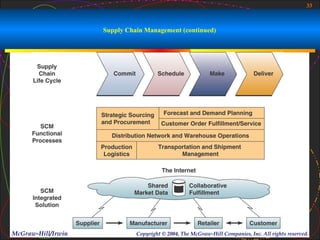
A  cross-functional interenterprise system that
  uses IT to help support & manage the links
  between some of a company’s key business
  processes and those of its suppliers, customers,
  & business partners.

Goal  is to create a fast, efficient, & low-cost
  network of business relationships.

McGraw-Hill/Irwin           Copyright © 2004, The McGraw-Hill Companies, Inc. All rights reserved.
33


                    Supply Chain Management (continued)


McGraw-Hill/Irwin             Copyright © 2004, The McGraw-Hill Companies, Inc. All rights reserved.
34


                    Supply Chain Management (continued)


   Electronic   data interchange
       Exchanging business transaction

        documents over the Internet & other
        networks between supply chain trading
        partners


McGraw-Hill/Irwin             Copyright © 2004, The McGraw-Hill Companies, Inc. All rights reserved.
35


                    Supply Chain Management (continued)


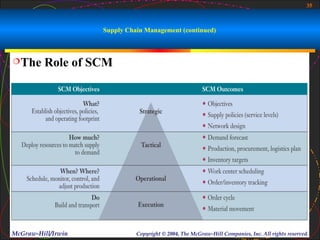
 The    Role of SCM


McGraw-Hill/Irwin             Copyright © 2004, The McGraw-Hill Companies, Inc. All rights reserved.
36


                    Supply Chain Management (continued)


Benefits  and Challenges
   Can provide faster, more accurate order

    processing, reductions in inventory levels,
    quicker time to market, lower transaction
    and materials costs, & strategic relationships
    with suppliers


McGraw-Hill/Irwin             Copyright © 2004, The McGraw-Hill Companies, Inc. All rights reserved.
37


                    Supply Chain Management (continued)


Problem   causes
   Lack of proper demand planning

    knowledge, tools, and guidelines
   Inaccurate or overoptimistic demand

    forecasts
   Inaccurate production, inventory, and other

    business data
   Lack of adequate collaboration


McGraw-Hill/Irwin             Copyright © 2004, The McGraw-Hill Companies, Inc. All rights reserved.
38


                    Supply Chain Management (continued)


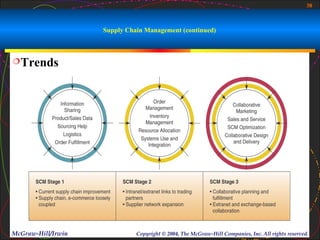
 Trends


McGraw-Hill/Irwin             Copyright © 2004, The McGraw-Hill Companies, Inc. All rights reserved.
39


                    Discussion Questions
Should  a company become a customer-focused
  business?

Why    would systems that enhance a company’s
  relationships with customers have such a high
  rate of failure?


McGraw-Hill/Irwin         Copyright © 2004, The McGraw-Hill Companies, Inc. All rights reserved.
40


                    Discussion Questions (continued)


How  could some of the spectacular failures of
  ERP systems have been avoided?

Should  companies continue to use EDI
  systems?


McGraw-Hill/Irwin           Copyright © 2004, The McGraw-Hill Companies, Inc. All rights reserved.
41


                    Discussion Questions (continued)


How   can the problem of overenthusiastic
  demand forecasts in supply chain planning be
  avoided?

What   challenges do you see for a company
  that wants to implement collaborative SCM
  systems?


McGraw-Hill/Irwin           Copyright © 2004, The McGraw-Hill Companies, Inc. All rights reserved.
42


                    Discussion Questions (continued)


Should   companies install e-business software
  suites or “best of breed” e-business software
  components?


McGraw-Hill/Irwin           Copyright © 2004, The McGraw-Hill Companies, Inc. All rights reserved.
43


   Real World Case 1 – Mitsubishi Motor Sales

What  are the key application components of
  Mitsubishi’s CRM system?

What  is the business use of each of those
  components?


McGraw-Hill/Irwin    Copyright © 2004, The McGraw-Hill Companies, Inc. All rights reserved.
44


                    Real World Case 1 (continued)


What   are the benefits to a business and its
  customers of a CRM system like Mitsubishi’s?

Do  you approve of Mitsubishi’s approach to
  acquiring and installing its CRM system?


McGraw-Hill/Irwin         Copyright © 2004, The McGraw-Hill Companies, Inc. All rights reserved.
45


                    Real World Case 1 (continued)


Why   have many CRM systems failed to
  provide promised benefits like those generated
  by Mitsubishi’s system?


McGraw-Hill/Irwin         Copyright © 2004, The McGraw-Hill Companies, Inc. All rights reserved.
46


    Real World Case 2 – Agilent Technologies & Russ Berrie


What   are the main reasons companies
  experience failures in implementing ERP
  systems?

What    are several key things companies should
  do to avoid ERP systems failures?


McGraw-Hill/Irwin         Copyright © 2004, The McGraw-Hill Companies, Inc. All rights reserved.
47


                    Real World Case 2 (continued)


Why    do you think ERP systems in particular
  are often cited as examples of failures in IT
  systems development, implementation, or
  management?


McGraw-Hill/Irwin         Copyright © 2004, The McGraw-Hill Companies, Inc. All rights reserved.
48


                    Real World Case 2 (continued)


What   do you think caused the major failure of
  Agilent’s ERP implementation?

Why   do you think they did not act to avoid the
  reasons you specified?


McGraw-Hill/Irwin         Copyright © 2004, The McGraw-Hill Companies, Inc. All rights reserved.
49


    Real World Case 3 – TaylorMade Golf & HON Industries


How   could moving business information
  systems with suppliers and distributors to the
  Web result in such dramatic business benefits
  as experienced by TaylorMade Golf?

How  does HON Industries’ new SCM system
  improve the efficiency of their supply chain?


McGraw-Hill/Irwin       Copyright © 2004, The McGraw-Hill Companies, Inc. All rights reserved.
50


                    Real World Case 3 (continued)


What   other SCM initiatives would you
  recommend that TaylorMade or HON
  Industries implement to improve their supply
  chain performance and business value?


McGraw-Hill/Irwin         Copyright © 2004, The McGraw-Hill Companies, Inc. All rights reserved.
51


                    Real World Case 3 (continued)


What    are several ways a small business could
  use supply chain management to improve the
  efficiency and business value of their supply
  chain?


McGraw-Hill/Irwin         Copyright © 2004, The McGraw-Hill Companies, Inc. All rights reserved.
52


    Real World Case 4 – H-P, Eastman Chemical, & Others


Why    can both large and small businesses cut
  costs and increase revenues by moving their
  supply chains online?


McGraw-Hill/Irwin        Copyright © 2004, The McGraw-Hill Companies, Inc. All rights reserved.
53


                    Real World Case 4 (continued)


What     is the business value to Eastman
  Chemical and W.W. Grainger of their
  initiatives to help their suppliers and
  customers do business online?


McGraw-Hill/Irwin         Copyright © 2004, The McGraw-Hill Companies, Inc. All rights reserved.
54


                    Real World Case 4 (continued)


Why   are many small suppliers reluctant to do
  business online with their large customers?

What   can be done to encourage small
  suppliers to get online?


McGraw-Hill/Irwin         Copyright © 2004, The McGraw-Hill Companies, Inc. All rights reserved.
55


    Real World Case 5 – Wal-Mart & Mattel


Do  you agree that Wal-Mart is “the best
  supply chain operator of all time”?

Why        or why not?


McGraw-Hill/Irwin         Copyright © 2004, The McGraw-Hill Companies, Inc. All rights reserved.
56


                      Real World Case 5 (continued)


What         has Mattel learned from Wal-Mart?

How   well are they applying it to their own
  business?


McGraw-Hill/Irwin           Copyright © 2004, The McGraw-Hill Companies, Inc. All rights reserved.
57


                    Real World Case 5 (continued)


What   can other businesses learn from the
  experiences of Wal-Mart and Mattel that
  could improve their supply chain
  performance?


McGraw-Hill/Irwin         Copyright © 2004, The McGraw-Hill Companies, Inc. All rights reserved.

Chap006 MIS

  • 1.
    1 Chapter 6 Enterprise e-Business Systems McGraw-Hill/Irwin Copyright © 2004, The McGraw-Hill Companies, Inc. All rights reserved.
  • 2.
    2 Learning Objectives Identify and give examples to illustrate the following aspects of customer relationship management, enterprise resource management, and supply chain management systems: Business processes supported Customer and business value provided Potential challenges and trends McGraw-Hill/Irwin Copyright © 2004, The McGraw-Hill Companies, Inc. All rights reserved.
  • 3.
    3 Section I Customer Relationship Management: The Business Focus McGraw-Hill/Irwin Copyright © 2004, The McGraw-Hill Companies, Inc. All rights reserved.
  • 4.
    4 Customer Relationship Management Provides customer-facing employees with a single, complete view of every customer at every touch point and across all channels Provides the customer with a single, complete view of the company and its extended channels McGraw-Hill/Irwin Copyright © 2004, The McGraw-Hill Companies, Inc. All rights reserved.
  • 5.
    5 Customer Relationship Management (continued) CRM.. Integrates and automates many of the customer serving processes Creates an IT framework of Web-enabled software & databases that integrates these processes with the rest of the company’s business operations McGraw-Hill/Irwin Copyright © 2004, The McGraw-Hill Companies, Inc. All rights reserved.
  • 6.
    6 Customer Relationship Management (continued) Includes software modules that provide tools that enable a business & its employees to provide fast, convenient, dependable, consistent service. McGraw-Hill/Irwin Copyright © 2004, The McGraw-Hill Companies, Inc. All rights reserved.
  • 7.
    7 Customer Relationship Management (continued) Major Application Components Contact & Account Management Helps capture and track relevant data about past and planned contacts with prospects & customers. McGraw-Hill/Irwin Copyright © 2004, The McGraw-Hill Companies, Inc. All rights reserved.
  • 8.
    8 Customer Relationship Management (continued) Sales Provides sales reps with software tools & company data needed to support & manage their sales activities. Helps optimize cross-selling & up-selling McGraw-Hill/Irwin Copyright © 2004, The McGraw-Hill Companies, Inc. All rights reserved.
  • 9.
    9 Customer Relationship Management (continued) Marketing & Fulfillment Helps accomplish direct marketing campaigns by automating tasks Helps capture & manage prospect & customer response data Helps in fulfillment by quickly scheduling sales contacts & providing appropriate information on products & services to them McGraw-Hill/Irwin Copyright © 2004, The McGraw-Hill Companies, Inc. All rights reserved.
  • 10.
    10 Customer Relationship Management (continued) Customer Service and Support Provides software tools & real-time access to the common customer database Helps create, assign, & manage requests for service from customers Call center software Help desk software McGraw-Hill/Irwin Copyright © 2004, The McGraw-Hill Companies, Inc. All rights reserved.
  • 11.
    11 Customer Relationship Management (continued) Retention and Loyalty Programs Helps the company identify, reward, and market to their most loyal and profitable customers McGraw-Hill/Irwin Copyright © 2004, The McGraw-Hill Companies, Inc. All rights reserved.
  • 12.
    12 Customer Relationship Management (continued) McGraw-Hill/Irwin Copyright © 2004, The McGraw-Hill Companies, Inc. All rights reserved.
  • 13.
    13 Customer Relationship Management (continued) Three Phases of CRM Acquire (new customers) By doing a superior job of contact management, sales prospecting, selling, direct marketing, & fulfillment. McGraw-Hill/Irwin Copyright © 2004, The McGraw-Hill Companies, Inc. All rights reserved.
  • 14.
    14 Customer Relationship Management (continued) Enhance (customer satisfaction) By supporting superior service from a responsive networked team of sales and service specialists. McGraw-Hill/Irwin Copyright © 2004, The McGraw-Hill Companies, Inc. All rights reserved.
  • 15.
    15 Customer Relationship Management (continued) Retain (your customers) Help identify and reward your most loyal, profitable customers. McGraw-Hill/Irwin Copyright © 2004, The McGraw-Hill Companies, Inc. All rights reserved.
  • 16.
    16 Customer Relationship Management (continued) Benefits and Challenges Allows a business to identify its best customers Makes possible real-time customization & personalization of products & services based on customer wants, needs, buying habits, & life cycles McGraw-Hill/Irwin Copyright © 2004, The McGraw-Hill Companies, Inc. All rights reserved.
  • 17.
    17 Customer Relationship Management (continued) Benefits and Challenges (continued) Enables a company to provide a consistent customer service experience Failures Dueto lack of understanding & preparation. CRM is not a silver bullet McGraw-Hill/Irwin Copyright © 2004, The McGraw-Hill Companies, Inc. All rights reserved.
  • 18.
    18 Customer Relationship Management (continued) Trends Operational CRM Analytical CRM Collaborative CRM Portal-based CRM McGraw-Hill/Irwin Copyright © 2004, The McGraw-Hill Companies, Inc. All rights reserved.
  • 19.
    19 Section II Enterprise Resource Planning: The Business Backbone McGraw-Hill/Irwin Copyright © 2004, The McGraw-Hill Companies, Inc. All rights reserved.
  • 20.
    20 Enterprise Resource Planning Serves as a cross-functional enterprise backbone that integrates & automates many internal business processes and information systems Helps companies gain the efficiency, agility, & responsiveness needed to succeed today McGraw-Hill/Irwin Copyright © 2004, The McGraw-Hill Companies, Inc. All rights reserved.
  • 21.
    21 Enterprise Resource Planning (continued) Gives a company an integrated real-time view of its core business processes ERP software suites typically consist of integrated modules of… Manufacturing Distribution Sales Accounting Human Resource Management McGraw-Hill/Irwin Copyright © 2004, The McGraw-Hill Companies, Inc. All rights reserved.
  • 22.
    22 Enterprise Resource Planning (continued) Benefits and Challenges Quality and efficiency Helps improve the quality and efficiency of customer service, production, & distribution by creating a framework for integrating and improving internal business processes McGraw-Hill/Irwin Copyright © 2004, The McGraw-Hill Companies, Inc. All rights reserved.
  • 23.
    23 Enterprise Resource Planning (continued) Decreased Costs Reductions in transaction processing costs and hardware, software, and IT support staff McGraw-Hill/Irwin Copyright © 2004, The McGraw-Hill Companies, Inc. All rights reserved.
  • 24.
    24 Enterprise Resource Planning (continued) Decision support Provides cross-functional information on business performance to assist managers in making better decisions McGraw-Hill/Irwin Copyright © 2004, The McGraw-Hill Companies, Inc. All rights reserved.
  • 25.
    25 Enterprise Resource Planning (continued) Enterprise agility Results in more flexible organizational structures, managerial responsibilities, and work roles McGraw-Hill/Irwin Copyright © 2004, The McGraw-Hill Companies, Inc. All rights reserved.
  • 26.
    26 Enterprise Resource Planning (continued) Costs of ERP The costs and risks of failure in implementing a new ERP system are substantial. McGraw-Hill/Irwin Copyright © 2004, The McGraw-Hill Companies, Inc. All rights reserved.
  • 27.
    27 Enterprise Resource Planning (continued) McGraw-Hill/Irwin Copyright © 2004, The McGraw-Hill Companies, Inc. All rights reserved.
  • 28.
    28 Enterprise Resource Planning (continued) Causes of ERP failures Underestimating the complexity of the planning, development, and training required Failure to involve affected employees in the planning & development phases and change management programs McGraw-Hill/Irwin Copyright © 2004, The McGraw-Hill Companies, Inc. All rights reserved.
  • 29.
    29 Enterprise Resource Planning (continued) Trying to do too much, too fast Insufficient training Believing everything the software vendors and/or consultants say McGraw-Hill/Irwin Copyright © 2004, The McGraw-Hill Companies, Inc. All rights reserved.
  • 30.
    30 Enterprise Resource Planning (continued) Trends FlexibleERP Web-enabled ERP Interenterprise ERP E-Business Suites McGraw-Hill/Irwin Copyright © 2004, The McGraw-Hill Companies, Inc. All rights reserved.
  • 31.
    31 Section III Supply Chain Management: The Business Network McGraw-Hill/Irwin Copyright © 2004, The McGraw-Hill Companies, Inc. All rights reserved.
  • 32.
    32 Supply Chain Management A cross-functional interenterprise system that uses IT to help support & manage the links between some of a company’s key business processes and those of its suppliers, customers, & business partners. Goal is to create a fast, efficient, & low-cost network of business relationships. McGraw-Hill/Irwin Copyright © 2004, The McGraw-Hill Companies, Inc. All rights reserved.
  • 33.
    33 Supply Chain Management (continued) McGraw-Hill/Irwin Copyright © 2004, The McGraw-Hill Companies, Inc. All rights reserved.
  • 34.
    34 Supply Chain Management (continued) Electronic data interchange Exchanging business transaction documents over the Internet & other networks between supply chain trading partners McGraw-Hill/Irwin Copyright © 2004, The McGraw-Hill Companies, Inc. All rights reserved.
  • 35.
    35 Supply Chain Management (continued)  The Role of SCM McGraw-Hill/Irwin Copyright © 2004, The McGraw-Hill Companies, Inc. All rights reserved.
  • 36.
    36 Supply Chain Management (continued) Benefits and Challenges Can provide faster, more accurate order processing, reductions in inventory levels, quicker time to market, lower transaction and materials costs, & strategic relationships with suppliers McGraw-Hill/Irwin Copyright © 2004, The McGraw-Hill Companies, Inc. All rights reserved.
  • 37.
    37 Supply Chain Management (continued) Problem causes Lack of proper demand planning knowledge, tools, and guidelines Inaccurate or overoptimistic demand forecasts Inaccurate production, inventory, and other business data Lack of adequate collaboration McGraw-Hill/Irwin Copyright © 2004, The McGraw-Hill Companies, Inc. All rights reserved.
  • 38.
    38 Supply Chain Management (continued)  Trends McGraw-Hill/Irwin Copyright © 2004, The McGraw-Hill Companies, Inc. All rights reserved.
  • 39.
    39 Discussion Questions Should a company become a customer-focused business? Why would systems that enhance a company’s relationships with customers have such a high rate of failure? McGraw-Hill/Irwin Copyright © 2004, The McGraw-Hill Companies, Inc. All rights reserved.
  • 40.
    40 Discussion Questions (continued) How could some of the spectacular failures of ERP systems have been avoided? Should companies continue to use EDI systems? McGraw-Hill/Irwin Copyright © 2004, The McGraw-Hill Companies, Inc. All rights reserved.
  • 41.
    41 Discussion Questions (continued) How can the problem of overenthusiastic demand forecasts in supply chain planning be avoided? What challenges do you see for a company that wants to implement collaborative SCM systems? McGraw-Hill/Irwin Copyright © 2004, The McGraw-Hill Companies, Inc. All rights reserved.
  • 42.
    42 Discussion Questions (continued) Should companies install e-business software suites or “best of breed” e-business software components? McGraw-Hill/Irwin Copyright © 2004, The McGraw-Hill Companies, Inc. All rights reserved.
  • 43.
    43 Real World Case 1 – Mitsubishi Motor Sales What are the key application components of Mitsubishi’s CRM system? What is the business use of each of those components? McGraw-Hill/Irwin Copyright © 2004, The McGraw-Hill Companies, Inc. All rights reserved.
  • 44.
    44 Real World Case 1 (continued) What are the benefits to a business and its customers of a CRM system like Mitsubishi’s? Do you approve of Mitsubishi’s approach to acquiring and installing its CRM system? McGraw-Hill/Irwin Copyright © 2004, The McGraw-Hill Companies, Inc. All rights reserved.
  • 45.
    45 Real World Case 1 (continued) Why have many CRM systems failed to provide promised benefits like those generated by Mitsubishi’s system? McGraw-Hill/Irwin Copyright © 2004, The McGraw-Hill Companies, Inc. All rights reserved.
  • 46.
    46 Real World Case 2 – Agilent Technologies & Russ Berrie What are the main reasons companies experience failures in implementing ERP systems? What are several key things companies should do to avoid ERP systems failures? McGraw-Hill/Irwin Copyright © 2004, The McGraw-Hill Companies, Inc. All rights reserved.
  • 47.
    47 Real World Case 2 (continued) Why do you think ERP systems in particular are often cited as examples of failures in IT systems development, implementation, or management? McGraw-Hill/Irwin Copyright © 2004, The McGraw-Hill Companies, Inc. All rights reserved.
  • 48.
    48 Real World Case 2 (continued) What do you think caused the major failure of Agilent’s ERP implementation? Why do you think they did not act to avoid the reasons you specified? McGraw-Hill/Irwin Copyright © 2004, The McGraw-Hill Companies, Inc. All rights reserved.
  • 49.
    49 Real World Case 3 – TaylorMade Golf & HON Industries How could moving business information systems with suppliers and distributors to the Web result in such dramatic business benefits as experienced by TaylorMade Golf? How does HON Industries’ new SCM system improve the efficiency of their supply chain? McGraw-Hill/Irwin Copyright © 2004, The McGraw-Hill Companies, Inc. All rights reserved.
  • 50.
    50 Real World Case 3 (continued) What other SCM initiatives would you recommend that TaylorMade or HON Industries implement to improve their supply chain performance and business value? McGraw-Hill/Irwin Copyright © 2004, The McGraw-Hill Companies, Inc. All rights reserved.
  • 51.
    51 Real World Case 3 (continued) What are several ways a small business could use supply chain management to improve the efficiency and business value of their supply chain? McGraw-Hill/Irwin Copyright © 2004, The McGraw-Hill Companies, Inc. All rights reserved.
  • 52.
    52 Real World Case 4 – H-P, Eastman Chemical, & Others Why can both large and small businesses cut costs and increase revenues by moving their supply chains online? McGraw-Hill/Irwin Copyright © 2004, The McGraw-Hill Companies, Inc. All rights reserved.
  • 53.
    53 Real World Case 4 (continued) What is the business value to Eastman Chemical and W.W. Grainger of their initiatives to help their suppliers and customers do business online? McGraw-Hill/Irwin Copyright © 2004, The McGraw-Hill Companies, Inc. All rights reserved.
  • 54.
    54 Real World Case 4 (continued) Why are many small suppliers reluctant to do business online with their large customers? What can be done to encourage small suppliers to get online? McGraw-Hill/Irwin Copyright © 2004, The McGraw-Hill Companies, Inc. All rights reserved.
  • 55.
    55 Real World Case 5 – Wal-Mart & Mattel Do you agree that Wal-Mart is “the best supply chain operator of all time”? Why or why not? McGraw-Hill/Irwin Copyright © 2004, The McGraw-Hill Companies, Inc. All rights reserved.
  • 56.
    56 Real World Case 5 (continued) What has Mattel learned from Wal-Mart? How well are they applying it to their own business? McGraw-Hill/Irwin Copyright © 2004, The McGraw-Hill Companies, Inc. All rights reserved.
  • 57.
    57 Real World Case 5 (continued) What can other businesses learn from the experiences of Wal-Mart and Mattel that could improve their supply chain performance? McGraw-Hill/Irwin Copyright © 2004, The McGraw-Hill Companies, Inc. All rights reserved.