McGraw-Hill/Irwin © 2007 The McGraw-Hill Companies, Inc. All rights reserved.
5
Chapter Title
15/e PPT
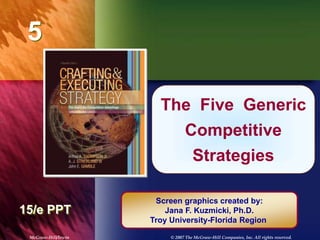
The Five Generic
Competitive
Strategies
Screen graphics created by:
Jana F. Kuzmicki, Ph.D.
Troy University-Florida Region
5-2
“Competitive strategy is about
being different. It means
deliberately choosing to perform
activities differently or to perform
different activities than rivals to
deliver a unique mix of value.”
Michael E. Porter
5-3
Chapter Roadmap
 The Five Competitive Strategies
 Low-Cost Provider Strategies
 Broad Differentiation Strategies
 Best-Cost Provider Strategies
 Focused (or Market Niche) Strategies
 The Contrasting Features of the Five Generic
Competitive Strategies: A Summary
5-4
Strategy and Competitive Advantage
 Competitive advantage exists when a firm’s
strategy gives it an edge in
 Attracting customers and
 Defending against competitive forces
 Convince customers firm’s product / service offers
superior value
 A good product at a low price
 A superior product worth paying more for
 A best-value product
Key to Gaining a Competitive Advantage
5-5
What Is Competitive Strategy?
 Deals exclusively with a company’s business
plans to compete successfully
 Specific efforts to please customers
 Offensive and defensive moves
to counter maneuvers of rivals
 Responses to prevailing market conditions
 Initiatives to strengthen its market position
 Narrower in scope than business strategy
5-6
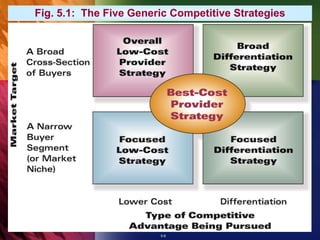
Fig. 5.1: The Five Generic Competitive Strategies
5-7
Low-Cost Provider Strategies
 Make achievement of meaningful lower costs
than rivals the theme of firm’s strategy
 Include features and services in product
offering that buyers consider essential
 Find approaches to achieve a cost advantage
in ways difficult for rivals to copy or match
Keys to Success
Low-cost leadership means low overall costs, not
just low manufacturing or production costs!
5-8
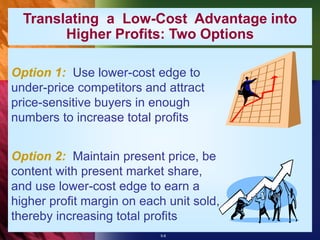
Option 1: Use lower-cost edge to
under-price competitors and attract
price-sensitive buyers in enough
numbers to increase total profits
Option 2: Maintain present price, be
content with present market share,
and use lower-cost edge to earn a
higher profit margin on each unit sold,
thereby increasing total profits
Translating a Low-Cost Advantage into
Higher Profits: Two Options
5-9
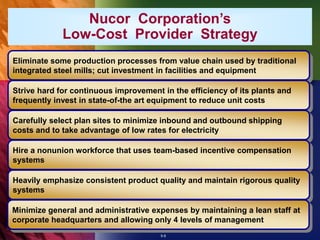
Nucor Corporation’s
Low-Cost Provider Strategy
Eliminate some production processes from value chain used by traditional
integrated steel mills; cut investment in facilities and equipment
Strive hard for continuous improvement in the efficiency of its plants and
frequently invest in state-of-the art equipment to reduce unit costs
Carefully select plan sites to minimize inbound and outbound shipping
costs and to take advantage of low rates for electricity
Hire a nonunion workforce that uses team-based incentive compensation
systems
Heavily emphasize consistent product quality and maintain rigorous quality
systems
Minimize general and administrative expenses by maintaining a lean staff at
corporate headquarters and allowing only 4 levels of management
5-10
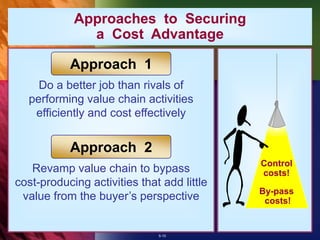
Approaches to Securing
a Cost Advantage
Do a better job than rivals of
performing value chain activities
efficiently and cost effectively
Revamp value chain to bypass
cost-producing activities that add little
value from the buyer’s perspective
Approach 1
Approach 2
Control
costs!
By-pass
costs!
5-11
Approach 1: Controlling the Cost Drivers
 Capture scale economies; avoid scale diseconomies
 Capture learning and experience curve effects
 Control percentage of capacity utilization
 Pursue efforts to boost sales and spread costs such as R&D
and advertising over more units
 Improve supply chain efficiency
 Substitute use of low-cost for high-cost raw materials
 Use online systems and sophisticated software to achieve
operating efficiencies
 Adopt labor-saving operating methods
 Use bargaining power to gain concessions from suppliers
 Compare vertical integration vs. outsourcing
5-12
 Use direct-to-end-user sales/marketing methods
 Make greater use of online technology applications
 Streamline operations by eliminating low-value-
added or unnecessary work steps
 Relocate facilities closer to suppliers or customers
 Offer basic, no-frills product/service
 Offer a limited product/service as opposed to a full
product/service line
Approach 2: Revamping the Value Chain
5-13
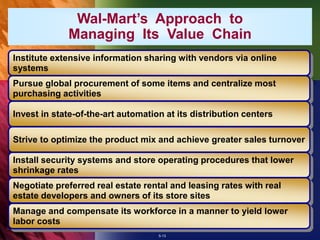
Wal-Mart’s Approach to
Managing Its Value Chain
Institute extensive information sharing with vendors via online
systems
Pursue global procurement of some items and centralize most
purchasing activities
Invest in state-of-the-art automation at its distribution centers
Strive to optimize the product mix and achieve greater sales turnover
Install security systems and store operating procedures that lower
shrinkage rates
Negotiate preferred real estate rental and leasing rates with real
estate developers and owners of its store sites
Manage and compensate its workforce in a manner to yield lower
labor costs
5-14
Keys to Success in Achieving
Low-Cost Leadership
 Scrutinize each cost-creating activity, identifying cost drivers
 Use knowledge about cost drivers to manage
costs of each activity down year after year
 Find ways to restructure value chain to eliminate
nonessential work steps and low-value activities
 Work diligently to create cost-conscious corporate cultures
 Feature broad employee participation in continuous cost-
improvement efforts and limited perks for executives
 Strive to operate with exceptionally small corporate staffs
 Aggressively pursue investments in resources and
capabilities that promise to drive costs out of the business
5-15
 Cost conscious corporate culture
 Employee participation in cost-control efforts
 Ongoing efforts to benchmark costs
 Intensive scrutiny of budget requests
 Programs promoting continuous cost improvement
Successful low-cost producers champion
frugality but wisely and aggressively
invest in cost-saving improvements !
Characteristics of a Low-Cost Provider
5-16
 Price competition is vigorous
 Product is standardized or readily available
from many suppliers
 There are few ways to achieve
differentiation that have value to buyers
 Most buyers use product in same ways
 Buyers incur low switching costs
 Buyers are large and have
significant bargaining power
 Industry newcomers use introductory low prices to
attract buyers and build customer base
When Does a Low-Cost
Strategy Work Best?
5-17
Pitfalls of Low-Cost Strategies
 Being overly aggressive in cutting price
 Low cost methods are easily imitated by rivals
 Becoming too fixated on reducing costs
and ignoring
 Buyer interest in additional features
 Declining buyer sensitivity to price
 Changes in how the product is used
 Technological breakthroughs open up cost
reductions for rivals
5-18
Test Your Knowledge
Striving to be the industry’s low-cost provider and achieving
lower costs than rivals entails
A. doing a better job than rivals of performing value chain
activities more cost-effectively.
B. having a smaller labor force than rivals, paying lower wages
than rivals, locating all facilities in countries where labor costs
are low, and outsourcing many value chain activities to
suppliers with world-class technological capabilities.
C. revamping the firm’s overall value chain to eliminate or bypass
cost-producing activities that produce little value added
insofar as customers are concerned.
D. adopting activity-based costing, utilizing more best practices
than rivals, and having a narrower product line than rivals.
E. Both A and C.
5-19
 Incorporate differentiating features that cause
buyers to prefer firm’s product or service over
brands of rivals
 Find ways to differentiate that create value for
buyers and are not easily matched or cheaply
copied by rivals
 Not spending more to achieve differentiation
than the price premium that can be charged
Objective
Keys to Success
Differentiation Strategies
5-20
Benefits of Successful Differentiation
A product / service with unique,
appealing attributes allows a firm to
 Command a premium price and/or
 Increase unit sales and/or
 Build brand loyalty
= Competitive Advantage
Which
hat is
unique?
5-21
 Unique taste – Dr. Pepper
 Multiple features – Microsoft Windows and Office
 Wide selection and one-stop shopping – Home Depot,
Amazon.com
 Superior service -- FedEx, Ritz-Carlton
 Spare parts availability – Caterpillar
 Engineering design and performance – Mercedes, BMW
 Prestige – Rolex
 Product reliability – Johnson & Johnson
 Quality manufacture – Karastan, Michelin, Toyota
 Technological leadership – 3M Corporation
 Top-of-line image – Ralph Lauren, Starbucks, Chanel
Types of Differentiation Themes
5-22
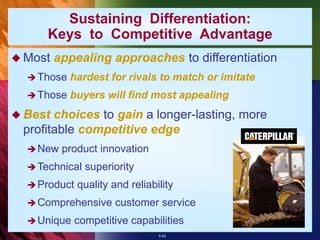
Sustaining Differentiation:
Keys to Competitive Advantage
 Most appealing approaches to differentiation
Those hardest for rivals to match or imitate
Those buyers will find most appealing
 Best choices to gain a longer-lasting, more
profitable competitive edge
New product innovation
Technical superiority
Product quality and reliability
Comprehensive customer service
Unique competitive capabilities
5-23
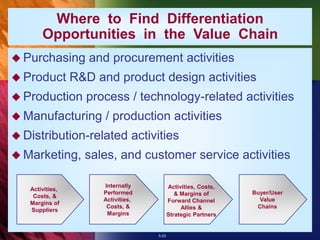
Where to Find Differentiation
Opportunities in the Value Chain
 Purchasing and procurement activities
 Product R&D and product design activities
 Production process / technology-related activities
 Manufacturing / production activities
 Distribution-related activities
 Marketing, sales, and customer service activities
Internally
Performed
Activities,
Costs, &
Margins
Activities,
Costs, &
Margins of
Suppliers
Buyer/User
Value
Chains
Activities, Costs,
& Margins of
Forward Channel
Allies &
Strategic Partners
5-24
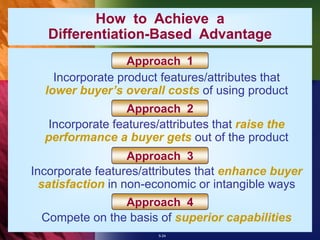
How to Achieve a
Differentiation-Based Advantage
Approach 1
Incorporate features/attributes that raise the
performance a buyer gets out of the product
Approach 2
Incorporate features/attributes that enhance buyer
satisfaction in non-economic or intangible ways
Approach 3
Compete on the basis of superior capabilities
Approach 4
Incorporate product features/attributes that
lower buyer’s overall costs of using product
5-25
Test Your Knowledge
Which of the following is not one of the four basic routes to
achieving a differentiation-based competitive advantage?
A. Appealing to high-income buyers who are willing and able to
pay a premium price for a high-performing, multi-featured
product
B. Incorporating features that raise product performance
C. Incorporating product attributes and user features that lower
the buyer’s overall costs of using the company’s product
D. Delivering value to customers via competencies and
competitive capabilities that rivals don’t have or can’t afford to
match
E. Incorporating features that enhance buyer satisfaction in
intangible or non-economic ways
5-26
Importance of Perceived Value
 Buyers seldom pay for value that is not perceived
 Price premium of a differentiation strategy reflects
 Value actually delivered to the buyer
and
 Value perceived by the buyer
 Actual and perceived value can differ when buyers
are unable to assess their experience with a
product
5-27
Signaling Value as Well
as Delivering Value
 Incomplete knowledge of buyers causes them to
judge value based on such signals as
 Price
 Attractive packaging
 Extensive ad campaigns
 Ad content and image
 Seller facilities or professionalism and
personality of employees
 Having a list of prestigious customers
 Signals of value may be as important as
actual value when
 Nature of differentiation is hard to quantify
 Buyers are making first-time purchases
 Repurchase is infrequent
 Buyers are unsophisticated
5-28
When Does a Differentiation
Strategy Work Best?
 There are many ways to differentiate a product
that have value and please customers
 Buyer needs and uses are diverse
 Few rivals are following a similar
differentiation approach
 Technological change and
product innovation are fast-paced
5-29
Pitfalls of Differentiation Strategies
 Appealing product features are easily copied by rivals
 Buyers see little value in unique attributes of product
 Overspending on efforts to differentiate the product
offering, thus eroding profitability
 Over-differentiating such that product
features exceed buyers’ needs
 Charging a price premium
buyers perceive is too high
 Not striving to open up meaningful gaps in quality,
service, or performance features vis-à-vis rivals’
products
5-30
For Discussion: Your Opinion
A low-cost provider strategy can defeat a
differentiation strategy when buyers are satisfied with
a basic product and don’t think “extra” attributes are
worth a higher price. True or false? Explain.
5-31
Best-Cost Provider Strategies
 Combine a strategic emphasis on low-cost with
a strategic emphasis on differentiation
 Make an upscale product at a lower cost
 Give customers more value for the money
 Deliver superior value by meeting or exceeding
buyer expectations on product attributes and
beating their price expectations
 Be the low-cost provider of a product with good-to-
excellent product attributes, then use cost
advantage to underprice comparable brands
Objectives
5-32
 A best-cost provider’s competitive advantage is
based on its capability to include upscale attributes
at a lower cost than rivals’ comparable products
 To achieve competitive advantage,
a company must be able to
 Incorporate attractive features at a lower cost than rivals
 Manufacture a good-to-excellent quality product at a
lower cost than rivals
 Develop a product that delivers good-to-excellent
performance at a lower cost than rivals
 Provide attractive customer
service at a lower cost than rivals
Competitive Strength of a
Best-Cost Provider Strategy
5-33
When Does a Best-Cost
Provider Strategy Work Best?
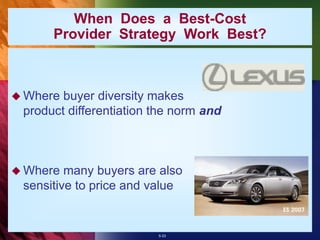
 Where buyer diversity makes
product differentiation the norm and
 Where many buyers are also
sensitive to price and value
5-34
Risk of a Best-Cost Provider Strategy
 A best-cost provider may get squeezed between
strategies of firms using low-cost and
differentiation strategies
 Low-cost leaders may be able to siphon
customers away with a lower price
 High-end differentiators may be able to
steal customers away with better product attributes
5-35
Test Your Knowledge
Which of the following are distinguishing features of a best-
cost provider strategy (based on the comparisons of the five
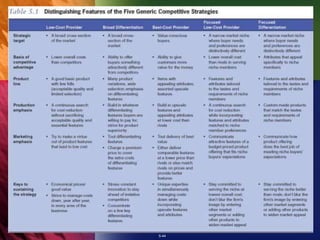
generic competitive strategies shown in Figure 5.1)?
A. The strategic target is price-conscious buyers
B. A marketing emphasis on charging a slightly higher price than
rival brands having comparable features and attributes
C. A product line that stresses wide selection, many product
variations, and emphasis on differentiating features
D. A competitive advantage based on more value for the money
E. Using constant product innovation, excellent R&D skills, and
periodic technological breakthroughs to sustain the strategy
5-36
Focus / Niche Strategies
 Involve concentrated attention on a narrow piece of
the total market
Serve niche buyers better than rivals
 Choose a market niche where buyers
have distinctive preferences, special
requirements, or unique needs
 Develop unique capabilities to serve
needs of target buyer segment
Objective
Keys to Success
5-37
 Geographic uniqueness
 Specialized requirements in
using product/service
 Special product attributes
appealing only to niche buyers
Approaches to Defining a Market Niche
5-38
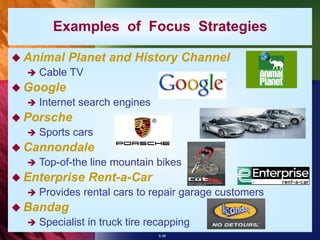
Examples of Focus Strategies
 Animal Planet and History Channel
 Cable TV
 Google
 Internet search engines
 Porsche
 Sports cars
 Cannondale
 Top-of-the line mountain bikes
 Enterprise Rent-a-Car
 Provides rental cars to repair garage customers
 Bandag
 Specialist in truck tire recapping
5-39
Focus / Niche Strategies
and Competitive Advantage
 Achieve lower costs than rivals in
serving a well-defined buyer segment –
Focused low-cost strategy
 Offer a product appealing to unique
preferences of a well-defined buyer segment –
Focused differentiation strategy
Approach 1
Approach 2
Which
hat is
unique?
5-40
What Makes a Niche
Attractive for Focusing?
 Big enough to be profitable and offers good growth
potential
 Not crucial to success of industry leaders
 Costly or difficult for multi-segment competitors
to meet specialized needs of niche members
 Focuser has resources and capabilities
to effectively serve an attractive niche
 Few other rivals are specializing in same niche
 Focuser can defend against challengers via
superior ability to serve niche members
5-41
Risks of a Focus Strategy
 Competitors find effective ways to match
a focuser’s capabilities in serving niche
 Niche buyers’ preferences shift towards product
attributes desired by majority of buyers – niche
becomes part of overall market
 Segment becomes so attractive it becomes
crowded with rivals, causing segment profits to be
splintered
5-42
For Discussion: Your Opinion
Which of the five generic competitive strategies do
you think the following companies are employing:
 The Saturn division of General Motors
 Abercrombie & Fitch
 Amazon.com
 Avon Products
5-43
Deciding Which Generic
Competitive Strategy to Use
 Each positions a company differently in its market and
competitive environment
 Each establishes a central theme for how a company will
endeavor to outcompete rivals
 Each creates some boundaries for maneuvering as market
circumstances unfold
 Each points to different ways of experimenting with the
basics of the strategy
 Each entails differences in product line, production
emphasis, marketing emphasis, and means to sustain the
strategy
The big risk – Selecting a “stuck in the middle” strategy!
This rarely produces a sustainable competitive
advantage or a distinctive competitive position!
5-44

Chap005.ppt

  • 1.
    McGraw-Hill/Irwin © 2007The McGraw-Hill Companies, Inc. All rights reserved. 5 Chapter Title 15/e PPT The Five Generic Competitive Strategies Screen graphics created by: Jana F. Kuzmicki, Ph.D. Troy University-Florida Region
  • 2.
    5-2 “Competitive strategy isabout being different. It means deliberately choosing to perform activities differently or to perform different activities than rivals to deliver a unique mix of value.” Michael E. Porter
  • 3.
    5-3 Chapter Roadmap  TheFive Competitive Strategies  Low-Cost Provider Strategies  Broad Differentiation Strategies  Best-Cost Provider Strategies  Focused (or Market Niche) Strategies  The Contrasting Features of the Five Generic Competitive Strategies: A Summary
  • 4.
    5-4 Strategy and CompetitiveAdvantage  Competitive advantage exists when a firm’s strategy gives it an edge in  Attracting customers and  Defending against competitive forces  Convince customers firm’s product / service offers superior value  A good product at a low price  A superior product worth paying more for  A best-value product Key to Gaining a Competitive Advantage
  • 5.
    5-5 What Is CompetitiveStrategy?  Deals exclusively with a company’s business plans to compete successfully  Specific efforts to please customers  Offensive and defensive moves to counter maneuvers of rivals  Responses to prevailing market conditions  Initiatives to strengthen its market position  Narrower in scope than business strategy
  • 6.
    5-6 Fig. 5.1: TheFive Generic Competitive Strategies
  • 7.
    5-7 Low-Cost Provider Strategies Make achievement of meaningful lower costs than rivals the theme of firm’s strategy  Include features and services in product offering that buyers consider essential  Find approaches to achieve a cost advantage in ways difficult for rivals to copy or match Keys to Success Low-cost leadership means low overall costs, not just low manufacturing or production costs!
  • 8.
    5-8 Option 1: Uselower-cost edge to under-price competitors and attract price-sensitive buyers in enough numbers to increase total profits Option 2: Maintain present price, be content with present market share, and use lower-cost edge to earn a higher profit margin on each unit sold, thereby increasing total profits Translating a Low-Cost Advantage into Higher Profits: Two Options
  • 9.
    5-9 Nucor Corporation’s Low-Cost ProviderStrategy Eliminate some production processes from value chain used by traditional integrated steel mills; cut investment in facilities and equipment Strive hard for continuous improvement in the efficiency of its plants and frequently invest in state-of-the art equipment to reduce unit costs Carefully select plan sites to minimize inbound and outbound shipping costs and to take advantage of low rates for electricity Hire a nonunion workforce that uses team-based incentive compensation systems Heavily emphasize consistent product quality and maintain rigorous quality systems Minimize general and administrative expenses by maintaining a lean staff at corporate headquarters and allowing only 4 levels of management
  • 10.
    5-10 Approaches to Securing aCost Advantage Do a better job than rivals of performing value chain activities efficiently and cost effectively Revamp value chain to bypass cost-producing activities that add little value from the buyer’s perspective Approach 1 Approach 2 Control costs! By-pass costs!
  • 11.
    5-11 Approach 1: Controllingthe Cost Drivers  Capture scale economies; avoid scale diseconomies  Capture learning and experience curve effects  Control percentage of capacity utilization  Pursue efforts to boost sales and spread costs such as R&D and advertising over more units  Improve supply chain efficiency  Substitute use of low-cost for high-cost raw materials  Use online systems and sophisticated software to achieve operating efficiencies  Adopt labor-saving operating methods  Use bargaining power to gain concessions from suppliers  Compare vertical integration vs. outsourcing
  • 12.
    5-12  Use direct-to-end-usersales/marketing methods  Make greater use of online technology applications  Streamline operations by eliminating low-value- added or unnecessary work steps  Relocate facilities closer to suppliers or customers  Offer basic, no-frills product/service  Offer a limited product/service as opposed to a full product/service line Approach 2: Revamping the Value Chain
  • 13.
    5-13 Wal-Mart’s Approach to ManagingIts Value Chain Institute extensive information sharing with vendors via online systems Pursue global procurement of some items and centralize most purchasing activities Invest in state-of-the-art automation at its distribution centers Strive to optimize the product mix and achieve greater sales turnover Install security systems and store operating procedures that lower shrinkage rates Negotiate preferred real estate rental and leasing rates with real estate developers and owners of its store sites Manage and compensate its workforce in a manner to yield lower labor costs
  • 14.
    5-14 Keys to Successin Achieving Low-Cost Leadership  Scrutinize each cost-creating activity, identifying cost drivers  Use knowledge about cost drivers to manage costs of each activity down year after year  Find ways to restructure value chain to eliminate nonessential work steps and low-value activities  Work diligently to create cost-conscious corporate cultures  Feature broad employee participation in continuous cost- improvement efforts and limited perks for executives  Strive to operate with exceptionally small corporate staffs  Aggressively pursue investments in resources and capabilities that promise to drive costs out of the business
  • 15.
    5-15  Cost consciouscorporate culture  Employee participation in cost-control efforts  Ongoing efforts to benchmark costs  Intensive scrutiny of budget requests  Programs promoting continuous cost improvement Successful low-cost producers champion frugality but wisely and aggressively invest in cost-saving improvements ! Characteristics of a Low-Cost Provider
  • 16.
    5-16  Price competitionis vigorous  Product is standardized or readily available from many suppliers  There are few ways to achieve differentiation that have value to buyers  Most buyers use product in same ways  Buyers incur low switching costs  Buyers are large and have significant bargaining power  Industry newcomers use introductory low prices to attract buyers and build customer base When Does a Low-Cost Strategy Work Best?
  • 17.
    5-17 Pitfalls of Low-CostStrategies  Being overly aggressive in cutting price  Low cost methods are easily imitated by rivals  Becoming too fixated on reducing costs and ignoring  Buyer interest in additional features  Declining buyer sensitivity to price  Changes in how the product is used  Technological breakthroughs open up cost reductions for rivals
  • 18.
    5-18 Test Your Knowledge Strivingto be the industry’s low-cost provider and achieving lower costs than rivals entails A. doing a better job than rivals of performing value chain activities more cost-effectively. B. having a smaller labor force than rivals, paying lower wages than rivals, locating all facilities in countries where labor costs are low, and outsourcing many value chain activities to suppliers with world-class technological capabilities. C. revamping the firm’s overall value chain to eliminate or bypass cost-producing activities that produce little value added insofar as customers are concerned. D. adopting activity-based costing, utilizing more best practices than rivals, and having a narrower product line than rivals. E. Both A and C.
  • 19.
    5-19  Incorporate differentiatingfeatures that cause buyers to prefer firm’s product or service over brands of rivals  Find ways to differentiate that create value for buyers and are not easily matched or cheaply copied by rivals  Not spending more to achieve differentiation than the price premium that can be charged Objective Keys to Success Differentiation Strategies
  • 20.
    5-20 Benefits of SuccessfulDifferentiation A product / service with unique, appealing attributes allows a firm to  Command a premium price and/or  Increase unit sales and/or  Build brand loyalty = Competitive Advantage Which hat is unique?
  • 21.
    5-21  Unique taste– Dr. Pepper  Multiple features – Microsoft Windows and Office  Wide selection and one-stop shopping – Home Depot, Amazon.com  Superior service -- FedEx, Ritz-Carlton  Spare parts availability – Caterpillar  Engineering design and performance – Mercedes, BMW  Prestige – Rolex  Product reliability – Johnson & Johnson  Quality manufacture – Karastan, Michelin, Toyota  Technological leadership – 3M Corporation  Top-of-line image – Ralph Lauren, Starbucks, Chanel Types of Differentiation Themes
  • 22.
    5-22 Sustaining Differentiation: Keys toCompetitive Advantage  Most appealing approaches to differentiation Those hardest for rivals to match or imitate Those buyers will find most appealing  Best choices to gain a longer-lasting, more profitable competitive edge New product innovation Technical superiority Product quality and reliability Comprehensive customer service Unique competitive capabilities
  • 23.
    5-23 Where to FindDifferentiation Opportunities in the Value Chain  Purchasing and procurement activities  Product R&D and product design activities  Production process / technology-related activities  Manufacturing / production activities  Distribution-related activities  Marketing, sales, and customer service activities Internally Performed Activities, Costs, & Margins Activities, Costs, & Margins of Suppliers Buyer/User Value Chains Activities, Costs, & Margins of Forward Channel Allies & Strategic Partners
  • 24.
    5-24 How to Achievea Differentiation-Based Advantage Approach 1 Incorporate features/attributes that raise the performance a buyer gets out of the product Approach 2 Incorporate features/attributes that enhance buyer satisfaction in non-economic or intangible ways Approach 3 Compete on the basis of superior capabilities Approach 4 Incorporate product features/attributes that lower buyer’s overall costs of using product
  • 25.
    5-25 Test Your Knowledge Whichof the following is not one of the four basic routes to achieving a differentiation-based competitive advantage? A. Appealing to high-income buyers who are willing and able to pay a premium price for a high-performing, multi-featured product B. Incorporating features that raise product performance C. Incorporating product attributes and user features that lower the buyer’s overall costs of using the company’s product D. Delivering value to customers via competencies and competitive capabilities that rivals don’t have or can’t afford to match E. Incorporating features that enhance buyer satisfaction in intangible or non-economic ways
  • 26.
    5-26 Importance of PerceivedValue  Buyers seldom pay for value that is not perceived  Price premium of a differentiation strategy reflects  Value actually delivered to the buyer and  Value perceived by the buyer  Actual and perceived value can differ when buyers are unable to assess their experience with a product
  • 27.
    5-27 Signaling Value asWell as Delivering Value  Incomplete knowledge of buyers causes them to judge value based on such signals as  Price  Attractive packaging  Extensive ad campaigns  Ad content and image  Seller facilities or professionalism and personality of employees  Having a list of prestigious customers  Signals of value may be as important as actual value when  Nature of differentiation is hard to quantify  Buyers are making first-time purchases  Repurchase is infrequent  Buyers are unsophisticated
  • 28.
    5-28 When Does aDifferentiation Strategy Work Best?  There are many ways to differentiate a product that have value and please customers  Buyer needs and uses are diverse  Few rivals are following a similar differentiation approach  Technological change and product innovation are fast-paced
  • 29.
    5-29 Pitfalls of DifferentiationStrategies  Appealing product features are easily copied by rivals  Buyers see little value in unique attributes of product  Overspending on efforts to differentiate the product offering, thus eroding profitability  Over-differentiating such that product features exceed buyers’ needs  Charging a price premium buyers perceive is too high  Not striving to open up meaningful gaps in quality, service, or performance features vis-à-vis rivals’ products
  • 30.
    5-30 For Discussion: YourOpinion A low-cost provider strategy can defeat a differentiation strategy when buyers are satisfied with a basic product and don’t think “extra” attributes are worth a higher price. True or false? Explain.
  • 31.
    5-31 Best-Cost Provider Strategies Combine a strategic emphasis on low-cost with a strategic emphasis on differentiation  Make an upscale product at a lower cost  Give customers more value for the money  Deliver superior value by meeting or exceeding buyer expectations on product attributes and beating their price expectations  Be the low-cost provider of a product with good-to- excellent product attributes, then use cost advantage to underprice comparable brands Objectives
  • 32.
    5-32  A best-costprovider’s competitive advantage is based on its capability to include upscale attributes at a lower cost than rivals’ comparable products  To achieve competitive advantage, a company must be able to  Incorporate attractive features at a lower cost than rivals  Manufacture a good-to-excellent quality product at a lower cost than rivals  Develop a product that delivers good-to-excellent performance at a lower cost than rivals  Provide attractive customer service at a lower cost than rivals Competitive Strength of a Best-Cost Provider Strategy
  • 33.
    5-33 When Does aBest-Cost Provider Strategy Work Best?  Where buyer diversity makes product differentiation the norm and  Where many buyers are also sensitive to price and value
  • 34.
    5-34 Risk of aBest-Cost Provider Strategy  A best-cost provider may get squeezed between strategies of firms using low-cost and differentiation strategies  Low-cost leaders may be able to siphon customers away with a lower price  High-end differentiators may be able to steal customers away with better product attributes
  • 35.
    5-35 Test Your Knowledge Whichof the following are distinguishing features of a best- cost provider strategy (based on the comparisons of the five generic competitive strategies shown in Figure 5.1)? A. The strategic target is price-conscious buyers B. A marketing emphasis on charging a slightly higher price than rival brands having comparable features and attributes C. A product line that stresses wide selection, many product variations, and emphasis on differentiating features D. A competitive advantage based on more value for the money E. Using constant product innovation, excellent R&D skills, and periodic technological breakthroughs to sustain the strategy
  • 36.
    5-36 Focus / NicheStrategies  Involve concentrated attention on a narrow piece of the total market Serve niche buyers better than rivals  Choose a market niche where buyers have distinctive preferences, special requirements, or unique needs  Develop unique capabilities to serve needs of target buyer segment Objective Keys to Success
  • 37.
    5-37  Geographic uniqueness Specialized requirements in using product/service  Special product attributes appealing only to niche buyers Approaches to Defining a Market Niche
  • 38.
    5-38 Examples of FocusStrategies  Animal Planet and History Channel  Cable TV  Google  Internet search engines  Porsche  Sports cars  Cannondale  Top-of-the line mountain bikes  Enterprise Rent-a-Car  Provides rental cars to repair garage customers  Bandag  Specialist in truck tire recapping
  • 39.
    5-39 Focus / NicheStrategies and Competitive Advantage  Achieve lower costs than rivals in serving a well-defined buyer segment – Focused low-cost strategy  Offer a product appealing to unique preferences of a well-defined buyer segment – Focused differentiation strategy Approach 1 Approach 2 Which hat is unique?
  • 40.
    5-40 What Makes aNiche Attractive for Focusing?  Big enough to be profitable and offers good growth potential  Not crucial to success of industry leaders  Costly or difficult for multi-segment competitors to meet specialized needs of niche members  Focuser has resources and capabilities to effectively serve an attractive niche  Few other rivals are specializing in same niche  Focuser can defend against challengers via superior ability to serve niche members
  • 41.
    5-41 Risks of aFocus Strategy  Competitors find effective ways to match a focuser’s capabilities in serving niche  Niche buyers’ preferences shift towards product attributes desired by majority of buyers – niche becomes part of overall market  Segment becomes so attractive it becomes crowded with rivals, causing segment profits to be splintered
  • 42.
    5-42 For Discussion: YourOpinion Which of the five generic competitive strategies do you think the following companies are employing:  The Saturn division of General Motors  Abercrombie & Fitch  Amazon.com  Avon Products
  • 43.
    5-43 Deciding Which Generic CompetitiveStrategy to Use  Each positions a company differently in its market and competitive environment  Each establishes a central theme for how a company will endeavor to outcompete rivals  Each creates some boundaries for maneuvering as market circumstances unfold  Each points to different ways of experimenting with the basics of the strategy  Each entails differences in product line, production emphasis, marketing emphasis, and means to sustain the strategy The big risk – Selecting a “stuck in the middle” strategy! This rarely produces a sustainable competitive advantage or a distinctive competitive position!
  • 44.