Raimund Laqua, PMP, P.Eng
ray.laqua@leancompliance.ca
Know Your
Obligations
Hi, I’m an
obligation Wsup A BEST PRACTICE COMPLIANCE
MANAGEMENT FRAMEWORK:
ISO 19600
KNOW YOUR OBLIGATIONS
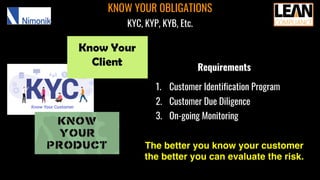
1. Customer Identification Program
2. Customer Due Diligence
3. On-going Monitoring
Requirements
KYC, KYP, KYB, Etc.
The better you know your customer
the better you can evaluate the risk.
KNOW YOUR OBLIGATIONS
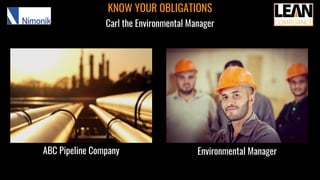
ABC Pipeline Company Environmental Manager
Carl the Environmental Manager
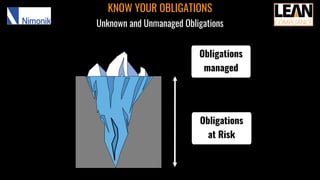
Obligations
managed
Obligations
at Risk
KNOW YOUR OBLIGATIONS
Unknown and Unmanaged Obligations
KNOW YOUR OBLIGATIONS
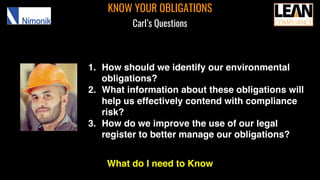
Carl’s Questions
1. How should we identify our environmental
obligations?
2. What information about these obligations will
help us effectively contend with compliance
risk?
3. How do we improve the use of our legal
register to better manage our obligations?
What do I need to Know
KNOW YOUR OBLIGATIONS
ISO 19600 Guidelines
KNOW YOUR OBLIGATIONS
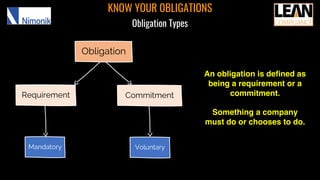
Obligation Types
Obligation
Requirement
Mandatory Voluntary
Commitment
An obligation is defined as
being a requirement or a
commitment.
Something a company
must do or chooses to do.
KNOW YOUR OBLIGATIONS
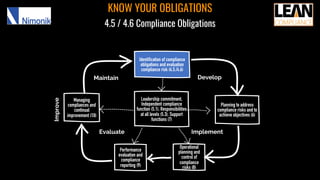
4.5 / 4.6 Compliance Obligations
Identification of compliance
obligations and evaluation
compliance risk (4.5./4.6)
Leadership commitment,
Independent compliance
function (5.1), Responsibilities
at all levels (5.3), Support
functions (7)
Planning to address
compliance risks and to
achieve objectives (6)
Operational
planning and
control of
compliance
risks (8)
Performance
evaluation and
compliance
reporting (9)
Managing
compliances and
continual
improvement (10)
Maintain Develop
ImplementEvaluate
Improve
KNOW YOUR OBLIGATIONS
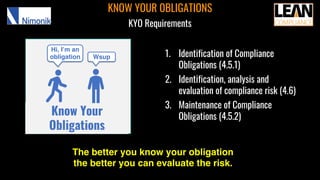
1. Identification of Compliance
Obligations (4.5.1)
2. Identification, analysis and
evaluation of compliance risk (4.6)
3. Maintenance of Compliance
Obligations (4.5.2)
KYO Requirements
Know Your
Obligations
Hi, I’m an
obligation Wsup
The better you know your obligation
the better you can evaluate the risk.
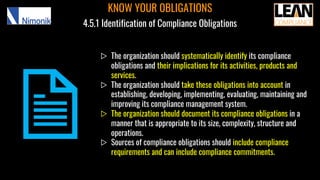
▷ The organization should systematically identify its compliance
obligations and their implications for its activities, products and
services.
▷ The organization should take these obligations into account in
establishing, developing, implementing, evaluating, maintaining and
improving its compliance management system.
▷ The organization should document its compliance obligations in a
manner that is appropriate to its size, complexity, structure and
operations.
▷ Sources of compliance obligations should include compliance
requirements and can include compliance commitments.
KNOW YOUR OBLIGATIONS
4.5.1 Identification of Compliance Obligations
KNOW YOUR OBLIGATIONS
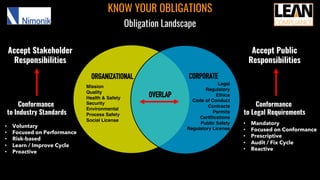
Obligation Landscape
Mission
Quality
Health & Safety
Security
Environmental
Process Safety
Social License
Conformance
to Industry Standards
Conformance
to Legal Requirements
Accept Stakeholder
Responsibilities
Accept Public
Responsibilities
Legal
Regulatory
Ethics
Code of Conduct
Contracts
Permits
Certifications
Public Safety
Regulatory License• Voluntary
• Focused on Performance
• Risk-based
• Learn / Improve Cycle
• Proactive
• Mandatory
• Focused on Conformance
• Prescriptive
• Audit / Fix Cycle
• Reactive
ORGANIZATIONAL CORPORATE
OVERLAP
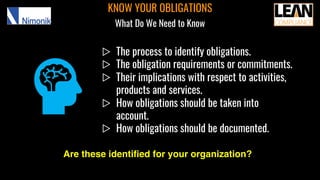
▷ The process to identify obligations.
▷ The obligation requirements or commitments.
▷ Their implications with respect to activities,
products and services.
▷ How obligations should be taken into
account.
▷ How obligations should be documented.
KNOW YOUR OBLIGATIONS
What Do We Need to Know
Are these identified for your organization?
KNOW YOUR OBLIGATIONS
Obligation Sources
Source
KNOW YOUR OBLIGATIONS
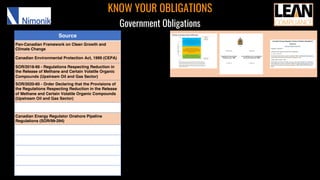
Government Obligations
Source
Pan-Canadian Framework on Clean Growth and
Climate Change
Canadian Environmental Protection Act, 1999 (CEPA)
SOR/2018-66 - Regulations Respecting Reduction in
the Release of Methane and Certain Volatile Organic
Compounds (Upstream Oil and Gas Sector)
SOR/2020-60 - Order Declaring that the Provisions of
the Regulations Respecting Reduction in the Release
of Methane and Certain Volatile Organic Compounds
(Upstream Oil and Gas Sector)
Canadian Energy Regulator Onshore Pipeline
Regulations (SOR/99-294)
KNOW YOUR OBLIGATIONS
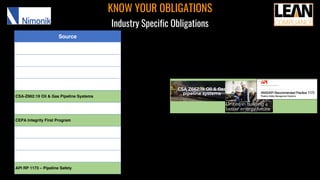
Industry Specific Obligations
Source
CSA-Z662:19 Oil & Gas Pipeline Systems
CEPA Integrity First Program
API RP 1173 – Pipeline Safety
KNOW YOUR OBLIGATIONS
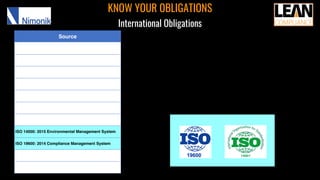
International Obligations
Source
ISO 14000: 2015 Environmental Management System
ISO 19600: 2014 Compliance Management System
KNOW YOUR OBLIGATIONS
Interna Obligationsl
Source
Corporate EHS Policy
KNOW YOUR OBLIGATIONS
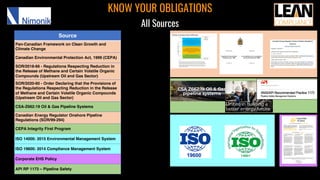
All Sources
Source
Pan-Canadian Framework on Clean Growth and
Climate Change
Canadian Environmental Protection Act, 1999 (CEPA)
SOR/2018-66 - Regulations Respecting Reduction in
the Release of Methane and Certain Volatile Organic
Compounds (Upstream Oil and Gas Sector)
SOR/2020-60 - Order Declaring that the Provisions of
the Regulations Respecting Reduction in the Release
of Methane and Certain Volatile Organic Compounds
(Upstream Oil and Gas Sector)
CSA-Z662:19 Oil & Gas Pipeline Systems
Canadian Energy Regulator Onshore Pipeline
Regulations (SOR/99-294)
CEPA Integrity First Program
ISO 14000: 2015 Environmental Management System
ISO 19600: 2014 Compliance Management System
Corporate EHS Policy
API RP 1173 – Pipeline Safety
KNOW YOUR OBLIGATIONS
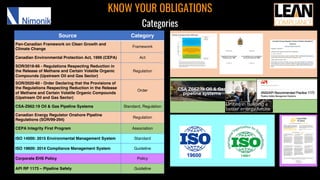
Categories
Source Category
Pan-Canadian Framework on Clean Growth and
Climate Change
Framework
Canadian Environmental Protection Act, 1999 (CEPA) Act
SOR/2018-66 - Regulations Respecting Reduction in
the Release of Methane and Certain Volatile Organic
Compounds (Upstream Oil and Gas Sector)
Regulation
SOR/2020-60 - Order Declaring that the Provisions of
the Regulations Respecting Reduction in the Release
of Methane and Certain Volatile Organic Compounds
(Upstream Oil and Gas Sector)
Order
CSA-Z662:19 Oil & Gas Pipeline Systems Standard, Regulation
Canadian Energy Regulator Onshore Pipeline
Regulations (SOR/99-294)
Regulation
CEPA Integrity First Program Association
ISO 14000: 2015 Environmental Management System Standard
ISO 19600: 2014 Compliance Management System Guideline
Corporate EHS Policy Policy
API RP 1173 – Pipeline Safety Guideline
KNOW YOUR OBLIGATIONS
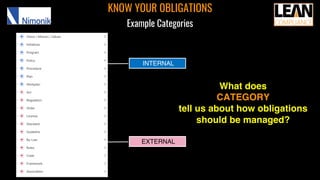
Example Categories
INTERNAL
EXTERNAL
What does
CATEGORY
tell us about how obligations
should be managed?
KNOW YOUR OBLIGATIONS
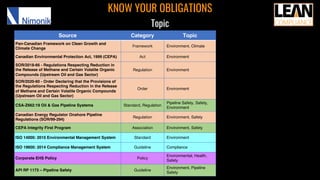
Topic
Source Category Topic
Pan-Canadian Framework on Clean Growth and
Climate Change
Framework Environment, Climate
Canadian Environmental Protection Act, 1999 (CEPA) Act Environment
SOR/2018-66 - Regulations Respecting Reduction in
the Release of Methane and Certain Volatile Organic
Compounds (Upstream Oil and Gas Sector)
Regulation Environment
SOR/2020-60 - Order Declaring that the Provisions of
the Regulations Respecting Reduction in the Release
of Methane and Certain Volatile Organic Compounds
(Upstream Oil and Gas Sector)
Order Environment
CSA-Z662:19 Oil & Gas Pipeline Systems Standard, Regulation
Pipeline Safety, Safety,
Environment
Canadian Energy Regulator Onshore Pipeline
Regulations (SOR/99-294)
Regulation Environment, Safety
CEPA Integrity First Program Association Environment, Safety
ISO 14000: 2015 Environmental Management System Standard Environment
ISO 19600: 2014 Compliance Management System Guideline Compliance
Corporate EHS Policy Policy
Environmental, Health,
Safety
API RP 1173 – Pipeline Safety Guideline
Environment, Pipeline
Safety
KNOW YOUR OBLIGATIONS
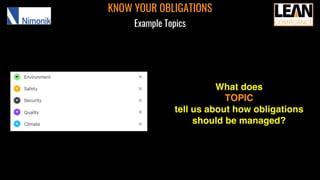
Example Topics
What does
TOPIC
tell us about how obligations
should be managed?
KNOW YOUR OBLIGATIONS
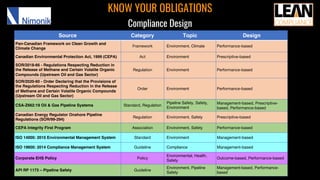
Compliance Design
Source Category Topic Design
Pan-Canadian Framework on Clean Growth and
Climate Change
Framework Environment, Climate Performance-based
Canadian Environmental Protection Act, 1999 (CEPA) Act Environment Prescriptive-based
SOR/2018-66 - Regulations Respecting Reduction in
the Release of Methane and Certain Volatile Organic
Compounds (Upstream Oil and Gas Sector)
Regulation Environment Performance-based
SOR/2020-60 - Order Declaring that the Provisions of
the Regulations Respecting Reduction in the Release
of Methane and Certain Volatile Organic Compounds
(Upstream Oil and Gas Sector)
Order Environment Performance-based
CSA-Z662:19 Oil & Gas Pipeline Systems Standard, Regulation
Pipeline Safety, Safety,
Environment
Management-based, Prescriptive-
based, Performance-based
Canadian Energy Regulator Onshore Pipeline
Regulations (SOR/99-294)
Regulation Environment, Safety Prescriptive-based
CEPA Integrity First Program Association Environment, Safety Performance-based
ISO 14000: 2015 Environmental Management System Standard Environment Management-based
ISO 19600: 2014 Compliance Management System Guideline Compliance Management-based
Corporate EHS Policy Policy
Environmental, Health,
Safety
Outcome-based, Performance-based
API RP 1173 – Pipeline Safety Guideline
Environment, Pipeline
Safety
Management-based, Performance-
based
KNOW YOUR OBLIGATIONS
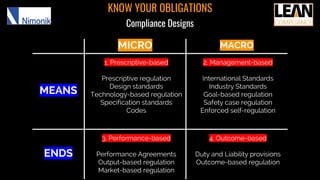
Compliance Designs
MICRO MACRO
MEANS
1. Prescriptive-based
Prescriptive regulation
Design standards
Technology-based regulation
Specification standards
Codes
2. Management-based
International Standards
Industry Standards
Goal-based regulation
Safety case regulation
Enforced self-regulation
ENDS
3. Performance-based
Performance Agreements
Output-based regulation
Market-based regulation
4. Outcome-based
Duty and Liability provisions
Outcome-based regulation
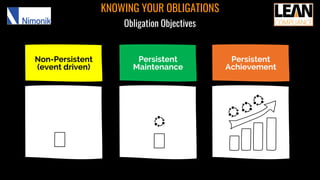
Non-Persistent
(event driven)
KNOWING YOUR OBLIGATIONS
Obligation Objectives
Persistent
Maintenance
Persistent
Achievement
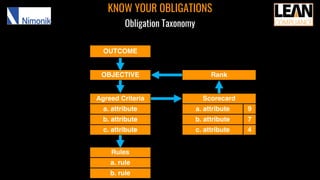
KNOW YOUR OBLIGATIONS
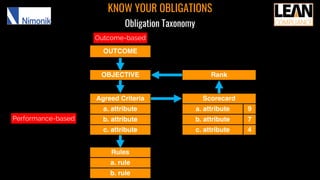
Obligation Taxonomy
OBJECTIVE Rank
Agreed Criteria
a. attribute
b. attribute
c. attribute
Scorecard
a. attribute
b. attribute
c. attribute
9
7
4
OUTCOME
Rules
a. rule
b. rule
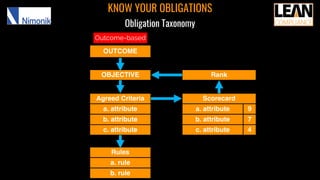
KNOW YOUR OBLIGATIONS
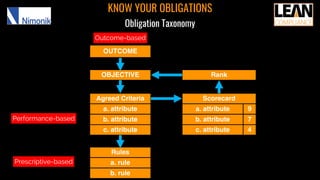
Obligation Taxonomy
OBJECTIVE Rank
Agreed Criteria
a. attribute
b. attribute
c. attribute
Scorecard
a. attribute
b. attribute
c. attribute
9
7
4
OUTCOME
Outcome-based
Rules
a. rule
b. rule
KNOW YOUR OBLIGATIONS
Obligation Taxonomy
OBJECTIVE Rank
Agreed Criteria
a. attribute
b. attribute
c. attribute
Scorecard
a. attribute
b. attribute
c. attribute
9
7
4
OUTCOME
Outcome-based
Rules
a. rule
b. rule
Performance-based
KNOW YOUR OBLIGATIONS
Obligation Taxonomy
OBJECTIVE Rank
Agreed Criteria
a. attribute
b. attribute
c. attribute
Scorecard
a. attribute
b. attribute
c. attribute
9
7
4
OUTCOME
Outcome-based
Rules
a. rule
b. rule
Performance-based
Prescriptive-based
KNOW YOUR OBLIGATIONS
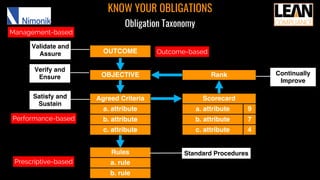
Obligation Taxonomy
OBJECTIVE Rank
Agreed Criteria
a. attribute
b. attribute
c. attribute
Scorecard
a. attribute
b. attribute
c. attribute
9
7
4
OUTCOME
Validate and
Assure
Verify and
Ensure
Satisfy and
Sustain
Continually
Improve
Outcome-based
Performance-based
Management-based
Prescriptive-based
Rules
a. rule
b. rule
Standard Procedures
KNOW YOUR OBLIGATIONS
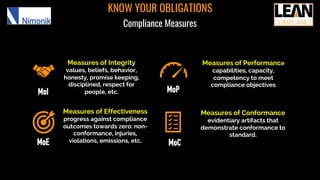
Compliance Measures
MoE
MoP
MoC
Measures of Effectiveness
progress against compliance
outcomes towards zero: non-
conformance, injuries,
violations, emissions, etc.
Measures of Performance
capabilities, capacity,
competency to meet
compliance objectives
Measures of Conformance
evidentiary artifacts that
demonstrate conformance to
standard.
MoI
Measures of Integrity
values, beliefs, behavior,
honesty, promise keeping,
disciplined, respect for
people, etc.
KNOW YOUR OBLIGATIONS
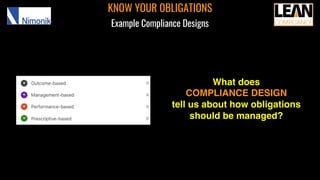
Example Compliance Designs
What does
COMPLIANCE DESIGN
tell us about how obligations
should be managed?
▷The organization should identify and evaluate its compliance risks.
This evaluation can be based on a formal compliance risk
assessment or conducted via alternative approaches. Compliance
risk assessment constitutes the basis for the implementation of the
compliance management system and the planned allocation of
appropriate and adequate resources and processes to manage
identified compliance risks.
▷The organization should identify compliance risks by relating its
compliance obligations to its activities, products, services and
relevant aspects of its operations in order to identify situations
where noncompliance can occur. The organization should identify the
causes for and consequences of noncompliance.
KNOW YOUR OBLIGATIONS
4.6 Identification, Analysis and Evaluation of Compliance Risk
▷ The organization should analyse compliance risks by
considering causes and sources of noncompliance and the
severity of their consequences, as well as the likelihood that
noncompliance and associated consequences can occur.
Consequences can include, for example, personal and
environmental harm, economic loss, reputational harm and
administrative liability.
▷ Risk evaluation involves comparing the level of compliance
risk found during the analysis process with the level of
compliance risk the organization is able and willing to accept.
Based on this comparison, priorities can be set as a basis for
determining the need for implementing controls and the
extent of these controls (see 6.1).
KNOW YOUR OBLIGATIONS
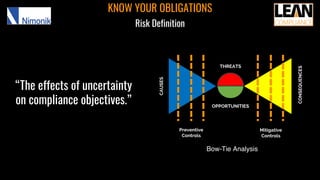
Risk Evaluation
“The effects of uncertainty
on compliance objectives.”
KNOW YOUR OBLIGATIONS
Risk Definition
THREATS
OPPORTUNITIES
CAUSES
CONSEQUENCES
Preventive
Controls
Mitigative
Controls
Bow-Tie Analysis
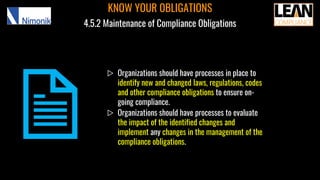
▷ Organizations should have processes in place to
identify new and changed laws, regulations, codes
and other compliance obligations to ensure on-
going compliance.
▷ Organizations should have processes to evaluate
the impact of the identified changes and
implement any changes in the management of the
compliance obligations.
KNOW YOUR OBLIGATIONS
4.5.2 Maintenance of Compliance Obligations
KNOW YOUR OBLIGATIONS
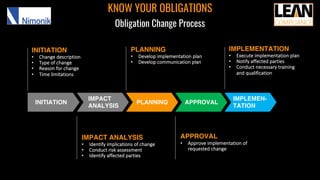
Obligation Change Process
INITIATION
• Change description
• Type of change
• Reason for change
• Time limitations
IMPACT ANALYSIS
• Identify implications of change
• Conduct risk assessment
• Identify affected parties
APPROVAL
• Approve implementation of
requested change
PLANNING
• Develop implementation plan
• Develop communication plan
INITIATION
IMPLEMEN-
TATION
IMPACT
ANALYSIS
PLANNING APPROVAL
IMPLEMENTATION
• Execute implementation plan
• Notify affected parties
• Conduct necessary training
and qualification
KNOW YOUR OBLIGATIONS
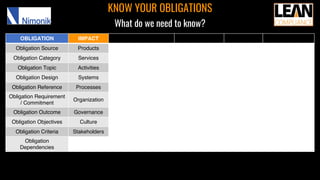
What Do We Need To Know?
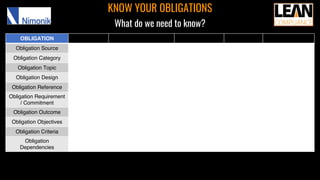
OBLIGATION
Obligation Source
Obligation Category
Obligation Topic
Obligation Design
Obligation Reference
Obligation Requirement
/ Commitment
Obligation Outcome
Obligation Objectives
Obligation Criteria
Obligation
Dependencies
KNOW YOUR OBLIGATIONS
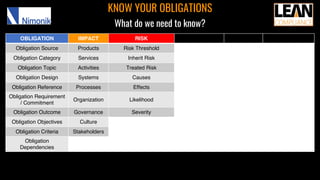
What do we need to know?
OBLIGATION IMPACT
Obligation Source Products
Obligation Category Services
Obligation Topic Activities
Obligation Design Systems
Obligation Reference Processes
Obligation Requirement
/ Commitment
Organization
Obligation Outcome Governance
Obligation Objectives Culture
Obligation Criteria Stakeholders
Obligation
Dependencies
KNOW YOUR OBLIGATIONS
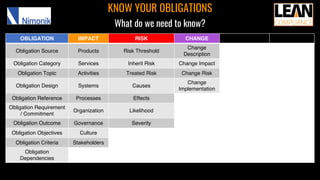
What do we need to know?
OBLIGATION IMPACT RISK
Obligation Source Products Risk Threshold
Obligation Category Services Inherit Risk
Obligation Topic Activities Treated Risk
Obligation Design Systems Causes
Obligation Reference Processes Effects
Obligation Requirement
/ Commitment
Organization Likelihood
Obligation Outcome Governance Severity
Obligation Objectives Culture
Obligation Criteria Stakeholders
Obligation
Dependencies
KNOW YOUR OBLIGATIONS
What do we need to know?
OBLIGATION IMPACT RISK CHANGE
Obligation Source Products Risk Threshold
Change
Description
Obligation Category Services Inherit Risk Change Impact
Obligation Topic Activities Treated Risk Change Risk
Obligation Design Systems Causes
Change
Implementation
Obligation Reference Processes Effects
Obligation Requirement
/ Commitment
Organization Likelihood
Obligation Outcome Governance Severity
Obligation Objectives Culture
Obligation Criteria Stakeholders
Obligation
Dependencies
KNOW YOUR OBLIGATIONS
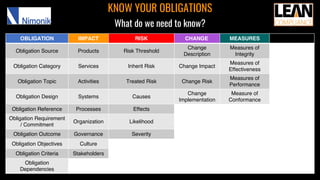
What do we need to know?
OBLIGATION IMPACT RISK CHANGE MEASURES
Obligation Source Products Risk Threshold
Change
Description
Measures of
Integrity
Obligation Category Services Inherit Risk Change Impact
Measures of
Effectiveness
Obligation Topic Activities Treated Risk Change Risk
Measures of
Performance
Obligation Design Systems Causes
Change
Implementation
Measure of
Conformance
Obligation Reference Processes Effects
Obligation Requirement
/ Commitment
Organization Likelihood
Obligation Outcome Governance Severity
Obligation Objectives Culture
Obligation Criteria Stakeholders
Obligation
Dependencies
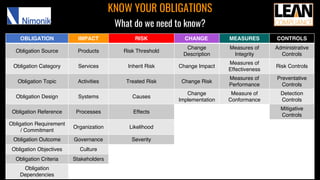
KNOW YOUR OBLIGATIONS
What do we need to know?
OBLIGATION IMPACT RISK CHANGE MEASURES CONTROLS
Obligation Source Products Risk Threshold
Change
Description
Measures of
Integrity
Administrative
Controls
Obligation Category Services Inherit Risk Change Impact
Measures of
Effectiveness
Risk Controls
Obligation Topic Activities Treated Risk Change Risk
Measures of
Performance
Preventative
Controls
Obligation Design Systems Causes
Change
Implementation
Measure of
Conformance
Detection
Controls
Obligation Reference Processes Effects
Mitigative
Controls
Obligation Requirement
/ Commitment
Organization Likelihood
Obligation Outcome Governance Severity
Obligation Objectives Culture
Obligation Criteria Stakeholders
Obligation
Dependencies
KNOW YOUR OBLIGATIONS
What do we need to know?
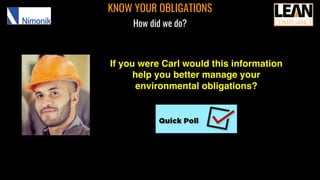
KNOW YOUR OBLIGATIONS
How did we do?
If you were Carl would this information
help you better manage your
environmental obligations?
KNOW YOUR OBLIGATIONS
How did we do?
Would it help you
better manage your
obligations?
KNOW YOUR OBLIGATIONS
What steps can you take to know your obligations better?
1. Which attributes or sets of attributes tend to
be missing from your obligation register?
2. What 3 attributes would significantly improve
your ability to manage your obligations?
3. What steps could you take to start including
those attributes in your obligation registers?
4. Will you be acting on those steps in the
upcoming weeks?
The better you know your obligations
the better you can evaluate the risk.
A BEST PRACTICE COMPLIANCE
MANAGEMENT FRAMEWORK:
ISO 19600
Know Your
Obligations
Hi, I’m an
obligation Wsup
Know Your
Obligations
Hi, I’m an
obligation Wsup
Know Your
Obligations
Hi, I’m an
obligation Wsup

ISO 19600 Section 4.5 - Know your Obligations

  • 1.
    Raimund Laqua, PMP,P.Eng ray.laqua@leancompliance.ca Know Your Obligations Hi, I’m an obligation Wsup A BEST PRACTICE COMPLIANCE MANAGEMENT FRAMEWORK: ISO 19600
  • 2.
    KNOW YOUR OBLIGATIONS 1.Customer Identification Program 2. Customer Due Diligence 3. On-going Monitoring Requirements KYC, KYP, KYB, Etc. The better you know your customer the better you can evaluate the risk.
  • 3.
    KNOW YOUR OBLIGATIONS ABCPipeline Company Environmental Manager Carl the Environmental Manager
  • 4.
    Obligations managed Obligations at Risk KNOW YOUROBLIGATIONS Unknown and Unmanaged Obligations
  • 5.
    KNOW YOUR OBLIGATIONS Carl’sQuestions 1. How should we identify our environmental obligations? 2. What information about these obligations will help us effectively contend with compliance risk? 3. How do we improve the use of our legal register to better manage our obligations? What do I need to Know
  • 6.
    KNOW YOUR OBLIGATIONS ISO19600 Guidelines
  • 7.
    KNOW YOUR OBLIGATIONS ObligationTypes Obligation Requirement Mandatory Voluntary Commitment An obligation is defined as being a requirement or a commitment. Something a company must do or chooses to do.
  • 8.
    KNOW YOUR OBLIGATIONS 4.5/ 4.6 Compliance Obligations Identification of compliance obligations and evaluation compliance risk (4.5./4.6) Leadership commitment, Independent compliance function (5.1), Responsibilities at all levels (5.3), Support functions (7) Planning to address compliance risks and to achieve objectives (6) Operational planning and control of compliance risks (8) Performance evaluation and compliance reporting (9) Managing compliances and continual improvement (10) Maintain Develop ImplementEvaluate Improve
  • 9.
    KNOW YOUR OBLIGATIONS 1.Identification of Compliance Obligations (4.5.1) 2. Identification, analysis and evaluation of compliance risk (4.6) 3. Maintenance of Compliance Obligations (4.5.2) KYO Requirements Know Your Obligations Hi, I’m an obligation Wsup The better you know your obligation the better you can evaluate the risk.
  • 10.
    ▷ The organizationshould systematically identify its compliance obligations and their implications for its activities, products and services. ▷ The organization should take these obligations into account in establishing, developing, implementing, evaluating, maintaining and improving its compliance management system. ▷ The organization should document its compliance obligations in a manner that is appropriate to its size, complexity, structure and operations. ▷ Sources of compliance obligations should include compliance requirements and can include compliance commitments. KNOW YOUR OBLIGATIONS 4.5.1 Identification of Compliance Obligations
  • 11.
    KNOW YOUR OBLIGATIONS ObligationLandscape Mission Quality Health & Safety Security Environmental Process Safety Social License Conformance to Industry Standards Conformance to Legal Requirements Accept Stakeholder Responsibilities Accept Public Responsibilities Legal Regulatory Ethics Code of Conduct Contracts Permits Certifications Public Safety Regulatory License• Voluntary • Focused on Performance • Risk-based • Learn / Improve Cycle • Proactive • Mandatory • Focused on Conformance • Prescriptive • Audit / Fix Cycle • Reactive ORGANIZATIONAL CORPORATE OVERLAP
  • 12.
    ▷ The processto identify obligations. ▷ The obligation requirements or commitments. ▷ Their implications with respect to activities, products and services. ▷ How obligations should be taken into account. ▷ How obligations should be documented. KNOW YOUR OBLIGATIONS What Do We Need to Know Are these identified for your organization?
  • 13.
  • 14.
    KNOW YOUR OBLIGATIONS GovernmentObligations Source Pan-Canadian Framework on Clean Growth and Climate Change Canadian Environmental Protection Act, 1999 (CEPA) SOR/2018-66 - Regulations Respecting Reduction in the Release of Methane and Certain Volatile Organic Compounds (Upstream Oil and Gas Sector) SOR/2020-60 - Order Declaring that the Provisions of the Regulations Respecting Reduction in the Release of Methane and Certain Volatile Organic Compounds (Upstream Oil and Gas Sector) Canadian Energy Regulator Onshore Pipeline Regulations (SOR/99-294)
  • 15.
    KNOW YOUR OBLIGATIONS IndustrySpecific Obligations Source CSA-Z662:19 Oil & Gas Pipeline Systems CEPA Integrity First Program API RP 1173 – Pipeline Safety
  • 16.
    KNOW YOUR OBLIGATIONS InternationalObligations Source ISO 14000: 2015 Environmental Management System ISO 19600: 2014 Compliance Management System
  • 17.
    KNOW YOUR OBLIGATIONS InternaObligationsl Source Corporate EHS Policy
  • 18.
    KNOW YOUR OBLIGATIONS AllSources Source Pan-Canadian Framework on Clean Growth and Climate Change Canadian Environmental Protection Act, 1999 (CEPA) SOR/2018-66 - Regulations Respecting Reduction in the Release of Methane and Certain Volatile Organic Compounds (Upstream Oil and Gas Sector) SOR/2020-60 - Order Declaring that the Provisions of the Regulations Respecting Reduction in the Release of Methane and Certain Volatile Organic Compounds (Upstream Oil and Gas Sector) CSA-Z662:19 Oil & Gas Pipeline Systems Canadian Energy Regulator Onshore Pipeline Regulations (SOR/99-294) CEPA Integrity First Program ISO 14000: 2015 Environmental Management System ISO 19600: 2014 Compliance Management System Corporate EHS Policy API RP 1173 – Pipeline Safety
  • 19.
    KNOW YOUR OBLIGATIONS Categories SourceCategory Pan-Canadian Framework on Clean Growth and Climate Change Framework Canadian Environmental Protection Act, 1999 (CEPA) Act SOR/2018-66 - Regulations Respecting Reduction in the Release of Methane and Certain Volatile Organic Compounds (Upstream Oil and Gas Sector) Regulation SOR/2020-60 - Order Declaring that the Provisions of the Regulations Respecting Reduction in the Release of Methane and Certain Volatile Organic Compounds (Upstream Oil and Gas Sector) Order CSA-Z662:19 Oil & Gas Pipeline Systems Standard, Regulation Canadian Energy Regulator Onshore Pipeline Regulations (SOR/99-294) Regulation CEPA Integrity First Program Association ISO 14000: 2015 Environmental Management System Standard ISO 19600: 2014 Compliance Management System Guideline Corporate EHS Policy Policy API RP 1173 – Pipeline Safety Guideline
  • 20.
    KNOW YOUR OBLIGATIONS ExampleCategories INTERNAL EXTERNAL What does CATEGORY tell us about how obligations should be managed?
  • 21.
    KNOW YOUR OBLIGATIONS Topic SourceCategory Topic Pan-Canadian Framework on Clean Growth and Climate Change Framework Environment, Climate Canadian Environmental Protection Act, 1999 (CEPA) Act Environment SOR/2018-66 - Regulations Respecting Reduction in the Release of Methane and Certain Volatile Organic Compounds (Upstream Oil and Gas Sector) Regulation Environment SOR/2020-60 - Order Declaring that the Provisions of the Regulations Respecting Reduction in the Release of Methane and Certain Volatile Organic Compounds (Upstream Oil and Gas Sector) Order Environment CSA-Z662:19 Oil & Gas Pipeline Systems Standard, Regulation Pipeline Safety, Safety, Environment Canadian Energy Regulator Onshore Pipeline Regulations (SOR/99-294) Regulation Environment, Safety CEPA Integrity First Program Association Environment, Safety ISO 14000: 2015 Environmental Management System Standard Environment ISO 19600: 2014 Compliance Management System Guideline Compliance Corporate EHS Policy Policy Environmental, Health, Safety API RP 1173 – Pipeline Safety Guideline Environment, Pipeline Safety
  • 22.
    KNOW YOUR OBLIGATIONS ExampleTopics What does TOPIC tell us about how obligations should be managed?
  • 23.
    KNOW YOUR OBLIGATIONS ComplianceDesign Source Category Topic Design Pan-Canadian Framework on Clean Growth and Climate Change Framework Environment, Climate Performance-based Canadian Environmental Protection Act, 1999 (CEPA) Act Environment Prescriptive-based SOR/2018-66 - Regulations Respecting Reduction in the Release of Methane and Certain Volatile Organic Compounds (Upstream Oil and Gas Sector) Regulation Environment Performance-based SOR/2020-60 - Order Declaring that the Provisions of the Regulations Respecting Reduction in the Release of Methane and Certain Volatile Organic Compounds (Upstream Oil and Gas Sector) Order Environment Performance-based CSA-Z662:19 Oil & Gas Pipeline Systems Standard, Regulation Pipeline Safety, Safety, Environment Management-based, Prescriptive- based, Performance-based Canadian Energy Regulator Onshore Pipeline Regulations (SOR/99-294) Regulation Environment, Safety Prescriptive-based CEPA Integrity First Program Association Environment, Safety Performance-based ISO 14000: 2015 Environmental Management System Standard Environment Management-based ISO 19600: 2014 Compliance Management System Guideline Compliance Management-based Corporate EHS Policy Policy Environmental, Health, Safety Outcome-based, Performance-based API RP 1173 – Pipeline Safety Guideline Environment, Pipeline Safety Management-based, Performance- based
  • 24.
    KNOW YOUR OBLIGATIONS ComplianceDesigns MICRO MACRO MEANS 1. Prescriptive-based Prescriptive regulation Design standards Technology-based regulation Specification standards Codes 2. Management-based International Standards Industry Standards Goal-based regulation Safety case regulation Enforced self-regulation ENDS 3. Performance-based Performance Agreements Output-based regulation Market-based regulation 4. Outcome-based Duty and Liability provisions Outcome-based regulation
  • 25.
    Non-Persistent (event driven) KNOWING YOUROBLIGATIONS Obligation Objectives Persistent Maintenance Persistent Achievement
  • 26.
    KNOW YOUR OBLIGATIONS ObligationTaxonomy OBJECTIVE Rank Agreed Criteria a. attribute b. attribute c. attribute Scorecard a. attribute b. attribute c. attribute 9 7 4 OUTCOME Rules a. rule b. rule
  • 27.
    KNOW YOUR OBLIGATIONS ObligationTaxonomy OBJECTIVE Rank Agreed Criteria a. attribute b. attribute c. attribute Scorecard a. attribute b. attribute c. attribute 9 7 4 OUTCOME Outcome-based Rules a. rule b. rule
  • 28.
    KNOW YOUR OBLIGATIONS ObligationTaxonomy OBJECTIVE Rank Agreed Criteria a. attribute b. attribute c. attribute Scorecard a. attribute b. attribute c. attribute 9 7 4 OUTCOME Outcome-based Rules a. rule b. rule Performance-based
  • 29.
    KNOW YOUR OBLIGATIONS ObligationTaxonomy OBJECTIVE Rank Agreed Criteria a. attribute b. attribute c. attribute Scorecard a. attribute b. attribute c. attribute 9 7 4 OUTCOME Outcome-based Rules a. rule b. rule Performance-based Prescriptive-based
  • 30.
    KNOW YOUR OBLIGATIONS ObligationTaxonomy OBJECTIVE Rank Agreed Criteria a. attribute b. attribute c. attribute Scorecard a. attribute b. attribute c. attribute 9 7 4 OUTCOME Validate and Assure Verify and Ensure Satisfy and Sustain Continually Improve Outcome-based Performance-based Management-based Prescriptive-based Rules a. rule b. rule Standard Procedures
  • 31.
    KNOW YOUR OBLIGATIONS ComplianceMeasures MoE MoP MoC Measures of Effectiveness progress against compliance outcomes towards zero: non- conformance, injuries, violations, emissions, etc. Measures of Performance capabilities, capacity, competency to meet compliance objectives Measures of Conformance evidentiary artifacts that demonstrate conformance to standard. MoI Measures of Integrity values, beliefs, behavior, honesty, promise keeping, disciplined, respect for people, etc.
  • 32.
    KNOW YOUR OBLIGATIONS ExampleCompliance Designs What does COMPLIANCE DESIGN tell us about how obligations should be managed?
  • 33.
    ▷The organization shouldidentify and evaluate its compliance risks. This evaluation can be based on a formal compliance risk assessment or conducted via alternative approaches. Compliance risk assessment constitutes the basis for the implementation of the compliance management system and the planned allocation of appropriate and adequate resources and processes to manage identified compliance risks. ▷The organization should identify compliance risks by relating its compliance obligations to its activities, products, services and relevant aspects of its operations in order to identify situations where noncompliance can occur. The organization should identify the causes for and consequences of noncompliance. KNOW YOUR OBLIGATIONS 4.6 Identification, Analysis and Evaluation of Compliance Risk
  • 34.
    ▷ The organizationshould analyse compliance risks by considering causes and sources of noncompliance and the severity of their consequences, as well as the likelihood that noncompliance and associated consequences can occur. Consequences can include, for example, personal and environmental harm, economic loss, reputational harm and administrative liability. ▷ Risk evaluation involves comparing the level of compliance risk found during the analysis process with the level of compliance risk the organization is able and willing to accept. Based on this comparison, priorities can be set as a basis for determining the need for implementing controls and the extent of these controls (see 6.1). KNOW YOUR OBLIGATIONS Risk Evaluation
  • 35.
    “The effects ofuncertainty on compliance objectives.” KNOW YOUR OBLIGATIONS Risk Definition THREATS OPPORTUNITIES CAUSES CONSEQUENCES Preventive Controls Mitigative Controls Bow-Tie Analysis
  • 36.
    ▷ Organizations shouldhave processes in place to identify new and changed laws, regulations, codes and other compliance obligations to ensure on- going compliance. ▷ Organizations should have processes to evaluate the impact of the identified changes and implement any changes in the management of the compliance obligations. KNOW YOUR OBLIGATIONS 4.5.2 Maintenance of Compliance Obligations
  • 37.
    KNOW YOUR OBLIGATIONS ObligationChange Process INITIATION • Change description • Type of change • Reason for change • Time limitations IMPACT ANALYSIS • Identify implications of change • Conduct risk assessment • Identify affected parties APPROVAL • Approve implementation of requested change PLANNING • Develop implementation plan • Develop communication plan INITIATION IMPLEMEN- TATION IMPACT ANALYSIS PLANNING APPROVAL IMPLEMENTATION • Execute implementation plan • Notify affected parties • Conduct necessary training and qualification
  • 38.
    KNOW YOUR OBLIGATIONS WhatDo We Need To Know?
  • 39.
    OBLIGATION Obligation Source Obligation Category ObligationTopic Obligation Design Obligation Reference Obligation Requirement / Commitment Obligation Outcome Obligation Objectives Obligation Criteria Obligation Dependencies KNOW YOUR OBLIGATIONS What do we need to know?
  • 40.
    OBLIGATION IMPACT Obligation SourceProducts Obligation Category Services Obligation Topic Activities Obligation Design Systems Obligation Reference Processes Obligation Requirement / Commitment Organization Obligation Outcome Governance Obligation Objectives Culture Obligation Criteria Stakeholders Obligation Dependencies KNOW YOUR OBLIGATIONS What do we need to know?
  • 41.
    OBLIGATION IMPACT RISK ObligationSource Products Risk Threshold Obligation Category Services Inherit Risk Obligation Topic Activities Treated Risk Obligation Design Systems Causes Obligation Reference Processes Effects Obligation Requirement / Commitment Organization Likelihood Obligation Outcome Governance Severity Obligation Objectives Culture Obligation Criteria Stakeholders Obligation Dependencies KNOW YOUR OBLIGATIONS What do we need to know?
  • 42.
    OBLIGATION IMPACT RISKCHANGE Obligation Source Products Risk Threshold Change Description Obligation Category Services Inherit Risk Change Impact Obligation Topic Activities Treated Risk Change Risk Obligation Design Systems Causes Change Implementation Obligation Reference Processes Effects Obligation Requirement / Commitment Organization Likelihood Obligation Outcome Governance Severity Obligation Objectives Culture Obligation Criteria Stakeholders Obligation Dependencies KNOW YOUR OBLIGATIONS What do we need to know?
  • 43.
    OBLIGATION IMPACT RISKCHANGE MEASURES Obligation Source Products Risk Threshold Change Description Measures of Integrity Obligation Category Services Inherit Risk Change Impact Measures of Effectiveness Obligation Topic Activities Treated Risk Change Risk Measures of Performance Obligation Design Systems Causes Change Implementation Measure of Conformance Obligation Reference Processes Effects Obligation Requirement / Commitment Organization Likelihood Obligation Outcome Governance Severity Obligation Objectives Culture Obligation Criteria Stakeholders Obligation Dependencies KNOW YOUR OBLIGATIONS What do we need to know?
  • 44.
    OBLIGATION IMPACT RISKCHANGE MEASURES CONTROLS Obligation Source Products Risk Threshold Change Description Measures of Integrity Administrative Controls Obligation Category Services Inherit Risk Change Impact Measures of Effectiveness Risk Controls Obligation Topic Activities Treated Risk Change Risk Measures of Performance Preventative Controls Obligation Design Systems Causes Change Implementation Measure of Conformance Detection Controls Obligation Reference Processes Effects Mitigative Controls Obligation Requirement / Commitment Organization Likelihood Obligation Outcome Governance Severity Obligation Objectives Culture Obligation Criteria Stakeholders Obligation Dependencies KNOW YOUR OBLIGATIONS What do we need to know?
  • 45.
    KNOW YOUR OBLIGATIONS Howdid we do? If you were Carl would this information help you better manage your environmental obligations?
  • 46.
    KNOW YOUR OBLIGATIONS Howdid we do? Would it help you better manage your obligations?
  • 47.
    KNOW YOUR OBLIGATIONS Whatsteps can you take to know your obligations better? 1. Which attributes or sets of attributes tend to be missing from your obligation register? 2. What 3 attributes would significantly improve your ability to manage your obligations? 3. What steps could you take to start including those attributes in your obligation registers? 4. Will you be acting on those steps in the upcoming weeks?
  • 48.
    The better youknow your obligations the better you can evaluate the risk. A BEST PRACTICE COMPLIANCE MANAGEMENT FRAMEWORK: ISO 19600 Know Your Obligations Hi, I’m an obligation Wsup
  • 49.
  • 50.