Challenges in Vascular tissue
Engineering
Presented by: Yogesh Joshi
Introduction
• Growing blood vessel in vivo or in vitro and
transferring to the required site
• Example: to treat atherosclerosis leading to
Myocardial infarction,coronary artery bypass
graft surgery
Steps Involved
• Finding Substitute Material eg. Dacron or
expanded polytetrafluoroethylene (ePTFE).
• Endothelial Cell seeded synthetic graft
• Cell technology :Cell sourcing and the control
and manipulation of cell function.
• Construct Technology: Mimicking the natural
vessel in architecture and function
• Integrating living substitute in living system
Five approaches used:
• EC-seeded synthetic grafts- Adherence of EC
• Collagen-based blood vessel analogs- Physical weakness
• Biodegradable synthetic polymer-based constructs-expensive and
vasoelasticity
• Cell self-assembly blood vessels: long culture time, elasticity and
integrity
• Decellularized tissue approaches: Lack of non-thromogenics
components
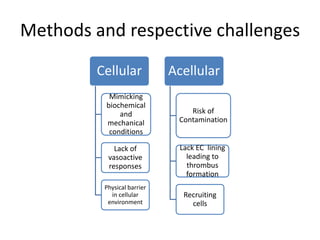
Methods and respective challenges
Cellular
Mimicking
biochemical
and
mechanical
conditions
Lack of
vasoactive
responses
Physical barrier
in cellular
environment
Acellular
Risk of
Contamination
Lack EC lining
leading to
thrombus
formation
Recruiting
cells
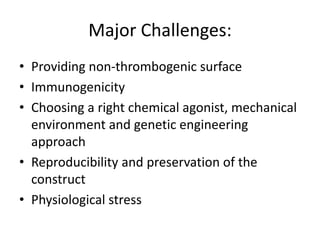
Major Challenges:
• Providing non-thrombogenic surface
• Immunogenicity
• Choosing a right chemical agonist, mechanical
environment and genetic engineering
approach
• Reproducibility and preservation of the
construct
• Physiological stress
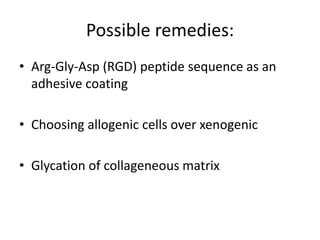
Possible remedies:
• Arg-Gly-Asp (RGD) peptide sequence as an
adhesive coating
• Choosing allogenic cells over xenogenic
• Glycation of collageneous matrix
Thank You!!

Challenges in vascular tissue engineering

  • 1.
    Challenges in Vasculartissue Engineering Presented by: Yogesh Joshi
  • 2.
    Introduction • Growing bloodvessel in vivo or in vitro and transferring to the required site • Example: to treat atherosclerosis leading to Myocardial infarction,coronary artery bypass graft surgery
  • 3.
    Steps Involved • FindingSubstitute Material eg. Dacron or expanded polytetrafluoroethylene (ePTFE). • Endothelial Cell seeded synthetic graft • Cell technology :Cell sourcing and the control and manipulation of cell function. • Construct Technology: Mimicking the natural vessel in architecture and function • Integrating living substitute in living system
  • 4.
    Five approaches used: •EC-seeded synthetic grafts- Adherence of EC • Collagen-based blood vessel analogs- Physical weakness • Biodegradable synthetic polymer-based constructs-expensive and vasoelasticity • Cell self-assembly blood vessels: long culture time, elasticity and integrity • Decellularized tissue approaches: Lack of non-thromogenics components
  • 5.
    Methods and respectivechallenges Cellular Mimicking biochemical and mechanical conditions Lack of vasoactive responses Physical barrier in cellular environment Acellular Risk of Contamination Lack EC lining leading to thrombus formation Recruiting cells
  • 6.
    Major Challenges: • Providingnon-thrombogenic surface • Immunogenicity • Choosing a right chemical agonist, mechanical environment and genetic engineering approach • Reproducibility and preservation of the construct • Physiological stress
  • 7.
    Possible remedies: • Arg-Gly-Asp(RGD) peptide sequence as an adhesive coating • Choosing allogenic cells over xenogenic • Glycation of collageneous matrix
  • 8.