INTERNATIONAL JOURNAL OF INNOVATIVE HORTICULTURE
Volume 1, Number 1, 2012


Research Articles                                            Inter Simple Sequence Repeat (ISSR) markers for
                                                             identification of germplasm and diversity analysis in
Pesticide-free plasticulture for sustainable vegetable       coconut (Cocos nucifera L)
production in the context of climate change                  R. Manimekalai 63
Prabhat Kumar 1
                                                             Chromatographic fingerprinting and estimation of
Diversity analysis of Alternaria porri (Ellis) Cif- causal   organic acids in selected Garcinia Species
organism of purple leaf blotch of onion                      Utpala Parthasarathy, O.P. Nandakishore, R.Senthil
P. Chowdappa, H. Sandhya and B. Reddi Bhargavi 11            Kumar, K.Nirmal Babu, T.J. Zachariah and V.A.
                                                             Parthasarathy 68
Variation among guava (Psidium guajava L.)
accessions in seed hardness associated with fruit            Effect of sub lethal dose of insecticides on
characteristics                                              electrophysiological and behavioural response of
S. Rajan, L.P. Yadava and Ram Kumar 18                       Bracon brevicornis Wesmael (Braconidae :
                                                             Hymenoptera) a parasitoid of coconut black headed
Evaluation of critical limits and development of leaf        caterpillar, Opisina arenosella Walker
nutrient standards in litchi (Litchi chinensis Sonn.)        (Oecophoridae: Lepidoptera)
Babita Singh and K.L Chadha 24                               Kesavan Subaharan, Charles Sahayaraj, A.R. Prasad and
                                                             N. Ravikumar 74
Ball Milled Nanosized zeolite loaded with zinc sulfate:
A putative slow release Zn fertilizer                        Zinc nitrate derived nano ZnO: Fungicide for disease
K.S. Subramanian and C. Sharmila Rahale 33                   management of horticultural crops
                                                             Prasun Patra and Arunava Goswami 79
Aonla pomace as substrate for endoglucanase
production using Trichoderma harzianum                       Short Communications
Devendra Kumar, Neelima Garg, M. Muthukumar and
Kaushlesh, K. Yadav 41                                       Analysis of growth related traits in turf grasses in
                                                             India
Genetic diversity and phylogenetic relationships             Namita and T. Janakiram 85
among small cardamom (Elettaria cardamomum
Maton.) cultivars and related genera using DNA               NRCSS Ani-1 — A new variety of anise
markers                                                      S.K. Malhotra 87
K. Nirmal Babu, V.N. Jayakumar, Minoo Divakaran,
M.N. Venugopal, M.R. Sudarshan V.V. Radhakrishnan,           Book Reviews    90
S. Backiyarani, M.M. Narayanaswami, K.V. Peter and
V.A. Parthasarathy 47

Genome specific primers: A tool for genetic profiling
of potato species
Virupaksh, U. Patil, G. Vanishree, S. Sundaresha, Vinay
Bhardwaj, S.K. Chakrabarti and B.P. Singh 57
International Journal of Innovative Horticulture. 1(1):1-10, 2012 production in the context of climate change
               Pesticide-free plasticulture for sustainable vegetable                                                      1
                                                                                                            Research Articles


Pesticide-free plasticulture for sustainable vegetable production in the
context of climate change

Prabhat Kumar
Agricultural Systems and Engineering, School of Environment, Resources, and Development
Asian Institute of Technology, PO Box 4, Klong Luang, Pathumthani 12120, Thailand
Corresponding author: pkipm@yahoo.com

ABSTRACT
Among plethora of insect-pests and diseases, sucking pests and related plant viruses are number one cause of concern for
majority of farmers raising crops either in field or inside net/poly/greenhouse (GH) or tunnels. To explore the possibility
of “zero-pesticide’ plasticulture in the tropical areas, studies were conducted to investigate the effect of ultraviolet (UV)
blocked greenhouses made from combination of net and plastics on the immigration of thrips (Ceratothripoides claratris)
and occurrences of capsicum cholorosis virus (CaCV-AIT) as a model. Using UV-blocking nets and plastics, to allow
ventilation – a pre-requisite for tropical greenhouses, various levels of ambient UV intensity were achieved under test
greenhouses and followed so that immigration of the model pests and occurrences of virus were observed. Significantly
fewer thrips immigrated under GH with lower UV intensity and consequently caused lower levels of leaf damage clearly
indicating crucial role of UV in flight and forging behaviour of thrips. During open gates experiments, a total of 96-100%
virus infestation was recorded under non UV-blocking greenhouses compared to 6-10% under UV-blocking greenhouses,
having majority of the virus infected plants tested positive for the tospovirus, CaCV-AIT. The virus spreads were remarkably
delayed for several days under greenhouses with lower UV light. These results suggests that greenhouses made from the
combination of the UV-blocking nets and plastics have a significant influence on both the immigration and virus spread
vectored by thrips. The results are discussed in context of pesticide free management of other sucking pests and virus
spread in tomatoes under plasticulture in the context of climate change.
Key words: Ceratothripoides claratris, tospovirus, UV-blocking nets and plastic films, plasticulture


INTRODUCTION                                                    Use of chemical pesticides remains a majority option for
Vegetable cultivation under plasticulture structures are on     sucking pest and other insect-pest management with its well
rise in all continents, including many countries in Asia, to    documented and known adverse impacts on overall
raise quality and high-value horticultural crops. A range       environment. Rampant uses of chemical pesticides are
of vegetable crops including cucumber, melon, tomatoes          directly attributed to the rapid increase in resistance,
and capsicum are widely grown in such structures.               resurgence and secondary pest outbreaks (Perkins, 1982).
However, unlike the open-field production systems, which        In summary, the region is facing challenges of over use
represents an open ecosystem, plasticulture based               and misuse (Srinivasan, 2008), inappropriate labeling (EJF,
production system represents closed and human managed           2002), serious quality issues, environmental pollution,
production systems, where growers have a higher degree          health hazards to farmers and consumers (Mancini et al,
of control on various parameters of the micro-climate.          2009) related to the pesticides in the Asian region. In
The sucking insects-pests (Hemiptera: Suborder                  addition, the greater awareness among consumers in urban
Homoptera) represented by whiteflies, thrips, jassids, aphids   communities of the dangers of toxic residues on vegetables
are some of commonly occurring vectors for vegetable crops      has created an ever growing demand (e.g. GAP) for
responsible for transmitting some of the deadliest plant        vegetables free of pesticide residues across the region
viruses. The climate change mediated variations in              creating favorable to produce and consume healthy
temperature rainfall along with anthropogenic reasons of        vegetables. In line with the FAO Codex Alimentarius,
round-the-year cultivation, increased trade related             governments in many Asian countries have established
movements resulted in unprecedented increase in incidence       Maximum Residue Levels (MRLs) for pesticides on
of plant virus diseases.                                        imported vegetables (Ketalaar and Kumar, 2012).
2                                                      Prabhat Kumar

To overcome negative externalities and improve quality, a        MATERIALS AND METHODS
number of efforts to promote plant-based, microbial based
and other strategies have been developed (Kumar et al.,          Location
2005; Kumar and Poehling, 2007) but only with limited            Experiments were conducted on tomato plants
and sporadic success (Lewis, 1997). Further, the challenges      (Lycopersicon esculentum Mill; family Solanaceae; cv. King
of brining ‘system perspective of sustainable pest               Kong II) at the greenhouse complex provided for the AIT-
management’ remains an allusive dream due to ‘linearity’         Hanover Project, Asian Institute of Technology, Bangkok,
in planning pest management. Few attempts have been made         Thailand.
till-date to manipulate the basic behavior of the insects that
have the strong potential to be part of developing a system-     Nets and plastics
based pest management approach.                                  Two nets UV-blocking, Bionet® and non UV-blocking (=
Many herbivorous insects studied have two or three types         UV transmitting), Anti Insect® nets (50 mesh: Polysack
of photosensitive receptor cells in their compound eyes;         Plastic Industries, Israel) along with two plastics, UV-
hence they show a di- or tri-chromatic system able to            blocking (Sun Selector Diffused Antivirus®, Ginegar Plastic
differentiate not only brightness but colors by interpolating    Product Ltd, Kibbutz, Israel) and UV-transmitting (= non
the different stimuli from the multiple receptor system for      blocking) plastic film, PE-1A (RKW AG, Germany) were
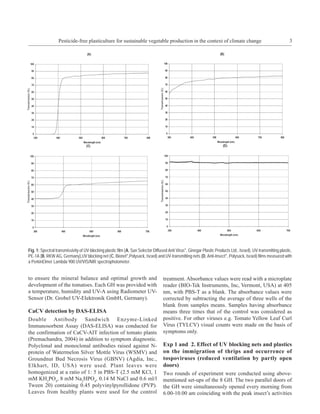
aphid vision (Döring and Chittka, 2007). However,                used in the experiments (for spectral transmission,
sensitivity maxima are quite different from vertebrates. Most    Fig. 1).
insects react especially to wavelength between 500 and 600
nm (green), around 450 nm (blue) and 350 – 380 nm (UV
                                                                 Treatments and greenhouses
A). The function of UV sensitivity is only partly explained      These two nets (UV-blocking and UV non-blocking) and
today. It is known that UV reception is used for inducing        plastics (UV blocking and non-blocking) were permutated
flight activity (“take-off”), spatial orientation during         in 4 different combinations: UV Blocking nets + UV
distance flights (e.g. whiteflies, thrips, aphids) as well as    Blocking Plastics [henceforth referred as B (N+P)]; Non
location of specific targets that intensively reflect light in   UV-blocking net + UV blocking plastic [NB-N+BP)]; UV
the UV range, such as specific structures in flowers offering    blocking nets + UN non-blocking Plastics [BN+N-BP)];
high quality nutrition (e.g. bees, bumble bees) and it is        UV Non-blocking nets + UV non-blocking plastic [NB
important for color differentiation (Kring and Schuster          (N+P)]. A total of eight greenhouses (GH) (7.5 m × 2 m ×
1992; Goldsmith, 1993; Costa and Robb, 1999; Raviv and           2 m) were constructed with four GH each placed in identical
Antignus, 2004; Döring and Chittka, 2007; Diaz and               orientations (either east/west or north/south direction) to
Fereres, 2007).                                                  avoid any effect of orientation. Furthermore, each
                                                                 greenhouse was provided with two identical doors at the
Aim of protected cultivation is not only to allow                length side. The front and rear end of the door walls were
production even under worse climatic conditions (e.g.            covered with identical nets used for the side walls of each
heavy rainfalls) but to reduce the dependence of frequent        greenhouse. The side-walls of the greenhouses were always
pesticide use with all its severe drawbacks (e.g. residues,      covered with either of the nets and the roofs with either of
resistance). However, the use of screens as a physical           the plastics. Between GH, 1.5 meter space reduced shading
control has limitations particularly with small insects since    from each other. The area around the GH complex was
too small mesh sizes of nets or complete cover with              cleaned and all weed plants were removed prior to each
plastics reduces the efficiency of natural ventilation which     series of experiments. Between each series, greenhouses
is a prerequisite for greenhouses without expensive              were thoroughly washed and cleaned approximately one
cooling devices. Materials hindering immigration and             week prior to new experiments. A total of three experimental
being enough air transmissible are desired and UV-               series of five weeks duration were carried out and each
blocking materials may be a further milestone in such a          experiment was repeated once over the time. A total of 30
development. Therefore, we undertook this study with             potted (25 cm high and 27 cm) tomato plants (2 weeks old)
different combined UV-blocking and UV-transmissible              were transplanted in a local media in each greenhouse (pH-
roof and wall materials in small experimental greenhouses        5.3; organic matter – 28%; sand – 30%; silt – 39%; clay –
to study the immigration pattern of one of the major tomato      31%; total N – 0.4% ; K – 0.65%; P – 0.18%; Ca – 0.08%).
pest ie, thrips and related virus incidences in the humid        Tomato seedlings were grown in an insect-free evapo-
tropics to explore the possibilities of designing a chemical     cooled nursery. Radiation triggered and scheduled drip
free high quality vegetable production system.                   irrigation combined with dosatron fertigation was provided
Pesticide-free plasticulture for sustainable vegetable production in the context of climate change                                             3


Fig. 1: Spectral transmissivity of UV-blocking plastic film (A, Sun Selector Diffused Anti Virus®, Ginegar Plastic Products Ltd., Israel), UV-transmitting plastic,
PE-1A (B, RKW AG, Germany),UV blocking net (C, Bionet®,Polysack, Israel) and UV-transmitting nets (D, Anti-Insect®, Polysack, Israel) films measured with
a PerkinElmer Lambda 900 UV/VIS/NIR spectrophotometer.


to ensure the mineral balance and optimal growth and                               treatment. Absorbance values were read with a microplate
development of the tomatoes. Each GH was provided with                             reader (BIO-Tek Instruments, Inc, Vermont, USA) at 405
a temperature, humidity and UV-A using Radiometer UV-                              nm, with PBS-T as a blank. The absorbance values were
Sensor (Dr. Grobel UV-Elektronik GmbH, Germany).                                   corrected by subtracting the average of three wells of the
                                                                                   blank from samples means. Samples having absorbance
CaCV detection by DAS-ELISA                                                        means three times that of the control was considered as
Double Antibody Sandwich Enzyme-Linked                                             positive. For other viruses e.g. Tomato Yellow Leaf Curl
Immunosorbent Assay (DAS-ELISA) was conducted for                                  Virus (TYLCV) visual counts were made on the basis of
the confirmation of CaCV-AIT infection of tomato plants                            symptoms only.
(Premachandra, 2004) in addition to symptom diagnostic.
Polyclonal and monoclonal antibodies raised against N-                             Exp 1 and 2. Effect of UV blocking nets and plastics
protein of Watermelon Silver Mottle Virus (WSMV) and                               on the immigration of thrips and occurrence of
Groundnut Bud Necrosis Virus (GBNV) (Agdia, Inc.,                                  tospoviruses (reduced ventilation by partly open
Elkhart, ID, USA) were used. Plant leaves were                                     doors)
homogenized at a ratio of 1: 5 in PBS-T (2.5 mM KCl, 1                             Two rounds of experiment were conducted using above-
mM KH2PO4, 8 mM Na2HPO4, 0.14 M NaCl and 0.6 ml/l                                  mentioned set-ups of the 8 GH. The two parallel doors of
Tween 20) containing 0.45 polyvinylpyrollidone (PVP).                              the GH were simultaneously opened every morning from
Leaves from healthy plants were used for the control                               6.00-10.00 am coinciding with the peak insect’s activities
4                                                       Prabhat Kumar

time (Cohen and Melamed-Madjar, 1978). The immigrating            were transformed by square-root transformation before
thrips population were measured by blue sticky traps (BST)        running an ANOVA followed by mean separation using
(25 × 15 cm) positioned half at the plant canopy and half         Fisher’s LSD test (Steel and Torrie, 1980; Gomez and
above canopy. The BST were made from Blue PVC sheets              Gomez, 1984). Data were then back transformed for
coated with insect-glue (Kosfix ®, Kosmix Polymer,                presentation as Mean± SE. A significance level of µ = 0.05
Bangkok, Thailand) on both sides. A total of 6 BST were           was used in for all analysis.
placed for each GH, changed two times a week and number
of thrips trapped at both side of the traps were counted.         RESULTS AND DISCUSSION
Since each trap was considered as one replication total of
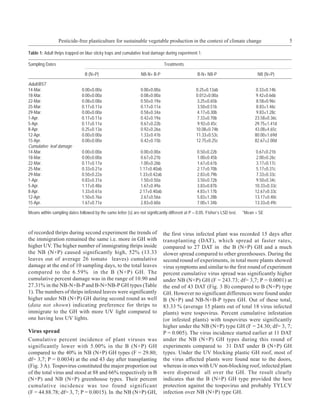
10 readings (sampling days) were collected on the                 Light Transmission and Temperature
immigrating thrips inside each 8 GH during each of the            No significant differences in temperatures or humidity
experiments. Additionally, two times a week number of             inside the four greenhouses were found during either round
thrips infested leaves were counted from the non-virus            of experiments. However, the UV light varies under each
infested plants until the fifth week. Two times a week,           GH type either during sunny and cloudy days during each
number of virus infected tomato plants were counted and           four experiments (Fig. 2). The UV levels drops to almost
marked and at the end of the experiments (43 days after           half during cloudy days. During exp. 1 and 2, only 20% of
transplanting), DAS-ELISA tests were carried out to               the days were cloudy whereas during experiment 3 and 4
distinguish between the tospovirus and other viruses e.g.         over 40% days were cloudy.
TYLCV. Since the tospovirus was the most commonly
occurring one, the plants failed to test positive for the CaCV-   Experiment 1 and 2. Partial Open gates (Partial
AIT infection but showing virus symptoms were assumed             Ventilation)
to be infected with the TYCLV (referred as other viruses).
                                                                  Thrips and leaf damage
Exp. 3 and 4. Effect of UV blocking nets and plastics             Thrips, most abundantly recorded species during this
on the immigration and attraction of thrips and                   experiment and immigration of thrips followed similar
occurrence of tospoviruses (full ventilation with                 trends of entry into UV rich greenhouses over the ones
complete open doors)                                              having low UV-intensity. The NB (N+P) GH attracted
Two rounds of experiments were carried out in a similar           significantly highest number of thrips over all other
greenhouse set-up as discussed above except that during           greenhouses. Whereas, the B-N + NB-P and NB (N+P) GH
this round the two doors were kept open during the entire         types had significantly different immigrating thrips for all
period of experiment. The number of thrips were counted           sampling dates (Table 1). Even with a different total number
on the BST as per the procedure explained above. Similarly,
number of thrips infested leaves and virus infected plants
were counted, marked and at the end of experiment, tests
were carried out to distinguish between the tospoviruses
and other viruses. To investigate the abilities of thrips to
reach the experimental GH, two BST each was attached at
the outer walls (centrally placed) and traps were changed
twice a week followed by counting of thrips. The position
and orientation of the traps on all 4 GH types were same.
In this way, abilities of the thrips reaching GH were
determined.

Statistical Analyses
Adult whiteflies, thrips and aphids on traps, alate aphids
and whiteflies on leaves, number of thrips infested leaves,
percentage of virus infected plants were subjected to             Fig. 2: UV-A measurement (W/m2) under each four greenhouses, UV-block-
                                                                  ing net sidewalls with UV-blocking plastic film as roof [ B (N+P)]; UV non-
HOVTEST = LEVENE option of SAS (SAS, 1999) to
                                                                  blocking nets as sidewalls and UV non blocking plastic films as roof [NB
account for homogeneity of variance and normality. In case        (N+P)]; UV-blocking nets as side walls and UV non blocking plastic films as
of non-homogeneity, percent values were transformed using         roof [B-N+NB-P]; and, UV non blocking nets as side wall and UV-blocking
arcsine–square-root (arcsine√) transformation. Insects on         plastics films as roof [NB-N+B=P] using Radiometer UV-Sensor (Dr. Grobel
traps and plants and number of infested leaves count values       UV-Elektronik GmbH, Germany).
Pesticide-free plasticulture for sustainable vegetable production in the context of climate change                              5

Table 1: Adult thrips trapped on blue sticky traps and cumulative lead damage during experiment 1.

Sampling Dates                                                                  Treatments

                                 B (N+P)                          NB-N+ B-P                        B-N+ NB-P                         NB (N+P)

Adult/BST
14-Mar.                        0.00±0.00a                         0.00±0.00a                       0.25±0.13ab                     0.33±0.14b
18-Mar.                        0.00±0.00a                         0.08±0.00a                       0.012±0.00a                     9.42±0.66b
22-Mar.                        0.08±0.08a                         0.50±0.19a                       3.25±0.65b                       8.58±0.96c
25-Mar.                        0.17±0.11a                         0.17±0.11a                       3.50±0.51b                       8.83±1.46c
29-Mar.                        0.00±0.00a                         0.58±0.34a                       4.17±0.30b                       9.83±1.28c
1-Apr.                         0.17±0.11a                         0.42±0.19a                       7.33±0.70b                      23.58±0.36c
5-Apr.                         0.17±0.11a                         0.67±0.22b                        9.92±0.45c                     29.75±1.41d
8-Apr.                         0.25±0.13a                         0.92±0.26a                       10.08±0.74b                     43.08±4.65c
12-Apr.                        0.00±0.00a                         1.33±0.41b                       11.33±0.53c                     80.00±1.69d
15-Apr.                        0.00±0.00a                         0.42±0.15b                       12.75±0.25c                     82.67±2.00d
Cumulative leaf damage
14-Mar.                        0.00±0.00a                        0.00±0.00a                        0.50±0.22b                      0.67±0.21b
18-Mar.                        0.00±0.00a                        0.67±0.21b                        1.00±0.45b                       2.00±0.26c
22-Mar.                        0.17±0.17a                        1.00±0.26b                        1.67±0.61b                       3.17±0.17c
25-Mar.                        0.33±0.21a                        1.17±0.40ab                       2.17±0.70b                       5.17±0.31c
29-Mar.                        0.50±0.22a                        1.33±0.42ab                       2.83±0.79b                       7.33±0.33c
1-Apr.                         0.83±0.31a                        1.50±0.50a                        3.50±0.72b                       9.50±0.34c
5-Apr.                         1.17±0.48a                        1.67±0.49a                        3.83±0.87b                      10.33±0.33c
8-Apr.                         1.33±0.61a                        2.17±0.40ab                       4.83±1.17b                      12.67±0.33c
12-Apr.                        1.50±0.76a                        2.67±0.56a                        5.83±1.28b                      13.17±0.40c
15-Apr.                        1.67±0.71a                        2.83±0.60a                        7.00±1.34b                      13.33±0.49c

Means within sampling dates followed by the same letter (s) are not significantly different at P = 0.05. Fisher’s LSD test.   *Mean + SE


of recorded thrips during second experiment the trends of                      the first virus infected plant was recorded 15 days after
the immigration remained the same i.e. more in GH with                         transplanting (DAT), which spread at faster rates,
higher UV. The higher number of immigrating thrips inside                      compared to 27 DAT in the B (N+P) GH and a much
the NB (N+P) caused significantly high, 52% (13.33                             slower spread compared to other greenhouses. During the
leaves out of average 26 tomato leaves) cumulative                             second round of experiments, in total more plants showed
damage at the end of 10 sampling days, to the total leaves                     virus symptoms and similar to the first round of experiment
compared to the 6.59% in the B (N+P) GH. The                                   percent cumulative virus spread was significantly higher
cumulative percent damage was in the range of 10.90 and                        under NB (N+P) GH (F = 243.73; df= 3,7; P = 0.0001) at
27.31% in the NB-N+B-P and B-N+NB-P GH types (Table                            the end of 43 DAT (Fig. 3 B) compared to B (N+P) type
1). The numbers of thrips infested leaves were significantly                   GH. However no significant differences were found under
higher under NB (N+P) GH during second round as well                           B (N+P) and NB-N+B-P types GH. Out of these total,
(data not shown) indicating preference for thrips to                           83.33 % (average 15 plants out of total 18 virus infected
immigrate to the GH with more UV light compared to                             plants) were tospovirus. Percent cumulative infestation
one having less UV lights.                                                     (or infested plants) with tospovirus were significantly
                                                                               higher under the NB (N+P) type GH (F = 24.30; df= 3, 7;
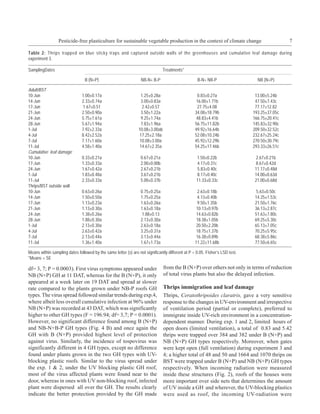
Virus spread                                                                   P = 0.005). The virus incidence started earlier at 11 DAT
Cumulative percent incidence of plant viruses was                              under the NB (N+P) GH types during this round of
significantly lower with 5.00% in the B (N+P) GH                               experiments compared to 31 DAT under B (N+P) GH
compared to the 40% in NB (N+P) GH types (F = 29.80;                           types. Under the UV blocking plastic GH roof, most of
df= 3,7; P = 0.0034) at the end 43 day after transplanting                     the virus affected plants were found near to the doors,
(Fig. 3 A). Tospovirus constituted the major proportion out                    whereas in ones with UV non-blocking roof, infected plant
of the total virus and stood at 88 and 66% respectively in B                   were dispersed all over the GH. The result clearly
(N+P) and NB (N+P) greenhouse types. Their percent                             indicates that the B (N+P) GH type provided the best
cumulative incidence was too found significant                                 protection against the tospovirus and probably TYLCV
(F = 44.88.78; df= 3, 7; P = 0.0015). In the NB (N+P) GH,                      infection over NB (N+P) type GH.
6                                                                       Prabhat Kumar

                                                                                    found during experiment 4 for the immigrating thrips and
                                                                                    a higher number of thrips were attracted towards the GH
                                                                                    with high UV intensity.

                                                                                    Virus spread
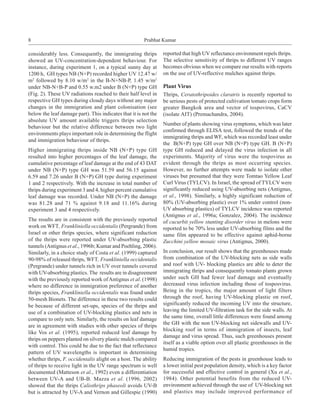
                                                                                    The high thrips population during exp. 3, resulted into 100%
                                                                                    virus infection by 43 DAT, which was significantly higher
                                                                                    compared to other GH type (F = 1588.25; df= 3,7; P =
                                                                                    0.0001). The B (N+P) provided significant protection
                                                                                    against viruses and only 10% plants found to have virus;
                                                                                    15% under NB-N+B-P and 51% plant under B-N+NB-P
                                                                                    GH types (Fig. 4 A.) Out of these total virus infections,
                                                                                    over 75% tomato plants tested positive for tospovirus.
                                                                                    Tospovirus infection followed the similar trends and lowest
                                                                                    infection was recorded under B (N+P) GH type (F = 96.38;


Fig. 3: Percent cumulative virus infected tomato plants under greenhouses,
UV-blocking net sidewalls with UV-blocking plastic film as roof [ B (N+P)]; UV
non-blocking nets as sidewalls and UV non blocking plastic films as roof [NB
(N+P)]; UV-blocking nets as side walls and UV non blocking plastic films as
roof [B-N+NB-P]; and, UV non blocking nets as side wall and UV-blocking
plastics films as roof [NB-N+B-P] during exp. 1 (A) and exp. 2 (B),when green-
house door open for 600-1000h. Cumulative percent at the 43 days after
transplanting sharing a common letter are not significantly different at P <0.05,
Fisher’s LSD.

Experiment 3 and 4. Open doors (Complete
Ventilation)

Thrips and leaf damage
During exp.3, similar to the previously observed trends,
significantly higher number of thrips immigrated and
captured from the NB (N+P) GH followed by the B-N +
NB-P and others. Similar trends of higher leaf damage were
observed under NB (N+P) GH. No significant difference
was found for most sampling day between B (N+P) and
NB-N+B-P type GH (Table 2). Similar trends of thrips
                                                                                    Fig. 4: Percent cumulative virus infected tomato plants under greenhouses
immigration and leaf damage with overall lower thrips                               (treatments), UV-blocking net sidewalls with UV-blocking plastic film as roof
population were observed during exp.4, a month later.                               [ B (N+P)]; UV non-blocking nets as sidewalls and UV non blocking plastic
                                                                                    films as roof [NB (N+P)]; UV-blocking nets as side walls and UV non blocking
During experiment, 3, significantly higher numbers of thrips
                                                                                    plastic films as roof [B-N+NB-P]; and, UV non blocking nets as side wall and
were attracted towards the NB (N+P) type greenhouses for                            UV-blocking plastics films as roof [NB-N+B-P] during exp. 3 (A) and exp. 4
all sampling days followed by B-N+NB-P. However no                                  (B), when greenhouse doors kept open (complete ventilation). Cumulative
differences were found among the B (N+P) and NB-N+ B-                               percent at the 43 days after transplanting sharing a common letter are not
P type GH (Table 2). Similar significant attraction was                             significantly different at P <0.05, Fisher’s LSD.
Pesticide-free plasticulture for sustainable vegetable production in the context of climate change                           7

Table 2: Thrips trapped on blue sticky traps and captured outside walls of the greenhouses and cumulative leaf damage during
experiment 3.

SamplingDates                                                                  Treatments*

                                 B (N+P)                          NB-N+ B-P                        B-N+ NB-P                    NB (N+P)

Adult/BST
10-Jun                         1.00±0.17a                         1.25±0.28a                       0.83±0.27a                  13.00±5.24b
14-Jun                         2.33±0.74a                         3.00±0.83a                       16.00±1.71b                 47.50±7.43c
17-Jun                         1.67±0.51                           2.42±0.57                       27.75±4.08                  77.17±12.82
21-Jun                         2.50±0.90a                         3.50±1.22a                      34.08±18.79b                193.25±37.05c
24-Jun                         5.75±1.61a                         9.25±1.74a                       48.83±4.41b                166.75±20.41c
28-Jun                         5.67±1.94a                         7.83±1.96a                      56.75±11.82b                145.83±32.90c
1-Jul                          7.92±2.33a                        10.08±3.00ab                     49.92±16.64b                209.50±32.52c
4-Jul                          8.42±2.52a                         17.25±2.18a                     52.08±10.24b                232.67±25.24c
7-Jul                          7.17±1.60a                         10.08±3.00a                     45.92±12.29b                270.50±30.79c
11-Jul                         4.58±1.40a                         14.67±2.35a                     54.25±17.46b                293.33±26.51c
Cumulative leaf damage
10-Jun                         0.33±0.21a                         0.67±0.21a                       1.50±0.22b                   2.67±0.21b
17-Jun                         1.33±0.33a                         2.00±0.00b                       4.17±0.31c                   8.67±0.42d
24-Jun                         1.67±0.42a                         2.67±0.21b                       5.83±0.40c                  11.17±0.48d
1-Jul                          1.83±0.48a                         3.67±0.21b                       8.17±0.40c                  14.00±0.63d
11-Jul                         2.33±0.33a                         5.00±0.37b                       11.33±0.33c                 21.00±0.68d
Thrips/BST outside wall
10-Jun                         0.63±0.26a                         0.75±0.25a                       2.63±0.18b                   5.63±0.50c
14-Jun                         1.50±0.50a                         1.75±0.25a                       4.13±0.40b                  14.25±1.53c
17-Jun                         1.13±0.23a                         1.63±0.26a                       9.50±1.35b                  21.50±1.76c
21-Jun                         1.13±0.30a                         1.63±0.18a                       10.13±0.97b                 36.13±2.87c
24-Jun                         1.38±0.26a                          1.88±0.13                       14.63±0.82b                 51.63±7.80c
28-Jun                         1.88±0.30a                         2.13±0.30a                       18.38±1.05b                 69.25±5.30c
1-Jul                          2.13±0.30a                         2.63±0.18a                       20.50±2.20b                 65.13±7.05c
4-Jul                          2.63±0.42a                         3.25±0.31a                       18.75±1.37b                 70.25±5.95c
7-Jul                          2.13±0.44a                         3.13±0.44a                       16.38±0.89b                 68.38±5.86c
11-Jul                         1.36±1.40a                         1.67±1.73a                      11.22±11.68b                 77.50±6.65c

Means within sampling dates followed by the same letter (s) are not significantly different at P = 0.05. Fisher’s LSD test.
*Means + SE

df= 3, 7; P = 0.0003). First virus symptoms appeared under                      from the B (N+P) over others not only in terms of reduction
NB (N+P) GH at 11 DAT, whereas for the B (N+P), it only                         of total virus plants but also the delayed infection.
appeared at a week later on 19 DAT and spread at slower
rate compared to the plants grown under NB-P roofs GH                           Thrips immigration and leaf damage
types. The virus spread followed similar trends during exp.4,                   Thrips, Ceratothripoides claratris, gave a very sensitive
where albeit less overall cumulative infection at 96% under                     response to the changes in UV-environment and irrespective
NB (N+P) was recorded at 43 DAT, which was significantly                        of ventilation period (partial or complete), preferred to
higher to other GH types (F = 196.94; df= 3,7; P = 0.0001).                     immigrate inside UV-rich environment in a concentration-
However, no significant difference found among B (N+P)                          dependent manner. During exp. 1 and 2, limited hours of
and NB-N+B-P GH types (Fig. 4 B) and once again the                             open doors (limited ventilation), a total of 0.83 and 5.42
GH with B (N+P) provided highest level of protection                            thrips were trapped over 384 and 382 under B (N+P) and
against virus. Similarly, the incidence of tospovirus was                       NB (N+P) GH types respectively. Moreover, when gates
significantly different in 4 GH types, except no difference                     were kept open (full ventilation) during experiment 3 and
found under plants grown in the two GH types with UV-                           4; a higher total of 48 and 50 and 1664 and 1070 thrips on
blocking plastic roofs. Similar to the virus spread under                       BST were trapped under B (N+P) and NB (N+P) GH types
the exp. 1 & 2, under the UV blocking plastic GH roof,                          respectively. When incoming radiation were measured
most of the virus affected plants were found near to the                        inside these structures (Fig. 2), roofs of the houses were
door, whereas in ones with UV non-blocking roof, infected                       more important over side nets that determines the amount
plant were dispersed all over the GH. The results clearly                       of UV inside a GH and wherever, the UV-blocking plastics
indicate the better protection provided by the GH made                          were used as roof, the incoming UV-radiation were
8                                                      Prabhat Kumar

considerably less. Consequently, the immigrating thrips          reported that high UV reflectance environment repels thrips.
showed an UV-concentration-dependent behaviour. For              The selective sensitivity of thrips to different UV ranges
instance, during experiment 1, on a typical sunny day at         becomes obvious when we compare our results with reports
1200 h, GH types NB (N+P) recorded higher UV 12.47 w/            on the use of UV-reflective mulches against thrips.
m2 followed by 8.10 w/m2 in the B-N+NB-P, 1.45 w/m2
under NB-N+B-P and 0.55 w.m2 under B (N+P) type GH               Plant Virus
(Fig. 2). These UV radiations reached to their half level in     Thrips, Ceratothripoides claratris is recently reported to
respective GH types during cloudy days without any major         be serious pests of protected cultivation tomato crops form
changes in the immigration and plant colonisation (see           greater Bangkok area and vector of tospovirus, CaCV
below the leaf damage part). This indicates that it is not the   (isolate AIT) (Premachandra, 2004).
absolute UV amount available triggers thrips selection
                                                                 Number of plants showing virus symptoms, which was later
behaviour but the relative difference between two light
                                                                 confirmed through ELISA test, followed the trends of the
environments plays important role in determining the flight
                                                                 immigrating thrips and WF, which was recorded least under
and immigration behaviour of thrips.
                                                                 the B(N+P) type GH over NB (N+P) type GH. B (N+P)
Higher immigrating thrips inside NB (N+P) type GH                type GH reduced and delayed the virus infection in all
resulted into higher percentages of the leaf damage, the         experiments. Majority of virus were the tospovirus as
cumulative percentage of leaf damage at the end of 43 DAT        evident through the thrips as most occurring species.
under NB (N+P) type GH was 51.59 and 56.15 against               However, no further attempts were made to isolate other
6.59 and 7.26 under B (N+P) GH type during experiment            viruses but presumed that they were Tomtao Yellow Leaf
1 and 2 respectively. With the increase in total number of       Curl Virus (TYLCV). In Israel, the spread of TYLCV were
thrips during experiment 3 and 4, higher percent cumulative      significantly reduced using UV-absorbing nets (Antignus,
leaf damage was recorded. Under NB (N+P) the damage              et al., 1998). Similarly, a highly significant reduction of
was 81.28 and 71 % against 9.18 and 11.16% during                80% (UV-absorbing plastic) over 1% under control (non-
experiment 3 and 4 respectively.                                 UV absorbing plastics) of TYLCV incidence was reported
                                                                 (Antignus et al., 1996a; Gonzalez, 2004). The incidence
The results are in consistent with the previously reported       of cucurbit yellow stunting disorder virus in melons were
work on WFT, Frankliniella occidentalis (Pergrande) from         reported to be 70% less under UV-absorbing films and the
Israel or other thrips species, where significant reduction      same film appeared to be effective against aphid-borne
of the thrips were reported under UV-absorbing plastic           Zucchini yellow mosaic virus (Antignus, 2000).
tunnels (Antignus et al., 1996b; Kumar and Poehling, 2006).
Similarly, in a choice study of Costa et al. (1999) captured     In conclusion, our result shows that the greenhouses made
90-98% of released thrips, WFT, Frankliniella occidentalis       from combination of the UV-blocking nets as side walls
(Pergrande) under tunnels rich in UV over tunnels covered        and roof with UV- blocking plastics are able to deter the
with UV-absorbing plastics. The results are in disagreement      immigrating thrips and consequently tomato plants grown
with the previously reported work of Antignus et al. (1998)      under such GH had fewer leaf damage and eventually
where no difference in immigration preference of another         decreased virus infection including those of tosposvirus.
thrips species, Frankliniella occidentalis was found under       Being in the tropics, the major amount of light filters
50-mesh Bionets. The difference in these two results could       through the roof, having UV-blocking plastic on roof,
be because of different set-ups, species of the thrips and       significantly reduced the incoming UV into the structure,
use of a combination of UV-blocking plastics and nets in         leaving the limited UV-filtration task for the side walls. At
compare to only nets. Similarly, the results on leaf damage      the same time, overall little differences were found among
                                                                 the GH with the non UV-blocking net sidewalls and UV-
are in agreement with studies with other species of thrips
                                                                 blocking roof in terms of immigration of insects, leaf
like Vos et al. (1995), reported reduced leaf damage by
                                                                 damage and virus spread. Thus, such greenhouses present
thrips on peppers planted on silvery plastic mulch compared
                                                                 itself as a viable option over all plastic greenhouses in the
with control. This could be due to the fact that reflectance
                                                                 humid tropics.
pattern of UV wavelengths is important in determining
whether thrips, F. occidentalis alight on a host. The ability    Reducing immigration of the pests in greenhouse leads to
of thrips to receive light in the UV range spectrum is well      a lower initial pest population density, which is a key factor
documented (Matteson et al., 1992) even a differentiation        for successful and effective control in general (Xu et al.,
between UV-A and UB-B. Mazza et al. (1996, 2002)                 1984). Other potential benefits from the reduced UV-
showed that the thrips Caliothrips phaseoli avoids UV-B          environment achieved through the use of UV-blocking net
but is attracted by UV-A and Vernon and Gillespie (1990)         and plastics may include improved performance of
Pesticide-free plasticulture for sustainable vegetable production in the context of climate change                                        9

entomopathogenic fungi (Costa et al., 2001) and                                          (Gennadius) (Hemiptera: Aleyrodidae) in Isreal. Bull. Entomol. Res.,
baculoviruses (Goulsom et al., 2003), improved                                           68:465-470.
                                                                                Costa, H.S. and Robb, K.L. 1999. Effects of ultraviolet-absorbing greenhouse
management of some fungal pathogens (Reuveni and Raviv,
                                                                                         plastic films on flight behaviour of Bemisia argentifolii (Homoptera:
1992, 1997; Elad, 1997), reduced UV related degradation                                  Aleyrodidae) and Frankliniella occidentalis (Thysanoptera:
of botanicals like neem (Johnson et al., 2003; Barrek et                                 Thripidae). J. Econ. Entomol., 92:557-562.
al., 2004) and overall improvements in the microclimate                         Costa, H.S., Robb, K.L. and Wilen, C.A. 2001. Increased persistence of
leading to healthier production of crops like tomatoes.                                  Beauveria bassiana spore viability under high ultraviolet-blocking
                                                                                         greenhouse plastic. Hort-Science, 36:1082-1084.
Recently most publications reported that under climate                          Diaz, B. M. and Fereres, A. 2007. Ultraviolet-Blocking materials as a physical
change scenario the sucking pest and plant viruses will                                  Barrier to Control Insect Pests and Plant Pathogens in Protected
increase so does the plant diseases (Canto and Aranda,                                   Crops. Pest Technology, 1:85-95.
2009). Clearly a low UV environment facilitated through                         Döring, T. F. and Chittka, L. 2007. Visual ecology of aphids — a critical
                                                                                         review on the role of colours in host finding. Arthropod Plant Inter.
optimal combination of low-cost nets and plastics could
                                                                                         1:3-16.
provide a sustainable environment for safer and non-                            EJF, 2002. Death in Small Doses: Cambodia’s Pesticides Problems and
pesticide produce, which would be a much needed and                                      Solutions. Environmental Justice Foundation, London, UK. 37 pp.
sought after by consumers and exporters. However, it has                        Elad, Y. 1997. Effect of solar light on the production of conidia by field
been also reported that reduced UV could have some                                       isolates of Botrytis cinerea and on several diseases of greenhouse
negative effects on some plant species. It is suggested that                             grown vegetables. Crop Protect. 16:635-642.
                                                                                Goldsmith, T.H. 1993. Ultraviolet receptors and color vision: evolutionary
more studies should be carried out using different crops
                                                                                         implication and a dissonance of paradigms. Vision Res.,
and pest models to further refine the idea into working                                  34:1479-1487.
technologies. Similarly, in the case where release of                           Gomez, K.A. and Gomez, A.A. 1984. Statistical Procedures for Agriculture
parasitoids and predators are carried out, being arthropods,                             Research. John Wiley and Sons, New York, USA.
further studies are also suggested.                                             Gonzalez, A. 2004. Viral Diseases Control with UV-Blocking Films in
                                                                                         Greenhouses of Southern Spain, International Symposium on
Finally, the increased surge in number of plant viruses due                              Protected Culture in a Mild-Winter Climate, Kissimmee, Florida.
to sucking pest, and resulting losses to the yield and quality                  Goulson, D., Derwent, L.C., Pernagos, D.I. and Williams, T. 2003. Effects
of vegetable crops, could be reduced directly by adopting                                of optical brighteners included in biopesticide formulations on the
to the low UV growing condition under various plasticulture                              growth of crops. Agric. Ecosys. Environ., 95:235-240.
                                                                                Johnson, S., Dureja, P. and Dhingra, S. 2003. Photostablizers for
production system that would require minimal use of                                      Azadirachtin-A (a Neem-based pesticide). J Environ Sci. Health B.
chemical pesticides for sustainable pest management in the                               38:451-462.
context of climate change.                                                      Ketelaar, J.W. and Kumar, P. 2012. Asian Smallholder Vegetable Farmers
                                                                                         as IPM Experts: Experiences from the FAO Regional Vegetable
                                                                                         IPM Programme. Acta Horticulturae, 20:30.
REFERENCES                                                                      Kring, J. B. and Schuster, D.J. 1992. Management of insects on pepper
Antignus, Y. 2000. Manipulation of wavelength dependent behaviour of                     and tomato with UV reflective mulches. Fla. Entomol., 75:119-129.
        insects: an IPM tool to impede insects and restrict epidemics of        Kring, J.B., and D.J. Schuster. 1992. Management of insects, 13.
        insect borne viruses. Virus Res., 71:213-220.                           Kumar, P., Poehling, H.M. and Borgemeister, C. 2005. Effects of different
Antignus, Y., Lapidot, M., Hadar, D., Messika, M. and Cohen, C. 1998.                    application methods of neem against sweetpotato whitefly Bemisia
        Ultraviolet absorbing screens serve as optical barriers to protect               tabaci Gennadius (Homoptera: Aleyrodidae) on tomato plants.
        greenhouse crops from virus diseases and insect pests. J. Econ.                  Journal of Applied Entomology, 129:489.497.
        Entomol., 9:1401-1405.                                                  Kumar, P. and Poehling, H.M. 2006. UV-blocking Plastic Films and Nets
Antignus, Y., Lapidot, M., Mor, N., Ben-Joseph, R. and Cohen, S. 1996a.                  Influence Vectors and Virus Transmission on Greenhouse Tomatoes
        Ultra violet absorbing plastic sheets protect crops from insect pests            in the Humid Tropics. Environmental Entomology, 35:1069-1082.
        and virus diseases vectored by insects. Environ. Entomol. 25: 919-      Kumar, P., and Poehling, H.M. 2007. Effects of azadirachtin, avamectin
        924.                                                                             and spinosad on sweetpotato whitefly Bemisia tabaci Gennadius
Antignus, Y., Cohen, S., Mor, N., Messika, Y. and Lapidot, M. 1996b. The                 (Homoptera: Aleyrodidae) on tomato plants under laboratory and
        effects of UV blocking greenhouse covers on insects and insect-                  greenhouse conditions in the humid tropics. Journal of Economic
        borne virus diseases. Plasticulture, 11:15-20.                                   Entomology, 100:411-420.
Barrek, S., Paisse, O. and Marie-Florence, G.L. 2004. Analysis of neem          Lewis, W.J., van Lenteren, J.C., Phatak, S.C. and Tumlinson, J.H. 1997. A
        oils by LC-MS and degradation kinetics of azadirachtin-A in a                    total system approach to sustainable pest management. PNAS,
        controlled environment. Anal. Bioanal. Chem., 378:753-763.                       94:12243-12248.
Canto, T. and Aranda, M.A. 2009. Climate change effects on physiology           Mancini, F. Jiggins, J. and O’Malley, M. 2009. Reducing the incidence of
        and population processes of hosts and vectors that influence the                 pesticide poisoning by educating farmers on Integrated Pest
        spread of hemipteran-borne plant viruses. Global Change                          Management in South India. Int. Journal of Occupational and
        Biology.,15:1884-1894.                                                           Environmental Health, 15:143-151.
Cohen, S., and Melamed-Madjar, V. 1978. Prevention by soil mulching of          Matteson, N., Terry, I., Ascoli-Christensen, A. and Gilbert, C. 1992. Spectral
        spread of tomato yellow leaf curl virus transmitted by Bemisia tabaci            efficiency of the western flower thrips, Frankliniella occidentalis.
10                                                                    Prabhat Kumar

        Journal of Insect Physiology, 38:453-459.                                Reuveni, R., and Raviv, M. 1997. Manipulation of light for the management
Mazza, C.A., Izaguirre, M.M., Zavala, J., Scopel, A.L. and Ballaré, C.L. 2002.           of foliar pathogens of greenhouse crops. The story of the
        Insect perception of ambient ultraviolet-B radiation. Ecology Letters.           establishment of a new discipline., pp. 269-281, International
        6:722.                                                                           Congress for Plastics in Agriculture. CIPA Proceedings, Tel Aviv,
Mazza, C.A., Zavala, J., Scopel, A.L. and Ballare, C.L. 1996. Perception of              Israel.
        solar UVB radiation by phytophagous insects: Behavioral responses        SAS Institute. 1999. SAS/Stat user’s guide, version 8, SAS Institute, Cary,
        and ecosystem implications. Proceedings of the National Academy                  NC
        of Science of the United States of America, 96:980-985.                  Srinivasan, R., 2008. Integrated Pest Management for eggplant fruit and
Perkins, J.H., 1982. Insects, Experts, and the Insecticide Crisis. The quest             shoot borer (Leucinodes orbonalis) in south and southeast Asia:
                                                                                         Past, Present and Future. Journal of Biopesticides, 1:105-112.
        for new pest management strategies. Plenum Press, New York.
                                                                                 Steel, R.G.D. and Torrie, J.H. 1980. Principles and Procedures of Statistics,
        304 pp.
                                                                                         2nd Edn. McGraw Hill, Inc, New York.
Premachandra, W.T.S.D. 2004. Biology, population dynamics, vector
                                                                                 Vernon, R.S. and Gillespie, D.R. 1990. Spectral responsiveness of
        potential and management of Ceratothripoides claratris on tomatoes               Frankliniella occidentalis (Thysanoptera: Thripidae) determined by
        in central Thailand. pp. 140, Institute of Plant Protection and Plant            trap catches in greenhouses. Environ. Entomol., 19:1229-1241.
        Diseases. PhD dissertation, University of Hanover, Germany,              Vos, J.G., Uhan, M.T.S. and R. Sutarya. 1995. Integrated crop management
        Hanover.                                                                         of hot pepper (Capsicum spp.) under tropical lowland conditions:
Raviv, M. and Antignus, Y. 2004. UV radiation effects on pathogens and                   effects of rice straw and plastic mulches on crop health. Crop
        insect pests of greenhouse-grown crops. Photochemistry and                       Protection. 4:445-452.
        Photobiology, 79:219-226.                                                Xu, R.M., Zhu, Q.R. and Zhang, Z.L. 1984. A system approach to greenhouse
Reuveni, R. and Raviv, M. 1992. The effect of spectrally modified                        whitefly Trialeurodes vaporariorum population dynamics and
        polyethylene films on the development of Botrytis cinerea in                     strategy for greenhouse whitefly control in China. Z. Angew.
        greenhouse grown tomato plants. Biol. Agric. Hort., 9:77-86.                     Entomol., 97:305-313.
International Journal of analysis of Horticulture. 1(1):11-17, 2012
               Diversity Innovative Alternaria porri (Ellis) Cif- causal organism of purple leaf blotch of onion            11


Diversity analysis of Alternaria porri (Ellis) Cif - causal organism of
purple leaf blotch of onion

P. Chowdappa, H. Sandhya and B. Reddi Bhargavi
Indian Institute of Horticultural Research, Hessaraghatta Lake Post, Bangalore – 560 089
Coresponding author - pallem22@gmail.com

ABSTRACT
Purple leaf blotch (PLB), caused by Alternaria porri (Ellis) Cif, is the most destructive disease of onion in India. Phenotypic
and genetic diversity of 19 A. porri isolates collected from different farms in Karnataka state of India was characterized
based on morphology, aggressiveness, response to the fungicides (chlorothalonil and mancozeb), and genetic analysis
using sequencing of ITS region of rDNA. All A. porri isolates produced typical orange color pigmentation on potato
dextrose agar (PDA). Isolates exhibited significant differences in their aggressiveness on onion variety, Arka kalyan and
could be categorized into highly aggressive, moderately aggressive and less aggressive groups. Comparative fungicidal
assays indicated that isolates were more sensitive to chlorothalonil than to mancozeb. EC50 values for inhibition of mycelia
growth ranged from 3.07 to 48.30 µg/ml for chlorothalonil and 33.22 to 76.90 µg/ml for mancozeb. Isolates could be
separated into two groups based on phylogenetic analysis of ITS sequences; Clade I contains highly and moderately
aggressive isolates and clade II contains less aggressive and nonpathogenic isolates. Thus, the present study demonstrated
existence of phenotypic and genotypic diversity among A. porri isolates collected from areas of commercial onion
production, which has implications in breeding onion for resistance to purple blotch.
Key words:Onion, purple leaf blotch, Alternaria porri, onion, genotypic diversity

INTRODUCTION                                                     Under the favorable conditions of warm temperatures and
Onion is considered as one of the five most important fresh      prolonged leaf wetness, onion foliage may rapidly succumb
                                                                 to blight (Everts and Lacy, 1996; Suheri and Price, 2001).
market vegetable crops (Cramer, 2000). Onions are used
                                                                 Premature loss or collapse of foliage may result in
both as food and seasoning, the immature and mature bulbs
                                                                 significant yield reductions in onion fields. To maintain crop
are eaten raw or they may be cooked and eaten as a
                                                                 healthy, the onion growers use integrated strategies for
vegetable (Messiaen, 1994). Onion contains the
                                                                 management of PLB, including the use of pathogen free
lachrymatory agent, a strong antibiotic, with fungicidal,
                                                                 seed, crop rotation, planting of disease resistant varieties,
bacterial and nematicidal properties (Purseglove, 1972).
                                                                 disease forecasting models, and most notably, the
The world production of onion including shallots was 3.56        application of protectant fungicides, chlorothalonil and
lakh tonnes in 2.8 lakh hectares (FAO, 2008). India ranks        mancozeb (O’Higgins, 1988; Gupta et al., 1996; Gupta and
second in area and third in production with 6.66 million         Pathak, 1988; Srivastava et al.,1996; Sharma, 1987).
tonnes in 0.478 million hectare area. Onion is susceptible       Artificial inoculation experiments in controlled
to various foliar, bulb and root pathogens that reduce yield     environments and screening under natural epiphytotic led
and quality (Cramer, 2000). Among these, purple leaf blotch      to development of moderate level of resistance in onion
(PLB) caused by Alternaria porri (Ellis) Cif, is one of the      germplasm for resistance to PLB (Sharma, 1997; Sugha et
most important fungal diseases of onion (Allium cepa L)          al.,1992; Dhiman and Chada, 1986). Pathogen diversity
affecting both bulb and seed crop (Awad et al., 1978; Everts     plays significant role in determining the variation in
and Lacy, 1990a; Brar et al., 1990; Aveling et al., 1993,        response of host and fungicides to PLB. However, the
1994 and Cramer, 2000; Dhiman and Chada, 1986), causing          existence of pathogen diversity with regard to
losses up to 100 per cent (Singh et al., 1992). The disease      aggressiveness on host and fungicidal sensitivity has not
is characterized by the development of sunken purple             been elucidated. There is concern that resistant individuals
necrotic lesions on the foliage and seed stock that              within a fungal population may develop due to repeated
progressively coalesce, leading to premature drying of           application of these fungicides. There are several examples
leaves and cessation of bulb development (Gupta et al.,          of pathogen populations that express reduced sensitivity to
1994).                                                           fungicides under the selection pressure from repeated
12                                    P. Chowdappa, H. Sandhya and B. Reddi Bhargavi

fungicide use (Eckert,1988). For example, Holm et al.              examined for colony color, colony margin, colony texture,
(2003) reported considerable variability in A. solani isolates     and the development of pigments in the agar medium (Pryor
to chlorothalonil and mancozeb due to repeated exposure.           and Michailides, 2002). For sporulation, five mm diameter
Monitoring A. porri isolates is necessary to better                disks were transferred to Petri dishes containing
understand population responses to these compounds and             0.05 × PDA. Dishes were incubated under continuous light
the potential for continued control of PLB.                        at 25 °C ±1 °C for 7 days. After incubation, cultures were
Variation in phenotypic, genotypic and biochemical traits          examined for sporulation.
within populations of Alternaria spp., has been reported
(Aradhya and Chan, 2001, Naresh and Sangwan,. 2003,                Aggressiveness
Remneva and Ivanyuk, 1968; Rotem, 1966; Van der Waals              The aggressiveness of the isolates was determined by
et al., 2004; Weir, et al., 1998; Kumar et al., 2008; Rogers       inoculating detached onion leaves according to the method
and Stevenson, 2010). Morphological and pathogenic                 of Pryor and Michailides (2002) with slight modifications.
variability among isolates of A. solani has given rise to          Fully matured third leaf from bottom were obtained from
claims of the existence of races (Rotem, 1966). Molecular          60 days old plants during July-October crop seasons of 2010
analysis including nucleotide sequence of the internal             and 2011. The leaves were surface sterilized by immersing
transcribed spacer (ITS) regions of rDNA is a useful tool          them in a 1% sodium hypochlorite solution for 1 min before
for studying phylogenetic relationships of filamentous fungi       inoculation, then rinsed three times in sterile distilled water
and for relating it to host-specificity, geographical variation,   and subsequently air dried. The middle portion of the leaves
and gene-diversity among intra- and interspecies groups            were then pinpricked and placed on wire mesh platforms
(O’Donnell, 1993). To date, no research has determined             in plastic boxes (23 × 31 × 10 cm, length by width by
diversity in aggressiveness in populations of A. porri in          height). Inoculation was carried out on the wounded leaves
relation to phenotypic and genotypic characteristics. The          by placing 20 µl of a 2.5 x 10⁵/ml H2O conidial suspension
objectives of this study were to examine morphological,            on each wound. Leaves used as control were inoculated
molecular, the aggressiveness and in vitro sensitivity of A.       with 20 µl of sterile distilled water. Sterile distilled water
porri to commonly used fungicides to control PLB and to            was added in each box and then covered to maintain high
correlate phenotypic characters with genotypic markers.            relative humidity. The containers with the inoculated leaves
                                                                   were incubated at 25 °C ±1 °C for 7 days. The infection
MATERIALS AND METHODS                                              was recorded by measuring the length and width of the
                                                                   lesions on each leaf seven days after the inoculation. Since
Collection, isolation and maintenance of isolates                  the lesions are elliptical in shape, the lesion area was
Onion leaves showing typical symptoms of PLB were                  calculated using the formula µ × l × w, where the l= half
collected from different onion farms located in Karnataka          length of lesion and w= half width of lesion (Fagan, 1988).
during July-October crop season of 2009 and 2010. To
obtain isolates, a small piece of tissue (5 × 5mm) was taken       Fungicide sensitivity determination
from the margin of the lesion, surface sterilized in 1%
                                                                   The commercial formulations of mancozeb (80%WP) and
sodium hypochlorite for 3 min, rinsed with sterile water,
                                                                   chlorothalonil (75%WP) were used in the present study.
and placed on potato dextrose agar (PDA). The plates were
                                                                   Sensitivity of A. porri isolates to mancozeb and
incubated under cool white fluorescent lights at 25 °C ±1 °C
                                                                   chlorothalonil were evaluated using mycelia growth assays.
for 7days. Then, the plates were examined with a dissecting
                                                                   Mycelial disks (5 mm in diameter) of the fungal isolates,
microscope (×15 magnification) and a small agar plug with
                                                                   removed from the margins of 7-day-old culture, were
a single germinating spore was picked from each plate with
                                                                   inoculated to PDA amended with mancozeb and
the use of a sterile surgical blade and transferred to a new
                                                                   chlorothalonil at concentrations of 0, 0.1, 1.0, 10.0, 100
PDA plate. A total of 19 Alternaria porri isolates were
                                                                   and 1000 µg/ml. Petri plates without the fungicide were
collected (Table.1). The cultures were maintained on PDA
                                                                   used as controls. Three replicates per concentration were
slopes under liquid paraffin oil at 8 °C.
                                                                   used for each isolate. The radial growth (colony diameter)
                                                                   of each isolate was measured in two perpendicular
Morphological examination                                          directions, with the original mycelial plug diameter (5 mm)
For colony morphology, five mm diameter disks cut from             subtracted from this measurement, after 7 days of incubation
colonies derived from single germinated conidia were               at 25°C ±1°C in the dark. The percent growth inhibition
transferred to Petri dishes (80mm) containing PDA and              for each isolate and fungicide was determined by using the
incubated at 25 °C ±1 °C for 10 days (Pryor and                    formula suggested by Vincent (1947). EC50 values were
Michailides, 2002). After incubation, cultures were                calculated for each isolate and each fungicide by regression
Diversity analysis of Alternaria porri (Ellis) Cif- causal organism of purple leaf blotch of onion                 13

Table 1: Alternaria porri isolates used in this study

Isolate No             Year of isolation                Location              Gene bank accession No           Genetic group

OOA2                         2009                       Hessaraghatta                JF710495                        I
OOA3                         2009                       Doddaballapur                JF710499                        I
OOA5                         2009                       Gouribidnur                  JF710486                        I
OOA6                         2009                       Malur                        JF710488                        I
OOA8                         2009                       Sira                         JF710494                        I
OOA11                        2009                       Challekere                   JF710496                        I
OOA12                        2009                       Chitraduraga                 JF710497                        I
OOA13                        2009                       Rannebenur                   JF710491                        I
OOA14                        2009                       Haveri                       JF710489                        I
OOA15                        2010                       Dharawad                     JF710485                        I
OOA17                        2010                       Kolar                        JF710483                        I
OOA19                        2010                       Chintamani                   JF710490                        I
OOA20                        2010                       Hiriyur                      JF710487                        II
OOA21                        2010                       Gubbi                        JF710481                        II
OOA22                        2010                       Arsikeri                     JF710493                        I
OOA23                        2010                       Hassan                          —                            I
OOA24                        2010                       Bagalakota                      —                            I
OOA25                        2010                       Hosakote                        —                            I
OOA29                        2010                       Birur                        JF710498                        I


analysis of the percent inhibition of fungal growth versus              denaturation of 5 min at 94 °C before cycling and final
the log10 of the fungicide concentration (µg/ml). Analyses              extension of 5 min at 72 °C after cycling. Amplified PCR
of variation of EC50 values from three experiments were                 products were separated in 2 % agarose gels in Tris- Borate-
conducted using SAS Proc ANOVA followed by mean                         EDTA (TBE) buffer and visualized under UV after staining
separation using Fisher’s LSD in SAS (SAS Institute).                   with ethidium bromide (0.5µg/ml).

Molecular characterization                                              Sequencing of the ribosomal ITS region: Amplified ITS
                                                                        region of r DNA products (560bp) with primer pair (ITS1
DNA extraction: Total fungal DNA was extracted from
                                                                        and ITS4) were purified using PCR product purification
mycelia obtained from 100 ml of potato dextrose broth
                                                                        kit KT 72 (Genei, Bangalore). The purified product (10-12
(PDB) for 7 days at 25 ±1 °C. Mycelium was harvested
                                                                        ng) was used for PCR cycle sequencing using Big Dye
from liquid cultures by filtration through Whatman no.3
filter paper and damp dried and subsequently ground into a              Terminator ready reaction Mixture kit (Applied Bio
fine powder in liquid nitrogen. DNA was extracted from                  systems, USA) and analyzed with ABI 3100 analyzer
the frozen mycelial powder employing a slightly modified                capillary machines. The sequences were deposited in the
method of Raeder and Broda (1985) by incubating at 37 °C                Gene Bank (www.ncbi.nlm.nih.gov) and the accession
for 10 min after the phenol: chloroform: isoamyl alcohol                numbers are given in the Table 1.
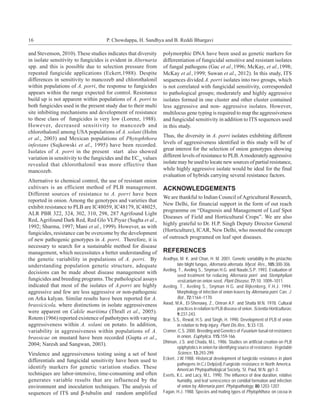
(25:24:1) precipitation. This was followed by precipitation             Phylogenetic analysis: The evolutionary history was inferred
with 0.54 volumes of isopropyl alcohol and centrifugation               using the Neighbor-Joining method (Saitou and Nei, 1987).
at 10,000 g for 2 min. The DNA pellet was washed with                   The optimal tree with the sum of branch length = 0.06225136
70% cold ethanol, dried at room temperature overnight                   is shown (Fig. 2). The tree is drawn to scale, with branch
(16hr) and then pellet was re-suspended in 30 µl 10mM                   lengths in the same units as those of the evolutionary distances
TE buffer (pH.8) DNA was stored at -20 °C.                              used to infer the phylogenetic tree. The evolutionary distances
PCR amplification: ITS region of r DNA of fungal isolates               were computed using the Maximum Composite Likelihood
were amplified by PCR with universal primer pair ITS1                   method (Tamura, et al., 2004) and are in the units of the number
(5’-TCCGTAGGTGAACCTGCGG-3’) and ITS4 (5’-                               of base substitutions per site. All positions containing gaps
TCCTCCGCTTATTGATATGC-3’ (White et al., 1990).                           and missing data were eliminated from the dataset (Complete
PCR reactions (50 µl) were performed with primer pair                   deletion option). There were a total of 690 positions in the
ITS1/ITS4 in Eppendorf master cycler by 34 cycles of                    final dataset. Phylogenetic analyses were conducted in
denaturation at 94°C for 60s, annealing at 55 °C for 60s,               MEGA4 (Tamura, et al., 2007).
and extension at 72 °C for 1.5 min with an initial
14                                            P. Chowdappa, H. Sandhya and B. Reddi Bhargavi

RESULTS AND DISCUSSION                                                  Fungicidal sensitivity
                                                                        The isolates exhibited significant differences (p<0.05) in
Morphological characters                                                sensitivity to mancozeb and chlorothalonil in EC50 values
Isolates produced colonies were either greyish orange or                (Table 3). When tested against chlorothalonil, EC50 values
brownish orange in color. Colonies generally had a cottony              ranged from 3.07 to 48.30 µg/ml, and the mean value across
texture, the reverse side of the colonies were yellowish or             the population was 22.90 µg/ml. One isolate (OOA17) of the
dark orange. Majority of the isolates produced dark orange              19 isolates was highly sensitive (EC50 3.07 µg/ml). Population
pigment while two isolates (OOA2 and OOA29) produced                    responses to mancozeb were substantially lower than
yellowish orange pigment on PDA after seven days of                     chlorothalonil (Table 3). Mean EC50 values ranged from 33.22
inoculation. Most of the cultures exhibited cottony colonies            to 76.90 µg/ml with a population mean of 51.69 µg/ml.
with circular margin and isolates OOA2, OOA3, OOA25
and OOA250 had smooth colonies with circular margin                     Molecular characterization
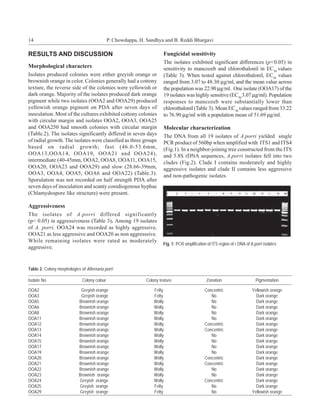
(Table.2). The isolates significantly differed in seven days            The DNA from all 19 isolates of A.porri yielded single
of radial growth. The isolates were classified as three groups          PCR product of 560bp when amplified with ITS1 and ITS4
based on radial growth; fast (46.0-53.6mm,                              (Fig.1). In a neighbor-joining tree constructed from the ITS
OOA13,OOA14, OOA19, OOA21 and OOA24),                                   and 5.8S rDNA sequences, A.porri isolates fell into two
intermediate (40-45mm, OOA2, OOA8, OOA11, OOA15,                        clades (Fig.2). Clade I contains moderately and highly
OOA20, OOA23 and OOA29) and slow (28.66-39mm,                           aggressive isolates and clade II contains less aggressive
OOA3, OOA4, OOA5, OOA6 and OOA22) (Table.3).                            and non-pathogenic isolates.
Sporulation was not recorded on half strength PDA after
seven days of inoculation and scanty conidiogenous hyphae
(Chlamydospore like structure) were present.

Aggressiveness
The isolates of A.porri differed significantly
(p< 0.05) in aggressiveness (Table 3). Among 19 isolates
of A. porri, OOA24 was recorded as highly aggressive,
OOA21 as less aggressive and OOA20 as non aggresssive.
While remaining isolates were rated as moderately
                                                                        Fig. 1: PCR amplification of ITS region of r DNA of A.porri isolates
aggressive.


Table 2: Colony morphologies of Alternaria porri

Isolate No                    Colony colour                    Colony texture                    Zonation                      Pigmentation

OOA2                         Greyish orange                        Felty                        Concentric                   Yellowish orange
OOA3                         Greyish orange                        Felty                           No                          Dark orange
OOA5                        Brownish orange                        Wolly                           No                          Dark orange
OOA6                        Brownish orange                        Wolly                           No                          Dark orange
OOA8                        Brownish orange                        Wolly                           No                          Dark orange
OOA11                       Brownish orange                        Wolly                           No                          Dark orange
OOA12                       Brownish orange                        Wolly                        Concentric                     Dark orange
OOA13                       Brownish orange                        Wolly                        Concentric                     Dark orange
OOA14                       Brownish orange                        Wolly                           No                          Dark orange
OOA15                       Brownish orange                        Wolly                           No                          Dark orange
OOA17                       Brownish orange                        Wolly                           No                          Dark orange
OOA19                       Brownish orange                        Wolly                           No                          Dark orange
OOA20                       Brownish orange                        Wolly                        Concentric                     Dark orange
OOA21                       Brownish orange                        Wolly                        Concentric                     Dark orange
OOA22                       Brownish orange                        Wolly                           No                          Dark orange
OOA23                       Brownish orange                        Wolly                           No                          Dark orange
OOA24                        Greyish orange                        Wolly                        Concentric                     Dark orange
OOA25                        Greyish orange                        Felty                           No                          Dark orange
OOA29                        Greyish orange                        Felty                           No                        Yellowish orange
Diversity analysis of Alternaria porri (Ellis) Cif- causal organism of purple leaf blotch of onion                            15

Table 3: Colony growth, aggressiveness and fungicidal sensitivity of Alternaria porri isolates

Isolates               Growth rate(mm)¹                    Aggressiveness (mm2)²                                  EC50 Values

                                                                                                 Chlorothalonil                 Mancozeb

OOA2                      52.0±1.7                           327.2±50.56                              34.2                         44.1
OOA3                      32.0±5.2                           279.5±65.7                               13.7                         57.6
OOA5                      38.0±0.0                           315.5±45.42                              30.9                         76.9
OOA6                      28.6±4.0                           319.2±89.56                              13.7                         43.7
OOA8                      43.3±1.5                           296.6±59.05                              15.0                         48.9
OOA11                     41.6±4.9                           276.9±63.33                              20.9                         72.5
OOA12                     36.3±4.7                           155.0±50.4                               15.0                         59.4
OOA13                     48.3±1.5                           248.6±57.0                               21.5                         43.5
OOA14                     46.0±1.7                           316.25±39.4                              48.3                         39.9
OOA15                     40.0±2.0                           248.2±68.3                               10.6                         68.8
OOA17                     33.33±1.1                          283.7±83.2                                3.07                        33.2
OOA19                     53.33±1.5                          187.2±48.7                               23.2                         47.6
OOA20                     43.3±4.1                           0                                        17.8                         62.2
OOA21                     53.6±2.52                          122.4±54.97                              31.4                         36.3
OOA22                     39.0±6.5                           297.6±69.8                               11.0                         51.6
OOA23                     40.0±5.0                           267.7±66.0                               26.7                         40.5
OOA24                     52.0±3.4                           384.3±58.4                               35.9                         49.6
OOA25                     34.6±1.53                          197.0±54.57                              24.3                         47.5
OOA29                     40.0±0.0                           227.0±44.8                               17.8                         60.7
CD5%                      8.11                               101.89

¹Mean of three replications± standard deviation. Each replication consists of 9 Petri plates ²Mean of three replications± standard deviation.
Each replication consists of 12 detached leaf lets

                                                                               Development of resistance and reduced sensitivity to
                                                                               fungicides and increased aggressiveness within populations
                                                                               of Alternaria spp are emerging as serious problems for
                                                                               disease management (Holm et al., 2003; Naresh and
                                                                               Sangwan, 2003; Gupta et al., 2004: Pasche et al., 2004;
                                                                               Thrall et al., 2005; Rogers and Stevenson, 2010). For
                                                                               effective management of PLB of onion, a clear
                                                                               understanding of fungicide sensitivity and aggressiveness
                                                                               in populations of A. porri derived from different crop
                                                                               backgrounds is required. We assumed that change in
                                                                               cropping patterns, introduction of new crop varieties and
                                                                               repeated applications of protectant fungicides may cause
                                                                               change in structure of A. porri populations. In present study,
                                                                               an attempt was made to identify and characterize variability
                                                                               among isolates of A. porri obtained from different
                                                                               geographic regions of onion production in Karnataka state
                                                                               using biologically relevant phenotypic criteria such as
                                                                               aggressiveness and in vitro fungicidal response and
                                                                               genotypic printing using nucleotide sequences of ITS region
                                                                               of rDNA. Results obtained in this study showed that there
                                                                               were differences in the degree of sensitivity to mancozeb
                                                                               and chlorothalonil within isolates of A. porri. These findings
                                                                               are in agreement with results obtained for A. solani, where
                                                                               distinctions in sensitivity to mancozeb and chlorothalonil
                                                                               were apparent (Holm et al., 2003). Similarly, differences
Fig. 2: Internal transcribed spacer (ITS) and 5.8S sequence-based tree gen-    in sensitivity to azoxystrobin, boscalid and chlorothalonil
erated using neighbor-joining analysis                                         within populations of A. dauci have been reported (Rogers
16                                   P. Chowdappa, H. Sandhya and B. Reddi Bhargavi

and Stevenson, 2010). These studies indicates that diversity     polymorphic DNA have been used as genetic markers for
in isolate sensitivity to fungicides is evident in Alternaria    differentiation of fungicidal sensitive and resistant isolates
spp. and this is possible due to selection pressure from         of fungal pathogens (Gac et al.,1996; McKay, et al.,1998;
repeated fungicide applications (Eckert,1988). Despite           McKay et al.,1999; Suwan et al., 2012). In this study, ITS
differences in sensitivity to mancozeb and chlorothalonil        sequences divided A. porri isolates into two groups, which
within populations of A. porri, the response to fungicides       is not correlated with fungicidal sensitivity, corresponded
appears within the range expected for control. Resistance        to pathological groups; moderately and highly aggressive
build up is not apparent within populations of A. porri to       isolates formed in one cluster and other cluster contained
both fungicides used in the present study due to their multi     less aggressive and non- aggressive isolates. However,
site inhibiting mechanisms and development of resistance         multilocus gene typing is required to map the aggressiveness
to these class of fungicides is very low (Lorenz, 1988).         and fungicidal sensitivity in addition to ITS sequences used
However, decreased sensitivity to mancozeb and                   in this study.
chlorothalonil among USA populations of A. solani (Holm
                                                                 Thus, the diversity in A. porri isolates exhibiting different
et al., 2003) and Mexican populations of Phytophthora
infestans (Sujkowski et al., 1995) have been recorded.           levels of aggressiveness identified in this study will be of
Isolates of A. porri in the present start also showed            great interest for the selection of onion genotypes showing
variation in sensitivity to the fungicides and the EC50 values   different levels of resistance to PLB. A moderately aggressive
revealed that chlorothalonil was more effective than             isolate may be used to locate new sources of partial resistance,
mancozeb.                                                        while highly aggressive isolate would be ideal for the final
                                                                 evaluation of hybrids carrying several resistance factors.
Alternative to chemical control, the use of resistant onion
cultivars is an efficient method of PLB management.              ACKNOWLEDGEMENTS
Different sources of resistance to A. porri have been
                                                                 We are thankful to Indian Council of Agricultural Research,
reported in onion. Among the genotypes and varieties that
                                                                 New Delhi, for financial support in the form of out reach
exhibit resistance to PLB are IC48059, IC48179, IC48025,
                                                                 programme on “Diagnosis and Management of Leaf Spot
ALR PBR 322, 324, 302, 310, 298, 287 Agrifound Light
                                                                 Diseases of Field and Horticultural Crops”. We are also
Red, Agrifound Dark Red, Red Glo VLPiyaz (Sugha et al.,
                                                                 highly grateful to Dr. H.P. Singh Deputy Director General
1992; Sharma, 1997; Mani et al., 1999). However, as with
                                                                 (Horticulture), ICAR, New Delhi, who mooted the concept
fungicides, resistance can be overcome by the development
of new pathogenic genotypes in A. porri. Therefore, it is        of outreach programed on leaf spot diseases.
necessary to search for a sustainable method for disease
management, which necessitates a better understanding of         REFERENCES
the genetic variability in populations of A. porri. By           Aradhya, M. K. and Chan, H. M. 2001. Genetic variability in the pistachio
understanding population genetic structure, adequate                     late blight fungus, Alternaria alternata. Mycol. Res., 105:300-306.
                                                                 Aveling, T., Aveling S., Snyman H.G. and Naude,S.P. 1993. Evaluation of
decisions can be made about disease management with
                                                                         seed treatment for reducing Alternaria porri and Stemphylium
fungicides and breeding programs. The pathological assays                vesicarium on onion seed. Plant Disease, 77:10. 1009–1011.
indicated that most of the isolates of A.porri are highly        Aveling, T., Aveling S., Snyman H.G. and Rijkenberg, F.H.J. 1994.
aggressive and few are less aggressive or non-pathogenic                 Morphology of infection of onion leaves by Alternaria porri. Can. J.
on Arka kalyan. Similar results have been reported for A.                Bot., 72:1164–1170.
brassicicola, where distinctions in isolate aggressiveness       Awad, M.A., El-Shenawy, Z., Omran A.F. and Shatla M.N. 1978. Cultural
                                                                         practices in relation to PLB disease of onion. Scientia Horticulturae,
were apparent on Cakile maritima (Thrall et al., 2005).                  9:237-243.
Rotem (1966) reported existence of pathotypes with varying       Brar, S.S., Rewal, H.S. and Singh, H. 1990. Development of PLB of onion
aggressiveness within A. solani on potato. In addition,                  in relation to thrip injury. Plant Dis.Res., 5:33-135.
variability in aggressiveness within populations of A.           Cramer, C.S. 2000. Breeding and Genetics of Fusarium basal rot resistance
brassicae on mustard have been recorded (Gupta et al.,                   in onion. Euphytica, 115:159-166.
                                                                 Dhiman, J.S. and Chada, M.L. 1986. Studies on artificial creation on PLB
2004; Naresh and Sangwan, 2003).
                                                                         epiphytotics in onion for identifying source of resistance. Vegetable
Virulence and aggressiveness testing using a set of host                 Science, 13:293-299.
differentials and fungicidal sensitivity have been used to       Eckert, J.W.1988. Historical development of fungicide resistance in plant
                                                                         pathogens In:CJ.Delp(ed).Fungicide resistance in North America.
identify markers for genetic variation studies. These                    American Phytopathological Society, St. Paul, M.N. pp1-3.
techniques are labor-intensive, time-consuming and often         Everts, K.L. and Lacy, M.L. 1990. The influence of dew duration, relative
generates variable results that are influenced by the                    humidity, and leaf senescence on conidial formation and infection
environment and inoculation techniques. The analysis of                  of onion by Alternaria porri. Phytopathology, 80:1203-1207.
sequences of ITS and β-tubulin and random amplified              Fagan, H.J. 1988. Species and mating types of Phytophthora on cocoa in
Diversity analysis of Alternaria porri (Ellis) Cif- causal organism of purple leaf blotch of onion                                            17

        Jamaica and their effect on selected cocoa varieties. Trans. Brit.                   molecular characterization of Alternaria isolates associated with
        Mycol.Soc., 91:389-401.                                                              Alternaria late blight of pistachio. Phytopathology, 92:406-416.
Food and Agricultural Organization, 2008.www.fao.org                                Purseglove, J.W. 1972. Tropical crops: Monocotyledons. Longma. London.
Gupta, R.P. Srivastava, K.J., Pandey, U.B. and Midmore, D.J. 1994.                  Raeder, U. and Broda, P. 1985. Rapid preparation of DNA from filamentous
        Diseases and insect pests of onion in India. International Symposium                 fungi. Applied Microbiology, 1:17-20.
        on Alliums for the Tropics. Acta Horticulturae, 35:265-269.                 Remneva, Z.I., and Ivanyuk, V.G. 1968. Intraspecific heterogeneity of
Gupta, K., Saharan, G. S., Naresh, M., and Sangwan, M. S. 2004.                              Alternaria solani the causal agent of early blight of potato. Mikol.
        Identification of pathotypes of Alternaria brassicae from Indian                     Fitopatol. 202-209.
        mustard [Brassica juncea (L.) Czern. and Coss]. J. Mycol. Plant             Rogers, P. M. and Stevenson, W.R. 2010. Aggressiveness and fungicide
        Pathol. 34:15-19.                                                                    sensitivity of Alternaria dauci from cultivated carrot. Plant Disease,
Gac, M.L., Montfort, F., Cavelier, N. and Sailland, A. 1996. Comparative                     94:405-412.
        study of morphological, cultural and molecular markers for the              Rotem, J. 1966. Variability in Alternaria porri f. solani. Isr. J. Bot. 15:48-57.
        characterization of Pseudocercosporella herpotrichoides isolates.           Saitou, N., and Nei, M.1987. The neighbor-joining method: A new method
        European Journal of Plant Pathology, 102:325-337.                                    for reconstructing phylogenetic trees. Molecular Biology and
Holm, A.L., Rivera, V.V., Secor, G.A and Gudmestad, N.C. 2003. Temporal                      Evolution, 4:406-425
        sensitivity of Alternaria solani isolates to foliar fungicides. Am. J. of   Sharma, I.M.1997. Screening of onion varieties /lines against PLB caused
        Potato Res., 80:33-40.                                                               by Alternaria porri under field condition. Plant Disease Research,
Kumar, V., Haldar, S., Pandey, K.K., Singh, P.R., Singh, A.K. and Singh,                     12:60-61
        C.P. 2008. Cultural, morphological, pathogenic and molecular                Singh, Daljeet. Dhiman, J.S., Sidhu, A.S., Hari Singh, D. and Singh, H.
        variability amongst tomato isolates of Alternaria solani in India. World             1992. Current status of onions in India: strategies for disease
        J Microbiol Biotechnol, 24:1003-1009.                                                resistance breeding for sustained production. Onion Newsletter
Lorenz, G. 1988. Dicarboximide fungicides: History of resistance                             Tropics. 4:43-44.
        development and monitoring methods. In: CJ. Delp(ed), Fungicide
                                                                                    Sugha, S,K., Develash, R.K. and Tyagi, R.D.1992. Performance of onion
        Resistance in North America. American Phytopathological Society,
                                                                                             genotypes against PLB pathogen. South Ind.Hort., 40:297.
        St. Paul, MN.pp45-51.
                                                                                    Sujkowski, L.S., Fry, B.A., Power, R.J., Goodwin, S.B., Peever, T.A.,Hamlen,
Mani, V.P., Chauhan, V.S., Joshi, H.C. and Tandon, J.P. 1999. Exploiting
                                                                                             R.A and Fry, W.E.1995. Senstivities of Mexican isolates of
        gene effects for improving bulb yields in onion. Ind. J. genet. Pl.
                                                                                             Phytophthora infestans to chlorothalonil, cymoxanil amd metalaxyl.
        Breed., 59:511-514
                                                                                             Plant Disease, 79:1117-1120.
McKay G. J., Egan D., Morris E. and Brown A. E. 1998. Identification of
                                                                                    Suwan, N., Nuandee, N., Akimitsu, K. and Nalumpang, S. 2012. Analysis of
        benzimidazole resistance in Cladobotryum dendroides using a PCR-
                                                                                             β-tubulin gene from carbendazim resistant isolates of Cercospora
        based method. Mycol. Res., 102:671-676
                                                                                             lactucae-sativae on lettuce in Thailand ‘Journal of Agricultural
McKay G.J., Egan, D., Morris, E., Scott S, and Brown, A.E. 1999. Genetic
        and morphological characterization of Cladobotryum Species                           Technology, 8:711-723.
        causing cobweb disease of mushrooms Appl.Environ. Microbiol.,               Tamura, K., Nei, M., and Kumar, S. 2004. Prospects for inferring very large
        65:606-610.                                                                          phylogenies by using the neighbor-joining method. Proceedings of
Messiaen, C.M.1994. The Alliums. The Tropical Vegetable Garden:                              the National Academy of Sciences (USA), 01:1030-1035.
        Principles for improvement and increased production with                    Tamura, K., Dudley, J., Nei, M. and Kumar S. 2007. MEGA4: Molecular
        application to the main vegetable types. C.T.A. Macmillan. London.                   Evolutionary Genetics Analysis (MEGA) software version 4.0.
Naresh, M., and Sangwan, M. S. 2003. Morphological and pathological                          Molecular Biology and Evolution, 24:1596-1599.
        variations in rapeseed and mustard isolates of Alternaria brassicae.        Thrall, P.H., Barrett, L.G., Burdon, J.J. and Alexander, H.M. 2005. Variation
        Ind. Phytopathol., 56:188-190.                                                       in pathogen aggressiveness within meta population of Cakile
O’Donnell, K. 1993. Fusarium and its near relatives. Pages 225-236 in: The                   maritime-Alternaria brassicicola host pathogen association. Plant
        Fungal Holomorph:Mitotic, Meiotic, and Pleomorphic Speciation in                     Pathol., 54:265-274.
        Fungal Systematics. D. R. Reynolds and J. W. Taylor, (eds.) CAB             Van der Waals, J.E., Korsten, L. and Slippers, B. 2004. Genetic diversity
        International, Wallingford, U.K.                                                     among Alternaria solani isolates from potatoes in South Africa. Plant
Pasche, J.S., Wharam, C. M. and Gudmestad, N. C. 2004. Shift in sensitivity                  Disease, 88:959-964.
        of Alternaria solani in response to QoI fungicides. Plant Dis. (eds.),      Weir, T. L., Huff, D. R., Christ, B. J. and Romaine, C. P. 1998. RAPD-PCR
        88:181-187.                                                                          analysis of genetic variation among isolates of Alternaria solani and
Pryor, B.M. and Michailides, T.J. 2002. Morphological, pathogenic and                        Alternaria alternata from potato and tomato. Mycologia, 90:813-821.
18
International Journal of Innovative Horticulture. 1(1):18-23, 2012 Ram Kumar
                                           S. Rajan, L.P. Yadava and


Variation among guava (Psidium guajava L.) accessions in seed
hardness and its association with fruit characteristics

S. Rajan, L.P. Yadava and Ram Kumar
Central Institute for Subtropical Horticulture, Rehmankhera, Kakori, Lucknow – 226101, U.P., India
Corresponding author: srajanlko@gmail.com

ABSTRACT
Guava is an important tropical fruit crop with considerable economic potential but to further increase popularity and
demand, the soft seeded cultivars needs to be developed. Breeding for soft seeded cultivars is one of the major objectives
of guava breeding programmes but limited research on seed hardness and its association with other fruit characters has
been conducted. A study was carried out to determine the genotypic and phenotypic variation in and association among
the fruit traits of weight, height, diameter, firmness and the seed characters of weight and number of seeds per fruit, fruit
seed weight ratio, 100-seed weight and seed hardness. Trait values were estimated in 50 accessions grown under subtropical
conditions. High genotypic (GCV) and phenotypic (PCV) coefficients of variation were found in all the traits studied.
Estimates of heritability ranged from 0.499 (fruit firmness) to 0.988 (fruit seed weight ratio). All the traits except 100-
seed weight, showed almost similar magnitude of genetic advance, and exceptionally high genetic advance for fruit
weight, number of seeds per fruit and fruit: seed weight ratio. At genotypic and phenotypic levels, seed hardness was
significantly and positively correlated with 100-seed weight of the fruit and inversely with number of seeds fruit-1. In
path analysis, residual values at genotypic (0.076) and phenotypic (0.268) levels were fairly low and indicate that
variables included in this study had significant association with seed hardness. Correlation and path coefficient analysis
revealed that 100-seed weight was the most important character for realizing improvement in seed hardness.
Key words: Guava, Psidium guajava L., seed hardness, fruit quality, fruit traits correlation

INTRODUCTION                                                      pulp, or made into preserves, jam, jelly or paste. However,
Guava (Psidium guajava L.) of the Myrtle family                   high content of hard and large sized seeds reduce the fruit
(Myrtaceae), is one of the most important fruit tree crops        quality in most of the guava varieties (Negi and Rajan,
in the tropics and subtropics and is commercially cultivated      2007).
in more than 60 countries (Rajan et al., 2007). In India,         Seed content and hardness in guava are determinants of
guava is particularly important because of its excellent          fruit quality and vary with cultivar. There are some
nutritive value, wide adaptability and high productivity.         understandings that pink flesh colour may correlate with
Guava is an excellent source of Vitamin C and rich in             hardness of seeds but such correlations may not hold true
nutraceuticals (Wilson III, 1980; Jimenez-Escrig et al.,          for all the guava cultivars. Few studies have been conducted
2001). Area under this crop has increased in India over           on the variability in seed characteristics (Rajan et al., 2005).
time lot of variability is available due to propagation through   The high genetic coefficient of variation and heritability
seeds.                                                            estimates associated with greater genetic advance as percent
Fruits of the numerous guava varieties are extremely              of mean were recorded for pulp: seed weight ratio, 100-
variable in shape, size and other characteristics (Yadava         seed weight and number of seeds per fruit (Rajan et al.,
and Shanker, 2007). They may be globular, ovoid or                2005). However, information on these estimates in relation
pyriform and from 3 to 15 cm long. Skin may be greenish-          to seed hardness and their association with fruit characters
white, yellowish, or pink and in taste, varieties range from      is not available. Accordingly, in this study heritability,
sweet to tart, all with the characteristic musky flavour and      genetic advance, correlation and path coefficient are
odour of the guava more or less pronounced. Fruits also           evaluated with the objective of selecting the genotypes
vary in the thickness of the fleshy mesocarp and in some          comprising few and soft seeds. Path coefficient analysis
varieties it is extremely thin. Most varieties bear numerous      was done to ascertain the direct and indirect contribution
seeds embedded in the soft pulp at the center. Guava may          of fruit and seed characters towards seed hardness in guava
be eaten fresh, made into a juice or nectar containing fruit      genotypes.
Variation among guava (Psidium guajava L.) accession in seed hardness and its association with fruit characteristics 19

MATERIALS AND METHODS                                           for various characters were computed as per Burton and
                                                                De Vane (1953), and estimates of heritability (broad-sense)
Plant material                                                  and genetic advance (Johnson et al., 1955; Allard, 1960;
Fifty guava accessions available in the field gene bank         Hansen, 1963; Falconer, 1989) were calculated as follows:
(FGB) situated at the Central Institute for Subtropical
Horticulture, Lucknow, India (26.85 oN latitude and 80.90 oE                 ( Mg − Me)
                                                                    σg =
                                                                     2
longitude and altitude of 128 m from mean sea level) were                         r
evaluated for seed characters during 2007 and 2008. The
plants were maintained under uniform cultural conditions            σ 2 = σ g + σ e2
                                                                      p
                                                                            2

in the Indo-Gangatic plains. It has a subtropical climate
with cool winter, dry and hot summer and intense rainy              ó2e = Me
seasons. Three clonally multiplied trees of each accession
replicated in randomized complete block design, were used
                                                                                  σg
                                                                                   2
for collection of fruit samples. In each replication, seeds         GCV =              ×100
were extracted from random fruits collected from four                             X
directions and outer part of the tree canopy. Thus 12 fruits
of each accession and mean of four fruits per replication
was used for data analysis. Fruits were harvested at colour                       σ2
                                                                                       ×100
                                                                                   p
                                                                    PCV =
break stage of the exocarp and weighed individually. Seeds                        X
were extracted from individual fruit, cleaned and air-dried
for a week before their assessment.
                                                                             σg
                                                                              2

                                                                     hb2 =
Fruit and seed characters                                                    σ2
                                                                              p
Weight of fruit (FW) and seed weight per fruit (SWPF)
were determined with a digital balance (Mettler AJ 100)             GA = ih2 σp
and fruit: seed weight ratio (FSWR) was calculated.                 Where,
Diameter (FD) and height (FH) of fruit were measured at
maximum diameter with a standard calipers. 100-seed                 GCV = genotypic coefficient of variation
weight (100SW) was measured by weighing 100-seeds on                PCV = phenotypic coefficient of variation
electronic balance (Mettler AJ 100) with 0.0001g least
                                                                Mg = mean sum of square due to genotypes, Me = mean
count. Image analysis was performed for counting the seeds.
                                                                sum of square due to error, r = number of replications, GA
For each fruit sample, extracted seeds were spreaded on
                                                                = Genetic advance and X is the population mean.
black paper without touching each other. Seeds were
digitally photographed and saved in TIFF format for image        h2b is heritability in broad sense, ó2g, ó2p and ó2e are the
analysis. Number of seeds per fruit (NSPF) were counted         genotypic, phenotypic and environmental variance,
with the help of JavaScript image analysis software, ImageJ     respectively, and i is the standardized selection differential
(http://rsb.info.nih.gov/ij/index.html), using digital image.   at selection intensity of 5%.
Seed hardness (SH) and fruit firmness (FF) were measured
                                                                 Genetic (rg) and phenotypic (rF) correlations between two
by Mecmesin Basic Force Gauge (BFG 1000N, England)
                                                                x and y traits were analyzed from the mean value of various
using an 8 mm probe and expressed as kg cm-2. Maximum
                                                                accessions using the procedure outlined by Kempthorne
fracture force required to crack a seed was recorded on 20
                                                                (1973) and Miller et al. (1958) as follows:
seeds per fruit. A thin slice of skin (about 2-mm thick and
slightly larger diameter than the probe) was removed from
the position with largest fruit diameter before the firmness
measurement.

Biometrical analysis
The experimental data was analysed in Standard
Randomized Complete Block with three replications. Mean
sum of squares were calculated using ANOVA over three
replications for genotypic and phenotypic coefficient of
variation. Genotypic and phenotypic coefficient of variation    Path coefficients between seed hardness and all possible
20                                             S. Rajan, L.P. Yadava and Ram Kumar

combinations of variables were calculated as per method               the structural, physiological, biochemical characteristics of
of Dewey and Lu (1959). Path analysis is a special type of            the living cells and change with the ripening of the fruit
multivariate analysis, which enables us to provide so-called          (Harker et al., 1997).
correlation analysis according to the following equation:
                                                                      Most of the traits had high heritability estimates, ranging
                                                                      from 0.499 to 0.988 (Table 1). High broad sense heritability
                                                                      for all the traits is another significant indicator that may be
                                                                      used as selection criteria even in variable environmental
                                                                      conditions (Mahon, 1983 and Messina, 1993). A wide range
                                                                      of values from 0.61 to 365.89 was observed for genetic
Where: ryi is correlation coefficient between the i-th causal
                                                                      advance. All the traits, except 100-seed weight showed
variable (Xi) and effect variable (y), rii’ is simple correlation
                                                                      almost similar magnitude of genetic advance, ignoring the
coefficient between the i-th and the i’-th causal variable,
                                                                      exceptionally high for fruit weight, number of seeds per
pyi is path coefficient (direct effect) of the i-th causal variable
                                                                      fruit and fruit seed weight ratio. Thus high genetic
(Xi), rii pyi is called indirect effect of the i-th causal variable
                                                                      coefficient of variation (GCV) and heritability estimates
via the i’-th causal variable.
                                                                      indicated that these three characters had additive gene effect
We made path coefficient analysis between seed hardness               and therefore effective selection can be made for these
(effect variable) and eight causal variables: fruit weight            characters.
(FW), fruit height (FH), fruit diameter (FD), fruit firmness
                                                                      As far as interrelationship is concerned, seed hardness
(FF), seed weight per fruit (SWPF), number of seed per
                                                                      showed positive correlations with 100-seed weight but was
fruit (NSPF), fruit seed weight ratio (FSWR), 100-seed
                                                                      negatively associated with fruit firmness, number of seeds
weight (100SW) using data from both study years. They
                                                                      per fruit at both genotypic and phenotypic levels (Table 2).
were based on genotypic and phenotypic correlation
                                                                      Fruit weight showed positive genetic and phenotypic
coefficients for means of the full-sib population.
                                                                      correlations with fruit height and diameter and with weight
                                                                      and number of seeds per fruit. Height and diameter of the
RESULTS AND DISCUSSION
                                                                      fruit exhibited significant positive correlation with weight
Fruit and seed characters viz., fruit weight, height, diameter,       and number of seeds per fruit. Fruit firmness had positive
firmness and seed weight and number of seeds per fruit,               correlation with number of seeds per fruit and negative
fruit seed weight ratio, 100-seed weight and seed hardness            association with seed hardness. Seed weight per fruit
differed significantly among the accessions (Table I).                showed significant positive relationship with number of
High genotypic (GCV) and phenotypic (PCV) coefficient                 seeds per fruit and negative association with fruit: seed
of variation estimates were recorded for all the traits.              weight ratio and 100-seed weight. Number of seeds per
However, the genotypic coefficient of variation (GCV) was             fruit also showed negative association with 100-seed
maximum for fruit: seed weight ratio (230.79%) followed               weight. Correlations among different traits can be exploited
by fruit weight (53.78%) number of seeds per fruit                    to select a desired plant type.
(49.37%), seed weight per fruit (46.27%), 100-seed weight             However, these correlation coefficient values sometimes
(30.00%) seed hardness (25.04%), fruit firmness (19.87%),             do not serve as a reliable tool thus selections based on these
fruit height (19.21%) and diameter (18.68%). The                      estimates give meager or no response to selection. Because
characters showing high GCV indicates that they were                  a trait showing positive association may not have direct
highly influenced by the genotypic components. The                    effect on seed hardness but may contribute to seed hardness
estimates of phenotypic coefficient of variation (PCV)                indirectly via other traits. The genotypic (0.076) residual
ranged from 20.01 (average fruit diameter) to 232.14%                 value was fairly low, which apparently showed that variables
(fruit: seed weight ratio). Nevertheless, the difference              included in this study had significant contribution. At
between GCV and PCV was small for all the traits except               phenotypic level, high residual value (0.268) indicated the
fruit firmness, indicating that genetic factors rather than           limitation of traits included in the study, which need to be
the environment exerted the major influence on the variation          supplemented with more morphological characters to
and these traits are valuable for crop improvement.                   illustrate the whole range of variation. Considering such
Environmental features such as storage temperature as well            opinion, direct positive effects of fruit height, number of
as stage of maturity are other important factors influencing          seeds per fruit, seed weight per fruit and 100-seed weight
fruit firmness (Thaipong and Boonprakob, 2005). Such                  and negative direct effects of weight, diameter and firmness
influences indicated the wide gap between GCV and PCV                 of fruit and fruit seed weight ratio were observed on seed
for fruit firmness. Textural attributes of fruits are related to      hardness (Table 3). The study revealed that the positive
Variation among guava (Psidium guajava L.) accession in seed hardness and its association with fruit characteristics 21

Table 1: Estimates of genotypic (GCV) and phenotypic (PCV) coefficients of variation, heritability (h2b) and genetic advance as percent of mean

Characters                             GCV(%)                 PCV(%)                         (h2b)   Genetic advance as percent of mean                F$

Fruit weight                           53.78                   57.23                        0.883                   162.57                           23.63**
Fruit height                           19.21                   20.78                        0.854                     2.33                           18.54**
Fruit diameter                         18.68                   20.01                        0.871                     2.26                           21.31**
Fruit firmness                         19.87                   28.11                        0.499                     1.05                           03.99**
Seed weight per fruit                  46.27                   50.77                        0.831                     2.79                           15.72**
Number of seed per fruit               49.37                   53.67                        0.846                   306.05                          255.98**
Fruit seed weight ratio               230.79                  232.14                        0.988                   365.89                           17.52**
100-seed weight                        30.00                   33.65                        0.795                     0.61                           12.62**
Seed hardness                          25.04                   27.55                        0.826                     5.53                           15.20**

**= Significant at p≤0.01.
$
  Calculated “F” value from analysis of variance

Table 2: Genotypic (G) and Phenotypic (P) correlation coefficient among 8 characters in 50 guava genotypes

Characters          FW               FH              FD                FF               SWPF            FSWR          NSPF               100SW          SH

FW                                 0.719**         0.893**       -0.019                 0.727**         -0.027        0.482**            -0.049       -0.103
FH                 0.722**                         0.642**        0.016                 0.434**         -0.026        0.233              -0.034        0.018
FD                 0.890**         0.641**                        0.198                 0.773**          0.004        0.613**            -0.232       -0.301**
FF                 0.015           0.052            0.137                               0.204            0.172        0.334*             -0.426**     -0.546**
SWPF               0.678**         0.401**          0.712**       0.183                                 -0.344*       0.892**            -0.378**     -0.270*
FSWR              -0.017          -0.013            0.015         0.108                 -0.322*                      -0.344*              0.422**     -0.005
NSPF               0.440**         0.218            0.556**       0.248                  0.859**        -0.324*                          -0.667**     -0.551**
100SW             -0.004           0.004           -0.166        -0.263*                -0.280*          0.395**     -0.617**                          0.856**
SH                -0.032           0.049           -0.206*       -0.338**               -0.176          -0.003       -0.464**            0.775**

*= Significant at p≤0.05, **= Significant at p≤0.01
Above diagonal values represent genotypic correlation coefficient whereas below diagonal show phenotypic correlation coefficients
FW= fruit weight, FH= fruit height, FD= fruit diameter, FF= fruit firmness, SWPF= seed weight per fruit, FSWR= fruit: seed weight ratio, NSPF= number of
seed per fruit, 100SW= 100-seed weight, SH= seed hardness, G= genotypic correlation, P= phenotypic correlation

Table 3: Path coefficient values estimated for seed hardness and other characters

Pathways of associations                                                    Genotypic                                        Phenotypic

Seed hardness vs. fruit weight
Direct effect                                                                -0.283                                             -0.073
Indirect effect via fruit height                                              0.159                                              0.114
Indirect effect via fruit diameter                                           -0.032                                             -0.083
Indirect effect via fruit firmness                                            0.001                                             -0.001
Indirect effect via seed weight per fruit                                     0.041                                             -0.051
Indirect effect via fruit seed weight ratio                                   0.011                                              0.006
Indirect effect via number of seeds per fruit                                 0.052                                              0.069
Indirect effect via 100-seed weight                                          -0.052                                             -0.004
Correlation, r19                                                             -0.103                                             -0.032
Seed hardness vs. fruit height
Direct effect                                                                 0.221                                              0.158
Indirect effect via fruit weight                                             -0.203                                             -0.053
Indirect effect via fruit diameter                                           -0.023                                             -0.060
Indirect effect via fruit firmness                                           -0.001                                             -0.004
Indirect effect via seed weight per fruit                                     0.025                                             -0.030
Indirect effect via fruit seed weight ratio                                   0.010                                              0.004
Indirect effect via number of seeds per fruit                                 0.025                                              0.029
Indirect effect via 100-seed weight                                          -0.036                                              0.003
Correlation, r29                                                              0.018                                              0.049
Seed hardness vs. fruit diameter
                                                                                                                                                        Contd.
22                                                    S. Rajan, L.P. Yadava and Ram Kumar

Pathways of associations                                            Genotypic               Phenotypic
Direct effect                                                        -0.036                   -0.093
Indirect effect via fruit weight                                     -0.253                   -0.065
Indirect effect via fruit height                                      0.142                    0.102
Indirect effect via fruit firmness                                   -0.015                   -0.009
Indirect effect via seed weight per fruit                             0.044                   -0.054
Indirect effect via fruit seed weight ratio                          -0.001                   -0.005
Indirect effect via number of seeds per fruit                         0.066                    0.075
Indirect effect via 100-seed weight                                  -0.247                   -0.156
Correlation, r39                                                     -0.301**                 -0.206*
Seed hardness vs. fruit firmness
Direct effect                                                        -0.078                   -0.068
Indirect effect via fruit weight                                      0.005                   -0.001
Indirect effect via fruit height                                      0.003                    0.008
Indirect effect via fruit diameter                                   -0.007                   -0.013
Indirect effect via seed weight per fruit                             0.012                   -0.014
Indirect effect via fruit seed weight ratio                          -0.066                   -0.037
Indirect effect via number of seed per fruit                          0.036                    0.034
Indirect effect via 100-seed weight                                  -0.452                   -0.247
Correlation, r49                                                     -0.546**                 -0.338**
Seed hardness vs. seed weight per fruit
Direct effect                                                         0.057                   -0.075
Indirect effect via fruit weight                                     -0.206                   -0.049
Indirect effect via fruit height                                      0.096                    0.064
Indirect effect via fruit diameter                                   -0.028                   -0.066
Indirect effect via fruit firmness                                   -0.016                   -0.012
Indirect effect via fruit seed weight ratio                           0.133                    0.111
Indirect effect via number of seed per fruit                          0.096                    0.116
Indirect effect via 100-seed weight                                  -0.402                   -0.263
Correlation, r59                                                     -0.270*                  -0.176
Seed hardness vs. fruit seed weight ratio
Direct effect                                                        -0.386                   -0.344
Indirect effect via fruit weight                                      0.008                    0.001
Indirect effect via fruit height                                     -0.006                   -0.002
Indirect effect via fruit diameter                                    0.000                   -0.001
Indirect effect via fruit firmness                                   -0.013                   -0.007
Indirect effect via seed weight per fruit                            -0.020                    0.024
Indirect effect via number of seed per fruit                         -0.037                   -0.044
Indirect effect via 100-seed weight                                   0.447                    0.371
Correlation, r69                                                     -0.005                   -0.003
Seed hardness vs. number of seed per fruit
Direct effect                                                         0.107                    0.135
Indirect effect via fruit weight                                     -0.136                   -0.032
Indirect effect via fruit height                                      0.052                    0.034
Indirect effect via fruit diameter                                   -0.022                   -0.052
Indirect effect via fruit firmness                                   -0.026                   -0.017
Indirect effect via seed weight per fruit                             0.051                   -0.065
Indirect effect via fruit seed weight ratio                           0.133                    0.112
Indirect effect via 100-seed weight                                  -0.709                   -0.579
Correlation, r79                                                     -0.551**                 -0.464**
Seed hardness vs. 100-seed weight
Direct effect                                                         1.063                    0.939
Indirect effect via fruit weight                                      0.014                    0.000
Indirect effect via fruit height                                     -0.007                    0.001
Indirect effect via fruit diameter                                    0.008                    0.015
Indirect effect via fruit firmness                                    0.033                    0.018
Indirect effect via seed weight per fruit                            -0.022                    0.021
Indirect effect via fruit seed weight ratio                          -0.163                   -0.136
Indirect effect via number of seed per fruit                         -0.071                   -0.083
Correlation, r89                                                      0.856**                  0.775**

*= Significant at p≤0.05, **= Significant at p≤0.01
Variation among guava (Psidium guajava L.) accession in seed hardness and its association with fruit characteristics 23

direct effects reflect the impact of number of seeds per fruit                Dewey, D.R. and Lu, K.H. 1959. A correlation and path coefficient analysis
on seed hardness as showed significantly negative                                      of components of crested wheat grass seed production. Agronomy
association with seed hardness. The 100-seed weight                                    Journal, 51:515-518.
                                                                              Falconer, D.S. 1989. Introduction to quantitative genetics. John Wiley &
exhibited maximum positive direct effect on seed hardness.                             Sons, New York.
Such positive direct effect established the fact that 100-                    Gohil, S.N., Garad, B.V., Shirsath, H.K. and Palande, A.L. 2006. Study of
seed weight exhibit large seed in the fruit. Thus it reveals                           physical constituents in guava (Psidium guajava) under sub arid
                                                                                       zone of Maharashtra. Advances in Plant Sciences, 19:515-519.
that increase in 100-seed weight directly related to seed
                                                                              Hansen Berlin, W.D. 1963. Heritability statistical genetics and plant breeding.
hardness. Despite that boldness attributed to size and/or                              NAS-NRC Publication, Washington, USA.
specific gravity of the seed which reflects the hardness.                     Harker, F.R., Redgwell, R.J., Hallett, I.C. and Murray, S.H. 1997. Texture of
These findings confirmed the reports of Bisla and Daulta                               fresh fruit. Horticultural Review, 20:121-224.
(1987), Prajapati et al. (1996) and Pareek and Dhaka (2003),                   Jimenez-escrig, A., Rincon, M., Pulido, R. and Saura-Calixto, F. 2001.
regarding the direct and indirect effects of characters on                             Guava fruit (Psidium guajava L.) as a new source of antioxidant
fruit yield through path coefficient analysis in ber (Zizyphus                         dietary fibre. Journal of Agricultural Food Chemistry, 48: 5489-5493.
                                                                              Johnson, H.W., Robinson, H.F. and Comstock, R.E. 1955. Estimation of
spp.). However, 100-seed weight will be better parameters                              genetic and environmental variability in soybean. Agronomy Journal,
for correlating seed hardness. Contrary to the findings of                             47:314-318.
Gohil et al. (2006), our results indicates that pulp weight                   Kempthorne, O. 1973. An Introduction to Genetic Statistics. Iowa State
has weak relationship with seed hardness. Gohil et al.                                 University Press, Ames.
(2006) reported that pulp weight and seed weight had                          Mahon, J.D. 1983. Limitations to the use of physiological variability in plant
positive direct effects on seed hardness. Fruit size exhibited                         breeding. Cannadian Journal of Plant Science, 63:11-21.
                                                                              Messina, F.J. 1993. Heritabilty and evolvability of fitness components in
positive direct effects on pulp weight and seed weight in
                                                                                       Callosobruchus maculatus. Heredity, 71:623-629.
guava.                                                                        Miller, P.A., Williams, V.C., Robinson, H.P. and Comstock, R.C. 1958.
Thus it may be concluded that wide variation exist in seed                             Estimates of genotypic and phenotypic environmental variances
hardness associated with fruit and seed characteristics of                             and covariances in upland cottons and their implications in
                                                                                       selections. Agronomy Journal, 5:126-136.
guava. Heritability and genetic advance as percent of mean
                                                                              Negi, S.S. and Rajan, S. 2007. Improvement of guava through breeding.
for fruit: seed weight ratio, fruit weight, number of seeds                            Acta Horticulture, 735:31-37.
fruit-1, seed hardness and 100-seed weight indicated scope                    Pareek, S. and Dhaka, R.S. 2003. Correlation and path coefficient analysis
of effective selections. Correlation and path coefficient                              of yield attributes in ber (Zizyphus spp.) Journal of Applied
analysis revealed that 100-seed weight was the most                                    Horticulture, 5:42-43.
important character for realizing improvement for seed                        Prajapati, B.H., Goswami, D.G. and Prajapati, M.R. 1996. Cause and effect
hardness in guava genotypes.                                                           analysis for fruit yield in ber. Gujarat Agriculture University Research
                                                                                       Journal, 21(2):76-79.
                                                                              Rajan, S., Yadava, L.P., Kumar, R. and Saxena, S.K. 2005. Selection
ACKNOWLEDGEMENTS                                                                       possibilities for seed content– A determinant of fresh fruit quality in
The authors express their thanks to the Director, Central                              guava (Psidium guajava L.). Journal of Applied Horticulture,
Institute for Subtropical Horticulture, Lucknow for                                    7(2): 52-54.
                                                                              Rajan, S., Yadava, L.P., Kumar, R. and Saxena, S.K. 2007. GIS based
providing facilities.
                                                                                       diversity analysis of guava growing distribution in Uttar Pradesh.
                                                                                       Acta Horticulture, 735:109-113.
REFERENCES                                                                    Thaipong, K. and Boonprakob, U. 2005. Genetic and environmental variance
Allard, R.W. 1960. Principles of plant breeding. John Wiley Inc., London,              components in guava fruit qualities. Scientia Horticulturae,
         UK.                                                                           104: 37-47.
Bisla, S.S. and Daulta, B.S. 1987. Correlation and path analysis studies on   Wilson III, C.W. 1980. Guava. In: Tropical and Subtropical Fruits (Nagy, S.
         fruit and seed characters in ber. Agriculture Science Digest,                 and Shaw, P. E., Eds). The AVI Publishing Company, Inc. Westport,
         7: 170-172.                                                                   Connecticut, USA, 279-299.
Burton, G.W. and De Vane, F.H. 1953. Estimating heritability in tall fescue   Yadava, L.P. and Shanker, G. 2007. Exploiting genetic diversity in guava
         (Festuea arundianacea) from replicated clonal material. Agronomy              (Psidium guajava L.) from Allahabad and surrounding areas. Plant
         Journal, 45:478-481.                                                          Genetic Resources Newsletter, 149:14-16.
24
International Journal of Innovative Horticulture. 1(1):24-32, and K.L Chadha
                                               Babita Singh 2012


Evaluation of critical limits and development of leaf nutrient standards
in litchi (Litchi chinensis Sonn.)

Babita Singh1 and K.L. Chadha
Division of Fruits and Horticultural Technology, Indian Agricultural Research Institute, N. Delhi 110012
1
Present address: Amity Institute of Horticulture Studies and Research, Amity University Noida, Uttar Pradesh
Corresponding author: drbabita9@gmail.com

ABSTRACT
An experiment was conducted to evaluate existing critical limits and develop leaf nutrient standards in litchi. Thirty
orchards with 20 ±2 years old trees planted with the cultivar Shahi (15 orchards) and China (15 orchards) in different
districts of Bihar and Jharkhand, India were selected for the study. In order to develop soil and leaf nutrient standard,
relations were exhibited between leaf nutrients content and yield. There was a little difference in values of leaf
nutrient among cultivars Shahi and China, but the differences were not enough to suggest that different standards
are required for different cultivars as the differences were due to nutrient uptake and not due to requirements. Thus,
standard ranges have to allow tolerance to varietal variability. Leaf nutrient standards in litchi have been developed
for the first time in India and would be used as a guide for litchi orchards. Among the nutrients N, P, Ca, Mg, Zn, Fe,
B appeared to be more essential, which could be monitored, based on the leaf nutrient content. However, the standard
would need refinement based on response to applied fertilizer. The critical value for the nutrients for leaf nutrient
standard were N-1.75%, P-0.17%, K-0.80%, S-0.25%, Ca-0.90%, Mg-0.60%, Fe-100 ppm, Mn-120 ppm, Zn-28 ppm,
Cu-30 ppm, B-29 ppm.
Key words: Litchi, leaf nutrient standard, soil nutrient standard, yield, macronutrient, micronutrient, critical limits.


INTRODUCTION                                                     MATERIALS AND METHODS
Litchi (Litchi chinensis Sonn.), is an important fruit crop      The study was conducted on 20 ±2 years old trees of cv.
of India, has gained its importance globally due to its          Shahi and China grown in different districts of Bihar and
appearance, taste and quality. Commercial industries have        Jharkhand. A total of 30 orchards planted with the cultivar
developed in several countries like Taiwan, Thailand, India,     Shahi (15 orchards) and China (15 orchards) were selected
South Africa and Australia (Menzel and Simpson, 1987).           in different districts of Bihar and Jharkhand, for the study.
In India, its commercial cultivation is done in Bihar,           All these orchards were planted in square system of planting
Jharkhand, West Bengal, Uttaranchal and some part of north       at the spacing of 8-8.5 m. Package of practices, with respect
India out of which more than 56 percent production of litchi     to nutrition varied from orchard to orchard. To assess the
comes from Bihar and Jharkhand states of the total               leaf nutrient status the autumn (September) flush was
production of litchi in India. Therefore, the study was          selected as it was the most fruitful of the flushes (Kotur
conducted in these two states to evaluate existing critical      and Singh, 1993; Singh et al., 2010b). In order to asses the
limits of leaf nutrient standards in Litchi. Balanced and        variability in litchi orchards with respect to soil
adequate nutrition is essential for the plant growth and yield   characteristics and also quality of fruits produced, soil
to their maximum potential. No universal nutrition program       samples collected from different litchi orchards at the depth
seems to be available for litchi, and poor nutrition is likely   of 15-30 cms were analysed for pH, Electrical Conductivity
to be one of the major factors contributing to fluctuating       (EC), organic carbon (OC), P, K, Ca, Mg, Fe, Mn, Zn and
yields (Menzel and Simpson, 1987). Therefore, orchards           Cu content. While for the leaf samples, second pair of
were surveyed and thirty orchards were selected in these         leaflets from tip of the terminal, 6-7 months old, from all
two states which had 20 ±2 years old trees of cv. Shahi and      directions and at mid height (6-7ft.) of the tree (Singh and
China.                                                           Chadha, 2009) which were 40 in number were collected
Evaluation of critical limits and development of leaf nutrient standards in litchi (Litchi chinensis Sonn)                           25

from ten healthy trees of each orchard and were marked.                        2001. pH of soil directly or indirectly influence availability
The leaves collected from all the ten trees were pooled to                     of various nutrients which ultimately influence yield and
get representative sample of an orchard. These samples were                    quality. OC content in the soil was related with the age of
decontaminated and then dried at 60 ± 1oC in hot air oven                      orchards which indicated that leaf residues which are more
till constant weight. Total nitrogen was analysed by                           in older orchards had influence on soil OC content. Nutrient
Kjeltech-2300 auto analyzer using 40% NaOH, 1% boric                           K content of the soil was higher in soils of Jharkhand when
acid and 0.1 N HCL. Samples were wet digested with diacid                      compared to Bihar, it increased as the pH decrease upto
mixture of nitric acid and perchloric acid in the ratio of                     the pH value 5.0 and continued to decrease above 7.0 pH,
9:4. Vanado-molybdate colour reaction method was used                          this confirms the findings of Menzel and Kirkby, 1979. Soil
for estimation of phosphorus using spectrophotometer.                          nutrient P and S content was not dependent on the
Potassium content was estimated using flame photometer.                        geographic location of the soil type, and varied from orchard
To determine sulphur content Turbid biometric method was                       to orchard. Soil Ca content was highly variable among the
used using Spectrophotometer, while Ca, Mg, Fe, Mn, Zn                         orchards but higher Ca content was observed in litchi
and Cu was determined using Atomic Absorption                                  orchards of Bihar which has been considered to be
Spectrophotometer (AAS).                                                       conducive for better growth and yield and lime application
                                                                               is essential in soils with low Ca content (Singh and Babita,
RESULTS AND DISCUSSION                                                         2002). Soil Mg, Fe, Mn, Zn content could not establish
The soil and leaf samples of the different orchard selected                    any definite trend due to the geographical location of the
for the study from both the states were analysed. The soil                     soil.
samples at different depths were examined for pH, EC, OC,
P, K, S, Ca, Mg, Fe, Mn, Zn and Cu content for all the                         Variation in yield and quality
orchards of cultivars Shahi and China (Table 1). The yield                     Fruit yield, in terms of weight per plant varied from orchards
and quality of fruits and physical qualities of different                      to orchards for both the cultivars. Variation could be
orchards for cultivar Shahi and China were also assessed                       attributed to the difference in nutritional case of litchi plants
(Table 2). Similarly, even the leaf samples were analysed                      (Rao et al., 1985). Since soils of orchards varied
for N, P, K, S, Ca, Mg, Fe, Mn, Zn and Cu content for                          significantly for soil pH, EC and nutrient content, yield
cultivars Shahi (Table 3) and China (Table 4).                                 variation was noticed which was reflected in leaf nutrient
                                                                               content also. Orchards in alluvial soil of Bihar had higher
Table 1: Characteristics of soils of Litchi orchards for cultivars Shahi and
China                                                                          yield, and soil pH was found to influence the production
                                                                               (Kanwar, 2002). Therefore, variability in yield, among the
                               Shahi                        China              orchards for both the cultivars could be attributed to soil
                                                                               condition and management practices. Fruit weight varied
pH                           5.06 – 8.94                 4.82 – 8.63
                                                                               significantly among the orchards, mean value of average
EC     (dsm -1)              0.04 – 0.47                 0.05 – 0.17
OC    (%)                    0.18 – 0.41                 0.18 – 0.50           fruit weight varied from 18.19 to 23.10 g and 17.35-19.85 g
P     (ppm)                  0.51 – 3.25                 0.60 – 2.00           for cultivar Shahi and China respectively. There was a wide
K    (ppm)                 41.00 – 99.51                34.00 – 85.5           variation for TSS content which ranged between 19.92-
S     (ppm)                32.10 – 51.65               19.99 – 53.31           23.65 oBrix and 19.08-20.63 oBrix for cv. Shahi and China
Ca   (ppm)                271.61 – 2040.11            488.20 – 2137.33         respectively (Table 2).
Mg    (ppm)                10.81 – 34.71               12.20 – 32.78
Fe    (ppm)                 4.39 – 15.43                6.84 – 11.40
                                                                               Table 2: Yield and properties of fruits of cultivars Shahi and China
Mn    (ppm)                21.83 – 38.20               22.54 – 35.48
Zn   (ppm)                   0.32 – 0.70                 0.31 – 0.66
                                                                                                                   Shahi                   China
Cu     (ppm)                 0.85 – 2.94                 1.13 – 3.19
                                                                               Yield/ Tree (kg)               41.32 – 132.65          42.85 – 133.72
Soil nutrient content                                                          Average Fruit weight (g)        18.19 – 23.10           17.34 – 19.74
                                                                               TSS (oBrix)                     19.92 – 23.65           19.08 – 20.65
The soil status, in orchards of the cultivars varied depending
on the type of soil and geographical location. The pH value
ranged between 5.06 to 8.9 which confirms the perception
                                                                               Studies on leaf nutrient content
that litchi tree has wide adaptability of soil pH (Arnon and                   The leaf N and P content was significantly influenced with
Johnson, 1942). Litchi is grown successfully in the pH                         the physiography and management practices adopted but
range of 7.5-8.5 in calcareous soils of Bihar, while in                        there was significant variation among the orchards
Jharkhand state it is grown in the laterite soil having pH of                  indicating that leaf nutrient content is influenced
5.0 to 5.5 is in confirmation with the study of Rai et al.,                    significantly due to management practices adopted by the
26                                                          Babita Singh and K.L Chadha

farmers. Leaf K content was significantly influenced by                          leaf S content increased with increase in soil pH. Leaf Ca
physico-chemical properties of the soil apart from the                           content in litchi orchards for cultivar Shahi was significantly
management practices. Although there appears to be a trend                       influenced due to the location and the type of soil of the
in leaf K content being influenced by the soil but there                         orchards and was very low in the orchards located in acidic
were significant variations among the orchards for leaf K                        soils. The orchards located in acidic soil had lower leaf Mg
content even in the nearby orchards. Leaf K content was                          content compared to orchards having alluvial soil with pH
lower in the orchards with high Ca content and higher with                       above neutral. Leaf Fe, Mn and Zn content was invariably
low Ca content in the soil. Interestingly, leaf K content                        low in the orchards located in acidic soils and comparatively
appears to have relation with soil pH and EC besides                             higher in alluvial soils and was also significantly influenced
availability of K in the soil. Leaf S content was influenced                     due to the location of the orchards and varied significantly
due to the soil conditions and management practices and                          from orchard to orchard. Leaf Cu content was not influenced

Table 3: Leaf nutrient content in different litchi orchards of cultivar Shahi

Orchard no. N (%)         P (%)       K (%)        S (%)       Ca (%)        Mg (%)     Fe (ppm)    Mn (ppm)    Zn (ppm)    Cu (ppm)    B (ppm)

14M            1.67       0.17         0.66         0.27        1.01          0.67      110.74       144.83       34.78      23.08       25.85
16M            1.74       0.15         0.61         0.29        1.00          0.70      106.20       133.27       30.61      26.41       24.01
18M            1.67       0.17         0.69         0.30        0.99          0.64      119.13       128.61       33.56      36.44       29.83
22M            1.87       0.13         0.56         0.22        0.85          0.63      108.58       110.95       32.00      21.27       22.85
25S            1.83       0.15         0.59         0.23         0.81         0.58      117.31       111.90       29.00      23.78       28.34
1R             1.55       0.10         1.08         0.35         0.41         0.37       99.10        97.14       23.36      25.32       15.59
4R             1.53       0.10         1.13         0.33         0.42         0.36       69.09        97.47       22.68      23.27       17.01
11M            1.67       0.15         0.63         0.25        0.78          0.64      118.93       118.61       25.93      33.50       23.28
21M            1.79       0.11         0.58         0.28        0.85          0.64      108.55       113.60       24.81      24.42       19.35
30S            1.52       0.18         0.78         0.22         0.79         0.62      110.42       112.07       23.78      22.00       28.20
5R             1.35       0.10         1.20         0.35         0.47         0.39       68.53        99.04       18.72      35.88       17.74
7V             1.48       0.13         0.79         0.26        0.72          0.57      104.52       104.94       20.43      24.86       24.43
8V             1.38       0.12         0.85         0.27        0.71          0.54      108.78       115.02       19.60      26.26       20.94
28S            1.50       0.13         0.78         0.28         0.70         0.61      113.79       112.23       20.64      26.97       24.90
29S            1.44       0.11         0.81         0.24         0.79         0.62      105.89       112.61       19.93      25.21       19.83
F test        **         **           **           **           **           **           **           **          **         **          **
SE m ±         0.03       0.01         0.02         0.03         0.01         0.02         2.10         2.03        0.32       1.28        0.70
LSD (5%)       0.05       0.02         0.03         0.05         0.02         0.03         4.12         3.98        0.63       2.50        1.37
LSD (1%)       0.07       0.02         0.04         0.07         0.02         0.04         5.41         5.24        0.83       3.29        1.79

Table 4: Leaf nutrient content in different litchi orchards cultivar China

Orchard no. N (%)         P (%)       K (%)        S (%)       Ca (%)        Mg (%)     Fe (ppm)    Mn (ppm)    Zn (ppm)    Cu (ppm)    B (ppm)

12M            1.76        0.13        0.66          0.29        0.77         0.62       104.30      118.10      26.58       26.07       27.74
13M            1.79        0.13        0.62          0.30        0.76         0.61       105.94      113.98      31.64       27.41       26.25
15M            1.78        0.16        0.63          0.28        0.98         0.63       129.51      144.48      24.54       38.68       31.26
17M            1.89        0.20        0.55          0.27        0.85         0.61       123.88      134.60      29.30       25.90       35.26
23M            1.98        0.17        0.53          0.27        0.82         0.60       107.50      113.69      21.55       26.43       30.61
2R             1.61        0.10        1.10          0.42         0.41        0.30        72.57       83.56      21.53       27.56       23.50
19M            1.60        0.12        1.17          0.28        0.98         0.62       116.94      131.79      20.57       27.64       26.26
20M            1.82        0.16        0.62          0.27        0.97         0.63       120.76      126.74      22.65       34.33       31.76
24M            1.84        0.17        0.59          0.30        0.85         0.59       108.06      118.14      24.15       27.39       30.93
26S            1.56        0.18        0.80          0.23         0.80        0.61       105.65      116.92      19.46       26.72       31.27
3R             1.48        0.10        1.15          0.41         0.40        0.29        69.43       85.03      16.57       38.48       22.73
6V             1.61        0.14        0.72          0.35        0.72         0.41       102.91      111.15      21.13       27.93       25.72
9V             1.51        0.13        0.80          0.31        0.72         0.43        92.93      109.92      20.56       28.84       28.37
10V            1.58        0.14        0.74          0.26         0.68        0.49        97.63      108.69      19.48       28.60       31.59
27S            1.46        0.12        0.83          0.22         0.77        0.57       104.95      115.39      18.02       28.36       26.39
F test        **          **          **            **           **          **            **          **         **          **          **
SE m ±         0.02        0.01        0.01          0.01         0.02        0.02          2.81        1.62       0.38        0.85        0.95
LSD (5%)       0.04        0.01        0.03          0.02         0.04        0.03          5.51        3.17       0.74        1.66        1.86
LSD (1%)       0.05        0.02        0.03          0.03         0.05        0.04          7.25        4.16       0.97        2.19        2.44
Evaluation of critical limits and development of leaf nutrient standards in litchi (Litchi chinensis Sonn)                        27

Table 5: Leaf nutrient standard values for litchi

Nutrients          Africa             Australia          Australia                                India (Present Investigation)
                (Cull, 1977)        (Anon, 1983)    (Menzel et al., 1992)     Range (max & min)          Critical range           Critical value

N %               1.3 – 1.4           1.3 – 1.4          1.6 – 1.7                1.33 – 2.00             1.7 – 1.90                  1.75
P %              0.08 – 0.1          0.17 – 0.2         0.15 – 0.25               0.09 – 0.20             0.16 – 0.20                 0.17
K %                 1.0 -             0.8 – 1.2         0.85 – 0.95               0.50 – 1.21             0.70 – 0.90                 0.80
S %                   -                   -                   -                   0.21 – 0.43             0.25 – 0.30                 0.25
Ca %              1.5 – 2.5             0.56            0.5 – 0.55                0.38 – 1.02             0.80 – 1.0                  0.90
Mg %              0.4 – 0.7             0.21            0.35 – 0.45               0.28 – 0.65             0.50 – 0.68                 0.60
Fe ppm            50 – 200           50 – 200            50 – 100                  67 – 120                95 – 120                   100
Mn ppm            50 – 200            30 – 500          180 – 210                  90 – 150                105 – 130                  120
Zn ppm               15              30 – 150             15 – 20                   16 – 35                 25 – 30                    28
Cu ppm               10                5 – 15              5 – 10                   20 – 40                 26 – 35                    30
B ppm              27 – 75            50 – 100            20 – 25                   15 – 35                 22 – 30                    29


by the geographic regions as seen for many of the mineral                   nutrient standard values derived therefore can be used for
elements, of the orchards but was influenced by the                         nutritional management in litchi, which would require
management practices followed for the orchardist. Orchards                  refinement based on field trials to achieve targeted yield
located in red laterite soils having lower pH had invariably                and quality of fruits, using appropriate sampling technique
very low B content compared to the orchards located in                      and interpretation of derived nutrient values. Variation in
alluvial soils. It is also evident from the investigation that              soil and leaf nutrient content is attributed to soil condition,
leaf B content was influenced both by locations of the                      management practices adopted and varietal differences (Rao
orchards and also by management practices adopted within                    et. al., 1985). The observations that were recorded from
the district. The leaf nutrient content for both the cultivars              the survey of orchards, are used to work out the leaf nutrient
are presented in Table 3 and 4. No definite relationship                    standards based on the relations established with soil
could be established for leaf nutrient content to orchards.                 nutrient content, leaf nutrient content with yield and quality
This is because of variation among agro-climatic conditions,                of fruits. In order to develop leaf nutrient standard relations
soil series, management practices as well as meteorological                 were exhibited between leaf nutrients content and yield.
parameter, which differ from orchard to orchard.                            Through scatter diagram and regression studies. Leaf
                                                                            nutrients, which had maximum yield values, were taken as
Interrelations of the leaf nutrient status with the yield                   values of leaf to obtain optimum yield. The maximum and
The interrelations of the leaf nutrient content with yield for              minimum range, critical range and critical values are
cvs. Shahi and China are depicted in Fig. 1a, 1b and 2a, 2b                 depicted in Table 5.
respectively. It is concluded from the study that the yield                 Leaf nutrient standards of litchi developed in the present
increases with the increase in leaf N and Zn, and declines                  investigation, derived from all feasible angles are tentative
after reaching optimum level, while for leaf P, Ca, Mg, Fe,                 values. (Cull, 1977; Anon, 1983 and Menzel et al., 1972).
Mn and Cu content the trend was not clear. The yield                        The tentative values derived in present investigation are
declined with the increase in leaf K and leaf S. This trend                 closer to values reported by Menzel et. al. (1992). Leece
was observed for both the cultivars cultivar Shahi and China                et. al., (1971) observed that standards developed in different
for both the years of observations.                                         countries could be similar if standard samples are taken.
                                                                            Thus, standard developed will have larger application.
Development of leaf nutrient standards in litchi                            There was a little difference in values of leaf nutrient among
While interpreting the result of leaf analysis consideration                cultivar Shahi and China, but the differences were not
of single element will have limited values. Understanding                   enough to suggest that different standards are required for
of the effect of the elements on one another is also desirable              different cultivars, as the differences were due to nutrient
due to the synergistic and antagonistic influence on mineral                uptake not due to requirements. Thus, standard ranges have
content. Therefore it was observed that higher N level had                  to allow tolerance to varietal variability. It is further
suppressive effect on K, S, Fe and Mn while increased K                     concluded that leaf nutrient standard developed in this study
had suppressive effect on Ca, Mg, N and Zn. Antagonistic                    could be adopted for nutrient management in litchi. For
and synergistic effect of element in the present investigation              appropriate diagnostic sampling 4-7 month old, 40 numbers
is in conformity with the result of Smith (1966). The leaf                  of leaflets from the middle of the canopy from non-fruiting
28                      Babita Singh and K.L Chadha


     Fig. 1a: Relation of leaf macronutrient content with yield for cultivar Shahi
Evaluation of critical limits and development of leaf nutrient standards in litchi (Litchi chinensis Sonn)   29


                     Fig. 1b: Relation of leaf micronutrient content with yield for cultivar Shahi
30                      Babita Singh and K.L Chadha


     Fig. 2a: Relation of leaf macronutrient content with yield for cultivar China
Evaluation of critical limits and development of leaf nutrient standards in litchi (Litchi chinensis Sonn)   31


                      Fig. 2b: Relation of leaf micronutrient content with yield for cultivar China
32                                                        Babita Singh and K.L Chadha

branches could be sampled (Singh and Chadha, 2009).                                   Potash Institute, Switzerland. pp 529.
Shahi and China cultivars could be commercially grown                         Menzel, C.M., Carseldine, M.L. and Simpson, D.R. 1987. The effect of leaf
                                                                                      age on nutrient composition of non-fruiting litchi. J. Hort. Sci.,
(Singh et al.,2010a). Leaf nutrient standard have been
                                                                                      62:273-79.
developed for the first time in India and would be used as a                  Menzel, C.M., Carseldine, M.L., Haydon, G.F. and Simpson, D.R. 1992. A
guide for litchi orchards. Among the nutrients N, P, Ca,                              review of existing and proposed new leaf nutrient standards for
Mg, Zn, Fe, B appeared to be more essential, which could                              lychee. Scientia Horticulturae, 49:33-53.
be monitored, based on the leaf nutrient content. However,                    Rai, M., Nath, V. and Dey, P. 2001. Genetic Resources, Production,
the standard would need refinement based on response to                               Protection and Post Harvest Management and Nutrient
applied fertilizer.                                                                   Management. Litchi. pp. 45-50.
                                                                              Rao, D.P., Mukherjee, S.K. and Ray, R.N. 1985. Nutritional studies in litchi
                                                                                      orchards in different districts of West Bengal. Indian J. Hort.,
REFERENCES                                                                            42:1-7.
Anonymous. 1983. Plant tissue and water interpretation manual.                Singh, H.P. and Babita, S. 2002. Lychee production in India. Lychee
        Consolidated Fertilizers, Brisbane. 328 pp.                                   production in the Asia pacific Region AO. Bangkok. Thailand.
Arnon, D.I. and Johnson, C.M. 1942. Influence of hydrogen-ion concentration           pp. 55-57.
        on the growth of higher plants under controlled conditions. Plant     Singh, B. and Chadha, K.L. 2009. Standardization of leaf sampling technique
        Physiol., 17:525-39.                                                          in litchi. Indian J. Hort., 66:445-448.
Cull, B.W. 1977. Report on overseas tour. Queensl. Dep. Primary Ind., pp.     Singh, B., Chadha, K.L. and Sahai, S. 2010a. Performance of litchi cultivar
        1-92.                                                                         for yield and physico-chemical quality of fruits. Indian J. Hort.,
Kanwar, J.S. 2002. Litchi. Kalyani Publishers, New Delhi. 87-178.                     67:96-98.
Kotur, S.C. and Singh, H.P. 1993. Leaf sampling technique in litchi (Litchi   Singh, B., Chadha, K.L. and Sahai, S. 2010b. Studies on differences in leaf
        chinensis Sonn). Indian J. Agri. Sci., 63:632-38.                             nutrient composition of some litchi cultivars. Indian J. Hort.,
Leece, D.R., Cradock, F.W. and Carter, O.G. 1971. Development of leaf                 67:134-137.
        nutrient concentration standards for peach trees in New South         Smith, P.F. 1966. Leaf analysis of citrus. In: Nutrition of fruit crops (Childers,
        Wales. J. Hortic. Sci., 46:163-75.                                            N.F., Ed.,), Somerset press incorporated, Somerville, New Jersey,
Mengel, K. and Kirkby, 1979. Principles of Plant Nutrition. International             USA. 208-29.
International Journal milled nanosized zeolite loaded with zinc sulfate: A putative slow release Zn fertilizer
                 Ball of Innovative Horticulture. 1(1):33-40, 2012                                                                 33


Ball milled nanosized zeolite loaded with zinc sulfate: A putative slow
release Zn fertilizer

K.S. Subramanian1 and C. Sharmila Rahale2
Department of Nano Science & Technology, Tamil Nadu Agricultural University, Coimbatore, India
Corresponding author: kssubra2001@rediffmail.com

ABSTRACT
Commercially available zeolite was ball milled and the resultant nano sized product was characterized with powder XRD,
SEM, FT-IR and BET. Ball milled nano-sized zeolite was mixed with zinc sulfate solution at various concentrations. Zinc
sorption and desorption studies were carried out. Nano zeolite loaded with zinc sulfate showed the highest sorption
among native and ball milled zeolite and montmorillonite, halloysite and bentonite. The results showed that the highest
sorption of 429.5 mg kg-1 was observed for nano-zeolite with highest bonding energy (0.33 mmol-1 × 10⁻³) and regression
coefficient (0.99). The nano-zeolite recorded 47.9% higher adsorption than nano-montmorillonite. Nano-zeolite showed
the release of zinc in three stages. Zn levels decreased sharply in the first 220 hours (k1 = 0.53), and stabilized thereafter.
The result also showed that from 300 to 500 hours it follows second stage (k2 = 9.44 × 10⁻³). In this stage it supplies 2 ppm
of Zn2+. The next stage falls from 500 hours (k3 = 1.7 × 10⁻³) and it supplies 1.5 ppm of Zn2+ and this condition is static
even after 1000 hours. This study suggests that nano-zeolite based Zn fertilizers may be used as a strategy to achieve the
slow release of Zn which in turn would improve Zn use efficiency in crops.
Key words: Nano-zeolite, percolation reactor, slow release fertilizer, agriculture, horticulture


INTRODUCTION                                                       also a part of several other enzymes such as superoxide
Nanotechnology is a highly promising technology that spans         dismutase and catalase, which prevents oxidative stress in plant
many areas of science and technological applications. Rapid        cells (Antonyuk et al., 2008). Zeolites are crystalline alumino-
advancements in nano sciences and nanotechnologies in              silicate minerals of the alkali and alkaline group elements and
recent years have opened up new horizons for agriculture           have a molecular sieve action due to their open channel
                                                                   network, thereby allowing some ions to pass through while
and allied sectors (Adebowale et al., 2005) There are several
                                                                   blocking others (Bansiwal et al., 2006, Broadley et al., 2007)
slow release nitrogenous fertilizers such as neem coated,
                                                                   All zeolite framework structures have a three dimensional
gypsum coated or tar coated urea to improve the N use
                                                                   arrangement of TO4 tetrahedra (T= tetrahedrally co-ordinated
efficiency. But the fertilizers vanished at the commercial
                                                                   atom, usually Si4+, Al3+). These tetrahedra are linked together
stage due to the non-availability or practical field problems
                                                                   by the sharing of oxygen atoms and result in an open and
associated with it. There are no slow release Zn fertilizers
                                                                   stable three dimensional honeycomb structure with an overall
available in the market and this is one of the first attempts
                                                                   negative charge, which is balanced by the cations that move
to look at the slow release pattern of Zn2+ as a result of use
                                                                   freely in and out of its framework. Ion exchange is an intrinsic
of nano-carriers such as zeolite.
                                                                   property of most zeolites. The cation exchange capacity of a
Zinc is one of the essential micronutrients required for optimum   zeolite is a consequence of the degree of substitution of Al3+
crop growth. Plants take up zinc in its divalent form (Zn2+).      for Si4+ in the framework. These charge balancing cations are
Zinc plays an important role in many biochemical reactions         generally exchangeable, and channel structure of zeolites is
within the plants (Ali and Abidin, 2006). Both field crops         responsible for their function as a “molecular sieve”. The
(maize and sorghum and sugarcane) and horticultural crops          channels and cages of a particular zeolite are clearly defined
(fruits and vegetables) showed reduced photosynthetic carbon       in their dimensions and shape, owing to high crystalline
metabolism due to zinc deficiency (Almaraz Veronica et al.,        structure of these materials. The open channels thereby allow
2003). Zinc modifies and/or regulates the activity of carbonic     ions to pass through very freely. On the other hand, it is possible
anhydrase, an enzyme that regulates the conversion of carbon       for ions to exchange only partially, because the volumes of
dioxide to reactive bicarbonate species for fixation to            the ions are such that these completely fill the intra crystalline
carbohydrates in these plants (Amer et al., 2010). Zinc is         space in the channels before 100% exchange is attained
34                                                 K.S. Subramanian and C. Sharmila Rahale

(Chirenje, et al., 2005). Thus, zeolite may show great promise             magnification and 12.50KV.
as anion and cation carriers for CRFs to control zinc release.
It is hypothesized that nano zeolite are negatively charged and            Surface Area measurement
they are capable of adsorbing Zn2+ ions that facilitate slow               X-Ray Diffraction technique was used for rapid surface area
steady and regulated release of nutrients. This process will               determination. Approximately one gram of samples was dusted
result in nano-fertilizer formulations that assist to regulated            on a glass substrate. Care should be taken that the surface on
release of nutrients and improve zinc use efficiency while                 the glass substrate should be even and it was mounted on the
preventing environmental hazard.                                           sample stage and diffraction was measured. From this an
                                                                           automatic strip chart record of the sample peak was obtained.
MATERIALS AND METHODS                                                      The well known Deby-Scherrer formula provides the
                                                                           relationship between mean crystallite size and diffraction line
Synthesis of zeolite based nano-fertilizer                                 breadth.
The zeolite (clinoptilolites) (GM Chemicals, Ahmedabad,
India) were of vulcanoclastic origin, with a high cationic                 Bulk Density
interchange capacity [270 C mol (p+) kg-1]. The clinoptilolite             The bulk density, particle density were determined by
was subjected to ball milling to achieve particles of 30 nm                cylinder method as given by (Gupta and Dhakshinamurthi,
in diameter. Commonly occurring nano-clays such as                         1980). Exactly 20 g of nano-clay samples were taken and
halloysite, montmorrilionite, and bentonite of 30-40 nm                    transferred to 100 ml measuring cylinder and compacted
sized particles (Sigma Aldrich chemicals, Bangalore) were                  by tapping 20 times and the volume was noted. Then 50 ml
used for the study. The physico chemical properties of                     of water was added along the sides of the cylinder using
zeolite and nano-were estimated following standard                         pipette till the entire mass was completely soaked. The
protocols (Cichocki, 2001).                                                cylinder with nano-clays and water kept in an undisturbed
                                                                           condition for at least 30 minutes so that the entire pore
Particle size analysis                                                     space was completely filled with water. The final volume
The samples were analyzed for size using DELSA Nano                        of soil plus water after the expiry of time and the bulk
Particle Size Analyzer (Beckman Coulter Counter, Model                     density was calculated.
ZM, Beckman Instruments, Fullerton, CA). All samples
were dispersed in deionized water. The sample was                          Colour
sonicated using Sonicator (Model MS-50, Heat Systems,                      Munsell colour chart is used for measuring the colour. The
UIltrasonics, Inc., USA) for five minutes at 1500rpm before                colour of the dried powder of nanoclay was determined by
the average particle size measurement was done.                            matching the clay samples with the colour chip. The colour
                                                                           chip which closely matches was taken as the colour.
Shape
The Scanning Electron Microscopy (FEI, Quanta 200,                         pH and Electrical Conductivity
Phillips, Netherlands) was used to get the shape of the nano-              The pH and Electrical Conductivity (EC) of the nano-clay
clays. About 0.5 to 1.0 g of nano-clay sample was dusted                   samples was determined using pH meter and EC meter as
on the carbon conducting tape. Then the tape was mounted                   per the procedure given by (Cichocki, 2001). Exactly 20g
on sample stage and the images were taken in 16,000                        of nano-clay sample was taken into a clean 100 ml beaker.

Table 1: Physical and chemical properties of nano-zeolite and nano-clays

Parameters                               Zeolite                  Montmorillonite               Halloysite                Bentonite

Physical Properties
Size (nm)                               25-30                      30-40                         30-40                     30-40
Shape                                   Cubical                    Irregular Flakes              Tubular                   Round
Surface Area (m2 g-1)                   1300                       1000                          150                       80
Bulk Density (g cc-1)                   0.30                       0.46                          0.35                      0.90
Color                                   5Y 7/4                     5Y 8/1                        2.5Y 8/2                  2.5Y 7/4
Chemical Properties
pH of 1% slurry                         7.9                        8.0                           8.2                       10.4
EC (dSm-1)                              0.02                       0.02                          0.03                      0.35
CEC (C mol(p+) kg-1)                    270                        180                           80                        60
SiO2/Al2O3 molar ratio                  1.95                       1.83                          1.72                      1.65
Ball milled nanosized zeolite loaded with zinc sulfate: A putative slow release Zn fertilizer                 35

Then 50 ml of distilled water was added . The content was        Fourier Transform Infrared Spectroscopy
stirred intermittently and allowed to stand for half an hour.    Fourier Transform Infrared Spectroscopy (FTIR) is a
After half an hour the meter reading was recorded.               powerful tool for identifying types of chemical bonds in a
                                                                 molecule by producing an infrared absorption spectrum.
Cation Exchange Capacity of clays                                Clay sample and IR transparent material like KBr was mixed
The Cation Exchange Capacity (CEC) of the clays were             in the ratio of 2:1 in a mortar and pestle for 30 minutes.
determined using the complexes of copper (II) ion with           Then the mixture was converted into pellets by pressing
Triethylenetetramine and tetraethylenepentamine (He, et al.,     the prepared mixture with a hydraulic or hand press into a
2002). Two hundred mg of clay sample was added to 35 ml          hard disk. The pellet, ideally 0.5 to 1 mm thick was then
of distilled water. Water was added to make the final volume     placed in a transmission holder and scanned. Typically, the
of 50 ml and transferred into a 100 ml beaker. While stirring    pellet technique provides good quality spectra with a wide
the suspension, 10 ml 0.01 M copper(II) trien sulphate           spectral range and no interfering absorbance bands. Then,
solution (1.463 g of triethylenetetramine were dissolved in      the spectra was obtained by Hewlett Packyard Model 8452
100 ml of distilled water) was added. Another solution was       A diode Array Spectrophotometer.
prepared by mixing 1.596 g of dry Cu(II) sulphate with
distilled water. These solutions were mixed together and         Energy dispersive X-ray spectroscopy
added. After 3 min reaction time, the suspension was             Energy dispersive X-ray spectroscopy (EDAX) is an
centrifuged with a micro centrifuge at 13,000 rpm for 3          analytical technique used for the elemental analysis or
min. The supernatant solution was carefully removed and          chemical characterization of a sample. (It was done by FEI
the intensity was measured at 620 nm in a 10 mm cuvette          Quanta 200 EDAX, Phillips, Netherlands).
against water as a blank. The CEC was then calculated.
                                                                 Surface Modification of nano-clays
Sesquioxide content
                                                                 Negative charges of the nano-clays were modified by treating
Sesquioxide of nano-clay was estimated based on the              them with a surfactant hexadecyltrimethylammonium bromide
principle that iron and alumina are precipitated as their        (HDTMABr) (M/s. Sigma Aldrich, Bangalore) as suggested
respective hydroxides by the addition of ammonia. Then           by (Hernandez et al., 1994). A pre-weighed quantity of nano-
they are converted into oxide forms by ignition and the
                                                                 clays samples were mixed with HDTMABr solution in a 1:100
residue was weighed. First, 50 ml of the HCl extract was
                                                                 (solid: liquid) ratio. The solution was agitated for 7-8 h at 150
pipetted out into a 250 ml beaker. Then 1 g of solid
                                                                 rpm in a centrifuge. The solution was then filtered, and the
ammonium chloride was added and boiled. The beaker was
                                                                 solid residue was washed with double-distilled water and air-
removed from the flame and diluted ammonium hydroxide
                                                                 dried for 4-6 h. The synthesized surface modified nano-clays
was added till the solution becomes alkaline. Again boiled
                                                                 (SMNC) were then mechanically ground with a mortar and
for 4 to 5 minutes and filtered through Whatman No.42
                                                                 pestle to a fine particle size.
filter paper. The residue was washed with hot water till the
filtrate runs free of chloride. The precipitate on the filter
                                                                 Zinc sorption
paper was dried and transferred to a weighed silica crucible
and the constant weight was recorded after ignition. The         To study the sorption behavior of zinc on surface
sesquioxide content was reported in percentage.                  modified nano-clays, to each 40-ml centrifuge tube, 2.5
                                                                 g of nano zeolite and 25 ml of 0.5,1.0,1.5,2.0,2.5,3.0,3.5
Atomic Force Microscopy                                          and 4.0 M zinc sulphate solution were mixed for 24 h at
                                                                 150 rpm. The mixtures were then centrifuged and the
Atomic force microscopy (AFM) is a method of measuring
                                                                 solution was filtered (Whatman no. 42 filter paper pre-
surface topography on a scale from angstroms to 100
                                                                 washed to eliminate contamination) and zinc
microns. About 0.1 mg of nano-clays were dissolved in 1ml
                                                                 concentration was determined by Atomic Adsorption
of acetone. In order to increase the adhesive properties of
                                                                 Spectrophotometer (Varian, AA 240, Varian, Inc., USA)
the mica substrate, poly D-lysine was spread on the surface.
                                                                 The amount of zinc adsorbed was calculated from the
One drop of suspension was spread on the mica substrate
                                                                 difference between the initial and equilibrium solution
and setting it aside for few minutes for drying. After drying,
                                                                 concentrations. Then the data were fitted with Langumir
the substrate was mounted on sample stage and the images
                                                                 equations (Jackson, 1973).
were taken under non tapping mode. The (AFM) images
were obtained by means of a NanoScope III (Veeco
                                                                 Preparation of Slow Release Fertilizers
Dimension 3100 AFM, Veeco Instruments, UK) apparatus
using a non tapping mode.                                        To each 250ml centrifuge tube, 60 g of nano-clay was
36                                       K.S. Subramanian and C. Sharmila Rahale

homogenized with 250 ml of 1 M zinc sulphate solution           The data were confirmed by the FTIR. IR spectra of unloaded
for 8 h and filtered, washed three times with deionized         nano-zeolite having the characteristic peak at 3618, 3440 cm-1
water, and air-dried. The solid:liquid ratio used was 1:10      (Fig. 4a). The IR pattern of nano zeolite loaded with Zn with
for the synthesis of zinc loaded nano-clays (Hernandez, et      the characteristic peaks at wave numbers 1643, 1404, and 840
al., 1994).                                                     cm-1 (Fig. 4b). There was lot of differences in peaks after
                                                                loading with Zn. There was shifting in peaks because of loading
Soil                                                            of Zn. Then it was compared with the reference peak (Fig.
The soil samples collected from Maize Research Station,         4c). It showed that, the peak at 1503, 1331 and 833 cm-1 for
Vagarai, TNAU was used for this study to simulate the           zinc in reference graph referred to Zn. The same range of peaks
actual field conditions.                                        at 1331 and 833 cm-1 was also obtained in Fig.1b which was
                                                                nano-zeolite load with Zn which is in confirmation with the
Experimental Design for Nutrient Release                        observations made by Langmuir, 1961.
The chemical reactor designed for a constant flow of            The phase and 3D AFM images of nano-zeolite and nano-
(Jakkula, 2005) solution in several studies concerning          clays after loading with zinc are given in the Fig. 3a and
zeolites was used. Inside the reactor, 5 g of soil overlaid     3b. The phase image of zinc loaded nano-zeolite showed
with the nano-zeolite loaded with zinc sulfate were             the way in which the zinc ions were attached on the surface.
placed. Solutions were collected to determine ammonium          Using software of AFM, from a typical horizontal line
and nitrate ions. The mean temperature during the               analysis, for nano-zeolite, we obtained the Roughness
experiment was 25+0.2°C.                                        average (Ra) to be 1.53 nm, maximum height of the profile
                                                                above the mean line (Rp) to be 12.56nm, mean of maximum
RESULTS AND DISCUSSION                                          height above mean line (Rpm) to be 7.32 nm, maximum
                                                                peak to valley height (Rt) to be 18.36 nm and mean of peak
Characterization of nano-clays                                  to valley height (Rtm) to be 13.19 nm. Similar results were
The nano-zeolite and other nano-clays (montmorillonite,         obtained by (Minceva et al., 2007) .
halloysite and bentonite), after loading with Zn2+ were         The EDAX images given the mineral composition of nano-
scanned through SEM to know the surface morphology              zeolite before and after loading Zn. Mineral composition
(Fig. 1). It showed that the nano zeolite was typical cubic     of pure zeolite consists of carbon (11.74%), oxygen
to round in shape. Surface morphology of nano-zeolite after     (44.79%), magnesium (8.18%), aluminum (4.66%), silica
attaching Zn ions (Fig.2) is in confirmation with the results   (26.19%) and calcium (4.43%) (Fig. 5). The result showed
obtained by Kim, et al., 2004.                                  that, the zinc ions was adsorbed by the zeolite and it was


Fig. 1: Nano zeolite                                            Fig. 2: Nano zeolite after loading zn
Ball milled nanosized zeolite loaded with zinc sulfate: A putative slow release Zn fertilizer                                    37


Fig. 3a: Phase image of zinc ions on zeolite                                Fig. 4: FT-IR spectra of zeolite, zeolite loaded with zinc and the reference
Fig. 3b: 3D view of zinc ions on zeolite


                                               Fig. 5: EDAX image of nano-zeolite loaded with Zn
38                                                 K.S. Subramanian and C. Sharmila Rahale

included in the mineral composition as 0.38%. Similar                          Freundlich models (Table.2). The applicability of isotherm
results were obtained by several researchers (Ming and                         model to the Zn-clinoptilolite system implies that both
Allen 2006, Murat et al., 2006, Patrick and Francoiz, 2008).                   monolayer adsorption and heterogeneous surface conditions
                                                                               exist. The adsorption of Zn2+ ions on the clinoptilolite is thus
Zinc Sorption                                                                  complex, involving more than one mechanism. Freundlich
The zeolite and nano-clays montmorillonite, halloysite and                     isotherm assumes heterogeneous surface with a non-uniform
bentonite were loaded with zinc sulphate of different molar                    distribution of heat of adsorption. The result showed that the
concentrations (Fig. 6). The zinc sorption on nano-zeolite                     highest sorption of 429.5 mg kg-1 was observed for nano-zeolite
and nano-clays showed that the amount of zinc sorbed                           with highest bonding energy (0.33 mmol-1x 10⁻³) and regression
increases with the increase in equilibrium Zn 2+                               coefficient (0.99). The nano-zeolite recorded 47.9% higher
concentration (Murat et al., 2006). This increase continues                    adsorption than nano-montmorillonite. The nano-
up to 4500 ppm and beyond this value, there is not a                           montmorillonite showed the adsorption of 223.6 mg kg-1 with
significant change at the amount of adsorbed metal ions                        the bonding energy of 0.29 mmol-1 × 10⁻³, followed by nano-
(Patrick and Francosis, 2008). This plateau represents                         halloysite 147.3mg kg-1 and nano-bentonite 93.5 mg kg-1.
saturation of the active sites available on the zeolite samples                Among them, nano-zeolite adsorbed higher amount of zinc
for interaction with metal ions (Peric and Medvidovic,                         than all other nano-clays. Thus, the Langmuir isotherm
2004). It can be concluded that the amount of metal ions                       provided the best correlation for modified clinoptilolite.
adsorbed into unit mass of the zeolite at equilibrium (the                     Zeolite, which is known as the best absorbent material for
adsorption capacity) rapidly increases at the low initial metal                heavy metals, has the highest CEC and shows high adsorption
ions concentration and then it begins to a slight increase                     rates (Yeshchenko, et al., 2005).
with increasing metal concentration (Sheta et al., 2003).                      Table 2. Sorption Maxima (b), Bonding Energy (K), and Coefficients of
These results indicated that energetically less favorable sites                Regression for Zn sorption on NC (r2)
become involved with increasing metal concentrations.
Among them, zeolite adsorbed more zinc (220ppm) than                           Nanoclays              b (mg/kg)      K (mmol-1x 10⁻³)        r2
other nano-clays, which was followed by nano-                                  Nano zeolite            429.5              0.33              0.99
montmorillonite (175 ppm). The adsorption rate obtained                        Nano montmorillonite    223.6              0.29              0.97
with the zeolite seemed to be very satisfactory and                            Nano Halloysite         147.3              0.24              0.96
clinoptilolite can be accepted as an efficient adsorbent for                   Nano Bentonite          93..5              0.20              0.94
zinc removal (Subramanian and Tarafdar, 2011).The other
clays nano-halloysite and nano-bentonite more or less                          Slow Release of Zinc
similar amount of Zn2+ from the solution. Modification of
clay minerals for the adsorption of Zn2+ has been reported                     At the start of the experiment (Fig.7), a maximum
by many researchers (Tiwari et al., 2008, Unuabonah                            concentration of 22 ppm Zn was observed in the leachate
                                                                               from nano-zeolite followed by nano- montmorillonite
et al., 2007, Welch,1995).
                                                                               (12 ppm), nano-halloysite (5 ppm), nano-bentonite (3 ppm)
The experimental data fitted well with the linearized form of                  and zinc sulphate (2.5 ppm). Furthermore, it can be seen
                                                                               that in the initial stage, Zn2+ release from all the nano-clays
                                                                               occured rapidly and attained a static at about 312 h, after
                                                                               which slow release was observed. The data revealed that
                                                                               the entire available Zn from zinc sulphate was exhausted
                                                                               after 120 h beyond which the concentration of Zn2+ reached
                                                                               below detectable limits. However, the release of zinc from
                                                                               nano-zeolite was continued even after 1176 h, with a
                                                                               concentration of 5 ppm. The same results were reported by
                                                                               several researchers (Zhou and Huang, 2007). It was reported
                                                                               that, the mechanism for this effect may be sparingly soluble
                                                                               minerals are dissolved by the sequestering effect of the
                                                                               exchanger, thereby releasing trace nutrients to zeolite
                                                                               exchange sites where they are more readily available for
                                                                               uptake by plants. Zeolites can become an excellent plant
                                                                               growth medium for supplying plant roots with additional
Fig. 6: Sorption zinc on zeolite and nano-clays (montmorillonite, halloysite   vital nutrient cations and anions. The nutrients are provided
and bentonite) under varying molar concentration of zinc sulphate              in a slow-release, plant root demand-driven fashion through
Ball milled nanosized zeolite loaded with zinc sulfate: A putative slow release Zn fertilizer                                        39

the process of dissolution and ion exchange reactions. The                     ACKNOWLEDGEMENTS
absorption of nutrients from the soil solution by plant roots                  The authors express thanks to Indian Council of Agricultural
drives the dissolution and ion exchange reactions, pulling                     Research (ICAR) for providing financial support.
away nutrients as needed. The zeolite is then “recharged”
by the addition of more dissolved nutrients. In effect,
                                                                               REFERENCES
zeolites increase nutrient retention, reduce environmental
                                                                               Adebowale, K.O., Unuabonah, I.E. and Olu-Owolabi, B.I. 2005. Adsorption
nutrient losses and reduce fertilizer requirements by
                                                                                        of some heavy metal ions on sulfate- and phosphate-modified kaolin.
establishing a replenishable and balanced nutrient supply                               Appl. Clay Sci., 29:145-148
in the plant root zone.                                                        Ali, H.O. and Abidin, K . 2006. Factors Affecting Adsorption Characteristics
                                                                                        of Zn 2+ on Two Natural Zeolites. J. of Hazardous Materials,
Nano-zeolite showed leaching of zinc in three stages
                                                                                        6:59-65.
                                                                               Almaraz Véronica, Patrick, B. and Dávila-Rangel. 2003. Adsorption of
                                                                                        aqueous Zn(II) species on synthetic zeolite. Nuclear Instruments
                                                                                        and Methods in Physics Research Section B., 210:424-428.
                                                                               Amer, A.W., Khalili, F. and Awwad, M. 2010. Adsorption of lead, zinc and
                                                                                        cadmium ions on polyphosphate-modified kaolinite clay. J.
                                                                                        Environ.Chem.and Ecotox., 2:001-008.
                                                                               Antonyuk, S.V., Strange, R.W., Marklund, S.L. and Hasnain, S.S. 2008.
                                                                                        The structure of human extracellular copper-zinc superoxide
                                                                                        dismutase at 1.7 A resolution: insights into heparin and collagen
                                                                                        binding. J. Mol. Biol., 388(2):310-26.
                                                                               Bansiwal, A.K., Rayalu, S.S., Labhasetwar, N.K., Juwarkar, A.A. and
                                                                                        Devotta, S. 2006. Surfactant-Modified Zeolite as a Slow Release
                                                                                        Fertilizer for Phosphorus. J. Agric. Food Chem., 54:4773-4779.
                                                                               Broadley, M.R., White, P.J., Hammond, J.P., Zelko, I. and Lux. A. 2007.
                                                                                        Zinc in plants. New Phytologist, 173:677-702.
                                                                               Chirenje, T., Ma, Q. and Liping Lu. 2005. Retention of Cd, Cu, Pb and Zn
                                                                                        by Ash, Lime And Fume Dust. Springer.,16:301-315.
Fig. 7: Kinetics of zinc release from nano-zeolite, nano-clays and zinc sul-   Cichocki, I. 2001. Synthesis of High Aluminium Phillipsite. Verified
phate                                                                                   Synthesis of Zeolitic Materials, 246-248.
                                                                               Gupta, R.P. and Dhakshinamurthi, C. 1980. Procedures for Physical analysis
                                                                                        of soils and collection of Agrometerological Data Division of
(Fig. 7). Zn levels decrease sharply in the first 220 hours                             Agricultural Physics. IARI, New Delhi.
(k1 = 0.53), and stabilize thereafter. The result also showed                  He, Z.L., Calvert, D.V. and Li, Y.C. 2002. Clinoptilolite zeolite and cellulose
that from 300 to 500 hours it follows second stage                                      amendments to reduce ammonia volatilization in a calcareous sandy
                                                                                        soil. Plant Soil, 247:53-260.
(k2 = 9.44 × 10⁻³). In this stage it supplies 2 ppm of zinc.
                                                                               Hernandez, G., Diaz, R.D., Notario del Pino, J.S. and Gonzalez Martin,
The next stage falls from 500 hours (k3 = 1.7 × 10⁻³) and it                            M.M. 1994. NH4+ Na-exchange and NH4+- release studies in
supplies 1.5 ppm of zinc and this condition is static even                              natural phillipsite. Appl Clay Sci., 9:29-137.
after 1000 hours. This may be due to the fact that, the zeolite                Jackson, M.l. 1973. Soil chemical Analysis. Pentice Hall of India Pvt. Ltd.,
not only increases nutrient retention but also achieves the                             New Delhi, India.
slow release process of nutrient for gradually releasing the                   Jakkula, V.S. 2005. Synthesis of zeolites and their application as soil
                                                                                        amendments to increase crop yield and potentially act as controlled
nutrient to the plant so as to reduce environmental nutrient
                                                                                        release fertilizers. Ph.D Thess submitted to University of
losses of the soil by means of the ion exchange ability.                                Wolverhampton.
Therefore, the natural environmental materials of the                          Kim, J., Dong, H., Seabaugh, J., Newell, S.W. and Eberl., D.D. 2004. Role
diatomite and the zeolite are mixed to be the plant growth                              of microbes in the smectite-to-illite reaction. Sci., 303:830-832.
medium for agriculture to increase crop yields.                                Langmuir, I. 1916. The constitution and fundamental properties of solids
                                                                                        and liquids. part i. solids. J. Am. Chem. Soc., 38:2221-2295.
The data suggest that the nano-zeolite based fertilizers                       Minceva, M., Markovska, L. and Meshko, V. 2007. Removal of Zn 2+, Cd2+
supply Zn for an extended period of up to 40 days while                                 And Pb2+ from binary aqueous solution by natural zeolite and
such release ceased to exist within 10-12 days. The trend                               granulated activated carbon. Macedonian J. Chem. and Chemical
of Zn release pattern can be exploited in the development                               Engineering., 26:125-134.
                                                                               Ming, D.W. and Allen, E.R. 2006. Use of natural zeolites in agronomy,
of nano-fertilizer that ensures sustainable plant development
                                                                                        horticulture, and environmental soil remediation. In: Bish DL and
besides environmental safety. More research is needed to                                Ming DW (eds.) Natural Zeolites: Occurrence, Properties,
address the field response of nano-formulations and                                     applications. Reviews in Mineralogy and Geochemistry 45. Min.
biosafety issues concerning nano-fertilizers.                                           Soc. Amer. Washington, USA, 619-654.
                                                                               Murat, A., Abdulkerim, K., Orhan, A. and Yuda, Y. 2006. Removal of silver
40                                                   K.S. Subramanian and C. Sharmila Rahale

         (I) from aqueous solutions with clinoptilolite, J. Microporous and       Tiwari, J., Dharmendra, K.J. and Sen, P. 2008. Application of nanoparticles
         Mesoporous Mat., 94:99-104.                                                       in waste water treatment. World Applied Sciences J., 3(3):417-433.
Patrick, J.M. and François, M.M.M. 2008. Expression and regulation of             Unuabonah, I.E., Olu-Owolabi, B.I., Adebowale, K.O., Ofomaja, A.E. 2007.
         carbonic anhydrases in the marine diatom Thalassiosira                            Adsorption of lead and cadmium ions from aqueous solutions by
         pseudonana and in natural phytoplankton assemblages from Great                    tripolyphosphate-impregnated kaolinite clay, colloids and surfaces
         Bay, New Jersey. Physiologia Plantarum,133:78-91.                                 A:Physicochem. Eng. Asp., 282:202-211.
Peric, J., Trgo, M. and Medvidovic, V.N. 2004. Removal of Zinc, Copper
                                                                                  Welch, R.M. 1995. Micronutrient nutrition of plants. Critical Reviews of Plant
         and lead by natural zeolite - a comparison of adsorption isotherms,
                                                                                           Science, 14:49-82.
         Water Res., 38:1893-1899.
                                                                                  Yeshchenko, O.A., Dmitruka, I.M., Koryakova, S.V., Pundyka, I.P. and Yu,
Sheta, A.S., Falatah, A.M., Al-Sewailem, M.S., Khaled, E.M. and Sallam, A.S.H.
         2003. Sorption characteristics of zinc and iron by natural zeolite and            A. Barnakov. 2005. Optical study of ZnP2 nanoparticles in zeolite
         bentonite. Microporous and Mesoporous Mat., 61:127-136.                           Na–X. Solid State Communications, 133:109-112
Subramanian, K.S. and Tarafdar, J.C. 2011. Prospects of Nanotechnology            Zhou, and Huang, P.M. 2007. Kinetics of potassium release from illite as
         in Indian Farming. I. J. Agric. Sci., 88:3-9.                                     influenced by different phosphates. Geoderma, 138:221-228.
International Journal of Innovative Horticulture. endoglucanase production using Trichoderma harzianum
                  Aonla pomace as substrate for 1(1):41-46, 2012                                                        41


Aonla pomace as substrate for endoglucanase production using
Trichoderma harzianum

Devendra Kumar1, Neelima Garg1, M. Muthukumar2, Kaushlesh and K. Yadav1
1
  Division of Post Harvest Management, Central Institute for Subtropical Horticulture, Rehmankhera
P.O.Kakori, Lucknow – 227107
2
  Division of Crop Improvement and Biotechnology, Central Institute for Subtropical Horticulture, Rehmankhera,
P.O.Kakori, Lucknow – 227107
†Corresponding author–neelimagargg@rediffmail.com

ABSTRACT
Submerged fermentative (SmF) production of endoglucanase by a cellulolytic fungus Trichoderma harzianum any isolet
number using aonla (Emblica officinalis Gaertn.) pomace as a substrate was standardized. Optimum production of the
enzyme (0.57 ± 0.05 U/ml) was obtained at pH 4.0 and 30 ºC temperature using substrate concentration of 1.5% (w/v)
supplemented with ammonium sulphate (1.5% w/w of substrate) as nitrogen source on 3rd day of fermentation. The
soluble extracellular protein was extracted and partially purified by acetone to an extent of 2.395 fold. Protein profiling
on 12% Sodium dodecylsulfate-Polyacrylamide gel electrophoresis (SDS-PAGE) revealed three bands with molecular
size corresponding to 86, 68 and 46 kDa, suggesting the isomeric forms of endoglucanase. The optimum endoglucanase
activity in partially purified sample was achieved at pH 6.0 and 30 ºC temperature. The Michaelis-Menten constant (KM)
and Vmax were found to be 13.89 mg/ml, and 0.215 µmole/min/mg, respectively.
Key words: Aonla, endoglucanase, submerged fermentation, Trichoderma harzianum.

INTRODUCTION                                                  MATERIALS AND METHODS
Gooseberry (Emblica officinalis Gaertn.), commonly called     Substrate
as aonla or amla, is one of the important indigenous fruits
                                                              Aonla pomace (dried and powdered) was used as substrate
of the Indian subcontinent. Various products are prepared
                                                              for endoglucanase production.
from aonla, which include juice, squash, syrup, jam, candy,
shreds, sauce, etc. In recent years, its juice is gaining     General fermentation protocol
popularity and commercial significance owing to its
                                                              The production medium (100 ml in triplicate) was
nutraceutical and pharmaceutical properties (Tambekar and
                                                              autoclaved and inoculated with Trichoderma harzianum
Dahikar, 2010). During aonla juice extraction voluminous
                                                              isolet number and (105 spores). The flasks were incubated
amount (upto 35%) of solid pomace is generated, which is
                                                              at 30°C+1°C under stationary conditions and sampling was
a rich source of ligno-cellulosic fibre (23.5% w/v).
                                                              done at specific time intervals of 5 days unless other wise
Endoglucanase (also known as endo-β-1-4 glucanase;1, 4-
                                                              stated.
β glucano hydrolase; EC 3.2.1.4) is involved in the break
down of inner cellulose chain. It is a major constituent of   Protein quantification
cellulase enzyme complex, which is widely used in             The protein concentration of crude as well as partially
chemical, fuel, food, animal feed, brewery, wine, textile,    purified enzyme was determined by the method of Lowry
laundry, pulp, paper and other agro-based industries. There   et al. (1951) using bovine serum albumin (BSA) as standard.
are reports of endoglucanase production using sugar cane,
rice straw and citrus processing waste (Tao et al., 2011).    Enzyme assay
The present paper reports endoglucanase production using      The reaction mixture, containing 0.4 ml of 2%
aonla pomace as substrate. The conditions for submerged       carboxymethyl cellulose sodium salt (Hi-media, India) in
fermentative production of endoglucanase by Trichoderma       0.05M acetate buffer (pH 5.0) and 0.1 ml of the enzyme
harzianum, a potent cellulolytic fungus, were standardized.   solution, was incubated at 30 ºC for 60 min. Endoglucanase
The enzyme was also partially purified and characterized      activity was quantified by measuring the amount of reducing
and the enzyme kinetics was worked out.                       sugars released in the medium (Vintila et al., 2010). One
42                          Devendra Kumar, Neelima Garg, M. Muthukumar, Kaushlesh and K. Yadav

unit of endoglucanase is the amount of enzyme that                         temperature optimization studies, the enzyme extract was
produced one µ mole of glucose min-1 ml-1 under assay                      incubated at incremental temperatures of 10 ºC from
conditions.                                                                20-60 ºC for 30 min and then assayed for endoglucanase
Optimization of pH and fermentation duration                               activity.

The pH of production medium was adjusted to 2.5, 4.0,                      Sodium dodecylsulfate
5.5, 6.5 and 8.5. The specific pH level for production of                  Polyacrylamide gel (SDS-PAGE) electrophoresis:
maximum enzyme was recorded. Fermentation period (1-5                      Electrophoretic analysis of purified protein was done under
day) was also standardized for optimum endoglucanase                       alkaline conditions at pH 8.8 on 10% native polyacrylamide
production.                                                                gel and 12% denaturating PAGE (SDS-PAGE) as described
Optimization of substrate concentrations                                   by Laemmli and Favre (1973). Electrophoresis was
                                                                           performed at constant voltage of 100V for 4 h in Vertical
Substrate concentrations (0.5-2% w/v with increments of                    Mini Gel apparatus (Bangalore Genei, India). After
0.5%) and nitrogen addition (in the form of ammonium                       electrophoresis, the gels were stained with glycoprotein
sulphate @ 0.5-2% w/w of substrate with increments of                      staining using Schiff’s reagent. The molecular size of the
0.5%) were optimized.                                                      enzyme (kDa) was determined from the gel based standard
Effect of inorganic salts addition on endoglucanase                        protein markers [(β-galactosidase (110 kDa), phosphorylase
production                                                                 (97 kDa), bovine serum albumin (66 kDa), carbonic
                                                                           anhydrase (30 kDa) and bamHI-25 (25 kDa)]
Inorganic salts viz. calcium as CaCl2. 2H2O (4.5, 9.0 and
                                                                           coelectrophoresed with the protein samples by relative front
45 mM), iron as FeCl3 (4.5, 9.0, 45 mM), magnesium as
                                                                           (Rf) value determination based on migration distance.
MgCl2.7H2O (0.33, 3.3 and 33 mM) and Zinc as ZnSO4
(1.75, 17.5 and 35.5mM), were added individually into the                  Determination of kinetic constant
100 ml production medium. The endoglucanase activity was
                                                                           Kinetics of the enzyme was analyzed using Lineweaver-
determined in the culture filtrate.
                                                                           Burke and Michaelis-Menten plots (Sanghi et al., 2010).
Enzyme purification                                                        The enzyme kinetics experiment was performed by
Culture filtrate to acetone ratio was standardized for                     measuring the initial enzyme reaction velocity at different
optimum enzyme purification. The culture filtrate                          substrate concentrations of carboxy methyl cellulose sodium
containing extracellular protein was partially purified using              salt in 50mM acetate buffer (pH 5.0). The Lineweaver-
culture filtrate to acetone ratio, i.e., 1:1, 1:2, 1:3 and 1:4 at          Burke plot was used to establish the Michaelis constant
4 °C for 24 h. The precipitate was collected by                            (KM) and maximum velocity (Vmax) of the enzyme reaction.
centrifugation at 12,000 g, at 4 °C for 20 min and re                      In all experiments three replications were taken and mean
dissolved in10 ml of 0.05 M acetate buffer of pH 5.0.                      values were calculated.

Enzyme characterization                                                    RESULTS AND DISCUSSION
                                                                           Optimization of fermentation temperature and pH for
Optimization of pH and temperature for maximum                             enzyme production
enzyme activity
                                                                           Temperature and pH are the most important factors, as they
The effect of pH (3.0 to 7.0 in the increments of 1unit) on                markedly influence enzyme activity. Maximum
endoglucanase activity was studied using citrate/phosphate                 endoglucanase activity (0.024 ± 0.004U/ml) was recorded
buffer (0.02 M) as described by Ali et al., (2008). For                    at 30 ºC while the reducing sugar content decreased (Table 1).

Table 1: Optimization of fermentation temperature for endoglucanase production

Temperature(oC)            Endoglucanasea(U/ml)                            Proteinb(mg/ml)                        Reducing sugars c(mg/ml)

     20                         0.018±0.001                                  5.014±0.62                                   3.386±0.09
     30                         0.024±0.004                                  4.161±0.63                                   3.085±0.26
     40                         0.010±0.001                                  7.090±0.84                                   4.830±0.37
a
  One unit of endoglucanase is the amount of enzyme that produced one µmol of glucose min-1 ml-1 under assay conditions
b
  Quantification of protein in culture filtrate (enzyme) ± standard deviation
c
  Quantification of reducing sugars present in culture filtrate (enzyme) ± standard deviation
Aonla pomace as substrate for endoglucanase production using Trichoderma harzianum                                               43

Table 2: Optimization of fermentation pH for endoglucanase production

    pH                       Endoglucanasea(U/ml)                               Proteinb(mg/ml)                            Reducing sugars c(mg/ml)

    2.5                           0.003 ± 0.001                                   2.287 ± 0.15                                   6.012 ± 0.32
    4.0                            0.087 ± 0.01                                   2.430 ± 0.62                                   6.854 ± 0.43
    5.5                            0.047 ± 0.01                                   2.652 ± 0.30                                   5.331 ± 0.54
    6.5                            0.002 ± 0.01                                   2.738 ± 0.21                                   2.631 ± 0.24
    8.5                           0.000 ± 0.001                                   2.477 ± 0.45                                   0.831 ± 0.06
a
  One unit of endoglucanase is the amount of enzyme that produced one ìmol of glucose min-1 ml-1 under assay conditions
b
  Quantification of protein in culture filtrate (enzyme) ± standard deviation
c
  Quantification of reducing sugars present in culture filtrate (enzyme) ± stamdard devoatopm

Later might have triggered enzyme production since the                          inhibition. Rashid et al. (2009) also reported that 1.5%
specific activity was highest (0.006 U/mg proteins). Further                    substrate concentration (oil palm waste) was optimum for
increase in temperature resulted in decrease of the activity                    cellulase production.
of the enzyme. Sun et al. (2010) have also reported
maximum endoglucanase production at 30 ± 2 ºC by                                Nitrogen source for enzyme production
Trichoderma sp. using apple pomace as substrate. Since                          Nitrogen addition as ammonium sulphate had shown
enzymes are secondary metabolites produced during                               positive effect on endoglucanase production. Among
exponential growth phase, incubation at high temperature                        various concentrations of ammonium sulphate tested, a
leads to poor growth which eventually reduces the enzyme                        concentration of 1.5 % (w/w) resulted in maximum enzyme
yield (Sabu et al., 2002). Maximum enzyme production                            (0.346 ± 0.02 U/ml) production (Fig 2). Any increase or
(0.087 ± 0.01U/ml) and specific activity (0.036 U/mg                            decrease in the nitrogen concentration resulted in declined
protein) was observed at pH 4.0 (Table 2).                                      enzyme activity. Sun et al., (2010) reported 14% increase
Substrate concentration for enzyme production                                   in cellulase production by Trichoderma sp. on apple pomace
                                                                                supplemented with 1.0% ammonium sulphate.
The maximum enzyme activity (0.15±0.01U/ml) was
observed at 1.5 % aonla pomace. Higher pomace                                   Optimization of fermentation time for enzyme production
concentration (> 1.5 % w/v) in the production medium                            Optimum enzyme production (0.57 ± 0.05 U/ml) was
produced negative effect and the enzyme yield was reduced                       observed on the third day of incubation (Fig 3), when
considerably (Fig 1), which might be due to the feed back                       protein concentration was maximum (2.3 ± 0.23mg/ml) and


Fig. 1: Effect of substrate (aonla pomace) concentration on the endoglucanase   Fig. 2: Effect of ammonium sulphate addition on the endoglucanase production
production using T. harzianum.
44                             Devendra Kumar, Neelima Garg, M. Muthukumar, Kaushlesh and K. Yadav

                                                                           mM) to growth medium, decreased the enzyme production
                                                                           from 0.88 ( control) to 0.44, 0.7, 0.2, 0.3 U/ml respectively.
                                                                           Increasing the inorganic salt concentration (as indicated in
                                                                           material and method) inversely affected the enzyme
                                                                           production. Rashid et al. (2009) reported negative effect
                                                                           of Mg2+ on endoglucanase production.
                                                                           Enzyme purification
                                                                           Acetone precipitation has been reported as an efficient
                                                                           method for concentrating and desalting sample for protein
                                                                           purification (Jiang et al., 2004). In the present study the
                                                                           concentration of acetone for optimum protein purification
                                                                           was standardized. Maximum purification of extracellular
                                                                           protein could be achieved when present filtrate was
                                                                           precipitated with acetone in 1:3 ratio resulting into 2.39
                                                                           fold purification at 9.58% protein concentration. The


Fig. 3: Effect of incubation period on endoglucanase production under
optimized conditions.


reducing sugars were low (0.011 ± 0.004). The reduction
in the reducing sugars might have created a stress for carbon
source and hence, activated the secondary carbon source
(aonla fibre) utilization resulting into increased
endoglucanase production. Odeniyi et al., (2009) reported
optimum fermentation on third day of incubation using palm
fruit industrial residue as carbon source. However, Khan
et al. (2007) and Ali et al. (2008) reported highest
endoglucanase activity on fourth day of fermentation by
Trichoderma harzianum and Phanerochaete chrysosporum,
respectively in synthetic CMC medium.
Effect of inorganic salt addition for enzyme production
Inorganic salts are nutrients needed in small quantities for
                                                                           Fig. 4: SDS-PAGE profile of crude protein and purified endoglucanase.
enzyme production. However, the results indicated the
                                                                           Abbreviations: M-Marker (β-Galactosidase (110kDa), Phosphorylase (97kDa),
inhibitory effect of inorganic salts (Ca+2, Mg+2, Zn+2 and                 Bovine Serum albumin (66kDa), Carbonic anhydrase (30kDa), BamH I-25
Fe+3), addition on the enzyme production. Addition of Mg+2                 (25kDa))
(0.33 mM), Ca+2 (4.5 mM), Fe+3 (4.5 mM), and Zn+2 (1.75                    PU-Purified endoglucanase: 86, 68 and 46 kDa


Table 3: Purification profile of endoglucanase produced from aonla pomace by Trichoderma harzianum as achieved in different acetone concentrations.

Purification step                       Volume        Total Endoglucanase        Total Protein     Specificactivity       Yield        Purification
                                          (ml)                (*U)                   (mg)             (U/mg)              (%)             (fold)

Crude culture filtrate                    200                319.44                 345.67              0.92             100.00             1
Supernatant                               190                 74.22                 164.93              0.004             23.23            0.01
Partial purification by acetone (1:1)      10                  9.04                  11.54              0.783             2.83            0.851
Partial purification by acetone (1:2)      10                  8.04                  15.54              0.517              2.51            0.56
Partial purification by acetone (1:3)      10                  30.6                  13.83              2.210              9.58            2.39
Partial purification by acetone (1:4)      10                  9.04                  25.82              0.350              2.83            0.37

*One unit of endoglucanase is the amount of enzyme that produced one ìmol of glucose min-1 ml-1 under assay condition
Aonla pomace as substrate for endoglucanase production using Trichoderma harzianum                                              45

acetone precipitation at 1:4 ratio resulted in only 0.379 fold                degrading endoglucanases are known to exhibit maximum
purification at 2.83% protein concentration (Table 3).                        activity in the temperature range of 30-60 ºC (Ariffin et
                                                                              al., 2006; Ali et al., 2008).
Molecular size determination by SDS-PAGE
                                                                              Enzyme kinetics
Protein profiling on 12% SDS-PAGE revealed three bands
corresponding to 86, 68 and 46 kDa molecular sizes (Fig                       The effect of the substrate concentration on the enzyme
4), suggesting the isomeric forms of endoglucanse, while                      activity indicated that endoglucanase activity increased with
it was observed as single band on 10% Native gel. Since                       the increase in carboxymethyl cellulose concentration up
cellulase is a heteromeric multienzyme complex, these three                   to 24 mg/ml and decreased thereafter. The Michaelis
bands might correspond to different components of cellulase                   constant (KM) and Vmax values were found to be 13.89 mg/
enzyme complex in Trichoderma harzianum. Kim et al.,                          ml and 0.215 µmole glucose released sec-1 mg-1 protein,
(1994) reported average molecular size of 51, 59 and 41                       respectively. Using Line weaver-Burke plot (Fig 5) the R2
kDa for endoglucanase in Trichoderma viride. Saravanan                        value was worked out to be higher than 0.9 which depicted
et al. (2007) reported 52-62 kDa sized endoglucanase in                       Michaelis–Menten-type of kinetics for endoglucanase on
Trichoderma reesei. On an average, molecular size of                          the carboxymethyl cellulose under the standard assay
microbial endoglucanase has been reported to be in the                        conditions. De Castro et al. (2010) reported KM (19.39 mg/
range of 50-94 kDa (Chen et al., 2004; Ariffin et al., 2006;                  ml) and V max (0.0948 m.mole/L) for endoglucanase
Aygan and Arikan, 2008).                                                      production using Trichoderma harzianum on pure
                                                                              carboxymethyl cellulose. The lower KM values observed in
Optimization of pH, temperature and substrate
                                                                              our study might be due to aonla pomace as substrate.
concentration for endoglucanase activity
                                                                              The study indicated that aonla pomace may serve as suitable
The optimum endoglucanase activity (0.116U/ml) was
                                                                              substrate for endoglucanase production. More and more
achieved at pH 6. Lower activity of 0.106 U/ml and 0.08U/
                                                                              emphasis is now being laid on utilization of fruit processing
ml were observed at pH 5 and 7, respectively. Ali et al.,
                                                                              industry waste for value added products. In this context,
(2008) reported pH 5 as ideal for endoglucanase activity.
                                                                              the present research may find useful application.
A temperature of 30ºC was found optimum for maximum
endoglucanase activity (0.25 U/ml). Lower activities viz.
0.18 U/ml and 0.21 U/ml were observed at 20 ºC and 40
                                                                              ACKNOWLEDGMENTS
ºC, respectively. Most of the carboxymethyl cellulose                         Authors are thankful to Director, Central Institute for
                                                                              Subtropical Horticulture, Lucknow for his constant support.
                                                                              The research was funded by Application of Microorganism
                                                                              in Agriculture and Allied Sector (AMAAS) networking
                                                                              project of Indian Council of Agricultural Research (ICAR),
                                                                              New Delhi.

                                                                              REFERENCES
                                                                              Ali, U.F and El-Dein, H.S.S. 2008. Production and partial purification of
                                                                                        cellulase complex by Aspergillus niger and Aspergillus. nidulans
                                                                                        grown on water hyacinth blend. Journal of Applied Sciences
                                                                                        Research, 4:875-891.
                                                                              Ariffin, H., Abdullah, N., Kalsom, M.S.U., Shirai, Y. and Hassan, M.A. 2006.
                                                                                        Production and characterization of cellulase by Bacillus pumilus
                                                                                        EB3. International Journal of Engineering and Technology,
                                                                                        3:47-53.
                                                                              Aygan, A. and Arikan, B. 2008. A new halo-alkaliphilic, thermostable
                                                                                        endoglucanase from moderately Halophilic bacillus sp. C14 isolated
                                                                                        from van soda lake. International Journal of Agricultural and
                                                                                        Biological Engineering, 1814–9596: 07–321/abb/2008/10–4–369–
                                                                                        374.
                                                                              Chen, P., Wei, T., Chang, Y and Lin, L. 2004. Purification and
                                                                                        characterization of carboxymethyl cellulase from Sinorhizobium
                                                                                        fredii. Botanical Bulletin of Academia Sinica, 45:111-118.
Fig. 5: Lineweaver-Burke plot showing the Michaelis–Menten-type kinetics      Jiang, L., He, L. and Fountoulakis, M. 2004. Comparison of protein
of endoglucanase on the carboxylmethyl cellulose under the standard assay               precipitation methods for sample preparation prior to proteomic
condition specified, indicating the KM value under maximum velocity (Vmax )             analysis. Journal of Chromatography A., 1023: 317-320.
46                             Devendra Kumar, Neelima Garg, M. Muthukumar, Kaushlesh and K. Yadav

Khan, M.H., Ali, S., Fakhru’l-Razi, A and Alam, Z. 2007. Use of fungi for the              oligosporus. Applied Biochemistry and Biotechnology, 102-103: 251-260.
        bioconversion of rice straw into cellulase complex. Journal of           Sanghi, A., Garg, N., Gupta, V.K., Mittal, A and Kuhad, R.C. 2010. One-
        Environmental Science and Health, 42:381-388.                                      step purification and characterization of cellulase-free xylanase
Kim, D.W. and Kim, T.S. 1994. Purification of cellulose from Tricoderma                    produced by alkalophilic Bacillus subtilis ash. Brazilian Journal of
        viride and properties of its component enzyme. Bulletin of the Korean              Microbiology, 41:467-476.
        Chemical Society, 15:721-724.                                            Saravanan, R., Devi, V.P., Shanmugam, A. and Kumar, S. 2007. Isolation
Laemmli, U.K and Favre, M. 1973. Maturation of the head of bacteriophage                   and partial purification of extra cellular enzyme (1, 3)-b-D glucanase
        T4. I.DNA packaging events, Journal of Molecular Biology,                          from Trichoderma reesei (3929). Journal biotechnology,
        80: 575-99.                                                                        6:440-443.
Lowry, O.H, Rosebrough N.J., Farr, A.L., Randall, R.J. 1951. Protein             Sun, H., Ge, X., Hao, Z and Ming. 2010. Cellulase production by Trichoderma
        measurement with folin phenol reagent. Journal of Biological                       sp. on apple pomace under solid state fermentation. African
        Chemistry, 193: 265-275.                                                           Journal of Biotechnology, 9:163-166.
Odeniyi, O.A., Onilude, A.A and Ayodele, M.A. 2009. Production                   Tambekar, D.H and Dahikar, S.B. 2010. Exploring antibacterial potential of
        characteristics and properties of cellulase/polygalacturonase by a                 some ayurvedic preparations to control bacterial enteric infections.
        Bacillus coagulans strain from a fermenting palm-fruit industrial                  Journal of Chemical and Pharmaceutical Research, 2: 494-501.
        residue. African Journal of Microbiology Research, 3: 407-417.           Tao, N., Shi, W., Liu, Y. and Huang, S. 2011. Production of feed enzymes
Rashid, S.S., Alam, M.Z., Karim, M.I.A. and Salleh, M.H. 2009. Optimization                from citrus processing waste by solid-state fermentation
        of the nutrient suppliants for cellulase production with the basal                 with Eupenicillium javanicum International Journal of Food Science
        medium palm oil mill effluent. World Academy of Science,                           & Technology, 46:1073-1079.
        Engineering and Technology, 60:809-815.                                  Vintila, T., Croitoriu, V., Dragomirescu., M and Nica, D. 2010. The effects of
Sabu, A., Sarita, S., Pandey, A., Bogar, B., Szakacs, G. and Soccol C.R. 2002.             bioprocess parameters on cellulase production with Trichoderma
        Solid-state fermentation for production of phytase by Rhizopus                     viride CMIT35. Animal Science and Biotechnolology, 43: 337-340.0
International Journal of Innovative Horticulture. 1(1):47-56, 2012
          Genetic diversity and phylogenetic relationships among small cardamom (Elettaria cardamomum Maton.)          47


Genetic diversity and phylogenetic relationships among small
cardamom (Elettaria cardamomum Maton.) cultivars and related
genera using DNA markers

K. Nirmal Babu1*, V.N. Jayakumar1, Minoo Divakaran2, M.N. Venugopal1, M.R. Sudarshan3
V.V. Radhakrishnan3, S. Backiyarani4, M., M. Narayanaswami5, K.V. Peter6 and V.A. Parthasarathy1

1
  Indian Institute of Spices Research, Calicut- 673 012, Kerala, India
2
  Providence women’s college, Calicut, Kerala
3
  Indian Cardamom Research Institute, Myladumpara, Kerala
4
  National Research Center for Banana, Trichy, Tamilnadu
5
  AICRP Centre Mudigere, Karnataka
6
  Kerala Agricultural University, Thrissur, Kerala
*Corresponding author:nirmalbabu30@hotmail.com

ABSTRACT
Elettaria cardamomum Maton is a monotypic genus native to India but a few related tribes like Amomum, Aframomum,
Alpinia and Hedychium, coexist with small cardamom. In the present study, about 11 species representing 5 major tribes
viz., Amomum, Aframomum, Alpinia, Hedychium and Elettaria and 96 collections of cardamom germplasm representing
the range of genetic variability available in different Cardamom Research Centers were studied using RAPD, PCR -
RFLP and ISSR polymorphism. The study indicated that all the genotypes are distinct from each other and there are no
duplicates in germplasm collections studied. Among the released varieties and promising genotypes, the lines developed
by different research centers by selection, clustered together, indicating narrow range of diversity from which these
selections are made. But the distinct grouping of hybrids showed the varieties developed by hybridization have higher
divergence. Hence, hybridization rather than selection should be the preferred method of improvement to broaden the
genetic base of cultivated cardamom. Among the eleven species representing 5 major tribes studied, Amomum is closest
to cultivated cardamom. The present study revealed that the genetic variation expressed by molecular markers is relatively
low among the cultivated cardamom though most of them are clear morphological variants and this is expected from a
monotypic genus like Elettaria.
Key words: Zingiberaceae, Cardamom, India, monotypic genus, ISSR, RAPD, PCR- RFLP

INTRODUCTION                                                    cultivated races (Purseglove et al., 1981). Cardamom
India, the centre of diversity of small cardamom (Elettaria     substitutes, which sometimes appear in trade and are given
cardamomum Maton.), is one of the most important                the name cardamom, are obtained from Aframomum spp.
economical spices, along with saffron and vanilla.              in Africa and Amomum spp. in Asia. Small cardamom
Cardamom var. minor acclaimed, as the ‘Queen of spices’,        occurs wild in the gaps of evergreen mountain monsoon
is the true cardamom belonging to the family Zingiberaceae      forests of Western Ghats in South India and in the western
under natural order Scitaminae. The genus Elettaria             high lands of Sri Lanka (Wardini and Thomas, 1999). The
consists of about six to seven species distributed in India,    other main cardamom cultivating countries are Guatemala,
Sri Lanka, Malaysia and Indonesia. Of these only E.             Srilanka, Thailand and Sumatra (Purseglove et al. 1981).
cardamomum is economically important (Hooker, 1894,             The total area under the crop in India during 2009-10 is
Gamble, 1925, Holttum, 1950; Mabberly, 1987;                    90,000 ha which spreads over Kerala, Karnataka and
Madhusoodanan et al., 2002). In India Elettaria is a            Tamilnadu (Directorate of Economics and Statistics,
monotypic genus represented with only E. cardamomum.            Ministry of Agriculture 2011, New Delhi). E. cardamomum,
Two varieties are recognized based on the size of the fruits.   generally propagated by seeds and suckers, exhibits
They are Elettaria cardamom var. major, with larger fruits      considerable variation under cultivation. Based on the
and Elettaria cardamom var. minor comprises of all the          nature of the panicle, shape, size of the fruit and other
48     K. Nirmal Babu, V.N. Jayakumar, Minoo Divakaran, M.N. Venugopal, M.R. Sudarshan, V.V. Radhakrishnan, et al.

general growth characters cardamom is broadly grouped              thermal cycler with initial denaturation at 94 oC for 3 minute
into three main ‘cultivated types’ – Malabar, Mysore and           and followed by 30 cycles of 94 oC for 1min., 40 oC for
Vazhuka. The naming of commercial types based on the               1minute 72 oC for 1minute and the final extension of 72 oC
places of production has led to confusion regarding the            for 10 min. ISSR reactions were carried out with
identity of the varieties. All the varieties and races are inter   dinucleotide repeat primers (Synthesized from Genei.
fertile and the observed variations are probably due to            Bangalore) with two 3l anchored primers (Wolfe and Liston
natural crossing. Since environment plays an important role        1998). Thirty picomoles of primers were used for single
in the phenotype of an organism, the genetic variations            25µl reaction. Primer-annealing temperature was raised to
cannot be measured by the phenotypic evaluation alone.             50 oC, other PCR conditions are same as for RAPD assay.
DNA markers provide much clear insight into genetic                12 primers viz., (CT)7 TG, (CT)7 AG, (CT)7 GC, (CA)7 AC,
variation in molecular level (Rafalski et al., 1996). The          (CA)7 GT, (CA)7 AG, (CA)7 GG, (GA)6 GG, (GA)6 CC,
present study aims to use molecular data to augment the            (GT)6 CC , (GT)6 GG and (CAC)3 GC were used for the
current understanding of diversity and inter relationships         profiling of related genera of E. cardamomum, 6 primers
between the cultivated cardamom and some of the related            viz., (CT)7 TG, (CT)7 AG, (CT)7 GC, (CA)7 AC, (CA)7 AG,
genera.                                                            (CA)7 GG were used for the profiling cardamom collections.
                                                                   In view of the limited polymorphism observed in RAPD
MATERIALS AND METHODS                                              profiles of cardamom-cultivated types a modified RFLP
                                                                   PCR was standardized. RAPD reaction was carried out in
Plant material
                                                                   40 µl volume as per the standard conditions for cardamom.
Ninety six important collections of Elettaria cardamomum           15 µl of the amplified product was loaded in 2% agarose
var. minor including varieties, promising lines and other          gel in TBE Buffer and the rest was used for restriction
cultivated types representing most of the diversity available      digestion. The product was digested with Eco R1 (New
in cardamom germplasm conserved at different cardamom              England Biolab) in a reaction containing 5 µl of Eco R1
research stations were included in the present study               Buffer, 0.15µl of enzyme (20,000 U), 19.85 µl of sterile
(Table 1). Eleven species representing 5 major genera viz.,        double distilled water, and 25 µl of amplified product in a
Amomum subulatum, A. aromaticum, A. ghaticum, A.                   PCR tube and incubated at 37 oC for 3 hours. The digested
microstephanum, A. involucratum, Alpinia galanga, A.               samples were resolved on a 2% agarose gel in 1XTAE buffer
purpurea, A. mutica, Aframomum melegueta, Hedychium
                                                                   stained with Ethidium bromide (0.5 mg/ml).
coronarium and Elettaria cardamomum were used to study
the interrelationships among the closely related taxa of
                                                                   Construction of phylogenetic tree
cardamom (Table 1).
                                                                   The presence or absence of bands from ISSR, RAPD and
DNA isolation and ISSR, RAPD & PCR- RFLP assay                     PCR- RFLP profiles were scored as ‘1’ (Presence) and ‘0’
Approximately 2 g of cardamom leaf tissue was collected            (absence). The data was combined into a single matrix. The
from healthy plants and frozen in liquid nitrogen. Genomic         cluster analysis was performed according to the Unweighted
DNA was isolated according to the protocol of Murray and           Pair Group Arithmetic Average (UPGMA) method.
Thompson (1980) with slight modification and dissolved             Dendrogram was created for both cultivated types and
in 250 µl of TE buffer (10 mM Tris-HCl and 0.1 mM EDTA             related genera using NTSYSpc2.0 software for studying
pH 8.0). The concentration of DNA samples were                     genetic distances and phylogrames.
determined by running 1µl of samples with standard (25µl)
undigested DNA (Sambrook et al. 1989) on a 0.8% Agarose            RESULTS AND DISCUSSION
gel in Tris Borate buffer. Hundred random primers viz., OPA
                                                                   In the present study molecular profiling of 96 collections
– OPF series obtained from OPERON Technologies,
                                                                   of cardamom germplasm representing the range of genetic
Alameda, California, US were screened for amplification
                                                                   variability and 11 species representing 5 major genera viz.,
and polymorphism, of which 30 RAPD primers were used
                                                                   Amomum, Aframomum, Alpinia, Hedychium and Elettaria
for profiling of related genera of cardamom and 50 RAPD
                                                                   were studied using RAPD, PCR - RFLP and ISSR
primers were used for released varieties and important
                                                                   polymorphism.
cultivars. RAPD reactions were performed according to the
protocol of Williams et al. (l990) in a 25 µl reaction mix
                                                                   Molecular characterization of different collections of
contains 0.15 mM dNTPs (Pharmacia Biotech), 2 mM
MgCl2, 30 ng genomic DNA, 10 picomoles of primers, and
                                                                   cardamom (Elettaria cardamom var. minor)
of 1U Taq DNA polymerase (Genei. Bangalore). The                   When the collections of cardamom germplasm, which
amplification were carried out in a Perkin Elmer 9700              include among others, released varieties; promising lines
Genetic diversity and phylogenetic relationships among small cardamom (Elettaria cardamomum Maton.)                                         49

Table 1: Germplasm collections of cardamom included in the present study

No        Genotype                  Plant type               Characteristics

1.        Mudigere-13               Malabar                  Compact plant, suitable for high density planting. Short panicle, oval bold pale green
                                                             capsule. Suitable for traditional cardamom growing malanad areas of Karnataka.
2.        Mudigere-23               Malabar                  An early maturing type. Round/oval and bold capsules. Suitable for cardamom growing
                                                             tracts of Karnataka.
3.        PV-15                     Malabar                  An early maturing variety, long panicles, oblong bold and parrot green capsule. Suitable
                                                             for all cardamom tracts of Kerala.
4.        PV-25                     Vazhukka                 Ovoid and parrot green capsules, thin fruit wall, 23% dry recovery tolerant to biotic stress
                                                             like thrips, clump rot and capsule rot. Suited for cardamom Hill Reserve of Idukki district.
5.        ICRI-14                   Malabar                  An early Maturing profusely flowering variety, medium sized panicles, globose, extra
                                                             bold dark green capsule.
6.        ICRI-24                   Mysore                   Suitable for higher altitudes, medium long panicles oblong bold and parrot green capsules.
                                                             Tolerant to azhukal disease.
7.        CCS11                     Malabar                  An early maturing variety with bold capsules. Suitable for high density planting.
8.        RR11                      Malabar                  Dark green capsule, shoot/ panicle/ capsule borer (Conogethes puncitferalis) tolerant
                                                             Rhizome rot (Pythium vexans and Rhizoctonia solani) resistant OP progeny of CCS-1.
                                                             High yielder, suitable for planting in valleys of Karnataka and Waynad.
9.        RR21                      Malabar                  Rhizome rot escape, high biomass type, short triangular capsule.
10.       NKE91                     Malabar                  Resistant to mosaic, pubescent.
11.       NKE121                    Malabar                  High yielding, bold capsule. Resistant to mosaic, pubescent. Field Tolerant to thrips
                                                             (Sciothrips cardamom). Shoot/panicle /capsule borer (Conogethes puncitferalis).
12.       NKE 191                   Malabar                  Resistant to mosaic, pubescent.
13.       Sampajie1                 Malabar                  High yielding, leaf pubescent, round capsule.
14.       Green Gold1               Mysore                   Land race. Dark green bold capsules.
15.       MCC 2604                  Vazhukka                 High yielding type, planters selection.
16.       PS275                     Malabar                  High yielding round capsule tolerant to thrips.
17.       S15                       Malabar                  Bolder than PV1, oblong fruit, consistent yield.
18.       SKP512                    Malabar                  Collection from N.Kannara.
19.       SKP1002                   Malabar                  Collection from N.Kannara.
20.       SKP1652                   Malabar                  Collection from N.Kannara, oblong bold capsule, long panicle.
21.       SKP1702                   Malabar                  Collection from N.Kannara, bold capsule, high yielder.
22.       Wonder cardamom1          Malabar                  Suitable for low elevation.
23.       Pallakkodi1               Malabar                  High yielder.
24.       NKE 41                    Malabar                  Resistant to mosaic, pubescent.
25.       NKE 81                    Malabar                  Resistant to mosaic, pubescent.
26.       NKE 111                   Malabar                  Resistant to mosaic, pubescent.
27.       NKE 161                   Malabar                  Resistant to mosaic, pubescent.
28.       NKE 261                   Malabar                  Resistant to mosaic, pubescent.
29.       NKE 281                   Malabar                  Resistant to mosaic, pubescent.
30.       NKE 311                   Malabar                  Resistant to mosaic, pubescent, elongated capsule.
31.       NKE 321                   Malabar                  Resistant to mosaic, pubescent.
32.       NKE 341                   Malabar                  Resistant to mosaic, pubescent.
33.       NKE 711                   Malabar                  Resistant to mosaic, pubescent.
34.       NKE 721                   Malabar                  Resistant to mosaic, pubescent.
35.       NKE 781                   Malabar                  Resistant to mosaic, pubescent.
36.       Compound panicle 31       Malabar                  Collection from Kodagu.
37.       Compound panicle 41       Malabar                  Collection from Kodagu.
38.       Compoundpanicle 101       Malabar                  Collection from Kodagu.
39.       Compoundpanicle111        Malabar                  Collection from Kodagu.
40.       Compoundpanicle121        Malabar                  Collection from Kodagu.
41.       Multibranch 31            Malabar                  Branched panicles, collection from Kodagu.
42.       Multibranch 251           Malabar                  Branched panicles, collection from Kodagu.
43.       Multibranch 261           Malabar                  Branched panicles, collection from Kodagu.
44.       Multibranch 271           Malabar                  Branched panicles, collection from Kodagu.
45.       Multibranch 291           Malabar                  Branched panicles, collection from Kodagu.
46.       Multibranch 371           Malabar                  Branched panicles, collection from Kodagu.

                                                                                                                                                  Contd.
50     K. Nirmal Babu, V.N. Jayakumar, Minoo Divakaran, M.N. Venugopal, M.R. Sudarshan, V.V. Radhakrishnan, et al.

No      Genotype                Plant type        Characteristics

47.     Multibranch 451         Malabar           Branched panicles, collection from Kodagu.
48.     Multibranch 601         Malabar           Branched panicles, collection from Kodagu.
49.     MCC 124                 Mysore            Deep green capsule, occasional top bearing panicle.
50.     MCC 214                 Vazhukka          Long bold capsule, Highly adapted to Idukki tract.
51.     MCC 404                 Malabar           Early bearing, long capsule.
52.     MCC 614                 Mysore            Long bold, Parrot green capsule, relative tolerant to capsule rot.
53.     MCC734                  Malabar           High yielder, angular bold capsule.
54.     MCC 854                 Vazhukka          Angular bold capsule.
55.     MCC3464                 Vazhukka          Well adapted to all cardamom growing areas, angular bold capsules.
56.     Malabar 20              Malabar           High biomass type, short green elongated capsule, drought tolerant type.
57.     Malabar 21              Malabar           Boldest and elongated capsule in Malabar, leaf pubescent.
58.     Malabar 22              Malabar           High biomass type, ovoid capsule.
59.     Malabar 25              Malabar           High yielding collection.
60.     Malabar 27              Malabar           High yielding collection.
61.     APG 81                  Malabar           Collection from Kodagu.
62.     APG 101                 Malabar           Collection from Mudigere.
63.     APG 211                 Malabar           Collection from Mudigere.
64.     APG 271                 Malabar           Collection from Mudigere.
65.     APG 281                 Malabar           Collection from Mudigere.
66.     APG 361                 Mysore            Collection from Pampadumpara.
67.     APG 411                 Mysore            Collection from Pampadumpara.
68.     APG 431                 Malabar           Collection from Mudigere.
69.     APG 521                 Malabar           Collection from Pampadumpara.
70.     APG 721                 Malabar           Collection from Koppa.
71.     APG 761                 Malabar           Collection from Yeslore.
72.     APG 1001                Malabar           Collection from Gowdahalli.
73.     APG 1211                Malabar           Collection from Valayar.
74.     APG 1681                Malabar           Collection from Burliar.
75.     APG 2421                Malabar           Collection from Kodagu.
76.     APG 821                 Vazhukka          Collection from Kodagu.
77.     APG 621                 Mysore            Collection from Mudigere.
78.     APG 501                 Malabar           Collection from Pampadumpara.
79.     APG 481                 Mysore            Collection from Nenmara.
80.     APG 861                 Mysore            Collection from Mudigere.
81.     APG 3161                Vazhukka          Collection from Kodagu.
82.     APG 2821                Vazhukka          Collection from Kodagu.
83.     APG 2561                Vazhukka          Collection from Kodagu.
84.     Vazhukka 91             Vazhukka          High yielder.
85.     Hybrid 31               Vazhukka          High yielder hybrid.
86.     Hybrid 51               Malabar           High yielder, long panicles.
87.     MHC 104                 Mysore            Hybrid progeny.
88.     MHC 134                 Mysore            Hybrid progeny.
89.     MHC 184                 Vazhukka          Hybrid progeny.
90.     MHC 264                 Malabar           Hybrid progeny.
91.     MHC 274                 Mysore            Hybrid progeny.
92.     Minipink5               Malabar           Light pink coloured stem, very light pink panicles, showing slight resistance to thrips.
93.     Pink base5              Malabar           Pink panicle and clump.
94.     Narrow Leaf1            Malabar           Narrow elongated leaf.
95.     Multibranch Sterile1    Mysore            Branching type, Nelliampathy collection.
96.     Myladumpara Sterile 4   Malabar           Sterile type.
97.     Amomum subulatum1       Large cardamom    Commercially grown in Nepal and Sikkim.
98.     Amomum aromaticum1      Bengal cardamom   Seeds are used as spice, in place of A.subulatum. Contains large quantities of cineole.
                                                  Grown in West Bengal.
99.     Amomum ghaticum1      -                   Rare and endangered species occurring in Indo Malayan region.
100.    Amomum microstephanum1-                   Leaves silky, tomaritose breath, leafy stem 4-5 ft long, and petiole 1-7 inches long, corolla
                                                  lobes linear-oblong, ovary glabrous.


                                                                                                                                        Contd.
Genetic diversity and phylogenetic relationships among small cardamom (Elettaria cardamomum Maton.)                                       51

No        Genotype                  Plant type                 Characteristics

101.      Amomum involucratum1,     -                           Occurs in Sri Lanka and Anamalai hills in India, flowers numerous, lip pale
                                                                ochraceous yellow.
102.      Alpinia galanga1          Greater galangal            Native to Indonesia, but found in many places of India, Sub Himalayan region
                                                                of Bihar, West Bengal and Assam. Used as a reputed Drug in the indigenous
                                                                system of medicine.
103.      Alpinia purpurea1         Red ginger                  Moluccas to New Caledonia. Herb with leafy stem ending in a showy
                                                                inflorescence with a brush like flower spike with numerous large boat shaped
                                                                red bracts each with a white flower. Apomictic plant.
104.      Alpinia mutica1           Orchid ginger               Distribution -India and Malaysia.
105.      Aframomum melegueta1      Grains of paradise          Seeds contain 1-2% essential oil with 35.1% cineole as major component
106.      Hedychium coronarium1     Ginger Lilly,Garland flower Native to India and East Indies. An essential oil obtained from rhizome is active
                                                                against gram-positive bacteria and fungi; Powered rhizome are used in
                                                                medicine. Decoction is considered as antichematic and tonic; Aerial stem are
                                                                used for manufacturing of paper.

1.Indian Institute of Spices Research, Cardamom Research Station Appangala, Kodagu, Karnataka; 2. Indian Cardamom Research Institute
Sakleshpur, Karnataka; 3.University of Agricultural Sciences, Mudigere, Karnataka; 4.Indian Cardamom Research Institute, Myladumpara,
Idukki district, Kerala; 5. Kerala Agricultural University, Center Pampadumpara, Idukki District, Kerala.


and local cultivars of cardamom were characterized using                     The phylogram generated (Fig 2) has shown that all the
50 RAPD primers, 6 ISSR primers and 2 PCR - RFLP                             genotypes are well separated except NKE (Natural Katte
primers, produced 220 polymorphic bands (Fig. 1).                            Escape) NKE 8, NKE 16, NKE 4 and NKE 26 indicating
Phylogrames were created for studying genetic distance                       that except for these 4 NKE lines all the other accessions
for all the genotypes (Fig. 2) and separately for 24 released                are different and are not duplicates.
varieties and new varieties in the process of development
for better clarity (Fig. 3).                                                 There are five major clusters formed in the phylogram. In


Fig.1: RAPD polymorphism of cultivated small cardamom, as collection generated by primer OPE 8
1.M1 2.M2 3.PV1 4.PV2 5.ICRI1 6.ICRI2 7.CCS1 8.RR1 9.RR2 10.NKE9 11.NKE12 12.NKE19 13.Smapajie Clone 14.Green Gold 15.MCC260 16.PS27
17.S1 18SKP51 .19.SKP100 20.SKP165 21.SKP170 22.Wonder cardamom 23.Pallakodi 24.NKE4 25. NKE8 26. NKE11 27. NKE16 28. NKE26 29. NKE28
30. NKE31 31. NKE32 32. NKE34 33. NKE71 34. NKE72 35. NKE78 36. CP3 37. CP4 38. CP10 39. CP11 40. CP12 41.MB3 42. MB25 43. MB 26, 44. MB 27,
45. MB 29, 46. MB 37, 47. MB 45, 48. MB 60, 49. MCC 12, 50.MCC 21, 51.MCC 40, 52.MCC 61, 53. MCC 61, 54. MCC 85, 55. MCC 346, 56. Malab20,
57.Malab21, 58.Malab22, 59.Malab25, 60.Malab27, 61.APG8, 62.APG10, 63. APG 21, APG27, 64. APG27, 65. APG 28, 66.APG36, 67.APG41. 68.APG 43,
69.APG52, 70.APG 72, 71.APG 76, 72.APG 100, 73. APG121, 74.APG 168, 75.APG 242, 76.APG 82, 77. APG 62, 78.APG50, 79.APG48, 80.APG 80,
81.APG 316, 82.APG 282, 83.APG 256, 84.Vazhukka9, 85. Hyb 3, 86. Hyb5, 87. MHC 10, 88.MHC13, 89. MHC18, 90.MHC 26, 91.MHC 27, 92. Minipink, 93.
Pink base, 94.Naroow leaf, 95.Multibranch sterile, 96. Mylad. Sterile. L : 1kb Ladder
52      K. Nirmal Babu, V.N. Jayakumar, Minoo Divakaran, M.N. Venugopal, M.R. Sudarshan, V.V. Radhakrishnan, et al.


Fig. 2: Dendrogram of collections of E. cardamomum Maton. produced using UPGMA clustering of pair wise similarity distances using RAPD and RAPD-
PCR polymorphism. Details of the genotypes are given in Table 1
Genetic diversity and phylogenetic relationships among small cardamom (Elettaria cardamomum Maton.)                                        53


Fig. 3: ISSR polymorphism in released varieties and promising lines of E. cardamomum, generated by primer IS 6
Lane M. 1 kb ladder, 1.ICRI 1, 2... ICRI 2, 3.CCS 1, 4...RR 1, 5.NKE 9, 6.NKE 12, 7.NKE 19, 8.PV 1, 9. PV 2, 10.M 1, 11.M 2, 12.Sampajie, 13. MCC 12, 14.
MCC 21, 15.MCC 40, 16. MCC 85, 17. MCC 346, 18. S 1, 19.PS 27, 20. SKP 165, 21. SKP 170, 22.HY3, 23. MHC 26, 24.MHC 27; Primer IS 6
(51-CACACACACACACAAG 3’)


Fig. 4: Dendrogram of diversity showing similarity among the released varieties and promising lines of cardamom genotypes studied using ISSR polymor-
phism


general, collections from same center clustered together.                     branch line is uniquely placed. These collections with
This may indicate that location and population specific                       multiple branching and compound panicles have been
collections are maintained in each center i.e. most of the                    reported to have higher yield potential (Miniraj et al, 2000).
collections maintained in each center are segregants from                     PV1, PV2, PS 27, S1, minipink, pinkbase which are
one or two major populations.                                                 collected from KAU center Pampadumpara are grouped
Most of the collections from Indian Institute of Spices                       with Mudigere 1, Mudigere 2, ICRI 1, ICRI 2, SKP 50,
Research, Cardamom Research Center, Appangala,                                SKP 100, SKP 165 and 170 and this cluster showed high
Karnataka formed the main central cluster with two major                      amount of divergence from the major clusters.
sub-groups. One comprising mainly of NKE lines                                Green gold (Njallani), a farmer’s collection from Idukki
(Venugopal,1999) and the other containing APG lines. The                      district of Kerala, is distinctly different from other released
clustering of NKE and APG lines indicate their possible                       varieties of cardamom. MCC 260, a planter’s selection
origin as segregating progeny from populations of narrow                      from Indian Cardamom Research Institute (ICRI)
genetic diversity and collected possibly from same genetic                    Myladumpara, ‘Pallakodi’ and ‘Wonder cardamom’, which
stock.                                                                        are two other popular cultivated types, also showed distinct
                                                                              differences.
The compound panicles and multi branch types are grouped
into a few groups’ individuals indicating that this character                 Separate analysis of all the released varieties and promising
has originated from more than one genotype from both                          lines from different centers (Fig 2 and 4) also showed similar
Karnataka as well as Kerala collections. But the sterile multi                patterns. The varieties developed from each center tend to
54        K. Nirmal Babu, V.N. Jayakumar, Minoo Divakaran, M.N. Venugopal, M.R. Sudarshan, V.V. Radhakrishnan, et al.

cluster together. All these indicate clear divergence in Kerala             reported high variation among cultivated small cardamom
and Karnataka collections, the two main regions of                          accessions but this was not reflected in molecular characters.
cardamom diversity. The comparatively less divergence
within a population is because of the open pollinated seed                  Interrelationships among the related genera of
origin (siblings) of the individual collections. It may be                  cardamom
noted that most of the cardamom plantations are planted                     When eleven species representing five major genera viz.,
with seed derived plants with reasonable amount of                          Amomum subulatum, A. aromaticum, A. ghaticum,
uniformity and still seed progeny is the preferred method                   A. microstephanum, A. involucratum, Alpinia galanga,
of propagation though clonal propagation is catching up.                    A. purpurea, A. mutica, Aframomum melegueta, Hedychium
The collections and hybrids from ICRI Myladumpara                           coronarium and Elettaria cardamomum were profiled for
formed one cluster and they are well separated from rest of                 polymorphism using 30 RAPD and 12 ISSR primers, high
                                                                            amount of RAPD and ISSR polymorphism was noticed
the genotypes and most of them are of hybrid origin. This
                                                                            (Fig 5).
indicates controlled breeding rather than selection from
open pollinated progeny is to be preferred in cardamom to                   In the present study, the phylogram generated (Fig 6)
bring more variability in germplasm. Prasath et al (2004)                   showed all the genotypes are separated at similarity


Fig. 5: ISSR polymorphism in wild and related genera of E.cardamomom as expressed by primers
Lane1. 1 kb ladder, 2.Amomum subulatum, 3. A. ghaticum, 4. A. microstephanum, 5. A. melegueta, 6. A. involucratum, 7. Amomum aromaticum, 8. Alpinia
purpurea, 9. A. galangal, 10. A. multicar 11.Hedychium coronarium, 12. Elettaria cardamomum (APG 6)


     Fig. 6: Dendrogram of diversity showing similarity among the related genera of cardamom genotypes based on ISSR polymorphism.
Genetic diversity and phylogenetic relationships among small cardamom (Elettaria cardamomum Maton.)                            55

coefficient between 58 and 75%. Two major clusters were        ACKNOWLEDGEMENTS
formed; E.cardamomum formed a first cluster with               The authors acknowledge the support and encouragement
Amomum subulatum, A.microstephanum (62.8% similarity)          given by Director, Indian Institute of Spices Research,
and Alpinia purpurea, A. galanga (60% similarity). This        Calicut, Dr. Potti and Dr. K.J Madhusoodanan of Indian
group linked to the second major cluster with 58%              Cardamom Research Institute, Myaladumpara, for sparing
similarity. The second cluster comprised of Alpinia mutica,    their valuable materials for the present study. The financial
Amomum aromaticum, A. involucratum, Alpinia galanga,           support given by Department of Biotechnology Government
Aframomum melegeuta and H.coronarium. The recent               of India is gratefully acknowlegded.
classification proposed by Kress et al. (2002), based on the
DNA sequences of Internally Transcribed Spacer region
                                                               REFERENCES
(ITS), grouped Alpinia, Aframomum, Amomum and
                                                               Fischer C.E.C. 1956. Flora of the Presidency of Madras. Part VIII. Ulmaceae
Elettariopsis (which is near to Elettaria) in a single clade
                                                                        to Xypridaceae. Government of India.
‘Alpineae’, whereas Hedychium, Zingiber and Curcuma            Gamble J.S. 1925. The Flora of Presidency of Madras. Bot. Sur. India,
formed another clade ‘Zingibereae’.                                     Calcutta (Reprint).
                                                               Holttum R.E 1950. The zingiberaceae of the Malay Peninsula. Gard. Bull.
Elettaria cardamomum is clustered with Amomum                           Singapore, 13:1-249.
subulatum and A. microstephanum indicating that                Hooker, J.D. 1894. The Flora of British India. Vol.6, Reeves and Co, London.
Amomum is closest to cultivated cardamom among the             Kress W.J., Linda, M.P. and Kyle, J.W. 2002. The phylogeny and a new
genera studied. The molecular profiles indicated clear                  classification of the gingers (zingiberaceae): evidence from
clustering together of most of the species of each genus                molecular data. Amer. J. Botany, 89(11):1682-1696.
                                                               Mabberly, D.J. 1987. The Plant Book. Cambridge University Press.
except Alpinia mutica and Amomum aromaticum that
                                                                        Cambridge.
formed separate cluster. This is in agreement with Fischer     Madhusoodanan, K.J., Pradipkumar, K. and Ravindran, P.N. 2002. Botany,
(1956) who in his classification, of the family                         crop improvement and biotechnology of cardamom. In Ravindran
Zingiberaceae, has indicated similarity of Elettaria to                 P.N. and Madhusoodanan, K.J. 2002. (Eds,) Cardamom - The genus
Amomum based on the absence of lateral staminodes                       Elettaria, Taylor & Francis Inc, New York, pp. 11-68.
(which are small and narrow or absent) and to Alpinia          Miniraj, N., Murugan M. and Joseph, C.R. 2000. Evaluation of cardamom
                                                                        (Elettaria cardamomum Maton) germplasm. J. Spices and Aromatic
based on the inflorescence type.
                                                                        Crops, 9(1): 55-56.
The Zingiberaceae is distributed pantropically and is still    Murray, M.G. and Thompson, W.F. 1980. Rapid isolation of high molecular
poorly known taxonomically with many species. The                       weight plant DNA. Nucl. Acids Res., 8:4321-4325.
                                                               Ngamriabsakul, C., Newman, M.F. and Cronk, Q.C.B. 2003. The phylogeny
currently accepted classification of the Zingiberaceae                  of tribe Zingibereae (Zingiberaceae) based on ITS (nrDNA) and
includes four tribes Hedychiaea twenty two genera,                      trnl–f (cpDNA) sequences. Edinburgh Journal of Botany,
Alpinieae twenty five genera, Zingibereae one genus,                    60:483-507.
Globbeae four genera, and is based on both vegetative          Nirmal Babu, K., George, J.K., Anandaraj, M., Venugopal, M.N., Nair. R.R.
and floral characteristics. Nearly one-quarter of the genera            et al., 2005. Improvement of selected spices through Biotechnology
                                                                        tools – Black pepper, Cardamom, Ginger, Vanilla. Project Report,
in the Zingiberaceae are monospecific, but no criteria for
                                                                        Department of Biotechnology, Government of India, pp. 111.
the recognition of these species at the generic level have     Nirmal Babu, K. Usha Rani T.R. and Parthasarathy, V.A. 2011. Cardamom
been established. Studies using molecular sequence data                 in Singh, H.P., Parthasarathy, V.A. and Nirmal Babu, K. (eds)
(ITS- nrDNA and trnl–f -cpDNA, matK) have been                          Advances in Horticulture Biotechnology - Vol 3 - Molecular Markers
utilized to generate hypotheses on the phylogenetic                     and Marker Assisted Selection - Fruit Crops, Plantation Crops and
relationships among the genera of the Zingiberaceae to                  Spices, Westville Publishing House, New Delhi. p. 261-268.
                                                               Prasath, D. and M.N. Venugopal, 2004. Genetic diversity and conservation
evaluate past classifications of the family, to identify                of cardamom (Elettaria cardamomum Maton) in India. Plant Genetic
morphological features that characterize the various clades             Resources Newsletter. 138:55-60.
and can be detected by molecular analyses, to evaluate         Purseglove, J.W., Brown E.G., Green C.l. and Robbins S.R.J. 1981. Spices.
the status of monotypic genera where ever possible, and                 Vol. 2. Tropical Agricultural Series. Longman Inc., New York.
to construct a new phylogenetic classification of the family   Rafalski, A.J., Vogel., Morgante. M., Powell, W., Andre. C. and Tingey, S.
(Kress et al., 2002; Ngamriabsakul et al, 2003; Nirmal                  1996. Generating and using DNA markers in plants. In non-
                                                                        mammalian genomic analysis: A practical Guide. Academic Press,
Babu et al., 2005, 2011).                                               Inc, pp. 75-134.
The present study indicates that Elettaria is closer to        Sambrook, J., Fritsch, E.F. and Maniaties T. 1989. Molecular Cloning: A
                                                                        Laboratory Manual. 2nd ed. Cold Spring Harbor Lab., Cold Spring
Ammomum and Alpinia which is in agreement with the
                                                                        Harbor, N.Y.
modern classification of Kress et al. (2002) based on ITS      Venugopal, M.N. 1999. Natural disease escapes as sources of resistance
sequences.                                                              against Cardamom mosaic virus causing katte disease of
56       K. Nirmal Babu, V.N. Jayakumar, Minoo Divakaran, M.N. Venugopal, M.R. Sudarshan, V.V. Radhakrishnan, et al.

        Cardamom (E.C. Maton). J. of Spices and Aromatic Crops.,                 Wardini T.H. and Thomas. 1999. Elettaria Cardamom Maton. Plant
        8(2):145-151.                                                                    Resources of South East Asia. 13- Spices- Prosen. Eds: Backhuys
Wolfe A.D. and Liston A. 1998. Contribution of PCR based methods to plant                Publishers, Lesden. pp. 117-120.
        systematics and evolutionary biology. In Plant molecular                 Williams J., Kubelik A.R. and Livak, K.J., 1990. Oligonucleotide primers of
        Systematics 11 D.E. Soltis, P.S. Soltis, and J.J. Doyle (eds.) Boston,           arbitrary sequence amplify DNA polymorphisms which are useful
        Kluwer. pp. 43-86.                                                               as genetic markers. Nucl.Acids.Res.,18:6531-6535.
International Journal of Innovative Horticulture. 1(1):57-62, 2012
                           Genome specific primers: A tool for genetic profiling of potato species                           57


Genome specific primers: A tool for genetic profiling of potato species

Virupaksh, U. Patil1, G. Vanishree2, S. Sundaresha1, Vinay Bhardwaj1, S.K. Chakrabarti3
and B.P. Singh1
1
  Central Potato Research Institute, Bemloe, Shimla – 171001, Himachal Pradesh
2
  Indian Agriculture Research Institute, Pusa, New Delhi – 110012
3
  Central Tuber Crop Research Institute, Sreekariyam, Thiruvananthapuram – 695 017, Kerala
Corresponding author: vinaycpri@gmail.com

ABSTRACT
Genome sequencing of the Solanum phureja (a diploid species of potato) has provided new insights to understand the
complete genome functioning of the Solanum species. The present study was conducted to understand the genetic
relatedness among different potato species. A set of twenty genotypes, including wild and cultivated, possessing
agonomically important traits were analyzed for genetic diversity using the genome specific markers. Twenty randomly
selected BAC end sequences were used for primer designing and screening. Expectedly, the commercial potato cultivars
along with their progenitors used in the present study clustered. The wild species viz., S. albicans, S. sleumeri and S.
demissum clustered separately in the dendrogram indicating that these are genetically unrelated with the rest of the
species. Result of the principal component analysis (PCA) was consistent with the clustering pattern of the dendrogram.
The generation of the genetic profiling of the potato species using the genome specific markers will help in documentation
of ownership and protection of intellectual property rights along with the presently used RAPD, AFLP and SSR profiles.
Key words: Solanum sp., genome, primers, diploid, tetraploid, PCA

INTRODUCTION                                                     studies have shown relationship among different species
The cultivated potato, Solanum tuberosum L. (2n=2x=24)           using comparative genome mapping (Paterson et al., 2000),
                                                                 reconstruction of ancestral genomes (Blanchette et al.,
is a member of an economically important family
                                                                 2004), phylogenetic studies (Rokas et al., 2003),
Solanaceae with more than 3000 species. Cultivated potato
                                                                 deciphering patterns of natural selection on coding regions
has a narrow genetic base owing to the fact, that present
                                                                 (Bustamante et al., 2005), and predictions of common gene
day cultivars evolved from a narrow genepool introduced
                                                                 function across species (Doganlar et al., 2002) in potato.
from few germplasm sources of South American centre of
                                                                 While the cultivated species have been bred for these
origin to the new world and Asia during the western colonial
                                                                 diverse agronomic traits, genome sequence analysis has
rule. The potato genome consists of 12 chromosomes and
                                                                 indicated that these species share, to a large extent, not only
has a (haploid) length of approximately 844 million base
                                                                 genes (Xu et al., 2011) but also gene order (synteny)
pairs, making it a medium-sized plant genome. The genome
                                                                 between their genomes (De Jong et al., 2004; Xu et al.,
of potato has been sequenced by international consortium
                                                                 2011). While major classes of repetitive sequences are
of 19 institutes belonging to 13 countries as part of a larger
                                                                 conserved among some Solanaceae species (Ganal et al.,
initiative called the ‘Potato Genome Sequencing
                                                                 1988; Schweizer et al., 1993), lineage-specific repetitive
Consortium’ (Xu et al., 2011). Along with whole genome           sequences have been reported, suggesting that divergence
sequence other genomic resources for potato have been            of this fraction of the genome has occurred through
developed including Expressed Sequence Tag (ESTs)                evolution. The availability of the whole genome sequence
(Rensink et al., 2005), Bacterial Artificial Chromosome          data would provide opportunities for exploring DNA-level
(BAC) clone, phasmid libraries (Chen et al., 2004),              diversity among the members of a crop species and its
microarray platforms (Kloosterman et al., 2005) and a dense      relationship to phenotypic diversity. Now the potato genome
genetic map (Van et al., 2006). These resources have been        is sequenced, the next important question for the researchers
utilized in studies on potato physiology, development,           would be utilization of this genome information to study
responses to abiotic and biotic stress, polyploidy,              various agronomically important genes present in different
comparative genomics as well as enhancement of genetic           wild species and to get them into the cultivated tetrapliod
maps (Kloosterman et al., 2005; Rensink et al., 2005). Many      potato.
58                 Virupaksh, U. Patil, Vanishree, G., Sundaresha, S., Vinay Bhardwaj, S.K. Chakrabarti and B.P. Singh


MATERIALS AND METHODS                                                       end sequence library, 10 each from DM (Double
                                                                            Monoploid, S. Phureja, DM1-3 516 R44) and RH (S.
Plant material                                                              tuberosum, RH89-039-16) BAC end libraries from the
Twenty potato (Solanum spp.) genotypes including wild,                      PGSC site (www.secure.potatogenomics.com). The
semi-cultivated and cultivated species were evaluated.                      genomic sequence from each BAC end sequence was used
Tubers of 20 potato genotypes (Table 1) including few                       to design both forward and reverse primer set using Primer3
commercial cultivars and an advanced hybrid which possess                   software (http://frodo.wi.mit.edu/primer3/). The primers
agronomically important traits were grown under the poly-                   were designed to get amplicon size ranging from 350 bp to
house conditions in earthen pots during summer, 2010.                       700 bp, with 24 to 30 nucleotide length, having high
                                                                            annealing temperature (Tm) and > 50% GC content in the
DNA extraction and quantification                                           amplicons to ensure high specificity while amplification.
Total Genomic DNA from the tender leaves of each potato                     These primer sequences were synthesized from M/S Lab
plant was isolated using Sigma kit (GeneEluteTM Plant                       India (IDT) (Table 2).
Genomic DNA Miniprep kit) and genomic DNA was
quantified using the spectrophototmeter (UV-1700                            PCR conditions
PharmaSpec, Shimadzu) and quality was checked both by                       All PCR reactions were carried out with total reaction
A260/A280 ratio and by gel-electrophoresis. Working stock                   volume of 20 µl containing 1 µl (300 ng) of genomic DNA
of 300 ng/ul was made for using in PCR reactions.                           along with 200 µM dNTPs, 0.2 µM both forward and
                                                                            reverse primer, 2 units Taq polymerase (AmpliTaq, Perklin
Primer designing                                                            Elmer) and 1.5 mM Mg2+ was used in the PCR reaction of
Randomly 20 BACs were selected from the Potato BAC                          35 cycles in thermocycler (Perklin Elmer GenAmp 2400)


Table 1: Selected genotypes (Solanum species) and their importance

S. No.   Species (Clone No.)             Importance                                                     Selected References

 1.      S. alandiae (SS 1764-01)        Low cold induced sweetening                                    Bhardwaj et al., 2011
 2.      S. albicans (SS 1763-18)        Low cold induced sweetening                                    Bhardwaj et al., 2011
 3.      S. andigena (JEX/A-85)          Black dot resistance Cyst nematode resistance Late blight      Nadav et al., 2010
         S. andigena (JEX/A-1038)        resistancePVX resistance                                       Gabriel et al., 2007
 4.      S. balbocastinum (SS 1721)      Late blight resistance                                         Song et al., 2003
 5.      S. brevicaule (SS 1794-07)      Low cold induced sweetening. Late blight resistance            Bhardwaj et al., 2011
 6.      S. cardiophyllum (SS 1825-10)   Late blight resistance                                         Bradshaw and Ramsay, 2005
 7.      S. chacoense (SS 660-16)        Leptin rich, Colarado beetle resistant, PVX                    Susannah et al., 2009; Bradshaw and
                                         and PVY resistant                                              Ramsay, 2005
 8.      S. demissum (SS 1850-4)         Cytoplasmic sterility. Late blight resistance                  Bradshaw and Ramsay, 2005
 9.      S. jamesi (SS 1652-09)          Low cold induced sweetening                                    Luthra et al., 2009
10.      S. mona (SS1659-02)             Not studied                                                    -
11.      S. sleumeri (SS 1301-04)        Not studied                                                    -
12.      S. sparsipilum (SS 1724-2)      Late blight resistance. Root knot nematode resistance          Finbarr et al., 2010; Kouassi et al., 2005
                                         Cyst nematode resistance                                       Katella et al., 2007
13.      S. spegazzinii (SS 1725-84)     Cyst nematode resistance. Late blight resistance               Bradshaw and Ramsay, 2005; Paal et al., 2004
14.      S. tuberosum ssp. tuberosum
14.1     Atlantic                        First exotic high yielding variety                             CPRI bulletin
14.2     Kufri Chipsona-III              High yielding, Good processing quality, Late blight tolerant   CPRI bulletin
14.3     Kufri Pukhraj                   High yielding, Early blight tolerant and moderately tolerant   CPRI bulletin
                                         to late blight
14.4     Phulwa                          Parentage of K. Deva and K. Sheetman, K. Safed,                CPRI bulletin
                                         K. Chandramukhi
14.5     Kufri Badshah                   High yielding, Early and Late blight tolerant                  CPRI bulletin
14.6     MP/97-1008                      Used as parent in breeding programmme                          CPRI bulletin

Would the sequenced diploid potato (S. phureja) data help in studying the other species? If yes, to what extent? How far
different potato species are inter-related? Which species of potato are near relative and which are distant relative? To
know the answers for these questions a genetic profiling study was conducted using genome specific markers and 20
different potato genotypes including wild, semi-cultivated and cultivated possessing agronomically important traits.
Genome specific primers: A tool for genetic profiling of potato species                        59

Table 2: List of genome primers used in the study

        Sl No.     Primer               Sequence (5'—> 3')                                                Amplicon size (bp)

          1.        RH 1                F: GCCTGAGCAATCTGCACAGGTC
                                        R: CTGGCAAACGACGTCGGCCAAGT                                               515
          2.        RH 2                F: TGATGGTGGTCCAAACCATGGAGA
                                        R: TTGCTGGAAATAGGCCTGCT                                                  358
          3.        RH 3                F: GAGGAGTGCCTGCTGGAGCT
                                        R: TGAGCCAATCCTTTTGGTGAGC                                                428
          4.        RH 4                F: TGAGTTGACCTTCCTTGGTTGTCG
                                        R: GAACTCAATGTTGATCGGGTTCTG                                              164
          5.        RH 5                F: CTTTAGGCCTTGGAACCCTT
                                        R: GTTTGCGAGCTATTGCATAGGAGC                                              216
          6.        RH 6                F: GTGAGGGGTTTATACCTTGCCACC
                                        R: GGGGCCATGACATTCTACCGGCTC                                              480
          7.        RH 7                F: ATCGAGGGGTTCATCCGAATCTCC
                                        R: ACACACCGAACCCTACTTGACCCT                                              448
          8.        RH 8                F: TTGGGGAGCACAATTGCTTCCACC
                                        R: GATCGGATTCCTTGGTTCGCAGA                                               256
          9.        RH 9                F: TTTCGCAAGGATCGTCGTGGTA
                                        R: AGCATGCTCGACACCCGAAC                                                  478
          10.      RH 10                F: AGGCTGTTGATGCTCACACT
                                        R: GGAAGGCCAATATTGTAGCGGATG                                              512
          11.      DM 1                 F: TGAACTGCTCCAAGCAACTG
                                        R: ATTCCAACGCACATGCCACA                                                  356
          12.      DM 2                 F: ACTACAGGGATGAACCCAATCC
                                        R: CTACGACACAATCAAACCCGA                                                 367
          13.      DM 3                 F: ACGACTCGGTAACAGATCGCTT
                                        R: TGGGGATTCTTGATTGGTGCTG                                                260
          14.      DM 4                 F: GAGGCTTACCTCAGCCACTG
                                        R: GAAGTTACCCAAGGGCAGGT                                                  597
          15.      DM 5                 F: TGGGGATCTTCACTAGTCTGCGA
                                        R: GCTTATGCCAGGATTGCGAATGC                                               245
          16.      DM 6                 F: TCCTCAAGGCAGTATGGTGCTACG
                                        R: ATGACTGGCTCACTAGGTTGCTCA                                              441
          17.      DM 7                 F: TTTCAGCGGCGGGCTTACCT
                                        R: GATCCTTGCGCCGATTCTCG                                                  519
          18.      DM 8                 F: TGTCCAACCCGTACGGCCAAAG
                                        R: ACCGGTCACAACATCCAGAGAGCT                                              141
          19.      DM 9                 F: CACGCATCGATAGGGAACCCA
                                        R: AGCTTCGACGAGCTGGGACGT                                                 430
          20.      DM 10                F: GCTTGCTCGAGAGAGAGAGGTCGT
                                        R: CCGCATGAAGACTAGCCTATGGCT                                              163

by using the following temperature sequence: 94 oC for 1            A similarity matrix on the basis of band sharing was
min, 35.5 oC for 1 min and 72oC for 2 min. Cycles were              calculated from the binary data using Dice coefficient
preceded by denaturation for 5 min at 94 oC followed by a           (Nei & Li, 1979). Similarities were graphically expressed
final extension at 72 oC for 10 min. The PCR product was            using the group average agglomerative clustering to
run on 2.5% agarose gel with TAE as tank buffer and stained         generate dendograms. The analysis was done using the
with ethidium bromide. Gel image was captured and stored            software package NTSYS-pc (version 2.02) (Rohlf, 1998).
in a computer using Fluor-STM Multimager (Bio-Rad)                  Principal Component Analysis (PCA) from the binary data
(Fig. 1). Manual scoring was done for the presence or               was performed to graphically summarize associations
absence of the amplicons.                                           among the lines. Analysis was done through a batch file
                                                                    following the software package NTSYS-pc.
Data Analysis
DNA amplification with each primer was assayed twice.               RESULTS AND DISCUSSION
DNA fragment profiles were scored in a binary fashion with          The importance of divergence in the improvement of crop
0 indicating absence and 1 indicating presence of a band.           has been reported both in self and cross-pollinated crops
60                 Virupaksh, U. Patil, Vanishree, G., Sundaresha, S., Vinay Bhardwaj, S.K. Chakrabarti and B.P. Singh


Fig. 1: Genome specific marker DM7 screening with 2.5% agarose (M-100bp
ladder, 1-20 potato genotypes as mentioned in the table 1)


                                                                          Fig. 3: Dendrogram depicting the phylogenetic relationship among potato
                                                                          genotypes


                                                                          that these three wild species viz. S. albicans, S. sleumeri
                                                                          and S. demissum are un-related with other studied species.
                                                                          Cluster IV was the biggest cluster which further divided
                                                                          into four sub-groups consisting of both cultivars and wild
                                                                          species. In the pedigree of world potato cultivars S.
                                                                          demissum and S. andigena has been used to the maximum
                                                                          extent (Bradshaw et al 2006). Two commercial cultivars
                                                                          viz. Atlantic and Kufri Pukhraj closely clustered with S.
                                                                          andigena (JEX-A-785), a neo-tuberosum species which is
                                                                          one of the common parents in hybridization programme of
                                                                          these cultivars. Cultivars, Kufri Chipsona-III, Kufri
Fig. 2: Principal coordinate analysis (PCA) obtained by genome specific
                                                                          Badshah, Phulwa and an advanced hybrid MP/97-1008 also
markers
                                                                          closely clustered with S. andigena (JEX-A-103). In all these
                                                                          potato cultivars different S. andigena clones have been used
(Griffing and Lindsstromm, 1954; Gaur et al., 1978). In                   as one of the progenitor in their breeding programmes and
the present study, 20 different potato genotypes including                therefore the results suggest that these genome specific
cultivated, semi-cultivated and wild species were compared                primers are able to distinguish among wild and cultivated
using genome specific markers to study the genetic                        species. Interestingly, S. jamesi, which is largely under-
relatedness between the species. Coefficients of similarity               studied species, closely clustered with wild species S.
were calculated according to Nei and Li (1979) and the                    bulbocastanum, S. cardiophyllum and S. demissum. This
matrix of similarity was analysed by the Unweighted Pair-                 indicated that S. demissum is closely related to these three
Group Method (UPGMA). The associations among the                          diploid, 1EBN species which are not easily crossable with
species and cultivars were characterized by a multivariate                cultivated S. tuberosum. It also largely indicates that all the
technique, principal component analysis (PCA). The                        agronomically important traits present in these three 1EBN
Principal Coordinate Analysis (Fig. 3), where the first two               species might have been taken care by S. demissum in the
principal components accounted for 76.1% of the variance,                 traditional potato breeding programmes. This study also
was able to separate the different groups. The PCA results                gives an important clue that closely related wild species
(Fig. 2) indicated that all genotypes can be grouped into                 viz., S. cardiophyllum, S. bulbocastanum, S. jamesi, S.
four major clusters. Besides, a dendrogram was constructed                sparsipilum and S. spegazzinii share a common genetic pool
based on agglomerative clustering (Fig. 3) which also                     of many agronomically important genes. It is also evident
showed four major clusters confirming the PCA results.                    from the study that broad genetic diversity is present in
Clusters I, II and III contain one genotype each suggesting               unexploited wild species which can be further utilized for
Genome specific primers: A tool for genetic profiling of potato species                                                61

crop improvement programmes to widen the genetic base                              (including wild and cultivated Solanum species) and progress in
of the commercial potatoes (Gopal and Oyama, 2005). The                            their utilisation in potato breeding. Potato Res., 49:49-65.
narrow genetic base among commercial cultivars in the                     Bustamante, C.D., Fledel, A.A., Lon, S., Williamson, R. and Nielsen, M.T.
                                                                                   2005. Natural selection on protein-coding genes in the human
study is expected as the markers are genome specific,                              genome. Nature, 437:1153-1157.
besides, few markers and low sample size used in the                      Chakrabarti, S.K., Pattanayak, D., Sarmat, D., Chimote, V.P. and Naik, P.S.
present study. This is in contrast to the wide genetic base                        2001. Stability of RAPD fingerprints in potato: effect of source tissue
of Indian potato cultivars estimated using random amplified                        and primers. Biologia Plantarum, 50:531-536.
polymorphic DNA (RAPD) analysis (Chakrabarti et al.,                      Chakrabarti, S.K., Birhman, R.K. and Pattanayak, D. 1999. Genetic similarity
1999; Chakrabarti et al. 2001; Pattanayak et al., 2002). This                      analysis and identification of Indian potato cultivars by random
                                                                                   amplified polymorphic DNAs. Indian J. Exp. Biol., 37:1123-1128.
may be due to nonspecific amplification, lower annealing                  Chen, Q., Sun, S., Ye, Q., McCuine, S., Huff, E. and Zhang, H.B. 2004.
temperature, smaller primer size, involvement of entire                            Construction of two BAC libraries from the wild Mexican diploid
genomic DNA in RAPD amplification. However, results                                potato, Solanum pinnatisectum, and the identification of clones near
obtained in the present study were in conformity with those                        the late blight and Colorado potato beetle resistance loci. Theor.
obtained by Chimote et al. (2004), using simple sequence                           Appl. Genet., 108:1002-1009.
repeats (SSRs) for studying the diversity among the Indian                Chimote, V.P., Chakrabarti, S.K., Pattanayak, D. and Naik, P.S. 2004. Semi-
                                                                                   automated simple sequence repeat analysis reveals narrow genetic
potato cultivars. The genetic diversity revealed by genome                         base in Indian potato cultivars. Biologia Plantarum, 48:517-522.
specific markers may not present the actual genetic                       CPRI, Technical Bulletin No. 78 (2011)
relationship among the various wild/cultivated Solanum                    De Jong W.S., Eannetta, N.T., De Jong, D.M. and Bodis, M. 2004. Candidate
species studied as similarity coefficient is based on presence                     gene analysis of anthocyanin pigmentation loci in the Solanaceae.
or absence of a amplicon and the potato genotype having                            Theor. Appl. Genet., 108:423-432.
an allele in single, double, triple or quadruple doses will be            Doganlar, S., Frary, A., Daunay, M.C., Lester, R.N. and Tanksley, S.D. 2002.
                                                                                   Conservation of gene function in the Solanaceae as revealed by
considered same for estimation of similarity value.                                comparative mapping of domestication traits in eggplant. Genetics,
Therefore, there is a need to estimate allele dosage also.                         161:1713-1726.
The present results offer an avenue of some closely related               Finbarr, G.H., Dan, T.Q., Aziz, L., Alberto, R.S. and Yvan, P. 2010. Variations
wild species with S. tuberosum for widening the genetic                            in resistance against Phthorimaea operculella in wild potato tubers.
base of the future potato cultivars.                                               Entomologia Experimentalis et Applicata, 137:269-279.
                                                                          Gabriel, A.J., Coca, G.P. and Parlevliet, J.E. 2007. Characterization of the
This is the first report of using the genome specific primers                      resistance to Phytophthora infestans in local potato cultivars in
in potato. Study indicates that use of these markers can                           Bolivia. Euphytica, 153:321-328.
clearly distinguish different cultivated, semi-cultivated and             Ganal, M.W., Lapitan, N. and Tanksley, S. 1988. A molecular and
                                                                                   cytogenetic survey of major repeated DNA sequences in tomato
wild species. Generation of the genetic profiles using the
                                                                                   (Lycopersicon esculentum). Mol. Gen. Genet., 213:262-268.
genome specific primers helps in documentation of                         Gaur, P.C., Gupta, P.K. and Kishore, H. 1978. Studies on genetic divergence
ownership and protection of intellectual property rights                           in potato. Euphytica, 27:361-368.
along with other molecular marker systems (RAPD, AFLP,                    Gopal, J. and K. Oyama, 2005. Genetic base of Indian potato selections as
and SSR). The present study also clearly elucidated the                            revealed by pedigree analysis. Euphytica, 142:23-31.
genetic relatedness among the genotypes, which helps in                   Griffing, B. and Lindsstromm, E.W. 1954. A study of combining ability of
                                                                                   corn inbred having proportion of Corn Belt germplasm. Agron. J.,
selection of the diverse genotypes for genetic improvement
                                                                                   46:545-552.
of potato using unexploited wild species. It will also                    Kloosterman, B., Vorst, O., Hall, R.D., Visser, R.G. and Bachem, C.W. 2005.
facilitate the construction of library of introgression lines                      Tuber on a chip: differential gene expression during potato tuber
(IL’s) of the wild species in genetic background of cultivated                     development. Plant Biotechnol. J., 3:505-519.
potato which in turn would help in genetic study of the                   Luthra, S.K., Gopal, J., Kumar, D., Singh, D. and Pandey, S.K. 2009.
agronomically important traits found in the wild potato                            Solanum wild and cultivated species as source of resistance to cold
                                                                                   induced sweetening. Potato J., 36:115-120.
species.
                                                                          Nadav, N., Richard, Q., Will, H., John, B. and Chuck, B. 2010. Partial
                                                                                   resistance to potato black dot, caused by Colletotrichum coccodes
REFERENCES                                                                         in Solanum tuberosum Group Andigena. Am. J. Potato Res.,
Bhardwaj, V., Manivel, P. and Gopal, J. 2011. Screening potato (Solanum            87: 502-508.
       spp.) for cold-induced sweetening. The Indian J. Agric. Sci.,      Nei, M. and Li, W.H. 1979. Mathematical modeling for studying genetic
       81:20-24.                                                                   variation in terms of restriction endonucleases. Proc. Natl. Acad.
Blanchette, M., Green, E.D., Miller, W. and Haussler, D. 2004.                     Sci. USA, 74:5267-5273.
       Reconstructing large regions of an ancestral mammalian genome      Paal, J., Henselewski, H., Muth, J., Meksem, K., Menéndez, C.M., Salamini,
       in silico. Genome Res., 14:2412–2423.                                       F., Ballvora, A. and Gebhardt, C. 2004. Molecular cloning of the
Bradshaw, J.E. and Ramsay, G. 2005. Utilisation of the Commonwealth                potato Gro1-4 gene conferring resistance to pathotype Ro1 of the
       Potato Collection in potato breeding. Euphytica, 146:9-19.                  root cyst nematode Globodera rostochiensis, based on a candidate
Bradshaw, J.E., Bryan, G.J. and Ramsay, G. 2006. Genetic resources                 gene approach. Plant J., 38:285-97.
62                   Virupaksh, U. Patil, Vanishree, G., Sundaresha, S., Vinay Bhardwaj, S.K. Chakrabarti and B.P. Singh

Paterson, A.H., Bowers, J.E., Burow, M.D., Draye, X., Elsik, C.G., Jiang,          Van Os, H., Andrzejewski, S., Bakker, E., Barrena, I., Bryan, G.J., Caromel,
         C.X., Katsar, C.S., Lan, T.H., Lin, Y.R., Ming, R., and Wright, R.J.              B., Ghareeb, B., Isidore, E., de Jong, W., van Koert, P., Lefebvre,
         2000. Comparative genomics of plant chromosomes. Plant Cell,                      V., Milbourne, D., Ritter, E., Voort van der, J.N., Rousselle, B.F.,
         12:1523-1540.                                                                     van Vliet, J., Waugh, R., Visser, R.G., Bakker, J. and van Eck, H.J.
Pattanayak, D., Chakrabarti, S.K. and Naik, P.S. 2002. Genetic diversity of                2006. Construction of a 10,000-marker ultra-dense genetic
         late blight resistant and susceptible Indian potato cultivars revealed            recombination map of potato: providing a framework for accelerated
         by RAPD markers. Euphytica, 128:183-189.                                          gene isolation and a genomewide physical map. Genetics,
Rensink, W.A., Lobst, S., Hart, A., Stegalkina, S., Liu, J. and Buell, C.R.                173:1075-1087.
         2005. Gene expression profiling of potato responses to cold, heat         Xu, X., S. Pan, Cheng, S., Zhang, B., Mu, D., Ni, P., Zhang, G., Yang, S.,
         and salt stress. Funct. Integr. Genomics, 5:201-207.                              Li, R., Wang, J., Orjeda, G., Guzman, F., Torres, M., Lozano, M.,
Rohlf, F.J. 1998. NTSYS-pc Numerical Taxonomy and Multivariate Analysis                    Ponce, O., Martinez, D., De la Cruz, G., Chakrabarti, S.K., Patil,
         System, Version 2.0. Exeter Software, New York.                                   V.U., Skryabin, K.G., Kuznetsov, B.B., Ravin, N.V., Kolganova, T.V.,
Rokas, A., Williams, B.L. King, N. and Carroll, S.B. 2003. Genome-scale                    Beletsky, A.V., Mardanov, A.V., Di Genova, A., Bolser, D.M., Martin,
         approaches to resolving incongruence in molecular phylogenies.                    D.M., Li, G., Yang, Y., Kuang, H., Hu, Q., Xiong, X., Bishop, G.J.,
         Nature, 425:798-804.                                                              Sagredo, B., Mejía N, Zagorski, W., Gromadka, R., Gawor, J.,
Schweizer, G., Borisjuk, N., Borisjuk, L., Stafler, M., Stelzer, T., Schilde, L.           Szczesny, P., Huang, S., Zhang, Z., Liang, C., He, J., Li, J., He, Y.,
         and Hemleben, V. 1993. Molecular analysis of highly repeated                      Xu, J., Zhang, Y., Xie, B., Du, Y., Qu, D., Bonierbale, M., Ghislain,
         genome fractions in Solanum and their use as markers for the                      M., Herrera, M., Giuliano, G., Pietrella, M., Perrotta, M., Facella,
         characterization of species and cultivars. Theor. Appl. Genet.,                   P., O’ Brien, K., Feingold, S.E., Barreiro, L.E., Massa, G.A.,
         85:801-808.                                                                       Diambra, L., Whitty, B.R., Vaillancourt, B., Lin, H., Massa, A.N.,
Song, J., James, M.B., Kristine, N.S., John, A.R., Susan, M.W., Geraldine,                 Geoffroy, M., Lundback, S., DellaPenna, D., Buell, C.R., Sharma,
         T.H., Jia, L., Hanhui, K., Sandra, A.P., Robin, C.B., John, P.H. and              S.K., Marshall, D.F., Waugh, R., Bryan, G.J., Destefanis, M., Nagy,
         Jiming, J. 2003. Gene RB cloned from Solanum bulbocastanum
                                                                                           I., Milbourne, D., Thomson, S.J., Fiers, M., Jacobs, J.M., Nielsen,
         confers broad spectrum resistance to potato late blight. PNAS,
                                                                                           K.L., Sønderkær, M., Lovene, M., Torres, G.A., Jiang, G.A., Veilleux,
         100: 9128-33.
                                                                                           G.A., Bachem, C.W., de Boer, J., Borm, T., Kloosterman, B., van
Susannah, C.G., David, D.S. and Kelly, Z. 2009. Enhanced resistance to
                                                                                           Eck, H., Datema, E., Hekkert, B.L., Goverse, A., van Ham, R.C.,
         control potato tuberworm by combining engineered resistance,
                                                                                           and Visser, R.G., 2011. Genome Sequence and Analysis of the
         avidin, and natural resistance derived from, Solanum chacoense.
                                                                                           tuber crop Potato. Nature, 475:189-195.
         Am. J. Potato Res., 86:24-30.
International Journal of Innovative Horticulture. 1(1):63-67, 2012
      Inter Simple Sequence Repeat (ISSR) markers for identification of germplasm and diversity analysis in coconut       63


Inter Simple Sequence Repeat (ISSR) markers for identification of
germplasm and diversity analysis in coconut (Cocos nucifera L.)

R. Manimekalai
Central Plantation Crops Research Institute, Kasaragod – 671124
Corresponding author: rmanimekalaiicar@gmail.com

ABSTRACT
Inter Simple Sequence Repeat (ISSR) is a powerful molecular marker technique used for variety of purposes like genetic
diversity analysis, phylogeny information, germplasm identification, gene tagging etc. In the present paper, 33 coconut
(Cocos nucifera L.) germplasm representing different geographical regions have been fingerprinted with highly polymorphic
ISSR markers. Ten polymorphic primers targeting the microsatellite regions were used to amplify the coconut germplasms.
Ten primer produced 104 polymorphic markers with 87 percent polymorphism. Cluster analysis was carried out among
33 accessions by UPGMA using the software POPGENE ver.1.32. The dendrogram revealed five clusters. Based on the
fingerprint data germplasm specific markers were identified using the primers UBC 810, UBC 915, UBC 823, UBC 824
and UBC 855. The marker UBC 8151673 was specific to Panama Tall (PNT) and Saint Vincent Tall (STVT). The marker
UBC 854573 was specific to Nuwehnug Tall (NWHT). ISSR markers were proved to be useful for generating fingerprints
and for deriving genetic relationships in coconut.
Keywords: Coconut, ISSR markers, germplasm, specific markers

INTRODUCTION                                                     overcomes the problems like low reproducibility of RAPD,
The coconut palm (Cocos nucifera L.) is one of the major         high cost of AFLP, and the need to know the flanking
perennial oil crops of tropics providing the basis for food      sequences to develop species specific primers for SSR
and industrial products in many developing countries. So         polymorphism (Goodwin et al., 1997). ISSRs have high
far, germplasm accessions have been characterized and            reproducibility possibly due to the use of longer primers
identified using morphological and nut characteristic such       (16-25 mers) as compared to RAPD primers (10 mers)
as plant stature as tall/dwarf, crown shape, leaf characters,    which permit the subsequent use of high annealing
nut shape, nut color etc. These characteristics are still        temperature (45-60 °C) leading to higher stringency.
continued to be used in the germplasm bank at Central            Because of high polymorphism and reproducibility, it
Plantation crops Research Institute (CPCRI), India. But,         seemed likely that this maker would be useful for
the task of unambiguously identifying the new accessions         germplasm identification in coconut. The objective of the
will be difficult by the use of conventional characteristics     work reported here was to assess the ability of ISSR to
alone. It is apparent that use of molecular markers would        distinguish the coconut accessions and to discern genetic
solve the problem of providing unique DNA profiles for           relationships among a set of coconut germplasm.
the germplasms, with aid of morphological characteristics.
                                                                 MATERIALS AND METHODS
Molecular markers like RFLPs (Lebrun et al., 1998), RAPD
(Everard, 1999, Upadhyay et al., 2004), AFLP (Perera et          DNA was extracted from 2g of fresh leaf material from
al., 1998), SSR (Perera et al., 2000, 2003. Rajesh et al.,       132 individuals of 33 germplasm (4 individuals per
2008) and ISSR (Manimekalai, 2005) have been reported            accession) using Plant DNA extraction kit (In vitrogen) as
in coconut for genetic diversity estimation. Cultivar specific   per the manufacturer’s instructions (Table 1). Amplification
markers from retrotransposon-based insertional                   reactions were carried out as per the standardized protocol
polymorphism (RBIP) based on the long terminal repeat            (Manimekalai, 2005). ISSR primer sequences and primers
(LTR) sequences have been developed for Japnese Pear             were supplied by University of British Columbia, Canada.
(Kim et al., 2012) and for the analysis of diversity (Kalendar   Ten highly polymorphic primers were used to amplify the
et al., 2011). The cost involved in the development of SSR       DNA. These primers were selected based on preliminary
markers necessitates the use of Inter Simple Sequence            primer screening of 40 ISSR primers and then selected
Repeat (ISSR) markers. ISSR PCR is a technique that              highly polymorphic 10 primers. Amplifications were
64                                                    R. Manimekalai

performed in a Thermo Cycler (MJ Research Inc.)                 markers produced by the individual primer were labeled
programmed for an initial denaturation at 94 °C for 5 min.,     by suffixing the molecular weight of the respective band.
40 cycles of 1 min., denaturation at 94 °C, 1 min., annealing
at 50 ºC and 2 min. extension at 72 ºC and a final extension
                                                                RESULTS AND DISCUSSION
of 7 min. at 72 ºC. The PCR products were electrophoresed
in 1.80 % agarose gels.                                         Ten highly polymorphic ISSR primers detected a total of
                                                                120 markers across 33 coconut germplasms, out of which
Only the clear, unambiguous and reproducible bands were         104 were polymorphic. The number of markers per primer
considered for scoring. Each band was considered to             varied from nine (UBC 854) to 17 (UBC 854), with a mean
represent a single locus. Data were scored as 1 for the         of 12 markers per primer. The number of polymorphic markers
presence and 0 for the absence of a DNA band of each            for each primer varied from seven (UBC 835) to 15 (UBC
accession. DNA band size was estimated by comparing the         854 and UBC 855) with a mean of 10.4. The product size
DNA bands with a 1 Kb and 100 bp DNA ladder or lambda           ranged from 206 bp (UBC 834) to 2618 bp (UBC 815) (Table
DNA Eco RI / Hind III double digest (MBI Fermentas,             2). Fingerprint pattern produced by the primer UBC 889
Lithuania). Binary data were analyzed using the software        (Fig. 2).
POPGENE version 1.32 (Yeh and Boyle, 1999). The
dendrogram was constructed using UPGMA based on Nei’s           ISSR primers produced specific markers for germplasm.
unbiased genetic distance in the software Phylip 3.5. The       The primer UBC 810 produced three markers (Table 3).


Table 1: Details of coconut germplasm accessions

No.      Accession                                     Code                               Geographic region

 1.      Kong Thienyong Tall                           KTYT                               Southeast Asia
 2.      Straight Settlement Green Tall                SSGT                               Southeast Asia
 3.      Straight Settlement Apricot Tall              SSAT                               Southeast Asia
 4.      Philippines Kalambahim Tall                   PKBT                               Southeast Asia
 5.      Laguna Tall                                   LAGT                               Southeast Asia
 6.      Philippines Palawan Tall                      PPWT                               Southeast Asia
 7.      Philippines Dalig Tall                        PDLT                               Southeast Asia
 8.      San Roman Tall                                SNRT                               Southeast Asia
 9.      Markham Valley Tall                           MVT                                South Pacific
10.      Nufella Tall                                  NUFT                               South Pacific
11.      Nugili Tall                                   NUGT                               South Pacific
12.      Nuwallis Tall                                 NUWT                               South Pacific
13.      Nu Quamen Tall                                NUQT                               South Pacific
14.      Kupien Tall                                   NHKT                               South Pacific
15.      Nuwehnug Tall                                 NWHT                               South Pacific
16.      Lifou Tall                                    LFT                                South Pacific
17.      British Solomon Island Tall                   BSIT                               South Pacific
18.      Jamaica Tall                                  JMT                                Atlantic
19.      Saint Vincent Tall                            STVT                               Atlantic
20.      Panama Tall                                   PNT                                America
21.      Nigerian Tall                                 NIT                                Africa
22.      Kaithathali Tall                              KAIT                               South Asia
23.      Indian Spicata                                WCT01                              South Asia
24.      Indian East Coast Tall                        ECT                                South Asia
25.      Verrikobbari Tall                             VKBT                               South Asia
26.      Nadora Tall                                   NDRT                               South Asia
27.      Nicobar Tall                                  NICT01                             South Asia
28.      Hazari Tall                                   HZT                                South Asia
29.      Navassi Tall                                  NAVT                               South Asia
30.      Niuleka Dwarf                                 NLAD                               South Pacific
31.      King coconut                                  RTB04                              South Asia
32.      Laccadive Dwarf                               LCOD                               South Asia
33.      Chowghat Orange Dwarf                         COD                                South Asia
Inter Simple Sequence Repeat (ISSR) markers for identification of germplasm and diversity analysis in coconut                            65

The marker UBC 8552155 was unique to dwarf coconuts                          UPGMA method. The dendrogram revealed five clusters.
studied here and two of the South Pacific coconut                            Cluster I consisted of germplasm belonging to the South
populations, Nufella Tall (NUFT) and Nuwallis Tall                           East Asia (KTYT, SSGT, SSAT, PKBT, LAGT, PPWT,
(NUWT). The marker UBC 8151673 was specific to Panama                        SNRT) and South Pacific region (MVT, NUWT, NUQT,
Tall (PNT) and Saint Vincent Tall (STVT). UBC 889914                         LFT) . Dwarf and intermediate population (LCOD, NLAD,
was specific to Philippines Palawan Tall (PPWT), San                         RTB 04) and Indian Spicata (WCT 01) also clustered within
Ramon Tall (SNRT), Nuwallis Tall (NUWT), Saint Vincent                       cluster I. Indian Spicata (WCT 01) which is characterized
Tall (STVT), of Nicobar Tall (NICT 01), Kaitha4thali Tall                    by a single spike, without any spikelets that bears many
(KAIT) and Hazari Tall (HZT). This is the first report of                    female flowers is generally considered a variant of West
use of ISSR markers in germplasm identification in coconut,                  Coast Tall (WCT) in India. It showed clear proximity to
however they are available in other crops. In cashew ISSR                    South East Asia coconut in this study. Previous reports
fingerprints have been developed for the germplasm                           (Manimekalai and Nagarajan, 2006) also suggested the
identification (Archak et al., 2003)                                         clustering of Indian Spicata coconuts with South East Asian
Dendrogram was constructed based on average genetic                          accessions. The dwarf coconuts clustering with the South
distance among 33 coconut germplasming (Fig. 1) by                           East Asia coconuts are in agreement with the earlier report


Table 2: Details of primers used and markers produced in coconut germplasms

S.No.      Primer             Sequence                                Total markers (No.)    Polymor phic markers (No.)       Product size (bp)

 1.        UBC815             CTCTCTCTCTCTCTCTG                                13                       13                       2618-554
 2.        UBC834             AGAGAGAGAGAGAGAGYT                               12                       10                       1252-206
 3.        UBC841             GAGAGAGAGAGAGAGAYC                               10                        8                       2316-698
 4.        UBC810             GAGAGAGAGAGAGAGAT                                 9                        8                       2443-879
 5.        UBC824             TCTCTCTCTCTCTCTCG                                10                        9                       2455-506
 6.        UBC835             AGAGAGAGAGAGAGAGYC                               10                        7                       2375-514
 7.        UBC854             TCTCTCTCTCTCTCTCRG                               17                       15                       1545-299
 8.        UBC855             ACACACACACACACACYT                               15                       15                       2459-606
 9.        UBC889             DBDACACACACACACAC                                14                       10                       2069-290
10.        UBC823             TCTCTCTCTCTCTCTCC                                10                        9                       2287-877
           Total                                                             120                       104
           Mean                                                              12.0                     10.4

Y= (C, T)
D= (A, G, T)
R= (A, G)
B=(C,G,T) ie not A

Table 3: List of ISSR markers identified for the coconut germplasms

S. No.               ISSR marker                      Germplasms identified

  1.                 UBC 889 914                      Philippines Palawan Tall (PPWT), San Roman Tall (SNRT), Nuwallis Tall (NUWT), Saint Vincent
                                                      Tall (STVT), Kaithathali Tall (KAIT), Nicobar Tall (NICT 01) and Hazari Tall (HZT)
  2.                 UBC 810 1543                     Hazari Tall (HZT), Niu Leka Dwarf (NLAD) and King coconut (RTB 04)
  3.                 UBC 810 879                      Kupien Tall (NHKT)
  4.                 UBC 810 674                      Straight Settlement Apricot Tall (SSAT) and Hazari Tall (HZT)
  5.                 UBC 815 1673                     Saint Vincent Tall (STVT) and Panama Tall (PNT)
  6.                 UBC 823 1081                     Straight Settlement Apricot (SSAT), Nuwallis Tall (NUWT) and Navassi Tall (NAVT)
  7.                 UBC 824 1008                     Jamaica Tall (JMT), Panama Tall (PNT), Nigerian Tall (NIT) and Nadora Tall (NDRT)
  8.                 UBC 824 939                      Hazari Tall (HZT), San Roman Tall (SNRT), Markham Valley Tall (MVT), Philippines Kalambahim
                                                      Tall (PKBT), Nu Quamen Tall (NUQT), Jamaica Tall (JMT), Panama Tall (PNT), Saint Vincent Tall
                                                      (STVT), Nigerian Tall (NIT) and Chowghat Orange Dwarf (COD)
 9.                  UBC 854 952                      Straight Settlement Apricot Tall (SSAT)
10.                  UBC 854 573                      Nuwehnug Tall (NWHT)
11.                  UBC 855 2155                     Nufella Tall (NUFT), Nuwallis Tall (NUWT), King coconut (RTB 04), Laccadive Dwarf (LCOD) and
                                                      Chowghat Orange Dwarf (COD)
66                                                            R. Manimekalai


POP1=KTYT; POP2=SSGT; POP3=SSAT; POP4=PKBT; POP5=LAGT; POP6=PPWT; POP7=PDLT;POP8=SNRT; POP9=MVT; POP10=NUFT;
POP11=NUGT; POP12=NUWT; POP13=NUQT; POP14=NHKT; POP15=LFT; POP16=BSIT; POP17=JMT; POP18=STVT; POP19=PNT POP 20=NIT;
POP21=KAIT; POP22=WCT01; POP23=ECT; POP24=VKBT; POP25=NDRT; POP26=NICT01; POP27=NWHT POP28=HZT; POP29=NAVT
POP30=NLAD; POP31=RTB04; POP32=LCOD; POP33=COD)
Fig. 1: Dendrogram of 33 coconut germplasm based on 120 ISSR markers constructed using UPGMA based on Nei’s unbiased genetic distance in the
software Phylip 3.5


                                   Fig. 2: UBC 889 ISSR profile of coconut accessions showing specific markers
Inter Simple Sequence Repeat (ISSR) markers for identification of germplasm and diversity analysis in coconut                                      67

(Perera et al., 2003). Cluster II comprised accessions                                 marker assisted selection. CORD. 15:115-130.
belonging to South Asian (ECT, HZT, NDRT), Atlantic and                         Goodwin, I.D., Aitken, E.A.B. and Smith, L.W. 1997. Application of inter
American populations (PNT, STVT) and African                                           simple sequence repeat (ISSR) markers to plant genetics.
                                                                                       Electrophoresis, 18:1524-1528.
populations (NIT). Generally, a grouping of population
                                                                               Jeanson, M.L., Labat, J.N., Little, D.P. 2011. DNA barcoding: a new tool for
based on the geographic origin was observed, except in                                 palm taxonomists? Ann of Botany, 108:445-1451
Philippines Dalig Tall (PDLT), Kaithathali Tall (KAIT),                        Kalendar, R., Flavell, A.J., Ellis, T.H.N., Sjakste, T., Moisy, C. and Schulman,
Verrikobari Tall (VKBT), Nicobar Tall (NICT 01) and                                    C. 2011. Analysis of plant diversity with retrotransposon based
Indian Spicata (WCT 01). The clustering pattern of coconut                             molecular markers. Heredity 106:520-530.
population obtained here using ISSR markers is comparable                      Kim, H., Terakami, S., Nishitani, C., Kurita, K., Kanamori, H., Katayose,
with that of clusters produced by RAPD markers (Lebrun                                 Y.Y., Sawamura, Saito, D.P. and Yamamoto, D.P. 2012.
                                                                                       Development of cultivar-specific DNA markers based on
et al., 1998). The accession Navassi tall (NAVT) occupied
                                                                                       retrotransposon-based insertional polymorphism in Japanese pear.
separate position in the dendrogram, even though this                                  Breeding Science, 62:53-62
accession belongs to the South Asia region, It reveals that                    Lebrun, P., Cho, Y.P.N., Seguin, M., Grivet, M. and Baudouin, L. 1998.
the NAVT has variability among South Asian accessions.                                 Genetic diversity in coconut (Cocos nucifera L) revealed by
Based on our study, ISSR markers are found to be useful in                             restriction fragment length polymorphism (RFLP) markers.
generating fingerprints for coconuts and to infer genetic                              Euphytica, 101:103-108.
relationships among the coconut accessions. Moreover,                          Manimekalai, R. 2005. Informative Inter Simple Sequence Repeat markers
                                                                                       for genetic analysis in coconut (Cocos nucifera L). CORD., 21:40-
ISSR technique is robust compared to RAPD, technically
                                                                                       45.
less demanding than AFLP and less complex than SSR.                            Manimekalai, R. and Nagarajan, P. 2006. Inter-relationship among coconut
With the less infrastructure facility this technique could be                          (Cocos nucifera L) germplasm accessions using RAPD technique.
performed. Hence, ISSR markers have potential in                                       Genet. Resour. Crop Evol., 53:1137-1144.
genotypic studies in coconut. Barcode for the Palmae family                    Perera, L., Russell, J.R., Provan, J. and Powell, W. 2003. Studying genetic
species are being developed (Jeanson et al., 2011) based                               relationships among coconut varieties/populations using microsatellite
on matK, rbcL and nrITS2 for species identification,                                   markers. Euphytica, 132:121-128.
however, for germplasm identification, highly polymorphic                      Perera, L., Russell, J.R., Provan, J. and Powell, J. 2000. Use of microsatellite
                                                                                       DNA markers to investigate the level of genetic diversity and
markers are useful than the barcodes.
                                                                                       population genetic structure of coconut (Cocos nucifera L). Genome,
                                                                                       43:15-21.
REFERENCES                                                                     Rajesh, M.K., Nagarajan, P., Jerard, B.A., Arunachalam, V. and Dhanapal,
Archak, S., Gaikwad, A.B., Gautam, D., Rao, E.V.V.B., Swamy, K.R.M. and                R. 2008 Microsatellite variability of coconut accessions (Cocos
        Karihaloo, K.R.M. 2003. DNA fingerprinting of Indian cashew                    nucifera L.) from Andaman and Nicobar Islands. Curr. Sci., 94:1627-
        (Anacardium occidentale L) varieties using RAPD and ISSR techniques.           1631.
        Euphytica. 130:397-404.                                                Upadhyay, A., Jayadev, K., Manimekalai, R. and Parthasarathy, V.A. 2004.
Everard, J.M.D.T. 1999. An investigation towards developing a molecular                Genetic relationship and diversity in Indian coconut accessions
        approach to improve the efficiency of coconut breeding by RAPD                 based on RAPD markers. Scientia Hort., 99:353-362.
68 Utpala Parthasarathy, O.P. Nandakishore, R.1(1):68-73, 2012K. Nirmal Babu, T.J. Zachariah and V.A. Parthasarathy
International Journal of Innovative Horticulture. Senthil Kumar,


Chromatographic fingerprinting and estimation of organic acids in
selected Garcinia species

Utpala Parthasarathy*, O.P. Nandakishore, R. Senthil Kumar, K. Nirmal Babu, T.J. Zachariah
and V.A. Parthasarathy
Indian Institute of Spices Research, P.O. Merikunnu, Kozhikode – 673012, Kerala, India
Corresponding author: utpala@spices.res.in

Abstract
Garcinia is more valued as medicinal crop because of the presence of Hydroxy citric acid (HCA). Studies on the presence
of other acids like malic acid, citric acid, oxalic acid and tartaric acid will improve the importance of the crop. HPLC
chromatographic studies indicated that the Garcinia species showed a great variation in the number of peaks and their
relative area. Among the Western Ghats species (G. gummi-gutta, G. tinctoria,G. indica and G. Subelliptica) along with
the Malayan species G. mangostana, the peak corresponding to HCA (Peak No.4) had the largest area while in case of the
species from NE Himalayas, the Peak3 corresponding to malic acid was the largest. In case of G. tinctoria, the largest
peak was for citric acid with small peak for HCA. In all the species, the peaks corresponding to tartaric acid, oxalic acid
and ascorbic acid were small. Total acids obtained were highest in G. kidya/Cowa 28% followed by G. gummi-gutta and
G. pedunculata (15.8%) while it is less in G. mangostana (4.5%)
Key words: Garcinia HCA, G. gummi-gutta, G. tinctoria, G. indica and G. Subelliptica, G. mangostana, hydroxy citric
Acid, malic acid, citric acid, oxalic acid and tartaric acid.

INTRODUCTION                                                      medicines (Lazarowych and Pekos, 1998). Organic acids can
Garcinia is a plant genus of the family Clusiaceae, native        penetrate the bacteria cell wall and disrupt the normal
to Asia, Australia, tropical and southern Africa, and             physiology of certain types of bacteria. It lowers pH of
Polynesia, includes about 300 species. About 35 species           cytoplasm and increases osmotic potential of cell, making
are found in India among which 17 are endemic. Many               the cells stop functioning and get damaged. Hence acids like
species are threatened due to habitat destruction (Cheek,         citric acid, tartaric acid and lactic acid is used as food
2004). It is an important medicinal crop due to the presence      preservatives and anti-microbial solutions (Brul and Coote,
of many beneficial compounds like phenols and acids in            1999). Organic acids are also used to cure gastro intestinal
the fruit rinds. Utpala et al. (2010) quantified the presence     tract infections and control gut microflora. They are provided
of HCA in the fruit rind of 8 species of Western Ghats &          in cattle and poultry feeds to improve digestive health of
North East Himalayas. The present work focuses on the             animals without any adverse health-ethic impact and so can
identification and quantification of organic acids present        be used in foods for babies and ill-people (Dibner and Butin,
in the dried rinds of 8 different species from Western Ghats      2002). In food and medicine industries, addition of organic
and N.E. Himalayas.                                               acid increases shelf-life of foods and drugs, and reduces
                                                                  chances of microbial contamination. They are preferred over
Organic acids are the product of metabolism and stored in         benzoic acid derivatives as organic acids are non-toxic and
the vacuoles of cell, which are colourless, non-volatile and      highly water soluble (Patanen and Mroz, 1999). Organic acids
water soluble compounds and can be easily detected using
                                                                  provide flavor to food. According to Silva et al. (2004),
acid indicators like bromocresol green. Common plant
                                                                  organic acids may have a protective effect against multiple
organic acids are malic, citric, tartaric, oxalic and ascorbic
                                                                  diseases due to their antioxidant activity.
acids. Acidity plays an important part in the perception of
fruit quality. It affects the sweetness of fruit by masking the   Considering the importance of organic acids and the
taste of sugars (Lyon et al., 1993). A chemical fingerprint       Garcinia species in medicine and food, the present studies
obtained by hyphenated chromatography, out of question,           were conducted. This is the first report of such a study in
will become the primary tool for quality control of herbal        Garcinia.
Chromatographic fingerprinting and estimation of organic acids in selected Garcinia species                             69

MATERIALS AND METHODS                                           Ghats species (G. gummi-gutta, G. tinctoria, G. indica and
Dried fruit rinds of 8 species namely G. gummi-gutta, G.        G. subelliptica) along with the Malayan species
tinctoria, G. indica, G. mangostana and G. subelliptica of      G.mangostana, the peak corresponding to HCA (Peak No.4)
                                                                had the largest area while in case of the species from NE
W. Ghats and G. pedunculata (Bor thekera), G. lancifolia
                                                                Himalayas, the Peak 3 corresponding to malic acid was the
(Rupohi thekera) and G. kidya (Kuji thekera) of N.E
                                                                largest. In case of G. tinctoria, the largest peak was for
Himalayas were taken for the experiment. 5 g of finely
                                                                citric acid with small peak for HCA. In all the species, the
chopped rinds were refluxed with 20 ml de-ionized water
                                                                peaks corresponding to tartaric acid, oxalic acid and
for 1 hour, filtered and transferred extract into 100 ml
                                                                ascorbic acid were small.
standard flask. Repeated the extraction with fresh distilled
water and pooled up the extracts. Final volume was then
made up to 100ml with de-ionized water. Total acidity was
estimated by acid-base titration method against 0.075M
NaOH and phenolphthalein as the indicator. Detection of
organic acids was performed by ascending paper
chromatography using Whatman No.1 paper of about
20 × 5 cm dimension. A proportionate mixture of n-butanol,
formic acid and water was taken as the solvent (5:1:5). After
completion, the paper was dried and sprayed with the
indicator and re-dried. Indicator solution was 1% solution
of bromocresol green which was then made alkaline using
sodium hydroxide to obtain deep blue colouration. Rf values
for each organic acids were calculated and compared with
that of standard acids. Estimation of organic acids was
performed using Reverse Phase HPLC. 50mM phosphate
solution was taken as mobile phase for HPLC whose pH
was adjusted to 2.1 using ortho-phosphoric acid. pH 2.1
was selected due to better resolution. Standard solutions
for various organic acids were prepared separately with
concentrations of malic acid (7000 mg/l), citric acid
(5000 mg/l), oxalic acid (1000 mg/l), ascorbic acid (1000       Fig. 1: Paper Chromatograms for organic acid detection
mg/l), acetic acid (750 mg/l), tartaric acid (5000 mg/l) and
succinic acid (5000 mg/l) in de-ionized water and then          Table 1: Retention factor of organic acids in Garcinia samples:
filtered. Standards are stored at 4 oC. Succinic acid is used
                                                                Sample            No.of spots      Rf values
as internal standard and response factor were calculated
for each acids.                                                 G. gummigutta          5           0.15, 0.20, 0.26, 0.37, 0.45
                                                                G. indica              7           0.16, 0.22, 0.26, 0.36, 0.40, 0.45, 0.67
HPLC instrument and conditions                                  G. tinctoria           5           0.15, 0.20, 0.25, 0.37, 0.45
                                                                G. mangostana          6           0.14, 0.22, 0.26, 0.37, 0.46, 0.59
HPLC system comprising of Shimadzu LC-10AT pump,                G. kidya               5           0.13, 0.20, 0.24, 0.38, 0.45
SPD-10A VP UV-VIS detector, SCL-10A VP controller and           G. pedunculata         6           0.15, 0.21, 0.25, 0.36, 0.45, 0.59
C-18 reversed phase column was used for analysis. Analysis      G. lancifolia          6           0.16, 0.21, 0.24, 0.38, 0.44, 0.54
were made at 214nm wavelength at a flow rate of 1.00ml          G. subelliptica        6           0.14, 0.20, 0.24, 0.36, 0.45, 0.59
per minute.
                                                                The Rf values of standard acids were found to be oxalic
RESULTS AND DISCUSSION                                          acid (0.14), tartaric acid (0.21), malic acid (0.45), citric
The paper chromatograms are given in Fig.1. The HPLC            acid (0.38), hydroxycitric acid (0.24) and ascorbic acid
chromatograms are given in Fig. 2 a&b. In HPLC, the             (0.60). These values were found to be in agreement with
conversion factors for each organic acids were calculated       that reported by Harborne (2005) with deviation of +- 0.01
using the peak area information and the concentration of        to 0.07.
the concerned organic acids as well as the internal standard    Total acids obtained were highest in G. kidya/Cowa (28%)
(succinic acid). The species showed a great variation in the    followed by G. gummi-gutta and G. pedunculata. (15.8%)
number of peaks and their relative area. Among the Western      while it is less in G. mangostana (4.5%) (Table 2). Common
70    Utpala Parthasarathy, O.P. Nandakishore, R. Senthil Kumar, K. Nirmal Babu, T.J. Zachariah and V.A. Parthasarathy


Peaks 1 to 7 refer to Oxalic acid, tartaric acid, malic acid, Hydroxycitric acid, Citric acid, succinic acid and ascorbic acid respectively.


Fig. 2a: HPLC chromatograms for Garcinia organic acid profiling
Chromatographic fingerprinting and estimation of organic acids in selected Garcinia species                                71


Peaks 1 to 7 refer to Oxalic acid, tartaric acid, malic acid, Hydroxycitric acid, Citric acid, succinic acid and ascorbic acid respectively.

Fig. 2b: HPLC chromatograms for Garcinia organic acid profiling
72    Utpala Parthasarathy, O.P. Nandakishore, R. Senthil Kumar, K. Nirmal Babu, T.J. Zachariah and V.A. Parthasarathy

Table 2: Organic Acid profile of Garcinia species

Sample              Total acidity       HCA         Malic acid   Oxalic acid     Citric acid   Tartaric acid   Acetic acid   Ascorbic acid
                       (g %)            (g %)        (g %)         (g %)           (g %)          (g %)          (g %)          (g %)
G. gummi-gutta         15.81            10.48         4.62          0.18            0.62           0.11           0.07          trace

G. indica               8.11            6.13         1.67          0.63            0.79           0.51            0.31           trace
G. mangostana           4.49            0.26         0.44          0.73            1.42           1.66            0.26            0.41
G. tinctoria            8.95            0.05         0.31          0.37            6.00           0.10            0.04           trace
G. subelliptica         9.16            1.16         3.77          0.92            0.81           0.88            1.22            4.61
G. kidya/Cowa          28.00            8.97        14.32          0.60            1.35           1.80            0.23           trace
G. lancifolia          12.17            1.93        10.02          1.70            1.45           0.07            0.14           trace
G. pedunculata         15.92            1.02         8.95          0.51            1.30           0.12           trace            1.54

plant organic acids are malic, citric, tartaric and ascorbic            during the processing, like canned fruits. A study conducted
acids. Acidity plays an important role in the perception of             in 2009 published by a group of doctors in the “Journal of
fruit quality. It imparts not only the sour taste to the fruit,         Clinical Biochemistry and Nutrition” suggested that malic
but also masks the sugars in the ripened fruit (Lyon et al.,            acid is beneficial in lowering blood pressure. The Food and
1993).                                                                  Drug Administration identifies malic acid as being an
                                                                        effective pain reliever for certain conditions, like the pain
Hydroxycitric acid (HCA), 1,2-dihydroxypropane-1,2,3-
                                                                        sustained from an ischemic reperfusion injury. It can also
tricarboxylic acid is well known acid of Garcinia present
                                                                        act as an anti-inflammatory agent (www.livingstrong.com).
in all the species which is more than 1%, except in G.
tinctoria and G. mangostana. G. gummi-gutta which are                   Citric acid is nominal in all the species except in tinctoria
having highest 10.48%. G. kidya/Cowa and G. indica is also              where HCA is less and citric acid is high. G. mangostana is
having mordarately high 8.97 and 6.13% respectively.                    have considerably high (1.42%) citric acid. All Himalayan
Hydroxycitric acid is a potent anti-obesity compound and                species have more than 1% citric acid, which is a weak
reduces lipid and sugar levels in blood. Sullivan & Triscari            organic acid, sold in a dry powdered form and is commonly
(1977) reported that (-) HCA lowered body fat level with                sold in markets and groceries as “sour salt”, due to its
no loss of body protein or lean mass in test animals that               physical resemblance to table salt. It has use in culinary
had been experimentally made obese. Thus as natural                     applications where an acid is needed for either its chemical
product of Garcinia the hydroxycitric acid is working                   properties or for its sour flavor, but a dry ingredient is
wonders in reducing weight and obesity. HCA is a potent                 needed and additional flavors are unwanted (e.g., instead
metabolic regulator of obesity and it also lowers blood lipids          of vinegar or lemon juice). A solution with a 6%
such as cholesterol and triglycerides. Thus, it is increasingly         concentration of citric acid will remove hard water stains
becoming important industrially, commercially and                       from glass without scrubbing. In industry, it is used to
medicinally                                                             dissolve rust from steel. It can be used in shampoo to wash
                                                                        out wax and coloring from the hair. (Frank, 2005).
Malic Acid occurs naturally almost in all fruits. It is
generated during fruit metabolism. Malic acid is used as                  Oxalic acid and oxalates are present in many plants,
an ingredient in skin preparations (combined with benzoic                 including tea and cocoa. Within the sub-group of ‘weak
acid and salicylic acid) for the removal of dead skin from                acids’, oxalic acid is relatively strong. Oxalic acid is a
                                                                          chemical that can be a dangerous in high-doses but not in
ulcers, burns, and wounds. It is also an ingredient in artificial
                                                                          moderate levels. In G. indica, oxalic acid percentage is
saliva preparations. Malic acid is also present in good
                                                                          comparatively high (0.63%). The Himalayan sample G.
concentration in G. kidya/Cowa, (14.32%), G. lancifolia
                                                                          lancifolia is having good amount of oxalic acid (1.7%). It
(10.02%) and in G. pedunculata (8.95%). It is interesting
                                                                          is also used for juice preparation. Oxalic acid has many
to note that all Himalayan samples are having more
                                                                          uses, but it is widely used as a wood bleach because it
percentage of malic acid than Western Ghats samples. G.
                                                                          removes stains without removing the natural color of the
lancifolia is known as Rupohi thekara in Assam and the
                                                                          wood. It was identified as the acid which kills cancer cells
extract is used for skin beautification. Malic acid is added
                                                                          without harming normal cells (www.youtube.com/watch).
to many foods and candies to give them a more tart taste.
Fruity-tasting candies and confections rely on malic acid                 Ascorbic acid is present only in traces in Garcinia species
as a flavoring agent, as do some sodas. Malic acid can be                 except G. Subelliptica and G. pedunculata. Ascorbic acid
used to preserve certain flavors, or enhance flavors in                   which is also known as vitamin C is a good antioxidant
processed foods that lose some of their natural flavoring                 and anti-ageing chemical. It is an important co-factor for
Chromatographic fingerprinting and estimation of organic acids in selected Garcinia species                                       73

several enzymes and essential for collagen synthesis. It is         by G. gummi-gutta and G. pedunculata (15.8%) while it is
used to prevent cold and ulcers. It is known to enhance             less in G. mangostana (4.5%).
immunity. It is used in cosmetic industries for reducing
ageing symptoms and enhancing wound healing (Garret                 REFERENCES
and Grisham, 2005). Sometimes ascorbic acid is put on               Brul, S. and Coote, P. 1999. Preservative agents in foods, mode of action
their skin to protect it against the sun, pollutants, and other              and microbial resistance mechanisms. Intl. J. Food Microbiology,
environmental hazards.                                                       50: 1-17.
                                                                    Cheek, M. 2004. Garcinia kola. In: IUCN 2004. IUCN Red List of Threatened
Tartaric acid is high in G. kydia and at moderate level in G.                Species. Downloaded on 23 December 2008.
pedunculata. It occurs in traces in other species. Tartaric         Dibner, J. J. and Butin, P. 2002. Use of organic acids as a model to study
acid is among the fruit acids used as a flavoring ingredient                 the impact of gut microflora on nutrition and metabolism. J. Appl.
in soft drinks. It also adds tartness in foods. Tartaric acid is             Poultry Res., 11:453-463.
used in the tanning of leather. As a di-acid and a di-alcohol,      Frank H.V. 2005. Citric Acid, Ullmann’s Encyclopedia of Industrial Chemistry,
it can be used in polymeric products, including lacquers.                    Weinheim: Wiley-VCH. http://onlinelibrary.wiley.com/book/10.1002/
                                                                             14356007
Additionally, it is used in textile printing and blue printing
                                                                    Garret. R.H. and Grisham.C.M. 2005. Nutrition Biochemistry, pp 597-600.
applications (http://www.ehow.com/about_5349916_use-                http://www.livestrong.com/article/28688-uses-malic-acid/
tartaric-acid.html)                                                 http://www.chow.com/about–5349916_use–tartaric-acid.html
                                                                    Lazarowych, N.J. and P. Pekos, 1998. Use of fingerprinting and marker
Acidity plays an important part in the perception of fruit
                                                                             compounds for identification and standardization of botanical drugs:
quality. It affects not only the sour taste of the fruit but also            strategies for applying pharmaceutical HPLC analysis to herbal
sweetness, by masking the taste of sugars. In the recent                     products. Drug Inf. J., 32:497-512.
years Garcinia is more valued as medicinal crop because             Lyon ,B.G., Robertson, J.A. and Meredith, F.I. 1993. Sensory descriptive
of the presence of HCA. Studies on the presence of other                     analysis of cv. Cresthaven peaches: maturity, ripening and storage
acids like malic acid, citric acid, oxalic acid and tartaric                 effects. J. Fd. Sci., 58:177-181.
acid will improve the importance of the crop. HPLC                  Patanen, K. H. and Mroz, Z. 1999. Organic acids for preservation. In Block,
                                                                             S. S.. Disinfection, sterilization & preservation (5th ed.). Philadelphia:
chromatographic studies indicated that the Garcinia species                  Lea Febiger. ISBN 0683307401.
showed a great variation in the number of peaks and their           Silva, B.M., Andrade, P.B., Valentão, P., Ferreres, F., Seabra, R.M., and
relative areas. Among the Western Ghats species (G. gummi-                   Ferreira, M.A. 2004. Quince (Cydonia oblonga Miller) fruit (pulp,
gutta , G. tinctoria,G. indica and G. Subelliptica) along with               peel, and seed) and jam: Antioxidant activity. J. Agricultural and
the Malayan species G. mangostana, the peak corresponding                    Food Chemistry, 52:4705-4712.
to HCA (Peak No.4) had the largest area while in case of            Sullivan, A.C. and Triscari, J. 1977. Metabolic regulation as a control for
                                                                             lipid disorders. influence of (-) hydroxy citrate on experimentally
the species from NE Himalayas, the Peak 3 corresponding
                                                                             induced obesity in the rodent. Am. J. Clin. Nutr., 30:767-776.
to malic acid was the largest. In case of G. tinctoria, the         Utpala, P., Asish, G. R., Jayarajan, K., Aravind, R. Krishnamoorthy, B. and
largest peak was for citric acid with small peak for HCA.                    Mathew, P.A. 2010. Isozyme diversity of Garcinia gummigutta (L.)
In all the species, the peaks corresponding to tartaric acid,                N. Robson in Western Ghat region, South India. J. Spices and
oxalic acid and ascorbic acid were small. Total acids                        Aromatic Crops, 19:29-33.
obtained were highest in G. kidya/Cowa (28%) followed               www.youtube.com/watch
International Journal of Innovative Horticulture. 1(1):74-78, 2012 A.R. Prasad and N.Ravikumar
74                         Kesavan Subaharan, Charles Sahayaraj,


Effect of sub lethal dose of insecticides on electrophysiological and
behavioral response of Bracon brevicornis Wesmael (Braconidae :
Hymenoptera) a parasitoid of coconut black headed caterpillar,
Opisina arenosella Walker (Oecophoridae : Lepidoptera)

Kesavan Subaharan*, Charles Sahayaraj, A.R. Prasad1 and N. Ravikumar
Central Plantation Crops Research Institute, Kasaragod – 671124
1
  Indian Institute of Chemical Technology, Hyderabad
Corresponding author: subaharan_70@yahoo.com


ABSTRACT
Bracon brevicornis Wesmael (Braconidae : Hymenoptera) is an effective parasitoid against coconut black headed
caterpillar, Opisina arenosella Walker (Oecophoridae : Lepidoptera) a major pest on coconut. During outbreaks, chemical
insecticides and bioagents are used in tandem to manage O. arenosella. Traditionally the impact of pesticides on beneficial
arthropods was assessed by determining acute toxicity. In addition to direct mortality caused by insecticides, the sublethal
effect on sensory physiology and behavior of parasitoids must be considered for complete analysis of their impact. The
present study aims to investigate the impact of sub lethal dose of insecticides on B. brevicornis. In olfactory assay, the
starved parasitoids oriented to food source, whilst the fed parasitoids responded more to host volatiles. In
electrophysiological assay, the antennal responses of B. brevicornis to host volatiles were higher in female. Among the
volatiles tested, the host frass and host haemolymph was most preferred by both sexes. Exposure of B. brevicornis to
sublethal dose of imidacloprid, malathion and carbaryl (LD20) altered the orientation of B. brevicornis to host volatiles.
Key words: Behavior, Bracon brevicornis, EAG, insecticide, Opisina arenosella.

INTRODUCTION                                                      on B. brevicornis. The detection of chemical stimuli and
                                                                  its association to adapted behavior is entirely dependent
Coconut (Cocos nucifera Linn.), a perennial crop is attacked
                                                                  on nervous transmission (Komez et al., 2001). Considering
by an array of pests round the year. Among the key pests,
coconut black headed caterpillar (Opisina arenosella Walker)      the above, the present study was taken up to study the
(Oecophoridae: Lepidoptera) is a serious one. The larval stage    response of B. brevicornis to host volatiles when exposed
of the O. arenosella feeds on the parenchymatous tissues on       to sub lethal dose of insecticides. Considering the above,
the undersurface of the leaflets and constructs galleries of      the present study was conducted to study the response of
silk and frass. Under favorable conditions the pest multiplies    B. brevicornis to host volatiles when exposed to sub lethal
rapidly and devastates the leaf lamina (Venkatesan et al.,        dose of insecticides.
2003). In the year following severe outbreak, there is a crop
loss of 45.4% in terms of nut yield. It takes around four years   MATERIALS AND METHODS
for the infested palms to regain their normal yield (Chandrika    The study was conducted at Central Plantation Crops
Mohan et al., 2010).                                              Research Institute, Kasaragod, India (Latitude – 1203 0’N;
O. arenosella is managed by spraying dichlorvos @ 0.02%           Longitude 75 0 00’E). Bracon brevicornis was mass
(Nair et al., 1998). In addition to spraying chemical             multiplied on alternate host rice moth, Corcyra cephalonica
pesticides, the ecto parasitoids are released to target O.        larvae. A pair of freshly eclosed parasitoid (male and female)
arenosella. The success of inundative release of Bracon           was introduced in a tube (7.5 × 2.5cm) for mating. After a
brevicornis Wesmael (Braconidae: Hymenoptera) to                  pre-oviposition period of 6 days, a last instar larva of C.
manage O. arenosella was reported by Venkatesan et al.,           cephalonica was provided in the vial. The paralyzed larva
(2009). The parasitoids released in the field are exposed to      was removed and a new larva was introduced into the vial.
insecticides through droplets or residues on crop foliage or      The life cycle of the parasitoid was completed in 10-14
when feeding on contaminated water droplets and nectar.           days. The cultures were maintained at 25 oC and 65 – 70 %
There are no studies on the behavioral effects of insecticide     RH with a constant dim light illumination.
Effect of sub lethal dose of insecticides on electrophysiological and behavioral response of Bracon brevicornis    75

Olfactory assay                                                  Olfactory stimulation system
‘Y’ tube made of clear glass having two arms of 10 cm           The stimulus to be tested was placed into the microtip
length and stem of 20 cm length with an internal diameter       pipettes (Tarsons 100–1000 µl). This was connected to
of 3 cm was used in the assay. The odor source was placed       stimulus controller by silicone rubber tube. The stimulus
in one arm and control in other arm. The adult parasitoids      was puffed on to the antenna by injecting the vapor phase
were released in the stem of the ‘Y’ tube and secured with      of the micro tip pipette 15 mm upstream from the antennae
muslin cloth. The airflow was passed into the arms through      in the continuous air stream (pulse time 0.5 s, continuous
activated charcoal cartridge @ 30 ml / min. Constant airflow    flow 25 ml/s, pulse flow 21 ml/s). The minimum delay
was maintained in both arms. A fluorescent bulb was placed      between the stimulus puff was 120 s. Antennal response to
in front of the Y arms. The parasitoids (0 -12 hrs old) fed /   host products was recorded from ten adults with three
starved for 24 hrs were used for the assay. The choice of       replications per antenna.
the parasitoids was assessed from the tracks of the images
captured. The parasitoid movements and their choice of          Pesticide exposure
the arm was recorded by the JVC TK C 1380 CCD camera,           The adult females were exposed to dry residue of
which in turn was connected to Pinnacle video capturing         insecticides. The insecticides viz. malathion, imidacloprid,
card in the CPU. The data was captured at 640 × 480             carbaryl, that are commonly used in coconut pest
resolution at the rate of 30 frames per second and stored in    management (Rajan et al., 2009) were obtained from
MPEG format. The MPEG video clips were converted into           Accustandards, USA. It was dissolved in acetone (Merck
AVI format in ‘true color’ image type and ‘indeo5’ video        HPLC grade) and applied on the inner surface of the glass
compression. The program was implemented using the              tubes. To obtain a homogenous residue layer 200 µl of the
functions of Image Processing Toolbox in MATLAB®                analyte was applied per tube. This volume aids to achieve
Release14. The MATLAB script was run with a graphical           full coverage of the internal surface of the glass tube. The
user interface on a Dell Optiplex GX270, 2.99 GHz,              tubes after filling with the insecticides were uniformly
Pentium IV Hyper Threading (HT) processor, with                 rotated over a flat surface so as to achieve a full coverage
WINDOWS XP Professional (Service Pack 2) and 512                of the internal surface of the glass tube. They were left for
megabyte of memory. All video footages were converted           30 min for complete evaporation of acetone before
into AVI format using Adobe Premier Pro 2.0 version.            introducing the parasitoid. Ten adults (3- 4 day old) per
Backlight was used to create maximum contrast between           tube were exposed to insecticides. Three replicates were
the insect and the substrate. Parasitoids that walked 7 cm      maintained per treatment. Two to three drops of honey were
up into one of the arms were considered to have made            placed in each tube over a strip of wax coated paper. The
choice. Parasitoids not making a choice within five minutes     neck of the tubes was secured by a muslin cloth so as to
were considered not responding. Ten adults were assessed        enable air circulation. The entire setup was maintained at
per treatment with four replications per treatment. After       room temperature 250C and 12: 12 h light and dark period.
testing ten individuals the tubes were cleaned and treatments   After 12 hrs the number of dead parasitoids was counted.
were reversed to avoid position effects. The data was           For determining the regression line of mortality, four
subjected to G test.                                            increasing doses of insecticides were used and 30 adults
                                                                were exposed to each dose. The LD 20 was estimated from
Electrophysiology                                               the regression line and this dose was used to assess the sub
Electroantennogram (EAG) responses of B. brevicornis            lethal effect of insecticides on adult B. brevicornis.
adults were made using a commercially available
electroantennographic system (Syntech, Hilversum, The           Residence time on kairomone patch
Netherlands) consisting of a dual electrode probe for           The sub lethal effect of insecticides on adult female
antenna fixation, a CS-55 stimulus controller and an IDAC       parasitoids towards host frass was determined. For this, the
232 box for data acquisition. The antenna was excised at        females exposed to pesticides at LD 20 level were used.
scape level and then fixed with the tip to one of the           Those that were not exposed to pesticides served as control.
electrodes and terminal portion of the club of the antennae     Two pieces of 2 cm dia filter paper discs were placed in
was fixed to the other electrode as suggested by Reinecke       Petri dish. Ten mg frass (equivalent to the amount produced
et al. (2005). The antenna was fixed between the two            by one larva per day) was placed in one disc and the other
electrodes using Spectra 360 conductive gel (Parker,            was maintained as control. Individual adults were released
Orange, New Jersey). The antenna was flushed continuously       into the Petri dish and their orientation towards the frass
with stream of activated charcoal filtered air.                 and the time spent on the patch was recorded using JVC
76                               Kesavan Subaharan, Charles Sahayaraj, A.R. Prasad and N.Ravikumar

TK C 1380 CCD camera, which in turn was connected to                          can be disadvantageous as they expose themselves to natural
Pinnacle video capturing card in the CPU. The data was                        enemies. The damaged leaf with the larval frass is used by
captured in 640×480 resolution, 30 frames per second and                      the parasitoids as a cue to locate its host (Reddy et al, 2002;
stored in MPEG format. The time spent on the patches was                      Rogers and Potter, 2002). Attraction of parasitoid to host
calculated.                                                                   frass has been observed in Microplitis and Trichogramma
                                                                              (Gross et al., 1975). Ghosh and Abdurahiman (1996)
RESULTS AND DISCUSSION                                                        observed that gallery washings of O. arenosella served as
                                                                              a vital cue in host searching and oviposition behavior in
Olfactory response of B. brevicornis                                          Apanteles taragamae.
In olfactory assay the starved adults of B. brevicornis when
provided a choice between food and host volatiles they                        Antennal response of B. brevicornis
oriented to food source (honey) (Fig. 1). In case of fed                      The antennal response of B. brevicornis to volatiles was
parasitoids the orientation was more to Opisina larval
                                                                              assessed by electroantennography. The antennal response of
haemolymph and frass than towards food source (honey).
                                                                              females was higher than that of males. In case of female the
When choice was offered between larvae and damaged leaf
                                                                              antennal response was more for damaged leaf with frass (0.7
containing larval frass the parasitoid preferred the latter.
                                                                              mv) whilst in male it was higher for the larval haemolymph
Feeding of the parasitoids in laboratory prior to field release
                                                                              (0.33 mv). Antennae of both sexes caused good responses to
would aid them to search for host than wasting its energy
towards foraging for food (nectar) (Fig.2). Orientation of                    Opisina larval haemolymph followed by the volatiles form
an animal is affected by its internal condition. Host                         larval frass. Volatiles from undamaged leaf caused minimum
searching behavior of Pterostichus spp. was affected by its                   antennal response in both male and female parasitoids (Table
hunger (Wallen and Ekbom, 1994). The orientation of fed                       1). The investigation on host finding by parasitic
B. brevicornis was more towards the larval frass and                          Hymenoptera is mostly done at behavioral level. The EAG
haemolymph. Hexane wash of larval body and frass of O.                        experiments represent an alternative and convenient method
arenosella elicited positive response from G. nephantidis                     to assess the overall sensitivity of insects to a range of
and Elasmus nephantidis in terms of number of parasitoids                     compounds at physiologically relevant concentration under
entering the arm of ‘Y‘tube containing kairomone                              the rationale that the peripheral olfactory system has evolved
(Bakthavatsalam et al., 1999). In case of O. arenosella                       sensitivity to behaviorally important odors (Their and Marion-
larvae that live near their feeding site, accumulation of frass               Poll, 1998).


Fig. 1: Response of starved female parasitoid to odor from food source        Fig. 2: Response of female parasitoid (fed) to odor from food source and
(Honey). Asterisks indicate significant difference (*p <0.05, **p< 0.01) by   host volatiles. Asterisks indicate significant difference (* p <0.05, ** p< 0.01)
G test. DL – Damaged leaf Black bar represents arm-1 and grey bar repre-      by G test. Black bar represents arm-1 and grey bar represents arm- 2
sents arm- 2
Effect of sub lethal dose of insecticides on electrophysiological and behavioral response of Bracon brevicornis                                  77

Table 1: EAG response of female B. brevicornis antennae to host associated   exposed to imidacloprid (0.45 ppm) and carbaryl (0.54 ppm)
volatiles                                                                    (G = 0.11, 1 d.f., P= 0.75; G=0.09, 1 d.f., P=0.75
                                                                             respectively). In either cases < 50 % parasitoids responded
Stimulus                         B. brevicornis antennal response (mV)
                                                                             to the test while majority of the parasitoids remained still
                                            Female               Male        without moving (Table 3). The detection of chemical stimuli
                                                                             and its association to adapted behavior is entirely dependent
O.arenosella larvae                   0.39 + 0.004 d       0.12 + 0.004 c
Larval haemolymph                     0.67 + 0.007 b       0.33 + 0.009 a    on nervous transmissions. Toxic effects of many insecticides
Larval frass                          0.53 + 0.008 c       0.28 + 0.005 b    cause perturbation of nervous transmissions, and this cause
Damaged coconut leaf let + frass      0.7 + 0.009 a        0.35 + 0.006 a    interference with kairomone perception, depending on the
Undamaged coconut leaf let            0.15 + 0.008 f       0.08 + 0.005 d    type of insecticide and the level of exposition (Komez et
Mechanically damaged coconut leaf let 0.27 + 0.007 e       0.15 + 0.009 c    al., 2001).
Means followed by same alphabet are not significantly different by DMRT.     Table 3: Effect of sublethal dose of insecticide on B. brevicornis orientation

EAG responses do not necessarily reflect the central                         Insecticide                    Per cent response of female            G test
                                                                             (Sublethal dose)             B. brevicornis to arms containing
integrations of peripheral stimuli and therefore do not
indicate the resulting behavioral responses (Baehrecke et                                                  Air          Damaged coconut
                                                                                                                         leaf let + Frass
al., 1989). However, there are reports of correlation of
electrophysiological data with behavioral studies with minor                 Carbaryl 0.54 ppm            14.99               13.33                 ns
differences (Baehrecke et al., 1989; Li and Dickens, 1992;                   Imidacloprid 0.45 ppm        13.31               11.66                 ns
Vaughn et al., 1996). In the present investigation, the                      Malathion 0.65 ppm           18.33               23.33                  *
electrophysiological antennal response of male and female                    Control                      13.31               58.33                 **
B. brevicornis to host volatiles as well as to the volatile
blend from the leaf material mechanically damaged/                           Sublethal dose behavior relationship on patch
herbivore-damaged leaf, showed a higher olfactory                            residence time of parasitoids
receptivity of females as compared to males. In contrast to                  The LD20 values of insecticides were considered as sub
our findings the similarity in electrophysiological responses                lethal dose for assaying the behavior of adults. Parasitoid
between sexes of parasitic Hymenoptera has been reported                     exposed to sub lethal dose of insecticides when evaluated
(Lecomte and Pouzai, 1985; Salom et al., 1992; Li and                        for their residence time in kairamone patch revealed that
Dickens, 1992), which suggests that several of the                           the control group had a residence time of over 150 sec. on
compounds may be used together by both sexes in host                         the larval frass patch followed by malathion at 50 sec.
habitat/or host community locations.                                         Parasitoids exposed to imidacloprid and carbaryl did not
Table 2: Dose mortality relationship LD values                               spend over 10 sec in the frass patch. In majority of the cases
                                                                             they were immobile (Fig.3).
Chemical                         LD20                     LD50

Malathion                        0.65                     1.81
Imidacloprid                     0.45                     0.91
Carbaryl                         0.54                     1.15

LD- lethal dose

The insecticides evaluated to fix LD50 values had linear
regression of the dose mortality relationship. The ranking
of insecticides in the order of increasing toxicity to
parasitoid was imidacloprid> carbaryl > malathion. The sub
lethal dose (LD 20) of malathion, imidacloprid and carbaryl
were 0.65, 0.45 and 0.54 ppm respectively (Table 2).
Parasitoids when exposed to sub lethal dose of insecticides
had altered orientation to the host volatiles. The parasitoids
from control group had higher response to damaged leaflet
and frass volatiles as compared to fresh air (G = 30.53, 1
d.f., P=< 0.000). There was no significant difference in odor                Fig. 3: Effect of sub lethal dose on patch residence by B. brevicornis. Means
choice (air vs damaged leaflets + frass) in the parasitoids                  followed by same alphabet are not significantly different by DMRT.
78                                Kesavan Subaharan, Charles Sahayaraj, A.R. Prasad and N.Ravikumar

Studies suggest that highly variable and potentially strong                               Response to Kairomones of a Parasitoid Wasp, Leptopilina boulardi.
sub lethal effects are the general feature of the impact of                               Archives of Environment Contamination and Toxicology, 41:436-
                                                                                          442
synthetic organic pesticide on parasitoids. The behavior of
                                                                                 Lecomte, C. and Pouzai, J. 1985. Responses electroantennographiqes de
the parasitoid exposed to insecticide was modified, but the                               deux Parasitoids ichneumonidaes, Diadromus pulchellus et D.
arrestment by kairomones was still effective as seen in case                              Collaris, aux odeurs de vegetanx du phytophagenote Acrolepiopsis
of parasitoids exposed to sub lethal dose of malathion (Table                             assectella etr du partenaire sexuel. Entomologia Experimentalis et
3). The modified behavior of the females exposed especially                               Applicata. 39:295-306.
to insecticides can be explained by the mode of action of                        Li, Y. and Dickens, J. 1992. Antennal olfactory resposiveness of Microplitis
                                                                                          croceipes (Hymenoptera : Braconidae) to cotto leaf volatiles. Journal
the insecticide. Chlorpyrifos interferes with the behavioral
                                                                                          of Chemical Ecology., 18:1761-1773.
response of L. boulardi to kairomone of its host (Komez et                       Nair, C.P.R., Sathiamma, B., Chandrika, M. and Gopal, M. 1998. Newer
al., 2001)                                                                                approaches in the integrated pest management in coconut. Indian
                                                                                          Coconut Journal, 29:99-10.
The study on the feeding status on olfactory response of B.
                                                                                 Rajan, P., Chandrika Mohan, Nair, C.P.R. and Joseph Rajkumar, A. 2009.
brevicornis to host volatiles clearly establishes that the                                Integrated pest management in coconut. Technical Bulletin No.55,
parasitoids have to be fed on emergence prior to field release                            Central Plantation Crops Research Institute (RS), Kayamkulam,
as this would enhance their searching ability. Though                                     Kerala, India, 20p.
sublethal dose of insecticides of imidacloprid, malathion                        Reinecke, A., Ruther, J. and Hilker, M. 2005. Electrophysiological and
and carbaryl doesn’t cause mortality, they cause disturbance                              behavioural responses of Melolantha melolantha to saturated and
                                                                                          unsaturated aliphatic alcohols. Entomologia Experimentalis et
in peripheral sensory physiology of B. brevicornis which
                                                                                          Applicata, 115:33-40.
alters their olfactory response to host volatiles. Information                   Reddy, G.V.P., Holopainen, J.K. and Guerrero, A. 2002. Olfactory responses
gained on sub lethal dose will help to time the safe interval                             of Plutella xylostellanatural enemies to host pheromone, larval frass,
for release of B. brevicornis in pesticide treated fields.                                and green leaf cabbage volatiles. Journal of Chemical Ecology,
                                                                                          28:131-143.
ACKNOWLEDGEMENTS                                                                 Rogers, M. and Potter, H.M. 2002. Kairomones from scarabaeid grubs and
                                                                                          their frass as cues in belowground host location by the parasitoids
The first author is grateful to Dr. George.V. Thomas,                                     Tiphia vernalis and Tiphia pygidialis. Entomologia Experimentalis
Director and Dr. R. Chandra Mohanan, Head (Crop                                           et Applicata, 102:307-314.
Protection), CPCRI, Kasaragod for the facilities provided                        Salom, S.M., Ascoli-Chritenson, A., Birgersson, G., Payne, T.L. and
for carrying out the experiments.                                                         Berisford, C.W. 1992. Electroantennogram responses of the
                                                                                          southern pine beetle parasitoid, Coeloides pissodis (Ashmead)
                                                                                          (Hymenoptera: Braconidae) to potential semiochemicals. Journal
REFERENCES                                                                                of Applied Entomology, 114:472-479.
Baehrecke, E. H., Wiliams, H.J. and Vinson, S.B. 1989. Electroantennogram        Their D and Marion-Poll, F. 1998. Electroantennogram responses to Douglas
        responses of Campoletis sonorensis (Hymenoptera:                                  fir seed chalcids to plant volatiles. Journal of Insect Physiology,
        Ichneumonidae) to chemicals in cotton (Gossypium hirsutum L.).                    44: 483-490.
        Journal of Chemical Ecology., 15:37-45.                                  Vaughn, T.T., Antolin, M.F., Bjostad, L.B. 1996. Behavioural and
Bakthavatsalam, N., Singh, S.P., Tandon, P.L., Chaudhary, M. and Preethi,                 Physiological responses of Diaeretiel rapae to semiochemicals.
        S. 1999. Behavioural responses of key parasitoids of Opisina                      Entomologia Experimentalis et Applicata, 78:187-196.
        arenosella Walker (Lepidoptera: Noctuidae) to the kairomones.            Venkatesan .T, Jalali, K., Murthy, K.S., Rabindra, R.J. and Rao, N.S. 2003.
        Journal of Biological Control., 13:7-14.                                          A novel method of field release of Goniozus nephantidis an important
Chandrika Mohan, Radhakrishnan Nair, C.P., Kesavan Nampoothiri, C. and                    parasitoid of Opisina arenosella on coconut. Journal of Biological
        Rajan, P. 2010. Leaf eating caterpillar induced yield loss in coconut.            Control, 91(1):79-80.
        International Journal of Tropical Insect Science., 30:132-137.           Venkatesan .T, Jalali, K. and Murthy, K.S. 2009. Competitive interactions
Gross, H.R. Jr, Lewis, W.J., Jones, R.L. and Nordlund, D.A. 1975. Kairomons               between Goniozus nephantidis and Bracon brevicornis parasitoids
        and their use for management of entomophagous insects: III                        of coconut pest Opisina arenosella. International Journal of Pest
        Stimulation of Trichogramma achaeae, T. pretiosum and Microplitis                 Management, 55:257-263.
        croceipes with host seeking stimuli at time of release to improve        Wallen, H. and Ekbom, B. 1994. Influence of hunger level and prey densities
        their efficiency. Journal of Chemical Ecology, 1:431-438.                         on movement pattern in three species of Pterostichus beetles
Komez,N., Fouillet, P., Boule, M.´treau and Delpuech, J.M. 2001.                          (Coleoptera: Carabidae). Environmental Entomology, 23:1171-
        Modification, by the Insecticide Chlorpyrifos, of the Behavioral                  1181.
International Journal ofnitrate derived nano ZnO:1(1):79-84,for disease management of horticultural crops
                  Zinc Innovative Horticulture. Fungicide 2012                                                             79


Zinc nitrate derived nano ZnO: Fungicide for disease management of
horticultural crops

Prasun Patra and Arunava Goswami
Agricultural and Ecological Research Unit, Biological Sciences Division, Indian Statistical Institute, 203 B.T. Road,
Kolkata – 700108, India
Corresponding author: agoswami@isical.ac.in

ABSTRACT
A laboratory study was undertaken to assess the antifungal property of the nano ZnO against a food borne pathogen
Aspergillus fumigatus. In this study nano ZnO was synthesized from zinc nitrate solution using sodium hydroxide.
Synthesized nano ZnO was characterized by DLS, SEM, TEM and EDAX analysis. Nano ZnO was used for antifungal
assay against A. fumigatus through poisoned food technique. Antifungal activity of nano ZnO was found to be significantly
higher than bulk sized ZnO. Mechanism of action studies of nano-ZnO on the A. fumigatus show that hydroxyl radicals
and superoxides generated by nano-ZnO remain bound to the fungal cell wall and causes deformity due to high energy
transfer leading to death of fungi.
Key words: Nano ZnO, Aspergillus fumigatus, fungicide, agriculture, horticulture

INTRODUCTION                                                    Nano ZnO is one of the five zinc compounds that are
Different agro-climatic regions of India is highly supportive   currently listed as, generally recognized as safe (GRAS)
of a large number of horticultural crops (Roy and Thorat,       by US food and Drug Administration (21 CFR 182.8991).
2008; NHB, 2005 and Wahl, et al., 2006).                        Previously nano ZnO is used as antibacterial agent (Ma,X.Y.
                                                                and Zhang, W.D., 2009 and Latge J.P., 1999) against E.
Though India is the second largest producer of horticultural    coli, S. oneidensis, S. aureus etc, but we use nano ZnO as a
crops, next to China, India has always performed poorly in      fungicide first time against A. fumigatus. Inhalation of
exporting its produce to international markets. One of the      conidia by immunocompromised patients has a number of
major reasons for the failure is inability to meet the          major adverse effects, since the conidia are not eliminated
international biosafety standards. One of the major             relatively efficiently by innate immune mechanisms. Thus,
pathogen affecting horticultural produce is endophytic          A. fumigatus is viewed as a potent pathogen responsible
fungus, Aspergillus fumigatus. This fungus affects nearly       for allergic forms of the disease, such as farmer’s lung, a
all fruits and vegetable crops and stays alive in the final     clinical condition observed among individuals exposed
produce form. A. fumigatus is the major cause of                repeatedly to conidia, or aspergilloma, an overgrowth of
Aspergillosis in immuno-compromised patients.                   the fungus on the surface of preexisting cavities in the lungs
A. fumigatus contaminated horticultural produce are not         of patients treated successfully for tuberculosis.
accepted by foreign markets due to potential health risk of     Aspergilloma, commonly referred to as “fungus ball,”
the customers. Therefore, control of this fungus will be        occurs in pre-existing pulmonary cavities that were caused
major boost for Indian horticulture. Nanotechnology offers      by tuberculosis, sarcoidosis, or other bullous lung disorders
a major promise towards control of A. fumigatus (Hunag,         and in chronically obstructed paranasal sinuses (Wu, C. et
W.S. 2004, Economic Survey 2006-07, Lee, Y.S. et al.,           al., 2006) Conidia are also involved in mild aspergillosis
2008) .                                                         with symptoms like cough, coughing up blood or brownish
Nano metal oxides are used in different areas like solar        mucus plugs, fever, wheezing and severe weight loss.
energy conversion (Leschkies, K.S. et al., 2007, Breeivik,      Patients with acute aspergillosis, show symptoms like blood
T.H. et al., 2007, Dhoke, S.K. et al., 2009), super             in the urine, bone pain, chest pain, chills, decreased urine
conductors (Dong, L.F. et al., 1997), chemical sensors          output, severe headache, increased phlegm production
(Liang S.W. et al., 2009) magnetic devices (Li, J.F. et al.,    (which may be bloody), shortness of breath, skin sores
2001, Jung, S.W. et al., 2003, Li, S.C. and Li. Y.N. 2010),     (lesions) and also develop vision problems. In this paper
due to their promising activities in the corresponding areas.   we demonstrate that biosafe form of nano ZnO derived from
80                                               Prasun Patra and Arunava Goswami

zinc nitrate act as an effective antifungal agent against A.           synthesized nano ZnO was recorded from Dynamic Light
fumigatus.                                                             Scattering (DLS) in a particle size analyzer (90 Plus,
                                                                       Brookhaven Instrument Corporation, USA). The laser light
MATERIALS AND METHODS                                                  (λ = 660 nm) was scattered at an angle θ = 90º at 25 ºC
Chemicals                                                              placing the dispersion in a glass cuvette. For this measurement
                                                                       a small portion of sample solution in ethanol was taken in a
AR grade zinc nitrate [Zn(NO3)2·6H2O], Sodium hydroxide                test tube and then diluted with further addition of ethanol
(NaOH) were purchased from Merck, India. AR grade                      and then again sonicated for 30 minutes in a sonication bath
Potato Dextrose Agar (PDA) was purchased from Himedia,                 (Branson Inc, USA). After settling for 10 minutes the solution
India. Deionised water (Sartorious Stedim biotech) was used            was again diluted with same ratio of ethanol and
throughout the experiment.                                             measurements were performed after sonication of the solution
Fungus Strain                                                          for 30 minutes. The average size was found to be 586 nm
                                                                       (~ 600 nm) with poly-dispersity ratio of 0.242 (Fig. 1a).
Wild Aspergillus fumigatus strain was purchased from                   Scanning electron microscope was used to study the size
Microbial Type Culture Collection (MTCC), Chandigarh,                  and surface morphology of ZnO nanoparticles. Due to small
India. Strain was phenotypically and genotypically                     size of the particles the morphology was not quite clear from
characterized in the laboratory with standard markers and              SEM micrograph (Fig. 1b). However, the size of the particles
PCR primers.                                                           was far smaller (~50 nm) as compared to the DLS results.
Synthesis of nano ZnO nanoparticles                                    Composition of the sample was confirmed by Energy-
                                                                       dispersive X-ray spectroscopy. EDAX analysis showed that
To prepare the precursor, 50 ml of 0.5 M zinc nitrate was              the sample contained Zn and O as the elemental composition
added (drop wise) to 50 ml of 0.5 M NaOH solution within               of synthesized nano ZnO (Fig. 2a). Distinct size and shape
a time period of 30 min, and then the mixed solution was               (50 nm) was confirmed by TEM micrograph (Fig. 2b). Taken
kept at 25 °C for 2 h under vigorous stirring condition. The           together the size of nano-ZnO was found to be 50 nm.
aqueous solution turns slimy, and precipitates were found
in the bottom of the flask. Finally, the white precursor was
                                                                       Antifungal assay
collected after the mixture was centrifuged, filtrated, washed         Wild strain of A. fumigatus was used for antifungal assay.
with water and alcohol, and dried at room temperature under            Strain was maintained on potato dextrose agar plates at 30°C
vacuum overnight for further characterization (Dhingra and             by periodical sub-culturing. The antimycotic activity of both
Sinclair, 1985).                                                       nano ZnO and micronized (bulk) were tested at four
                                                                       different concentrations (250, 500, 1000 and 2000 ppm)
Characterization of ZnO nanoparticles
                                                                       using modified poison food technique originally proposed
Synthesized nano ZnO was characterized by using Dynamic                by Dhingra and Sinclair in 1985 (Stoimenov, P.K. et al.,
Light Scattering (DLS), Scanning Electron Microscopy                   2002). Every concentration of micronized and nano ZnO
(SEM), Transmission Electron Microscopy (TEM) and                      was mixed in distilled water and sonicated for 15 minutes
EDAX analysis. Particle size distributions (PSD) of                    and then mixed with potato dextrose agar. Fungal


Fig. 1a: Particle size distribution (DLS measurements) of nano ZnO which depicts the size distribution as well as the quality of the sample;
Fig. 1b: Scanning electron microscopic image of nano ZnO.
Zinc nitrate derived nano ZnO: Fungicide for disease management of horticultural crops                                           81


Fig. 2a: Energy-dispersive X-ray analysis of nano ZnO;                             Fig. 2b: Transmission electron micrograph of nano ZnO.


suspension (3µl) was spotted in triplicate per Petri plate                    fungal cultures (both control and nano ZnO treated) were
and incubated at 28°- 2 °C for 48hrs. Radial growth of the                    fixed with 2% glutaraldehyde solution at 4 °C for 2 hours.
fungus was measured manually by zone diameter measuring                       After that, specimens were post fixed for 2 hours with 1%
scale. Change in zone diameter between control and                            osmium tetroxide solution. Then samples were dehydrated
treatment plates with increasing concentrations of                            with graded ethanol (Fang, M. et al., 2006)
micronized and nano ZnO was analyzed statistically.
Scanning electron microscopic study A. fumigatus:                             RESULTS AND DISCUSSION
Glass slides required for microscopic study were prepared                     The fungicidal efficacies of ZnO suspensions (both nano
following standard method (Yajoi, H. 2005). For SEM                           and bulk) at four different concentrations (250 ppm, 500
study, fungal culture was prepared by standard protocol                       ppm, 1000 ppm and 2000 ppm) after 48 h of inoculation
(Padmavathy, N and Vijayaraghavan, R., 2008). Briefly                         are shown in Fig. 3 and 4.


Fig. 3: Reduction in radial growth (means of zone diameter ± standard deviation) among A. fumigatus, after treatment with control (without any particles),
micron size ZnO and nano ZnO.
82                                                  Prasun Patra and Arunava Goswami


Fig. 6: Photographs of comparative study of zone diameter of A. fumigatus treated with Micron size ZnO (MZnO) and Nano ZnO (NZnO) after 48 hours of
inoculation.

Table 1: Statistical representation of reduction of radial growth of A.    Since, the hydroxyl radicals and superoxides are negatively
fumigatus after treatment with water (Control), Micron size ZnO (MZnO) &   charged particles, they cannot penetrate into the cell
Nano-ZnO (ZNPs) at different concentrations                                membrane and must remain in direct contact with the outer
                                                                           surface of the fungus, however H2O2 can penetrate into the
Treatment                        Zone Diameter(mm) ±           SE
                                                                           cell. The surface area to volume ratio of nano ZnO is higher
Control                                 22.96 ±                0.62        than bulk ZnO. The generation of H2O2 depends strongly
250 ppm Micron Size ZnO                 18.55 ±                0.50
250 ppm Nano ZnO                        12.96 ±                0.90
                                                                           on the surface area of ZnO, which results in more reactive
500 ppm micron size ZnO                 15.20 ±                0.67        oxygen species on the surface and thus the higher
500 ppm Nano ZnO                         9.62 ±                0.67        antimicrobial activity of smaller nanoparticles. ZnO
1000 ppm Micron size ZnO                 11.4 ±                0.56        suspensions in the lower concentration range seem to exhibit
1000 ppm Nano ZnO                        4.10 ±                0.77        less antimicrobial activity which may be due to the possible
2000 ppm Micron size ZnO                 9.17 ±                0.38
                                                                           presence of fewer Zn2+ ions, which might act as a nutrient.
2000 ppm Nano ZnO                        2.27 ±                0.52
                                                                           In SEM study, severe damage to cell wall was observed in
The data (Table 1) showed that nano ZnO is more effective                  case of nano ZnO treated fungal hyphae (Fig. 5A) in
than its micron counterpart. This can be explained on the                  comparison to control hyphae of A. fumigatus (Fig. 5a).
basis of the oxygen species released on the surface of ZnO,                Healthy, regular, uninterrupted cell surface of control
which cause fatal damage to microorganisms. The                            hyphae was observed while nano ZnO treated hyphae
generation of highly reactive species such as OH-, H2O2,                   showed surface depression of cell wall. A dramatic change
and O22- is explained as follows. Since ZnO with defects                   of hyphal cell surface was observed in nano ZnO treated
can be activated by both UV and visible light, electron–                   hyphae. As discussed above, nano-ZnO produces hydroxyl
hole (e-h+) can be created. The holes split H2O molecules                  radicals and superoxides which are negatively charged
(from the suspension of ZnO) into OH- and H+. Dissolved                    particles and therefore cannot penetrate into the cell
oxygen molecules are transformed to superoxide radical                     membrane. As a result, they remain in direct contact with
anions (.O2-), which in turn react with H+ to generate (HO2.)              the outer surface of the fungus. These free radicals cause
radicals, which upon subsequent collision with electrons                   deformity in the outer membrane of the fungi.
produce hydrogen peroxide anions. The generated H2O2                       Morphological changes such as disappearance of smooth
can penetrate the cell membrane and kill the fungus.                       surface texture and thickening of cell wall confirms that
ZnO + hυu → e- + h+ ; h+ + H2O → OH + H+                                   nano ZnO possibly act on the cell wall of fungal hyphae
                                                                           (Fig. 5b).
e- + O2 → O2- ; .O2 + H+ → HO2.
HO2. + H+ + e- → H2O2                                                      The study suggests that nano ZnO showed a greater
Zinc nitrate derived nano ZnO: Fungicide for disease management of horticultural crops                                                  83


              a                                                                                                                                    b


Fig. 5: Scanning Electron Micrographs of control (a) and nano-ZnO treated hyphae (b) of A. fumigatus.


inhibition than bulk (micron sized) against food borne                                       8:815-823.
                                                                                   Economic Survey, 2006-07. Ministry of Finance, Government of India.
pathogen A. fumigatus. We hypothesized that the cell wall                          Fang, M., Chen, J.H., Xu, X.L., Yang, P.H. and Hildebrand, H.F. 2006.
rupture must be due to surface activity of ZnO in contact                                    Antibacterial activities of inorganic agents on six bacteria associated
with fungus. The damage of the cell wall and cell membrane                                   with oral infections by two susceptibility tests. International Journal
leads to the leakage of minerals, proteins and genetic                                       of Antimicrobial Agents, 27:513-517.
material causing cell death. Therefore, Zinc nitrate derived                       Hunag, W.S. 2004. Global Trade Patterns in Fruits and Vegetables. Agriculture
nano ZnO acts as biologically safe fungicide against A.                                      and Trade Report Number, WRS-04-06. USDA, June 2004.
                                                                                   Jung, S.W., Park, W.I., Yi, G.C. and Kim, M.Y. 2003. Fabrication and
fumigatus. The nano-formulation utilized during the study                                    Controlled Magnetic Properties of Ni/ZnO Nanorod Heterostructures.
can be sprayed on the crop surface and thus can protect the                                  Advanced Materials, 15:1358–1361.
plant from A. fumigates infection. This novel fungicide if                         Latgé, J.P. 1999. Aspergillus fumigatus and Aspergillosis, Clinical
commercialized would be a major boost for horticultural                                      Microbiology Reviews, 12:310-350.
crop production in India.                                                          Lee, Y.J., Ruby, D.S., Peters, D.W., McKenzie, B.B. and Hsu, J.W.P.
                                                                                             2008. ZnO Nanostructures as Efficient Antireflection Layers in Solar
                                                                                             Cells. Nano Letters, 8(5):1501–1505.
ACKNOWLEDGEMENTS                                                                   Leschkies, K.S., Divakar, R., Basu, J., Pommer, E.E., Boercker, J.E., Barry
This work was generously supported by major grants from                                      Carter, C., Kortshagen, U.R., Norris, D.J. and Aydil, E.S. 2007.
Department of Biotechnology, Govt. of India, (DBT), Indian                                   Photosensitization of ZnO Nanowires with CdSe Quantum Dots for
                                                                                             Photovoltaic Devices. Nano Letters, 7:1793-1798.
Council of Agricultural Research (ICAR). Authors are also
                                                                                   Li, J.F., Yao, L.Z., Ye, C.H., Mo, C.M., Cai, W.L., Zhang, Y. and Zhang,
grateful to several undergraduate students of Indian                                         L.D. 2001. Photoluminescence enhancement of Zn
Statistical Institute (ISI), K. Dey, S. Bera, A. Bhattacharya,                               Onanocrystallites with BN capsules. Journal of Crystal Growth,
S. Basu, R. Maity, P. Pal Choudhury for their assistance in                                  223 :535-538.
statistical analysis and computational studies.                                    Li, S.C. and Li, Y.N. 2010. Mechanical and antibacterial properties of modified
                                                                                             nano-ZnO/high-density polyethylene composite films with a low
                                                                                             doped content of nano-ZnO. Journal of Applied Polymer Science,
REFERENCES                                                                                   116:2965-2969.
Breivik, T.H., Diplas, S., Ulyashin, A.G., Gunnæs, A.E., Olaisen, B.R.,            Liang, S.W., Yuhas, B.D. and Yang, P. 2009. Magneto transport in Co-
         Wright, D.N., Holt, A. and Olsen, A. 2007. Nano-structural properties               Doped ZnO Nanowires. Nano Letters, 9:892-896.
         of ZnO films for Si based heterojunction solar cells. Thin Solid Films,   Ma, X.Y. and Zhang, W.D. 2009. Effects of flower-like ZnO nanowhiskers
         515: 8479-8483.                                                                     on the mechanical, thermal and antibacterial properties of
Dhingra O.D. and Sinclair, J.B. 1985. Basic Plant Pathology Methods. CRC                     waterborne polyurethane. Polymer Degradation and Stability,
         Press, Boca Raton, FL, USA.                                                         94:1103-1109.
Dhoke, S.K., Khanna, A.S. and Sinha, T.J.M. 2009. Effect of nano-ZnO               NHB, 2005. Indian Horticulture Database. National Horticultural Board.
         particles on the corrosion behavior of alkyd-based waterborne                       Ministry of Agriculture, Government of India.
         coatings. Progress in Organic Coatings, 64:371-382.                       Padmavathy, N. and Vijayaraghavan, R. 2008. Enhanced bioactivity of ZnO
Dong, L.F., Cui, Z.L. and Zhang, Z.K. 1997. Gas sensing properties of nano-                  nanoparticles: an antimicrobial study. Science and Technology of
         Zno prepared by arc plasma method. Nanostructured Materials,                        Advanced Materials, 9:035004.
84                                                     Prasun Patra and Arunava Goswami

Roy, D. and Thorat, A. 2008. Success in High Value Horticultural Export               Competitor. IMPACT. Washington State University. E news June.
        Markets for the Small Farmers: The Case of Mahagrapes in India.               2006.
        World Development, 36:1874–1890.                                       Wu, C., Qiao, X., Chen, J., Wang, H., Tan, F. and Li, S. 2006. A novel
Stoimenov, P.K., Klinger, R.L., Marchin, G.L. and Klabunde, K.J. 2002. Metal          chemical route to prepare ZnO nanoparticles. Materials Letters,
        Oxide Nanoparticles as Bactericidal Agents. Langmuir, 18:6679-                60:1828-1832.
        6686.                                                                  Yayoi, H. 2005. Effects of micafungin on the morphology of Aspergillus
Wahl, T.I., Yamazaki, F. and Paggi, M.S. 2006. China as Horticultural                 fumigatus. Journal of electron microscopy, 54:67-77.
International Journal of InnovativeAnalysis of growth related2012 in turf grasses in India
                                   Horticulture. 1(1):85-86, traits                                                      85
                                                                                                      Short Communications


Analysis of growth related traits in turf grasses in India

Namita and T. Janakiram
Division of Floriculture and Landscaping, IARI, New Delhi – 110 012
Corresponding author: namitabanyal@gmail.com, tolety07@gmail.com

ABSTRACT
The present investigation conducted on eight species and four varieties of turfgrasses depicted significant differences in
all the growth related traits studied. All turfgrasses under study exhibited fine leaf texture except Eragrostis curvula
(Schrad.) Nees, having medium coarse texture, Paspalum notatum Flugge and Argentine bahia having coarse texture and
Poa pratensis L. which exhibited medium fine leaf texture. The Agrostis palustris L. exhibited maximum mean performance
for shoot density/10 cm2 (277.33) whereas minimum was exhibited by Cynodon dactylon L. var Panama (57.67). Maximum
root density/10cm 2 was observed in C. dactylon L. var. Panama (15.80) followed by C. dactylon L. var. Panam (14.87).
Key words: Turfgrass, qualitative and quantitative traits, shoot density, species.


Turf grasses are considered as an integral part of landscape   Division of Floriculture and Landscaping, Indian
ecological systems worldwide which provide aesthetic value     Agricultural Research Institute, New Delhi after rainy
(Roberts et al., 1992). Turf grasses are narrow-leaved grass   season 2011 in a randomized block design with three
species that form a uniform and long-lived ground cover        replications. The above farm is situated at 77o12’E longitude
which can tolerate traffic and low mowing heights (Rongda      28o40’N latitude and at an altitude of 228.16 m above the
et al. 2008). Turf grass is world widely used in enhancing     mean sea level. The observations were recorded on various
and maintaining the function and beauty of lawns, aesthetic    turf grass quantitative traits viz., germination percentage
fields, etc. (Fender, 2006; King and Balogh, 2006), where      (%), shoot Length (cm), root length (cm), fresh weight of
proper selection and care of turf grass depends upon           shoots (g), fresh weight of roots (g), dry weight of shoots
knowledge of the environmental adaptations, cultural           (g), dry weight of roots (g), shoot density per 10 cm2, root
requirements and quality features of the grass species. Most   density per 10 cm2, dry root/shoot ratio, relative water
of the work on turf grasses has been done in foreign           content (RWC – %).
countries viz., USA, Australia, Japan, Singapore, etc., but
                                                               All turf grasses under study exhibited fine leaf texture
these grass species and varieties have not proved suitable
                                                               except Eragrostis curvula (Schrad.) Nees having medium
for Indian agro-climatic conditions because a variety bred
                                                               coarse texture, Paspalum notatum Flugge and Argentine
under a specific climatic zone, may not necessarily perform
                                                               bahia having coarse texture and Poa pratensis L. which
well under other climatic zones. Some preliminary work
                                                               exhibited medium fine leaf texture. Most of the turf grasses
has been carried out concerning this but less information is
                                                               exhibited spreading growth habit except Eragrostis curvula
available on these aspects in India. In order to contribute
                                                               (Schrad.) Nees and Lolium perenne L. having upright
towards improvement in turf grasses, the objective of this
                                                               growth habit. Mean performance of the different species
study was to evaluate turfgrass species and varieties for
                                                               revealed that no single species was superior for all traits
various growth related qualitative and quantitative traits.
                                                               (Table 1). The data revealed a high range in shoot length
The plant materials utilized for the present study consisted   (2.06-15.4 cm), root length (1.20-8.67 cm), relative water
of eight species and four varieties of turf grasses named as   content (54.35-86.41), shoot density per 10cm2 (57.67-
Agrostis palustris L., Eragrostis curvula (Schrad.) Nees,      277.33) and root density per 10cm2 (2.83-15.80). The
Dichondra repens Forst, Paspalum notatum Flugge,               longest shoot was recorded in Eragrostis curvula (Schrad.)
Argentine bahia, Poa pratensis L., Cyndon dactylon L.          Nees (15.4 cm) followed by Lolium perenne L. (13.66 cm)
var bargusto, C. dactylon L. var. Palna, C. dactylon L. var.   and Cyndon dactylon L. var Bargusto (12.4 cm) whereas
Panam, C. dactylon L. var. Panama, C. dactylon L. var.         Argentine bahia exhibited shortest shoots (3.1 cm). This
Selection1, Lolium perenne L. The seeds of turfgrass           might be due to various environmental and genetic factors
species were procured from NBPGR, New Delhi. The               which influence the shoot growth rate, one of them being
present investigation was carried out at Research Farm of      ethylene production which has been reported to influence
86                                                            Namita and T. Janakiram

Table 1: Mean performance of turf grass species for growth related traits

Species                               Shoot           Root          Fresh weight     Fresh weight of       Relative        Shoot             Root
                                    Length (cm)    length (cm)      of shoots (g)       roots (g)        water content density /10cm 2 density /10cm 2
                                                                                                               (%)


Agrostis palustris L.                   7.73           3.13             0.04              0.023              56.69            277.33               3.63
Eragrostis curvula (Schrad.) Nees      15.40           8.67             0.11              0.028              77.02            108.00               2.83
Dichondra repens Forst                  3.66           2.60             0.25              0.020              82.56            236.67               7.33
Paspalum notatum Flugge                 2.06           1.30             0.09              0.017              65.20            128.00               8.73
Argentine bahia                         3.10           1.43             0.08              0.018              84.14            114.00               11.33
Poa pratensis L.                        7.10           4.60             0.06              0.024              70.35            127.33               7.13
Cyndon dactylon L. var bargusto        12.40           6.60             0.15              0.013              77.73            102.67               9.97
C. dactylon L. var. Palma               5.30           1.40             0.13              0.082              68.49            215.00               11.60
C. dactylon L. var. Panam              10.70           5.63             0.08              0.031              71.07             71.00               14.87
C. dactylon L. var. Panama             11.60           8.00             0.10              0.039              72.24             57.67               15.80
C. dactylon L. var. Selection1          5.70           1.20             0.05              0.016              54.35            110.33               5.90
Lolium perenne L.                      13.66           4.73             0.16              0.035              86.41            207.67               9.47
Mean                                    8.20           4.11             0.11              0.037              72.19            146.30               9.05


the shoot growth in turfgrasses under varied stress                            REFERENCES
conditions (Verslues et al., 1996). Root length is considered
                                                                               Carrow, R. N. 1996. Drought avoidance characterstics of diverse tall fescue
to be important survival factor of turfgrass growing in areas                          cultivars. Crop Science, 36:371-377.
of limited water (Simanton and Jordan, 1986). Therefore,                       Erusha, K. S. 1986. Turfgrass rooting response in hydroponics. M.Sc. thesis,
during the experiment, observations on root length and dry                             University of Nebraska, Lincoln.
root : shoot ratios were also recorded. Eragrostis curvula                     Fender, D. 2006. Urban perennial grasses in times of a water crisis: benefits
(Schrad.) Nees showed maximum root length (8.67 cm)                                    and concerns. Council for Agricultural Science and Technology
followed by Cynadon dactylon L. var. Bargusto (6.6 cm).                                (CAST). Water quality & quantity issues for turfgrasses in urban
However, minimum root length was observed in C. dactylon                               landscapes, Las Vegas, NV.
L. var Selection 1 (1.2 cm) which was at par with Paspalum                     Garrot, D.J. and Mancino, C.F. 1994. Consumptive water use of three
notatum Flugge (1.3 cm), C. dactylon L. var Palma (1.4                                 intensively managed bermudagrasses growing under arid
                                                                                       conditions, Crop Science, 34:215-221.
cm) and Argentine bahia (1.43 cm). Rooting characteristics
                                                                               King, K. and Balogh, J.C. 2006. Nutrient and pesticide transport in surface
of turfgrasses have a profound influence on their response
                                                                                       runoff from perennial grasses in the urban landscape. Council for
to abiotic stresses and this has been supported by many                                Agricultural Science and Technology (CAST). Water Quality &
earlier reports. The turf grasses having more root length,                             Quantity Issues for Turfgrasses in Urban Landscapes.
require less water i.e. more tolerant to drought. Rooting                      Roberts, E. C., Huffine, W.W., Grau, F.V. and Murray, J. J. 1992. Turfgrass
depth is more important than total root production in                                  Science – Historical Overview. In: Waddington, D.V., Carrow, R.N.,
selection for drought avoidance (Erusha, 1986; Sullivan,                               and Shearman, R.C. (eds). 1997. Turfgrass. American Society of
1983; Garrot and Mancino, 1994; Carrow 1996). White et                                 Agronomy, Inc., Crop Science Sociey of America, Inc., Soil Science
al. (1993) observed that based on root length characteristics,                         Society of America, Inc., Publishers. Madison, Wisconsin.
drought resistance vary from one turf grass specie to other.                   Rongda, Q., Hong, L. and Virgil, D.M. 2008. Turf grasses. In: Compendium
                                                                                       of Transgenic Crop Plants: Transgenic Plantation Crops,
Since, shoot density is a key trait to assess the turf quality,                        Ornamentals and Turf Grasses. Eds. Chittaranjan Kole and Timothy
therefore, shoot density was measured during evaluation                                C. Hall. Blackwell Publishing Ltd.
of various turf grasses. The highest shoot density per 10cm2                   Simanton J.R. and Jordan, G.L. 1986. Early root and shoot elongation of
was exhibited by Agrostis palustris L. (277.33) which was                              selected warm-season perennial grasses. Journal of Range
at par with Dichondra repens Forst (236.67) while lowest                               Management, 39:63-67
                                                                               Sullivan, C.Y. 1983. Genetic variability in physiological mechanisms of
was found in C. dactylon L. var. Panama (57.67) which
                                                                                       drought resistance. Lowa State Journal Research, 57:423-429.
was at par with C. dactylon L. var. Panam. Maximum root
                                                                               Verslues, P.E., Ober, E.S. and Sharp, R.E. 1996. Shoot, root growth and
density per 10 cm2 was observed in C. dactylon L. var.                                 oxygen relations at low water potentials. Impact of oxygen availability
Panama (15.80) followed by C. dactylon L. var. Panam                                   in polythene glycol solutions. Plant physiology, 116:1403-1412.
(14.87) which were at par to each other. However, minimum                      White, R. H., Bruneau, A.H. and Cowett, T.J. 1993. Drought resistance of
was exhibited by Eragrostis curvula (Schrad.) Nees (2.83)                              diverse tall fescue cultivars. International Turf Society Research
which was at par with Agrostis palustris L. (3.63).                                    Journal, 7:607-613.
International Journal of Innovative Horticulture 1(1):87-89,A new variety of Anise
                                          NRCSS Ani-1 — 2012                                                                  87


NRCSS Ani-1 — A new variety of Anise

S.K. Malhotra
National Research Centre on Seed Spices, Ajmer – 305 206, Rajasthan, India
Present address: Indian Council of Agricultural Research, KAB-II, Pusa campus, New Delhi – 110012
Corresponding author: malhotraskraj@yahoo.com


ABSTRACT
Anise (Pimpinella anisum L.) well-known for several functional properties, is valued abundantly in food, medicinal and
perfumery industry. To cater the needs of growers, processors and exporters, the first variety of anise NRCSS Ani-1, has
been developed. This variety is high yielding (average yield, 733 kg/ha), bears attractive seeds with a high volatile oil
content of 3.2 % and anethole content of 89.6 %. This variety offers a potential nutraceutical value and scope for diversifying
the farming systems in the semi-arid agro-ecosystem, where anise forms one element.
Key words: Anise, Pimpinella anisum, cultivar, essential oil


INTRODUCTION                                                      for a report for superior line EC 22091 (Pareek et al., 1981).
Anise (Pimpinella anisum L., family Apiaceae) is an annual        The plants of variety NRCSS Ani-1, grows to a height of
seed spice, grown mostly for the seeds (botanically fruits).      56.2 cm with primary branches of 6.5 in number and thus
                                                                  is suitable for sowing in close proximity at distance of 30
The fruits are used for flavouring food, confectionery,
                                                                  cm between rows and 15 cm between plants. The leaves
chewing gums, beverages, mouthwashes and toothpastes.
                                                                  are dark green in colour. The lower leaves are broadly
Essential oil is the prized product of anise seeds and is
                                                                  triangular, incised serrate and the upper ones are trifid. The
used in food, medicinal and perfumery industry owing to
                                                                  variety takes 103 days to reach 50% onset of flowering.
several functional properties (Ozguven, 2001, Haghir
                                                                  On the basis of days taken to seed maturity, the anise
et al., 2010). Anise breeding is still nascent in India and
                                                                  varieties can be categorized into three groups i.e. early (125-
NRCSS Ani-1 is the first result of the pioneering efforts of
                                                                  145 days), mid (145-165 days) and late (>165 days). This
National Research Centre on Seed Spices (NRCSS) Ajmer,
                                                                  variety tends to be 12 days early in maturity than the check
Rajasthan. It has been identified for release under All India
                                                                  (174 days) but falls under the category of mid group taking
Co-ordinated Research Project on Spices. It is a high
                                                                  162 days to attain seed maturity stage. The plant bears
yielding variety, bearing attractive seeds with a high volatile
                                                                  profuse inflorescence with around 52.6 umbels per plant
oil content of 3.2 %. The anethole is the main constituent
                                                                  and 15.2 umbelets per umbel at about 75% flowering stage
of essential oil and in NRCSS Ani-1, the anethole content         whereas 18.4 fruits per umbellate were counted at full seed
is 89.6 %. This variety is suitable for cultivation in semi-      set stage when fruits are green. Salient ancillary
arid region under irrigated conditions and takes 162 days         observations on growth and yield attributes are given in
to reach maturity. It gives an average yield of 733 kg/ha         Table 1 and Fig.1. According to the average yield
under semi-arid conditions with potential yields of 1150          performance obtained in four consecutive years from 2002-
kg/ha (Malhotra, 2006). This variety suits best in                03 to 2005-06, the selection A Ani-01-2 renamed as NRCSS
diversifying the farming systems in the semi-arid agro-           Ani-1 exhibited 733 kg fruit yield per ha which is 23.4 %
ecosystem, where anise forms an important component.              higher than check a line recommended for cultivation in
                                                                  India during early eighties (Pareek et al., 1981) (Table 2).
ORIGIN AND DESCRIPTION                                            The variety consistently performed well to the other test
NRCSS Ani-1 (Sel A Ani-01-2) originated through selection         varieties at all the test locations (Table 2). The fruits are
from EC 22091 at NRCSS, Ajmer. The breeding                       attractive and bold (2.7 g of 1000 seeds) and are brown,
programme aimed to create a cultivar of anise suitable for        medium in size with volatile oil content up to 3.2%. The
cultivation under semi arid conditions. Till the development      anethole content an important valued criteria for the
of this variety, no other improved variety is available except    essential oil quality, is present to the high level (89.6%).
88                                                                    S.K. Malhotra

Table 1: Ancillary observations of Anise Varieties (Mean of 2002-03 to 2005-06)

Sl. No. Characters                                                                   A Ani-01-1 A Ani-01-2(NRCSS Ani 1)         A Ani-01-4     EC 22091

 1.     Days to 50% flowering                                                          106                 103                   102              111
 2.     No. of primary branches/plant                                                    5.8                 6.5                   6.2              5.6
 3.     No. of umbels/plant at 75% flowering stage                                      48.3                52.6                  43.6             42.4
 4.     No. of umbellates/umbelat 75% flowering stage                                   13.2                15.2                  14.3             12.9
 5.     No. of seeds/umbellate at full fruit set stage                                  14.8                18.4                  14.2             14.8
 6.     Plant height (cm)                                                               52.4                56.2                  48.6             48.8
 7.     Days to maturity                                                               168                 162                   162              174
 8.     1000 seed weight (g)                                                             2.2                 2.7                   2.5              2.1
 9.     Essential Oil (%)                                                                2.9                 3.2                   3.0              3.2
10.     Anethol (%) in total oil*(This estimation relates to only year 2005-06)         78.4                89.6                  90.0             90.2

Table 2: Yield performance of Anise in varietal evaluation trial during four years

S.No.    Entry                                                     Seed yield kg/ha                                   Average         % increase over
                                                                                                                       yield         control
                                      2002-03               2003-04               2004-05             2005-06          kg/ha

 1.     A Ani-01-1                     645.4                 618.5                712.4                 682.5           664.7        The selection A Ani-
 2.     A Ani-01-2(NRCSS Ani 1)        684.2                 748.5                738.4                 763.3           733.6        01-2 have shown 23.4
 3.     A Ani-01-4                     630.8                 645.7                681.8                 622.5           645.2        % higher yield on the
 4.     EC 22091Check                  596.7                 612.4                567.3                 601.4           594.4        check
        CD at 5%                        63.8                  84.4                 92.6                  88.6            79.4


                                                                                  Anise seeds are used as food flavourant (Var. NRCSS Ani 1)
Fig. 1: Seed yield performance of anise varieties


                                                           A view of Anise plant (NRCSS Ani 1)
NRCSS Ani-1 — A new variety of Anise                                                             89

According to earlier reports, the variation in essential oil      oil. The fresh seed crop generally yields 3.2% oil. Anise
estimated for 29 samples from different geographic areas          oil is a colourless or pale-yellow liquid having market value
ranged between 1.3 to 3.7% and trans anethol from 78.63           for the characteristic odour and taste.
to 95.21% (Arslan et al., 2004) and 76.9 to 93.7 (Orav et
al., 2008). The considerable high quantity of essential oil       AVAILABILITY
and anethole, the peculiar fragrant principles, thus attributes   Limited quantity of breeder seed of this variety is available
for presence of high pleasant fragrance, tends the variety        for testing and commercial growing at NRCSS, Ajmer. For
NRCSS Ani-1 more suitable for industrial and export               further details, the section of Technology Commercialization
purpose. Therefore, this variety offers a potential               of NRCSS, Tabiji, Ajmer may be contacted
nutraceutical value and scope for cultivation in the semi-        (nrcss.director@gmail.com).
arid agro-ecosystem.
                                                                  REFERENCES
HOW TO GROW AND PROCESS                                           Arslan, Ne ßet ., G. Rb. Z Bilal., O. Erc. Ment., Ali Sarihan and Ahmet
                                                                          G.M.Þ. Bayrak. 2004. Variation in essential oil content and
A fairly warm weather during sowing with a temperature
                                                                          composition in Turkish anise (Pimpinella anisum L.) populations.
of 20-28 oC is desirable. Mid October is ideal for sowing in
                                                                          Turk J Agric For. 28:173-177.
North Indian plains. The crop is raised through seeds             Haghir, H., Gorji, A. and Hami, J. 2010. Effects of Pimpinella anisum on
requiring 8 kg-1ha, drilled in rows at a distance of 30 cm                spreading depression in rat neocortical tissue. Journal of Birjand
and keeping plant to plant spacing of 15 cm with in rows,                 University of Medical Sciences, 17(3):184.
seed depth should not exceed 2.5 cm. The seed starts              Malhotra, S.K. 2006. Minor seed spices- Ajowan, Dill, Celery, Aniseed, p.785-
germinating after 7 days and the germination end by 10                    802. In: Ravindran, P.N., K. Nirmal Babu, K.N. Shiva and A.
days. The crop is moderate in its manure and fertilizer                   Kallupurackal (eds). Advances in Spices Research. Agrobios (India),
                                                                          Jodhpur, India.
requirements. The flowering and grain filling are important
                                                                  Ozguven, M. 2001. Aniseed. p. 39-51. In: Peter, K.V (ed). Handbook of
stages requiring irrigation. The umbels become ready for
                                                                          Herbs and Spices, Woodhead Publ. Ltd., Cambridge, England.
harvest in March. The terminal umbels mature first and            Orav, A., Raal, A. and Arak, E. 2008. Essential oil composition of Pimpinella
lateral ones after 15 to 20 days gap. Average yield of 6.5-               anisum L. fruits from various European countries. Nat. Prod. Res.,
7.5 quintals per hectare can be obtained. Anise should be                 22(3):227-32.
crushed and distilled immediately after harvest to obtain         Pareek, S.K., Maheshwari., M.L., Trivedi, K.C. and Gupta, R. 1981. Anise,
higher oil yield. The freshly harvested seeds contain more                A new cash crop. Indian Farming, 30:25-26, 34.
Book Reviews


                  Piperaceae Crops – Production and Utilization
                  H.P. Singh, V.A. Parthasarathy, V. Srinivasan and K.V. Saji
                  2012, ISBN 978-81-85873-75-6, Rs 1,350/US$ 60
                  Westville Publishing House, New Delhi – 110063
                  Tel: 011-25284742, Telefax: 011-25267469, 0-9868124228
                  Email: westville_2002@yahoo.co.in


This is one of the very useful and interesting monographs on the very useful but less known family of
very important crops. The family consists of 5 genera and about 3600 species. The well-known examples
of useful plants of this family are Black pepper and Betel vine besides many other members. The plants
have a global distribution and many have rich ethno botanical and ethno pharmaceutical history. The
book has been well organised into 13 chapters written by eminent authors. A total of 26 eminent authors
have contributed to various chapters. The first chapter introduces lucidly the family and the crops. The
treatise on botany is excellent, covering all aspects of taxonomy and cytogenetics. Improvements of
these crops using conventional and biotechnological tools have been dealt in detail. The production
and agronomy have been covered in details along with nutrition and physiology. The crops dealt with
are useful as spices and as medicine. The chapters on chemistry and nutraceutical uses have been dealt
with adequately. A chapter on the use of these crops in traditional Ayurvedic medicine makes an interesting
reading. A separate chapter covers the under exploited crops in the family.
An exhaustive attempt has been made to cover all the important aspect of the Piperaceae family. The
editors deserve complement for bringing out such an important book. While books are available on
many important crops, the crops dealt within the present book are hard to find. A very dedicated attempt
has been made with a clear index at the end. It would be a welcome addition to all the libraries in
botany, agricultural laboratories and educational institutes. All those working on spices and medicinal
plants and various stakeholders will find this monograph very useful. I congratulate the editors for the
fine contribution.
I have strongly believe that this book would be highly beneficial for botanist, horticulturists, agriculturists,
students, growers, teacher and various stakeholders.

                                                                                                  K.V. Peter
                                                                                Former Vice Chancellor, KAU
                                                                                            Vellayani, Kerala
Zingiberaceae Crops – Present and Future
                   H.P. Singh, V.A. Parthasarathy, K. Kandiannan and K.S. Krishnamurthy
                   2012, ISBN 978-81-85873-78-7, Rs 2,500/US$ 85
                   Westville Publishing House, New Delhi – 110063
                   Tel: 011-25284742, Telefax: 011-25267469, 0-9868124228
                   Email: westville_2002@yahoo.co.in


The book entitled “Zingiberaceae Crops – Present and Future” is a monograph on the Zingiberaceae
family which is one of the largest families under monocots. This family consists of about 53 genera and
more than 1300 species comprising of many economically important plants like ginger, cardamom,
turmeric and many ornamental and medicinal plants. The book has been very nicely structured and
contains sixteen chapters. The chapters have been contributed by eminent persons in the relevant field.
The first chapter introduces the theme very graphically on production trend and the importance of these
crops. The various chapters on botany, cytogenetics, genetic diversity and biotechnology address the
basic aspects of the crop. It would be a very valuable reference for breeders, biotechnologists and
students. It provides vistas for future research as well. A chapter on physiology is well depicted. Many
such monographs do not carry such a detailed account on physiology. Cropping zones using most
modern tools of GIS have been described well. The agronomical aspects of these groups of crop have
been dealt well. The editors have not lost sight of important area. Production techniques, input use
efficiency, management of pests and diseases and have been covered precisely in four different chapters.
Many of these crops are essentially used as spices and as medicinal plants. The chemistry of these crops
has been dealt in detail along with the chapter on Post Harvest processing. Nutraceutical, pharmaceutical
and ayurvedic uses have been dealt in two chapters. A welcome chapter, unusual in many other
monographs, is on web resources.
This book has been very lucidly written with an exhaustive review clearly giving future directions. I
strongly recommend this book to all students of horticulture/agriculture in general and students of
spices in particular in the Agricultural/Horticultural universities. It would be of great use to the biologists,
botanists, horticulturists and even to the growers. In short, this book should find place in all the
agricultural/bioscience libraries.


                                                                                              P. Rethinam
                                                                                   Former Executive Director
                                                                                             APCC, Jakarta
International Journal of Innovative Horticulture (IJIH)

                                              ORDER FORM

                                         Institutional Subscription Rates

                       One Year                   ` 5,000                 US$ 200
                       Three Year                 ` 13,500                US$ 540
                       Five Year                  ` 21,000                US$ 840


Tick as appropriate
 •   I/we would like to subscribe to International Journal of Innovative Horticulture (IJIH) and my payment instructions
     are given below.
 •   I/we would not like to receive IJIH
 •   I/we would like to receive IJIH but am unable to pay the subscription charges.

Name:_______________________________________________________________________________________
Company/lnstitution:____________________________________________________________________________
Address _____________________________________________________________________________________
City : ___________________ State/Province: ______________________________________________________
Zip/Pin Code:________________________________________________________________________________
Country ___________________ email: ___________________________________________________________
Tel (with ISD/STD code):_______________________________________________________________________


                                                              Subscription Total       US$/`


Method of Payment
 •   Purchase order enclosed
 •   Bill me (Phone number required)

Phone:_________________________________                            Signature: ________________________________
                                                                    with stamp

Send your order to Publication Officer along with the DD drawn in favour of Confederation of Horticulture
Associations of India paybale at New Delhi


                              Confederation of Horticulture Associatons of India
                                 249, Sector 18 A, Dwarka, New Delhi – 110075, India
We Value Your Feedback


Dear Reader,

We would be highly obliged if you can spare a few minutes to fill out the following feedback form.
This would definitely go a long way in helping us improve the overall quality of the Journal and thus
maintain high quality and standards of content, layout and design.

You can scan and email it to us at: confedhorti@gmail.com; journal.chai@gmail.com

Name:.............................................................................................................................................
Designation.....................................................................................................................................
Institution Name:.............................................................................................................................
Institution Address...........................................................................................................................
........................................................................................................................................................
........................................................................................................................................................
Tel. No..............................................................................................................................................
Fax No:..........................................................................................................................................


S. No.        Parameter                              Excellent               Good                   Average                 Fair             Poor

  1.          Selection of Articles
  2.          Content of Articles
  3.          Design & Layout

  4.          Overall appeal


What themes/topics would you like to read?

Any valuable comments/suggestions that you have to help us improve on any parameter?
Chai journal -_ijih__vol1__no.1

Chai journal -_ijih__vol1__no.1

  • 3.
    INTERNATIONAL JOURNAL OFINNOVATIVE HORTICULTURE Volume 1, Number 1, 2012 Research Articles Inter Simple Sequence Repeat (ISSR) markers for identification of germplasm and diversity analysis in Pesticide-free plasticulture for sustainable vegetable coconut (Cocos nucifera L) production in the context of climate change R. Manimekalai 63 Prabhat Kumar 1 Chromatographic fingerprinting and estimation of Diversity analysis of Alternaria porri (Ellis) Cif- causal organic acids in selected Garcinia Species organism of purple leaf blotch of onion Utpala Parthasarathy, O.P. Nandakishore, R.Senthil P. Chowdappa, H. Sandhya and B. Reddi Bhargavi 11 Kumar, K.Nirmal Babu, T.J. Zachariah and V.A. Parthasarathy 68 Variation among guava (Psidium guajava L.) accessions in seed hardness associated with fruit Effect of sub lethal dose of insecticides on characteristics electrophysiological and behavioural response of S. Rajan, L.P. Yadava and Ram Kumar 18 Bracon brevicornis Wesmael (Braconidae : Hymenoptera) a parasitoid of coconut black headed Evaluation of critical limits and development of leaf caterpillar, Opisina arenosella Walker nutrient standards in litchi (Litchi chinensis Sonn.) (Oecophoridae: Lepidoptera) Babita Singh and K.L Chadha 24 Kesavan Subaharan, Charles Sahayaraj, A.R. Prasad and N. Ravikumar 74 Ball Milled Nanosized zeolite loaded with zinc sulfate: A putative slow release Zn fertilizer Zinc nitrate derived nano ZnO: Fungicide for disease K.S. Subramanian and C. Sharmila Rahale 33 management of horticultural crops Prasun Patra and Arunava Goswami 79 Aonla pomace as substrate for endoglucanase production using Trichoderma harzianum Short Communications Devendra Kumar, Neelima Garg, M. Muthukumar and Kaushlesh, K. Yadav 41 Analysis of growth related traits in turf grasses in India Genetic diversity and phylogenetic relationships Namita and T. Janakiram 85 among small cardamom (Elettaria cardamomum Maton.) cultivars and related genera using DNA NRCSS Ani-1 — A new variety of anise markers S.K. Malhotra 87 K. Nirmal Babu, V.N. Jayakumar, Minoo Divakaran, M.N. Venugopal, M.R. Sudarshan V.V. Radhakrishnan, Book Reviews 90 S. Backiyarani, M.M. Narayanaswami, K.V. Peter and V.A. Parthasarathy 47 Genome specific primers: A tool for genetic profiling of potato species Virupaksh, U. Patil, G. Vanishree, S. Sundaresha, Vinay Bhardwaj, S.K. Chakrabarti and B.P. Singh 57
  • 5.
    International Journal ofInnovative Horticulture. 1(1):1-10, 2012 production in the context of climate change Pesticide-free plasticulture for sustainable vegetable 1 Research Articles Pesticide-free plasticulture for sustainable vegetable production in the context of climate change Prabhat Kumar Agricultural Systems and Engineering, School of Environment, Resources, and Development Asian Institute of Technology, PO Box 4, Klong Luang, Pathumthani 12120, Thailand Corresponding author: pkipm@yahoo.com ABSTRACT Among plethora of insect-pests and diseases, sucking pests and related plant viruses are number one cause of concern for majority of farmers raising crops either in field or inside net/poly/greenhouse (GH) or tunnels. To explore the possibility of “zero-pesticide’ plasticulture in the tropical areas, studies were conducted to investigate the effect of ultraviolet (UV) blocked greenhouses made from combination of net and plastics on the immigration of thrips (Ceratothripoides claratris) and occurrences of capsicum cholorosis virus (CaCV-AIT) as a model. Using UV-blocking nets and plastics, to allow ventilation – a pre-requisite for tropical greenhouses, various levels of ambient UV intensity were achieved under test greenhouses and followed so that immigration of the model pests and occurrences of virus were observed. Significantly fewer thrips immigrated under GH with lower UV intensity and consequently caused lower levels of leaf damage clearly indicating crucial role of UV in flight and forging behaviour of thrips. During open gates experiments, a total of 96-100% virus infestation was recorded under non UV-blocking greenhouses compared to 6-10% under UV-blocking greenhouses, having majority of the virus infected plants tested positive for the tospovirus, CaCV-AIT. The virus spreads were remarkably delayed for several days under greenhouses with lower UV light. These results suggests that greenhouses made from the combination of the UV-blocking nets and plastics have a significant influence on both the immigration and virus spread vectored by thrips. The results are discussed in context of pesticide free management of other sucking pests and virus spread in tomatoes under plasticulture in the context of climate change. Key words: Ceratothripoides claratris, tospovirus, UV-blocking nets and plastic films, plasticulture INTRODUCTION Use of chemical pesticides remains a majority option for Vegetable cultivation under plasticulture structures are on sucking pest and other insect-pest management with its well rise in all continents, including many countries in Asia, to documented and known adverse impacts on overall raise quality and high-value horticultural crops. A range environment. Rampant uses of chemical pesticides are of vegetable crops including cucumber, melon, tomatoes directly attributed to the rapid increase in resistance, and capsicum are widely grown in such structures. resurgence and secondary pest outbreaks (Perkins, 1982). However, unlike the open-field production systems, which In summary, the region is facing challenges of over use represents an open ecosystem, plasticulture based and misuse (Srinivasan, 2008), inappropriate labeling (EJF, production system represents closed and human managed 2002), serious quality issues, environmental pollution, production systems, where growers have a higher degree health hazards to farmers and consumers (Mancini et al, of control on various parameters of the micro-climate. 2009) related to the pesticides in the Asian region. In The sucking insects-pests (Hemiptera: Suborder addition, the greater awareness among consumers in urban Homoptera) represented by whiteflies, thrips, jassids, aphids communities of the dangers of toxic residues on vegetables are some of commonly occurring vectors for vegetable crops has created an ever growing demand (e.g. GAP) for responsible for transmitting some of the deadliest plant vegetables free of pesticide residues across the region viruses. The climate change mediated variations in creating favorable to produce and consume healthy temperature rainfall along with anthropogenic reasons of vegetables. In line with the FAO Codex Alimentarius, round-the-year cultivation, increased trade related governments in many Asian countries have established movements resulted in unprecedented increase in incidence Maximum Residue Levels (MRLs) for pesticides on of plant virus diseases. imported vegetables (Ketalaar and Kumar, 2012).
  • 6.
    2 Prabhat Kumar To overcome negative externalities and improve quality, a MATERIALS AND METHODS number of efforts to promote plant-based, microbial based and other strategies have been developed (Kumar et al., Location 2005; Kumar and Poehling, 2007) but only with limited Experiments were conducted on tomato plants and sporadic success (Lewis, 1997). Further, the challenges (Lycopersicon esculentum Mill; family Solanaceae; cv. King of brining ‘system perspective of sustainable pest Kong II) at the greenhouse complex provided for the AIT- management’ remains an allusive dream due to ‘linearity’ Hanover Project, Asian Institute of Technology, Bangkok, in planning pest management. Few attempts have been made Thailand. till-date to manipulate the basic behavior of the insects that have the strong potential to be part of developing a system- Nets and plastics based pest management approach. Two nets UV-blocking, Bionet® and non UV-blocking (= Many herbivorous insects studied have two or three types UV transmitting), Anti Insect® nets (50 mesh: Polysack of photosensitive receptor cells in their compound eyes; Plastic Industries, Israel) along with two plastics, UV- hence they show a di- or tri-chromatic system able to blocking (Sun Selector Diffused Antivirus®, Ginegar Plastic differentiate not only brightness but colors by interpolating Product Ltd, Kibbutz, Israel) and UV-transmitting (= non the different stimuli from the multiple receptor system for blocking) plastic film, PE-1A (RKW AG, Germany) were aphid vision (Döring and Chittka, 2007). However, used in the experiments (for spectral transmission, sensitivity maxima are quite different from vertebrates. Most Fig. 1). insects react especially to wavelength between 500 and 600 nm (green), around 450 nm (blue) and 350 – 380 nm (UV Treatments and greenhouses A). The function of UV sensitivity is only partly explained These two nets (UV-blocking and UV non-blocking) and today. It is known that UV reception is used for inducing plastics (UV blocking and non-blocking) were permutated flight activity (“take-off”), spatial orientation during in 4 different combinations: UV Blocking nets + UV distance flights (e.g. whiteflies, thrips, aphids) as well as Blocking Plastics [henceforth referred as B (N+P)]; Non location of specific targets that intensively reflect light in UV-blocking net + UV blocking plastic [NB-N+BP)]; UV the UV range, such as specific structures in flowers offering blocking nets + UN non-blocking Plastics [BN+N-BP)]; high quality nutrition (e.g. bees, bumble bees) and it is UV Non-blocking nets + UV non-blocking plastic [NB important for color differentiation (Kring and Schuster (N+P)]. A total of eight greenhouses (GH) (7.5 m × 2 m × 1992; Goldsmith, 1993; Costa and Robb, 1999; Raviv and 2 m) were constructed with four GH each placed in identical Antignus, 2004; Döring and Chittka, 2007; Diaz and orientations (either east/west or north/south direction) to Fereres, 2007). avoid any effect of orientation. Furthermore, each greenhouse was provided with two identical doors at the Aim of protected cultivation is not only to allow length side. The front and rear end of the door walls were production even under worse climatic conditions (e.g. covered with identical nets used for the side walls of each heavy rainfalls) but to reduce the dependence of frequent greenhouse. The side-walls of the greenhouses were always pesticide use with all its severe drawbacks (e.g. residues, covered with either of the nets and the roofs with either of resistance). However, the use of screens as a physical the plastics. Between GH, 1.5 meter space reduced shading control has limitations particularly with small insects since from each other. The area around the GH complex was too small mesh sizes of nets or complete cover with cleaned and all weed plants were removed prior to each plastics reduces the efficiency of natural ventilation which series of experiments. Between each series, greenhouses is a prerequisite for greenhouses without expensive were thoroughly washed and cleaned approximately one cooling devices. Materials hindering immigration and week prior to new experiments. A total of three experimental being enough air transmissible are desired and UV- series of five weeks duration were carried out and each blocking materials may be a further milestone in such a experiment was repeated once over the time. A total of 30 development. Therefore, we undertook this study with potted (25 cm high and 27 cm) tomato plants (2 weeks old) different combined UV-blocking and UV-transmissible were transplanted in a local media in each greenhouse (pH- roof and wall materials in small experimental greenhouses 5.3; organic matter – 28%; sand – 30%; silt – 39%; clay – to study the immigration pattern of one of the major tomato 31%; total N – 0.4% ; K – 0.65%; P – 0.18%; Ca – 0.08%). pest ie, thrips and related virus incidences in the humid Tomato seedlings were grown in an insect-free evapo- tropics to explore the possibilities of designing a chemical cooled nursery. Radiation triggered and scheduled drip free high quality vegetable production system. irrigation combined with dosatron fertigation was provided
  • 7.
    Pesticide-free plasticulture forsustainable vegetable production in the context of climate change 3 Fig. 1: Spectral transmissivity of UV-blocking plastic film (A, Sun Selector Diffused Anti Virus®, Ginegar Plastic Products Ltd., Israel), UV-transmitting plastic, PE-1A (B, RKW AG, Germany),UV blocking net (C, Bionet®,Polysack, Israel) and UV-transmitting nets (D, Anti-Insect®, Polysack, Israel) films measured with a PerkinElmer Lambda 900 UV/VIS/NIR spectrophotometer. to ensure the mineral balance and optimal growth and treatment. Absorbance values were read with a microplate development of the tomatoes. Each GH was provided with reader (BIO-Tek Instruments, Inc, Vermont, USA) at 405 a temperature, humidity and UV-A using Radiometer UV- nm, with PBS-T as a blank. The absorbance values were Sensor (Dr. Grobel UV-Elektronik GmbH, Germany). corrected by subtracting the average of three wells of the blank from samples means. Samples having absorbance CaCV detection by DAS-ELISA means three times that of the control was considered as Double Antibody Sandwich Enzyme-Linked positive. For other viruses e.g. Tomato Yellow Leaf Curl Immunosorbent Assay (DAS-ELISA) was conducted for Virus (TYLCV) visual counts were made on the basis of the confirmation of CaCV-AIT infection of tomato plants symptoms only. (Premachandra, 2004) in addition to symptom diagnostic. Polyclonal and monoclonal antibodies raised against N- Exp 1 and 2. Effect of UV blocking nets and plastics protein of Watermelon Silver Mottle Virus (WSMV) and on the immigration of thrips and occurrence of Groundnut Bud Necrosis Virus (GBNV) (Agdia, Inc., tospoviruses (reduced ventilation by partly open Elkhart, ID, USA) were used. Plant leaves were doors) homogenized at a ratio of 1: 5 in PBS-T (2.5 mM KCl, 1 Two rounds of experiment were conducted using above- mM KH2PO4, 8 mM Na2HPO4, 0.14 M NaCl and 0.6 ml/l mentioned set-ups of the 8 GH. The two parallel doors of Tween 20) containing 0.45 polyvinylpyrollidone (PVP). the GH were simultaneously opened every morning from Leaves from healthy plants were used for the control 6.00-10.00 am coinciding with the peak insect’s activities
  • 8.
    4 Prabhat Kumar time (Cohen and Melamed-Madjar, 1978). The immigrating were transformed by square-root transformation before thrips population were measured by blue sticky traps (BST) running an ANOVA followed by mean separation using (25 × 15 cm) positioned half at the plant canopy and half Fisher’s LSD test (Steel and Torrie, 1980; Gomez and above canopy. The BST were made from Blue PVC sheets Gomez, 1984). Data were then back transformed for coated with insect-glue (Kosfix ®, Kosmix Polymer, presentation as Mean± SE. A significance level of µ = 0.05 Bangkok, Thailand) on both sides. A total of 6 BST were was used in for all analysis. placed for each GH, changed two times a week and number of thrips trapped at both side of the traps were counted. RESULTS AND DISCUSSION Since each trap was considered as one replication total of 10 readings (sampling days) were collected on the Light Transmission and Temperature immigrating thrips inside each 8 GH during each of the No significant differences in temperatures or humidity experiments. Additionally, two times a week number of inside the four greenhouses were found during either round thrips infested leaves were counted from the non-virus of experiments. However, the UV light varies under each infested plants until the fifth week. Two times a week, GH type either during sunny and cloudy days during each number of virus infected tomato plants were counted and four experiments (Fig. 2). The UV levels drops to almost marked and at the end of the experiments (43 days after half during cloudy days. During exp. 1 and 2, only 20% of transplanting), DAS-ELISA tests were carried out to the days were cloudy whereas during experiment 3 and 4 distinguish between the tospovirus and other viruses e.g. over 40% days were cloudy. TYLCV. Since the tospovirus was the most commonly occurring one, the plants failed to test positive for the CaCV- Experiment 1 and 2. Partial Open gates (Partial AIT infection but showing virus symptoms were assumed Ventilation) to be infected with the TYCLV (referred as other viruses). Thrips and leaf damage Exp. 3 and 4. Effect of UV blocking nets and plastics Thrips, most abundantly recorded species during this on the immigration and attraction of thrips and experiment and immigration of thrips followed similar occurrence of tospoviruses (full ventilation with trends of entry into UV rich greenhouses over the ones complete open doors) having low UV-intensity. The NB (N+P) GH attracted Two rounds of experiments were carried out in a similar significantly highest number of thrips over all other greenhouse set-up as discussed above except that during greenhouses. Whereas, the B-N + NB-P and NB (N+P) GH this round the two doors were kept open during the entire types had significantly different immigrating thrips for all period of experiment. The number of thrips were counted sampling dates (Table 1). Even with a different total number on the BST as per the procedure explained above. Similarly, number of thrips infested leaves and virus infected plants were counted, marked and at the end of experiment, tests were carried out to distinguish between the tospoviruses and other viruses. To investigate the abilities of thrips to reach the experimental GH, two BST each was attached at the outer walls (centrally placed) and traps were changed twice a week followed by counting of thrips. The position and orientation of the traps on all 4 GH types were same. In this way, abilities of the thrips reaching GH were determined. Statistical Analyses Adult whiteflies, thrips and aphids on traps, alate aphids and whiteflies on leaves, number of thrips infested leaves, percentage of virus infected plants were subjected to Fig. 2: UV-A measurement (W/m2) under each four greenhouses, UV-block- ing net sidewalls with UV-blocking plastic film as roof [ B (N+P)]; UV non- HOVTEST = LEVENE option of SAS (SAS, 1999) to blocking nets as sidewalls and UV non blocking plastic films as roof [NB account for homogeneity of variance and normality. In case (N+P)]; UV-blocking nets as side walls and UV non blocking plastic films as of non-homogeneity, percent values were transformed using roof [B-N+NB-P]; and, UV non blocking nets as side wall and UV-blocking arcsine–square-root (arcsine√) transformation. Insects on plastics films as roof [NB-N+B=P] using Radiometer UV-Sensor (Dr. Grobel traps and plants and number of infested leaves count values UV-Elektronik GmbH, Germany).
  • 9.
    Pesticide-free plasticulture forsustainable vegetable production in the context of climate change 5 Table 1: Adult thrips trapped on blue sticky traps and cumulative lead damage during experiment 1. Sampling Dates Treatments B (N+P) NB-N+ B-P B-N+ NB-P NB (N+P) Adult/BST 14-Mar. 0.00±0.00a 0.00±0.00a 0.25±0.13ab 0.33±0.14b 18-Mar. 0.00±0.00a 0.08±0.00a 0.012±0.00a 9.42±0.66b 22-Mar. 0.08±0.08a 0.50±0.19a 3.25±0.65b 8.58±0.96c 25-Mar. 0.17±0.11a 0.17±0.11a 3.50±0.51b 8.83±1.46c 29-Mar. 0.00±0.00a 0.58±0.34a 4.17±0.30b 9.83±1.28c 1-Apr. 0.17±0.11a 0.42±0.19a 7.33±0.70b 23.58±0.36c 5-Apr. 0.17±0.11a 0.67±0.22b 9.92±0.45c 29.75±1.41d 8-Apr. 0.25±0.13a 0.92±0.26a 10.08±0.74b 43.08±4.65c 12-Apr. 0.00±0.00a 1.33±0.41b 11.33±0.53c 80.00±1.69d 15-Apr. 0.00±0.00a 0.42±0.15b 12.75±0.25c 82.67±2.00d Cumulative leaf damage 14-Mar. 0.00±0.00a 0.00±0.00a 0.50±0.22b 0.67±0.21b 18-Mar. 0.00±0.00a 0.67±0.21b 1.00±0.45b 2.00±0.26c 22-Mar. 0.17±0.17a 1.00±0.26b 1.67±0.61b 3.17±0.17c 25-Mar. 0.33±0.21a 1.17±0.40ab 2.17±0.70b 5.17±0.31c 29-Mar. 0.50±0.22a 1.33±0.42ab 2.83±0.79b 7.33±0.33c 1-Apr. 0.83±0.31a 1.50±0.50a 3.50±0.72b 9.50±0.34c 5-Apr. 1.17±0.48a 1.67±0.49a 3.83±0.87b 10.33±0.33c 8-Apr. 1.33±0.61a 2.17±0.40ab 4.83±1.17b 12.67±0.33c 12-Apr. 1.50±0.76a 2.67±0.56a 5.83±1.28b 13.17±0.40c 15-Apr. 1.67±0.71a 2.83±0.60a 7.00±1.34b 13.33±0.49c Means within sampling dates followed by the same letter (s) are not significantly different at P = 0.05. Fisher’s LSD test. *Mean + SE of recorded thrips during second experiment the trends of the first virus infected plant was recorded 15 days after the immigration remained the same i.e. more in GH with transplanting (DAT), which spread at faster rates, higher UV. The higher number of immigrating thrips inside compared to 27 DAT in the B (N+P) GH and a much the NB (N+P) caused significantly high, 52% (13.33 slower spread compared to other greenhouses. During the leaves out of average 26 tomato leaves) cumulative second round of experiments, in total more plants showed damage at the end of 10 sampling days, to the total leaves virus symptoms and similar to the first round of experiment compared to the 6.59% in the B (N+P) GH. The percent cumulative virus spread was significantly higher cumulative percent damage was in the range of 10.90 and under NB (N+P) GH (F = 243.73; df= 3,7; P = 0.0001) at 27.31% in the NB-N+B-P and B-N+NB-P GH types (Table the end of 43 DAT (Fig. 3 B) compared to B (N+P) type 1). The numbers of thrips infested leaves were significantly GH. However no significant differences were found under higher under NB (N+P) GH during second round as well B (N+P) and NB-N+B-P types GH. Out of these total, (data not shown) indicating preference for thrips to 83.33 % (average 15 plants out of total 18 virus infected immigrate to the GH with more UV light compared to plants) were tospovirus. Percent cumulative infestation one having less UV lights. (or infested plants) with tospovirus were significantly higher under the NB (N+P) type GH (F = 24.30; df= 3, 7; Virus spread P = 0.005). The virus incidence started earlier at 11 DAT Cumulative percent incidence of plant viruses was under the NB (N+P) GH types during this round of significantly lower with 5.00% in the B (N+P) GH experiments compared to 31 DAT under B (N+P) GH compared to the 40% in NB (N+P) GH types (F = 29.80; types. Under the UV blocking plastic GH roof, most of df= 3,7; P = 0.0034) at the end 43 day after transplanting the virus affected plants were found near to the doors, (Fig. 3 A). Tospovirus constituted the major proportion out whereas in ones with UV non-blocking roof, infected plant of the total virus and stood at 88 and 66% respectively in B were dispersed all over the GH. The result clearly (N+P) and NB (N+P) greenhouse types. Their percent indicates that the B (N+P) GH type provided the best cumulative incidence was too found significant protection against the tospovirus and probably TYLCV (F = 44.88.78; df= 3, 7; P = 0.0015). In the NB (N+P) GH, infection over NB (N+P) type GH.
  • 10.
    6 Prabhat Kumar found during experiment 4 for the immigrating thrips and a higher number of thrips were attracted towards the GH with high UV intensity. Virus spread The high thrips population during exp. 3, resulted into 100% virus infection by 43 DAT, which was significantly higher compared to other GH type (F = 1588.25; df= 3,7; P = 0.0001). The B (N+P) provided significant protection against viruses and only 10% plants found to have virus; 15% under NB-N+B-P and 51% plant under B-N+NB-P GH types (Fig. 4 A.) Out of these total virus infections, over 75% tomato plants tested positive for tospovirus. Tospovirus infection followed the similar trends and lowest infection was recorded under B (N+P) GH type (F = 96.38; Fig. 3: Percent cumulative virus infected tomato plants under greenhouses, UV-blocking net sidewalls with UV-blocking plastic film as roof [ B (N+P)]; UV non-blocking nets as sidewalls and UV non blocking plastic films as roof [NB (N+P)]; UV-blocking nets as side walls and UV non blocking plastic films as roof [B-N+NB-P]; and, UV non blocking nets as side wall and UV-blocking plastics films as roof [NB-N+B-P] during exp. 1 (A) and exp. 2 (B),when green- house door open for 600-1000h. Cumulative percent at the 43 days after transplanting sharing a common letter are not significantly different at P <0.05, Fisher’s LSD. Experiment 3 and 4. Open doors (Complete Ventilation) Thrips and leaf damage During exp.3, similar to the previously observed trends, significantly higher number of thrips immigrated and captured from the NB (N+P) GH followed by the B-N + NB-P and others. Similar trends of higher leaf damage were observed under NB (N+P) GH. No significant difference was found for most sampling day between B (N+P) and NB-N+B-P type GH (Table 2). Similar trends of thrips Fig. 4: Percent cumulative virus infected tomato plants under greenhouses immigration and leaf damage with overall lower thrips (treatments), UV-blocking net sidewalls with UV-blocking plastic film as roof population were observed during exp.4, a month later. [ B (N+P)]; UV non-blocking nets as sidewalls and UV non blocking plastic films as roof [NB (N+P)]; UV-blocking nets as side walls and UV non blocking During experiment, 3, significantly higher numbers of thrips plastic films as roof [B-N+NB-P]; and, UV non blocking nets as side wall and were attracted towards the NB (N+P) type greenhouses for UV-blocking plastics films as roof [NB-N+B-P] during exp. 3 (A) and exp. 4 all sampling days followed by B-N+NB-P. However no (B), when greenhouse doors kept open (complete ventilation). Cumulative differences were found among the B (N+P) and NB-N+ B- percent at the 43 days after transplanting sharing a common letter are not P type GH (Table 2). Similar significant attraction was significantly different at P <0.05, Fisher’s LSD.
  • 11.
    Pesticide-free plasticulture forsustainable vegetable production in the context of climate change 7 Table 2: Thrips trapped on blue sticky traps and captured outside walls of the greenhouses and cumulative leaf damage during experiment 3. SamplingDates Treatments* B (N+P) NB-N+ B-P B-N+ NB-P NB (N+P) Adult/BST 10-Jun 1.00±0.17a 1.25±0.28a 0.83±0.27a 13.00±5.24b 14-Jun 2.33±0.74a 3.00±0.83a 16.00±1.71b 47.50±7.43c 17-Jun 1.67±0.51 2.42±0.57 27.75±4.08 77.17±12.82 21-Jun 2.50±0.90a 3.50±1.22a 34.08±18.79b 193.25±37.05c 24-Jun 5.75±1.61a 9.25±1.74a 48.83±4.41b 166.75±20.41c 28-Jun 5.67±1.94a 7.83±1.96a 56.75±11.82b 145.83±32.90c 1-Jul 7.92±2.33a 10.08±3.00ab 49.92±16.64b 209.50±32.52c 4-Jul 8.42±2.52a 17.25±2.18a 52.08±10.24b 232.67±25.24c 7-Jul 7.17±1.60a 10.08±3.00a 45.92±12.29b 270.50±30.79c 11-Jul 4.58±1.40a 14.67±2.35a 54.25±17.46b 293.33±26.51c Cumulative leaf damage 10-Jun 0.33±0.21a 0.67±0.21a 1.50±0.22b 2.67±0.21b 17-Jun 1.33±0.33a 2.00±0.00b 4.17±0.31c 8.67±0.42d 24-Jun 1.67±0.42a 2.67±0.21b 5.83±0.40c 11.17±0.48d 1-Jul 1.83±0.48a 3.67±0.21b 8.17±0.40c 14.00±0.63d 11-Jul 2.33±0.33a 5.00±0.37b 11.33±0.33c 21.00±0.68d Thrips/BST outside wall 10-Jun 0.63±0.26a 0.75±0.25a 2.63±0.18b 5.63±0.50c 14-Jun 1.50±0.50a 1.75±0.25a 4.13±0.40b 14.25±1.53c 17-Jun 1.13±0.23a 1.63±0.26a 9.50±1.35b 21.50±1.76c 21-Jun 1.13±0.30a 1.63±0.18a 10.13±0.97b 36.13±2.87c 24-Jun 1.38±0.26a 1.88±0.13 14.63±0.82b 51.63±7.80c 28-Jun 1.88±0.30a 2.13±0.30a 18.38±1.05b 69.25±5.30c 1-Jul 2.13±0.30a 2.63±0.18a 20.50±2.20b 65.13±7.05c 4-Jul 2.63±0.42a 3.25±0.31a 18.75±1.37b 70.25±5.95c 7-Jul 2.13±0.44a 3.13±0.44a 16.38±0.89b 68.38±5.86c 11-Jul 1.36±1.40a 1.67±1.73a 11.22±11.68b 77.50±6.65c Means within sampling dates followed by the same letter (s) are not significantly different at P = 0.05. Fisher’s LSD test. *Means + SE df= 3, 7; P = 0.0003). First virus symptoms appeared under from the B (N+P) over others not only in terms of reduction NB (N+P) GH at 11 DAT, whereas for the B (N+P), it only of total virus plants but also the delayed infection. appeared at a week later on 19 DAT and spread at slower rate compared to the plants grown under NB-P roofs GH Thrips immigration and leaf damage types. The virus spread followed similar trends during exp.4, Thrips, Ceratothripoides claratris, gave a very sensitive where albeit less overall cumulative infection at 96% under response to the changes in UV-environment and irrespective NB (N+P) was recorded at 43 DAT, which was significantly of ventilation period (partial or complete), preferred to higher to other GH types (F = 196.94; df= 3,7; P = 0.0001). immigrate inside UV-rich environment in a concentration- However, no significant difference found among B (N+P) dependent manner. During exp. 1 and 2, limited hours of and NB-N+B-P GH types (Fig. 4 B) and once again the open doors (limited ventilation), a total of 0.83 and 5.42 GH with B (N+P) provided highest level of protection thrips were trapped over 384 and 382 under B (N+P) and against virus. Similarly, the incidence of tospovirus was NB (N+P) GH types respectively. Moreover, when gates significantly different in 4 GH types, except no difference were kept open (full ventilation) during experiment 3 and found under plants grown in the two GH types with UV- 4; a higher total of 48 and 50 and 1664 and 1070 thrips on blocking plastic roofs. Similar to the virus spread under BST were trapped under B (N+P) and NB (N+P) GH types the exp. 1 & 2, under the UV blocking plastic GH roof, respectively. When incoming radiation were measured most of the virus affected plants were found near to the inside these structures (Fig. 2), roofs of the houses were door, whereas in ones with UV non-blocking roof, infected more important over side nets that determines the amount plant were dispersed all over the GH. The results clearly of UV inside a GH and wherever, the UV-blocking plastics indicate the better protection provided by the GH made were used as roof, the incoming UV-radiation were
  • 12.
    8 Prabhat Kumar considerably less. Consequently, the immigrating thrips reported that high UV reflectance environment repels thrips. showed an UV-concentration-dependent behaviour. For The selective sensitivity of thrips to different UV ranges instance, during experiment 1, on a typical sunny day at becomes obvious when we compare our results with reports 1200 h, GH types NB (N+P) recorded higher UV 12.47 w/ on the use of UV-reflective mulches against thrips. m2 followed by 8.10 w/m2 in the B-N+NB-P, 1.45 w/m2 under NB-N+B-P and 0.55 w.m2 under B (N+P) type GH Plant Virus (Fig. 2). These UV radiations reached to their half level in Thrips, Ceratothripoides claratris is recently reported to respective GH types during cloudy days without any major be serious pests of protected cultivation tomato crops form changes in the immigration and plant colonisation (see greater Bangkok area and vector of tospovirus, CaCV below the leaf damage part). This indicates that it is not the (isolate AIT) (Premachandra, 2004). absolute UV amount available triggers thrips selection Number of plants showing virus symptoms, which was later behaviour but the relative difference between two light confirmed through ELISA test, followed the trends of the environments plays important role in determining the flight immigrating thrips and WF, which was recorded least under and immigration behaviour of thrips. the B(N+P) type GH over NB (N+P) type GH. B (N+P) Higher immigrating thrips inside NB (N+P) type GH type GH reduced and delayed the virus infection in all resulted into higher percentages of the leaf damage, the experiments. Majority of virus were the tospovirus as cumulative percentage of leaf damage at the end of 43 DAT evident through the thrips as most occurring species. under NB (N+P) type GH was 51.59 and 56.15 against However, no further attempts were made to isolate other 6.59 and 7.26 under B (N+P) GH type during experiment viruses but presumed that they were Tomtao Yellow Leaf 1 and 2 respectively. With the increase in total number of Curl Virus (TYLCV). In Israel, the spread of TYLCV were thrips during experiment 3 and 4, higher percent cumulative significantly reduced using UV-absorbing nets (Antignus, leaf damage was recorded. Under NB (N+P) the damage et al., 1998). Similarly, a highly significant reduction of was 81.28 and 71 % against 9.18 and 11.16% during 80% (UV-absorbing plastic) over 1% under control (non- experiment 3 and 4 respectively. UV absorbing plastics) of TYLCV incidence was reported (Antignus et al., 1996a; Gonzalez, 2004). The incidence The results are in consistent with the previously reported of cucurbit yellow stunting disorder virus in melons were work on WFT, Frankliniella occidentalis (Pergrande) from reported to be 70% less under UV-absorbing films and the Israel or other thrips species, where significant reduction same film appeared to be effective against aphid-borne of the thrips were reported under UV-absorbing plastic Zucchini yellow mosaic virus (Antignus, 2000). tunnels (Antignus et al., 1996b; Kumar and Poehling, 2006). Similarly, in a choice study of Costa et al. (1999) captured In conclusion, our result shows that the greenhouses made 90-98% of released thrips, WFT, Frankliniella occidentalis from combination of the UV-blocking nets as side walls (Pergrande) under tunnels rich in UV over tunnels covered and roof with UV- blocking plastics are able to deter the with UV-absorbing plastics. The results are in disagreement immigrating thrips and consequently tomato plants grown with the previously reported work of Antignus et al. (1998) under such GH had fewer leaf damage and eventually where no difference in immigration preference of another decreased virus infection including those of tosposvirus. thrips species, Frankliniella occidentalis was found under Being in the tropics, the major amount of light filters 50-mesh Bionets. The difference in these two results could through the roof, having UV-blocking plastic on roof, be because of different set-ups, species of the thrips and significantly reduced the incoming UV into the structure, use of a combination of UV-blocking plastics and nets in leaving the limited UV-filtration task for the side walls. At compare to only nets. Similarly, the results on leaf damage the same time, overall little differences were found among the GH with the non UV-blocking net sidewalls and UV- are in agreement with studies with other species of thrips blocking roof in terms of immigration of insects, leaf like Vos et al. (1995), reported reduced leaf damage by damage and virus spread. Thus, such greenhouses present thrips on peppers planted on silvery plastic mulch compared itself as a viable option over all plastic greenhouses in the with control. This could be due to the fact that reflectance humid tropics. pattern of UV wavelengths is important in determining whether thrips, F. occidentalis alight on a host. The ability Reducing immigration of the pests in greenhouse leads to of thrips to receive light in the UV range spectrum is well a lower initial pest population density, which is a key factor documented (Matteson et al., 1992) even a differentiation for successful and effective control in general (Xu et al., between UV-A and UB-B. Mazza et al. (1996, 2002) 1984). Other potential benefits from the reduced UV- showed that the thrips Caliothrips phaseoli avoids UV-B environment achieved through the use of UV-blocking net but is attracted by UV-A and Vernon and Gillespie (1990) and plastics may include improved performance of
  • 13.
    Pesticide-free plasticulture forsustainable vegetable production in the context of climate change 9 entomopathogenic fungi (Costa et al., 2001) and (Gennadius) (Hemiptera: Aleyrodidae) in Isreal. Bull. Entomol. Res., baculoviruses (Goulsom et al., 2003), improved 68:465-470. Costa, H.S. and Robb, K.L. 1999. Effects of ultraviolet-absorbing greenhouse management of some fungal pathogens (Reuveni and Raviv, plastic films on flight behaviour of Bemisia argentifolii (Homoptera: 1992, 1997; Elad, 1997), reduced UV related degradation Aleyrodidae) and Frankliniella occidentalis (Thysanoptera: of botanicals like neem (Johnson et al., 2003; Barrek et Thripidae). J. Econ. Entomol., 92:557-562. al., 2004) and overall improvements in the microclimate Costa, H.S., Robb, K.L. and Wilen, C.A. 2001. Increased persistence of leading to healthier production of crops like tomatoes. Beauveria bassiana spore viability under high ultraviolet-blocking greenhouse plastic. Hort-Science, 36:1082-1084. Recently most publications reported that under climate Diaz, B. M. and Fereres, A. 2007. Ultraviolet-Blocking materials as a physical change scenario the sucking pest and plant viruses will Barrier to Control Insect Pests and Plant Pathogens in Protected increase so does the plant diseases (Canto and Aranda, Crops. Pest Technology, 1:85-95. 2009). Clearly a low UV environment facilitated through Döring, T. F. and Chittka, L. 2007. Visual ecology of aphids — a critical review on the role of colours in host finding. Arthropod Plant Inter. optimal combination of low-cost nets and plastics could 1:3-16. provide a sustainable environment for safer and non- EJF, 2002. Death in Small Doses: Cambodia’s Pesticides Problems and pesticide produce, which would be a much needed and Solutions. Environmental Justice Foundation, London, UK. 37 pp. sought after by consumers and exporters. However, it has Elad, Y. 1997. Effect of solar light on the production of conidia by field been also reported that reduced UV could have some isolates of Botrytis cinerea and on several diseases of greenhouse negative effects on some plant species. It is suggested that grown vegetables. Crop Protect. 16:635-642. Goldsmith, T.H. 1993. Ultraviolet receptors and color vision: evolutionary more studies should be carried out using different crops implication and a dissonance of paradigms. Vision Res., and pest models to further refine the idea into working 34:1479-1487. technologies. Similarly, in the case where release of Gomez, K.A. and Gomez, A.A. 1984. Statistical Procedures for Agriculture parasitoids and predators are carried out, being arthropods, Research. John Wiley and Sons, New York, USA. further studies are also suggested. Gonzalez, A. 2004. Viral Diseases Control with UV-Blocking Films in Greenhouses of Southern Spain, International Symposium on Finally, the increased surge in number of plant viruses due Protected Culture in a Mild-Winter Climate, Kissimmee, Florida. to sucking pest, and resulting losses to the yield and quality Goulson, D., Derwent, L.C., Pernagos, D.I. and Williams, T. 2003. Effects of vegetable crops, could be reduced directly by adopting of optical brighteners included in biopesticide formulations on the to the low UV growing condition under various plasticulture growth of crops. Agric. Ecosys. Environ., 95:235-240. Johnson, S., Dureja, P. and Dhingra, S. 2003. Photostablizers for production system that would require minimal use of Azadirachtin-A (a Neem-based pesticide). J Environ Sci. Health B. chemical pesticides for sustainable pest management in the 38:451-462. context of climate change. Ketelaar, J.W. and Kumar, P. 2012. Asian Smallholder Vegetable Farmers as IPM Experts: Experiences from the FAO Regional Vegetable IPM Programme. Acta Horticulturae, 20:30. REFERENCES Kring, J. B. and Schuster, D.J. 1992. Management of insects on pepper Antignus, Y. 2000. Manipulation of wavelength dependent behaviour of and tomato with UV reflective mulches. Fla. Entomol., 75:119-129. insects: an IPM tool to impede insects and restrict epidemics of Kring, J.B., and D.J. Schuster. 1992. Management of insects, 13. insect borne viruses. Virus Res., 71:213-220. Kumar, P., Poehling, H.M. and Borgemeister, C. 2005. Effects of different Antignus, Y., Lapidot, M., Hadar, D., Messika, M. and Cohen, C. 1998. application methods of neem against sweetpotato whitefly Bemisia Ultraviolet absorbing screens serve as optical barriers to protect tabaci Gennadius (Homoptera: Aleyrodidae) on tomato plants. greenhouse crops from virus diseases and insect pests. J. Econ. Journal of Applied Entomology, 129:489.497. Entomol., 9:1401-1405. Kumar, P. and Poehling, H.M. 2006. UV-blocking Plastic Films and Nets Antignus, Y., Lapidot, M., Mor, N., Ben-Joseph, R. and Cohen, S. 1996a. Influence Vectors and Virus Transmission on Greenhouse Tomatoes Ultra violet absorbing plastic sheets protect crops from insect pests in the Humid Tropics. Environmental Entomology, 35:1069-1082. and virus diseases vectored by insects. Environ. Entomol. 25: 919- Kumar, P., and Poehling, H.M. 2007. Effects of azadirachtin, avamectin 924. and spinosad on sweetpotato whitefly Bemisia tabaci Gennadius Antignus, Y., Cohen, S., Mor, N., Messika, Y. and Lapidot, M. 1996b. The (Homoptera: Aleyrodidae) on tomato plants under laboratory and effects of UV blocking greenhouse covers on insects and insect- greenhouse conditions in the humid tropics. Journal of Economic borne virus diseases. Plasticulture, 11:15-20. Entomology, 100:411-420. Barrek, S., Paisse, O. and Marie-Florence, G.L. 2004. Analysis of neem Lewis, W.J., van Lenteren, J.C., Phatak, S.C. and Tumlinson, J.H. 1997. A oils by LC-MS and degradation kinetics of azadirachtin-A in a total system approach to sustainable pest management. PNAS, controlled environment. Anal. Bioanal. Chem., 378:753-763. 94:12243-12248. Canto, T. and Aranda, M.A. 2009. Climate change effects on physiology Mancini, F. Jiggins, J. and O’Malley, M. 2009. Reducing the incidence of and population processes of hosts and vectors that influence the pesticide poisoning by educating farmers on Integrated Pest spread of hemipteran-borne plant viruses. Global Change Management in South India. Int. Journal of Occupational and Biology.,15:1884-1894. Environmental Health, 15:143-151. Cohen, S., and Melamed-Madjar, V. 1978. Prevention by soil mulching of Matteson, N., Terry, I., Ascoli-Christensen, A. and Gilbert, C. 1992. Spectral spread of tomato yellow leaf curl virus transmitted by Bemisia tabaci efficiency of the western flower thrips, Frankliniella occidentalis.
  • 14.
    10 Prabhat Kumar Journal of Insect Physiology, 38:453-459. Reuveni, R., and Raviv, M. 1997. Manipulation of light for the management Mazza, C.A., Izaguirre, M.M., Zavala, J., Scopel, A.L. and Ballaré, C.L. 2002. of foliar pathogens of greenhouse crops. The story of the Insect perception of ambient ultraviolet-B radiation. Ecology Letters. establishment of a new discipline., pp. 269-281, International 6:722. Congress for Plastics in Agriculture. CIPA Proceedings, Tel Aviv, Mazza, C.A., Zavala, J., Scopel, A.L. and Ballare, C.L. 1996. Perception of Israel. solar UVB radiation by phytophagous insects: Behavioral responses SAS Institute. 1999. SAS/Stat user’s guide, version 8, SAS Institute, Cary, and ecosystem implications. Proceedings of the National Academy NC of Science of the United States of America, 96:980-985. Srinivasan, R., 2008. Integrated Pest Management for eggplant fruit and Perkins, J.H., 1982. Insects, Experts, and the Insecticide Crisis. The quest shoot borer (Leucinodes orbonalis) in south and southeast Asia: Past, Present and Future. Journal of Biopesticides, 1:105-112. for new pest management strategies. Plenum Press, New York. Steel, R.G.D. and Torrie, J.H. 1980. Principles and Procedures of Statistics, 304 pp. 2nd Edn. McGraw Hill, Inc, New York. Premachandra, W.T.S.D. 2004. Biology, population dynamics, vector Vernon, R.S. and Gillespie, D.R. 1990. Spectral responsiveness of potential and management of Ceratothripoides claratris on tomatoes Frankliniella occidentalis (Thysanoptera: Thripidae) determined by in central Thailand. pp. 140, Institute of Plant Protection and Plant trap catches in greenhouses. Environ. Entomol., 19:1229-1241. Diseases. PhD dissertation, University of Hanover, Germany, Vos, J.G., Uhan, M.T.S. and R. Sutarya. 1995. Integrated crop management Hanover. of hot pepper (Capsicum spp.) under tropical lowland conditions: Raviv, M. and Antignus, Y. 2004. UV radiation effects on pathogens and effects of rice straw and plastic mulches on crop health. Crop insect pests of greenhouse-grown crops. Photochemistry and Protection. 4:445-452. Photobiology, 79:219-226. Xu, R.M., Zhu, Q.R. and Zhang, Z.L. 1984. A system approach to greenhouse Reuveni, R. and Raviv, M. 1992. The effect of spectrally modified whitefly Trialeurodes vaporariorum population dynamics and polyethylene films on the development of Botrytis cinerea in strategy for greenhouse whitefly control in China. Z. Angew. greenhouse grown tomato plants. Biol. Agric. Hort., 9:77-86. Entomol., 97:305-313.
  • 15.
    International Journal ofanalysis of Horticulture. 1(1):11-17, 2012 Diversity Innovative Alternaria porri (Ellis) Cif- causal organism of purple leaf blotch of onion 11 Diversity analysis of Alternaria porri (Ellis) Cif - causal organism of purple leaf blotch of onion P. Chowdappa, H. Sandhya and B. Reddi Bhargavi Indian Institute of Horticultural Research, Hessaraghatta Lake Post, Bangalore – 560 089 Coresponding author - pallem22@gmail.com ABSTRACT Purple leaf blotch (PLB), caused by Alternaria porri (Ellis) Cif, is the most destructive disease of onion in India. Phenotypic and genetic diversity of 19 A. porri isolates collected from different farms in Karnataka state of India was characterized based on morphology, aggressiveness, response to the fungicides (chlorothalonil and mancozeb), and genetic analysis using sequencing of ITS region of rDNA. All A. porri isolates produced typical orange color pigmentation on potato dextrose agar (PDA). Isolates exhibited significant differences in their aggressiveness on onion variety, Arka kalyan and could be categorized into highly aggressive, moderately aggressive and less aggressive groups. Comparative fungicidal assays indicated that isolates were more sensitive to chlorothalonil than to mancozeb. EC50 values for inhibition of mycelia growth ranged from 3.07 to 48.30 µg/ml for chlorothalonil and 33.22 to 76.90 µg/ml for mancozeb. Isolates could be separated into two groups based on phylogenetic analysis of ITS sequences; Clade I contains highly and moderately aggressive isolates and clade II contains less aggressive and nonpathogenic isolates. Thus, the present study demonstrated existence of phenotypic and genotypic diversity among A. porri isolates collected from areas of commercial onion production, which has implications in breeding onion for resistance to purple blotch. Key words:Onion, purple leaf blotch, Alternaria porri, onion, genotypic diversity INTRODUCTION Under the favorable conditions of warm temperatures and Onion is considered as one of the five most important fresh prolonged leaf wetness, onion foliage may rapidly succumb to blight (Everts and Lacy, 1996; Suheri and Price, 2001). market vegetable crops (Cramer, 2000). Onions are used Premature loss or collapse of foliage may result in both as food and seasoning, the immature and mature bulbs significant yield reductions in onion fields. To maintain crop are eaten raw or they may be cooked and eaten as a healthy, the onion growers use integrated strategies for vegetable (Messiaen, 1994). Onion contains the management of PLB, including the use of pathogen free lachrymatory agent, a strong antibiotic, with fungicidal, seed, crop rotation, planting of disease resistant varieties, bacterial and nematicidal properties (Purseglove, 1972). disease forecasting models, and most notably, the The world production of onion including shallots was 3.56 application of protectant fungicides, chlorothalonil and lakh tonnes in 2.8 lakh hectares (FAO, 2008). India ranks mancozeb (O’Higgins, 1988; Gupta et al., 1996; Gupta and second in area and third in production with 6.66 million Pathak, 1988; Srivastava et al.,1996; Sharma, 1987). tonnes in 0.478 million hectare area. Onion is susceptible Artificial inoculation experiments in controlled to various foliar, bulb and root pathogens that reduce yield environments and screening under natural epiphytotic led and quality (Cramer, 2000). Among these, purple leaf blotch to development of moderate level of resistance in onion (PLB) caused by Alternaria porri (Ellis) Cif, is one of the germplasm for resistance to PLB (Sharma, 1997; Sugha et most important fungal diseases of onion (Allium cepa L) al.,1992; Dhiman and Chada, 1986). Pathogen diversity affecting both bulb and seed crop (Awad et al., 1978; Everts plays significant role in determining the variation in and Lacy, 1990a; Brar et al., 1990; Aveling et al., 1993, response of host and fungicides to PLB. However, the 1994 and Cramer, 2000; Dhiman and Chada, 1986), causing existence of pathogen diversity with regard to losses up to 100 per cent (Singh et al., 1992). The disease aggressiveness on host and fungicidal sensitivity has not is characterized by the development of sunken purple been elucidated. There is concern that resistant individuals necrotic lesions on the foliage and seed stock that within a fungal population may develop due to repeated progressively coalesce, leading to premature drying of application of these fungicides. There are several examples leaves and cessation of bulb development (Gupta et al., of pathogen populations that express reduced sensitivity to 1994). fungicides under the selection pressure from repeated
  • 16.
    12 P. Chowdappa, H. Sandhya and B. Reddi Bhargavi fungicide use (Eckert,1988). For example, Holm et al. examined for colony color, colony margin, colony texture, (2003) reported considerable variability in A. solani isolates and the development of pigments in the agar medium (Pryor to chlorothalonil and mancozeb due to repeated exposure. and Michailides, 2002). For sporulation, five mm diameter Monitoring A. porri isolates is necessary to better disks were transferred to Petri dishes containing understand population responses to these compounds and 0.05 × PDA. Dishes were incubated under continuous light the potential for continued control of PLB. at 25 °C ±1 °C for 7 days. After incubation, cultures were Variation in phenotypic, genotypic and biochemical traits examined for sporulation. within populations of Alternaria spp., has been reported (Aradhya and Chan, 2001, Naresh and Sangwan,. 2003, Aggressiveness Remneva and Ivanyuk, 1968; Rotem, 1966; Van der Waals The aggressiveness of the isolates was determined by et al., 2004; Weir, et al., 1998; Kumar et al., 2008; Rogers inoculating detached onion leaves according to the method and Stevenson, 2010). Morphological and pathogenic of Pryor and Michailides (2002) with slight modifications. variability among isolates of A. solani has given rise to Fully matured third leaf from bottom were obtained from claims of the existence of races (Rotem, 1966). Molecular 60 days old plants during July-October crop seasons of 2010 analysis including nucleotide sequence of the internal and 2011. The leaves were surface sterilized by immersing transcribed spacer (ITS) regions of rDNA is a useful tool them in a 1% sodium hypochlorite solution for 1 min before for studying phylogenetic relationships of filamentous fungi inoculation, then rinsed three times in sterile distilled water and for relating it to host-specificity, geographical variation, and subsequently air dried. The middle portion of the leaves and gene-diversity among intra- and interspecies groups were then pinpricked and placed on wire mesh platforms (O’Donnell, 1993). To date, no research has determined in plastic boxes (23 × 31 × 10 cm, length by width by diversity in aggressiveness in populations of A. porri in height). Inoculation was carried out on the wounded leaves relation to phenotypic and genotypic characteristics. The by placing 20 µl of a 2.5 x 10⁵/ml H2O conidial suspension objectives of this study were to examine morphological, on each wound. Leaves used as control were inoculated molecular, the aggressiveness and in vitro sensitivity of A. with 20 µl of sterile distilled water. Sterile distilled water porri to commonly used fungicides to control PLB and to was added in each box and then covered to maintain high correlate phenotypic characters with genotypic markers. relative humidity. The containers with the inoculated leaves were incubated at 25 °C ±1 °C for 7 days. The infection MATERIALS AND METHODS was recorded by measuring the length and width of the lesions on each leaf seven days after the inoculation. Since Collection, isolation and maintenance of isolates the lesions are elliptical in shape, the lesion area was Onion leaves showing typical symptoms of PLB were calculated using the formula µ × l × w, where the l= half collected from different onion farms located in Karnataka length of lesion and w= half width of lesion (Fagan, 1988). during July-October crop season of 2009 and 2010. To obtain isolates, a small piece of tissue (5 × 5mm) was taken Fungicide sensitivity determination from the margin of the lesion, surface sterilized in 1% The commercial formulations of mancozeb (80%WP) and sodium hypochlorite for 3 min, rinsed with sterile water, chlorothalonil (75%WP) were used in the present study. and placed on potato dextrose agar (PDA). The plates were Sensitivity of A. porri isolates to mancozeb and incubated under cool white fluorescent lights at 25 °C ±1 °C chlorothalonil were evaluated using mycelia growth assays. for 7days. Then, the plates were examined with a dissecting Mycelial disks (5 mm in diameter) of the fungal isolates, microscope (×15 magnification) and a small agar plug with removed from the margins of 7-day-old culture, were a single germinating spore was picked from each plate with inoculated to PDA amended with mancozeb and the use of a sterile surgical blade and transferred to a new chlorothalonil at concentrations of 0, 0.1, 1.0, 10.0, 100 PDA plate. A total of 19 Alternaria porri isolates were and 1000 µg/ml. Petri plates without the fungicide were collected (Table.1). The cultures were maintained on PDA used as controls. Three replicates per concentration were slopes under liquid paraffin oil at 8 °C. used for each isolate. The radial growth (colony diameter) of each isolate was measured in two perpendicular Morphological examination directions, with the original mycelial plug diameter (5 mm) For colony morphology, five mm diameter disks cut from subtracted from this measurement, after 7 days of incubation colonies derived from single germinated conidia were at 25°C ±1°C in the dark. The percent growth inhibition transferred to Petri dishes (80mm) containing PDA and for each isolate and fungicide was determined by using the incubated at 25 °C ±1 °C for 10 days (Pryor and formula suggested by Vincent (1947). EC50 values were Michailides, 2002). After incubation, cultures were calculated for each isolate and each fungicide by regression
  • 17.
    Diversity analysis ofAlternaria porri (Ellis) Cif- causal organism of purple leaf blotch of onion 13 Table 1: Alternaria porri isolates used in this study Isolate No Year of isolation Location Gene bank accession No Genetic group OOA2 2009 Hessaraghatta JF710495 I OOA3 2009 Doddaballapur JF710499 I OOA5 2009 Gouribidnur JF710486 I OOA6 2009 Malur JF710488 I OOA8 2009 Sira JF710494 I OOA11 2009 Challekere JF710496 I OOA12 2009 Chitraduraga JF710497 I OOA13 2009 Rannebenur JF710491 I OOA14 2009 Haveri JF710489 I OOA15 2010 Dharawad JF710485 I OOA17 2010 Kolar JF710483 I OOA19 2010 Chintamani JF710490 I OOA20 2010 Hiriyur JF710487 II OOA21 2010 Gubbi JF710481 II OOA22 2010 Arsikeri JF710493 I OOA23 2010 Hassan — I OOA24 2010 Bagalakota — I OOA25 2010 Hosakote — I OOA29 2010 Birur JF710498 I analysis of the percent inhibition of fungal growth versus denaturation of 5 min at 94 °C before cycling and final the log10 of the fungicide concentration (µg/ml). Analyses extension of 5 min at 72 °C after cycling. Amplified PCR of variation of EC50 values from three experiments were products were separated in 2 % agarose gels in Tris- Borate- conducted using SAS Proc ANOVA followed by mean EDTA (TBE) buffer and visualized under UV after staining separation using Fisher’s LSD in SAS (SAS Institute). with ethidium bromide (0.5µg/ml). Molecular characterization Sequencing of the ribosomal ITS region: Amplified ITS region of r DNA products (560bp) with primer pair (ITS1 DNA extraction: Total fungal DNA was extracted from and ITS4) were purified using PCR product purification mycelia obtained from 100 ml of potato dextrose broth kit KT 72 (Genei, Bangalore). The purified product (10-12 (PDB) for 7 days at 25 ±1 °C. Mycelium was harvested ng) was used for PCR cycle sequencing using Big Dye from liquid cultures by filtration through Whatman no.3 filter paper and damp dried and subsequently ground into a Terminator ready reaction Mixture kit (Applied Bio fine powder in liquid nitrogen. DNA was extracted from systems, USA) and analyzed with ABI 3100 analyzer the frozen mycelial powder employing a slightly modified capillary machines. The sequences were deposited in the method of Raeder and Broda (1985) by incubating at 37 °C Gene Bank (www.ncbi.nlm.nih.gov) and the accession for 10 min after the phenol: chloroform: isoamyl alcohol numbers are given in the Table 1. (25:24:1) precipitation. This was followed by precipitation Phylogenetic analysis: The evolutionary history was inferred with 0.54 volumes of isopropyl alcohol and centrifugation using the Neighbor-Joining method (Saitou and Nei, 1987). at 10,000 g for 2 min. The DNA pellet was washed with The optimal tree with the sum of branch length = 0.06225136 70% cold ethanol, dried at room temperature overnight is shown (Fig. 2). The tree is drawn to scale, with branch (16hr) and then pellet was re-suspended in 30 µl 10mM lengths in the same units as those of the evolutionary distances TE buffer (pH.8) DNA was stored at -20 °C. used to infer the phylogenetic tree. The evolutionary distances PCR amplification: ITS region of r DNA of fungal isolates were computed using the Maximum Composite Likelihood were amplified by PCR with universal primer pair ITS1 method (Tamura, et al., 2004) and are in the units of the number (5’-TCCGTAGGTGAACCTGCGG-3’) and ITS4 (5’- of base substitutions per site. All positions containing gaps TCCTCCGCTTATTGATATGC-3’ (White et al., 1990). and missing data were eliminated from the dataset (Complete PCR reactions (50 µl) were performed with primer pair deletion option). There were a total of 690 positions in the ITS1/ITS4 in Eppendorf master cycler by 34 cycles of final dataset. Phylogenetic analyses were conducted in denaturation at 94°C for 60s, annealing at 55 °C for 60s, MEGA4 (Tamura, et al., 2007). and extension at 72 °C for 1.5 min with an initial
  • 18.
    14 P. Chowdappa, H. Sandhya and B. Reddi Bhargavi RESULTS AND DISCUSSION Fungicidal sensitivity The isolates exhibited significant differences (p<0.05) in Morphological characters sensitivity to mancozeb and chlorothalonil in EC50 values Isolates produced colonies were either greyish orange or (Table 3). When tested against chlorothalonil, EC50 values brownish orange in color. Colonies generally had a cottony ranged from 3.07 to 48.30 µg/ml, and the mean value across texture, the reverse side of the colonies were yellowish or the population was 22.90 µg/ml. One isolate (OOA17) of the dark orange. Majority of the isolates produced dark orange 19 isolates was highly sensitive (EC50 3.07 µg/ml). Population pigment while two isolates (OOA2 and OOA29) produced responses to mancozeb were substantially lower than yellowish orange pigment on PDA after seven days of chlorothalonil (Table 3). Mean EC50 values ranged from 33.22 inoculation. Most of the cultures exhibited cottony colonies to 76.90 µg/ml with a population mean of 51.69 µg/ml. with circular margin and isolates OOA2, OOA3, OOA25 and OOA250 had smooth colonies with circular margin Molecular characterization (Table.2). The isolates significantly differed in seven days The DNA from all 19 isolates of A.porri yielded single of radial growth. The isolates were classified as three groups PCR product of 560bp when amplified with ITS1 and ITS4 based on radial growth; fast (46.0-53.6mm, (Fig.1). In a neighbor-joining tree constructed from the ITS OOA13,OOA14, OOA19, OOA21 and OOA24), and 5.8S rDNA sequences, A.porri isolates fell into two intermediate (40-45mm, OOA2, OOA8, OOA11, OOA15, clades (Fig.2). Clade I contains moderately and highly OOA20, OOA23 and OOA29) and slow (28.66-39mm, aggressive isolates and clade II contains less aggressive OOA3, OOA4, OOA5, OOA6 and OOA22) (Table.3). and non-pathogenic isolates. Sporulation was not recorded on half strength PDA after seven days of inoculation and scanty conidiogenous hyphae (Chlamydospore like structure) were present. Aggressiveness The isolates of A.porri differed significantly (p< 0.05) in aggressiveness (Table 3). Among 19 isolates of A. porri, OOA24 was recorded as highly aggressive, OOA21 as less aggressive and OOA20 as non aggresssive. While remaining isolates were rated as moderately Fig. 1: PCR amplification of ITS region of r DNA of A.porri isolates aggressive. Table 2: Colony morphologies of Alternaria porri Isolate No Colony colour Colony texture Zonation Pigmentation OOA2 Greyish orange Felty Concentric Yellowish orange OOA3 Greyish orange Felty No Dark orange OOA5 Brownish orange Wolly No Dark orange OOA6 Brownish orange Wolly No Dark orange OOA8 Brownish orange Wolly No Dark orange OOA11 Brownish orange Wolly No Dark orange OOA12 Brownish orange Wolly Concentric Dark orange OOA13 Brownish orange Wolly Concentric Dark orange OOA14 Brownish orange Wolly No Dark orange OOA15 Brownish orange Wolly No Dark orange OOA17 Brownish orange Wolly No Dark orange OOA19 Brownish orange Wolly No Dark orange OOA20 Brownish orange Wolly Concentric Dark orange OOA21 Brownish orange Wolly Concentric Dark orange OOA22 Brownish orange Wolly No Dark orange OOA23 Brownish orange Wolly No Dark orange OOA24 Greyish orange Wolly Concentric Dark orange OOA25 Greyish orange Felty No Dark orange OOA29 Greyish orange Felty No Yellowish orange
  • 19.
    Diversity analysis ofAlternaria porri (Ellis) Cif- causal organism of purple leaf blotch of onion 15 Table 3: Colony growth, aggressiveness and fungicidal sensitivity of Alternaria porri isolates Isolates Growth rate(mm)¹ Aggressiveness (mm2)² EC50 Values Chlorothalonil Mancozeb OOA2 52.0±1.7 327.2±50.56 34.2 44.1 OOA3 32.0±5.2 279.5±65.7 13.7 57.6 OOA5 38.0±0.0 315.5±45.42 30.9 76.9 OOA6 28.6±4.0 319.2±89.56 13.7 43.7 OOA8 43.3±1.5 296.6±59.05 15.0 48.9 OOA11 41.6±4.9 276.9±63.33 20.9 72.5 OOA12 36.3±4.7 155.0±50.4 15.0 59.4 OOA13 48.3±1.5 248.6±57.0 21.5 43.5 OOA14 46.0±1.7 316.25±39.4 48.3 39.9 OOA15 40.0±2.0 248.2±68.3 10.6 68.8 OOA17 33.33±1.1 283.7±83.2 3.07 33.2 OOA19 53.33±1.5 187.2±48.7 23.2 47.6 OOA20 43.3±4.1 0 17.8 62.2 OOA21 53.6±2.52 122.4±54.97 31.4 36.3 OOA22 39.0±6.5 297.6±69.8 11.0 51.6 OOA23 40.0±5.0 267.7±66.0 26.7 40.5 OOA24 52.0±3.4 384.3±58.4 35.9 49.6 OOA25 34.6±1.53 197.0±54.57 24.3 47.5 OOA29 40.0±0.0 227.0±44.8 17.8 60.7 CD5% 8.11 101.89 ¹Mean of three replications± standard deviation. Each replication consists of 9 Petri plates ²Mean of three replications± standard deviation. Each replication consists of 12 detached leaf lets Development of resistance and reduced sensitivity to fungicides and increased aggressiveness within populations of Alternaria spp are emerging as serious problems for disease management (Holm et al., 2003; Naresh and Sangwan, 2003; Gupta et al., 2004: Pasche et al., 2004; Thrall et al., 2005; Rogers and Stevenson, 2010). For effective management of PLB of onion, a clear understanding of fungicide sensitivity and aggressiveness in populations of A. porri derived from different crop backgrounds is required. We assumed that change in cropping patterns, introduction of new crop varieties and repeated applications of protectant fungicides may cause change in structure of A. porri populations. In present study, an attempt was made to identify and characterize variability among isolates of A. porri obtained from different geographic regions of onion production in Karnataka state using biologically relevant phenotypic criteria such as aggressiveness and in vitro fungicidal response and genotypic printing using nucleotide sequences of ITS region of rDNA. Results obtained in this study showed that there were differences in the degree of sensitivity to mancozeb and chlorothalonil within isolates of A. porri. These findings are in agreement with results obtained for A. solani, where distinctions in sensitivity to mancozeb and chlorothalonil were apparent (Holm et al., 2003). Similarly, differences Fig. 2: Internal transcribed spacer (ITS) and 5.8S sequence-based tree gen- in sensitivity to azoxystrobin, boscalid and chlorothalonil erated using neighbor-joining analysis within populations of A. dauci have been reported (Rogers
  • 20.
    16 P. Chowdappa, H. Sandhya and B. Reddi Bhargavi and Stevenson, 2010). These studies indicates that diversity polymorphic DNA have been used as genetic markers for in isolate sensitivity to fungicides is evident in Alternaria differentiation of fungicidal sensitive and resistant isolates spp. and this is possible due to selection pressure from of fungal pathogens (Gac et al.,1996; McKay, et al.,1998; repeated fungicide applications (Eckert,1988). Despite McKay et al.,1999; Suwan et al., 2012). In this study, ITS differences in sensitivity to mancozeb and chlorothalonil sequences divided A. porri isolates into two groups, which within populations of A. porri, the response to fungicides is not correlated with fungicidal sensitivity, corresponded appears within the range expected for control. Resistance to pathological groups; moderately and highly aggressive build up is not apparent within populations of A. porri to isolates formed in one cluster and other cluster contained both fungicides used in the present study due to their multi less aggressive and non- aggressive isolates. However, site inhibiting mechanisms and development of resistance multilocus gene typing is required to map the aggressiveness to these class of fungicides is very low (Lorenz, 1988). and fungicidal sensitivity in addition to ITS sequences used However, decreased sensitivity to mancozeb and in this study. chlorothalonil among USA populations of A. solani (Holm Thus, the diversity in A. porri isolates exhibiting different et al., 2003) and Mexican populations of Phytophthora infestans (Sujkowski et al., 1995) have been recorded. levels of aggressiveness identified in this study will be of Isolates of A. porri in the present start also showed great interest for the selection of onion genotypes showing variation in sensitivity to the fungicides and the EC50 values different levels of resistance to PLB. A moderately aggressive revealed that chlorothalonil was more effective than isolate may be used to locate new sources of partial resistance, mancozeb. while highly aggressive isolate would be ideal for the final evaluation of hybrids carrying several resistance factors. Alternative to chemical control, the use of resistant onion cultivars is an efficient method of PLB management. ACKNOWLEDGEMENTS Different sources of resistance to A. porri have been We are thankful to Indian Council of Agricultural Research, reported in onion. Among the genotypes and varieties that New Delhi, for financial support in the form of out reach exhibit resistance to PLB are IC48059, IC48179, IC48025, programme on “Diagnosis and Management of Leaf Spot ALR PBR 322, 324, 302, 310, 298, 287 Agrifound Light Diseases of Field and Horticultural Crops”. We are also Red, Agrifound Dark Red, Red Glo VLPiyaz (Sugha et al., highly grateful to Dr. H.P. Singh Deputy Director General 1992; Sharma, 1997; Mani et al., 1999). However, as with (Horticulture), ICAR, New Delhi, who mooted the concept fungicides, resistance can be overcome by the development of new pathogenic genotypes in A. porri. Therefore, it is of outreach programed on leaf spot diseases. necessary to search for a sustainable method for disease management, which necessitates a better understanding of REFERENCES the genetic variability in populations of A. porri. By Aradhya, M. K. and Chan, H. M. 2001. Genetic variability in the pistachio understanding population genetic structure, adequate late blight fungus, Alternaria alternata. Mycol. Res., 105:300-306. Aveling, T., Aveling S., Snyman H.G. and Naude,S.P. 1993. Evaluation of decisions can be made about disease management with seed treatment for reducing Alternaria porri and Stemphylium fungicides and breeding programs. The pathological assays vesicarium on onion seed. Plant Disease, 77:10. 1009–1011. indicated that most of the isolates of A.porri are highly Aveling, T., Aveling S., Snyman H.G. and Rijkenberg, F.H.J. 1994. aggressive and few are less aggressive or non-pathogenic Morphology of infection of onion leaves by Alternaria porri. Can. J. on Arka kalyan. Similar results have been reported for A. Bot., 72:1164–1170. brassicicola, where distinctions in isolate aggressiveness Awad, M.A., El-Shenawy, Z., Omran A.F. and Shatla M.N. 1978. Cultural practices in relation to PLB disease of onion. Scientia Horticulturae, were apparent on Cakile maritima (Thrall et al., 2005). 9:237-243. Rotem (1966) reported existence of pathotypes with varying Brar, S.S., Rewal, H.S. and Singh, H. 1990. Development of PLB of onion aggressiveness within A. solani on potato. In addition, in relation to thrip injury. Plant Dis.Res., 5:33-135. variability in aggressiveness within populations of A. Cramer, C.S. 2000. Breeding and Genetics of Fusarium basal rot resistance brassicae on mustard have been recorded (Gupta et al., in onion. Euphytica, 115:159-166. Dhiman, J.S. and Chada, M.L. 1986. Studies on artificial creation on PLB 2004; Naresh and Sangwan, 2003). epiphytotics in onion for identifying source of resistance. Vegetable Virulence and aggressiveness testing using a set of host Science, 13:293-299. differentials and fungicidal sensitivity have been used to Eckert, J.W.1988. Historical development of fungicide resistance in plant pathogens In:CJ.Delp(ed).Fungicide resistance in North America. identify markers for genetic variation studies. These American Phytopathological Society, St. Paul, M.N. pp1-3. techniques are labor-intensive, time-consuming and often Everts, K.L. and Lacy, M.L. 1990. The influence of dew duration, relative generates variable results that are influenced by the humidity, and leaf senescence on conidial formation and infection environment and inoculation techniques. The analysis of of onion by Alternaria porri. Phytopathology, 80:1203-1207. sequences of ITS and β-tubulin and random amplified Fagan, H.J. 1988. Species and mating types of Phytophthora on cocoa in
  • 21.
    Diversity analysis ofAlternaria porri (Ellis) Cif- causal organism of purple leaf blotch of onion 17 Jamaica and their effect on selected cocoa varieties. Trans. Brit. molecular characterization of Alternaria isolates associated with Mycol.Soc., 91:389-401. Alternaria late blight of pistachio. Phytopathology, 92:406-416. Food and Agricultural Organization, 2008.www.fao.org Purseglove, J.W. 1972. Tropical crops: Monocotyledons. Longma. London. Gupta, R.P. Srivastava, K.J., Pandey, U.B. and Midmore, D.J. 1994. Raeder, U. and Broda, P. 1985. Rapid preparation of DNA from filamentous Diseases and insect pests of onion in India. International Symposium fungi. Applied Microbiology, 1:17-20. on Alliums for the Tropics. Acta Horticulturae, 35:265-269. Remneva, Z.I., and Ivanyuk, V.G. 1968. Intraspecific heterogeneity of Gupta, K., Saharan, G. S., Naresh, M., and Sangwan, M. S. 2004. Alternaria solani the causal agent of early blight of potato. Mikol. Identification of pathotypes of Alternaria brassicae from Indian Fitopatol. 202-209. mustard [Brassica juncea (L.) Czern. and Coss]. J. Mycol. Plant Rogers, P. M. and Stevenson, W.R. 2010. Aggressiveness and fungicide Pathol. 34:15-19. sensitivity of Alternaria dauci from cultivated carrot. Plant Disease, Gac, M.L., Montfort, F., Cavelier, N. and Sailland, A. 1996. Comparative 94:405-412. study of morphological, cultural and molecular markers for the Rotem, J. 1966. Variability in Alternaria porri f. solani. Isr. J. Bot. 15:48-57. characterization of Pseudocercosporella herpotrichoides isolates. Saitou, N., and Nei, M.1987. The neighbor-joining method: A new method European Journal of Plant Pathology, 102:325-337. for reconstructing phylogenetic trees. Molecular Biology and Holm, A.L., Rivera, V.V., Secor, G.A and Gudmestad, N.C. 2003. Temporal Evolution, 4:406-425 sensitivity of Alternaria solani isolates to foliar fungicides. Am. J. of Sharma, I.M.1997. Screening of onion varieties /lines against PLB caused Potato Res., 80:33-40. by Alternaria porri under field condition. Plant Disease Research, Kumar, V., Haldar, S., Pandey, K.K., Singh, P.R., Singh, A.K. and Singh, 12:60-61 C.P. 2008. Cultural, morphological, pathogenic and molecular Singh, Daljeet. Dhiman, J.S., Sidhu, A.S., Hari Singh, D. and Singh, H. variability amongst tomato isolates of Alternaria solani in India. World 1992. Current status of onions in India: strategies for disease J Microbiol Biotechnol, 24:1003-1009. resistance breeding for sustained production. Onion Newsletter Lorenz, G. 1988. Dicarboximide fungicides: History of resistance Tropics. 4:43-44. development and monitoring methods. In: CJ. Delp(ed), Fungicide Sugha, S,K., Develash, R.K. and Tyagi, R.D.1992. Performance of onion Resistance in North America. American Phytopathological Society, genotypes against PLB pathogen. South Ind.Hort., 40:297. St. Paul, MN.pp45-51. Sujkowski, L.S., Fry, B.A., Power, R.J., Goodwin, S.B., Peever, T.A.,Hamlen, Mani, V.P., Chauhan, V.S., Joshi, H.C. and Tandon, J.P. 1999. Exploiting R.A and Fry, W.E.1995. Senstivities of Mexican isolates of gene effects for improving bulb yields in onion. Ind. J. genet. Pl. Phytophthora infestans to chlorothalonil, cymoxanil amd metalaxyl. Breed., 59:511-514 Plant Disease, 79:1117-1120. McKay G. J., Egan D., Morris E. and Brown A. E. 1998. Identification of Suwan, N., Nuandee, N., Akimitsu, K. and Nalumpang, S. 2012. Analysis of benzimidazole resistance in Cladobotryum dendroides using a PCR- β-tubulin gene from carbendazim resistant isolates of Cercospora based method. Mycol. Res., 102:671-676 lactucae-sativae on lettuce in Thailand ‘Journal of Agricultural McKay G.J., Egan, D., Morris, E., Scott S, and Brown, A.E. 1999. Genetic and morphological characterization of Cladobotryum Species Technology, 8:711-723. causing cobweb disease of mushrooms Appl.Environ. Microbiol., Tamura, K., Nei, M., and Kumar, S. 2004. Prospects for inferring very large 65:606-610. phylogenies by using the neighbor-joining method. Proceedings of Messiaen, C.M.1994. The Alliums. The Tropical Vegetable Garden: the National Academy of Sciences (USA), 01:1030-1035. Principles for improvement and increased production with Tamura, K., Dudley, J., Nei, M. and Kumar S. 2007. MEGA4: Molecular application to the main vegetable types. C.T.A. Macmillan. London. Evolutionary Genetics Analysis (MEGA) software version 4.0. Naresh, M., and Sangwan, M. S. 2003. Morphological and pathological Molecular Biology and Evolution, 24:1596-1599. variations in rapeseed and mustard isolates of Alternaria brassicae. Thrall, P.H., Barrett, L.G., Burdon, J.J. and Alexander, H.M. 2005. Variation Ind. Phytopathol., 56:188-190. in pathogen aggressiveness within meta population of Cakile O’Donnell, K. 1993. Fusarium and its near relatives. Pages 225-236 in: The maritime-Alternaria brassicicola host pathogen association. Plant Fungal Holomorph:Mitotic, Meiotic, and Pleomorphic Speciation in Pathol., 54:265-274. Fungal Systematics. D. R. Reynolds and J. W. Taylor, (eds.) CAB Van der Waals, J.E., Korsten, L. and Slippers, B. 2004. Genetic diversity International, Wallingford, U.K. among Alternaria solani isolates from potatoes in South Africa. Plant Pasche, J.S., Wharam, C. M. and Gudmestad, N. C. 2004. Shift in sensitivity Disease, 88:959-964. of Alternaria solani in response to QoI fungicides. Plant Dis. (eds.), Weir, T. L., Huff, D. R., Christ, B. J. and Romaine, C. P. 1998. RAPD-PCR 88:181-187. analysis of genetic variation among isolates of Alternaria solani and Pryor, B.M. and Michailides, T.J. 2002. Morphological, pathogenic and Alternaria alternata from potato and tomato. Mycologia, 90:813-821.
  • 22.
    18 International Journal ofInnovative Horticulture. 1(1):18-23, 2012 Ram Kumar S. Rajan, L.P. Yadava and Variation among guava (Psidium guajava L.) accessions in seed hardness and its association with fruit characteristics S. Rajan, L.P. Yadava and Ram Kumar Central Institute for Subtropical Horticulture, Rehmankhera, Kakori, Lucknow – 226101, U.P., India Corresponding author: srajanlko@gmail.com ABSTRACT Guava is an important tropical fruit crop with considerable economic potential but to further increase popularity and demand, the soft seeded cultivars needs to be developed. Breeding for soft seeded cultivars is one of the major objectives of guava breeding programmes but limited research on seed hardness and its association with other fruit characters has been conducted. A study was carried out to determine the genotypic and phenotypic variation in and association among the fruit traits of weight, height, diameter, firmness and the seed characters of weight and number of seeds per fruit, fruit seed weight ratio, 100-seed weight and seed hardness. Trait values were estimated in 50 accessions grown under subtropical conditions. High genotypic (GCV) and phenotypic (PCV) coefficients of variation were found in all the traits studied. Estimates of heritability ranged from 0.499 (fruit firmness) to 0.988 (fruit seed weight ratio). All the traits except 100- seed weight, showed almost similar magnitude of genetic advance, and exceptionally high genetic advance for fruit weight, number of seeds per fruit and fruit: seed weight ratio. At genotypic and phenotypic levels, seed hardness was significantly and positively correlated with 100-seed weight of the fruit and inversely with number of seeds fruit-1. In path analysis, residual values at genotypic (0.076) and phenotypic (0.268) levels were fairly low and indicate that variables included in this study had significant association with seed hardness. Correlation and path coefficient analysis revealed that 100-seed weight was the most important character for realizing improvement in seed hardness. Key words: Guava, Psidium guajava L., seed hardness, fruit quality, fruit traits correlation INTRODUCTION pulp, or made into preserves, jam, jelly or paste. However, Guava (Psidium guajava L.) of the Myrtle family high content of hard and large sized seeds reduce the fruit (Myrtaceae), is one of the most important fruit tree crops quality in most of the guava varieties (Negi and Rajan, in the tropics and subtropics and is commercially cultivated 2007). in more than 60 countries (Rajan et al., 2007). In India, Seed content and hardness in guava are determinants of guava is particularly important because of its excellent fruit quality and vary with cultivar. There are some nutritive value, wide adaptability and high productivity. understandings that pink flesh colour may correlate with Guava is an excellent source of Vitamin C and rich in hardness of seeds but such correlations may not hold true nutraceuticals (Wilson III, 1980; Jimenez-Escrig et al., for all the guava cultivars. Few studies have been conducted 2001). Area under this crop has increased in India over on the variability in seed characteristics (Rajan et al., 2005). time lot of variability is available due to propagation through The high genetic coefficient of variation and heritability seeds. estimates associated with greater genetic advance as percent Fruits of the numerous guava varieties are extremely of mean were recorded for pulp: seed weight ratio, 100- variable in shape, size and other characteristics (Yadava seed weight and number of seeds per fruit (Rajan et al., and Shanker, 2007). They may be globular, ovoid or 2005). However, information on these estimates in relation pyriform and from 3 to 15 cm long. Skin may be greenish- to seed hardness and their association with fruit characters white, yellowish, or pink and in taste, varieties range from is not available. Accordingly, in this study heritability, sweet to tart, all with the characteristic musky flavour and genetic advance, correlation and path coefficient are odour of the guava more or less pronounced. Fruits also evaluated with the objective of selecting the genotypes vary in the thickness of the fleshy mesocarp and in some comprising few and soft seeds. Path coefficient analysis varieties it is extremely thin. Most varieties bear numerous was done to ascertain the direct and indirect contribution seeds embedded in the soft pulp at the center. Guava may of fruit and seed characters towards seed hardness in guava be eaten fresh, made into a juice or nectar containing fruit genotypes.
  • 23.
    Variation among guava(Psidium guajava L.) accession in seed hardness and its association with fruit characteristics 19 MATERIALS AND METHODS for various characters were computed as per Burton and De Vane (1953), and estimates of heritability (broad-sense) Plant material and genetic advance (Johnson et al., 1955; Allard, 1960; Fifty guava accessions available in the field gene bank Hansen, 1963; Falconer, 1989) were calculated as follows: (FGB) situated at the Central Institute for Subtropical Horticulture, Lucknow, India (26.85 oN latitude and 80.90 oE ( Mg − Me) σg = 2 longitude and altitude of 128 m from mean sea level) were r evaluated for seed characters during 2007 and 2008. The plants were maintained under uniform cultural conditions σ 2 = σ g + σ e2 p 2 in the Indo-Gangatic plains. It has a subtropical climate with cool winter, dry and hot summer and intense rainy ó2e = Me seasons. Three clonally multiplied trees of each accession replicated in randomized complete block design, were used σg 2 for collection of fruit samples. In each replication, seeds GCV = ×100 were extracted from random fruits collected from four X directions and outer part of the tree canopy. Thus 12 fruits of each accession and mean of four fruits per replication was used for data analysis. Fruits were harvested at colour σ2 ×100 p PCV = break stage of the exocarp and weighed individually. Seeds X were extracted from individual fruit, cleaned and air-dried for a week before their assessment. σg 2 hb2 = Fruit and seed characters σ2 p Weight of fruit (FW) and seed weight per fruit (SWPF) were determined with a digital balance (Mettler AJ 100) GA = ih2 σp and fruit: seed weight ratio (FSWR) was calculated. Where, Diameter (FD) and height (FH) of fruit were measured at maximum diameter with a standard calipers. 100-seed GCV = genotypic coefficient of variation weight (100SW) was measured by weighing 100-seeds on PCV = phenotypic coefficient of variation electronic balance (Mettler AJ 100) with 0.0001g least Mg = mean sum of square due to genotypes, Me = mean count. Image analysis was performed for counting the seeds. sum of square due to error, r = number of replications, GA For each fruit sample, extracted seeds were spreaded on = Genetic advance and X is the population mean. black paper without touching each other. Seeds were digitally photographed and saved in TIFF format for image h2b is heritability in broad sense, ó2g, ó2p and ó2e are the analysis. Number of seeds per fruit (NSPF) were counted genotypic, phenotypic and environmental variance, with the help of JavaScript image analysis software, ImageJ respectively, and i is the standardized selection differential (http://rsb.info.nih.gov/ij/index.html), using digital image. at selection intensity of 5%. Seed hardness (SH) and fruit firmness (FF) were measured Genetic (rg) and phenotypic (rF) correlations between two by Mecmesin Basic Force Gauge (BFG 1000N, England) x and y traits were analyzed from the mean value of various using an 8 mm probe and expressed as kg cm-2. Maximum accessions using the procedure outlined by Kempthorne fracture force required to crack a seed was recorded on 20 (1973) and Miller et al. (1958) as follows: seeds per fruit. A thin slice of skin (about 2-mm thick and slightly larger diameter than the probe) was removed from the position with largest fruit diameter before the firmness measurement. Biometrical analysis The experimental data was analysed in Standard Randomized Complete Block with three replications. Mean sum of squares were calculated using ANOVA over three replications for genotypic and phenotypic coefficient of variation. Genotypic and phenotypic coefficient of variation Path coefficients between seed hardness and all possible
  • 24.
    20 S. Rajan, L.P. Yadava and Ram Kumar combinations of variables were calculated as per method the structural, physiological, biochemical characteristics of of Dewey and Lu (1959). Path analysis is a special type of the living cells and change with the ripening of the fruit multivariate analysis, which enables us to provide so-called (Harker et al., 1997). correlation analysis according to the following equation: Most of the traits had high heritability estimates, ranging from 0.499 to 0.988 (Table 1). High broad sense heritability for all the traits is another significant indicator that may be used as selection criteria even in variable environmental conditions (Mahon, 1983 and Messina, 1993). A wide range of values from 0.61 to 365.89 was observed for genetic Where: ryi is correlation coefficient between the i-th causal advance. All the traits, except 100-seed weight showed variable (Xi) and effect variable (y), rii’ is simple correlation almost similar magnitude of genetic advance, ignoring the coefficient between the i-th and the i’-th causal variable, exceptionally high for fruit weight, number of seeds per pyi is path coefficient (direct effect) of the i-th causal variable fruit and fruit seed weight ratio. Thus high genetic (Xi), rii pyi is called indirect effect of the i-th causal variable coefficient of variation (GCV) and heritability estimates via the i’-th causal variable. indicated that these three characters had additive gene effect We made path coefficient analysis between seed hardness and therefore effective selection can be made for these (effect variable) and eight causal variables: fruit weight characters. (FW), fruit height (FH), fruit diameter (FD), fruit firmness As far as interrelationship is concerned, seed hardness (FF), seed weight per fruit (SWPF), number of seed per showed positive correlations with 100-seed weight but was fruit (NSPF), fruit seed weight ratio (FSWR), 100-seed negatively associated with fruit firmness, number of seeds weight (100SW) using data from both study years. They per fruit at both genotypic and phenotypic levels (Table 2). were based on genotypic and phenotypic correlation Fruit weight showed positive genetic and phenotypic coefficients for means of the full-sib population. correlations with fruit height and diameter and with weight and number of seeds per fruit. Height and diameter of the RESULTS AND DISCUSSION fruit exhibited significant positive correlation with weight Fruit and seed characters viz., fruit weight, height, diameter, and number of seeds per fruit. Fruit firmness had positive firmness and seed weight and number of seeds per fruit, correlation with number of seeds per fruit and negative fruit seed weight ratio, 100-seed weight and seed hardness association with seed hardness. Seed weight per fruit differed significantly among the accessions (Table I). showed significant positive relationship with number of High genotypic (GCV) and phenotypic (PCV) coefficient seeds per fruit and negative association with fruit: seed of variation estimates were recorded for all the traits. weight ratio and 100-seed weight. Number of seeds per However, the genotypic coefficient of variation (GCV) was fruit also showed negative association with 100-seed maximum for fruit: seed weight ratio (230.79%) followed weight. Correlations among different traits can be exploited by fruit weight (53.78%) number of seeds per fruit to select a desired plant type. (49.37%), seed weight per fruit (46.27%), 100-seed weight However, these correlation coefficient values sometimes (30.00%) seed hardness (25.04%), fruit firmness (19.87%), do not serve as a reliable tool thus selections based on these fruit height (19.21%) and diameter (18.68%). The estimates give meager or no response to selection. Because characters showing high GCV indicates that they were a trait showing positive association may not have direct highly influenced by the genotypic components. The effect on seed hardness but may contribute to seed hardness estimates of phenotypic coefficient of variation (PCV) indirectly via other traits. The genotypic (0.076) residual ranged from 20.01 (average fruit diameter) to 232.14% value was fairly low, which apparently showed that variables (fruit: seed weight ratio). Nevertheless, the difference included in this study had significant contribution. At between GCV and PCV was small for all the traits except phenotypic level, high residual value (0.268) indicated the fruit firmness, indicating that genetic factors rather than limitation of traits included in the study, which need to be the environment exerted the major influence on the variation supplemented with more morphological characters to and these traits are valuable for crop improvement. illustrate the whole range of variation. Considering such Environmental features such as storage temperature as well opinion, direct positive effects of fruit height, number of as stage of maturity are other important factors influencing seeds per fruit, seed weight per fruit and 100-seed weight fruit firmness (Thaipong and Boonprakob, 2005). Such and negative direct effects of weight, diameter and firmness influences indicated the wide gap between GCV and PCV of fruit and fruit seed weight ratio were observed on seed for fruit firmness. Textural attributes of fruits are related to hardness (Table 3). The study revealed that the positive
  • 25.
    Variation among guava(Psidium guajava L.) accession in seed hardness and its association with fruit characteristics 21 Table 1: Estimates of genotypic (GCV) and phenotypic (PCV) coefficients of variation, heritability (h2b) and genetic advance as percent of mean Characters GCV(%) PCV(%) (h2b) Genetic advance as percent of mean F$ Fruit weight 53.78 57.23 0.883 162.57 23.63** Fruit height 19.21 20.78 0.854 2.33 18.54** Fruit diameter 18.68 20.01 0.871 2.26 21.31** Fruit firmness 19.87 28.11 0.499 1.05 03.99** Seed weight per fruit 46.27 50.77 0.831 2.79 15.72** Number of seed per fruit 49.37 53.67 0.846 306.05 255.98** Fruit seed weight ratio 230.79 232.14 0.988 365.89 17.52** 100-seed weight 30.00 33.65 0.795 0.61 12.62** Seed hardness 25.04 27.55 0.826 5.53 15.20** **= Significant at p≤0.01. $ Calculated “F” value from analysis of variance Table 2: Genotypic (G) and Phenotypic (P) correlation coefficient among 8 characters in 50 guava genotypes Characters FW FH FD FF SWPF FSWR NSPF 100SW SH FW 0.719** 0.893** -0.019 0.727** -0.027 0.482** -0.049 -0.103 FH 0.722** 0.642** 0.016 0.434** -0.026 0.233 -0.034 0.018 FD 0.890** 0.641** 0.198 0.773** 0.004 0.613** -0.232 -0.301** FF 0.015 0.052 0.137 0.204 0.172 0.334* -0.426** -0.546** SWPF 0.678** 0.401** 0.712** 0.183 -0.344* 0.892** -0.378** -0.270* FSWR -0.017 -0.013 0.015 0.108 -0.322* -0.344* 0.422** -0.005 NSPF 0.440** 0.218 0.556** 0.248 0.859** -0.324* -0.667** -0.551** 100SW -0.004 0.004 -0.166 -0.263* -0.280* 0.395** -0.617** 0.856** SH -0.032 0.049 -0.206* -0.338** -0.176 -0.003 -0.464** 0.775** *= Significant at p≤0.05, **= Significant at p≤0.01 Above diagonal values represent genotypic correlation coefficient whereas below diagonal show phenotypic correlation coefficients FW= fruit weight, FH= fruit height, FD= fruit diameter, FF= fruit firmness, SWPF= seed weight per fruit, FSWR= fruit: seed weight ratio, NSPF= number of seed per fruit, 100SW= 100-seed weight, SH= seed hardness, G= genotypic correlation, P= phenotypic correlation Table 3: Path coefficient values estimated for seed hardness and other characters Pathways of associations Genotypic Phenotypic Seed hardness vs. fruit weight Direct effect -0.283 -0.073 Indirect effect via fruit height 0.159 0.114 Indirect effect via fruit diameter -0.032 -0.083 Indirect effect via fruit firmness 0.001 -0.001 Indirect effect via seed weight per fruit 0.041 -0.051 Indirect effect via fruit seed weight ratio 0.011 0.006 Indirect effect via number of seeds per fruit 0.052 0.069 Indirect effect via 100-seed weight -0.052 -0.004 Correlation, r19 -0.103 -0.032 Seed hardness vs. fruit height Direct effect 0.221 0.158 Indirect effect via fruit weight -0.203 -0.053 Indirect effect via fruit diameter -0.023 -0.060 Indirect effect via fruit firmness -0.001 -0.004 Indirect effect via seed weight per fruit 0.025 -0.030 Indirect effect via fruit seed weight ratio 0.010 0.004 Indirect effect via number of seeds per fruit 0.025 0.029 Indirect effect via 100-seed weight -0.036 0.003 Correlation, r29 0.018 0.049 Seed hardness vs. fruit diameter Contd.
  • 26.
    22 S. Rajan, L.P. Yadava and Ram Kumar Pathways of associations Genotypic Phenotypic Direct effect -0.036 -0.093 Indirect effect via fruit weight -0.253 -0.065 Indirect effect via fruit height 0.142 0.102 Indirect effect via fruit firmness -0.015 -0.009 Indirect effect via seed weight per fruit 0.044 -0.054 Indirect effect via fruit seed weight ratio -0.001 -0.005 Indirect effect via number of seeds per fruit 0.066 0.075 Indirect effect via 100-seed weight -0.247 -0.156 Correlation, r39 -0.301** -0.206* Seed hardness vs. fruit firmness Direct effect -0.078 -0.068 Indirect effect via fruit weight 0.005 -0.001 Indirect effect via fruit height 0.003 0.008 Indirect effect via fruit diameter -0.007 -0.013 Indirect effect via seed weight per fruit 0.012 -0.014 Indirect effect via fruit seed weight ratio -0.066 -0.037 Indirect effect via number of seed per fruit 0.036 0.034 Indirect effect via 100-seed weight -0.452 -0.247 Correlation, r49 -0.546** -0.338** Seed hardness vs. seed weight per fruit Direct effect 0.057 -0.075 Indirect effect via fruit weight -0.206 -0.049 Indirect effect via fruit height 0.096 0.064 Indirect effect via fruit diameter -0.028 -0.066 Indirect effect via fruit firmness -0.016 -0.012 Indirect effect via fruit seed weight ratio 0.133 0.111 Indirect effect via number of seed per fruit 0.096 0.116 Indirect effect via 100-seed weight -0.402 -0.263 Correlation, r59 -0.270* -0.176 Seed hardness vs. fruit seed weight ratio Direct effect -0.386 -0.344 Indirect effect via fruit weight 0.008 0.001 Indirect effect via fruit height -0.006 -0.002 Indirect effect via fruit diameter 0.000 -0.001 Indirect effect via fruit firmness -0.013 -0.007 Indirect effect via seed weight per fruit -0.020 0.024 Indirect effect via number of seed per fruit -0.037 -0.044 Indirect effect via 100-seed weight 0.447 0.371 Correlation, r69 -0.005 -0.003 Seed hardness vs. number of seed per fruit Direct effect 0.107 0.135 Indirect effect via fruit weight -0.136 -0.032 Indirect effect via fruit height 0.052 0.034 Indirect effect via fruit diameter -0.022 -0.052 Indirect effect via fruit firmness -0.026 -0.017 Indirect effect via seed weight per fruit 0.051 -0.065 Indirect effect via fruit seed weight ratio 0.133 0.112 Indirect effect via 100-seed weight -0.709 -0.579 Correlation, r79 -0.551** -0.464** Seed hardness vs. 100-seed weight Direct effect 1.063 0.939 Indirect effect via fruit weight 0.014 0.000 Indirect effect via fruit height -0.007 0.001 Indirect effect via fruit diameter 0.008 0.015 Indirect effect via fruit firmness 0.033 0.018 Indirect effect via seed weight per fruit -0.022 0.021 Indirect effect via fruit seed weight ratio -0.163 -0.136 Indirect effect via number of seed per fruit -0.071 -0.083 Correlation, r89 0.856** 0.775** *= Significant at p≤0.05, **= Significant at p≤0.01
  • 27.
    Variation among guava(Psidium guajava L.) accession in seed hardness and its association with fruit characteristics 23 direct effects reflect the impact of number of seeds per fruit Dewey, D.R. and Lu, K.H. 1959. A correlation and path coefficient analysis on seed hardness as showed significantly negative of components of crested wheat grass seed production. Agronomy association with seed hardness. The 100-seed weight Journal, 51:515-518. Falconer, D.S. 1989. Introduction to quantitative genetics. John Wiley & exhibited maximum positive direct effect on seed hardness. Sons, New York. Such positive direct effect established the fact that 100- Gohil, S.N., Garad, B.V., Shirsath, H.K. and Palande, A.L. 2006. Study of seed weight exhibit large seed in the fruit. Thus it reveals physical constituents in guava (Psidium guajava) under sub arid zone of Maharashtra. Advances in Plant Sciences, 19:515-519. that increase in 100-seed weight directly related to seed Hansen Berlin, W.D. 1963. Heritability statistical genetics and plant breeding. hardness. Despite that boldness attributed to size and/or NAS-NRC Publication, Washington, USA. specific gravity of the seed which reflects the hardness. Harker, F.R., Redgwell, R.J., Hallett, I.C. and Murray, S.H. 1997. Texture of These findings confirmed the reports of Bisla and Daulta fresh fruit. Horticultural Review, 20:121-224. (1987), Prajapati et al. (1996) and Pareek and Dhaka (2003), Jimenez-escrig, A., Rincon, M., Pulido, R. and Saura-Calixto, F. 2001. regarding the direct and indirect effects of characters on Guava fruit (Psidium guajava L.) as a new source of antioxidant fruit yield through path coefficient analysis in ber (Zizyphus dietary fibre. Journal of Agricultural Food Chemistry, 48: 5489-5493. Johnson, H.W., Robinson, H.F. and Comstock, R.E. 1955. Estimation of spp.). However, 100-seed weight will be better parameters genetic and environmental variability in soybean. Agronomy Journal, for correlating seed hardness. Contrary to the findings of 47:314-318. Gohil et al. (2006), our results indicates that pulp weight Kempthorne, O. 1973. An Introduction to Genetic Statistics. Iowa State has weak relationship with seed hardness. Gohil et al. University Press, Ames. (2006) reported that pulp weight and seed weight had Mahon, J.D. 1983. Limitations to the use of physiological variability in plant positive direct effects on seed hardness. Fruit size exhibited breeding. Cannadian Journal of Plant Science, 63:11-21. Messina, F.J. 1993. Heritabilty and evolvability of fitness components in positive direct effects on pulp weight and seed weight in Callosobruchus maculatus. Heredity, 71:623-629. guava. Miller, P.A., Williams, V.C., Robinson, H.P. and Comstock, R.C. 1958. Thus it may be concluded that wide variation exist in seed Estimates of genotypic and phenotypic environmental variances hardness associated with fruit and seed characteristics of and covariances in upland cottons and their implications in selections. Agronomy Journal, 5:126-136. guava. Heritability and genetic advance as percent of mean Negi, S.S. and Rajan, S. 2007. Improvement of guava through breeding. for fruit: seed weight ratio, fruit weight, number of seeds Acta Horticulture, 735:31-37. fruit-1, seed hardness and 100-seed weight indicated scope Pareek, S. and Dhaka, R.S. 2003. Correlation and path coefficient analysis of effective selections. Correlation and path coefficient of yield attributes in ber (Zizyphus spp.) Journal of Applied analysis revealed that 100-seed weight was the most Horticulture, 5:42-43. important character for realizing improvement for seed Prajapati, B.H., Goswami, D.G. and Prajapati, M.R. 1996. Cause and effect hardness in guava genotypes. analysis for fruit yield in ber. Gujarat Agriculture University Research Journal, 21(2):76-79. Rajan, S., Yadava, L.P., Kumar, R. and Saxena, S.K. 2005. Selection ACKNOWLEDGEMENTS possibilities for seed content– A determinant of fresh fruit quality in The authors express their thanks to the Director, Central guava (Psidium guajava L.). Journal of Applied Horticulture, Institute for Subtropical Horticulture, Lucknow for 7(2): 52-54. Rajan, S., Yadava, L.P., Kumar, R. and Saxena, S.K. 2007. GIS based providing facilities. diversity analysis of guava growing distribution in Uttar Pradesh. Acta Horticulture, 735:109-113. REFERENCES Thaipong, K. and Boonprakob, U. 2005. Genetic and environmental variance Allard, R.W. 1960. Principles of plant breeding. John Wiley Inc., London, components in guava fruit qualities. Scientia Horticulturae, UK. 104: 37-47. Bisla, S.S. and Daulta, B.S. 1987. Correlation and path analysis studies on Wilson III, C.W. 1980. Guava. In: Tropical and Subtropical Fruits (Nagy, S. fruit and seed characters in ber. Agriculture Science Digest, and Shaw, P. E., Eds). The AVI Publishing Company, Inc. Westport, 7: 170-172. Connecticut, USA, 279-299. Burton, G.W. and De Vane, F.H. 1953. Estimating heritability in tall fescue Yadava, L.P. and Shanker, G. 2007. Exploiting genetic diversity in guava (Festuea arundianacea) from replicated clonal material. Agronomy (Psidium guajava L.) from Allahabad and surrounding areas. Plant Journal, 45:478-481. Genetic Resources Newsletter, 149:14-16.
  • 28.
    24 International Journal ofInnovative Horticulture. 1(1):24-32, and K.L Chadha Babita Singh 2012 Evaluation of critical limits and development of leaf nutrient standards in litchi (Litchi chinensis Sonn.) Babita Singh1 and K.L. Chadha Division of Fruits and Horticultural Technology, Indian Agricultural Research Institute, N. Delhi 110012 1 Present address: Amity Institute of Horticulture Studies and Research, Amity University Noida, Uttar Pradesh Corresponding author: drbabita9@gmail.com ABSTRACT An experiment was conducted to evaluate existing critical limits and develop leaf nutrient standards in litchi. Thirty orchards with 20 ±2 years old trees planted with the cultivar Shahi (15 orchards) and China (15 orchards) in different districts of Bihar and Jharkhand, India were selected for the study. In order to develop soil and leaf nutrient standard, relations were exhibited between leaf nutrients content and yield. There was a little difference in values of leaf nutrient among cultivars Shahi and China, but the differences were not enough to suggest that different standards are required for different cultivars as the differences were due to nutrient uptake and not due to requirements. Thus, standard ranges have to allow tolerance to varietal variability. Leaf nutrient standards in litchi have been developed for the first time in India and would be used as a guide for litchi orchards. Among the nutrients N, P, Ca, Mg, Zn, Fe, B appeared to be more essential, which could be monitored, based on the leaf nutrient content. However, the standard would need refinement based on response to applied fertilizer. The critical value for the nutrients for leaf nutrient standard were N-1.75%, P-0.17%, K-0.80%, S-0.25%, Ca-0.90%, Mg-0.60%, Fe-100 ppm, Mn-120 ppm, Zn-28 ppm, Cu-30 ppm, B-29 ppm. Key words: Litchi, leaf nutrient standard, soil nutrient standard, yield, macronutrient, micronutrient, critical limits. INTRODUCTION MATERIALS AND METHODS Litchi (Litchi chinensis Sonn.), is an important fruit crop The study was conducted on 20 ±2 years old trees of cv. of India, has gained its importance globally due to its Shahi and China grown in different districts of Bihar and appearance, taste and quality. Commercial industries have Jharkhand. A total of 30 orchards planted with the cultivar developed in several countries like Taiwan, Thailand, India, Shahi (15 orchards) and China (15 orchards) were selected South Africa and Australia (Menzel and Simpson, 1987). in different districts of Bihar and Jharkhand, for the study. In India, its commercial cultivation is done in Bihar, All these orchards were planted in square system of planting Jharkhand, West Bengal, Uttaranchal and some part of north at the spacing of 8-8.5 m. Package of practices, with respect India out of which more than 56 percent production of litchi to nutrition varied from orchard to orchard. To assess the comes from Bihar and Jharkhand states of the total leaf nutrient status the autumn (September) flush was production of litchi in India. Therefore, the study was selected as it was the most fruitful of the flushes (Kotur conducted in these two states to evaluate existing critical and Singh, 1993; Singh et al., 2010b). In order to asses the limits of leaf nutrient standards in Litchi. Balanced and variability in litchi orchards with respect to soil adequate nutrition is essential for the plant growth and yield characteristics and also quality of fruits produced, soil to their maximum potential. No universal nutrition program samples collected from different litchi orchards at the depth seems to be available for litchi, and poor nutrition is likely of 15-30 cms were analysed for pH, Electrical Conductivity to be one of the major factors contributing to fluctuating (EC), organic carbon (OC), P, K, Ca, Mg, Fe, Mn, Zn and yields (Menzel and Simpson, 1987). Therefore, orchards Cu content. While for the leaf samples, second pair of were surveyed and thirty orchards were selected in these leaflets from tip of the terminal, 6-7 months old, from all two states which had 20 ±2 years old trees of cv. Shahi and directions and at mid height (6-7ft.) of the tree (Singh and China. Chadha, 2009) which were 40 in number were collected
  • 29.
    Evaluation of criticallimits and development of leaf nutrient standards in litchi (Litchi chinensis Sonn) 25 from ten healthy trees of each orchard and were marked. 2001. pH of soil directly or indirectly influence availability The leaves collected from all the ten trees were pooled to of various nutrients which ultimately influence yield and get representative sample of an orchard. These samples were quality. OC content in the soil was related with the age of decontaminated and then dried at 60 ± 1oC in hot air oven orchards which indicated that leaf residues which are more till constant weight. Total nitrogen was analysed by in older orchards had influence on soil OC content. Nutrient Kjeltech-2300 auto analyzer using 40% NaOH, 1% boric K content of the soil was higher in soils of Jharkhand when acid and 0.1 N HCL. Samples were wet digested with diacid compared to Bihar, it increased as the pH decrease upto mixture of nitric acid and perchloric acid in the ratio of the pH value 5.0 and continued to decrease above 7.0 pH, 9:4. Vanado-molybdate colour reaction method was used this confirms the findings of Menzel and Kirkby, 1979. Soil for estimation of phosphorus using spectrophotometer. nutrient P and S content was not dependent on the Potassium content was estimated using flame photometer. geographic location of the soil type, and varied from orchard To determine sulphur content Turbid biometric method was to orchard. Soil Ca content was highly variable among the used using Spectrophotometer, while Ca, Mg, Fe, Mn, Zn orchards but higher Ca content was observed in litchi and Cu was determined using Atomic Absorption orchards of Bihar which has been considered to be Spectrophotometer (AAS). conducive for better growth and yield and lime application is essential in soils with low Ca content (Singh and Babita, RESULTS AND DISCUSSION 2002). Soil Mg, Fe, Mn, Zn content could not establish The soil and leaf samples of the different orchard selected any definite trend due to the geographical location of the for the study from both the states were analysed. The soil soil. samples at different depths were examined for pH, EC, OC, P, K, S, Ca, Mg, Fe, Mn, Zn and Cu content for all the Variation in yield and quality orchards of cultivars Shahi and China (Table 1). The yield Fruit yield, in terms of weight per plant varied from orchards and quality of fruits and physical qualities of different to orchards for both the cultivars. Variation could be orchards for cultivar Shahi and China were also assessed attributed to the difference in nutritional case of litchi plants (Table 2). Similarly, even the leaf samples were analysed (Rao et al., 1985). Since soils of orchards varied for N, P, K, S, Ca, Mg, Fe, Mn, Zn and Cu content for significantly for soil pH, EC and nutrient content, yield cultivars Shahi (Table 3) and China (Table 4). variation was noticed which was reflected in leaf nutrient content also. Orchards in alluvial soil of Bihar had higher Table 1: Characteristics of soils of Litchi orchards for cultivars Shahi and China yield, and soil pH was found to influence the production (Kanwar, 2002). Therefore, variability in yield, among the Shahi China orchards for both the cultivars could be attributed to soil condition and management practices. Fruit weight varied pH 5.06 – 8.94 4.82 – 8.63 significantly among the orchards, mean value of average EC (dsm -1) 0.04 – 0.47 0.05 – 0.17 OC (%) 0.18 – 0.41 0.18 – 0.50 fruit weight varied from 18.19 to 23.10 g and 17.35-19.85 g P (ppm) 0.51 – 3.25 0.60 – 2.00 for cultivar Shahi and China respectively. There was a wide K (ppm) 41.00 – 99.51 34.00 – 85.5 variation for TSS content which ranged between 19.92- S (ppm) 32.10 – 51.65 19.99 – 53.31 23.65 oBrix and 19.08-20.63 oBrix for cv. Shahi and China Ca (ppm) 271.61 – 2040.11 488.20 – 2137.33 respectively (Table 2). Mg (ppm) 10.81 – 34.71 12.20 – 32.78 Fe (ppm) 4.39 – 15.43 6.84 – 11.40 Table 2: Yield and properties of fruits of cultivars Shahi and China Mn (ppm) 21.83 – 38.20 22.54 – 35.48 Zn (ppm) 0.32 – 0.70 0.31 – 0.66 Shahi China Cu (ppm) 0.85 – 2.94 1.13 – 3.19 Yield/ Tree (kg) 41.32 – 132.65 42.85 – 133.72 Soil nutrient content Average Fruit weight (g) 18.19 – 23.10 17.34 – 19.74 TSS (oBrix) 19.92 – 23.65 19.08 – 20.65 The soil status, in orchards of the cultivars varied depending on the type of soil and geographical location. The pH value ranged between 5.06 to 8.9 which confirms the perception Studies on leaf nutrient content that litchi tree has wide adaptability of soil pH (Arnon and The leaf N and P content was significantly influenced with Johnson, 1942). Litchi is grown successfully in the pH the physiography and management practices adopted but range of 7.5-8.5 in calcareous soils of Bihar, while in there was significant variation among the orchards Jharkhand state it is grown in the laterite soil having pH of indicating that leaf nutrient content is influenced 5.0 to 5.5 is in confirmation with the study of Rai et al., significantly due to management practices adopted by the
  • 30.
    26 Babita Singh and K.L Chadha farmers. Leaf K content was significantly influenced by leaf S content increased with increase in soil pH. Leaf Ca physico-chemical properties of the soil apart from the content in litchi orchards for cultivar Shahi was significantly management practices. Although there appears to be a trend influenced due to the location and the type of soil of the in leaf K content being influenced by the soil but there orchards and was very low in the orchards located in acidic were significant variations among the orchards for leaf K soils. The orchards located in acidic soil had lower leaf Mg content even in the nearby orchards. Leaf K content was content compared to orchards having alluvial soil with pH lower in the orchards with high Ca content and higher with above neutral. Leaf Fe, Mn and Zn content was invariably low Ca content in the soil. Interestingly, leaf K content low in the orchards located in acidic soils and comparatively appears to have relation with soil pH and EC besides higher in alluvial soils and was also significantly influenced availability of K in the soil. Leaf S content was influenced due to the location of the orchards and varied significantly due to the soil conditions and management practices and from orchard to orchard. Leaf Cu content was not influenced Table 3: Leaf nutrient content in different litchi orchards of cultivar Shahi Orchard no. N (%) P (%) K (%) S (%) Ca (%) Mg (%) Fe (ppm) Mn (ppm) Zn (ppm) Cu (ppm) B (ppm) 14M 1.67 0.17 0.66 0.27 1.01 0.67 110.74 144.83 34.78 23.08 25.85 16M 1.74 0.15 0.61 0.29 1.00 0.70 106.20 133.27 30.61 26.41 24.01 18M 1.67 0.17 0.69 0.30 0.99 0.64 119.13 128.61 33.56 36.44 29.83 22M 1.87 0.13 0.56 0.22 0.85 0.63 108.58 110.95 32.00 21.27 22.85 25S 1.83 0.15 0.59 0.23 0.81 0.58 117.31 111.90 29.00 23.78 28.34 1R 1.55 0.10 1.08 0.35 0.41 0.37 99.10 97.14 23.36 25.32 15.59 4R 1.53 0.10 1.13 0.33 0.42 0.36 69.09 97.47 22.68 23.27 17.01 11M 1.67 0.15 0.63 0.25 0.78 0.64 118.93 118.61 25.93 33.50 23.28 21M 1.79 0.11 0.58 0.28 0.85 0.64 108.55 113.60 24.81 24.42 19.35 30S 1.52 0.18 0.78 0.22 0.79 0.62 110.42 112.07 23.78 22.00 28.20 5R 1.35 0.10 1.20 0.35 0.47 0.39 68.53 99.04 18.72 35.88 17.74 7V 1.48 0.13 0.79 0.26 0.72 0.57 104.52 104.94 20.43 24.86 24.43 8V 1.38 0.12 0.85 0.27 0.71 0.54 108.78 115.02 19.60 26.26 20.94 28S 1.50 0.13 0.78 0.28 0.70 0.61 113.79 112.23 20.64 26.97 24.90 29S 1.44 0.11 0.81 0.24 0.79 0.62 105.89 112.61 19.93 25.21 19.83 F test ** ** ** ** ** ** ** ** ** ** ** SE m ± 0.03 0.01 0.02 0.03 0.01 0.02 2.10 2.03 0.32 1.28 0.70 LSD (5%) 0.05 0.02 0.03 0.05 0.02 0.03 4.12 3.98 0.63 2.50 1.37 LSD (1%) 0.07 0.02 0.04 0.07 0.02 0.04 5.41 5.24 0.83 3.29 1.79 Table 4: Leaf nutrient content in different litchi orchards cultivar China Orchard no. N (%) P (%) K (%) S (%) Ca (%) Mg (%) Fe (ppm) Mn (ppm) Zn (ppm) Cu (ppm) B (ppm) 12M 1.76 0.13 0.66 0.29 0.77 0.62 104.30 118.10 26.58 26.07 27.74 13M 1.79 0.13 0.62 0.30 0.76 0.61 105.94 113.98 31.64 27.41 26.25 15M 1.78 0.16 0.63 0.28 0.98 0.63 129.51 144.48 24.54 38.68 31.26 17M 1.89 0.20 0.55 0.27 0.85 0.61 123.88 134.60 29.30 25.90 35.26 23M 1.98 0.17 0.53 0.27 0.82 0.60 107.50 113.69 21.55 26.43 30.61 2R 1.61 0.10 1.10 0.42 0.41 0.30 72.57 83.56 21.53 27.56 23.50 19M 1.60 0.12 1.17 0.28 0.98 0.62 116.94 131.79 20.57 27.64 26.26 20M 1.82 0.16 0.62 0.27 0.97 0.63 120.76 126.74 22.65 34.33 31.76 24M 1.84 0.17 0.59 0.30 0.85 0.59 108.06 118.14 24.15 27.39 30.93 26S 1.56 0.18 0.80 0.23 0.80 0.61 105.65 116.92 19.46 26.72 31.27 3R 1.48 0.10 1.15 0.41 0.40 0.29 69.43 85.03 16.57 38.48 22.73 6V 1.61 0.14 0.72 0.35 0.72 0.41 102.91 111.15 21.13 27.93 25.72 9V 1.51 0.13 0.80 0.31 0.72 0.43 92.93 109.92 20.56 28.84 28.37 10V 1.58 0.14 0.74 0.26 0.68 0.49 97.63 108.69 19.48 28.60 31.59 27S 1.46 0.12 0.83 0.22 0.77 0.57 104.95 115.39 18.02 28.36 26.39 F test ** ** ** ** ** ** ** ** ** ** ** SE m ± 0.02 0.01 0.01 0.01 0.02 0.02 2.81 1.62 0.38 0.85 0.95 LSD (5%) 0.04 0.01 0.03 0.02 0.04 0.03 5.51 3.17 0.74 1.66 1.86 LSD (1%) 0.05 0.02 0.03 0.03 0.05 0.04 7.25 4.16 0.97 2.19 2.44
  • 31.
    Evaluation of criticallimits and development of leaf nutrient standards in litchi (Litchi chinensis Sonn) 27 Table 5: Leaf nutrient standard values for litchi Nutrients Africa Australia Australia India (Present Investigation) (Cull, 1977) (Anon, 1983) (Menzel et al., 1992) Range (max & min) Critical range Critical value N % 1.3 – 1.4 1.3 – 1.4 1.6 – 1.7 1.33 – 2.00 1.7 – 1.90 1.75 P % 0.08 – 0.1 0.17 – 0.2 0.15 – 0.25 0.09 – 0.20 0.16 – 0.20 0.17 K % 1.0 - 0.8 – 1.2 0.85 – 0.95 0.50 – 1.21 0.70 – 0.90 0.80 S % - - - 0.21 – 0.43 0.25 – 0.30 0.25 Ca % 1.5 – 2.5 0.56 0.5 – 0.55 0.38 – 1.02 0.80 – 1.0 0.90 Mg % 0.4 – 0.7 0.21 0.35 – 0.45 0.28 – 0.65 0.50 – 0.68 0.60 Fe ppm 50 – 200 50 – 200 50 – 100 67 – 120 95 – 120 100 Mn ppm 50 – 200 30 – 500 180 – 210 90 – 150 105 – 130 120 Zn ppm 15 30 – 150 15 – 20 16 – 35 25 – 30 28 Cu ppm 10 5 – 15 5 – 10 20 – 40 26 – 35 30 B ppm 27 – 75 50 – 100 20 – 25 15 – 35 22 – 30 29 by the geographic regions as seen for many of the mineral nutrient standard values derived therefore can be used for elements, of the orchards but was influenced by the nutritional management in litchi, which would require management practices followed for the orchardist. Orchards refinement based on field trials to achieve targeted yield located in red laterite soils having lower pH had invariably and quality of fruits, using appropriate sampling technique very low B content compared to the orchards located in and interpretation of derived nutrient values. Variation in alluvial soils. It is also evident from the investigation that soil and leaf nutrient content is attributed to soil condition, leaf B content was influenced both by locations of the management practices adopted and varietal differences (Rao orchards and also by management practices adopted within et. al., 1985). The observations that were recorded from the district. The leaf nutrient content for both the cultivars the survey of orchards, are used to work out the leaf nutrient are presented in Table 3 and 4. No definite relationship standards based on the relations established with soil could be established for leaf nutrient content to orchards. nutrient content, leaf nutrient content with yield and quality This is because of variation among agro-climatic conditions, of fruits. In order to develop leaf nutrient standard relations soil series, management practices as well as meteorological were exhibited between leaf nutrients content and yield. parameter, which differ from orchard to orchard. Through scatter diagram and regression studies. Leaf nutrients, which had maximum yield values, were taken as Interrelations of the leaf nutrient status with the yield values of leaf to obtain optimum yield. The maximum and The interrelations of the leaf nutrient content with yield for minimum range, critical range and critical values are cvs. Shahi and China are depicted in Fig. 1a, 1b and 2a, 2b depicted in Table 5. respectively. It is concluded from the study that the yield Leaf nutrient standards of litchi developed in the present increases with the increase in leaf N and Zn, and declines investigation, derived from all feasible angles are tentative after reaching optimum level, while for leaf P, Ca, Mg, Fe, values. (Cull, 1977; Anon, 1983 and Menzel et al., 1972). Mn and Cu content the trend was not clear. The yield The tentative values derived in present investigation are declined with the increase in leaf K and leaf S. This trend closer to values reported by Menzel et. al. (1992). Leece was observed for both the cultivars cultivar Shahi and China et. al., (1971) observed that standards developed in different for both the years of observations. countries could be similar if standard samples are taken. Thus, standard developed will have larger application. Development of leaf nutrient standards in litchi There was a little difference in values of leaf nutrient among While interpreting the result of leaf analysis consideration cultivar Shahi and China, but the differences were not of single element will have limited values. Understanding enough to suggest that different standards are required for of the effect of the elements on one another is also desirable different cultivars, as the differences were due to nutrient due to the synergistic and antagonistic influence on mineral uptake not due to requirements. Thus, standard ranges have content. Therefore it was observed that higher N level had to allow tolerance to varietal variability. It is further suppressive effect on K, S, Fe and Mn while increased K concluded that leaf nutrient standard developed in this study had suppressive effect on Ca, Mg, N and Zn. Antagonistic could be adopted for nutrient management in litchi. For and synergistic effect of element in the present investigation appropriate diagnostic sampling 4-7 month old, 40 numbers is in conformity with the result of Smith (1966). The leaf of leaflets from the middle of the canopy from non-fruiting
  • 32.
    28 Babita Singh and K.L Chadha Fig. 1a: Relation of leaf macronutrient content with yield for cultivar Shahi
  • 33.
    Evaluation of criticallimits and development of leaf nutrient standards in litchi (Litchi chinensis Sonn) 29 Fig. 1b: Relation of leaf micronutrient content with yield for cultivar Shahi
  • 34.
    30 Babita Singh and K.L Chadha Fig. 2a: Relation of leaf macronutrient content with yield for cultivar China
  • 35.
    Evaluation of criticallimits and development of leaf nutrient standards in litchi (Litchi chinensis Sonn) 31 Fig. 2b: Relation of leaf micronutrient content with yield for cultivar China
  • 36.
    32 Babita Singh and K.L Chadha branches could be sampled (Singh and Chadha, 2009). Potash Institute, Switzerland. pp 529. Shahi and China cultivars could be commercially grown Menzel, C.M., Carseldine, M.L. and Simpson, D.R. 1987. The effect of leaf age on nutrient composition of non-fruiting litchi. J. Hort. Sci., (Singh et al.,2010a). Leaf nutrient standard have been 62:273-79. developed for the first time in India and would be used as a Menzel, C.M., Carseldine, M.L., Haydon, G.F. and Simpson, D.R. 1992. A guide for litchi orchards. Among the nutrients N, P, Ca, review of existing and proposed new leaf nutrient standards for Mg, Zn, Fe, B appeared to be more essential, which could lychee. Scientia Horticulturae, 49:33-53. be monitored, based on the leaf nutrient content. However, Rai, M., Nath, V. and Dey, P. 2001. Genetic Resources, Production, the standard would need refinement based on response to Protection and Post Harvest Management and Nutrient applied fertilizer. Management. Litchi. pp. 45-50. Rao, D.P., Mukherjee, S.K. and Ray, R.N. 1985. Nutritional studies in litchi orchards in different districts of West Bengal. Indian J. Hort., REFERENCES 42:1-7. Anonymous. 1983. Plant tissue and water interpretation manual. Singh, H.P. and Babita, S. 2002. Lychee production in India. Lychee Consolidated Fertilizers, Brisbane. 328 pp. production in the Asia pacific Region AO. Bangkok. Thailand. Arnon, D.I. and Johnson, C.M. 1942. Influence of hydrogen-ion concentration pp. 55-57. on the growth of higher plants under controlled conditions. Plant Singh, B. and Chadha, K.L. 2009. Standardization of leaf sampling technique Physiol., 17:525-39. in litchi. Indian J. Hort., 66:445-448. Cull, B.W. 1977. Report on overseas tour. Queensl. Dep. Primary Ind., pp. Singh, B., Chadha, K.L. and Sahai, S. 2010a. Performance of litchi cultivar 1-92. for yield and physico-chemical quality of fruits. Indian J. Hort., Kanwar, J.S. 2002. Litchi. Kalyani Publishers, New Delhi. 87-178. 67:96-98. Kotur, S.C. and Singh, H.P. 1993. Leaf sampling technique in litchi (Litchi Singh, B., Chadha, K.L. and Sahai, S. 2010b. Studies on differences in leaf chinensis Sonn). Indian J. Agri. Sci., 63:632-38. nutrient composition of some litchi cultivars. Indian J. Hort., Leece, D.R., Cradock, F.W. and Carter, O.G. 1971. Development of leaf 67:134-137. nutrient concentration standards for peach trees in New South Smith, P.F. 1966. Leaf analysis of citrus. In: Nutrition of fruit crops (Childers, Wales. J. Hortic. Sci., 46:163-75. N.F., Ed.,), Somerset press incorporated, Somerville, New Jersey, Mengel, K. and Kirkby, 1979. Principles of Plant Nutrition. International USA. 208-29.
  • 37.
    International Journal millednanosized zeolite loaded with zinc sulfate: A putative slow release Zn fertilizer Ball of Innovative Horticulture. 1(1):33-40, 2012 33 Ball milled nanosized zeolite loaded with zinc sulfate: A putative slow release Zn fertilizer K.S. Subramanian1 and C. Sharmila Rahale2 Department of Nano Science & Technology, Tamil Nadu Agricultural University, Coimbatore, India Corresponding author: kssubra2001@rediffmail.com ABSTRACT Commercially available zeolite was ball milled and the resultant nano sized product was characterized with powder XRD, SEM, FT-IR and BET. Ball milled nano-sized zeolite was mixed with zinc sulfate solution at various concentrations. Zinc sorption and desorption studies were carried out. Nano zeolite loaded with zinc sulfate showed the highest sorption among native and ball milled zeolite and montmorillonite, halloysite and bentonite. The results showed that the highest sorption of 429.5 mg kg-1 was observed for nano-zeolite with highest bonding energy (0.33 mmol-1 × 10⁻³) and regression coefficient (0.99). The nano-zeolite recorded 47.9% higher adsorption than nano-montmorillonite. Nano-zeolite showed the release of zinc in three stages. Zn levels decreased sharply in the first 220 hours (k1 = 0.53), and stabilized thereafter. The result also showed that from 300 to 500 hours it follows second stage (k2 = 9.44 × 10⁻³). In this stage it supplies 2 ppm of Zn2+. The next stage falls from 500 hours (k3 = 1.7 × 10⁻³) and it supplies 1.5 ppm of Zn2+ and this condition is static even after 1000 hours. This study suggests that nano-zeolite based Zn fertilizers may be used as a strategy to achieve the slow release of Zn which in turn would improve Zn use efficiency in crops. Key words: Nano-zeolite, percolation reactor, slow release fertilizer, agriculture, horticulture INTRODUCTION also a part of several other enzymes such as superoxide Nanotechnology is a highly promising technology that spans dismutase and catalase, which prevents oxidative stress in plant many areas of science and technological applications. Rapid cells (Antonyuk et al., 2008). Zeolites are crystalline alumino- advancements in nano sciences and nanotechnologies in silicate minerals of the alkali and alkaline group elements and recent years have opened up new horizons for agriculture have a molecular sieve action due to their open channel network, thereby allowing some ions to pass through while and allied sectors (Adebowale et al., 2005) There are several blocking others (Bansiwal et al., 2006, Broadley et al., 2007) slow release nitrogenous fertilizers such as neem coated, All zeolite framework structures have a three dimensional gypsum coated or tar coated urea to improve the N use arrangement of TO4 tetrahedra (T= tetrahedrally co-ordinated efficiency. But the fertilizers vanished at the commercial atom, usually Si4+, Al3+). These tetrahedra are linked together stage due to the non-availability or practical field problems by the sharing of oxygen atoms and result in an open and associated with it. There are no slow release Zn fertilizers stable three dimensional honeycomb structure with an overall available in the market and this is one of the first attempts negative charge, which is balanced by the cations that move to look at the slow release pattern of Zn2+ as a result of use freely in and out of its framework. Ion exchange is an intrinsic of nano-carriers such as zeolite. property of most zeolites. The cation exchange capacity of a Zinc is one of the essential micronutrients required for optimum zeolite is a consequence of the degree of substitution of Al3+ crop growth. Plants take up zinc in its divalent form (Zn2+). for Si4+ in the framework. These charge balancing cations are Zinc plays an important role in many biochemical reactions generally exchangeable, and channel structure of zeolites is within the plants (Ali and Abidin, 2006). Both field crops responsible for their function as a “molecular sieve”. The (maize and sorghum and sugarcane) and horticultural crops channels and cages of a particular zeolite are clearly defined (fruits and vegetables) showed reduced photosynthetic carbon in their dimensions and shape, owing to high crystalline metabolism due to zinc deficiency (Almaraz Veronica et al., structure of these materials. The open channels thereby allow 2003). Zinc modifies and/or regulates the activity of carbonic ions to pass through very freely. On the other hand, it is possible anhydrase, an enzyme that regulates the conversion of carbon for ions to exchange only partially, because the volumes of dioxide to reactive bicarbonate species for fixation to the ions are such that these completely fill the intra crystalline carbohydrates in these plants (Amer et al., 2010). Zinc is space in the channels before 100% exchange is attained
  • 38.
    34 K.S. Subramanian and C. Sharmila Rahale (Chirenje, et al., 2005). Thus, zeolite may show great promise magnification and 12.50KV. as anion and cation carriers for CRFs to control zinc release. It is hypothesized that nano zeolite are negatively charged and Surface Area measurement they are capable of adsorbing Zn2+ ions that facilitate slow X-Ray Diffraction technique was used for rapid surface area steady and regulated release of nutrients. This process will determination. Approximately one gram of samples was dusted result in nano-fertilizer formulations that assist to regulated on a glass substrate. Care should be taken that the surface on release of nutrients and improve zinc use efficiency while the glass substrate should be even and it was mounted on the preventing environmental hazard. sample stage and diffraction was measured. From this an automatic strip chart record of the sample peak was obtained. MATERIALS AND METHODS The well known Deby-Scherrer formula provides the relationship between mean crystallite size and diffraction line Synthesis of zeolite based nano-fertilizer breadth. The zeolite (clinoptilolites) (GM Chemicals, Ahmedabad, India) were of vulcanoclastic origin, with a high cationic Bulk Density interchange capacity [270 C mol (p+) kg-1]. The clinoptilolite The bulk density, particle density were determined by was subjected to ball milling to achieve particles of 30 nm cylinder method as given by (Gupta and Dhakshinamurthi, in diameter. Commonly occurring nano-clays such as 1980). Exactly 20 g of nano-clay samples were taken and halloysite, montmorrilionite, and bentonite of 30-40 nm transferred to 100 ml measuring cylinder and compacted sized particles (Sigma Aldrich chemicals, Bangalore) were by tapping 20 times and the volume was noted. Then 50 ml used for the study. The physico chemical properties of of water was added along the sides of the cylinder using zeolite and nano-were estimated following standard pipette till the entire mass was completely soaked. The protocols (Cichocki, 2001). cylinder with nano-clays and water kept in an undisturbed condition for at least 30 minutes so that the entire pore Particle size analysis space was completely filled with water. The final volume The samples were analyzed for size using DELSA Nano of soil plus water after the expiry of time and the bulk Particle Size Analyzer (Beckman Coulter Counter, Model density was calculated. ZM, Beckman Instruments, Fullerton, CA). All samples were dispersed in deionized water. The sample was Colour sonicated using Sonicator (Model MS-50, Heat Systems, Munsell colour chart is used for measuring the colour. The UIltrasonics, Inc., USA) for five minutes at 1500rpm before colour of the dried powder of nanoclay was determined by the average particle size measurement was done. matching the clay samples with the colour chip. The colour chip which closely matches was taken as the colour. Shape The Scanning Electron Microscopy (FEI, Quanta 200, pH and Electrical Conductivity Phillips, Netherlands) was used to get the shape of the nano- The pH and Electrical Conductivity (EC) of the nano-clay clays. About 0.5 to 1.0 g of nano-clay sample was dusted samples was determined using pH meter and EC meter as on the carbon conducting tape. Then the tape was mounted per the procedure given by (Cichocki, 2001). Exactly 20g on sample stage and the images were taken in 16,000 of nano-clay sample was taken into a clean 100 ml beaker. Table 1: Physical and chemical properties of nano-zeolite and nano-clays Parameters Zeolite Montmorillonite Halloysite Bentonite Physical Properties Size (nm) 25-30 30-40 30-40 30-40 Shape Cubical Irregular Flakes Tubular Round Surface Area (m2 g-1) 1300 1000 150 80 Bulk Density (g cc-1) 0.30 0.46 0.35 0.90 Color 5Y 7/4 5Y 8/1 2.5Y 8/2 2.5Y 7/4 Chemical Properties pH of 1% slurry 7.9 8.0 8.2 10.4 EC (dSm-1) 0.02 0.02 0.03 0.35 CEC (C mol(p+) kg-1) 270 180 80 60 SiO2/Al2O3 molar ratio 1.95 1.83 1.72 1.65
  • 39.
    Ball milled nanosizedzeolite loaded with zinc sulfate: A putative slow release Zn fertilizer 35 Then 50 ml of distilled water was added . The content was Fourier Transform Infrared Spectroscopy stirred intermittently and allowed to stand for half an hour. Fourier Transform Infrared Spectroscopy (FTIR) is a After half an hour the meter reading was recorded. powerful tool for identifying types of chemical bonds in a molecule by producing an infrared absorption spectrum. Cation Exchange Capacity of clays Clay sample and IR transparent material like KBr was mixed The Cation Exchange Capacity (CEC) of the clays were in the ratio of 2:1 in a mortar and pestle for 30 minutes. determined using the complexes of copper (II) ion with Then the mixture was converted into pellets by pressing Triethylenetetramine and tetraethylenepentamine (He, et al., the prepared mixture with a hydraulic or hand press into a 2002). Two hundred mg of clay sample was added to 35 ml hard disk. The pellet, ideally 0.5 to 1 mm thick was then of distilled water. Water was added to make the final volume placed in a transmission holder and scanned. Typically, the of 50 ml and transferred into a 100 ml beaker. While stirring pellet technique provides good quality spectra with a wide the suspension, 10 ml 0.01 M copper(II) trien sulphate spectral range and no interfering absorbance bands. Then, solution (1.463 g of triethylenetetramine were dissolved in the spectra was obtained by Hewlett Packyard Model 8452 100 ml of distilled water) was added. Another solution was A diode Array Spectrophotometer. prepared by mixing 1.596 g of dry Cu(II) sulphate with distilled water. These solutions were mixed together and Energy dispersive X-ray spectroscopy added. After 3 min reaction time, the suspension was Energy dispersive X-ray spectroscopy (EDAX) is an centrifuged with a micro centrifuge at 13,000 rpm for 3 analytical technique used for the elemental analysis or min. The supernatant solution was carefully removed and chemical characterization of a sample. (It was done by FEI the intensity was measured at 620 nm in a 10 mm cuvette Quanta 200 EDAX, Phillips, Netherlands). against water as a blank. The CEC was then calculated. Surface Modification of nano-clays Sesquioxide content Negative charges of the nano-clays were modified by treating Sesquioxide of nano-clay was estimated based on the them with a surfactant hexadecyltrimethylammonium bromide principle that iron and alumina are precipitated as their (HDTMABr) (M/s. Sigma Aldrich, Bangalore) as suggested respective hydroxides by the addition of ammonia. Then by (Hernandez et al., 1994). A pre-weighed quantity of nano- they are converted into oxide forms by ignition and the clays samples were mixed with HDTMABr solution in a 1:100 residue was weighed. First, 50 ml of the HCl extract was (solid: liquid) ratio. The solution was agitated for 7-8 h at 150 pipetted out into a 250 ml beaker. Then 1 g of solid rpm in a centrifuge. The solution was then filtered, and the ammonium chloride was added and boiled. The beaker was solid residue was washed with double-distilled water and air- removed from the flame and diluted ammonium hydroxide dried for 4-6 h. The synthesized surface modified nano-clays was added till the solution becomes alkaline. Again boiled (SMNC) were then mechanically ground with a mortar and for 4 to 5 minutes and filtered through Whatman No.42 pestle to a fine particle size. filter paper. The residue was washed with hot water till the filtrate runs free of chloride. The precipitate on the filter Zinc sorption paper was dried and transferred to a weighed silica crucible and the constant weight was recorded after ignition. The To study the sorption behavior of zinc on surface sesquioxide content was reported in percentage. modified nano-clays, to each 40-ml centrifuge tube, 2.5 g of nano zeolite and 25 ml of 0.5,1.0,1.5,2.0,2.5,3.0,3.5 Atomic Force Microscopy and 4.0 M zinc sulphate solution were mixed for 24 h at 150 rpm. The mixtures were then centrifuged and the Atomic force microscopy (AFM) is a method of measuring solution was filtered (Whatman no. 42 filter paper pre- surface topography on a scale from angstroms to 100 washed to eliminate contamination) and zinc microns. About 0.1 mg of nano-clays were dissolved in 1ml concentration was determined by Atomic Adsorption of acetone. In order to increase the adhesive properties of Spectrophotometer (Varian, AA 240, Varian, Inc., USA) the mica substrate, poly D-lysine was spread on the surface. The amount of zinc adsorbed was calculated from the One drop of suspension was spread on the mica substrate difference between the initial and equilibrium solution and setting it aside for few minutes for drying. After drying, concentrations. Then the data were fitted with Langumir the substrate was mounted on sample stage and the images equations (Jackson, 1973). were taken under non tapping mode. The (AFM) images were obtained by means of a NanoScope III (Veeco Preparation of Slow Release Fertilizers Dimension 3100 AFM, Veeco Instruments, UK) apparatus using a non tapping mode. To each 250ml centrifuge tube, 60 g of nano-clay was
  • 40.
    36 K.S. Subramanian and C. Sharmila Rahale homogenized with 250 ml of 1 M zinc sulphate solution The data were confirmed by the FTIR. IR spectra of unloaded for 8 h and filtered, washed three times with deionized nano-zeolite having the characteristic peak at 3618, 3440 cm-1 water, and air-dried. The solid:liquid ratio used was 1:10 (Fig. 4a). The IR pattern of nano zeolite loaded with Zn with for the synthesis of zinc loaded nano-clays (Hernandez, et the characteristic peaks at wave numbers 1643, 1404, and 840 al., 1994). cm-1 (Fig. 4b). There was lot of differences in peaks after loading with Zn. There was shifting in peaks because of loading Soil of Zn. Then it was compared with the reference peak (Fig. The soil samples collected from Maize Research Station, 4c). It showed that, the peak at 1503, 1331 and 833 cm-1 for Vagarai, TNAU was used for this study to simulate the zinc in reference graph referred to Zn. The same range of peaks actual field conditions. at 1331 and 833 cm-1 was also obtained in Fig.1b which was nano-zeolite load with Zn which is in confirmation with the Experimental Design for Nutrient Release observations made by Langmuir, 1961. The chemical reactor designed for a constant flow of The phase and 3D AFM images of nano-zeolite and nano- (Jakkula, 2005) solution in several studies concerning clays after loading with zinc are given in the Fig. 3a and zeolites was used. Inside the reactor, 5 g of soil overlaid 3b. The phase image of zinc loaded nano-zeolite showed with the nano-zeolite loaded with zinc sulfate were the way in which the zinc ions were attached on the surface. placed. Solutions were collected to determine ammonium Using software of AFM, from a typical horizontal line and nitrate ions. The mean temperature during the analysis, for nano-zeolite, we obtained the Roughness experiment was 25+0.2°C. average (Ra) to be 1.53 nm, maximum height of the profile above the mean line (Rp) to be 12.56nm, mean of maximum RESULTS AND DISCUSSION height above mean line (Rpm) to be 7.32 nm, maximum peak to valley height (Rt) to be 18.36 nm and mean of peak Characterization of nano-clays to valley height (Rtm) to be 13.19 nm. Similar results were The nano-zeolite and other nano-clays (montmorillonite, obtained by (Minceva et al., 2007) . halloysite and bentonite), after loading with Zn2+ were The EDAX images given the mineral composition of nano- scanned through SEM to know the surface morphology zeolite before and after loading Zn. Mineral composition (Fig. 1). It showed that the nano zeolite was typical cubic of pure zeolite consists of carbon (11.74%), oxygen to round in shape. Surface morphology of nano-zeolite after (44.79%), magnesium (8.18%), aluminum (4.66%), silica attaching Zn ions (Fig.2) is in confirmation with the results (26.19%) and calcium (4.43%) (Fig. 5). The result showed obtained by Kim, et al., 2004. that, the zinc ions was adsorbed by the zeolite and it was Fig. 1: Nano zeolite Fig. 2: Nano zeolite after loading zn
  • 41.
    Ball milled nanosizedzeolite loaded with zinc sulfate: A putative slow release Zn fertilizer 37 Fig. 3a: Phase image of zinc ions on zeolite Fig. 4: FT-IR spectra of zeolite, zeolite loaded with zinc and the reference Fig. 3b: 3D view of zinc ions on zeolite Fig. 5: EDAX image of nano-zeolite loaded with Zn
  • 42.
    38 K.S. Subramanian and C. Sharmila Rahale included in the mineral composition as 0.38%. Similar Freundlich models (Table.2). The applicability of isotherm results were obtained by several researchers (Ming and model to the Zn-clinoptilolite system implies that both Allen 2006, Murat et al., 2006, Patrick and Francoiz, 2008). monolayer adsorption and heterogeneous surface conditions exist. The adsorption of Zn2+ ions on the clinoptilolite is thus Zinc Sorption complex, involving more than one mechanism. Freundlich The zeolite and nano-clays montmorillonite, halloysite and isotherm assumes heterogeneous surface with a non-uniform bentonite were loaded with zinc sulphate of different molar distribution of heat of adsorption. The result showed that the concentrations (Fig. 6). The zinc sorption on nano-zeolite highest sorption of 429.5 mg kg-1 was observed for nano-zeolite and nano-clays showed that the amount of zinc sorbed with highest bonding energy (0.33 mmol-1x 10⁻³) and regression increases with the increase in equilibrium Zn 2+ coefficient (0.99). The nano-zeolite recorded 47.9% higher concentration (Murat et al., 2006). This increase continues adsorption than nano-montmorillonite. The nano- up to 4500 ppm and beyond this value, there is not a montmorillonite showed the adsorption of 223.6 mg kg-1 with significant change at the amount of adsorbed metal ions the bonding energy of 0.29 mmol-1 × 10⁻³, followed by nano- (Patrick and Francosis, 2008). This plateau represents halloysite 147.3mg kg-1 and nano-bentonite 93.5 mg kg-1. saturation of the active sites available on the zeolite samples Among them, nano-zeolite adsorbed higher amount of zinc for interaction with metal ions (Peric and Medvidovic, than all other nano-clays. Thus, the Langmuir isotherm 2004). It can be concluded that the amount of metal ions provided the best correlation for modified clinoptilolite. adsorbed into unit mass of the zeolite at equilibrium (the Zeolite, which is known as the best absorbent material for adsorption capacity) rapidly increases at the low initial metal heavy metals, has the highest CEC and shows high adsorption ions concentration and then it begins to a slight increase rates (Yeshchenko, et al., 2005). with increasing metal concentration (Sheta et al., 2003). Table 2. Sorption Maxima (b), Bonding Energy (K), and Coefficients of These results indicated that energetically less favorable sites Regression for Zn sorption on NC (r2) become involved with increasing metal concentrations. Among them, zeolite adsorbed more zinc (220ppm) than Nanoclays b (mg/kg) K (mmol-1x 10⁻³) r2 other nano-clays, which was followed by nano- Nano zeolite 429.5 0.33 0.99 montmorillonite (175 ppm). The adsorption rate obtained Nano montmorillonite 223.6 0.29 0.97 with the zeolite seemed to be very satisfactory and Nano Halloysite 147.3 0.24 0.96 clinoptilolite can be accepted as an efficient adsorbent for Nano Bentonite 93..5 0.20 0.94 zinc removal (Subramanian and Tarafdar, 2011).The other clays nano-halloysite and nano-bentonite more or less Slow Release of Zinc similar amount of Zn2+ from the solution. Modification of clay minerals for the adsorption of Zn2+ has been reported At the start of the experiment (Fig.7), a maximum by many researchers (Tiwari et al., 2008, Unuabonah concentration of 22 ppm Zn was observed in the leachate from nano-zeolite followed by nano- montmorillonite et al., 2007, Welch,1995). (12 ppm), nano-halloysite (5 ppm), nano-bentonite (3 ppm) The experimental data fitted well with the linearized form of and zinc sulphate (2.5 ppm). Furthermore, it can be seen that in the initial stage, Zn2+ release from all the nano-clays occured rapidly and attained a static at about 312 h, after which slow release was observed. The data revealed that the entire available Zn from zinc sulphate was exhausted after 120 h beyond which the concentration of Zn2+ reached below detectable limits. However, the release of zinc from nano-zeolite was continued even after 1176 h, with a concentration of 5 ppm. The same results were reported by several researchers (Zhou and Huang, 2007). It was reported that, the mechanism for this effect may be sparingly soluble minerals are dissolved by the sequestering effect of the exchanger, thereby releasing trace nutrients to zeolite exchange sites where they are more readily available for uptake by plants. Zeolites can become an excellent plant growth medium for supplying plant roots with additional Fig. 6: Sorption zinc on zeolite and nano-clays (montmorillonite, halloysite vital nutrient cations and anions. The nutrients are provided and bentonite) under varying molar concentration of zinc sulphate in a slow-release, plant root demand-driven fashion through
  • 43.
    Ball milled nanosizedzeolite loaded with zinc sulfate: A putative slow release Zn fertilizer 39 the process of dissolution and ion exchange reactions. The ACKNOWLEDGEMENTS absorption of nutrients from the soil solution by plant roots The authors express thanks to Indian Council of Agricultural drives the dissolution and ion exchange reactions, pulling Research (ICAR) for providing financial support. away nutrients as needed. The zeolite is then “recharged” by the addition of more dissolved nutrients. In effect, REFERENCES zeolites increase nutrient retention, reduce environmental Adebowale, K.O., Unuabonah, I.E. and Olu-Owolabi, B.I. 2005. Adsorption nutrient losses and reduce fertilizer requirements by of some heavy metal ions on sulfate- and phosphate-modified kaolin. establishing a replenishable and balanced nutrient supply Appl. Clay Sci., 29:145-148 in the plant root zone. Ali, H.O. and Abidin, K . 2006. Factors Affecting Adsorption Characteristics of Zn 2+ on Two Natural Zeolites. J. of Hazardous Materials, Nano-zeolite showed leaching of zinc in three stages 6:59-65. Almaraz Véronica, Patrick, B. and Dávila-Rangel. 2003. Adsorption of aqueous Zn(II) species on synthetic zeolite. Nuclear Instruments and Methods in Physics Research Section B., 210:424-428. Amer, A.W., Khalili, F. and Awwad, M. 2010. Adsorption of lead, zinc and cadmium ions on polyphosphate-modified kaolinite clay. J. Environ.Chem.and Ecotox., 2:001-008. Antonyuk, S.V., Strange, R.W., Marklund, S.L. and Hasnain, S.S. 2008. The structure of human extracellular copper-zinc superoxide dismutase at 1.7 A resolution: insights into heparin and collagen binding. J. Mol. Biol., 388(2):310-26. Bansiwal, A.K., Rayalu, S.S., Labhasetwar, N.K., Juwarkar, A.A. and Devotta, S. 2006. Surfactant-Modified Zeolite as a Slow Release Fertilizer for Phosphorus. J. Agric. Food Chem., 54:4773-4779. Broadley, M.R., White, P.J., Hammond, J.P., Zelko, I. and Lux. A. 2007. Zinc in plants. New Phytologist, 173:677-702. Chirenje, T., Ma, Q. and Liping Lu. 2005. Retention of Cd, Cu, Pb and Zn by Ash, Lime And Fume Dust. Springer.,16:301-315. Fig. 7: Kinetics of zinc release from nano-zeolite, nano-clays and zinc sul- Cichocki, I. 2001. Synthesis of High Aluminium Phillipsite. Verified phate Synthesis of Zeolitic Materials, 246-248. Gupta, R.P. and Dhakshinamurthi, C. 1980. Procedures for Physical analysis of soils and collection of Agrometerological Data Division of (Fig. 7). Zn levels decrease sharply in the first 220 hours Agricultural Physics. IARI, New Delhi. (k1 = 0.53), and stabilize thereafter. The result also showed He, Z.L., Calvert, D.V. and Li, Y.C. 2002. Clinoptilolite zeolite and cellulose that from 300 to 500 hours it follows second stage amendments to reduce ammonia volatilization in a calcareous sandy soil. Plant Soil, 247:53-260. (k2 = 9.44 × 10⁻³). In this stage it supplies 2 ppm of zinc. Hernandez, G., Diaz, R.D., Notario del Pino, J.S. and Gonzalez Martin, The next stage falls from 500 hours (k3 = 1.7 × 10⁻³) and it M.M. 1994. NH4+ Na-exchange and NH4+- release studies in supplies 1.5 ppm of zinc and this condition is static even natural phillipsite. Appl Clay Sci., 9:29-137. after 1000 hours. This may be due to the fact that, the zeolite Jackson, M.l. 1973. Soil chemical Analysis. Pentice Hall of India Pvt. Ltd., not only increases nutrient retention but also achieves the New Delhi, India. slow release process of nutrient for gradually releasing the Jakkula, V.S. 2005. Synthesis of zeolites and their application as soil amendments to increase crop yield and potentially act as controlled nutrient to the plant so as to reduce environmental nutrient release fertilizers. Ph.D Thess submitted to University of losses of the soil by means of the ion exchange ability. Wolverhampton. Therefore, the natural environmental materials of the Kim, J., Dong, H., Seabaugh, J., Newell, S.W. and Eberl., D.D. 2004. Role diatomite and the zeolite are mixed to be the plant growth of microbes in the smectite-to-illite reaction. Sci., 303:830-832. medium for agriculture to increase crop yields. Langmuir, I. 1916. The constitution and fundamental properties of solids and liquids. part i. solids. J. Am. Chem. Soc., 38:2221-2295. The data suggest that the nano-zeolite based fertilizers Minceva, M., Markovska, L. and Meshko, V. 2007. Removal of Zn 2+, Cd2+ supply Zn for an extended period of up to 40 days while And Pb2+ from binary aqueous solution by natural zeolite and such release ceased to exist within 10-12 days. The trend granulated activated carbon. Macedonian J. Chem. and Chemical of Zn release pattern can be exploited in the development Engineering., 26:125-134. Ming, D.W. and Allen, E.R. 2006. Use of natural zeolites in agronomy, of nano-fertilizer that ensures sustainable plant development horticulture, and environmental soil remediation. In: Bish DL and besides environmental safety. More research is needed to Ming DW (eds.) Natural Zeolites: Occurrence, Properties, address the field response of nano-formulations and applications. Reviews in Mineralogy and Geochemistry 45. Min. biosafety issues concerning nano-fertilizers. Soc. Amer. Washington, USA, 619-654. Murat, A., Abdulkerim, K., Orhan, A. and Yuda, Y. 2006. Removal of silver
  • 44.
    40 K.S. Subramanian and C. Sharmila Rahale (I) from aqueous solutions with clinoptilolite, J. Microporous and Tiwari, J., Dharmendra, K.J. and Sen, P. 2008. Application of nanoparticles Mesoporous Mat., 94:99-104. in waste water treatment. World Applied Sciences J., 3(3):417-433. Patrick, J.M. and François, M.M.M. 2008. Expression and regulation of Unuabonah, I.E., Olu-Owolabi, B.I., Adebowale, K.O., Ofomaja, A.E. 2007. carbonic anhydrases in the marine diatom Thalassiosira Adsorption of lead and cadmium ions from aqueous solutions by pseudonana and in natural phytoplankton assemblages from Great tripolyphosphate-impregnated kaolinite clay, colloids and surfaces Bay, New Jersey. Physiologia Plantarum,133:78-91. A:Physicochem. Eng. Asp., 282:202-211. Peric, J., Trgo, M. and Medvidovic, V.N. 2004. Removal of Zinc, Copper Welch, R.M. 1995. Micronutrient nutrition of plants. Critical Reviews of Plant and lead by natural zeolite - a comparison of adsorption isotherms, Science, 14:49-82. Water Res., 38:1893-1899. Yeshchenko, O.A., Dmitruka, I.M., Koryakova, S.V., Pundyka, I.P. and Yu, Sheta, A.S., Falatah, A.M., Al-Sewailem, M.S., Khaled, E.M. and Sallam, A.S.H. 2003. Sorption characteristics of zinc and iron by natural zeolite and A. Barnakov. 2005. Optical study of ZnP2 nanoparticles in zeolite bentonite. Microporous and Mesoporous Mat., 61:127-136. Na–X. Solid State Communications, 133:109-112 Subramanian, K.S. and Tarafdar, J.C. 2011. Prospects of Nanotechnology Zhou, and Huang, P.M. 2007. Kinetics of potassium release from illite as in Indian Farming. I. J. Agric. Sci., 88:3-9. influenced by different phosphates. Geoderma, 138:221-228.
  • 45.
    International Journal ofInnovative Horticulture. endoglucanase production using Trichoderma harzianum Aonla pomace as substrate for 1(1):41-46, 2012 41 Aonla pomace as substrate for endoglucanase production using Trichoderma harzianum Devendra Kumar1, Neelima Garg1, M. Muthukumar2, Kaushlesh and K. Yadav1 1 Division of Post Harvest Management, Central Institute for Subtropical Horticulture, Rehmankhera P.O.Kakori, Lucknow – 227107 2 Division of Crop Improvement and Biotechnology, Central Institute for Subtropical Horticulture, Rehmankhera, P.O.Kakori, Lucknow – 227107 †Corresponding author–neelimagargg@rediffmail.com ABSTRACT Submerged fermentative (SmF) production of endoglucanase by a cellulolytic fungus Trichoderma harzianum any isolet number using aonla (Emblica officinalis Gaertn.) pomace as a substrate was standardized. Optimum production of the enzyme (0.57 ± 0.05 U/ml) was obtained at pH 4.0 and 30 ºC temperature using substrate concentration of 1.5% (w/v) supplemented with ammonium sulphate (1.5% w/w of substrate) as nitrogen source on 3rd day of fermentation. The soluble extracellular protein was extracted and partially purified by acetone to an extent of 2.395 fold. Protein profiling on 12% Sodium dodecylsulfate-Polyacrylamide gel electrophoresis (SDS-PAGE) revealed three bands with molecular size corresponding to 86, 68 and 46 kDa, suggesting the isomeric forms of endoglucanase. The optimum endoglucanase activity in partially purified sample was achieved at pH 6.0 and 30 ºC temperature. The Michaelis-Menten constant (KM) and Vmax were found to be 13.89 mg/ml, and 0.215 µmole/min/mg, respectively. Key words: Aonla, endoglucanase, submerged fermentation, Trichoderma harzianum. INTRODUCTION MATERIALS AND METHODS Gooseberry (Emblica officinalis Gaertn.), commonly called Substrate as aonla or amla, is one of the important indigenous fruits Aonla pomace (dried and powdered) was used as substrate of the Indian subcontinent. Various products are prepared for endoglucanase production. from aonla, which include juice, squash, syrup, jam, candy, shreds, sauce, etc. In recent years, its juice is gaining General fermentation protocol popularity and commercial significance owing to its The production medium (100 ml in triplicate) was nutraceutical and pharmaceutical properties (Tambekar and autoclaved and inoculated with Trichoderma harzianum Dahikar, 2010). During aonla juice extraction voluminous isolet number and (105 spores). The flasks were incubated amount (upto 35%) of solid pomace is generated, which is at 30°C+1°C under stationary conditions and sampling was a rich source of ligno-cellulosic fibre (23.5% w/v). done at specific time intervals of 5 days unless other wise Endoglucanase (also known as endo-β-1-4 glucanase;1, 4- stated. β glucano hydrolase; EC 3.2.1.4) is involved in the break down of inner cellulose chain. It is a major constituent of Protein quantification cellulase enzyme complex, which is widely used in The protein concentration of crude as well as partially chemical, fuel, food, animal feed, brewery, wine, textile, purified enzyme was determined by the method of Lowry laundry, pulp, paper and other agro-based industries. There et al. (1951) using bovine serum albumin (BSA) as standard. are reports of endoglucanase production using sugar cane, rice straw and citrus processing waste (Tao et al., 2011). Enzyme assay The present paper reports endoglucanase production using The reaction mixture, containing 0.4 ml of 2% aonla pomace as substrate. The conditions for submerged carboxymethyl cellulose sodium salt (Hi-media, India) in fermentative production of endoglucanase by Trichoderma 0.05M acetate buffer (pH 5.0) and 0.1 ml of the enzyme harzianum, a potent cellulolytic fungus, were standardized. solution, was incubated at 30 ºC for 60 min. Endoglucanase The enzyme was also partially purified and characterized activity was quantified by measuring the amount of reducing and the enzyme kinetics was worked out. sugars released in the medium (Vintila et al., 2010). One
  • 46.
    42 Devendra Kumar, Neelima Garg, M. Muthukumar, Kaushlesh and K. Yadav unit of endoglucanase is the amount of enzyme that temperature optimization studies, the enzyme extract was produced one µ mole of glucose min-1 ml-1 under assay incubated at incremental temperatures of 10 ºC from conditions. 20-60 ºC for 30 min and then assayed for endoglucanase Optimization of pH and fermentation duration activity. The pH of production medium was adjusted to 2.5, 4.0, Sodium dodecylsulfate 5.5, 6.5 and 8.5. The specific pH level for production of Polyacrylamide gel (SDS-PAGE) electrophoresis: maximum enzyme was recorded. Fermentation period (1-5 Electrophoretic analysis of purified protein was done under day) was also standardized for optimum endoglucanase alkaline conditions at pH 8.8 on 10% native polyacrylamide production. gel and 12% denaturating PAGE (SDS-PAGE) as described Optimization of substrate concentrations by Laemmli and Favre (1973). Electrophoresis was performed at constant voltage of 100V for 4 h in Vertical Substrate concentrations (0.5-2% w/v with increments of Mini Gel apparatus (Bangalore Genei, India). After 0.5%) and nitrogen addition (in the form of ammonium electrophoresis, the gels were stained with glycoprotein sulphate @ 0.5-2% w/w of substrate with increments of staining using Schiff’s reagent. The molecular size of the 0.5%) were optimized. enzyme (kDa) was determined from the gel based standard Effect of inorganic salts addition on endoglucanase protein markers [(β-galactosidase (110 kDa), phosphorylase production (97 kDa), bovine serum albumin (66 kDa), carbonic anhydrase (30 kDa) and bamHI-25 (25 kDa)] Inorganic salts viz. calcium as CaCl2. 2H2O (4.5, 9.0 and coelectrophoresed with the protein samples by relative front 45 mM), iron as FeCl3 (4.5, 9.0, 45 mM), magnesium as (Rf) value determination based on migration distance. MgCl2.7H2O (0.33, 3.3 and 33 mM) and Zinc as ZnSO4 (1.75, 17.5 and 35.5mM), were added individually into the Determination of kinetic constant 100 ml production medium. The endoglucanase activity was Kinetics of the enzyme was analyzed using Lineweaver- determined in the culture filtrate. Burke and Michaelis-Menten plots (Sanghi et al., 2010). Enzyme purification The enzyme kinetics experiment was performed by Culture filtrate to acetone ratio was standardized for measuring the initial enzyme reaction velocity at different optimum enzyme purification. The culture filtrate substrate concentrations of carboxy methyl cellulose sodium containing extracellular protein was partially purified using salt in 50mM acetate buffer (pH 5.0). The Lineweaver- culture filtrate to acetone ratio, i.e., 1:1, 1:2, 1:3 and 1:4 at Burke plot was used to establish the Michaelis constant 4 °C for 24 h. The precipitate was collected by (KM) and maximum velocity (Vmax) of the enzyme reaction. centrifugation at 12,000 g, at 4 °C for 20 min and re In all experiments three replications were taken and mean dissolved in10 ml of 0.05 M acetate buffer of pH 5.0. values were calculated. Enzyme characterization RESULTS AND DISCUSSION Optimization of fermentation temperature and pH for Optimization of pH and temperature for maximum enzyme production enzyme activity Temperature and pH are the most important factors, as they The effect of pH (3.0 to 7.0 in the increments of 1unit) on markedly influence enzyme activity. Maximum endoglucanase activity was studied using citrate/phosphate endoglucanase activity (0.024 ± 0.004U/ml) was recorded buffer (0.02 M) as described by Ali et al., (2008). For at 30 ºC while the reducing sugar content decreased (Table 1). Table 1: Optimization of fermentation temperature for endoglucanase production Temperature(oC) Endoglucanasea(U/ml) Proteinb(mg/ml) Reducing sugars c(mg/ml) 20 0.018±0.001 5.014±0.62 3.386±0.09 30 0.024±0.004 4.161±0.63 3.085±0.26 40 0.010±0.001 7.090±0.84 4.830±0.37 a One unit of endoglucanase is the amount of enzyme that produced one µmol of glucose min-1 ml-1 under assay conditions b Quantification of protein in culture filtrate (enzyme) ± standard deviation c Quantification of reducing sugars present in culture filtrate (enzyme) ± standard deviation
  • 47.
    Aonla pomace assubstrate for endoglucanase production using Trichoderma harzianum 43 Table 2: Optimization of fermentation pH for endoglucanase production pH Endoglucanasea(U/ml) Proteinb(mg/ml) Reducing sugars c(mg/ml) 2.5 0.003 ± 0.001 2.287 ± 0.15 6.012 ± 0.32 4.0 0.087 ± 0.01 2.430 ± 0.62 6.854 ± 0.43 5.5 0.047 ± 0.01 2.652 ± 0.30 5.331 ± 0.54 6.5 0.002 ± 0.01 2.738 ± 0.21 2.631 ± 0.24 8.5 0.000 ± 0.001 2.477 ± 0.45 0.831 ± 0.06 a One unit of endoglucanase is the amount of enzyme that produced one ìmol of glucose min-1 ml-1 under assay conditions b Quantification of protein in culture filtrate (enzyme) ± standard deviation c Quantification of reducing sugars present in culture filtrate (enzyme) ± stamdard devoatopm Later might have triggered enzyme production since the inhibition. Rashid et al. (2009) also reported that 1.5% specific activity was highest (0.006 U/mg proteins). Further substrate concentration (oil palm waste) was optimum for increase in temperature resulted in decrease of the activity cellulase production. of the enzyme. Sun et al. (2010) have also reported maximum endoglucanase production at 30 ± 2 ºC by Nitrogen source for enzyme production Trichoderma sp. using apple pomace as substrate. Since Nitrogen addition as ammonium sulphate had shown enzymes are secondary metabolites produced during positive effect on endoglucanase production. Among exponential growth phase, incubation at high temperature various concentrations of ammonium sulphate tested, a leads to poor growth which eventually reduces the enzyme concentration of 1.5 % (w/w) resulted in maximum enzyme yield (Sabu et al., 2002). Maximum enzyme production (0.346 ± 0.02 U/ml) production (Fig 2). Any increase or (0.087 ± 0.01U/ml) and specific activity (0.036 U/mg decrease in the nitrogen concentration resulted in declined protein) was observed at pH 4.0 (Table 2). enzyme activity. Sun et al., (2010) reported 14% increase Substrate concentration for enzyme production in cellulase production by Trichoderma sp. on apple pomace supplemented with 1.0% ammonium sulphate. The maximum enzyme activity (0.15±0.01U/ml) was observed at 1.5 % aonla pomace. Higher pomace Optimization of fermentation time for enzyme production concentration (> 1.5 % w/v) in the production medium Optimum enzyme production (0.57 ± 0.05 U/ml) was produced negative effect and the enzyme yield was reduced observed on the third day of incubation (Fig 3), when considerably (Fig 1), which might be due to the feed back protein concentration was maximum (2.3 ± 0.23mg/ml) and Fig. 1: Effect of substrate (aonla pomace) concentration on the endoglucanase Fig. 2: Effect of ammonium sulphate addition on the endoglucanase production production using T. harzianum.
  • 48.
    44 Devendra Kumar, Neelima Garg, M. Muthukumar, Kaushlesh and K. Yadav mM) to growth medium, decreased the enzyme production from 0.88 ( control) to 0.44, 0.7, 0.2, 0.3 U/ml respectively. Increasing the inorganic salt concentration (as indicated in material and method) inversely affected the enzyme production. Rashid et al. (2009) reported negative effect of Mg2+ on endoglucanase production. Enzyme purification Acetone precipitation has been reported as an efficient method for concentrating and desalting sample for protein purification (Jiang et al., 2004). In the present study the concentration of acetone for optimum protein purification was standardized. Maximum purification of extracellular protein could be achieved when present filtrate was precipitated with acetone in 1:3 ratio resulting into 2.39 fold purification at 9.58% protein concentration. The Fig. 3: Effect of incubation period on endoglucanase production under optimized conditions. reducing sugars were low (0.011 ± 0.004). The reduction in the reducing sugars might have created a stress for carbon source and hence, activated the secondary carbon source (aonla fibre) utilization resulting into increased endoglucanase production. Odeniyi et al., (2009) reported optimum fermentation on third day of incubation using palm fruit industrial residue as carbon source. However, Khan et al. (2007) and Ali et al. (2008) reported highest endoglucanase activity on fourth day of fermentation by Trichoderma harzianum and Phanerochaete chrysosporum, respectively in synthetic CMC medium. Effect of inorganic salt addition for enzyme production Inorganic salts are nutrients needed in small quantities for Fig. 4: SDS-PAGE profile of crude protein and purified endoglucanase. enzyme production. However, the results indicated the Abbreviations: M-Marker (β-Galactosidase (110kDa), Phosphorylase (97kDa), inhibitory effect of inorganic salts (Ca+2, Mg+2, Zn+2 and Bovine Serum albumin (66kDa), Carbonic anhydrase (30kDa), BamH I-25 Fe+3), addition on the enzyme production. Addition of Mg+2 (25kDa)) (0.33 mM), Ca+2 (4.5 mM), Fe+3 (4.5 mM), and Zn+2 (1.75 PU-Purified endoglucanase: 86, 68 and 46 kDa Table 3: Purification profile of endoglucanase produced from aonla pomace by Trichoderma harzianum as achieved in different acetone concentrations. Purification step Volume Total Endoglucanase Total Protein Specificactivity Yield Purification (ml) (*U) (mg) (U/mg) (%) (fold) Crude culture filtrate 200 319.44 345.67 0.92 100.00 1 Supernatant 190 74.22 164.93 0.004 23.23 0.01 Partial purification by acetone (1:1) 10 9.04 11.54 0.783 2.83 0.851 Partial purification by acetone (1:2) 10 8.04 15.54 0.517 2.51 0.56 Partial purification by acetone (1:3) 10 30.6 13.83 2.210 9.58 2.39 Partial purification by acetone (1:4) 10 9.04 25.82 0.350 2.83 0.37 *One unit of endoglucanase is the amount of enzyme that produced one ìmol of glucose min-1 ml-1 under assay condition
  • 49.
    Aonla pomace assubstrate for endoglucanase production using Trichoderma harzianum 45 acetone precipitation at 1:4 ratio resulted in only 0.379 fold degrading endoglucanases are known to exhibit maximum purification at 2.83% protein concentration (Table 3). activity in the temperature range of 30-60 ºC (Ariffin et al., 2006; Ali et al., 2008). Molecular size determination by SDS-PAGE Enzyme kinetics Protein profiling on 12% SDS-PAGE revealed three bands corresponding to 86, 68 and 46 kDa molecular sizes (Fig The effect of the substrate concentration on the enzyme 4), suggesting the isomeric forms of endoglucanse, while activity indicated that endoglucanase activity increased with it was observed as single band on 10% Native gel. Since the increase in carboxymethyl cellulose concentration up cellulase is a heteromeric multienzyme complex, these three to 24 mg/ml and decreased thereafter. The Michaelis bands might correspond to different components of cellulase constant (KM) and Vmax values were found to be 13.89 mg/ enzyme complex in Trichoderma harzianum. Kim et al., ml and 0.215 µmole glucose released sec-1 mg-1 protein, (1994) reported average molecular size of 51, 59 and 41 respectively. Using Line weaver-Burke plot (Fig 5) the R2 kDa for endoglucanase in Trichoderma viride. Saravanan value was worked out to be higher than 0.9 which depicted et al. (2007) reported 52-62 kDa sized endoglucanase in Michaelis–Menten-type of kinetics for endoglucanase on Trichoderma reesei. On an average, molecular size of the carboxymethyl cellulose under the standard assay microbial endoglucanase has been reported to be in the conditions. De Castro et al. (2010) reported KM (19.39 mg/ range of 50-94 kDa (Chen et al., 2004; Ariffin et al., 2006; ml) and V max (0.0948 m.mole/L) for endoglucanase Aygan and Arikan, 2008). production using Trichoderma harzianum on pure carboxymethyl cellulose. The lower KM values observed in Optimization of pH, temperature and substrate our study might be due to aonla pomace as substrate. concentration for endoglucanase activity The study indicated that aonla pomace may serve as suitable The optimum endoglucanase activity (0.116U/ml) was substrate for endoglucanase production. More and more achieved at pH 6. Lower activity of 0.106 U/ml and 0.08U/ emphasis is now being laid on utilization of fruit processing ml were observed at pH 5 and 7, respectively. Ali et al., industry waste for value added products. In this context, (2008) reported pH 5 as ideal for endoglucanase activity. the present research may find useful application. A temperature of 30ºC was found optimum for maximum endoglucanase activity (0.25 U/ml). Lower activities viz. 0.18 U/ml and 0.21 U/ml were observed at 20 ºC and 40 ACKNOWLEDGMENTS ºC, respectively. Most of the carboxymethyl cellulose Authors are thankful to Director, Central Institute for Subtropical Horticulture, Lucknow for his constant support. The research was funded by Application of Microorganism in Agriculture and Allied Sector (AMAAS) networking project of Indian Council of Agricultural Research (ICAR), New Delhi. REFERENCES Ali, U.F and El-Dein, H.S.S. 2008. Production and partial purification of cellulase complex by Aspergillus niger and Aspergillus. nidulans grown on water hyacinth blend. Journal of Applied Sciences Research, 4:875-891. Ariffin, H., Abdullah, N., Kalsom, M.S.U., Shirai, Y. and Hassan, M.A. 2006. Production and characterization of cellulase by Bacillus pumilus EB3. International Journal of Engineering and Technology, 3:47-53. Aygan, A. and Arikan, B. 2008. A new halo-alkaliphilic, thermostable endoglucanase from moderately Halophilic bacillus sp. C14 isolated from van soda lake. International Journal of Agricultural and Biological Engineering, 1814–9596: 07–321/abb/2008/10–4–369– 374. Chen, P., Wei, T., Chang, Y and Lin, L. 2004. Purification and characterization of carboxymethyl cellulase from Sinorhizobium fredii. Botanical Bulletin of Academia Sinica, 45:111-118. Fig. 5: Lineweaver-Burke plot showing the Michaelis–Menten-type kinetics Jiang, L., He, L. and Fountoulakis, M. 2004. Comparison of protein of endoglucanase on the carboxylmethyl cellulose under the standard assay precipitation methods for sample preparation prior to proteomic condition specified, indicating the KM value under maximum velocity (Vmax ) analysis. Journal of Chromatography A., 1023: 317-320.
  • 50.
    46 Devendra Kumar, Neelima Garg, M. Muthukumar, Kaushlesh and K. Yadav Khan, M.H., Ali, S., Fakhru’l-Razi, A and Alam, Z. 2007. Use of fungi for the oligosporus. Applied Biochemistry and Biotechnology, 102-103: 251-260. bioconversion of rice straw into cellulase complex. Journal of Sanghi, A., Garg, N., Gupta, V.K., Mittal, A and Kuhad, R.C. 2010. One- Environmental Science and Health, 42:381-388. step purification and characterization of cellulase-free xylanase Kim, D.W. and Kim, T.S. 1994. Purification of cellulose from Tricoderma produced by alkalophilic Bacillus subtilis ash. Brazilian Journal of viride and properties of its component enzyme. Bulletin of the Korean Microbiology, 41:467-476. Chemical Society, 15:721-724. Saravanan, R., Devi, V.P., Shanmugam, A. and Kumar, S. 2007. Isolation Laemmli, U.K and Favre, M. 1973. Maturation of the head of bacteriophage and partial purification of extra cellular enzyme (1, 3)-b-D glucanase T4. I.DNA packaging events, Journal of Molecular Biology, from Trichoderma reesei (3929). Journal biotechnology, 80: 575-99. 6:440-443. Lowry, O.H, Rosebrough N.J., Farr, A.L., Randall, R.J. 1951. Protein Sun, H., Ge, X., Hao, Z and Ming. 2010. Cellulase production by Trichoderma measurement with folin phenol reagent. Journal of Biological sp. on apple pomace under solid state fermentation. African Chemistry, 193: 265-275. Journal of Biotechnology, 9:163-166. Odeniyi, O.A., Onilude, A.A and Ayodele, M.A. 2009. Production Tambekar, D.H and Dahikar, S.B. 2010. Exploring antibacterial potential of characteristics and properties of cellulase/polygalacturonase by a some ayurvedic preparations to control bacterial enteric infections. Bacillus coagulans strain from a fermenting palm-fruit industrial Journal of Chemical and Pharmaceutical Research, 2: 494-501. residue. African Journal of Microbiology Research, 3: 407-417. Tao, N., Shi, W., Liu, Y. and Huang, S. 2011. Production of feed enzymes Rashid, S.S., Alam, M.Z., Karim, M.I.A. and Salleh, M.H. 2009. Optimization from citrus processing waste by solid-state fermentation of the nutrient suppliants for cellulase production with the basal with Eupenicillium javanicum International Journal of Food Science medium palm oil mill effluent. World Academy of Science, & Technology, 46:1073-1079. Engineering and Technology, 60:809-815. Vintila, T., Croitoriu, V., Dragomirescu., M and Nica, D. 2010. The effects of Sabu, A., Sarita, S., Pandey, A., Bogar, B., Szakacs, G. and Soccol C.R. 2002. bioprocess parameters on cellulase production with Trichoderma Solid-state fermentation for production of phytase by Rhizopus viride CMIT35. Animal Science and Biotechnolology, 43: 337-340.0
  • 51.
    International Journal ofInnovative Horticulture. 1(1):47-56, 2012 Genetic diversity and phylogenetic relationships among small cardamom (Elettaria cardamomum Maton.) 47 Genetic diversity and phylogenetic relationships among small cardamom (Elettaria cardamomum Maton.) cultivars and related genera using DNA markers K. Nirmal Babu1*, V.N. Jayakumar1, Minoo Divakaran2, M.N. Venugopal1, M.R. Sudarshan3 V.V. Radhakrishnan3, S. Backiyarani4, M., M. Narayanaswami5, K.V. Peter6 and V.A. Parthasarathy1 1 Indian Institute of Spices Research, Calicut- 673 012, Kerala, India 2 Providence women’s college, Calicut, Kerala 3 Indian Cardamom Research Institute, Myladumpara, Kerala 4 National Research Center for Banana, Trichy, Tamilnadu 5 AICRP Centre Mudigere, Karnataka 6 Kerala Agricultural University, Thrissur, Kerala *Corresponding author:nirmalbabu30@hotmail.com ABSTRACT Elettaria cardamomum Maton is a monotypic genus native to India but a few related tribes like Amomum, Aframomum, Alpinia and Hedychium, coexist with small cardamom. In the present study, about 11 species representing 5 major tribes viz., Amomum, Aframomum, Alpinia, Hedychium and Elettaria and 96 collections of cardamom germplasm representing the range of genetic variability available in different Cardamom Research Centers were studied using RAPD, PCR - RFLP and ISSR polymorphism. The study indicated that all the genotypes are distinct from each other and there are no duplicates in germplasm collections studied. Among the released varieties and promising genotypes, the lines developed by different research centers by selection, clustered together, indicating narrow range of diversity from which these selections are made. But the distinct grouping of hybrids showed the varieties developed by hybridization have higher divergence. Hence, hybridization rather than selection should be the preferred method of improvement to broaden the genetic base of cultivated cardamom. Among the eleven species representing 5 major tribes studied, Amomum is closest to cultivated cardamom. The present study revealed that the genetic variation expressed by molecular markers is relatively low among the cultivated cardamom though most of them are clear morphological variants and this is expected from a monotypic genus like Elettaria. Key words: Zingiberaceae, Cardamom, India, monotypic genus, ISSR, RAPD, PCR- RFLP INTRODUCTION cultivated races (Purseglove et al., 1981). Cardamom India, the centre of diversity of small cardamom (Elettaria substitutes, which sometimes appear in trade and are given cardamomum Maton.), is one of the most important the name cardamom, are obtained from Aframomum spp. economical spices, along with saffron and vanilla. in Africa and Amomum spp. in Asia. Small cardamom Cardamom var. minor acclaimed, as the ‘Queen of spices’, occurs wild in the gaps of evergreen mountain monsoon is the true cardamom belonging to the family Zingiberaceae forests of Western Ghats in South India and in the western under natural order Scitaminae. The genus Elettaria high lands of Sri Lanka (Wardini and Thomas, 1999). The consists of about six to seven species distributed in India, other main cardamom cultivating countries are Guatemala, Sri Lanka, Malaysia and Indonesia. Of these only E. Srilanka, Thailand and Sumatra (Purseglove et al. 1981). cardamomum is economically important (Hooker, 1894, The total area under the crop in India during 2009-10 is Gamble, 1925, Holttum, 1950; Mabberly, 1987; 90,000 ha which spreads over Kerala, Karnataka and Madhusoodanan et al., 2002). In India Elettaria is a Tamilnadu (Directorate of Economics and Statistics, monotypic genus represented with only E. cardamomum. Ministry of Agriculture 2011, New Delhi). E. cardamomum, Two varieties are recognized based on the size of the fruits. generally propagated by seeds and suckers, exhibits They are Elettaria cardamom var. major, with larger fruits considerable variation under cultivation. Based on the and Elettaria cardamom var. minor comprises of all the nature of the panicle, shape, size of the fruit and other
  • 52.
    48 K. Nirmal Babu, V.N. Jayakumar, Minoo Divakaran, M.N. Venugopal, M.R. Sudarshan, V.V. Radhakrishnan, et al. general growth characters cardamom is broadly grouped thermal cycler with initial denaturation at 94 oC for 3 minute into three main ‘cultivated types’ – Malabar, Mysore and and followed by 30 cycles of 94 oC for 1min., 40 oC for Vazhuka. The naming of commercial types based on the 1minute 72 oC for 1minute and the final extension of 72 oC places of production has led to confusion regarding the for 10 min. ISSR reactions were carried out with identity of the varieties. All the varieties and races are inter dinucleotide repeat primers (Synthesized from Genei. fertile and the observed variations are probably due to Bangalore) with two 3l anchored primers (Wolfe and Liston natural crossing. Since environment plays an important role 1998). Thirty picomoles of primers were used for single in the phenotype of an organism, the genetic variations 25µl reaction. Primer-annealing temperature was raised to cannot be measured by the phenotypic evaluation alone. 50 oC, other PCR conditions are same as for RAPD assay. DNA markers provide much clear insight into genetic 12 primers viz., (CT)7 TG, (CT)7 AG, (CT)7 GC, (CA)7 AC, variation in molecular level (Rafalski et al., 1996). The (CA)7 GT, (CA)7 AG, (CA)7 GG, (GA)6 GG, (GA)6 CC, present study aims to use molecular data to augment the (GT)6 CC , (GT)6 GG and (CAC)3 GC were used for the current understanding of diversity and inter relationships profiling of related genera of E. cardamomum, 6 primers between the cultivated cardamom and some of the related viz., (CT)7 TG, (CT)7 AG, (CT)7 GC, (CA)7 AC, (CA)7 AG, genera. (CA)7 GG were used for the profiling cardamom collections. In view of the limited polymorphism observed in RAPD MATERIALS AND METHODS profiles of cardamom-cultivated types a modified RFLP PCR was standardized. RAPD reaction was carried out in Plant material 40 µl volume as per the standard conditions for cardamom. Ninety six important collections of Elettaria cardamomum 15 µl of the amplified product was loaded in 2% agarose var. minor including varieties, promising lines and other gel in TBE Buffer and the rest was used for restriction cultivated types representing most of the diversity available digestion. The product was digested with Eco R1 (New in cardamom germplasm conserved at different cardamom England Biolab) in a reaction containing 5 µl of Eco R1 research stations were included in the present study Buffer, 0.15µl of enzyme (20,000 U), 19.85 µl of sterile (Table 1). Eleven species representing 5 major genera viz., double distilled water, and 25 µl of amplified product in a Amomum subulatum, A. aromaticum, A. ghaticum, A. PCR tube and incubated at 37 oC for 3 hours. The digested microstephanum, A. involucratum, Alpinia galanga, A. samples were resolved on a 2% agarose gel in 1XTAE buffer purpurea, A. mutica, Aframomum melegueta, Hedychium stained with Ethidium bromide (0.5 mg/ml). coronarium and Elettaria cardamomum were used to study the interrelationships among the closely related taxa of Construction of phylogenetic tree cardamom (Table 1). The presence or absence of bands from ISSR, RAPD and DNA isolation and ISSR, RAPD & PCR- RFLP assay PCR- RFLP profiles were scored as ‘1’ (Presence) and ‘0’ Approximately 2 g of cardamom leaf tissue was collected (absence). The data was combined into a single matrix. The from healthy plants and frozen in liquid nitrogen. Genomic cluster analysis was performed according to the Unweighted DNA was isolated according to the protocol of Murray and Pair Group Arithmetic Average (UPGMA) method. Thompson (1980) with slight modification and dissolved Dendrogram was created for both cultivated types and in 250 µl of TE buffer (10 mM Tris-HCl and 0.1 mM EDTA related genera using NTSYSpc2.0 software for studying pH 8.0). The concentration of DNA samples were genetic distances and phylogrames. determined by running 1µl of samples with standard (25µl) undigested DNA (Sambrook et al. 1989) on a 0.8% Agarose RESULTS AND DISCUSSION gel in Tris Borate buffer. Hundred random primers viz., OPA In the present study molecular profiling of 96 collections – OPF series obtained from OPERON Technologies, of cardamom germplasm representing the range of genetic Alameda, California, US were screened for amplification variability and 11 species representing 5 major genera viz., and polymorphism, of which 30 RAPD primers were used Amomum, Aframomum, Alpinia, Hedychium and Elettaria for profiling of related genera of cardamom and 50 RAPD were studied using RAPD, PCR - RFLP and ISSR primers were used for released varieties and important polymorphism. cultivars. RAPD reactions were performed according to the protocol of Williams et al. (l990) in a 25 µl reaction mix Molecular characterization of different collections of contains 0.15 mM dNTPs (Pharmacia Biotech), 2 mM MgCl2, 30 ng genomic DNA, 10 picomoles of primers, and cardamom (Elettaria cardamom var. minor) of 1U Taq DNA polymerase (Genei. Bangalore). The When the collections of cardamom germplasm, which amplification were carried out in a Perkin Elmer 9700 include among others, released varieties; promising lines
  • 53.
    Genetic diversity andphylogenetic relationships among small cardamom (Elettaria cardamomum Maton.) 49 Table 1: Germplasm collections of cardamom included in the present study No Genotype Plant type Characteristics 1. Mudigere-13 Malabar Compact plant, suitable for high density planting. Short panicle, oval bold pale green capsule. Suitable for traditional cardamom growing malanad areas of Karnataka. 2. Mudigere-23 Malabar An early maturing type. Round/oval and bold capsules. Suitable for cardamom growing tracts of Karnataka. 3. PV-15 Malabar An early maturing variety, long panicles, oblong bold and parrot green capsule. Suitable for all cardamom tracts of Kerala. 4. PV-25 Vazhukka Ovoid and parrot green capsules, thin fruit wall, 23% dry recovery tolerant to biotic stress like thrips, clump rot and capsule rot. Suited for cardamom Hill Reserve of Idukki district. 5. ICRI-14 Malabar An early Maturing profusely flowering variety, medium sized panicles, globose, extra bold dark green capsule. 6. ICRI-24 Mysore Suitable for higher altitudes, medium long panicles oblong bold and parrot green capsules. Tolerant to azhukal disease. 7. CCS11 Malabar An early maturing variety with bold capsules. Suitable for high density planting. 8. RR11 Malabar Dark green capsule, shoot/ panicle/ capsule borer (Conogethes puncitferalis) tolerant Rhizome rot (Pythium vexans and Rhizoctonia solani) resistant OP progeny of CCS-1. High yielder, suitable for planting in valleys of Karnataka and Waynad. 9. RR21 Malabar Rhizome rot escape, high biomass type, short triangular capsule. 10. NKE91 Malabar Resistant to mosaic, pubescent. 11. NKE121 Malabar High yielding, bold capsule. Resistant to mosaic, pubescent. Field Tolerant to thrips (Sciothrips cardamom). Shoot/panicle /capsule borer (Conogethes puncitferalis). 12. NKE 191 Malabar Resistant to mosaic, pubescent. 13. Sampajie1 Malabar High yielding, leaf pubescent, round capsule. 14. Green Gold1 Mysore Land race. Dark green bold capsules. 15. MCC 2604 Vazhukka High yielding type, planters selection. 16. PS275 Malabar High yielding round capsule tolerant to thrips. 17. S15 Malabar Bolder than PV1, oblong fruit, consistent yield. 18. SKP512 Malabar Collection from N.Kannara. 19. SKP1002 Malabar Collection from N.Kannara. 20. SKP1652 Malabar Collection from N.Kannara, oblong bold capsule, long panicle. 21. SKP1702 Malabar Collection from N.Kannara, bold capsule, high yielder. 22. Wonder cardamom1 Malabar Suitable for low elevation. 23. Pallakkodi1 Malabar High yielder. 24. NKE 41 Malabar Resistant to mosaic, pubescent. 25. NKE 81 Malabar Resistant to mosaic, pubescent. 26. NKE 111 Malabar Resistant to mosaic, pubescent. 27. NKE 161 Malabar Resistant to mosaic, pubescent. 28. NKE 261 Malabar Resistant to mosaic, pubescent. 29. NKE 281 Malabar Resistant to mosaic, pubescent. 30. NKE 311 Malabar Resistant to mosaic, pubescent, elongated capsule. 31. NKE 321 Malabar Resistant to mosaic, pubescent. 32. NKE 341 Malabar Resistant to mosaic, pubescent. 33. NKE 711 Malabar Resistant to mosaic, pubescent. 34. NKE 721 Malabar Resistant to mosaic, pubescent. 35. NKE 781 Malabar Resistant to mosaic, pubescent. 36. Compound panicle 31 Malabar Collection from Kodagu. 37. Compound panicle 41 Malabar Collection from Kodagu. 38. Compoundpanicle 101 Malabar Collection from Kodagu. 39. Compoundpanicle111 Malabar Collection from Kodagu. 40. Compoundpanicle121 Malabar Collection from Kodagu. 41. Multibranch 31 Malabar Branched panicles, collection from Kodagu. 42. Multibranch 251 Malabar Branched panicles, collection from Kodagu. 43. Multibranch 261 Malabar Branched panicles, collection from Kodagu. 44. Multibranch 271 Malabar Branched panicles, collection from Kodagu. 45. Multibranch 291 Malabar Branched panicles, collection from Kodagu. 46. Multibranch 371 Malabar Branched panicles, collection from Kodagu. Contd.
  • 54.
    50 K. Nirmal Babu, V.N. Jayakumar, Minoo Divakaran, M.N. Venugopal, M.R. Sudarshan, V.V. Radhakrishnan, et al. No Genotype Plant type Characteristics 47. Multibranch 451 Malabar Branched panicles, collection from Kodagu. 48. Multibranch 601 Malabar Branched panicles, collection from Kodagu. 49. MCC 124 Mysore Deep green capsule, occasional top bearing panicle. 50. MCC 214 Vazhukka Long bold capsule, Highly adapted to Idukki tract. 51. MCC 404 Malabar Early bearing, long capsule. 52. MCC 614 Mysore Long bold, Parrot green capsule, relative tolerant to capsule rot. 53. MCC734 Malabar High yielder, angular bold capsule. 54. MCC 854 Vazhukka Angular bold capsule. 55. MCC3464 Vazhukka Well adapted to all cardamom growing areas, angular bold capsules. 56. Malabar 20 Malabar High biomass type, short green elongated capsule, drought tolerant type. 57. Malabar 21 Malabar Boldest and elongated capsule in Malabar, leaf pubescent. 58. Malabar 22 Malabar High biomass type, ovoid capsule. 59. Malabar 25 Malabar High yielding collection. 60. Malabar 27 Malabar High yielding collection. 61. APG 81 Malabar Collection from Kodagu. 62. APG 101 Malabar Collection from Mudigere. 63. APG 211 Malabar Collection from Mudigere. 64. APG 271 Malabar Collection from Mudigere. 65. APG 281 Malabar Collection from Mudigere. 66. APG 361 Mysore Collection from Pampadumpara. 67. APG 411 Mysore Collection from Pampadumpara. 68. APG 431 Malabar Collection from Mudigere. 69. APG 521 Malabar Collection from Pampadumpara. 70. APG 721 Malabar Collection from Koppa. 71. APG 761 Malabar Collection from Yeslore. 72. APG 1001 Malabar Collection from Gowdahalli. 73. APG 1211 Malabar Collection from Valayar. 74. APG 1681 Malabar Collection from Burliar. 75. APG 2421 Malabar Collection from Kodagu. 76. APG 821 Vazhukka Collection from Kodagu. 77. APG 621 Mysore Collection from Mudigere. 78. APG 501 Malabar Collection from Pampadumpara. 79. APG 481 Mysore Collection from Nenmara. 80. APG 861 Mysore Collection from Mudigere. 81. APG 3161 Vazhukka Collection from Kodagu. 82. APG 2821 Vazhukka Collection from Kodagu. 83. APG 2561 Vazhukka Collection from Kodagu. 84. Vazhukka 91 Vazhukka High yielder. 85. Hybrid 31 Vazhukka High yielder hybrid. 86. Hybrid 51 Malabar High yielder, long panicles. 87. MHC 104 Mysore Hybrid progeny. 88. MHC 134 Mysore Hybrid progeny. 89. MHC 184 Vazhukka Hybrid progeny. 90. MHC 264 Malabar Hybrid progeny. 91. MHC 274 Mysore Hybrid progeny. 92. Minipink5 Malabar Light pink coloured stem, very light pink panicles, showing slight resistance to thrips. 93. Pink base5 Malabar Pink panicle and clump. 94. Narrow Leaf1 Malabar Narrow elongated leaf. 95. Multibranch Sterile1 Mysore Branching type, Nelliampathy collection. 96. Myladumpara Sterile 4 Malabar Sterile type. 97. Amomum subulatum1 Large cardamom Commercially grown in Nepal and Sikkim. 98. Amomum aromaticum1 Bengal cardamom Seeds are used as spice, in place of A.subulatum. Contains large quantities of cineole. Grown in West Bengal. 99. Amomum ghaticum1 - Rare and endangered species occurring in Indo Malayan region. 100. Amomum microstephanum1- Leaves silky, tomaritose breath, leafy stem 4-5 ft long, and petiole 1-7 inches long, corolla lobes linear-oblong, ovary glabrous. Contd.
  • 55.
    Genetic diversity andphylogenetic relationships among small cardamom (Elettaria cardamomum Maton.) 51 No Genotype Plant type Characteristics 101. Amomum involucratum1, - Occurs in Sri Lanka and Anamalai hills in India, flowers numerous, lip pale ochraceous yellow. 102. Alpinia galanga1 Greater galangal Native to Indonesia, but found in many places of India, Sub Himalayan region of Bihar, West Bengal and Assam. Used as a reputed Drug in the indigenous system of medicine. 103. Alpinia purpurea1 Red ginger Moluccas to New Caledonia. Herb with leafy stem ending in a showy inflorescence with a brush like flower spike with numerous large boat shaped red bracts each with a white flower. Apomictic plant. 104. Alpinia mutica1 Orchid ginger Distribution -India and Malaysia. 105. Aframomum melegueta1 Grains of paradise Seeds contain 1-2% essential oil with 35.1% cineole as major component 106. Hedychium coronarium1 Ginger Lilly,Garland flower Native to India and East Indies. An essential oil obtained from rhizome is active against gram-positive bacteria and fungi; Powered rhizome are used in medicine. Decoction is considered as antichematic and tonic; Aerial stem are used for manufacturing of paper. 1.Indian Institute of Spices Research, Cardamom Research Station Appangala, Kodagu, Karnataka; 2. Indian Cardamom Research Institute Sakleshpur, Karnataka; 3.University of Agricultural Sciences, Mudigere, Karnataka; 4.Indian Cardamom Research Institute, Myladumpara, Idukki district, Kerala; 5. Kerala Agricultural University, Center Pampadumpara, Idukki District, Kerala. and local cultivars of cardamom were characterized using The phylogram generated (Fig 2) has shown that all the 50 RAPD primers, 6 ISSR primers and 2 PCR - RFLP genotypes are well separated except NKE (Natural Katte primers, produced 220 polymorphic bands (Fig. 1). Escape) NKE 8, NKE 16, NKE 4 and NKE 26 indicating Phylogrames were created for studying genetic distance that except for these 4 NKE lines all the other accessions for all the genotypes (Fig. 2) and separately for 24 released are different and are not duplicates. varieties and new varieties in the process of development for better clarity (Fig. 3). There are five major clusters formed in the phylogram. In Fig.1: RAPD polymorphism of cultivated small cardamom, as collection generated by primer OPE 8 1.M1 2.M2 3.PV1 4.PV2 5.ICRI1 6.ICRI2 7.CCS1 8.RR1 9.RR2 10.NKE9 11.NKE12 12.NKE19 13.Smapajie Clone 14.Green Gold 15.MCC260 16.PS27 17.S1 18SKP51 .19.SKP100 20.SKP165 21.SKP170 22.Wonder cardamom 23.Pallakodi 24.NKE4 25. NKE8 26. NKE11 27. NKE16 28. NKE26 29. NKE28 30. NKE31 31. NKE32 32. NKE34 33. NKE71 34. NKE72 35. NKE78 36. CP3 37. CP4 38. CP10 39. CP11 40. CP12 41.MB3 42. MB25 43. MB 26, 44. MB 27, 45. MB 29, 46. MB 37, 47. MB 45, 48. MB 60, 49. MCC 12, 50.MCC 21, 51.MCC 40, 52.MCC 61, 53. MCC 61, 54. MCC 85, 55. MCC 346, 56. Malab20, 57.Malab21, 58.Malab22, 59.Malab25, 60.Malab27, 61.APG8, 62.APG10, 63. APG 21, APG27, 64. APG27, 65. APG 28, 66.APG36, 67.APG41. 68.APG 43, 69.APG52, 70.APG 72, 71.APG 76, 72.APG 100, 73. APG121, 74.APG 168, 75.APG 242, 76.APG 82, 77. APG 62, 78.APG50, 79.APG48, 80.APG 80, 81.APG 316, 82.APG 282, 83.APG 256, 84.Vazhukka9, 85. Hyb 3, 86. Hyb5, 87. MHC 10, 88.MHC13, 89. MHC18, 90.MHC 26, 91.MHC 27, 92. Minipink, 93. Pink base, 94.Naroow leaf, 95.Multibranch sterile, 96. Mylad. Sterile. L : 1kb Ladder
  • 56.
    52 K. Nirmal Babu, V.N. Jayakumar, Minoo Divakaran, M.N. Venugopal, M.R. Sudarshan, V.V. Radhakrishnan, et al. Fig. 2: Dendrogram of collections of E. cardamomum Maton. produced using UPGMA clustering of pair wise similarity distances using RAPD and RAPD- PCR polymorphism. Details of the genotypes are given in Table 1
  • 57.
    Genetic diversity andphylogenetic relationships among small cardamom (Elettaria cardamomum Maton.) 53 Fig. 3: ISSR polymorphism in released varieties and promising lines of E. cardamomum, generated by primer IS 6 Lane M. 1 kb ladder, 1.ICRI 1, 2... ICRI 2, 3.CCS 1, 4...RR 1, 5.NKE 9, 6.NKE 12, 7.NKE 19, 8.PV 1, 9. PV 2, 10.M 1, 11.M 2, 12.Sampajie, 13. MCC 12, 14. MCC 21, 15.MCC 40, 16. MCC 85, 17. MCC 346, 18. S 1, 19.PS 27, 20. SKP 165, 21. SKP 170, 22.HY3, 23. MHC 26, 24.MHC 27; Primer IS 6 (51-CACACACACACACAAG 3’) Fig. 4: Dendrogram of diversity showing similarity among the released varieties and promising lines of cardamom genotypes studied using ISSR polymor- phism general, collections from same center clustered together. branch line is uniquely placed. These collections with This may indicate that location and population specific multiple branching and compound panicles have been collections are maintained in each center i.e. most of the reported to have higher yield potential (Miniraj et al, 2000). collections maintained in each center are segregants from PV1, PV2, PS 27, S1, minipink, pinkbase which are one or two major populations. collected from KAU center Pampadumpara are grouped Most of the collections from Indian Institute of Spices with Mudigere 1, Mudigere 2, ICRI 1, ICRI 2, SKP 50, Research, Cardamom Research Center, Appangala, SKP 100, SKP 165 and 170 and this cluster showed high Karnataka formed the main central cluster with two major amount of divergence from the major clusters. sub-groups. One comprising mainly of NKE lines Green gold (Njallani), a farmer’s collection from Idukki (Venugopal,1999) and the other containing APG lines. The district of Kerala, is distinctly different from other released clustering of NKE and APG lines indicate their possible varieties of cardamom. MCC 260, a planter’s selection origin as segregating progeny from populations of narrow from Indian Cardamom Research Institute (ICRI) genetic diversity and collected possibly from same genetic Myladumpara, ‘Pallakodi’ and ‘Wonder cardamom’, which stock. are two other popular cultivated types, also showed distinct differences. The compound panicles and multi branch types are grouped into a few groups’ individuals indicating that this character Separate analysis of all the released varieties and promising has originated from more than one genotype from both lines from different centers (Fig 2 and 4) also showed similar Karnataka as well as Kerala collections. But the sterile multi patterns. The varieties developed from each center tend to
  • 58.
    54 K. Nirmal Babu, V.N. Jayakumar, Minoo Divakaran, M.N. Venugopal, M.R. Sudarshan, V.V. Radhakrishnan, et al. cluster together. All these indicate clear divergence in Kerala reported high variation among cultivated small cardamom and Karnataka collections, the two main regions of accessions but this was not reflected in molecular characters. cardamom diversity. The comparatively less divergence within a population is because of the open pollinated seed Interrelationships among the related genera of origin (siblings) of the individual collections. It may be cardamom noted that most of the cardamom plantations are planted When eleven species representing five major genera viz., with seed derived plants with reasonable amount of Amomum subulatum, A. aromaticum, A. ghaticum, uniformity and still seed progeny is the preferred method A. microstephanum, A. involucratum, Alpinia galanga, of propagation though clonal propagation is catching up. A. purpurea, A. mutica, Aframomum melegueta, Hedychium The collections and hybrids from ICRI Myladumpara coronarium and Elettaria cardamomum were profiled for formed one cluster and they are well separated from rest of polymorphism using 30 RAPD and 12 ISSR primers, high amount of RAPD and ISSR polymorphism was noticed the genotypes and most of them are of hybrid origin. This (Fig 5). indicates controlled breeding rather than selection from open pollinated progeny is to be preferred in cardamom to In the present study, the phylogram generated (Fig 6) bring more variability in germplasm. Prasath et al (2004) showed all the genotypes are separated at similarity Fig. 5: ISSR polymorphism in wild and related genera of E.cardamomom as expressed by primers Lane1. 1 kb ladder, 2.Amomum subulatum, 3. A. ghaticum, 4. A. microstephanum, 5. A. melegueta, 6. A. involucratum, 7. Amomum aromaticum, 8. Alpinia purpurea, 9. A. galangal, 10. A. multicar 11.Hedychium coronarium, 12. Elettaria cardamomum (APG 6) Fig. 6: Dendrogram of diversity showing similarity among the related genera of cardamom genotypes based on ISSR polymorphism.
  • 59.
    Genetic diversity andphylogenetic relationships among small cardamom (Elettaria cardamomum Maton.) 55 coefficient between 58 and 75%. Two major clusters were ACKNOWLEDGEMENTS formed; E.cardamomum formed a first cluster with The authors acknowledge the support and encouragement Amomum subulatum, A.microstephanum (62.8% similarity) given by Director, Indian Institute of Spices Research, and Alpinia purpurea, A. galanga (60% similarity). This Calicut, Dr. Potti and Dr. K.J Madhusoodanan of Indian group linked to the second major cluster with 58% Cardamom Research Institute, Myaladumpara, for sparing similarity. The second cluster comprised of Alpinia mutica, their valuable materials for the present study. The financial Amomum aromaticum, A. involucratum, Alpinia galanga, support given by Department of Biotechnology Government Aframomum melegeuta and H.coronarium. The recent of India is gratefully acknowlegded. classification proposed by Kress et al. (2002), based on the DNA sequences of Internally Transcribed Spacer region REFERENCES (ITS), grouped Alpinia, Aframomum, Amomum and Fischer C.E.C. 1956. Flora of the Presidency of Madras. Part VIII. Ulmaceae Elettariopsis (which is near to Elettaria) in a single clade to Xypridaceae. Government of India. ‘Alpineae’, whereas Hedychium, Zingiber and Curcuma Gamble J.S. 1925. The Flora of Presidency of Madras. Bot. Sur. India, formed another clade ‘Zingibereae’. Calcutta (Reprint). Holttum R.E 1950. The zingiberaceae of the Malay Peninsula. Gard. Bull. Elettaria cardamomum is clustered with Amomum Singapore, 13:1-249. subulatum and A. microstephanum indicating that Hooker, J.D. 1894. The Flora of British India. Vol.6, Reeves and Co, London. Amomum is closest to cultivated cardamom among the Kress W.J., Linda, M.P. and Kyle, J.W. 2002. The phylogeny and a new genera studied. The molecular profiles indicated clear classification of the gingers (zingiberaceae): evidence from clustering together of most of the species of each genus molecular data. Amer. J. Botany, 89(11):1682-1696. Mabberly, D.J. 1987. The Plant Book. Cambridge University Press. except Alpinia mutica and Amomum aromaticum that Cambridge. formed separate cluster. This is in agreement with Fischer Madhusoodanan, K.J., Pradipkumar, K. and Ravindran, P.N. 2002. Botany, (1956) who in his classification, of the family crop improvement and biotechnology of cardamom. In Ravindran Zingiberaceae, has indicated similarity of Elettaria to P.N. and Madhusoodanan, K.J. 2002. (Eds,) Cardamom - The genus Amomum based on the absence of lateral staminodes Elettaria, Taylor & Francis Inc, New York, pp. 11-68. (which are small and narrow or absent) and to Alpinia Miniraj, N., Murugan M. and Joseph, C.R. 2000. Evaluation of cardamom (Elettaria cardamomum Maton) germplasm. J. Spices and Aromatic based on the inflorescence type. Crops, 9(1): 55-56. The Zingiberaceae is distributed pantropically and is still Murray, M.G. and Thompson, W.F. 1980. Rapid isolation of high molecular poorly known taxonomically with many species. The weight plant DNA. Nucl. Acids Res., 8:4321-4325. Ngamriabsakul, C., Newman, M.F. and Cronk, Q.C.B. 2003. The phylogeny currently accepted classification of the Zingiberaceae of tribe Zingibereae (Zingiberaceae) based on ITS (nrDNA) and includes four tribes Hedychiaea twenty two genera, trnl–f (cpDNA) sequences. Edinburgh Journal of Botany, Alpinieae twenty five genera, Zingibereae one genus, 60:483-507. Globbeae four genera, and is based on both vegetative Nirmal Babu, K., George, J.K., Anandaraj, M., Venugopal, M.N., Nair. R.R. and floral characteristics. Nearly one-quarter of the genera et al., 2005. Improvement of selected spices through Biotechnology tools – Black pepper, Cardamom, Ginger, Vanilla. Project Report, in the Zingiberaceae are monospecific, but no criteria for Department of Biotechnology, Government of India, pp. 111. the recognition of these species at the generic level have Nirmal Babu, K. Usha Rani T.R. and Parthasarathy, V.A. 2011. Cardamom been established. Studies using molecular sequence data in Singh, H.P., Parthasarathy, V.A. and Nirmal Babu, K. (eds) (ITS- nrDNA and trnl–f -cpDNA, matK) have been Advances in Horticulture Biotechnology - Vol 3 - Molecular Markers utilized to generate hypotheses on the phylogenetic and Marker Assisted Selection - Fruit Crops, Plantation Crops and relationships among the genera of the Zingiberaceae to Spices, Westville Publishing House, New Delhi. p. 261-268. Prasath, D. and M.N. Venugopal, 2004. Genetic diversity and conservation evaluate past classifications of the family, to identify of cardamom (Elettaria cardamomum Maton) in India. Plant Genetic morphological features that characterize the various clades Resources Newsletter. 138:55-60. and can be detected by molecular analyses, to evaluate Purseglove, J.W., Brown E.G., Green C.l. and Robbins S.R.J. 1981. Spices. the status of monotypic genera where ever possible, and Vol. 2. Tropical Agricultural Series. Longman Inc., New York. to construct a new phylogenetic classification of the family Rafalski, A.J., Vogel., Morgante. M., Powell, W., Andre. C. and Tingey, S. (Kress et al., 2002; Ngamriabsakul et al, 2003; Nirmal 1996. Generating and using DNA markers in plants. In non- mammalian genomic analysis: A practical Guide. Academic Press, Babu et al., 2005, 2011). Inc, pp. 75-134. The present study indicates that Elettaria is closer to Sambrook, J., Fritsch, E.F. and Maniaties T. 1989. Molecular Cloning: A Laboratory Manual. 2nd ed. Cold Spring Harbor Lab., Cold Spring Ammomum and Alpinia which is in agreement with the Harbor, N.Y. modern classification of Kress et al. (2002) based on ITS Venugopal, M.N. 1999. Natural disease escapes as sources of resistance sequences. against Cardamom mosaic virus causing katte disease of
  • 60.
    56 K. Nirmal Babu, V.N. Jayakumar, Minoo Divakaran, M.N. Venugopal, M.R. Sudarshan, V.V. Radhakrishnan, et al. Cardamom (E.C. Maton). J. of Spices and Aromatic Crops., Wardini T.H. and Thomas. 1999. Elettaria Cardamom Maton. Plant 8(2):145-151. Resources of South East Asia. 13- Spices- Prosen. Eds: Backhuys Wolfe A.D. and Liston A. 1998. Contribution of PCR based methods to plant Publishers, Lesden. pp. 117-120. systematics and evolutionary biology. In Plant molecular Williams J., Kubelik A.R. and Livak, K.J., 1990. Oligonucleotide primers of Systematics 11 D.E. Soltis, P.S. Soltis, and J.J. Doyle (eds.) Boston, arbitrary sequence amplify DNA polymorphisms which are useful Kluwer. pp. 43-86. as genetic markers. Nucl.Acids.Res.,18:6531-6535.
  • 61.
    International Journal ofInnovative Horticulture. 1(1):57-62, 2012 Genome specific primers: A tool for genetic profiling of potato species 57 Genome specific primers: A tool for genetic profiling of potato species Virupaksh, U. Patil1, G. Vanishree2, S. Sundaresha1, Vinay Bhardwaj1, S.K. Chakrabarti3 and B.P. Singh1 1 Central Potato Research Institute, Bemloe, Shimla – 171001, Himachal Pradesh 2 Indian Agriculture Research Institute, Pusa, New Delhi – 110012 3 Central Tuber Crop Research Institute, Sreekariyam, Thiruvananthapuram – 695 017, Kerala Corresponding author: vinaycpri@gmail.com ABSTRACT Genome sequencing of the Solanum phureja (a diploid species of potato) has provided new insights to understand the complete genome functioning of the Solanum species. The present study was conducted to understand the genetic relatedness among different potato species. A set of twenty genotypes, including wild and cultivated, possessing agonomically important traits were analyzed for genetic diversity using the genome specific markers. Twenty randomly selected BAC end sequences were used for primer designing and screening. Expectedly, the commercial potato cultivars along with their progenitors used in the present study clustered. The wild species viz., S. albicans, S. sleumeri and S. demissum clustered separately in the dendrogram indicating that these are genetically unrelated with the rest of the species. Result of the principal component analysis (PCA) was consistent with the clustering pattern of the dendrogram. The generation of the genetic profiling of the potato species using the genome specific markers will help in documentation of ownership and protection of intellectual property rights along with the presently used RAPD, AFLP and SSR profiles. Key words: Solanum sp., genome, primers, diploid, tetraploid, PCA INTRODUCTION studies have shown relationship among different species The cultivated potato, Solanum tuberosum L. (2n=2x=24) using comparative genome mapping (Paterson et al., 2000), reconstruction of ancestral genomes (Blanchette et al., is a member of an economically important family 2004), phylogenetic studies (Rokas et al., 2003), Solanaceae with more than 3000 species. Cultivated potato deciphering patterns of natural selection on coding regions has a narrow genetic base owing to the fact, that present (Bustamante et al., 2005), and predictions of common gene day cultivars evolved from a narrow genepool introduced function across species (Doganlar et al., 2002) in potato. from few germplasm sources of South American centre of While the cultivated species have been bred for these origin to the new world and Asia during the western colonial diverse agronomic traits, genome sequence analysis has rule. The potato genome consists of 12 chromosomes and indicated that these species share, to a large extent, not only has a (haploid) length of approximately 844 million base genes (Xu et al., 2011) but also gene order (synteny) pairs, making it a medium-sized plant genome. The genome between their genomes (De Jong et al., 2004; Xu et al., of potato has been sequenced by international consortium 2011). While major classes of repetitive sequences are of 19 institutes belonging to 13 countries as part of a larger conserved among some Solanaceae species (Ganal et al., initiative called the ‘Potato Genome Sequencing 1988; Schweizer et al., 1993), lineage-specific repetitive Consortium’ (Xu et al., 2011). Along with whole genome sequences have been reported, suggesting that divergence sequence other genomic resources for potato have been of this fraction of the genome has occurred through developed including Expressed Sequence Tag (ESTs) evolution. The availability of the whole genome sequence (Rensink et al., 2005), Bacterial Artificial Chromosome data would provide opportunities for exploring DNA-level (BAC) clone, phasmid libraries (Chen et al., 2004), diversity among the members of a crop species and its microarray platforms (Kloosterman et al., 2005) and a dense relationship to phenotypic diversity. Now the potato genome genetic map (Van et al., 2006). These resources have been is sequenced, the next important question for the researchers utilized in studies on potato physiology, development, would be utilization of this genome information to study responses to abiotic and biotic stress, polyploidy, various agronomically important genes present in different comparative genomics as well as enhancement of genetic wild species and to get them into the cultivated tetrapliod maps (Kloosterman et al., 2005; Rensink et al., 2005). Many potato.
  • 62.
    58 Virupaksh, U. Patil, Vanishree, G., Sundaresha, S., Vinay Bhardwaj, S.K. Chakrabarti and B.P. Singh MATERIALS AND METHODS end sequence library, 10 each from DM (Double Monoploid, S. Phureja, DM1-3 516 R44) and RH (S. Plant material tuberosum, RH89-039-16) BAC end libraries from the Twenty potato (Solanum spp.) genotypes including wild, PGSC site (www.secure.potatogenomics.com). The semi-cultivated and cultivated species were evaluated. genomic sequence from each BAC end sequence was used Tubers of 20 potato genotypes (Table 1) including few to design both forward and reverse primer set using Primer3 commercial cultivars and an advanced hybrid which possess software (http://frodo.wi.mit.edu/primer3/). The primers agronomically important traits were grown under the poly- were designed to get amplicon size ranging from 350 bp to house conditions in earthen pots during summer, 2010. 700 bp, with 24 to 30 nucleotide length, having high annealing temperature (Tm) and > 50% GC content in the DNA extraction and quantification amplicons to ensure high specificity while amplification. Total Genomic DNA from the tender leaves of each potato These primer sequences were synthesized from M/S Lab plant was isolated using Sigma kit (GeneEluteTM Plant India (IDT) (Table 2). Genomic DNA Miniprep kit) and genomic DNA was quantified using the spectrophototmeter (UV-1700 PCR conditions PharmaSpec, Shimadzu) and quality was checked both by All PCR reactions were carried out with total reaction A260/A280 ratio and by gel-electrophoresis. Working stock volume of 20 µl containing 1 µl (300 ng) of genomic DNA of 300 ng/ul was made for using in PCR reactions. along with 200 µM dNTPs, 0.2 µM both forward and reverse primer, 2 units Taq polymerase (AmpliTaq, Perklin Primer designing Elmer) and 1.5 mM Mg2+ was used in the PCR reaction of Randomly 20 BACs were selected from the Potato BAC 35 cycles in thermocycler (Perklin Elmer GenAmp 2400) Table 1: Selected genotypes (Solanum species) and their importance S. No. Species (Clone No.) Importance Selected References 1. S. alandiae (SS 1764-01) Low cold induced sweetening Bhardwaj et al., 2011 2. S. albicans (SS 1763-18) Low cold induced sweetening Bhardwaj et al., 2011 3. S. andigena (JEX/A-85) Black dot resistance Cyst nematode resistance Late blight Nadav et al., 2010 S. andigena (JEX/A-1038) resistancePVX resistance Gabriel et al., 2007 4. S. balbocastinum (SS 1721) Late blight resistance Song et al., 2003 5. S. brevicaule (SS 1794-07) Low cold induced sweetening. Late blight resistance Bhardwaj et al., 2011 6. S. cardiophyllum (SS 1825-10) Late blight resistance Bradshaw and Ramsay, 2005 7. S. chacoense (SS 660-16) Leptin rich, Colarado beetle resistant, PVX Susannah et al., 2009; Bradshaw and and PVY resistant Ramsay, 2005 8. S. demissum (SS 1850-4) Cytoplasmic sterility. Late blight resistance Bradshaw and Ramsay, 2005 9. S. jamesi (SS 1652-09) Low cold induced sweetening Luthra et al., 2009 10. S. mona (SS1659-02) Not studied - 11. S. sleumeri (SS 1301-04) Not studied - 12. S. sparsipilum (SS 1724-2) Late blight resistance. Root knot nematode resistance Finbarr et al., 2010; Kouassi et al., 2005 Cyst nematode resistance Katella et al., 2007 13. S. spegazzinii (SS 1725-84) Cyst nematode resistance. Late blight resistance Bradshaw and Ramsay, 2005; Paal et al., 2004 14. S. tuberosum ssp. tuberosum 14.1 Atlantic First exotic high yielding variety CPRI bulletin 14.2 Kufri Chipsona-III High yielding, Good processing quality, Late blight tolerant CPRI bulletin 14.3 Kufri Pukhraj High yielding, Early blight tolerant and moderately tolerant CPRI bulletin to late blight 14.4 Phulwa Parentage of K. Deva and K. Sheetman, K. Safed, CPRI bulletin K. Chandramukhi 14.5 Kufri Badshah High yielding, Early and Late blight tolerant CPRI bulletin 14.6 MP/97-1008 Used as parent in breeding programmme CPRI bulletin Would the sequenced diploid potato (S. phureja) data help in studying the other species? If yes, to what extent? How far different potato species are inter-related? Which species of potato are near relative and which are distant relative? To know the answers for these questions a genetic profiling study was conducted using genome specific markers and 20 different potato genotypes including wild, semi-cultivated and cultivated possessing agronomically important traits.
  • 63.
    Genome specific primers:A tool for genetic profiling of potato species 59 Table 2: List of genome primers used in the study Sl No. Primer Sequence (5'—> 3') Amplicon size (bp) 1. RH 1 F: GCCTGAGCAATCTGCACAGGTC R: CTGGCAAACGACGTCGGCCAAGT 515 2. RH 2 F: TGATGGTGGTCCAAACCATGGAGA R: TTGCTGGAAATAGGCCTGCT 358 3. RH 3 F: GAGGAGTGCCTGCTGGAGCT R: TGAGCCAATCCTTTTGGTGAGC 428 4. RH 4 F: TGAGTTGACCTTCCTTGGTTGTCG R: GAACTCAATGTTGATCGGGTTCTG 164 5. RH 5 F: CTTTAGGCCTTGGAACCCTT R: GTTTGCGAGCTATTGCATAGGAGC 216 6. RH 6 F: GTGAGGGGTTTATACCTTGCCACC R: GGGGCCATGACATTCTACCGGCTC 480 7. RH 7 F: ATCGAGGGGTTCATCCGAATCTCC R: ACACACCGAACCCTACTTGACCCT 448 8. RH 8 F: TTGGGGAGCACAATTGCTTCCACC R: GATCGGATTCCTTGGTTCGCAGA 256 9. RH 9 F: TTTCGCAAGGATCGTCGTGGTA R: AGCATGCTCGACACCCGAAC 478 10. RH 10 F: AGGCTGTTGATGCTCACACT R: GGAAGGCCAATATTGTAGCGGATG 512 11. DM 1 F: TGAACTGCTCCAAGCAACTG R: ATTCCAACGCACATGCCACA 356 12. DM 2 F: ACTACAGGGATGAACCCAATCC R: CTACGACACAATCAAACCCGA 367 13. DM 3 F: ACGACTCGGTAACAGATCGCTT R: TGGGGATTCTTGATTGGTGCTG 260 14. DM 4 F: GAGGCTTACCTCAGCCACTG R: GAAGTTACCCAAGGGCAGGT 597 15. DM 5 F: TGGGGATCTTCACTAGTCTGCGA R: GCTTATGCCAGGATTGCGAATGC 245 16. DM 6 F: TCCTCAAGGCAGTATGGTGCTACG R: ATGACTGGCTCACTAGGTTGCTCA 441 17. DM 7 F: TTTCAGCGGCGGGCTTACCT R: GATCCTTGCGCCGATTCTCG 519 18. DM 8 F: TGTCCAACCCGTACGGCCAAAG R: ACCGGTCACAACATCCAGAGAGCT 141 19. DM 9 F: CACGCATCGATAGGGAACCCA R: AGCTTCGACGAGCTGGGACGT 430 20. DM 10 F: GCTTGCTCGAGAGAGAGAGGTCGT R: CCGCATGAAGACTAGCCTATGGCT 163 by using the following temperature sequence: 94 oC for 1 A similarity matrix on the basis of band sharing was min, 35.5 oC for 1 min and 72oC for 2 min. Cycles were calculated from the binary data using Dice coefficient preceded by denaturation for 5 min at 94 oC followed by a (Nei & Li, 1979). Similarities were graphically expressed final extension at 72 oC for 10 min. The PCR product was using the group average agglomerative clustering to run on 2.5% agarose gel with TAE as tank buffer and stained generate dendograms. The analysis was done using the with ethidium bromide. Gel image was captured and stored software package NTSYS-pc (version 2.02) (Rohlf, 1998). in a computer using Fluor-STM Multimager (Bio-Rad) Principal Component Analysis (PCA) from the binary data (Fig. 1). Manual scoring was done for the presence or was performed to graphically summarize associations absence of the amplicons. among the lines. Analysis was done through a batch file following the software package NTSYS-pc. Data Analysis DNA amplification with each primer was assayed twice. RESULTS AND DISCUSSION DNA fragment profiles were scored in a binary fashion with The importance of divergence in the improvement of crop 0 indicating absence and 1 indicating presence of a band. has been reported both in self and cross-pollinated crops
  • 64.
    60 Virupaksh, U. Patil, Vanishree, G., Sundaresha, S., Vinay Bhardwaj, S.K. Chakrabarti and B.P. Singh Fig. 1: Genome specific marker DM7 screening with 2.5% agarose (M-100bp ladder, 1-20 potato genotypes as mentioned in the table 1) Fig. 3: Dendrogram depicting the phylogenetic relationship among potato genotypes that these three wild species viz. S. albicans, S. sleumeri and S. demissum are un-related with other studied species. Cluster IV was the biggest cluster which further divided into four sub-groups consisting of both cultivars and wild species. In the pedigree of world potato cultivars S. demissum and S. andigena has been used to the maximum extent (Bradshaw et al 2006). Two commercial cultivars viz. Atlantic and Kufri Pukhraj closely clustered with S. andigena (JEX-A-785), a neo-tuberosum species which is one of the common parents in hybridization programme of these cultivars. Cultivars, Kufri Chipsona-III, Kufri Fig. 2: Principal coordinate analysis (PCA) obtained by genome specific Badshah, Phulwa and an advanced hybrid MP/97-1008 also markers closely clustered with S. andigena (JEX-A-103). In all these potato cultivars different S. andigena clones have been used (Griffing and Lindsstromm, 1954; Gaur et al., 1978). In as one of the progenitor in their breeding programmes and the present study, 20 different potato genotypes including therefore the results suggest that these genome specific cultivated, semi-cultivated and wild species were compared primers are able to distinguish among wild and cultivated using genome specific markers to study the genetic species. Interestingly, S. jamesi, which is largely under- relatedness between the species. Coefficients of similarity studied species, closely clustered with wild species S. were calculated according to Nei and Li (1979) and the bulbocastanum, S. cardiophyllum and S. demissum. This matrix of similarity was analysed by the Unweighted Pair- indicated that S. demissum is closely related to these three Group Method (UPGMA). The associations among the diploid, 1EBN species which are not easily crossable with species and cultivars were characterized by a multivariate cultivated S. tuberosum. It also largely indicates that all the technique, principal component analysis (PCA). The agronomically important traits present in these three 1EBN Principal Coordinate Analysis (Fig. 3), where the first two species might have been taken care by S. demissum in the principal components accounted for 76.1% of the variance, traditional potato breeding programmes. This study also was able to separate the different groups. The PCA results gives an important clue that closely related wild species (Fig. 2) indicated that all genotypes can be grouped into viz., S. cardiophyllum, S. bulbocastanum, S. jamesi, S. four major clusters. Besides, a dendrogram was constructed sparsipilum and S. spegazzinii share a common genetic pool based on agglomerative clustering (Fig. 3) which also of many agronomically important genes. It is also evident showed four major clusters confirming the PCA results. from the study that broad genetic diversity is present in Clusters I, II and III contain one genotype each suggesting unexploited wild species which can be further utilized for
  • 65.
    Genome specific primers:A tool for genetic profiling of potato species 61 crop improvement programmes to widen the genetic base (including wild and cultivated Solanum species) and progress in of the commercial potatoes (Gopal and Oyama, 2005). The their utilisation in potato breeding. Potato Res., 49:49-65. narrow genetic base among commercial cultivars in the Bustamante, C.D., Fledel, A.A., Lon, S., Williamson, R. and Nielsen, M.T. 2005. Natural selection on protein-coding genes in the human study is expected as the markers are genome specific, genome. Nature, 437:1153-1157. besides, few markers and low sample size used in the Chakrabarti, S.K., Pattanayak, D., Sarmat, D., Chimote, V.P. and Naik, P.S. present study. This is in contrast to the wide genetic base 2001. Stability of RAPD fingerprints in potato: effect of source tissue of Indian potato cultivars estimated using random amplified and primers. Biologia Plantarum, 50:531-536. polymorphic DNA (RAPD) analysis (Chakrabarti et al., Chakrabarti, S.K., Birhman, R.K. and Pattanayak, D. 1999. Genetic similarity 1999; Chakrabarti et al. 2001; Pattanayak et al., 2002). This analysis and identification of Indian potato cultivars by random amplified polymorphic DNAs. Indian J. Exp. Biol., 37:1123-1128. may be due to nonspecific amplification, lower annealing Chen, Q., Sun, S., Ye, Q., McCuine, S., Huff, E. and Zhang, H.B. 2004. temperature, smaller primer size, involvement of entire Construction of two BAC libraries from the wild Mexican diploid genomic DNA in RAPD amplification. However, results potato, Solanum pinnatisectum, and the identification of clones near obtained in the present study were in conformity with those the late blight and Colorado potato beetle resistance loci. Theor. obtained by Chimote et al. (2004), using simple sequence Appl. Genet., 108:1002-1009. repeats (SSRs) for studying the diversity among the Indian Chimote, V.P., Chakrabarti, S.K., Pattanayak, D. and Naik, P.S. 2004. Semi- automated simple sequence repeat analysis reveals narrow genetic potato cultivars. The genetic diversity revealed by genome base in Indian potato cultivars. Biologia Plantarum, 48:517-522. specific markers may not present the actual genetic CPRI, Technical Bulletin No. 78 (2011) relationship among the various wild/cultivated Solanum De Jong W.S., Eannetta, N.T., De Jong, D.M. and Bodis, M. 2004. Candidate species studied as similarity coefficient is based on presence gene analysis of anthocyanin pigmentation loci in the Solanaceae. or absence of a amplicon and the potato genotype having Theor. Appl. Genet., 108:423-432. an allele in single, double, triple or quadruple doses will be Doganlar, S., Frary, A., Daunay, M.C., Lester, R.N. and Tanksley, S.D. 2002. Conservation of gene function in the Solanaceae as revealed by considered same for estimation of similarity value. comparative mapping of domestication traits in eggplant. Genetics, Therefore, there is a need to estimate allele dosage also. 161:1713-1726. The present results offer an avenue of some closely related Finbarr, G.H., Dan, T.Q., Aziz, L., Alberto, R.S. and Yvan, P. 2010. Variations wild species with S. tuberosum for widening the genetic in resistance against Phthorimaea operculella in wild potato tubers. base of the future potato cultivars. Entomologia Experimentalis et Applicata, 137:269-279. Gabriel, A.J., Coca, G.P. and Parlevliet, J.E. 2007. Characterization of the This is the first report of using the genome specific primers resistance to Phytophthora infestans in local potato cultivars in in potato. Study indicates that use of these markers can Bolivia. Euphytica, 153:321-328. clearly distinguish different cultivated, semi-cultivated and Ganal, M.W., Lapitan, N. and Tanksley, S. 1988. A molecular and cytogenetic survey of major repeated DNA sequences in tomato wild species. Generation of the genetic profiles using the (Lycopersicon esculentum). Mol. Gen. Genet., 213:262-268. genome specific primers helps in documentation of Gaur, P.C., Gupta, P.K. and Kishore, H. 1978. Studies on genetic divergence ownership and protection of intellectual property rights in potato. Euphytica, 27:361-368. along with other molecular marker systems (RAPD, AFLP, Gopal, J. and K. Oyama, 2005. Genetic base of Indian potato selections as and SSR). The present study also clearly elucidated the revealed by pedigree analysis. Euphytica, 142:23-31. genetic relatedness among the genotypes, which helps in Griffing, B. and Lindsstromm, E.W. 1954. A study of combining ability of corn inbred having proportion of Corn Belt germplasm. Agron. J., selection of the diverse genotypes for genetic improvement 46:545-552. of potato using unexploited wild species. It will also Kloosterman, B., Vorst, O., Hall, R.D., Visser, R.G. and Bachem, C.W. 2005. facilitate the construction of library of introgression lines Tuber on a chip: differential gene expression during potato tuber (IL’s) of the wild species in genetic background of cultivated development. Plant Biotechnol. J., 3:505-519. potato which in turn would help in genetic study of the Luthra, S.K., Gopal, J., Kumar, D., Singh, D. and Pandey, S.K. 2009. agronomically important traits found in the wild potato Solanum wild and cultivated species as source of resistance to cold induced sweetening. Potato J., 36:115-120. species. Nadav, N., Richard, Q., Will, H., John, B. and Chuck, B. 2010. Partial resistance to potato black dot, caused by Colletotrichum coccodes REFERENCES in Solanum tuberosum Group Andigena. Am. J. Potato Res., Bhardwaj, V., Manivel, P. and Gopal, J. 2011. Screening potato (Solanum 87: 502-508. spp.) for cold-induced sweetening. The Indian J. Agric. Sci., Nei, M. and Li, W.H. 1979. Mathematical modeling for studying genetic 81:20-24. variation in terms of restriction endonucleases. Proc. Natl. Acad. Blanchette, M., Green, E.D., Miller, W. and Haussler, D. 2004. Sci. USA, 74:5267-5273. Reconstructing large regions of an ancestral mammalian genome Paal, J., Henselewski, H., Muth, J., Meksem, K., Menéndez, C.M., Salamini, in silico. Genome Res., 14:2412–2423. F., Ballvora, A. and Gebhardt, C. 2004. Molecular cloning of the Bradshaw, J.E. and Ramsay, G. 2005. Utilisation of the Commonwealth potato Gro1-4 gene conferring resistance to pathotype Ro1 of the Potato Collection in potato breeding. Euphytica, 146:9-19. root cyst nematode Globodera rostochiensis, based on a candidate Bradshaw, J.E., Bryan, G.J. and Ramsay, G. 2006. Genetic resources gene approach. Plant J., 38:285-97.
  • 66.
    62 Virupaksh, U. Patil, Vanishree, G., Sundaresha, S., Vinay Bhardwaj, S.K. Chakrabarti and B.P. Singh Paterson, A.H., Bowers, J.E., Burow, M.D., Draye, X., Elsik, C.G., Jiang, Van Os, H., Andrzejewski, S., Bakker, E., Barrena, I., Bryan, G.J., Caromel, C.X., Katsar, C.S., Lan, T.H., Lin, Y.R., Ming, R., and Wright, R.J. B., Ghareeb, B., Isidore, E., de Jong, W., van Koert, P., Lefebvre, 2000. Comparative genomics of plant chromosomes. Plant Cell, V., Milbourne, D., Ritter, E., Voort van der, J.N., Rousselle, B.F., 12:1523-1540. van Vliet, J., Waugh, R., Visser, R.G., Bakker, J. and van Eck, H.J. Pattanayak, D., Chakrabarti, S.K. and Naik, P.S. 2002. Genetic diversity of 2006. Construction of a 10,000-marker ultra-dense genetic late blight resistant and susceptible Indian potato cultivars revealed recombination map of potato: providing a framework for accelerated by RAPD markers. Euphytica, 128:183-189. gene isolation and a genomewide physical map. Genetics, Rensink, W.A., Lobst, S., Hart, A., Stegalkina, S., Liu, J. and Buell, C.R. 173:1075-1087. 2005. Gene expression profiling of potato responses to cold, heat Xu, X., S. Pan, Cheng, S., Zhang, B., Mu, D., Ni, P., Zhang, G., Yang, S., and salt stress. Funct. Integr. Genomics, 5:201-207. Li, R., Wang, J., Orjeda, G., Guzman, F., Torres, M., Lozano, M., Rohlf, F.J. 1998. NTSYS-pc Numerical Taxonomy and Multivariate Analysis Ponce, O., Martinez, D., De la Cruz, G., Chakrabarti, S.K., Patil, System, Version 2.0. Exeter Software, New York. V.U., Skryabin, K.G., Kuznetsov, B.B., Ravin, N.V., Kolganova, T.V., Rokas, A., Williams, B.L. King, N. and Carroll, S.B. 2003. Genome-scale Beletsky, A.V., Mardanov, A.V., Di Genova, A., Bolser, D.M., Martin, approaches to resolving incongruence in molecular phylogenies. D.M., Li, G., Yang, Y., Kuang, H., Hu, Q., Xiong, X., Bishop, G.J., Nature, 425:798-804. Sagredo, B., Mejía N, Zagorski, W., Gromadka, R., Gawor, J., Schweizer, G., Borisjuk, N., Borisjuk, L., Stafler, M., Stelzer, T., Schilde, L. Szczesny, P., Huang, S., Zhang, Z., Liang, C., He, J., Li, J., He, Y., and Hemleben, V. 1993. Molecular analysis of highly repeated Xu, J., Zhang, Y., Xie, B., Du, Y., Qu, D., Bonierbale, M., Ghislain, genome fractions in Solanum and their use as markers for the M., Herrera, M., Giuliano, G., Pietrella, M., Perrotta, M., Facella, characterization of species and cultivars. Theor. Appl. Genet., P., O’ Brien, K., Feingold, S.E., Barreiro, L.E., Massa, G.A., 85:801-808. Diambra, L., Whitty, B.R., Vaillancourt, B., Lin, H., Massa, A.N., Song, J., James, M.B., Kristine, N.S., John, A.R., Susan, M.W., Geraldine, Geoffroy, M., Lundback, S., DellaPenna, D., Buell, C.R., Sharma, T.H., Jia, L., Hanhui, K., Sandra, A.P., Robin, C.B., John, P.H. and S.K., Marshall, D.F., Waugh, R., Bryan, G.J., Destefanis, M., Nagy, Jiming, J. 2003. Gene RB cloned from Solanum bulbocastanum I., Milbourne, D., Thomson, S.J., Fiers, M., Jacobs, J.M., Nielsen, confers broad spectrum resistance to potato late blight. PNAS, K.L., Sønderkær, M., Lovene, M., Torres, G.A., Jiang, G.A., Veilleux, 100: 9128-33. G.A., Bachem, C.W., de Boer, J., Borm, T., Kloosterman, B., van Susannah, C.G., David, D.S. and Kelly, Z. 2009. Enhanced resistance to Eck, H., Datema, E., Hekkert, B.L., Goverse, A., van Ham, R.C., control potato tuberworm by combining engineered resistance, and Visser, R.G., 2011. Genome Sequence and Analysis of the avidin, and natural resistance derived from, Solanum chacoense. tuber crop Potato. Nature, 475:189-195. Am. J. Potato Res., 86:24-30.
  • 67.
    International Journal ofInnovative Horticulture. 1(1):63-67, 2012 Inter Simple Sequence Repeat (ISSR) markers for identification of germplasm and diversity analysis in coconut 63 Inter Simple Sequence Repeat (ISSR) markers for identification of germplasm and diversity analysis in coconut (Cocos nucifera L.) R. Manimekalai Central Plantation Crops Research Institute, Kasaragod – 671124 Corresponding author: rmanimekalaiicar@gmail.com ABSTRACT Inter Simple Sequence Repeat (ISSR) is a powerful molecular marker technique used for variety of purposes like genetic diversity analysis, phylogeny information, germplasm identification, gene tagging etc. In the present paper, 33 coconut (Cocos nucifera L.) germplasm representing different geographical regions have been fingerprinted with highly polymorphic ISSR markers. Ten polymorphic primers targeting the microsatellite regions were used to amplify the coconut germplasms. Ten primer produced 104 polymorphic markers with 87 percent polymorphism. Cluster analysis was carried out among 33 accessions by UPGMA using the software POPGENE ver.1.32. The dendrogram revealed five clusters. Based on the fingerprint data germplasm specific markers were identified using the primers UBC 810, UBC 915, UBC 823, UBC 824 and UBC 855. The marker UBC 8151673 was specific to Panama Tall (PNT) and Saint Vincent Tall (STVT). The marker UBC 854573 was specific to Nuwehnug Tall (NWHT). ISSR markers were proved to be useful for generating fingerprints and for deriving genetic relationships in coconut. Keywords: Coconut, ISSR markers, germplasm, specific markers INTRODUCTION overcomes the problems like low reproducibility of RAPD, The coconut palm (Cocos nucifera L.) is one of the major high cost of AFLP, and the need to know the flanking perennial oil crops of tropics providing the basis for food sequences to develop species specific primers for SSR and industrial products in many developing countries. So polymorphism (Goodwin et al., 1997). ISSRs have high far, germplasm accessions have been characterized and reproducibility possibly due to the use of longer primers identified using morphological and nut characteristic such (16-25 mers) as compared to RAPD primers (10 mers) as plant stature as tall/dwarf, crown shape, leaf characters, which permit the subsequent use of high annealing nut shape, nut color etc. These characteristics are still temperature (45-60 °C) leading to higher stringency. continued to be used in the germplasm bank at Central Because of high polymorphism and reproducibility, it Plantation crops Research Institute (CPCRI), India. But, seemed likely that this maker would be useful for the task of unambiguously identifying the new accessions germplasm identification in coconut. The objective of the will be difficult by the use of conventional characteristics work reported here was to assess the ability of ISSR to alone. It is apparent that use of molecular markers would distinguish the coconut accessions and to discern genetic solve the problem of providing unique DNA profiles for relationships among a set of coconut germplasm. the germplasms, with aid of morphological characteristics. MATERIALS AND METHODS Molecular markers like RFLPs (Lebrun et al., 1998), RAPD (Everard, 1999, Upadhyay et al., 2004), AFLP (Perera et DNA was extracted from 2g of fresh leaf material from al., 1998), SSR (Perera et al., 2000, 2003. Rajesh et al., 132 individuals of 33 germplasm (4 individuals per 2008) and ISSR (Manimekalai, 2005) have been reported accession) using Plant DNA extraction kit (In vitrogen) as in coconut for genetic diversity estimation. Cultivar specific per the manufacturer’s instructions (Table 1). Amplification markers from retrotransposon-based insertional reactions were carried out as per the standardized protocol polymorphism (RBIP) based on the long terminal repeat (Manimekalai, 2005). ISSR primer sequences and primers (LTR) sequences have been developed for Japnese Pear were supplied by University of British Columbia, Canada. (Kim et al., 2012) and for the analysis of diversity (Kalendar Ten highly polymorphic primers were used to amplify the et al., 2011). The cost involved in the development of SSR DNA. These primers were selected based on preliminary markers necessitates the use of Inter Simple Sequence primer screening of 40 ISSR primers and then selected Repeat (ISSR) markers. ISSR PCR is a technique that highly polymorphic 10 primers. Amplifications were
  • 68.
    64 R. Manimekalai performed in a Thermo Cycler (MJ Research Inc.) markers produced by the individual primer were labeled programmed for an initial denaturation at 94 °C for 5 min., by suffixing the molecular weight of the respective band. 40 cycles of 1 min., denaturation at 94 °C, 1 min., annealing at 50 ºC and 2 min. extension at 72 ºC and a final extension RESULTS AND DISCUSSION of 7 min. at 72 ºC. The PCR products were electrophoresed in 1.80 % agarose gels. Ten highly polymorphic ISSR primers detected a total of 120 markers across 33 coconut germplasms, out of which Only the clear, unambiguous and reproducible bands were 104 were polymorphic. The number of markers per primer considered for scoring. Each band was considered to varied from nine (UBC 854) to 17 (UBC 854), with a mean represent a single locus. Data were scored as 1 for the of 12 markers per primer. The number of polymorphic markers presence and 0 for the absence of a DNA band of each for each primer varied from seven (UBC 835) to 15 (UBC accession. DNA band size was estimated by comparing the 854 and UBC 855) with a mean of 10.4. The product size DNA bands with a 1 Kb and 100 bp DNA ladder or lambda ranged from 206 bp (UBC 834) to 2618 bp (UBC 815) (Table DNA Eco RI / Hind III double digest (MBI Fermentas, 2). Fingerprint pattern produced by the primer UBC 889 Lithuania). Binary data were analyzed using the software (Fig. 2). POPGENE version 1.32 (Yeh and Boyle, 1999). The dendrogram was constructed using UPGMA based on Nei’s ISSR primers produced specific markers for germplasm. unbiased genetic distance in the software Phylip 3.5. The The primer UBC 810 produced three markers (Table 3). Table 1: Details of coconut germplasm accessions No. Accession Code Geographic region 1. Kong Thienyong Tall KTYT Southeast Asia 2. Straight Settlement Green Tall SSGT Southeast Asia 3. Straight Settlement Apricot Tall SSAT Southeast Asia 4. Philippines Kalambahim Tall PKBT Southeast Asia 5. Laguna Tall LAGT Southeast Asia 6. Philippines Palawan Tall PPWT Southeast Asia 7. Philippines Dalig Tall PDLT Southeast Asia 8. San Roman Tall SNRT Southeast Asia 9. Markham Valley Tall MVT South Pacific 10. Nufella Tall NUFT South Pacific 11. Nugili Tall NUGT South Pacific 12. Nuwallis Tall NUWT South Pacific 13. Nu Quamen Tall NUQT South Pacific 14. Kupien Tall NHKT South Pacific 15. Nuwehnug Tall NWHT South Pacific 16. Lifou Tall LFT South Pacific 17. British Solomon Island Tall BSIT South Pacific 18. Jamaica Tall JMT Atlantic 19. Saint Vincent Tall STVT Atlantic 20. Panama Tall PNT America 21. Nigerian Tall NIT Africa 22. Kaithathali Tall KAIT South Asia 23. Indian Spicata WCT01 South Asia 24. Indian East Coast Tall ECT South Asia 25. Verrikobbari Tall VKBT South Asia 26. Nadora Tall NDRT South Asia 27. Nicobar Tall NICT01 South Asia 28. Hazari Tall HZT South Asia 29. Navassi Tall NAVT South Asia 30. Niuleka Dwarf NLAD South Pacific 31. King coconut RTB04 South Asia 32. Laccadive Dwarf LCOD South Asia 33. Chowghat Orange Dwarf COD South Asia
  • 69.
    Inter Simple SequenceRepeat (ISSR) markers for identification of germplasm and diversity analysis in coconut 65 The marker UBC 8552155 was unique to dwarf coconuts UPGMA method. The dendrogram revealed five clusters. studied here and two of the South Pacific coconut Cluster I consisted of germplasm belonging to the South populations, Nufella Tall (NUFT) and Nuwallis Tall East Asia (KTYT, SSGT, SSAT, PKBT, LAGT, PPWT, (NUWT). The marker UBC 8151673 was specific to Panama SNRT) and South Pacific region (MVT, NUWT, NUQT, Tall (PNT) and Saint Vincent Tall (STVT). UBC 889914 LFT) . Dwarf and intermediate population (LCOD, NLAD, was specific to Philippines Palawan Tall (PPWT), San RTB 04) and Indian Spicata (WCT 01) also clustered within Ramon Tall (SNRT), Nuwallis Tall (NUWT), Saint Vincent cluster I. Indian Spicata (WCT 01) which is characterized Tall (STVT), of Nicobar Tall (NICT 01), Kaitha4thali Tall by a single spike, without any spikelets that bears many (KAIT) and Hazari Tall (HZT). This is the first report of female flowers is generally considered a variant of West use of ISSR markers in germplasm identification in coconut, Coast Tall (WCT) in India. It showed clear proximity to however they are available in other crops. In cashew ISSR South East Asia coconut in this study. Previous reports fingerprints have been developed for the germplasm (Manimekalai and Nagarajan, 2006) also suggested the identification (Archak et al., 2003) clustering of Indian Spicata coconuts with South East Asian Dendrogram was constructed based on average genetic accessions. The dwarf coconuts clustering with the South distance among 33 coconut germplasming (Fig. 1) by East Asia coconuts are in agreement with the earlier report Table 2: Details of primers used and markers produced in coconut germplasms S.No. Primer Sequence Total markers (No.) Polymor phic markers (No.) Product size (bp) 1. UBC815 CTCTCTCTCTCTCTCTG 13 13 2618-554 2. UBC834 AGAGAGAGAGAGAGAGYT 12 10 1252-206 3. UBC841 GAGAGAGAGAGAGAGAYC 10 8 2316-698 4. UBC810 GAGAGAGAGAGAGAGAT 9 8 2443-879 5. UBC824 TCTCTCTCTCTCTCTCG 10 9 2455-506 6. UBC835 AGAGAGAGAGAGAGAGYC 10 7 2375-514 7. UBC854 TCTCTCTCTCTCTCTCRG 17 15 1545-299 8. UBC855 ACACACACACACACACYT 15 15 2459-606 9. UBC889 DBDACACACACACACAC 14 10 2069-290 10. UBC823 TCTCTCTCTCTCTCTCC 10 9 2287-877 Total 120 104 Mean 12.0 10.4 Y= (C, T) D= (A, G, T) R= (A, G) B=(C,G,T) ie not A Table 3: List of ISSR markers identified for the coconut germplasms S. No. ISSR marker Germplasms identified 1. UBC 889 914 Philippines Palawan Tall (PPWT), San Roman Tall (SNRT), Nuwallis Tall (NUWT), Saint Vincent Tall (STVT), Kaithathali Tall (KAIT), Nicobar Tall (NICT 01) and Hazari Tall (HZT) 2. UBC 810 1543 Hazari Tall (HZT), Niu Leka Dwarf (NLAD) and King coconut (RTB 04) 3. UBC 810 879 Kupien Tall (NHKT) 4. UBC 810 674 Straight Settlement Apricot Tall (SSAT) and Hazari Tall (HZT) 5. UBC 815 1673 Saint Vincent Tall (STVT) and Panama Tall (PNT) 6. UBC 823 1081 Straight Settlement Apricot (SSAT), Nuwallis Tall (NUWT) and Navassi Tall (NAVT) 7. UBC 824 1008 Jamaica Tall (JMT), Panama Tall (PNT), Nigerian Tall (NIT) and Nadora Tall (NDRT) 8. UBC 824 939 Hazari Tall (HZT), San Roman Tall (SNRT), Markham Valley Tall (MVT), Philippines Kalambahim Tall (PKBT), Nu Quamen Tall (NUQT), Jamaica Tall (JMT), Panama Tall (PNT), Saint Vincent Tall (STVT), Nigerian Tall (NIT) and Chowghat Orange Dwarf (COD) 9. UBC 854 952 Straight Settlement Apricot Tall (SSAT) 10. UBC 854 573 Nuwehnug Tall (NWHT) 11. UBC 855 2155 Nufella Tall (NUFT), Nuwallis Tall (NUWT), King coconut (RTB 04), Laccadive Dwarf (LCOD) and Chowghat Orange Dwarf (COD)
  • 70.
    66 R. Manimekalai POP1=KTYT; POP2=SSGT; POP3=SSAT; POP4=PKBT; POP5=LAGT; POP6=PPWT; POP7=PDLT;POP8=SNRT; POP9=MVT; POP10=NUFT; POP11=NUGT; POP12=NUWT; POP13=NUQT; POP14=NHKT; POP15=LFT; POP16=BSIT; POP17=JMT; POP18=STVT; POP19=PNT POP 20=NIT; POP21=KAIT; POP22=WCT01; POP23=ECT; POP24=VKBT; POP25=NDRT; POP26=NICT01; POP27=NWHT POP28=HZT; POP29=NAVT POP30=NLAD; POP31=RTB04; POP32=LCOD; POP33=COD) Fig. 1: Dendrogram of 33 coconut germplasm based on 120 ISSR markers constructed using UPGMA based on Nei’s unbiased genetic distance in the software Phylip 3.5 Fig. 2: UBC 889 ISSR profile of coconut accessions showing specific markers
  • 71.
    Inter Simple SequenceRepeat (ISSR) markers for identification of germplasm and diversity analysis in coconut 67 (Perera et al., 2003). Cluster II comprised accessions marker assisted selection. CORD. 15:115-130. belonging to South Asian (ECT, HZT, NDRT), Atlantic and Goodwin, I.D., Aitken, E.A.B. and Smith, L.W. 1997. Application of inter American populations (PNT, STVT) and African simple sequence repeat (ISSR) markers to plant genetics. Electrophoresis, 18:1524-1528. populations (NIT). Generally, a grouping of population Jeanson, M.L., Labat, J.N., Little, D.P. 2011. DNA barcoding: a new tool for based on the geographic origin was observed, except in palm taxonomists? Ann of Botany, 108:445-1451 Philippines Dalig Tall (PDLT), Kaithathali Tall (KAIT), Kalendar, R., Flavell, A.J., Ellis, T.H.N., Sjakste, T., Moisy, C. and Schulman, Verrikobari Tall (VKBT), Nicobar Tall (NICT 01) and C. 2011. Analysis of plant diversity with retrotransposon based Indian Spicata (WCT 01). The clustering pattern of coconut molecular markers. Heredity 106:520-530. population obtained here using ISSR markers is comparable Kim, H., Terakami, S., Nishitani, C., Kurita, K., Kanamori, H., Katayose, with that of clusters produced by RAPD markers (Lebrun Y.Y., Sawamura, Saito, D.P. and Yamamoto, D.P. 2012. Development of cultivar-specific DNA markers based on et al., 1998). The accession Navassi tall (NAVT) occupied retrotransposon-based insertional polymorphism in Japanese pear. separate position in the dendrogram, even though this Breeding Science, 62:53-62 accession belongs to the South Asia region, It reveals that Lebrun, P., Cho, Y.P.N., Seguin, M., Grivet, M. and Baudouin, L. 1998. the NAVT has variability among South Asian accessions. Genetic diversity in coconut (Cocos nucifera L) revealed by Based on our study, ISSR markers are found to be useful in restriction fragment length polymorphism (RFLP) markers. generating fingerprints for coconuts and to infer genetic Euphytica, 101:103-108. relationships among the coconut accessions. Moreover, Manimekalai, R. 2005. Informative Inter Simple Sequence Repeat markers for genetic analysis in coconut (Cocos nucifera L). CORD., 21:40- ISSR technique is robust compared to RAPD, technically 45. less demanding than AFLP and less complex than SSR. Manimekalai, R. and Nagarajan, P. 2006. Inter-relationship among coconut With the less infrastructure facility this technique could be (Cocos nucifera L) germplasm accessions using RAPD technique. performed. Hence, ISSR markers have potential in Genet. Resour. Crop Evol., 53:1137-1144. genotypic studies in coconut. Barcode for the Palmae family Perera, L., Russell, J.R., Provan, J. and Powell, W. 2003. Studying genetic species are being developed (Jeanson et al., 2011) based relationships among coconut varieties/populations using microsatellite on matK, rbcL and nrITS2 for species identification, markers. Euphytica, 132:121-128. however, for germplasm identification, highly polymorphic Perera, L., Russell, J.R., Provan, J. and Powell, J. 2000. Use of microsatellite DNA markers to investigate the level of genetic diversity and markers are useful than the barcodes. population genetic structure of coconut (Cocos nucifera L). Genome, 43:15-21. REFERENCES Rajesh, M.K., Nagarajan, P., Jerard, B.A., Arunachalam, V. and Dhanapal, Archak, S., Gaikwad, A.B., Gautam, D., Rao, E.V.V.B., Swamy, K.R.M. and R. 2008 Microsatellite variability of coconut accessions (Cocos Karihaloo, K.R.M. 2003. DNA fingerprinting of Indian cashew nucifera L.) from Andaman and Nicobar Islands. Curr. Sci., 94:1627- (Anacardium occidentale L) varieties using RAPD and ISSR techniques. 1631. Euphytica. 130:397-404. Upadhyay, A., Jayadev, K., Manimekalai, R. and Parthasarathy, V.A. 2004. Everard, J.M.D.T. 1999. An investigation towards developing a molecular Genetic relationship and diversity in Indian coconut accessions approach to improve the efficiency of coconut breeding by RAPD based on RAPD markers. Scientia Hort., 99:353-362.
  • 72.
    68 Utpala Parthasarathy,O.P. Nandakishore, R.1(1):68-73, 2012K. Nirmal Babu, T.J. Zachariah and V.A. Parthasarathy International Journal of Innovative Horticulture. Senthil Kumar, Chromatographic fingerprinting and estimation of organic acids in selected Garcinia species Utpala Parthasarathy*, O.P. Nandakishore, R. Senthil Kumar, K. Nirmal Babu, T.J. Zachariah and V.A. Parthasarathy Indian Institute of Spices Research, P.O. Merikunnu, Kozhikode – 673012, Kerala, India Corresponding author: utpala@spices.res.in Abstract Garcinia is more valued as medicinal crop because of the presence of Hydroxy citric acid (HCA). Studies on the presence of other acids like malic acid, citric acid, oxalic acid and tartaric acid will improve the importance of the crop. HPLC chromatographic studies indicated that the Garcinia species showed a great variation in the number of peaks and their relative area. Among the Western Ghats species (G. gummi-gutta, G. tinctoria,G. indica and G. Subelliptica) along with the Malayan species G. mangostana, the peak corresponding to HCA (Peak No.4) had the largest area while in case of the species from NE Himalayas, the Peak3 corresponding to malic acid was the largest. In case of G. tinctoria, the largest peak was for citric acid with small peak for HCA. In all the species, the peaks corresponding to tartaric acid, oxalic acid and ascorbic acid were small. Total acids obtained were highest in G. kidya/Cowa 28% followed by G. gummi-gutta and G. pedunculata (15.8%) while it is less in G. mangostana (4.5%) Key words: Garcinia HCA, G. gummi-gutta, G. tinctoria, G. indica and G. Subelliptica, G. mangostana, hydroxy citric Acid, malic acid, citric acid, oxalic acid and tartaric acid. INTRODUCTION medicines (Lazarowych and Pekos, 1998). Organic acids can Garcinia is a plant genus of the family Clusiaceae, native penetrate the bacteria cell wall and disrupt the normal to Asia, Australia, tropical and southern Africa, and physiology of certain types of bacteria. It lowers pH of Polynesia, includes about 300 species. About 35 species cytoplasm and increases osmotic potential of cell, making are found in India among which 17 are endemic. Many the cells stop functioning and get damaged. Hence acids like species are threatened due to habitat destruction (Cheek, citric acid, tartaric acid and lactic acid is used as food 2004). It is an important medicinal crop due to the presence preservatives and anti-microbial solutions (Brul and Coote, of many beneficial compounds like phenols and acids in 1999). Organic acids are also used to cure gastro intestinal the fruit rinds. Utpala et al. (2010) quantified the presence tract infections and control gut microflora. They are provided of HCA in the fruit rind of 8 species of Western Ghats & in cattle and poultry feeds to improve digestive health of North East Himalayas. The present work focuses on the animals without any adverse health-ethic impact and so can identification and quantification of organic acids present be used in foods for babies and ill-people (Dibner and Butin, in the dried rinds of 8 different species from Western Ghats 2002). In food and medicine industries, addition of organic and N.E. Himalayas. acid increases shelf-life of foods and drugs, and reduces chances of microbial contamination. They are preferred over Organic acids are the product of metabolism and stored in benzoic acid derivatives as organic acids are non-toxic and the vacuoles of cell, which are colourless, non-volatile and highly water soluble (Patanen and Mroz, 1999). Organic acids water soluble compounds and can be easily detected using provide flavor to food. According to Silva et al. (2004), acid indicators like bromocresol green. Common plant organic acids may have a protective effect against multiple organic acids are malic, citric, tartaric, oxalic and ascorbic diseases due to their antioxidant activity. acids. Acidity plays an important part in the perception of fruit quality. It affects the sweetness of fruit by masking the Considering the importance of organic acids and the taste of sugars (Lyon et al., 1993). A chemical fingerprint Garcinia species in medicine and food, the present studies obtained by hyphenated chromatography, out of question, were conducted. This is the first report of such a study in will become the primary tool for quality control of herbal Garcinia.
  • 73.
    Chromatographic fingerprinting andestimation of organic acids in selected Garcinia species 69 MATERIALS AND METHODS Ghats species (G. gummi-gutta, G. tinctoria, G. indica and Dried fruit rinds of 8 species namely G. gummi-gutta, G. G. subelliptica) along with the Malayan species tinctoria, G. indica, G. mangostana and G. subelliptica of G.mangostana, the peak corresponding to HCA (Peak No.4) had the largest area while in case of the species from NE W. Ghats and G. pedunculata (Bor thekera), G. lancifolia Himalayas, the Peak 3 corresponding to malic acid was the (Rupohi thekera) and G. kidya (Kuji thekera) of N.E largest. In case of G. tinctoria, the largest peak was for Himalayas were taken for the experiment. 5 g of finely citric acid with small peak for HCA. In all the species, the chopped rinds were refluxed with 20 ml de-ionized water peaks corresponding to tartaric acid, oxalic acid and for 1 hour, filtered and transferred extract into 100 ml ascorbic acid were small. standard flask. Repeated the extraction with fresh distilled water and pooled up the extracts. Final volume was then made up to 100ml with de-ionized water. Total acidity was estimated by acid-base titration method against 0.075M NaOH and phenolphthalein as the indicator. Detection of organic acids was performed by ascending paper chromatography using Whatman No.1 paper of about 20 × 5 cm dimension. A proportionate mixture of n-butanol, formic acid and water was taken as the solvent (5:1:5). After completion, the paper was dried and sprayed with the indicator and re-dried. Indicator solution was 1% solution of bromocresol green which was then made alkaline using sodium hydroxide to obtain deep blue colouration. Rf values for each organic acids were calculated and compared with that of standard acids. Estimation of organic acids was performed using Reverse Phase HPLC. 50mM phosphate solution was taken as mobile phase for HPLC whose pH was adjusted to 2.1 using ortho-phosphoric acid. pH 2.1 was selected due to better resolution. Standard solutions for various organic acids were prepared separately with concentrations of malic acid (7000 mg/l), citric acid (5000 mg/l), oxalic acid (1000 mg/l), ascorbic acid (1000 Fig. 1: Paper Chromatograms for organic acid detection mg/l), acetic acid (750 mg/l), tartaric acid (5000 mg/l) and succinic acid (5000 mg/l) in de-ionized water and then Table 1: Retention factor of organic acids in Garcinia samples: filtered. Standards are stored at 4 oC. Succinic acid is used Sample No.of spots Rf values as internal standard and response factor were calculated for each acids. G. gummigutta 5 0.15, 0.20, 0.26, 0.37, 0.45 G. indica 7 0.16, 0.22, 0.26, 0.36, 0.40, 0.45, 0.67 HPLC instrument and conditions G. tinctoria 5 0.15, 0.20, 0.25, 0.37, 0.45 G. mangostana 6 0.14, 0.22, 0.26, 0.37, 0.46, 0.59 HPLC system comprising of Shimadzu LC-10AT pump, G. kidya 5 0.13, 0.20, 0.24, 0.38, 0.45 SPD-10A VP UV-VIS detector, SCL-10A VP controller and G. pedunculata 6 0.15, 0.21, 0.25, 0.36, 0.45, 0.59 C-18 reversed phase column was used for analysis. Analysis G. lancifolia 6 0.16, 0.21, 0.24, 0.38, 0.44, 0.54 were made at 214nm wavelength at a flow rate of 1.00ml G. subelliptica 6 0.14, 0.20, 0.24, 0.36, 0.45, 0.59 per minute. The Rf values of standard acids were found to be oxalic RESULTS AND DISCUSSION acid (0.14), tartaric acid (0.21), malic acid (0.45), citric The paper chromatograms are given in Fig.1. The HPLC acid (0.38), hydroxycitric acid (0.24) and ascorbic acid chromatograms are given in Fig. 2 a&b. In HPLC, the (0.60). These values were found to be in agreement with conversion factors for each organic acids were calculated that reported by Harborne (2005) with deviation of +- 0.01 using the peak area information and the concentration of to 0.07. the concerned organic acids as well as the internal standard Total acids obtained were highest in G. kidya/Cowa (28%) (succinic acid). The species showed a great variation in the followed by G. gummi-gutta and G. pedunculata. (15.8%) number of peaks and their relative area. Among the Western while it is less in G. mangostana (4.5%) (Table 2). Common
  • 74.
    70 Utpala Parthasarathy, O.P. Nandakishore, R. Senthil Kumar, K. Nirmal Babu, T.J. Zachariah and V.A. Parthasarathy Peaks 1 to 7 refer to Oxalic acid, tartaric acid, malic acid, Hydroxycitric acid, Citric acid, succinic acid and ascorbic acid respectively. Fig. 2a: HPLC chromatograms for Garcinia organic acid profiling
  • 75.
    Chromatographic fingerprinting andestimation of organic acids in selected Garcinia species 71 Peaks 1 to 7 refer to Oxalic acid, tartaric acid, malic acid, Hydroxycitric acid, Citric acid, succinic acid and ascorbic acid respectively. Fig. 2b: HPLC chromatograms for Garcinia organic acid profiling
  • 76.
    72 Utpala Parthasarathy, O.P. Nandakishore, R. Senthil Kumar, K. Nirmal Babu, T.J. Zachariah and V.A. Parthasarathy Table 2: Organic Acid profile of Garcinia species Sample Total acidity HCA Malic acid Oxalic acid Citric acid Tartaric acid Acetic acid Ascorbic acid (g %) (g %) (g %) (g %) (g %) (g %) (g %) (g %) G. gummi-gutta 15.81 10.48 4.62 0.18 0.62 0.11 0.07 trace G. indica 8.11 6.13 1.67 0.63 0.79 0.51 0.31 trace G. mangostana 4.49 0.26 0.44 0.73 1.42 1.66 0.26 0.41 G. tinctoria 8.95 0.05 0.31 0.37 6.00 0.10 0.04 trace G. subelliptica 9.16 1.16 3.77 0.92 0.81 0.88 1.22 4.61 G. kidya/Cowa 28.00 8.97 14.32 0.60 1.35 1.80 0.23 trace G. lancifolia 12.17 1.93 10.02 1.70 1.45 0.07 0.14 trace G. pedunculata 15.92 1.02 8.95 0.51 1.30 0.12 trace 1.54 plant organic acids are malic, citric, tartaric and ascorbic during the processing, like canned fruits. A study conducted acids. Acidity plays an important role in the perception of in 2009 published by a group of doctors in the “Journal of fruit quality. It imparts not only the sour taste to the fruit, Clinical Biochemistry and Nutrition” suggested that malic but also masks the sugars in the ripened fruit (Lyon et al., acid is beneficial in lowering blood pressure. The Food and 1993). Drug Administration identifies malic acid as being an effective pain reliever for certain conditions, like the pain Hydroxycitric acid (HCA), 1,2-dihydroxypropane-1,2,3- sustained from an ischemic reperfusion injury. It can also tricarboxylic acid is well known acid of Garcinia present act as an anti-inflammatory agent (www.livingstrong.com). in all the species which is more than 1%, except in G. tinctoria and G. mangostana. G. gummi-gutta which are Citric acid is nominal in all the species except in tinctoria having highest 10.48%. G. kidya/Cowa and G. indica is also where HCA is less and citric acid is high. G. mangostana is having mordarately high 8.97 and 6.13% respectively. have considerably high (1.42%) citric acid. All Himalayan Hydroxycitric acid is a potent anti-obesity compound and species have more than 1% citric acid, which is a weak reduces lipid and sugar levels in blood. Sullivan & Triscari organic acid, sold in a dry powdered form and is commonly (1977) reported that (-) HCA lowered body fat level with sold in markets and groceries as “sour salt”, due to its no loss of body protein or lean mass in test animals that physical resemblance to table salt. It has use in culinary had been experimentally made obese. Thus as natural applications where an acid is needed for either its chemical product of Garcinia the hydroxycitric acid is working properties or for its sour flavor, but a dry ingredient is wonders in reducing weight and obesity. HCA is a potent needed and additional flavors are unwanted (e.g., instead metabolic regulator of obesity and it also lowers blood lipids of vinegar or lemon juice). A solution with a 6% such as cholesterol and triglycerides. Thus, it is increasingly concentration of citric acid will remove hard water stains becoming important industrially, commercially and from glass without scrubbing. In industry, it is used to medicinally dissolve rust from steel. It can be used in shampoo to wash out wax and coloring from the hair. (Frank, 2005). Malic Acid occurs naturally almost in all fruits. It is generated during fruit metabolism. Malic acid is used as Oxalic acid and oxalates are present in many plants, an ingredient in skin preparations (combined with benzoic including tea and cocoa. Within the sub-group of ‘weak acid and salicylic acid) for the removal of dead skin from acids’, oxalic acid is relatively strong. Oxalic acid is a chemical that can be a dangerous in high-doses but not in ulcers, burns, and wounds. It is also an ingredient in artificial moderate levels. In G. indica, oxalic acid percentage is saliva preparations. Malic acid is also present in good comparatively high (0.63%). The Himalayan sample G. concentration in G. kidya/Cowa, (14.32%), G. lancifolia lancifolia is having good amount of oxalic acid (1.7%). It (10.02%) and in G. pedunculata (8.95%). It is interesting is also used for juice preparation. Oxalic acid has many to note that all Himalayan samples are having more uses, but it is widely used as a wood bleach because it percentage of malic acid than Western Ghats samples. G. removes stains without removing the natural color of the lancifolia is known as Rupohi thekara in Assam and the wood. It was identified as the acid which kills cancer cells extract is used for skin beautification. Malic acid is added without harming normal cells (www.youtube.com/watch). to many foods and candies to give them a more tart taste. Fruity-tasting candies and confections rely on malic acid Ascorbic acid is present only in traces in Garcinia species as a flavoring agent, as do some sodas. Malic acid can be except G. Subelliptica and G. pedunculata. Ascorbic acid used to preserve certain flavors, or enhance flavors in which is also known as vitamin C is a good antioxidant processed foods that lose some of their natural flavoring and anti-ageing chemical. It is an important co-factor for
  • 77.
    Chromatographic fingerprinting andestimation of organic acids in selected Garcinia species 73 several enzymes and essential for collagen synthesis. It is by G. gummi-gutta and G. pedunculata (15.8%) while it is used to prevent cold and ulcers. It is known to enhance less in G. mangostana (4.5%). immunity. It is used in cosmetic industries for reducing ageing symptoms and enhancing wound healing (Garret REFERENCES and Grisham, 2005). Sometimes ascorbic acid is put on Brul, S. and Coote, P. 1999. Preservative agents in foods, mode of action their skin to protect it against the sun, pollutants, and other and microbial resistance mechanisms. Intl. J. Food Microbiology, environmental hazards. 50: 1-17. Cheek, M. 2004. Garcinia kola. In: IUCN 2004. IUCN Red List of Threatened Tartaric acid is high in G. kydia and at moderate level in G. Species. Downloaded on 23 December 2008. pedunculata. It occurs in traces in other species. Tartaric Dibner, J. J. and Butin, P. 2002. Use of organic acids as a model to study acid is among the fruit acids used as a flavoring ingredient the impact of gut microflora on nutrition and metabolism. J. Appl. in soft drinks. It also adds tartness in foods. Tartaric acid is Poultry Res., 11:453-463. used in the tanning of leather. As a di-acid and a di-alcohol, Frank H.V. 2005. Citric Acid, Ullmann’s Encyclopedia of Industrial Chemistry, it can be used in polymeric products, including lacquers. Weinheim: Wiley-VCH. http://onlinelibrary.wiley.com/book/10.1002/ 14356007 Additionally, it is used in textile printing and blue printing Garret. R.H. and Grisham.C.M. 2005. Nutrition Biochemistry, pp 597-600. applications (http://www.ehow.com/about_5349916_use- http://www.livestrong.com/article/28688-uses-malic-acid/ tartaric-acid.html) http://www.chow.com/about–5349916_use–tartaric-acid.html Lazarowych, N.J. and P. Pekos, 1998. Use of fingerprinting and marker Acidity plays an important part in the perception of fruit compounds for identification and standardization of botanical drugs: quality. It affects not only the sour taste of the fruit but also strategies for applying pharmaceutical HPLC analysis to herbal sweetness, by masking the taste of sugars. In the recent products. Drug Inf. J., 32:497-512. years Garcinia is more valued as medicinal crop because Lyon ,B.G., Robertson, J.A. and Meredith, F.I. 1993. Sensory descriptive of the presence of HCA. Studies on the presence of other analysis of cv. Cresthaven peaches: maturity, ripening and storage acids like malic acid, citric acid, oxalic acid and tartaric effects. J. Fd. Sci., 58:177-181. acid will improve the importance of the crop. HPLC Patanen, K. H. and Mroz, Z. 1999. Organic acids for preservation. In Block, S. S.. Disinfection, sterilization & preservation (5th ed.). Philadelphia: chromatographic studies indicated that the Garcinia species Lea Febiger. ISBN 0683307401. showed a great variation in the number of peaks and their Silva, B.M., Andrade, P.B., Valentão, P., Ferreres, F., Seabra, R.M., and relative areas. Among the Western Ghats species (G. gummi- Ferreira, M.A. 2004. Quince (Cydonia oblonga Miller) fruit (pulp, gutta , G. tinctoria,G. indica and G. Subelliptica) along with peel, and seed) and jam: Antioxidant activity. J. Agricultural and the Malayan species G. mangostana, the peak corresponding Food Chemistry, 52:4705-4712. to HCA (Peak No.4) had the largest area while in case of Sullivan, A.C. and Triscari, J. 1977. Metabolic regulation as a control for lipid disorders. influence of (-) hydroxy citrate on experimentally the species from NE Himalayas, the Peak 3 corresponding induced obesity in the rodent. Am. J. Clin. Nutr., 30:767-776. to malic acid was the largest. In case of G. tinctoria, the Utpala, P., Asish, G. R., Jayarajan, K., Aravind, R. Krishnamoorthy, B. and largest peak was for citric acid with small peak for HCA. Mathew, P.A. 2010. Isozyme diversity of Garcinia gummigutta (L.) In all the species, the peaks corresponding to tartaric acid, N. Robson in Western Ghat region, South India. J. Spices and oxalic acid and ascorbic acid were small. Total acids Aromatic Crops, 19:29-33. obtained were highest in G. kidya/Cowa (28%) followed www.youtube.com/watch
  • 78.
    International Journal ofInnovative Horticulture. 1(1):74-78, 2012 A.R. Prasad and N.Ravikumar 74 Kesavan Subaharan, Charles Sahayaraj, Effect of sub lethal dose of insecticides on electrophysiological and behavioral response of Bracon brevicornis Wesmael (Braconidae : Hymenoptera) a parasitoid of coconut black headed caterpillar, Opisina arenosella Walker (Oecophoridae : Lepidoptera) Kesavan Subaharan*, Charles Sahayaraj, A.R. Prasad1 and N. Ravikumar Central Plantation Crops Research Institute, Kasaragod – 671124 1 Indian Institute of Chemical Technology, Hyderabad Corresponding author: subaharan_70@yahoo.com ABSTRACT Bracon brevicornis Wesmael (Braconidae : Hymenoptera) is an effective parasitoid against coconut black headed caterpillar, Opisina arenosella Walker (Oecophoridae : Lepidoptera) a major pest on coconut. During outbreaks, chemical insecticides and bioagents are used in tandem to manage O. arenosella. Traditionally the impact of pesticides on beneficial arthropods was assessed by determining acute toxicity. In addition to direct mortality caused by insecticides, the sublethal effect on sensory physiology and behavior of parasitoids must be considered for complete analysis of their impact. The present study aims to investigate the impact of sub lethal dose of insecticides on B. brevicornis. In olfactory assay, the starved parasitoids oriented to food source, whilst the fed parasitoids responded more to host volatiles. In electrophysiological assay, the antennal responses of B. brevicornis to host volatiles were higher in female. Among the volatiles tested, the host frass and host haemolymph was most preferred by both sexes. Exposure of B. brevicornis to sublethal dose of imidacloprid, malathion and carbaryl (LD20) altered the orientation of B. brevicornis to host volatiles. Key words: Behavior, Bracon brevicornis, EAG, insecticide, Opisina arenosella. INTRODUCTION on B. brevicornis. The detection of chemical stimuli and its association to adapted behavior is entirely dependent Coconut (Cocos nucifera Linn.), a perennial crop is attacked on nervous transmission (Komez et al., 2001). Considering by an array of pests round the year. Among the key pests, coconut black headed caterpillar (Opisina arenosella Walker) the above, the present study was taken up to study the (Oecophoridae: Lepidoptera) is a serious one. The larval stage response of B. brevicornis to host volatiles when exposed of the O. arenosella feeds on the parenchymatous tissues on to sub lethal dose of insecticides. Considering the above, the undersurface of the leaflets and constructs galleries of the present study was conducted to study the response of silk and frass. Under favorable conditions the pest multiplies B. brevicornis to host volatiles when exposed to sub lethal rapidly and devastates the leaf lamina (Venkatesan et al., dose of insecticides. 2003). In the year following severe outbreak, there is a crop loss of 45.4% in terms of nut yield. It takes around four years MATERIALS AND METHODS for the infested palms to regain their normal yield (Chandrika The study was conducted at Central Plantation Crops Mohan et al., 2010). Research Institute, Kasaragod, India (Latitude – 1203 0’N; O. arenosella is managed by spraying dichlorvos @ 0.02% Longitude 75 0 00’E). Bracon brevicornis was mass (Nair et al., 1998). In addition to spraying chemical multiplied on alternate host rice moth, Corcyra cephalonica pesticides, the ecto parasitoids are released to target O. larvae. A pair of freshly eclosed parasitoid (male and female) arenosella. The success of inundative release of Bracon was introduced in a tube (7.5 × 2.5cm) for mating. After a brevicornis Wesmael (Braconidae: Hymenoptera) to pre-oviposition period of 6 days, a last instar larva of C. manage O. arenosella was reported by Venkatesan et al., cephalonica was provided in the vial. The paralyzed larva (2009). The parasitoids released in the field are exposed to was removed and a new larva was introduced into the vial. insecticides through droplets or residues on crop foliage or The life cycle of the parasitoid was completed in 10-14 when feeding on contaminated water droplets and nectar. days. The cultures were maintained at 25 oC and 65 – 70 % There are no studies on the behavioral effects of insecticide RH with a constant dim light illumination.
  • 79.
    Effect of sublethal dose of insecticides on electrophysiological and behavioral response of Bracon brevicornis 75 Olfactory assay Olfactory stimulation system ‘Y’ tube made of clear glass having two arms of 10 cm The stimulus to be tested was placed into the microtip length and stem of 20 cm length with an internal diameter pipettes (Tarsons 100–1000 µl). This was connected to of 3 cm was used in the assay. The odor source was placed stimulus controller by silicone rubber tube. The stimulus in one arm and control in other arm. The adult parasitoids was puffed on to the antenna by injecting the vapor phase were released in the stem of the ‘Y’ tube and secured with of the micro tip pipette 15 mm upstream from the antennae muslin cloth. The airflow was passed into the arms through in the continuous air stream (pulse time 0.5 s, continuous activated charcoal cartridge @ 30 ml / min. Constant airflow flow 25 ml/s, pulse flow 21 ml/s). The minimum delay was maintained in both arms. A fluorescent bulb was placed between the stimulus puff was 120 s. Antennal response to in front of the Y arms. The parasitoids (0 -12 hrs old) fed / host products was recorded from ten adults with three starved for 24 hrs were used for the assay. The choice of replications per antenna. the parasitoids was assessed from the tracks of the images captured. The parasitoid movements and their choice of Pesticide exposure the arm was recorded by the JVC TK C 1380 CCD camera, The adult females were exposed to dry residue of which in turn was connected to Pinnacle video capturing insecticides. The insecticides viz. malathion, imidacloprid, card in the CPU. The data was captured at 640 × 480 carbaryl, that are commonly used in coconut pest resolution at the rate of 30 frames per second and stored in management (Rajan et al., 2009) were obtained from MPEG format. The MPEG video clips were converted into Accustandards, USA. It was dissolved in acetone (Merck AVI format in ‘true color’ image type and ‘indeo5’ video HPLC grade) and applied on the inner surface of the glass compression. The program was implemented using the tubes. To obtain a homogenous residue layer 200 µl of the functions of Image Processing Toolbox in MATLAB® analyte was applied per tube. This volume aids to achieve Release14. The MATLAB script was run with a graphical full coverage of the internal surface of the glass tube. The user interface on a Dell Optiplex GX270, 2.99 GHz, tubes after filling with the insecticides were uniformly Pentium IV Hyper Threading (HT) processor, with rotated over a flat surface so as to achieve a full coverage WINDOWS XP Professional (Service Pack 2) and 512 of the internal surface of the glass tube. They were left for megabyte of memory. All video footages were converted 30 min for complete evaporation of acetone before into AVI format using Adobe Premier Pro 2.0 version. introducing the parasitoid. Ten adults (3- 4 day old) per Backlight was used to create maximum contrast between tube were exposed to insecticides. Three replicates were the insect and the substrate. Parasitoids that walked 7 cm maintained per treatment. Two to three drops of honey were up into one of the arms were considered to have made placed in each tube over a strip of wax coated paper. The choice. Parasitoids not making a choice within five minutes neck of the tubes was secured by a muslin cloth so as to were considered not responding. Ten adults were assessed enable air circulation. The entire setup was maintained at per treatment with four replications per treatment. After room temperature 250C and 12: 12 h light and dark period. testing ten individuals the tubes were cleaned and treatments After 12 hrs the number of dead parasitoids was counted. were reversed to avoid position effects. The data was For determining the regression line of mortality, four subjected to G test. increasing doses of insecticides were used and 30 adults were exposed to each dose. The LD 20 was estimated from Electrophysiology the regression line and this dose was used to assess the sub Electroantennogram (EAG) responses of B. brevicornis lethal effect of insecticides on adult B. brevicornis. adults were made using a commercially available electroantennographic system (Syntech, Hilversum, The Residence time on kairomone patch Netherlands) consisting of a dual electrode probe for The sub lethal effect of insecticides on adult female antenna fixation, a CS-55 stimulus controller and an IDAC parasitoids towards host frass was determined. For this, the 232 box for data acquisition. The antenna was excised at females exposed to pesticides at LD 20 level were used. scape level and then fixed with the tip to one of the Those that were not exposed to pesticides served as control. electrodes and terminal portion of the club of the antennae Two pieces of 2 cm dia filter paper discs were placed in was fixed to the other electrode as suggested by Reinecke Petri dish. Ten mg frass (equivalent to the amount produced et al. (2005). The antenna was fixed between the two by one larva per day) was placed in one disc and the other electrodes using Spectra 360 conductive gel (Parker, was maintained as control. Individual adults were released Orange, New Jersey). The antenna was flushed continuously into the Petri dish and their orientation towards the frass with stream of activated charcoal filtered air. and the time spent on the patch was recorded using JVC
  • 80.
    76 Kesavan Subaharan, Charles Sahayaraj, A.R. Prasad and N.Ravikumar TK C 1380 CCD camera, which in turn was connected to can be disadvantageous as they expose themselves to natural Pinnacle video capturing card in the CPU. The data was enemies. The damaged leaf with the larval frass is used by captured in 640×480 resolution, 30 frames per second and the parasitoids as a cue to locate its host (Reddy et al, 2002; stored in MPEG format. The time spent on the patches was Rogers and Potter, 2002). Attraction of parasitoid to host calculated. frass has been observed in Microplitis and Trichogramma (Gross et al., 1975). Ghosh and Abdurahiman (1996) RESULTS AND DISCUSSION observed that gallery washings of O. arenosella served as a vital cue in host searching and oviposition behavior in Olfactory response of B. brevicornis Apanteles taragamae. In olfactory assay the starved adults of B. brevicornis when provided a choice between food and host volatiles they Antennal response of B. brevicornis oriented to food source (honey) (Fig. 1). In case of fed The antennal response of B. brevicornis to volatiles was parasitoids the orientation was more to Opisina larval assessed by electroantennography. The antennal response of haemolymph and frass than towards food source (honey). females was higher than that of males. In case of female the When choice was offered between larvae and damaged leaf antennal response was more for damaged leaf with frass (0.7 containing larval frass the parasitoid preferred the latter. mv) whilst in male it was higher for the larval haemolymph Feeding of the parasitoids in laboratory prior to field release (0.33 mv). Antennae of both sexes caused good responses to would aid them to search for host than wasting its energy towards foraging for food (nectar) (Fig.2). Orientation of Opisina larval haemolymph followed by the volatiles form an animal is affected by its internal condition. Host larval frass. Volatiles from undamaged leaf caused minimum searching behavior of Pterostichus spp. was affected by its antennal response in both male and female parasitoids (Table hunger (Wallen and Ekbom, 1994). The orientation of fed 1). The investigation on host finding by parasitic B. brevicornis was more towards the larval frass and Hymenoptera is mostly done at behavioral level. The EAG haemolymph. Hexane wash of larval body and frass of O. experiments represent an alternative and convenient method arenosella elicited positive response from G. nephantidis to assess the overall sensitivity of insects to a range of and Elasmus nephantidis in terms of number of parasitoids compounds at physiologically relevant concentration under entering the arm of ‘Y‘tube containing kairomone the rationale that the peripheral olfactory system has evolved (Bakthavatsalam et al., 1999). In case of O. arenosella sensitivity to behaviorally important odors (Their and Marion- larvae that live near their feeding site, accumulation of frass Poll, 1998). Fig. 1: Response of starved female parasitoid to odor from food source Fig. 2: Response of female parasitoid (fed) to odor from food source and (Honey). Asterisks indicate significant difference (*p <0.05, **p< 0.01) by host volatiles. Asterisks indicate significant difference (* p <0.05, ** p< 0.01) G test. DL – Damaged leaf Black bar represents arm-1 and grey bar repre- by G test. Black bar represents arm-1 and grey bar represents arm- 2 sents arm- 2
  • 81.
    Effect of sublethal dose of insecticides on electrophysiological and behavioral response of Bracon brevicornis 77 Table 1: EAG response of female B. brevicornis antennae to host associated exposed to imidacloprid (0.45 ppm) and carbaryl (0.54 ppm) volatiles (G = 0.11, 1 d.f., P= 0.75; G=0.09, 1 d.f., P=0.75 respectively). In either cases < 50 % parasitoids responded Stimulus B. brevicornis antennal response (mV) to the test while majority of the parasitoids remained still Female Male without moving (Table 3). The detection of chemical stimuli and its association to adapted behavior is entirely dependent O.arenosella larvae 0.39 + 0.004 d 0.12 + 0.004 c Larval haemolymph 0.67 + 0.007 b 0.33 + 0.009 a on nervous transmissions. Toxic effects of many insecticides Larval frass 0.53 + 0.008 c 0.28 + 0.005 b cause perturbation of nervous transmissions, and this cause Damaged coconut leaf let + frass 0.7 + 0.009 a 0.35 + 0.006 a interference with kairomone perception, depending on the Undamaged coconut leaf let 0.15 + 0.008 f 0.08 + 0.005 d type of insecticide and the level of exposition (Komez et Mechanically damaged coconut leaf let 0.27 + 0.007 e 0.15 + 0.009 c al., 2001). Means followed by same alphabet are not significantly different by DMRT. Table 3: Effect of sublethal dose of insecticide on B. brevicornis orientation EAG responses do not necessarily reflect the central Insecticide Per cent response of female G test (Sublethal dose) B. brevicornis to arms containing integrations of peripheral stimuli and therefore do not indicate the resulting behavioral responses (Baehrecke et Air Damaged coconut leaf let + Frass al., 1989). However, there are reports of correlation of electrophysiological data with behavioral studies with minor Carbaryl 0.54 ppm 14.99 13.33 ns differences (Baehrecke et al., 1989; Li and Dickens, 1992; Imidacloprid 0.45 ppm 13.31 11.66 ns Vaughn et al., 1996). In the present investigation, the Malathion 0.65 ppm 18.33 23.33 * electrophysiological antennal response of male and female Control 13.31 58.33 ** B. brevicornis to host volatiles as well as to the volatile blend from the leaf material mechanically damaged/ Sublethal dose behavior relationship on patch herbivore-damaged leaf, showed a higher olfactory residence time of parasitoids receptivity of females as compared to males. In contrast to The LD20 values of insecticides were considered as sub our findings the similarity in electrophysiological responses lethal dose for assaying the behavior of adults. Parasitoid between sexes of parasitic Hymenoptera has been reported exposed to sub lethal dose of insecticides when evaluated (Lecomte and Pouzai, 1985; Salom et al., 1992; Li and for their residence time in kairamone patch revealed that Dickens, 1992), which suggests that several of the the control group had a residence time of over 150 sec. on compounds may be used together by both sexes in host the larval frass patch followed by malathion at 50 sec. habitat/or host community locations. Parasitoids exposed to imidacloprid and carbaryl did not Table 2: Dose mortality relationship LD values spend over 10 sec in the frass patch. In majority of the cases they were immobile (Fig.3). Chemical LD20 LD50 Malathion 0.65 1.81 Imidacloprid 0.45 0.91 Carbaryl 0.54 1.15 LD- lethal dose The insecticides evaluated to fix LD50 values had linear regression of the dose mortality relationship. The ranking of insecticides in the order of increasing toxicity to parasitoid was imidacloprid> carbaryl > malathion. The sub lethal dose (LD 20) of malathion, imidacloprid and carbaryl were 0.65, 0.45 and 0.54 ppm respectively (Table 2). Parasitoids when exposed to sub lethal dose of insecticides had altered orientation to the host volatiles. The parasitoids from control group had higher response to damaged leaflet and frass volatiles as compared to fresh air (G = 30.53, 1 d.f., P=< 0.000). There was no significant difference in odor Fig. 3: Effect of sub lethal dose on patch residence by B. brevicornis. Means choice (air vs damaged leaflets + frass) in the parasitoids followed by same alphabet are not significantly different by DMRT.
  • 82.
    78 Kesavan Subaharan, Charles Sahayaraj, A.R. Prasad and N.Ravikumar Studies suggest that highly variable and potentially strong Response to Kairomones of a Parasitoid Wasp, Leptopilina boulardi. sub lethal effects are the general feature of the impact of Archives of Environment Contamination and Toxicology, 41:436- 442 synthetic organic pesticide on parasitoids. The behavior of Lecomte, C. and Pouzai, J. 1985. Responses electroantennographiqes de the parasitoid exposed to insecticide was modified, but the deux Parasitoids ichneumonidaes, Diadromus pulchellus et D. arrestment by kairomones was still effective as seen in case Collaris, aux odeurs de vegetanx du phytophagenote Acrolepiopsis of parasitoids exposed to sub lethal dose of malathion (Table assectella etr du partenaire sexuel. Entomologia Experimentalis et 3). The modified behavior of the females exposed especially Applicata. 39:295-306. to insecticides can be explained by the mode of action of Li, Y. and Dickens, J. 1992. Antennal olfactory resposiveness of Microplitis croceipes (Hymenoptera : Braconidae) to cotto leaf volatiles. Journal the insecticide. Chlorpyrifos interferes with the behavioral of Chemical Ecology., 18:1761-1773. response of L. boulardi to kairomone of its host (Komez et Nair, C.P.R., Sathiamma, B., Chandrika, M. and Gopal, M. 1998. Newer al., 2001) approaches in the integrated pest management in coconut. Indian Coconut Journal, 29:99-10. The study on the feeding status on olfactory response of B. Rajan, P., Chandrika Mohan, Nair, C.P.R. and Joseph Rajkumar, A. 2009. brevicornis to host volatiles clearly establishes that the Integrated pest management in coconut. Technical Bulletin No.55, parasitoids have to be fed on emergence prior to field release Central Plantation Crops Research Institute (RS), Kayamkulam, as this would enhance their searching ability. Though Kerala, India, 20p. sublethal dose of insecticides of imidacloprid, malathion Reinecke, A., Ruther, J. and Hilker, M. 2005. Electrophysiological and and carbaryl doesn’t cause mortality, they cause disturbance behavioural responses of Melolantha melolantha to saturated and unsaturated aliphatic alcohols. Entomologia Experimentalis et in peripheral sensory physiology of B. brevicornis which Applicata, 115:33-40. alters their olfactory response to host volatiles. Information Reddy, G.V.P., Holopainen, J.K. and Guerrero, A. 2002. Olfactory responses gained on sub lethal dose will help to time the safe interval of Plutella xylostellanatural enemies to host pheromone, larval frass, for release of B. brevicornis in pesticide treated fields. and green leaf cabbage volatiles. Journal of Chemical Ecology, 28:131-143. ACKNOWLEDGEMENTS Rogers, M. and Potter, H.M. 2002. Kairomones from scarabaeid grubs and their frass as cues in belowground host location by the parasitoids The first author is grateful to Dr. George.V. Thomas, Tiphia vernalis and Tiphia pygidialis. Entomologia Experimentalis Director and Dr. R. Chandra Mohanan, Head (Crop et Applicata, 102:307-314. Protection), CPCRI, Kasaragod for the facilities provided Salom, S.M., Ascoli-Chritenson, A., Birgersson, G., Payne, T.L. and for carrying out the experiments. Berisford, C.W. 1992. Electroantennogram responses of the southern pine beetle parasitoid, Coeloides pissodis (Ashmead) (Hymenoptera: Braconidae) to potential semiochemicals. Journal REFERENCES of Applied Entomology, 114:472-479. Baehrecke, E. H., Wiliams, H.J. and Vinson, S.B. 1989. Electroantennogram Their D and Marion-Poll, F. 1998. Electroantennogram responses to Douglas responses of Campoletis sonorensis (Hymenoptera: fir seed chalcids to plant volatiles. Journal of Insect Physiology, Ichneumonidae) to chemicals in cotton (Gossypium hirsutum L.). 44: 483-490. Journal of Chemical Ecology., 15:37-45. Vaughn, T.T., Antolin, M.F., Bjostad, L.B. 1996. Behavioural and Bakthavatsalam, N., Singh, S.P., Tandon, P.L., Chaudhary, M. and Preethi, Physiological responses of Diaeretiel rapae to semiochemicals. S. 1999. Behavioural responses of key parasitoids of Opisina Entomologia Experimentalis et Applicata, 78:187-196. arenosella Walker (Lepidoptera: Noctuidae) to the kairomones. Venkatesan .T, Jalali, K., Murthy, K.S., Rabindra, R.J. and Rao, N.S. 2003. Journal of Biological Control., 13:7-14. A novel method of field release of Goniozus nephantidis an important Chandrika Mohan, Radhakrishnan Nair, C.P., Kesavan Nampoothiri, C. and parasitoid of Opisina arenosella on coconut. Journal of Biological Rajan, P. 2010. Leaf eating caterpillar induced yield loss in coconut. Control, 91(1):79-80. International Journal of Tropical Insect Science., 30:132-137. Venkatesan .T, Jalali, K. and Murthy, K.S. 2009. Competitive interactions Gross, H.R. Jr, Lewis, W.J., Jones, R.L. and Nordlund, D.A. 1975. Kairomons between Goniozus nephantidis and Bracon brevicornis parasitoids and their use for management of entomophagous insects: III of coconut pest Opisina arenosella. International Journal of Pest Stimulation of Trichogramma achaeae, T. pretiosum and Microplitis Management, 55:257-263. croceipes with host seeking stimuli at time of release to improve Wallen, H. and Ekbom, B. 1994. Influence of hunger level and prey densities their efficiency. Journal of Chemical Ecology, 1:431-438. on movement pattern in three species of Pterostichus beetles Komez,N., Fouillet, P., Boule, M.´treau and Delpuech, J.M. 2001. (Coleoptera: Carabidae). Environmental Entomology, 23:1171- Modification, by the Insecticide Chlorpyrifos, of the Behavioral 1181.
  • 83.
    International Journal ofnitratederived nano ZnO:1(1):79-84,for disease management of horticultural crops Zinc Innovative Horticulture. Fungicide 2012 79 Zinc nitrate derived nano ZnO: Fungicide for disease management of horticultural crops Prasun Patra and Arunava Goswami Agricultural and Ecological Research Unit, Biological Sciences Division, Indian Statistical Institute, 203 B.T. Road, Kolkata – 700108, India Corresponding author: agoswami@isical.ac.in ABSTRACT A laboratory study was undertaken to assess the antifungal property of the nano ZnO against a food borne pathogen Aspergillus fumigatus. In this study nano ZnO was synthesized from zinc nitrate solution using sodium hydroxide. Synthesized nano ZnO was characterized by DLS, SEM, TEM and EDAX analysis. Nano ZnO was used for antifungal assay against A. fumigatus through poisoned food technique. Antifungal activity of nano ZnO was found to be significantly higher than bulk sized ZnO. Mechanism of action studies of nano-ZnO on the A. fumigatus show that hydroxyl radicals and superoxides generated by nano-ZnO remain bound to the fungal cell wall and causes deformity due to high energy transfer leading to death of fungi. Key words: Nano ZnO, Aspergillus fumigatus, fungicide, agriculture, horticulture INTRODUCTION Nano ZnO is one of the five zinc compounds that are Different agro-climatic regions of India is highly supportive currently listed as, generally recognized as safe (GRAS) of a large number of horticultural crops (Roy and Thorat, by US food and Drug Administration (21 CFR 182.8991). 2008; NHB, 2005 and Wahl, et al., 2006). Previously nano ZnO is used as antibacterial agent (Ma,X.Y. and Zhang, W.D., 2009 and Latge J.P., 1999) against E. Though India is the second largest producer of horticultural coli, S. oneidensis, S. aureus etc, but we use nano ZnO as a crops, next to China, India has always performed poorly in fungicide first time against A. fumigatus. Inhalation of exporting its produce to international markets. One of the conidia by immunocompromised patients has a number of major reasons for the failure is inability to meet the major adverse effects, since the conidia are not eliminated international biosafety standards. One of the major relatively efficiently by innate immune mechanisms. Thus, pathogen affecting horticultural produce is endophytic A. fumigatus is viewed as a potent pathogen responsible fungus, Aspergillus fumigatus. This fungus affects nearly for allergic forms of the disease, such as farmer’s lung, a all fruits and vegetable crops and stays alive in the final clinical condition observed among individuals exposed produce form. A. fumigatus is the major cause of repeatedly to conidia, or aspergilloma, an overgrowth of Aspergillosis in immuno-compromised patients. the fungus on the surface of preexisting cavities in the lungs A. fumigatus contaminated horticultural produce are not of patients treated successfully for tuberculosis. accepted by foreign markets due to potential health risk of Aspergilloma, commonly referred to as “fungus ball,” the customers. Therefore, control of this fungus will be occurs in pre-existing pulmonary cavities that were caused major boost for Indian horticulture. Nanotechnology offers by tuberculosis, sarcoidosis, or other bullous lung disorders a major promise towards control of A. fumigatus (Hunag, and in chronically obstructed paranasal sinuses (Wu, C. et W.S. 2004, Economic Survey 2006-07, Lee, Y.S. et al., al., 2006) Conidia are also involved in mild aspergillosis 2008) . with symptoms like cough, coughing up blood or brownish Nano metal oxides are used in different areas like solar mucus plugs, fever, wheezing and severe weight loss. energy conversion (Leschkies, K.S. et al., 2007, Breeivik, Patients with acute aspergillosis, show symptoms like blood T.H. et al., 2007, Dhoke, S.K. et al., 2009), super in the urine, bone pain, chest pain, chills, decreased urine conductors (Dong, L.F. et al., 1997), chemical sensors output, severe headache, increased phlegm production (Liang S.W. et al., 2009) magnetic devices (Li, J.F. et al., (which may be bloody), shortness of breath, skin sores 2001, Jung, S.W. et al., 2003, Li, S.C. and Li. Y.N. 2010), (lesions) and also develop vision problems. In this paper due to their promising activities in the corresponding areas. we demonstrate that biosafe form of nano ZnO derived from
  • 84.
    80 Prasun Patra and Arunava Goswami zinc nitrate act as an effective antifungal agent against A. synthesized nano ZnO was recorded from Dynamic Light fumigatus. Scattering (DLS) in a particle size analyzer (90 Plus, Brookhaven Instrument Corporation, USA). The laser light MATERIALS AND METHODS (λ = 660 nm) was scattered at an angle θ = 90º at 25 ºC Chemicals placing the dispersion in a glass cuvette. For this measurement a small portion of sample solution in ethanol was taken in a AR grade zinc nitrate [Zn(NO3)2·6H2O], Sodium hydroxide test tube and then diluted with further addition of ethanol (NaOH) were purchased from Merck, India. AR grade and then again sonicated for 30 minutes in a sonication bath Potato Dextrose Agar (PDA) was purchased from Himedia, (Branson Inc, USA). After settling for 10 minutes the solution India. Deionised water (Sartorious Stedim biotech) was used was again diluted with same ratio of ethanol and throughout the experiment. measurements were performed after sonication of the solution Fungus Strain for 30 minutes. The average size was found to be 586 nm (~ 600 nm) with poly-dispersity ratio of 0.242 (Fig. 1a). Wild Aspergillus fumigatus strain was purchased from Scanning electron microscope was used to study the size Microbial Type Culture Collection (MTCC), Chandigarh, and surface morphology of ZnO nanoparticles. Due to small India. Strain was phenotypically and genotypically size of the particles the morphology was not quite clear from characterized in the laboratory with standard markers and SEM micrograph (Fig. 1b). However, the size of the particles PCR primers. was far smaller (~50 nm) as compared to the DLS results. Synthesis of nano ZnO nanoparticles Composition of the sample was confirmed by Energy- dispersive X-ray spectroscopy. EDAX analysis showed that To prepare the precursor, 50 ml of 0.5 M zinc nitrate was the sample contained Zn and O as the elemental composition added (drop wise) to 50 ml of 0.5 M NaOH solution within of synthesized nano ZnO (Fig. 2a). Distinct size and shape a time period of 30 min, and then the mixed solution was (50 nm) was confirmed by TEM micrograph (Fig. 2b). Taken kept at 25 °C for 2 h under vigorous stirring condition. The together the size of nano-ZnO was found to be 50 nm. aqueous solution turns slimy, and precipitates were found in the bottom of the flask. Finally, the white precursor was Antifungal assay collected after the mixture was centrifuged, filtrated, washed Wild strain of A. fumigatus was used for antifungal assay. with water and alcohol, and dried at room temperature under Strain was maintained on potato dextrose agar plates at 30°C vacuum overnight for further characterization (Dhingra and by periodical sub-culturing. The antimycotic activity of both Sinclair, 1985). nano ZnO and micronized (bulk) were tested at four different concentrations (250, 500, 1000 and 2000 ppm) Characterization of ZnO nanoparticles using modified poison food technique originally proposed Synthesized nano ZnO was characterized by using Dynamic by Dhingra and Sinclair in 1985 (Stoimenov, P.K. et al., Light Scattering (DLS), Scanning Electron Microscopy 2002). Every concentration of micronized and nano ZnO (SEM), Transmission Electron Microscopy (TEM) and was mixed in distilled water and sonicated for 15 minutes EDAX analysis. Particle size distributions (PSD) of and then mixed with potato dextrose agar. Fungal Fig. 1a: Particle size distribution (DLS measurements) of nano ZnO which depicts the size distribution as well as the quality of the sample; Fig. 1b: Scanning electron microscopic image of nano ZnO.
  • 85.
    Zinc nitrate derivednano ZnO: Fungicide for disease management of horticultural crops 81 Fig. 2a: Energy-dispersive X-ray analysis of nano ZnO; Fig. 2b: Transmission electron micrograph of nano ZnO. suspension (3µl) was spotted in triplicate per Petri plate fungal cultures (both control and nano ZnO treated) were and incubated at 28°- 2 °C for 48hrs. Radial growth of the fixed with 2% glutaraldehyde solution at 4 °C for 2 hours. fungus was measured manually by zone diameter measuring After that, specimens were post fixed for 2 hours with 1% scale. Change in zone diameter between control and osmium tetroxide solution. Then samples were dehydrated treatment plates with increasing concentrations of with graded ethanol (Fang, M. et al., 2006) micronized and nano ZnO was analyzed statistically. Scanning electron microscopic study A. fumigatus: RESULTS AND DISCUSSION Glass slides required for microscopic study were prepared The fungicidal efficacies of ZnO suspensions (both nano following standard method (Yajoi, H. 2005). For SEM and bulk) at four different concentrations (250 ppm, 500 study, fungal culture was prepared by standard protocol ppm, 1000 ppm and 2000 ppm) after 48 h of inoculation (Padmavathy, N and Vijayaraghavan, R., 2008). Briefly are shown in Fig. 3 and 4. Fig. 3: Reduction in radial growth (means of zone diameter ± standard deviation) among A. fumigatus, after treatment with control (without any particles), micron size ZnO and nano ZnO.
  • 86.
    82 Prasun Patra and Arunava Goswami Fig. 6: Photographs of comparative study of zone diameter of A. fumigatus treated with Micron size ZnO (MZnO) and Nano ZnO (NZnO) after 48 hours of inoculation. Table 1: Statistical representation of reduction of radial growth of A. Since, the hydroxyl radicals and superoxides are negatively fumigatus after treatment with water (Control), Micron size ZnO (MZnO) & charged particles, they cannot penetrate into the cell Nano-ZnO (ZNPs) at different concentrations membrane and must remain in direct contact with the outer surface of the fungus, however H2O2 can penetrate into the Treatment Zone Diameter(mm) ± SE cell. The surface area to volume ratio of nano ZnO is higher Control 22.96 ± 0.62 than bulk ZnO. The generation of H2O2 depends strongly 250 ppm Micron Size ZnO 18.55 ± 0.50 250 ppm Nano ZnO 12.96 ± 0.90 on the surface area of ZnO, which results in more reactive 500 ppm micron size ZnO 15.20 ± 0.67 oxygen species on the surface and thus the higher 500 ppm Nano ZnO 9.62 ± 0.67 antimicrobial activity of smaller nanoparticles. ZnO 1000 ppm Micron size ZnO 11.4 ± 0.56 suspensions in the lower concentration range seem to exhibit 1000 ppm Nano ZnO 4.10 ± 0.77 less antimicrobial activity which may be due to the possible 2000 ppm Micron size ZnO 9.17 ± 0.38 presence of fewer Zn2+ ions, which might act as a nutrient. 2000 ppm Nano ZnO 2.27 ± 0.52 In SEM study, severe damage to cell wall was observed in The data (Table 1) showed that nano ZnO is more effective case of nano ZnO treated fungal hyphae (Fig. 5A) in than its micron counterpart. This can be explained on the comparison to control hyphae of A. fumigatus (Fig. 5a). basis of the oxygen species released on the surface of ZnO, Healthy, regular, uninterrupted cell surface of control which cause fatal damage to microorganisms. The hyphae was observed while nano ZnO treated hyphae generation of highly reactive species such as OH-, H2O2, showed surface depression of cell wall. A dramatic change and O22- is explained as follows. Since ZnO with defects of hyphal cell surface was observed in nano ZnO treated can be activated by both UV and visible light, electron– hyphae. As discussed above, nano-ZnO produces hydroxyl hole (e-h+) can be created. The holes split H2O molecules radicals and superoxides which are negatively charged (from the suspension of ZnO) into OH- and H+. Dissolved particles and therefore cannot penetrate into the cell oxygen molecules are transformed to superoxide radical membrane. As a result, they remain in direct contact with anions (.O2-), which in turn react with H+ to generate (HO2.) the outer surface of the fungus. These free radicals cause radicals, which upon subsequent collision with electrons deformity in the outer membrane of the fungi. produce hydrogen peroxide anions. The generated H2O2 Morphological changes such as disappearance of smooth can penetrate the cell membrane and kill the fungus. surface texture and thickening of cell wall confirms that ZnO + hυu → e- + h+ ; h+ + H2O → OH + H+ nano ZnO possibly act on the cell wall of fungal hyphae (Fig. 5b). e- + O2 → O2- ; .O2 + H+ → HO2. HO2. + H+ + e- → H2O2 The study suggests that nano ZnO showed a greater
  • 87.
    Zinc nitrate derivednano ZnO: Fungicide for disease management of horticultural crops 83 a b Fig. 5: Scanning Electron Micrographs of control (a) and nano-ZnO treated hyphae (b) of A. fumigatus. inhibition than bulk (micron sized) against food borne 8:815-823. Economic Survey, 2006-07. Ministry of Finance, Government of India. pathogen A. fumigatus. We hypothesized that the cell wall Fang, M., Chen, J.H., Xu, X.L., Yang, P.H. and Hildebrand, H.F. 2006. rupture must be due to surface activity of ZnO in contact Antibacterial activities of inorganic agents on six bacteria associated with fungus. The damage of the cell wall and cell membrane with oral infections by two susceptibility tests. International Journal leads to the leakage of minerals, proteins and genetic of Antimicrobial Agents, 27:513-517. material causing cell death. Therefore, Zinc nitrate derived Hunag, W.S. 2004. Global Trade Patterns in Fruits and Vegetables. Agriculture nano ZnO acts as biologically safe fungicide against A. and Trade Report Number, WRS-04-06. USDA, June 2004. Jung, S.W., Park, W.I., Yi, G.C. and Kim, M.Y. 2003. Fabrication and fumigatus. The nano-formulation utilized during the study Controlled Magnetic Properties of Ni/ZnO Nanorod Heterostructures. can be sprayed on the crop surface and thus can protect the Advanced Materials, 15:1358–1361. plant from A. fumigates infection. This novel fungicide if Latgé, J.P. 1999. Aspergillus fumigatus and Aspergillosis, Clinical commercialized would be a major boost for horticultural Microbiology Reviews, 12:310-350. crop production in India. Lee, Y.J., Ruby, D.S., Peters, D.W., McKenzie, B.B. and Hsu, J.W.P. 2008. ZnO Nanostructures as Efficient Antireflection Layers in Solar Cells. Nano Letters, 8(5):1501–1505. ACKNOWLEDGEMENTS Leschkies, K.S., Divakar, R., Basu, J., Pommer, E.E., Boercker, J.E., Barry This work was generously supported by major grants from Carter, C., Kortshagen, U.R., Norris, D.J. and Aydil, E.S. 2007. Department of Biotechnology, Govt. of India, (DBT), Indian Photosensitization of ZnO Nanowires with CdSe Quantum Dots for Photovoltaic Devices. Nano Letters, 7:1793-1798. Council of Agricultural Research (ICAR). Authors are also Li, J.F., Yao, L.Z., Ye, C.H., Mo, C.M., Cai, W.L., Zhang, Y. and Zhang, grateful to several undergraduate students of Indian L.D. 2001. Photoluminescence enhancement of Zn Statistical Institute (ISI), K. Dey, S. Bera, A. Bhattacharya, Onanocrystallites with BN capsules. Journal of Crystal Growth, S. Basu, R. Maity, P. Pal Choudhury for their assistance in 223 :535-538. statistical analysis and computational studies. Li, S.C. and Li, Y.N. 2010. Mechanical and antibacterial properties of modified nano-ZnO/high-density polyethylene composite films with a low doped content of nano-ZnO. Journal of Applied Polymer Science, REFERENCES 116:2965-2969. Breivik, T.H., Diplas, S., Ulyashin, A.G., Gunnæs, A.E., Olaisen, B.R., Liang, S.W., Yuhas, B.D. and Yang, P. 2009. Magneto transport in Co- Wright, D.N., Holt, A. and Olsen, A. 2007. Nano-structural properties Doped ZnO Nanowires. Nano Letters, 9:892-896. of ZnO films for Si based heterojunction solar cells. Thin Solid Films, Ma, X.Y. and Zhang, W.D. 2009. Effects of flower-like ZnO nanowhiskers 515: 8479-8483. on the mechanical, thermal and antibacterial properties of Dhingra O.D. and Sinclair, J.B. 1985. Basic Plant Pathology Methods. CRC waterborne polyurethane. Polymer Degradation and Stability, Press, Boca Raton, FL, USA. 94:1103-1109. Dhoke, S.K., Khanna, A.S. and Sinha, T.J.M. 2009. Effect of nano-ZnO NHB, 2005. Indian Horticulture Database. National Horticultural Board. particles on the corrosion behavior of alkyd-based waterborne Ministry of Agriculture, Government of India. coatings. Progress in Organic Coatings, 64:371-382. Padmavathy, N. and Vijayaraghavan, R. 2008. Enhanced bioactivity of ZnO Dong, L.F., Cui, Z.L. and Zhang, Z.K. 1997. Gas sensing properties of nano- nanoparticles: an antimicrobial study. Science and Technology of Zno prepared by arc plasma method. Nanostructured Materials, Advanced Materials, 9:035004.
  • 88.
    84 Prasun Patra and Arunava Goswami Roy, D. and Thorat, A. 2008. Success in High Value Horticultural Export Competitor. IMPACT. Washington State University. E news June. Markets for the Small Farmers: The Case of Mahagrapes in India. 2006. World Development, 36:1874–1890. Wu, C., Qiao, X., Chen, J., Wang, H., Tan, F. and Li, S. 2006. A novel Stoimenov, P.K., Klinger, R.L., Marchin, G.L. and Klabunde, K.J. 2002. Metal chemical route to prepare ZnO nanoparticles. Materials Letters, Oxide Nanoparticles as Bactericidal Agents. Langmuir, 18:6679- 60:1828-1832. 6686. Yayoi, H. 2005. Effects of micafungin on the morphology of Aspergillus Wahl, T.I., Yamazaki, F. and Paggi, M.S. 2006. China as Horticultural fumigatus. Journal of electron microscopy, 54:67-77.
  • 89.
    International Journal ofInnovativeAnalysis of growth related2012 in turf grasses in India Horticulture. 1(1):85-86, traits 85 Short Communications Analysis of growth related traits in turf grasses in India Namita and T. Janakiram Division of Floriculture and Landscaping, IARI, New Delhi – 110 012 Corresponding author: namitabanyal@gmail.com, tolety07@gmail.com ABSTRACT The present investigation conducted on eight species and four varieties of turfgrasses depicted significant differences in all the growth related traits studied. All turfgrasses under study exhibited fine leaf texture except Eragrostis curvula (Schrad.) Nees, having medium coarse texture, Paspalum notatum Flugge and Argentine bahia having coarse texture and Poa pratensis L. which exhibited medium fine leaf texture. The Agrostis palustris L. exhibited maximum mean performance for shoot density/10 cm2 (277.33) whereas minimum was exhibited by Cynodon dactylon L. var Panama (57.67). Maximum root density/10cm 2 was observed in C. dactylon L. var. Panama (15.80) followed by C. dactylon L. var. Panam (14.87). Key words: Turfgrass, qualitative and quantitative traits, shoot density, species. Turf grasses are considered as an integral part of landscape Division of Floriculture and Landscaping, Indian ecological systems worldwide which provide aesthetic value Agricultural Research Institute, New Delhi after rainy (Roberts et al., 1992). Turf grasses are narrow-leaved grass season 2011 in a randomized block design with three species that form a uniform and long-lived ground cover replications. The above farm is situated at 77o12’E longitude which can tolerate traffic and low mowing heights (Rongda 28o40’N latitude and at an altitude of 228.16 m above the et al. 2008). Turf grass is world widely used in enhancing mean sea level. The observations were recorded on various and maintaining the function and beauty of lawns, aesthetic turf grass quantitative traits viz., germination percentage fields, etc. (Fender, 2006; King and Balogh, 2006), where (%), shoot Length (cm), root length (cm), fresh weight of proper selection and care of turf grass depends upon shoots (g), fresh weight of roots (g), dry weight of shoots knowledge of the environmental adaptations, cultural (g), dry weight of roots (g), shoot density per 10 cm2, root requirements and quality features of the grass species. Most density per 10 cm2, dry root/shoot ratio, relative water of the work on turf grasses has been done in foreign content (RWC – %). countries viz., USA, Australia, Japan, Singapore, etc., but All turf grasses under study exhibited fine leaf texture these grass species and varieties have not proved suitable except Eragrostis curvula (Schrad.) Nees having medium for Indian agro-climatic conditions because a variety bred coarse texture, Paspalum notatum Flugge and Argentine under a specific climatic zone, may not necessarily perform bahia having coarse texture and Poa pratensis L. which well under other climatic zones. Some preliminary work exhibited medium fine leaf texture. Most of the turf grasses has been carried out concerning this but less information is exhibited spreading growth habit except Eragrostis curvula available on these aspects in India. In order to contribute (Schrad.) Nees and Lolium perenne L. having upright towards improvement in turf grasses, the objective of this growth habit. Mean performance of the different species study was to evaluate turfgrass species and varieties for revealed that no single species was superior for all traits various growth related qualitative and quantitative traits. (Table 1). The data revealed a high range in shoot length The plant materials utilized for the present study consisted (2.06-15.4 cm), root length (1.20-8.67 cm), relative water of eight species and four varieties of turf grasses named as content (54.35-86.41), shoot density per 10cm2 (57.67- Agrostis palustris L., Eragrostis curvula (Schrad.) Nees, 277.33) and root density per 10cm2 (2.83-15.80). The Dichondra repens Forst, Paspalum notatum Flugge, longest shoot was recorded in Eragrostis curvula (Schrad.) Argentine bahia, Poa pratensis L., Cyndon dactylon L. Nees (15.4 cm) followed by Lolium perenne L. (13.66 cm) var bargusto, C. dactylon L. var. Palna, C. dactylon L. var. and Cyndon dactylon L. var Bargusto (12.4 cm) whereas Panam, C. dactylon L. var. Panama, C. dactylon L. var. Argentine bahia exhibited shortest shoots (3.1 cm). This Selection1, Lolium perenne L. The seeds of turfgrass might be due to various environmental and genetic factors species were procured from NBPGR, New Delhi. The which influence the shoot growth rate, one of them being present investigation was carried out at Research Farm of ethylene production which has been reported to influence
  • 90.
    86 Namita and T. Janakiram Table 1: Mean performance of turf grass species for growth related traits Species Shoot Root Fresh weight Fresh weight of Relative Shoot Root Length (cm) length (cm) of shoots (g) roots (g) water content density /10cm 2 density /10cm 2 (%) Agrostis palustris L. 7.73 3.13 0.04 0.023 56.69 277.33 3.63 Eragrostis curvula (Schrad.) Nees 15.40 8.67 0.11 0.028 77.02 108.00 2.83 Dichondra repens Forst 3.66 2.60 0.25 0.020 82.56 236.67 7.33 Paspalum notatum Flugge 2.06 1.30 0.09 0.017 65.20 128.00 8.73 Argentine bahia 3.10 1.43 0.08 0.018 84.14 114.00 11.33 Poa pratensis L. 7.10 4.60 0.06 0.024 70.35 127.33 7.13 Cyndon dactylon L. var bargusto 12.40 6.60 0.15 0.013 77.73 102.67 9.97 C. dactylon L. var. Palma 5.30 1.40 0.13 0.082 68.49 215.00 11.60 C. dactylon L. var. Panam 10.70 5.63 0.08 0.031 71.07 71.00 14.87 C. dactylon L. var. Panama 11.60 8.00 0.10 0.039 72.24 57.67 15.80 C. dactylon L. var. Selection1 5.70 1.20 0.05 0.016 54.35 110.33 5.90 Lolium perenne L. 13.66 4.73 0.16 0.035 86.41 207.67 9.47 Mean 8.20 4.11 0.11 0.037 72.19 146.30 9.05 the shoot growth in turfgrasses under varied stress REFERENCES conditions (Verslues et al., 1996). Root length is considered Carrow, R. N. 1996. Drought avoidance characterstics of diverse tall fescue to be important survival factor of turfgrass growing in areas cultivars. Crop Science, 36:371-377. of limited water (Simanton and Jordan, 1986). Therefore, Erusha, K. S. 1986. Turfgrass rooting response in hydroponics. M.Sc. thesis, during the experiment, observations on root length and dry University of Nebraska, Lincoln. root : shoot ratios were also recorded. Eragrostis curvula Fender, D. 2006. Urban perennial grasses in times of a water crisis: benefits (Schrad.) Nees showed maximum root length (8.67 cm) and concerns. Council for Agricultural Science and Technology followed by Cynadon dactylon L. var. Bargusto (6.6 cm). (CAST). Water quality & quantity issues for turfgrasses in urban However, minimum root length was observed in C. dactylon landscapes, Las Vegas, NV. L. var Selection 1 (1.2 cm) which was at par with Paspalum Garrot, D.J. and Mancino, C.F. 1994. Consumptive water use of three notatum Flugge (1.3 cm), C. dactylon L. var Palma (1.4 intensively managed bermudagrasses growing under arid conditions, Crop Science, 34:215-221. cm) and Argentine bahia (1.43 cm). Rooting characteristics King, K. and Balogh, J.C. 2006. Nutrient and pesticide transport in surface of turfgrasses have a profound influence on their response runoff from perennial grasses in the urban landscape. Council for to abiotic stresses and this has been supported by many Agricultural Science and Technology (CAST). Water Quality & earlier reports. The turf grasses having more root length, Quantity Issues for Turfgrasses in Urban Landscapes. require less water i.e. more tolerant to drought. Rooting Roberts, E. C., Huffine, W.W., Grau, F.V. and Murray, J. J. 1992. Turfgrass depth is more important than total root production in Science – Historical Overview. In: Waddington, D.V., Carrow, R.N., selection for drought avoidance (Erusha, 1986; Sullivan, and Shearman, R.C. (eds). 1997. Turfgrass. American Society of 1983; Garrot and Mancino, 1994; Carrow 1996). White et Agronomy, Inc., Crop Science Sociey of America, Inc., Soil Science al. (1993) observed that based on root length characteristics, Society of America, Inc., Publishers. Madison, Wisconsin. drought resistance vary from one turf grass specie to other. Rongda, Q., Hong, L. and Virgil, D.M. 2008. Turf grasses. In: Compendium of Transgenic Crop Plants: Transgenic Plantation Crops, Since, shoot density is a key trait to assess the turf quality, Ornamentals and Turf Grasses. Eds. Chittaranjan Kole and Timothy therefore, shoot density was measured during evaluation C. Hall. Blackwell Publishing Ltd. of various turf grasses. The highest shoot density per 10cm2 Simanton J.R. and Jordan, G.L. 1986. Early root and shoot elongation of was exhibited by Agrostis palustris L. (277.33) which was selected warm-season perennial grasses. Journal of Range at par with Dichondra repens Forst (236.67) while lowest Management, 39:63-67 Sullivan, C.Y. 1983. Genetic variability in physiological mechanisms of was found in C. dactylon L. var. Panama (57.67) which drought resistance. Lowa State Journal Research, 57:423-429. was at par with C. dactylon L. var. Panam. Maximum root Verslues, P.E., Ober, E.S. and Sharp, R.E. 1996. Shoot, root growth and density per 10 cm2 was observed in C. dactylon L. var. oxygen relations at low water potentials. Impact of oxygen availability Panama (15.80) followed by C. dactylon L. var. Panam in polythene glycol solutions. Plant physiology, 116:1403-1412. (14.87) which were at par to each other. However, minimum White, R. H., Bruneau, A.H. and Cowett, T.J. 1993. Drought resistance of was exhibited by Eragrostis curvula (Schrad.) Nees (2.83) diverse tall fescue cultivars. International Turf Society Research which was at par with Agrostis palustris L. (3.63). Journal, 7:607-613.
  • 91.
    International Journal ofInnovative Horticulture 1(1):87-89,A new variety of Anise NRCSS Ani-1 — 2012 87 NRCSS Ani-1 — A new variety of Anise S.K. Malhotra National Research Centre on Seed Spices, Ajmer – 305 206, Rajasthan, India Present address: Indian Council of Agricultural Research, KAB-II, Pusa campus, New Delhi – 110012 Corresponding author: malhotraskraj@yahoo.com ABSTRACT Anise (Pimpinella anisum L.) well-known for several functional properties, is valued abundantly in food, medicinal and perfumery industry. To cater the needs of growers, processors and exporters, the first variety of anise NRCSS Ani-1, has been developed. This variety is high yielding (average yield, 733 kg/ha), bears attractive seeds with a high volatile oil content of 3.2 % and anethole content of 89.6 %. This variety offers a potential nutraceutical value and scope for diversifying the farming systems in the semi-arid agro-ecosystem, where anise forms one element. Key words: Anise, Pimpinella anisum, cultivar, essential oil INTRODUCTION for a report for superior line EC 22091 (Pareek et al., 1981). Anise (Pimpinella anisum L., family Apiaceae) is an annual The plants of variety NRCSS Ani-1, grows to a height of seed spice, grown mostly for the seeds (botanically fruits). 56.2 cm with primary branches of 6.5 in number and thus is suitable for sowing in close proximity at distance of 30 The fruits are used for flavouring food, confectionery, cm between rows and 15 cm between plants. The leaves chewing gums, beverages, mouthwashes and toothpastes. are dark green in colour. The lower leaves are broadly Essential oil is the prized product of anise seeds and is triangular, incised serrate and the upper ones are trifid. The used in food, medicinal and perfumery industry owing to variety takes 103 days to reach 50% onset of flowering. several functional properties (Ozguven, 2001, Haghir On the basis of days taken to seed maturity, the anise et al., 2010). Anise breeding is still nascent in India and varieties can be categorized into three groups i.e. early (125- NRCSS Ani-1 is the first result of the pioneering efforts of 145 days), mid (145-165 days) and late (>165 days). This National Research Centre on Seed Spices (NRCSS) Ajmer, variety tends to be 12 days early in maturity than the check Rajasthan. It has been identified for release under All India (174 days) but falls under the category of mid group taking Co-ordinated Research Project on Spices. It is a high 162 days to attain seed maturity stage. The plant bears yielding variety, bearing attractive seeds with a high volatile profuse inflorescence with around 52.6 umbels per plant oil content of 3.2 %. The anethole is the main constituent and 15.2 umbelets per umbel at about 75% flowering stage of essential oil and in NRCSS Ani-1, the anethole content whereas 18.4 fruits per umbellate were counted at full seed is 89.6 %. This variety is suitable for cultivation in semi- set stage when fruits are green. Salient ancillary arid region under irrigated conditions and takes 162 days observations on growth and yield attributes are given in to reach maturity. It gives an average yield of 733 kg/ha Table 1 and Fig.1. According to the average yield under semi-arid conditions with potential yields of 1150 performance obtained in four consecutive years from 2002- kg/ha (Malhotra, 2006). This variety suits best in 03 to 2005-06, the selection A Ani-01-2 renamed as NRCSS diversifying the farming systems in the semi-arid agro- Ani-1 exhibited 733 kg fruit yield per ha which is 23.4 % ecosystem, where anise forms an important component. higher than check a line recommended for cultivation in India during early eighties (Pareek et al., 1981) (Table 2). ORIGIN AND DESCRIPTION The variety consistently performed well to the other test NRCSS Ani-1 (Sel A Ani-01-2) originated through selection varieties at all the test locations (Table 2). The fruits are from EC 22091 at NRCSS, Ajmer. The breeding attractive and bold (2.7 g of 1000 seeds) and are brown, programme aimed to create a cultivar of anise suitable for medium in size with volatile oil content up to 3.2%. The cultivation under semi arid conditions. Till the development anethole content an important valued criteria for the of this variety, no other improved variety is available except essential oil quality, is present to the high level (89.6%).
  • 92.
    88 S.K. Malhotra Table 1: Ancillary observations of Anise Varieties (Mean of 2002-03 to 2005-06) Sl. No. Characters A Ani-01-1 A Ani-01-2(NRCSS Ani 1) A Ani-01-4 EC 22091 1. Days to 50% flowering 106 103 102 111 2. No. of primary branches/plant 5.8 6.5 6.2 5.6 3. No. of umbels/plant at 75% flowering stage 48.3 52.6 43.6 42.4 4. No. of umbellates/umbelat 75% flowering stage 13.2 15.2 14.3 12.9 5. No. of seeds/umbellate at full fruit set stage 14.8 18.4 14.2 14.8 6. Plant height (cm) 52.4 56.2 48.6 48.8 7. Days to maturity 168 162 162 174 8. 1000 seed weight (g) 2.2 2.7 2.5 2.1 9. Essential Oil (%) 2.9 3.2 3.0 3.2 10. Anethol (%) in total oil*(This estimation relates to only year 2005-06) 78.4 89.6 90.0 90.2 Table 2: Yield performance of Anise in varietal evaluation trial during four years S.No. Entry Seed yield kg/ha Average % increase over yield control 2002-03 2003-04 2004-05 2005-06 kg/ha 1. A Ani-01-1 645.4 618.5 712.4 682.5 664.7 The selection A Ani- 2. A Ani-01-2(NRCSS Ani 1) 684.2 748.5 738.4 763.3 733.6 01-2 have shown 23.4 3. A Ani-01-4 630.8 645.7 681.8 622.5 645.2 % higher yield on the 4. EC 22091Check 596.7 612.4 567.3 601.4 594.4 check CD at 5% 63.8 84.4 92.6 88.6 79.4 Anise seeds are used as food flavourant (Var. NRCSS Ani 1) Fig. 1: Seed yield performance of anise varieties A view of Anise plant (NRCSS Ani 1)
  • 93.
    NRCSS Ani-1 —A new variety of Anise 89 According to earlier reports, the variation in essential oil oil. The fresh seed crop generally yields 3.2% oil. Anise estimated for 29 samples from different geographic areas oil is a colourless or pale-yellow liquid having market value ranged between 1.3 to 3.7% and trans anethol from 78.63 for the characteristic odour and taste. to 95.21% (Arslan et al., 2004) and 76.9 to 93.7 (Orav et al., 2008). The considerable high quantity of essential oil AVAILABILITY and anethole, the peculiar fragrant principles, thus attributes Limited quantity of breeder seed of this variety is available for presence of high pleasant fragrance, tends the variety for testing and commercial growing at NRCSS, Ajmer. For NRCSS Ani-1 more suitable for industrial and export further details, the section of Technology Commercialization purpose. Therefore, this variety offers a potential of NRCSS, Tabiji, Ajmer may be contacted nutraceutical value and scope for cultivation in the semi- (nrcss.director@gmail.com). arid agro-ecosystem. REFERENCES HOW TO GROW AND PROCESS Arslan, Ne ßet ., G. Rb. Z Bilal., O. Erc. Ment., Ali Sarihan and Ahmet G.M.Þ. Bayrak. 2004. Variation in essential oil content and A fairly warm weather during sowing with a temperature composition in Turkish anise (Pimpinella anisum L.) populations. of 20-28 oC is desirable. Mid October is ideal for sowing in Turk J Agric For. 28:173-177. North Indian plains. The crop is raised through seeds Haghir, H., Gorji, A. and Hami, J. 2010. Effects of Pimpinella anisum on requiring 8 kg-1ha, drilled in rows at a distance of 30 cm spreading depression in rat neocortical tissue. Journal of Birjand and keeping plant to plant spacing of 15 cm with in rows, University of Medical Sciences, 17(3):184. seed depth should not exceed 2.5 cm. The seed starts Malhotra, S.K. 2006. Minor seed spices- Ajowan, Dill, Celery, Aniseed, p.785- germinating after 7 days and the germination end by 10 802. In: Ravindran, P.N., K. Nirmal Babu, K.N. Shiva and A. days. The crop is moderate in its manure and fertilizer Kallupurackal (eds). Advances in Spices Research. Agrobios (India), Jodhpur, India. requirements. The flowering and grain filling are important Ozguven, M. 2001. Aniseed. p. 39-51. In: Peter, K.V (ed). Handbook of stages requiring irrigation. The umbels become ready for Herbs and Spices, Woodhead Publ. Ltd., Cambridge, England. harvest in March. The terminal umbels mature first and Orav, A., Raal, A. and Arak, E. 2008. Essential oil composition of Pimpinella lateral ones after 15 to 20 days gap. Average yield of 6.5- anisum L. fruits from various European countries. Nat. Prod. Res., 7.5 quintals per hectare can be obtained. Anise should be 22(3):227-32. crushed and distilled immediately after harvest to obtain Pareek, S.K., Maheshwari., M.L., Trivedi, K.C. and Gupta, R. 1981. Anise, higher oil yield. The freshly harvested seeds contain more A new cash crop. Indian Farming, 30:25-26, 34.
  • 94.
    Book Reviews Piperaceae Crops – Production and Utilization H.P. Singh, V.A. Parthasarathy, V. Srinivasan and K.V. Saji 2012, ISBN 978-81-85873-75-6, Rs 1,350/US$ 60 Westville Publishing House, New Delhi – 110063 Tel: 011-25284742, Telefax: 011-25267469, 0-9868124228 Email: westville_2002@yahoo.co.in This is one of the very useful and interesting monographs on the very useful but less known family of very important crops. The family consists of 5 genera and about 3600 species. The well-known examples of useful plants of this family are Black pepper and Betel vine besides many other members. The plants have a global distribution and many have rich ethno botanical and ethno pharmaceutical history. The book has been well organised into 13 chapters written by eminent authors. A total of 26 eminent authors have contributed to various chapters. The first chapter introduces lucidly the family and the crops. The treatise on botany is excellent, covering all aspects of taxonomy and cytogenetics. Improvements of these crops using conventional and biotechnological tools have been dealt in detail. The production and agronomy have been covered in details along with nutrition and physiology. The crops dealt with are useful as spices and as medicine. The chapters on chemistry and nutraceutical uses have been dealt with adequately. A chapter on the use of these crops in traditional Ayurvedic medicine makes an interesting reading. A separate chapter covers the under exploited crops in the family. An exhaustive attempt has been made to cover all the important aspect of the Piperaceae family. The editors deserve complement for bringing out such an important book. While books are available on many important crops, the crops dealt within the present book are hard to find. A very dedicated attempt has been made with a clear index at the end. It would be a welcome addition to all the libraries in botany, agricultural laboratories and educational institutes. All those working on spices and medicinal plants and various stakeholders will find this monograph very useful. I congratulate the editors for the fine contribution. I have strongly believe that this book would be highly beneficial for botanist, horticulturists, agriculturists, students, growers, teacher and various stakeholders. K.V. Peter Former Vice Chancellor, KAU Vellayani, Kerala
  • 95.
    Zingiberaceae Crops –Present and Future H.P. Singh, V.A. Parthasarathy, K. Kandiannan and K.S. Krishnamurthy 2012, ISBN 978-81-85873-78-7, Rs 2,500/US$ 85 Westville Publishing House, New Delhi – 110063 Tel: 011-25284742, Telefax: 011-25267469, 0-9868124228 Email: westville_2002@yahoo.co.in The book entitled “Zingiberaceae Crops – Present and Future” is a monograph on the Zingiberaceae family which is one of the largest families under monocots. This family consists of about 53 genera and more than 1300 species comprising of many economically important plants like ginger, cardamom, turmeric and many ornamental and medicinal plants. The book has been very nicely structured and contains sixteen chapters. The chapters have been contributed by eminent persons in the relevant field. The first chapter introduces the theme very graphically on production trend and the importance of these crops. The various chapters on botany, cytogenetics, genetic diversity and biotechnology address the basic aspects of the crop. It would be a very valuable reference for breeders, biotechnologists and students. It provides vistas for future research as well. A chapter on physiology is well depicted. Many such monographs do not carry such a detailed account on physiology. Cropping zones using most modern tools of GIS have been described well. The agronomical aspects of these groups of crop have been dealt well. The editors have not lost sight of important area. Production techniques, input use efficiency, management of pests and diseases and have been covered precisely in four different chapters. Many of these crops are essentially used as spices and as medicinal plants. The chemistry of these crops has been dealt in detail along with the chapter on Post Harvest processing. Nutraceutical, pharmaceutical and ayurvedic uses have been dealt in two chapters. A welcome chapter, unusual in many other monographs, is on web resources. This book has been very lucidly written with an exhaustive review clearly giving future directions. I strongly recommend this book to all students of horticulture/agriculture in general and students of spices in particular in the Agricultural/Horticultural universities. It would be of great use to the biologists, botanists, horticulturists and even to the growers. In short, this book should find place in all the agricultural/bioscience libraries. P. Rethinam Former Executive Director APCC, Jakarta
  • 96.
    International Journal ofInnovative Horticulture (IJIH) ORDER FORM Institutional Subscription Rates One Year ` 5,000 US$ 200 Three Year ` 13,500 US$ 540 Five Year ` 21,000 US$ 840 Tick as appropriate • I/we would like to subscribe to International Journal of Innovative Horticulture (IJIH) and my payment instructions are given below. • I/we would not like to receive IJIH • I/we would like to receive IJIH but am unable to pay the subscription charges. Name:_______________________________________________________________________________________ Company/lnstitution:____________________________________________________________________________ Address _____________________________________________________________________________________ City : ___________________ State/Province: ______________________________________________________ Zip/Pin Code:________________________________________________________________________________ Country ___________________ email: ___________________________________________________________ Tel (with ISD/STD code):_______________________________________________________________________ Subscription Total US$/` Method of Payment • Purchase order enclosed • Bill me (Phone number required) Phone:_________________________________ Signature: ________________________________ with stamp Send your order to Publication Officer along with the DD drawn in favour of Confederation of Horticulture Associations of India paybale at New Delhi Confederation of Horticulture Associatons of India 249, Sector 18 A, Dwarka, New Delhi – 110075, India
  • 97.
    We Value YourFeedback Dear Reader, We would be highly obliged if you can spare a few minutes to fill out the following feedback form. This would definitely go a long way in helping us improve the overall quality of the Journal and thus maintain high quality and standards of content, layout and design. You can scan and email it to us at: confedhorti@gmail.com; journal.chai@gmail.com Name:............................................................................................................................................. Designation..................................................................................................................................... Institution Name:............................................................................................................................. Institution Address........................................................................................................................... ........................................................................................................................................................ ........................................................................................................................................................ Tel. No.............................................................................................................................................. Fax No:.......................................................................................................................................... S. No. Parameter Excellent Good Average Fair Poor 1. Selection of Articles 2. Content of Articles 3. Design & Layout 4. Overall appeal What themes/topics would you like to read? Any valuable comments/suggestions that you have to help us improve on any parameter?