3.1
Chapter 3
Traditional
Symmetric-Key Ciphers
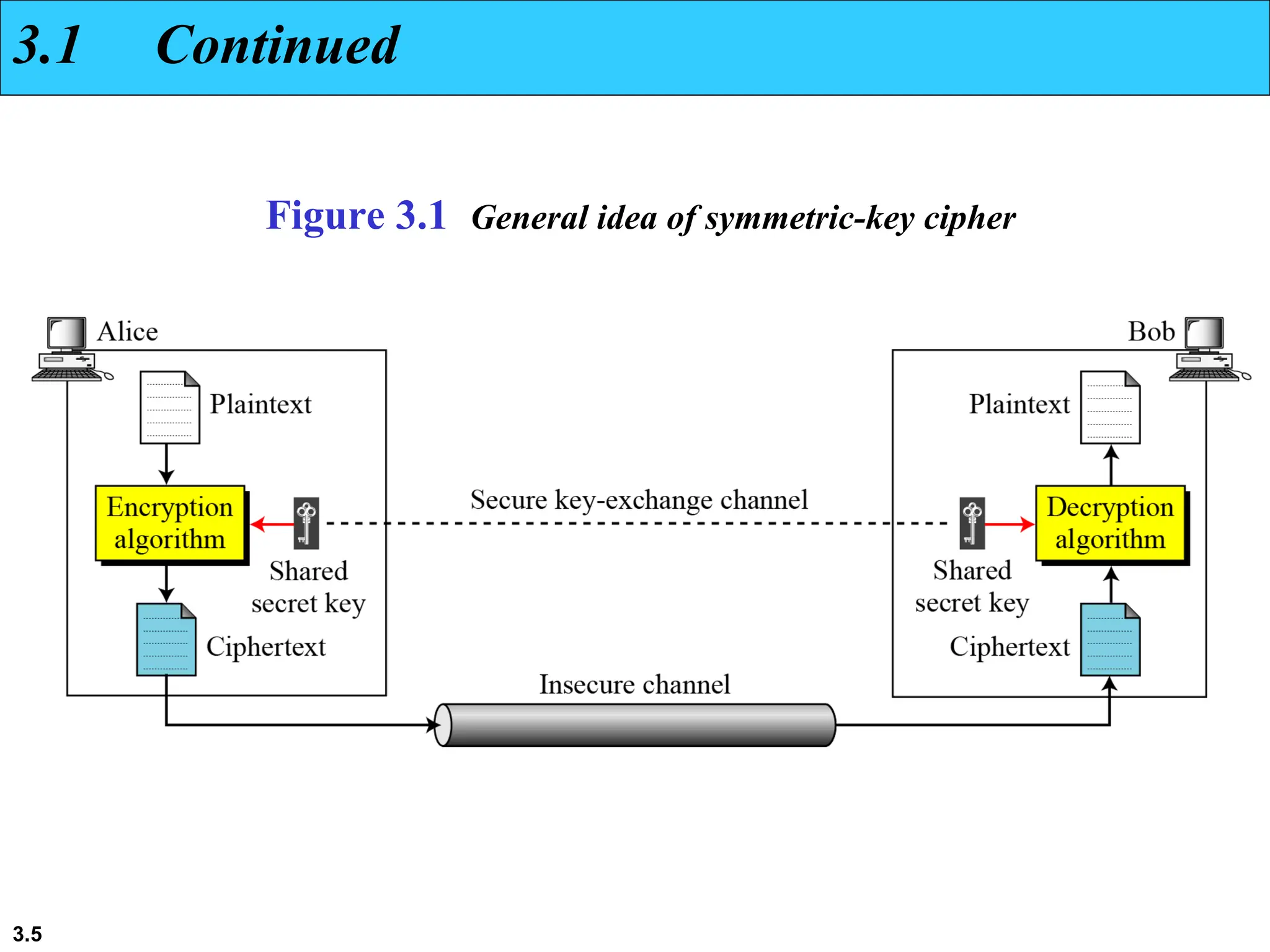
3.2
❏ To define the terms and the concepts of symmetric
key ciphers
❏ To emphasize the two categories of traditional
ciphers: substitution and transposition ciphers
❏ To describe the categories of cryptanalysis used to
break the symmetric ciphers
❏ To introduce the concepts of the stream ciphers and
block ciphers
❏ To discuss some very dominant ciphers used in the
past, such as the Enigma machine
Objectives
Chapter 3
3.3
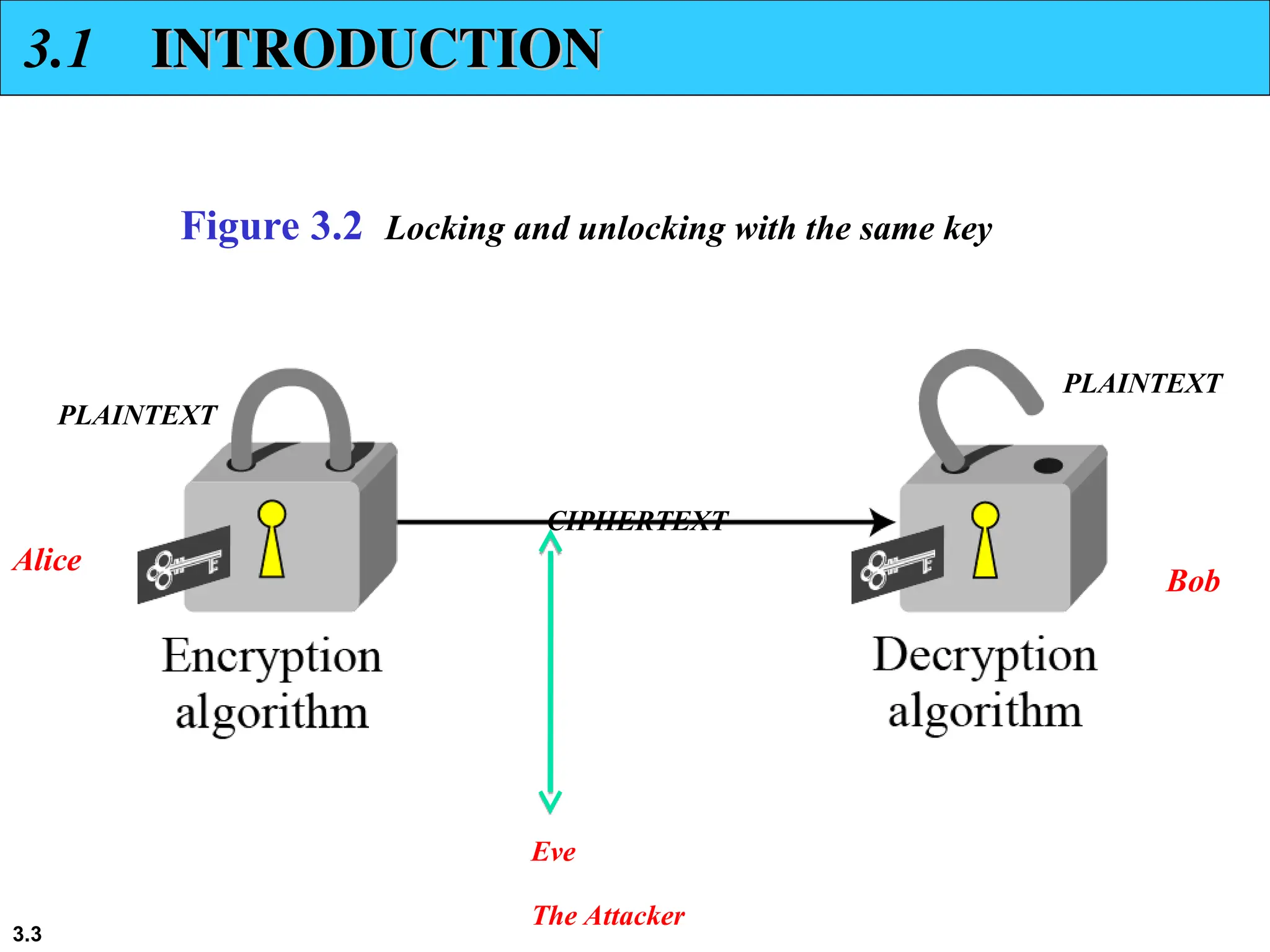
Figure 3.2 Locking and unlocking with the same key
3.1 INTRODUCTION
INTRODUCTION
PLAINTEXT
CIPHERTEXT
PLAINTEXT
Alice
Eve
The Attacker
Bob
3.4
3-1
3-1 Continued
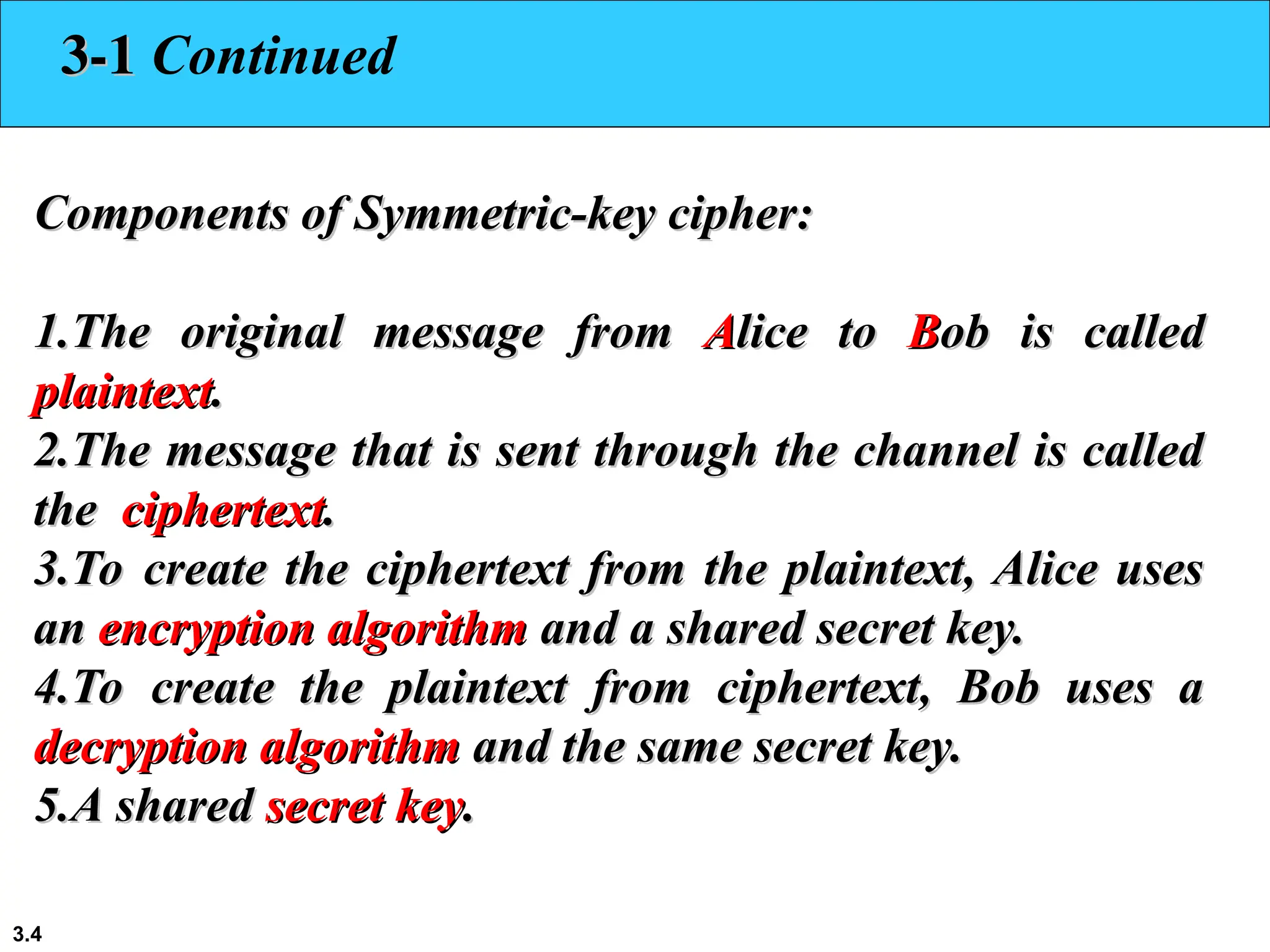
Components of Symmetric-key cipher:
1.
1.The original message from
The original message from A
Alice to
lice to B
Bob is called
ob is called
plaintext
plaintext.
.
2.
2.The message that is sent through the channel is called
The message that is sent through the channel is called
the
the ciphertext
ciphertext.
.
3.
3.To create the ciphertext from the plaintext, Alice uses
To create the ciphertext from the plaintext, Alice uses
an
an encryption algorithm
encryption algorithm and a shared secret key.
and a shared secret key.
4.
4.To create the plaintext from ciphertext, Bob uses a
To create the plaintext from ciphertext, Bob uses a
decryption algorithm
decryption algorithm and the same secret key.
and the same secret key.
5.
5.A shared
A shared secret key
secret key.
.
3.5
Figure 3.1 General idea of symmetric-key cipher
3.1 Continued
3.6
3.1 Continued
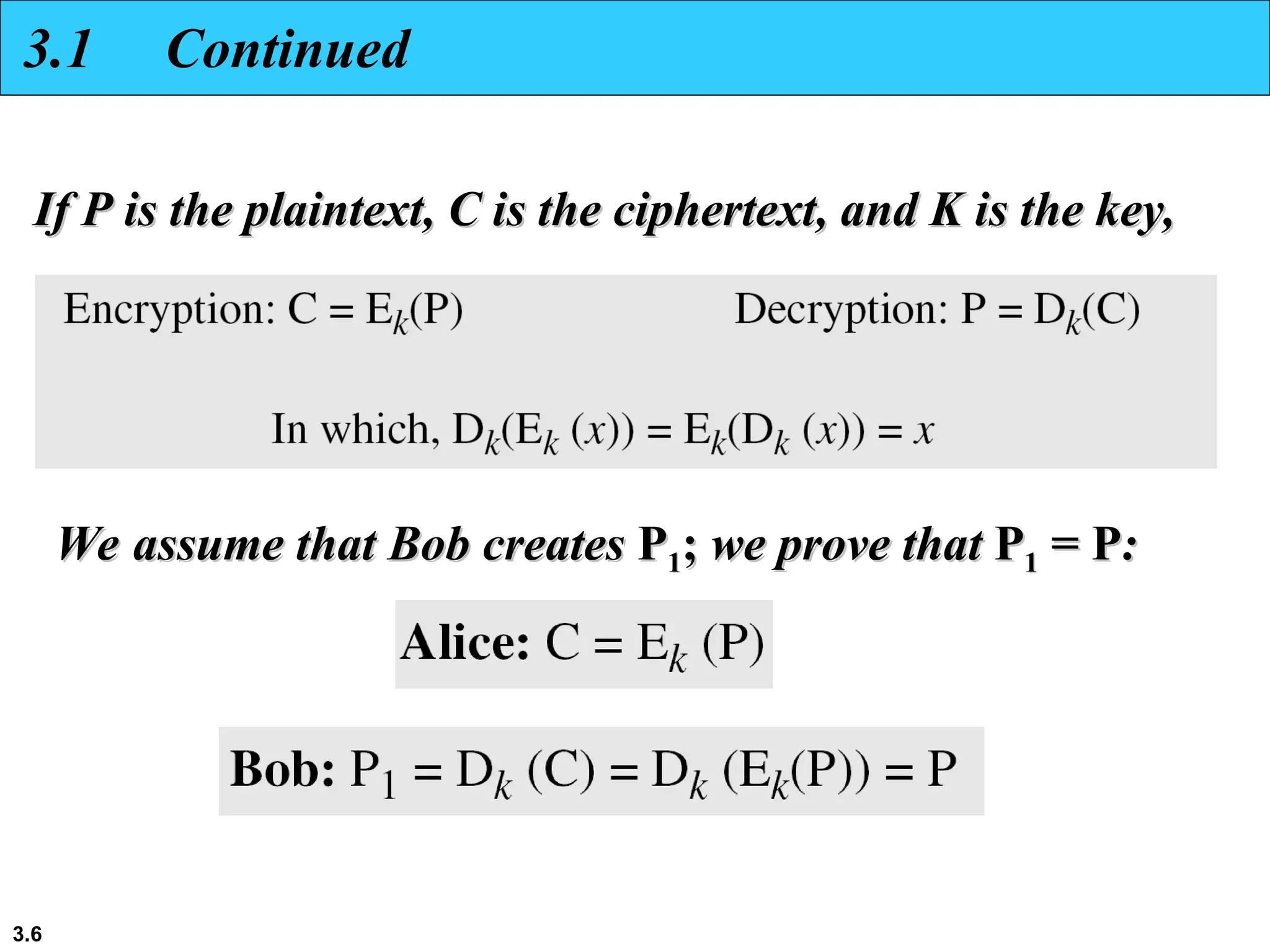
If P is the plaintext, C is the ciphertext, and K is the key,
We assume that Bob creates
We assume that Bob creates P
P1
1;
; we prove that
we prove that P
P1
1 = P
= P:
:
3.7
3.1.1 Kerckhoff’s Principle
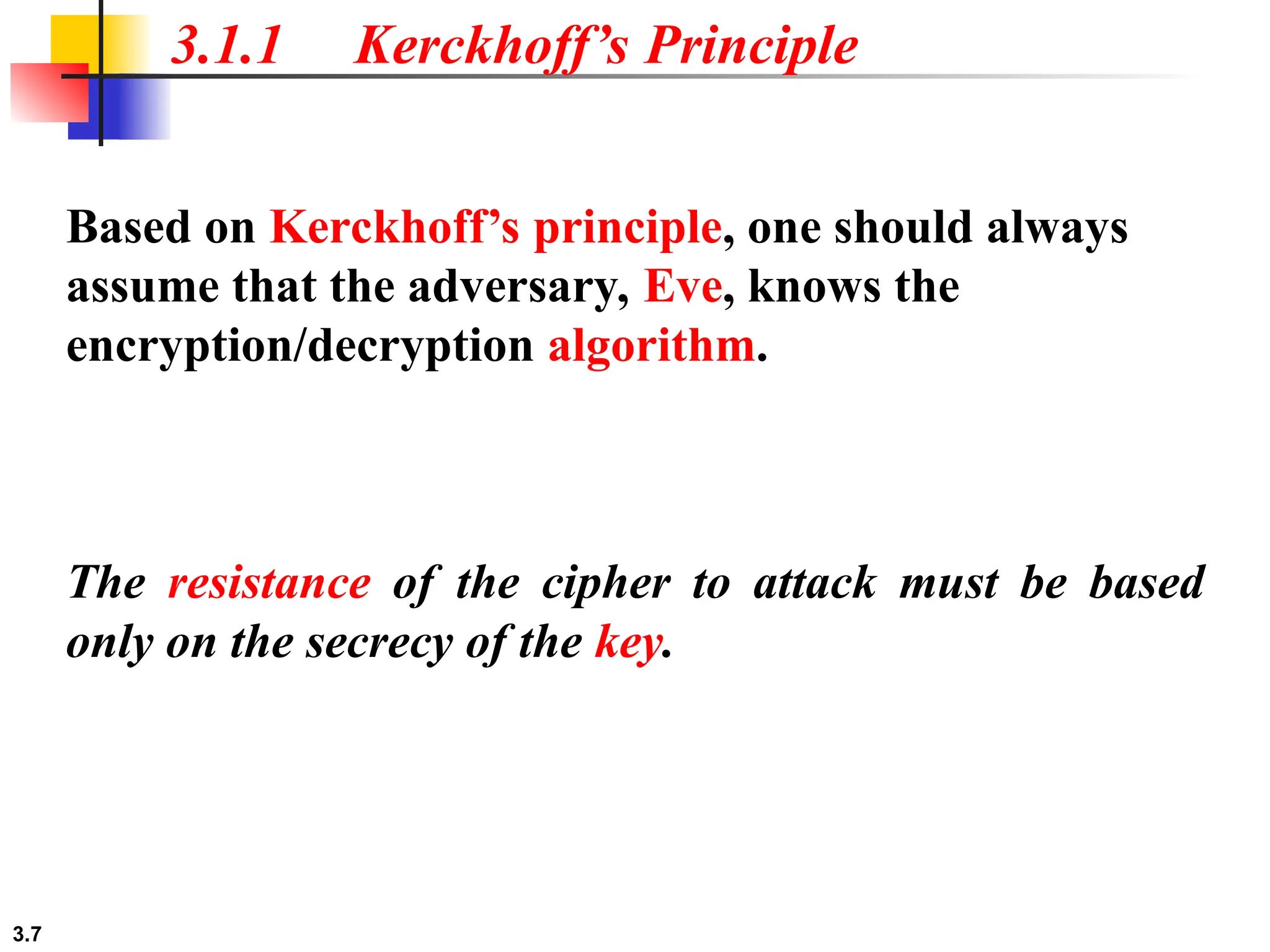
Based on Kerckhoff’s principle, one should always
assume that the adversary, Eve, knows the
encryption/decryption algorithm.
The resistance of the cipher to attack must be based
only on the secrecy of the key.
3.8
3.1.2 Cryptanalysis
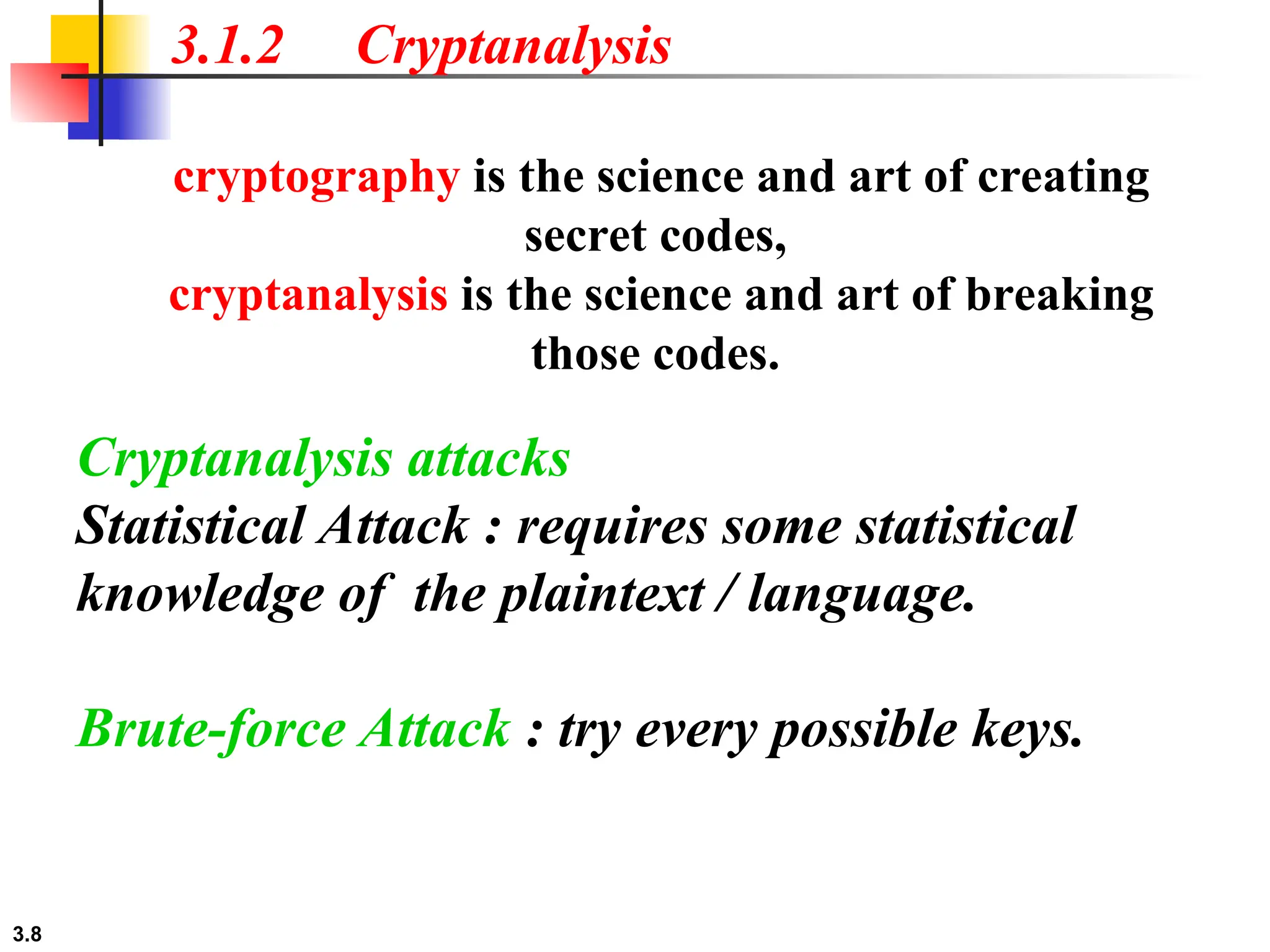
cryptography is the science and art of creating
secret codes,
cryptanalysis is the science and art of breaking
those codes.
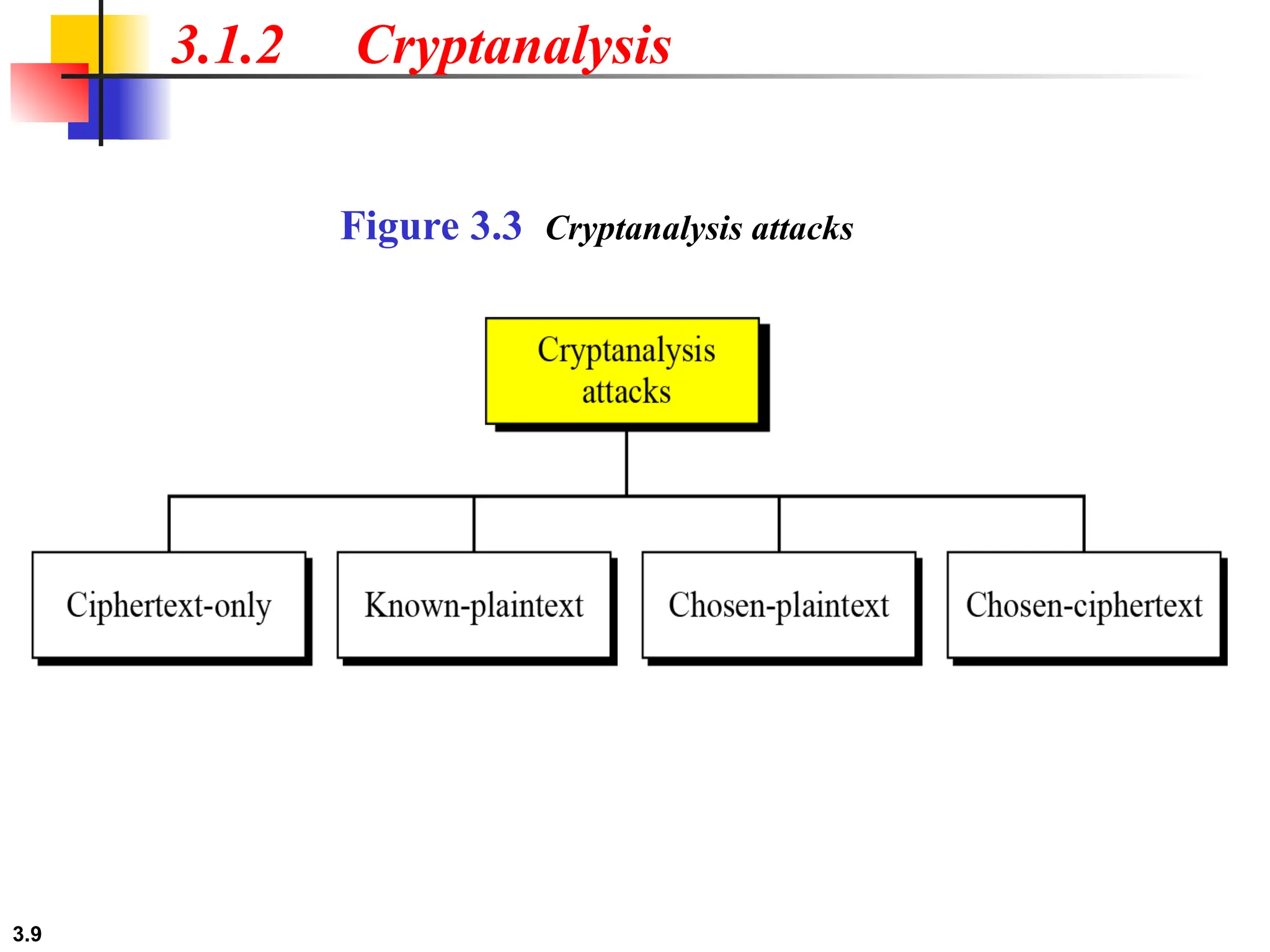
Cryptanalysis attacks
Statistical Attack : requires some statistical
knowledge of the plaintext / language.
Brute-force Attack : try every possible keys.
3.9
3.1.2 Cryptanalysis
Figure 3.3 Cryptanalysis attacks
3.10
3.1.2 Continued
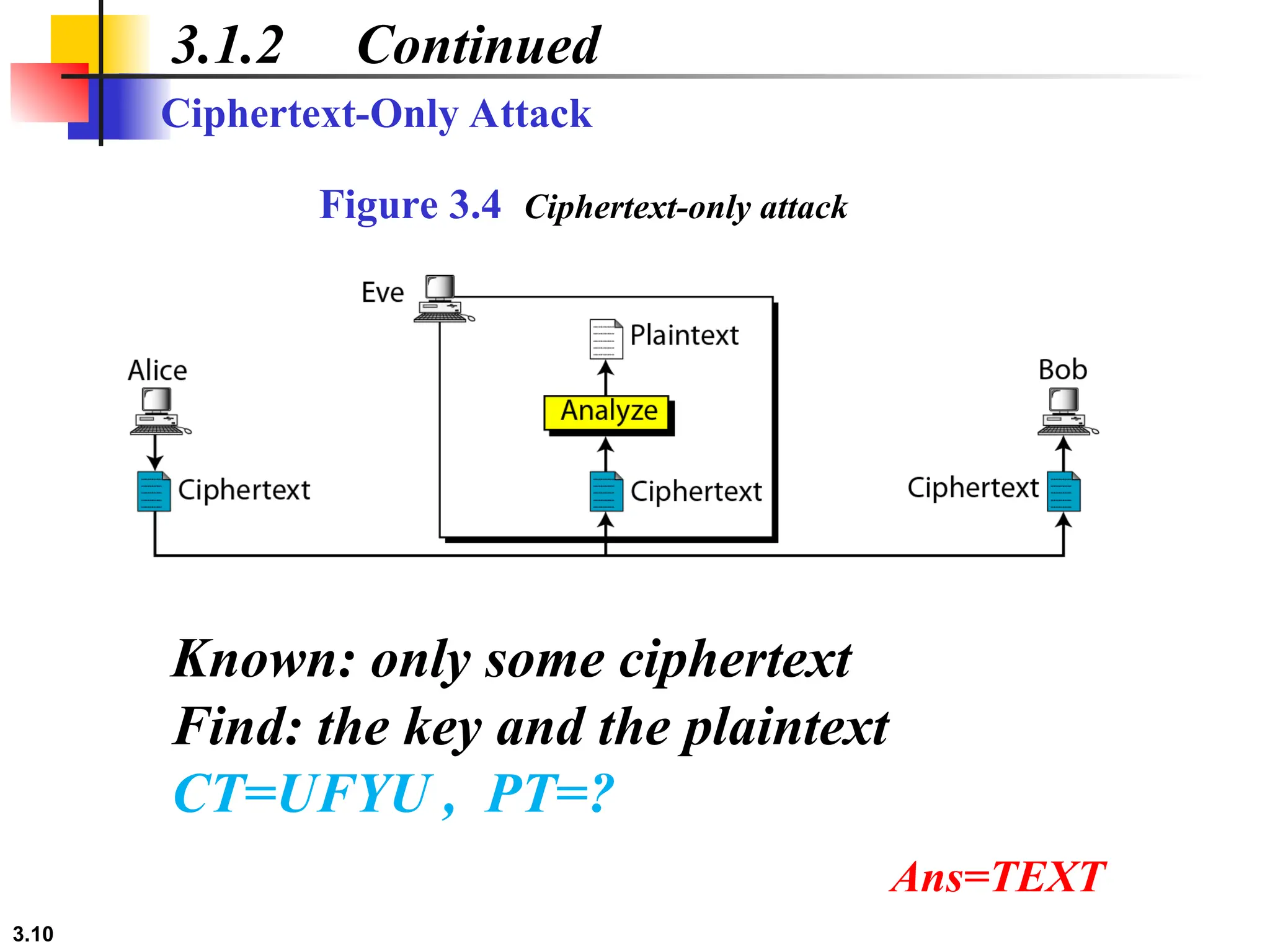
Figure 3.4 Ciphertext-only attack
Ciphertext-Only Attack
Known: only some ciphertext
Find: the key and the plaintext
CT=UFYU , PT=?
Ans=TEXT
3.11
3.1.2 Continued
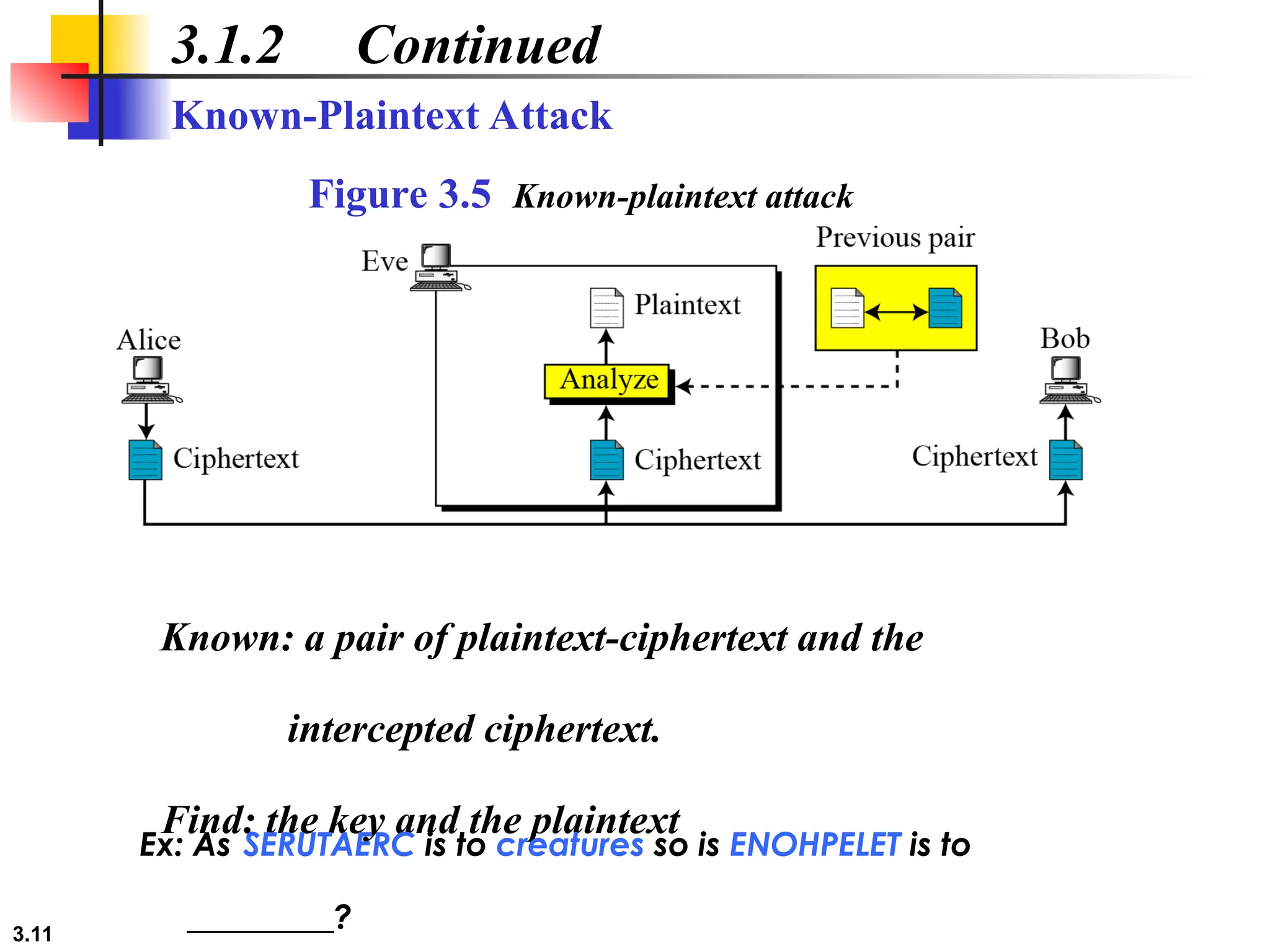
Figure 3.5 Known-plaintext attack
Known-Plaintext Attack
Known: a pair of plaintext-ciphertext and the
intercepted ciphertext.
Find: the key and the plaintext
Ex: As SERUTAERC is to creatures so is ENOHPELET is to
_________?
3.12
3.1.2 Continued
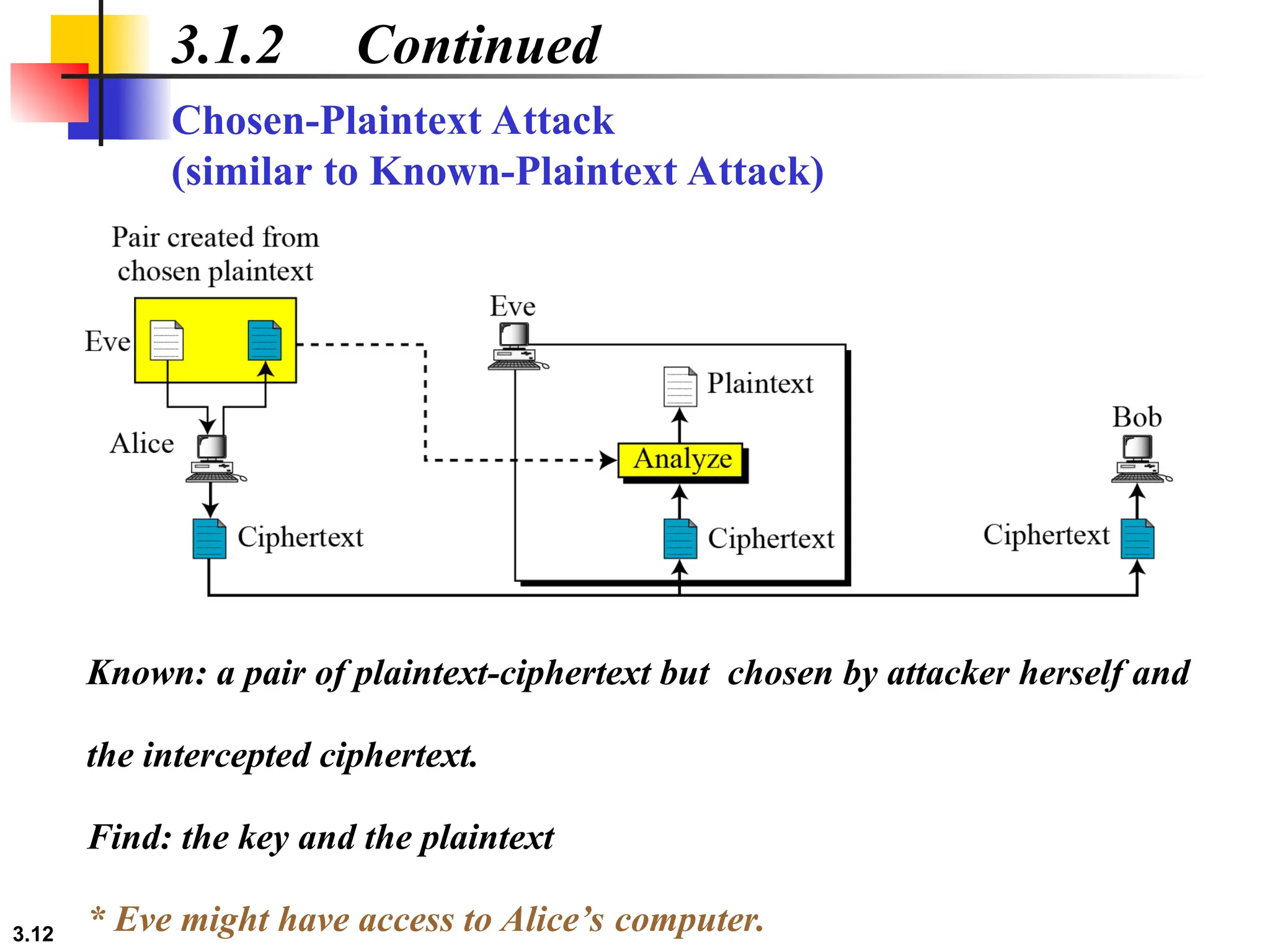
Chosen-Plaintext Attack
(similar to Known-Plaintext Attack)
Known: a pair of plaintext-ciphertext but chosen by attacker herself and
the intercepted ciphertext.
Find: the key and the plaintext
* Eve might have access to Alice’s computer.
3.13
3.1.2 Continued
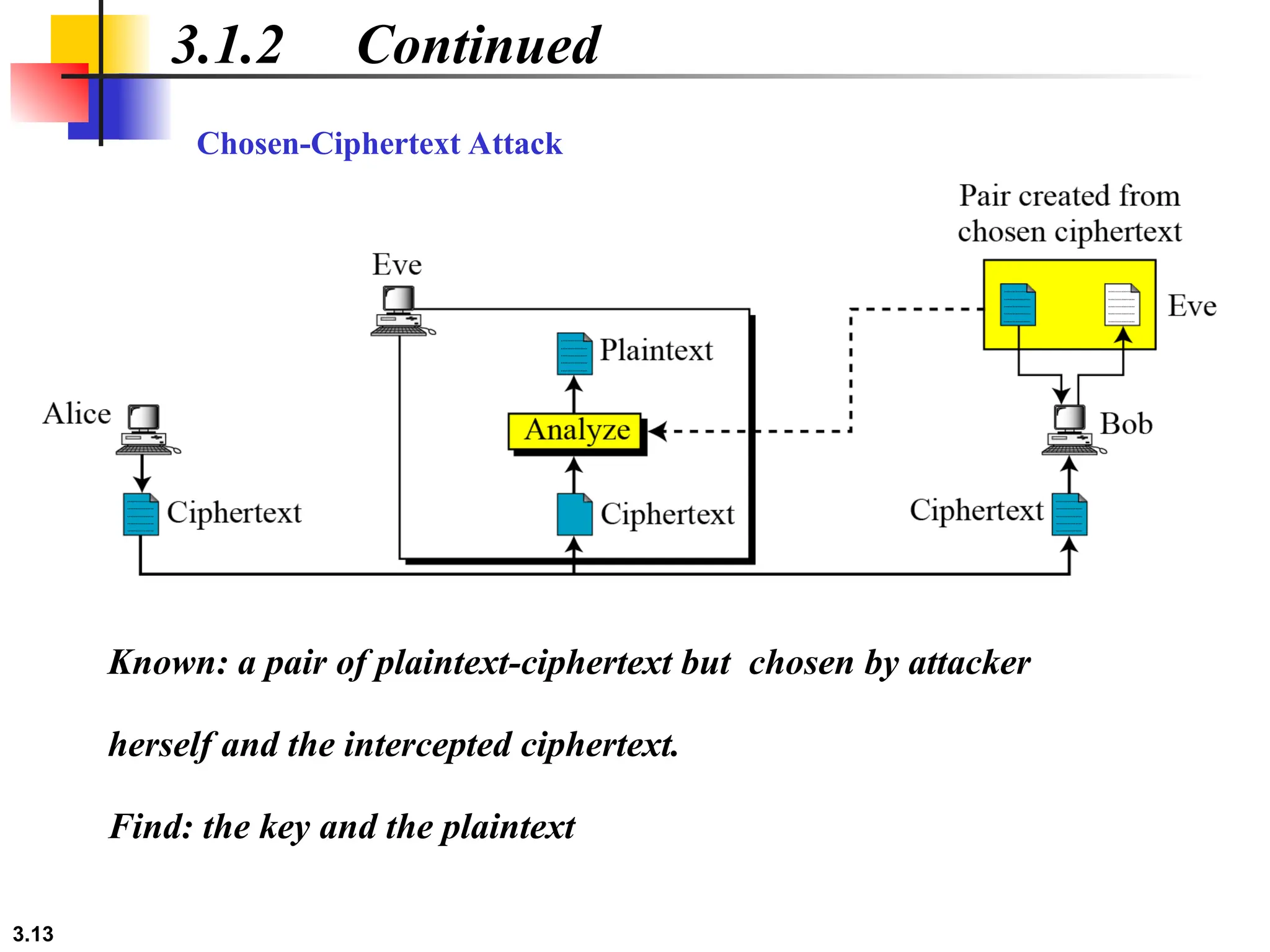
Chosen-Ciphertext Attack
Known: a pair of plaintext-ciphertext but chosen by attacker
herself and the intercepted ciphertext.
Find: the key and the plaintext
3.14
3-2 SUBSTITUTION CIPHERS
A substitution cipher replaces one symbol with another.
Substitution ciphers can be categorized as either
monoalphabetic ciphers or polyalphabetic ciphers.
3.2.1 Monoalphabetic Ciphres
3.2.2 Polyalphabetic Ciphers
Topics discussed in this section:
A substitution cipher replaces one
symbol with another.
Note
3.15
3.2.1 Monoalphabetic Ciphers
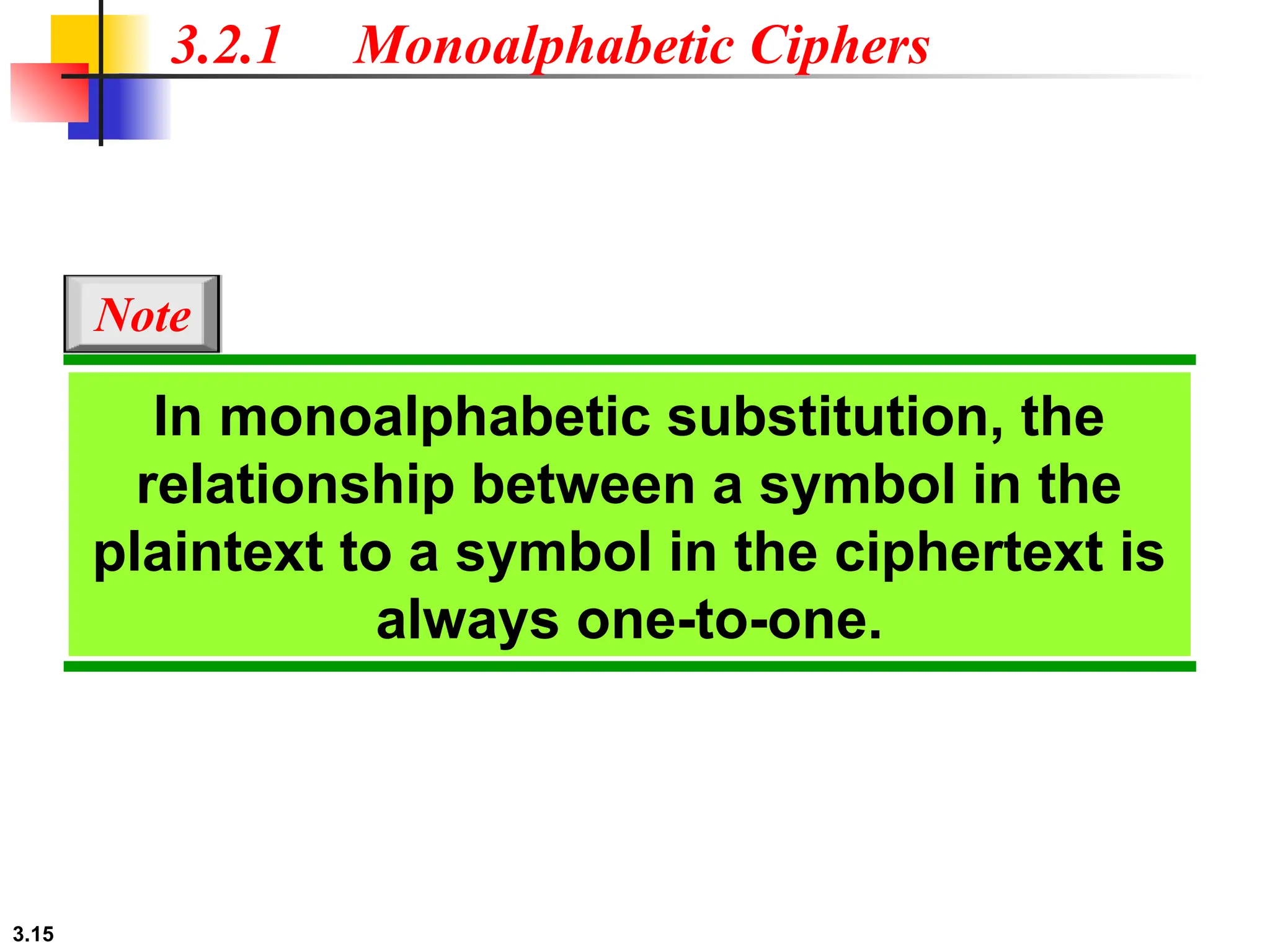
In monoalphabetic substitution, the
relationship between a symbol in the
plaintext to a symbol in the ciphertext is
always one-to-one.
Note
3.16
3.2.1 Continued
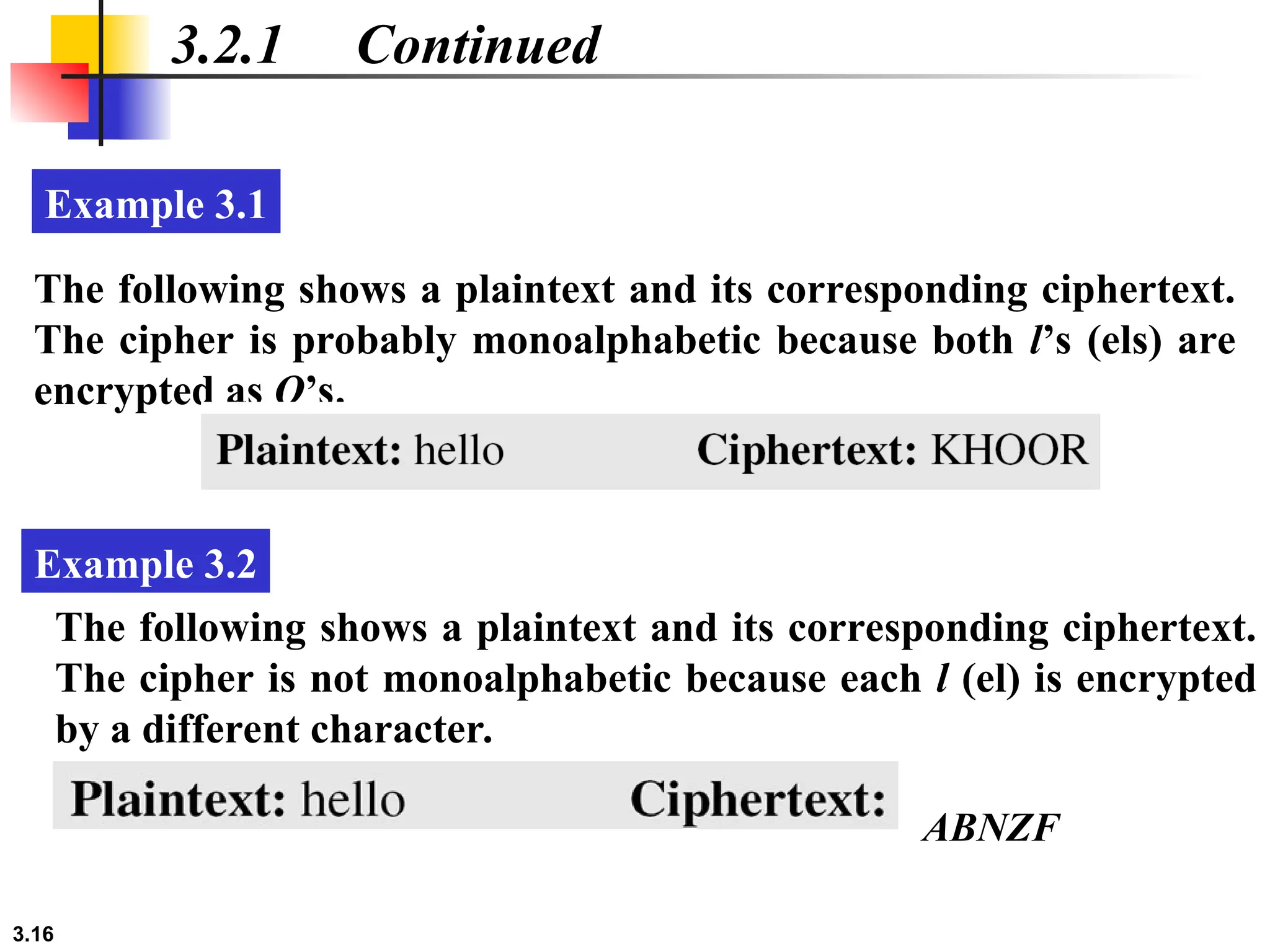
The following shows a plaintext and its corresponding ciphertext.
The cipher is probably monoalphabetic because both l’s (els) are
encrypted as O’s.
Example 3.1
The following shows a plaintext and its corresponding ciphertext.
The cipher is not monoalphabetic because each l (el) is encrypted
by a different character.
Example 3.2
ABNZF
3.17
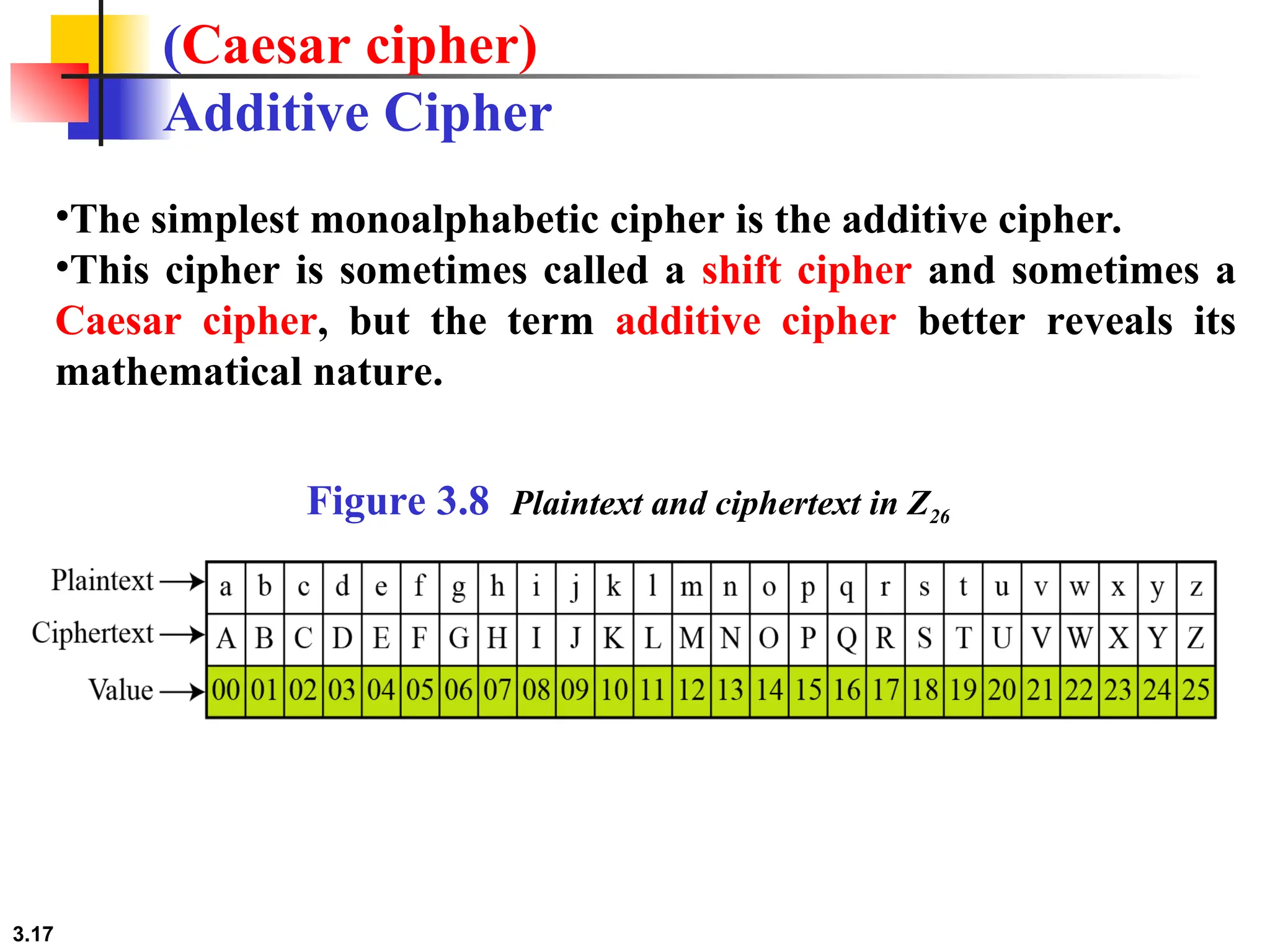
•The simplest monoalphabetic cipher is the additive cipher.
•This cipher is sometimes called a shift cipher and sometimes a
Caesar cipher, but the term additive cipher better reveals its
mathematical nature.
(Caesar cipher)
Additive Cipher
Figure 3.8 Plaintext and ciphertext in Z26
3.18
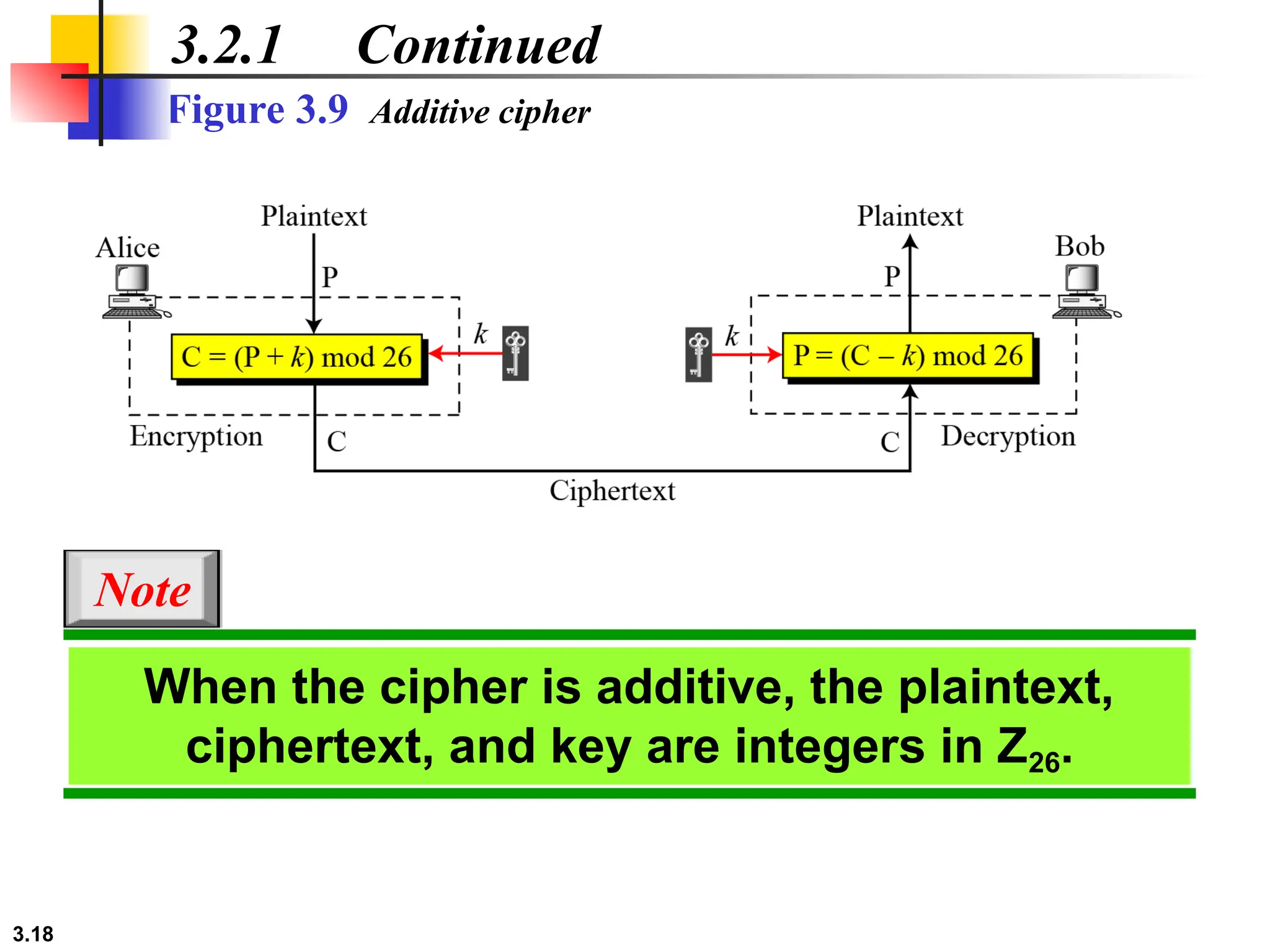
Figure 3.9 Additive cipher
3.2.1 Continued
When the cipher is additive, the plaintext,
ciphertext, and key are integers in Z26.
Note
3.19
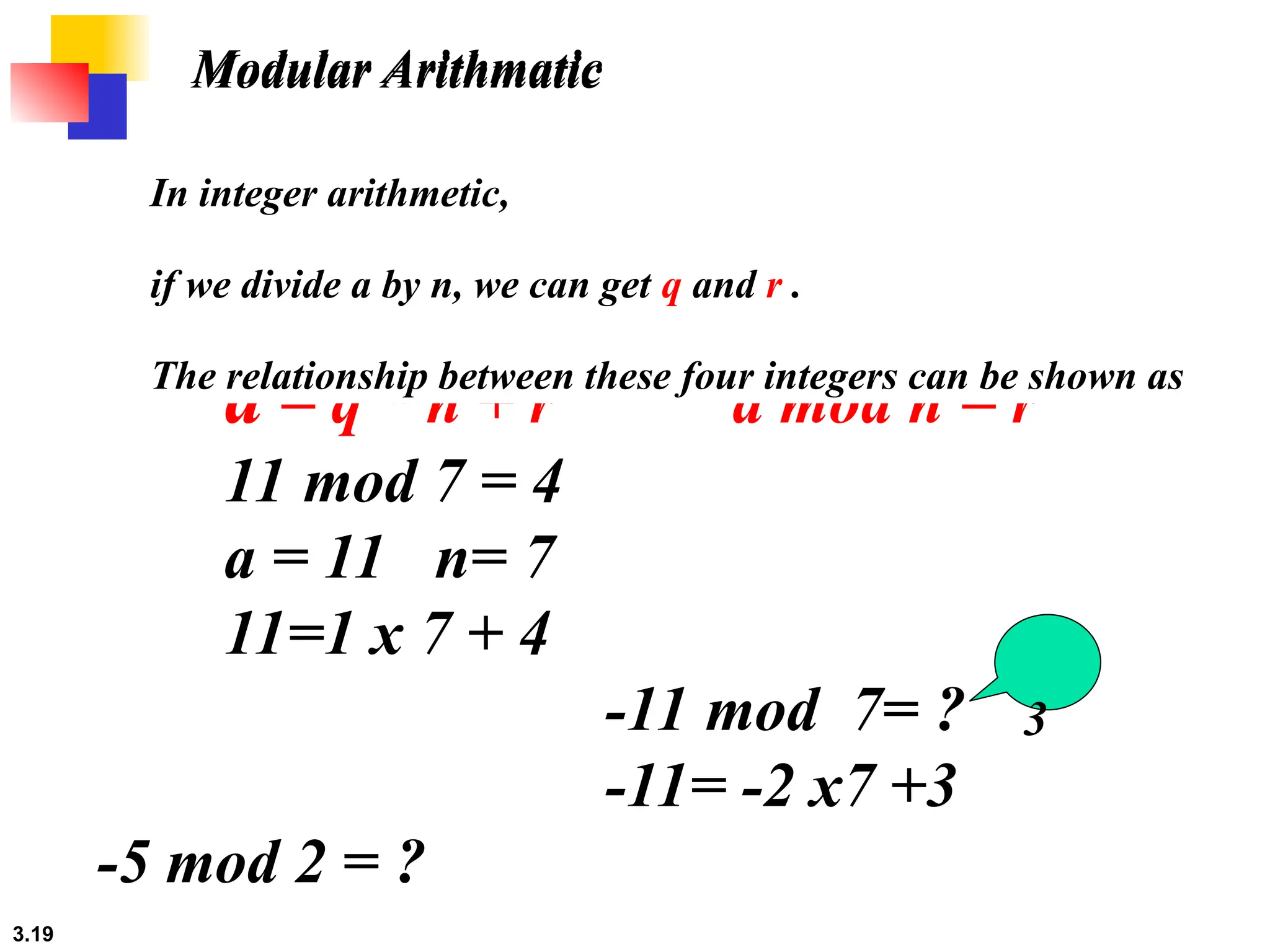
Modular Arithmatic
a = q * n + r a mod n = r
11 mod 7 = 4
a = 11 n= 7
11=1 x 7 + 4
-11 mod 7= ?
-11= -2 x7 +3
-5 mod 2 = ?
In integer arithmetic,
if we divide a by n, we can get q and r .
The relationship between these four integers can be shown as
3
Modular Arithmatic
3.20
3.2.1 Continued
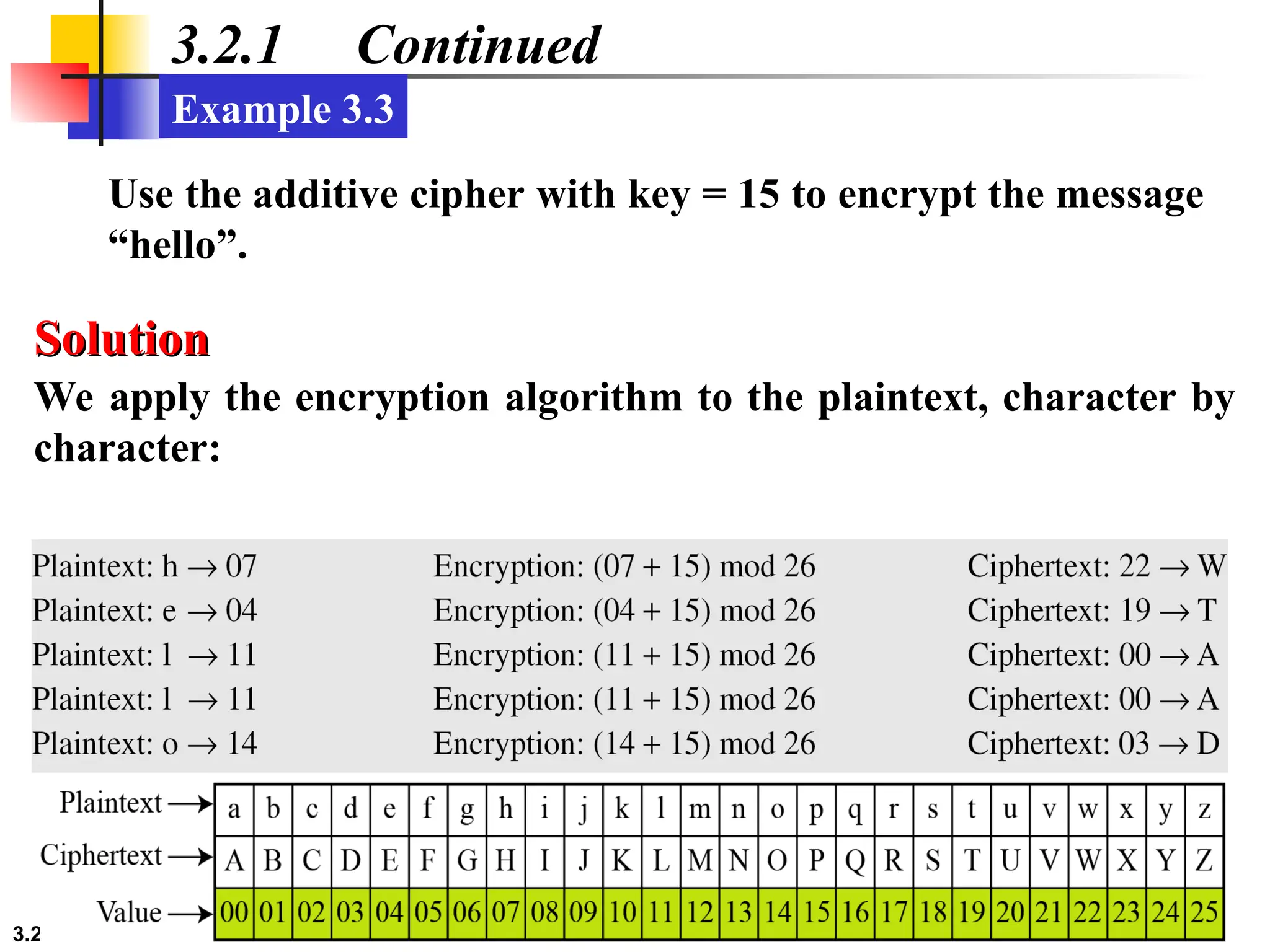
Use the additive cipher with key = 15 to encrypt the message
“hello”.
Example 3.3
We apply the encryption algorithm to the plaintext, character by
character:
Solution
Solution
3.21
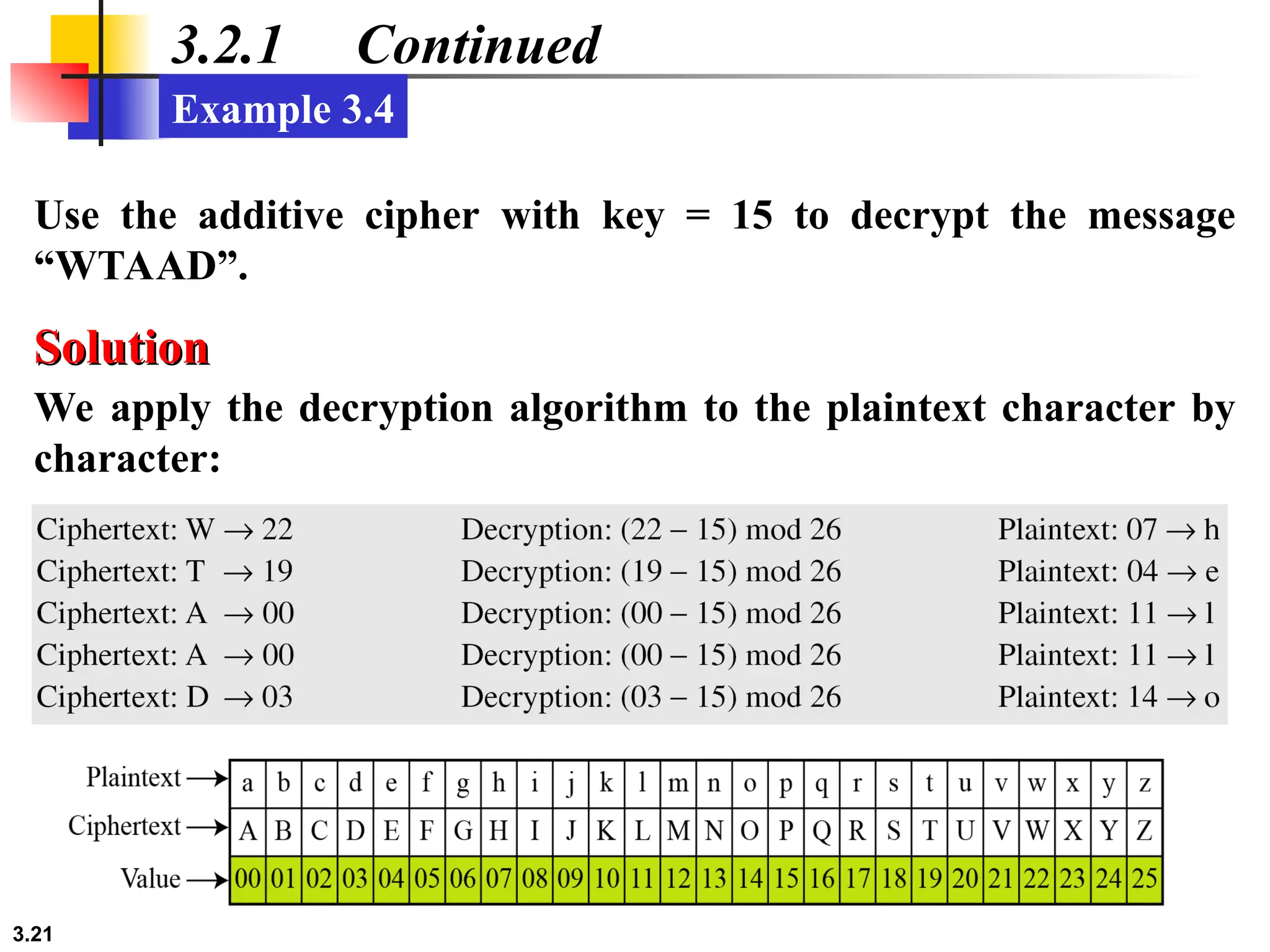
3.2.1 Continued
Use the additive cipher with key = 15 to decrypt the message
“WTAAD”.
Example 3.4
We apply the decryption algorithm to the plaintext character by
character:
Solution
Solution
3.22
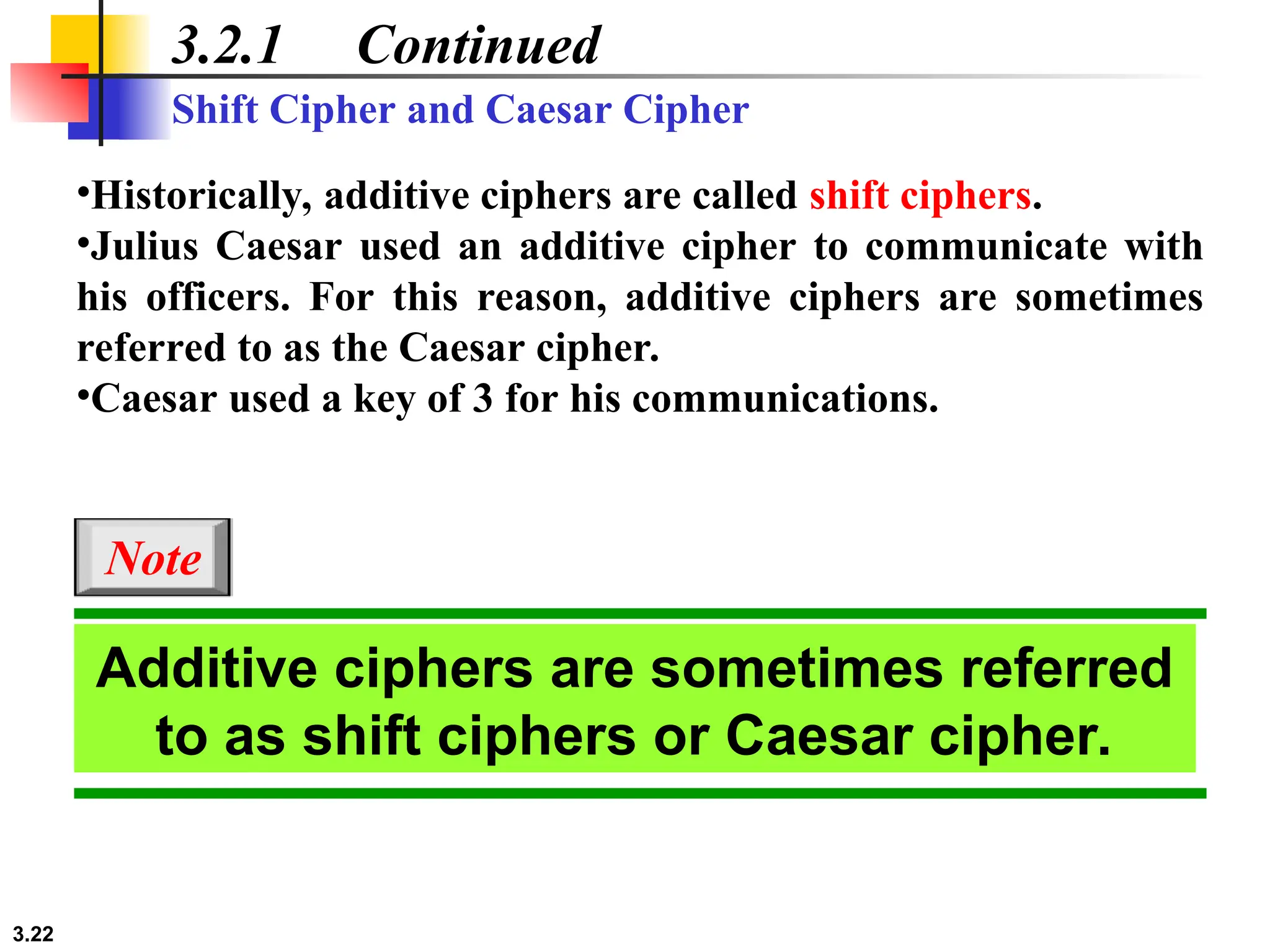
3.2.1 Continued
•Historically, additive ciphers are called shift ciphers.
•Julius Caesar used an additive cipher to communicate with
his officers. For this reason, additive ciphers are sometimes
referred to as the Caesar cipher.
•Caesar used a key of 3 for his communications.
Shift Cipher and Caesar Cipher
Additive ciphers are sometimes referred
to as shift ciphers or Caesar cipher.
Note
3.23
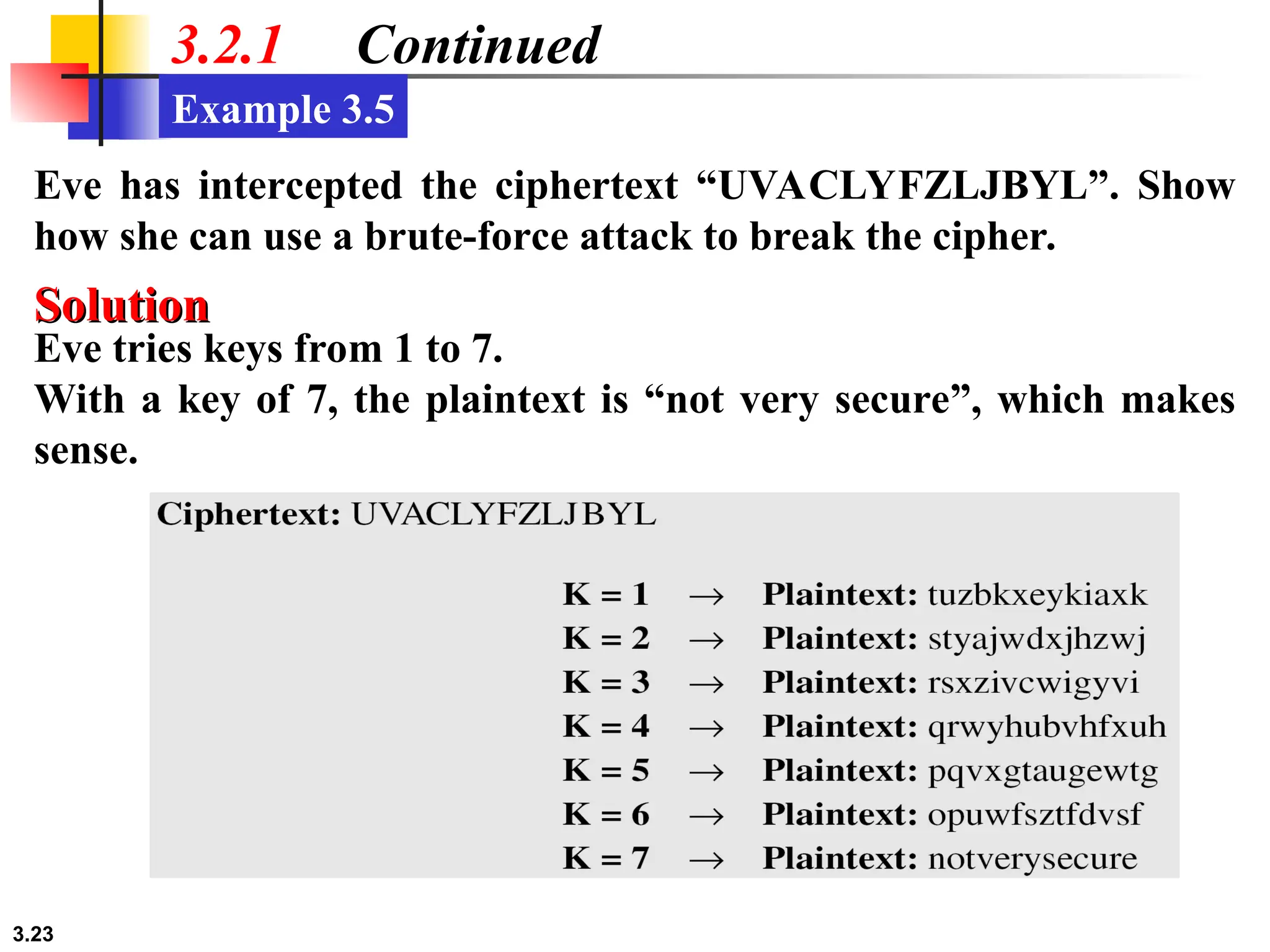
3.2.1 Continued
Eve has intercepted the ciphertext “UVACLYFZLJBYL”. Show
how she can use a brute-force attack to break the cipher.
Example 3.5
Eve tries keys from 1 to 7.
With a key of 7, the plaintext is “not very secure”, which makes
sense.
Solution
Solution
3.24
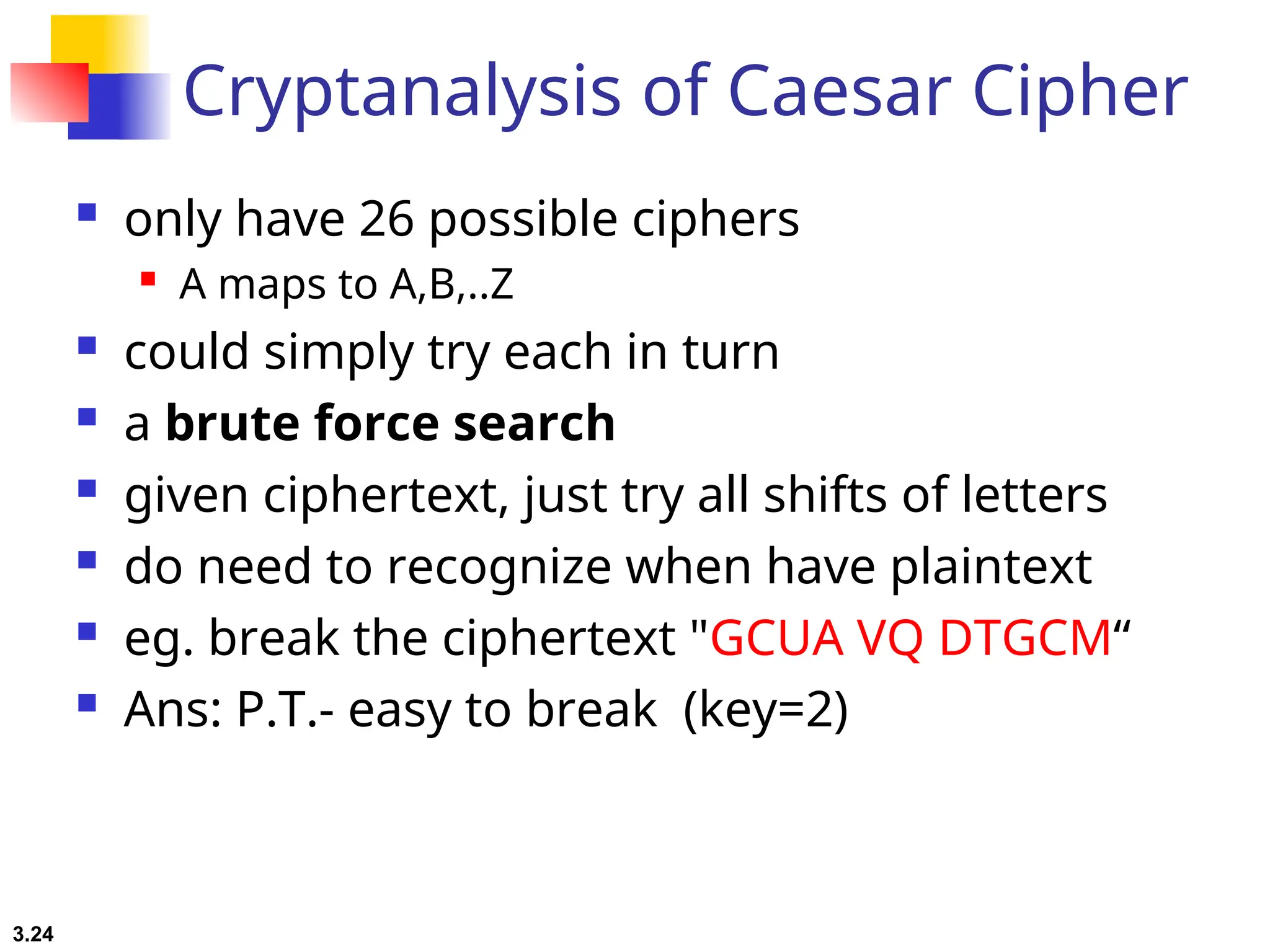
Cryptanalysis of Caesar Cipher
 only have 26 possible ciphers
 A maps to A,B,..Z
 could simply try each in turn
 a brute force search
 given ciphertext, just try all shifts of letters
 do need to recognize when have plaintext
 eg. break the ciphertext "GCUA VQ DTGCM“
 Ans: P.T.- easy to break (key=2)
3.25
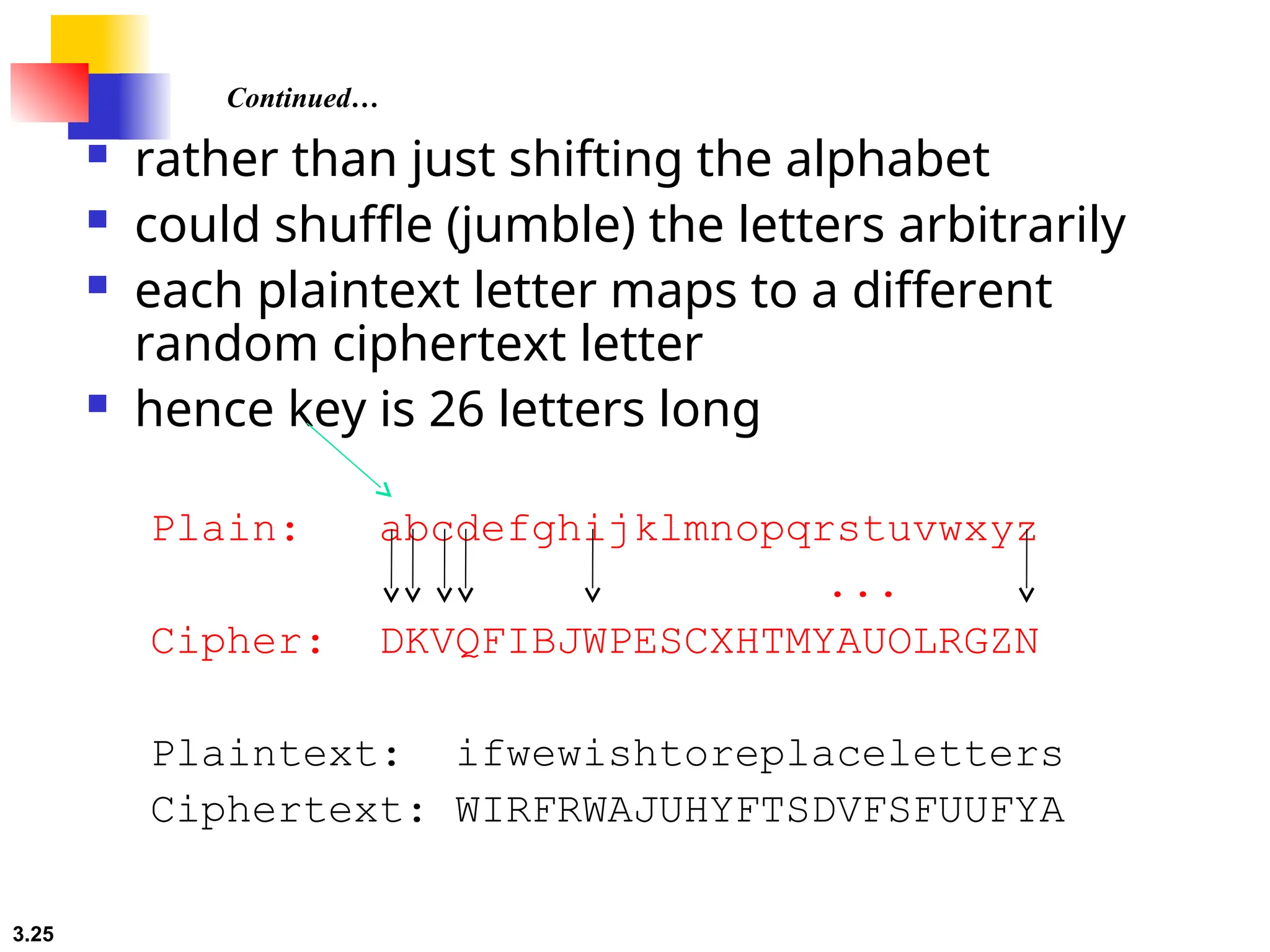
 rather than just shifting the alphabet
 could shuffle (jumble) the letters arbitrarily
 each plaintext letter maps to a different
random ciphertext letter
 hence key is 26 letters long
Plain: abcdefghijklmnopqrstuvwxyz
...
Cipher: DKVQFIBJWPESCXHTMYAUOLRGZN
Plaintext: ifwewishtoreplaceletters
Ciphertext: WIRFRWAJUHYFTSDVFSFUUFYA
Continued…
3.26
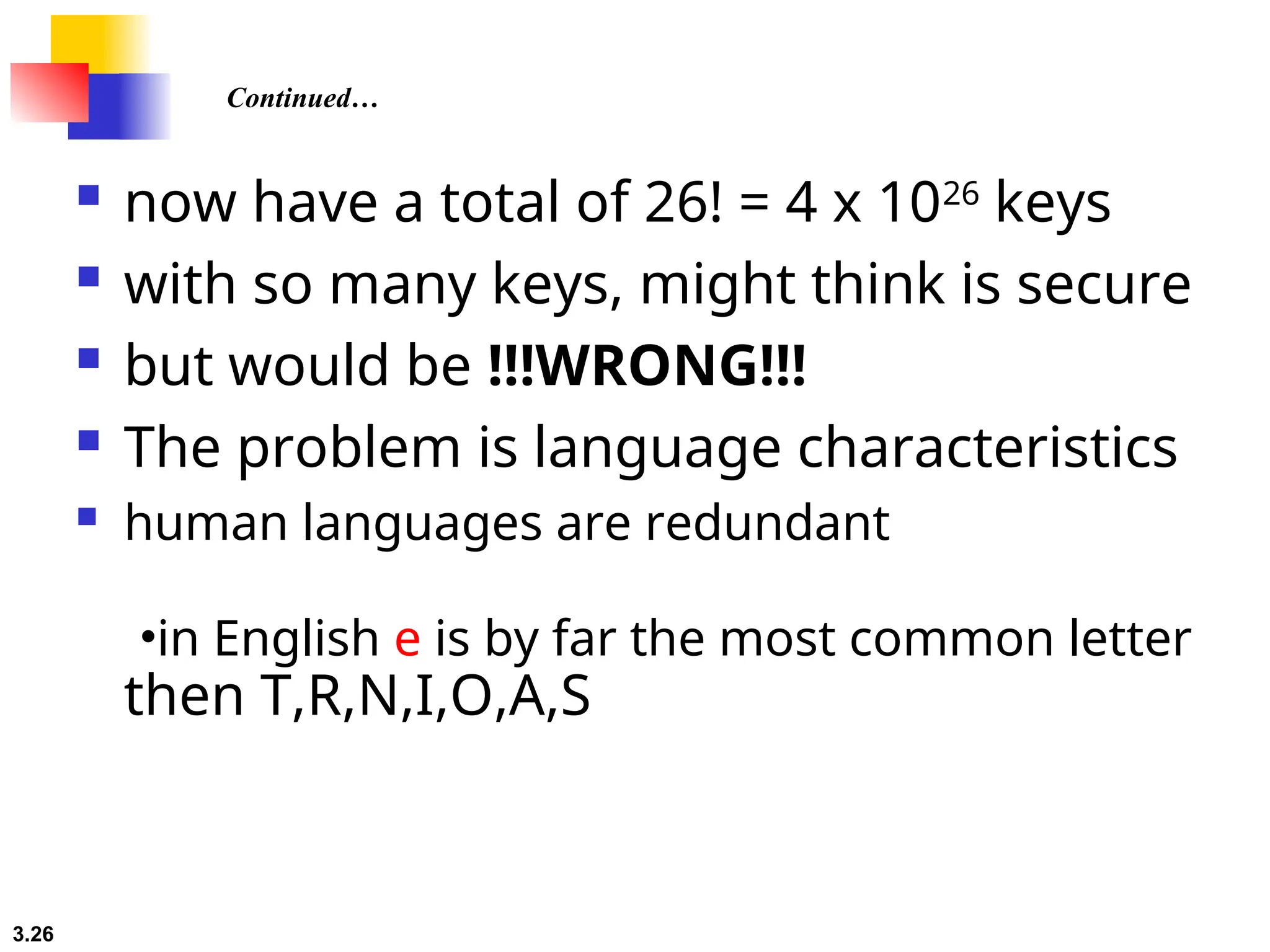
 now have a total of 26! = 4 x 1026
keys
 with so many keys, might think is secure
 but would be !!!WRONG!!!
 The problem is language characteristics
 human languages are redundant
•in English e is by far the most common letter
then T,R,N,I,O,A,S
Continued…
3.27
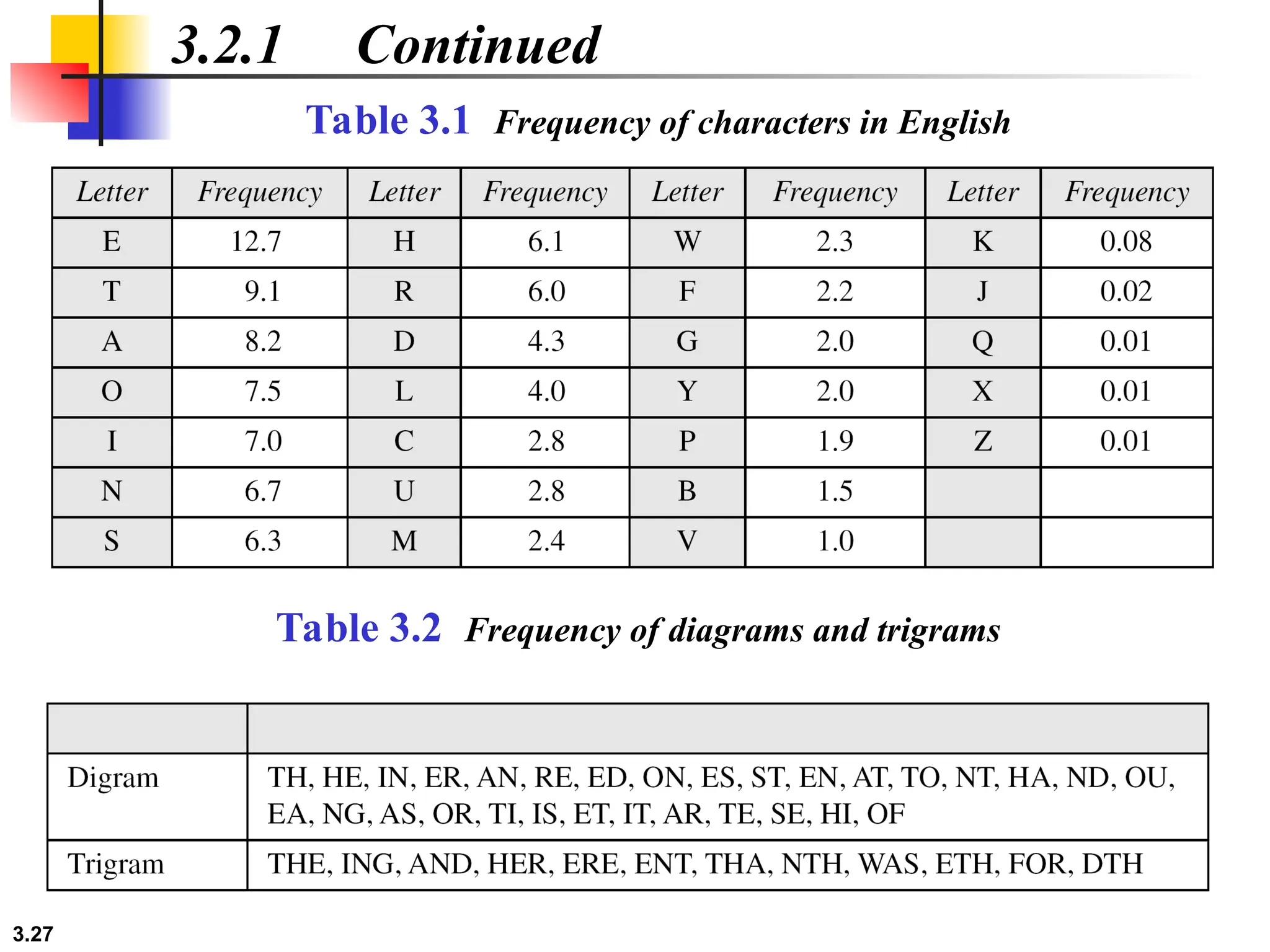
3.2.1 Continued
Table 3.1 Frequency of characters in English
Table 3.2 Frequency of diagrams and trigrams
3.28
3.2.1 Continued
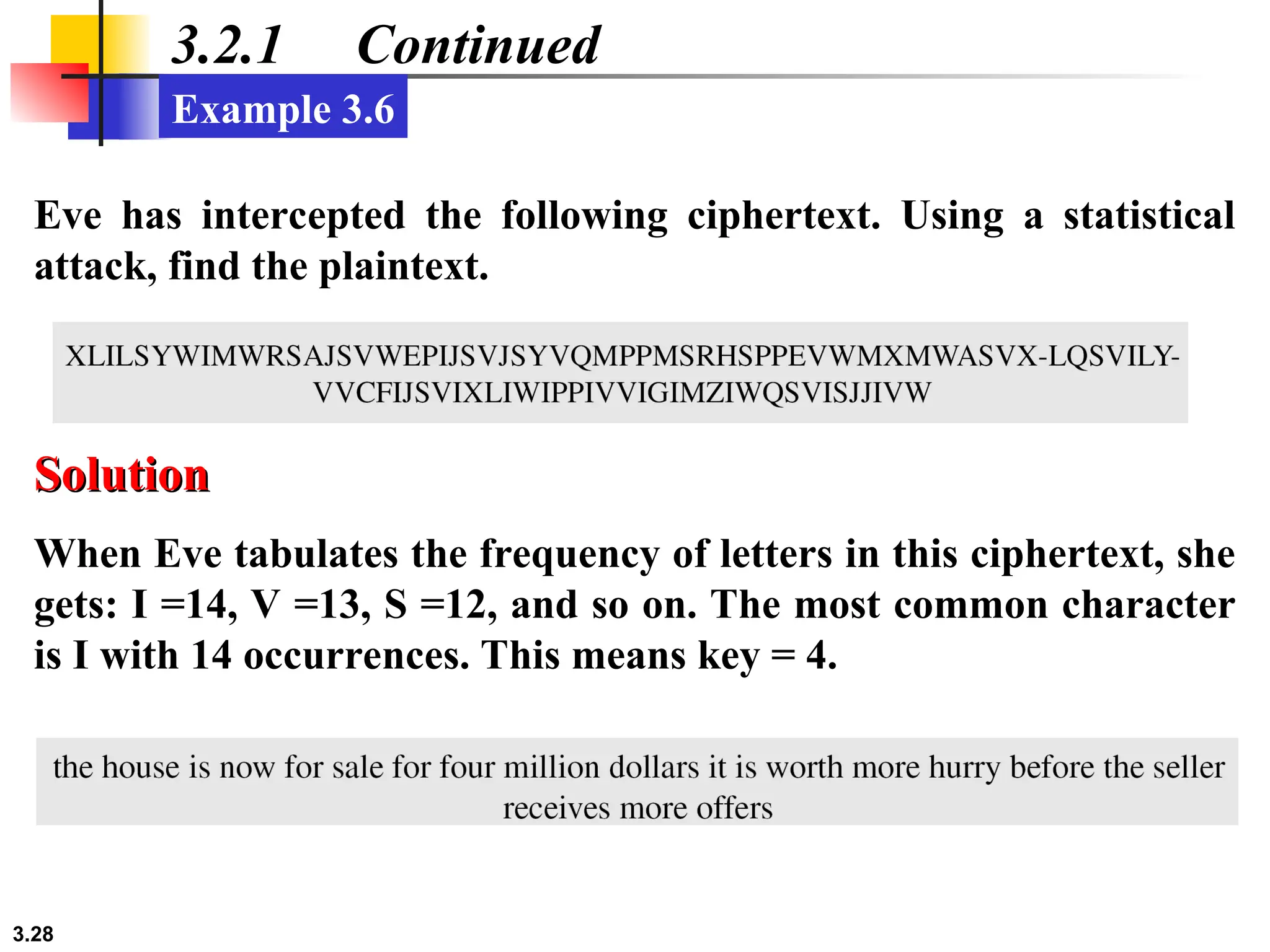
Eve has intercepted the following ciphertext. Using a statistical
attack, find the plaintext.
Example 3.6
When Eve tabulates the frequency of letters in this ciphertext, she
gets: I =14, V =13, S =12, and so on. The most common character
is I with 14 occurrences. This means key = 4.
Solution
Solution
3.29
3.2.1 Continued
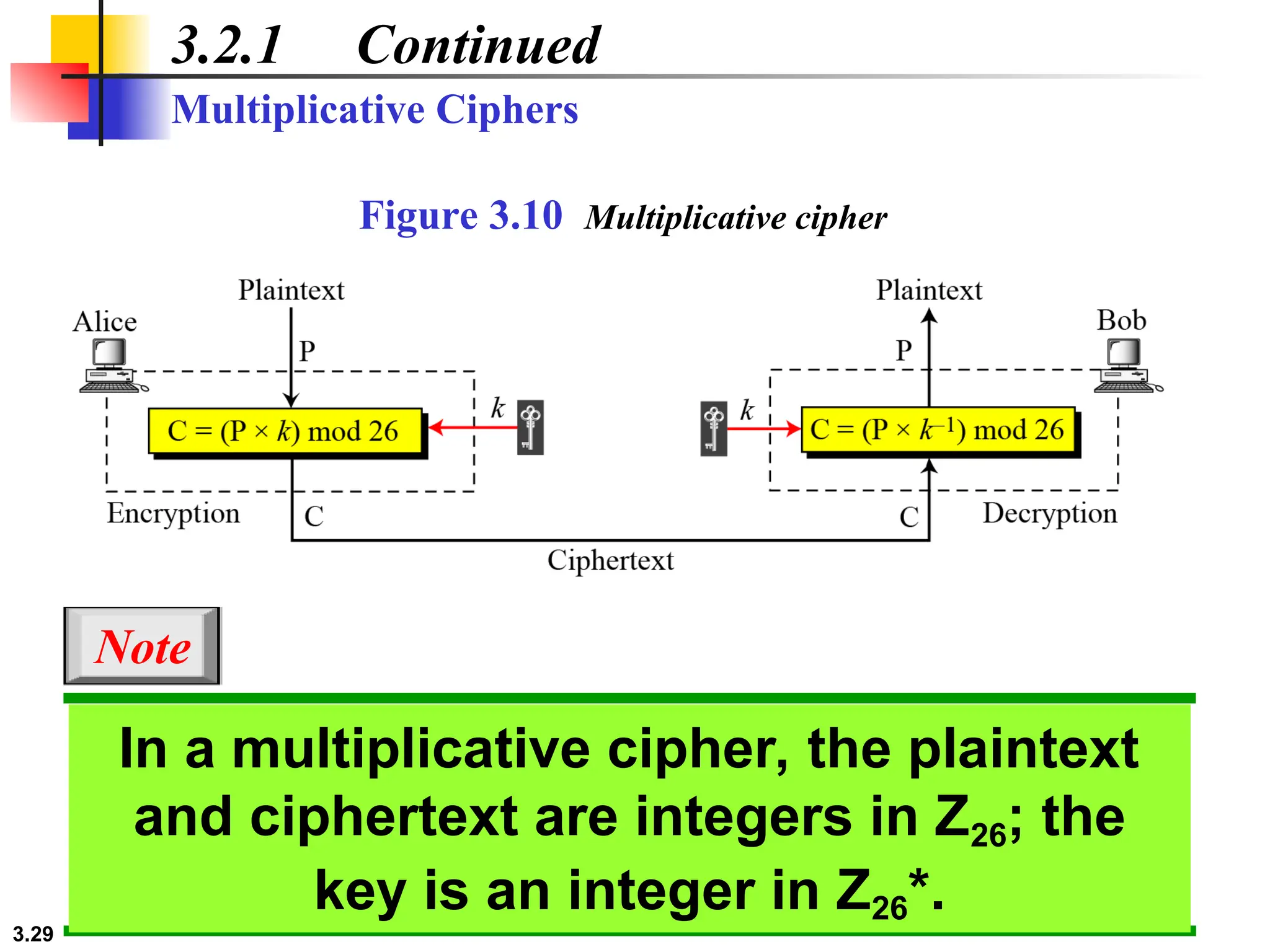
Multiplicative Ciphers
In a multiplicative cipher, the plaintext
and ciphertext are integers in Z26; the
key is an integer in Z26*.
Note
Figure 3.10 Multiplicative cipher
3.30
3.2.1 Continued
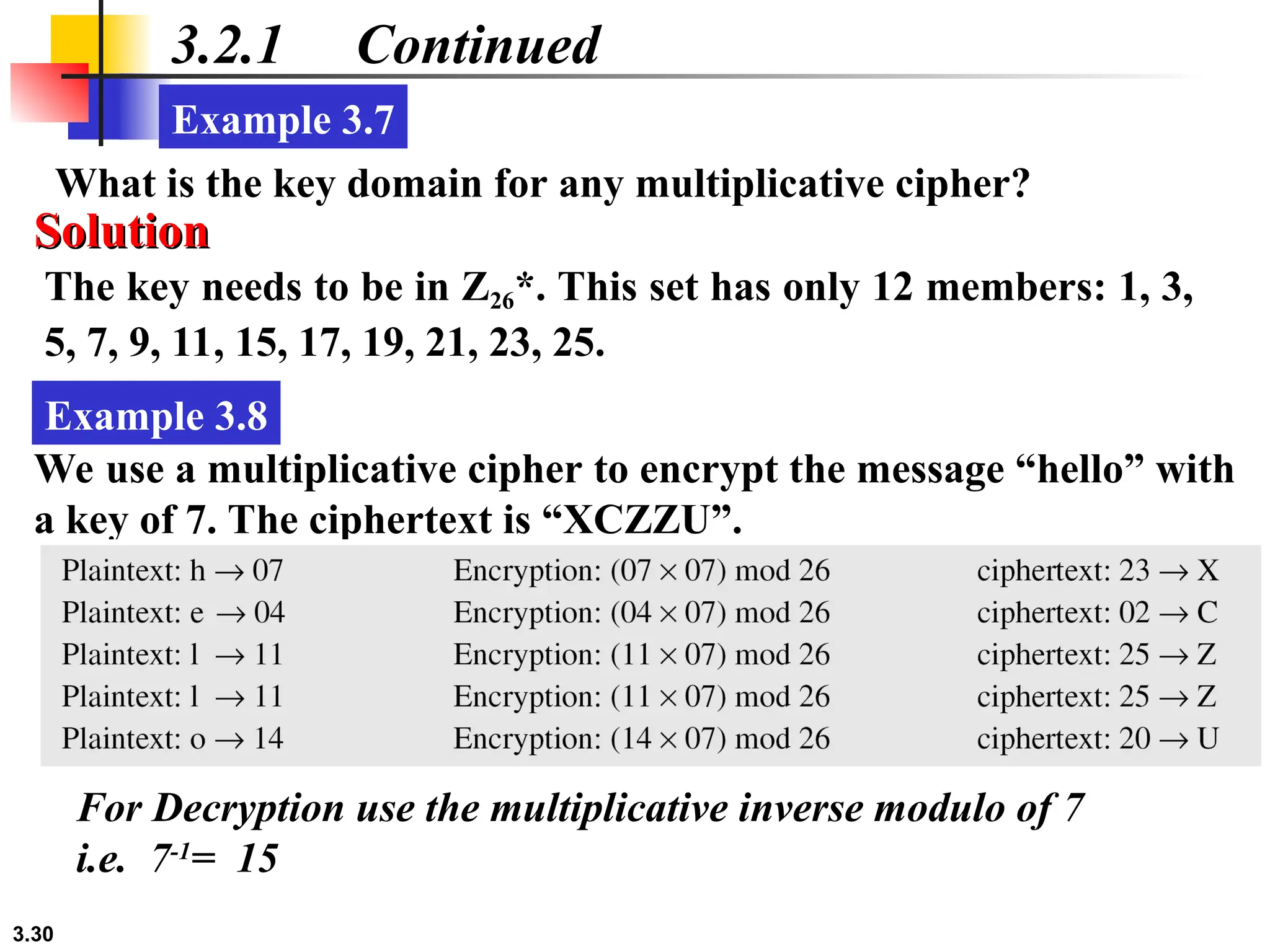
What is the key domain for any multiplicative cipher?
Example 3.7
The key needs to be in Z26*. This set has only 12 members: 1, 3,
5, 7, 9, 11, 15, 17, 19, 21, 23, 25.
Solution
Solution
We use a multiplicative cipher to encrypt the message “hello” with
a key of 7. The ciphertext is “XCZZU”.
Example 3.8
For Decryption use the multiplicative inverse modulo of 7
i.e. 7-1
= 15
3.31
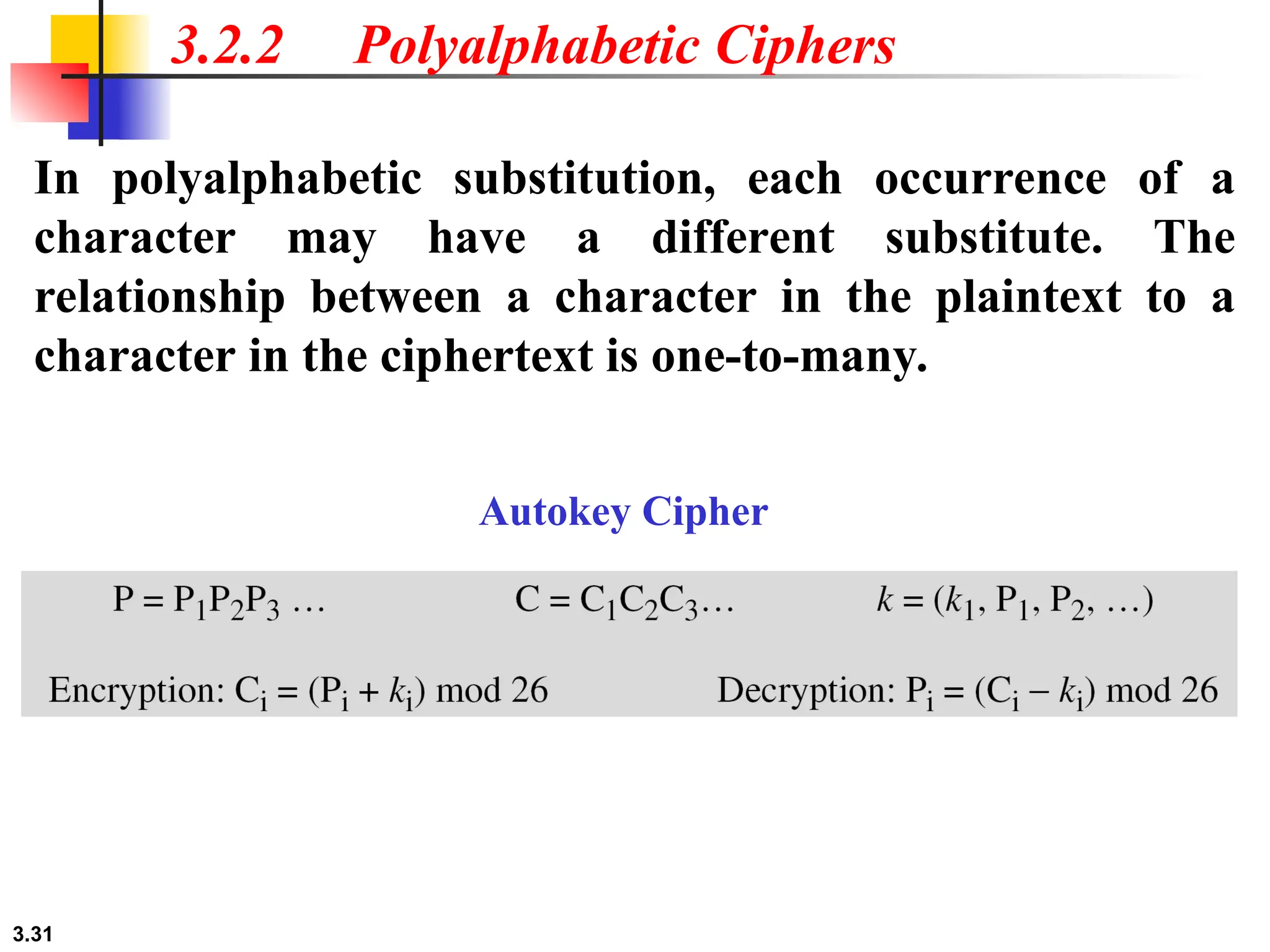
3.2.2 Polyalphabetic Ciphers
In polyalphabetic substitution, each occurrence of a
character may have a different substitute. The
relationship between a character in the plaintext to a
character in the ciphertext is one-to-many.
Autokey Cipher
3.32
3.2.2 Continued
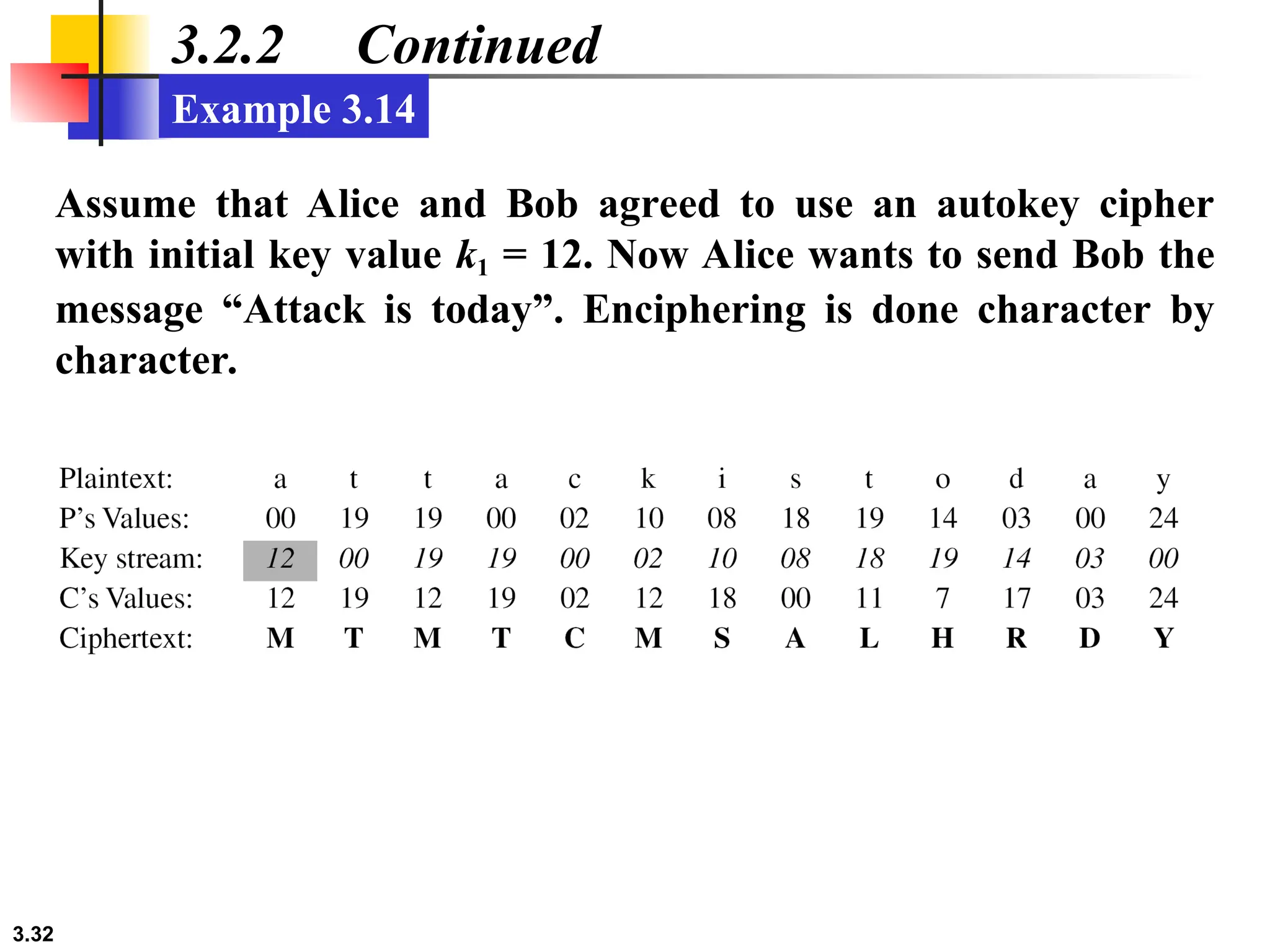
Assume that Alice and Bob agreed to use an autokey cipher
with initial key value k1 = 12. Now Alice wants to send Bob the
message “Attack is today”. Enciphering is done character by
character.
Example 3.14
3.33
3.2.2 Continued
Playfair Cipher
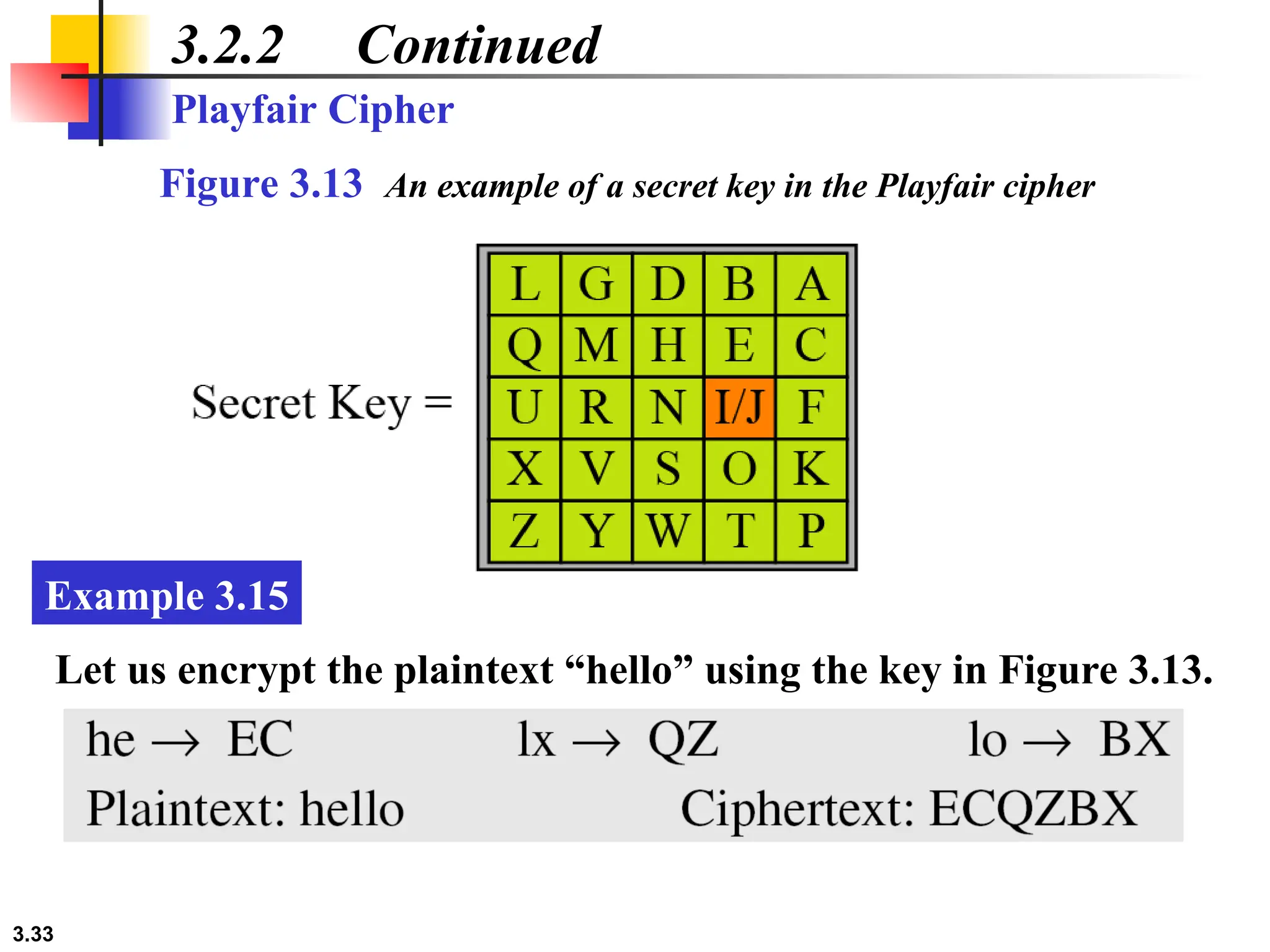
Figure 3.13 An example of a secret key in the Playfair cipher
Let us encrypt the plaintext “hello” using the key in Figure 3.13.
Example 3.15
3.34
3.2.2 Playfair Cipher:
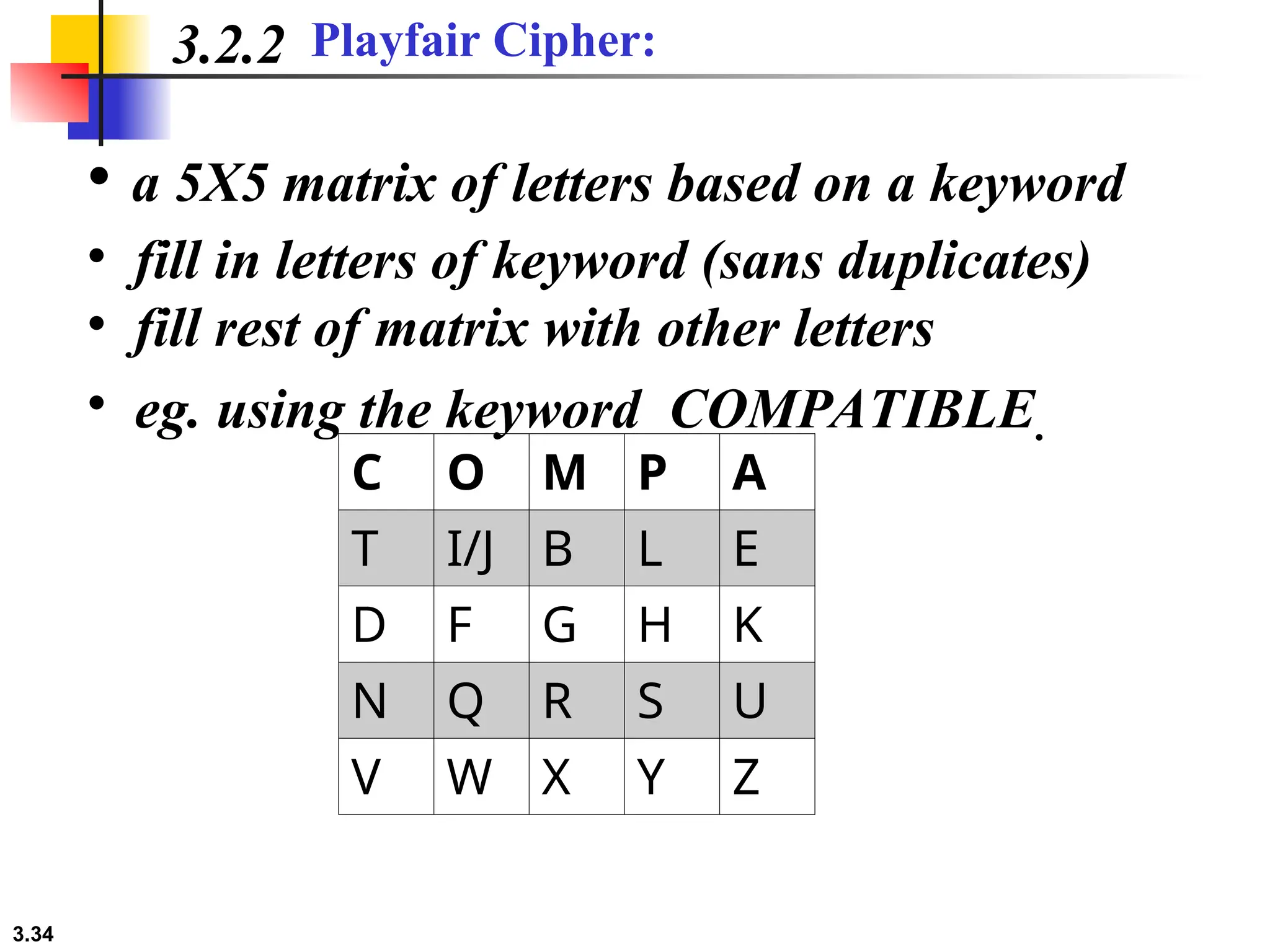
• a 5X5 matrix of letters based on a keyword
• fill in letters of keyword (sans duplicates)
• fill rest of matrix with other letters
• eg. using the keyword COMPATIBLE.
C O M P A
T I/J B L E
D F G H K
N Q R S U
V W X Y Z
3.35
Encrypting and Decrypting
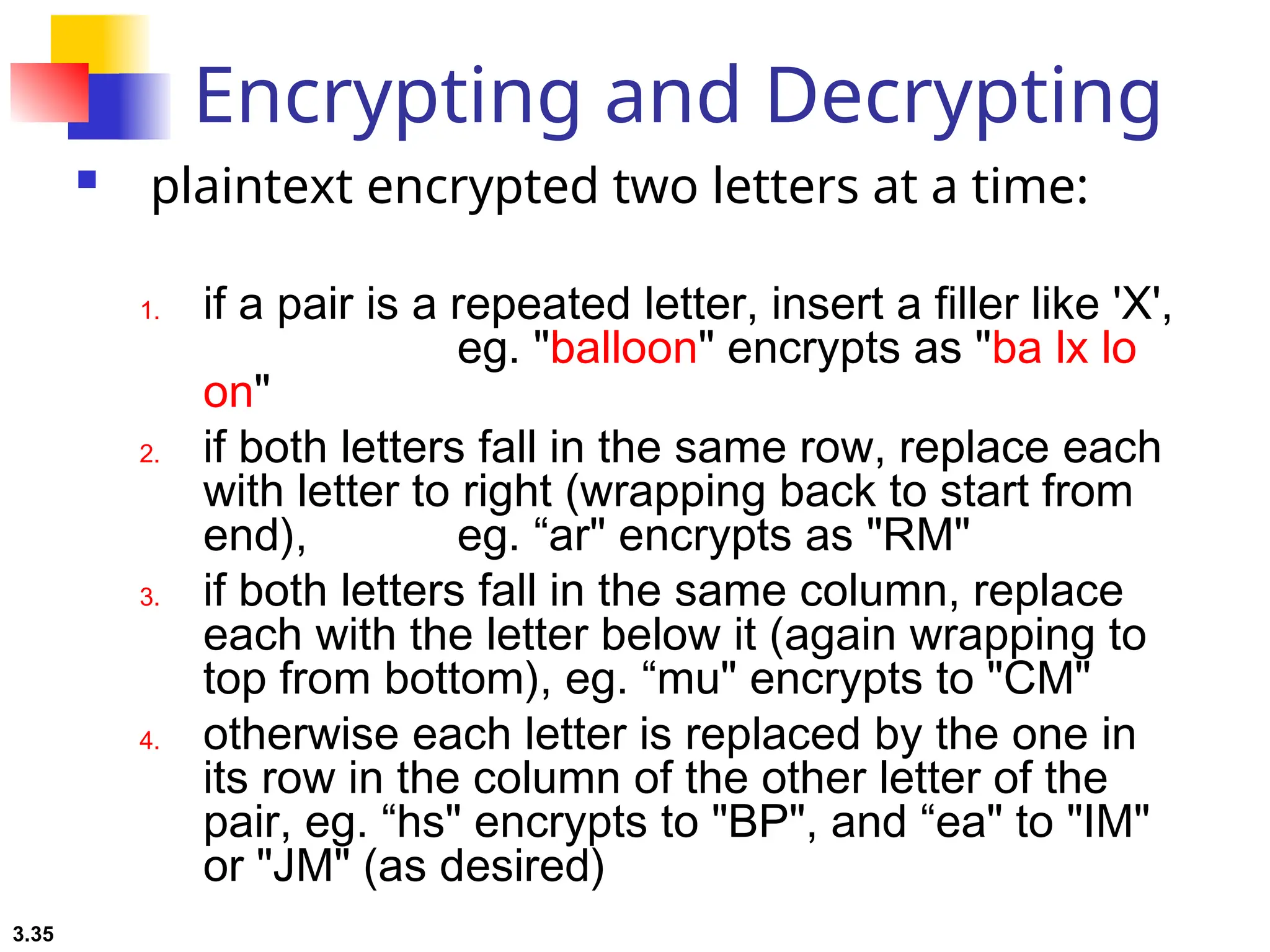
 plaintext encrypted two letters at a time:
1. if a pair is a repeated letter, insert a filler like 'X',
eg. "balloon" encrypts as "ba lx lo
on"
2. if both letters fall in the same row, replace each
with letter to right (wrapping back to start from
end), eg. “ar" encrypts as "RM"
3. if both letters fall in the same column, replace
each with the letter below it (again wrapping to
top from bottom), eg. “mu" encrypts to "CM"
4. otherwise each letter is replaced by the one in
its row in the column of the other letter of the
pair, eg. “hs" encrypts to "BP", and “ea" to "IM"
or "JM" (as desired)
3.36
Ex:
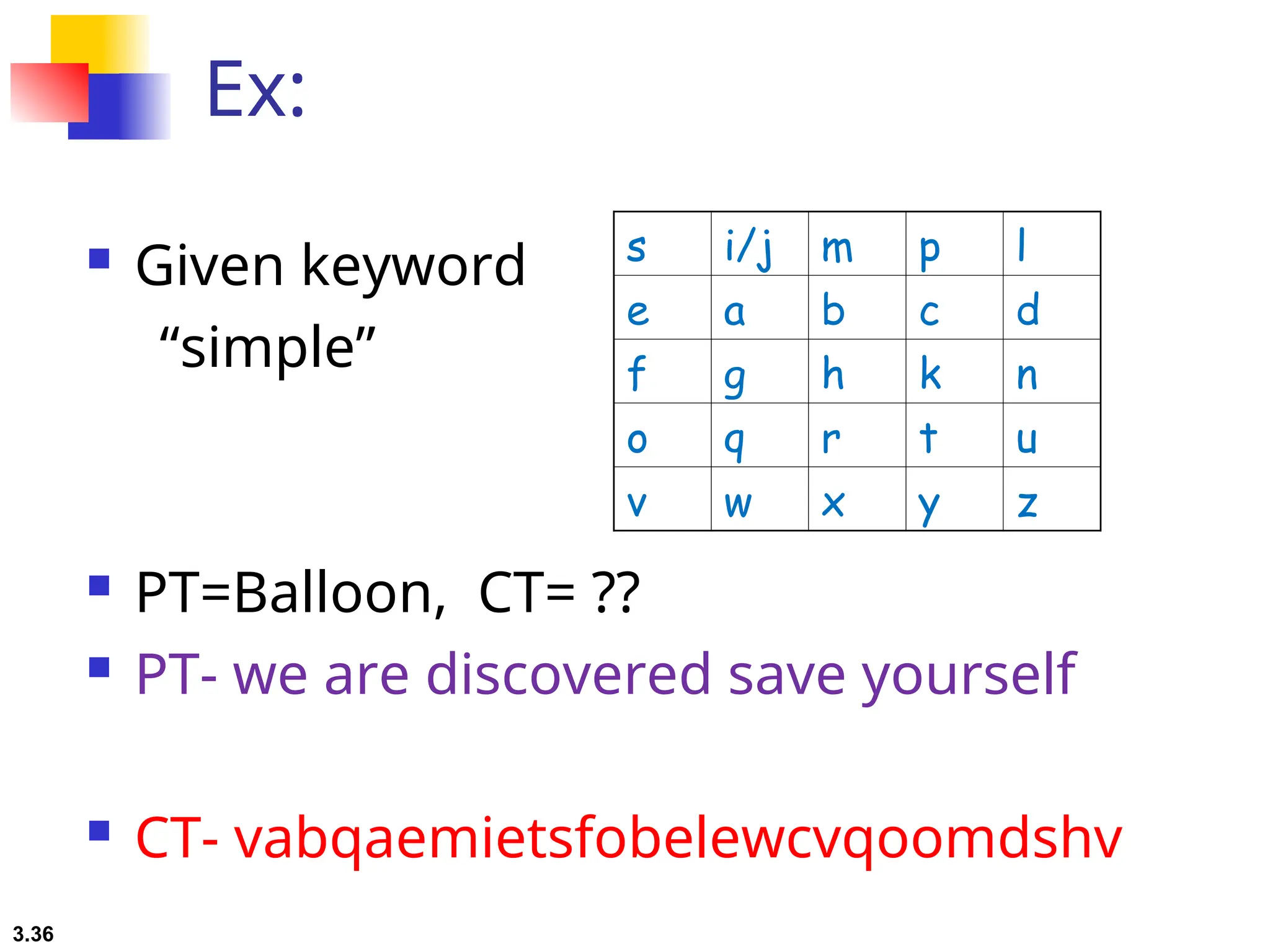
 Given keyword
“simple”
 PT=Balloon, CT= ??
 PT- we are discovered save yourself
 CT- vabqaemietsfobelewcvqoomdshv
s i/j m p l
e a b c d
f g h k n
o q r t u
v w x y z
3.37
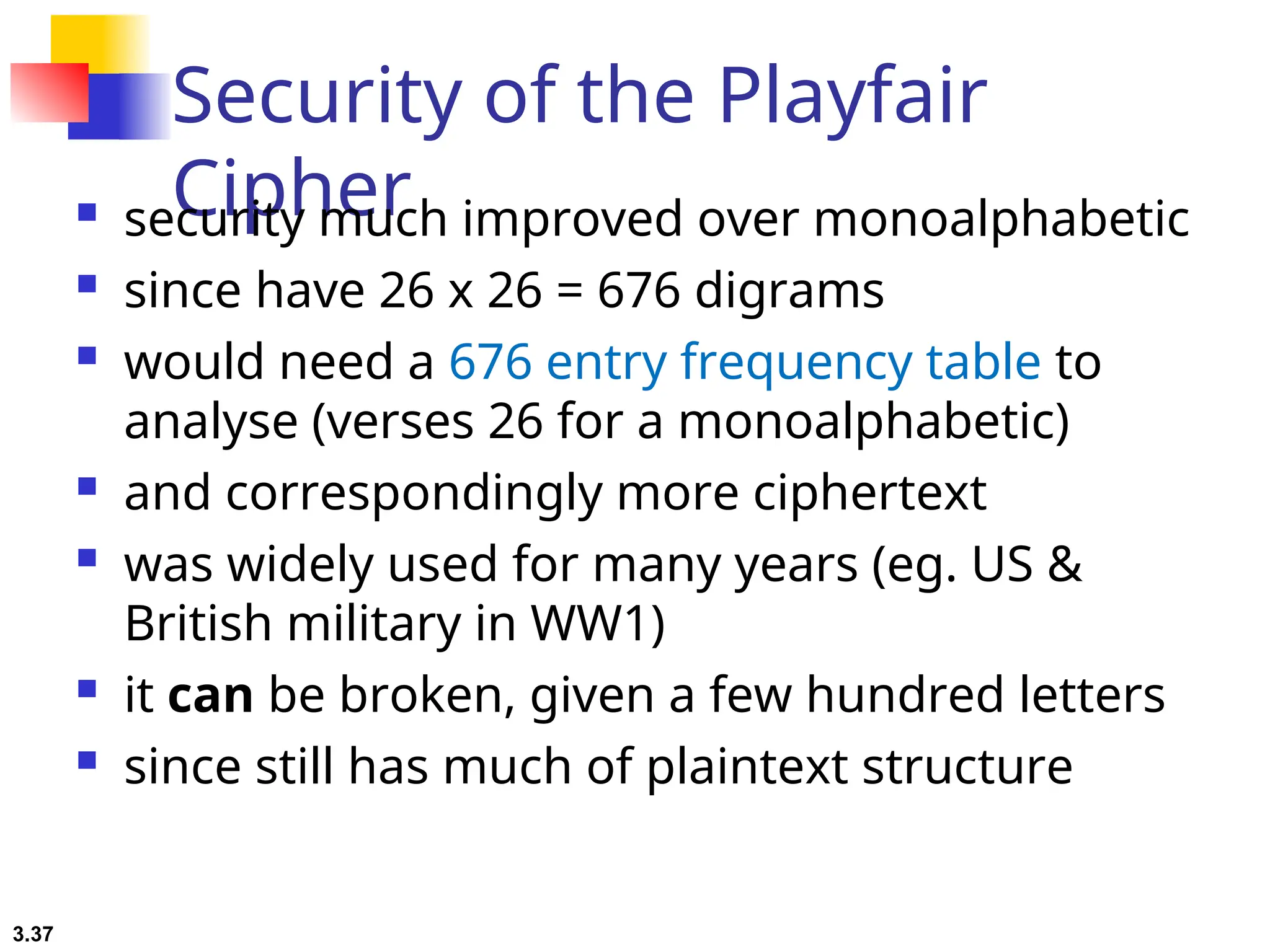
Security of the Playfair
Cipher
 security much improved over monoalphabetic
 since have 26 x 26 = 676 digrams
 would need a 676 entry frequency table to
analyse (verses 26 for a monoalphabetic)
 and correspondingly more ciphertext
 was widely used for many years (eg. US &
British military in WW1)
 it can be broken, given a few hundred letters
 since still has much of plaintext structure
3.38
3.2.2 Continued
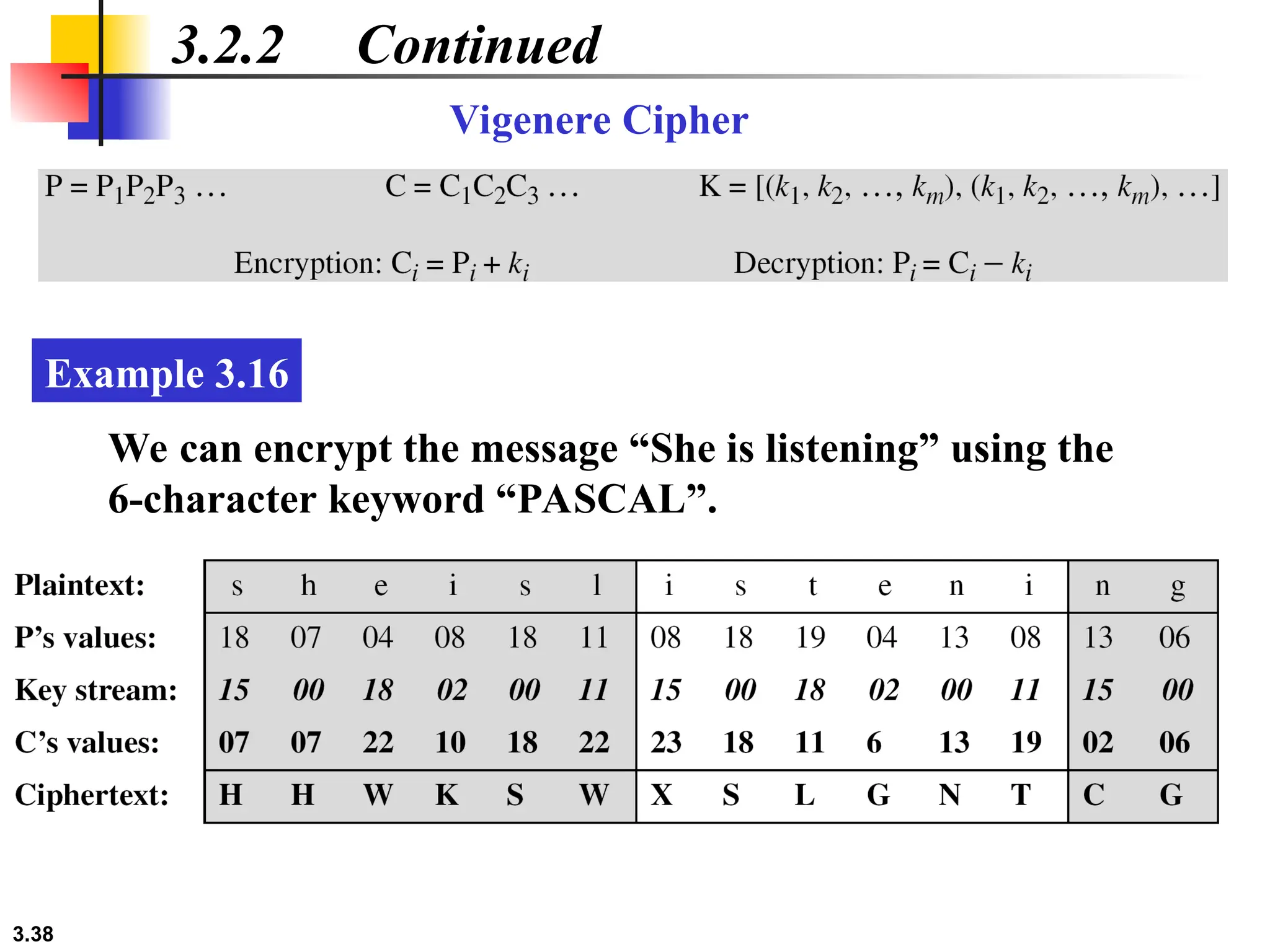
Vigenere Cipher
We can encrypt the message “She is listening” using the
6-character keyword “PASCAL”.
Example 3.16
3.39
3.2.2 Continued
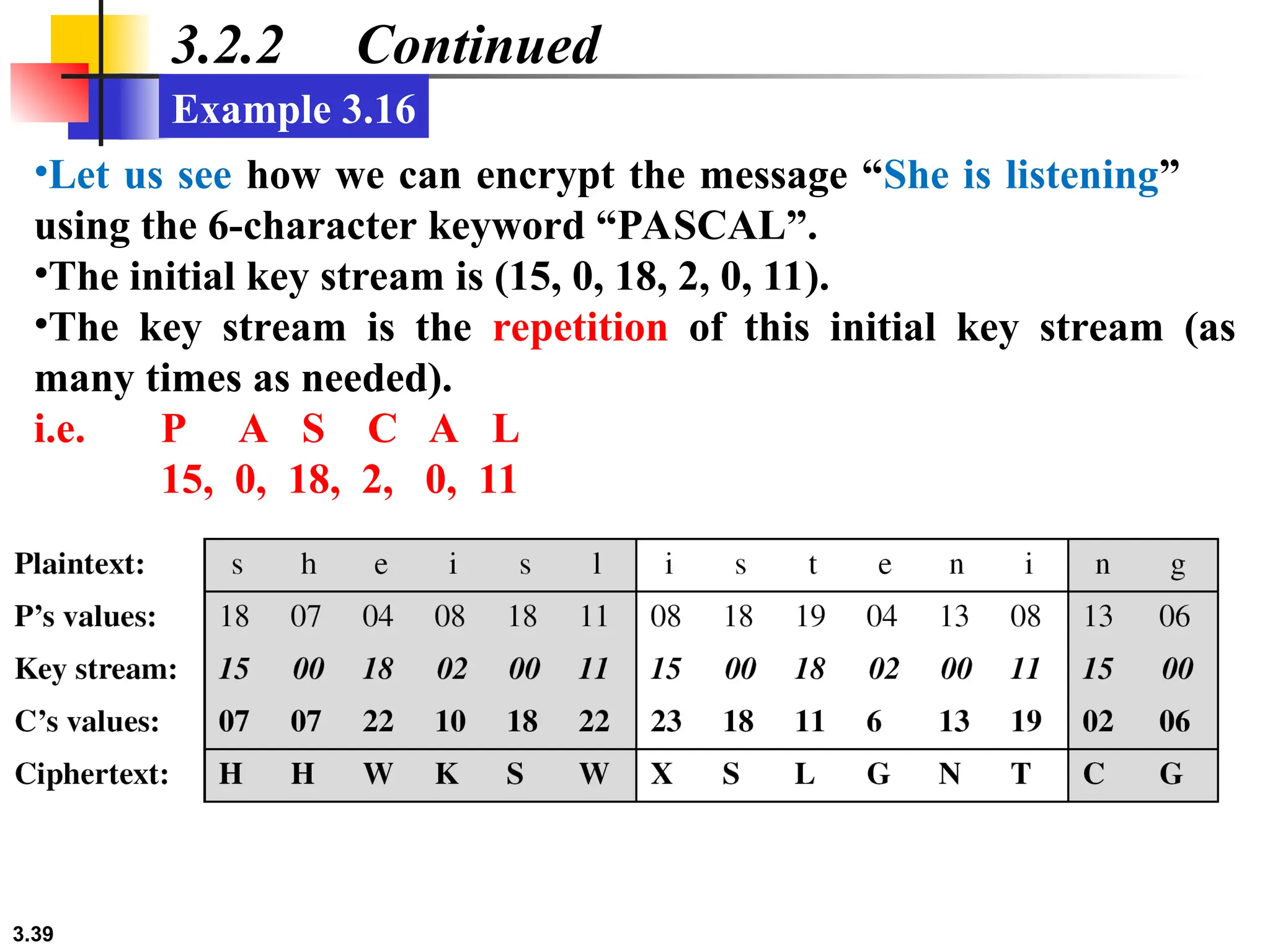
•Let us see how we can encrypt the message “She is listening”
using the 6-character keyword “PASCAL”.
•The initial key stream is (15, 0, 18, 2, 0, 11).
•The key stream is the repetition of this initial key stream (as
many times as needed).
i.e. P A S C A L
15, 0, 18, 2, 0, 11
Example 3.16
3.40
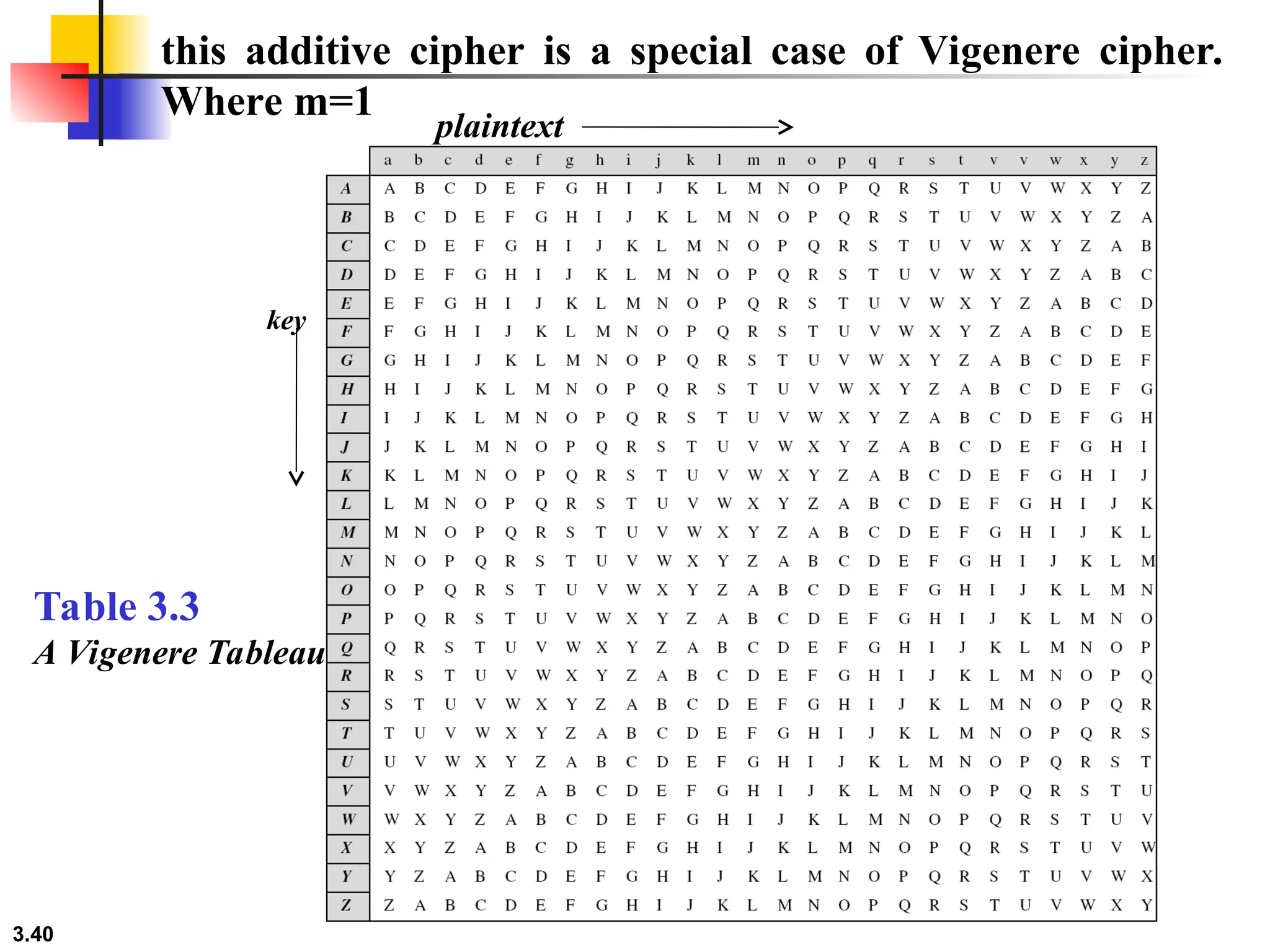
this additive cipher is a special case of Vigenere cipher.
Where m=1
Table 3.3
A Vigenere Tableau
plaintext
key
3.41
3.2.2 Continued
Vigenere Cipher (Crypanalysis)
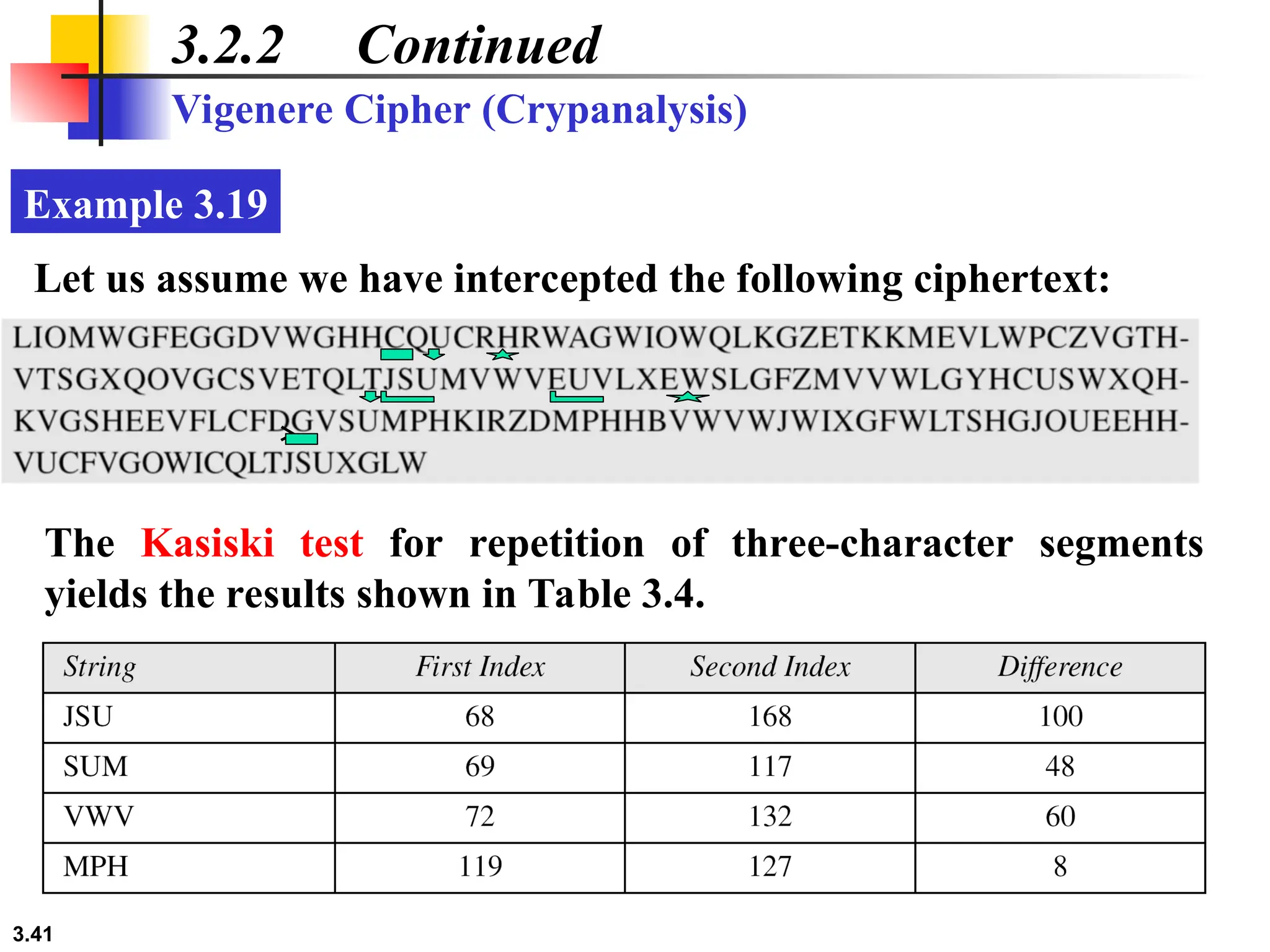
Let us assume we have intercepted the following ciphertext:
Example 3.19
The Kasiski test for repetition of three-character segments
yields the results shown in Table 3.4.
3.42
3.2.2 Continued
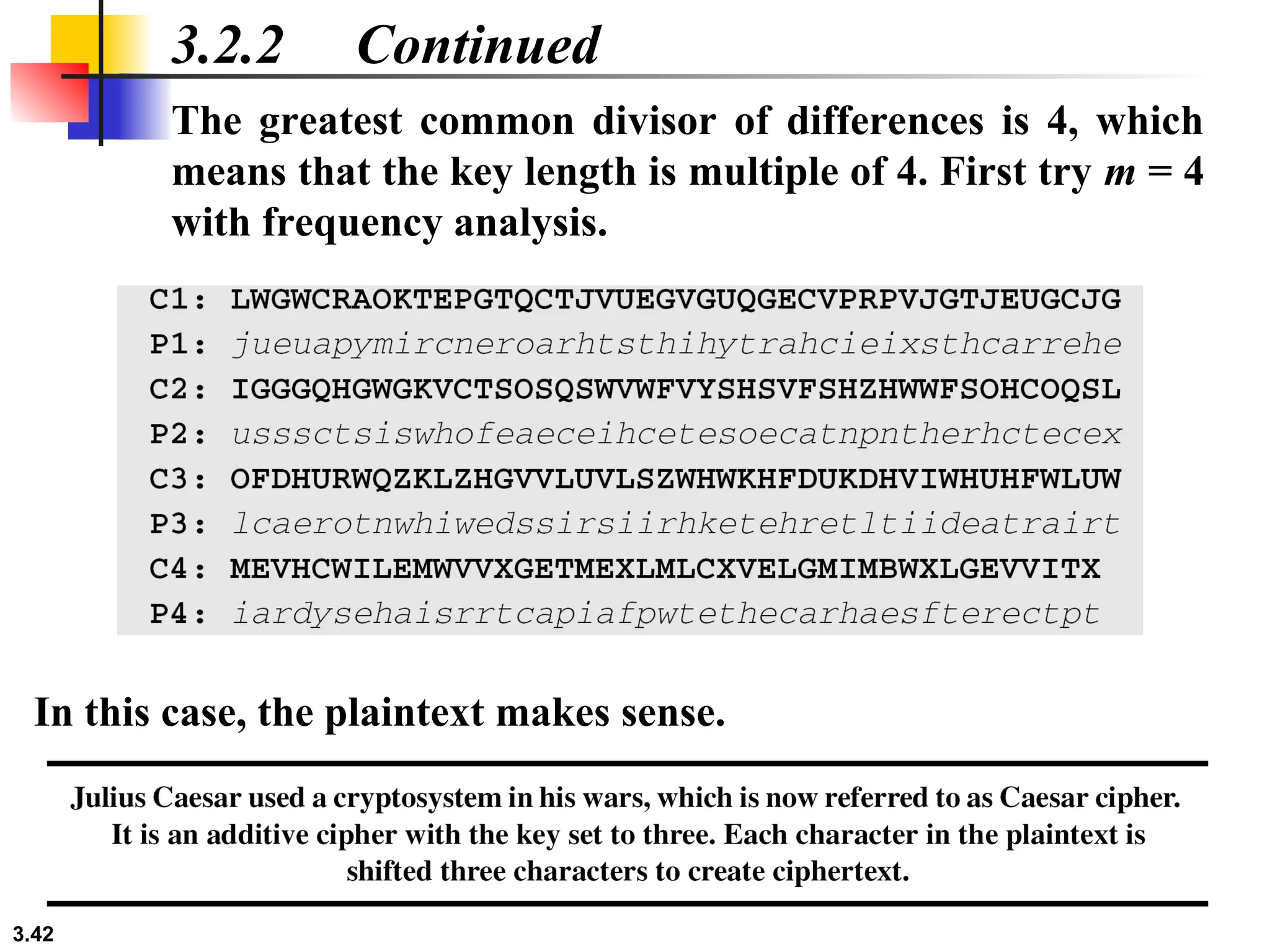
The greatest common divisor of differences is 4, which
means that the key length is multiple of 4. First try m = 4
with frequency analysis.
In this case, the plaintext makes sense.
3.43
Example
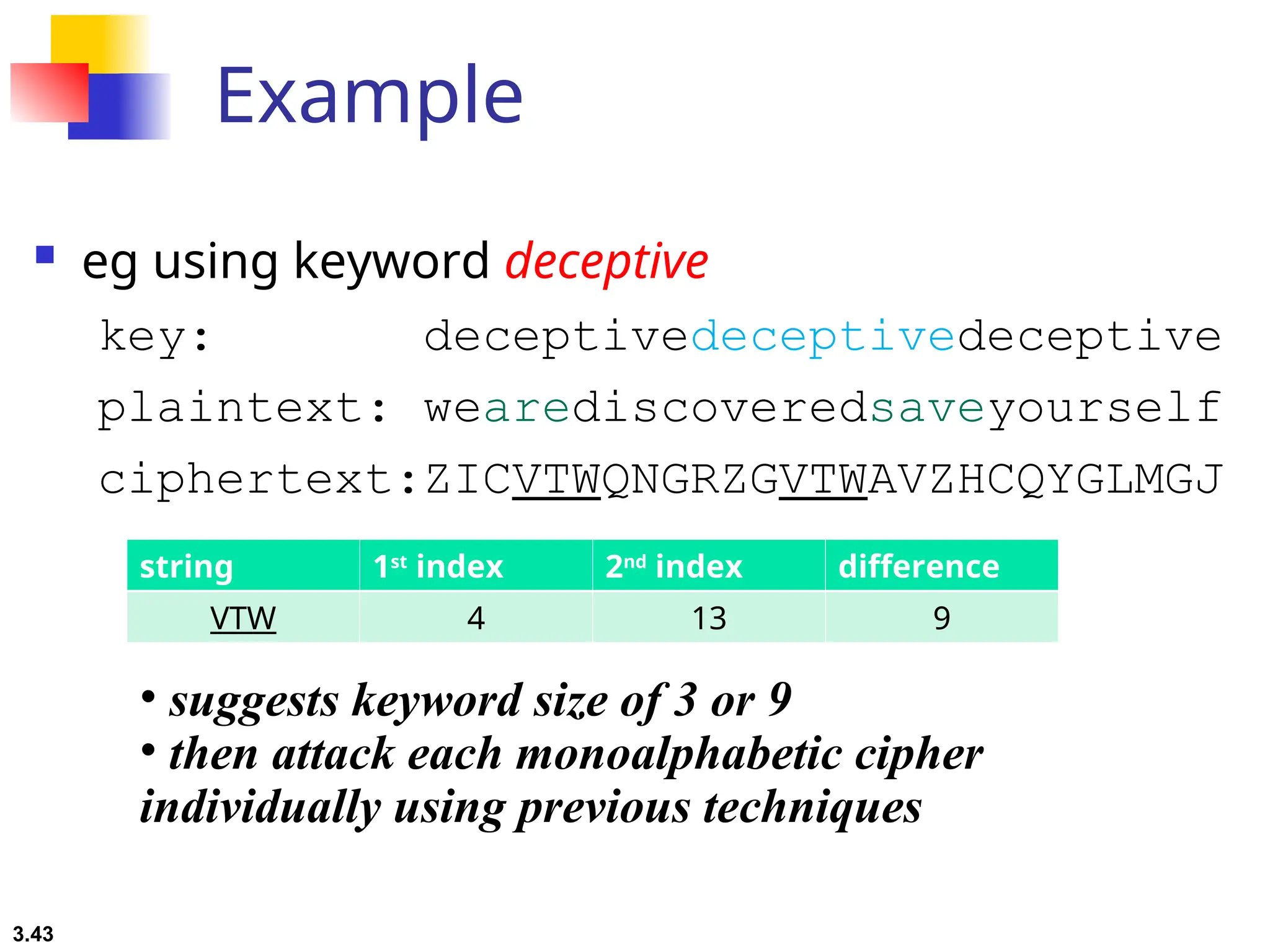
 eg using keyword deceptive
key: deceptivedeceptivedeceptive
plaintext: wearediscoveredsaveyourself
ciphertext:ZICVTWQNGRZGVTWAVZHCQYGLMGJ
string 1st
index 2nd
index difference
VTW 4 13 9
• suggests keyword size of 3 or 9
• then attack each monoalphabetic cipher
individually using previous techniques
3.44
3.2.2 Continued
• if a truly random key as long as the
message is used, the cipher will be secure
• called a One-Time pad
• is unbreakable since ciphertext bears no
statistical relationship to the plaintext
• since for any plaintext & any ciphertext
there exists a key mapping one to other
• can only use the key once though
• have problem of safe distribution of key
One-Time Pad
45
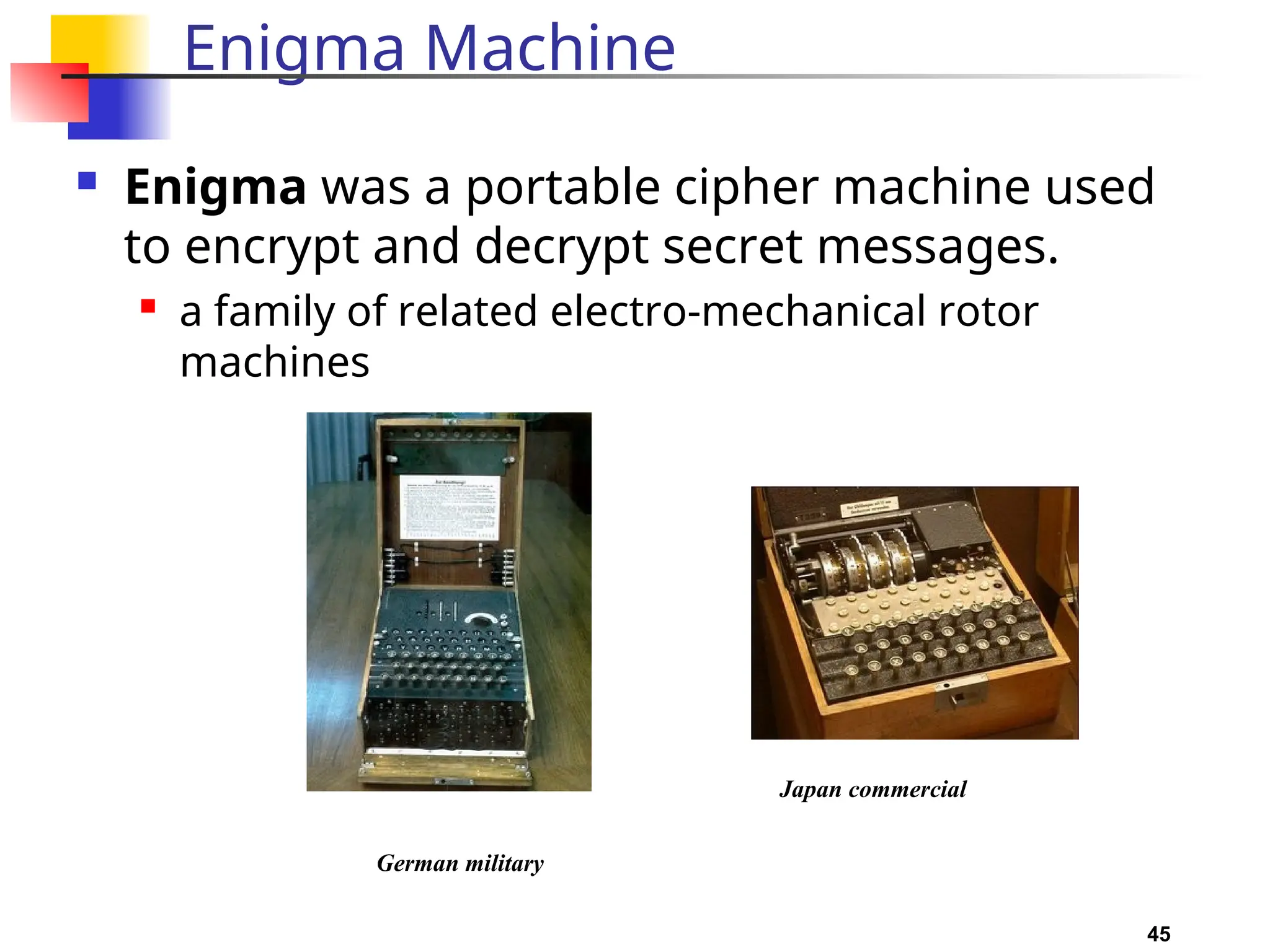
Enigma Machine
 Enigma was a portable cipher machine used
to encrypt and decrypt secret messages.
 a family of related electro-mechanical rotor
machines
German military
Japan commercial
46
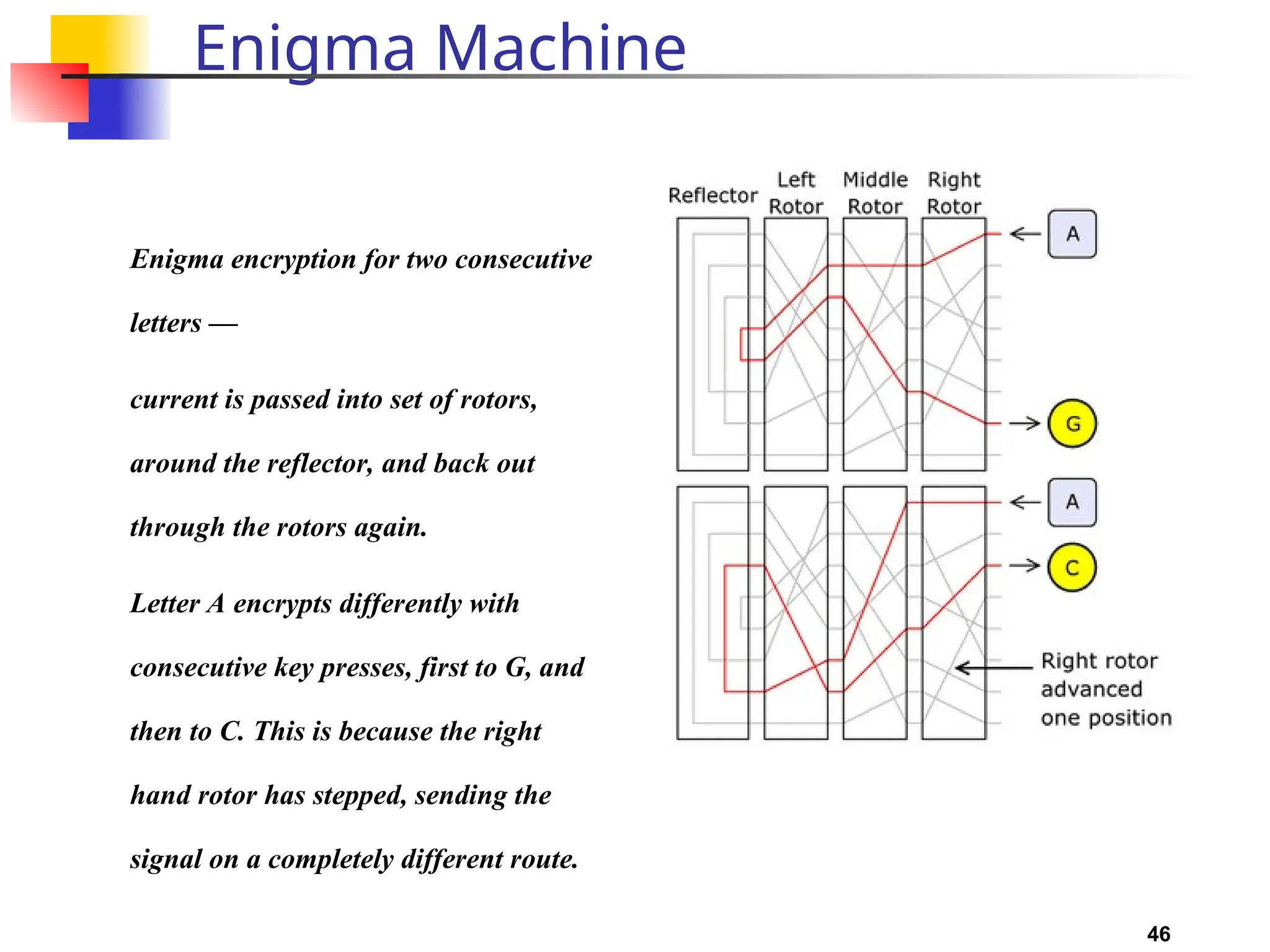
Enigma Machine
Enigma encryption for two consecutive
letters —
current is passed into set of rotors,
around the reflector, and back out
through the rotors again.
Letter A encrypts differently with
consecutive key presses, first to G, and
then to C. This is because the right
hand rotor has stepped, sending the
signal on a completely different route.
47
Enigma
 the actual encipherment of a letter is performed
electrically.

When a key is pressed, the circuit is completed; current flows
through the various components and ultimately lights one of
many lamps, indicating the output letter.
 Current flows from a battery through the switch controlled by
the depressed key into a fixed entry wheel. This leads into the
rotor assembly (or scrambler), where the complex internal wiring
of each rotor results in the current passing from one rotor to
the next along a convoluted path. After passing through all the
rotors, current enters the reflector, which relays the signal back
out again through the rotors and the entry wheel — this time via
a different path — and, finally, to one of the lamps (the earliest
Enigma models do not have the reflector).
48
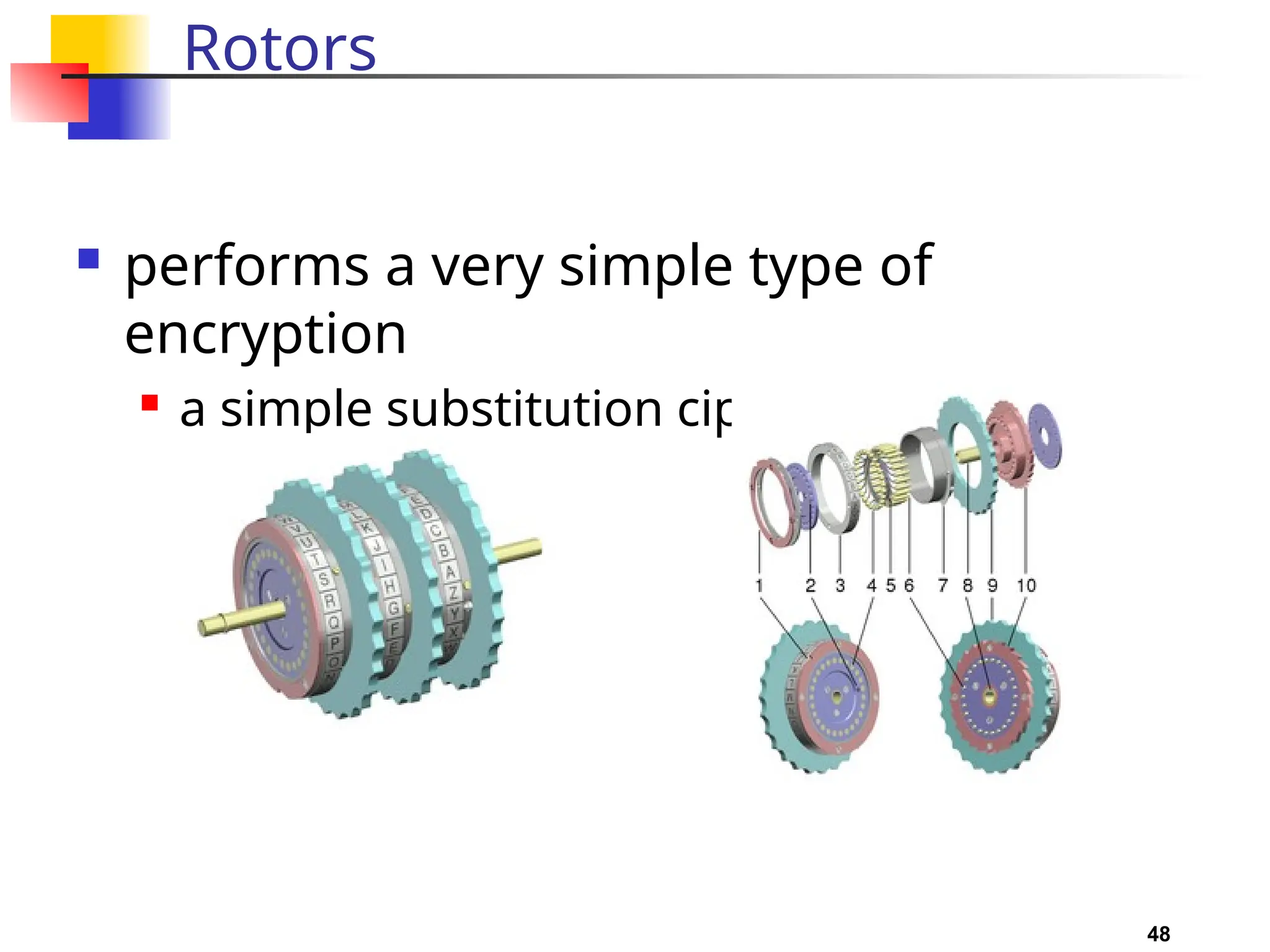
Rotors
 performs a very simple type of
encryption
 a simple substitution cipher
49
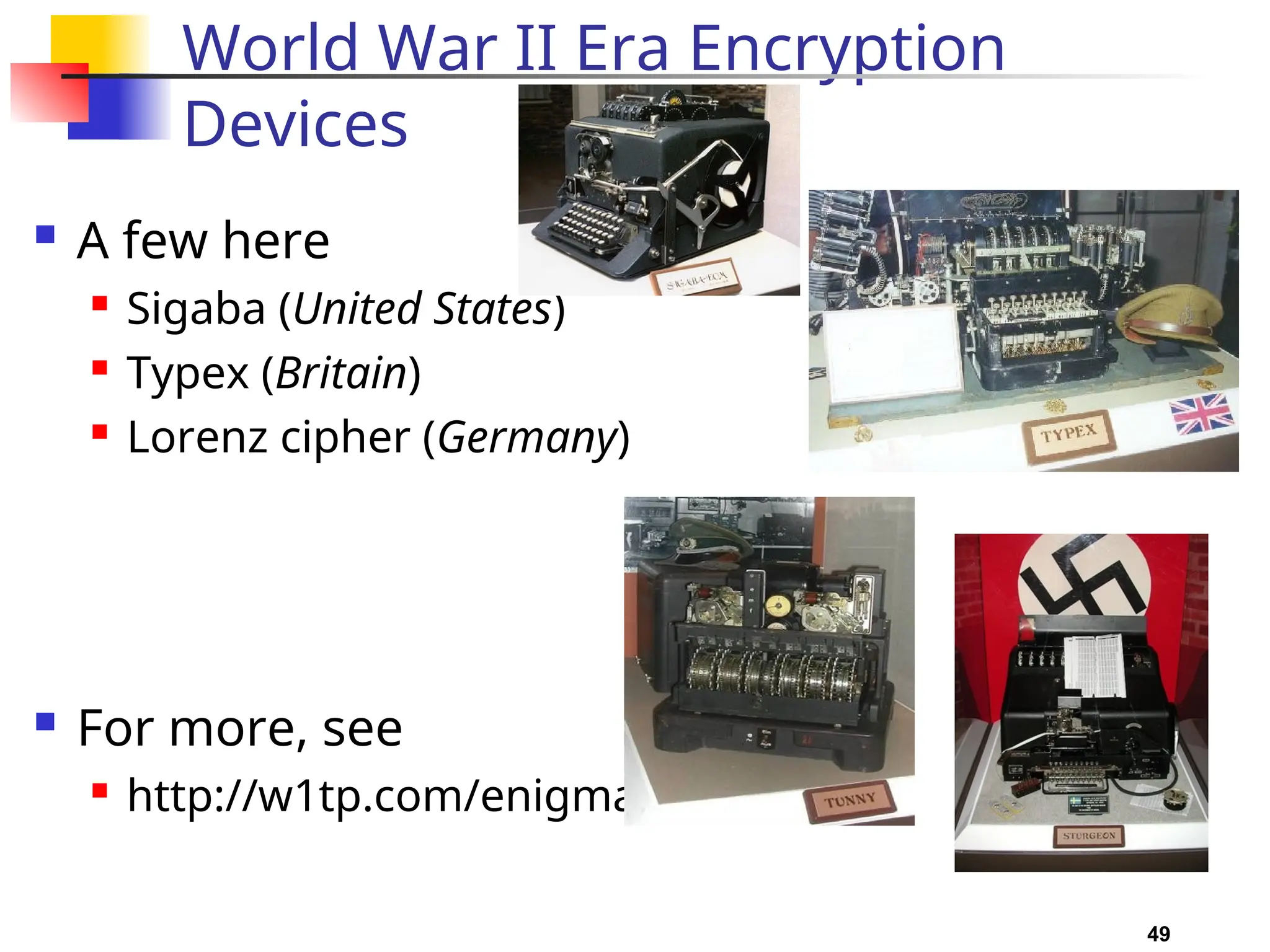
World War II Era Encryption
Devices
 A few here
 Sigaba (United States)
 Typex (Britain)
 Lorenz cipher (Germany)
 For more, see
 http://w1tp.com/enigma/
3.50
3-3 TRANSPOSITION CIPHERS
A transposition cipher does not substitute one symbol for
another, instead it changes the location of the symbols.
3.3.1 Keyless Transposition Ciphers
3.3.2 Keyed Transposition Ciphers
3.3.3 Combining Two Approaches
Topics discussed in this section:
A transposition cipher reorders symbols.
Note
•these hide the message by rearranging the letter order
without altering the actual letters used.
3.51
3.3.1 Keyless Transposition Ciphers
Simple transposition ciphers, which were used in the
past, are keyless.
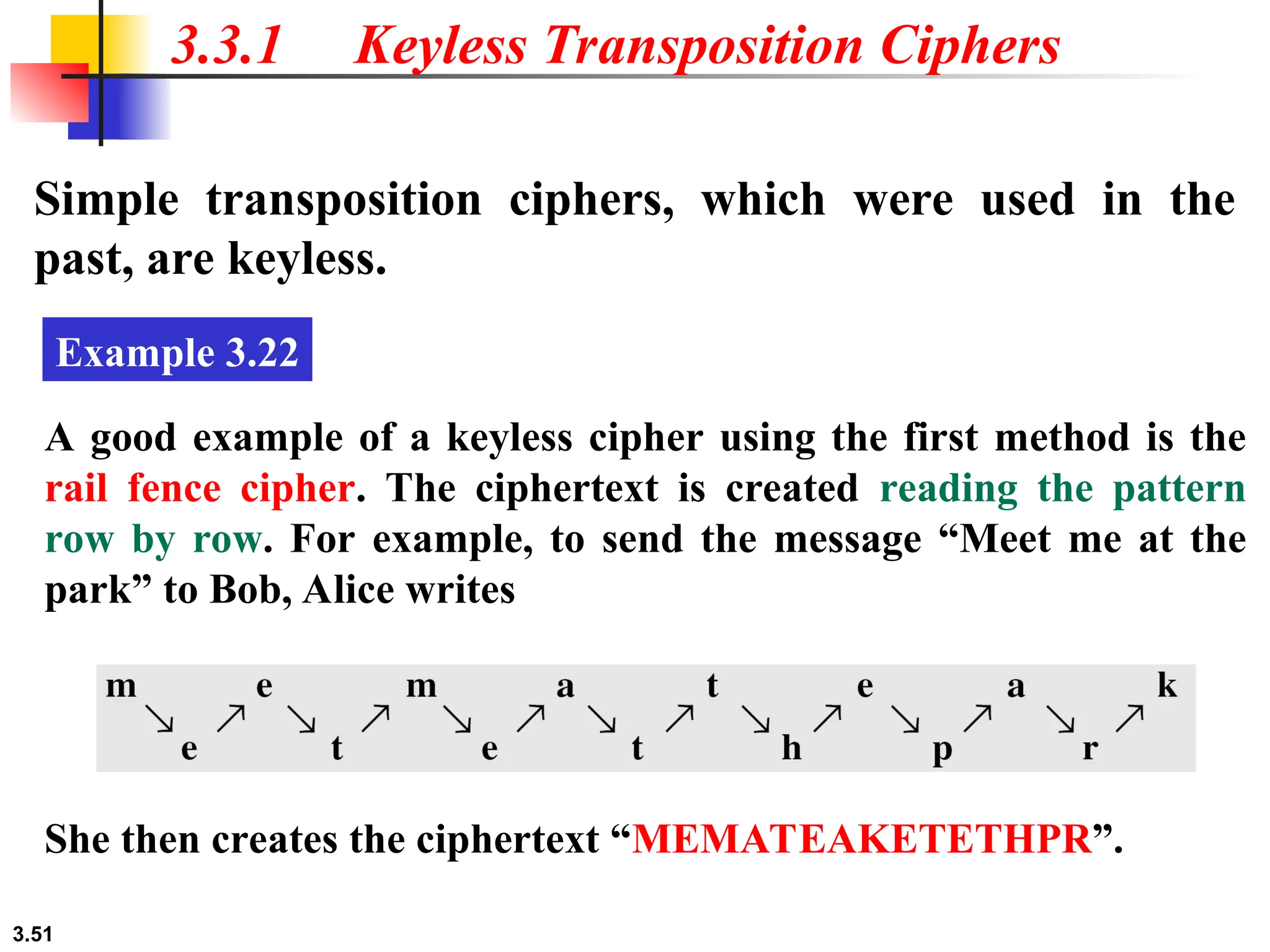
A good example of a keyless cipher using the first method is the
rail fence cipher. The ciphertext is created reading the pattern
row by row. For example, to send the message “Meet me at the
park” to Bob, Alice writes
Example 3.22
She then creates the ciphertext “MEMATEAKETETHPR”.
3.52
3.3.1 Continued
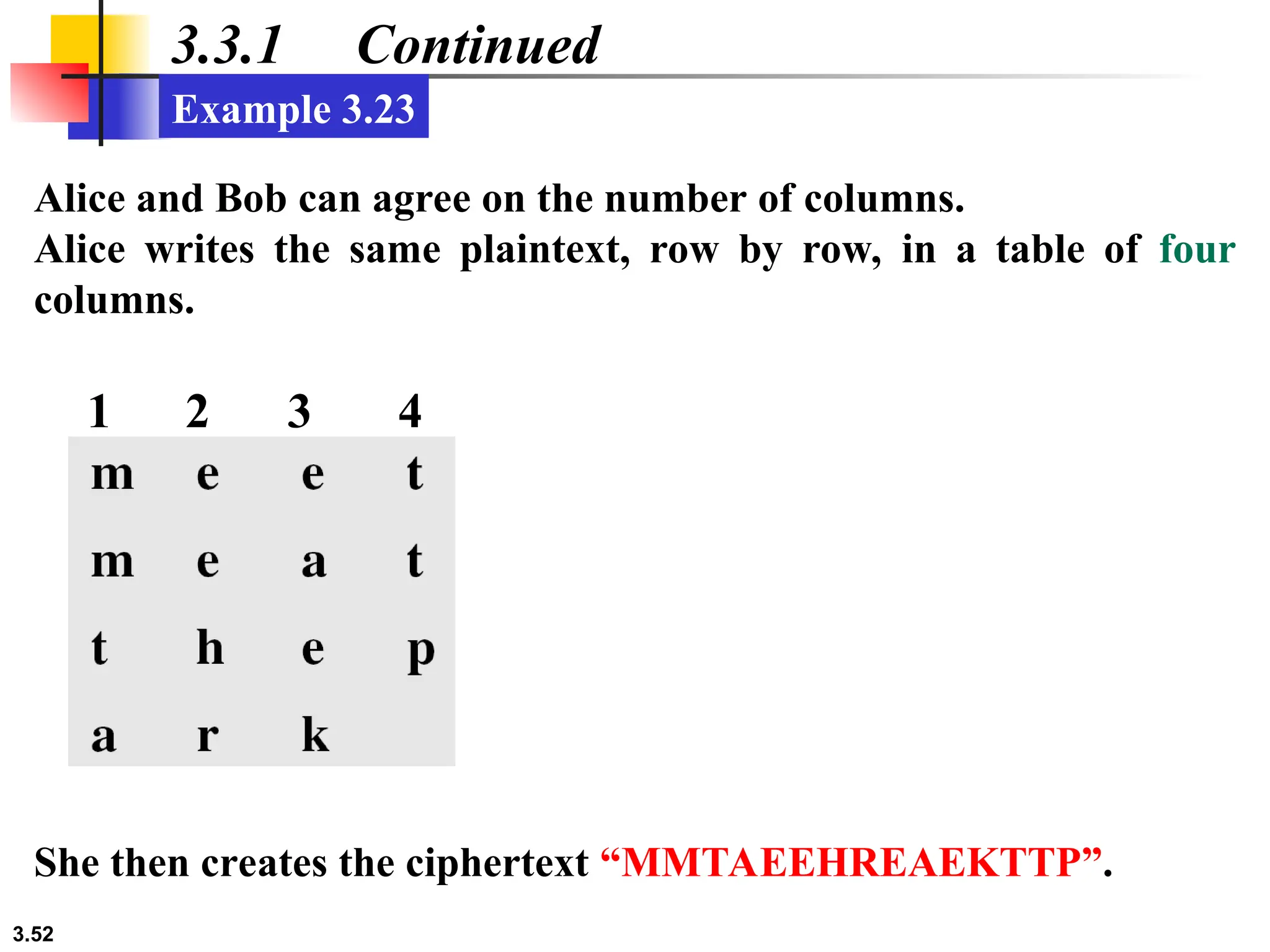
Alice and Bob can agree on the number of columns.
Alice writes the same plaintext, row by row, in a table of four
columns.
Example 3.23
She then creates the ciphertext “MMTAEEHREAEKTTP”.
1 2 3 4
3.53
3.3.2 Keyed Transposition Ciphers
•The keyless ciphers permute the characters
•by writing plaintext in one way and reading it in
another way.
•The permutation is done on the whole plaintext to
create the whole ciphertext.
•Another method is to divide the plaintext into
groups of predetermined size, called blocks, and then
use a key to permute the characters in each block
separately.
3.54
3.3.2 Continued
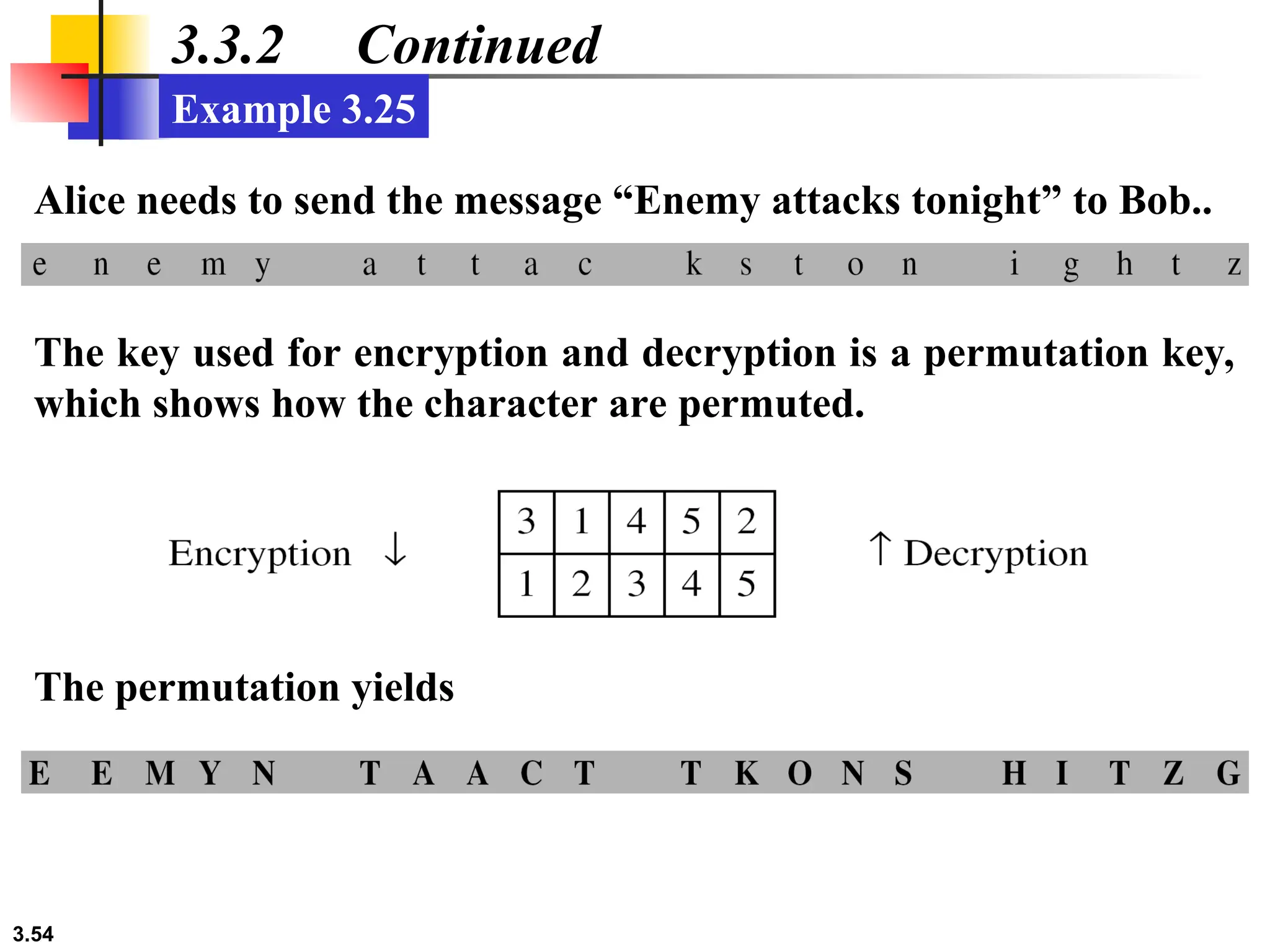
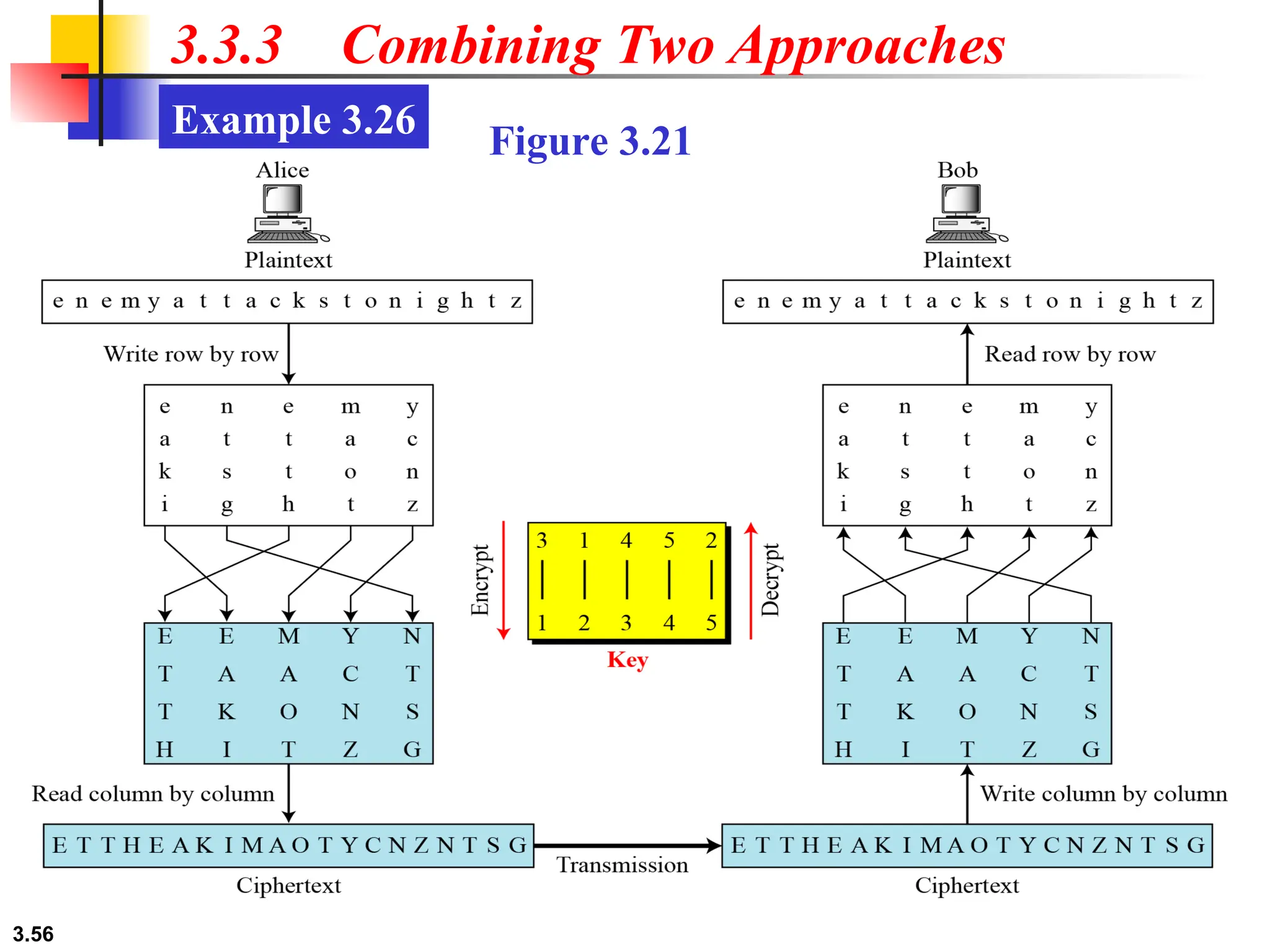
Alice needs to send the message “Enemy attacks tonight” to Bob..
Example 3.25
The key used for encryption and decryption is a permutation key,
which shows how the character are permuted.
The permutation yields
3.55
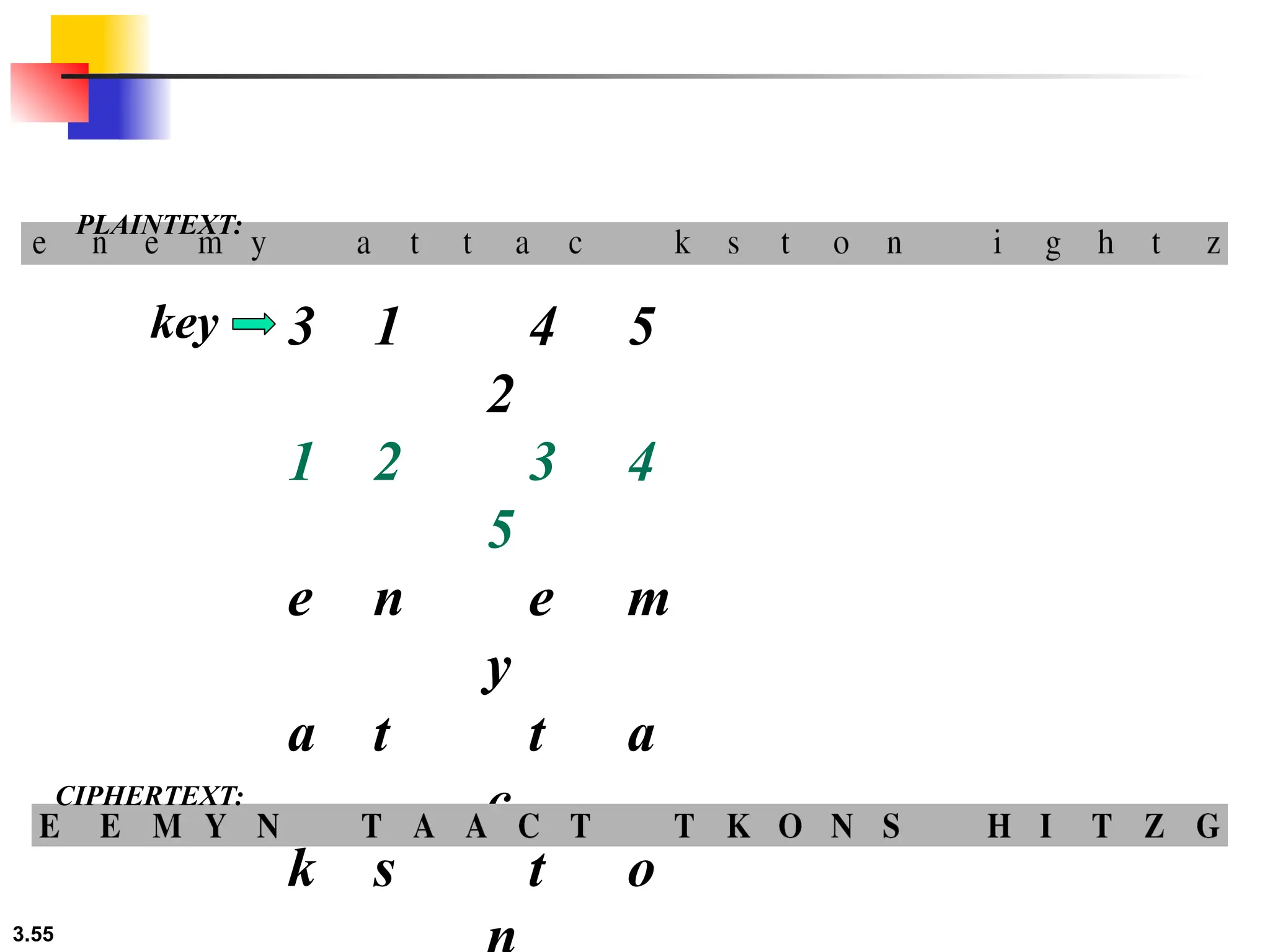
3 1 4 5
2
1 2 3 4
5
e n e m
y
a t t a
c
k s t o
key
PLAINTEXT:
CIPHERTEXT:
3.56
3.3.3 Combining Two Approaches
Example 3.26 Figure 3.21
3.57
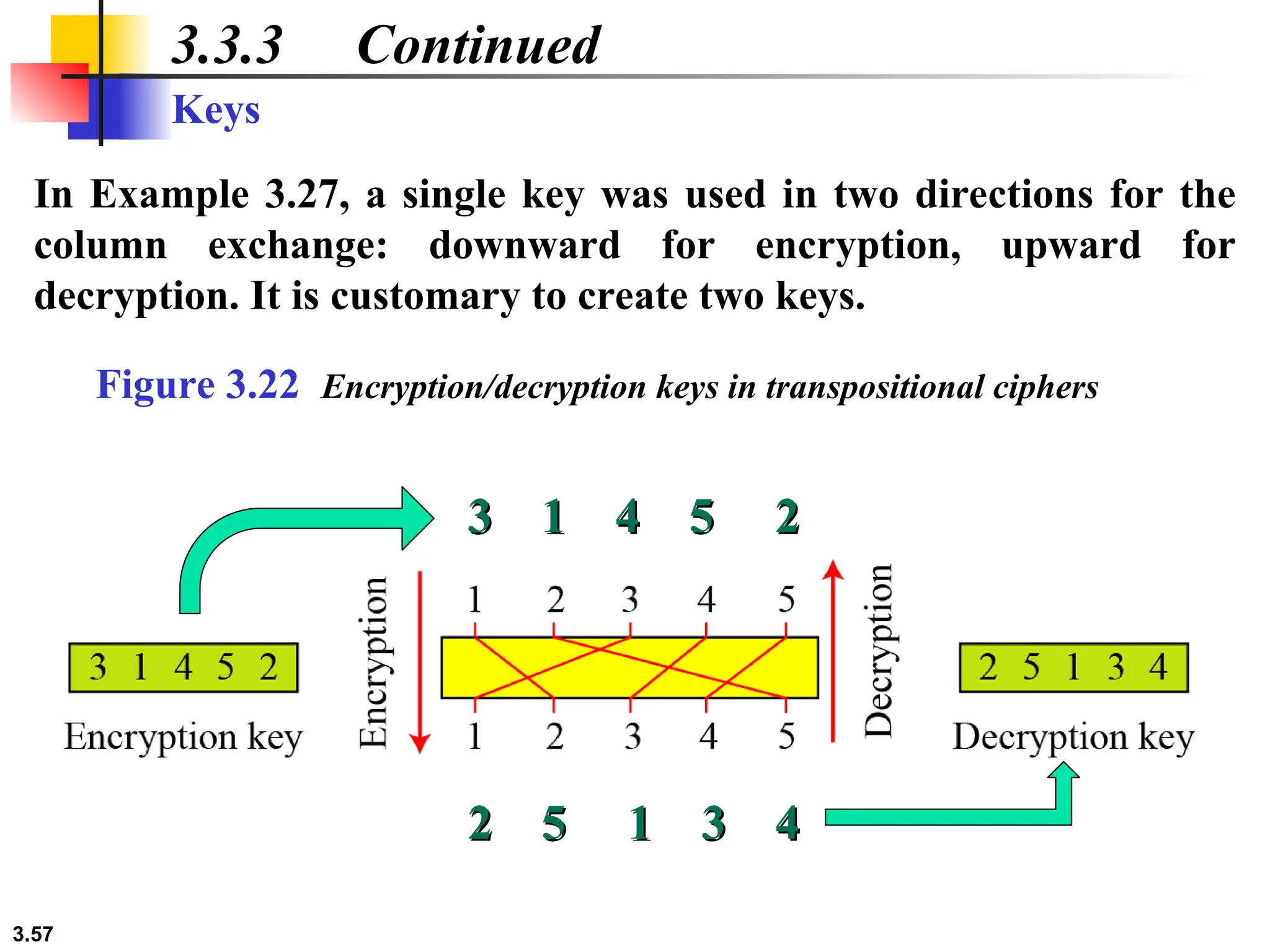
Figure 3.22 Encryption/decryption keys in transpositional ciphers
3.3.3 Continued
Keys
In Example 3.27, a single key was used in two directions for the
column exchange: downward for encryption, upward for
decryption. It is customary to create two keys.
3 1 4 5 2
3 1 4 5 2
2 5 1 3 4
2 5 1 3 4
3.58
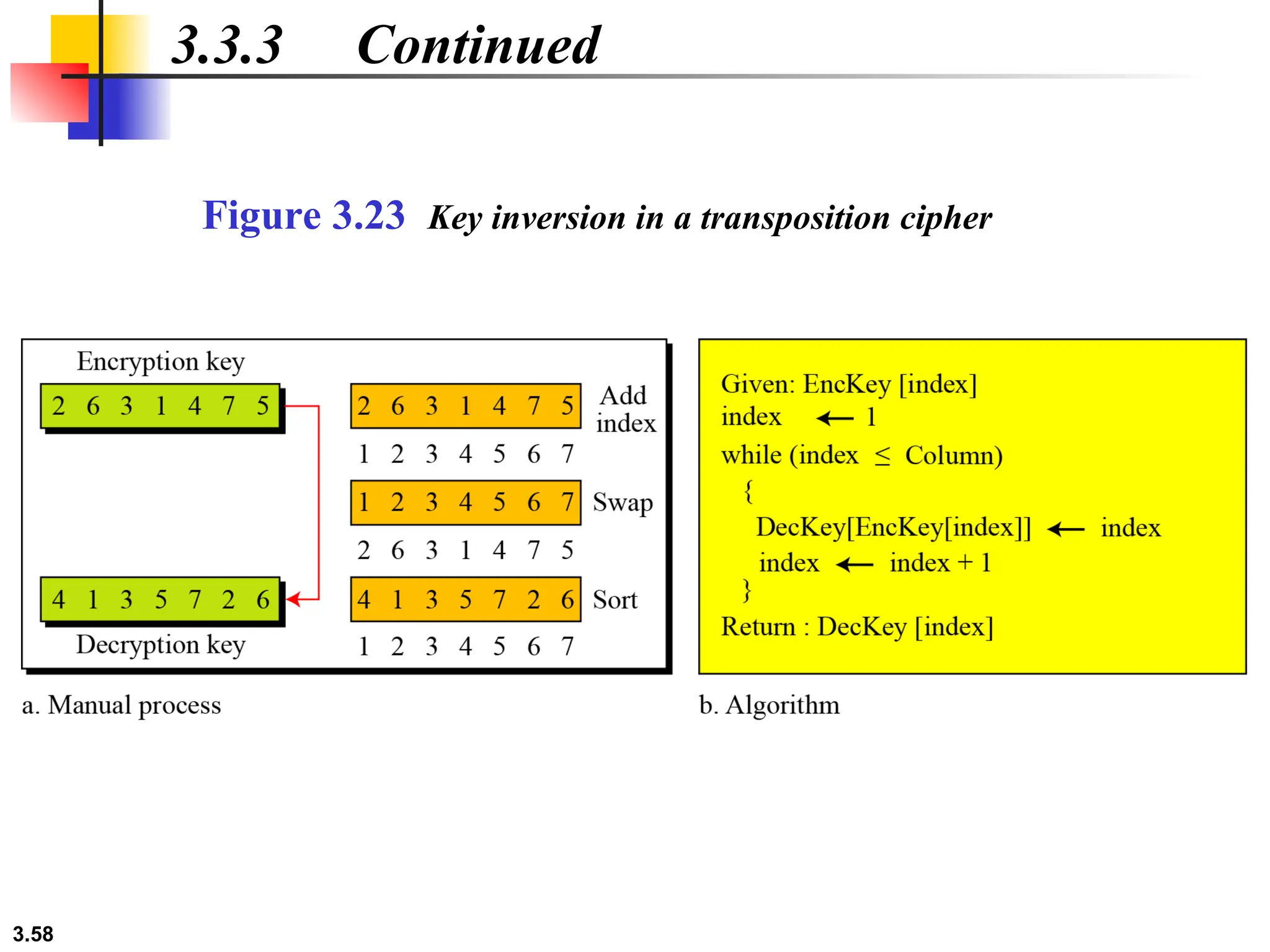
Figure 3.23 Key inversion in a transposition cipher
3.3.3 Continued
3.59
2 6 3 1 4 7 5
1 2 3 4 5 6 7
1 2 3 4 5 6 7
4 1 3 5 7 2 6
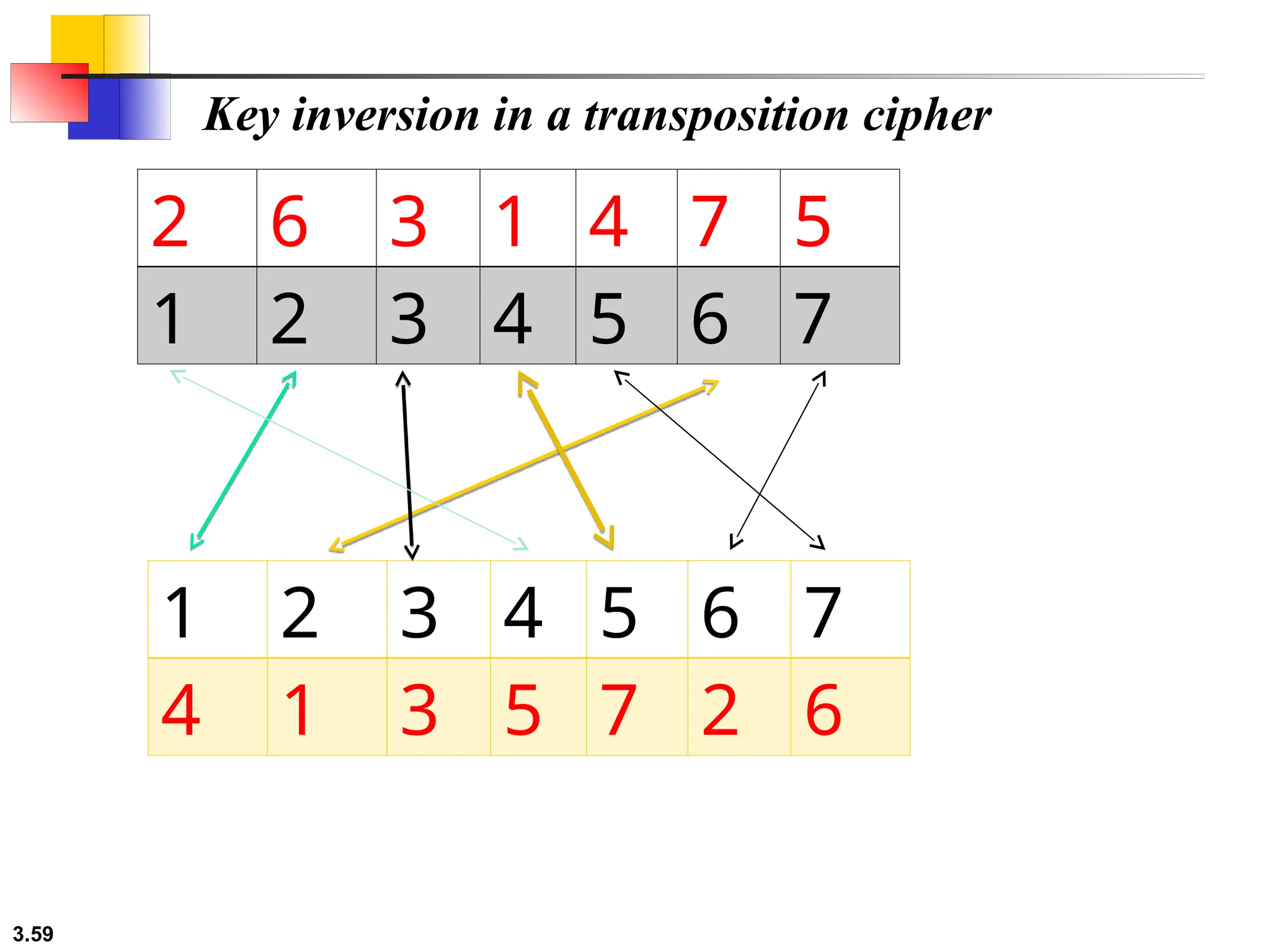
Key inversion in a transposition cipher
3.60
3.3.3 Continued
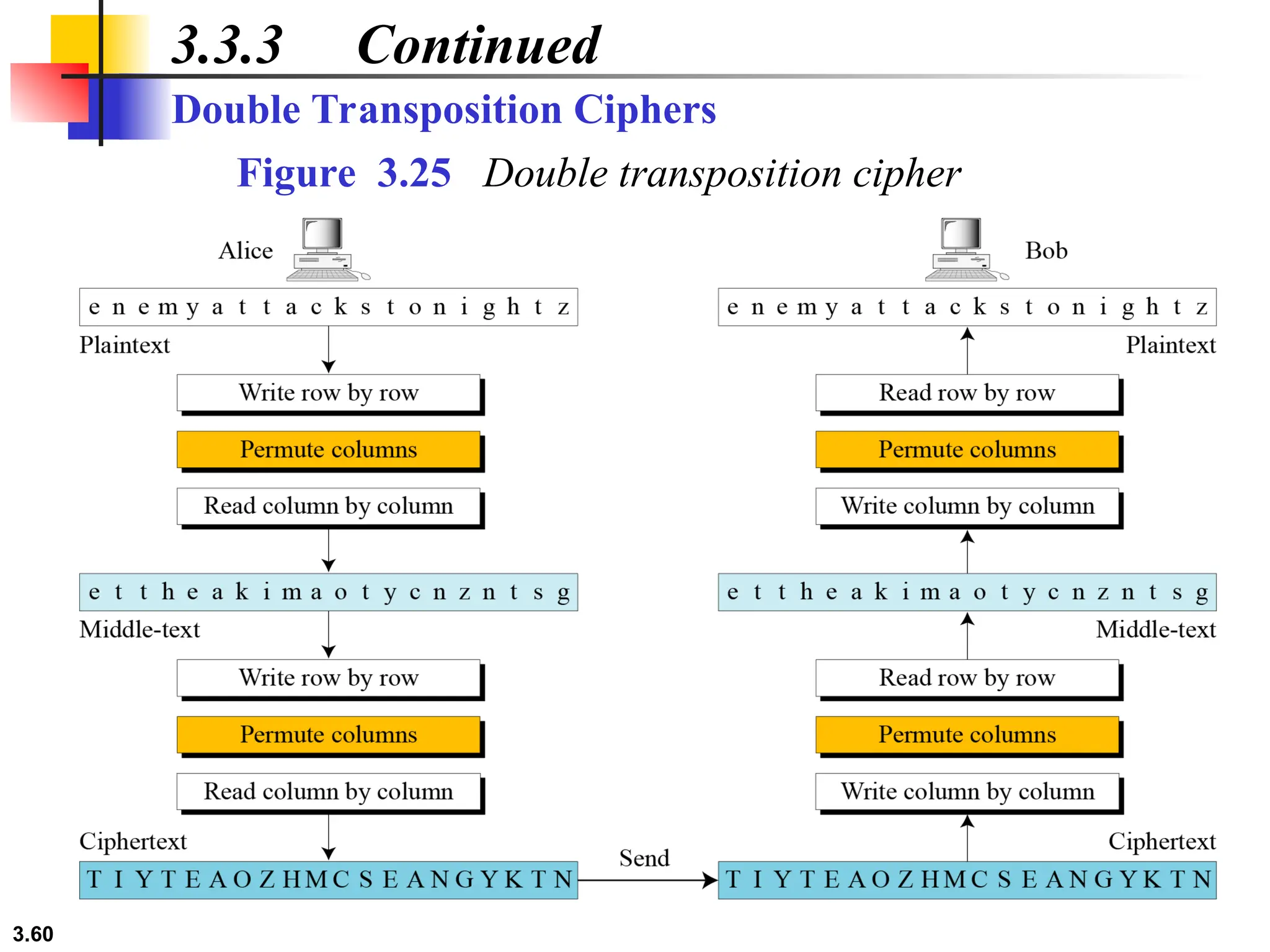
Double Transposition Ciphers
Figure 3.25 Double transposition cipher
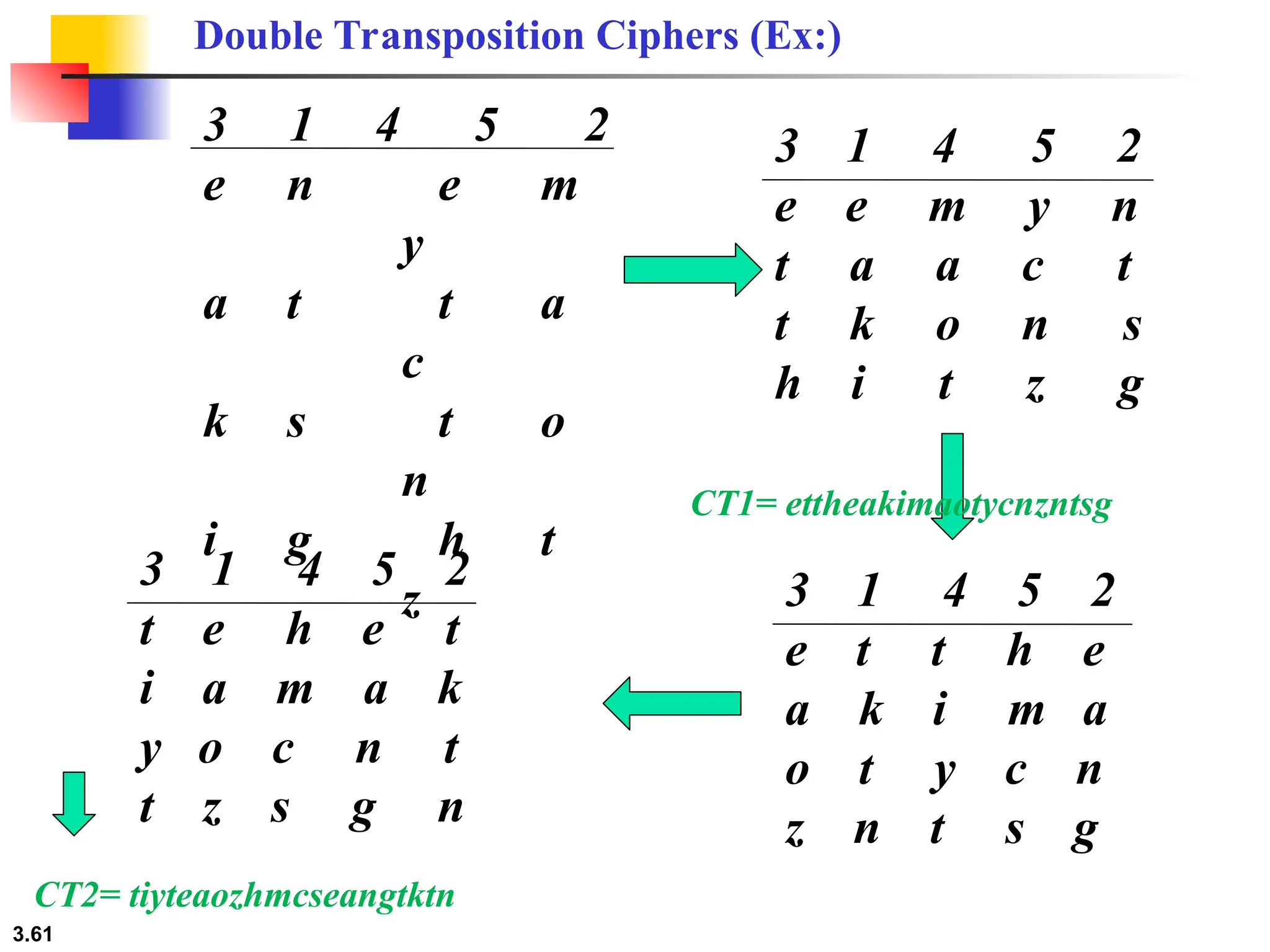
3.61
3 1 4 5 2
e n e m
y
a t t a
c
k s t o
n
i g h t
z
3 1 4 5 2
e e m y n
t a a c t
t k o n s
h i t z g
3 1 4 5 2
e t t h e
a k i m a
o t y c n
z n t s g
Double Transposition Ciphers (Ex:)
CT1= ettheakimaotycnzntsg
3 1 4 5 2
t e h e t
i a m a k
y o c n t
t z s g n
CT2= tiyteaozhmcseangtktn
3.62
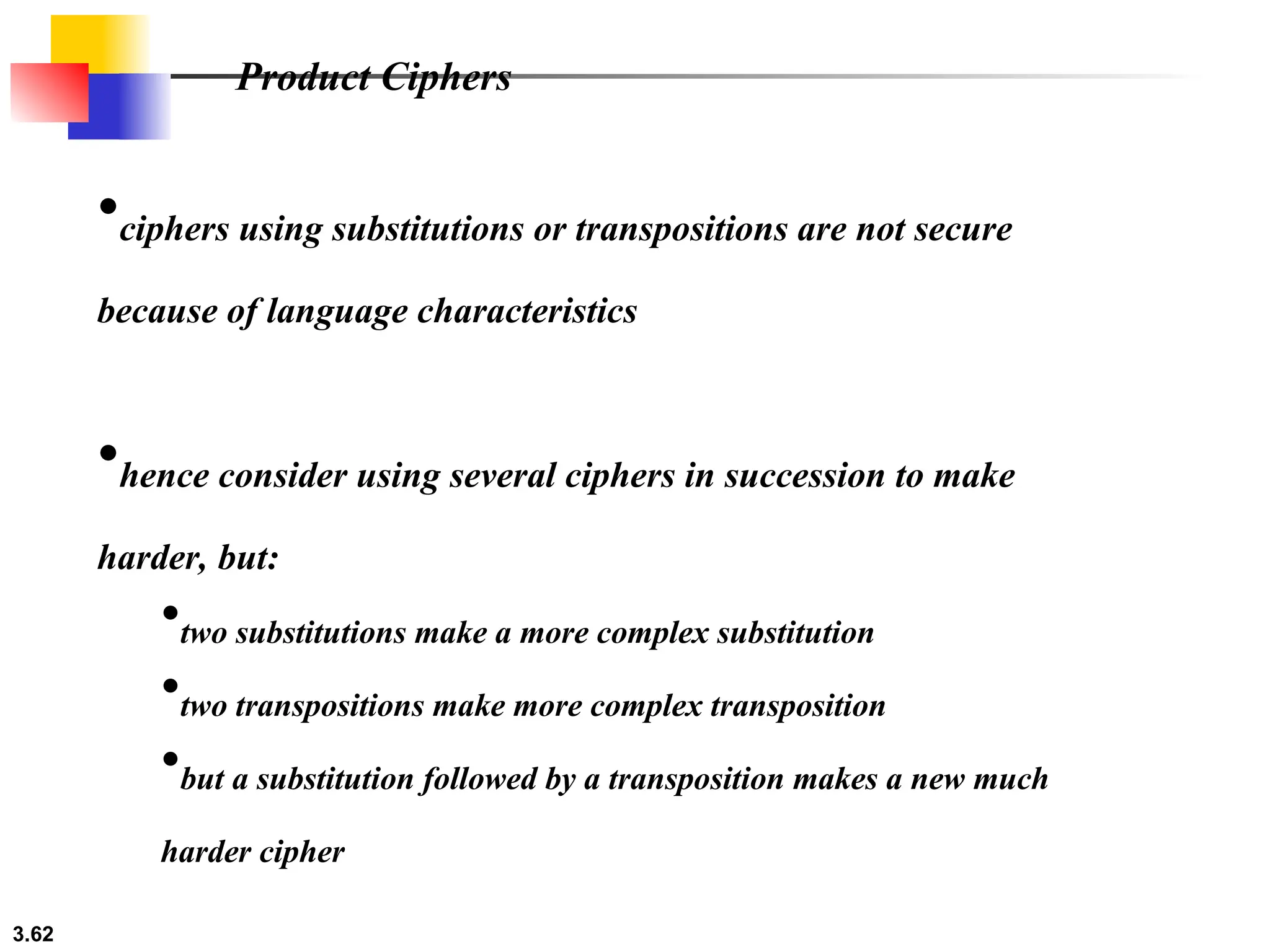
•ciphers using substitutions or transpositions are not secure
because of language characteristics
•hence consider using several ciphers in succession to make
harder, but:
•two substitutions make a more complex substitution
•two transpositions make more complex transposition
•but a substitution followed by a transposition makes a new much
harder cipher
Product Ciphers
Modern Block Ciphers
 will now look at modern block ciphers
 provide secrecy and/or authentication
services
 in particular will introduce DES (Data
Encryption Standard)
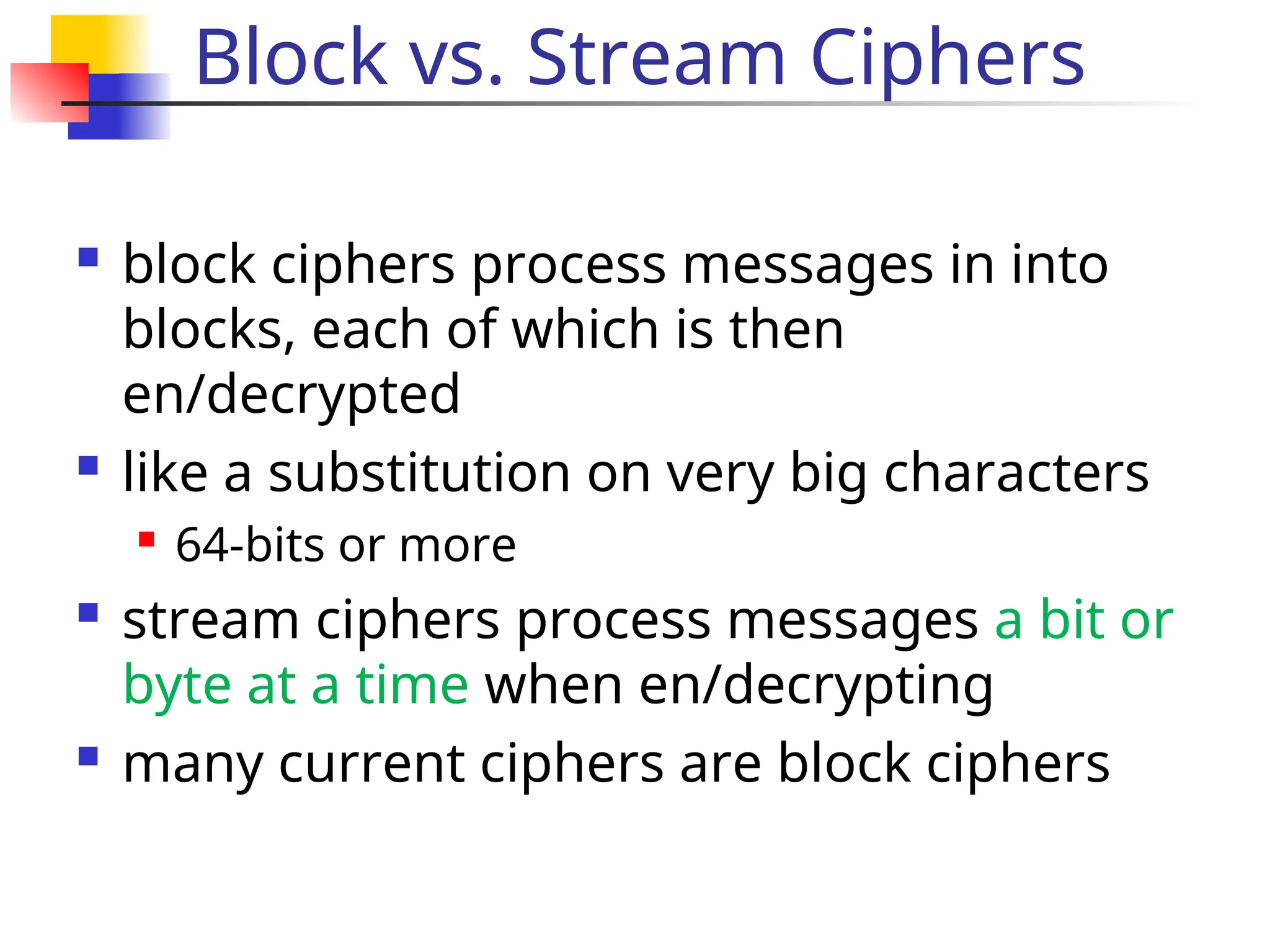
Block vs. Stream Ciphers
 block ciphers process messages in into
blocks, each of which is then
en/decrypted
 like a substitution on very big characters

64-bits or more
 stream ciphers process messages a bit or
byte at a time when en/decrypting
 many current ciphers are block ciphers
Block Cipher Principles
 most symmetric block ciphers are based on a
Feistel Cipher Structure
 block ciphers look like an extremely large
substitution
 would need table of 264
entries for a 64-bit
block
 using idea of a product cipher
Claude Shannon and
Substitution-Permutation Ciphers
 in 1949 Claude Shannon introduced idea of
substitution-permutation (S-P) networks

modern substitution-transposition product cipher
 these form the basis of modern block ciphers
 S-P networks are based on the two primitive
cryptographic operations we have seen before:

substitution (S-box)

permutation (P-box)
 provide confusion and diffusion of message
Feistel Cipher Structure
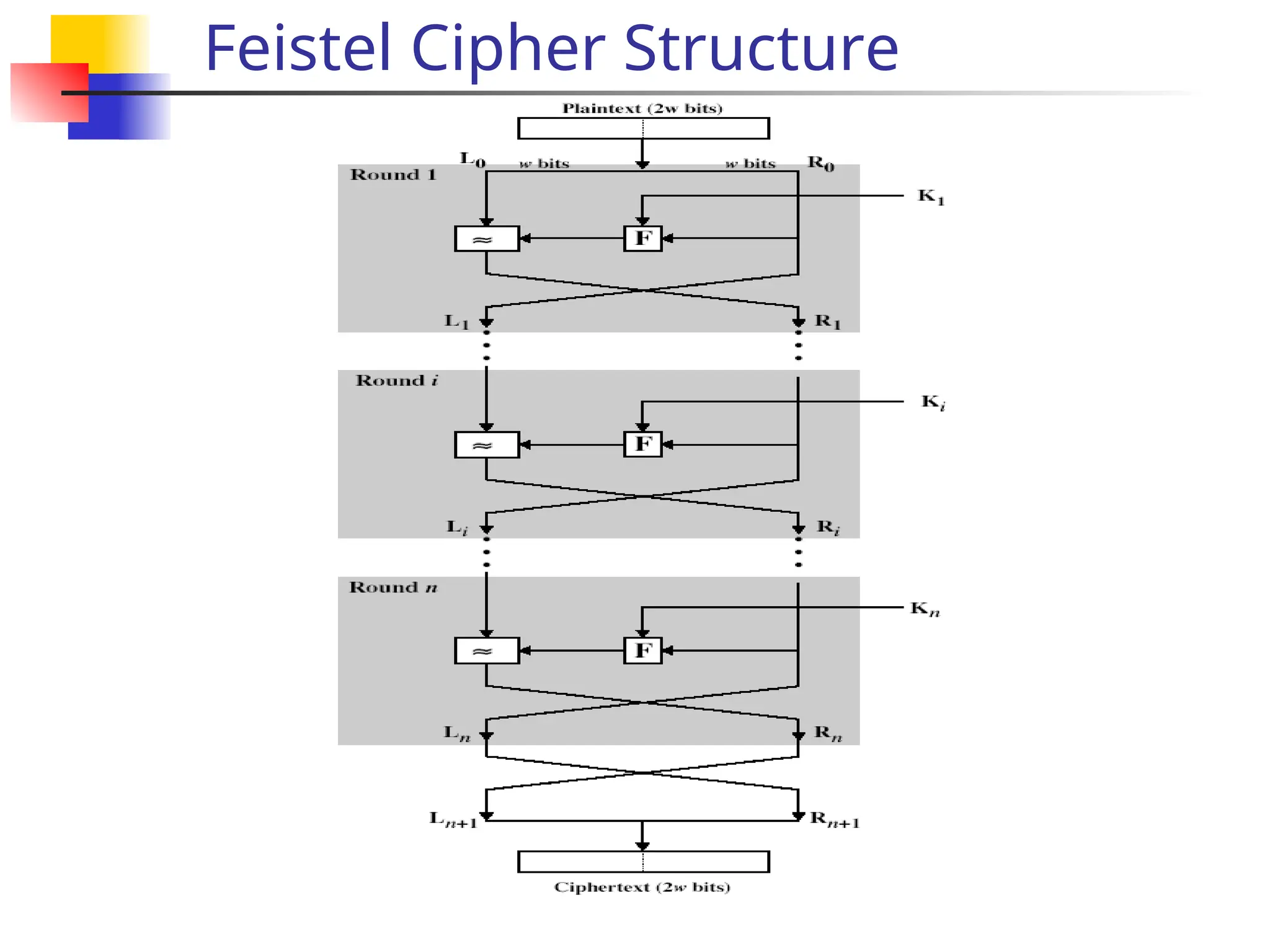
 Horst Feistel devised the feistel cipher
 based on concept of invertible product cipher
 partitions input block into two halves
 process through multiple rounds which
 perform a substitution on left data half
 based on round function of right half &
subkey
 then have permutation swapping halves
 implements Shannon’s substitution-
permutation network concept
Feistel Cipher Structure
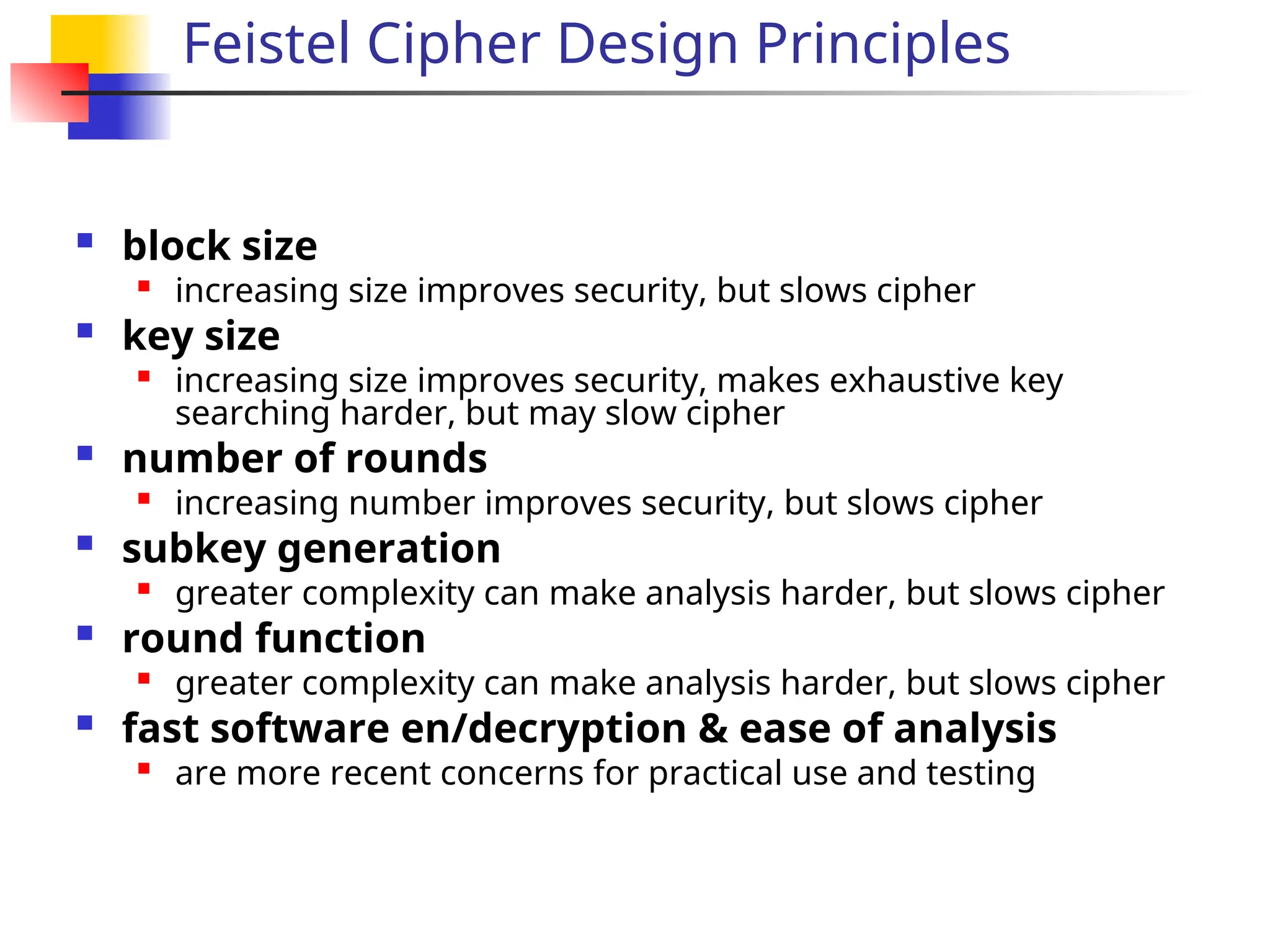
Feistel Cipher Design Principles
 block size

increasing size improves security, but slows cipher
 key size

increasing size improves security, makes exhaustive key
searching harder, but may slow cipher
 number of rounds

increasing number improves security, but slows cipher
 subkey generation

greater complexity can make analysis harder, but slows cipher
 round function

greater complexity can make analysis harder, but slows cipher
 fast software en/decryption & ease of analysis

are more recent concerns for practical use and testing
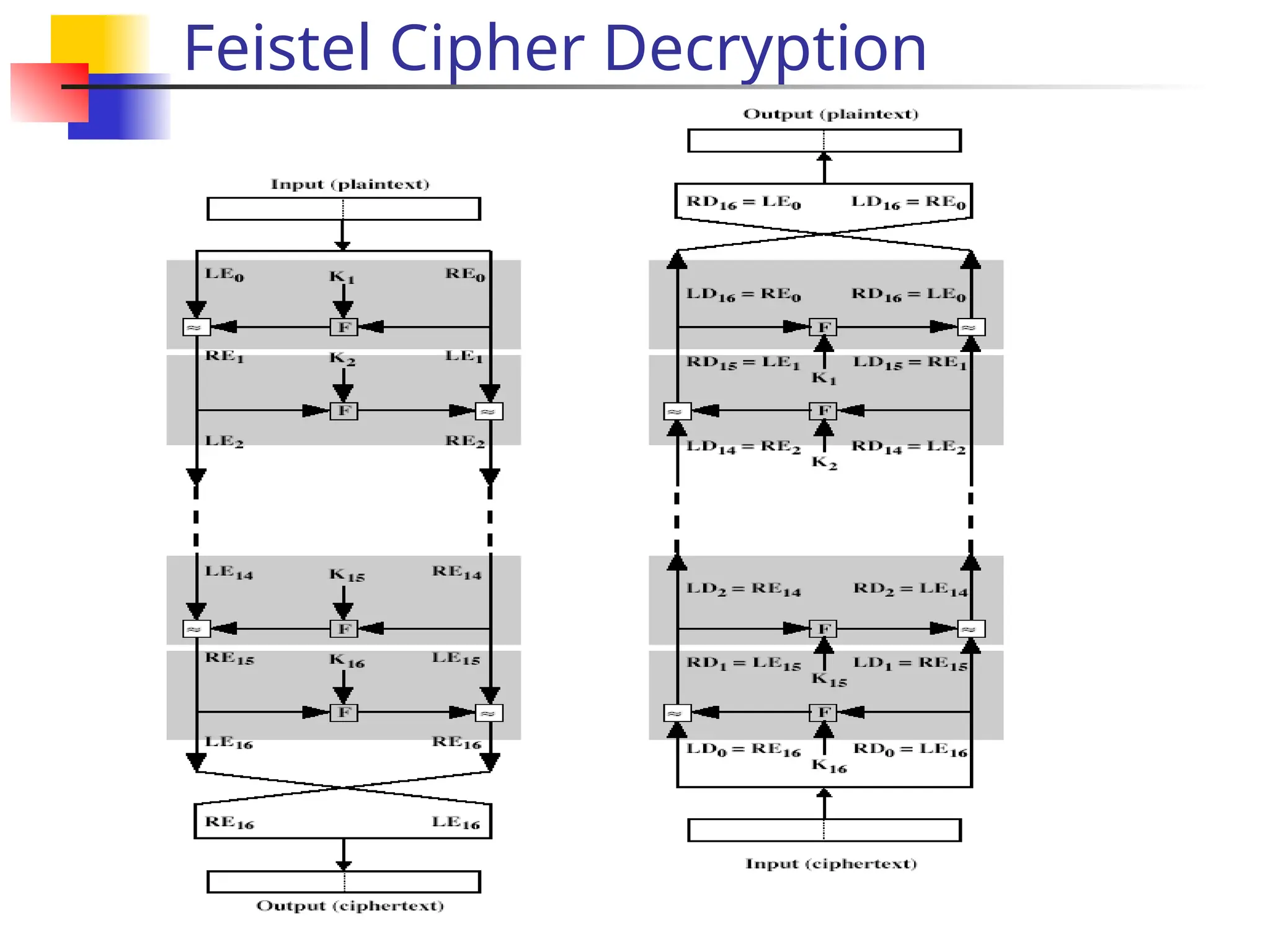
Feistel Cipher Decryption

ch_03 Traditional ciphering (1).ppt.xxxxxxxxx

  • 1.
  • 2.
    3.2 ❏ To definethe terms and the concepts of symmetric key ciphers ❏ To emphasize the two categories of traditional ciphers: substitution and transposition ciphers ❏ To describe the categories of cryptanalysis used to break the symmetric ciphers ❏ To introduce the concepts of the stream ciphers and block ciphers ❏ To discuss some very dominant ciphers used in the past, such as the Enigma machine Objectives Chapter 3
  • 3.
    3.3 Figure 3.2 Lockingand unlocking with the same key 3.1 INTRODUCTION INTRODUCTION PLAINTEXT CIPHERTEXT PLAINTEXT Alice Eve The Attacker Bob
  • 4.
    3.4 3-1 3-1 Continued Components ofSymmetric-key cipher: Components of Symmetric-key cipher: 1. 1.The original message from The original message from A Alice to lice to B Bob is called ob is called plaintext plaintext. . 2. 2.The message that is sent through the channel is called The message that is sent through the channel is called the the ciphertext ciphertext. . 3. 3.To create the ciphertext from the plaintext, Alice uses To create the ciphertext from the plaintext, Alice uses an an encryption algorithm encryption algorithm and a shared secret key. and a shared secret key. 4. 4.To create the plaintext from ciphertext, Bob uses a To create the plaintext from ciphertext, Bob uses a decryption algorithm decryption algorithm and the same secret key. and the same secret key. 5. 5.A shared A shared secret key secret key. .
  • 5.
    3.5 Figure 3.1 Generalidea of symmetric-key cipher 3.1 Continued
  • 6.
    3.6 3.1 Continued If Pis the plaintext, C is the ciphertext, and K is the key, If P is the plaintext, C is the ciphertext, and K is the key, We assume that Bob creates We assume that Bob creates P P1 1; ; we prove that we prove that P P1 1 = P = P: :
  • 7.
    3.7 3.1.1 Kerckhoff’s Principle Basedon Kerckhoff’s principle, one should always assume that the adversary, Eve, knows the encryption/decryption algorithm. The resistance of the cipher to attack must be based only on the secrecy of the key.
  • 8.
    3.8 3.1.2 Cryptanalysis cryptography isthe science and art of creating secret codes, cryptanalysis is the science and art of breaking those codes. Cryptanalysis attacks Statistical Attack : requires some statistical knowledge of the plaintext / language. Brute-force Attack : try every possible keys.
  • 9.
  • 10.
    3.10 3.1.2 Continued Figure 3.4Ciphertext-only attack Ciphertext-Only Attack Known: only some ciphertext Find: the key and the plaintext CT=UFYU , PT=? Ans=TEXT
  • 11.
    3.11 3.1.2 Continued Figure 3.5Known-plaintext attack Known-Plaintext Attack Known: a pair of plaintext-ciphertext and the intercepted ciphertext. Find: the key and the plaintext Ex: As SERUTAERC is to creatures so is ENOHPELET is to _________?
  • 12.
    3.12 3.1.2 Continued Chosen-Plaintext Attack (similarto Known-Plaintext Attack) Known: a pair of plaintext-ciphertext but chosen by attacker herself and the intercepted ciphertext. Find: the key and the plaintext * Eve might have access to Alice’s computer.
  • 13.
    3.13 3.1.2 Continued Chosen-Ciphertext Attack Known:a pair of plaintext-ciphertext but chosen by attacker herself and the intercepted ciphertext. Find: the key and the plaintext
  • 14.
    3.14 3-2 SUBSTITUTION CIPHERS 3-2SUBSTITUTION CIPHERS A substitution cipher replaces one symbol with another. A substitution cipher replaces one symbol with another. Substitution ciphers can be categorized as either Substitution ciphers can be categorized as either monoalphabetic ciphers or polyalphabetic ciphers. monoalphabetic ciphers or polyalphabetic ciphers. 3.2.1 Monoalphabetic Ciphres 3.2.2 Polyalphabetic Ciphers Topics discussed in this section: Topics discussed in this section: A substitution cipher replaces one symbol with another. Note
  • 15.
    3.15 3.2.1 Monoalphabetic Ciphers Inmonoalphabetic substitution, the relationship between a symbol in the plaintext to a symbol in the ciphertext is always one-to-one. Note
  • 16.
    3.16 3.2.1 Continued The followingshows a plaintext and its corresponding ciphertext. The cipher is probably monoalphabetic because both l’s (els) are encrypted as O’s. Example 3.1 The following shows a plaintext and its corresponding ciphertext. The cipher is not monoalphabetic because each l (el) is encrypted by a different character. Example 3.2 ABNZF
  • 17.
    3.17 •The simplest monoalphabeticcipher is the additive cipher. •This cipher is sometimes called a shift cipher and sometimes a Caesar cipher, but the term additive cipher better reveals its mathematical nature. (Caesar cipher) Additive Cipher Figure 3.8 Plaintext and ciphertext in Z26
  • 18.
    3.18 Figure 3.9 Additivecipher 3.2.1 Continued When the cipher is additive, the plaintext, ciphertext, and key are integers in Z26. Note
  • 19.
    3.19 Modular Arithmatic a =q * n + r a mod n = r 11 mod 7 = 4 a = 11 n= 7 11=1 x 7 + 4 -11 mod 7= ? -11= -2 x7 +3 -5 mod 2 = ? In integer arithmetic, if we divide a by n, we can get q and r . The relationship between these four integers can be shown as 3 Modular Arithmatic
  • 20.
    3.20 3.2.1 Continued Use theadditive cipher with key = 15 to encrypt the message “hello”. Example 3.3 We apply the encryption algorithm to the plaintext, character by character: Solution Solution
  • 21.
    3.21 3.2.1 Continued Use theadditive cipher with key = 15 to decrypt the message “WTAAD”. Example 3.4 We apply the decryption algorithm to the plaintext character by character: Solution Solution
  • 22.
    3.22 3.2.1 Continued •Historically, additiveciphers are called shift ciphers. •Julius Caesar used an additive cipher to communicate with his officers. For this reason, additive ciphers are sometimes referred to as the Caesar cipher. •Caesar used a key of 3 for his communications. Shift Cipher and Caesar Cipher Additive ciphers are sometimes referred to as shift ciphers or Caesar cipher. Note
  • 23.
    3.23 3.2.1 Continued Eve hasintercepted the ciphertext “UVACLYFZLJBYL”. Show how she can use a brute-force attack to break the cipher. Example 3.5 Eve tries keys from 1 to 7. With a key of 7, the plaintext is “not very secure”, which makes sense. Solution Solution
  • 24.
    3.24 Cryptanalysis of CaesarCipher  only have 26 possible ciphers  A maps to A,B,..Z  could simply try each in turn  a brute force search  given ciphertext, just try all shifts of letters  do need to recognize when have plaintext  eg. break the ciphertext "GCUA VQ DTGCM“  Ans: P.T.- easy to break (key=2)
  • 25.
    3.25  rather thanjust shifting the alphabet  could shuffle (jumble) the letters arbitrarily  each plaintext letter maps to a different random ciphertext letter  hence key is 26 letters long Plain: abcdefghijklmnopqrstuvwxyz ... Cipher: DKVQFIBJWPESCXHTMYAUOLRGZN Plaintext: ifwewishtoreplaceletters Ciphertext: WIRFRWAJUHYFTSDVFSFUUFYA Continued…
  • 26.
    3.26  now havea total of 26! = 4 x 1026 keys  with so many keys, might think is secure  but would be !!!WRONG!!!  The problem is language characteristics  human languages are redundant •in English e is by far the most common letter then T,R,N,I,O,A,S Continued…
  • 27.
    3.27 3.2.1 Continued Table 3.1Frequency of characters in English Table 3.2 Frequency of diagrams and trigrams
  • 28.
    3.28 3.2.1 Continued Eve hasintercepted the following ciphertext. Using a statistical attack, find the plaintext. Example 3.6 When Eve tabulates the frequency of letters in this ciphertext, she gets: I =14, V =13, S =12, and so on. The most common character is I with 14 occurrences. This means key = 4. Solution Solution
  • 29.
    3.29 3.2.1 Continued Multiplicative Ciphers Ina multiplicative cipher, the plaintext and ciphertext are integers in Z26; the key is an integer in Z26*. Note Figure 3.10 Multiplicative cipher
  • 30.
    3.30 3.2.1 Continued What isthe key domain for any multiplicative cipher? Example 3.7 The key needs to be in Z26*. This set has only 12 members: 1, 3, 5, 7, 9, 11, 15, 17, 19, 21, 23, 25. Solution Solution We use a multiplicative cipher to encrypt the message “hello” with a key of 7. The ciphertext is “XCZZU”. Example 3.8 For Decryption use the multiplicative inverse modulo of 7 i.e. 7-1 = 15
  • 31.
    3.31 3.2.2 Polyalphabetic Ciphers Inpolyalphabetic substitution, each occurrence of a character may have a different substitute. The relationship between a character in the plaintext to a character in the ciphertext is one-to-many. Autokey Cipher
  • 32.
    3.32 3.2.2 Continued Assume thatAlice and Bob agreed to use an autokey cipher with initial key value k1 = 12. Now Alice wants to send Bob the message “Attack is today”. Enciphering is done character by character. Example 3.14
  • 33.
    3.33 3.2.2 Continued Playfair Cipher Figure3.13 An example of a secret key in the Playfair cipher Let us encrypt the plaintext “hello” using the key in Figure 3.13. Example 3.15
  • 34.
    3.34 3.2.2 Playfair Cipher: •a 5X5 matrix of letters based on a keyword • fill in letters of keyword (sans duplicates) • fill rest of matrix with other letters • eg. using the keyword COMPATIBLE. C O M P A T I/J B L E D F G H K N Q R S U V W X Y Z
  • 35.
    3.35 Encrypting and Decrypting plaintext encrypted two letters at a time: 1. if a pair is a repeated letter, insert a filler like 'X', eg. "balloon" encrypts as "ba lx lo on" 2. if both letters fall in the same row, replace each with letter to right (wrapping back to start from end), eg. “ar" encrypts as "RM" 3. if both letters fall in the same column, replace each with the letter below it (again wrapping to top from bottom), eg. “mu" encrypts to "CM" 4. otherwise each letter is replaced by the one in its row in the column of the other letter of the pair, eg. “hs" encrypts to "BP", and “ea" to "IM" or "JM" (as desired)
  • 36.
    3.36 Ex:  Given keyword “simple” PT=Balloon, CT= ??  PT- we are discovered save yourself  CT- vabqaemietsfobelewcvqoomdshv s i/j m p l e a b c d f g h k n o q r t u v w x y z
  • 37.
    3.37 Security of thePlayfair Cipher  security much improved over monoalphabetic  since have 26 x 26 = 676 digrams  would need a 676 entry frequency table to analyse (verses 26 for a monoalphabetic)  and correspondingly more ciphertext  was widely used for many years (eg. US & British military in WW1)  it can be broken, given a few hundred letters  since still has much of plaintext structure
  • 38.
    3.38 3.2.2 Continued Vigenere Cipher Wecan encrypt the message “She is listening” using the 6-character keyword “PASCAL”. Example 3.16
  • 39.
    3.39 3.2.2 Continued •Let ussee how we can encrypt the message “She is listening” using the 6-character keyword “PASCAL”. •The initial key stream is (15, 0, 18, 2, 0, 11). •The key stream is the repetition of this initial key stream (as many times as needed). i.e. P A S C A L 15, 0, 18, 2, 0, 11 Example 3.16
  • 40.
    3.40 this additive cipheris a special case of Vigenere cipher. Where m=1 Table 3.3 A Vigenere Tableau plaintext key
  • 41.
    3.41 3.2.2 Continued Vigenere Cipher(Crypanalysis) Let us assume we have intercepted the following ciphertext: Example 3.19 The Kasiski test for repetition of three-character segments yields the results shown in Table 3.4.
  • 42.
    3.42 3.2.2 Continued The greatestcommon divisor of differences is 4, which means that the key length is multiple of 4. First try m = 4 with frequency analysis. In this case, the plaintext makes sense.
  • 43.
    3.43 Example  eg usingkeyword deceptive key: deceptivedeceptivedeceptive plaintext: wearediscoveredsaveyourself ciphertext:ZICVTWQNGRZGVTWAVZHCQYGLMGJ string 1st index 2nd index difference VTW 4 13 9 • suggests keyword size of 3 or 9 • then attack each monoalphabetic cipher individually using previous techniques
  • 44.
    3.44 3.2.2 Continued • ifa truly random key as long as the message is used, the cipher will be secure • called a One-Time pad • is unbreakable since ciphertext bears no statistical relationship to the plaintext • since for any plaintext & any ciphertext there exists a key mapping one to other • can only use the key once though • have problem of safe distribution of key One-Time Pad
  • 45.
    45 Enigma Machine  Enigmawas a portable cipher machine used to encrypt and decrypt secret messages.  a family of related electro-mechanical rotor machines German military Japan commercial
  • 46.
    46 Enigma Machine Enigma encryptionfor two consecutive letters — current is passed into set of rotors, around the reflector, and back out through the rotors again. Letter A encrypts differently with consecutive key presses, first to G, and then to C. This is because the right hand rotor has stepped, sending the signal on a completely different route.
  • 47.
    47 Enigma  the actualencipherment of a letter is performed electrically.  When a key is pressed, the circuit is completed; current flows through the various components and ultimately lights one of many lamps, indicating the output letter.  Current flows from a battery through the switch controlled by the depressed key into a fixed entry wheel. This leads into the rotor assembly (or scrambler), where the complex internal wiring of each rotor results in the current passing from one rotor to the next along a convoluted path. After passing through all the rotors, current enters the reflector, which relays the signal back out again through the rotors and the entry wheel — this time via a different path — and, finally, to one of the lamps (the earliest Enigma models do not have the reflector).
  • 48.
    48 Rotors  performs avery simple type of encryption  a simple substitution cipher
  • 49.
    49 World War IIEra Encryption Devices  A few here  Sigaba (United States)  Typex (Britain)  Lorenz cipher (Germany)  For more, see  http://w1tp.com/enigma/
  • 50.
    3.50 3-3 TRANSPOSITION CIPHERS 3-3TRANSPOSITION CIPHERS A transposition cipher does not substitute one symbol for A transposition cipher does not substitute one symbol for another, instead it changes the location of the symbols. another, instead it changes the location of the symbols. 3.3.1 Keyless Transposition Ciphers 3.3.2 Keyed Transposition Ciphers 3.3.3 Combining Two Approaches Topics discussed in this section: Topics discussed in this section: A transposition cipher reorders symbols. Note •these hide the message by rearranging the letter order without altering the actual letters used.
  • 51.
    3.51 3.3.1 Keyless TranspositionCiphers Simple transposition ciphers, which were used in the past, are keyless. A good example of a keyless cipher using the first method is the rail fence cipher. The ciphertext is created reading the pattern row by row. For example, to send the message “Meet me at the park” to Bob, Alice writes Example 3.22 She then creates the ciphertext “MEMATEAKETETHPR”.
  • 52.
    3.52 3.3.1 Continued Alice andBob can agree on the number of columns. Alice writes the same plaintext, row by row, in a table of four columns. Example 3.23 She then creates the ciphertext “MMTAEEHREAEKTTP”. 1 2 3 4
  • 53.
    3.53 3.3.2 Keyed TranspositionCiphers •The keyless ciphers permute the characters •by writing plaintext in one way and reading it in another way. •The permutation is done on the whole plaintext to create the whole ciphertext. •Another method is to divide the plaintext into groups of predetermined size, called blocks, and then use a key to permute the characters in each block separately.
  • 54.
    3.54 3.3.2 Continued Alice needsto send the message “Enemy attacks tonight” to Bob.. Example 3.25 The key used for encryption and decryption is a permutation key, which shows how the character are permuted. The permutation yields
  • 55.
    3.55 3 1 45 2 1 2 3 4 5 e n e m y a t t a c k s t o key PLAINTEXT: CIPHERTEXT:
  • 56.
    3.56 3.3.3 Combining TwoApproaches Example 3.26 Figure 3.21
  • 57.
    3.57 Figure 3.22 Encryption/decryptionkeys in transpositional ciphers 3.3.3 Continued Keys In Example 3.27, a single key was used in two directions for the column exchange: downward for encryption, upward for decryption. It is customary to create two keys. 3 1 4 5 2 3 1 4 5 2 2 5 1 3 4 2 5 1 3 4
  • 58.
    3.58 Figure 3.23 Keyinversion in a transposition cipher 3.3.3 Continued
  • 59.
    3.59 2 6 31 4 7 5 1 2 3 4 5 6 7 1 2 3 4 5 6 7 4 1 3 5 7 2 6 Key inversion in a transposition cipher
  • 60.
    3.60 3.3.3 Continued Double TranspositionCiphers Figure 3.25 Double transposition cipher
  • 61.
    3.61 3 1 45 2 e n e m y a t t a c k s t o n i g h t z 3 1 4 5 2 e e m y n t a a c t t k o n s h i t z g 3 1 4 5 2 e t t h e a k i m a o t y c n z n t s g Double Transposition Ciphers (Ex:) CT1= ettheakimaotycnzntsg 3 1 4 5 2 t e h e t i a m a k y o c n t t z s g n CT2= tiyteaozhmcseangtktn
  • 62.
    3.62 •ciphers using substitutionsor transpositions are not secure because of language characteristics •hence consider using several ciphers in succession to make harder, but: •two substitutions make a more complex substitution •two transpositions make more complex transposition •but a substitution followed by a transposition makes a new much harder cipher Product Ciphers
  • 63.
    Modern Block Ciphers will now look at modern block ciphers  provide secrecy and/or authentication services  in particular will introduce DES (Data Encryption Standard)
  • 64.
    Block vs. StreamCiphers  block ciphers process messages in into blocks, each of which is then en/decrypted  like a substitution on very big characters  64-bits or more  stream ciphers process messages a bit or byte at a time when en/decrypting  many current ciphers are block ciphers
  • 65.
    Block Cipher Principles most symmetric block ciphers are based on a Feistel Cipher Structure  block ciphers look like an extremely large substitution  would need table of 264 entries for a 64-bit block  using idea of a product cipher
  • 66.
    Claude Shannon and Substitution-PermutationCiphers  in 1949 Claude Shannon introduced idea of substitution-permutation (S-P) networks  modern substitution-transposition product cipher  these form the basis of modern block ciphers  S-P networks are based on the two primitive cryptographic operations we have seen before:  substitution (S-box)  permutation (P-box)  provide confusion and diffusion of message
  • 67.
    Feistel Cipher Structure Horst Feistel devised the feistel cipher  based on concept of invertible product cipher  partitions input block into two halves  process through multiple rounds which  perform a substitution on left data half  based on round function of right half & subkey  then have permutation swapping halves  implements Shannon’s substitution- permutation network concept
  • 68.
  • 69.
    Feistel Cipher DesignPrinciples  block size  increasing size improves security, but slows cipher  key size  increasing size improves security, makes exhaustive key searching harder, but may slow cipher  number of rounds  increasing number improves security, but slows cipher  subkey generation  greater complexity can make analysis harder, but slows cipher  round function  greater complexity can make analysis harder, but slows cipher  fast software en/decryption & ease of analysis  are more recent concerns for practical use and testing
  • 70.

Editor's Notes

  • #63 Modern block ciphers are widely used to provide encryption of quantities of information, and/or a cryptographic checksum to ensure the contents have not been altered. We continue to use block ciphers because they are comparatively fast, and because we know a fair amount about how to design them.
  • #64 Block ciphers work a on block / word at a time, which is some number of bits. All of these bits have to be available before the block can be processed. Stream ciphers work on a bit or byte of the message at a time, hence process it as a “stream”.
  • #65 An arbitrary reversible substitution cipher for a large block size is not practical, however, from an implementation and performance point of view. In general, for an n-bit general substitution block cipher, the size of the key is n x 2n. For a 64-bit block, which is a desirable length to thwart statistical attacks, the key size is 64 x 264 = 270 = 1021 bits.
  • #66 Claude Shannon’s 1949 paper has the key ideas that led to the development of modern block ciphers. Critically, it was the technique of layering groups of S-boxes separated by a larger P-box to form the S-P network, a complex form of a product cipher. He also introduced the ideas of confusion and diffusion, notionally provided by S-boxes and P-boxes (in conjunction with S-boxes).
  • #67 Horst Feistel, working at IBM Thomas J Watson Research Labs devised a suitable invertible cipher structure in early 70's. One of Feistel's main contributions was the invention of a suitable structure which adapted Shannon's S-P network in an easily inverted structure. Essentially the same h/w or s/w is used for both encryption and decryption, with just a slight change in how the keys are used. One layer of S-boxes and the following P-box are used to form the round function.
  • #70 The process of decryption with a Feistel cipher is essentially the same as the encryption process. The rule is as follows: Use the ciphertext as input to the algorithm, but use the subkeys Ki in reverse order. That is, use Kn in the first round, Kn–1 in the second round, and so on until K1 is used in the last round. This is a nice feature because it means we need not implement two different algorithms, one for encryption and one for decryption.