PRODUCTION: CH 6
OUTLINE
 The Technology of Production
 Production with One Variable Input (Labor,
Capital is fixed)
 Production with Two Variable Inputs [ K, L ]
 Iso-Quants
 Returns to Scale [RTS]
2
PRODUCTION DECISION OF A FIRM
 The theory of the firm describes how a firm makes
cost minimizing production decisions and how the
firm’s resulting cost varies with its output.
 Production decision of a firm.
The production decisions of firms are analogous to the
purchasing decisions of consumers, and can likewise be
understood in three steps:
1. Production Technology
2. Cost constraints ( Similar like budget constraint)
3. Input choices [ Q =100; 2k+5L; 3k+2L]
3
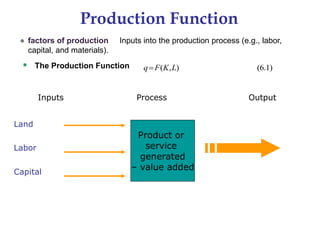
Production Function
Inputs Process Output
Land
Labor
Capital
Product or
service
generated
– value added
● factors of production Inputs into the production process (e.g., labor,
capital, and materials).
 The Production Function ( , ) (6.1)
q F K L

PRODUCTION FUNCTION
“Function showing the highest output that a firm can
produce for every specified combination of inputs”.
q = F (K, L)
Production functions describe what is technically feasible
when the firm operates efficiently.
Long-run and short run:
short run Period of time in which quantities of one or
more production factors cannot be changed.
●fixed input: Production factor that cannot be varied.
●long run: Amount of time needed to make all
production inputs variable.
5
Periods of Production, Inputs, and
Costs
DIFFERENT TYPES OF PRODUCTION CURVE
7
THREE STAGES OF PRODUCTION
 Three stages of Production:
 Stage 1: From origin to the point where AP of labor
is highest.[ MP ( Marginal product) of Capital is
Negative for capital intensive production function,
but MPL is positive]
 Stage 2: From Highest point of AP of labor to the
point where MP of labor is Zero.[MP of labor and
MP of capital, both are positive, this stage is the
optimal/efficient stage of production]
 Stage 3: The point where MP of labor starts to be
negative. [MP of labor is negative]
At Labor 4, AP of labor is highest [see. previous
figure]
8
APL AND MPL RELATIONSHIP
Relationship Between AP and MP. [ Page 209]
 As long as MPL is increasing, APL is also
increasing (MPL is above of APL).
 When APL = MPL; APL is optimum
 When MPL is decreasing, APL also starts
decreasing [ APL is above of MPL]
9
Managerial
Economics,
BUS-525
AVERAGE & MARGINAL PRODUCTS
Average product of labor
AP = Q/L
Marginal product of labor
MP = Q/L
When AP is rising, MP is greater than AP
When AP is falling, MP is less than AP
When AP reaches it maximum, AP = MP
Law of diminishing marginal product
As usage of a variable input increases, a point is reached
beyond which its marginal product decreases
EXERCISE 3. PAGE 227 .
Labor Output MPL APL [ Q/L]
0 0 - -
-
1 225 225 225
2 600 375 300
3* ?900 300 300
4 1140 240 285
At L = 3; APL = MPL = 300
L* = 3 [ Average product of labor is highest]
Change of output = 225 -0 =225
Change of labor = 1 -0 = 1
11
LET US USE DERIVATION
Q = 30L^2 – 0.5L^3
At what Labor, Average Product is highest?
APL = MPL [ at this intersection point, APL is highest]
APL = Q/L = 30L - 0.5L^2
MPL = dQ/dL = 60L – 1.5L^2
APL = MPL
30L - 0.5L^2 = 60L – 1.5L^2
30L -0.5L^2 - 60L + 1.5L^2 = 0
-30L +L^2 = 0
L (-30 + L) = 0 [ L = 0; -30+ L = 0, L = 30]
L = 0; 30
L*= 30; At L = 30, MPL = 60L – 1.5L^2 = 450,
APL = 30L - 0.5L^2 = 450
If you add one more labor say 31, APL and MPL both start
decreasing. Say if you use 31 labor, MPL and APL both would
decrease.
12
Managerial
Economics,
BUS-525
© 2012 Pearson Addison-Wesley
Short-Run Technology Constraint
To increase output in the short run, a firm must increase
the amount of labor employed.[ capital is fixed]
Three concepts describe the relationship between output
and the quantity of labor employed:
1. Total product
2. Marginal product
3. Average product
© 2012 Pearson Addison-Wesley
Product Schedules
Total product [ Total Output = Q ] is the total output
produced in a given period.
The marginal product of labor is the change in total
product that results from a one-unit increase in the
quantity of labor employed, with all other inputs remaining
the same. [ MPL = Change of Output/ Change of labor]
The of labor is equal to total product divided average
product by the quantity of labor employed[ APL = Q/L].
Short-Run Technology Constraint
USE OF THE CURVES SHOWN EARLIER
[AS LONG AS MP LABOR > AP LABOR, WE SHOULD HIRE
WHEN MP LABOR < AP LABOR, WE SHOULD NOT HIRE]
When to stop hiring new employees? Ans: If marginal
productivity declines, it doesn’t mean that we have to stop hiring
new people. Hiring may continue as long as marginal
productivity is greater than average productivity even though MP
has started declining.
15
Production with one variable input
(contd.)
 Marginal Product of Capital
 MPk = ΔQ/ ΔK
 Using Cobb-Douglas: [CHARLES C. COBB & ; PAUL H.
DOUGLAS; 1920]
Q = AKαLβ [ ALPHA+ BETA = 1; Constant Returns to Scale]
RTS: CRS; IRS; DRS
A = TECHNOLOGY PARAMETER; TFP = Total factor productivity;
 MPL =Marginal product of labor = dQ/dL = βAKαLβ-1
 MPk = Marginal product of Capital = dQ/dK= αAKα-1Lβ
………………………………………………………………………..
 Average Product of Labor
 APL =TPL/L
 Average Product of capital
 APK =TPK/K
Production with one variable input
(contd.)
 Marginal Product of Capital
 MPk = ΔQ/ ΔK
Using Cobb-Douglas: [CHARLES C. COBB AND ; PAUL H. DOUGLAS; 1920-1930]
Q K L LNQ LNK LNL
Q = AKαLβ [ NON-LINEAR FUNCTION]
LNQ = LnA+ αLnK + β LnL
= 2.32+ 0.19LNK + 0.88LNL [[α + β = 0.19 + 0.88 = 1.07; IRS ; If we increase capital and labor by 1%, output
increases by more than 1% (1.07%)
Q = AKαLβ [ PRESS SHIFT LNX; 2.32 IT BECOMES 10.17]
= 10.17K^0.19*L^0.88
MPL = Marginal product of labor = dQ/dL =10.17*0.88*K^0.19*L ^0.88-1 =
8.95*K^0.19*L^-0.12
MPK = Marginal product of capital = dQ/dk = 10.17*0.19*K^0.19-1*L^0.88
= 1.93*K^-0.81*L^0.88
Put a value a given value of Labor [20] and Capital [5], you would get MPL, MPK
Returns to scale [RTS]
Input increases output increase RTS
1% [K,L] = 1% CRS
1% [K,L] >1% IRS
1% [K, L] <1% DRS
CRS= Constant Returns to scale
IRS = Increasing Returns to scale
DRS = Decreasing Returns to scale
THE COSTS OF PRODUCTION 18
PRODUCTION WITH ONE VARIABLE INPUT (LABOR)
 The Law of Diminishing
Marginal Returns [DMR]:
Principle that as the use of an
input increases with other
inputs fixed [K], the resulting
additions to output will
eventually decrease.
 Labor productivity (output per
unit of labor) can increase if
there are improvements in
technology, even though any
given production process
exhibits diminishing returns to
labor. As we move from point A
on curve O1 to B on curve O2
to C on curve O3 over time,
labor productivity increases. 19
THE COSTS OF PRODUCTION 20
Why MPL Diminishes
. In general, MPL diminishes as L rises
whether the fixed input is land or capital (equipment,
machines, etc.).
 Diminishing marginal product:
the marginal product of an input declines as the
quantity of the input increases (other things equal).
 The law of diminishing returns states that: As a firm
uses more of a variable input [LABOR] with a given
quantity of fixed inputs [CAPITAL], the marginal
product of the variable input eventually diminishes.
Three important relationships can be
found
1. Substitutability between Factors: There are a variety of ways to
produce a particular rate of output (example: to produce a fixed units, any
combination can be used). Therefore, the question of labor or capital-
intensive production arises. Q = 100; 2K, 10L; OR 4K, 8L ( WE
SUBSITUTUTED LABOR FOR CAPITAL]
2. Returns to Scale: If input rates are doubled, the output rate also
doubles. [example: 200 = 1K + 4L, if 2K + 8L the Q would be = 400]. The
relationship between output change and proportionate changes in both inputs
is referred to Return to Scale. In this case we have CRS. [ IF 450 =
IRS; IF less than 400 = DRS]
3. Returns to Factor: When output changes because one input
changes while the other remains constant, the changes in the output
rates are referred to as Return to Factor. [example: 200 = 1K + 4L → 1K +
8L = 250; CHANGE OF LABOR = 4; CHANGE OF OUTPUT = 50; MPL = MARGINAL
Product of Labor = CHANGE OF OUTPUT/CHANGE OF LABOR = 50/4 = 12.5 [ per
worker output has increased by 12.5 Units]
PRODUCTION WITH TWO VARIABLE INPUTS AND
ISO-QUANT CURVE
 Iso-quant
Curve showing
all possible
combinations of
inputs that
yield the same
output.
22
CHARACTERISTICS OF ISO-QUANT
Properties of Iso-quant: [ SAME LIKE INDIFFERENCE CURVE]
1. Iso-quant is downward sloping.
2. Iso-quant is convex to the origin
3. Two Iso-quants can not cross (intersect)
4. Higher Iso-quant is better than lower Iso-quant.
[ If we like to draw figures, use the figures of indifference
curves and use L on the horizontal axis and K on the
vertical axis]
23
ISO-QUANT MAP AND DMR
 A set of isoquants that
describe firm’s production
function.
 Output increases as we
move from isoquant q1
(at which 55 units per
year are produced at
points such as A and D),
to isoquant q2 (75 units
per year at points such
as B) and to isoquant q3
(90 units per year at
points such as C and E).
 DMR: Holding the
amount of capital fixed at
a particular level—say 3,
we can see that each
additional unit of labor
generates less and less
additional output.
24
CONCEPT OF MRTS: [MRTS IS THE NEGATIVE SLOPE OF ISO-
QUANT]
 Marginal rate of
technical substitution
(MRTS): Amount by
which the quantity of
one input can be
reduced when one extra
unit of another input is
used, so that output
remains constant.
 (MPL ) / (MPK ) =
(change in K /change in
L ) = MRTS
25
Marginal rate of Technical
Substitution (MRTS)
Michael R. Baye, Managerial Economics and Business Strategy, 4e. ©The McGraw-Hill Companies, Inc. , 2003
 The MRTS is the slope (-) of an isoquant.
 The rate at which the two inputs can be
substituted for one another while maintaining
a constant level of output. [ MRTS = MPL/MPK]

 

K
MRTS
L
 
MRTS
K L
The minus sign is added to make a positive
number since , the slope of the isoquant, is
negative
PRODUCTION FUNCTIONS: TWO SPECIAL CASES
 1. When factors are perfect
substitutes: MRTS will be equal
(constant) at each point of the
iso-quant.[two inputs are perfect
substitute]
 2. The Leontief production
function [ L shaped] or fixed
proportions production
function is a production
function that implies the factors
of production will be used in
fixed (technologically pre-
determined) proportions, as
there is no substitutability
between factors. .[two inputs are
perfect complements; MRTS = 0
or Infinite ]
27
ANY RELATIONSHIP BETWEEN THESE FIGURES: IN LEFT FIGURE 2 INPUTS ARE USED AT A FIXED
PROPORTION AND IN RIGHT FIGURE NOT AT A FIXED PROPORTION/
28
Managerial
Economics,
BUS-525
RETURNS TO SCALE
 Returns to scale: Rate at which output increases as
inputs are increased proportionately.
 Increasing returns to scale: Situation in which output
more than doubles when all inputs are doubled.
 Constant returns to scale: Situation in which output
doubles when all inputs are doubled.
 Decreasing returns to scale: Situation in which
output less than doubles when all inputs are doubled.
 EXERCISE: 2, 3, 7, 8, 9, 10.
29
EX 7
MRTS = MPL/MPK = 50/MPK
¼ = 50/MPK ; MPK = 200
30
Managerial
Economics,
BUS-525
RETURNS TO SCALE
31
EXAMPLES
8. Do the following functions exhibit increasing, constant,
or decreasing returns to scale? What happens to the
marginal product of each individual factor as that
factor is increased and the other factor held constant?
1. Q = 3L + 2K [ let L = 3 = k = 3; Q = 15;
L = 6 = K; Q = 30 ; CRS
2. q = (2L + 2K)1/2
3. q = 3LK2
32
Do the following functions exhibit increasing,
constant, or decreasing returns to scale? What
happens to the marginal product of each individual
factor as that factor is increased and the other
factor held constant?
1. q = 3L + 2K
LET L =K = 2; Q = 3L + 2K = 10
LET L =K = 4; Q = 3L + 2K = 20
CRS: INPUTS ARE
DOUBLED, AND OUTPUT IS ALSO DOUBLED.
……………………………………
q = 3L + 2K
dq/dL = 3 = MPL [ CAPITAL IS FIXED]
dq/dK = 2 = MPK [ LABOR IS FIXED] 33
Managerial
Economics,
BUS-525
RTS; MPL; MPK
Q = (2L + 2K)1/2
LET L = K = 2
Q = (2*2+ 2*2)^1/2 = 2.83
LET L = K = 4
Q = (2*4+ 2*4)^1/2 = 4 ; DRS: DECREASING RETURNS TO SCALE AS
OUTPUT INCERASED BUT DID NOT DOUBLE.
………………………………………………………………..
MPL = dQ/dL = ½((2L + 2K)1/2 -1* dQ/dL (2L)
= ½(2L + 2K)^-1/2 *2
= (2L + 2K)^-1/2
= 1/(2L +2K)^1/2 ; AS LABOR IS INCERASED MPL IS DECREASED
Similarly
MPk = dQ/dk = ½((2L + 2K)1/2 -1* dQ/dK (2k)
= ½(2L + 2K)^-1/2 *2
= (2L + 2K)^-1/2
MPK = 1/(2L +2K)^1/2 34
Managerial
Economics,
BUS-525
RTS ; MPL; MPK
Q = 3LK2
LET L = K= 2; Q = 24 ;
LET L = K= 4 ; Q = 192 ; IRS
dQ/dL = 3k^2 = MPL
dQ/dK = 3L*2*K^2 -1 = 6LK
35
Managerial
Economics,
BUS-525
MATHEMATICAL EXAMPLES
10. Wheat is produced according to the production
function q = 100(K0.8L0.2), where K is capital and L
is labor.
a. Derive the marginal product of labor and the
marginal product of capital.
MPL = dQ/dL = 100K^.8*.2L^.2 -1 = 20K^0.8L^-0.8
b. Show that the marginal product of labor and the
marginal product of capital are both decreasing (hint:
beginning with K = 4, and L = 49).
c. Does this production function exhibit increasing,
decreasing, or constant returns to scale? [ ALPHA +
BETA = 0.8 +0.2 =1 = CRS]
36
37
Managerial
Economics,
BUS-525
L = 49; K =4 ; Q = 100(K0.8L0.2 = 660.21
38
Managerial
Economics,
BUS-525
EXERCISE 10.
39
Managerial
Economics,
BUS-525
PRACTICE EXAMPLES: EX 9. PAGE.227
The production function for the personal computers of
Company A, Inc., is given by q = 10K0.5L0.5, where q
is the number of computers produced per day, K is
hours of machine time, and L is hours of labor input.
A’s competitor, Company B, Inc., is using the
production function q = 10K0.6L0.4.
 If both companies use the same amounts of capital
and labor, which will generate more output?
 Assume that capital is limited to 9 machine hours,
but labor is unlimited in supply. In which company
is the marginal product of labor greater? Explain.
40
ANSWER
a)
41
Managerial
Economics,
BUS-525
Q1(FIRM 1) = 10K^0.5*L^0.5 = 10*9^0.5*L^0.5 = 30L^0.5
Q2 (FIRM 2) = 10K0.6L0.4. = 37.372L^0.4
42
Managerial
Economics,
BUS-525
Michael R. Baye, Managerial Economics and Business Strategy, 4e. ©The McGraw-Hill Companies, Inc. , 2003
 Expansion path gives the efficient (least-
cost) input combinations for every level
of output
 Derived for a specific set of input prices
 Along expansion path, input-price ratio is
constant & equal to the marginal rate of
technical substitution
Expansion Path
Expansion Path
Michael R. Baye, Managerial Economics and Business Strategy, 4e. ©The McGraw-Hill Companies, Inc. , 2003
Economies of Scale, Diseconomies of Scale, and Constant
Returns to Scale
• Economies of Scale exist when inputs are increased by some
percentage and output increases by a greater percentage,
causing unit costs to fall.
• Constant Returns to Scale exist when inputs are increased by
some percentage and output increases by an equal
percentage, causing unit costs to remain constant.
• Diseconomies of Scale exist when inputs are increased by
some percentage and output increases by a smaller
percentage, causing unit costs to rise.
• Minimum Efficient Scale is the lowest output level at which
average total costs are minimized. Efficient scale:
The quantity that minimizes ATC.
Ch. 7. Cost Minimization Principle [ P.
278]
Q = 100KL; Labor ,Capital
Wage = Taka 30; Rent = Taka 120, Production
target is 1000 units. Find the minimum cost to
produce 1000 units?
ANS:
WL + rK = C [ Iso-cost equation]
Slope of cost equation = wage/ rent = W/ R = Taka 30/
Taka 120 = ¼ = Price ratio of two inputs
Cost Minimization Principle
Q = 100KL [ Iso-quant: different combinations of labor
and capital produce same output ]
dQ/dL = MPL = marginal product of labor = 100K
dQ/dK = MPK = 100L
Slope of Iso-quant = MPL/MPK = 100k/100L = K/L
Apply two step approach:
MPL/MPK = W/R = wage/ rent ; [ Slope of Iso-quant =
Slope of Iso-cost; This is the cost minimization principle]
K/L = ¼
L = 4K
Cost Minimization Principle
1000 = 100KL [ Iso-quant]
1000 = 100K*4K = 400K^2
K^2 = 1000/400 = 2.5
K* = 1.58
L* = 4K = 4*1.58 = 6.32
wL* + rK* = C* [ Px*X + Py*Y = M]
30*6.32 + 120*1.58 = 379.2.

CH6 Production.pptx

  • 1.
  • 2.
    OUTLINE  The Technologyof Production  Production with One Variable Input (Labor, Capital is fixed)  Production with Two Variable Inputs [ K, L ]  Iso-Quants  Returns to Scale [RTS] 2
  • 3.
    PRODUCTION DECISION OFA FIRM  The theory of the firm describes how a firm makes cost minimizing production decisions and how the firm’s resulting cost varies with its output.  Production decision of a firm. The production decisions of firms are analogous to the purchasing decisions of consumers, and can likewise be understood in three steps: 1. Production Technology 2. Cost constraints ( Similar like budget constraint) 3. Input choices [ Q =100; 2k+5L; 3k+2L] 3
  • 4.
    Production Function Inputs ProcessOutput Land Labor Capital Product or service generated – value added ● factors of production Inputs into the production process (e.g., labor, capital, and materials).  The Production Function ( , ) (6.1) q F K L 
  • 5.
    PRODUCTION FUNCTION “Function showingthe highest output that a firm can produce for every specified combination of inputs”. q = F (K, L) Production functions describe what is technically feasible when the firm operates efficiently. Long-run and short run: short run Period of time in which quantities of one or more production factors cannot be changed. ●fixed input: Production factor that cannot be varied. ●long run: Amount of time needed to make all production inputs variable. 5
  • 6.
    Periods of Production,Inputs, and Costs
  • 7.
    DIFFERENT TYPES OFPRODUCTION CURVE 7
  • 8.
    THREE STAGES OFPRODUCTION  Three stages of Production:  Stage 1: From origin to the point where AP of labor is highest.[ MP ( Marginal product) of Capital is Negative for capital intensive production function, but MPL is positive]  Stage 2: From Highest point of AP of labor to the point where MP of labor is Zero.[MP of labor and MP of capital, both are positive, this stage is the optimal/efficient stage of production]  Stage 3: The point where MP of labor starts to be negative. [MP of labor is negative] At Labor 4, AP of labor is highest [see. previous figure] 8
  • 9.
    APL AND MPLRELATIONSHIP Relationship Between AP and MP. [ Page 209]  As long as MPL is increasing, APL is also increasing (MPL is above of APL).  When APL = MPL; APL is optimum  When MPL is decreasing, APL also starts decreasing [ APL is above of MPL] 9 Managerial Economics, BUS-525
  • 10.
    AVERAGE & MARGINALPRODUCTS Average product of labor AP = Q/L Marginal product of labor MP = Q/L When AP is rising, MP is greater than AP When AP is falling, MP is less than AP When AP reaches it maximum, AP = MP Law of diminishing marginal product As usage of a variable input increases, a point is reached beyond which its marginal product decreases
  • 11.
    EXERCISE 3. PAGE227 . Labor Output MPL APL [ Q/L] 0 0 - - - 1 225 225 225 2 600 375 300 3* ?900 300 300 4 1140 240 285 At L = 3; APL = MPL = 300 L* = 3 [ Average product of labor is highest] Change of output = 225 -0 =225 Change of labor = 1 -0 = 1 11
  • 12.
    LET US USEDERIVATION Q = 30L^2 – 0.5L^3 At what Labor, Average Product is highest? APL = MPL [ at this intersection point, APL is highest] APL = Q/L = 30L - 0.5L^2 MPL = dQ/dL = 60L – 1.5L^2 APL = MPL 30L - 0.5L^2 = 60L – 1.5L^2 30L -0.5L^2 - 60L + 1.5L^2 = 0 -30L +L^2 = 0 L (-30 + L) = 0 [ L = 0; -30+ L = 0, L = 30] L = 0; 30 L*= 30; At L = 30, MPL = 60L – 1.5L^2 = 450, APL = 30L - 0.5L^2 = 450 If you add one more labor say 31, APL and MPL both start decreasing. Say if you use 31 labor, MPL and APL both would decrease. 12 Managerial Economics, BUS-525
  • 13.
    © 2012 PearsonAddison-Wesley Short-Run Technology Constraint To increase output in the short run, a firm must increase the amount of labor employed.[ capital is fixed] Three concepts describe the relationship between output and the quantity of labor employed: 1. Total product 2. Marginal product 3. Average product
  • 14.
    © 2012 PearsonAddison-Wesley Product Schedules Total product [ Total Output = Q ] is the total output produced in a given period. The marginal product of labor is the change in total product that results from a one-unit increase in the quantity of labor employed, with all other inputs remaining the same. [ MPL = Change of Output/ Change of labor] The of labor is equal to total product divided average product by the quantity of labor employed[ APL = Q/L]. Short-Run Technology Constraint
  • 15.
    USE OF THECURVES SHOWN EARLIER [AS LONG AS MP LABOR > AP LABOR, WE SHOULD HIRE WHEN MP LABOR < AP LABOR, WE SHOULD NOT HIRE] When to stop hiring new employees? Ans: If marginal productivity declines, it doesn’t mean that we have to stop hiring new people. Hiring may continue as long as marginal productivity is greater than average productivity even though MP has started declining. 15
  • 16.
    Production with onevariable input (contd.)  Marginal Product of Capital  MPk = ΔQ/ ΔK  Using Cobb-Douglas: [CHARLES C. COBB & ; PAUL H. DOUGLAS; 1920] Q = AKαLβ [ ALPHA+ BETA = 1; Constant Returns to Scale] RTS: CRS; IRS; DRS A = TECHNOLOGY PARAMETER; TFP = Total factor productivity;  MPL =Marginal product of labor = dQ/dL = βAKαLβ-1  MPk = Marginal product of Capital = dQ/dK= αAKα-1Lβ ………………………………………………………………………..  Average Product of Labor  APL =TPL/L  Average Product of capital  APK =TPK/K
  • 17.
    Production with onevariable input (contd.)  Marginal Product of Capital  MPk = ΔQ/ ΔK Using Cobb-Douglas: [CHARLES C. COBB AND ; PAUL H. DOUGLAS; 1920-1930] Q K L LNQ LNK LNL Q = AKαLβ [ NON-LINEAR FUNCTION] LNQ = LnA+ αLnK + β LnL = 2.32+ 0.19LNK + 0.88LNL [[α + β = 0.19 + 0.88 = 1.07; IRS ; If we increase capital and labor by 1%, output increases by more than 1% (1.07%) Q = AKαLβ [ PRESS SHIFT LNX; 2.32 IT BECOMES 10.17] = 10.17K^0.19*L^0.88 MPL = Marginal product of labor = dQ/dL =10.17*0.88*K^0.19*L ^0.88-1 = 8.95*K^0.19*L^-0.12 MPK = Marginal product of capital = dQ/dk = 10.17*0.19*K^0.19-1*L^0.88 = 1.93*K^-0.81*L^0.88 Put a value a given value of Labor [20] and Capital [5], you would get MPL, MPK
  • 18.
    Returns to scale[RTS] Input increases output increase RTS 1% [K,L] = 1% CRS 1% [K,L] >1% IRS 1% [K, L] <1% DRS CRS= Constant Returns to scale IRS = Increasing Returns to scale DRS = Decreasing Returns to scale THE COSTS OF PRODUCTION 18
  • 19.
    PRODUCTION WITH ONEVARIABLE INPUT (LABOR)  The Law of Diminishing Marginal Returns [DMR]: Principle that as the use of an input increases with other inputs fixed [K], the resulting additions to output will eventually decrease.  Labor productivity (output per unit of labor) can increase if there are improvements in technology, even though any given production process exhibits diminishing returns to labor. As we move from point A on curve O1 to B on curve O2 to C on curve O3 over time, labor productivity increases. 19
  • 20.
    THE COSTS OFPRODUCTION 20 Why MPL Diminishes . In general, MPL diminishes as L rises whether the fixed input is land or capital (equipment, machines, etc.).  Diminishing marginal product: the marginal product of an input declines as the quantity of the input increases (other things equal).  The law of diminishing returns states that: As a firm uses more of a variable input [LABOR] with a given quantity of fixed inputs [CAPITAL], the marginal product of the variable input eventually diminishes.
  • 21.
    Three important relationshipscan be found 1. Substitutability between Factors: There are a variety of ways to produce a particular rate of output (example: to produce a fixed units, any combination can be used). Therefore, the question of labor or capital- intensive production arises. Q = 100; 2K, 10L; OR 4K, 8L ( WE SUBSITUTUTED LABOR FOR CAPITAL] 2. Returns to Scale: If input rates are doubled, the output rate also doubles. [example: 200 = 1K + 4L, if 2K + 8L the Q would be = 400]. The relationship between output change and proportionate changes in both inputs is referred to Return to Scale. In this case we have CRS. [ IF 450 = IRS; IF less than 400 = DRS] 3. Returns to Factor: When output changes because one input changes while the other remains constant, the changes in the output rates are referred to as Return to Factor. [example: 200 = 1K + 4L → 1K + 8L = 250; CHANGE OF LABOR = 4; CHANGE OF OUTPUT = 50; MPL = MARGINAL Product of Labor = CHANGE OF OUTPUT/CHANGE OF LABOR = 50/4 = 12.5 [ per worker output has increased by 12.5 Units]
  • 22.
    PRODUCTION WITH TWOVARIABLE INPUTS AND ISO-QUANT CURVE  Iso-quant Curve showing all possible combinations of inputs that yield the same output. 22
  • 23.
    CHARACTERISTICS OF ISO-QUANT Propertiesof Iso-quant: [ SAME LIKE INDIFFERENCE CURVE] 1. Iso-quant is downward sloping. 2. Iso-quant is convex to the origin 3. Two Iso-quants can not cross (intersect) 4. Higher Iso-quant is better than lower Iso-quant. [ If we like to draw figures, use the figures of indifference curves and use L on the horizontal axis and K on the vertical axis] 23
  • 24.
    ISO-QUANT MAP ANDDMR  A set of isoquants that describe firm’s production function.  Output increases as we move from isoquant q1 (at which 55 units per year are produced at points such as A and D), to isoquant q2 (75 units per year at points such as B) and to isoquant q3 (90 units per year at points such as C and E).  DMR: Holding the amount of capital fixed at a particular level—say 3, we can see that each additional unit of labor generates less and less additional output. 24
  • 25.
    CONCEPT OF MRTS:[MRTS IS THE NEGATIVE SLOPE OF ISO- QUANT]  Marginal rate of technical substitution (MRTS): Amount by which the quantity of one input can be reduced when one extra unit of another input is used, so that output remains constant.  (MPL ) / (MPK ) = (change in K /change in L ) = MRTS 25
  • 26.
    Marginal rate ofTechnical Substitution (MRTS) Michael R. Baye, Managerial Economics and Business Strategy, 4e. ©The McGraw-Hill Companies, Inc. , 2003  The MRTS is the slope (-) of an isoquant.  The rate at which the two inputs can be substituted for one another while maintaining a constant level of output. [ MRTS = MPL/MPK]     K MRTS L   MRTS K L The minus sign is added to make a positive number since , the slope of the isoquant, is negative
  • 27.
    PRODUCTION FUNCTIONS: TWOSPECIAL CASES  1. When factors are perfect substitutes: MRTS will be equal (constant) at each point of the iso-quant.[two inputs are perfect substitute]  2. The Leontief production function [ L shaped] or fixed proportions production function is a production function that implies the factors of production will be used in fixed (technologically pre- determined) proportions, as there is no substitutability between factors. .[two inputs are perfect complements; MRTS = 0 or Infinite ] 27
  • 28.
    ANY RELATIONSHIP BETWEENTHESE FIGURES: IN LEFT FIGURE 2 INPUTS ARE USED AT A FIXED PROPORTION AND IN RIGHT FIGURE NOT AT A FIXED PROPORTION/ 28 Managerial Economics, BUS-525
  • 29.
    RETURNS TO SCALE Returns to scale: Rate at which output increases as inputs are increased proportionately.  Increasing returns to scale: Situation in which output more than doubles when all inputs are doubled.  Constant returns to scale: Situation in which output doubles when all inputs are doubled.  Decreasing returns to scale: Situation in which output less than doubles when all inputs are doubled.  EXERCISE: 2, 3, 7, 8, 9, 10. 29
  • 30.
    EX 7 MRTS =MPL/MPK = 50/MPK ¼ = 50/MPK ; MPK = 200 30 Managerial Economics, BUS-525
  • 31.
  • 32.
    EXAMPLES 8. Do thefollowing functions exhibit increasing, constant, or decreasing returns to scale? What happens to the marginal product of each individual factor as that factor is increased and the other factor held constant? 1. Q = 3L + 2K [ let L = 3 = k = 3; Q = 15; L = 6 = K; Q = 30 ; CRS 2. q = (2L + 2K)1/2 3. q = 3LK2 32
  • 33.
    Do the followingfunctions exhibit increasing, constant, or decreasing returns to scale? What happens to the marginal product of each individual factor as that factor is increased and the other factor held constant? 1. q = 3L + 2K LET L =K = 2; Q = 3L + 2K = 10 LET L =K = 4; Q = 3L + 2K = 20 CRS: INPUTS ARE DOUBLED, AND OUTPUT IS ALSO DOUBLED. …………………………………… q = 3L + 2K dq/dL = 3 = MPL [ CAPITAL IS FIXED] dq/dK = 2 = MPK [ LABOR IS FIXED] 33 Managerial Economics, BUS-525
  • 34.
    RTS; MPL; MPK Q= (2L + 2K)1/2 LET L = K = 2 Q = (2*2+ 2*2)^1/2 = 2.83 LET L = K = 4 Q = (2*4+ 2*4)^1/2 = 4 ; DRS: DECREASING RETURNS TO SCALE AS OUTPUT INCERASED BUT DID NOT DOUBLE. ……………………………………………………………….. MPL = dQ/dL = ½((2L + 2K)1/2 -1* dQ/dL (2L) = ½(2L + 2K)^-1/2 *2 = (2L + 2K)^-1/2 = 1/(2L +2K)^1/2 ; AS LABOR IS INCERASED MPL IS DECREASED Similarly MPk = dQ/dk = ½((2L + 2K)1/2 -1* dQ/dK (2k) = ½(2L + 2K)^-1/2 *2 = (2L + 2K)^-1/2 MPK = 1/(2L +2K)^1/2 34 Managerial Economics, BUS-525
  • 35.
    RTS ; MPL;MPK Q = 3LK2 LET L = K= 2; Q = 24 ; LET L = K= 4 ; Q = 192 ; IRS dQ/dL = 3k^2 = MPL dQ/dK = 3L*2*K^2 -1 = 6LK 35 Managerial Economics, BUS-525
  • 36.
    MATHEMATICAL EXAMPLES 10. Wheatis produced according to the production function q = 100(K0.8L0.2), where K is capital and L is labor. a. Derive the marginal product of labor and the marginal product of capital. MPL = dQ/dL = 100K^.8*.2L^.2 -1 = 20K^0.8L^-0.8 b. Show that the marginal product of labor and the marginal product of capital are both decreasing (hint: beginning with K = 4, and L = 49). c. Does this production function exhibit increasing, decreasing, or constant returns to scale? [ ALPHA + BETA = 0.8 +0.2 =1 = CRS] 36
  • 37.
  • 38.
    L = 49;K =4 ; Q = 100(K0.8L0.2 = 660.21 38 Managerial Economics, BUS-525
  • 39.
  • 40.
    PRACTICE EXAMPLES: EX9. PAGE.227 The production function for the personal computers of Company A, Inc., is given by q = 10K0.5L0.5, where q is the number of computers produced per day, K is hours of machine time, and L is hours of labor input. A’s competitor, Company B, Inc., is using the production function q = 10K0.6L0.4.  If both companies use the same amounts of capital and labor, which will generate more output?  Assume that capital is limited to 9 machine hours, but labor is unlimited in supply. In which company is the marginal product of labor greater? Explain. 40
  • 41.
  • 42.
    Q1(FIRM 1) =10K^0.5*L^0.5 = 10*9^0.5*L^0.5 = 30L^0.5 Q2 (FIRM 2) = 10K0.6L0.4. = 37.372L^0.4 42 Managerial Economics, BUS-525
  • 43.
    Michael R. Baye,Managerial Economics and Business Strategy, 4e. ©The McGraw-Hill Companies, Inc. , 2003  Expansion path gives the efficient (least- cost) input combinations for every level of output  Derived for a specific set of input prices  Along expansion path, input-price ratio is constant & equal to the marginal rate of technical substitution Expansion Path
  • 44.
    Expansion Path Michael R.Baye, Managerial Economics and Business Strategy, 4e. ©The McGraw-Hill Companies, Inc. , 2003
  • 45.
    Economies of Scale,Diseconomies of Scale, and Constant Returns to Scale • Economies of Scale exist when inputs are increased by some percentage and output increases by a greater percentage, causing unit costs to fall. • Constant Returns to Scale exist when inputs are increased by some percentage and output increases by an equal percentage, causing unit costs to remain constant. • Diseconomies of Scale exist when inputs are increased by some percentage and output increases by a smaller percentage, causing unit costs to rise. • Minimum Efficient Scale is the lowest output level at which average total costs are minimized. Efficient scale: The quantity that minimizes ATC.
  • 46.
    Ch. 7. CostMinimization Principle [ P. 278] Q = 100KL; Labor ,Capital Wage = Taka 30; Rent = Taka 120, Production target is 1000 units. Find the minimum cost to produce 1000 units? ANS: WL + rK = C [ Iso-cost equation] Slope of cost equation = wage/ rent = W/ R = Taka 30/ Taka 120 = ¼ = Price ratio of two inputs
  • 47.
    Cost Minimization Principle Q= 100KL [ Iso-quant: different combinations of labor and capital produce same output ] dQ/dL = MPL = marginal product of labor = 100K dQ/dK = MPK = 100L Slope of Iso-quant = MPL/MPK = 100k/100L = K/L Apply two step approach: MPL/MPK = W/R = wage/ rent ; [ Slope of Iso-quant = Slope of Iso-cost; This is the cost minimization principle] K/L = ¼ L = 4K
  • 48.
    Cost Minimization Principle 1000= 100KL [ Iso-quant] 1000 = 100K*4K = 400K^2 K^2 = 1000/400 = 2.5 K* = 1.58 L* = 4K = 4*1.58 = 6.32 wL* + rK* = C* [ Px*X + Py*Y = M] 30*6.32 + 120*1.58 = 379.2.