Chapter 3
The Global
Trade
Environment
Table of content
3.1 The World Trade Organization and Gatt
3.2. Preferential Trade Agreements
3.3. North America
3.4. Latin America
3.5. Asia Pacific
3.6. Other major agreements
Copyright © 2020 Pearson Education, Ltd.
2-2
3.1. WTO: The World Trade Organisation
WTO: Forum for trade-related
negotiations among 164 members
–Based in Geneva
–Serves as dispute mediator through DSB
–Has enforcement power and can impose
sanctions
Copyright © 2020 Pearson Education, Ltd.
2-3
3.1. WTO
GATT : General Agreement on Tariffs and Trade
– Treaty among nations to promote trade among
members established in 1947
• Handled trade disputes
• Lacked enforcement power; nicknamed the
General Agreement to Talk and Talk
• Disputes lasted for years
• Replaced by World Trade Organization in 1995
Copyright © 2020 Pearson Education, Ltd.
2-4
3.2. Preferential Trade Agreements
a) Free Trade Area
Elimination of tariffs and other trade
barriers
Goal: have zero duties on goods that
cross borders between partners
Example: USCMA
Copyright © 2020 Pearson Education, Ltd.
3-5
b) Customs Union
Elimination of tariffs and
other trade barriers
AND establishes common
external barriers
Example: the Andean Community
Copyright © 2020 Pearson Education, Ltd.
3-6
c) Common Market
Elimination of tariffs and other trade
barriers
AND establishes common external barriers
AND allows for the free movement of
factors of production, such as labor,
capital, and information
Example: Mercosur
Copyright © 2020 Pearson Education, Ltd.
3-7
d) Economic Union
 Elimination of tariffs and other trade
barriers
 AND establishes common external barriers
 AND allows for the free movement of
factors of production, such as labor,
capital, and information
 AND coordinates and harmonizes
economic and social policy within the
union
Copyright © 2020 Pearson Education, Ltd.
3-8
e) Economic & Monetary Union
creation of unified central bank
use of single currency
common policies on issues such as agriculture,
social policy, transport, competition, mergers,
taxation
requires extensive political unity
would lead to a central government in time
Copyright © 2020 Pearson Education, Ltd.
3-9
The European Union (EU)
 Initially began with the 1958
Treaty of Rome
 Objective is to harmonize
national laws and regulations
so that goods, services,
people, and money could
flow freely across national
boundaries
 1991 Maastricht Treaty set stage
for transition to an economic union
with a central bank and single
currency (the Euro)
Copyright © 2020 Pearson Education, Ltd.
3-10
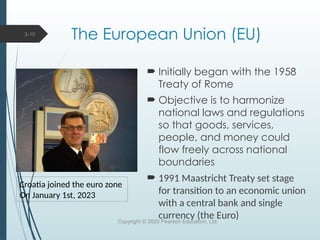
Croatia joined the euro zone
On January 1st, 2023
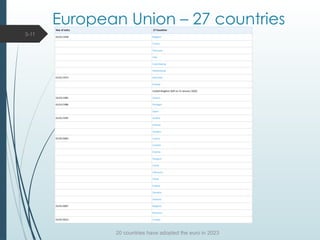
European Union – 27 countries
20 countries have adopted the euro in 2023
3-11
Year of entry 27 Countries
01/01/1958 Belgium
France
Germany
Italy
Luxembourg
Netherlands
01/01/1973 Denmark
Ireland
United Kingdom (left on 31 January 2020)
01/01/1981 Greece
01/01/1986 Portugal
Spain
01/01/1995 Austria
Finland
Sweden
01/05/2004 Cyprus
Czechia
Estonia
Hungary
Latvia
Lithuania
Malta
Poland
Slovakia
Slovenia
01/01/2007 Bulgaria
Romania
01/07/2013 Croatia
19
AELE - EEA – Shengen Area
• AELE: Free trade area consisting of 4 European states: Iceland,
Liechtenstein, Norway and Switzerland.
• EEA: European Economic Area
EU countries and 3 of the 4 AELE (Switzerland excl)
Created to facilitate participation in the European
Market trade and movement without having to apply to
be one of the EU member countries
=> Economic union but without customs union
• Shengen Area: 26 European countries (22 UE and 4 AELE) that
have officially abolished all passport and all other types of
border control at their mutual borders.
Created to facilitate international travel purposes
Copyright © 2022 Pearson Education, Ltd.
3-12
3.3. North America
• NAFTA established as a free trade area in 1994
New Name: USMCA: United States, Mexico and
Canada Agreement
• All three nations pledge to promote economic growth through tariff
reductions and expanded trade and investment
• No common external tariffs
• Restrictions on labor and other movements remain
=> Free trade area
Copyright © 2020 Pearson Education, Ltd.
2-
13
3.4. Latin America
Andean Community
•Bolivia, Colombia, Ecuador, Peru
•45th
anniversary in 2014
•Customs Union
Copyright © 2020 Pearson Education, Ltd.
2-
14
3.4. Latin America
MERCOSUR: Common Market of the South
• Argentina, Brazil, Paraguay, Uruguay, Venezuela
• Customs union, seeks to become common market
– Internal tariffs eliminated
– Established common external tariffs up to 20%
– In time, factors of production will move freely through member
countries
• Remark: Bolivia, Chile, Ecuador, Peru
– Associate members
– Participate in free trade area but not customs union
Copyright © 2020 Pearson Education, Ltd.
2-
15
3.5. Asia-Pacific
ASEAN: The Association of Southeast Asian Nations
• 10 Asian members: Brunei, Cambodia, Indonesia,
Laos, Malaysia, Myanmar, Philippines, Singapore,
Thailand, Vietnam
Free Trade Area
• Top trading partners U.S., Japan, EU, China
• Geographically close; historically divided
• “ASEAN plus six” (Japan, China, Korea, Australia, New Zealand, India) working
towards an economic community
Copyright © 2020 Pearson Education, Ltd.
2-
16
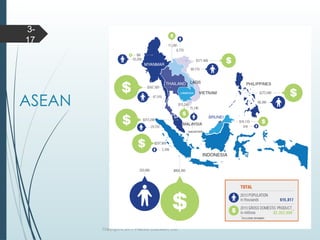
ASEAN
Copyright © 2017 Pearson Education, Ltd.
3-
17
3.5. Asia-Pacific
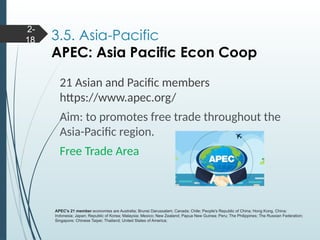
APEC: Asia Pacific Econ Coop
21 Asian and Pacific members
https://www.apec.org/
Aim: to promotes free trade throughout the
Asia-Pacific region.
Free Trade Area
APEC's 21 member economies are Australia; Brunei Darussalam; Canada; Chile; People's Republic of China; Hong Kong, China;
Indonesia; Japan; Republic of Korea; Malaysia; Mexico; New Zealand; Papua New Guinea; Peru; The Philippines; The Russian Federation;
Singapore; Chinese Taipei; Thailand; United States of America;
2-
18
Other major agreements
• TPP:
• TTIP:
• CETA:
2-
19
Other major agreements
• TPP: Trans Pacific Partnership
Free trade between USA and Asian countries
• TTIP: Transatlantic Trade and Investment Partnership
Free trade between USA and EU
• CETA: Comprehensive Economic and Trade
Agreement
Free trade between EU and Canada
2-
20
TPP – Latest news
• The TPP was a massive trade agreement signed by twelve
Pacific Rim countries, including the United States, that
together comprised 40 percent of the global economy.
• President Trump withdrew from the deal on his first day
in office.
• The eleven other TPP countries have moved forward with
a slightly modified agreement and have left the door open
for the United States to rejoin.
• The United Kingdom has officially joined in 2023
marking the first expansion since its inception. This move
is the UK's most significant trade deal post-Brexit, with
expectations to boost the UK economy
https://www.cfr.org/backgrounder/what-trans-pacific-partnership-tpp
2-
21
TTIP – Latest news
• The Transatlantic Trade and Investment Partnership (TTIP) as
an active and ongoing negotiation does not exist currently.
While it was a significant negotiation between the EU and the
U.S. for a free trade agreement, talks have been stalled since
2016. Recent discussions about reviving the TTIP have not led
to a resumption of formal negotiations, and both the European
Commission and the U.S. Trade Representative have indicated
that their focus is on other platforms and trade relations, not
on TTI
https://www.cfr.org/backgrounder/what-trans-pacific-partnership-tpp
2-
22
CETA – Latest news
• CETA has significantly boosted EU-Canada trade, increasing it by
over 30% in five years, creating jobs and strengthening economic
relations. The full ratification of CETA by all EU member states is
pending, which is necessary for the complete application of its
investment protection provisions. Current global challenges
underscore the importance of CETA for economic resilience and
supply chain security. There is ongoing work to finalize a Joint
Interpretative Statement to clarify investment protection
provisions. Both parties value the agreement for its role in
promoting cooperation, innovation, and competitiveness. The
benefits of CETA are to be broadly shared, including advancements
in clean technology and labor standards. Efforts continue to
maximize CETA's potential and address market access issues. The
next CETA Joint Committee meeting is planned for early 2024 in the
EU.
https://www.cfr.org/backgrounder/what-trans-pacific-partnership-tpp
2-
23
Summary
• See word document
2-
24
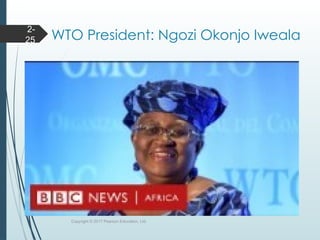
WTO President: Ngozi Okonjo Iweala
Copyright © 2017 Pearson Education, Ltd.
2-
25
Text Brexit
BREXIT finally becomes real for imports of EU
goods into Britain
The economist January 30th 2024
2-
26

Chapter 3 The Global Trade Environment.pptx

  • 1.
  • 2.
    Table of content 3.1The World Trade Organization and Gatt 3.2. Preferential Trade Agreements 3.3. North America 3.4. Latin America 3.5. Asia Pacific 3.6. Other major agreements Copyright © 2020 Pearson Education, Ltd. 2-2
  • 3.
    3.1. WTO: TheWorld Trade Organisation WTO: Forum for trade-related negotiations among 164 members –Based in Geneva –Serves as dispute mediator through DSB –Has enforcement power and can impose sanctions Copyright © 2020 Pearson Education, Ltd. 2-3
  • 4.
    3.1. WTO GATT :General Agreement on Tariffs and Trade – Treaty among nations to promote trade among members established in 1947 • Handled trade disputes • Lacked enforcement power; nicknamed the General Agreement to Talk and Talk • Disputes lasted for years • Replaced by World Trade Organization in 1995 Copyright © 2020 Pearson Education, Ltd. 2-4
  • 5.
    3.2. Preferential TradeAgreements a) Free Trade Area Elimination of tariffs and other trade barriers Goal: have zero duties on goods that cross borders between partners Example: USCMA Copyright © 2020 Pearson Education, Ltd. 3-5
  • 6.
    b) Customs Union Eliminationof tariffs and other trade barriers AND establishes common external barriers Example: the Andean Community Copyright © 2020 Pearson Education, Ltd. 3-6
  • 7.
    c) Common Market Eliminationof tariffs and other trade barriers AND establishes common external barriers AND allows for the free movement of factors of production, such as labor, capital, and information Example: Mercosur Copyright © 2020 Pearson Education, Ltd. 3-7
  • 8.
    d) Economic Union Elimination of tariffs and other trade barriers  AND establishes common external barriers  AND allows for the free movement of factors of production, such as labor, capital, and information  AND coordinates and harmonizes economic and social policy within the union Copyright © 2020 Pearson Education, Ltd. 3-8
  • 9.
    e) Economic &Monetary Union creation of unified central bank use of single currency common policies on issues such as agriculture, social policy, transport, competition, mergers, taxation requires extensive political unity would lead to a central government in time Copyright © 2020 Pearson Education, Ltd. 3-9
  • 10.
    The European Union(EU)  Initially began with the 1958 Treaty of Rome  Objective is to harmonize national laws and regulations so that goods, services, people, and money could flow freely across national boundaries  1991 Maastricht Treaty set stage for transition to an economic union with a central bank and single currency (the Euro) Copyright © 2020 Pearson Education, Ltd. 3-10 Croatia joined the euro zone On January 1st, 2023
  • 11.
    European Union –27 countries 20 countries have adopted the euro in 2023 3-11 Year of entry 27 Countries 01/01/1958 Belgium France Germany Italy Luxembourg Netherlands 01/01/1973 Denmark Ireland United Kingdom (left on 31 January 2020) 01/01/1981 Greece 01/01/1986 Portugal Spain 01/01/1995 Austria Finland Sweden 01/05/2004 Cyprus Czechia Estonia Hungary Latvia Lithuania Malta Poland Slovakia Slovenia 01/01/2007 Bulgaria Romania 01/07/2013 Croatia 19
  • 12.
    AELE - EEA– Shengen Area • AELE: Free trade area consisting of 4 European states: Iceland, Liechtenstein, Norway and Switzerland. • EEA: European Economic Area EU countries and 3 of the 4 AELE (Switzerland excl) Created to facilitate participation in the European Market trade and movement without having to apply to be one of the EU member countries => Economic union but without customs union • Shengen Area: 26 European countries (22 UE and 4 AELE) that have officially abolished all passport and all other types of border control at their mutual borders. Created to facilitate international travel purposes Copyright © 2022 Pearson Education, Ltd. 3-12
  • 13.
    3.3. North America •NAFTA established as a free trade area in 1994 New Name: USMCA: United States, Mexico and Canada Agreement • All three nations pledge to promote economic growth through tariff reductions and expanded trade and investment • No common external tariffs • Restrictions on labor and other movements remain => Free trade area Copyright © 2020 Pearson Education, Ltd. 2- 13
  • 14.
    3.4. Latin America AndeanCommunity •Bolivia, Colombia, Ecuador, Peru •45th anniversary in 2014 •Customs Union Copyright © 2020 Pearson Education, Ltd. 2- 14
  • 15.
    3.4. Latin America MERCOSUR:Common Market of the South • Argentina, Brazil, Paraguay, Uruguay, Venezuela • Customs union, seeks to become common market – Internal tariffs eliminated – Established common external tariffs up to 20% – In time, factors of production will move freely through member countries • Remark: Bolivia, Chile, Ecuador, Peru – Associate members – Participate in free trade area but not customs union Copyright © 2020 Pearson Education, Ltd. 2- 15
  • 16.
    3.5. Asia-Pacific ASEAN: TheAssociation of Southeast Asian Nations • 10 Asian members: Brunei, Cambodia, Indonesia, Laos, Malaysia, Myanmar, Philippines, Singapore, Thailand, Vietnam Free Trade Area • Top trading partners U.S., Japan, EU, China • Geographically close; historically divided • “ASEAN plus six” (Japan, China, Korea, Australia, New Zealand, India) working towards an economic community Copyright © 2020 Pearson Education, Ltd. 2- 16
  • 17.
    ASEAN Copyright © 2017Pearson Education, Ltd. 3- 17
  • 18.
    3.5. Asia-Pacific APEC: AsiaPacific Econ Coop 21 Asian and Pacific members https://www.apec.org/ Aim: to promotes free trade throughout the Asia-Pacific region. Free Trade Area APEC's 21 member economies are Australia; Brunei Darussalam; Canada; Chile; People's Republic of China; Hong Kong, China; Indonesia; Japan; Republic of Korea; Malaysia; Mexico; New Zealand; Papua New Guinea; Peru; The Philippines; The Russian Federation; Singapore; Chinese Taipei; Thailand; United States of America; 2- 18
  • 19.
    Other major agreements •TPP: • TTIP: • CETA: 2- 19
  • 20.
    Other major agreements •TPP: Trans Pacific Partnership Free trade between USA and Asian countries • TTIP: Transatlantic Trade and Investment Partnership Free trade between USA and EU • CETA: Comprehensive Economic and Trade Agreement Free trade between EU and Canada 2- 20
  • 21.
    TPP – Latestnews • The TPP was a massive trade agreement signed by twelve Pacific Rim countries, including the United States, that together comprised 40 percent of the global economy. • President Trump withdrew from the deal on his first day in office. • The eleven other TPP countries have moved forward with a slightly modified agreement and have left the door open for the United States to rejoin. • The United Kingdom has officially joined in 2023 marking the first expansion since its inception. This move is the UK's most significant trade deal post-Brexit, with expectations to boost the UK economy https://www.cfr.org/backgrounder/what-trans-pacific-partnership-tpp 2- 21
  • 22.
    TTIP – Latestnews • The Transatlantic Trade and Investment Partnership (TTIP) as an active and ongoing negotiation does not exist currently. While it was a significant negotiation between the EU and the U.S. for a free trade agreement, talks have been stalled since 2016. Recent discussions about reviving the TTIP have not led to a resumption of formal negotiations, and both the European Commission and the U.S. Trade Representative have indicated that their focus is on other platforms and trade relations, not on TTI https://www.cfr.org/backgrounder/what-trans-pacific-partnership-tpp 2- 22
  • 23.
    CETA – Latestnews • CETA has significantly boosted EU-Canada trade, increasing it by over 30% in five years, creating jobs and strengthening economic relations. The full ratification of CETA by all EU member states is pending, which is necessary for the complete application of its investment protection provisions. Current global challenges underscore the importance of CETA for economic resilience and supply chain security. There is ongoing work to finalize a Joint Interpretative Statement to clarify investment protection provisions. Both parties value the agreement for its role in promoting cooperation, innovation, and competitiveness. The benefits of CETA are to be broadly shared, including advancements in clean technology and labor standards. Efforts continue to maximize CETA's potential and address market access issues. The next CETA Joint Committee meeting is planned for early 2024 in the EU. https://www.cfr.org/backgrounder/what-trans-pacific-partnership-tpp 2- 23
  • 24.
    Summary • See worddocument 2- 24
  • 25.
    WTO President: NgoziOkonjo Iweala Copyright © 2017 Pearson Education, Ltd. 2- 25
  • 26.
    Text Brexit BREXIT finallybecomes real for imports of EU goods into Britain The economist January 30th 2024 2- 26

Editor's Notes

  • #5 The EU’s and Turkey’s 1996 agreement eliminated tariffs averaging 14% that added $1.5 billion/year to the cost of European goods imported into Turkey.
  • #6 The EU’s and Turkey’s 1996 agreement eliminated tariffs averaging 14% that added $1.5 billion/year to the cost of European goods imported into Turkey.
  • #7 Current Central and South American customs unions SICA, CARICOM, and the Andean Community may evolve into common markets.
  • #8 In the European Union, countries must harmonize their licensing standards so that professionals such as doctors or lawyers qualified in one country may work in another. Harmonization is an important concept to be stressed.
  • #9  The full evolution of an economic union would involve the creation of a unified central bank; the use of a single currency; and common policies on agriculture, social services, welfare, regional development, transport, taxation, competition, and mergers. A true economic union requires extensive political unity, which makes it similar to a nation. The further integration of nations that were members of fully developed economic unions would be the formation of a central government that would bring together independent political states into a single political framework. The EU is approaching its target of completing most of the steps required to become a full economic union, with one notable setback: Despite the fact that 16 member nations ratified a proposed European Constitution, the initiative was derailed after voters in France and the Netherlands voted against the measure.
  • #10 The origins of the European Union (EU) can be traced back to the 1958 Treaty of Rome. The six original members of the European Community (EC), as the group was called then, were Belgium, France, Holland, Italy, Luxembourg, and West Germany. In 1973, Great Britain, Denmark, and Ireland were admitted, followed by Greece in 1981 and Spain and Portugal in 1986. Beginning in 1987, the 12 countries that were EC members set about the difficult task of creating a genuine single market in goods, services, and capital. In other words, the goal was to create a true economic union. Adopting the Single European Act by the end of 1992 was a major EC achievement; the Council of Ministers adopted more than 200 pieces of legislation and regulations to make the single market a reality.