7.1
Chapter 2
Lecture 1
Transmission Media
Instructor: Tameru H. (Msc.)
Addis ababa Science and Technology University (AASTU)
Software Engineering Department
7.2
Classes of transmission media
7.3
GUIDED MEDIA
GUIDED MEDIA

Guided media, which are those that
provide a conduit from one device to
another, include twisted-pair cable, coaxial
cable, and fiber-optic cable.

Twisted-Pair Cable

Coaxial Cable

Fiber-Optic Cable
Guided media includes:
7.4
7.5
Twisted-pair cable
7.6
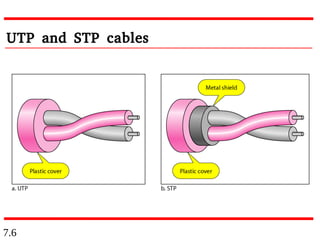
UTP and STP cables
7.7
UTP connector: RJ-45
7.8
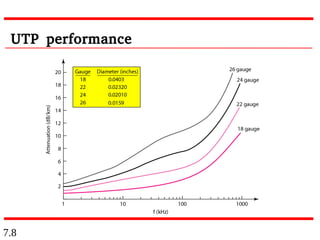
UTP performance
7.9
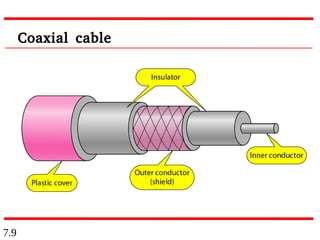
Coaxial cable
7.10
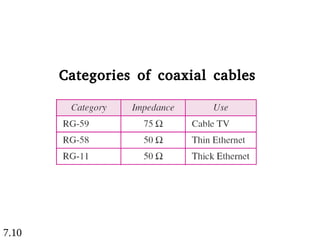
Categories of coaxial cables
7.11
BNC connectors
7.12
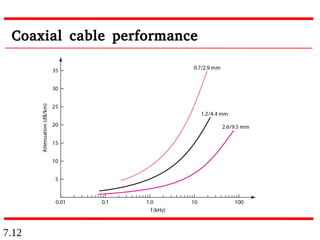
Coaxial cable performance
7.13
Optical fiber
7.14
Bending of light ray
7.15
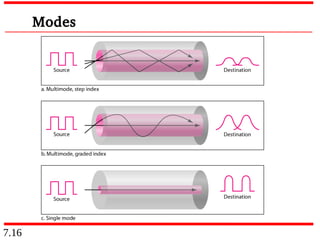
Propagation modes
7.16
Modes
7.17
Fiber types
7.18
Fiber construction
7.19
Fiber-optic cable connectors
7.20
Optical fiber performance
7.21
UNGUIDED MEDIA: WIRELESS

Unguided media transport
electromagnetic waves without using a
physical conductor. This type of
communication is often referred to as
wireless
wireless communication.
communication.

Radio Waves

Microwaves

Infrared
Unguided media includes :
7.22
Electromagnetic spectrum for
wireless communication
7.23
Propagation methods
7.24
Bands
7.25
Wireless transmission waves
7.26
Radio waves

Radio waves are used for multicast
communications, such as radio and
television, and paging systems.

They can penetrate through walls.

Highly regulated.

Use omni directional antennas
7.27
Omnidirectional antenna
7.28
Microwaves

Microwaves are used for unicast
communication such as cellular
telephones, satellite networks,
and wireless LANs.

Higher frequency ranges cannot penetrate
walls.

Use directional antennas - point to point
line of sight communications.
7.29
Unidirectional antennas
7.30
Infrared

Infrared signals can be used for short-
range communication in a closed area
using line-of-sight propagation.
7.31
Wireless Channels
 Are subject to a lot more errors than
guided media channels.
 Interference is one cause for errors, can be
circumvented with high SNR.
 The higher the SNR the less capacity is
available for transmission due to the
broadcast nature of the channel.
 Channel also subject to fading and no
coverage holes.

CH2-LECTURE-1.pdf