Consider seven questions when
revising your document for coherence:


• Have you left out anything in turning your
  outline into a draft?
• Have you included all the elements your
  readers expect to see?
• Have you organized the document logically?
• Is the document persuasive?


     Chapter 9. Writing Coherent Documents   © 2012 by Bedford/St. Martin's   1
Consider seven questions when revising
 your document for coherence (cont.):

• Do you come across as reliable, honest, and
  helpful?
• Have you presented all the elements
  consistently?
• Is the emphasis appropriate throughout the
  document?


     Chapter 9. Writing Coherent Documents   © 2012 by Bedford/St. Martin's   2
Follow four guidelines
            when revising headings:

• Avoid long noun strings.
• Be informative.
• Use a grammatical form appropriate to your
  audience.
• Avoid back-to-back headings.


     Chapter 9. Writing Coherent Documents   © 2012 by Bedford/St. Martin's   3
Turning paragraphs into lists
          presents four advantages:


•   It forces you to look at the big picture.
•   It forces you to examine the sequence.
•   It forces you to create a helpful lead-in.
•   It forces you to tighten and clarify your prose.


       Chapter 9. Writing Coherent Documents   © 2012 by Bedford/St. Martin's   4
Study documents from other
   cultures to answer four questions:

• How does the writer make the information
  accessible?
• How does the writer show the relationship
  among types of information?
• How does the writer communicate the
  organization of the document as a whole?
• How does the writer make transitions from one
  subject to another?

     Chapter 9. Writing Coherent Documents   © 2012 by Bedford/St. Martin's   5
There are two kinds of paragraphs:

• A body paragraph is a group of sentences (or
  sometimes a single sentence) that is complete
  and self-sufficient and that contributes to a
  larger discussion.
• A transitional paragraph helps readers move
  from one major point to another.


     Chapter 9. Writing Coherent Documents   © 2012 by Bedford/St. Martin's   6
Most paragraphs contain two elements:

• The topic sentence summarizes or forecasts
  the main point of the paragraph.
• The supporting information makes the topic
  sentence clear and convincing.


     Chapter 9. Writing Coherent Documents   © 2012 by Bedford/St. Martin's   7
Avoid burying bad news in paragraphs:

• The most emphatic location is the topic
  sentence.
• The second most emphatic location is the end of
  the paragraph.
• The least emphatic location is the middle of the
  paragraph.


       Chapter 9. Writing Coherent Documents   © 2012 by Bedford/St. Martin's   8
Supporting information
      usually fulfills one of five roles:

• It defines a key term or idea included in the topic
  sentence.
• It provides examples or illustrations of the
  situation described in the topic sentence.
• It identifies causes: factors that led to the
  situation.
• It defines effects: implications of the situation.
• It supports the claim made in the topic sentence.
      Chapter 9. Writing Coherent Documents   © 2012 by Bedford/St. Martin's   9
Follow three guidelines
     when dividing long paragraphs:

• Break the discussion at a logical place.
• Make the topic sentence a separate
  paragraph and break up the supporting
  information.
• Use a list.


     Chapter 9. Writing Coherent Documents   © 2012 by Bedford/St. Martin's   10
Use three techniques
           to emphasize coherence:

• Add transitional words and phrases.
• Repeat key words.
• Use demonstrative pronouns followed by
  nouns.


     Chapter 9. Writing Coherent Documents   © 2012 by Bedford/St. Martin's   11
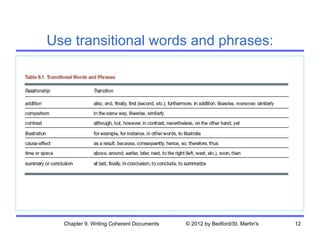
Use transitional words and phrases:


  Chapter 9. Writing Coherent Documents   © 2012 by Bedford/St. Martin's   12
Use two techniques
       to create a coherent design:

• Use headers and footers to enhance
  coherence.
• Use typefaces to enhance coherence.


     Chapter 9. Writing Coherent Documents   © 2012 by Bedford/St. Martin's   13
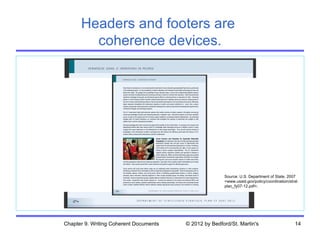
Headers and footers are
        coherence devices.


                                                       Source: U.S. Department of State, 2007
                                                       <www.usaid.gov/policy/coordination/strat
                                                       plan_fy07-12.pdf>.


Chapter 9. Writing Coherent Documents   © 2012 by Bedford/St. Martin's                       14

Ch09 slides

  • 1.
    Consider seven questionswhen revising your document for coherence: • Have you left out anything in turning your outline into a draft? • Have you included all the elements your readers expect to see? • Have you organized the document logically? • Is the document persuasive? Chapter 9. Writing Coherent Documents © 2012 by Bedford/St. Martin's 1
  • 2.
    Consider seven questionswhen revising your document for coherence (cont.): • Do you come across as reliable, honest, and helpful? • Have you presented all the elements consistently? • Is the emphasis appropriate throughout the document? Chapter 9. Writing Coherent Documents © 2012 by Bedford/St. Martin's 2
  • 3.
    Follow four guidelines when revising headings: • Avoid long noun strings. • Be informative. • Use a grammatical form appropriate to your audience. • Avoid back-to-back headings. Chapter 9. Writing Coherent Documents © 2012 by Bedford/St. Martin's 3
  • 4.
    Turning paragraphs intolists presents four advantages: • It forces you to look at the big picture. • It forces you to examine the sequence. • It forces you to create a helpful lead-in. • It forces you to tighten and clarify your prose. Chapter 9. Writing Coherent Documents © 2012 by Bedford/St. Martin's 4
  • 5.
    Study documents fromother cultures to answer four questions: • How does the writer make the information accessible? • How does the writer show the relationship among types of information? • How does the writer communicate the organization of the document as a whole? • How does the writer make transitions from one subject to another? Chapter 9. Writing Coherent Documents © 2012 by Bedford/St. Martin's 5
  • 6.
    There are twokinds of paragraphs: • A body paragraph is a group of sentences (or sometimes a single sentence) that is complete and self-sufficient and that contributes to a larger discussion. • A transitional paragraph helps readers move from one major point to another. Chapter 9. Writing Coherent Documents © 2012 by Bedford/St. Martin's 6
  • 7.
    Most paragraphs containtwo elements: • The topic sentence summarizes or forecasts the main point of the paragraph. • The supporting information makes the topic sentence clear and convincing. Chapter 9. Writing Coherent Documents © 2012 by Bedford/St. Martin's 7
  • 8.
    Avoid burying badnews in paragraphs: • The most emphatic location is the topic sentence. • The second most emphatic location is the end of the paragraph. • The least emphatic location is the middle of the paragraph. Chapter 9. Writing Coherent Documents © 2012 by Bedford/St. Martin's 8
  • 9.
    Supporting information usually fulfills one of five roles: • It defines a key term or idea included in the topic sentence. • It provides examples or illustrations of the situation described in the topic sentence. • It identifies causes: factors that led to the situation. • It defines effects: implications of the situation. • It supports the claim made in the topic sentence. Chapter 9. Writing Coherent Documents © 2012 by Bedford/St. Martin's 9
  • 10.
    Follow three guidelines when dividing long paragraphs: • Break the discussion at a logical place. • Make the topic sentence a separate paragraph and break up the supporting information. • Use a list. Chapter 9. Writing Coherent Documents © 2012 by Bedford/St. Martin's 10
  • 11.
    Use three techniques to emphasize coherence: • Add transitional words and phrases. • Repeat key words. • Use demonstrative pronouns followed by nouns. Chapter 9. Writing Coherent Documents © 2012 by Bedford/St. Martin's 11
  • 12.
    Use transitional wordsand phrases: Chapter 9. Writing Coherent Documents © 2012 by Bedford/St. Martin's 12
  • 13.
    Use two techniques to create a coherent design: • Use headers and footers to enhance coherence. • Use typefaces to enhance coherence. Chapter 9. Writing Coherent Documents © 2012 by Bedford/St. Martin's 13
  • 14.
    Headers and footersare coherence devices. Source: U.S. Department of State, 2007 <www.usaid.gov/policy/coordination/strat plan_fy07-12.pdf>. Chapter 9. Writing Coherent Documents © 2012 by Bedford/St. Martin's 14