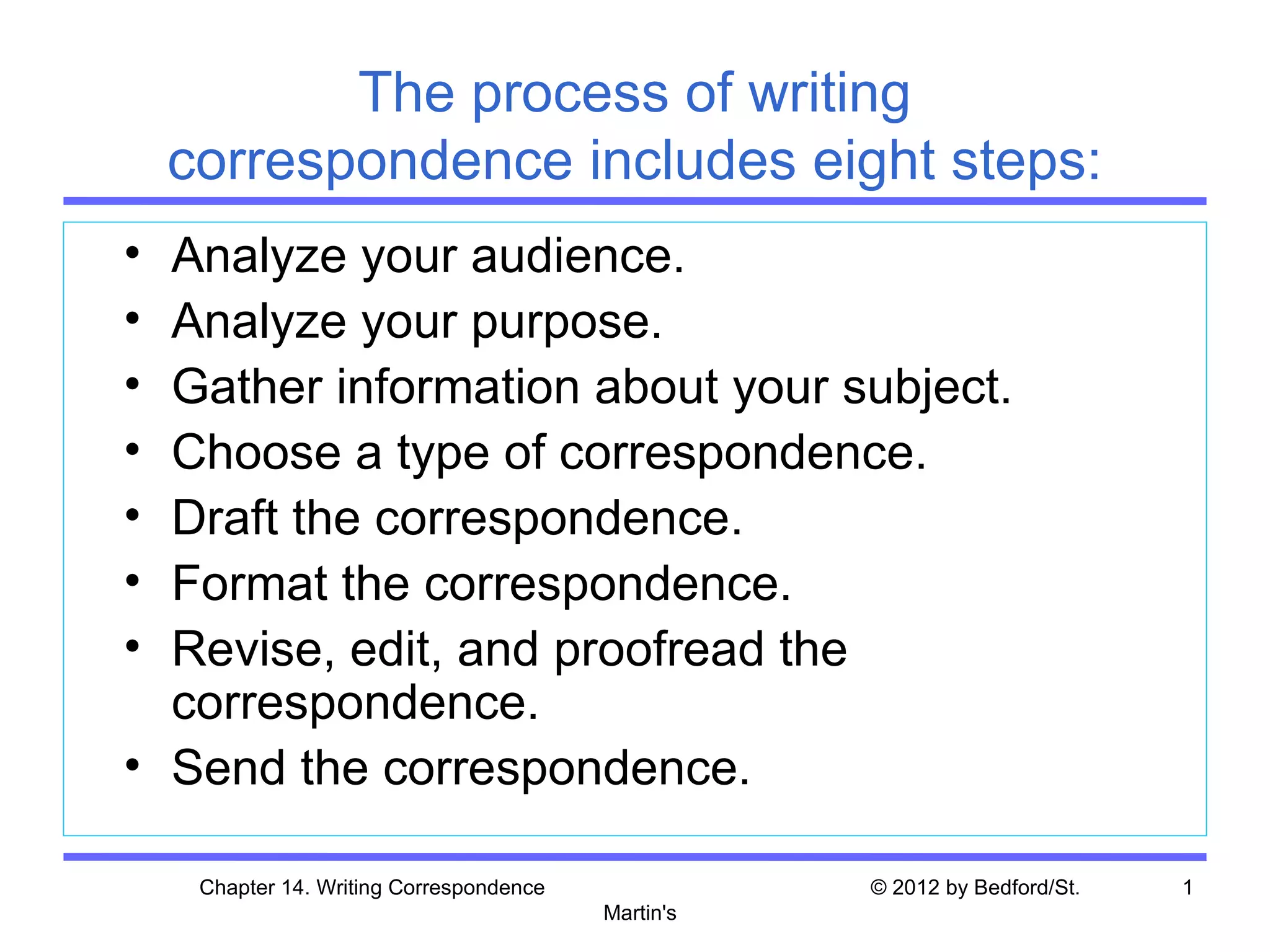
The process of writing
    correspondence includes eight steps:
• Analyze your audience.
• Analyze your purpose.
• Gather information about your subject.
• Choose a type of correspondence.
• Draft the correspondence.
• Format the correspondence.
• Revise, edit, and proofread the
  correspondence.
• Send the correspondence.

     Chapter 14. Writing Correspondence              © 2012 by Bedford/St.   1
                                          Martin's
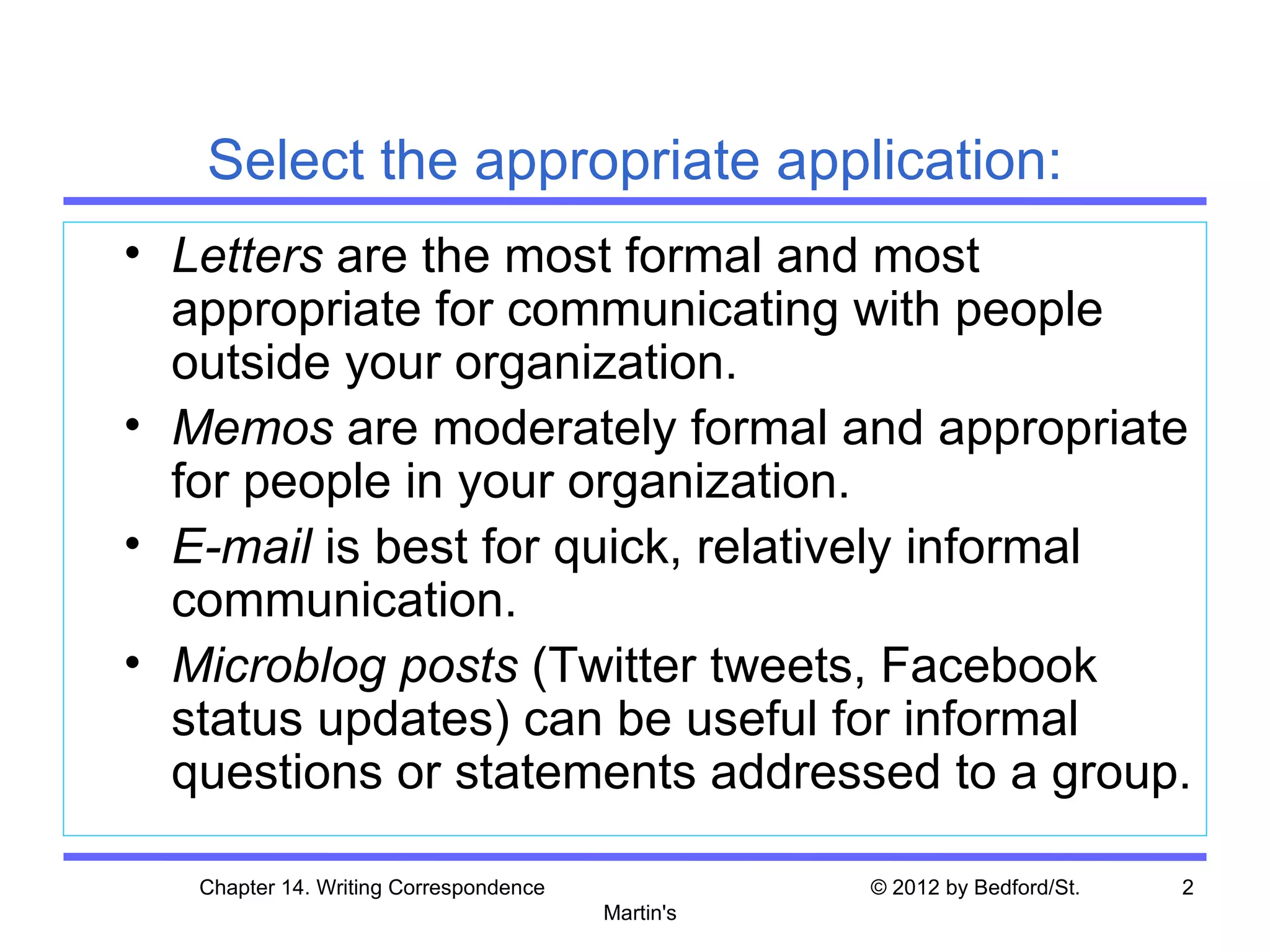
Select the appropriate application:
• Letters are the most formal and most
  appropriate for communicating with people
  outside your organization.
• Memos are moderately formal and appropriate
  for people in your organization.
• E-mail is best for quick, relatively informal
  communication.
• Microblog posts (Twitter tweets, Facebook
  status updates) can be useful for informal
  questions or statements addressed to a group.

   Chapter 14. Writing Correspondence              © 2012 by Bedford/St.   2
                                        Martin's
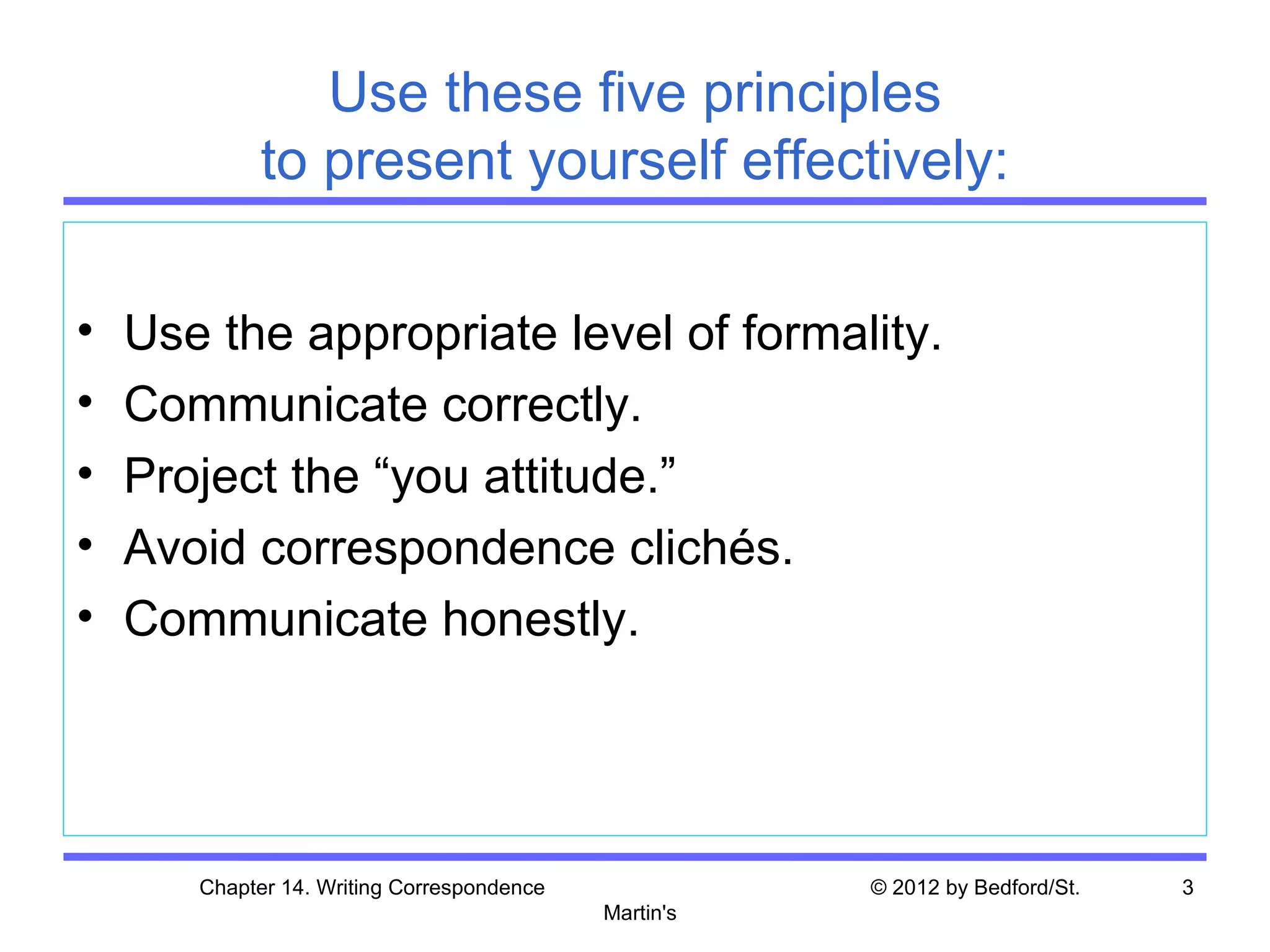
Use these five principles
             to present yourself effectively:

•   Use the appropriate level of formality.
•   Communicate correctly.
•   Project the “you attitude.”
•   Avoid correspondence clichés.
•   Communicate honestly.


       Chapter 14. Writing Correspondence              © 2012 by Bedford/St.   3
                                            Martin's
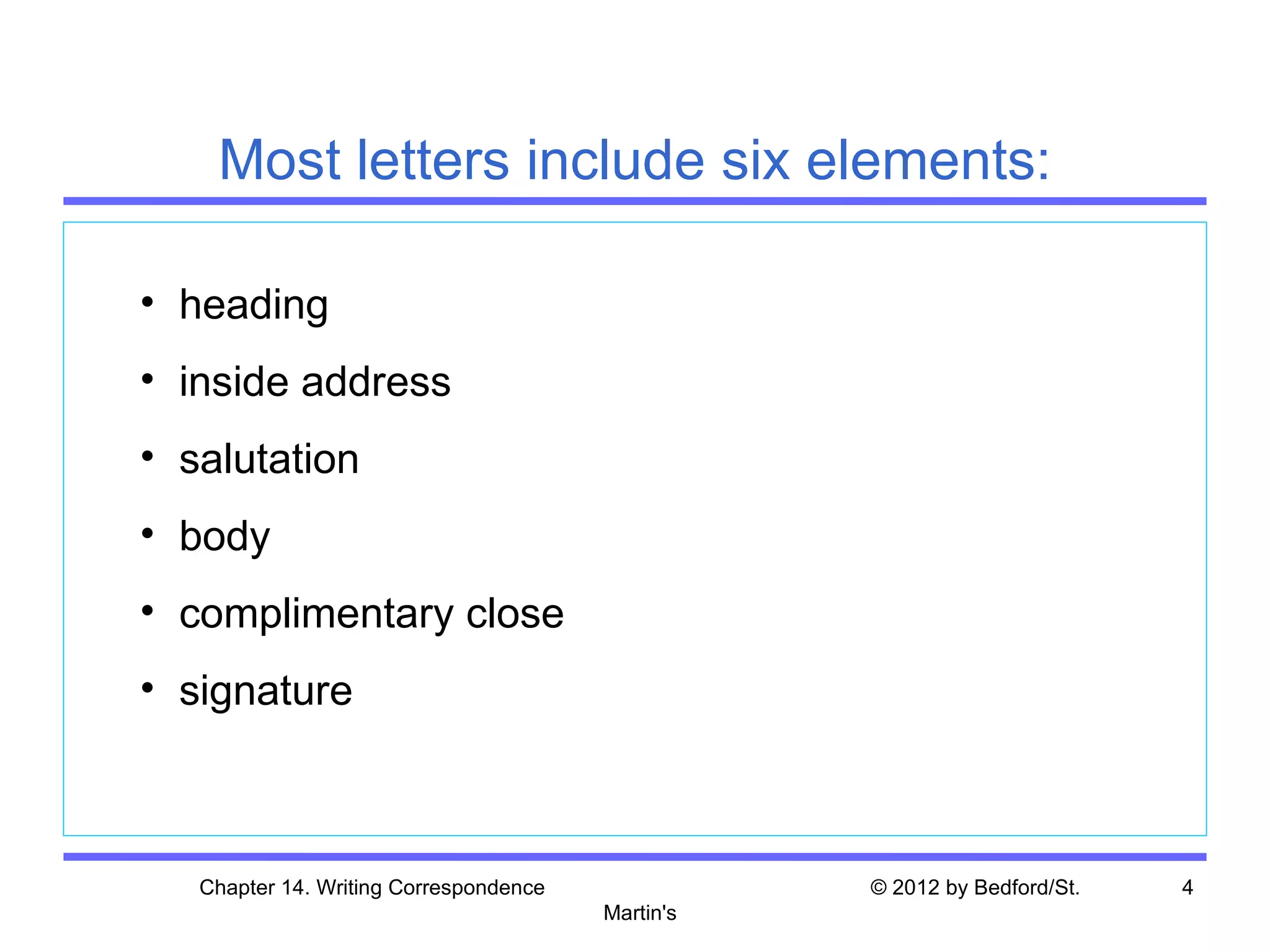
Most letters include six elements:

• heading
• inside address
• salutation
• body
• complimentary close
• signature


   Chapter 14. Writing Correspondence              © 2012 by Bedford/St.   4
                                        Martin's
Some letters include additional elements:

• attention line
• subject line
• header for second and subsequent pages
• enclosure line
• copy line


   Chapter 14. Writing Correspondence              © 2012 by Bedford/St.   5
                                        Martin's
Most letters use one of two formats:

• modified block
• full block


   Chapter 14. Writing Correspondence              © 2012 by Bedford/St.   6
                                        Martin's
Four types of letters are common:

• inquiry
• response to inquiry
• claim
• adjustment


  Chapter 14. Writing Correspondence              © 2012 by Bedford/St.   7
                                       Martin's
Use this strategy when
                writing an inquiry letter:
• Explain who you are and why you are writing.
• Make your questions precise and clear.
• Indicate your schedule.
• Politely request a response.
• Offer something in return.
• Always write a thank-you note to the person
  who has responded to your inquiry letter.

  Chapter 14. Writing Correspondence              © 2012 by Bedford/St.   8
                                       Martin's
Use this strategy when
          responding to an inquiry letter:

• Answer the questions if you can.
• If you cannot answer the questions, explain the
  reasons and offer to assist with other requests.
• Include additional information, if appropriate.


     Chapter 14. Writing Correspondence              © 2012 by Bedford/St.   9
                                          Martin's
Use this strategy
               when writing a claim letter:

• Use a professional tone.
• Clearly identify the product or service you are
  writing about.
• Explain the problem and include persuasive
  details.
• Propose a solution.


     Chapter 14. Writing Correspondence              © 2012 by Bedford/St.   10
                                          Martin's
Use this strategy when
 writing a bad-news adjustment letter:

• Meet the customer on neutral ground.
• Summarize the facts as you see them.
• Explain why you are unable to fulfill the
  request.
• Create goodwill.


  Chapter 14. Writing Correspondence              © 2012 by Bedford/St.   11
                                       Martin's
Use these five elements
                to organize most memos:

•   a specific subject line
•   a clear statement of purpose
•   a brief summary
•   informative headings
•   a prominent recommendation


     Chapter 14. Writing Correspondence              © 2012 by Bedford/St.   12
                                          Martin's
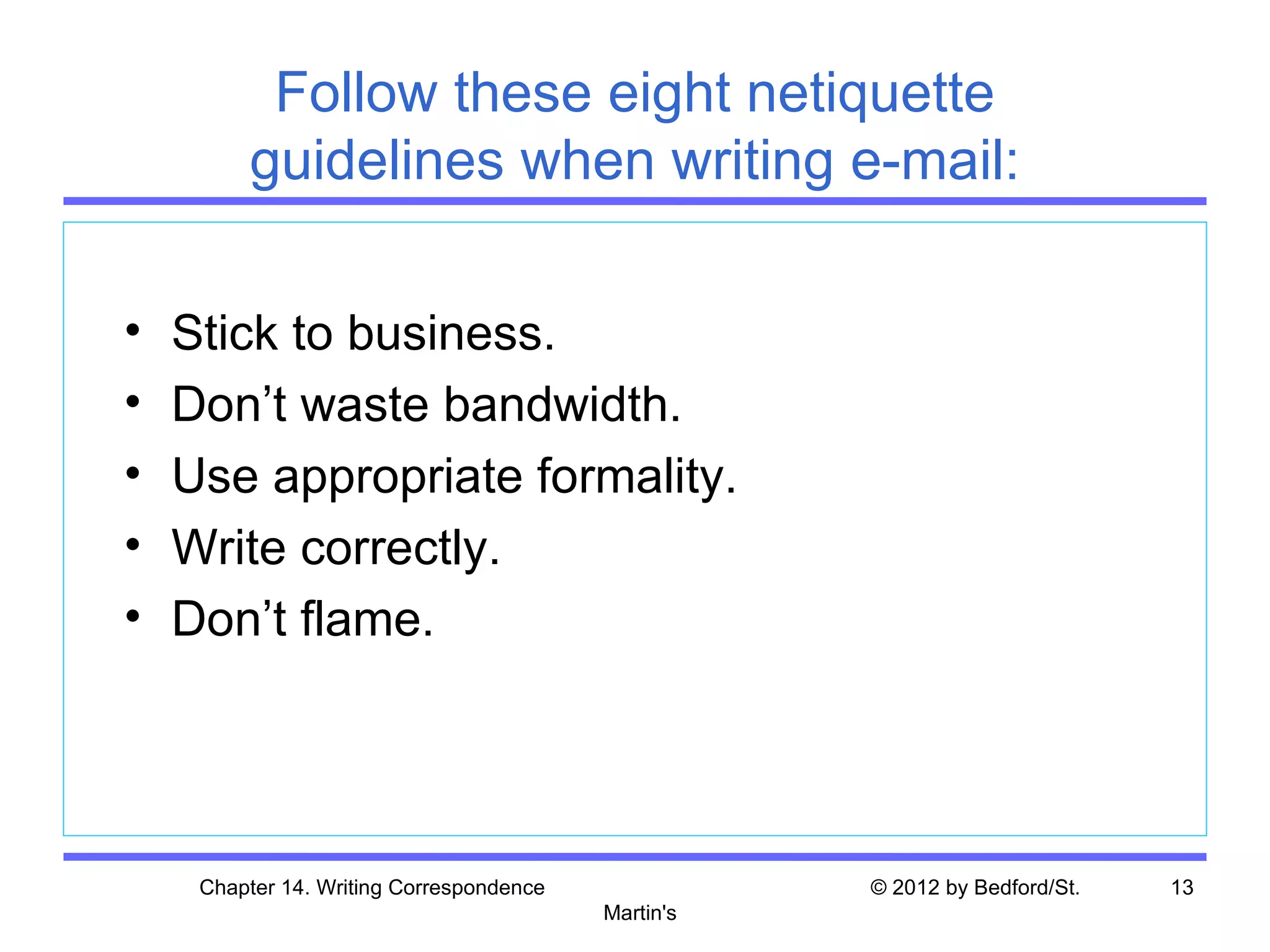
Follow these eight netiquette
         guidelines when writing e-mail:

•   Stick to business.
•   Don’t waste bandwidth.
•   Use appropriate formality.
•   Write correctly.
•   Don’t flame.


     Chapter 14. Writing Correspondence              © 2012 by Bedford/St.   13
                                          Martin's
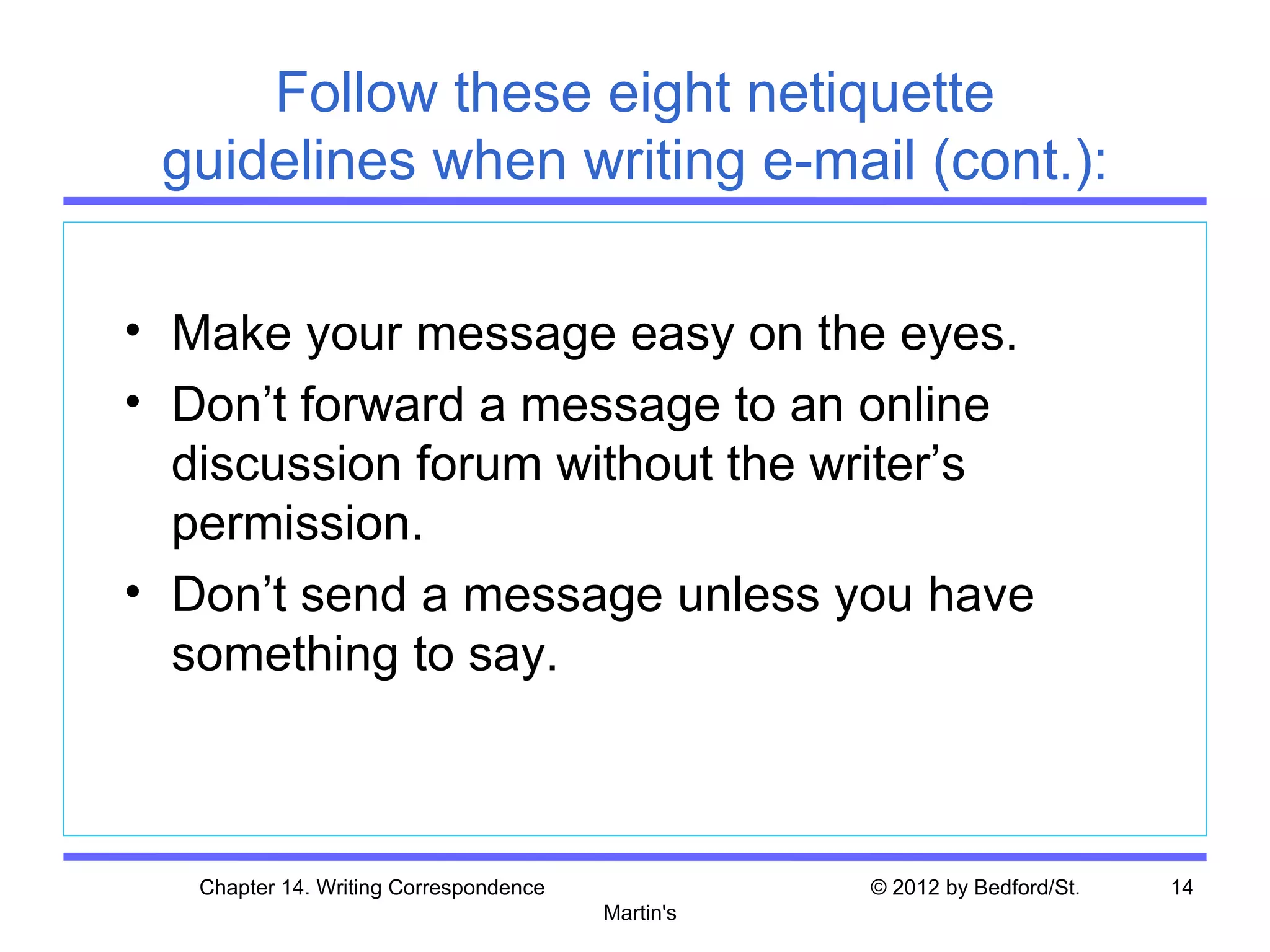
Follow these eight netiquette
 guidelines when writing e-mail (cont.):

• Make your message easy on the eyes.
• Don’t forward a message to an online
  discussion forum without the writer’s
  permission.
• Don’t send a message unless you have
  something to say.


   Chapter 14. Writing Correspondence              © 2012 by Bedford/St.   14
                                        Martin's
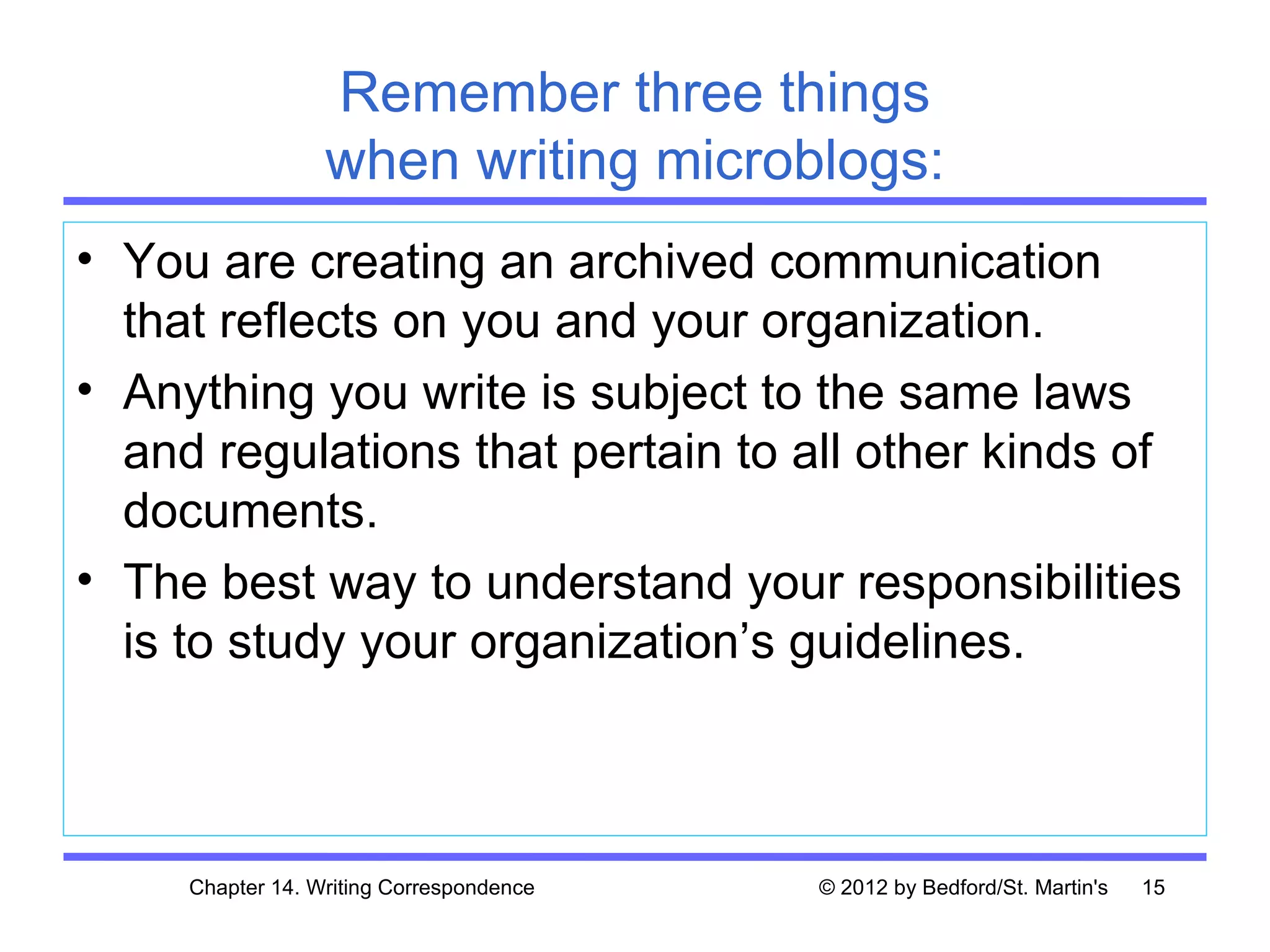
Remember three things
                  when writing microblogs:
• You are creating an archived communication
  that reflects on you and your organization.
• Anything you write is subject to the same laws
  and regulations that pertain to all other kinds of
  documents.
• The best way to understand your responsibilities
  is to study your organization’s guidelines.


     Chapter 14. Writing Correspondence   © 2012 by Bedford/St. Martin's   15
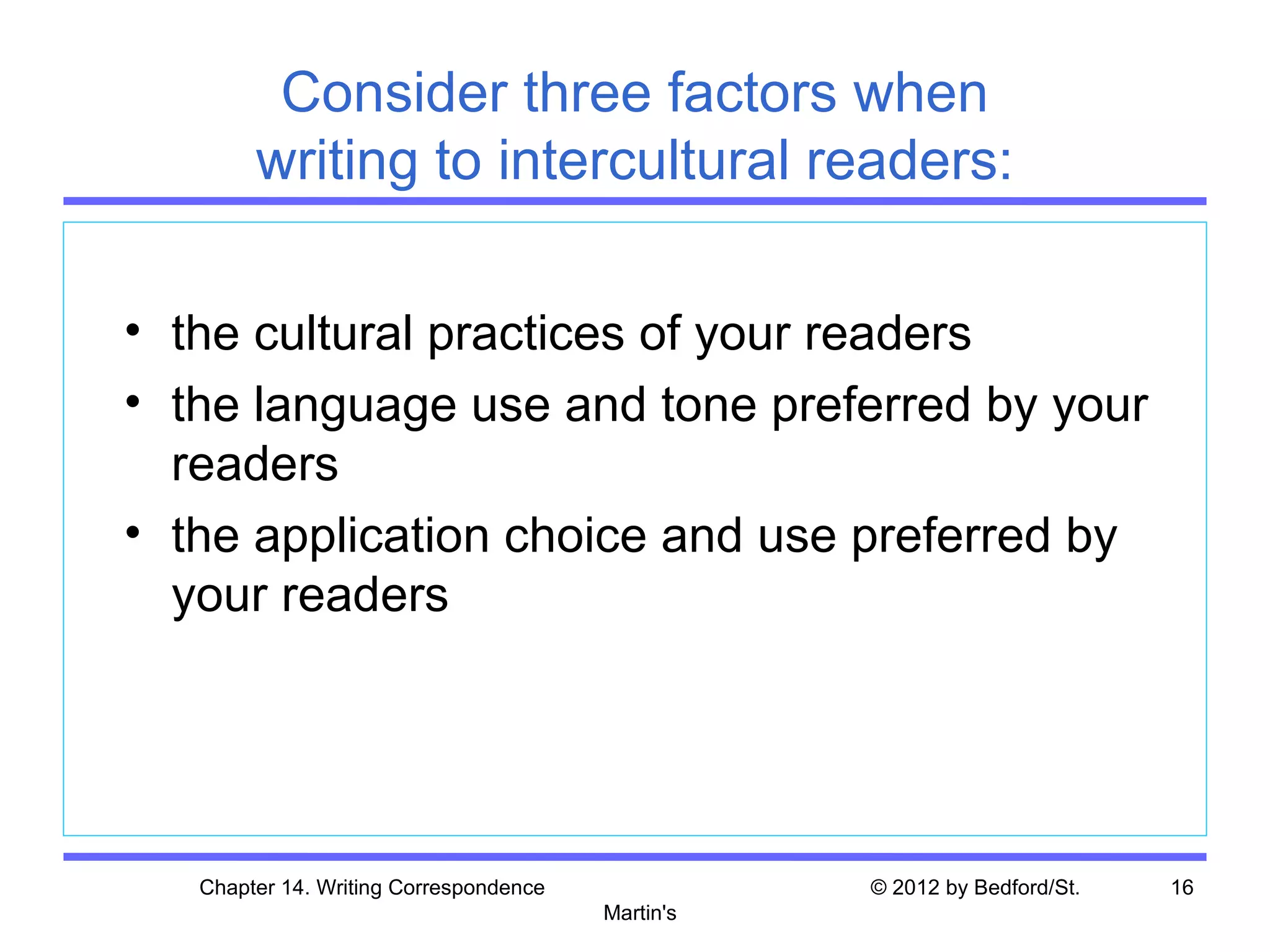
Consider three factors when
        writing to intercultural readers:

• the cultural practices of your readers
• the language use and tone preferred by your
  readers
• the application choice and use preferred by
  your readers


   Chapter 14. Writing Correspondence              © 2012 by Bedford/St.   16
                                        Martin's

Ch14 slides

  • 1.
    The process ofwriting correspondence includes eight steps: • Analyze your audience. • Analyze your purpose. • Gather information about your subject. • Choose a type of correspondence. • Draft the correspondence. • Format the correspondence. • Revise, edit, and proofread the correspondence. • Send the correspondence. Chapter 14. Writing Correspondence © 2012 by Bedford/St. 1 Martin's
  • 2.
    Select the appropriateapplication: • Letters are the most formal and most appropriate for communicating with people outside your organization. • Memos are moderately formal and appropriate for people in your organization. • E-mail is best for quick, relatively informal communication. • Microblog posts (Twitter tweets, Facebook status updates) can be useful for informal questions or statements addressed to a group. Chapter 14. Writing Correspondence © 2012 by Bedford/St. 2 Martin's
  • 3.
    Use these fiveprinciples to present yourself effectively: • Use the appropriate level of formality. • Communicate correctly. • Project the “you attitude.” • Avoid correspondence clichés. • Communicate honestly. Chapter 14. Writing Correspondence © 2012 by Bedford/St. 3 Martin's
  • 4.
    Most letters includesix elements: • heading • inside address • salutation • body • complimentary close • signature Chapter 14. Writing Correspondence © 2012 by Bedford/St. 4 Martin's
  • 5.
    Some letters includeadditional elements: • attention line • subject line • header for second and subsequent pages • enclosure line • copy line Chapter 14. Writing Correspondence © 2012 by Bedford/St. 5 Martin's
  • 6.
    Most letters useone of two formats: • modified block • full block Chapter 14. Writing Correspondence © 2012 by Bedford/St. 6 Martin's
  • 7.
    Four types ofletters are common: • inquiry • response to inquiry • claim • adjustment Chapter 14. Writing Correspondence © 2012 by Bedford/St. 7 Martin's
  • 8.
    Use this strategywhen writing an inquiry letter: • Explain who you are and why you are writing. • Make your questions precise and clear. • Indicate your schedule. • Politely request a response. • Offer something in return. • Always write a thank-you note to the person who has responded to your inquiry letter. Chapter 14. Writing Correspondence © 2012 by Bedford/St. 8 Martin's
  • 9.
    Use this strategywhen responding to an inquiry letter: • Answer the questions if you can. • If you cannot answer the questions, explain the reasons and offer to assist with other requests. • Include additional information, if appropriate. Chapter 14. Writing Correspondence © 2012 by Bedford/St. 9 Martin's
  • 10.
    Use this strategy when writing a claim letter: • Use a professional tone. • Clearly identify the product or service you are writing about. • Explain the problem and include persuasive details. • Propose a solution. Chapter 14. Writing Correspondence © 2012 by Bedford/St. 10 Martin's
  • 11.
    Use this strategywhen writing a bad-news adjustment letter: • Meet the customer on neutral ground. • Summarize the facts as you see them. • Explain why you are unable to fulfill the request. • Create goodwill. Chapter 14. Writing Correspondence © 2012 by Bedford/St. 11 Martin's
  • 12.
    Use these fiveelements to organize most memos: • a specific subject line • a clear statement of purpose • a brief summary • informative headings • a prominent recommendation Chapter 14. Writing Correspondence © 2012 by Bedford/St. 12 Martin's
  • 13.
    Follow these eightnetiquette guidelines when writing e-mail: • Stick to business. • Don’t waste bandwidth. • Use appropriate formality. • Write correctly. • Don’t flame. Chapter 14. Writing Correspondence © 2012 by Bedford/St. 13 Martin's
  • 14.
    Follow these eightnetiquette guidelines when writing e-mail (cont.): • Make your message easy on the eyes. • Don’t forward a message to an online discussion forum without the writer’s permission. • Don’t send a message unless you have something to say. Chapter 14. Writing Correspondence © 2012 by Bedford/St. 14 Martin's
  • 15.
    Remember three things when writing microblogs: • You are creating an archived communication that reflects on you and your organization. • Anything you write is subject to the same laws and regulations that pertain to all other kinds of documents. • The best way to understand your responsibilities is to study your organization’s guidelines. Chapter 14. Writing Correspondence © 2012 by Bedford/St. Martin's 15
  • 16.
    Consider three factorswhen writing to intercultural readers: • the cultural practices of your readers • the language use and tone preferred by your readers • the application choice and use preferred by your readers Chapter 14. Writing Correspondence © 2012 by Bedford/St. 16 Martin's