Normalization part 1
Sistem Basis Data
Rizka Wakhidatus Sholikah
www.its.ac.id
INSTITUT TEKNOLOGI SEPULUH NOPEMBER, Surabaya -
Indonesia
Outline
• Introduction in normalization
• The need of normalization
• How to perform normalization
www.its.ac.id
INSTITUT TEKNOLOGI SEPULUH NOPEMBER, Surabaya -
Indonesia
Normalization
• Normalization is a process for evaluating and
correcting table structure to minimize and
eliminate redundancies
• Normalization works through stages called
Normal Forms (NF)
• 1NF
• 2NF
• 3NF
• 4NF
www.its.ac.id
INSTITUT TEKNOLOGI SEPULUH NOPEMBER, Surabaya -
Indonesia
Normalization
• Note: you should not assume that the highest level of normalization is
always the most desirable
• The higher the norm form  the more relational join operation 
more resource to respond user queries
• Remember that a successful design must also considered end-user
demand for fast respond
www.its.ac.id
INSTITUT TEKNOLOGI SEPULUH NOPEMBER, Surabaya -
Indonesia
The need of normalization
• Normalization can be done when designing database from
scratch or modified existing one
• The process is the same
• The main goal of normalization:
• Eliminate data anomalies by eliminating unnecessary or unwanted
data redundancies
www.its.ac.id
INSTITUT TEKNOLOGI SEPULUH NOPEMBER, Surabaya -
Indonesia
Example
www.its.ac.id
INSTITUT TEKNOLOGI SEPULUH NOPEMBER, Surabaya -
Indonesia
• From the example, can you give an example of problem that will occur if
the table is applied to a table in database
Example
www.its.ac.id
INSTITUT TEKNOLOGI SEPULUH NOPEMBER, Surabaya -
Indonesia
Normalization process
• Remember of the goal of normalization, the tables must have the
following characteristics:
• Each table represent single subject
• Each cell (the intersection between row and column) only have one value
not a group of values
• No data item will be stored in more than one table
• All nonprime attribute in a table are dependent on the primary key
• Each table has no insertion, update, or deletion anomalies which ensures
the integrity and consistency of the data
www.its.ac.id
INSTITUT TEKNOLOGI SEPULUH NOPEMBER, Surabaya -
Indonesia
The most common normal
forms
www.its.ac.id
INSTITUT TEKNOLOGI SEPULUH NOPEMBER, Surabaya -
Indonesia
• The normalization start with identifying the dependencies on
the relation (table) and normalizing the ralation
• After that breaking up the relation (table) into a set of new
relations (tables) based on the identified dependencies
Normalization
www.its.ac.id
INSTITUT TEKNOLOGI SEPULUH NOPEMBER, Surabaya -
Indonesia
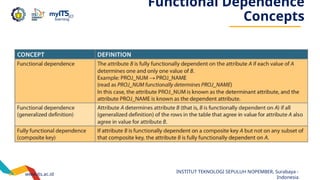
Functional Dependence
Concepts
www.its.ac.id
INSTITUT TEKNOLOGI SEPULUH NOPEMBER, Surabaya -
Indonesia
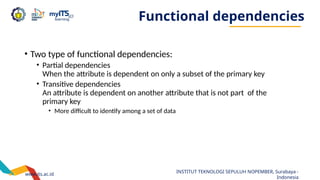
Functional dependencies
• Two type of functional dependencies:
• Partial dependencies
When the attribute is dependent on only a subset of the primary key
• Transitive dependencies
An attribute is dependent on another attribute that is not part of the
primary key
• More difficult to identify among a set of data
www.its.ac.id
INSTITUT TEKNOLOGI SEPULUH NOPEMBER, Surabaya -
Indonesia
Conversion to first normal form
(1NF)
• From example in table 6.1 there is a repeating group
(PROJ_NUM)
• Repeating group derives from a group of multiple entries of the
same or multiple types can exist for any single key attribute
occurrence
• 1NF:
1. All of the key attributes are defined
2. There are no repeating group in the table
3. All attributes are dependent on the primary key (PK)
www.its.ac.id
INSTITUT TEKNOLOGI SEPULUH NOPEMBER, Surabaya -
Indonesia
Conversion to first normal form
(1NF)
• Normalizing can be done by three steps:
1. Eliminate the repeating group and make sure each row only defines
a single entity instance
2. Identify the primary key
3. Identify all dependencies
www.its.ac.id
INSTITUT TEKNOLOGI SEPULUH NOPEMBER, Surabaya -
Indonesia
Step 1: Eliminate the repeating
groups
• Converting multivalued attribute
into single-valued attribute
www.its.ac.id
INSTITUT TEKNOLOGI SEPULUH NOPEMBER, Surabaya -
Indonesia
Step 1: Eliminate the repeating
groups
www.its.ac.id
INSTITUT TEKNOLOGI SEPULUH NOPEMBER, Surabaya -
Indonesia
Step 2: identify the primary key
• From the table in step 1, there is not any unique value that can
be used as primary key
• In that case the primary key can be composed primary key from
PROJ_NUM and EMP_NUM
www.its.ac.id
INSTITUT TEKNOLOGI SEPULUH NOPEMBER, Surabaya -
Indonesia
Step 3: Identify all
dependencies
• After identify the PK in step 2, we can get the dependency:
(PROJ_NUM, EMP_NUM)  PROJ_NAME, EMP_NAME, JOB_CLASS, CHG_HOUR, HOURS
www.its.ac.id
INSTITUT TEKNOLOGI SEPULUH NOPEMBER, Surabaya -
Indonesia
1NF
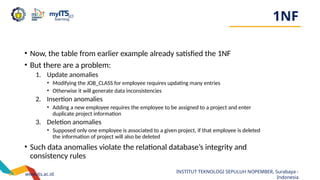
• Now, the table from earlier example already satisfied the 1NF
• But there are a problem:
1. Update anomalies
• Modifying the JOB_CLASS for employee requires updating many entries
• Otherwise it will generate data inconsistencies
2. Insertion anomalies
• Adding a new employee requires the employee to be assigned to a project and enter
duplicate project information
3. Deletion anomalies
• Supposed only one employee is associated to a given project, if that employee is deleted
the information of project will also be deleted
• Such data anomalies violate the relational database’s integrity and
consistency rules
www.its.ac.id
INSTITUT TEKNOLOGI SEPULUH NOPEMBER, Surabaya -
Indonesia
Conversion to second normal form
(2NF)
• Conversion to 2NF only occurs when the 1 NF has composite
PK
• If the 1 NF has a single attribute PK, then the table is
automatically in 2NF
• The table is in 2NF if:
• It is in 1NF
• It includes no partial dependencies
• Step by step conversion of 2NF from the result of 1NF:
1. Make new tables to eliminate partial dependencies
2. Reassign corresponding dependent attributes
www.its.ac.id
INSTITUT TEKNOLOGI SEPULUH NOPEMBER, Surabaya -
Indonesia
Step 1: Make new tables to eliminate partial
dependencies
• For each component of primary key
• Create a new table with a copy of that component as primary
key
• From composite primary key (PROJ_NUM, EMP_NUM):
• We can create three new tables with below primary key:
• PROJ_NUM
• EMP_NUM
• PROJ_NUM, EMP_NUM
www.its.ac.id
INSTITUT TEKNOLOGI SEPULUH NOPEMBER, Surabaya -
Indonesia
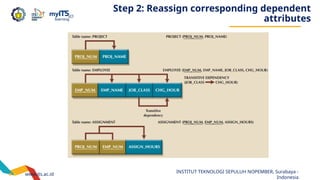
Step 2: Reassign corresponding dependent
attributes
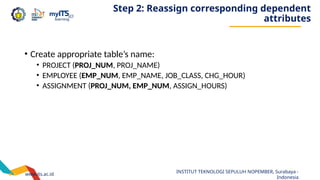
• Create appropriate table’s name:
• PROJECT (PROJ_NUM, PROJ_NAME)
• EMPLOYEE (EMP_NUM, EMP_NAME, JOB_CLASS, CHG_HOUR)
• ASSIGNMENT (PROJ_NUM, EMP_NUM, ASSIGN_HOURS)
www.its.ac.id
INSTITUT TEKNOLOGI SEPULUH NOPEMBER, Surabaya -
Indonesia
Step 2: Reassign corresponding dependent
attributes
www.its.ac.id
INSTITUT TEKNOLOGI SEPULUH NOPEMBER, Surabaya -
Indonesia
Conversion to third normal form (3NF)
• From the result of 2NF, there is transitive dependency, which
can generate anomalies
• Example:
• if the charge per hour changes for a job classification held by many
employee
• We have to update all of the record
• If we forget to update some of the employee records, different
employees with the same job description will generate different
hourly charges
www.its.ac.id
INSTITUT TEKNOLOGI SEPULUH NOPEMBER, Surabaya -
Indonesia
Conversion to third normal form (3NF)
• A table is satisfied the 3NF when:
• It is 2NF
• It contains no transitive dependencies
www.its.ac.id
INSTITUT TEKNOLOGI SEPULUH NOPEMBER, Surabaya -
Indonesia
Conversion to third normal form (3NF)
• Steps to convert to the 3NF:
1. Make new tables to eliminate transitive dependencies
• For every transitive dependency, write a copy of its determinant as PK for new
table
• A determinant is any attribute whose value determines other values within a
row
• In this case the determinant for the transitive dependency is JOB_CLASS
2. Reassign corresponding dependent attributes
• Identify the attributes that are dependent on each determinant
• Place the dependent attributes in the new tables with their determinant
• Remove them from the original tables
www.its.ac.id
INSTITUT TEKNOLOGI SEPULUH NOPEMBER, Surabaya -
Indonesia
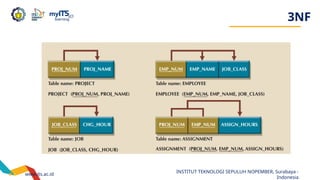
Conversion to third normal form (3NF)
• After 3NF is completed the database will contained four
tables:
• PROJECT (PROJ_NUM, PROJ_NAME)
• EMPLOYEE (EMP_NUM, EMP_NAME, JOB_CLASS)
• JOB (JOB_CLASS, CHG_HOUR)
• ASSIGNMENT (PROJ_NUM, EMP_NUM, ASSIGN_HOURS)
www.its.ac.id
INSTITUT TEKNOLOGI SEPULUH NOPEMBER, Surabaya -
Indonesia
3NF
www.its.ac.id
INSTITUT TEKNOLOGI SEPULUH NOPEMBER, Surabaya -
Indonesia
Improving the design
1. Evaluate PK assignment
• In table EMPLOYEE there is attribute JOB_CLASS, means each time new
employee entered we have to add JOB_CLASS that prone to error (referential
integrity violations)
• Why?
• Because the user can enter different name with refer to the same value
• Example: DB engineer == Database Engineer
• How to resolve this?
www.its.ac.id
INSTITUT TEKNOLOGI SEPULUH NOPEMBER, Surabaya -
Indonesia
Improving the design cont.
• Using JOB_CODE rather than JOB_CLASS
• So that in table JOB we create an attribute as primary key with name
JOB_CODE
• JOB_CODE  JOB_CLASS, CHG_HOUR
• JOB (JOB_CODE, JOB_CLASS, CHG_HOUR)
• Note: the JOB_CLASS and CHG_HOUR is not transitive dependency, since
JOB_CLASS is a candidate key
www.its.ac.id
INSTITUT TEKNOLOGI SEPULUH NOPEMBER, Surabaya -
Indonesia
Improving the design cont.
2. Evaluate naming conventions
• As the previous class, naming convention increase the understandability to
read the relation
• In this case we can change the CHG_HOURS into JOB_CHG_HOURS
• So that we know that CHG_HOURS is associate with table JOB
3. Refine attribute atomicity
• Attribute atomicity rule means that the attribute cannot be further subdivided
into meaningful value
• Example: in EMPLOYEE, EMP_NAME can be changed into EMP_LNAME and
EMP_FNAME
www.its.ac.id
INSTITUT TEKNOLOGI SEPULUH NOPEMBER, Surabaya -
Indonesia
Improving the design cont.
4. Identify new attributes
• If the entity were used in real-world environment, several attribute would have
to be added
• In table EMPLOYEE, we can add attributes such as employee hire date,
employee date of birth etc.
5. Identify new relationships
• In this case the users need to track which employee is acting as the manager of
each project
• This can be implemented as relationship between EMPLOYEE and PROJECT
• We can add EMP_NUM as FK in PROJECT
www.its.ac.id
INSTITUT TEKNOLOGI SEPULUH NOPEMBER, Surabaya -
Indonesia
To be continue…
www.its.ac.id
INSTITUT TEKNOLOGI SEPULUH NOPEMBER, Surabaya -
Indonesia
Exercise
• In a group of 3
• Convert this ERD into dependency diagram that is at least in 3NF
• Give the explanation for each stage (1NF, 2NF, 3NF)
www.its.ac.id
INSTITUT TEKNOLOGI SEPULUH NOPEMBER, Surabaya -
Indonesia
Exercise
Thank you

04_Normalizatio n.pptx

  • 1.
    Normalization part 1 SistemBasis Data Rizka Wakhidatus Sholikah
  • 2.
    www.its.ac.id INSTITUT TEKNOLOGI SEPULUHNOPEMBER, Surabaya - Indonesia Outline • Introduction in normalization • The need of normalization • How to perform normalization
  • 3.
    www.its.ac.id INSTITUT TEKNOLOGI SEPULUHNOPEMBER, Surabaya - Indonesia Normalization • Normalization is a process for evaluating and correcting table structure to minimize and eliminate redundancies • Normalization works through stages called Normal Forms (NF) • 1NF • 2NF • 3NF • 4NF
  • 4.
    www.its.ac.id INSTITUT TEKNOLOGI SEPULUHNOPEMBER, Surabaya - Indonesia Normalization • Note: you should not assume that the highest level of normalization is always the most desirable • The higher the norm form  the more relational join operation  more resource to respond user queries • Remember that a successful design must also considered end-user demand for fast respond
  • 5.
    www.its.ac.id INSTITUT TEKNOLOGI SEPULUHNOPEMBER, Surabaya - Indonesia The need of normalization • Normalization can be done when designing database from scratch or modified existing one • The process is the same • The main goal of normalization: • Eliminate data anomalies by eliminating unnecessary or unwanted data redundancies
  • 6.
    www.its.ac.id INSTITUT TEKNOLOGI SEPULUHNOPEMBER, Surabaya - Indonesia Example
  • 7.
    www.its.ac.id INSTITUT TEKNOLOGI SEPULUHNOPEMBER, Surabaya - Indonesia • From the example, can you give an example of problem that will occur if the table is applied to a table in database Example
  • 8.
    www.its.ac.id INSTITUT TEKNOLOGI SEPULUHNOPEMBER, Surabaya - Indonesia Normalization process • Remember of the goal of normalization, the tables must have the following characteristics: • Each table represent single subject • Each cell (the intersection between row and column) only have one value not a group of values • No data item will be stored in more than one table • All nonprime attribute in a table are dependent on the primary key • Each table has no insertion, update, or deletion anomalies which ensures the integrity and consistency of the data
  • 9.
    www.its.ac.id INSTITUT TEKNOLOGI SEPULUHNOPEMBER, Surabaya - Indonesia The most common normal forms
  • 10.
    www.its.ac.id INSTITUT TEKNOLOGI SEPULUHNOPEMBER, Surabaya - Indonesia • The normalization start with identifying the dependencies on the relation (table) and normalizing the ralation • After that breaking up the relation (table) into a set of new relations (tables) based on the identified dependencies Normalization
  • 11.
    www.its.ac.id INSTITUT TEKNOLOGI SEPULUHNOPEMBER, Surabaya - Indonesia Functional Dependence Concepts
  • 12.
    www.its.ac.id INSTITUT TEKNOLOGI SEPULUHNOPEMBER, Surabaya - Indonesia Functional dependencies • Two type of functional dependencies: • Partial dependencies When the attribute is dependent on only a subset of the primary key • Transitive dependencies An attribute is dependent on another attribute that is not part of the primary key • More difficult to identify among a set of data
  • 13.
    www.its.ac.id INSTITUT TEKNOLOGI SEPULUHNOPEMBER, Surabaya - Indonesia Conversion to first normal form (1NF) • From example in table 6.1 there is a repeating group (PROJ_NUM) • Repeating group derives from a group of multiple entries of the same or multiple types can exist for any single key attribute occurrence • 1NF: 1. All of the key attributes are defined 2. There are no repeating group in the table 3. All attributes are dependent on the primary key (PK)
  • 14.
    www.its.ac.id INSTITUT TEKNOLOGI SEPULUHNOPEMBER, Surabaya - Indonesia Conversion to first normal form (1NF) • Normalizing can be done by three steps: 1. Eliminate the repeating group and make sure each row only defines a single entity instance 2. Identify the primary key 3. Identify all dependencies
  • 15.
    www.its.ac.id INSTITUT TEKNOLOGI SEPULUHNOPEMBER, Surabaya - Indonesia Step 1: Eliminate the repeating groups • Converting multivalued attribute into single-valued attribute
  • 16.
    www.its.ac.id INSTITUT TEKNOLOGI SEPULUHNOPEMBER, Surabaya - Indonesia Step 1: Eliminate the repeating groups
  • 17.
    www.its.ac.id INSTITUT TEKNOLOGI SEPULUHNOPEMBER, Surabaya - Indonesia Step 2: identify the primary key • From the table in step 1, there is not any unique value that can be used as primary key • In that case the primary key can be composed primary key from PROJ_NUM and EMP_NUM
  • 18.
    www.its.ac.id INSTITUT TEKNOLOGI SEPULUHNOPEMBER, Surabaya - Indonesia Step 3: Identify all dependencies • After identify the PK in step 2, we can get the dependency: (PROJ_NUM, EMP_NUM)  PROJ_NAME, EMP_NAME, JOB_CLASS, CHG_HOUR, HOURS
  • 19.
    www.its.ac.id INSTITUT TEKNOLOGI SEPULUHNOPEMBER, Surabaya - Indonesia 1NF • Now, the table from earlier example already satisfied the 1NF • But there are a problem: 1. Update anomalies • Modifying the JOB_CLASS for employee requires updating many entries • Otherwise it will generate data inconsistencies 2. Insertion anomalies • Adding a new employee requires the employee to be assigned to a project and enter duplicate project information 3. Deletion anomalies • Supposed only one employee is associated to a given project, if that employee is deleted the information of project will also be deleted • Such data anomalies violate the relational database’s integrity and consistency rules
  • 20.
    www.its.ac.id INSTITUT TEKNOLOGI SEPULUHNOPEMBER, Surabaya - Indonesia Conversion to second normal form (2NF) • Conversion to 2NF only occurs when the 1 NF has composite PK • If the 1 NF has a single attribute PK, then the table is automatically in 2NF • The table is in 2NF if: • It is in 1NF • It includes no partial dependencies • Step by step conversion of 2NF from the result of 1NF: 1. Make new tables to eliminate partial dependencies 2. Reassign corresponding dependent attributes
  • 21.
    www.its.ac.id INSTITUT TEKNOLOGI SEPULUHNOPEMBER, Surabaya - Indonesia Step 1: Make new tables to eliminate partial dependencies • For each component of primary key • Create a new table with a copy of that component as primary key • From composite primary key (PROJ_NUM, EMP_NUM): • We can create three new tables with below primary key: • PROJ_NUM • EMP_NUM • PROJ_NUM, EMP_NUM
  • 22.
    www.its.ac.id INSTITUT TEKNOLOGI SEPULUHNOPEMBER, Surabaya - Indonesia Step 2: Reassign corresponding dependent attributes • Create appropriate table’s name: • PROJECT (PROJ_NUM, PROJ_NAME) • EMPLOYEE (EMP_NUM, EMP_NAME, JOB_CLASS, CHG_HOUR) • ASSIGNMENT (PROJ_NUM, EMP_NUM, ASSIGN_HOURS)
  • 23.
    www.its.ac.id INSTITUT TEKNOLOGI SEPULUHNOPEMBER, Surabaya - Indonesia Step 2: Reassign corresponding dependent attributes
  • 24.
    www.its.ac.id INSTITUT TEKNOLOGI SEPULUHNOPEMBER, Surabaya - Indonesia Conversion to third normal form (3NF) • From the result of 2NF, there is transitive dependency, which can generate anomalies • Example: • if the charge per hour changes for a job classification held by many employee • We have to update all of the record • If we forget to update some of the employee records, different employees with the same job description will generate different hourly charges
  • 25.
    www.its.ac.id INSTITUT TEKNOLOGI SEPULUHNOPEMBER, Surabaya - Indonesia Conversion to third normal form (3NF) • A table is satisfied the 3NF when: • It is 2NF • It contains no transitive dependencies
  • 26.
    www.its.ac.id INSTITUT TEKNOLOGI SEPULUHNOPEMBER, Surabaya - Indonesia Conversion to third normal form (3NF) • Steps to convert to the 3NF: 1. Make new tables to eliminate transitive dependencies • For every transitive dependency, write a copy of its determinant as PK for new table • A determinant is any attribute whose value determines other values within a row • In this case the determinant for the transitive dependency is JOB_CLASS 2. Reassign corresponding dependent attributes • Identify the attributes that are dependent on each determinant • Place the dependent attributes in the new tables with their determinant • Remove them from the original tables
  • 27.
    www.its.ac.id INSTITUT TEKNOLOGI SEPULUHNOPEMBER, Surabaya - Indonesia Conversion to third normal form (3NF) • After 3NF is completed the database will contained four tables: • PROJECT (PROJ_NUM, PROJ_NAME) • EMPLOYEE (EMP_NUM, EMP_NAME, JOB_CLASS) • JOB (JOB_CLASS, CHG_HOUR) • ASSIGNMENT (PROJ_NUM, EMP_NUM, ASSIGN_HOURS)
  • 28.
    www.its.ac.id INSTITUT TEKNOLOGI SEPULUHNOPEMBER, Surabaya - Indonesia 3NF
  • 29.
    www.its.ac.id INSTITUT TEKNOLOGI SEPULUHNOPEMBER, Surabaya - Indonesia Improving the design 1. Evaluate PK assignment • In table EMPLOYEE there is attribute JOB_CLASS, means each time new employee entered we have to add JOB_CLASS that prone to error (referential integrity violations) • Why? • Because the user can enter different name with refer to the same value • Example: DB engineer == Database Engineer • How to resolve this?
  • 30.
    www.its.ac.id INSTITUT TEKNOLOGI SEPULUHNOPEMBER, Surabaya - Indonesia Improving the design cont. • Using JOB_CODE rather than JOB_CLASS • So that in table JOB we create an attribute as primary key with name JOB_CODE • JOB_CODE  JOB_CLASS, CHG_HOUR • JOB (JOB_CODE, JOB_CLASS, CHG_HOUR) • Note: the JOB_CLASS and CHG_HOUR is not transitive dependency, since JOB_CLASS is a candidate key
  • 31.
    www.its.ac.id INSTITUT TEKNOLOGI SEPULUHNOPEMBER, Surabaya - Indonesia Improving the design cont. 2. Evaluate naming conventions • As the previous class, naming convention increase the understandability to read the relation • In this case we can change the CHG_HOURS into JOB_CHG_HOURS • So that we know that CHG_HOURS is associate with table JOB 3. Refine attribute atomicity • Attribute atomicity rule means that the attribute cannot be further subdivided into meaningful value • Example: in EMPLOYEE, EMP_NAME can be changed into EMP_LNAME and EMP_FNAME
  • 32.
    www.its.ac.id INSTITUT TEKNOLOGI SEPULUHNOPEMBER, Surabaya - Indonesia Improving the design cont. 4. Identify new attributes • If the entity were used in real-world environment, several attribute would have to be added • In table EMPLOYEE, we can add attributes such as employee hire date, employee date of birth etc. 5. Identify new relationships • In this case the users need to track which employee is acting as the manager of each project • This can be implemented as relationship between EMPLOYEE and PROJECT • We can add EMP_NUM as FK in PROJECT
  • 33.
    www.its.ac.id INSTITUT TEKNOLOGI SEPULUHNOPEMBER, Surabaya - Indonesia To be continue…
  • 34.
    www.its.ac.id INSTITUT TEKNOLOGI SEPULUHNOPEMBER, Surabaya - Indonesia Exercise • In a group of 3 • Convert this ERD into dependency diagram that is at least in 3NF • Give the explanation for each stage (1NF, 2NF, 3NF)
  • 35.
    www.its.ac.id INSTITUT TEKNOLOGI SEPULUHNOPEMBER, Surabaya - Indonesia Exercise
  • 36.