Emergency Care
CHAPTER
Copyright © 2016, 2012, 2009 by Pearson Education, Inc.
All Rights Reserved
Emergency Care, 13e
Daniel Limmer | Michael F. O'Keefe
THIRTEENTH EDITION
Medical Terminology
5
Copyright © 2016, 2012, 2009 by Pearson Education, Inc.
All Rights Reserved
Emergency Care, 13e
Daniel Limmer | Michael F. O'Keefe
Topics
• Medical Terminology
• The Language of Anatomy and
Physiology
• Anatomic Terms
Copyright © 2016, 2012, 2009 by Pearson Education, Inc.
All Rights Reserved
Emergency Care, 13e
Daniel Limmer | Michael F. O'Keefe
Medical Terminology
Copyright © 2016, 2012, 2009 by Pearson Education, Inc.
All Rights Reserved
Emergency Care, 13e
Daniel Limmer | Michael F. O'Keefe
The Components of
Medical Terms
• Compounds are made up of two or more words
 Smallpox
continued on next slide
Copyright © 2016, 2012, 2009 by Pearson Education, Inc.
All Rights Reserved
Emergency Care, 13e
Daniel Limmer | Michael F. O'Keefe
The Components of
Medical Terms
• Words made from parts
 Roots
• Therm meaning "heat"
 Roots with combining form
• Therm-o + meter = thermometer
 Prefixes
• Dys-pnea, tachy-pnea
 Suffixes
• Arthr-itis, hemophil-iac
Copyright © 2016, 2012, 2009 by Pearson Education, Inc.
All Rights Reserved
Emergency Care, 13e
Daniel Limmer | Michael F. O'Keefe
Word Component
Example
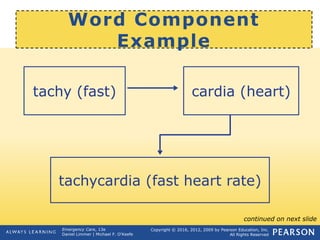
tachy (fast) cardia (heart)
tachycardia (fast heart rate)
continued on next slide
Copyright © 2016, 2012, 2009 by Pearson Education, Inc.
All Rights Reserved
Emergency Care, 13e
Daniel Limmer | Michael F. O'Keefe
Word Component Example
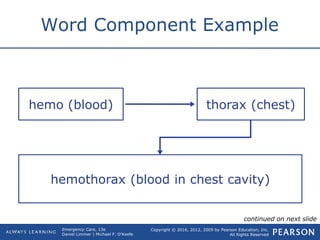
hemo (blood) thorax (chest)
hemothorax (blood in chest cavity)
continued on next slide
Copyright © 2016, 2012, 2009 by Pearson Education, Inc.
All Rights Reserved
Emergency Care, 13e
Daniel Limmer | Michael F. O'Keefe
Word Component Example
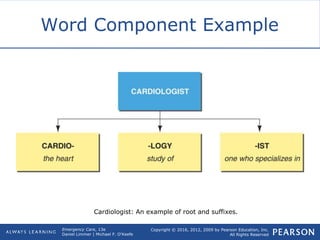
Cardiologist: An example of root and suffixes.
Copyright © 2016, 2012, 2009 by Pearson Education, Inc.
All Rights Reserved
Emergency Care, 13e
Daniel Limmer | Michael F. O'Keefe
Abbreviations and
Acronyms
• Acronym
 Abbreviation made up of initials that can
be pronounced as a word
• CPAP (SEE-pap)
• Continuous positive airway pressure
continued on next slide
Copyright © 2016, 2012, 2009 by Pearson Education, Inc.
All Rights Reserved
Emergency Care, 13e
Daniel Limmer | Michael F. O'Keefe
Abbreviations and
Acronyms
• Abbreviation
 Letters or symbols used in place of
words or phrases
• DNR
• Do Not Resuscitate
Copyright © 2016, 2012, 2009 by Pearson Education, Inc.
All Rights Reserved
Emergency Care, 13e
Daniel Limmer | Michael F. O'Keefe
When and When Not to
Use Medical Terms
• Do not use when speaking to patients or family
members.
• Occasionally complex terms used in messages can
cause confusion even among trained health care
professionals.
• If there is potential for ambiguity, do not be
reluctant to return to simple terms.
Copyright © 2016, 2012, 2009 by Pearson Education, Inc.
All Rights Reserved
Emergency Care, 13e
Daniel Limmer | Michael F. O'Keefe
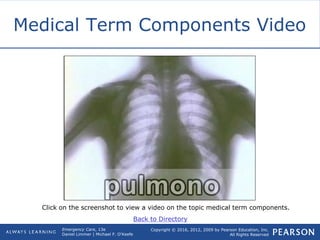
Medical Term Components Video
Click on the screenshot to view a video on the topic medical term components.
Back to Directory
Copyright © 2016, 2012, 2009 by Pearson Education, Inc.
All Rights Reserved
Emergency Care, 13e
Daniel Limmer | Michael F. O'Keefe
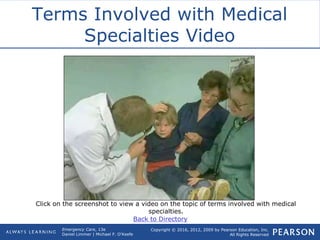
Terms Involved with Medical
Specialties Video
Click on the screenshot to view a video on the topic of terms involved with medical
specialties.
Back to Directory
Copyright © 2016, 2012, 2009 by Pearson Education, Inc.
All Rights Reserved
Emergency Care, 13e
Daniel Limmer | Michael F. O'Keefe
The Language of Anatomy and
Physiology
Copyright © 2016, 2012, 2009 by Pearson Education, Inc.
All Rights Reserved
Emergency Care, 13e
Daniel Limmer | Michael F. O'Keefe
Anatomy and
Physiology
• Anatomy
 Study of body structure
• Physiology
 Study of body function
Copyright © 2016, 2012, 2009 by Pearson Education, Inc.
All Rights Reserved
Emergency Care, 13e
Daniel Limmer | Michael F. O'Keefe
Anatomic Terms
Copyright © 2016, 2012, 2009 by Pearson Education, Inc.
All Rights Reserved
Emergency Care, 13e
Daniel Limmer | Michael F. O'Keefe
Directional Terms
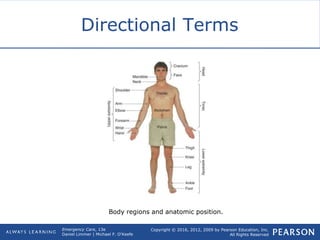
• Anatomic position
 Facing forward
 Hands at sides
 Palms facing forward
• Divide body into planes
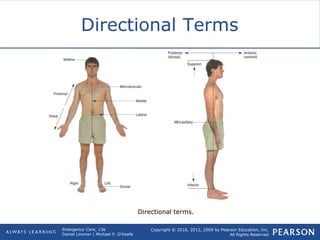
• Midline
 Medial is closer to the midline.
 Lateral is farther from the midline.
continued on next slide
Copyright © 2016, 2012, 2009 by Pearson Education, Inc.
All Rights Reserved
Emergency Care, 13e
Daniel Limmer | Michael F. O'Keefe
Directional Terms
• Bilateral
 "Both sides"
• Unilateral
 One side
• Mid-axillary line
continued on next slide
Copyright © 2016, 2012, 2009 by Pearson Education, Inc.
All Rights Reserved
Emergency Care, 13e
Daniel Limmer | Michael F. O'Keefe
Directional
Terms
• Anterior (ventral)
 Front
• Posterior (dorsal)
 Back
• Superior
 Vertical, above
• Inferior
 Vertical, below
continued on next slide
Copyright © 2016, 2012, 2009 by Pearson Education, Inc.
All Rights Reserved
Emergency Care, 13e
Daniel Limmer | Michael F. O'Keefe
Directional
Terms
• Proximal
 Closer to torso
• Distal
 Farther from torso
• Palmar
 Refers to the palm of the hand
• Plantar
 Refers to the sole of the foot
Copyright © 2016, 2012, 2009 by Pearson Education, Inc.
All Rights Reserved
Emergency Care, 13e
Daniel Limmer | Michael F. O'Keefe
Directional Terms
Body regions and anatomic position.
Copyright © 2016, 2012, 2009 by Pearson Education, Inc.
All Rights Reserved
Emergency Care, 13e
Daniel Limmer | Michael F. O'Keefe
Directional Terms
Directional terms.
Copyright © 2016, 2012, 2009 by Pearson Education, Inc.
All Rights Reserved
Emergency Care, 13e
Daniel Limmer | Michael F. O'Keefe
Directional
Terms
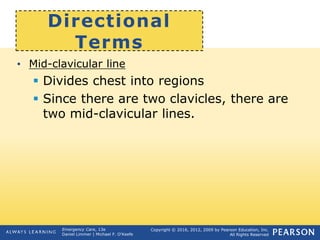
• Mid-clavicular line
 Divides chest into regions
 Since there are two clavicles, there are
two mid-clavicular lines.
Copyright © 2016, 2012, 2009 by Pearson Education, Inc.
All Rights Reserved
Emergency Care, 13e
Daniel Limmer | Michael F. O'Keefe
Directional Terms
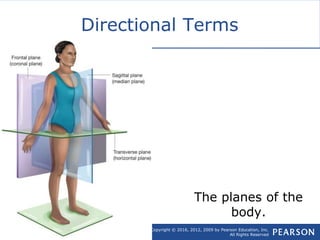
The planes of the
body.
Copyright © 2016, 2012, 2009 by Pearson Education, Inc.
All Rights Reserved
Emergency Care, 13e
Daniel Limmer | Michael F. O'Keefe
Directional
Terms
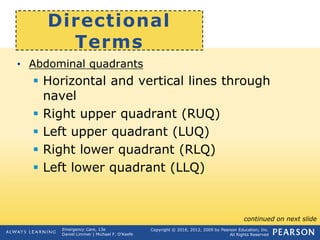
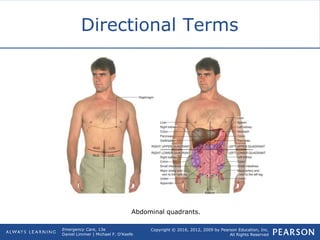
• Abdominal quadrants
 Horizontal and vertical lines through
navel
 Right upper quadrant (RUQ)
 Left upper quadrant (LUQ)
 Right lower quadrant (RLQ)
 Left lower quadrant (LLQ)
continued on next slide
Copyright © 2016, 2012, 2009 by Pearson Education, Inc.
All Rights Reserved
Emergency Care, 13e
Daniel Limmer | Michael F. O'Keefe
Directional Terms
Abdominal quadrants.
Copyright © 2016, 2012, 2009 by Pearson Education, Inc.
All Rights Reserved
Emergency Care, 13e
Daniel Limmer | Michael F. O'Keefe
Positional
Terms
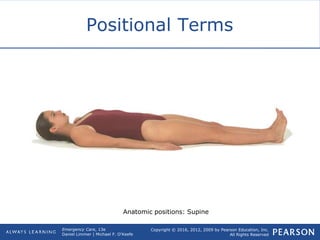
• Supine
 Patient lying on back
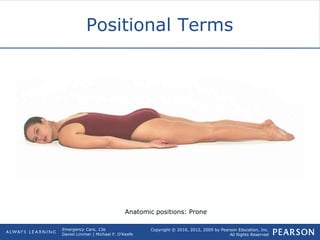
• Prone
 Patient lying on front
• Recovery
 Patient lying on side
 Preferred for any unconscious nontrauma
patient
Copyright © 2016, 2012, 2009 by Pearson Education, Inc.
All Rights Reserved
Emergency Care, 13e
Daniel Limmer | Michael F. O'Keefe
Positional Terms
Anatomic positions: Supine
Copyright © 2016, 2012, 2009 by Pearson Education, Inc.
All Rights Reserved
Emergency Care, 13e
Daniel Limmer | Michael F. O'Keefe
Positional Terms
Anatomic positions: Prone
Copyright © 2016, 2012, 2009 by Pearson Education, Inc.
All Rights Reserved
Emergency Care, 13e
Daniel Limmer | Michael F. O'Keefe
Positional Terms
Anatomic positions: Lateral recumbent (recovery)
Copyright © 2016, 2012, 2009 by Pearson Education, Inc.
All Rights Reserved
Emergency Care, 13e
Daniel Limmer | Michael F. O'Keefe
Positional Terms
Semi-Fowler position.
Copyright © 2016, 2012, 2009 by Pearson Education, Inc.
All Rights Reserved
Emergency Care, 13e
Daniel Limmer | Michael F. O'Keefe
Positional
Terms
• Fowler
 Patient seated straight up
 Semi-Fowler
• Leaning back in a semi-sitting position
Copyright © 2016, 2012, 2009 by Pearson Education, Inc.
All Rights Reserved
Emergency Care, 13e
Daniel Limmer | Michael F. O'Keefe
Chapter Review
Copyright © 2016, 2012, 2009 by Pearson Education, Inc.
All Rights Reserved
Emergency Care, 13e
Daniel Limmer | Michael F. O'Keefe
Chapter Review
• Medicine has a language of its own. As
an EMT, you will frequently
communicate with medical
professionals who speak this language.
• Medical terms generally consist of a
root with a prefix and/or suffix.
continued on next slide
Copyright © 2016, 2012, 2009 by Pearson Education, Inc.
All Rights Reserved
Emergency Care, 13e
Daniel Limmer | Michael F. O'Keefe
Remember
• Medical terminology is the language of
health care. Roots, prefixes, and
suffixes can lend clues to the meaning
of many terms.
• Understanding anatomy and physiology
is like reviewing the owner's manual for
the body.
• Anatomical terminology brings precision
and accuracy to descriptions.
Copyright © 2016, 2012, 2009 by Pearson Education, Inc.
All Rights Reserved
Emergency Care, 13e
Daniel Limmer | Michael F. O'Keefe
Questions to Consider
• Is my use of medical terms accurate
and descriptive?
• Can I identify critical organs and
structures that reside in an area where
a patient has a complaint or traumatic
injury?
Copyright © 2016, 2012, 2009 by Pearson Education, Inc.
All Rights Reserved
Emergency Care, 13e
Daniel Limmer | Michael F. O'Keefe
Critical Thinking
• You respond to a teenage boy who has
taken a hard fall from his dirt bike. He
has a deep gash on the outside of his
left arm halfway between shoulder and
elbow and another on the inside of his
right arm just above the wrist. His left
leg is bent at a funny angle about
halfway between hip and knee.
continued on next slide
Copyright © 2016, 2012, 2009 by Pearson Education, Inc.
All Rights Reserved
Emergency Care, 13e
Daniel Limmer | Michael F. O'Keefe
Critical Thinking
• When you cut away his pants leg, you
see a bone sticking out of a wound on
the front side. How will you describe
your patient's injuries over the radio to
the hospital staff?

Ch05 medical term

  • 1.
    Emergency Care CHAPTER Copyright ©2016, 2012, 2009 by Pearson Education, Inc. All Rights Reserved Emergency Care, 13e Daniel Limmer | Michael F. O'Keefe THIRTEENTH EDITION Medical Terminology 5
  • 2.
    Copyright © 2016,2012, 2009 by Pearson Education, Inc. All Rights Reserved Emergency Care, 13e Daniel Limmer | Michael F. O'Keefe Topics • Medical Terminology • The Language of Anatomy and Physiology • Anatomic Terms
  • 3.
    Copyright © 2016,2012, 2009 by Pearson Education, Inc. All Rights Reserved Emergency Care, 13e Daniel Limmer | Michael F. O'Keefe Medical Terminology
  • 4.
    Copyright © 2016,2012, 2009 by Pearson Education, Inc. All Rights Reserved Emergency Care, 13e Daniel Limmer | Michael F. O'Keefe The Components of Medical Terms • Compounds are made up of two or more words  Smallpox continued on next slide
  • 5.
    Copyright © 2016,2012, 2009 by Pearson Education, Inc. All Rights Reserved Emergency Care, 13e Daniel Limmer | Michael F. O'Keefe The Components of Medical Terms • Words made from parts  Roots • Therm meaning "heat"  Roots with combining form • Therm-o + meter = thermometer  Prefixes • Dys-pnea, tachy-pnea  Suffixes • Arthr-itis, hemophil-iac
  • 6.
    Copyright © 2016,2012, 2009 by Pearson Education, Inc. All Rights Reserved Emergency Care, 13e Daniel Limmer | Michael F. O'Keefe Word Component Example tachy (fast) cardia (heart) tachycardia (fast heart rate) continued on next slide
  • 7.
    Copyright © 2016,2012, 2009 by Pearson Education, Inc. All Rights Reserved Emergency Care, 13e Daniel Limmer | Michael F. O'Keefe Word Component Example hemo (blood) thorax (chest) hemothorax (blood in chest cavity) continued on next slide
  • 8.
    Copyright © 2016,2012, 2009 by Pearson Education, Inc. All Rights Reserved Emergency Care, 13e Daniel Limmer | Michael F. O'Keefe Word Component Example Cardiologist: An example of root and suffixes.
  • 9.
    Copyright © 2016,2012, 2009 by Pearson Education, Inc. All Rights Reserved Emergency Care, 13e Daniel Limmer | Michael F. O'Keefe Abbreviations and Acronyms • Acronym  Abbreviation made up of initials that can be pronounced as a word • CPAP (SEE-pap) • Continuous positive airway pressure continued on next slide
  • 10.
    Copyright © 2016,2012, 2009 by Pearson Education, Inc. All Rights Reserved Emergency Care, 13e Daniel Limmer | Michael F. O'Keefe Abbreviations and Acronyms • Abbreviation  Letters or symbols used in place of words or phrases • DNR • Do Not Resuscitate
  • 11.
    Copyright © 2016,2012, 2009 by Pearson Education, Inc. All Rights Reserved Emergency Care, 13e Daniel Limmer | Michael F. O'Keefe When and When Not to Use Medical Terms • Do not use when speaking to patients or family members. • Occasionally complex terms used in messages can cause confusion even among trained health care professionals. • If there is potential for ambiguity, do not be reluctant to return to simple terms.
  • 12.
    Copyright © 2016,2012, 2009 by Pearson Education, Inc. All Rights Reserved Emergency Care, 13e Daniel Limmer | Michael F. O'Keefe Medical Term Components Video Click on the screenshot to view a video on the topic medical term components. Back to Directory
  • 13.
    Copyright © 2016,2012, 2009 by Pearson Education, Inc. All Rights Reserved Emergency Care, 13e Daniel Limmer | Michael F. O'Keefe Terms Involved with Medical Specialties Video Click on the screenshot to view a video on the topic of terms involved with medical specialties. Back to Directory
  • 14.
    Copyright © 2016,2012, 2009 by Pearson Education, Inc. All Rights Reserved Emergency Care, 13e Daniel Limmer | Michael F. O'Keefe The Language of Anatomy and Physiology
  • 15.
    Copyright © 2016,2012, 2009 by Pearson Education, Inc. All Rights Reserved Emergency Care, 13e Daniel Limmer | Michael F. O'Keefe Anatomy and Physiology • Anatomy  Study of body structure • Physiology  Study of body function
  • 16.
    Copyright © 2016,2012, 2009 by Pearson Education, Inc. All Rights Reserved Emergency Care, 13e Daniel Limmer | Michael F. O'Keefe Anatomic Terms
  • 17.
    Copyright © 2016,2012, 2009 by Pearson Education, Inc. All Rights Reserved Emergency Care, 13e Daniel Limmer | Michael F. O'Keefe Directional Terms • Anatomic position  Facing forward  Hands at sides  Palms facing forward • Divide body into planes • Midline  Medial is closer to the midline.  Lateral is farther from the midline. continued on next slide
  • 18.
    Copyright © 2016,2012, 2009 by Pearson Education, Inc. All Rights Reserved Emergency Care, 13e Daniel Limmer | Michael F. O'Keefe Directional Terms • Bilateral  "Both sides" • Unilateral  One side • Mid-axillary line continued on next slide
  • 19.
    Copyright © 2016,2012, 2009 by Pearson Education, Inc. All Rights Reserved Emergency Care, 13e Daniel Limmer | Michael F. O'Keefe Directional Terms • Anterior (ventral)  Front • Posterior (dorsal)  Back • Superior  Vertical, above • Inferior  Vertical, below continued on next slide
  • 20.
    Copyright © 2016,2012, 2009 by Pearson Education, Inc. All Rights Reserved Emergency Care, 13e Daniel Limmer | Michael F. O'Keefe Directional Terms • Proximal  Closer to torso • Distal  Farther from torso • Palmar  Refers to the palm of the hand • Plantar  Refers to the sole of the foot
  • 21.
    Copyright © 2016,2012, 2009 by Pearson Education, Inc. All Rights Reserved Emergency Care, 13e Daniel Limmer | Michael F. O'Keefe Directional Terms Body regions and anatomic position.
  • 22.
    Copyright © 2016,2012, 2009 by Pearson Education, Inc. All Rights Reserved Emergency Care, 13e Daniel Limmer | Michael F. O'Keefe Directional Terms Directional terms.
  • 23.
    Copyright © 2016,2012, 2009 by Pearson Education, Inc. All Rights Reserved Emergency Care, 13e Daniel Limmer | Michael F. O'Keefe Directional Terms • Mid-clavicular line  Divides chest into regions  Since there are two clavicles, there are two mid-clavicular lines.
  • 24.
    Copyright © 2016,2012, 2009 by Pearson Education, Inc. All Rights Reserved Emergency Care, 13e Daniel Limmer | Michael F. O'Keefe Directional Terms The planes of the body.
  • 25.
    Copyright © 2016,2012, 2009 by Pearson Education, Inc. All Rights Reserved Emergency Care, 13e Daniel Limmer | Michael F. O'Keefe Directional Terms • Abdominal quadrants  Horizontal and vertical lines through navel  Right upper quadrant (RUQ)  Left upper quadrant (LUQ)  Right lower quadrant (RLQ)  Left lower quadrant (LLQ) continued on next slide
  • 26.
    Copyright © 2016,2012, 2009 by Pearson Education, Inc. All Rights Reserved Emergency Care, 13e Daniel Limmer | Michael F. O'Keefe Directional Terms Abdominal quadrants.
  • 27.
    Copyright © 2016,2012, 2009 by Pearson Education, Inc. All Rights Reserved Emergency Care, 13e Daniel Limmer | Michael F. O'Keefe Positional Terms • Supine  Patient lying on back • Prone  Patient lying on front • Recovery  Patient lying on side  Preferred for any unconscious nontrauma patient
  • 28.
    Copyright © 2016,2012, 2009 by Pearson Education, Inc. All Rights Reserved Emergency Care, 13e Daniel Limmer | Michael F. O'Keefe Positional Terms Anatomic positions: Supine
  • 29.
    Copyright © 2016,2012, 2009 by Pearson Education, Inc. All Rights Reserved Emergency Care, 13e Daniel Limmer | Michael F. O'Keefe Positional Terms Anatomic positions: Prone
  • 30.
    Copyright © 2016,2012, 2009 by Pearson Education, Inc. All Rights Reserved Emergency Care, 13e Daniel Limmer | Michael F. O'Keefe Positional Terms Anatomic positions: Lateral recumbent (recovery)
  • 31.
    Copyright © 2016,2012, 2009 by Pearson Education, Inc. All Rights Reserved Emergency Care, 13e Daniel Limmer | Michael F. O'Keefe Positional Terms Semi-Fowler position.
  • 32.
    Copyright © 2016,2012, 2009 by Pearson Education, Inc. All Rights Reserved Emergency Care, 13e Daniel Limmer | Michael F. O'Keefe Positional Terms • Fowler  Patient seated straight up  Semi-Fowler • Leaning back in a semi-sitting position
  • 33.
    Copyright © 2016,2012, 2009 by Pearson Education, Inc. All Rights Reserved Emergency Care, 13e Daniel Limmer | Michael F. O'Keefe Chapter Review
  • 34.
    Copyright © 2016,2012, 2009 by Pearson Education, Inc. All Rights Reserved Emergency Care, 13e Daniel Limmer | Michael F. O'Keefe Chapter Review • Medicine has a language of its own. As an EMT, you will frequently communicate with medical professionals who speak this language. • Medical terms generally consist of a root with a prefix and/or suffix. continued on next slide
  • 35.
    Copyright © 2016,2012, 2009 by Pearson Education, Inc. All Rights Reserved Emergency Care, 13e Daniel Limmer | Michael F. O'Keefe Remember • Medical terminology is the language of health care. Roots, prefixes, and suffixes can lend clues to the meaning of many terms. • Understanding anatomy and physiology is like reviewing the owner's manual for the body. • Anatomical terminology brings precision and accuracy to descriptions.
  • 36.
    Copyright © 2016,2012, 2009 by Pearson Education, Inc. All Rights Reserved Emergency Care, 13e Daniel Limmer | Michael F. O'Keefe Questions to Consider • Is my use of medical terms accurate and descriptive? • Can I identify critical organs and structures that reside in an area where a patient has a complaint or traumatic injury?
  • 37.
    Copyright © 2016,2012, 2009 by Pearson Education, Inc. All Rights Reserved Emergency Care, 13e Daniel Limmer | Michael F. O'Keefe Critical Thinking • You respond to a teenage boy who has taken a hard fall from his dirt bike. He has a deep gash on the outside of his left arm halfway between shoulder and elbow and another on the inside of his right arm just above the wrist. His left leg is bent at a funny angle about halfway between hip and knee. continued on next slide
  • 38.
    Copyright © 2016,2012, 2009 by Pearson Education, Inc. All Rights Reserved Emergency Care, 13e Daniel Limmer | Michael F. O'Keefe Critical Thinking • When you cut away his pants leg, you see a bone sticking out of a wound on the front side. How will you describe your patient's injuries over the radio to the hospital staff?

Editor's Notes

  • #3 Planning Your Time: Plan 45 minutes for this chapter. Medical Terminology (20 minutes) Anatomy and Physiology (10 minutes) Anatomical Terms (15 minutes) Note: The total teaching time recommended is only a guideline. Core Concepts: Medical terminology and how terms are constructed Directional terms Positional terms
  • #4 Teaching Time: 20 minutes Teaching Tips: Set a standard for precision. In your class, the language spoken is "health care." Demand precision in discussions every day. Do not overwhelm students. New languages are not learned in one lesson. Teach basic concepts in this lesson, but remember that this learning process will continue throughout the entire course. Keep interpretation simple. This lesson is not necessarily about memorization, but rather about common sense word recognition. Talking Points: In order to work in EMS, you must understand the basics of medical terminology. This understanding will make it easier to both receive and communicate to others information about the patient.
  • #5 Covers Objectives: 5.2 and 5.3 Discussion Topics: Explain how knowing various common roots, prefixes, and suffixes can help you identify unknown medical terms. List and define common medical roots, prefixes, and suffixes. Class Activity: Everyone in the class must use medical terminology from this point forward. This activity will continue throughout the length of the entire course. Have students practice using the terminology.
  • #6 Covers Objectives: 5.2 and 5.3 Discussion Topics: Explain how knowing various common roots, prefixes, and suffixes can help you identify unknown medical terms. List and define common medical roots, prefixes, and suffixes. Class Activity: Everyone in the class must use medical terminology from this point forward. This activity will continue throughout the length of the entire course. Have students practice using the terminology.
  • #7 Covers Objectives: 5.2 and 5.3 Point to Emphasize: Many medical terms can be broken down into roots, prefixes, and suffixes to identify their meaning.
  • #8 Covers Objectives: 5.2 and 5.3 Point to Emphasize: Learning to recognize common roots, prefixes, and suffixes will aid comprehension of unknown terms.
  • #9 Covers Objectives: 5.2 and 5.3 Knowledge Application: Assign homework. Provide students with a list of medical terms as well as a list of common roots, prefixes, and suffixes. Have students, using only these lists, define the medical terms. Discuss the results in class.
  • #10 Covers Objective: 5.4 Point to Emphasize: Abbreviations and acronyms can be helpful, but they often lead to ambiguity and imprecision. Discussion Topic: Discuss why abbreviations and acronyms might lead to imprecise documentation. Critical Thinking: Present two situations. First, describe a situation in which using precise medical terminology may not be the best course of action. Next, describe a situation in which the precision of medical terminology (compared to common language) might be necessary. Knowledge Application: Use random and unknown abbreviations and acronyms in the instructions for a homework assignment. Discuss the ensuing confusion.
  • #11 Covers Objective: 5.4 Point to Emphasize: Abbreviations and acronyms can be helpful, but they often lead to ambiguity and imprecision. Discussion Topic: Discuss why abbreviations and acronyms might lead to imprecise documentation. Critical Thinking: Present two situations. First, describe a situation in which using precise medical terminology may not be the best course of action. Next, describe a situation in which the precision of medical terminology (compared to common language) might be necessary. Knowledge Application: Use random and unknown abbreviations and acronyms in the instructions for a homework assignment. Discuss the ensuing confusion.
  • #12 Covers Objective: 5.4 Point to Emphasize: Abbreviations and acronyms can be helpful, but they often lead to ambiguity and imprecision. Discussion Topic: Discuss why abbreviations and acronyms might lead to imprecise documentation. Critical Thinking: Present two situations. First, describe a situation in which using precise medical terminology may not be the best course of action. Next, describe a situation in which the precision of medical terminology (compared to common language) might be necessary. Knowledge Application: Use random and unknown abbreviations and acronyms in the instructions for a homework assignment. Discuss the ensuing confusion.
  • #13 Covers Objective: 5.5 Video Clip Medical Term Components Why should an EMT use proper medical terms when communicating with other medical professionals? What are the main components of a medical term? Why is it necessary to memorize common term meanings? What does the prefix in pericarditis mean? Why should an EMT avoid using large medical terms when communicating with a patient?
  • #14 Covers Objective: 5.3 Video Terms Involved With Medical Specialties What is a pediatrician? To what does the term obstetrics refer? Who specializes in the eye? What is a cardiologist's specialty? What is the definition of surgery?
  • #15 Teaching Time: 10 minutes Teaching Tips: Provide a basic overview of anatomy and physiology. The text compares these concepts to an owner's manual. This is a helpful analogy.
  • #16 Covers Objectives: 5.1 and 5.2 Discussion Topic: Define anatomy and physiology. Critical Thinking: Why is understanding normal functions of the body so important? What help does it give us as EMTs? Knowledge Application: Explain why knowledge of anatomy and physiology might be helpful to you as an EMT in the areas of assessment and of treatment of your patients.
  • #17 Teaching Time: 15 minutes Teaching Tips: Set a standard for precision. In your class, students must use directional and positional terms when giving descriptions. Demand precision in every description. Visual learning is helpful in this section. Use a model to demonstrate directional and positional terms. Have students stand and demonstrate anatomical position.
  • #18 Covers Objective: 5.6 Points to Emphasize: Directional terms allow for precision of description. Anatomical position is the universal reference for directional terminology. Discussion Topic: Discuss how a possessing a knowledge of external anatomy might assist you in locating internal structures.
  • #19 Covers Objective: 5.6 Points to Emphasize: Directional terms allow for precision of description. Anatomical position is the universal reference for directional terminology. Discussion Topic: Discuss how a possessing a knowledge of external anatomy might assist you in locating internal structures.
  • #20 Covers Objective: 5.6 Points to Emphasize: Directional terms allow for precision of description. Anatomical position is the universal reference for directional terminology. Discussion Topic: Discuss how a possessing a knowledge of external anatomy might assist you in locating internal structures.
  • #21 Covers Objective: 5.6 Points to Emphasize: Directional terms allow for precision of description. Anatomical position is the universal reference for directional terminology. Discussion Topic: Discuss how a possessing a knowledge of external anatomy might assist you in locating internal structures.
  • #22 Covers Objective: 5.6 Points to Emphasize: Directional terms allow for precision of description. Anatomical position is the universal reference for directional terminology. Discussion Topic: Discuss how a possessing a knowledge of external anatomy might assist you in locating internal structures.
  • #23 Covers Objective: 5.6 Discussion Topic: Discuss how using directional terms makes your descriptions more precise. Knowledge Application: Have students work in small groups. Ask each group to provide directions for a simple task, using only anatomical directional terms. For example, one group might provide directions on how to walk to the bathroom; another might explain how to drink water from a cup.
  • #24 Covers Objective: 5.6 Points to Emphasize: Directional terms allow for precision of description. Anatomical position is the universal reference for directional terminology. Discussion Topic: Discuss how a possessing a knowledge of external anatomy might assist you in locating internal structures.
  • #25 Covers Objective: 5.6 Discussion Topic: Discuss how possessing a knowledge of external anatomy might assist you in locating internal structures. Class Activity: Have students, working with tape and a marker, use anatomical terms to label the student sitting next to them. (Do not allow this exercise to get out of hand or become inappropriate.) Critical Thinking: How might using medical directional terms be confusing to your patient? Knowledge Application: Use a skeleton or other anatomical model to demonstrate how external anatomy helps to identify internal structures.
  • #26 Covers Objective: 5.6 Discussion Topic: Discuss how possessing a knowledge of external anatomy might assist you in locating internal structures. Class Activity: Have students, working with tape and a marker, use anatomical terms to label the student sitting next to them. (Do not allow this exercise to get out of hand or become inappropriate.) Critical Thinking: How might using medical directional terms be confusing to your patient? Knowledge Application: Use a skeleton or other anatomical model to demonstrate how external anatomy helps to identify internal structures.
  • #27 Covers Objective: 5.6 Discussion Topic: Discuss how possessing a knowledge of external anatomy might assist you in locating internal structures. Class Activity: Have students, working with tape and a marker, use anatomical terms to label the student sitting next to them. (Do not allow this exercise to get out of hand or become inappropriate.) Critical Thinking: How might using medical directional terms be confusing to your patient? Knowledge Application: Use a skeleton or other anatomical model to demonstrate how external anatomy helps to identify internal structures.
  • #29 Covers Objective: 5.6 Point to Emphasize: Positional terms allow for precise and universal description of the patient's position.
  • #30 Covers Objective: 5.6
  • #31 Covers Objective: 5.6
  • #32 Covers Objective: 5.6 Discussion Topic: Explain the following positional terms: supine, prone, semi-Fowler, lateral recumbent.
  • #37 Talking Points: These questions point up the importance of this anatomy and physiology chapter. Being fluent with the language and being knowledgeable about the subject of the chapter will help EMTs not only assess and care for patients, but also relay information about the patient to other medical personnel and enable them to read medical records documenting the patient's medical condition.
  • #39 Talking Points: Remind students of the need to be precise in their language as well as to keep unnecessary words out of the radio message.