Developing Visual
    Literacy
• Relationship among words, images,
  objects in the real world

• Idea of representation

• Conventions in art

• Iconography
Relationship among words, images,
      objects in the real world
René Magritte. The Treason of Images. 1929.
             21 1/2 x 28 1/2 in.
Lorna Simpson. She. 1992.
      29 x 85 1/4 in.
Lorna Simpson. Necklines. 1989.
         68 1/2 x 70 in.
Shirin Neshat. Rebellious
Silence, from the Women of
     Allah series. 1994.
          11 x 14 in.
Andres Serrano
 Piss Christ
Idea of Representation


• Representational – art that portrays natural objects in
                              recognizable form

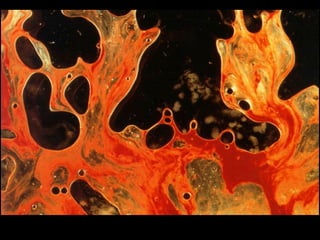
• Nonrepresentational – art that does not reference the
  natural                            or objective world at all.
Representational

Realistic – more representative of what the eye sees


Stylize - to design in or cause to conform to a particular style, as
       of representation or treatment in art; conventionalize.


Abstract – the less a work resembles real thing in the real world.
       Of or pertaining to the formal aspect of art,
       emphasizing lines, colors, generalized or
       geometrical forms, etc., especially with reference
       to their relationship to one another.
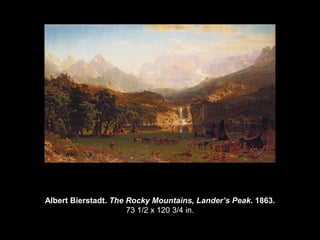
Albert Bierstadt. The Rocky Mountains, Lander’s Peak. 1863.
                      73 1/2 x 120 3/4 in.
Paul Cezanne. Mont Sainte-Victoire.
Sesshu Toyo. Haboku Landscape for Soen (detail). Muromachi period,
                               1495.
                      total height 58 1/4 in.
Apollo Belvedere (detail). Roman copy after a fourth-century BCE Greek
                                original.
                   Height of entire sculpture 7 ft. 4 in.
African mask, Sang tribe.
Naturalistic – where the artist retains apparently
              realistic elements, but present the
              visual world from a distinctly
              personal or subjective view.
Albert Bierstadt. The Rocky Mountains, Lander’s Peak. 1863.
                      73 1/2 x 120 3/4 in.
Ch02 b - Visual Literacy (Nonrepresentational / Iconography)

Ch02 b - Visual Literacy (Nonrepresentational / Iconography)

Editor's Notes

  • #2 It is important for you to understand that, from the outset, that you can neither recognize nor understand – let alone communicate – how visual art affects you without using language. One of the primary purposes of this class is to provide you with a descriptive vocabulary, terms, phrases, concepts, etc… that will allow you to think critically about visual images. It’s not enough to say, “I like this painting”. You need to be able to recognise why you like and why/how it communicates to you.
  • #3 It is important for you to understand that, from the outset, that you can neither recognize nor understand – let alone communicate – how visual art affects you without using language. One of the primary purposes of this class is to provide you with a descriptive vocabulary, terms, phrases, concepts, etc… that will allow you to think critically about visual images. It’s not enough to say, “I like this painting”. You need to be able to recognise why you like and why/how it communicates to you.
  • #4 It is important for you to understand that, from the outset, that you can neither recognize nor understand – let alone communicate – how visual art affects you without using language. One of the primary purposes of this class is to provide you with a descriptive vocabulary, terms, phrases, concepts, etc… that will allow you to think critically about visual images. It’s not enough to say, “I like this painting”. You need to be able to recognise why you like and why/how it communicates to you.
  • #5 Rene Magritte – english translation – This is not a Pipe
  • #21 Gods look like man, only more beautiful
  • #22 Exaggerated features to, at least in part, separate it form the “real”