Chapter 8:
Evaluation
 Lecturer: MR. VATH VARY
 Phone: 017 471 117
 Email: varyvath@gmail.com
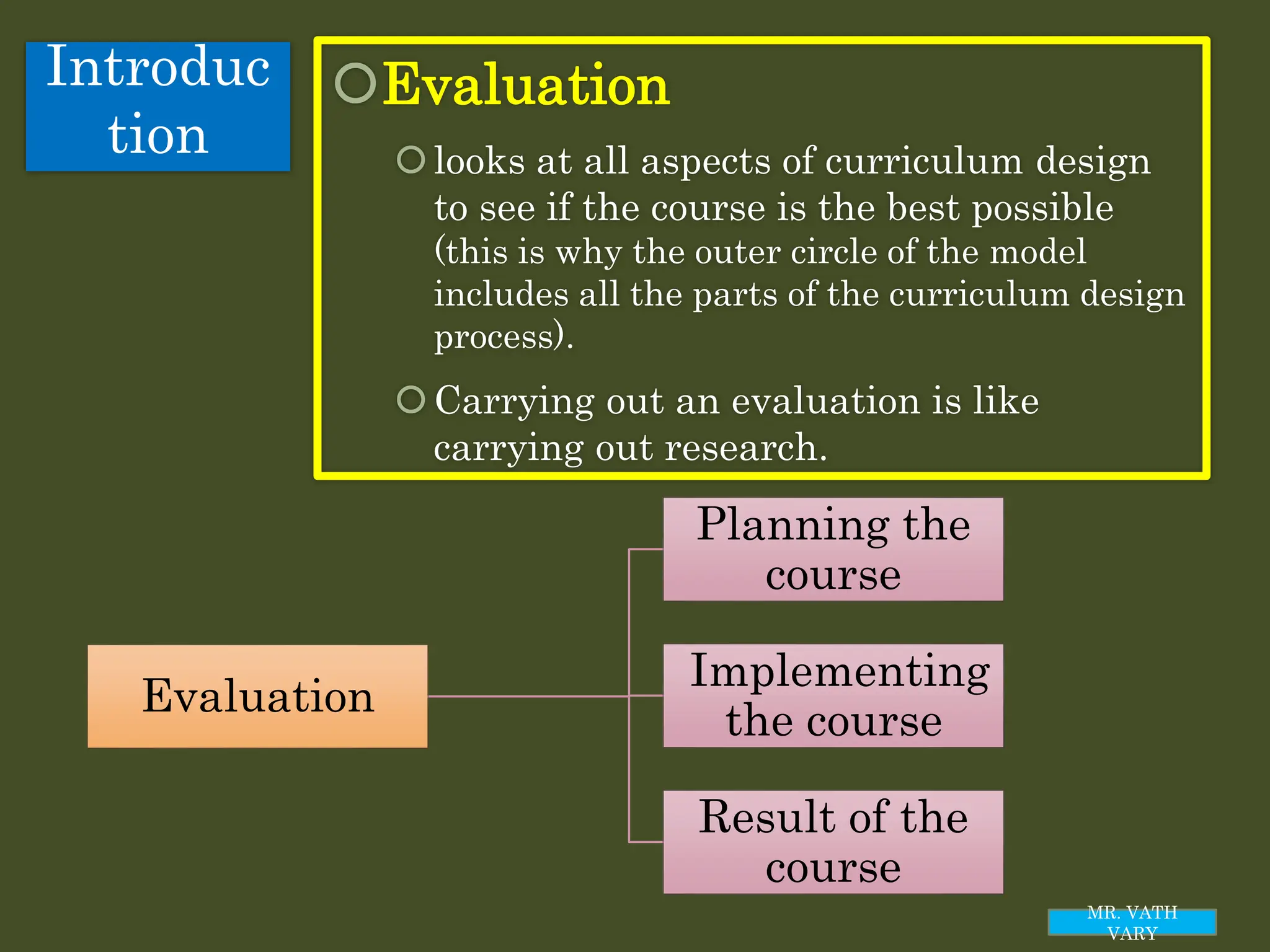
A model of the
parts of the
curriculum design
process.
The aim of this part of the curriculum design process is to
decide how to check if the course is successful and where it
needs to be improved.
MR. VATH VARY
Introduc
tion
Evaluation
looks at all aspects of curriculum design
to see if the course is the best possible
(this is why the outer circle of the model
includes all the parts of the curriculum design
process).
Carrying out an evaluation is like
carrying out research.
MR. VATH
VARY
Evaluation
Planning the
course
Implementing
the course
Result of the
course
Evaluation
has to
answer as
follows:
Is the teaching on the
course of a suitably high
standard?
Is the course preparing the
learners properly for their
use of English at the end of
the course (e.g. to pass the TOEFL
test, to study in an English-medium
university, to work as a tour guide)?
Are the learners satisfied
with the course?
Is the course cost effective?
MR. VATH
VARY
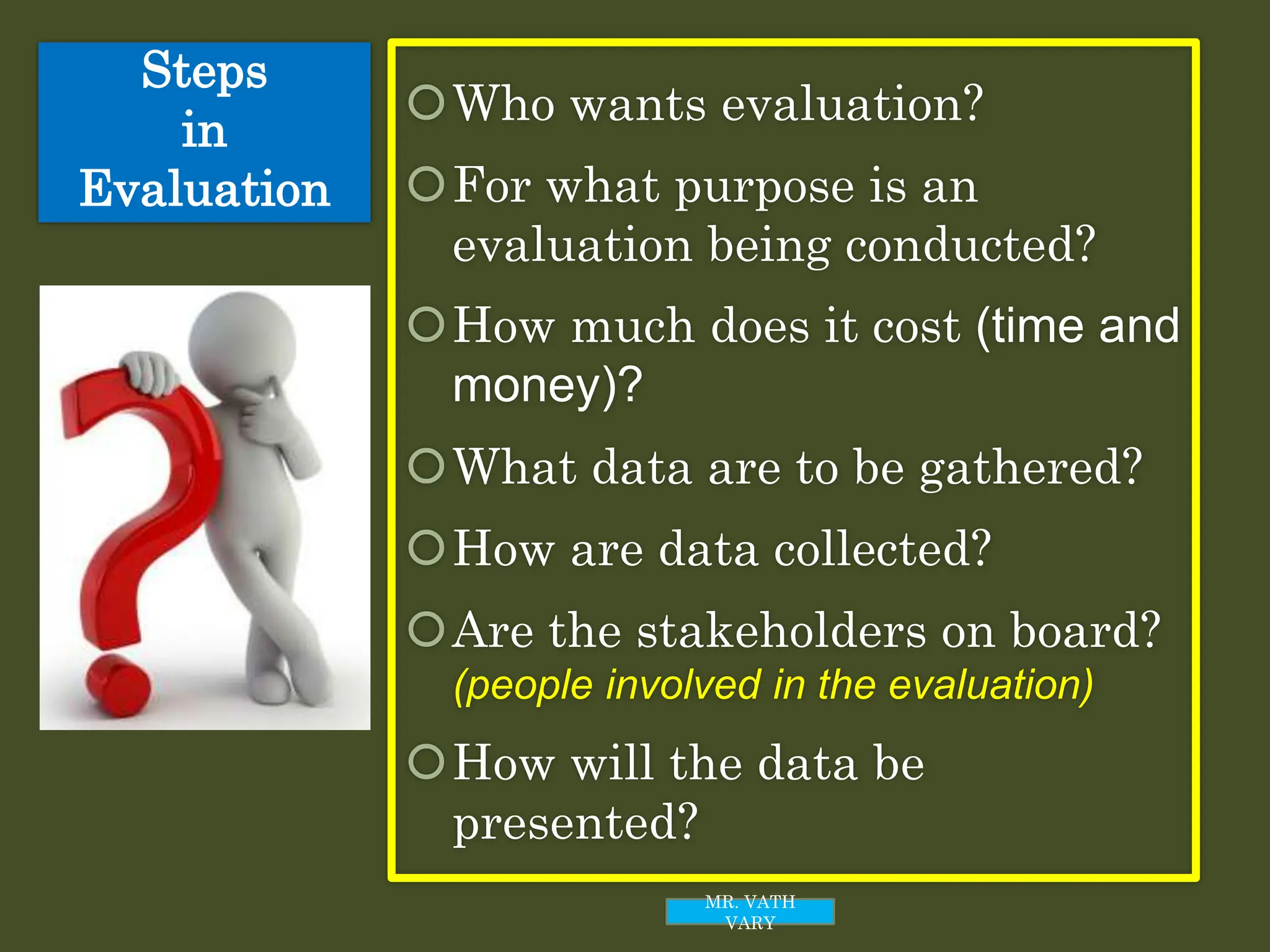
Steps
in
Evaluation
Who wants evaluation?
For what purpose is an
evaluation being conducted?
How much does it cost (time and
money)?
What data are to be gathered?
How are data collected?
Are the stakeholders on board?
(people involved in the evaluation)
How will the data be
presented?
MR. VATH
VARY
Purpose and
Audience of
the
Evaluation
Kiely and Rea-Dickens (2005:
225-271) make a useful three-
way scope distinction:
large-scale evaluations which “tend
to focus on major educational
innovations with significant
financial backing with an
underlying agenda”,
teacher-led evaluations, and
management-led evaluations.
MR. VATH
VARY
Purpose
and
Audience
of the
Evaluation
Who Wants Evaluation?
 Finding out who the evaluation is for and
what kind of information they value are
important for several reasons:
 help determine the degree of confidentiality of
the evaluation. Will the report of the
evaluation be available to all involved or will it
only go to the person or group commissioning
the evaluation?
 help determine what kind of information
should be gathered and what kind of
information should not be gathered.
 know who the evaluation is for is useful in
determining whether the data to be gathered
will be provided willingly or reluctantly.
MR. VATH
Purpose
and
Audience
of the
Evaluation
Is evaluation being done to improve
the course or to guide a decision on
whether to maintain or get rid of the
course?
 At the end of this preparatory stage of the
evaluation, the evaluator should be able to
tell the person commissioning the evaluation
 Whether the evaluation is worth doing.
 Whether the evaluation is possible.
 How long it might take.
 How much it might cost.
 Whether the evaluator is willing to do it.
 What kind of evidence the evaluation will
gather.
MR. VATH
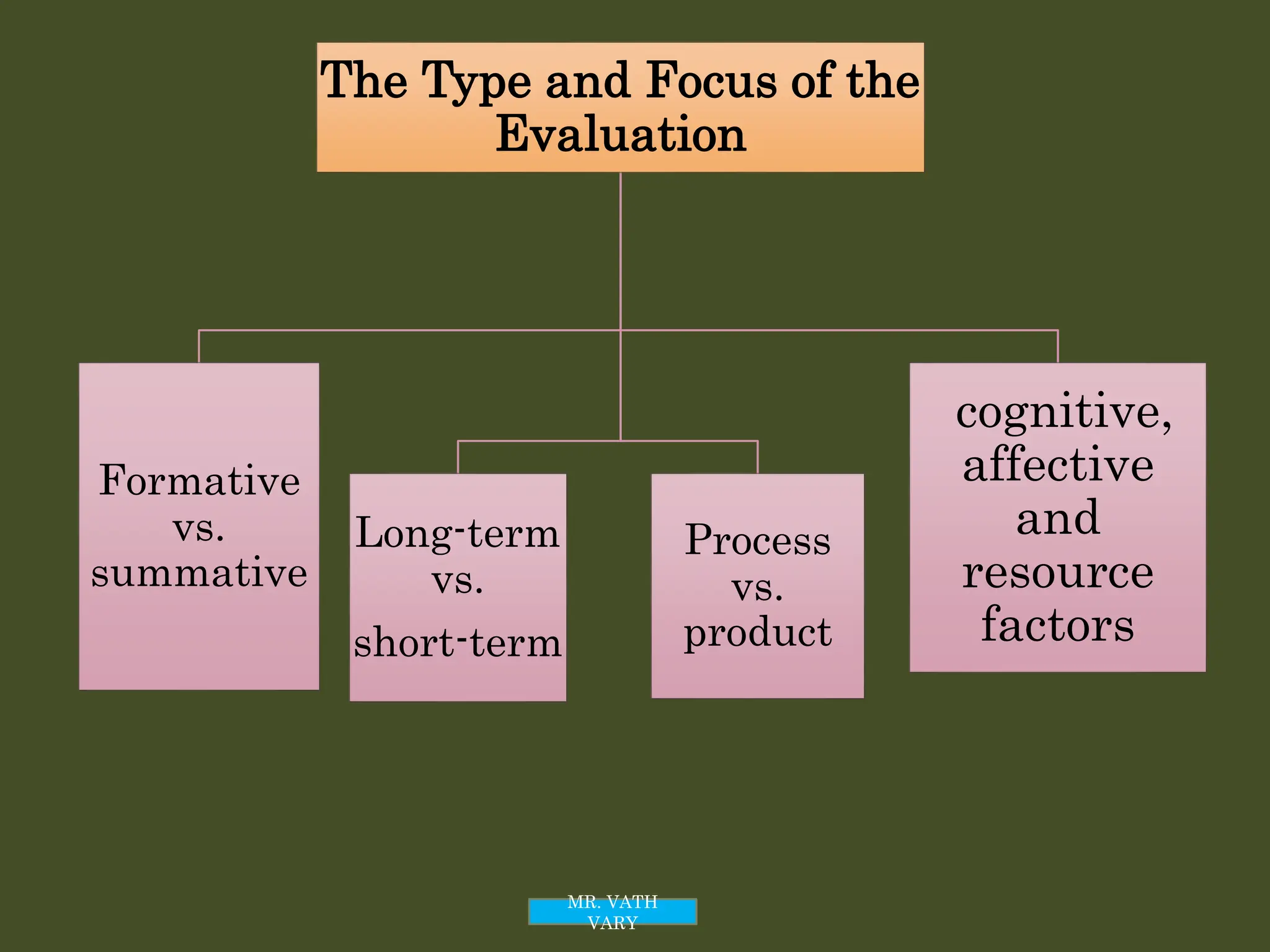
The Type and Focus of the
Evaluation
Formative
vs.
summative
Long-term
vs.
short-term
Process
vs.
product
cognitive,
affective
and
resource
factors
MR. VATH
VARY
The Type
and Focus
of the
Evaluation
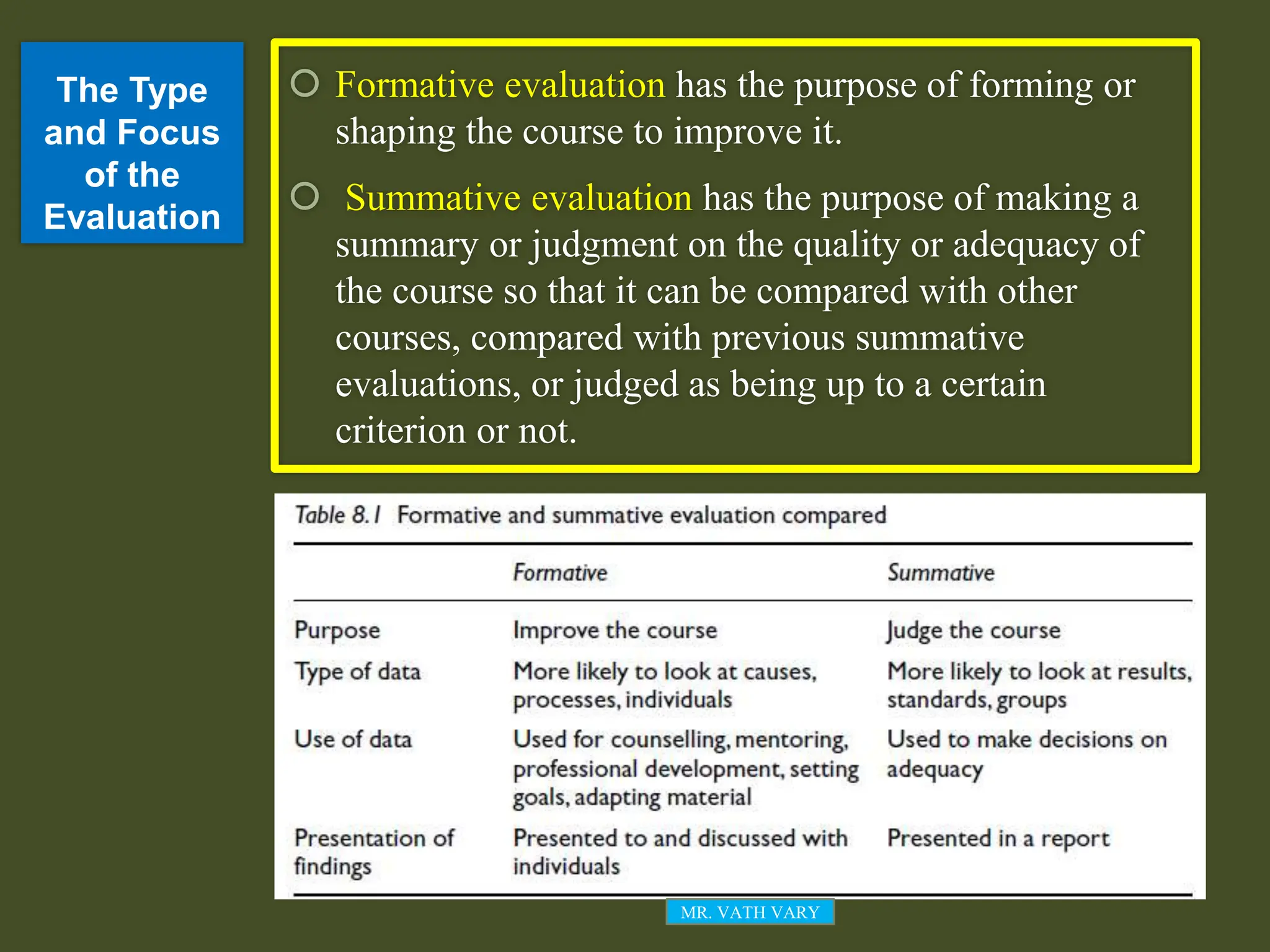
 Formative evaluation has the purpose of forming or
shaping the course to improve it.
 Summative evaluation has the purpose of making a
summary or judgment on the quality or adequacy of
the course so that it can be compared with other
courses, compared with previous summative
evaluations, or judged as being up to a certain
criterion or not.
MR. VATH VARY
The Type
and Focus
of the
Evaluation
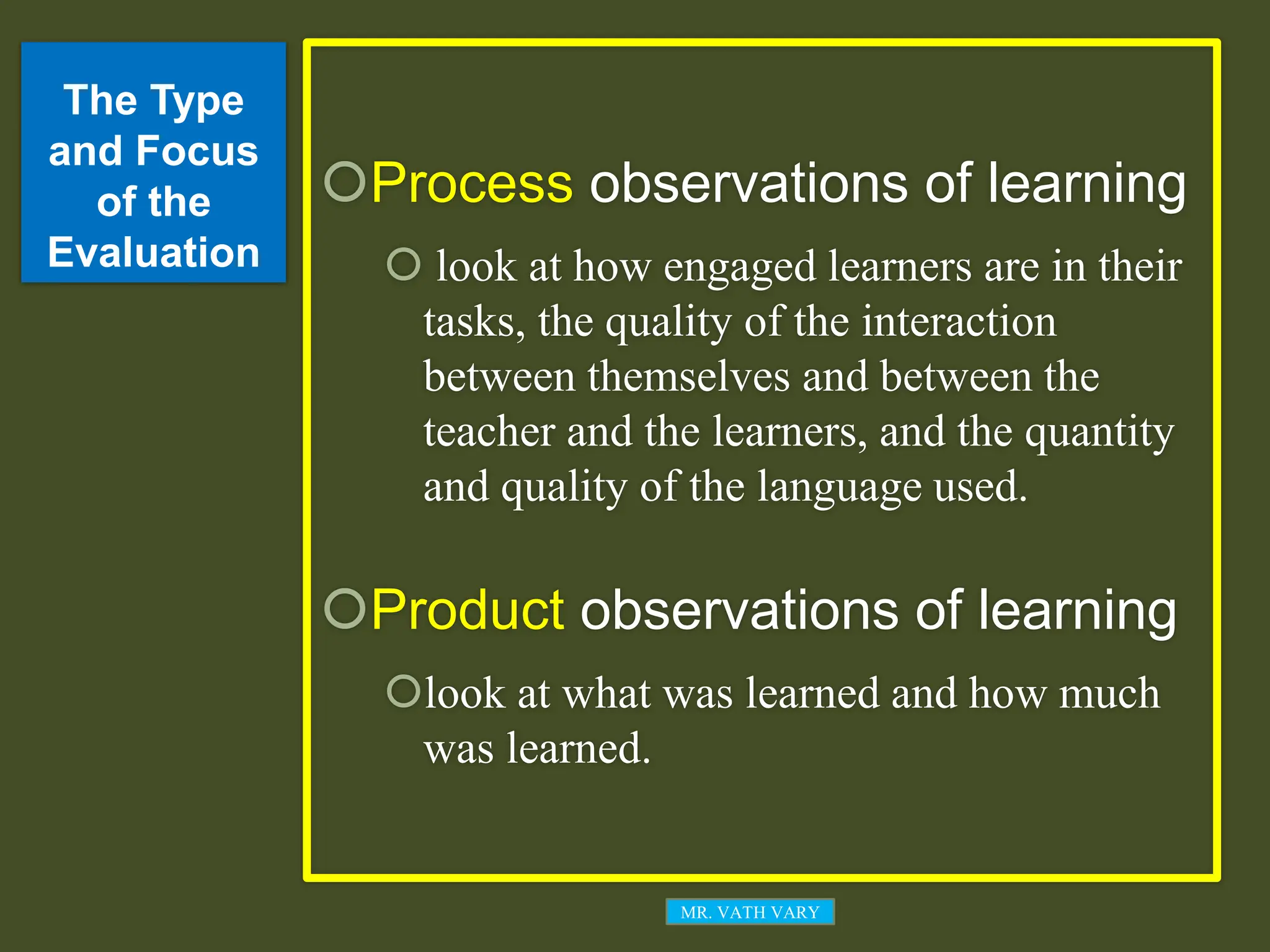
Process observations of learning
 look at how engaged learners are in their
tasks, the quality of the interaction
between themselves and between the
teacher and the learners, and the quantity
and quality of the language used.
Product observations of learning
look at what was learned and how much
was learned.
MR. VATH VARY
The Type
and Focus
of the
Evaluation
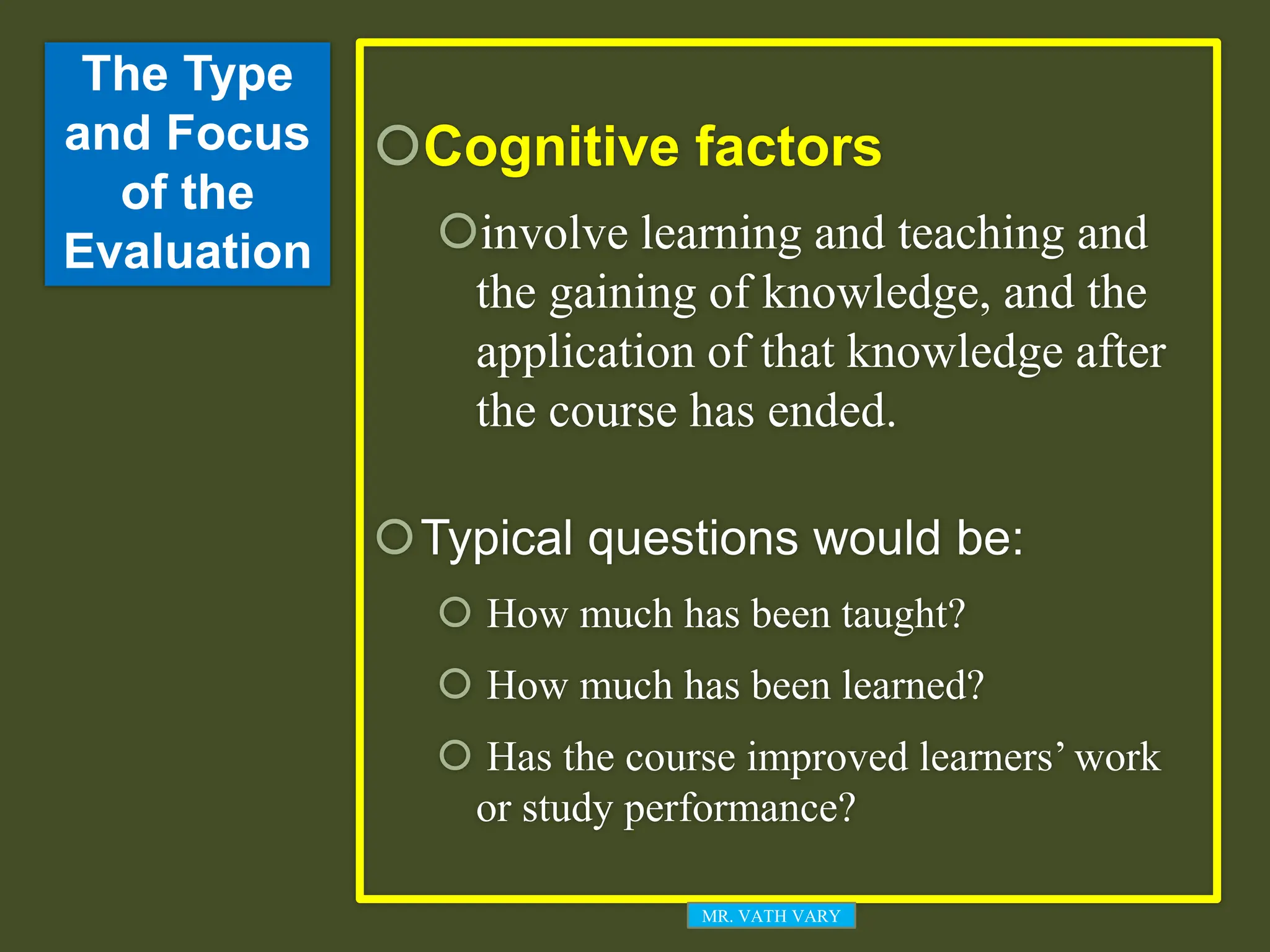
Cognitive factors
involve learning and teaching and
the gaining of knowledge, and the
application of that knowledge after
the course has ended.
Typical questions would be:
 How much has been taught?
 How much has been learned?
 Has the course improved learners’ work
or study performance?
MR. VATH VARY
The Type
and Focus of
the
Evaluation
Affective factors
involve feelings of satisfaction
attitudes.
Typical questions would be:
 Are the learners pleased with the
course?
 Do the staff work well together?
 Do the teachers feel the course is
effective?
MR. VATH
VARY
The Type
and Focus of
the
Evaluation
Resource factors
involve costs, profit, availability
and quality of teaching and
learning resources such as books,
classrooms, visual aids, tape
recorders, computers, library
facilities, social services and
administrative support.
Typical questions would be:
Is the library adequate for the needs of
the learners?
Are the classrooms large enough?
 Does the course make a financial
profit?
MR. VATH
VARY
Gaining
Support for
the
Evaluation
Are the stakeholders on board?
(people involved in the evaluation)
 A properly conducted evaluation can be an
empowering and motivating activity. The
assumptions behind an evaluation usually
are that:
this course is worth improving,
the people running and teaching the course
are capable of improving it,
the people involved in the course have the
freedom and flexibility to make changes to
the course, and
the improvements will make it a better
course for all concerned.
MR. VATH
VARY
Gathering
the
Information
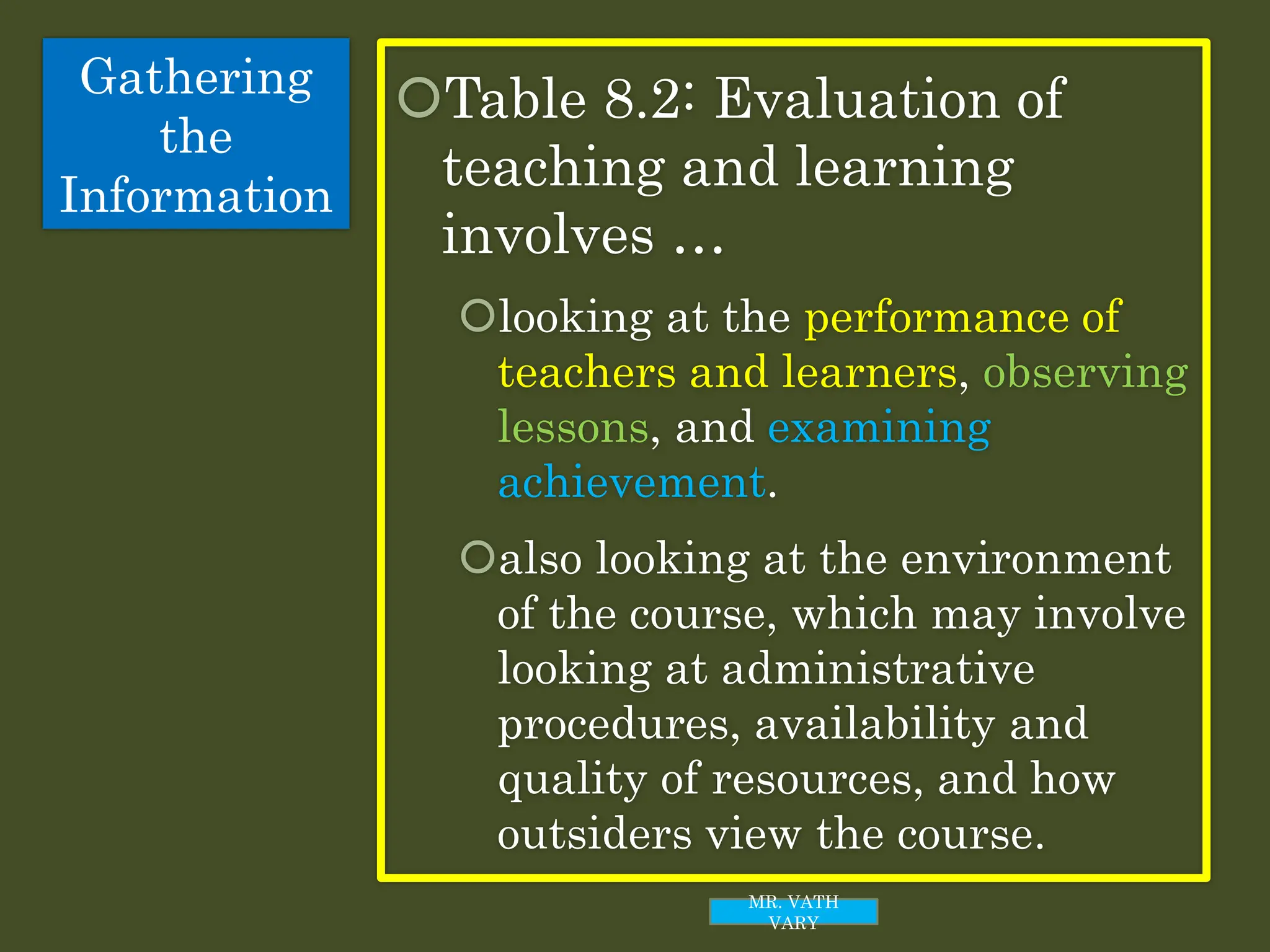
Table 8.2: Evaluation of
teaching and learning
involves …
looking at the performance of
teachers and learners, observing
lessons, and examining
achievement.
also looking at the environment
of the course, which may involve
looking at administrative
procedures, availability and
quality of resources, and how
outsiders view the course.
MR. VATH
VARY
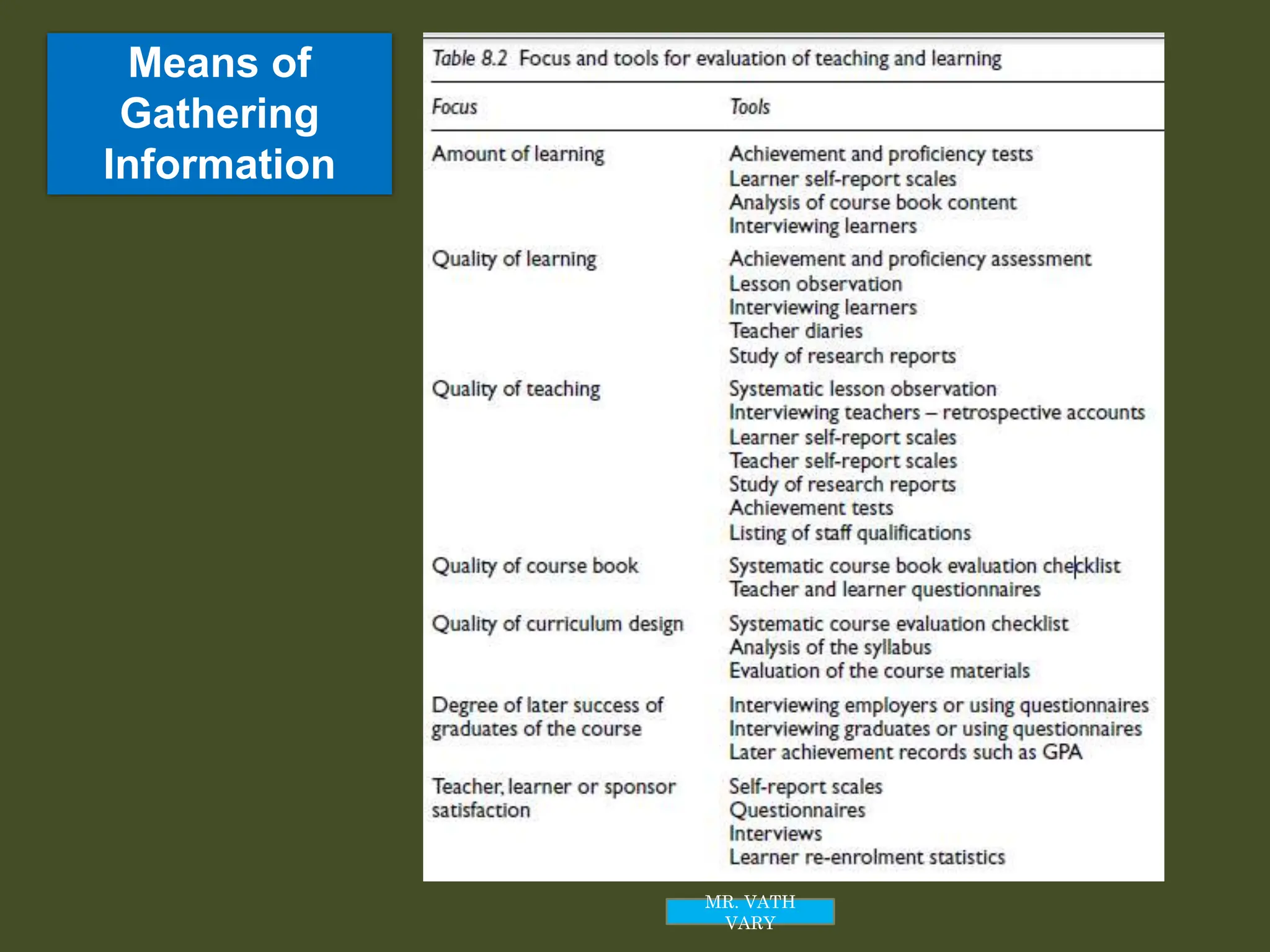
Means of
Gathering
Information
Mr. VATH VARY
MR. VATH
VARY
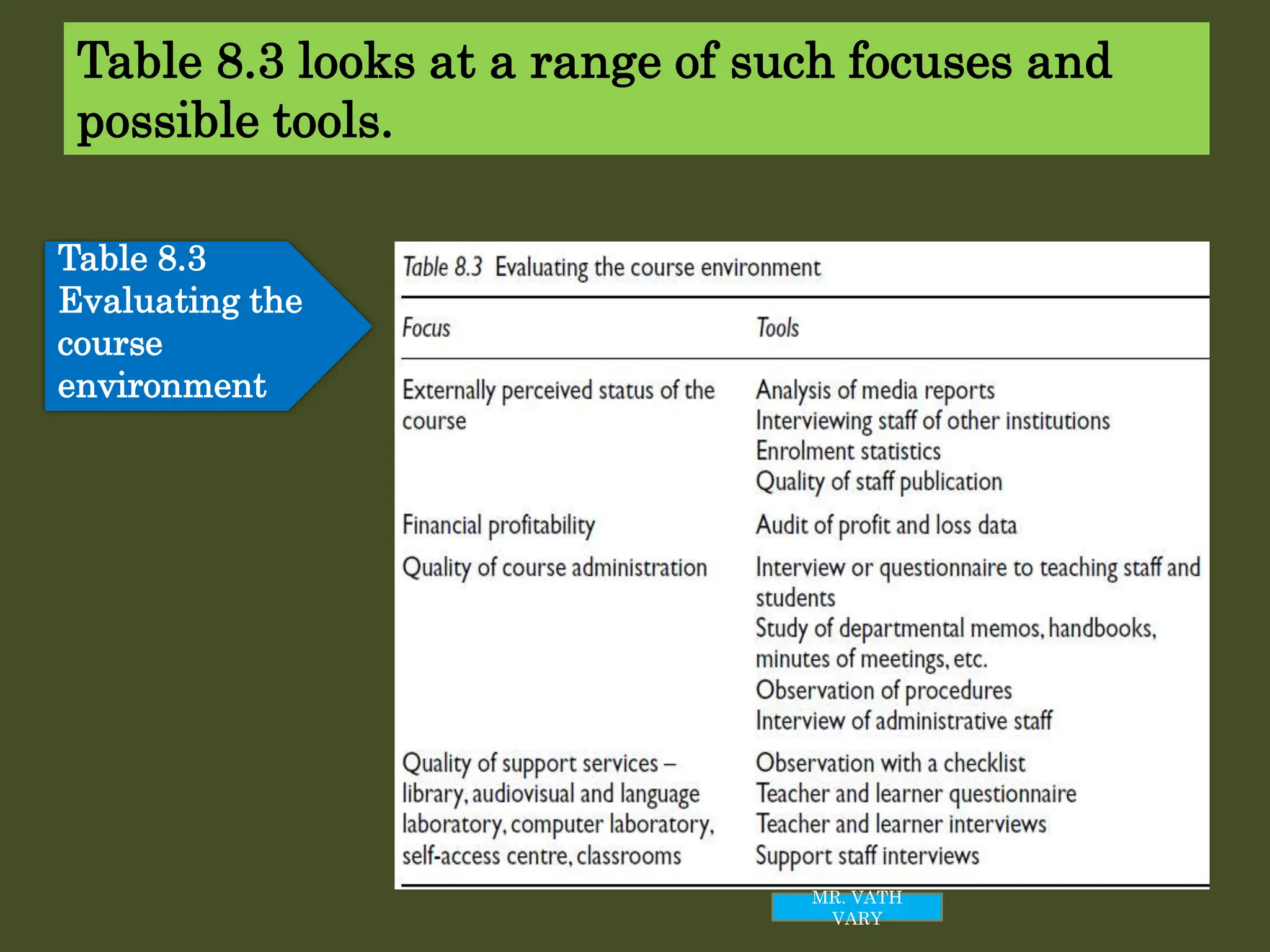
Table 8.3
Evaluating the
course
environment
MR. VATH
VARY
Table 8.3 looks at a range of such focuses and
possible tools.
Gathering
the
Information
Interviews
 Structured (the interviewer has a procedure
and a set of questions to follow and generally
keeps to these) or
 Unstructured (the course of the interview
depends on the wishes of the interviewer and
interviewee and is largely unpredictable)
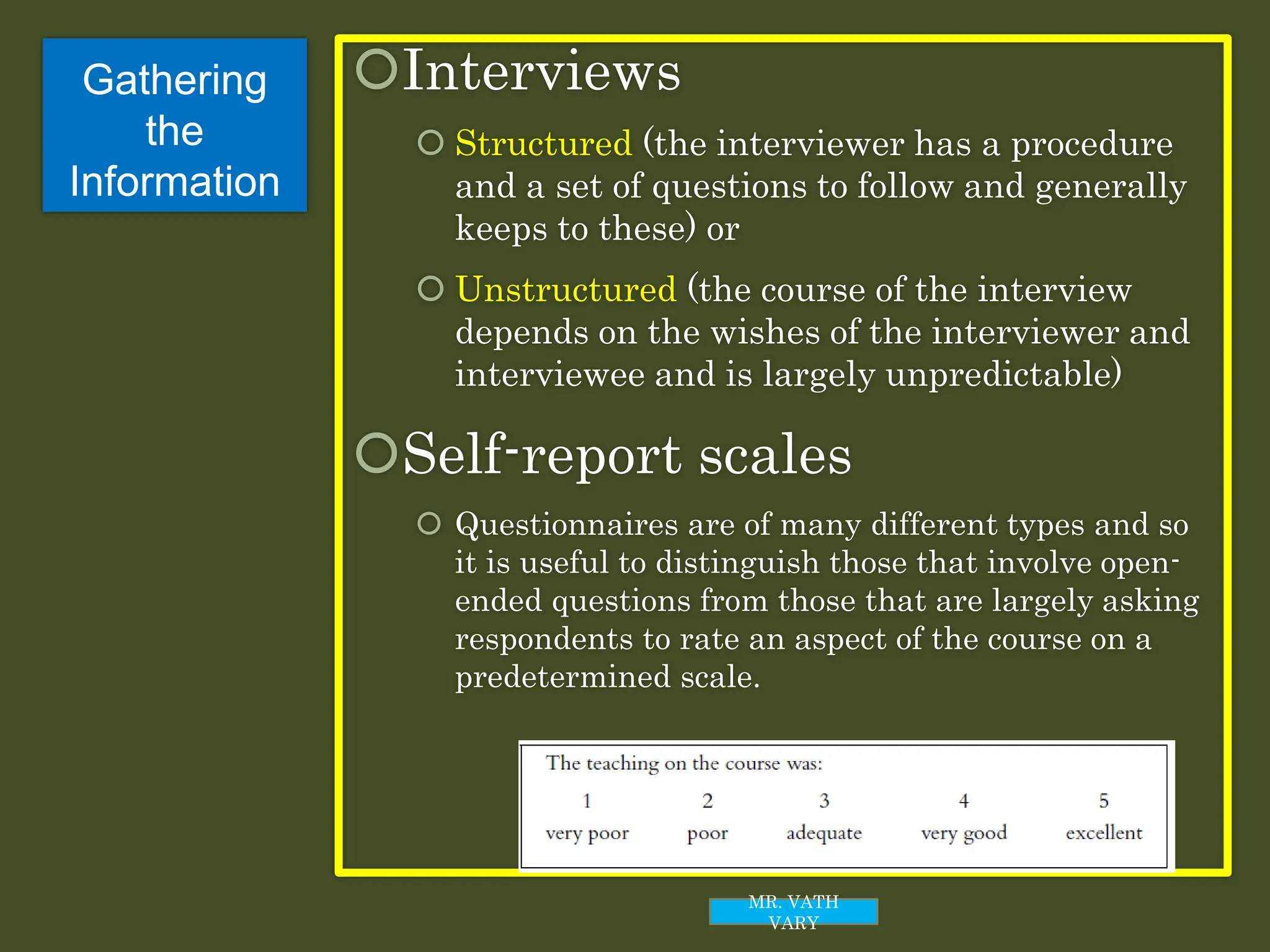
Self-report scales
 Questionnaires are of many different types and so
it is useful to distinguish those that involve open-
ended questions from those that are largely asking
respondents to rate an aspect of the course on a
predetermined scale.
MR. VATH
VARY
Gathering
the
Information
 Observation & checklists
 include analysing the course book, observing learning
in lessons, observing teaching, analysing the coverage
of curriculum design procedures, and observing the
performance of learners after the course.
 Observation can be:
 Unstructured observation: the observer or analyser
tries to see what is there without too many
preconceptions.
 Structured observation: where the observer or
analyser has a checklist of features to look for and
evaluate.
MR. VATH
VARY
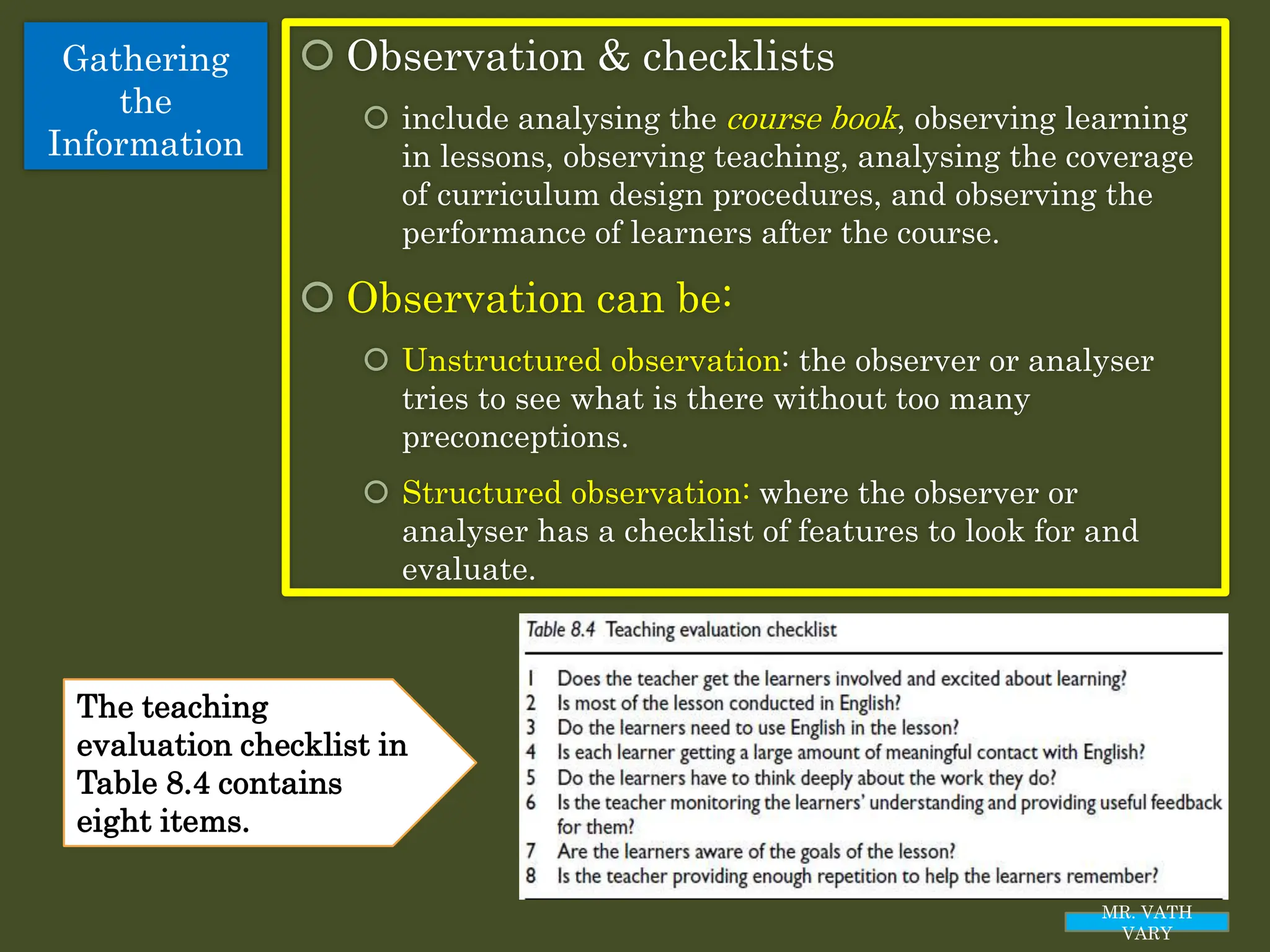
The teaching
evaluation checklist in
Table 8.4 contains
eight items.
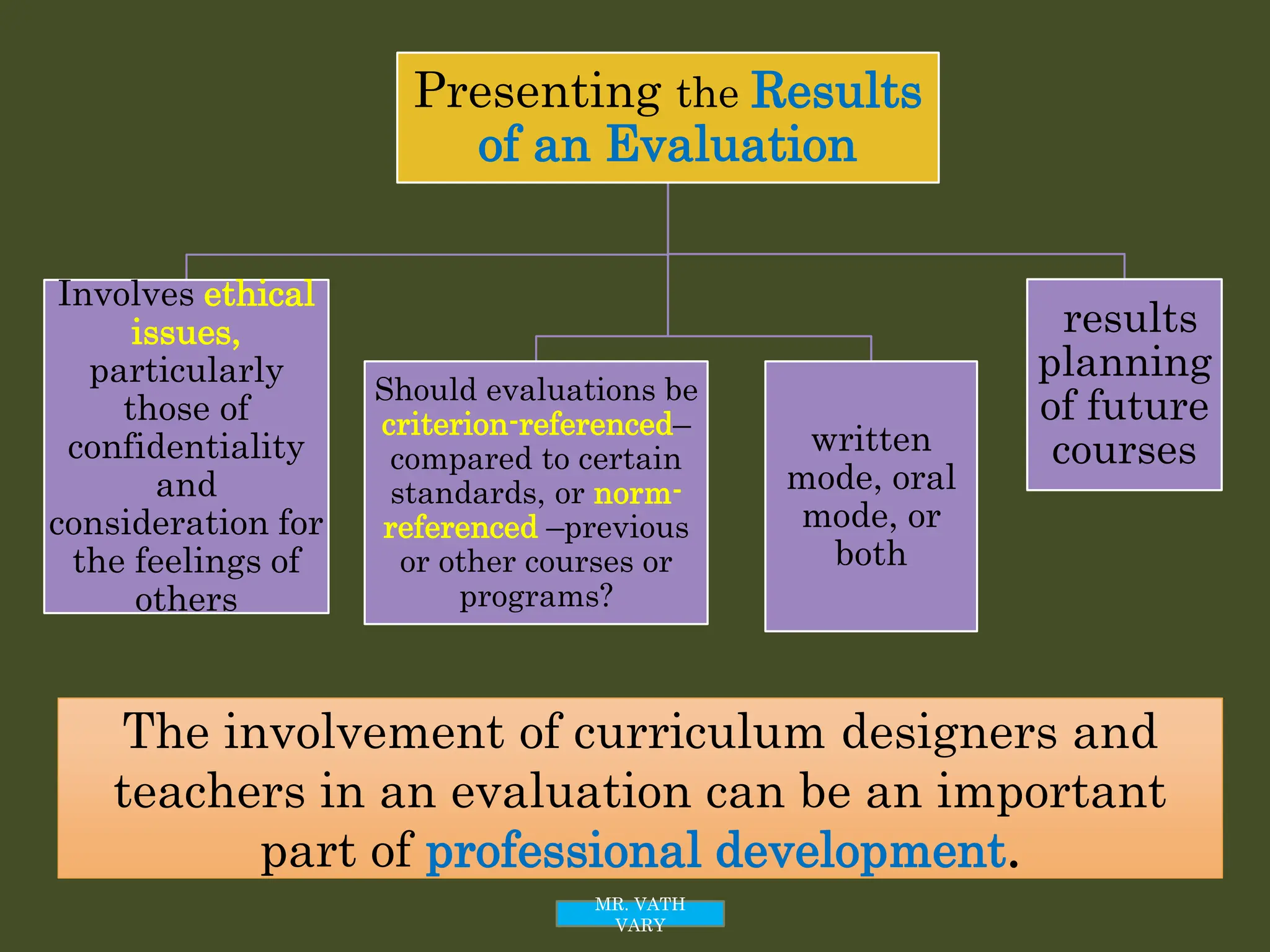
Presenting the Results
of an Evaluation
Involves ethical
issues,
particularly
those of
confidentiality
and
consideration for
the feelings of
others
Should evaluations be
criterion-referenced–
compared to certain
standards, or norm-
referenced –previous
or other courses or
programs?
written
mode, oral
mode, or
both
results
planning
of future
courses
The involvement of curriculum designers and
teachers in an evaluation can be an important
part of professional development.
MR. VATH
VARY
Task 1 Focus
of
Evaluation
 Why do so many people drop out of the course?
 Are the learners achieving the course goals?
 Does the course provide for slower learners?
 Are the learners satisfied with the course?
 Is this course putting accepted principles of
language learning into practice?
 Is the course book effective?
 Is the course preparing the learners for their use of
the language outside the classroom?
 Is the 4/3/2 technique an effective technique?
 Is the course making a profit?
MR. VATH VARY
Summary of
the Steps
 Discover the purpose and type of the
evaluation.
 Assess the time and money needed.
 Decide what kinds of information to
gather.
 Gain the support of the people involved.
 Gather the information.
 Present the findings.
 Apply what has been learned from the
evaluation.
 Do a follow-up evaluation.
MR. VATH VARY
MR. VATH
VARY

Ch 8 Evaluation in Language Curriculum Design.ppt

  • 1.
    Chapter 8: Evaluation  Lecturer:MR. VATH VARY  Phone: 017 471 117  Email: varyvath@gmail.com
  • 2.
    A model ofthe parts of the curriculum design process. The aim of this part of the curriculum design process is to decide how to check if the course is successful and where it needs to be improved. MR. VATH VARY
  • 3.
    Introduc tion Evaluation looks at allaspects of curriculum design to see if the course is the best possible (this is why the outer circle of the model includes all the parts of the curriculum design process). Carrying out an evaluation is like carrying out research. MR. VATH VARY Evaluation Planning the course Implementing the course Result of the course
  • 4.
    Evaluation has to answer as follows: Isthe teaching on the course of a suitably high standard? Is the course preparing the learners properly for their use of English at the end of the course (e.g. to pass the TOEFL test, to study in an English-medium university, to work as a tour guide)? Are the learners satisfied with the course? Is the course cost effective? MR. VATH VARY
  • 5.
    Steps in Evaluation Who wants evaluation? Forwhat purpose is an evaluation being conducted? How much does it cost (time and money)? What data are to be gathered? How are data collected? Are the stakeholders on board? (people involved in the evaluation) How will the data be presented? MR. VATH VARY
  • 6.
    Purpose and Audience of the Evaluation Kielyand Rea-Dickens (2005: 225-271) make a useful three- way scope distinction: large-scale evaluations which “tend to focus on major educational innovations with significant financial backing with an underlying agenda”, teacher-led evaluations, and management-led evaluations. MR. VATH VARY
  • 7.
    Purpose and Audience of the Evaluation Who WantsEvaluation?  Finding out who the evaluation is for and what kind of information they value are important for several reasons:  help determine the degree of confidentiality of the evaluation. Will the report of the evaluation be available to all involved or will it only go to the person or group commissioning the evaluation?  help determine what kind of information should be gathered and what kind of information should not be gathered.  know who the evaluation is for is useful in determining whether the data to be gathered will be provided willingly or reluctantly. MR. VATH
  • 8.
    Purpose and Audience of the Evaluation Is evaluationbeing done to improve the course or to guide a decision on whether to maintain or get rid of the course?  At the end of this preparatory stage of the evaluation, the evaluator should be able to tell the person commissioning the evaluation  Whether the evaluation is worth doing.  Whether the evaluation is possible.  How long it might take.  How much it might cost.  Whether the evaluator is willing to do it.  What kind of evidence the evaluation will gather. MR. VATH
  • 9.
    The Type andFocus of the Evaluation Formative vs. summative Long-term vs. short-term Process vs. product cognitive, affective and resource factors MR. VATH VARY
  • 10.
    The Type and Focus ofthe Evaluation  Formative evaluation has the purpose of forming or shaping the course to improve it.  Summative evaluation has the purpose of making a summary or judgment on the quality or adequacy of the course so that it can be compared with other courses, compared with previous summative evaluations, or judged as being up to a certain criterion or not. MR. VATH VARY
  • 11.
    The Type and Focus ofthe Evaluation Process observations of learning  look at how engaged learners are in their tasks, the quality of the interaction between themselves and between the teacher and the learners, and the quantity and quality of the language used. Product observations of learning look at what was learned and how much was learned. MR. VATH VARY
  • 12.
    The Type and Focus ofthe Evaluation Cognitive factors involve learning and teaching and the gaining of knowledge, and the application of that knowledge after the course has ended. Typical questions would be:  How much has been taught?  How much has been learned?  Has the course improved learners’ work or study performance? MR. VATH VARY
  • 13.
    The Type and Focusof the Evaluation Affective factors involve feelings of satisfaction attitudes. Typical questions would be:  Are the learners pleased with the course?  Do the staff work well together?  Do the teachers feel the course is effective? MR. VATH VARY
  • 14.
    The Type and Focusof the Evaluation Resource factors involve costs, profit, availability and quality of teaching and learning resources such as books, classrooms, visual aids, tape recorders, computers, library facilities, social services and administrative support. Typical questions would be: Is the library adequate for the needs of the learners? Are the classrooms large enough?  Does the course make a financial profit? MR. VATH VARY
  • 15.
    Gaining Support for the Evaluation Are thestakeholders on board? (people involved in the evaluation)  A properly conducted evaluation can be an empowering and motivating activity. The assumptions behind an evaluation usually are that: this course is worth improving, the people running and teaching the course are capable of improving it, the people involved in the course have the freedom and flexibility to make changes to the course, and the improvements will make it a better course for all concerned. MR. VATH VARY
  • 16.
    Gathering the Information Table 8.2: Evaluationof teaching and learning involves … looking at the performance of teachers and learners, observing lessons, and examining achievement. also looking at the environment of the course, which may involve looking at administrative procedures, availability and quality of resources, and how outsiders view the course. MR. VATH VARY
  • 17.
  • 18.
    Table 8.3 Evaluating the course environment MR.VATH VARY Table 8.3 looks at a range of such focuses and possible tools.
  • 19.
    Gathering the Information Interviews  Structured (theinterviewer has a procedure and a set of questions to follow and generally keeps to these) or  Unstructured (the course of the interview depends on the wishes of the interviewer and interviewee and is largely unpredictable) Self-report scales  Questionnaires are of many different types and so it is useful to distinguish those that involve open- ended questions from those that are largely asking respondents to rate an aspect of the course on a predetermined scale. MR. VATH VARY
  • 20.
    Gathering the Information  Observation &checklists  include analysing the course book, observing learning in lessons, observing teaching, analysing the coverage of curriculum design procedures, and observing the performance of learners after the course.  Observation can be:  Unstructured observation: the observer or analyser tries to see what is there without too many preconceptions.  Structured observation: where the observer or analyser has a checklist of features to look for and evaluate. MR. VATH VARY The teaching evaluation checklist in Table 8.4 contains eight items.
  • 21.
    Presenting the Results ofan Evaluation Involves ethical issues, particularly those of confidentiality and consideration for the feelings of others Should evaluations be criterion-referenced– compared to certain standards, or norm- referenced –previous or other courses or programs? written mode, oral mode, or both results planning of future courses The involvement of curriculum designers and teachers in an evaluation can be an important part of professional development. MR. VATH VARY
  • 22.
    Task 1 Focus of Evaluation Why do so many people drop out of the course?  Are the learners achieving the course goals?  Does the course provide for slower learners?  Are the learners satisfied with the course?  Is this course putting accepted principles of language learning into practice?  Is the course book effective?  Is the course preparing the learners for their use of the language outside the classroom?  Is the 4/3/2 technique an effective technique?  Is the course making a profit? MR. VATH VARY
  • 23.
    Summary of the Steps Discover the purpose and type of the evaluation.  Assess the time and money needed.  Decide what kinds of information to gather.  Gain the support of the people involved.  Gather the information.  Present the findings.  Apply what has been learned from the evaluation.  Do a follow-up evaluation. MR. VATH VARY
  • 24.