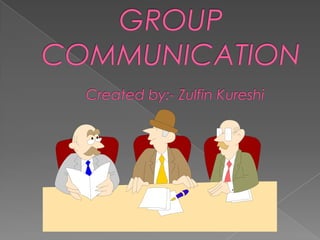
Three or more
individuals who
interact over time,
depend on each
other, and follow
shared rules of
conduct in order to
reach a common
goal is called
GROUP.
TEAM is special type of group
characterized by different and
complementary resources of members
and a strong sense of collective identity.
 Consists of 3-15 people
 Ideal groups are 5-7
 united by a common goal
 satisfy important social needs
 To solve problems
source of information and knowledge
for security (safety in numbers)
booster self-concept and social identity
 Primary group
 Study group
 Therapy group
 Problem-solving group
Focus group
 Social group
Communication
Principles
Be aware of
your
communicatio
n
Appropriately
adapt your
message to
others
Effectively
use and
interpret
verbal
messages
Listen and
respond
thoughtfully
to others Effectively
use and
interpret
nonverbal
messages
1. Cohesion
2. Group Size
3. Power Relationships
4. Interaction Patterns
Chain
Wheel
All-Channel
5. Group Norms
6. Cultural Differences
Factors that affect Group
Communication
Effective
Groups
Collaborative
Relationships
Clear
Purpose
Creative
Thinking
Focused
Efforts
Open
Communication
Conflict
Resolution
Consensus
Decision
Making
Conflicting Goals
Power Struggles
Attitudes and Values
Poor Communication
Task Responsibilities
Scarce Resources
Conflict in Groups
Advantages
Information & knowledge
Diversity of views
Acceptance of solutions
Performance
Disadvantages
Groupthink
Hidden agendas
Free riders
High costs
Overview of Teams
 Express understanding
 Raise awareness
 Evaluate objections
 Withhold arguments
Overcoming Resistance
THANK YOU ALL

Group communication 1