pp. 34-47 Chapter 3   Economic Activity in a Changing World
Learning Objectives After completing this chapter, you’ll be able to: Identify  how economic activity is measured. Explain  how inflation and deflation work. Discuss  the four phases of the business cycle.
Why It’s Important Economic activity affects everyday life. The history of the economy affects industries and people of today and tomorrow.
Key Words gross domestic product (GDP)  standard of living  inflation deflation budget deficit national debt  budget surplus  business cycle prosperity recession depression recovery
Measuring Economic Activity  Economic indicators are figures used to measure economic performance. Economic indicators measure things like how much a country is producing, whether its economy is growing, and how it compares to other countries.
Gross Domestic Product (GDP)  One way of telling how well an economy is performing is to determine how many goods and services it produces during a certain period of time.
Gross Domestic Product (GDP)  The total value of the goods and services produced in a country in a given year is called its  gross domestic product (GDP) .  To calculate the GDP, economists compute the sum of goods and services.
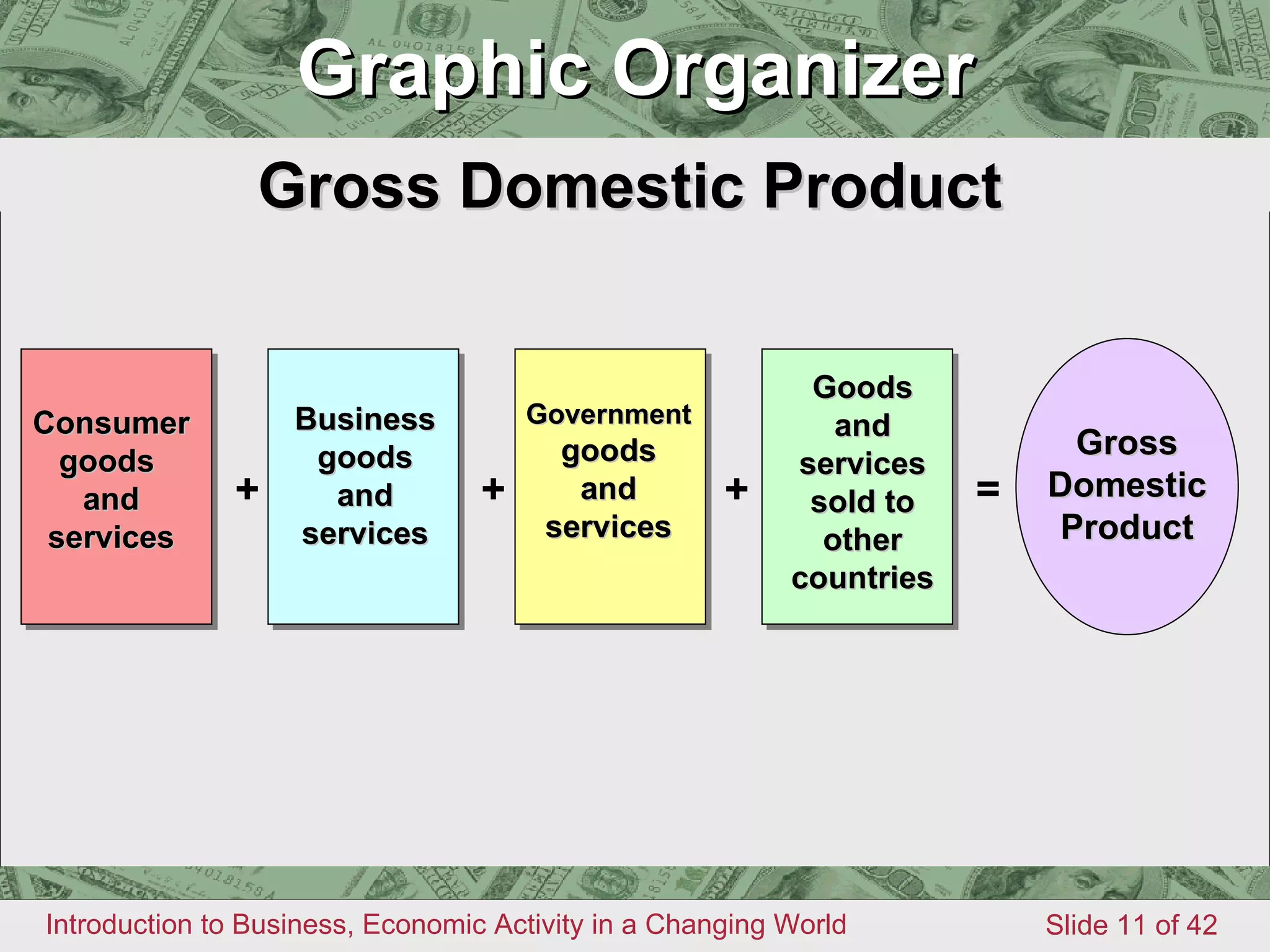
Gross Domestic Product (GDP)  Consumer goods and services Business goods and services Government goods and services Goods and services sold to other countries Economists include four main areas in calculating the GDP:
Gross Domestic Product (GDP)  The GDP doesn’t include the goods and services that aren’t reported to the government. The  standard of living  is the amount of goods and services the average citizen can buy.
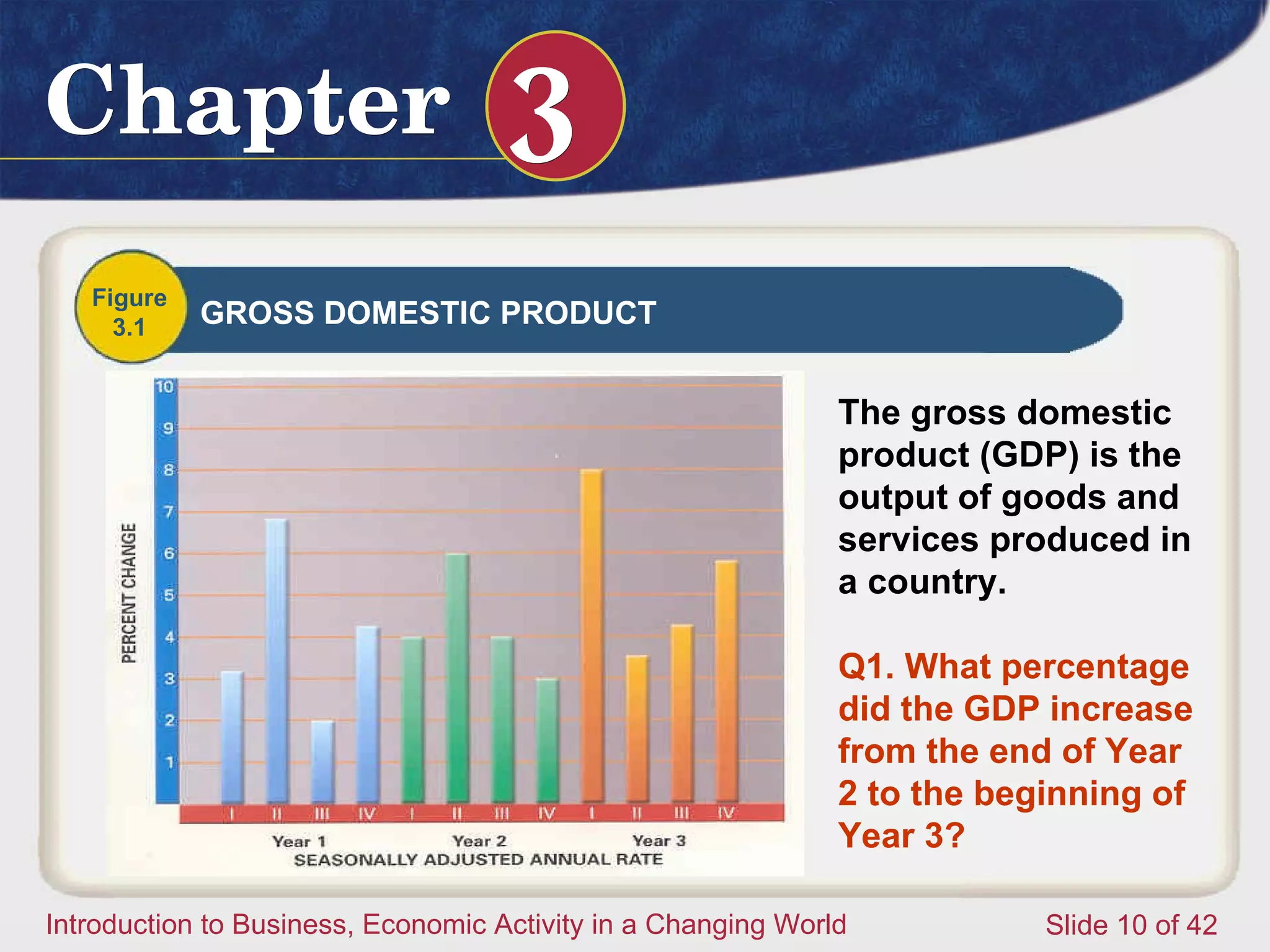
Figure 3.1 GROSS DOMESTIC PRODUCT The gross domestic product (GDP) is the output of goods and services produced in a country. Q1. What percentage did the GDP increase from the end of Year 2 to the beginning of Year 3?
Graphic Organizer Gross Domestic Product Graphic Organizer Consumer goods  and services Business goods and services Government goods and services Goods and services sold to other countries + = + + Gross Domestic Product
Unemployment Rate  The  unemployment rate  measures the number of people who are able to work but don’t have a job during a given period of time.
Unemployment Rate  There are different reasons for being unemployed, including: Temporary Seasonal Changes in industry Economic slowdown
Unemployment Rate  Changes in the unemployment rate show whether an economy is picking up or slowing down.
Rate of Inflation  Inflation  is a general increase in the cost of goods and services.  Inflation can happen when an economy actually becomes too productive.
Rate of Inflation  As the demand for goods goes up, producers raise their prices.  To pay the higher prices, workers demand higher wages.
Rate of Inflation  When wages go up, producers raise prices again to pay for the higher wages, and so on.  This situation can spiral out of control and lead to  hyperinflation .
Rate of Inflation  Deflation  is a general decrease in the cost of goods and services.  When an economy produces more goods than people want, it has to lower prices and cut production.
Rate of Inflation  The United States tries to maintain a slow but steady rate of economic growth to avoid both inflation and deflation.
National Debt  When the government spends more on programs than it collects in taxes, the difference in the amount is called the  budget deficit .
National Debt  The total amount of money a government owes is its  national debt .  If the debt gets too large, a nation can become dependent on other nations or unable to borrow any more money.
National Debt  If a nation spends less than its income, it has a  budget surplus .  The government will probably use a surplus to cut taxes, reduce the national debt, or increase spending for certain programs.
Fast Review Q2. What are some of the types of unemployment? Q3. What is the difference between inflation and deflation?
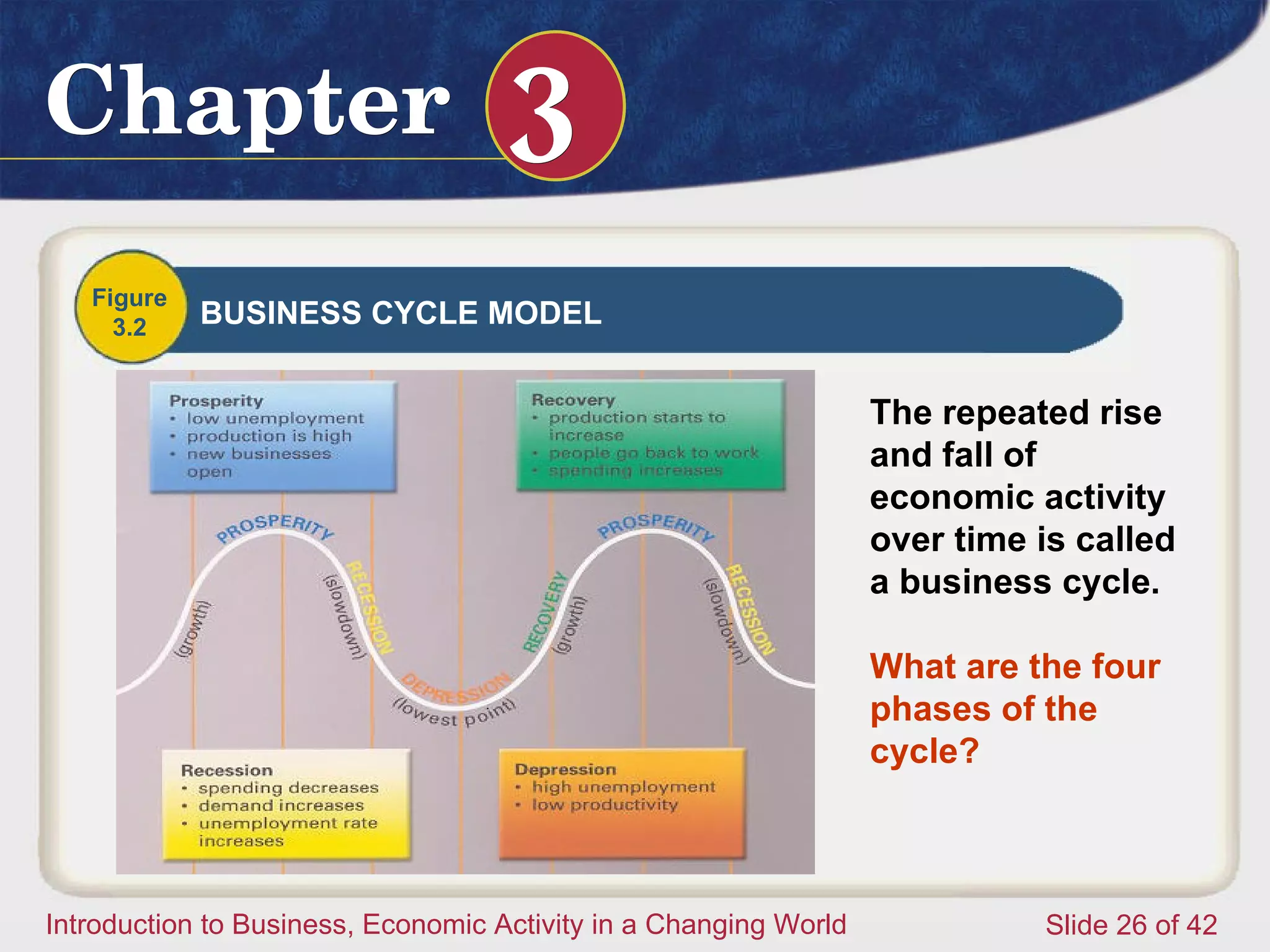
The Business Cycle  Over long periods of time economic changes seem to form patterns.  The rise and fall of economic activity over time is called the  business cycle .
The Business Cycle  The four phases of the business cycle are: Prosperity  Recession Depression Recovery
Figure 3.2 BUSINESS CYCLE MODEL The repeated rise and fall of economic activity over time is called a business cycle. What are the four phases of the cycle?
The Business Cycle  In a global economy, in which several countries are trading goods and services with one another, one country’s economy can affect its trading partners’ economies.
Prosperity  Prosperity  is a peak of economic activity.  Unemployment is low, production of goods and services is high, and new businesses open.
Prosperity  Prosperity, however, does not last. Any number of things can change.  Companies produce too much, people stop buying, or inflation rises dramatically.
Recession  During a  recession , economic activity slows down.  There is a general drop in the total production of goods and services, so the GDP declines.
Recession  A recession can affect only one industry, related industries, or spread to the entire economy.  The  ripple effect  is when a recession in one industry leads to a recession in other industries.
Depression  A deep recession that affects the entire economy and lasts for several years is called a  depression .  During a depression there is high unemployment, low production of goods and services, and excess capacity in manufacturing plants.  A depression can be limited to one country but usually spreads to related countries.
Depression  The stock market crash on October 29, 1929, or “Black Tuesday,” marked the beginning of the Great Depression.  Between 1929 and 1933, GDP fell from approximately $103 billion to $55 billion. During the Great Depression, the number of people out of work rose nearly 800 percent. During the Great Depression, many banks failed. The money supply fell by one-third.
Recovery  A rise in business activity after a recession or depression is called a  recovery .
Recovery  During a recovery: Production starts to increase People start going back to work and have money to spend again The new demand for goods and services stimulates more production The GDP grows New businesses open
Recovery  A recovery can take a long time or it can happen quickly.  During World War II, the United States recovered from the Great Depression much faster because of the demand for war production.
Fast Review Q4. What are the four phases of the business cycle? Q5. How does the ripple effect impact the economy?
Q6. Did colonists develop their own industries? Q7. How do factories influence the workplace?
Q8. How did the assembly line change American society? Q9. How has the Internet changed the way people do business?
Making an Ethical Decision Q10. Should you encourage other company executives to sell your product to countries that have an economic system you disapprove of? Q11. Does it matter if your product is desperately needed by the country to save lives?
Making an Ethical Decision Q13. If the United States bans trade with that country, would you still discuss the topic with other executives? If the executives want to help the banned country, how else could your company get a product to those who need it?
pp. 34-47 End of Chapter 3   Economic Activity in a Changing World

Ch 03

  • 1.
    pp. 34-47 Chapter3 Economic Activity in a Changing World
  • 2.
    Learning Objectives Aftercompleting this chapter, you’ll be able to: Identify how economic activity is measured. Explain how inflation and deflation work. Discuss the four phases of the business cycle.
  • 3.
    Why It’s ImportantEconomic activity affects everyday life. The history of the economy affects industries and people of today and tomorrow.
  • 4.
    Key Words grossdomestic product (GDP) standard of living inflation deflation budget deficit national debt budget surplus business cycle prosperity recession depression recovery
  • 5.
    Measuring Economic Activity Economic indicators are figures used to measure economic performance. Economic indicators measure things like how much a country is producing, whether its economy is growing, and how it compares to other countries.
  • 6.
    Gross Domestic Product(GDP) One way of telling how well an economy is performing is to determine how many goods and services it produces during a certain period of time.
  • 7.
    Gross Domestic Product(GDP) The total value of the goods and services produced in a country in a given year is called its gross domestic product (GDP) . To calculate the GDP, economists compute the sum of goods and services.
  • 8.
    Gross Domestic Product(GDP) Consumer goods and services Business goods and services Government goods and services Goods and services sold to other countries Economists include four main areas in calculating the GDP:
  • 9.
    Gross Domestic Product(GDP) The GDP doesn’t include the goods and services that aren’t reported to the government. The standard of living is the amount of goods and services the average citizen can buy.
  • 10.
    Figure 3.1 GROSSDOMESTIC PRODUCT The gross domestic product (GDP) is the output of goods and services produced in a country. Q1. What percentage did the GDP increase from the end of Year 2 to the beginning of Year 3?
  • 11.
    Graphic Organizer GrossDomestic Product Graphic Organizer Consumer goods and services Business goods and services Government goods and services Goods and services sold to other countries + = + + Gross Domestic Product
  • 12.
    Unemployment Rate The unemployment rate measures the number of people who are able to work but don’t have a job during a given period of time.
  • 13.
    Unemployment Rate There are different reasons for being unemployed, including: Temporary Seasonal Changes in industry Economic slowdown
  • 14.
    Unemployment Rate Changes in the unemployment rate show whether an economy is picking up or slowing down.
  • 15.
    Rate of Inflation Inflation is a general increase in the cost of goods and services. Inflation can happen when an economy actually becomes too productive.
  • 16.
    Rate of Inflation As the demand for goods goes up, producers raise their prices. To pay the higher prices, workers demand higher wages.
  • 17.
    Rate of Inflation When wages go up, producers raise prices again to pay for the higher wages, and so on. This situation can spiral out of control and lead to hyperinflation .
  • 18.
    Rate of Inflation Deflation is a general decrease in the cost of goods and services. When an economy produces more goods than people want, it has to lower prices and cut production.
  • 19.
    Rate of Inflation The United States tries to maintain a slow but steady rate of economic growth to avoid both inflation and deflation.
  • 20.
    National Debt When the government spends more on programs than it collects in taxes, the difference in the amount is called the budget deficit .
  • 21.
    National Debt The total amount of money a government owes is its national debt . If the debt gets too large, a nation can become dependent on other nations or unable to borrow any more money.
  • 22.
    National Debt If a nation spends less than its income, it has a budget surplus . The government will probably use a surplus to cut taxes, reduce the national debt, or increase spending for certain programs.
  • 23.
    Fast Review Q2.What are some of the types of unemployment? Q3. What is the difference between inflation and deflation?
  • 24.
    The Business Cycle Over long periods of time economic changes seem to form patterns. The rise and fall of economic activity over time is called the business cycle .
  • 25.
    The Business Cycle The four phases of the business cycle are: Prosperity Recession Depression Recovery
  • 26.
    Figure 3.2 BUSINESSCYCLE MODEL The repeated rise and fall of economic activity over time is called a business cycle. What are the four phases of the cycle?
  • 27.
    The Business Cycle In a global economy, in which several countries are trading goods and services with one another, one country’s economy can affect its trading partners’ economies.
  • 28.
    Prosperity Prosperity is a peak of economic activity. Unemployment is low, production of goods and services is high, and new businesses open.
  • 29.
    Prosperity Prosperity,however, does not last. Any number of things can change. Companies produce too much, people stop buying, or inflation rises dramatically.
  • 30.
    Recession Duringa recession , economic activity slows down. There is a general drop in the total production of goods and services, so the GDP declines.
  • 31.
    Recession Arecession can affect only one industry, related industries, or spread to the entire economy. The ripple effect is when a recession in one industry leads to a recession in other industries.
  • 32.
    Depression Adeep recession that affects the entire economy and lasts for several years is called a depression . During a depression there is high unemployment, low production of goods and services, and excess capacity in manufacturing plants. A depression can be limited to one country but usually spreads to related countries.
  • 33.
    Depression Thestock market crash on October 29, 1929, or “Black Tuesday,” marked the beginning of the Great Depression. Between 1929 and 1933, GDP fell from approximately $103 billion to $55 billion. During the Great Depression, the number of people out of work rose nearly 800 percent. During the Great Depression, many banks failed. The money supply fell by one-third.
  • 34.
    Recovery Arise in business activity after a recession or depression is called a recovery .
  • 35.
    Recovery Duringa recovery: Production starts to increase People start going back to work and have money to spend again The new demand for goods and services stimulates more production The GDP grows New businesses open
  • 36.
    Recovery Arecovery can take a long time or it can happen quickly. During World War II, the United States recovered from the Great Depression much faster because of the demand for war production.
  • 37.
    Fast Review Q4.What are the four phases of the business cycle? Q5. How does the ripple effect impact the economy?
  • 38.
    Q6. Did colonistsdevelop their own industries? Q7. How do factories influence the workplace?
  • 39.
    Q8. How didthe assembly line change American society? Q9. How has the Internet changed the way people do business?
  • 40.
    Making an EthicalDecision Q10. Should you encourage other company executives to sell your product to countries that have an economic system you disapprove of? Q11. Does it matter if your product is desperately needed by the country to save lives?
  • 41.
    Making an EthicalDecision Q13. If the United States bans trade with that country, would you still discuss the topic with other executives? If the executives want to help the banned country, how else could your company get a product to those who need it?
  • 42.
    pp. 34-47 Endof Chapter 3 Economic Activity in a Changing World