International Research Journal of Engineering and Technology (IRJET) e-ISSN: 2395-0056
Volume: 04 Issue: 09 | Sep -2017 www.irjet.net p-ISSN: 2395-0072
© 2017, IRJET | Impact Factor value: 5.181 | ISO 9001:2008 Certified Journal | Page 1049
CFD ANALYSIS ON AERODYNAMIC EFFECTS ON A PASSENGER CAR
P. Ramasekhar Reddy, R. Lokanadham
1 PG Scholar, Mechanical Engineering, Chadalawada Ramanamma Engineering College, Tirupati, Andhra Pradesh.
2 Professor, Mechanical Engineering, Chadalawada Ramanamma Engineering College,Tirupati,Andhra Pradesh.
---------------------------------------------------------------------***---------------------------------------------------------------------
Abstract - Performance, Handling, Safety, and Comfort of a
passenger car aresignificantly affected by its aerodynamic
properties. Getting high power under the normal conditions
is not enough to judge the performance of the car.
Aerodynamic properties must beconsideredforthepurpose
of studying the drag and stability performance of a car. In
order to improve car aerodynamic drag and its stability, an
aerodynamic device is needed such as Spoiler. Spoiler is an
aerodynamic device that functions to slow down and collect
air, causing it to stagnate. This device creates an area of high
pressure to replace the usual low pressure over the trunk
resulting increasing stability.
The objective of this study is to investigate the effects of
aftermarket spoiler to car aerodynamics drag and stability.
Several spoilers design is attached at rear and roof parts of
base line model. Both Base line model, rear and roof spoiler
models are built in CAD software. TheCADmodethen, either
with or without rear and roof spoiler are analyzed in CFD
software to estimate the drag and lift force whichisactingon
the car.
Taking CFD software as the platform and the car as the
research object, the air's resistance coefficients and speed
are solved by using k-ε equations and dynamic mesh
method and taking boundary conditions such as 100 kmph.
The finite volume method is used to discrete the governing
equations, Then CAD data , either with or without rear and
roof spoiler are analyze in CFD software to estimatethedrag
and lift force which is acting on the car. Force, drag and lift
coefficient values will be determined in order to study their
effect to drag and stability. Some limitations occurreddueto
the complexity of the design. From the result, compared to
with or without rear and roof spoiler roof is best in
increasing stability of car at high speed.
Keywords: Aerodynamic Drag, Coefficient of Drag,
Coefficient of Lift, Tail Plate, Wind tunnel simulation,
PTC Creo, ANSYS FLUENT, Generic passenger car, CFD.
1. INTRODUCTION
The regulation of greenhouse gases to control global
warming and rapidly increasing fuel prices have given
tremendous pressure onthe designengineersto enhancethe
current designs of the automobile using minimal changes in
the shapes. To fulfill the above requirements, design
engineers have been using the concepts of aerodynamics to
enhance the efficiency of automobiles. Although
aerodynamics depends on so many factors, this thesis
concentrates on external devices, which affect the flow
around the automobile body to reduce the resistance of the
vehicle in normal working conditions.
2. PRINCIPLES OF SPOILER SYSTEM
Spoilers are added to cars and other vehicles to make them
more aerodynamic. Most spoilers are attached to the rear of
a car, but they can also be found on the front. Various types
and the positioning of the spoilers can do different things to
improve a car’s performance. However, the main reason
people install spoilers is to allow for better airflow over and
around the car, which in turn creates better grip or traction
on the road. Cars that run at high speeds often encounter
control problems. That’s because at high speeds, the
increased air flow creates too much lift, which can be
especially dangerous when the car makes a turn, as this can
make it fly off the road and lose control.
2.1 Spoiler Types
I. Front spoiler
ii. Lighted Spoiler
iii. Pedestal Spoiler
iv. Roof Spoiler
v. Lip Spoiler
vi. Truck spoiler
I. Front spoiler
This accessory is usually madeoflightweightmetal orplastic
placed beneath the front bumperofa vehicleandintendedto
increase aerodynamics by blocking the flow of turbulent air
under the chassis.
ii. Lighted Spoiler
Lighted spoiler provided with the lights you spoiler will not
only ensure optimal brightness and visibility from behind,
but also add a stylish accent to the rear of the vehicle, which
is noticeable both in the daytime and in the nighttime.
iii. Pedestal Spoiler
The post spoiler is a popular aerodynamic addition, whichis
positioned on the top of the vehicle’s trunk. This automotive
accessory can improve stability of the car at a high speed for
a performance benefit on the street.A well-designed spoiler
can both modify the look of the car and improve its
performance.
International Research Journal of Engineering and Technology (IRJET) e-ISSN: 2395-0056
Volume: 04 Issue: 09 | Sep -2017 www.irjet.net p-ISSN: 2395-0072
© 2017, IRJET | Impact Factor value: 5.181 | ISO 9001:2008 Certified Journal | Page 1050
iv. Roof Spoiler
Roof spoiler is an aerodynamic device that is usually
attached to the rear of car’s roof. It is custom designed to fit
the upper window section and installs directly above the
glass.
v. Lip Spoiler
Lip spoiler is a best choice for the driver who prefers a more
subtle and at the same time appealing upgrade. Installed on
the lip of the trunk, this styling accessory delivers a sporty
image that is easy to be recognized. The lip spoiler can peer
off the rear of the automobile without being too tall or wide.
It also underlines a sleek lines of the car.
vi. Truck spoiler
When attached to any truck’s rear, these accessories make it
appear aggressive like a roadster. Different types of truck
spoilers are suitable for different types of truck brands and
their models.
3. LITERATURE SURVEY
Mustafa Cakir [1] , in this paper,“CFD Study on Aerodynamic
Effects of a Rear wing/spoiler on a passenger vehicle”, The
aerodynamic lift, drag and flow characteristics of a high-
speed (~65 mph) generic sedan passenger vehicle with a
spoiler and without a spoiler situations were numerically
investigated. The numerical analyzeofhigh-speedpassenger
car with first rear spoiler design (case #2, which was a wing
style spoiler) has showed that the aerodynamic drag is
reduced from 0.232 to 0.192, which is 17% drag reduction,
and it also increases negative lift by reducing the lift
coefficient from -0.222 to -0.239, which is 7% lift reduction.
McKay, Noah J[7], Aerodynamics plays a very importantrole
in motorsports. Car manufacturers around the world have
been fascinated and influenced by the various aerodynamic
improvements that are used in racing. There has been a
constant effort on their side to incorporate these changes to
road vehicles not just as an aesthetic design feature but also
since they believe that these features can contribute to
improving fuel economy and vehicle handling. One of the
main areas of concern in racing is to balance aerodynamic
forces and to streamline the air flow across the body
towards improving stability and handling characteristics,
especially, while cornering. At present, formula racing cars
are regulated by stringent FIA norms, there is a constraint
for the dimensions of the vehicle used, engine capacity,
power output and emission. It is difficult to obtain the
optimum aerodynamic performance withtheexisting racing
car. There is a need for improvement in the aerodynamic
performance of these race cars by using add-on devices
locally with different configurations to streamline and
channelize the airflow besides reducing aerodynamicforces
and providingstabilitythatimprovescorneringandhandling
characteristics.
Aniruddha Patiletal[9] The development of low form factor
flight controls is driven by the benefits of reducing the
installed volume of the control deviceand/orminimizing the
change in external geometry, with particular application to
flight control of low observable aircraft. For this work, the
term „low form factor‟ does not refer to the aspect ratio of
the control device rather the overall installed volume. This
thesis compares the use of low form factor geometric and
fluid devices on a NACA 0015 aerofoil section through two-
dimensional numerical analysis and low speed wind tunnel
experiments. The geometric spoiler is implemented as a
small (boundary layer scale) variable height tab oriented
normal to the local surface, referred to as a Micro Geometric
Spoiler (MiGS). The fluidic spoiler is implemented as an air
jet tangential to the local surface acting in the forward
direction, referred to as a Counter-Flow Fluidic Spoiler
(CFFS). Two chord wise spoiler locations were considered:
0.35c and 0.65c. Numerical analysis was undertaken using a
commercial CFD code using an unsteadysolverandk-omega
shear-stress-transport turbulence model. Experimental
forces and moments were measured via an overhead force
balance, integrated surface pressures and pressure wake
survey. Device performance is assessed against the
magnitude of control achievable compared to macro scale
spoilers and trailing edge controls (effectiveness), the ratio
of aerodynamic output to control input (efficiency or gain),
the shape of control response curve (linearity), and the
degree of control cross coupling.
4. MODELLING
4.1 PTC Creo Parametric
The flagship application in the PTC Creo Suite, PTC Creo
Parametric is the only software you need for 3D CAD. With
PTC Creo Parametric, you can seamlessly combine
parametric and direct modeling; open non-native CAD data
and collaborate with almost anyone thanks to Unite
technology; and relax knowing all downstream deliverables
will update automatically. Combine this rangeofcapabilities
with ease-of use, and you have a product design accelerator.
Figure 1: 3D elements/ Direct Modeling
International Research Journal of Engineering and Technology (IRJET) e-ISSN: 2395-0056
Volume: 04 Issue: 09 | Sep -2017 www.irjet.net p-ISSN: 2395-0072
© 2017, IRJET | Impact Factor value: 5.181 | ISO 9001:2008 Certified Journal | Page 1051
4.2 COMPUTATIONAL FLUID DYNAMICS
“CFD (Computational fluid dynamics) is a set of numerical
methods applied to obtainapproximatesolutionofproblems
of fluid dynamics and heat transfer.”According to this
definition, CFD is not a science by itself but a way to apply
methods of one discipline (numerical analysis) to
another(heat andmasstransfer).Thephysical characteristics
of the fluid motion can usually be described through
fundamental mathematical equations, usually in partial
differential form, which govern a process of interest and are
often called governing equations in CFD. Jiyuan Tu, Guan
Heng Yeoh and Chaoqun Liu has discussed how to solve
mathematical equations with using CFD.
Figure 2: Dimensions of the generic vehicle model
5. RESULTS & DISCUSSIONS
Results:
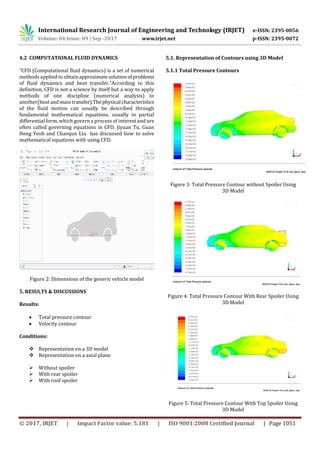
 Total pressure contour
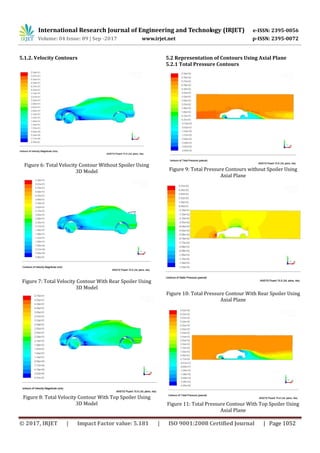
 Velocity contour
Conditions:
 Representation on a 3D model
 Representation on a axial plane
 Without spoiler
 With rear spoiler
 With roof spoiler
5.1. Representation of Contours using 3D Model
5.1.1 Total Pressure Contours
Figure 3: Total Pressure Contour without Spoiler Using
3D Model
Figure 4: Total Pressure Contour With Rear Spoiler Using
3D Model
Figure 5: Total Pressure Contour With Top Spoiler Using
3D Model
International Research Journal of Engineering and Technology (IRJET) e-ISSN: 2395-0056
Volume: 04 Issue: 09 | Sep -2017 www.irjet.net p-ISSN: 2395-0072
© 2017, IRJET | Impact Factor value: 5.181 | ISO 9001:2008 Certified Journal | Page 1052
5.1.2. Velocity Contours
Figure 6: Total Velocity Contour Without Spoiler Using
3D Model
Figure 7: Total Velocity Contour With Rear Spoiler Using
3D Model
Figure 8: Total Velocity Contour With Top Spoiler Using
3D Model
5.2 Representation of Contours Using Axial Plane
5.2.1 Total Pressure Contours
Figure 9: Total Pressure Contours without Spoiler Using
Axial Plane
Figure 10: Total Pressure Contour With Rear Spoiler Using
Axial Plane
Figure 11: Total Pressure Contour With Top Spoiler Using
Axial Plane
International Research Journal of Engineering and Technology (IRJET) e-ISSN: 2395-0056
Volume: 04 Issue: 09 | Sep -2017 www.irjet.net p-ISSN: 2395-0072
© 2017, IRJET | Impact Factor value: 5.181 | ISO 9001:2008 Certified Journal | Page 1053
5.2.2. Velocity Contours
Figure 12: Total Velocity Contour without Spoiler using
Axial Plane
Figure 13: Total Velocity Contour With Rear Spoiler Using
Axial Plane
Figure 14: Total Velocity Contour With Top Spoiler Using
Axial Plane
6. CONCLUSION
The aerodynamic lift, drag and flow characteristicsofa high-
speed (~100 Kmph) generic sedan passenger vehicle with a
spoiler and without a spoiler situations were numerically
investigated.Numerical analysis has showed us that the
spoiler design, which was mounted to the rear-endprovided
more negative lift force than the roof spoiler did but
provided less drag reduction.Roof spoiler provided drag
reduction but the negative lift force has been increased. It is
known that having down force (i.e. negativeliftforce).Sedan
car with roof Increases tires capability to produce cornering
force, Stabilizes vehicle sat high speed, Improves braking
performance, Gives better traction, Reduceinliftmayleadto
reduce of dirt on the rear surface, Reduce in drag leads to
maximum speed for a given engine power, compared torear
spoiler sedan car.
REFERENCES
[1] Mustafa Cakir , “CFD Study on Aerodynamic Effects of a
Rear wing/spoiler on a passenger vehicle”.Submitted in
partial fulfillment of the requirements for the degree of
masterof science in mechanical engineering in the school of
engineering at Santa Clara university, California.
[7] McKay, Noah J, 2002. “The Effect of Wing Aerodynamics
on Race Vehicle
Performance”. SAE Publications.
[9] Aniruddha Patil et al, “Study of Front Wing of Formula
One car using computational fluid dynamics”.
[10] Abdulnaser Sayma, “Computational Fluid
Dynamics”.computational analysis of base drag reduction
using active flow control
[11] G. Fillola et al, “Experiental Study and Numerical
Simulation of Flow Around Wing Control Surface”.
[12] P.M. VAN LEEUWEN “computational analysis of base
drag reduction using active flow control” aerospace
engineering at delft university of technology, november
2009.
[13] Dileep P. Menon, samir kamat
G.,yagnavalkyas.mukkamala,prakashS.kulkarni“toimprove
the aerodynamic performance of a model hacth back car
with the addition of rear roof spoiler” CFD sympo
2014,banglore. 16th Annual CFD symposium, august 11-
12,2014.
[14] MOHAMMAD MASHUD , MAUSUMI FERDOUS AND
SHAHRIAR HOSSAIN OMEE, Department of mechanical
engineering, kahulna university of engineering and
technology, KUET,Khulna -9203,bangladesh“Effectofspoiler
position on aerodynamic characteristics of an airfoil”
International Research Journal of Engineering and Technology (IRJET) e-ISSN: 2395-0056
Volume: 04 Issue: 09 | Sep -2017 www.irjet.net p-ISSN: 2395-0072
© 2017, IRJET | Impact Factor value: 5.181 | ISO 9001:2008 Certified Journal | Page 1054
International Journal of mechanical and mechatronics
engineering IJMMEIJENS vol:12 No:06 1.
[15] WOLF-HEINRICH HUCHO, GINO WOVSRAN
“AERODYNAMICS OF ROAD VEHICLES” Annu. Rev. Fluid
Mech. 1993.25:485-537,1993.
[16] Jiang, F., “Assessing Computational Fluid Dynamics
Predictions for Control Surface Effectivness ”, Journal of
Aircraft, vol. 38, n°6, 2001
[17] Archambeau , J.P., Dor , J.B., Michonneau , J.F., Brail J.F.,«
etude des effects latéraux autour d’un profil bidimensionnel
dans la soufflerie T2. Mesure par vélocimétrie laser et
utilisation de différents contrôles actifs », PV OA n°15/2891
AN 169D (DERAT n°15/5015.24), octobre 1991
[18] . Kieffera W, Moujaesb S and Armbyab N (2006), “CFD
Study of SectionCharacteristics of Formula Mazda Race Car
Wings”, Mathematical andComputer Modelling, Vol. 43,Nos.
11 -12, pp. 1275-1287.
[19] Mohd Syazrul Shafiq B Saad (2010), “Study of F1 Car
Aerodynamics FrontWing Using Computational Fluid
Dynamics (Cfd)”, Universiti MalaysiaPahang, December.
[20] Mack, M.D, Seetharam, H. C., Kuhn, W. G., Bright, J. T.,
“Aerodynamics of spoiler control devices,” presented at the
AIAA Aircraft Systems and Technology meeting, New York,
1979.
[21] Flower, J.W., “Lift and rolling moment duetospoilers on
wings with flaps undeflected at subsonic speeds,” ESDU,
90030b, pp. 1-30, 1999.

CFD Analysis on Aerodynamic Effects on a Passenger Car

  • 1.
    International Research Journalof Engineering and Technology (IRJET) e-ISSN: 2395-0056 Volume: 04 Issue: 09 | Sep -2017 www.irjet.net p-ISSN: 2395-0072 © 2017, IRJET | Impact Factor value: 5.181 | ISO 9001:2008 Certified Journal | Page 1049 CFD ANALYSIS ON AERODYNAMIC EFFECTS ON A PASSENGER CAR P. Ramasekhar Reddy, R. Lokanadham 1 PG Scholar, Mechanical Engineering, Chadalawada Ramanamma Engineering College, Tirupati, Andhra Pradesh. 2 Professor, Mechanical Engineering, Chadalawada Ramanamma Engineering College,Tirupati,Andhra Pradesh. ---------------------------------------------------------------------***--------------------------------------------------------------------- Abstract - Performance, Handling, Safety, and Comfort of a passenger car aresignificantly affected by its aerodynamic properties. Getting high power under the normal conditions is not enough to judge the performance of the car. Aerodynamic properties must beconsideredforthepurpose of studying the drag and stability performance of a car. In order to improve car aerodynamic drag and its stability, an aerodynamic device is needed such as Spoiler. Spoiler is an aerodynamic device that functions to slow down and collect air, causing it to stagnate. This device creates an area of high pressure to replace the usual low pressure over the trunk resulting increasing stability. The objective of this study is to investigate the effects of aftermarket spoiler to car aerodynamics drag and stability. Several spoilers design is attached at rear and roof parts of base line model. Both Base line model, rear and roof spoiler models are built in CAD software. TheCADmodethen, either with or without rear and roof spoiler are analyzed in CFD software to estimate the drag and lift force whichisactingon the car. Taking CFD software as the platform and the car as the research object, the air's resistance coefficients and speed are solved by using k-ε equations and dynamic mesh method and taking boundary conditions such as 100 kmph. The finite volume method is used to discrete the governing equations, Then CAD data , either with or without rear and roof spoiler are analyze in CFD software to estimatethedrag and lift force which is acting on the car. Force, drag and lift coefficient values will be determined in order to study their effect to drag and stability. Some limitations occurreddueto the complexity of the design. From the result, compared to with or without rear and roof spoiler roof is best in increasing stability of car at high speed. Keywords: Aerodynamic Drag, Coefficient of Drag, Coefficient of Lift, Tail Plate, Wind tunnel simulation, PTC Creo, ANSYS FLUENT, Generic passenger car, CFD. 1. INTRODUCTION The regulation of greenhouse gases to control global warming and rapidly increasing fuel prices have given tremendous pressure onthe designengineersto enhancethe current designs of the automobile using minimal changes in the shapes. To fulfill the above requirements, design engineers have been using the concepts of aerodynamics to enhance the efficiency of automobiles. Although aerodynamics depends on so many factors, this thesis concentrates on external devices, which affect the flow around the automobile body to reduce the resistance of the vehicle in normal working conditions. 2. PRINCIPLES OF SPOILER SYSTEM Spoilers are added to cars and other vehicles to make them more aerodynamic. Most spoilers are attached to the rear of a car, but they can also be found on the front. Various types and the positioning of the spoilers can do different things to improve a car’s performance. However, the main reason people install spoilers is to allow for better airflow over and around the car, which in turn creates better grip or traction on the road. Cars that run at high speeds often encounter control problems. That’s because at high speeds, the increased air flow creates too much lift, which can be especially dangerous when the car makes a turn, as this can make it fly off the road and lose control. 2.1 Spoiler Types I. Front spoiler ii. Lighted Spoiler iii. Pedestal Spoiler iv. Roof Spoiler v. Lip Spoiler vi. Truck spoiler I. Front spoiler This accessory is usually madeoflightweightmetal orplastic placed beneath the front bumperofa vehicleandintendedto increase aerodynamics by blocking the flow of turbulent air under the chassis. ii. Lighted Spoiler Lighted spoiler provided with the lights you spoiler will not only ensure optimal brightness and visibility from behind, but also add a stylish accent to the rear of the vehicle, which is noticeable both in the daytime and in the nighttime. iii. Pedestal Spoiler The post spoiler is a popular aerodynamic addition, whichis positioned on the top of the vehicle’s trunk. This automotive accessory can improve stability of the car at a high speed for a performance benefit on the street.A well-designed spoiler can both modify the look of the car and improve its performance.
  • 2.
    International Research Journalof Engineering and Technology (IRJET) e-ISSN: 2395-0056 Volume: 04 Issue: 09 | Sep -2017 www.irjet.net p-ISSN: 2395-0072 © 2017, IRJET | Impact Factor value: 5.181 | ISO 9001:2008 Certified Journal | Page 1050 iv. Roof Spoiler Roof spoiler is an aerodynamic device that is usually attached to the rear of car’s roof. It is custom designed to fit the upper window section and installs directly above the glass. v. Lip Spoiler Lip spoiler is a best choice for the driver who prefers a more subtle and at the same time appealing upgrade. Installed on the lip of the trunk, this styling accessory delivers a sporty image that is easy to be recognized. The lip spoiler can peer off the rear of the automobile without being too tall or wide. It also underlines a sleek lines of the car. vi. Truck spoiler When attached to any truck’s rear, these accessories make it appear aggressive like a roadster. Different types of truck spoilers are suitable for different types of truck brands and their models. 3. LITERATURE SURVEY Mustafa Cakir [1] , in this paper,“CFD Study on Aerodynamic Effects of a Rear wing/spoiler on a passenger vehicle”, The aerodynamic lift, drag and flow characteristics of a high- speed (~65 mph) generic sedan passenger vehicle with a spoiler and without a spoiler situations were numerically investigated. The numerical analyzeofhigh-speedpassenger car with first rear spoiler design (case #2, which was a wing style spoiler) has showed that the aerodynamic drag is reduced from 0.232 to 0.192, which is 17% drag reduction, and it also increases negative lift by reducing the lift coefficient from -0.222 to -0.239, which is 7% lift reduction. McKay, Noah J[7], Aerodynamics plays a very importantrole in motorsports. Car manufacturers around the world have been fascinated and influenced by the various aerodynamic improvements that are used in racing. There has been a constant effort on their side to incorporate these changes to road vehicles not just as an aesthetic design feature but also since they believe that these features can contribute to improving fuel economy and vehicle handling. One of the main areas of concern in racing is to balance aerodynamic forces and to streamline the air flow across the body towards improving stability and handling characteristics, especially, while cornering. At present, formula racing cars are regulated by stringent FIA norms, there is a constraint for the dimensions of the vehicle used, engine capacity, power output and emission. It is difficult to obtain the optimum aerodynamic performance withtheexisting racing car. There is a need for improvement in the aerodynamic performance of these race cars by using add-on devices locally with different configurations to streamline and channelize the airflow besides reducing aerodynamicforces and providingstabilitythatimprovescorneringandhandling characteristics. Aniruddha Patiletal[9] The development of low form factor flight controls is driven by the benefits of reducing the installed volume of the control deviceand/orminimizing the change in external geometry, with particular application to flight control of low observable aircraft. For this work, the term „low form factor‟ does not refer to the aspect ratio of the control device rather the overall installed volume. This thesis compares the use of low form factor geometric and fluid devices on a NACA 0015 aerofoil section through two- dimensional numerical analysis and low speed wind tunnel experiments. The geometric spoiler is implemented as a small (boundary layer scale) variable height tab oriented normal to the local surface, referred to as a Micro Geometric Spoiler (MiGS). The fluidic spoiler is implemented as an air jet tangential to the local surface acting in the forward direction, referred to as a Counter-Flow Fluidic Spoiler (CFFS). Two chord wise spoiler locations were considered: 0.35c and 0.65c. Numerical analysis was undertaken using a commercial CFD code using an unsteadysolverandk-omega shear-stress-transport turbulence model. Experimental forces and moments were measured via an overhead force balance, integrated surface pressures and pressure wake survey. Device performance is assessed against the magnitude of control achievable compared to macro scale spoilers and trailing edge controls (effectiveness), the ratio of aerodynamic output to control input (efficiency or gain), the shape of control response curve (linearity), and the degree of control cross coupling. 4. MODELLING 4.1 PTC Creo Parametric The flagship application in the PTC Creo Suite, PTC Creo Parametric is the only software you need for 3D CAD. With PTC Creo Parametric, you can seamlessly combine parametric and direct modeling; open non-native CAD data and collaborate with almost anyone thanks to Unite technology; and relax knowing all downstream deliverables will update automatically. Combine this rangeofcapabilities with ease-of use, and you have a product design accelerator. Figure 1: 3D elements/ Direct Modeling
  • 3.
    International Research Journalof Engineering and Technology (IRJET) e-ISSN: 2395-0056 Volume: 04 Issue: 09 | Sep -2017 www.irjet.net p-ISSN: 2395-0072 © 2017, IRJET | Impact Factor value: 5.181 | ISO 9001:2008 Certified Journal | Page 1051 4.2 COMPUTATIONAL FLUID DYNAMICS “CFD (Computational fluid dynamics) is a set of numerical methods applied to obtainapproximatesolutionofproblems of fluid dynamics and heat transfer.”According to this definition, CFD is not a science by itself but a way to apply methods of one discipline (numerical analysis) to another(heat andmasstransfer).Thephysical characteristics of the fluid motion can usually be described through fundamental mathematical equations, usually in partial differential form, which govern a process of interest and are often called governing equations in CFD. Jiyuan Tu, Guan Heng Yeoh and Chaoqun Liu has discussed how to solve mathematical equations with using CFD. Figure 2: Dimensions of the generic vehicle model 5. RESULTS & DISCUSSIONS Results:  Total pressure contour  Velocity contour Conditions:  Representation on a 3D model  Representation on a axial plane  Without spoiler  With rear spoiler  With roof spoiler 5.1. Representation of Contours using 3D Model 5.1.1 Total Pressure Contours Figure 3: Total Pressure Contour without Spoiler Using 3D Model Figure 4: Total Pressure Contour With Rear Spoiler Using 3D Model Figure 5: Total Pressure Contour With Top Spoiler Using 3D Model
  • 4.
    International Research Journalof Engineering and Technology (IRJET) e-ISSN: 2395-0056 Volume: 04 Issue: 09 | Sep -2017 www.irjet.net p-ISSN: 2395-0072 © 2017, IRJET | Impact Factor value: 5.181 | ISO 9001:2008 Certified Journal | Page 1052 5.1.2. Velocity Contours Figure 6: Total Velocity Contour Without Spoiler Using 3D Model Figure 7: Total Velocity Contour With Rear Spoiler Using 3D Model Figure 8: Total Velocity Contour With Top Spoiler Using 3D Model 5.2 Representation of Contours Using Axial Plane 5.2.1 Total Pressure Contours Figure 9: Total Pressure Contours without Spoiler Using Axial Plane Figure 10: Total Pressure Contour With Rear Spoiler Using Axial Plane Figure 11: Total Pressure Contour With Top Spoiler Using Axial Plane
  • 5.
    International Research Journalof Engineering and Technology (IRJET) e-ISSN: 2395-0056 Volume: 04 Issue: 09 | Sep -2017 www.irjet.net p-ISSN: 2395-0072 © 2017, IRJET | Impact Factor value: 5.181 | ISO 9001:2008 Certified Journal | Page 1053 5.2.2. Velocity Contours Figure 12: Total Velocity Contour without Spoiler using Axial Plane Figure 13: Total Velocity Contour With Rear Spoiler Using Axial Plane Figure 14: Total Velocity Contour With Top Spoiler Using Axial Plane 6. CONCLUSION The aerodynamic lift, drag and flow characteristicsofa high- speed (~100 Kmph) generic sedan passenger vehicle with a spoiler and without a spoiler situations were numerically investigated.Numerical analysis has showed us that the spoiler design, which was mounted to the rear-endprovided more negative lift force than the roof spoiler did but provided less drag reduction.Roof spoiler provided drag reduction but the negative lift force has been increased. It is known that having down force (i.e. negativeliftforce).Sedan car with roof Increases tires capability to produce cornering force, Stabilizes vehicle sat high speed, Improves braking performance, Gives better traction, Reduceinliftmayleadto reduce of dirt on the rear surface, Reduce in drag leads to maximum speed for a given engine power, compared torear spoiler sedan car. REFERENCES [1] Mustafa Cakir , “CFD Study on Aerodynamic Effects of a Rear wing/spoiler on a passenger vehicle”.Submitted in partial fulfillment of the requirements for the degree of masterof science in mechanical engineering in the school of engineering at Santa Clara university, California. [7] McKay, Noah J, 2002. “The Effect of Wing Aerodynamics on Race Vehicle Performance”. SAE Publications. [9] Aniruddha Patil et al, “Study of Front Wing of Formula One car using computational fluid dynamics”. [10] Abdulnaser Sayma, “Computational Fluid Dynamics”.computational analysis of base drag reduction using active flow control [11] G. Fillola et al, “Experiental Study and Numerical Simulation of Flow Around Wing Control Surface”. [12] P.M. VAN LEEUWEN “computational analysis of base drag reduction using active flow control” aerospace engineering at delft university of technology, november 2009. [13] Dileep P. Menon, samir kamat G.,yagnavalkyas.mukkamala,prakashS.kulkarni“toimprove the aerodynamic performance of a model hacth back car with the addition of rear roof spoiler” CFD sympo 2014,banglore. 16th Annual CFD symposium, august 11- 12,2014. [14] MOHAMMAD MASHUD , MAUSUMI FERDOUS AND SHAHRIAR HOSSAIN OMEE, Department of mechanical engineering, kahulna university of engineering and technology, KUET,Khulna -9203,bangladesh“Effectofspoiler position on aerodynamic characteristics of an airfoil”
  • 6.
    International Research Journalof Engineering and Technology (IRJET) e-ISSN: 2395-0056 Volume: 04 Issue: 09 | Sep -2017 www.irjet.net p-ISSN: 2395-0072 © 2017, IRJET | Impact Factor value: 5.181 | ISO 9001:2008 Certified Journal | Page 1054 International Journal of mechanical and mechatronics engineering IJMMEIJENS vol:12 No:06 1. [15] WOLF-HEINRICH HUCHO, GINO WOVSRAN “AERODYNAMICS OF ROAD VEHICLES” Annu. Rev. Fluid Mech. 1993.25:485-537,1993. [16] Jiang, F., “Assessing Computational Fluid Dynamics Predictions for Control Surface Effectivness ”, Journal of Aircraft, vol. 38, n°6, 2001 [17] Archambeau , J.P., Dor , J.B., Michonneau , J.F., Brail J.F.,« etude des effects latéraux autour d’un profil bidimensionnel dans la soufflerie T2. Mesure par vélocimétrie laser et utilisation de différents contrôles actifs », PV OA n°15/2891 AN 169D (DERAT n°15/5015.24), octobre 1991 [18] . Kieffera W, Moujaesb S and Armbyab N (2006), “CFD Study of SectionCharacteristics of Formula Mazda Race Car Wings”, Mathematical andComputer Modelling, Vol. 43,Nos. 11 -12, pp. 1275-1287. [19] Mohd Syazrul Shafiq B Saad (2010), “Study of F1 Car Aerodynamics FrontWing Using Computational Fluid Dynamics (Cfd)”, Universiti MalaysiaPahang, December. [20] Mack, M.D, Seetharam, H. C., Kuhn, W. G., Bright, J. T., “Aerodynamics of spoiler control devices,” presented at the AIAA Aircraft Systems and Technology meeting, New York, 1979. [21] Flower, J.W., “Lift and rolling moment duetospoilers on wings with flaps undeflected at subsonic speeds,” ESDU, 90030b, pp. 1-30, 1999.