ADVISOR/CLIENT EDUCATION BRIEF


10 Tips for Maximizing Financial Aid
By  Elaine  Floyd,  CFP®
College tuition is so expensive that even high-income families can get offers of
financial aid. Your first step is to complete the federal forms, and then contact
the school directly to further negotiate a financial aid package.
                                                                               Reprint  Licensee:  
Every year the College Board faces a public relations
challenge: how to accurately report trends in                                   Mark Pruitt
college pricing without discouraging high school                                Founder / President
students from going on to college. So in addition to
its annual booklet “Trends in College Pricing,” the                             Strategic Estate Planning Services
College Board publishes the annual report “Trends                               800-381-8870
in Student Aid,” which describes the widespread
availability of money for college. Both publications                            seps4u@gmail.com
run 20 pages or more.                                                           www.strategicestateplanning.com

And to make sure students and parents understand
why they should spend all this money or take
out all these loans, there’s the report “Education

50 or so pages.

The typical bachelor’s degree recipient can expect
to earn about 73% more over a 40-year working life
than the typical high school graduate earns over the
same time period. Or, to put it another way, by the
age of 33, the typical college graduate who enrolled
at age 18 has earned enough to compensate for not
only tuition and fees at the average.

Average cost of a college education
So what does it cost to achieve this lifetime
enhancement? Here’s the average cost of college
for the 2010–2011 school year with the percentage
cost increase over 2009-2010 as reported by
the College Board. Keep in mind that these are
averages. Also keep in mind that these amounts are
for one year of college only. To plan accurately for
college costs, it’s best to 1) identify the college the


Copyright  ©  2011  by  Annexus/Horsesmouth,  LLC.    All  Rights  Reserved.
License  #:  HMANX2011A
                                                                                                                         |1
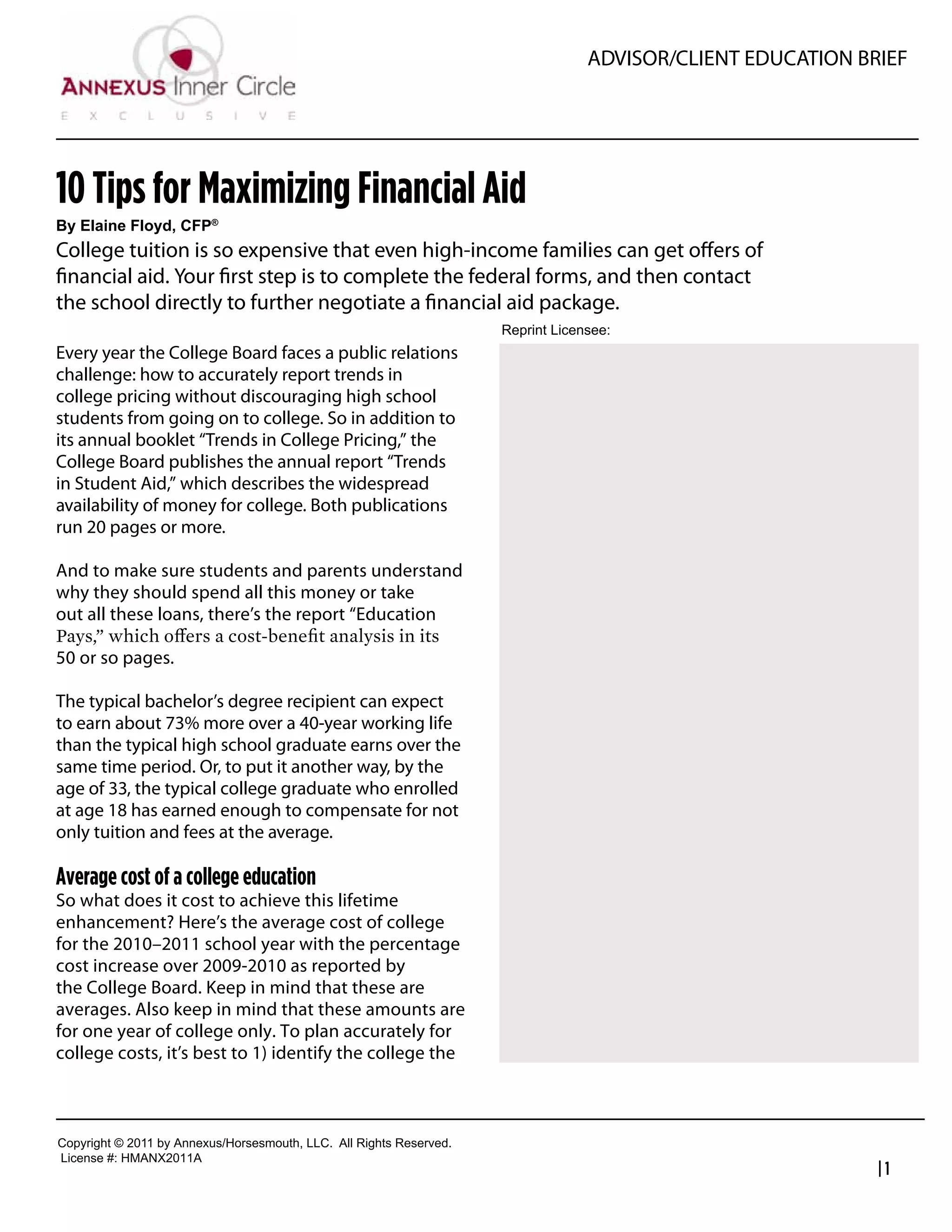
Average Cost of College for 2010-2011
                                                                 Four-Year Public         % Increase    Four-Year Private    % Increase
 T uition & fees                                                 $7,605                   + 7.9%        $27,293              + 4.5%
 T otal charges including room & board                           $16,140                  + 6.1%        $36,993              + 4.3%
Source: The College Board (www.collegeboard.org)


student is likely to attend and use those numbers;                                  2. Do it online. Because of the FAFSA’s
2) multiply the one-year cost by 4 (or even 5); and                                    complexity, it’s common for people to make
3) add an inflation factor.                                                             mistakes when filling it out. Paper applications
                                                                                       with errors or missing information will be
Applying for student aid                                                               returned for corrections; therefore, their
Your income may lead you to think it’s not worth                                       processing will be delayed. The online version of
the trouble of applying for student aid. But because                                   the form issues an alert for missing information
a greater portion of institutional grants is now                                       and even recognizes some obvious errors.
going to higher-income families, and because
                                                                                    3. Do not include exempt assets. Retirement
terms, anyone with a child enrolling in college                                        plans and home equity are exempt assets
should fill out the FAFSA (Free Application for                                         and should not be included in net worth
Federal Student Aid at www.fafsa.ed.gov).                                              information on the FAFSA.

Even parents with students who are several years                                    4. Keep all records. Make a copy of the
away from college should become familiar with                                          completed application and save it, along with
                                                                                       all records used to complete the FAFSA. Not
necessary, perhaps contributing more to retirement                                     only will this help in filing next year’s form,
plans (which are considered exempt assets) or                                          but documentation may need to be produced if
spending down UGMA/UTMA accounts so those                                              yours is one of those selected for verification.
assets won’t raise the expected family contribution                                    The U.S. Department of Education checks
(caution: UGMA assets must be spent on the child                                       FAFSA information against data from the
and may not be for necessities; summer camp, cars,                                     Social Security Administration, the Veterans
and computers are OK). Also, remember that the                                         Administration, and the Internal Revenue
FAFSA must be submitted every year that the child                                      Service. It also selects about one-third of all
is enrolled.                                                                           applications for verification.

Here are some tips for filling out the FAFSA:                                        5. Read all questions carefully. The words “you”
                                                                                       and “your” refer to the student, not the parents.
1. Do it early. At many schools financial aid is                                        Do not leave any answers blank. If the answer is
   distributed on a first-come, first-serve basis.                                       “zero” or “not applicable,” enter “0” or “N/A.”
   Although the federal deadline on the form
   is June 30, the aid deadline set by individual                                   6. Do not send letters of explanation with the
   schools could be as early as the end of February.                                   FAFSA. Although it is a good idea to make
   Deadlines for state aid also vary. And although
   it asks for the prior year tax information, which                                   circumstances, such as a job loss or reduced
   may not be in yet, financial aid counselors                                          income, such letters should be directed to
   advise using estimates or basing the figures on                                      individual schools. If they are attached to the
   last year’s tax return rather than waiting.                                         application, they will be thrown away.


     Copyright  ©  2011  by  Annexus/Horsesmouth,  LLC.    All  Rights  Reserved.
2|   License  #:  HMANX2011A
General tips on maximizing student aid                                         aren’t used to appealing for financial help, will
By perfectly matching the duration of the bond                                 probably want to participate in the student aid
Apart from the FAFSA, parents may want to                                      game rather than automatically writing checks to
contact the financial aid departments at individual                             their kid’s college.
schools to increase their chances of receiving a
favorable financial aid package.

7. Don’t discount expensive schools. Some
   families automatically cross high-tuition


     because they are often well endowed and can
     meet more of the need.

8. Reconsider early decision. Some schools
   allow students to get a jump on the application
   process if they will commit to attending if
   admitted. While this may help the student’s
   chances of getting in, it could reduce the

     student’s reduced bargaining position.

9. Ask for a review. To try to receive a better aid
   package, ask that it be reviewed. Avoid using
   the words “bargain” or “negotiate,” however;

     that position, and they especially hate having

     faces. Counselors advise thanking the school
     for its generosity and then expressing doubt
     at being able to meet the family’s expected
     contribution as a way to ask for more aid.

10. If outside scholarships come in, ask that
    loans be reduced first. Some students have
    discovered that outside scholarships from
    community organizations such as the Rotary
    Club end up going straight to the college. That’s
    because the grant portion of the aid package is
    reduced dollar for dollar by the amount of the
    scholarship. Ask that any outside scholarships be
    applied against the loan portion of the package.

The availability of student aid should not keep
parents from saving for college. But because grants
and loans are such an essential part of college
financing today, even high-income families, who


Copyright  ©  2011  by  Annexus/Horsesmouth,  LLC.    All  Rights  Reserved.
License  #:  HMANX2011A
                                                                                                                                  |3

M pruitt 10 tips for maximizing financial aid

  • 1.
    ADVISOR/CLIENT EDUCATION BRIEF 10Tips for Maximizing Financial Aid By  Elaine  Floyd,  CFP® College tuition is so expensive that even high-income families can get offers of financial aid. Your first step is to complete the federal forms, and then contact the school directly to further negotiate a financial aid package. Reprint  Licensee:   Every year the College Board faces a public relations challenge: how to accurately report trends in Mark Pruitt college pricing without discouraging high school Founder / President students from going on to college. So in addition to its annual booklet “Trends in College Pricing,” the Strategic Estate Planning Services College Board publishes the annual report “Trends 800-381-8870 in Student Aid,” which describes the widespread availability of money for college. Both publications seps4u@gmail.com run 20 pages or more. www.strategicestateplanning.com And to make sure students and parents understand why they should spend all this money or take out all these loans, there’s the report “Education 50 or so pages. The typical bachelor’s degree recipient can expect to earn about 73% more over a 40-year working life than the typical high school graduate earns over the same time period. Or, to put it another way, by the age of 33, the typical college graduate who enrolled at age 18 has earned enough to compensate for not only tuition and fees at the average. Average cost of a college education So what does it cost to achieve this lifetime enhancement? Here’s the average cost of college for the 2010–2011 school year with the percentage cost increase over 2009-2010 as reported by the College Board. Keep in mind that these are averages. Also keep in mind that these amounts are for one year of college only. To plan accurately for college costs, it’s best to 1) identify the college the Copyright  ©  2011  by  Annexus/Horsesmouth,  LLC.    All  Rights  Reserved. License  #:  HMANX2011A |1
  • 2.
    Average Cost ofCollege for 2010-2011 Four-Year Public % Increase Four-Year Private % Increase T uition & fees $7,605 + 7.9% $27,293 + 4.5% T otal charges including room & board $16,140 + 6.1% $36,993 + 4.3% Source: The College Board (www.collegeboard.org) student is likely to attend and use those numbers; 2. Do it online. Because of the FAFSA’s 2) multiply the one-year cost by 4 (or even 5); and complexity, it’s common for people to make 3) add an inflation factor. mistakes when filling it out. Paper applications with errors or missing information will be Applying for student aid returned for corrections; therefore, their Your income may lead you to think it’s not worth processing will be delayed. The online version of the trouble of applying for student aid. But because the form issues an alert for missing information a greater portion of institutional grants is now and even recognizes some obvious errors. going to higher-income families, and because 3. Do not include exempt assets. Retirement terms, anyone with a child enrolling in college plans and home equity are exempt assets should fill out the FAFSA (Free Application for and should not be included in net worth Federal Student Aid at www.fafsa.ed.gov). information on the FAFSA. Even parents with students who are several years 4. Keep all records. Make a copy of the away from college should become familiar with completed application and save it, along with all records used to complete the FAFSA. Not necessary, perhaps contributing more to retirement only will this help in filing next year’s form, plans (which are considered exempt assets) or but documentation may need to be produced if spending down UGMA/UTMA accounts so those yours is one of those selected for verification. assets won’t raise the expected family contribution The U.S. Department of Education checks (caution: UGMA assets must be spent on the child FAFSA information against data from the and may not be for necessities; summer camp, cars, Social Security Administration, the Veterans and computers are OK). Also, remember that the Administration, and the Internal Revenue FAFSA must be submitted every year that the child Service. It also selects about one-third of all is enrolled. applications for verification. Here are some tips for filling out the FAFSA: 5. Read all questions carefully. The words “you” and “your” refer to the student, not the parents. 1. Do it early. At many schools financial aid is Do not leave any answers blank. If the answer is distributed on a first-come, first-serve basis. “zero” or “not applicable,” enter “0” or “N/A.” Although the federal deadline on the form is June 30, the aid deadline set by individual 6. Do not send letters of explanation with the schools could be as early as the end of February. FAFSA. Although it is a good idea to make Deadlines for state aid also vary. And although it asks for the prior year tax information, which circumstances, such as a job loss or reduced may not be in yet, financial aid counselors income, such letters should be directed to advise using estimates or basing the figures on individual schools. If they are attached to the last year’s tax return rather than waiting. application, they will be thrown away. Copyright  ©  2011  by  Annexus/Horsesmouth,  LLC.    All  Rights  Reserved. 2| License  #:  HMANX2011A
  • 3.
    General tips onmaximizing student aid aren’t used to appealing for financial help, will By perfectly matching the duration of the bond probably want to participate in the student aid Apart from the FAFSA, parents may want to game rather than automatically writing checks to contact the financial aid departments at individual their kid’s college. schools to increase their chances of receiving a favorable financial aid package. 7. Don’t discount expensive schools. Some families automatically cross high-tuition because they are often well endowed and can meet more of the need. 8. Reconsider early decision. Some schools allow students to get a jump on the application process if they will commit to attending if admitted. While this may help the student’s chances of getting in, it could reduce the student’s reduced bargaining position. 9. Ask for a review. To try to receive a better aid package, ask that it be reviewed. Avoid using the words “bargain” or “negotiate,” however; that position, and they especially hate having faces. Counselors advise thanking the school for its generosity and then expressing doubt at being able to meet the family’s expected contribution as a way to ask for more aid. 10. If outside scholarships come in, ask that loans be reduced first. Some students have discovered that outside scholarships from community organizations such as the Rotary Club end up going straight to the college. That’s because the grant portion of the aid package is reduced dollar for dollar by the amount of the scholarship. Ask that any outside scholarships be applied against the loan portion of the package. The availability of student aid should not keep parents from saving for college. But because grants and loans are such an essential part of college financing today, even high-income families, who Copyright  ©  2011  by  Annexus/Horsesmouth,  LLC.    All  Rights  Reserved. License  #:  HMANX2011A |3