SEMINAR ON INDUSTRIAL TRAINING TOUR   JAYPEE HIMACHAL CEMENT PLANT NITIN KUMAR ABHISHEK   KATOCH BALDEV   SINGH MOHIT GULERIA ANKUL BANYAL (MECH.ENGG) PRESENTED BY
INTRODUCTION Sh. Jai Prakash Gaur ji, Chairman of the group founded the construction company in 1979 there after company made its foray into many areas of operation and came to be known as  Jaypee Group.   The motto of Jaypee Group ensures that its employees work towards achieving greater heights. Its motto is “  No Dream Too Big”
AIM & OBJECTIVE :  INDUSTRIAL TRAINING To expose student to engineering experience and knowledge, which is required in industry , where these are not taught in lectures room. To use the experienced gained from the industrial training in discussion held in the lecture rooms. To get a feel of the ‘work environment’. To gain experience in writing report in engineering works / project. To expose students to the engineer responsibilities and ethics. To expose the student to future employers. With all the experience and knowledge acquired, it is hoped at the student will able to choose appropriate work upon graduation. Industrial training also provides a systematic introduction to the ways of industry and developing talent and attitudes, so that one can understand how Human Resource Development works.  Systematic introduction to the ways of industry and developing talent and attitudes, so that he / she can enjoy fully, a career in engineering while recognizing his / her responsibilities as a professional engineer of the future.
JAYPEE   CEMENT PLANTS Jaypee group is the 3rd largest cement producer in the country. The groups cement facilities are located in the Satna Cluster (U.P), which has one of the highest cement production growth rates in India. But in Himachal only two plants are situated , one is Jaypee Himachal cement plant, BAGA. And other is Jaypee himachal cement grinding & blending unit , BAGHERI. Jaypee cement limited (JCL) was earlier a part of Jaypee industry limited (JIL) but now JCL has been merged with JIL and renamed or JAL  (Cement Division). Jaypee Rewa Plant under its fold has two plant . Plant 1 having 1MT capacity was commissioned in December 1986. Plant 2 having with a production capacity of 1.5MT was commissioned in April 1991 Keeping pace with the advancement in the IT industry, all the 140 cement dumps are networked using TDM/TDMA VSATs along with a dedicated hub to provide 24/7 connectivity between the plants and all the 120 points of cement distribution. In the near future, the group plans to expand its cement capacities via acquisition and Greenfield  addition to maximize economies of scale and build on vision to focus on large size plant from inception.
HISTORICAL DEVELOPMENT OF     CEMENT IN INDIA The Indian cement industry occupies predominant position not only as one of the basic industries for infrastructure development , but also because it is the second largest producer of cement in India.  In India , Portland cement was manufactured  first in 1904, near madras now in Chennai by  “ South Indian industry company ltd”  in a 30 ton capacity plant.  In 1936, all the existing cement companies except the  “SONE VALLEY   PORTLAND CEMENT COMPANIES LTD”.  Agreed to merge with  “ASSOCIATED CEMENT COMPANIES LTD”.(ACC).  This is the most significant event in the history of Indian cement industry. JOSEPH ASPDIN  was first manufactured Portland cement as known as today in 1824 by hitting powder chalk with clay mud of river med day.
CEMENT The word cement in its broadest sense denotes  any kind of adhesive in building and civil engineering it means a substance , which can be used to bind together the sand broken stone or aggregate into a solid mass. Cement is a crystalline compound of calcium silicates and other calcium compounds having hydraulic properties.
GEOLOGY (RAW MATERIAL)   The fundamental chemical compound to produce cement clinker are:  Lime (Ca O) Silica (SiO 2) Alumina (Al 2  O 3) Iron oxide (Fe 2 O 3 ) Raw material used in the production of clinker cement:
TYPES OF CEMENT   Two types of cement mainly used in the building industry are as follow: Hydraulic cement Non hydraulic cement
HYDRAULIC CEMENT   Hydraulic Cement sets and  hardens  by action of water. Such as Portland Cement In other words it means that hydraulic cement are: “  Any cements that turns into a solid  product in the presence of water (as well as air) resulting in a material that does not  disintegrate in water.” Most common hydraulic cement is Portland cement
NON HYDRAULIC CEMENT Any cement that does not require water to transform it into a solid product. Two common Non hydraulic Cement are:  a) Lime- derived from limestone /chalk b) Gypsum
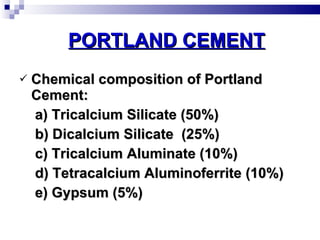
PORTLAND CEMENT Chemical composition of Portland Cement: a) Tricalcium Silicate (50%) b) Dicalcium Silicate  (25%) c) Tricalcium Aluminate (10%) d) Tetracalcium Aluminoferrite (10%) e) Gypsum (5%)
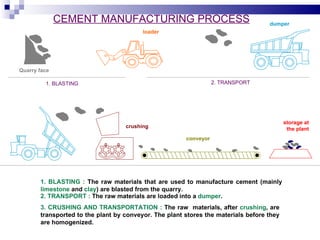
CEMENT MANUFACTURING PROCESS 1. BLASTING 2. TRANSPORT 1.  BLASTING :  The raw materials that are used to manufacture cement (mainly  limestone  and  clay ) are blasted from the quarry. 2.  TRANSPORT :  The raw materials are loaded into a  dumper . 3.  CRUSHING AND TRANSPORTATION :  The raw  materials, after  crushing , are transported to the plant by conveyor. The plant stores the materials before they are homogenized. Quarry face loader dumper crushing conveyor storage at the plant
CEMENT  MANUFACTURING  PROCESS RAW GRINDING BURNING & COOLONG 1.  RAW GRINDING :  The raw materials are very finely ground in order to produce the  raw mix .   2.  BURNING :  The raw mix is preheated before it goes into the kiln, which is heated by a flame that can be as hot as 2000 °C. The raw mix burns at 1500 °C producing  clinker  which, when it leaves the kiln, is rapidly cooled with air fans. So, the raw mix is burnt to produce clinker : the basic material needed to make cement.  storage at the plant conveyor Raw mill Raw mix preheating kiln cooling clinker
CEMENT  MANUFACTURING  PROCESS GRINDING STORAGE , PACKING , DISPATCH 1.GRINDING :  The clinker and the gypsum are  very finely   ground  giving a “pure cement”. Other  secondary additives  and  cementations  materials can also be added to make a blended cement. 2. STORAGE, PACKING, DISPATCH : The cement is stored in  silos  before being dispatched either in bulk or in bags to its final destination. clinker storage Gypsum and the secondary additives are added to the clinker . Finish grinding silos bags
FLOW SHEET OF CEMENT PROCESS
TRAINING SITE :  CEMENT PLANT
JAYPEE HIMACHAL CEMENT GRINDING & BLENDING UNIT   AT BAGHERI, (H P) After transported the clinker from Baga to this plant, we grind & blend the clinker for making cement and it has a packing plant where we pack the material and load into the truck.
JAYPEE HIMACHAL CEMENT PLANT   AT BAGA (H P)
JAYPEE HIMACHAL CEMENT PLANT BAGHERI & BAGA JAIPRAKASH ASSOCIATES LTD’s, a subsidinary of Jaypee group have established a cement plant in Himachal Pradesh on April 2009. the group have established 3 MTPA capacity plant in BAGA & BAGHERI village in the Solan district with investment of Rs 2000 crore. The state-level single window clearance and monitoring authority had cleared the project in September 2004 and with other requisite clearances and approvals, the construction of the plant was started in 2005.  The plant, having an annual capacity to produce 1.75 million tonne cement, will help in overall development of not only the region but also the entire state It has plans to raise the capacity by 1.5MTPA with an investment of Rs 700 crore by 2010. The company has installed pollution control equipments to keep emission below 50 mg/Nm 3. Jaypee group has emerged as the biggest private sector investor in Himachal Pradesh with the investment of nearly Rs 9000 crore in cement and hydro power sector. Jaypee Himachal cement grinding & blending unit, BAGHERI is the only plant have a blending unit in all over other  cement plant of Jaypee group.
PRODUCTION Three types of cement mainly produced in Jaypee Himachal cement grinding & blending unit in Bagheri : 1 .  ORDINARY PORTLAND CEMENT (OPC 43 Grade) 2.  ORDINARY PORTLAND CEMENT (OPC 53 Grade) 3.  POZZOLANE PORTLAND CEMENT  Continue
PORTLAND CEMENT POZZOLANE ORDINARY ORDINARY PORTLAND CEMENT   CLINKER  +  GYPSUM  (3%) POZZOLANE PORTLAND CEMENT CLINKER  +  GYPSUM(3%)  +  FLYASH(35%)
RAW MATERIAL : FOR MAKING CEMENT IN JAYPEE PLANT CLINKER COAL SHALE LIMESTONE LATERITE Continue
CEMENT CLINKER GYPSUM FLYASH
RAW MATERIAL FOR CEMENT Limestone is calcareous sedimentary rocks formed at the bottom of lakes and seas with the accumulation of shells, bones and other calcium rich goods. It is composed of calcite (CaCO3).  Physical Properties of Limestone Hardness 3 to 4 on Moh's Scale Density 2.5 to 2.65 Kg/m3 Compressive Strength 1800 to 2100 Kg/cm2 Water Absorption Less than 1% Porosity Quite low Weather Impact Resistant Chemical Properties of Limestone Lime (CaO) 38-42% Silica (SiO2) 20-25% Alumina (Al2O3) 2-4% Other Oxides like Na, Mg 1.5 to 2.5% Loss On Ignition (LOI) 30-32%  Uses of Limestone Flooring Wall cladding Vanity tops Furniture Cement Production Refining Metals Blackboard chalk Ocurrances of Limestone Texas Lampasas River area India Khasi, Jayantia and Garo Hills of Meghalaya, Satna limstone belt, Madhya Pradesh. LIMESTONE
GYPSUM  Gypsum is a very soft mineral composed of calcium sulfate dihydrate, with the chemical formula CaSO4·2H2O. Gypsum is a common mineral, with thick and extensive evaporite beds in association with sedimentary rocks  Gypsum is also formed as a by-product of sulfide oxidation, amongst others by pyrite oxidation, when the sulfuric acid generated reacts with calcium carbonate.
SHALE Shale  is a fine-grained, elastic sedimentary rock composed of mud that is a mix of flakes of clay minerals and tiny fragments (silt-sized particles) of other minerals, especially quartz and calcite. The ratio of clay to other minerals is variable. Shale is characterized by breaks along thin laminae or parallel layering or bedding less than one centimeter in thickness, called fissility. Mudstones, on the other hand, are similar in composition but do not show the fissility.  Shales are typically composed of variable amounts of clay minerals and quartz grains and the typical color is gray.
CLINKER Cement clinkers are formed by the heat processing of cement elements in a kiln. Limestone, clay, bauxite, and iron ore sand in specific proportions are heated in a rotating kiln at 2,770° Fahrenheit (1,400° Celsius) until they begin to form cinder lumps, which are also known as cement clinkers. Cement clinkers are usually ground with gypsum to produce the fine powder later mixed with liquid to produce cement, although some manufacturers ship cement clinkers in their lump form to cut down on dust. When the cement clinkers are ground with approximately 5% gypsum, they form Portland cement. These compounds allow cement to set when combined with water and to form strong bonds that can withstand pressure, water immersion, and other elements .
FLYASH Fly ash, also known as Pulverized Fuel Ash (PFA), is an industrial ash created when coal is burned to create electrical power.   Fly ash, which is largely made up of silicon dioxide and calcium oxide, can be used as a substitute for Portland cement, or as a supplement to it. The materials which make up fly ash are pozzolanic, meaning that they can be used to bind — or cement — materials together. Pozzolanic materials, including fly ash cement, add durability and strength to concrete  Fly ash cement is also known as green concrete. It binds the toxic chemicals that are present in the fly ash in a way that should prevent them from contaminating natural resources. Using fly ash cement in place of or in addition to Portland cement uses less energy, requires less invasive mining, and reduces both resource consumption and CO2 emissions.
MANUFACTURING PROCESS   JAYPEE CEMENT The process is divided into four main section in Jaypee cement plant at Bagheri as under categorized : #   RAW MATRERIAL HANDLING #  ROLL PRESS & CEMENT MILL #  FLYASH SEPERATION SYSTEM #  PACKING PLANT
 
MANUFACTURING PROCESS   JAYPEE CEMENT MINING The cement manufacturing process starts from the mining of limestone, which is the main raw material for making cement. Limestone is excavated from open cast mines after drilling and blasting and loaded on to dumpers which transport the material and unload into hoppers of the limestone crushers. CRUSHING STACKING & RECLAIMING   The LS Crushers crush the limestone to minus 80 mm size and discharge the material onto a belt conveyor which takes it to the stacker via the Bulk material analyser. The material is stacked in longitudinal stockpiles. Limestone is extracted transversely from the stockpiles by the reclaimers and conveyed to the Raw Mill hoppers for grinding of raw meal.
CRUSHING STACKING & RECLAIMING OF COAL  The process of making cement clinker requires heat. Coal is used as the fuel for providing heat. Raw Coal received from the collieries is stored in a coal yard. Raw Coal is dropped on a belt conveyor from a hopper and is taken to and crushed in a crusher. Crushed coal discharged from the Coal Crusher is stored in a longitudinal stockpile from where it is reclaimed by a reclaimer and taken to the coal mill hoppers for grinding of fine coal. RAW MEAL DRYING/ GRINDING & HOMOGENISATION Reclaimed limestone along with some laterite stored in their respective hoppers is fed to the Raw Mill for fine grinding. The hot gasses coming from the clinkerisation section are used in the raw mill for drying and transport of the ground raw meal to the Electrostatic Precipitator / Bag House, where it is collected and then stored and homogenised in the concrete silo. Raw Meal extracted from the silo (now called Kiln feed) is fed to the top of the preheater for pyroprocessing.
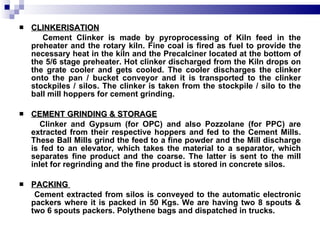
CLINKERISATION Cement Clinker is made by pyroprocessing of Kiln feed in the preheater and the rotary kiln. Fine coal is fired as fuel to provide the necessary heat in the kiln and the Precalciner located at the bottom of the 5/6 stage preheater. Hot clinker discharged from the Kiln drops on the grate cooler and gets cooled. The cooler discharges the clinker onto the pan / bucket conveyor and it is transported to the clinker stockpiles / silos. The clinker is taken from the stockpile / silo to the ball mill hoppers for cement grinding.  CEMENT GRINDING & STORAGE Clinker and Gypsum (for OPC) and also Pozzolane (for PPC) are extracted from their respective hoppers and fed to the Cement Mills. These Ball Mills grind the feed to a fine powder and the Mill discharge is fed to an elevator, which takes the material to a separator, which separates fine product and the coarse. The latter is sent to the mill inlet for regrinding and the fine product is stored in concrete silos.  PACKING  Cement extracted from silos is conveyed to the automatic electronic packers where it is packed in 50 Kgs. We are having two 8 spouts & two 6 spouts packers. Polythene bags and dispatched in trucks.
CEMENT BRANDS :  JAYPEE CEMENT Jaypee produces a wide variety of cements, which are specifically designed to cater to the customer’s requirements for different types of cements in each of its markets. All the brands, which the Company produces, are so evolved in their characteristics and properties that they will surpass BIS Standards. For each brand, the relevant BIS standards are mentioned in enclosed table along with a comparison with the BIS requirement. All brands are marketed in attractive HDPE bags, containing 50 Kgs of quality cement from Jaypee. Bags are identified with a conspicuous Jaypee Logo, which also over the years has come to be regarded as a “Hallmark” of quality. Jaypee produces & markets both Portland Pozzolana Cement (PPC)  & all grades of Ordinary Portland Cement (OPC)
CEMENT BRAND : JAYPEE CEMENT(OPC-43 GRADE) Jaypee Cement (OPC-43 Grade) is produced from enriched limestone most suited to make high quality clinker, which on grinding gives a cement with characteristics surpassing those specified in Indian Standards. Jaypee Cement (OPC-43 Grade) is available in 50 Kgs HDPE bags of a distinctive design and cover.  Jaypee Cement (OPC-43 Grade), has emerged as the top choice of Engineers and Engineering Companies engaged in construction of mega projects – such as National Highways, Bridges, Transmission lines, power plants, Industrial and Residential structures.
 
CEMENT BRANDS JAYPEE CEMENT(OPC-53 GRADE)  Jaypee Cement (OPC-53 Grade), because of its fine nature, good particle size distribution, optimal phase composition, imparts the properties of higher strength to the structures. The Chemical & Physical properties of Jaypee Cement (OPC-53 Grade) surpasses the properties of OPC 53 grade as defined in IS. OPC-53 Grade has been the mainstay for fast paced construction of high strength, heavy load bearing Structures viz., Bridges, prestressed elements, penstocks, precast elements etc. requiring very high strength to negotiate the heavy static & dynamic loads.
 
CEMENT BRANDS :  JAYPEE CEMENT(PPC) Jaypee Cement (PPC) is a market leader among all blended/composite cements in the markets of U.P, Bihar, M.P., Punjab, Haryana, Delhi & Nepal.  Fine particles of Jaypee Cement (PPC) when mixed with water readily form a smooth paste, which results in a smooth surface. When used with sand and aggregates it yields a very strong & durable concrete.  Jaypee Cement (PPC) helps to produce more cohesive concrete and mortar which is also less prone to segregation and bleeding. Due to this quality, Jaypee Cement (PPC) is suitable for any type of structural application.  *(Curing is done as per specified norms) Jaypee Cement (PPC) is being used for a number of applications like housing, commercial complexes, roads, wells, canals, dams etc. which establishes Jaypee Cement (PPC) as the preferred choice of the discerning customer. It is particularly well suited for the tropical climatic conditions of India
 
QUALITIES OF  JAYPEE CEMENT(PPC) Better workability due to spherical shape of flyash particles and better slump retention. Better pump ability – provides more cohesive concrete and mortar. Superfine particles provide great finish to the structure. Provides un-segregated concrete of better integrity. Low heat of hydration. Reduced shrinkage and swelling. Better pore refinement, reduced permeability. Better resistance to chloride and sulphate attack Better resistance to alkali-silica reaction. Resistance to corrosive attack on steel reinforcement. Reduced lime leaching. High compressive strength. High modulus of elasticity especially at later ages. Improved bondage of concrete to steel. Long term strength gain.
PERFORMANCE RECORD
DATA ON AMBIENT AIR QUALITY AND CRITICAL POLLUTANTS
 
ACHIEVEMENTS OF JAYPEE CEMENT DIVISION YEAR  2005 FIMI’s Environment Award “Abheraj Baldota Environment Award” for Naubasta Limestone Mine. Award Presented by Indian Bureau of Mines During Mines Environment & Mineral Conservation Week (Jabalpur Region) to Jaypee Rewa Plant for Overall Performance, Afforestation and Water Quality Management. YEAR  2006 National Energy Conservation Award 2005, for cement sector conferred by  Govt. of India, Ministry of Power. YEAR  2007   FLS (F.L. Smidth) Energy Award 2007 for Maximum percentage reduction in Thermal Energy (Kcal) consumption  per kg of Clinker production over year 2005-06 (Jaypee Rewa Plant) & Minimum % of Auxiliary power consumption with respect to Thermal power generation (Jaypee Bela Unit, Captive Power Plant, 2005-06). Award for Management of Sub- Grade Mineral received by Jaypee Limestone Mine of Jaiprakash Associates Limited during Mines Environment & Mineral Conservation Week Continue
YEAR  2008 Award presented for Overall Performance, 'Use of Explosives & Dust Suppression and Safety Education during Metalliferous Mines Safety Week Celebration Jabalpur Region.  Naubasta Limestone Mine of Jaiprakash Associates Limited. National Safety Award for the year 2006 to Jaypee Rewa Plant for longest Accident Free Period. YEAR  2009 Jaypee Rewa Plant, Jaypeenagar and Jaypee Bela Plant, Jaypeepuram (Both Units of Jaiprakash Associates Limited) were awarded Five Star Rating by the British Safety Council, London, U.K. for Health and Safety Management System. YEAR  2010 Indian Economic Development and Research Association National Award for outstanding contribution in the field of mining by Jaiprakash Associated Limited. NSCI Safety Award, Presented by National Safety Council for the Overall Performance of  the Cement division of Jaiprakash Associates Limited.
CONCLUSION I have learned how science and engineering can interact in useful ways and how remarkable training can occur even when it is profit driven at jaypee group while deadlines and budgets are important , creativity is not limited and true innovation occurs. I was enough lucky to work with a group of enthusiastic and communicative people, who for whatever reason share enjoying what they are doing , the atmosphere at jaypee group is unique and hope that it stays that way. It has been a unique opportunity and one that I will not soon forget; I am looking forward to continuing work there as a thesis student. My time there has been eye opening and I thoroughly recommend the experience to any other student who is thinking of applying.
 

C:\fakepath\industrial training cement

  • 1.
    SEMINAR ON INDUSTRIALTRAINING TOUR JAYPEE HIMACHAL CEMENT PLANT NITIN KUMAR ABHISHEK KATOCH BALDEV SINGH MOHIT GULERIA ANKUL BANYAL (MECH.ENGG) PRESENTED BY
  • 2.
    INTRODUCTION Sh. JaiPrakash Gaur ji, Chairman of the group founded the construction company in 1979 there after company made its foray into many areas of operation and came to be known as Jaypee Group. The motto of Jaypee Group ensures that its employees work towards achieving greater heights. Its motto is “ No Dream Too Big”
  • 3.
    AIM & OBJECTIVE: INDUSTRIAL TRAINING To expose student to engineering experience and knowledge, which is required in industry , where these are not taught in lectures room. To use the experienced gained from the industrial training in discussion held in the lecture rooms. To get a feel of the ‘work environment’. To gain experience in writing report in engineering works / project. To expose students to the engineer responsibilities and ethics. To expose the student to future employers. With all the experience and knowledge acquired, it is hoped at the student will able to choose appropriate work upon graduation. Industrial training also provides a systematic introduction to the ways of industry and developing talent and attitudes, so that one can understand how Human Resource Development works. Systematic introduction to the ways of industry and developing talent and attitudes, so that he / she can enjoy fully, a career in engineering while recognizing his / her responsibilities as a professional engineer of the future.
  • 4.
    JAYPEE CEMENT PLANTS Jaypee group is the 3rd largest cement producer in the country. The groups cement facilities are located in the Satna Cluster (U.P), which has one of the highest cement production growth rates in India. But in Himachal only two plants are situated , one is Jaypee Himachal cement plant, BAGA. And other is Jaypee himachal cement grinding & blending unit , BAGHERI. Jaypee cement limited (JCL) was earlier a part of Jaypee industry limited (JIL) but now JCL has been merged with JIL and renamed or JAL (Cement Division). Jaypee Rewa Plant under its fold has two plant . Plant 1 having 1MT capacity was commissioned in December 1986. Plant 2 having with a production capacity of 1.5MT was commissioned in April 1991 Keeping pace with the advancement in the IT industry, all the 140 cement dumps are networked using TDM/TDMA VSATs along with a dedicated hub to provide 24/7 connectivity between the plants and all the 120 points of cement distribution. In the near future, the group plans to expand its cement capacities via acquisition and Greenfield addition to maximize economies of scale and build on vision to focus on large size plant from inception.
  • 5.
    HISTORICAL DEVELOPMENT OF CEMENT IN INDIA The Indian cement industry occupies predominant position not only as one of the basic industries for infrastructure development , but also because it is the second largest producer of cement in India. In India , Portland cement was manufactured first in 1904, near madras now in Chennai by “ South Indian industry company ltd” in a 30 ton capacity plant. In 1936, all the existing cement companies except the “SONE VALLEY PORTLAND CEMENT COMPANIES LTD”. Agreed to merge with “ASSOCIATED CEMENT COMPANIES LTD”.(ACC). This is the most significant event in the history of Indian cement industry. JOSEPH ASPDIN was first manufactured Portland cement as known as today in 1824 by hitting powder chalk with clay mud of river med day.
  • 6.
    CEMENT The wordcement in its broadest sense denotes any kind of adhesive in building and civil engineering it means a substance , which can be used to bind together the sand broken stone or aggregate into a solid mass. Cement is a crystalline compound of calcium silicates and other calcium compounds having hydraulic properties.
  • 7.
    GEOLOGY (RAW MATERIAL) The fundamental chemical compound to produce cement clinker are: Lime (Ca O) Silica (SiO 2) Alumina (Al 2 O 3) Iron oxide (Fe 2 O 3 ) Raw material used in the production of clinker cement:
  • 8.
    TYPES OF CEMENT Two types of cement mainly used in the building industry are as follow: Hydraulic cement Non hydraulic cement
  • 9.
    HYDRAULIC CEMENT Hydraulic Cement sets and hardens by action of water. Such as Portland Cement In other words it means that hydraulic cement are: “ Any cements that turns into a solid product in the presence of water (as well as air) resulting in a material that does not disintegrate in water.” Most common hydraulic cement is Portland cement
  • 10.
    NON HYDRAULIC CEMENTAny cement that does not require water to transform it into a solid product. Two common Non hydraulic Cement are: a) Lime- derived from limestone /chalk b) Gypsum
  • 11.
    PORTLAND CEMENT Chemicalcomposition of Portland Cement: a) Tricalcium Silicate (50%) b) Dicalcium Silicate (25%) c) Tricalcium Aluminate (10%) d) Tetracalcium Aluminoferrite (10%) e) Gypsum (5%)
  • 12.
    CEMENT MANUFACTURING PROCESS1. BLASTING 2. TRANSPORT 1. BLASTING : The raw materials that are used to manufacture cement (mainly limestone and clay ) are blasted from the quarry. 2. TRANSPORT : The raw materials are loaded into a dumper . 3. CRUSHING AND TRANSPORTATION : The raw materials, after crushing , are transported to the plant by conveyor. The plant stores the materials before they are homogenized. Quarry face loader dumper crushing conveyor storage at the plant
  • 13.
    CEMENT MANUFACTURING PROCESS RAW GRINDING BURNING & COOLONG 1. RAW GRINDING : The raw materials are very finely ground in order to produce the raw mix . 2. BURNING : The raw mix is preheated before it goes into the kiln, which is heated by a flame that can be as hot as 2000 °C. The raw mix burns at 1500 °C producing clinker which, when it leaves the kiln, is rapidly cooled with air fans. So, the raw mix is burnt to produce clinker : the basic material needed to make cement. storage at the plant conveyor Raw mill Raw mix preheating kiln cooling clinker
  • 14.
    CEMENT MANUFACTURING PROCESS GRINDING STORAGE , PACKING , DISPATCH 1.GRINDING : The clinker and the gypsum are very finely ground giving a “pure cement”. Other secondary additives and cementations materials can also be added to make a blended cement. 2. STORAGE, PACKING, DISPATCH : The cement is stored in silos before being dispatched either in bulk or in bags to its final destination. clinker storage Gypsum and the secondary additives are added to the clinker . Finish grinding silos bags
  • 15.
    FLOW SHEET OFCEMENT PROCESS
  • 16.
    TRAINING SITE : CEMENT PLANT
  • 17.
    JAYPEE HIMACHAL CEMENTGRINDING & BLENDING UNIT AT BAGHERI, (H P) After transported the clinker from Baga to this plant, we grind & blend the clinker for making cement and it has a packing plant where we pack the material and load into the truck.
  • 18.
    JAYPEE HIMACHAL CEMENTPLANT AT BAGA (H P)
  • 19.
    JAYPEE HIMACHAL CEMENTPLANT BAGHERI & BAGA JAIPRAKASH ASSOCIATES LTD’s, a subsidinary of Jaypee group have established a cement plant in Himachal Pradesh on April 2009. the group have established 3 MTPA capacity plant in BAGA & BAGHERI village in the Solan district with investment of Rs 2000 crore. The state-level single window clearance and monitoring authority had cleared the project in September 2004 and with other requisite clearances and approvals, the construction of the plant was started in 2005. The plant, having an annual capacity to produce 1.75 million tonne cement, will help in overall development of not only the region but also the entire state It has plans to raise the capacity by 1.5MTPA with an investment of Rs 700 crore by 2010. The company has installed pollution control equipments to keep emission below 50 mg/Nm 3. Jaypee group has emerged as the biggest private sector investor in Himachal Pradesh with the investment of nearly Rs 9000 crore in cement and hydro power sector. Jaypee Himachal cement grinding & blending unit, BAGHERI is the only plant have a blending unit in all over other cement plant of Jaypee group.
  • 20.
    PRODUCTION Three typesof cement mainly produced in Jaypee Himachal cement grinding & blending unit in Bagheri : 1 . ORDINARY PORTLAND CEMENT (OPC 43 Grade) 2. ORDINARY PORTLAND CEMENT (OPC 53 Grade) 3. POZZOLANE PORTLAND CEMENT Continue
  • 21.
    PORTLAND CEMENT POZZOLANEORDINARY ORDINARY PORTLAND CEMENT CLINKER + GYPSUM (3%) POZZOLANE PORTLAND CEMENT CLINKER + GYPSUM(3%) + FLYASH(35%)
  • 22.
    RAW MATERIAL :FOR MAKING CEMENT IN JAYPEE PLANT CLINKER COAL SHALE LIMESTONE LATERITE Continue
  • 23.
  • 24.
    RAW MATERIAL FORCEMENT Limestone is calcareous sedimentary rocks formed at the bottom of lakes and seas with the accumulation of shells, bones and other calcium rich goods. It is composed of calcite (CaCO3). Physical Properties of Limestone Hardness 3 to 4 on Moh's Scale Density 2.5 to 2.65 Kg/m3 Compressive Strength 1800 to 2100 Kg/cm2 Water Absorption Less than 1% Porosity Quite low Weather Impact Resistant Chemical Properties of Limestone Lime (CaO) 38-42% Silica (SiO2) 20-25% Alumina (Al2O3) 2-4% Other Oxides like Na, Mg 1.5 to 2.5% Loss On Ignition (LOI) 30-32% Uses of Limestone Flooring Wall cladding Vanity tops Furniture Cement Production Refining Metals Blackboard chalk Ocurrances of Limestone Texas Lampasas River area India Khasi, Jayantia and Garo Hills of Meghalaya, Satna limstone belt, Madhya Pradesh. LIMESTONE
  • 25.
    GYPSUM Gypsumis a very soft mineral composed of calcium sulfate dihydrate, with the chemical formula CaSO4·2H2O. Gypsum is a common mineral, with thick and extensive evaporite beds in association with sedimentary rocks Gypsum is also formed as a by-product of sulfide oxidation, amongst others by pyrite oxidation, when the sulfuric acid generated reacts with calcium carbonate.
  • 26.
    SHALE Shale is a fine-grained, elastic sedimentary rock composed of mud that is a mix of flakes of clay minerals and tiny fragments (silt-sized particles) of other minerals, especially quartz and calcite. The ratio of clay to other minerals is variable. Shale is characterized by breaks along thin laminae or parallel layering or bedding less than one centimeter in thickness, called fissility. Mudstones, on the other hand, are similar in composition but do not show the fissility. Shales are typically composed of variable amounts of clay minerals and quartz grains and the typical color is gray.
  • 27.
    CLINKER Cement clinkersare formed by the heat processing of cement elements in a kiln. Limestone, clay, bauxite, and iron ore sand in specific proportions are heated in a rotating kiln at 2,770° Fahrenheit (1,400° Celsius) until they begin to form cinder lumps, which are also known as cement clinkers. Cement clinkers are usually ground with gypsum to produce the fine powder later mixed with liquid to produce cement, although some manufacturers ship cement clinkers in their lump form to cut down on dust. When the cement clinkers are ground with approximately 5% gypsum, they form Portland cement. These compounds allow cement to set when combined with water and to form strong bonds that can withstand pressure, water immersion, and other elements .
  • 28.
    FLYASH Fly ash,also known as Pulverized Fuel Ash (PFA), is an industrial ash created when coal is burned to create electrical power. Fly ash, which is largely made up of silicon dioxide and calcium oxide, can be used as a substitute for Portland cement, or as a supplement to it. The materials which make up fly ash are pozzolanic, meaning that they can be used to bind — or cement — materials together. Pozzolanic materials, including fly ash cement, add durability and strength to concrete Fly ash cement is also known as green concrete. It binds the toxic chemicals that are present in the fly ash in a way that should prevent them from contaminating natural resources. Using fly ash cement in place of or in addition to Portland cement uses less energy, requires less invasive mining, and reduces both resource consumption and CO2 emissions.
  • 29.
    MANUFACTURING PROCESS JAYPEE CEMENT The process is divided into four main section in Jaypee cement plant at Bagheri as under categorized : # RAW MATRERIAL HANDLING # ROLL PRESS & CEMENT MILL # FLYASH SEPERATION SYSTEM # PACKING PLANT
  • 30.
  • 31.
    MANUFACTURING PROCESS JAYPEE CEMENT MINING The cement manufacturing process starts from the mining of limestone, which is the main raw material for making cement. Limestone is excavated from open cast mines after drilling and blasting and loaded on to dumpers which transport the material and unload into hoppers of the limestone crushers. CRUSHING STACKING & RECLAIMING The LS Crushers crush the limestone to minus 80 mm size and discharge the material onto a belt conveyor which takes it to the stacker via the Bulk material analyser. The material is stacked in longitudinal stockpiles. Limestone is extracted transversely from the stockpiles by the reclaimers and conveyed to the Raw Mill hoppers for grinding of raw meal.
  • 32.
    CRUSHING STACKING &RECLAIMING OF COAL The process of making cement clinker requires heat. Coal is used as the fuel for providing heat. Raw Coal received from the collieries is stored in a coal yard. Raw Coal is dropped on a belt conveyor from a hopper and is taken to and crushed in a crusher. Crushed coal discharged from the Coal Crusher is stored in a longitudinal stockpile from where it is reclaimed by a reclaimer and taken to the coal mill hoppers for grinding of fine coal. RAW MEAL DRYING/ GRINDING & HOMOGENISATION Reclaimed limestone along with some laterite stored in their respective hoppers is fed to the Raw Mill for fine grinding. The hot gasses coming from the clinkerisation section are used in the raw mill for drying and transport of the ground raw meal to the Electrostatic Precipitator / Bag House, where it is collected and then stored and homogenised in the concrete silo. Raw Meal extracted from the silo (now called Kiln feed) is fed to the top of the preheater for pyroprocessing.
  • 33.
    CLINKERISATION Cement Clinkeris made by pyroprocessing of Kiln feed in the preheater and the rotary kiln. Fine coal is fired as fuel to provide the necessary heat in the kiln and the Precalciner located at the bottom of the 5/6 stage preheater. Hot clinker discharged from the Kiln drops on the grate cooler and gets cooled. The cooler discharges the clinker onto the pan / bucket conveyor and it is transported to the clinker stockpiles / silos. The clinker is taken from the stockpile / silo to the ball mill hoppers for cement grinding. CEMENT GRINDING & STORAGE Clinker and Gypsum (for OPC) and also Pozzolane (for PPC) are extracted from their respective hoppers and fed to the Cement Mills. These Ball Mills grind the feed to a fine powder and the Mill discharge is fed to an elevator, which takes the material to a separator, which separates fine product and the coarse. The latter is sent to the mill inlet for regrinding and the fine product is stored in concrete silos. PACKING Cement extracted from silos is conveyed to the automatic electronic packers where it is packed in 50 Kgs. We are having two 8 spouts & two 6 spouts packers. Polythene bags and dispatched in trucks.
  • 34.
    CEMENT BRANDS : JAYPEE CEMENT Jaypee produces a wide variety of cements, which are specifically designed to cater to the customer’s requirements for different types of cements in each of its markets. All the brands, which the Company produces, are so evolved in their characteristics and properties that they will surpass BIS Standards. For each brand, the relevant BIS standards are mentioned in enclosed table along with a comparison with the BIS requirement. All brands are marketed in attractive HDPE bags, containing 50 Kgs of quality cement from Jaypee. Bags are identified with a conspicuous Jaypee Logo, which also over the years has come to be regarded as a “Hallmark” of quality. Jaypee produces & markets both Portland Pozzolana Cement (PPC) & all grades of Ordinary Portland Cement (OPC)
  • 35.
    CEMENT BRAND :JAYPEE CEMENT(OPC-43 GRADE) Jaypee Cement (OPC-43 Grade) is produced from enriched limestone most suited to make high quality clinker, which on grinding gives a cement with characteristics surpassing those specified in Indian Standards. Jaypee Cement (OPC-43 Grade) is available in 50 Kgs HDPE bags of a distinctive design and cover.  Jaypee Cement (OPC-43 Grade), has emerged as the top choice of Engineers and Engineering Companies engaged in construction of mega projects – such as National Highways, Bridges, Transmission lines, power plants, Industrial and Residential structures.
  • 36.
  • 37.
    CEMENT BRANDS JAYPEECEMENT(OPC-53 GRADE) Jaypee Cement (OPC-53 Grade), because of its fine nature, good particle size distribution, optimal phase composition, imparts the properties of higher strength to the structures. The Chemical & Physical properties of Jaypee Cement (OPC-53 Grade) surpasses the properties of OPC 53 grade as defined in IS. OPC-53 Grade has been the mainstay for fast paced construction of high strength, heavy load bearing Structures viz., Bridges, prestressed elements, penstocks, precast elements etc. requiring very high strength to negotiate the heavy static & dynamic loads.
  • 38.
  • 39.
    CEMENT BRANDS : JAYPEE CEMENT(PPC) Jaypee Cement (PPC) is a market leader among all blended/composite cements in the markets of U.P, Bihar, M.P., Punjab, Haryana, Delhi & Nepal. Fine particles of Jaypee Cement (PPC) when mixed with water readily form a smooth paste, which results in a smooth surface. When used with sand and aggregates it yields a very strong & durable concrete. Jaypee Cement (PPC) helps to produce more cohesive concrete and mortar which is also less prone to segregation and bleeding. Due to this quality, Jaypee Cement (PPC) is suitable for any type of structural application. *(Curing is done as per specified norms) Jaypee Cement (PPC) is being used for a number of applications like housing, commercial complexes, roads, wells, canals, dams etc. which establishes Jaypee Cement (PPC) as the preferred choice of the discerning customer. It is particularly well suited for the tropical climatic conditions of India
  • 40.
  • 41.
    QUALITIES OF JAYPEE CEMENT(PPC) Better workability due to spherical shape of flyash particles and better slump retention. Better pump ability – provides more cohesive concrete and mortar. Superfine particles provide great finish to the structure. Provides un-segregated concrete of better integrity. Low heat of hydration. Reduced shrinkage and swelling. Better pore refinement, reduced permeability. Better resistance to chloride and sulphate attack Better resistance to alkali-silica reaction. Resistance to corrosive attack on steel reinforcement. Reduced lime leaching. High compressive strength. High modulus of elasticity especially at later ages. Improved bondage of concrete to steel. Long term strength gain.
  • 42.
  • 43.
    DATA ON AMBIENTAIR QUALITY AND CRITICAL POLLUTANTS
  • 44.
  • 45.
    ACHIEVEMENTS OF JAYPEECEMENT DIVISION YEAR 2005 FIMI’s Environment Award “Abheraj Baldota Environment Award” for Naubasta Limestone Mine. Award Presented by Indian Bureau of Mines During Mines Environment & Mineral Conservation Week (Jabalpur Region) to Jaypee Rewa Plant for Overall Performance, Afforestation and Water Quality Management. YEAR 2006 National Energy Conservation Award 2005, for cement sector conferred by Govt. of India, Ministry of Power. YEAR 2007   FLS (F.L. Smidth) Energy Award 2007 for Maximum percentage reduction in Thermal Energy (Kcal) consumption  per kg of Clinker production over year 2005-06 (Jaypee Rewa Plant) & Minimum % of Auxiliary power consumption with respect to Thermal power generation (Jaypee Bela Unit, Captive Power Plant, 2005-06). Award for Management of Sub- Grade Mineral received by Jaypee Limestone Mine of Jaiprakash Associates Limited during Mines Environment & Mineral Conservation Week Continue
  • 46.
    YEAR 2008Award presented for Overall Performance, 'Use of Explosives & Dust Suppression and Safety Education during Metalliferous Mines Safety Week Celebration Jabalpur Region. Naubasta Limestone Mine of Jaiprakash Associates Limited. National Safety Award for the year 2006 to Jaypee Rewa Plant for longest Accident Free Period. YEAR 2009 Jaypee Rewa Plant, Jaypeenagar and Jaypee Bela Plant, Jaypeepuram (Both Units of Jaiprakash Associates Limited) were awarded Five Star Rating by the British Safety Council, London, U.K. for Health and Safety Management System. YEAR 2010 Indian Economic Development and Research Association National Award for outstanding contribution in the field of mining by Jaiprakash Associated Limited. NSCI Safety Award, Presented by National Safety Council for the Overall Performance of the Cement division of Jaiprakash Associates Limited.
  • 47.
    CONCLUSION I havelearned how science and engineering can interact in useful ways and how remarkable training can occur even when it is profit driven at jaypee group while deadlines and budgets are important , creativity is not limited and true innovation occurs. I was enough lucky to work with a group of enthusiastic and communicative people, who for whatever reason share enjoying what they are doing , the atmosphere at jaypee group is unique and hope that it stays that way. It has been a unique opportunity and one that I will not soon forget; I am looking forward to continuing work there as a thesis student. My time there has been eye opening and I thoroughly recommend the experience to any other student who is thinking of applying.
  • 48.