June 2012  Correctional Forum


   Correctional Forum
                                                                                                              June 2012


    A Publication of the Pennsylvania Prison Society
Promoting a humane, just and constructive correctional system and a rational approach to criminal justice since 1787


Over 95,000 Children                          in    Pennsylvania               have a       Parent         in   Prison
New report includes the effects on children, recommended actions

by Bridget Fifer

   “This last December 31, I asked the     cial proceedings, care-giving shortcom- barrassment, to the shame….” More
inmates at the county jail how many        ings, and lack of contact with incarcer-     severe cases of neglect after a parent’s
of them had children, and 90 per-          ated parents, children across the nation arrest were mentioned in the report,
cent of them raised their hands. My        are experiencing                                                  such as “a child as
next question was, ‘Who was raising        trauma, fear, isola-                                              young as six years
their children?’” Philadelphia Mayor       tion, and neglect.                                                old who was sim-
Michael Nutter’s question leads to the     An example is                                                     ply left behind in
broader question of how the estimated      Miss America,                                                     the apartment…
95,000 children in Pennsylvania with       Laura Kaeppeler,                                                  without making
incarcerated parents are affected by       who experienced                                                   arrangements for
their situation.                           firsthand what                                                    him and his baby
                                           it’s like to have an                                              brother (the boy
   A new report entitled, “The             incarcerated par-                                                 tried to take care
Effects of Parental Incarceration on       ent and describes                                                 of himself and
Children: Needs and Responsive             the emotional                                                     his baby brother
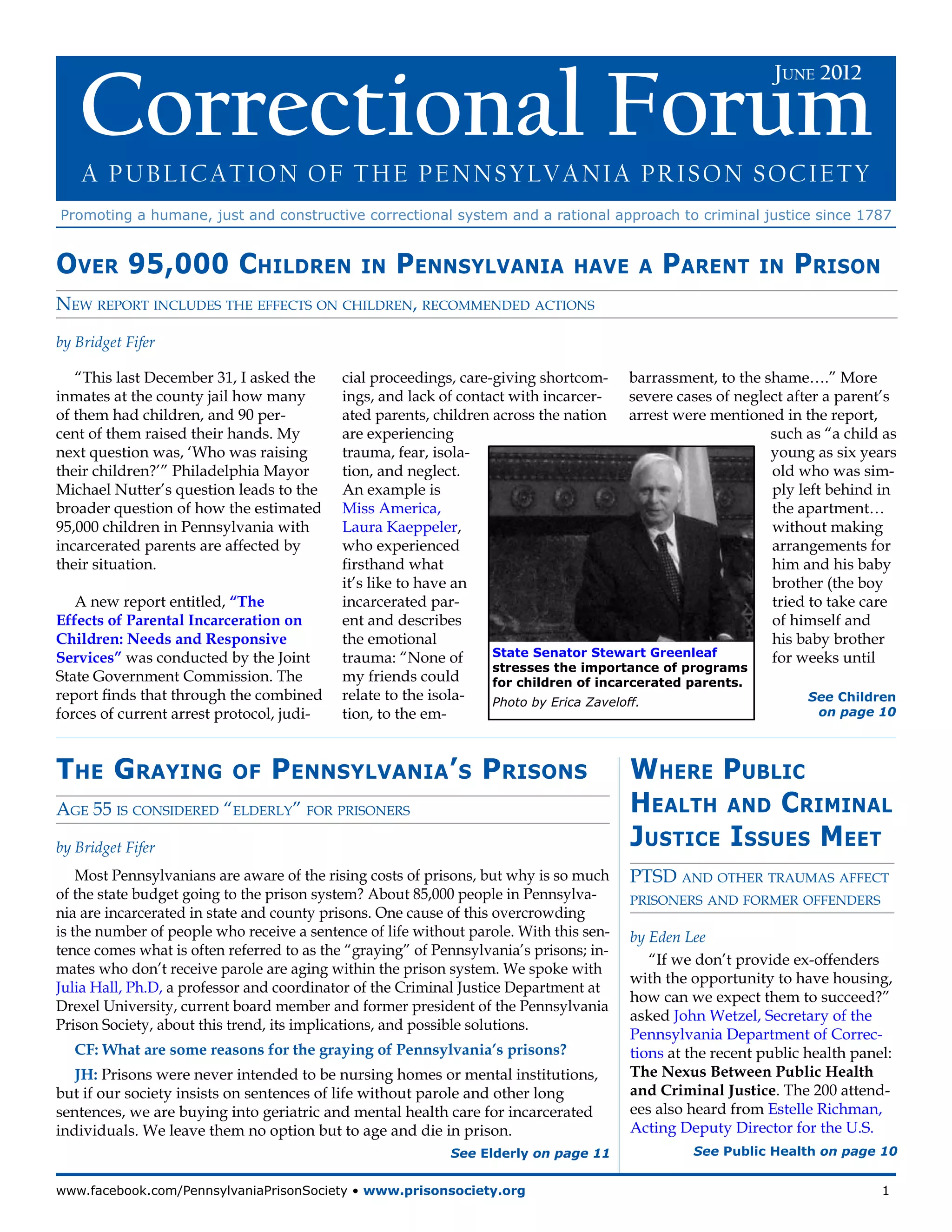
Services” was conducted by the Joint       trauma: “None of       State Senator Stewart Greenleaf            for weeks until
                                                                  stresses the importance of programs
State Government Commission. The           my friends could       for children of incarcerated parents.
report finds that through the combined     relate to the isola-   Photo by Erica Zaveloff.                         See Children
forces of current arrest protocol, judi-   tion, to the em-                                                          on page 10


The Graying                of    Pennsylvania’s Prisons                                 Where Public
Age 55 is considered “elderly” for prisoners                                            Health and Criminal
by Bridget Fifer                                                                        Justice Issues Meet
    Most Pennsylvanians are aware of the rising costs of prisons, but why is so much    PTSD and other traumas affect
of the state budget going to the prison system? About 85,000 people in Pennsylva-       prisoners and former offenders
nia are incarcerated in state and county prisons. One cause of this overcrowding
is the number of people who receive a sentence of life without parole. With this sen-   by Eden Lee
tence comes what is often referred to as the “graying” of Pennsylvania’s prisons; in-
                                                                                           “If we don’t provide ex-offenders
mates who don’t receive parole are aging within the prison system. We spoke with
                                                                                        with the opportunity to have housing,
Julia Hall, Ph.D, a professor and coordinator of the Criminal Justice Department at
                                                                                        how can we expect them to succeed?”
Drexel University, current board member and former president of the Pennsylvania
                                                                                        asked John Wetzel, Secretary of the
Prison Society, about this trend, its implications, and possible solutions.
                                                                                        Pennsylvania Department of Correc-
   CF: What are some reasons for the graying of Pennsylvania’s prisons?                 tions at the recent public health panel:
   JH: Prisons were never intended to be nursing homes or mental institutions,          The Nexus Between Public Health
but if our society insists on sentences of life without parole and other long           and Criminal Justice. The 200 attend-
sentences, we are buying into geriatric and mental health care for incarcerated         ees also heard from Estelle Richman,
individuals. We leave them no option but to age and die in prison.                      Acting Deputy Director for the U.S.
                                                            See Elderly on page 11               See Public Health on page 10


www.facebook.com/PennsylvaniaPrisonSociety • www.prisonsociety.org	1
Correctional Forum  June 2012


        The                                                From the Executive Director
   Pennsylvania
   Prison Society
 Board of Directors
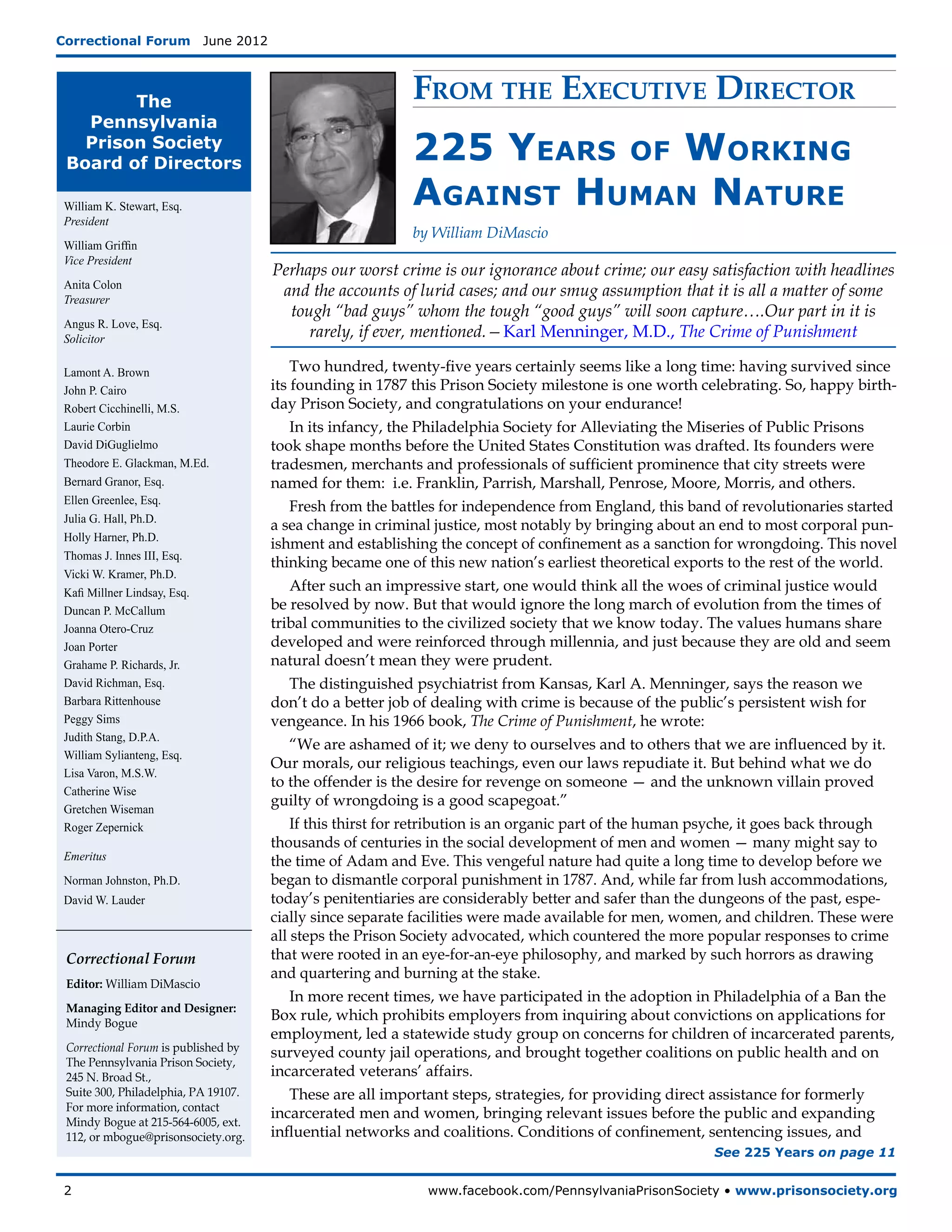
                                                           225 Years of Working
 William K. Stewart, Esq.                                  Against Human Nature
 President
                                                           by William DiMascio
 William Griffin
 Vice President
                                      Perhaps our worst crime is our ignorance about crime; our easy satisfaction with headlines
 Anita Colon
 Treasurer
                                       and the accounts of lurid cases; and our smug assumption that it is all a matter of some
                                        tough “bad guys” whom the tough “good guys” will soon capture….Our part in it is
 Angus R. Love, Esq.
 Solicitor                                 rarely, if ever, mentioned.—Karl Menninger, M.D., The Crime of Punishment

 Lamont A. Brown                          Two hundred, twenty-five years certainly seems like a long time: having survived since
 John P. Cairo                        its founding in 1787 this Prison Society milestone is one worth celebrating. So, happy birth-
 Robert Cicchinelli, M.S.             day Prison Society, and congratulations on your endurance!
 Laurie Corbin                            In its infancy, the Philadelphia Society for Alleviating the Miseries of Public Prisons
 David DiGuglielmo                    took shape months before the United States Constitution was drafted. Its founders were
 Theodore E. Glackman, M.Ed.          tradesmen, merchants and professionals of sufficient prominence that city streets were
 Bernard Granor, Esq.                 named for them: i.e. Franklin, Parrish, Marshall, Penrose, Moore, Morris, and others.
 Ellen Greenlee, Esq.
                                          Fresh from the battles for independence from England, this band of revolutionaries started
 Julia G. Hall, Ph.D.
                                      a sea change in criminal justice, most notably by bringing about an end to most corporal pun-
 Holly Harner, Ph.D.
                                      ishment and establishing the concept of confinement as a sanction for wrongdoing. This novel
 Thomas J. Innes III, Esq.
                                      thinking became one of this new nation’s earliest theoretical exports to the rest of the world.
 Vicki W. Kramer, Ph.D.
 Kafi Millner Lindsay, Esq.               After such an impressive start, one would think all the woes of criminal justice would
 Duncan P. McCallum                   be resolved by now. But that would ignore the long march of evolution from the times of
 Joanna Otero-Cruz                    tribal communities to the civilized society that we know today. The values humans share
 Joan Porter                          developed and were reinforced through millennia, and just because they are old and seem
 Grahame P. Richards, Jr.             natural doesn’t mean they were prudent.
 David Richman, Esq.                      The distinguished psychiatrist from Kansas, Karl A. Menninger, says the reason we
 Barbara Rittenhouse                  don’t do a better job of dealing with crime is because of the public’s persistent wish for
 Peggy Sims                           vengeance. In his 1966 book, The Crime of Punishment, he wrote:
 Judith Stang, D.P.A.
                                          “We are ashamed of it; we deny to ourselves and to others that we are influenced by it.
 William Sylianteng, Esq.
                                      Our morals, our religious teachings, even our laws repudiate it. But behind what we do
 Lisa Varon, M.S.W.
                                      to the offender is the desire for revenge on someone — and the unknown villain proved
 Catherine Wise
                                      guilty of wrongdoing is a good scapegoat.”
 Gretchen Wiseman
 Roger Zepernick                          If this thirst for retribution is an organic part of the human psyche, it goes back through
                                      thousands of centuries in the social development of men and women — many might say to
 Emeritus                             the time of Adam and Eve. This vengeful nature had quite a long time to develop before we
 Norman Johnston, Ph.D.               began to dismantle corporal punishment in 1787. And, while far from lush accommodations,
 David W. Lauder                      today’s penitentiaries are considerably better and safer than the dungeons of the past, espe-
                                      cially since separate facilities were made available for men, women, and children. These were
                                      all steps the Prison Society advocated, which countered the more popular responses to crime
 Correctional Forum                   that were rooted in an eye-for-an-eye philosophy, and marked by such horrors as drawing
                                      and quartering and burning at the stake.
 Editor: William DiMascio
                                          In more recent times, we have participated in the adoption in Philadelphia of a Ban the
 Managing Editor and Designer:
 Mindy Bogue
                                      Box rule, which prohibits employers from inquiring about convictions on applications for
                                      employment, led a statewide study group on concerns for children of incarcerated parents,
 Correctional Forum is published by   surveyed county jail operations, and brought together coalitions on public health and on
 The Pennsylvania Prison Society,
 245 N. Broad St.,                    incarcerated veterans’ affairs.
 Suite 300, Philadelphia, PA 19107.       These are all important steps, strategies, for providing direct assistance for formerly
 For more information, contact
                                      incarcerated men and women, bringing relevant issues before the public and expanding
 Mindy Bogue at 215-564-6005, ext.
 112, or mbogue@prisonsociety.org.    influential networks and coalitions. Conditions of confinement, sentencing issues, and
                                                                                                         See 225 Years on page 11


 2	                                                          www.facebook.com/PennsylvaniaPrisonSociety • www.prisonsociety.org
June 2012  Correctional Forum


Student-Run Program Helps                                                                            New Visitors
Children Connect with Parents                                            in    Prison                Chester county
by Danielle Collins                                                                                     Jacquelyn Carter
                                                                                                        Lamont Wilson
    Since 2011, the Pennsylvania Prison Society’s Indiana University of Pennsylvania (IUP) chap-
                                                                                                        Omar Harris
ter has helped connect inmates and their families through the Reading for Change program. The
chapter, founded by Dr. Rosemary Gido and Profes-                                                       Wayne Carter Jr.
sor Dan Lee, is open to all IUP Criminology students                                                    Rashad Grove
and seeks “to promote the welfare of inmates who are                                                    Clarence Smith Jr.
serving sentences in Pennsylvania correctional facili-                                                  Sanford Dickerson
ties and their families.”                                                                               Lamonte Wilson Sr.

    Reading for Change, which is the brainchild of IUP                                                  Dan Williams
student and chapter president Brandon Stroup, en-
ables incarcerated parents to record themselves read-                                                Lancaster county
ing books to their children. The Indiana County jail                                                    James Petersheim
then prepares and mails the book and the recording                                                      Derek Beiler
to the child with a personal message from the parent.
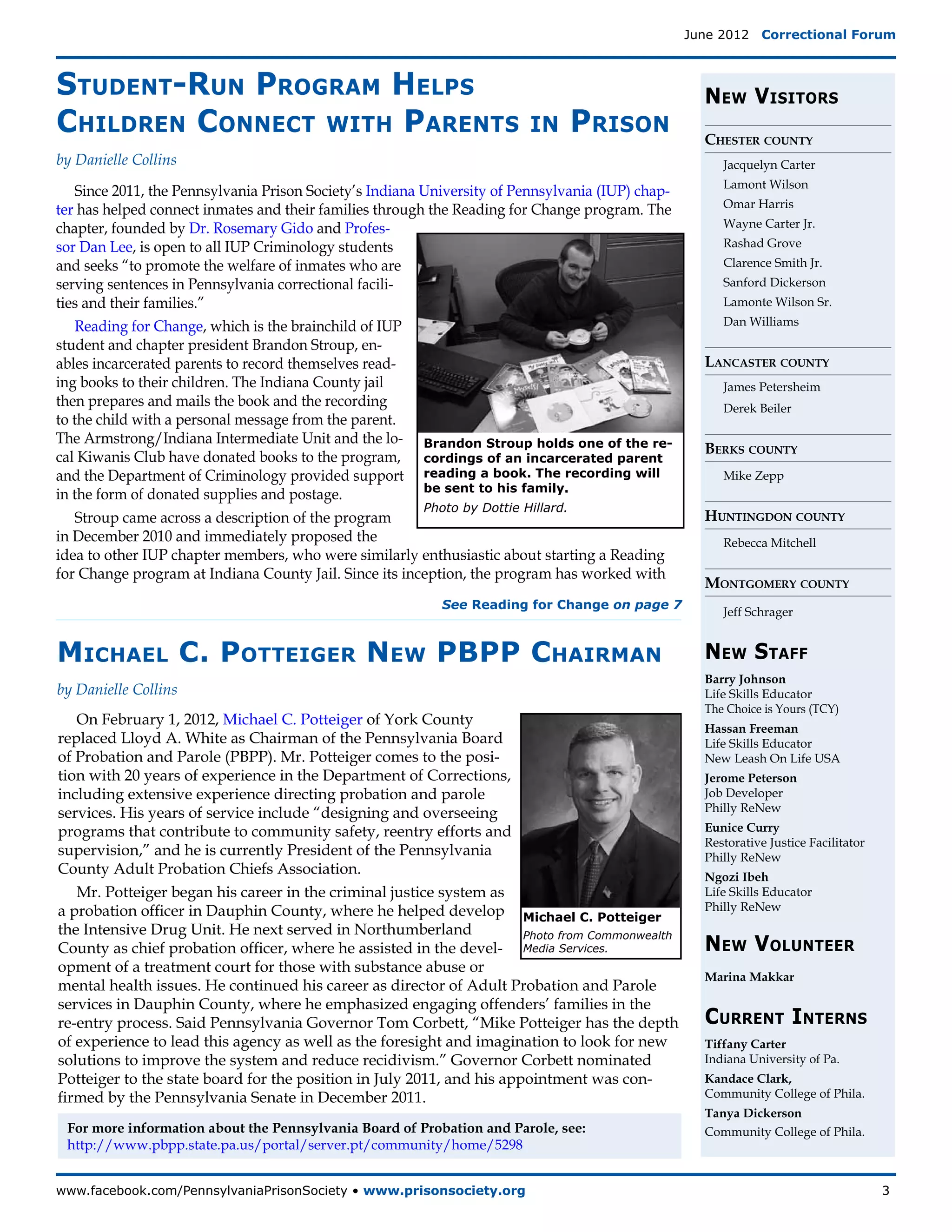
The Armstrong/Indiana Intermediate Unit and the lo- Brandon Stroup holds one of the re-
                                                                                                     Berks county
cal Kiwanis Club have donated books to the program, cordings of an incarcerated parent
and the Department of Criminology provided support reading a book. The recording will                   Mike Zepp
                                                          be sent to his family.
in the form of donated supplies and postage.
                                                          Photo by Dottie Hillard.
    Stroup came across a description of the program                                                  Huntingdon county
in December 2010 and immediately proposed the                                                           Rebecca Mitchell
idea to other IUP chapter members, who were similarly enthusiastic about starting a Reading
for Change program at Indiana County Jail. Since its inception, the program has worked with
                                                                                                     Montgomery county
                                                            See Reading for Change on page 7
                                                                                                        Jeff Schrager


Michael C. Potteiger New PBPP Chairman                                                               New Staff
                                                                                                     Barry Johnson
by Danielle Collins                                                                                  Life Skills Educator
                                                                                                     The Choice is Yours (TCY)
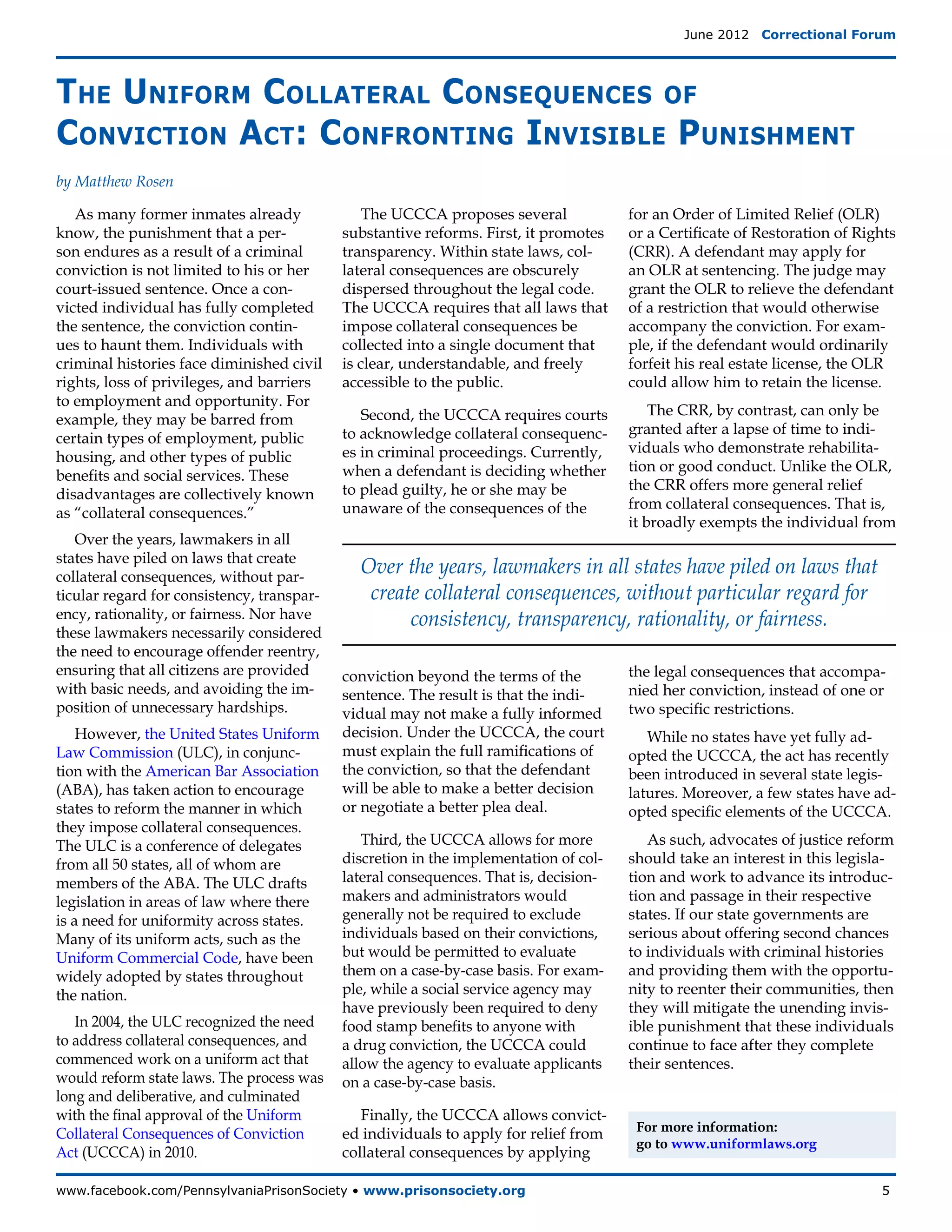
   On February 1, 2012, Michael C. Potteiger of York County
                                                                                                     Hassan Freeman
replaced Lloyd A. White as Chairman of the Pennsylvania Board                                        Life Skills Educator
of Probation and Parole (PBPP). Mr. Potteiger comes to the posi-                                     New Leash On Life USA
tion with 20 years of experience in the Department of Corrections,                                   Jerome Peterson
including extensive experience directing probation and parole                                        Job Developer
services. His years of service include “designing and overseeing                                     Philly ReNew
programs that contribute to community safety, reentry efforts and                                    Eunice Curry
                                                                                                     Restorative Justice Facilitator
supervision,” and he is currently President of the Pennsylvania                                      Philly ReNew
County Adult Probation Chiefs Association.                                                           Ngozi Ibeh
   Mr. Potteiger began his career in the criminal justice system as                                  Life Skills Educator
a probation officer in Dauphin County, where he helped develop Michael C. Potteiger                  Philly ReNew
the Intensive Drug Unit. He next served in Northumberland
                                                                                                     New Volunteer
                                                                       Photo from Commonwealth
County as chief probation officer, where he assisted in the devel- Media Services.
opment of a treatment court for those with substance abuse or
                                                                                                     Marina Makkar
mental health issues. He continued his career as director of Adult Probation and Parole
services in Dauphin County, where he emphasized engaging offenders’ families in the
re-entry process. Said Pennsylvania Governor Tom Corbett, “Mike Potteiger has the depth              Current Interns
of experience to lead this agency as well as the foresight and imagination to look for new           Tiffany Carter
solutions to improve the system and reduce recidivism.” Governor Corbett nominated                   Indiana University of Pa.
Potteiger to the state board for the position in July 2011, and his appointment was con-             Kandace Clark,
firmed by the Pennsylvania Senate in December 2011.                                                  Community College of Phila.
                                                                                                     Tanya Dickerson
 For more information about the Pennsylvania Board of Probation and Parole, see:                     Community College of Phila.
 http://www.pbpp.state.pa.us/portal/server.pt/community/home/5298


www.facebook.com/PennsylvaniaPrisonSociety • www.prisonsociety.org	3
Correctional Forum  June 2012


                                              Bookcase
The Furnace                      of      Affliction:
Prisons         and      Religion        in    Antebellum America
By Jennifer Graber

Review by Danielle Collins

                                                                ing and group discipline
   In The Furnace of Affliction, Jennifer Graber explores the   with the Quaker exter-
historical intersections between prison and Protestantism in    nal concern for other
pre-Civil War America. Graber, an assistant professor of re-    people.” These influ-
ligious studies at Wooster College, places modern concep-       ences and concerns led
tions about prison and punishment in historical context and     to his conception of the
notes that debates about the purpose of prison have been        prison as a “garden” in which inmates
ongoing for nearly two centuries. Policy and public dis-        reflected on their wrongdoings and engaged in whole-
course throughout the nation’s history have swung wildly        some, character-building activities. Eddy’s efforts were met
between viewing prison as a way to punish people or as an       with resistance from inmates who consistently rioted and
experience to aid in their rehabilitation, or both. For much    attempted to escape, causing public officials to question the
of the country’s history, religion was central to the debate    efficacy of Eddy’s religion-centered policies and remove
on both sides.                                                  the Quakers from the prison inspectors board.
   As Graber demonstrates, early Protestant reformers had          In contrast with “the prison as garden,” Eddy’s successors
many different notions about how prisons should function        had a less gentle conception of the role of prisons in inmate
— and even what their role should be — but all agreed that      reformation. Baptist minister Reverend John Stanford envi-
the nation’s penal institutions should feature humane liv-      sioned the prison as a furnace in which “criminals necessar-
ing conditions and practices. They operated under the reli-     ily experienced state-imposed physical and psychological
gious notion that “criminals can and should be redeemed,”       pain” in order to prepare them for redemption. Stanford’s
                                                                model was exported to prisons across the state, including
   Dr. Benjamin Rush advocated for “strict but                  Sing Sing (the successor to Newgate) and Auburn prison.

   humane environments designed for reform.”                       In the ensuing years, explicitly religious dimensions of
                                                                prison life were slowly marginalized. Protestant reformers’
                                                                theology of redemptive suffering was pushed aside for a
and wanted to make sure that prisons worked toward this         “religiosity of citizenship,” in which ethical behavior and
purpose. Operating out of these convictions, Protestant re-     obedience to secular authority were tantamount. Secular-
formers were central players in the process of shaping early    ization resulted in a system quite unlike either the garden
American prisons.                                               or furnace Protestant reformers had envisioned. Secular
                                                                prison officials heaped more and more degradation and
   Benjamin Rush, a Philadelphia physician, signer of the       physical punishment upon prisoners, and by the middle
Declaration of Independence, and a founding member of           of the nineteenth century, prison conditions were widely
the Philadelphia Society for Alleviating the Miseries of        acknowledged to be hellish. At this point, Protestant
the Public Prisons (now the Pennsylvania Prison Society),       reformers shifted from attempts to influence the direction
was among those who called for more humane practices in         of prison life to critiquing harsh institutional conditions
criminal justice. Rush advocated for “strict but humane en-     and practices. In their attempts to institutionalize religious
vironments designed for reform,” involving labor and soli-      beliefs and practices in the prison system and in society
tary cells for the worst offenders. Working along side Rush     at large, antebellum Protestant reformers actually laid the
at the PSAMPP were Pennsylvania Quakers who advocated           foundation for a system that ultimately aimed at punish-
for similar practices, along with Bible reading and silence.    ment rather than redemption.
   Quakers were also a visible presence in the develop-
ment of prisons in New York State. Newgate Prison in New
                                                                 For more information, go to: http://www.amazon.com/The-
York City, the state’s oldest prison, was established as the
                                                                 Furnace-Affliction-Religion-Antebellum/dp/0807834572/ref=sr
result of efforts by Quaker merchant and philanthropist          _1_1?ie=UTF8&qid=1334332170&sr=8-1.
Thomas Eddy. As Graber writes, “Eddy’s prison ideal
combined these internal [Quaker] traditions of childrear-        This book is also available for Kindle and Nook.


 4	                                                    www.facebook.com/PennsylvaniaPrisonSociety • www.prisonsociety.org
June 2012  Correctional Forum


The Uniform Collateral Consequences of
Conviction Act: Confronting Invisible Punishment
by Matthew Rosen

   As many former inmates already               The UCCCA proposes several             for an Order of Limited Relief (OLR)
know, the punishment that a per-            substantive reforms. First, it promotes    or a Certificate of Restoration of Rights
son endures as a result of a criminal       transparency. Within state laws, col-      (CRR). A defendant may apply for
conviction is not limited to his or her     lateral consequences are obscurely         an OLR at sentencing. The judge may
court-issued sentence. Once a con-          dispersed throughout the legal code.       grant the OLR to relieve the defendant
victed individual has fully completed       The UCCCA requires that all laws that      of a restriction that would otherwise
the sentence, the conviction contin-        impose collateral consequences be          accompany the conviction. For exam-
ues to haunt them. Individuals with         collected into a single document that      ple, if the defendant would ordinarily
criminal histories face diminished civil    is clear, understandable, and freely       forfeit his real estate license, the OLR
rights, loss of privileges, and barriers    accessible to the public.                  could allow him to retain the license.
to employment and opportunity. For
                                               Second, the UCCCA requires courts           The CRR, by contrast, can only be
example, they may be barred from
                                            to acknowledge collateral consequenc-      granted after a lapse of time to indi-
certain types of employment, public
                                            es in criminal proceedings. Currently,     viduals who demonstrate rehabilita-
housing, and other types of public
                                            when a defendant is deciding whether       tion or good conduct. Unlike the OLR,
benefits and social services. These
                                            to plead guilty, he or she may be          the CRR offers more general relief
disadvantages are collectively known
                                            unaware of the consequences of the         from collateral consequences. That is,
as “collateral consequences.”
                                                                                       it broadly exempts the individual from
   Over the years, lawmakers in all
states have piled on laws that create
collateral consequences, without par-
                                              Over the years, lawmakers in all states have piled on laws that
ticular regard for consistency, transpar-      create collateral consequences, without particular regard for
ency, rationality, or fairness. Nor have            consistency, transparency, rationality, or fairness.
these lawmakers necessarily considered
the need to encourage offender reentry,
ensuring that all citizens are provided     conviction beyond the terms of the         the legal consequences that accompa-
with basic needs, and avoiding the im-      sentence. The result is that the indi-     nied her conviction, instead of one or
position of unnecessary hardships.          vidual may not make a fully informed       two specific restrictions.
    However, the United States Uniform      decision. Under the UCCCA, the court          While no states have yet fully ad-
Law Commission (ULC), in conjunc-           must explain the full ramifications of     opted the UCCCA, the act has recently
tion with the American Bar Association      the conviction, so that the defendant      been introduced in several state legis-
(ABA), has taken action to encourage        will be able to make a better decision     latures. Moreover, a few states have ad-
states to reform the manner in which        or negotiate a better plea deal.           opted specific elements of the UCCCA.
they impose collateral consequences.
The ULC is a conference of delegates           Third, the UCCCA allows for more           As such, advocates of justice reform
from all 50 states, all of whom are         discretion in the implementation of col-   should take an interest in this legisla-
members of the ABA. The ULC drafts          lateral consequences. That is, decision-   tion and work to advance its introduc-
legislation in areas of law where there     makers and administrators would            tion and passage in their respective
is a need for uniformity across states.     generally not be required to exclude       states. If our state governments are
Many of its uniform acts, such as the       individuals based on their convictions,    serious about offering second chances
Uniform Commercial Code, have been          but would be permitted to evaluate         to individuals with criminal histories
widely adopted by states throughout         them on a case-by-case basis. For exam-    and providing them with the opportu-
the nation.                                 ple, while a social service agency may     nity to reenter their communities, then
                                            have previously been required to deny      they will mitigate the unending invis-
   In 2004, the ULC recognized the need     food stamp benefits to anyone with         ible punishment that these individuals
to address collateral consequences, and     a drug conviction, the UCCCA could         continue to face after they complete
commenced work on a uniform act that        allow the agency to evaluate applicants    their sentences.
would reform state laws. The process was    on a case-by-case basis.
long and deliberative, and culminated
with the final approval of the Uniform         Finally, the UCCCA allows convict-
                                                                                        For more information:
Collateral Consequences of Conviction       ed individuals to apply for relief from
                                                                                        go to www.uniformlaws.org
Act (UCCCA) in 2010.                        collateral consequences by applying

www.facebook.com/PennsylvaniaPrisonSociety • www.prisonsociety.org	5
Correctional Forum  June 2012


              Legislative Highlights
 Bill No.         Description                                  Chief Sponsor            Action Status                  PPS
 Printer No.                                                                                                           Position

 HB 1994          Amends Title 61 (Prisons and Parole)         Rep. J. Preston          Referred to House Judiciary    Support
 PN 3326          of the Pennsylvania Consolidated             D-Allegheny County       4/2/12
                  Statutes; provides for the reduction of
                  sentence for certain minors who were
                  under 18 when they committed a crime
                  and sentenced to serve at least 10 years
                  in prison, or received a life without
                  parole (LWOP) sentence and served up
                  to three years on that sentence.
 HB 2256          Amends Title 42 (Judiciary and Judicial      Rep. Ronald Waters       Referred to House Judiciary    Support
 PN 3228          Procedure) of the Pennsylvania               D-Delaware and           3/16/12
                  Consolidated Statutes, in sentencing,        Philadelphia counties
                  providing for consideration of race in
                  sentencing in capital cases.
 SB100            Amends Titles 18 (Crimes and                 Sen. Stewart Greenleaf   Vote expected in House         Support
 PN 1668          Offenses), 42 (Judiciary and Judicial        R-Bucks and              Judiciary in June
                  Procedure) and 61 (Prisons and Parole)       Montgomery counties
                  of the Pennsylvania Consolidated
                  Statutes. Provides for numerous
                  provisions for prison reform:
                  including visitation, State intermediate
                  punishment, recidivsm risk reduction
                  incentive, and more.
 SB 1454          Amends Titles 23 (Domestic Relations),       Sen. Stewart Greenleaf   Referred to Judiciary 4/5/12   Support
 PN 2099          42 (Judiciary and Judicial Procedure),       R-Bucks and
                  and 44 (Law and Justice) of the              Montgomery counties
                  Pennnsylvania Consolidated Statutes.
                  In juvenile matters, further providing
                  for disposition of dependent child; and
                  adding provisions relating to certain
                  arrest protocols.


Update        on    SB 1153: The Post Conviction Relief Act
   A hearing on March 30 to hear testimony on SB 1153 was sponsored by the Senate Judiciary Committee. SB 1153 was
authored by Senator Stewart Greenleaf (R-Montgomery County). It provides for changes in the time frame of filing for
post conviction relief. The deadline would be changed from 60 days to one year from the date of the claim. If there is a
miscarriage of justice leading to a conviction of an innocent individual, there is no deadline. Some of the witnesses testify-
ing included: Marissa Bluestine, Esq, (Legal Director of the Pennsylvania Innocence Project), James McCloskey (Founder
and Executive Director, Centurion Ministries), Vincent Johnson (a former prisoner who was found to be innocent of the
crime for which he was imprisoned), and others.

Update        on    The Effects              of    Parental Incarceration                           on     Children
   Another hearing on March 30 was sponsored by the Pennsylvania House Democratic Policy Committee to discuss
the report about children of incarcerated parents, based on SR 52 (sponsored by Senator Stewart Greenleaf) and HR
203 (sponsored by Representative Cherelle Parker). Members of the Committee were joined by other House and Senate
members, and City Council Member Marian Tasco. Witnesses included: Ann Schwartzman (Policy Director, Pennsylvania
Prison Society), Ann Adalist Estrin (Director, National Resource Center on Children and Families of the Incarcerated at
Family and Corrections Network), Kathleen Creamer (Staff Attorney, Stoneleigh Foundation Fellow, Community Legal
Services), Keeva King (child of an incarcerated parent), Reuben Jones (Founder/Director, Frontline Dads and a former
offender), and several others.

 6	                                                          www.facebook.com/PennsylvaniaPrisonSociety • www.prisonsociety.org
June 2012  Correctional Forum


A Message               from        John Hargreaves, Director                                      of    Volunteers
                       I have had the privilege of attending several chapter meetings during the past few weeks. The
                       range of issues and the concerns by Prison Society Official Visitors is astounding and admirable. I
                       heard about inmate education programs, work with a lifers’ group and providing transportation
                       to inmates and their families. I am concerned that what sometimes gets lost, while working in the
                       trenches like this, is the thanks, or lack thereof, that we hear.

                       To that end I would like to quote from a letter that was sent to the Philadelphia headquarters last
                       week from an inmate at a state prison. The inmate writes to Graterfriends:

                       “I want to thank you for showing great concerns about my problems. I am having a hard time
                      and someone did come to see me and talked to me. I never felt so good in my life. I didn’t want
                      that man to leave me here. I cried when he was here and I cried when I got back to my cell.”

As you can see, the impact of prison visitation is meaningful and truly important. The work you do is appreciated.


 For more information about becoming a Prison Society Official Visitor, please contact Kelly Golini: 215-564-6005, x100
 or kgolini@prisonsociety.org.


                                            prison. This ambitious, festive event          Reading for Change,
                                            ensures that each inmate is given three        continued from page 3
                                            cookies (baked by chapter members)
                                            and a holiday card, as well as two             17 adult inmates to record and deliver
                                            stamped cards they may send to loved           books to 38 children all over Penn-
                                            ones. Twelve chapter members partici-          sylvania, as well as several in North
                                            pated, along with the Men of Zion, a           Carolina. Says faculty advisor Profes-
                                            chorale from the Mount Zion Baptist            sor Lee, “Brandon’s idea about the
                                            Church in Altoona. Carols were sung            reading program is a great one, and

     Chapter                                on every cell block as the cookies and
                                            cards were distributed.
                                                                                           we are evaluating it with expectations
                                                                                           of publishing results that document

    Highlights
                                                                                           the ability of programs like this to
                                               “Some of them don’t have anyone             maintain family bonds and break the
                                            visiting and their gratitude is indescrib-     cycle of recidivism. Preliminary results
                                            able. It gives them hope and lets them         have been presented at the annual
Allegheny County                            know there are people who care about           conferences of the American Society
   Convener Marion Damick brought           them” said Convener Mary Burgoon.              of Criminology and the Academy of
the ACLU report on reproductive health      “That’s what the Prison Society is about,      Criminal Justice Sciences.”
in county jails to the attention of the     and I’m glad to be part of it. It’s the best
                                            charitable work I’ve ever done.”                  IUP students and chapter members
Allegheny County Oversight Board. She
                                                                                           report “learning a lot” and connect-
also attended a meeting on health care
                                                                                           ing with incarcerated parents through
for former offenders reentering society,    Centre County                                  the program. Parents appreciate that
speaking briefly with Secretary Wetzel.
                                               The Centre County chapter presents          the program is free of charge and
She also shared reports of bad condi-
                                            a program once a month at Centre               hope that these special books will
tions at Fayette County Jail with the
                                            County Correctional Facility. About            help them maintain relationships with
Fayette County chapter so that they are
                                            10-12 prisoners attend each one. The           their children despite distance and
prepared when sending visitors.
                                            programs have concentrated on reinte-          difficult conditions. 
                                            grating into society after release. Top-
Blair County Chapter                        ics include finding work, transitioning         For more information about the
   In December, the Blair County chap-      from prison to other housing, and               IUP chapter of the Prison Society,
ter held their twelfth annual holiday       general tips regarding the move from            see: http://www.iup.edu/page.
party for inmates at the Blair County       prison to the outside community.                aspx?id=86535


www.facebook.com/PennsylvaniaPrisonSociety • www.prisonsociety.org	7
Correctional Forum  June 2012


      Milestones in the Life of the                       The Pennsylvania Prison Society
      Pennsylvania Prison Society
                                                          Celebrates 225 Years of Fighting
 2012: Presented the Report, The Effects of Parental
 Incarceration on Children, at Philadelphia City Hall     for Social Justice!
 on two occasions and to the Senate Judiciary Com-
 mittee. The report includes the impact on children         The Pennsylvania Prison Society celebrated its 225th anniversary on
 and recommendations to meet their needs.
                                                          May 8, 2012, at the Arden Theatre in Philadelphia. We welcomed board
 2011: Ban the Box became law in Philadelphia. The        members, staff, conveners, official visitors, and other special guests, and
 Prison Society was part of the coalition leading the     had proclamations on-hand from the Pennsylvania State Senate, the
 initiative to ban the check box on job applications.     Mayor of Philadelphia, and the Governor of Pennsylvania.
 2008: Established Philly ReNew, a unique                    The evening began with an historical talk from Neil Ronk at Christ
 reentry program for Philadelphia fathers with a
                                                          Church, which is adjacent to the Arden Theatre. He explained general
 criminal background.
                                                          information about the church and also Bishop William White’s history
 2002: Started publishing Graterfriends, a newsletter     with the church. Bishop White was the rector there for over 50 years,
 written primarily by and for prisoners in Pennsylva-     was chaplain to the Continental Army during the American Revolution,
 nia. It was originally started in 1983 by Joan Gauker.   and was a founder of the Pennsylvania Prison Society.
 2000: Began inexpensive busing to state prisons
                                                              We also presented the Justice Award to Senator Greenleaf in honor
 for friends and family of prisoners.
                                                          of his work in reforming Pennsylvania’s criminal justice system. This is
 1998: Supported the move to reinstate former             only the third time we’ve given someone this award in the past decade,
 prisoners’ voting rights.                                and the only time the recipient has not been a long-term board member.
 1994: Reopened Eastern State Penitentiary as a           (See the sidebar on page nine for more information.)
 world class museum.
                                                             We also had fun raffling off a variety of baskets and hosting a silent auc-
 1991: Holds first SKIP class at the request of in-       tion for several pieces of art (donated by Tanya Bracey) and special baskets.
 mate parents desiring support for their children.
 1990: Reaffirmed official prison visitation for Pris-
 on Society Official Visitors and public officials.       Photos (L to R):
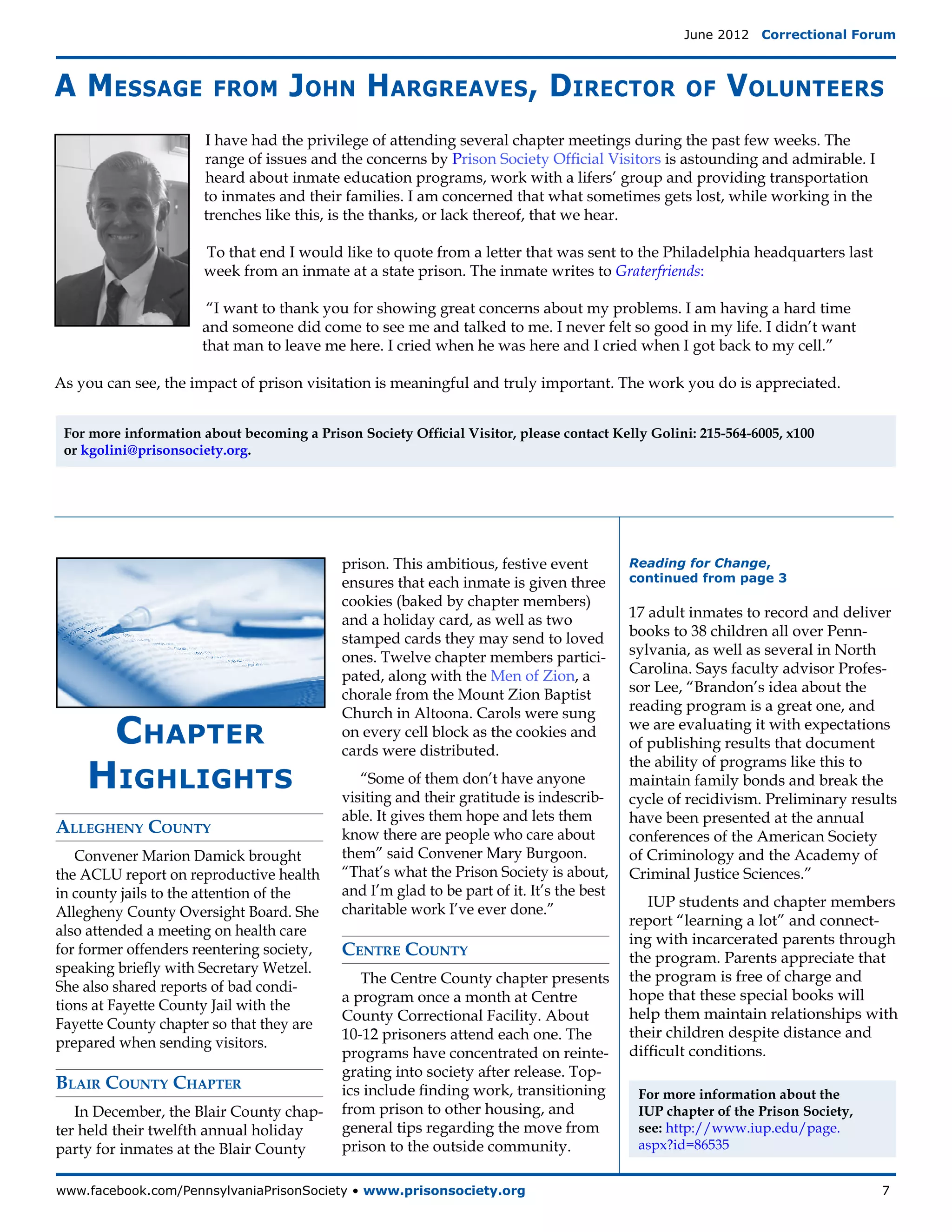
                                                          1. John Hargreaves, Louise DiMascio, William DiMascio
 1977: Established the Arts and Humanities Program,
                                                          2. Ceciley Bradford, Tina Spence, Barry Johnson,
 where a group of professional artists helped prison-
                                                             and Monique Hendricks
 ers express themselves through creativity, and create
                                                          3. Joan Porter and Howard Bradford, Sr.
 ties between prisoners and the outside community.
                                                          4. Cathy Wise and Ebonee Allen
 1934: Supported the creation of the Defender             5. Silent auction of baskets and artwork
 Association of Philadelphia, which continues to
 provide legal counsel for indigent offenders.            1                                       3
 1852: Initiated the removal of the mentally ill
 from prisons to specialized hospitals.
 1851: Began providing counseling services to
 offenders and former offenders.
 1829: Granted access to all state and county cor-
 rectional facilities through act of legislature – un-
 matched anywhere in the nation. Also appointed
 overseer of the new Eastern State Penitentiary.
 1823: Encouraged the removal of children from
                                                                                                                4
 adult institutions.
 1789: Led the move to establish separate
                                                          2
 facilities for women.
 1788: Initiated the penitentiary model at the
 Walnut Street Jail in Philadelphia. Before this
 time all prisoners men, women, and children
 were imprisoned together in one large room.
                                                                                                                5
 1787: Founded as the Philadelphia Society for
 Alleviating the Miseries in Public Prisons.
 Pioneered prison visits.


 8	                                                           www.facebook.com/PennsylvaniaPrisonSociety • www.prisonsociety.org
June 2012  Correctional Forum


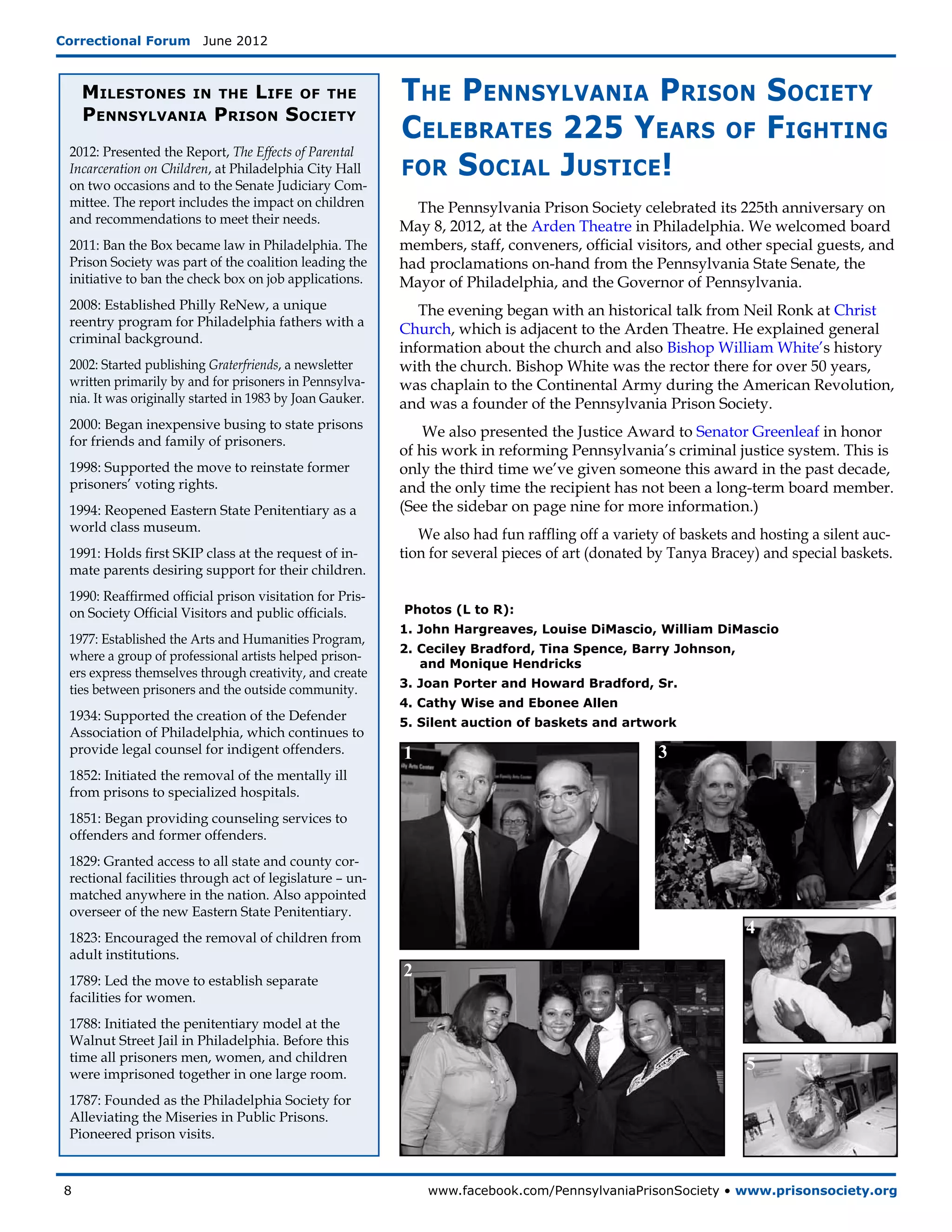
Photos (L to R):
6. Craig Stock                                Prison Society Presents Senator
7. Sec. John Wetzel and Angus Love             Greenleaf with Justice Award
8. Michael McCaney                     6
9. Cathy Wise and Clark DeLeon                 Senator Stewart Greenleaf has led ef-
10. Ellen Greenlee, Tyrone Werts,           forts in the Pennsylvania Legislature for a
    and Mindy Bogue                         number of years responding to the state’s
11. Pamela Superville,                      prison overpopulation crisis driven by
    Ceciley Bradford,                       years of harsh punishments for non-violent
    and Ann Schwartzman
                                            drug offenders. The Senator is currently
12. State Senate Proclamation
                                            working on legislation (SB 100) that would
13. Debra Stewart, Tanya Bracey,
    William Stewart, and Anita Colon        enhance Pennsylvania’s alternative sen-
14. Steve Blackburn      7                  tencing programs for non-violent offenders
                                            and improve rehabilitation and community
                                            re-entry for inmates.
8
                                               “I am truly honored to receive this
                                            recognition from one of the most highly
                                            regarded advocacy organizations in Penn-
                                            sylvania,” said the Senator. “I am proud to
                                            have the opportunity to work with the Pris-
                                            on Society on issues that are so important
                                            for humanity and the future of our state.
                                            The important progress that we are making
                                            today is a direct result of their hard work.
                                       10   And not only do they have a profound
                                            impact on public policy, but their wide net-
                                            work of staff and volunteers who visit and
9                                           work with inmates truly turns lives around.
                                            Rehabilitation programs within prisons are
                                            just as important as good law enforcement
                                            in keeping our streets safe.”


                                              Future Celebrations Throughout
                                       11
                                                 the State in 2012-2013

                                              Stay tuned for exact dates in your area.

12                                            2012
                                              June: Lackawanna County
                                              July: York County
                                              August: Blair County
                         13                   September: Adams County
                                              October: Erie County
                                              November: Union County
                                              December: Allegheny County
14
                                              2013
                                              February: Dauphin County
                                              March: Lancaster County
                                              April: Huntingdon County


www.facebook.com/PennsylvaniaPrisonSociety • www.prisonsociety.org	9
Correctional Forum  June 2012


Children, continued from page 1
                                                                                Facts About Incarcerated
a neighbor noticed him with the stroller and called Child Protective
Services).”
                                                                                Parents and Their Children
   In addition to explaining the effects incarceration of a parent has on chil-  1.	Over 10 million children in the United
dren, the report offered specific recommendations to facilitate a less trau-        States have a parent under some type of
matizing experience for children with incarcerated parents. These include:          correctional supervision — either prison,
   •	 Altering arrest procedure to include specific protocol for when 	             jail, probation, or parole. At least 1.7 million
	     there is a chance a child might be present at the time of arrest.             children have a parent currently in prison.
   •	 Providing education to officers, caregivers, and others on how to 	        2.	More than one in every 100 adults in
	     handle the sensitive nature of the situation.                                 America are in jail or prison.
   •	 Developing a more accurate means of identifying children whose
	     parents are incarcerated, their locations, and their well-being.           3.	Seventy-five percent of incarcerated
   •	 Involving incarcerated parents more thoroughly in the process of 	            women are mothers.
	     their child’s care-giving options.                                         4.	Forty-six percent of all imprisoned parents
   •	 Providing emotional support for children with incarcerated par	               lived with at least one of their minor chil-
	     ents, such as support groups or after school programs.                        dren prior to their imprisonment.
   The report was completed in December, then announced and dis-                 5.	The average age of children with an incar-
cussed at a press conference in February. It was also introduced to the             cerated parent is eight years old; 22 percent
State Senate Judiciary Committee in Harrisburg in March, where Rev.                 of the children are under the age of five.
Dr. Wilson Goode, Sr., Member of the Advisory Committee for the Joint
State Government Committee, said, “I saw in that prison a grandfather,
a father, and a grandson — all in the same prison, at the same time. And they met for the first time in prison. As I was
leaving, the grandson pulled me aside and asked, ‘Dr. Goode, I have a son that I’ve never seen. Do you think I will see
him for the first time in prison, too?’” Rev. Goode’s narrative illustrates a cycle of incarceration that the recommendations
this report makes, if implemented, can help to break.

 For more information: The report may be found at
 http://www.prisonsociety.org/adv/PDF/Effects_of_Parental_Incarceration_on_Children_Dec2011.pdf


Public Health, continued from page 1                                       •	  A large percentage of Pennsylvania’s prison popula-
Department of Housing and Urban Development. A panel of               	        tion is nonviolent, behind bars for misdemeanors.
five specialists on the subject of public health also made re-           •	    In Pennsylvania’s prisons, 17 percent of men and 48 	
marks based on the keynote speeches and answered questions            	        percent of women have diagnosed mental health issues.
from the audience. The event was presented by the Public                 •	    Prisoners leave the Philadelphia Prison System
Health Initiative of the Pennsylvania Prison Society, and             	        with at least five days of medication, plus a 15 day
sponsored by the University of the Sciences in Philadelphia           	        prescription — if they can pay for it. Out of 5200
and La Salle University’s Master of Public Health Program.            	        prescriptions last year, only 37 were filled.
   Richman talked about public housing issues in great                   •	    The incarceration rate for women has grown by 800
detail, especially when it comes to former prisoners finding          	        percent over the past twenty years. Most of these
safe and affordable housing. When individuals are released            	        women are in their 30s and 40s and in prison for
from incarceration, they often have no place to live. This            	        drug infractions and other nonviolent crimes.
is a major public health problem, resulting in homeless-
                                                                         •	    Nearly 80 percent of the women entering SCI
ness and weakened communities. Richman explained that,
                                                                      	        Muncy have suffered various forms of abuse. A
while public housing has become more accommodating to
                                                                      	        high proportion of women enter prison suffering 	
former offenders than in the past, many stipulations still
                                                                      	        from PTSD and various abuses.
exist. “If we’re going to make an impact on those coming
out of prison, we have to offer safe and affordable hous-                Seeking affordable health care and housing are problems
ing,” Richman said. “If we don’t spend now but spend                  experienced by millions of people, not just those released
three times as much in the future, are we really saving               from prison. This suffering can be avoided if legislators
taxpayers’ money?”                                                    amend policies that focus on public health. There is not just
                                                                      one solution for these problems; however, one step in the right
   Other facts that were highlighted in the session include:
                                                                      direction will decrease the suffering of many individuals.
   •	     25 percent of former offenders are homeless upon 	
	         their release. Their death rate is highest in the first 	       For more information: View video from the day at: http://
	         two weeks after their release, often due to having 	            www.youtube.com/user/PaPrisonSociety?feature=mhee
	         no home and no access to health care.

 10	                                                        www.facebook.com/PennsylvaniaPrisonSociety • www.prisonsociety.org
June 2012  Correctional Forum


Elderly, continued from page 1                                     hot flashes, etc. The women needed the companionship of
   CF: What are some health problems of individuals who            older people who understood. (Their facility was part of
are aging in our prison system?                                    the general prison population, and not a separate unit for
                                                                   elderly inmates.)
    JH: We tend to need the most medical care in the last
years of our lives and inmates are no different. Inmates              CF: Do you think it is necessary to create a separate facil-
often appear physically and psychologically ten years older        ity to accommodate the growing elderly prison population?
than their age-mates in free society. For this reason, the defi-       JH: No, I prefer a greater use of compassionate or medi-
nition of “elderly” has been set at 55 for incarcerated people.    cal release first. In general, an individual would be better
A lack of medical and dental care, unstable lifestyles, and        off in the community, with his or her family. At that age
drug and alcohol abuse may affect health and cause an              they are a very low crime risk; age and infirmity further
inmate to age faster and require more medical care. All the        reduce risk. In a needs assessment I conducted, I found that
dementias (Alzheimer’s, Parkinson’s, etc.) also afflict incar-     most elderly people do not want to be in a separate area or
cerated elderly, requiring special care and protection.            facility for fear of being forgotten and ignored. They want
   CF: Why is the cost of incarceration so much higher for         to be mainstreamed, but with access to necessary provi-
elderly prisoners?                                                 sions based on age. For example, schedule time in the gym
                                                                   for older men, or specific times in the yard. This worked
   JH: Elderly people have higher costs of medical care.           out well at SCI Graterford. Also, make sure they are not
This is true outside prison, and it is true inside prison.         pushed behind in the chow line. COs can let older men re-
They also need more medications and assistive devices like         ceive food first. This is not discrimination because younger
canes, braces, wheelchairs, glasses, etc. It has been esti-        prisoners will be older one day and will get their turn.
mated that medical care for elderly inmates is three times         Elderly prisoners do have needs for protection, support,
greater than the cost for younger inmates. The cost goes up,       and special services such as medical care and supportive,
but the crime risk goes down. After age 55, the elderly do         accessible environments.
not require as much prison security. We are paying a lot for
very little crime prevention.                                        CF: What are some possible solutions to the overrepre-
                                                                   sentation of the elderly population in prisons?
   CF: Is abuse or neglect a concern with the elderly popu-
lation in prisons?                                                     JH: A change of legislation would be ideal. Prisoners
                                                                   need to be reassessed at intervals to determine if they are
   JH: Elderly offenders as a general group are less likely to     still a risk. This, of course, would have to be done on an
complain if abused or neglected. They keep a low profile,          individual basis and incarcerated individuals would not
and it’s easy to ignore the quiet person: They’re not the          simply be released on the basis of age. There could always
squeaky wheels that get the oil, and their generation is           be that one wild card who is still a risk. (Life with parole
less likely to speak out against authority. They can also be       would have to be approved by the legislature to release
abused or intimidated by younger, stronger inmates.                these prisoners on parole.)
   CF: What about the needs of elderly women in the                  CF: What is something that the general population
prison system?                                                     should know about the graying of Pennsylvania prisons?
   JH: During my mid-1980s needs assessment at SCI                    JH: The cost of medical care for an elderly inmate goes
Muncy, I visited a support group that older woman had              up as they age, but the likeliness of their committing a crime
formed to allow women to discuss their grandchildren               decreases dramatically. Many tax dollars could be saved by
without feeling corny or stupid, or to discuss problems like       using alternatives to prison for low-risk older inmates.


225 Years, continued from page 2
                                                                       Dr. Menninger concluded his book with a call to all citi-
concerns for the physical, mental and behavioral conditions        zens to “renounce the philosophy of punishment” in favor
that drive people to commit crimes remain atop the list of         of a “comprehensive, constructive social attitude — thera-
problems with which we grapple on a daily basis.	                  peutic in some instances, restraining in some instances, but
   A 2008 research report by the Justice Policy Center suggests    preventive in its total social impact.” He goes on to say that
that nearly all men and women released from prison have            it is a matter of personal morals and values. And, he added:
health issues that impact the process of reintegration. “Policy-       “Unless this message is heard, unless we, the people…
makers and practitioners would be well served to adopt a new       can give up our delicious satisfactions in opportunities for
paradigm that recognizes health as a universal rather than a       vengeful retaliation on scapegoats, we cannot expect to pre-
special needs concern among returning prisoners,” it concludes.    serve our peace, our public safety, or our mental health.”
   Ultimately, we strive to ameliorate the damage done by              The magnitude of our challenge must be viewed in the
immersing people in the vileness of the prison experience.         context of man’s long standing addiction to vengeance. In
This is little different than the horrors of war, domestic vio-    the hourglass of history, 225 years is hardly the blink of an
lence and natural disasters which often lead to unbearable         eye. We can celebrate our accomplishments, but we have
traumatic stress that takes a toll for years.                      much more work to do.

www.facebook.com/PennsylvaniaPrisonSociety • www.prisonsociety.org	11
Correctional Forum  June 2012


                                  Guide                 Proposed Bylaw Changes
                                                       to
                                of the               Pennsylvania Prison Society
The Board of Directors of the Pennsylvania Prison Society is proposing to the membership revisions to the organization’s
bylaws. The intention of the Board in making these changes is to modernize the bylaws and include good governance
practices.
The process for altering the bylaws states: “the members of the Society shall have the right to amend these bylaws by a two-
thirds vote of the members who are present in person or by proxy and entitled to vote thereon, at any regular or special meeting duly
convened after notice to them of the purpose thereof, provided the proposed amendments have first been approved by the Board of
Directors and submitted to the members of the Society in writing sixty days prior to the date of the regular or special meeting.”


The complete Bylaws are below and on the following pages. Please read carefully, as changes have been made throughout.

PURPOSES                                                exclusive of the date of the meeting. Notice of       privileges of a Director excepting voting rights.
                                                        Special Meetings shall specify the object thereof.
    The purposes of the Corporation are exclu-                                                                    4.5	   Removal. Any Director may be
sively charitable as set forth in the Articles of           Voting at all elections and upon all ques-        removed from office, with or without the assign-
Incorporation. In pursuing such purposes, the           tions, shall, when so requested, be by ballot, cast   ment of any cause, only by a vote of two-thirds
Corporation shall not act so as to impair its eligi-    by members in person, except when a member            (2/3) of the Directors in office at any duly con-
bility for exemption under Section 501(c)(3) of         is incarcerated in which case voting may be           vened meeting of the Board, provided that writ-
the Internal Revenue Code of 1986, as amended.          done by absentee ballot, and a majority of the        ten notice of the intention to consider removal
                                                        votes shall be required in order to make an           of such Director has been included in the notice
OFFICES                                                 election or resolution valid. No member more          of the meeting. No Director shall be removed
                                                        than twelve months in arrears for dues shall be       without having the opportunity to be heard at
   Registered Office. The registered office of          permitted to vote.                                    such meeting, but no formal hearing procedure
the Corporation shall be at such location in                                                                  need be followed.
Pennsylvania as the Directors may from time to              Twenty-five members of the Society shall
time determine.                                         constitute a quorum at any meeting of members.            4.6 	 Quorum. One half (1/2) of all Direc-
                                                        If a quorum is not present, the meeting may           tors in office shall constitute a quorum of the
   Other Offices. The Corporation may also              be adjourned and may without further written          Board, and the acts of a majority of the Directors
have offices at such other places as the Directors      notice, be reconvened at such time and place as       present at a duly convened meeting at which a
may select and the business of the Corporation          a quorum is obtained.                                 quorum is present shall be the acts of the Board,
shall require.                                                                                                unless a greater number is required by the
                                                        DIRECTORS                                             Nonprofit Corporation Law of 1988 (“the Act”)
MEMBERS                                                                                                       or these Bylaws.
                                                           Powers. The Directors shall have all powers
    Membership Corporation. Membership in               and duties for the conduct of the activities of the      4.7 Vote. Each Director shall be entitled to
the Society shall be available to any person who        Corporation except as otherwise required by           one (1) vote.
is interested in supporting the mission and goals       these Bylaws or a resolution duly adopted by
of the Society, subject to criteria and process of      the Board.                                                4.8 Unanimous Consent of Directors in
approval established by the Board. Members                                                                    Lieu of Meeting. Any action that may be taken
shall have such powers and duties as may be                Qualifications of Directors. Each Director         at a meeting of the Board may be taken without
delegated to them by the Board.                         shall be an individual of at least 18 years of age,   a meeting if a consent or consents in writing
                                                        who need not be a resident of Pennsylvania.           setting forth the action so taken shall be signed
   Financial Support. The Board shall have the                                                                by all of the Directors and shall be filed with the
authority to establish classes of membership                4.3 	 Number, Election, Term. The Board of        Secretary of the Corporation.
and determine the financial support required for        Directors shall consist of not fewer than sixteen
each class of membership.                               (16) (including the officers) nor more than thirty        4.9	   Regular Meetings. Regular meetings
                                                        (30) persons as determined by the Board. Candi-       of the Directors shall be held as determined and
   3.3	   Meetings of Members                           dates for the Board shall be nominated only by        scheduled by the President or the Board.
   There shall be an Annual Meeting of the              existing Board members. The Nominating Com-
members of the Society. The time and place of           mittee of the Board may present to the Board a           4.10	 Annual Meeting. There shall be an an-
the meeting shall be designated by the Board            slate of candidates for nomination as Directors       nual meeting of the Directors on such day, at such
of Directors and specified in a notice, which           at which time other candidates may be nomi-           time, and in such place in the Commonwealth of
shall be sent to the membership at least 30 days        nated by any Board member. A nominee shall            Pennsylvania as the President shall choose.
before the date of the meeting. At the Annual           be included on the slate only upon an affirma-
                                                        tive vote of a majority of Directors present at a         4.11 Special Meetings. Special meetings of
Meeting the members shall receive a report of                                                                 the Board may be called by the President or by
the activities of the Society.                          meeting of the Board at which a quorum is pres-
                                                        ent. Directors shall be chosen by the members         five of the Directors at any time. At least five (5)
    Special meetings of the members may be              at the annual meeting and shall serve for terms       days notice stating the time, place and purpose
called by the President of the Society, and shall       of three (3) years and until their successors are     of any special meeting shall be given to the
be called by the President at the written request       elected and qualified. As nearly as possible, an      members of the Board.
of ten members of the Society, the request speci-       equal number of terms shall expire each year.             4.12 Teleconference Meetings. Any Director
fying the object or objects of the meeting.
                                                            4.4   Emeritus Director.	 Emeritus status         may participate in a meeting of the Board or
    Written notice of a Special Meeting of the          may be conferred by the Board of Directors on         any committee thereof by means of a conference
members shall be given by mailing such notice           any retiring or former director in recognition of     telephone or similar communications equip-
to the last known address of each member at             long and faithful service to the Society. Emeritus    ment by which all persons participating in the
least five days prior to the date of said meeting,      status entitles the conferee to all rights and        meeting can hear each other.


 12	                                                                    www.facebook.com/PennsylvaniaPrisonSociety • www.prisonsociety.org
June 2012  Correctional Forum


OFFICERS                                              Directors of the Corporation. Any such commit-     unless some later time may be fixed in the resig-
                                                      tee, to the extent provided in the resolution of   nation, and then from that date. The acceptance
    Positions, Election, Term. The officers of the    the Board, shall have and may exercise any of      of the resignation shall not be required to make
Corporation shall include a President, one or         the powers and authority of the Board, except      it effective.
more Vice-Presidents, a Treasurer and a Solicitor,    that no committee shall have any power or
who shall be elected by the Directors from among      authority as to the following:                        Filling Vacancies.
the Directors at an annual meeting of the Board
                                                         The filling of vacancies on the Board.                If a vacancy exists among the positions
of Directors and shall serve for a term of one
                                                                                                         available for Directors, by virtue of a desire to
year and until their successors are elected and          The adoption, amendment or repeal of the        fill unfilled positions, or by reason of death, res-
qualified. The Directors shall elect an Executive     Bylaws.                                            ignation, removal, disqualification or otherwise,
Director, who need not be a member of the Board,
                                                          The amendment or repeal of any resolution      the Directors in office may choose a person or
as they deem appropriate from time to time, and
                                                      of the Board.                                      persons who shall serve as a Director for the
who shall hold office at the pleasure of the Board,
                                                                                                         remainder of the applicable term.
and shall perform the duties of the Secretary.            Action on matters committed by the Bylaws
                                                      or by resolution of the Board to another commit-         If the position of any officer becomes
    Consecutive Terms. The President and any
                                                      tee of the Board.                                  vacant, by an increase in the number of officers,
Vice-President shall not be eligible for re-elec-
                                                                                                         or by reason of death, resignation, removal,
tion to the same office beyond three consecutive         The removal of the Executive Director.          disqualification or otherwise, the Directors may
one-year terms. The Treasurer and Solicitor shall
                                                          If any person who is not a Director is ap-     choose a person or persons who shall hold office
not be eligible for re-election to the same office
                                                      pointed to any committee of the Board, such        for the remaining term.
beyond six consecutive one-year terms.
                                                      non- Director shall have no right to vote on any
   Duties. The duties of the officers shall in-       question that would create a binding obligation    MEETINGS AND NOTICE
clude the following:                                  of the Corporation.
                                                                                                            Place of Meetings. Meetings may be held at
    The President or his designated representa-          Appointment to Committees. Unless oth-          such place within or without Pennsylvania as
tive shall preside at all meetings of the Members,    erwise determined by the Board, the President      the Board may from time to time determine.
Directors and Executive Committee; shall gener-       shall appoint members of all committees.
ally supervise the business of the Corporation;                                                              Notice. Whenever written notice is required
and shall execute documents on behalf of the              Creation and Composition of Advisory           to be given to any person, it may be given to
Corporation. The President shall be an ex-officio     Boards. The Corporation may, in its discretion,    such person either personally or by sending a
member of every Corporation committee.                establish Advisory Boards that may include         copy thereof by first class or express mail, post-
                                                      persons who are not Directors. Such Advisory       age prepaid, or courier service, charges prepaid,
   A Vice President shall have such powers and        Boards shall have no power to bind the Corpo-      or by facsimile transmission or electronic mail,
perform such duties as the Board of Directors         ration and shall have only such other responsi-    to that person’s address (or facsimile number or
may prescribe or as the President may delegate.       bilities and duties as delegated to them by the    e-mail address) appearing on the books of the
                                                      Board or the President.                            Corporation, or in the case of Directors, sup-
    The Executive Director shall be the Executive
Officer of the Corporation, the Custodian of its          6.4	   Executive Committee of the Board.       plied by that person to the Corporation for the
corporate seal, of its books, records and docu-       There shall be an Executive Committee of the       purpose of notice. If the notice is sent by mail
ments. The Executive Director shall be in charge      Board which shall have the authority to act on     or courier service, it shall be deemed to have
of the activities of the Corporation, shall keep      behalf of the full Board of Directors between      been given to the person entitled thereto when
minutes of all meetings of the Society and Board,     Board meetings when a decision requiring           deposited in the United States mail, or depos-
and shall be entitled to be present at all meetings   action by the Board cannot await convening         ited with a courier service for delivery to such
of the Corporation, and of the Board of Directors,    of a regular or special Board meeting, unless      person or, in the case of facsimile or electronic
and any committee thereof, but shall have no          such action by the Executive Committee is          mail, when dispatched. Such notice shall specify
vote at such meetings, except when the meetings       prohibited by law or by prior resolution of the    the place, day and hour of the meeting and any
go into executive session in which no one is pres-    Board. Whenever the Executive Committee            other information that may be required by the
ent but Board members and invited guests.             takes any action on behalf of the full Board, a    Act or these Bylaws.
                                                      report of such action shall be made at the next        Waiver of Notice. Any required notice may
    The Treasurer shall assure that accurate
                                                      regular or special Board meeting. The Executive    be waived by the written consent of the person
accounts of the receipts and disbursements of
                                                      Committee shall have such other authority and      entitled to such notice either before or after the
the Corporation are maintained; shall cause
                                                      responsibilities as shall from time to time be     time for giving of notice, and attendance of a
financial reports to be provided to the Board
                                                      determined by the Board of Directors. The Com-     person at a meeting shall constitute a waiver of
as requested, but not less than once a year; and
                                                      mittee shall be composed of the President, the     notice, except where a person attends a meeting
shall perform such other duties as may be pre-
                                                      Vice Presidents, Treasurer, Solicitor, Executive   for the express purpose of objecting to the trans-
scribed by the Board or by the President.
                                                      Director and two members elected by the Board.     action of any business because the meeting was
   The Solicitor shall advise the Corporation as      The Immediate Past President of the Board of       not lawfully called or convened.
to when it needs legal advice.                        Directors shall automatically continue to serve
                                                      as member of the Board and as a member of the         9.4	    Electronic Mail. Any action that may
    5.4 Removal of Officers. Any officer or           Executive Committee with full privileges there-    be done, or is required to be done, in writing
agent may be removed by the Board, with or            of. With regard to any motion that the Executive   under these Bylaws or the Act, including agree-
without the assignment of any cause, whenever         Committee takes formal action on behalf of the     ment to a unanimous written consent, shall be
in its judgment the best interests of the Corpora-    full Board, the Executive Director shall have no   valid if sent and received by electronic mail.
tion may be served thereby, but such removal          vote, and an affirmative vote of four members
shall be without prejudice to the contract rights     shall be necessary. The Committee may execute
of any person so removed. Any Officer may be          its authority and responsibilities by telephone
                                                                                                         LIABILITY AND INDEMNIFICATION
removed only upon a vote of a majority of Di-         conference, when necessary.                           9.1	   General Rule. A Director shall not
rectors present at a meeting at which a quorum
                                                                                                         be personally liable for monetary damages as
is present.
                                                      RESIGNATION AND VACANCIES                          Director for any action taken, or any failure to
                                                                                                         take any action, unless:
                                                          Resignations. Any Director or officer may
COMMITTEES
                                                      resign such position at any time, such resigna-          the director has breached or failed to per-
   Establishment. The Board may establish one         tion to be made in writing and to take effect      form the duties of Director in accordance with
or more committees to consist of one or more          from the time of its receipt by the Corporation,   the standard of conduct contained in Section


www.facebook.com/PennsylvaniaPrisonSociety • www.prisonsociety.org	13
Correctional Forum  June 2012

5712 of Act and any amendments and successor         disinterested Directors so directs, by indepen-           11.4	 Bond. If required by the Board, any
acts thereto; and                                    dent legal counsel in a written opinion.              person shall give bond for the faithful discharg-
                                                                                                           es of his or her duty in such sums and with such
      the breach or failure to perform constitutes       9.4	   Advancement of Expenses. The               surety as the Board shall determine.
self-dealing, willful misconduct or recklessness;    Corporation shall advance expenses incurred
                                                     by an officer or Director [or employee or other          11.5	 Subventions. The Corporation shall
    Provided, however, that the foregoing provi-                                                           be authorized, by resolution of the Directors, to
                                                     representative] who may be eligible for indem-
sion shall not apply to (a) the responsibility or                                                          accept subventions on terms and conditions not
                                                     nification pursuant to this Article in defending
liability of a Director pursuant to any criminal                                                           inconsistent with the Act and to issue certificates
                                                     a Proceeding unless such Proceeding is brought
statute or (b) the liability of a Director for the                                                         therefor.
                                                     against the person by or in the right of the
payment of taxes pursuant to local, state or
                                                     Corporation, and may advance such expenses
federal law.                                                                                                  11.6	 Corporate Seal. The corporate seal of
                                                     in any case in which it decides indemnification
                                                     may be appropriate, in advance of the final           the Corporation shall be in circular form and
     9.2 Indemnification. The Corporation shall                                                            shall bear the name of the Corporation and the
indemnify any officer or Director [or employee       disposition of such Proceeding, upon receipt of
                                                     an undertaking by or on behalf of such person         words “Corporate Seal, Pennsylvania 2006.”
or other representative] who was or is a party
or is threatened to be made a party to any           to repay the amount so advanced if it shall
threatened, pending or completed action, suit or     ultimately be determined that such person is not
proceeding, whether civil, criminal, administra-     entitled to be indemnified by the Corporation.
tive or investigative, (and whether or not by,           9.5	   Continuing Right to Indemnifica-
or in the right of, the Corpora­ ion) (a “Proceed-
                                t                    tion. The indemnification and advancement of
ing”) by reason of the fact that such person is      expenses provided pursuant to this Article shall
or was a representative of the Corporation, or       continue as to any person who has ceased to be
is or was serving at the request of the Corpora-     an officer or Director of the Corporation and
tion as a representative of another domestic or      shall inure to the benefit of the heirs, executors
foreign corporation for-profit or not-for-profit,    and administrators of such person.
partnership, joint venture, trust or other enter-
prise, against expenses (including attorneys’            9.6	  Other Rights. This Article shall not be
fees), judgments, fines and amounts paid in          exclusive of any other right that the Corporation
settlement actually and reasonably incurred in       may have to indemnify any person as a matter
connection with such Proceeding if such person       of law.
acted in good faith and in a manner he or she
reasonably believed to be in, or not opposed
to, the best interests of the Corporation, and
                                                     AMENDMENTS
with respect to any criminal proceeding, had             10.1	 Amendment of Bylaws. The Bylaws
no reason to believe such conduct was illegal,       may be amended by a two-thirds vote of the
provided, however, that no person shall be en-       members who are present in person and entitled
titled to indemnification pursuant to this Article   to vote at any duly convened meeting of mem-
in any instance in which the action or failure to    bers after notice of such purpose has been given,
take action giving rise to the claim for indem-      including a copy of the proposed amendment or
nification is determined by a court to have          a summary of the changes to be effected there-
constituted willful misconduct or recklessness;      by, sixty days prior to the date of the meeting.
and provided, further, however, in instances         The Bylaws may also be amended by a vote of
of a claim by or in the right of the Corporation,    a majority of all Directors in office to the extent
indemnification shall not be made under this         permitted by law at a duly convened meeting
section in respect of any claim, issue or matter     of the Directors after notice of such purpose has
as to which the person has been adjudged to          been given, including a copy of the proposed
be liable to the Corporation unless and only         amendment or a summary of the changes to be
to the extent that the court of common pleas         effected thereby, thirty days prior to the date of
of the judicial district embracing the county        the meeting.
in which the registered office of the Corpora-
tion is located or the court in which the action         10.2 Amendment of Articles of Incorpora-
was brought determines upon application that,        tion. The Articles of Incorporation may be
despite the adjudication of liability but in view    amended by a two-thirds vote of the members
of all the circumstances of the case, such person    who are present in person and entitled to vote
is fairly and reasonably entitled to indemnity for   at any duly convened meeting of members after
such expenses that the court of common pleas or      notice of such purpose has been given, includ-
other court shall deem proper.                       ing a copy of the proposed amendment or a
                                                     summary of the changes to be effected thereby,
    9.3	   Procedure. Unless ordered by a court,     sixty days prior to the date of the meeting.
any indemnification under Section 9.2 or oth-
erwise permitted by law shall be made by the
Corporation only as authorized in the specific
                                                     MISCELLANEOUS
case upon a determination that indemnification          11.1	 Fiscal Year. The fiscal year of the
is proper in the circumstances because he or she     Corporation shall begin on the first day of July
has met the applicable standard of conduct set       and end on the last day of June.
forth under that section. Such determina­ ion
                                        t
shall be made:                                            11.2	 Conflicts of Interest. The Board shall
                                                     adopt a policy on dealing with conflicts of inter-
   (a) by the Board of Directors by a majority       est.
vote of a quorum consisting of Directors who
were not parties to the action or proceeding; or        11.3	 Headings. In interpreting these
                                                     Bylaws, the headings of articles shall not be
   (b) if such a quorum is not obtainable or if      controlling.
obtainable and a majority vote of a quorum of


 14	                                                                 www.facebook.com/PennsylvaniaPrisonSociety • www.prisonsociety.org
June 2012  Correctional Forum


                                       Proxy Form Instructions
President William K. Stewart has called for a special membership meeting to be held on Tuesday, September 18, 2012,
beginning at 11:45 a.m. at the headquarters office of the Prison Society, 245 N. Broad Street, Philadelphia, Pa. A proxy
form is below for any member who is unable to attend. To be valid, proxies must be received at this office no later than
Monday, September 17, 2012.
If you plan to attend, please notify the Pennsylvania Prison Society by Monday, September 10, by calling 215-564-6005,
x116 or emailing tspence@prisonsociety.org.
If you do not plan to attend and want to send your proxy voting instructions, please fill in the Proxy Statement and return
it by Monday, September 17, 2012.
Tina Spence
Pennsylvania Prison Society
245 North Broad Street, Suite 300
Philadelphia, PA 19107


                                                 Proxy Statement
I _______________________________________________, a member of the Pennsylvania Prison Society, hereby authorize
William K. Stewart (President of the Board of Directors) or William M. DiMascio (Executive Director and Secretary of the Board
of Directors), as my proxy to vote on my behalf on the proposed amendments to the Pennsylvania Prison Society Bylaws at
a special meeting of the Pennsylvania Prison Society to be held on Tuesday, September 18, 2012 at 245 North Broad Street
in Philadelphia, Pennsylvania.

_____	 I approve the amendments
_____	 I reject the amendments

Signed this ______day of ______________________, 2012


____________________________________________________________________________________________________________
                                                                 Signature


____________________________________________________________________________________________________________
                                                      Print Name (Please print legibly)
#

                       Correctional Forum Subscription Information
                             To subscribe, simply become a member of the Prison Society.

 Name__________________________________________ Prisoner ID__________________             $40 	    Regular Membership
                                                                                          $5   	   Prisoner
 Institution___________________________________________________________________
                                                                                          $10 	    Family of Prisoner/Student
 Address_____________________________________________________________________             $100 	   Friend of the Society
 City___________________________________ State___________ Zip___________________          $200 	   Patron
                                                                                          $250 	   Sponsor
 Email________________________________________________________________________
                                                                                          $500 	   Founder
 Payment Amt_____________________Payment Method____________________________               $1,000 	 1787 Society


                 Make your check or money order payable to                                Mail your donation to:
                 The Pennsylvania Prison Society.                                         Memberships
                                                                                          The Pennsylvania Prison Society
                                                                                          245 North Broad Street, Suite 300
                    Thank you for your support!                                           Philadelphia, PA 19107


www.facebook.com/PennsylvaniaPrisonSociety • www.prisonsociety.org	15
non-profit org.
                                                                                                                   U.S.Postage
245 N. Broad Street • Suite 300                                                                                        paid
Philadelphia, PA 19107                                                                                           philadelphia, pa
                                                                                                                 Permit No. 1391
Visit us at
www.prisonsociety.org
www.facebook.com/PennsylvaniaPrisonSociety
https://raisingthebars.wordpress.com


  “Rehabilitation programs within prisons
      are just as important as good law
  enforcement in keeping our streets safe.”
	        — State Senator Stewart Greenleaf


   Correctional Forum
                                                                                                                     June 2012


    A Publication of the Pennsylvania Prison Society
Promoting a humane, just and constructive correctional system and a rational approach to criminal justice since 1787


                              In This Issue
                                              Page 1
                                              The Graying of Pennsylvania’s Prisons
                                              Age 55 is considered “elderly” for prisoners
                                              Page 2
                                              225 Years of Working Against
                                              Human Nature                                          Don’t miss out on
                                              From Executive Director William DiMascio
                                                                                                  important information!
                                              Page 3
                                              Student-Run Program Helps Children
                                              Connect with Parents in Prison                      Be among the first to know about
                                              Prisoners record themselves reading kids’ books     Prison Society news and events.
                                              Page 6                                             To be added to our e-mail list (or to
                                              Legislative Highlights                              notify us of an email change), send
                                              Update on SB1153: The Post Conviction Relief Act
                                                                                                              a message to
                                              Page 12                                                 mbogue@prisonsociety.org
                                              Guide to Proposed Bylaw Changes           of the
                                              Pennsylvania Prison Society
                                                                                                 asking us to use your email address.

June 2012 Correctional Forum

  • 1.
    June 2012  CorrectionalForum Correctional Forum June 2012 A Publication of the Pennsylvania Prison Society Promoting a humane, just and constructive correctional system and a rational approach to criminal justice since 1787 Over 95,000 Children in Pennsylvania have a Parent in Prison New report includes the effects on children, recommended actions by Bridget Fifer “This last December 31, I asked the cial proceedings, care-giving shortcom- barrassment, to the shame….” More inmates at the county jail how many ings, and lack of contact with incarcer- severe cases of neglect after a parent’s of them had children, and 90 per- ated parents, children across the nation arrest were mentioned in the report, cent of them raised their hands. My are experiencing such as “a child as next question was, ‘Who was raising trauma, fear, isola- young as six years their children?’” Philadelphia Mayor tion, and neglect. old who was sim- Michael Nutter’s question leads to the An example is ply left behind in broader question of how the estimated Miss America, the apartment… 95,000 children in Pennsylvania with Laura Kaeppeler, without making incarcerated parents are affected by who experienced arrangements for their situation. firsthand what him and his baby it’s like to have an brother (the boy A new report entitled, “The incarcerated par- tried to take care Effects of Parental Incarceration on ent and describes of himself and Children: Needs and Responsive the emotional his baby brother Services” was conducted by the Joint trauma: “None of State Senator Stewart Greenleaf for weeks until stresses the importance of programs State Government Commission. The my friends could for children of incarcerated parents. report finds that through the combined relate to the isola- Photo by Erica Zaveloff. See Children forces of current arrest protocol, judi- tion, to the em- on page 10 The Graying of Pennsylvania’s Prisons Where Public Age 55 is considered “elderly” for prisoners Health and Criminal by Bridget Fifer Justice Issues Meet Most Pennsylvanians are aware of the rising costs of prisons, but why is so much PTSD and other traumas affect of the state budget going to the prison system? About 85,000 people in Pennsylva- prisoners and former offenders nia are incarcerated in state and county prisons. One cause of this overcrowding is the number of people who receive a sentence of life without parole. With this sen- by Eden Lee tence comes what is often referred to as the “graying” of Pennsylvania’s prisons; in- “If we don’t provide ex-offenders mates who don’t receive parole are aging within the prison system. We spoke with with the opportunity to have housing, Julia Hall, Ph.D, a professor and coordinator of the Criminal Justice Department at how can we expect them to succeed?” Drexel University, current board member and former president of the Pennsylvania asked John Wetzel, Secretary of the Prison Society, about this trend, its implications, and possible solutions. Pennsylvania Department of Correc- CF: What are some reasons for the graying of Pennsylvania’s prisons? tions at the recent public health panel: JH: Prisons were never intended to be nursing homes or mental institutions, The Nexus Between Public Health but if our society insists on sentences of life without parole and other long and Criminal Justice. The 200 attend- sentences, we are buying into geriatric and mental health care for incarcerated ees also heard from Estelle Richman, individuals. We leave them no option but to age and die in prison. Acting Deputy Director for the U.S. See Elderly on page 11 See Public Health on page 10 www.facebook.com/PennsylvaniaPrisonSociety • www.prisonsociety.org 1
  • 2.
    Correctional Forum  June2012 The From the Executive Director Pennsylvania Prison Society Board of Directors 225 Years of Working William K. Stewart, Esq. Against Human Nature President by William DiMascio William Griffin Vice President Perhaps our worst crime is our ignorance about crime; our easy satisfaction with headlines Anita Colon Treasurer and the accounts of lurid cases; and our smug assumption that it is all a matter of some tough “bad guys” whom the tough “good guys” will soon capture….Our part in it is Angus R. Love, Esq. Solicitor rarely, if ever, mentioned.—Karl Menninger, M.D., The Crime of Punishment Lamont A. Brown Two hundred, twenty-five years certainly seems like a long time: having survived since John P. Cairo its founding in 1787 this Prison Society milestone is one worth celebrating. So, happy birth- Robert Cicchinelli, M.S. day Prison Society, and congratulations on your endurance! Laurie Corbin In its infancy, the Philadelphia Society for Alleviating the Miseries of Public Prisons David DiGuglielmo took shape months before the United States Constitution was drafted. Its founders were Theodore E. Glackman, M.Ed. tradesmen, merchants and professionals of sufficient prominence that city streets were Bernard Granor, Esq. named for them: i.e. Franklin, Parrish, Marshall, Penrose, Moore, Morris, and others. Ellen Greenlee, Esq. Fresh from the battles for independence from England, this band of revolutionaries started Julia G. Hall, Ph.D. a sea change in criminal justice, most notably by bringing about an end to most corporal pun- Holly Harner, Ph.D. ishment and establishing the concept of confinement as a sanction for wrongdoing. This novel Thomas J. Innes III, Esq. thinking became one of this new nation’s earliest theoretical exports to the rest of the world. Vicki W. Kramer, Ph.D. Kafi Millner Lindsay, Esq. After such an impressive start, one would think all the woes of criminal justice would Duncan P. McCallum be resolved by now. But that would ignore the long march of evolution from the times of Joanna Otero-Cruz tribal communities to the civilized society that we know today. The values humans share Joan Porter developed and were reinforced through millennia, and just because they are old and seem Grahame P. Richards, Jr. natural doesn’t mean they were prudent. David Richman, Esq. The distinguished psychiatrist from Kansas, Karl A. Menninger, says the reason we Barbara Rittenhouse don’t do a better job of dealing with crime is because of the public’s persistent wish for Peggy Sims vengeance. In his 1966 book, The Crime of Punishment, he wrote: Judith Stang, D.P.A. “We are ashamed of it; we deny to ourselves and to others that we are influenced by it. William Sylianteng, Esq. Our morals, our religious teachings, even our laws repudiate it. But behind what we do Lisa Varon, M.S.W. to the offender is the desire for revenge on someone — and the unknown villain proved Catherine Wise guilty of wrongdoing is a good scapegoat.” Gretchen Wiseman Roger Zepernick If this thirst for retribution is an organic part of the human psyche, it goes back through thousands of centuries in the social development of men and women — many might say to Emeritus the time of Adam and Eve. This vengeful nature had quite a long time to develop before we Norman Johnston, Ph.D. began to dismantle corporal punishment in 1787. And, while far from lush accommodations, David W. Lauder today’s penitentiaries are considerably better and safer than the dungeons of the past, espe- cially since separate facilities were made available for men, women, and children. These were all steps the Prison Society advocated, which countered the more popular responses to crime Correctional Forum that were rooted in an eye-for-an-eye philosophy, and marked by such horrors as drawing and quartering and burning at the stake. Editor: William DiMascio In more recent times, we have participated in the adoption in Philadelphia of a Ban the Managing Editor and Designer: Mindy Bogue Box rule, which prohibits employers from inquiring about convictions on applications for employment, led a statewide study group on concerns for children of incarcerated parents, Correctional Forum is published by surveyed county jail operations, and brought together coalitions on public health and on The Pennsylvania Prison Society, 245 N. Broad St., incarcerated veterans’ affairs. Suite 300, Philadelphia, PA 19107. These are all important steps, strategies, for providing direct assistance for formerly For more information, contact incarcerated men and women, bringing relevant issues before the public and expanding Mindy Bogue at 215-564-6005, ext. 112, or mbogue@prisonsociety.org. influential networks and coalitions. Conditions of confinement, sentencing issues, and See 225 Years on page 11 2 www.facebook.com/PennsylvaniaPrisonSociety • www.prisonsociety.org
  • 3.
    June 2012  CorrectionalForum Student-Run Program Helps New Visitors Children Connect with Parents in Prison Chester county by Danielle Collins Jacquelyn Carter Lamont Wilson Since 2011, the Pennsylvania Prison Society’s Indiana University of Pennsylvania (IUP) chap- Omar Harris ter has helped connect inmates and their families through the Reading for Change program. The chapter, founded by Dr. Rosemary Gido and Profes- Wayne Carter Jr. sor Dan Lee, is open to all IUP Criminology students Rashad Grove and seeks “to promote the welfare of inmates who are Clarence Smith Jr. serving sentences in Pennsylvania correctional facili- Sanford Dickerson ties and their families.” Lamonte Wilson Sr. Reading for Change, which is the brainchild of IUP Dan Williams student and chapter president Brandon Stroup, en- ables incarcerated parents to record themselves read- Lancaster county ing books to their children. The Indiana County jail James Petersheim then prepares and mails the book and the recording Derek Beiler to the child with a personal message from the parent. The Armstrong/Indiana Intermediate Unit and the lo- Brandon Stroup holds one of the re- Berks county cal Kiwanis Club have donated books to the program, cordings of an incarcerated parent and the Department of Criminology provided support reading a book. The recording will Mike Zepp be sent to his family. in the form of donated supplies and postage. Photo by Dottie Hillard. Stroup came across a description of the program Huntingdon county in December 2010 and immediately proposed the Rebecca Mitchell idea to other IUP chapter members, who were similarly enthusiastic about starting a Reading for Change program at Indiana County Jail. Since its inception, the program has worked with Montgomery county See Reading for Change on page 7 Jeff Schrager Michael C. Potteiger New PBPP Chairman New Staff Barry Johnson by Danielle Collins Life Skills Educator The Choice is Yours (TCY) On February 1, 2012, Michael C. Potteiger of York County Hassan Freeman replaced Lloyd A. White as Chairman of the Pennsylvania Board Life Skills Educator of Probation and Parole (PBPP). Mr. Potteiger comes to the posi- New Leash On Life USA tion with 20 years of experience in the Department of Corrections, Jerome Peterson including extensive experience directing probation and parole Job Developer services. His years of service include “designing and overseeing Philly ReNew programs that contribute to community safety, reentry efforts and Eunice Curry Restorative Justice Facilitator supervision,” and he is currently President of the Pennsylvania Philly ReNew County Adult Probation Chiefs Association. Ngozi Ibeh Mr. Potteiger began his career in the criminal justice system as Life Skills Educator a probation officer in Dauphin County, where he helped develop Michael C. Potteiger Philly ReNew the Intensive Drug Unit. He next served in Northumberland New Volunteer Photo from Commonwealth County as chief probation officer, where he assisted in the devel- Media Services. opment of a treatment court for those with substance abuse or Marina Makkar mental health issues. He continued his career as director of Adult Probation and Parole services in Dauphin County, where he emphasized engaging offenders’ families in the re-entry process. Said Pennsylvania Governor Tom Corbett, “Mike Potteiger has the depth Current Interns of experience to lead this agency as well as the foresight and imagination to look for new Tiffany Carter solutions to improve the system and reduce recidivism.” Governor Corbett nominated Indiana University of Pa. Potteiger to the state board for the position in July 2011, and his appointment was con- Kandace Clark, firmed by the Pennsylvania Senate in December 2011. Community College of Phila. Tanya Dickerson For more information about the Pennsylvania Board of Probation and Parole, see: Community College of Phila. http://www.pbpp.state.pa.us/portal/server.pt/community/home/5298 www.facebook.com/PennsylvaniaPrisonSociety • www.prisonsociety.org 3
  • 4.
    Correctional Forum  June2012 Bookcase The Furnace of Affliction: Prisons and Religion in Antebellum America By Jennifer Graber Review by Danielle Collins ing and group discipline In The Furnace of Affliction, Jennifer Graber explores the with the Quaker exter- historical intersections between prison and Protestantism in nal concern for other pre-Civil War America. Graber, an assistant professor of re- people.” These influ- ligious studies at Wooster College, places modern concep- ences and concerns led tions about prison and punishment in historical context and to his conception of the notes that debates about the purpose of prison have been prison as a “garden” in which inmates ongoing for nearly two centuries. Policy and public dis- reflected on their wrongdoings and engaged in whole- course throughout the nation’s history have swung wildly some, character-building activities. Eddy’s efforts were met between viewing prison as a way to punish people or as an with resistance from inmates who consistently rioted and experience to aid in their rehabilitation, or both. For much attempted to escape, causing public officials to question the of the country’s history, religion was central to the debate efficacy of Eddy’s religion-centered policies and remove on both sides. the Quakers from the prison inspectors board. As Graber demonstrates, early Protestant reformers had In contrast with “the prison as garden,” Eddy’s successors many different notions about how prisons should function had a less gentle conception of the role of prisons in inmate — and even what their role should be — but all agreed that reformation. Baptist minister Reverend John Stanford envi- the nation’s penal institutions should feature humane liv- sioned the prison as a furnace in which “criminals necessar- ing conditions and practices. They operated under the reli- ily experienced state-imposed physical and psychological gious notion that “criminals can and should be redeemed,” pain” in order to prepare them for redemption. Stanford’s model was exported to prisons across the state, including Dr. Benjamin Rush advocated for “strict but Sing Sing (the successor to Newgate) and Auburn prison. humane environments designed for reform.” In the ensuing years, explicitly religious dimensions of prison life were slowly marginalized. Protestant reformers’ theology of redemptive suffering was pushed aside for a and wanted to make sure that prisons worked toward this “religiosity of citizenship,” in which ethical behavior and purpose. Operating out of these convictions, Protestant re- obedience to secular authority were tantamount. Secular- formers were central players in the process of shaping early ization resulted in a system quite unlike either the garden American prisons. or furnace Protestant reformers had envisioned. Secular prison officials heaped more and more degradation and Benjamin Rush, a Philadelphia physician, signer of the physical punishment upon prisoners, and by the middle Declaration of Independence, and a founding member of of the nineteenth century, prison conditions were widely the Philadelphia Society for Alleviating the Miseries of acknowledged to be hellish. At this point, Protestant the Public Prisons (now the Pennsylvania Prison Society), reformers shifted from attempts to influence the direction was among those who called for more humane practices in of prison life to critiquing harsh institutional conditions criminal justice. Rush advocated for “strict but humane en- and practices. In their attempts to institutionalize religious vironments designed for reform,” involving labor and soli- beliefs and practices in the prison system and in society tary cells for the worst offenders. Working along side Rush at large, antebellum Protestant reformers actually laid the at the PSAMPP were Pennsylvania Quakers who advocated foundation for a system that ultimately aimed at punish- for similar practices, along with Bible reading and silence. ment rather than redemption. Quakers were also a visible presence in the develop- ment of prisons in New York State. Newgate Prison in New For more information, go to: http://www.amazon.com/The- York City, the state’s oldest prison, was established as the Furnace-Affliction-Religion-Antebellum/dp/0807834572/ref=sr result of efforts by Quaker merchant and philanthropist _1_1?ie=UTF8&qid=1334332170&sr=8-1. Thomas Eddy. As Graber writes, “Eddy’s prison ideal combined these internal [Quaker] traditions of childrear- This book is also available for Kindle and Nook. 4 www.facebook.com/PennsylvaniaPrisonSociety • www.prisonsociety.org
  • 5.
    June 2012  CorrectionalForum The Uniform Collateral Consequences of Conviction Act: Confronting Invisible Punishment by Matthew Rosen As many former inmates already The UCCCA proposes several for an Order of Limited Relief (OLR) know, the punishment that a per- substantive reforms. First, it promotes or a Certificate of Restoration of Rights son endures as a result of a criminal transparency. Within state laws, col- (CRR). A defendant may apply for conviction is not limited to his or her lateral consequences are obscurely an OLR at sentencing. The judge may court-issued sentence. Once a con- dispersed throughout the legal code. grant the OLR to relieve the defendant victed individual has fully completed The UCCCA requires that all laws that of a restriction that would otherwise the sentence, the conviction contin- impose collateral consequences be accompany the conviction. For exam- ues to haunt them. Individuals with collected into a single document that ple, if the defendant would ordinarily criminal histories face diminished civil is clear, understandable, and freely forfeit his real estate license, the OLR rights, loss of privileges, and barriers accessible to the public. could allow him to retain the license. to employment and opportunity. For Second, the UCCCA requires courts The CRR, by contrast, can only be example, they may be barred from to acknowledge collateral consequenc- granted after a lapse of time to indi- certain types of employment, public es in criminal proceedings. Currently, viduals who demonstrate rehabilita- housing, and other types of public when a defendant is deciding whether tion or good conduct. Unlike the OLR, benefits and social services. These to plead guilty, he or she may be the CRR offers more general relief disadvantages are collectively known unaware of the consequences of the from collateral consequences. That is, as “collateral consequences.” it broadly exempts the individual from Over the years, lawmakers in all states have piled on laws that create collateral consequences, without par- Over the years, lawmakers in all states have piled on laws that ticular regard for consistency, transpar- create collateral consequences, without particular regard for ency, rationality, or fairness. Nor have consistency, transparency, rationality, or fairness. these lawmakers necessarily considered the need to encourage offender reentry, ensuring that all citizens are provided conviction beyond the terms of the the legal consequences that accompa- with basic needs, and avoiding the im- sentence. The result is that the indi- nied her conviction, instead of one or position of unnecessary hardships. vidual may not make a fully informed two specific restrictions. However, the United States Uniform decision. Under the UCCCA, the court While no states have yet fully ad- Law Commission (ULC), in conjunc- must explain the full ramifications of opted the UCCCA, the act has recently tion with the American Bar Association the conviction, so that the defendant been introduced in several state legis- (ABA), has taken action to encourage will be able to make a better decision latures. Moreover, a few states have ad- states to reform the manner in which or negotiate a better plea deal. opted specific elements of the UCCCA. they impose collateral consequences. The ULC is a conference of delegates Third, the UCCCA allows for more As such, advocates of justice reform from all 50 states, all of whom are discretion in the implementation of col- should take an interest in this legisla- members of the ABA. The ULC drafts lateral consequences. That is, decision- tion and work to advance its introduc- legislation in areas of law where there makers and administrators would tion and passage in their respective is a need for uniformity across states. generally not be required to exclude states. If our state governments are Many of its uniform acts, such as the individuals based on their convictions, serious about offering second chances Uniform Commercial Code, have been but would be permitted to evaluate to individuals with criminal histories widely adopted by states throughout them on a case-by-case basis. For exam- and providing them with the opportu- the nation. ple, while a social service agency may nity to reenter their communities, then have previously been required to deny they will mitigate the unending invis- In 2004, the ULC recognized the need food stamp benefits to anyone with ible punishment that these individuals to address collateral consequences, and a drug conviction, the UCCCA could continue to face after they complete commenced work on a uniform act that allow the agency to evaluate applicants their sentences. would reform state laws. The process was on a case-by-case basis. long and deliberative, and culminated with the final approval of the Uniform Finally, the UCCCA allows convict- For more information: Collateral Consequences of Conviction ed individuals to apply for relief from go to www.uniformlaws.org Act (UCCCA) in 2010. collateral consequences by applying www.facebook.com/PennsylvaniaPrisonSociety • www.prisonsociety.org 5
  • 6.
    Correctional Forum  June2012 Legislative Highlights Bill No. Description Chief Sponsor Action Status PPS Printer No. Position HB 1994 Amends Title 61 (Prisons and Parole) Rep. J. Preston Referred to House Judiciary Support PN 3326 of the Pennsylvania Consolidated D-Allegheny County 4/2/12 Statutes; provides for the reduction of sentence for certain minors who were under 18 when they committed a crime and sentenced to serve at least 10 years in prison, or received a life without parole (LWOP) sentence and served up to three years on that sentence. HB 2256 Amends Title 42 (Judiciary and Judicial Rep. Ronald Waters Referred to House Judiciary Support PN 3228 Procedure) of the Pennsylvania D-Delaware and 3/16/12 Consolidated Statutes, in sentencing, Philadelphia counties providing for consideration of race in sentencing in capital cases. SB100 Amends Titles 18 (Crimes and Sen. Stewart Greenleaf Vote expected in House Support PN 1668 Offenses), 42 (Judiciary and Judicial R-Bucks and Judiciary in June Procedure) and 61 (Prisons and Parole) Montgomery counties of the Pennsylvania Consolidated Statutes. Provides for numerous provisions for prison reform: including visitation, State intermediate punishment, recidivsm risk reduction incentive, and more. SB 1454 Amends Titles 23 (Domestic Relations), Sen. Stewart Greenleaf Referred to Judiciary 4/5/12 Support PN 2099 42 (Judiciary and Judicial Procedure), R-Bucks and and 44 (Law and Justice) of the Montgomery counties Pennnsylvania Consolidated Statutes. In juvenile matters, further providing for disposition of dependent child; and adding provisions relating to certain arrest protocols. Update on SB 1153: The Post Conviction Relief Act A hearing on March 30 to hear testimony on SB 1153 was sponsored by the Senate Judiciary Committee. SB 1153 was authored by Senator Stewart Greenleaf (R-Montgomery County). It provides for changes in the time frame of filing for post conviction relief. The deadline would be changed from 60 days to one year from the date of the claim. If there is a miscarriage of justice leading to a conviction of an innocent individual, there is no deadline. Some of the witnesses testify- ing included: Marissa Bluestine, Esq, (Legal Director of the Pennsylvania Innocence Project), James McCloskey (Founder and Executive Director, Centurion Ministries), Vincent Johnson (a former prisoner who was found to be innocent of the crime for which he was imprisoned), and others. Update on The Effects of Parental Incarceration on Children Another hearing on March 30 was sponsored by the Pennsylvania House Democratic Policy Committee to discuss the report about children of incarcerated parents, based on SR 52 (sponsored by Senator Stewart Greenleaf) and HR 203 (sponsored by Representative Cherelle Parker). Members of the Committee were joined by other House and Senate members, and City Council Member Marian Tasco. Witnesses included: Ann Schwartzman (Policy Director, Pennsylvania Prison Society), Ann Adalist Estrin (Director, National Resource Center on Children and Families of the Incarcerated at Family and Corrections Network), Kathleen Creamer (Staff Attorney, Stoneleigh Foundation Fellow, Community Legal Services), Keeva King (child of an incarcerated parent), Reuben Jones (Founder/Director, Frontline Dads and a former offender), and several others. 6 www.facebook.com/PennsylvaniaPrisonSociety • www.prisonsociety.org
  • 7.
    June 2012  CorrectionalForum A Message from John Hargreaves, Director of Volunteers I have had the privilege of attending several chapter meetings during the past few weeks. The range of issues and the concerns by Prison Society Official Visitors is astounding and admirable. I heard about inmate education programs, work with a lifers’ group and providing transportation to inmates and their families. I am concerned that what sometimes gets lost, while working in the trenches like this, is the thanks, or lack thereof, that we hear. To that end I would like to quote from a letter that was sent to the Philadelphia headquarters last week from an inmate at a state prison. The inmate writes to Graterfriends: “I want to thank you for showing great concerns about my problems. I am having a hard time and someone did come to see me and talked to me. I never felt so good in my life. I didn’t want that man to leave me here. I cried when he was here and I cried when I got back to my cell.” As you can see, the impact of prison visitation is meaningful and truly important. The work you do is appreciated. For more information about becoming a Prison Society Official Visitor, please contact Kelly Golini: 215-564-6005, x100 or kgolini@prisonsociety.org. prison. This ambitious, festive event Reading for Change, ensures that each inmate is given three continued from page 3 cookies (baked by chapter members) and a holiday card, as well as two 17 adult inmates to record and deliver stamped cards they may send to loved books to 38 children all over Penn- ones. Twelve chapter members partici- sylvania, as well as several in North pated, along with the Men of Zion, a Carolina. Says faculty advisor Profes- chorale from the Mount Zion Baptist sor Lee, “Brandon’s idea about the Church in Altoona. Carols were sung reading program is a great one, and Chapter on every cell block as the cookies and cards were distributed. we are evaluating it with expectations of publishing results that document Highlights the ability of programs like this to “Some of them don’t have anyone maintain family bonds and break the visiting and their gratitude is indescrib- cycle of recidivism. Preliminary results able. It gives them hope and lets them have been presented at the annual Allegheny County know there are people who care about conferences of the American Society Convener Marion Damick brought them” said Convener Mary Burgoon. of Criminology and the Academy of the ACLU report on reproductive health “That’s what the Prison Society is about, Criminal Justice Sciences.” in county jails to the attention of the and I’m glad to be part of it. It’s the best charitable work I’ve ever done.” IUP students and chapter members Allegheny County Oversight Board. She report “learning a lot” and connect- also attended a meeting on health care ing with incarcerated parents through for former offenders reentering society, Centre County the program. Parents appreciate that speaking briefly with Secretary Wetzel. The Centre County chapter presents the program is free of charge and She also shared reports of bad condi- a program once a month at Centre hope that these special books will tions at Fayette County Jail with the County Correctional Facility. About help them maintain relationships with Fayette County chapter so that they are 10-12 prisoners attend each one. The their children despite distance and prepared when sending visitors. programs have concentrated on reinte- difficult conditions.  grating into society after release. Top- Blair County Chapter ics include finding work, transitioning For more information about the In December, the Blair County chap- from prison to other housing, and IUP chapter of the Prison Society, ter held their twelfth annual holiday general tips regarding the move from see: http://www.iup.edu/page. party for inmates at the Blair County prison to the outside community. aspx?id=86535 www.facebook.com/PennsylvaniaPrisonSociety • www.prisonsociety.org 7
  • 8.
    Correctional Forum  June2012 Milestones in the Life of the The Pennsylvania Prison Society Pennsylvania Prison Society Celebrates 225 Years of Fighting 2012: Presented the Report, The Effects of Parental Incarceration on Children, at Philadelphia City Hall for Social Justice! on two occasions and to the Senate Judiciary Com- mittee. The report includes the impact on children The Pennsylvania Prison Society celebrated its 225th anniversary on and recommendations to meet their needs. May 8, 2012, at the Arden Theatre in Philadelphia. We welcomed board 2011: Ban the Box became law in Philadelphia. The members, staff, conveners, official visitors, and other special guests, and Prison Society was part of the coalition leading the had proclamations on-hand from the Pennsylvania State Senate, the initiative to ban the check box on job applications. Mayor of Philadelphia, and the Governor of Pennsylvania. 2008: Established Philly ReNew, a unique The evening began with an historical talk from Neil Ronk at Christ reentry program for Philadelphia fathers with a Church, which is adjacent to the Arden Theatre. He explained general criminal background. information about the church and also Bishop William White’s history 2002: Started publishing Graterfriends, a newsletter with the church. Bishop White was the rector there for over 50 years, written primarily by and for prisoners in Pennsylva- was chaplain to the Continental Army during the American Revolution, nia. It was originally started in 1983 by Joan Gauker. and was a founder of the Pennsylvania Prison Society. 2000: Began inexpensive busing to state prisons We also presented the Justice Award to Senator Greenleaf in honor for friends and family of prisoners. of his work in reforming Pennsylvania’s criminal justice system. This is 1998: Supported the move to reinstate former only the third time we’ve given someone this award in the past decade, prisoners’ voting rights. and the only time the recipient has not been a long-term board member. 1994: Reopened Eastern State Penitentiary as a (See the sidebar on page nine for more information.) world class museum. We also had fun raffling off a variety of baskets and hosting a silent auc- 1991: Holds first SKIP class at the request of in- tion for several pieces of art (donated by Tanya Bracey) and special baskets. mate parents desiring support for their children. 1990: Reaffirmed official prison visitation for Pris- on Society Official Visitors and public officials. Photos (L to R): 1. John Hargreaves, Louise DiMascio, William DiMascio 1977: Established the Arts and Humanities Program, 2. Ceciley Bradford, Tina Spence, Barry Johnson, where a group of professional artists helped prison- and Monique Hendricks ers express themselves through creativity, and create 3. Joan Porter and Howard Bradford, Sr. ties between prisoners and the outside community. 4. Cathy Wise and Ebonee Allen 1934: Supported the creation of the Defender 5. Silent auction of baskets and artwork Association of Philadelphia, which continues to provide legal counsel for indigent offenders. 1 3 1852: Initiated the removal of the mentally ill from prisons to specialized hospitals. 1851: Began providing counseling services to offenders and former offenders. 1829: Granted access to all state and county cor- rectional facilities through act of legislature – un- matched anywhere in the nation. Also appointed overseer of the new Eastern State Penitentiary. 1823: Encouraged the removal of children from 4 adult institutions. 1789: Led the move to establish separate 2 facilities for women. 1788: Initiated the penitentiary model at the Walnut Street Jail in Philadelphia. Before this time all prisoners men, women, and children were imprisoned together in one large room. 5 1787: Founded as the Philadelphia Society for Alleviating the Miseries in Public Prisons. Pioneered prison visits. 8 www.facebook.com/PennsylvaniaPrisonSociety • www.prisonsociety.org
  • 9.
    June 2012  CorrectionalForum Photos (L to R): 6. Craig Stock Prison Society Presents Senator 7. Sec. John Wetzel and Angus Love Greenleaf with Justice Award 8. Michael McCaney 6 9. Cathy Wise and Clark DeLeon Senator Stewart Greenleaf has led ef- 10. Ellen Greenlee, Tyrone Werts, forts in the Pennsylvania Legislature for a and Mindy Bogue number of years responding to the state’s 11. Pamela Superville, prison overpopulation crisis driven by Ceciley Bradford, years of harsh punishments for non-violent and Ann Schwartzman drug offenders. The Senator is currently 12. State Senate Proclamation working on legislation (SB 100) that would 13. Debra Stewart, Tanya Bracey, William Stewart, and Anita Colon enhance Pennsylvania’s alternative sen- 14. Steve Blackburn 7 tencing programs for non-violent offenders and improve rehabilitation and community re-entry for inmates. 8 “I am truly honored to receive this recognition from one of the most highly regarded advocacy organizations in Penn- sylvania,” said the Senator. “I am proud to have the opportunity to work with the Pris- on Society on issues that are so important for humanity and the future of our state. The important progress that we are making today is a direct result of their hard work. 10 And not only do they have a profound impact on public policy, but their wide net- work of staff and volunteers who visit and 9 work with inmates truly turns lives around. Rehabilitation programs within prisons are just as important as good law enforcement in keeping our streets safe.” Future Celebrations Throughout 11 the State in 2012-2013 Stay tuned for exact dates in your area. 12 2012 June: Lackawanna County July: York County August: Blair County 13 September: Adams County October: Erie County November: Union County December: Allegheny County 14 2013 February: Dauphin County March: Lancaster County April: Huntingdon County www.facebook.com/PennsylvaniaPrisonSociety • www.prisonsociety.org 9
  • 10.
    Correctional Forum  June2012 Children, continued from page 1 Facts About Incarcerated a neighbor noticed him with the stroller and called Child Protective Services).” Parents and Their Children In addition to explaining the effects incarceration of a parent has on chil- 1. Over 10 million children in the United dren, the report offered specific recommendations to facilitate a less trau- States have a parent under some type of matizing experience for children with incarcerated parents. These include: correctional supervision — either prison, • Altering arrest procedure to include specific protocol for when jail, probation, or parole. At least 1.7 million there is a chance a child might be present at the time of arrest. children have a parent currently in prison. • Providing education to officers, caregivers, and others on how to 2. More than one in every 100 adults in handle the sensitive nature of the situation. America are in jail or prison. • Developing a more accurate means of identifying children whose parents are incarcerated, their locations, and their well-being. 3. Seventy-five percent of incarcerated • Involving incarcerated parents more thoroughly in the process of women are mothers. their child’s care-giving options. 4. Forty-six percent of all imprisoned parents • Providing emotional support for children with incarcerated par lived with at least one of their minor chil- ents, such as support groups or after school programs. dren prior to their imprisonment. The report was completed in December, then announced and dis- 5. The average age of children with an incar- cussed at a press conference in February. It was also introduced to the cerated parent is eight years old; 22 percent State Senate Judiciary Committee in Harrisburg in March, where Rev. of the children are under the age of five. Dr. Wilson Goode, Sr., Member of the Advisory Committee for the Joint State Government Committee, said, “I saw in that prison a grandfather, a father, and a grandson — all in the same prison, at the same time. And they met for the first time in prison. As I was leaving, the grandson pulled me aside and asked, ‘Dr. Goode, I have a son that I’ve never seen. Do you think I will see him for the first time in prison, too?’” Rev. Goode’s narrative illustrates a cycle of incarceration that the recommendations this report makes, if implemented, can help to break. For more information: The report may be found at http://www.prisonsociety.org/adv/PDF/Effects_of_Parental_Incarceration_on_Children_Dec2011.pdf Public Health, continued from page 1 • A large percentage of Pennsylvania’s prison popula- Department of Housing and Urban Development. A panel of tion is nonviolent, behind bars for misdemeanors. five specialists on the subject of public health also made re- • In Pennsylvania’s prisons, 17 percent of men and 48 marks based on the keynote speeches and answered questions percent of women have diagnosed mental health issues. from the audience. The event was presented by the Public • Prisoners leave the Philadelphia Prison System Health Initiative of the Pennsylvania Prison Society, and with at least five days of medication, plus a 15 day sponsored by the University of the Sciences in Philadelphia prescription — if they can pay for it. Out of 5200 and La Salle University’s Master of Public Health Program. prescriptions last year, only 37 were filled. Richman talked about public housing issues in great • The incarceration rate for women has grown by 800 detail, especially when it comes to former prisoners finding percent over the past twenty years. Most of these safe and affordable housing. When individuals are released women are in their 30s and 40s and in prison for from incarceration, they often have no place to live. This drug infractions and other nonviolent crimes. is a major public health problem, resulting in homeless- • Nearly 80 percent of the women entering SCI ness and weakened communities. Richman explained that, Muncy have suffered various forms of abuse. A while public housing has become more accommodating to high proportion of women enter prison suffering former offenders than in the past, many stipulations still from PTSD and various abuses. exist. “If we’re going to make an impact on those coming out of prison, we have to offer safe and affordable hous- Seeking affordable health care and housing are problems ing,” Richman said. “If we don’t spend now but spend experienced by millions of people, not just those released three times as much in the future, are we really saving from prison. This suffering can be avoided if legislators taxpayers’ money?” amend policies that focus on public health. There is not just one solution for these problems; however, one step in the right Other facts that were highlighted in the session include: direction will decrease the suffering of many individuals. • 25 percent of former offenders are homeless upon their release. Their death rate is highest in the first For more information: View video from the day at: http:// two weeks after their release, often due to having www.youtube.com/user/PaPrisonSociety?feature=mhee no home and no access to health care. 10 www.facebook.com/PennsylvaniaPrisonSociety • www.prisonsociety.org
  • 11.
    June 2012  CorrectionalForum Elderly, continued from page 1 hot flashes, etc. The women needed the companionship of CF: What are some health problems of individuals who older people who understood. (Their facility was part of are aging in our prison system? the general prison population, and not a separate unit for elderly inmates.) JH: We tend to need the most medical care in the last years of our lives and inmates are no different. Inmates CF: Do you think it is necessary to create a separate facil- often appear physically and psychologically ten years older ity to accommodate the growing elderly prison population? than their age-mates in free society. For this reason, the defi- JH: No, I prefer a greater use of compassionate or medi- nition of “elderly” has been set at 55 for incarcerated people. cal release first. In general, an individual would be better A lack of medical and dental care, unstable lifestyles, and off in the community, with his or her family. At that age drug and alcohol abuse may affect health and cause an they are a very low crime risk; age and infirmity further inmate to age faster and require more medical care. All the reduce risk. In a needs assessment I conducted, I found that dementias (Alzheimer’s, Parkinson’s, etc.) also afflict incar- most elderly people do not want to be in a separate area or cerated elderly, requiring special care and protection. facility for fear of being forgotten and ignored. They want CF: Why is the cost of incarceration so much higher for to be mainstreamed, but with access to necessary provi- elderly prisoners? sions based on age. For example, schedule time in the gym for older men, or specific times in the yard. This worked JH: Elderly people have higher costs of medical care. out well at SCI Graterford. Also, make sure they are not This is true outside prison, and it is true inside prison. pushed behind in the chow line. COs can let older men re- They also need more medications and assistive devices like ceive food first. This is not discrimination because younger canes, braces, wheelchairs, glasses, etc. It has been esti- prisoners will be older one day and will get their turn. mated that medical care for elderly inmates is three times Elderly prisoners do have needs for protection, support, greater than the cost for younger inmates. The cost goes up, and special services such as medical care and supportive, but the crime risk goes down. After age 55, the elderly do accessible environments. not require as much prison security. We are paying a lot for very little crime prevention. CF: What are some possible solutions to the overrepre- sentation of the elderly population in prisons? CF: Is abuse or neglect a concern with the elderly popu- lation in prisons? JH: A change of legislation would be ideal. Prisoners need to be reassessed at intervals to determine if they are JH: Elderly offenders as a general group are less likely to still a risk. This, of course, would have to be done on an complain if abused or neglected. They keep a low profile, individual basis and incarcerated individuals would not and it’s easy to ignore the quiet person: They’re not the simply be released on the basis of age. There could always squeaky wheels that get the oil, and their generation is be that one wild card who is still a risk. (Life with parole less likely to speak out against authority. They can also be would have to be approved by the legislature to release abused or intimidated by younger, stronger inmates. these prisoners on parole.) CF: What about the needs of elderly women in the CF: What is something that the general population prison system? should know about the graying of Pennsylvania prisons? JH: During my mid-1980s needs assessment at SCI JH: The cost of medical care for an elderly inmate goes Muncy, I visited a support group that older woman had up as they age, but the likeliness of their committing a crime formed to allow women to discuss their grandchildren decreases dramatically. Many tax dollars could be saved by without feeling corny or stupid, or to discuss problems like using alternatives to prison for low-risk older inmates. 225 Years, continued from page 2 Dr. Menninger concluded his book with a call to all citi- concerns for the physical, mental and behavioral conditions zens to “renounce the philosophy of punishment” in favor that drive people to commit crimes remain atop the list of of a “comprehensive, constructive social attitude — thera- problems with which we grapple on a daily basis. peutic in some instances, restraining in some instances, but A 2008 research report by the Justice Policy Center suggests preventive in its total social impact.” He goes on to say that that nearly all men and women released from prison have it is a matter of personal morals and values. And, he added: health issues that impact the process of reintegration. “Policy- “Unless this message is heard, unless we, the people… makers and practitioners would be well served to adopt a new can give up our delicious satisfactions in opportunities for paradigm that recognizes health as a universal rather than a vengeful retaliation on scapegoats, we cannot expect to pre- special needs concern among returning prisoners,” it concludes. serve our peace, our public safety, or our mental health.” Ultimately, we strive to ameliorate the damage done by The magnitude of our challenge must be viewed in the immersing people in the vileness of the prison experience. context of man’s long standing addiction to vengeance. In This is little different than the horrors of war, domestic vio- the hourglass of history, 225 years is hardly the blink of an lence and natural disasters which often lead to unbearable eye. We can celebrate our accomplishments, but we have traumatic stress that takes a toll for years. much more work to do. www.facebook.com/PennsylvaniaPrisonSociety • www.prisonsociety.org 11
  • 12.
    Correctional Forum  June2012 Guide Proposed Bylaw Changes to of the Pennsylvania Prison Society The Board of Directors of the Pennsylvania Prison Society is proposing to the membership revisions to the organization’s bylaws. The intention of the Board in making these changes is to modernize the bylaws and include good governance practices. The process for altering the bylaws states: “the members of the Society shall have the right to amend these bylaws by a two- thirds vote of the members who are present in person or by proxy and entitled to vote thereon, at any regular or special meeting duly convened after notice to them of the purpose thereof, provided the proposed amendments have first been approved by the Board of Directors and submitted to the members of the Society in writing sixty days prior to the date of the regular or special meeting.” The complete Bylaws are below and on the following pages. Please read carefully, as changes have been made throughout. PURPOSES exclusive of the date of the meeting. Notice of privileges of a Director excepting voting rights. Special Meetings shall specify the object thereof. The purposes of the Corporation are exclu- 4.5 Removal. Any Director may be sively charitable as set forth in the Articles of Voting at all elections and upon all ques- removed from office, with or without the assign- Incorporation. In pursuing such purposes, the tions, shall, when so requested, be by ballot, cast ment of any cause, only by a vote of two-thirds Corporation shall not act so as to impair its eligi- by members in person, except when a member (2/3) of the Directors in office at any duly con- bility for exemption under Section 501(c)(3) of is incarcerated in which case voting may be vened meeting of the Board, provided that writ- the Internal Revenue Code of 1986, as amended. done by absentee ballot, and a majority of the ten notice of the intention to consider removal votes shall be required in order to make an of such Director has been included in the notice OFFICES election or resolution valid. No member more of the meeting. No Director shall be removed than twelve months in arrears for dues shall be without having the opportunity to be heard at Registered Office. The registered office of permitted to vote. such meeting, but no formal hearing procedure the Corporation shall be at such location in need be followed. Pennsylvania as the Directors may from time to Twenty-five members of the Society shall time determine. constitute a quorum at any meeting of members. 4.6 Quorum. One half (1/2) of all Direc- If a quorum is not present, the meeting may tors in office shall constitute a quorum of the Other Offices. The Corporation may also be adjourned and may without further written Board, and the acts of a majority of the Directors have offices at such other places as the Directors notice, be reconvened at such time and place as present at a duly convened meeting at which a may select and the business of the Corporation a quorum is obtained. quorum is present shall be the acts of the Board, shall require. unless a greater number is required by the DIRECTORS Nonprofit Corporation Law of 1988 (“the Act”) MEMBERS or these Bylaws. Powers. The Directors shall have all powers Membership Corporation. Membership in and duties for the conduct of the activities of the 4.7 Vote. Each Director shall be entitled to the Society shall be available to any person who Corporation except as otherwise required by one (1) vote. is interested in supporting the mission and goals these Bylaws or a resolution duly adopted by of the Society, subject to criteria and process of the Board. 4.8 Unanimous Consent of Directors in approval established by the Board. Members Lieu of Meeting. Any action that may be taken shall have such powers and duties as may be Qualifications of Directors. Each Director at a meeting of the Board may be taken without delegated to them by the Board. shall be an individual of at least 18 years of age, a meeting if a consent or consents in writing who need not be a resident of Pennsylvania. setting forth the action so taken shall be signed Financial Support. The Board shall have the by all of the Directors and shall be filed with the authority to establish classes of membership 4.3 Number, Election, Term. The Board of Secretary of the Corporation. and determine the financial support required for Directors shall consist of not fewer than sixteen each class of membership. (16) (including the officers) nor more than thirty 4.9 Regular Meetings. Regular meetings (30) persons as determined by the Board. Candi- of the Directors shall be held as determined and 3.3 Meetings of Members dates for the Board shall be nominated only by scheduled by the President or the Board. There shall be an Annual Meeting of the existing Board members. The Nominating Com- members of the Society. The time and place of mittee of the Board may present to the Board a 4.10 Annual Meeting. There shall be an an- the meeting shall be designated by the Board slate of candidates for nomination as Directors nual meeting of the Directors on such day, at such of Directors and specified in a notice, which at which time other candidates may be nomi- time, and in such place in the Commonwealth of shall be sent to the membership at least 30 days nated by any Board member. A nominee shall Pennsylvania as the President shall choose. before the date of the meeting. At the Annual be included on the slate only upon an affirma- tive vote of a majority of Directors present at a 4.11 Special Meetings. Special meetings of Meeting the members shall receive a report of the Board may be called by the President or by the activities of the Society. meeting of the Board at which a quorum is pres- ent. Directors shall be chosen by the members five of the Directors at any time. At least five (5) Special meetings of the members may be at the annual meeting and shall serve for terms days notice stating the time, place and purpose called by the President of the Society, and shall of three (3) years and until their successors are of any special meeting shall be given to the be called by the President at the written request elected and qualified. As nearly as possible, an members of the Board. of ten members of the Society, the request speci- equal number of terms shall expire each year. 4.12 Teleconference Meetings. Any Director fying the object or objects of the meeting. 4.4 Emeritus Director. Emeritus status may participate in a meeting of the Board or Written notice of a Special Meeting of the may be conferred by the Board of Directors on any committee thereof by means of a conference members shall be given by mailing such notice any retiring or former director in recognition of telephone or similar communications equip- to the last known address of each member at long and faithful service to the Society. Emeritus ment by which all persons participating in the least five days prior to the date of said meeting, status entitles the conferee to all rights and meeting can hear each other. 12 www.facebook.com/PennsylvaniaPrisonSociety • www.prisonsociety.org
  • 13.
    June 2012  CorrectionalForum OFFICERS Directors of the Corporation. Any such commit- unless some later time may be fixed in the resig- tee, to the extent provided in the resolution of nation, and then from that date. The acceptance Positions, Election, Term. The officers of the the Board, shall have and may exercise any of of the resignation shall not be required to make Corporation shall include a President, one or the powers and authority of the Board, except it effective. more Vice-Presidents, a Treasurer and a Solicitor, that no committee shall have any power or who shall be elected by the Directors from among authority as to the following: Filling Vacancies. the Directors at an annual meeting of the Board The filling of vacancies on the Board. If a vacancy exists among the positions of Directors and shall serve for a term of one available for Directors, by virtue of a desire to year and until their successors are elected and The adoption, amendment or repeal of the fill unfilled positions, or by reason of death, res- qualified. The Directors shall elect an Executive Bylaws. ignation, removal, disqualification or otherwise, Director, who need not be a member of the Board, The amendment or repeal of any resolution the Directors in office may choose a person or as they deem appropriate from time to time, and of the Board. persons who shall serve as a Director for the who shall hold office at the pleasure of the Board, remainder of the applicable term. and shall perform the duties of the Secretary. Action on matters committed by the Bylaws or by resolution of the Board to another commit- If the position of any officer becomes Consecutive Terms. The President and any tee of the Board. vacant, by an increase in the number of officers, Vice-President shall not be eligible for re-elec- or by reason of death, resignation, removal, tion to the same office beyond three consecutive The removal of the Executive Director. disqualification or otherwise, the Directors may one-year terms. The Treasurer and Solicitor shall If any person who is not a Director is ap- choose a person or persons who shall hold office not be eligible for re-election to the same office pointed to any committee of the Board, such for the remaining term. beyond six consecutive one-year terms. non- Director shall have no right to vote on any Duties. The duties of the officers shall in- question that would create a binding obligation MEETINGS AND NOTICE clude the following: of the Corporation. Place of Meetings. Meetings may be held at The President or his designated representa- Appointment to Committees. Unless oth- such place within or without Pennsylvania as tive shall preside at all meetings of the Members, erwise determined by the Board, the President the Board may from time to time determine. Directors and Executive Committee; shall gener- shall appoint members of all committees. ally supervise the business of the Corporation; Notice. Whenever written notice is required and shall execute documents on behalf of the Creation and Composition of Advisory to be given to any person, it may be given to Corporation. The President shall be an ex-officio Boards. The Corporation may, in its discretion, such person either personally or by sending a member of every Corporation committee. establish Advisory Boards that may include copy thereof by first class or express mail, post- persons who are not Directors. Such Advisory age prepaid, or courier service, charges prepaid, A Vice President shall have such powers and Boards shall have no power to bind the Corpo- or by facsimile transmission or electronic mail, perform such duties as the Board of Directors ration and shall have only such other responsi- to that person’s address (or facsimile number or may prescribe or as the President may delegate. bilities and duties as delegated to them by the e-mail address) appearing on the books of the Board or the President. Corporation, or in the case of Directors, sup- The Executive Director shall be the Executive Officer of the Corporation, the Custodian of its 6.4 Executive Committee of the Board. plied by that person to the Corporation for the corporate seal, of its books, records and docu- There shall be an Executive Committee of the purpose of notice. If the notice is sent by mail ments. The Executive Director shall be in charge Board which shall have the authority to act on or courier service, it shall be deemed to have of the activities of the Corporation, shall keep behalf of the full Board of Directors between been given to the person entitled thereto when minutes of all meetings of the Society and Board, Board meetings when a decision requiring deposited in the United States mail, or depos- and shall be entitled to be present at all meetings action by the Board cannot await convening ited with a courier service for delivery to such of the Corporation, and of the Board of Directors, of a regular or special Board meeting, unless person or, in the case of facsimile or electronic and any committee thereof, but shall have no such action by the Executive Committee is mail, when dispatched. Such notice shall specify vote at such meetings, except when the meetings prohibited by law or by prior resolution of the the place, day and hour of the meeting and any go into executive session in which no one is pres- Board. Whenever the Executive Committee other information that may be required by the ent but Board members and invited guests. takes any action on behalf of the full Board, a Act or these Bylaws. report of such action shall be made at the next Waiver of Notice. Any required notice may The Treasurer shall assure that accurate regular or special Board meeting. The Executive be waived by the written consent of the person accounts of the receipts and disbursements of Committee shall have such other authority and entitled to such notice either before or after the the Corporation are maintained; shall cause responsibilities as shall from time to time be time for giving of notice, and attendance of a financial reports to be provided to the Board determined by the Board of Directors. The Com- person at a meeting shall constitute a waiver of as requested, but not less than once a year; and mittee shall be composed of the President, the notice, except where a person attends a meeting shall perform such other duties as may be pre- Vice Presidents, Treasurer, Solicitor, Executive for the express purpose of objecting to the trans- scribed by the Board or by the President. Director and two members elected by the Board. action of any business because the meeting was The Solicitor shall advise the Corporation as The Immediate Past President of the Board of not lawfully called or convened. to when it needs legal advice. Directors shall automatically continue to serve as member of the Board and as a member of the 9.4 Electronic Mail. Any action that may 5.4 Removal of Officers. Any officer or Executive Committee with full privileges there- be done, or is required to be done, in writing agent may be removed by the Board, with or of. With regard to any motion that the Executive under these Bylaws or the Act, including agree- without the assignment of any cause, whenever Committee takes formal action on behalf of the ment to a unanimous written consent, shall be in its judgment the best interests of the Corpora- full Board, the Executive Director shall have no valid if sent and received by electronic mail. tion may be served thereby, but such removal vote, and an affirmative vote of four members shall be without prejudice to the contract rights shall be necessary. The Committee may execute of any person so removed. Any Officer may be its authority and responsibilities by telephone LIABILITY AND INDEMNIFICATION removed only upon a vote of a majority of Di- conference, when necessary. 9.1 General Rule. A Director shall not rectors present at a meeting at which a quorum be personally liable for monetary damages as is present. RESIGNATION AND VACANCIES Director for any action taken, or any failure to take any action, unless: Resignations. Any Director or officer may COMMITTEES resign such position at any time, such resigna- the director has breached or failed to per- Establishment. The Board may establish one tion to be made in writing and to take effect form the duties of Director in accordance with or more committees to consist of one or more from the time of its receipt by the Corporation, the standard of conduct contained in Section www.facebook.com/PennsylvaniaPrisonSociety • www.prisonsociety.org 13
  • 14.
    Correctional Forum  June2012 5712 of Act and any amendments and successor disinterested Directors so directs, by indepen- 11.4 Bond. If required by the Board, any acts thereto; and dent legal counsel in a written opinion. person shall give bond for the faithful discharg- es of his or her duty in such sums and with such the breach or failure to perform constitutes 9.4 Advancement of Expenses. The surety as the Board shall determine. self-dealing, willful misconduct or recklessness; Corporation shall advance expenses incurred by an officer or Director [or employee or other 11.5 Subventions. The Corporation shall Provided, however, that the foregoing provi- be authorized, by resolution of the Directors, to representative] who may be eligible for indem- sion shall not apply to (a) the responsibility or accept subventions on terms and conditions not nification pursuant to this Article in defending liability of a Director pursuant to any criminal inconsistent with the Act and to issue certificates a Proceeding unless such Proceeding is brought statute or (b) the liability of a Director for the therefor. against the person by or in the right of the payment of taxes pursuant to local, state or Corporation, and may advance such expenses federal law. 11.6 Corporate Seal. The corporate seal of in any case in which it decides indemnification may be appropriate, in advance of the final the Corporation shall be in circular form and 9.2 Indemnification. The Corporation shall shall bear the name of the Corporation and the indemnify any officer or Director [or employee disposition of such Proceeding, upon receipt of an undertaking by or on behalf of such person words “Corporate Seal, Pennsylvania 2006.” or other representative] who was or is a party or is threatened to be made a party to any to repay the amount so advanced if it shall threatened, pending or completed action, suit or ultimately be determined that such person is not proceeding, whether civil, criminal, administra- entitled to be indemnified by the Corporation. tive or investigative, (and whether or not by, 9.5 Continuing Right to Indemnifica- or in the right of, the Corpora­ ion) (a “Proceed- t tion. The indemnification and advancement of ing”) by reason of the fact that such person is expenses provided pursuant to this Article shall or was a representative of the Corporation, or continue as to any person who has ceased to be is or was serving at the request of the Corpora- an officer or Director of the Corporation and tion as a representative of another domestic or shall inure to the benefit of the heirs, executors foreign corporation for-profit or not-for-profit, and administrators of such person. partnership, joint venture, trust or other enter- prise, against expenses (including attorneys’ 9.6 Other Rights. This Article shall not be fees), judgments, fines and amounts paid in exclusive of any other right that the Corporation settlement actually and reasonably incurred in may have to indemnify any person as a matter connection with such Proceeding if such person of law. acted in good faith and in a manner he or she reasonably believed to be in, or not opposed to, the best interests of the Corporation, and AMENDMENTS with respect to any criminal proceeding, had 10.1 Amendment of Bylaws. The Bylaws no reason to believe such conduct was illegal, may be amended by a two-thirds vote of the provided, however, that no person shall be en- members who are present in person and entitled titled to indemnification pursuant to this Article to vote at any duly convened meeting of mem- in any instance in which the action or failure to bers after notice of such purpose has been given, take action giving rise to the claim for indem- including a copy of the proposed amendment or nification is determined by a court to have a summary of the changes to be effected there- constituted willful misconduct or recklessness; by, sixty days prior to the date of the meeting. and provided, further, however, in instances The Bylaws may also be amended by a vote of of a claim by or in the right of the Corporation, a majority of all Directors in office to the extent indemnification shall not be made under this permitted by law at a duly convened meeting section in respect of any claim, issue or matter of the Directors after notice of such purpose has as to which the person has been adjudged to been given, including a copy of the proposed be liable to the Corporation unless and only amendment or a summary of the changes to be to the extent that the court of common pleas effected thereby, thirty days prior to the date of of the judicial district embracing the county the meeting. in which the registered office of the Corpora- tion is located or the court in which the action 10.2 Amendment of Articles of Incorpora- was brought determines upon application that, tion. The Articles of Incorporation may be despite the adjudication of liability but in view amended by a two-thirds vote of the members of all the circumstances of the case, such person who are present in person and entitled to vote is fairly and reasonably entitled to indemnity for at any duly convened meeting of members after such expenses that the court of common pleas or notice of such purpose has been given, includ- other court shall deem proper. ing a copy of the proposed amendment or a summary of the changes to be effected thereby, 9.3 Procedure. Unless ordered by a court, sixty days prior to the date of the meeting. any indemnification under Section 9.2 or oth- erwise permitted by law shall be made by the Corporation only as authorized in the specific MISCELLANEOUS case upon a determination that indemnification 11.1 Fiscal Year. The fiscal year of the is proper in the circumstances because he or she Corporation shall begin on the first day of July has met the applicable standard of conduct set and end on the last day of June. forth under that section. Such determina­ ion t shall be made: 11.2 Conflicts of Interest. The Board shall adopt a policy on dealing with conflicts of inter- (a) by the Board of Directors by a majority est. vote of a quorum consisting of Directors who were not parties to the action or proceeding; or 11.3 Headings. In interpreting these Bylaws, the headings of articles shall not be (b) if such a quorum is not obtainable or if controlling. obtainable and a majority vote of a quorum of 14 www.facebook.com/PennsylvaniaPrisonSociety • www.prisonsociety.org
  • 15.
    June 2012  CorrectionalForum Proxy Form Instructions President William K. Stewart has called for a special membership meeting to be held on Tuesday, September 18, 2012, beginning at 11:45 a.m. at the headquarters office of the Prison Society, 245 N. Broad Street, Philadelphia, Pa. A proxy form is below for any member who is unable to attend. To be valid, proxies must be received at this office no later than Monday, September 17, 2012. If you plan to attend, please notify the Pennsylvania Prison Society by Monday, September 10, by calling 215-564-6005, x116 or emailing tspence@prisonsociety.org. If you do not plan to attend and want to send your proxy voting instructions, please fill in the Proxy Statement and return it by Monday, September 17, 2012. Tina Spence Pennsylvania Prison Society 245 North Broad Street, Suite 300 Philadelphia, PA 19107 Proxy Statement I _______________________________________________, a member of the Pennsylvania Prison Society, hereby authorize William K. Stewart (President of the Board of Directors) or William M. DiMascio (Executive Director and Secretary of the Board of Directors), as my proxy to vote on my behalf on the proposed amendments to the Pennsylvania Prison Society Bylaws at a special meeting of the Pennsylvania Prison Society to be held on Tuesday, September 18, 2012 at 245 North Broad Street in Philadelphia, Pennsylvania. _____ I approve the amendments _____ I reject the amendments Signed this ______day of ______________________, 2012 ____________________________________________________________________________________________________________ Signature ____________________________________________________________________________________________________________ Print Name (Please print legibly) # Correctional Forum Subscription Information To subscribe, simply become a member of the Prison Society. Name__________________________________________ Prisoner ID__________________ $40 Regular Membership $5 Prisoner Institution___________________________________________________________________ $10 Family of Prisoner/Student Address_____________________________________________________________________ $100 Friend of the Society City___________________________________ State___________ Zip___________________ $200 Patron $250 Sponsor Email________________________________________________________________________ $500 Founder Payment Amt_____________________Payment Method____________________________ $1,000 1787 Society Make your check or money order payable to Mail your donation to: The Pennsylvania Prison Society. Memberships The Pennsylvania Prison Society 245 North Broad Street, Suite 300 Thank you for your support! Philadelphia, PA 19107 www.facebook.com/PennsylvaniaPrisonSociety • www.prisonsociety.org 15
  • 16.
    non-profit org. U.S.Postage 245 N. Broad Street • Suite 300 paid Philadelphia, PA 19107 philadelphia, pa Permit No. 1391 Visit us at www.prisonsociety.org www.facebook.com/PennsylvaniaPrisonSociety https://raisingthebars.wordpress.com “Rehabilitation programs within prisons are just as important as good law enforcement in keeping our streets safe.” — State Senator Stewart Greenleaf Correctional Forum June 2012 A Publication of the Pennsylvania Prison Society Promoting a humane, just and constructive correctional system and a rational approach to criminal justice since 1787 In This Issue Page 1 The Graying of Pennsylvania’s Prisons Age 55 is considered “elderly” for prisoners Page 2 225 Years of Working Against Human Nature Don’t miss out on From Executive Director William DiMascio important information! Page 3 Student-Run Program Helps Children Connect with Parents in Prison Be among the first to know about Prisoners record themselves reading kids’ books Prison Society news and events. Page 6 To be added to our e-mail list (or to Legislative Highlights notify us of an email change), send Update on SB1153: The Post Conviction Relief Act a message to Page 12 mbogue@prisonsociety.org Guide to Proposed Bylaw Changes of the Pennsylvania Prison Society asking us to use your email address.